There is a Chinese saying: while there is Heaven above, there are Suzhou and Hangzhou on Earth (上有天堂,下有苏杭). This saying compares the scenery of Hangzhou and the gardens in Suzhou to heaven. Since we had some time in Shanghai, we decided to take a day trip to Hangzhou.
From Shanghai to Hangzhou
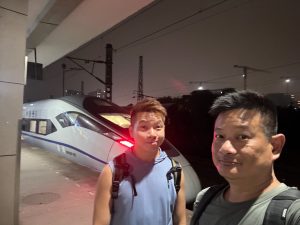
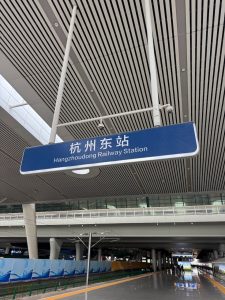
Hangzhou is approximately 179 km from Shanghai, and the fastest way to travel from Shanghai to Hangzhou is by high-speed train, which takes about 1 hour. Shanghai has two train stations: Shanghai Station and Shanghai Hongqiao Train Station. Although slightly farther from where we stayed, we took the train from Shanghai Hongqiao station as there are more connections between the two cities here. Three train stations serve the city of Hangzhou: Hangzhou Station, HangzhouDong Station, and HangzhouXi Station. Hangzhou Station is in the centre of the city, but connections between Shanghai Hongqiao Station and Hangzhou Station were few. HangzhouXi Station is far from the city, while HangzhouDong Station offers more connections and is closer to the city. Train tickets can be bought at the train station or via Trip.com. We purchased our tickets through the Alipay app, which includes a link to the Trip.com microsite.

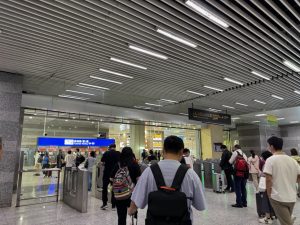


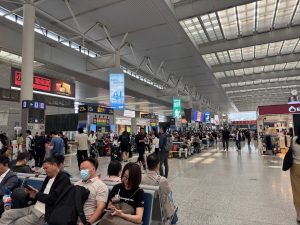
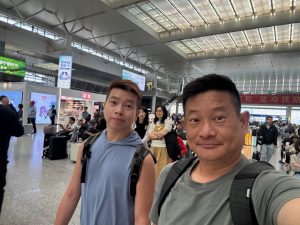
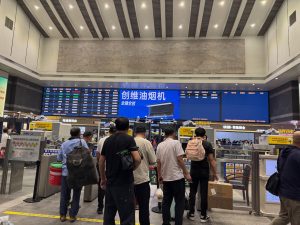
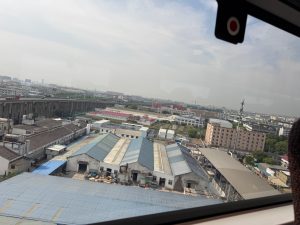
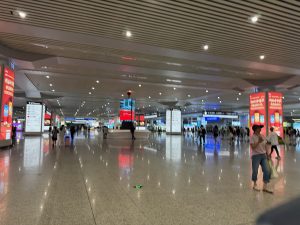
Shanghai Hongqiao Train Station is well-connected to Metro Lines 2 and 10, both of which pass through East Nanjing Road Station, where our hotel is located. It took about 50 minutes on the metro from our hotel to the train station. We set out from our hotel at 7:00 a.m. to catch our 8:15 a.m. train, taking into account the transit time between our hotel and the train station, as well as any other potential delays that might occur along the way. Our train to Hangzhou departs from level 2 of the train station. There are marked signs in both Chinese and English throughout the station that guide us to our destination. We were also not required to collect any tickets before boarding our train. Our passport details have been entered into the train ticketing system. We just need to scan our passports at the manned counter to gain access to the platform. The ride on China’s high-speed train was very smooth and comfortable; we were even given a bottle of water and some snacks for the duration of the ride. To get to the city from the HangzhouDong train station, we can take the metro or hail a cab. As we have limited time in Hangzhou, we went for the cab option. Getting a Didi (China’s Uber equivalent) was super easy. Although we didn’t have a local number, we were still able to use Didi through the Alipay app. There are designated areas in the train station for Didi pickups. At the pick-up point, a large display shows the cabs already pulled in, and we just need to look out for the car’s plate number and head to the parking lot.






West Lake (西湖)
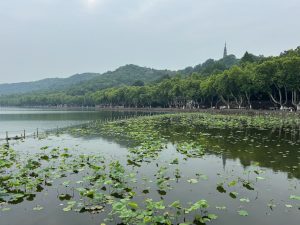
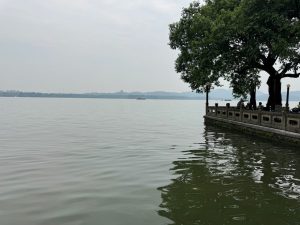
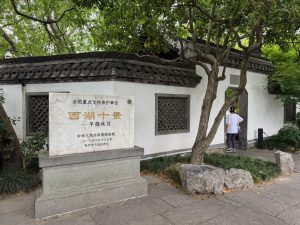
Visiting Hangzhou without coming to West Lake is like going to Paris and not visiting the Eiffel Tower. West Lake is the main attraction in Hangzhou, and it is this lake that gives Hangzhou its title of “Heaven on Earth.”


Baochu Pagoda (保俶塔)
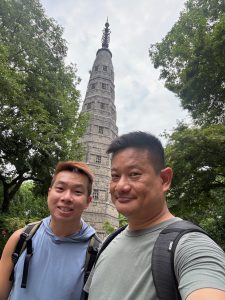
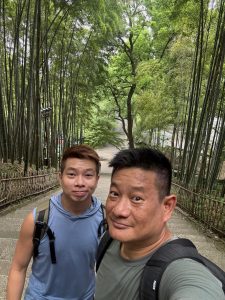
The first sight we visited in Hangzhou was Baochu Pagoda, one of the two pagodas in West Lake. Perched on top of a hill, we thought scaling up this pagoda would give us a great view of the entire West Lake. As our Didi ride came to a stop, we were dropped off at a neighbourhood-looking area. It took us 30 minutes to travel from our drop-off point to Baochu Pagoda. The walk to Baochu Pagoda requires a short hike up a small hill through a forested area. Occasionally, we saw groups of elderly people having fun in the open spaces along the path. As we walked along the path with signs pointing to the pagoda, the forest scenery gave way to rocky formations. The pagoda is not far from a pavement that seemed to wedge between narrow rocks.
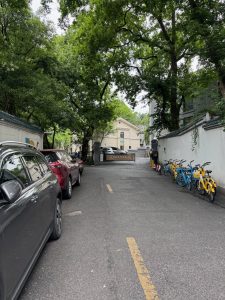

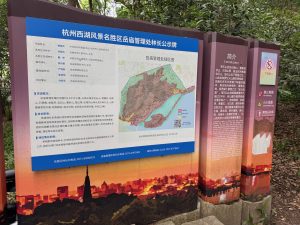
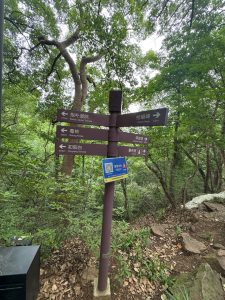

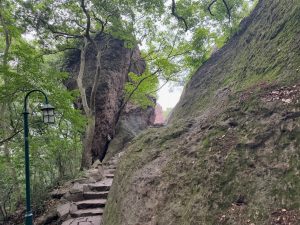
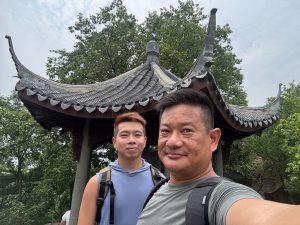
Past the rocks, we arrived at an open area, where we could see the pagoda sitting in one corner. From here, we were treated to a view of West Lake. We could see the mountains surrounding the lake as though they were protecting it. The view would be better if not for the trees from the forest below, which partially block the view. Nonetheless, we were able to see the Broken Bridge from one of the many viewpoints here. We wasted no time and approached the Baochu Pagoda. The moment we arrived, we were disappointed to find that the slender pagoda was closed to the public, and we were not able to climb to the top of the pagoda. Since we made it up here, we visited a nearby rock and pavilion before heading back down. As we walked down the staircase next to the pagoda, we noticed that this path was an easier climb. This is when we realised that we should have put the Baochu Pagoda car park as the drop-off point.



Broken Bridge (断桥)
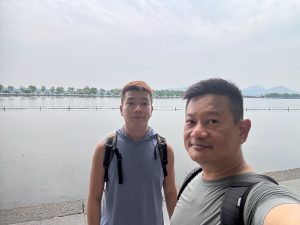
Our next stop was the Broken Bridge, about a 10-minute walk from the Baochu Pagoda. We had a brief rest at Starbucks on the southern part of the lake to escape the heat. The weather was rather humid when we did the climb to Baochu Pagoda. After resting briefly, we walked across the road to the Broken Bridge. The Broke Bridge was essentially a series of three sandbars connected by bridges. This place was given the name “Broken Bridge” as these bridges connecting the three sandbars appear to be broken when viewed from a distance during winter due to the snow. The Broken Bridge was the setting in the Chinese folklore “Legend of the White Snake” (白蛇传), centred around the romance between a man and a White Snake Spirit. Walking on the sandbars of the Broken Bridge brought us close to the West Lake; it felt like walking on the lake itself. We could see Baochu Pagoda sitting atop the hill we were on moments ago, as though she was flexing her beauty on the shores of the lake from the Broken Bridge. Locals taking their leisurely walk along the bridge, boats pulling off from the sandbar, paddling on the lake, and occasionally some locals feeding the ducks on the lake are common sights along the sandbar. Walking on the Broken Bridge was mostly relaxing, but we had to avoid the many tourist trams along the way. As our next stop, Leifeng Pagoda, was a distance away from the Broken Bridge, we initially wanted to take the tourist tram (costs RMB 80 per person). We managed to find one where the seats facing the back were empty. Unfortunately, the driver was on his way for his lunch break. We continued our walk towards the end of the sandbar, looking out for the next tram with the last row empty. Soon, we found ourselves at the end of the sandbar. We spotted some buses making a U-turn. We approached a lady who appeared to be a staff member, and she recommended that we take one of these buses to Leifeng Pagoda, which costs only RMB 2 per person.





Leifeng Pagoda (雷峰塔)
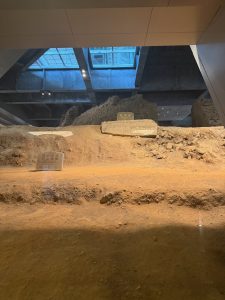
The bus ride to Leifeng Pagoda took only 10 mins, saving us time and a lot of walking. To get to Leifeng Pagoda from the Broken Bridge, we rode the bus for eight stops and alighted at Sutinankou (苏提南口). While the Baochu Pagoda was often described as the beauty of West Lake, in contrast, the bulky appearance of the Leifeng Pagoda was often associated with a monk. The entrance to Leifeng Pagoda costs RMB 40 per person. We visited the basement level first, followed by heading to the ground floor and taking a lift up to the top floor of the pagoda, and slowly making our way down the pagoda. The basement of the Leifeng Pagoda exhibits its original structure. Leifeng Pagoda was originally built in 977 AD as a monument to house the hair of Buddha. The pagoda collapsed due to excessive brick theft and nearby construction work. The pagoda we see today was rebuilt and reopened in 2002. Leifeng Pagoda is also the setting of the story in “Legend of the White Snake”, where the white snake spirit was trapped under the pagoda for years until her son released her. From the original structure on display in the basement, I wonder if the locals linked the collapse of the pagoda to the efforts of the white snake’s son in saving his mother. In addition to the original structures, the basement also features the original bricks and some Buddhist relics.

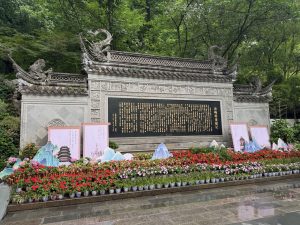
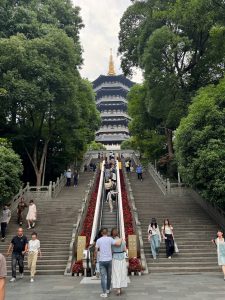
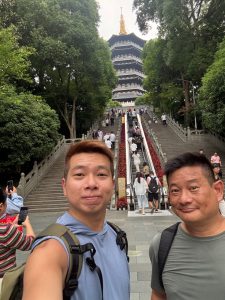
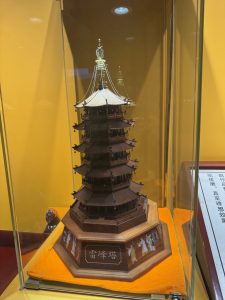

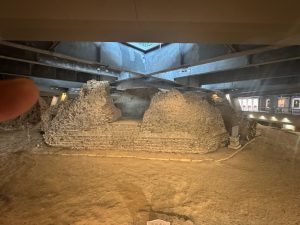
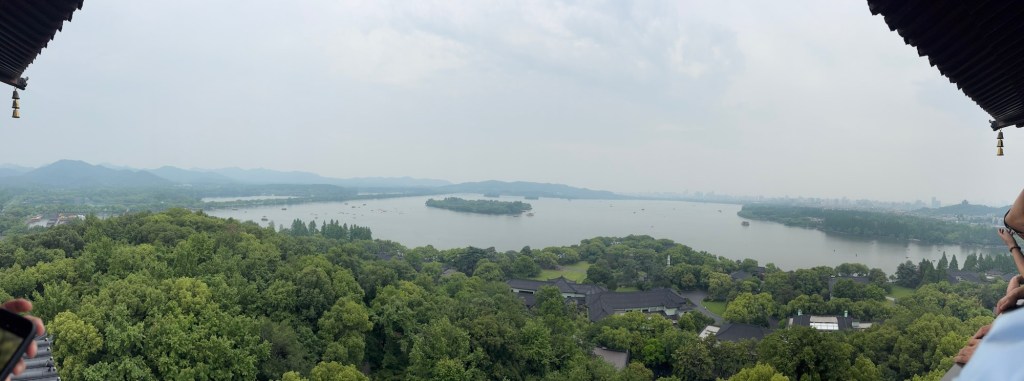
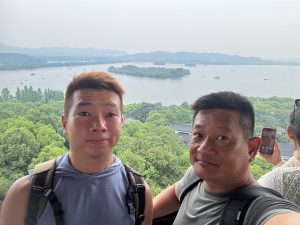
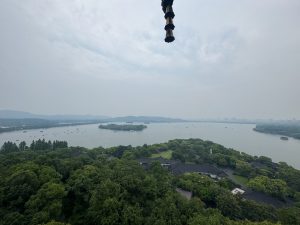
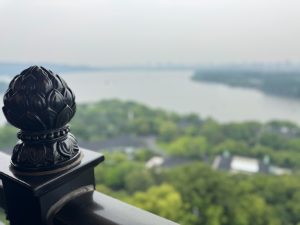
We headed to the ground floor to take one of the lifts to the top of the pagoda. The lift only stops at level 5 of the 7-storey pagoda; visitors must walk up the remaining two levels. As we emerged from the lift on level 5, we were captivated by the golden underdome of the level, but didn’t spend time looking at it. Our goal is to go to the top of the pagoda. At the top of Leifeng Pagoda, we were treated with an unobstructed view of the West Lake. This offers a far better view of the lake compared to the hills where the Baochu Pagoda is located. From here, we can see the Baochu Pagoda, seemingly emerging from the ground like a needle being stuck, as well as the numerous bridges on West Lake and the islets within the lake. Most of the visitors on this level focus on the view of the lake, and we found fewer crowds at the side facing the hills behind the pagoda. Although not as scenic, the hills stretching to the horizon evoke a certain tranquil vibe. It is a pity that today was a hazy day.
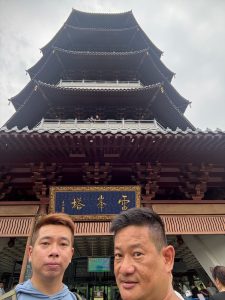
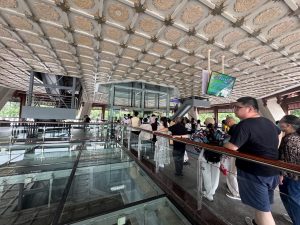

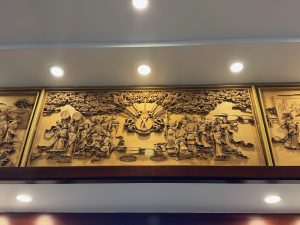
On our way up, via the lift, we saw numerous carvings on each level. We were able to take a closer look at them while walking down the pagoda. Each level depicts carvings of different scenes. The most memorable ones are those on the 5th floor and the 1st floor, depicting the birth and enlightenment of the Buddha, and scenes from “Legend of the White Snake”, respectively. These carvings, other than being a work of art, tell a story on their respective levels. The carvings are intricate, and one can spend hours looking at them. I thought the RMB 40 for the Leifeng Pagoda was worth it, as we got a better view of West Lake compared to the hills of Baochu Pagoda.


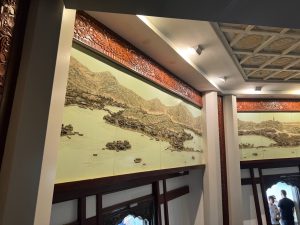

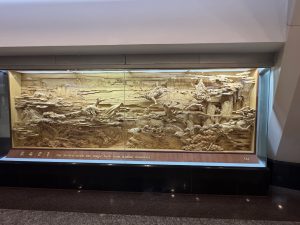

QingHefang (清河坊)- The Historic Commercial Centre of Hangzhou
It was already 3 pm by the time we were done with Leifeng Pagoda. We spent the remaining 4 hours in Hangzhou shopping on the iconic Hefang Pedestrian Street (河坊街). As we were feeling a little peckish, we hailed our ride using the Didi app in Alipay, which took us to Hefang Street in 20 minutes, instead of taking the bus (which would have taken us 1 hour). Hefang Street, one of the ancient streets in the Qinghefang commercial centre, is an ancient street where the business and political centre was located. Qinghefang comprises three streets: Hefang Street (河坊街), Wushan Square (吴山广场) and Southern Song Imperial Street (南宋御街). Today, these streets still preserve ancient buildings that have been repurposed as shops selling souvenirs to visitors. Walking along Hefang Street is like stepping right into the pages of history. Despite the numerous shops around, we thought the shops sold mostly the same things; it felt like these shops were copied and pasted, with the same order of shops selling the same things repeated over and over as we walked through the street.

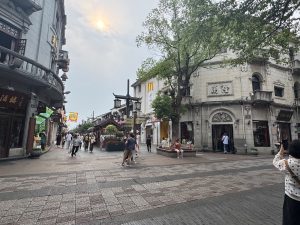
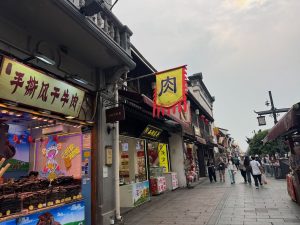


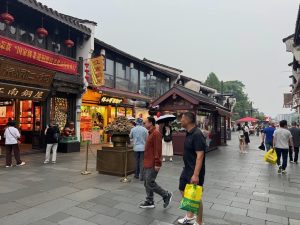
We tried to cover every street on Hefang Street and found ourselves in front of an ancient gate building with the Chinese words “Drum Tower” (鼓楼) inscribed on it. This tower was used to mark time and announce important events in the past. Today, visitors can only walk under the Drum Tower to a street filled with restaurants and eateries. We traced our footsteps back to Hefang Street and came to the Southern Song Imperial Street. Compared to Hefang Street, the Southern Song Imperial Street sees less foot traffic and feels more peaceful. This street is shorter than Hefang Street, with mainly art galleries.


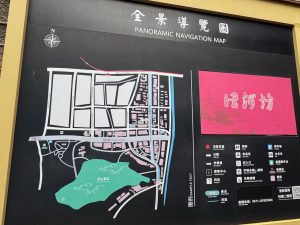

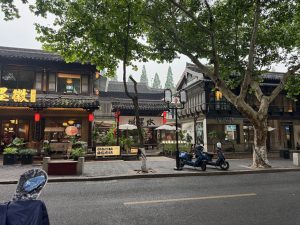
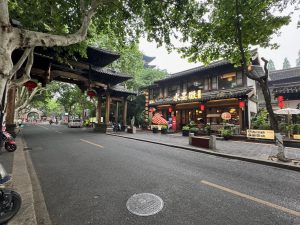
We had 1 hour left before our train back to Shanghai departed. Instead of the HangzhouDong Station, we managed to find a train that departs from Hangzhou Station, about a 25-minute walk from Hefang Street. As we still had some time, we chose to walk to the train station. Along the way, we encountered the peaceful and tranquil side of Hefang Street. We arrived at Hangzhou Station in time for our train, which took us back to Shanghai in one hour. We shopped for food below our hotel before returning to our room to rest for the night.