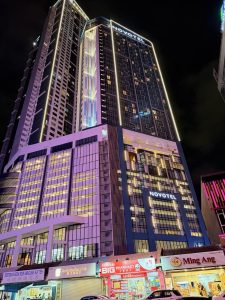
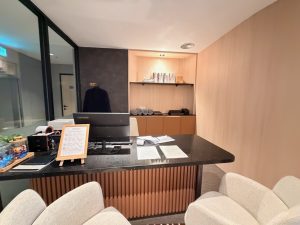
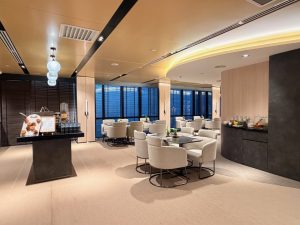
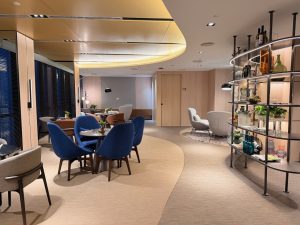
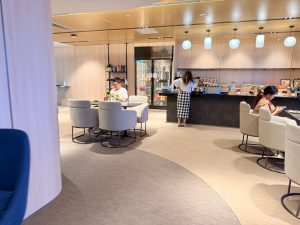
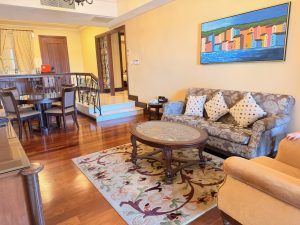
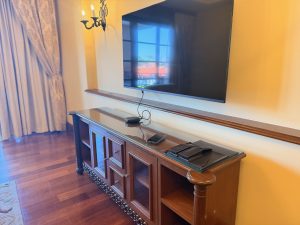
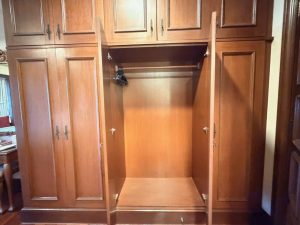
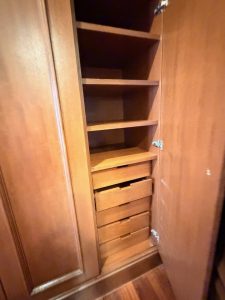
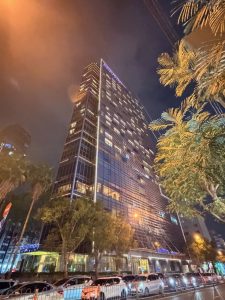
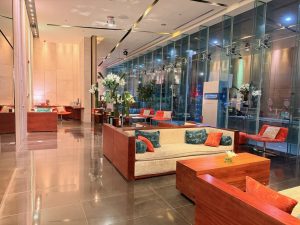
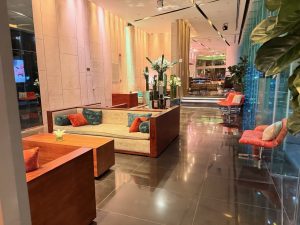
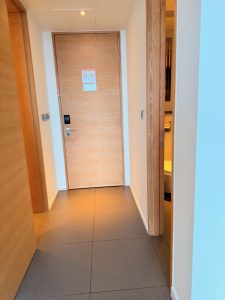
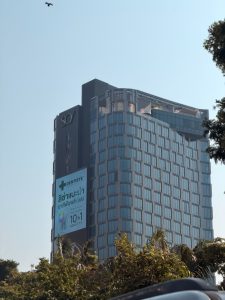
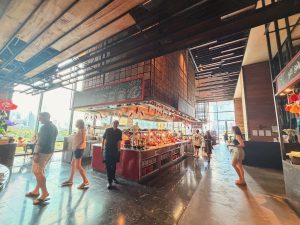
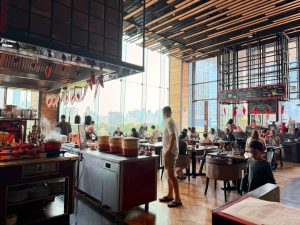
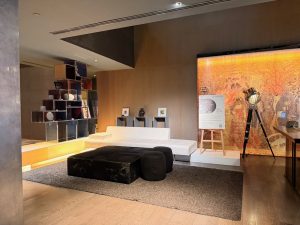
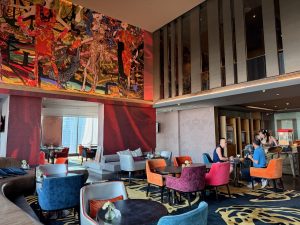
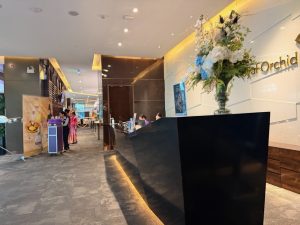
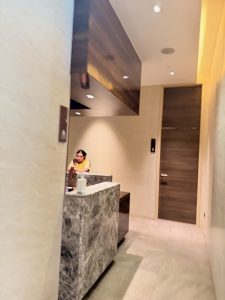
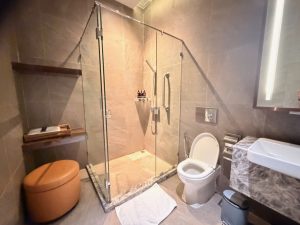
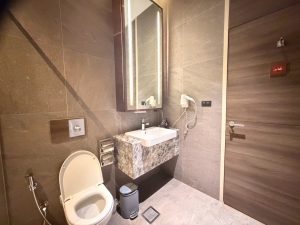
Novotel Johor Bahru City Centre is one of the latest additions to Accor properties in Malaysia, opening its doors in Dec 2025. The hotel is very well located in the heart of Johor Bahru, with KSL Mall sitting right across from the hotel, which houses stores from supermarkets to restaurants to massage shops. Other than the shopping mall, there are tons of eateries along the street within a stone’s throw from the hotel, with some operating 24 hours. We also found quite a few convenience shops within a 5-minute walk from the hotel, where guests would be able to stock up on snacks and drinks throughout the day.
Novotel Johor Bahru City Centre facade
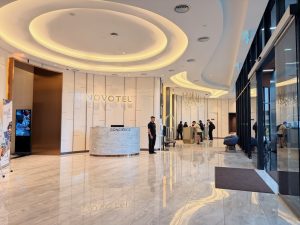
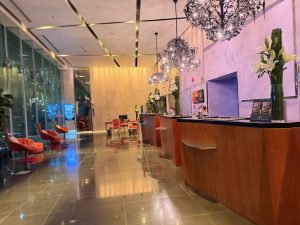
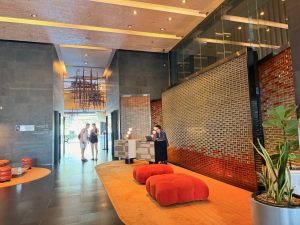
Reception at Novotel Johor Bahru City Centre
Hotel check-in counters
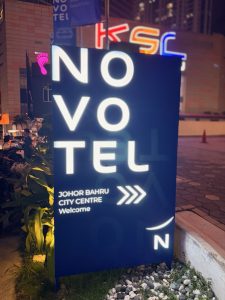
Hotel Signage
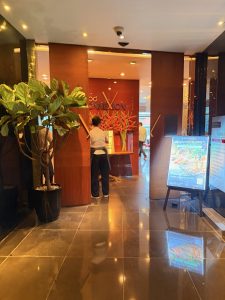
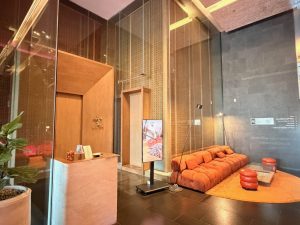
Hotel lobby next to the check-in counters
The Suite
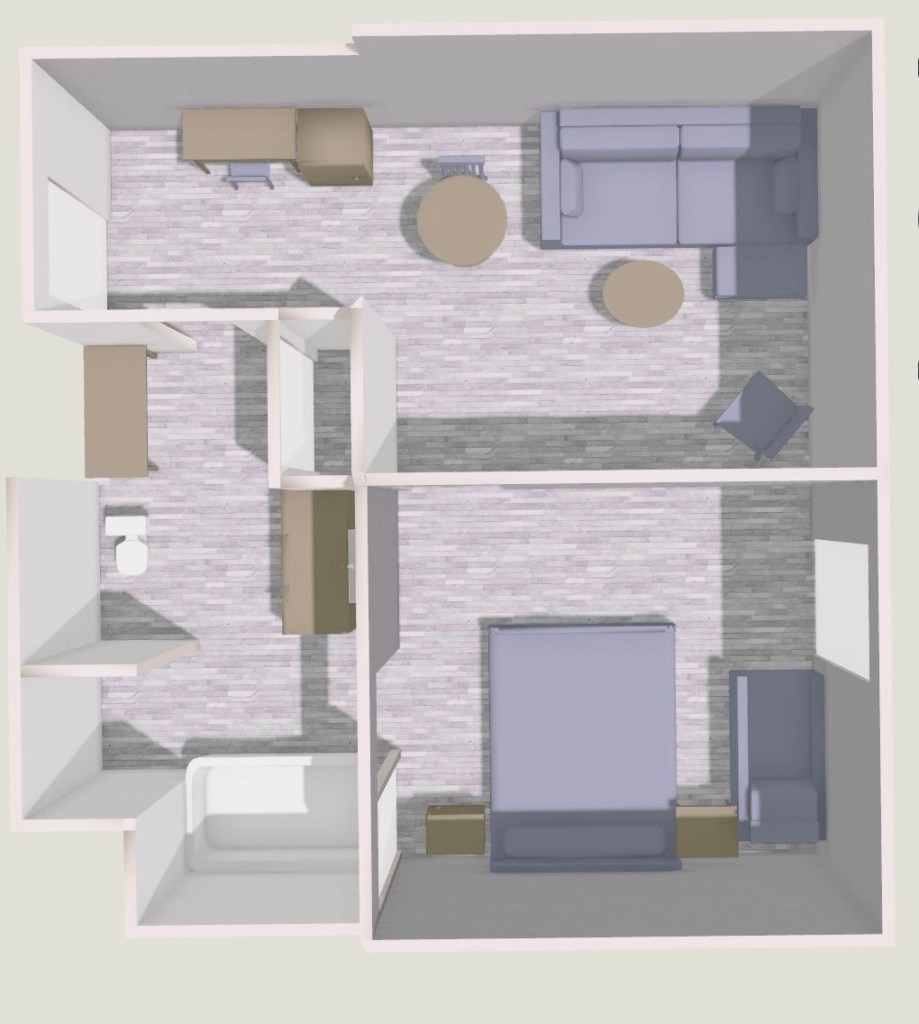
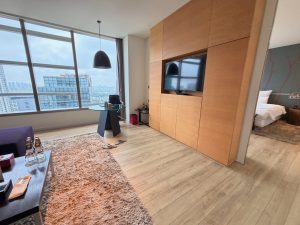
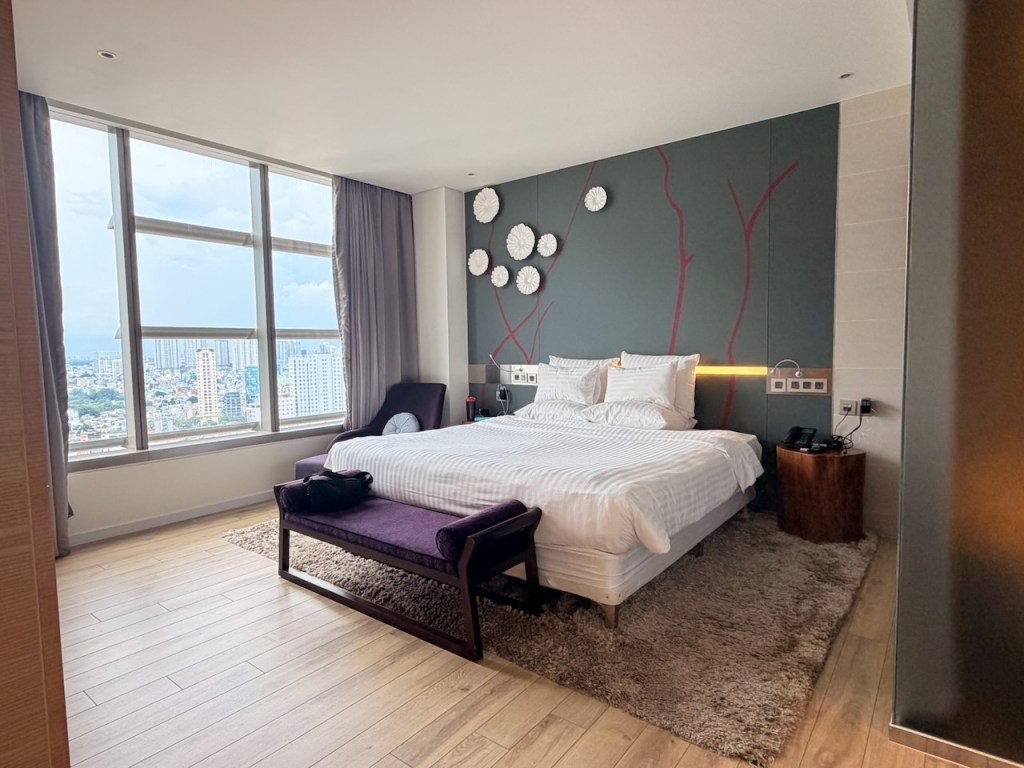
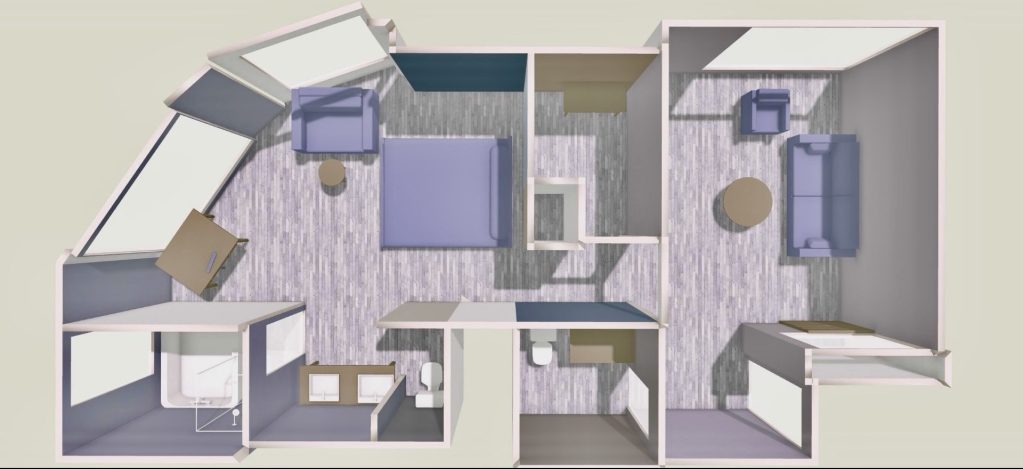
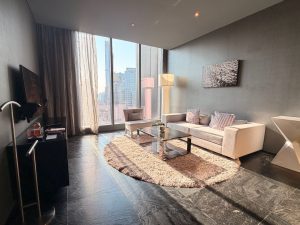
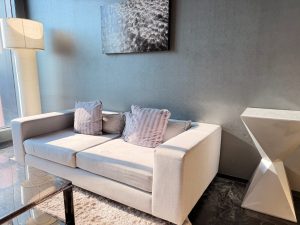
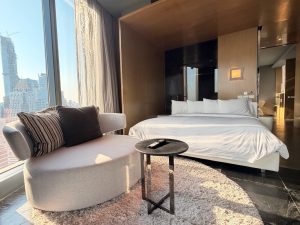
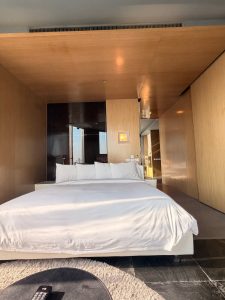
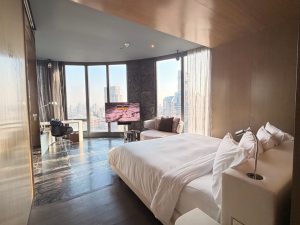
We originally booked the Standard Room, but were pleasantly surprised to find that we were upgraded to the Suite Room during check-in due to our status with the hotel group. According to the lounge staff who checked us in, not all suites in the hotel are open, and they are being gradually opened as the hotel is currently refurbishing the suites. The 53㎡ Suite is decked in Muji-themed interior design with wood elements from the flooring to the feature wall in the TV area. The combination of dark and light wooden colours used in the Suite, together with mocha and grey furnishings, made the Suite feel cosy and comfortable. The Suite is segregated into a living room, bedroom and bathroom.
Layout of the Suite at Novotel Johor Bahru City Centre
Entryway
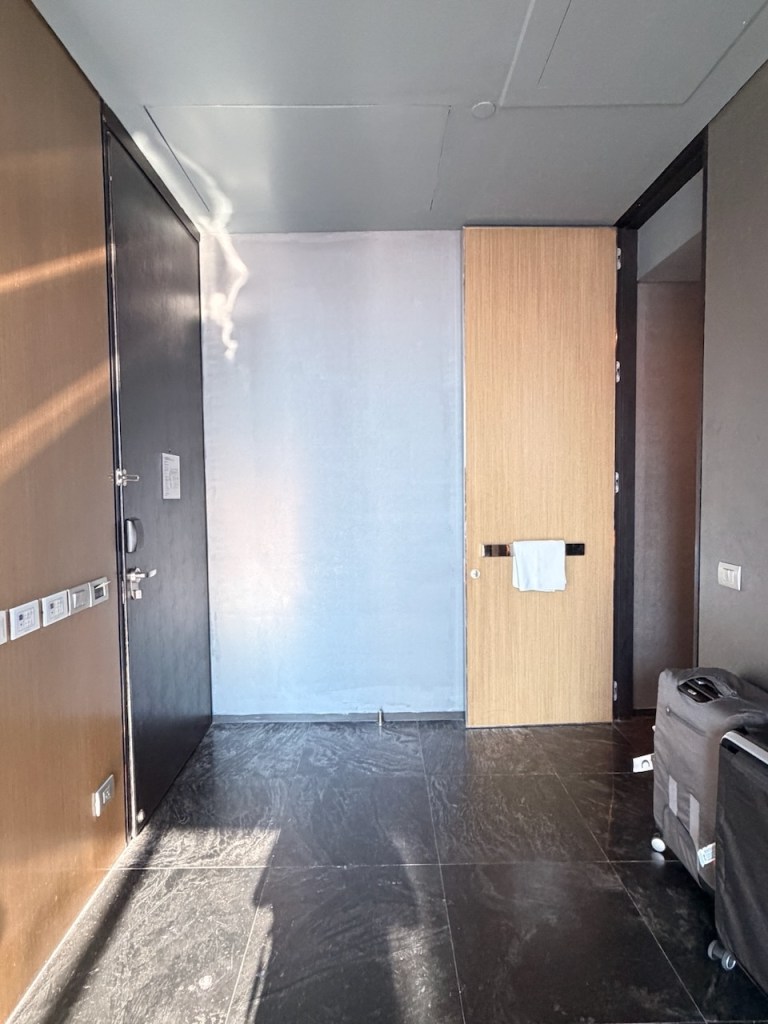
Entryway in the Suite at Novotel Johor Bahru City Centre
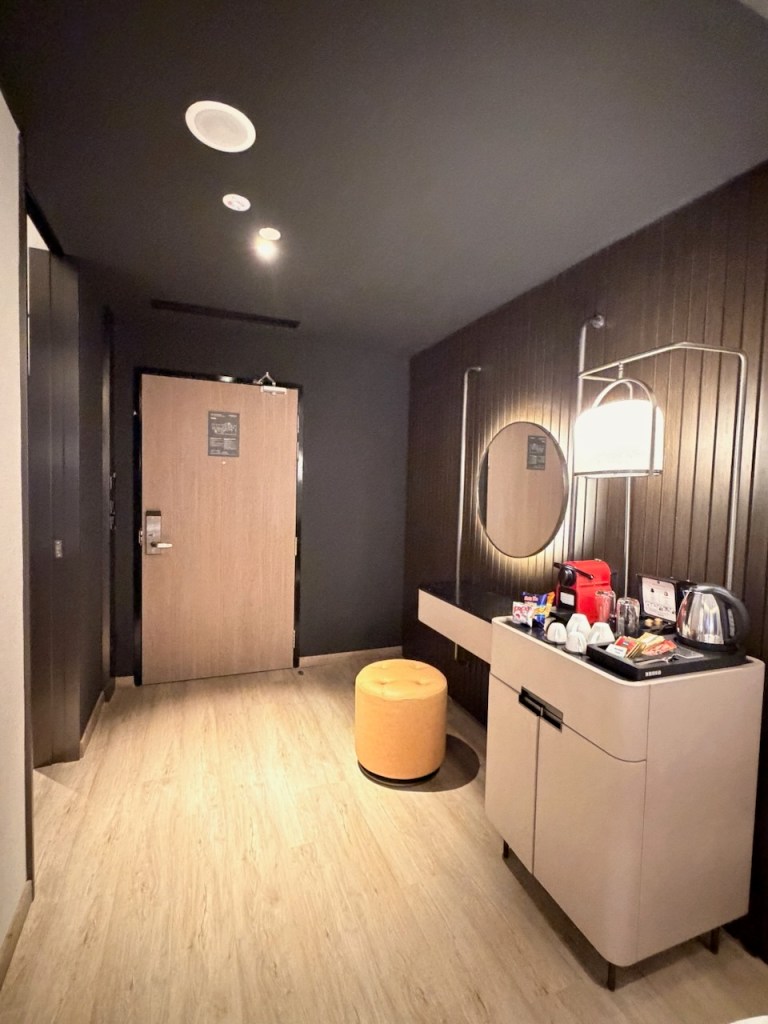
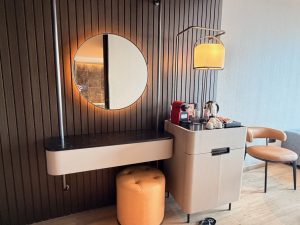
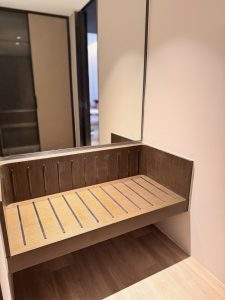
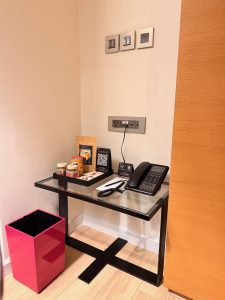
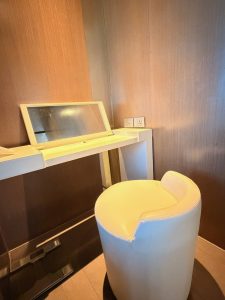
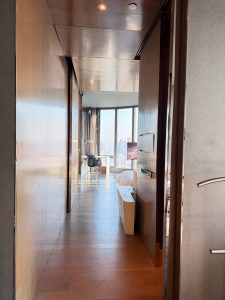
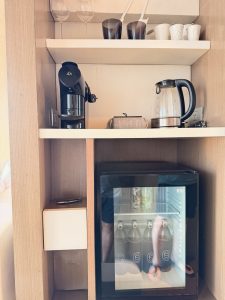
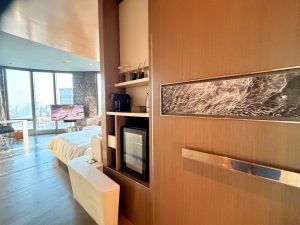
The entryway in the Suite at Novotel Johor Bahru City Centre is decked in a darker theme, but the dark tone does not make this part of the Suite feel small. Instead, we could immediately feel the cosiness that the Suite emits. Unlike most entryways in other hotels, the entryway of the Suite at Novotel Johor Bahru City Centre houses a vanity table and a minibar. Initially, I thought the vanity table being placed beside the entrance to the Suite was a tad out of place. However, upon closer observation, I thought it was clever for the hotel in its placement. By placing the vanity table at the entrance, the mirror at the table allows guests of the Suite to check their attire before heading out, other than using it for make-up. The Suite’s minibar is well placed in a luxurious leather-wrapped cabinet next to the vanity table in the entryway. On top of the minibar cabinet sits the Nespresso machine, a kettle and all that we needed to make a cup of coffee and tea. The mini fridge, stocked with complimentary drinks, is tucked inside the cabinet, in the lower part of the cabinet.
The dressing table is placed at the entryway next to the minibar
The minibar sits on a white leather-wrapped cabinet next to the dressing table in the entryway
We found a mini fridge in the bottom cabinet of the minibar stocked with complementary drinks
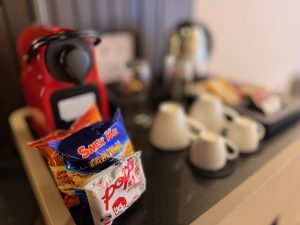
Other than the Nespresso machine, we were also treated with some local snacks in the minibar
Living Room
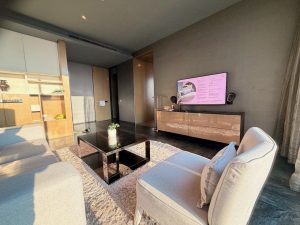
Living room of the Suite at a glance from the entryway
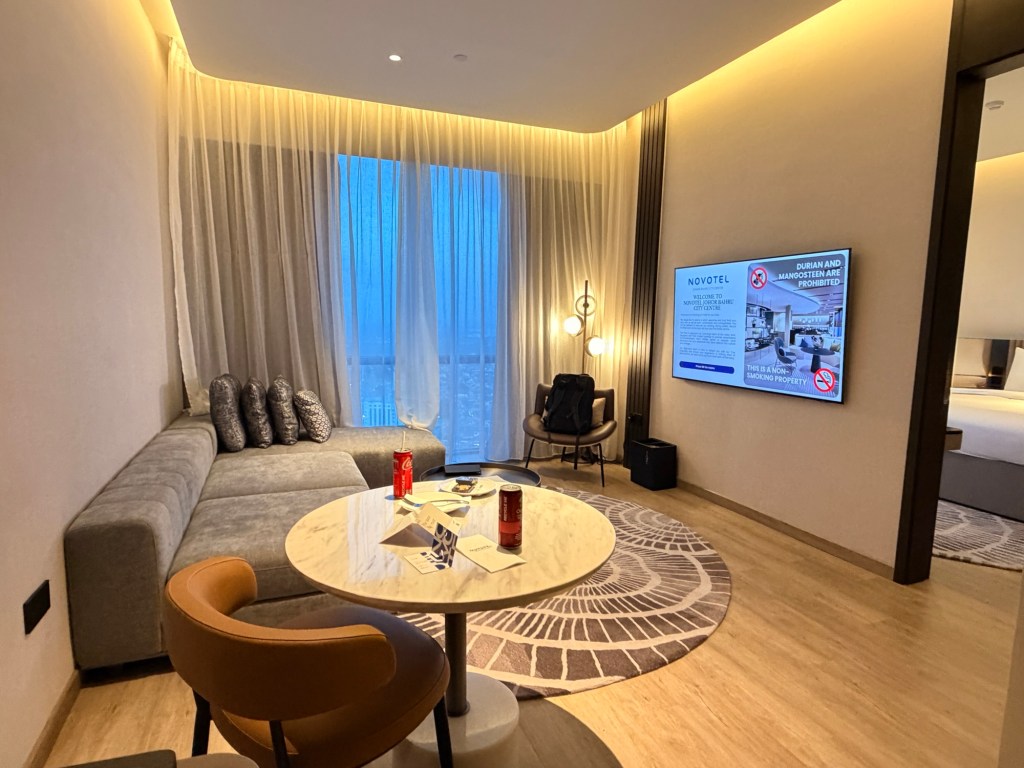
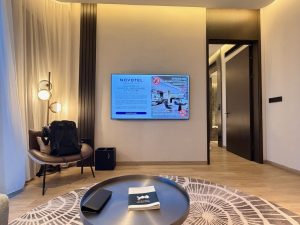
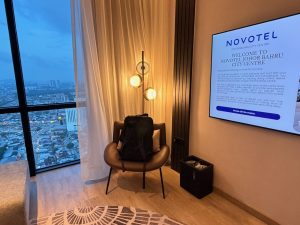
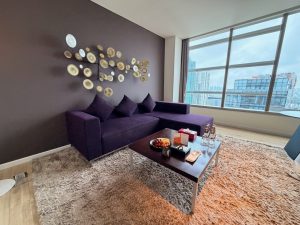
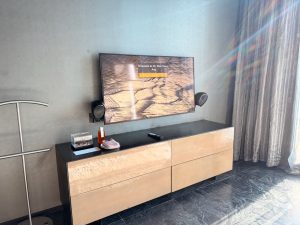
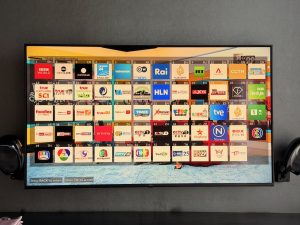
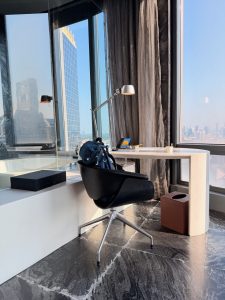
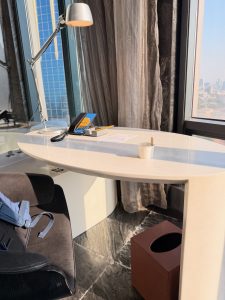
The living room of the Suite sits further into the entryway. Though not a large space, it has all it needs to function as a living room for guests to relax and chill. A small marble round table forms an introduction to the living room. This marble table, furnished with only one chair, serves more as a work desk, although it can also be used as a dining table. A three-seater European-size L-shaped sofa occupies most of the space in the living room. The fabric sofa is very comfortable to sit on, while we were entertained by the many local and international channels on the 65″ LED TV mounted on the wall. I like how the hotel chose a more minimalist decor in the living room by omitting a TV console, which would otherwise make the living room look cluttered, instead of the relaxing vibe that it currently exudes. Other than the sofa, the hotel tastefully placed a mocha leather armchair next to the floor-to-ceiling window that not only increased the sitting capacity in the living room but also allowed us to chill while looking out into the city.
There is a round table in the living room that works both as a dining table and a work desk
The LED TV in the living room that kept us entertained if we were not shopping around the city
I like how the hotel places a single armchair with the aesthetically pleasing lighting by the window that created a cosy and relaxing corner
The living room is decorated with a large European size three seater L-sofa
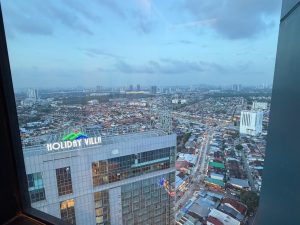
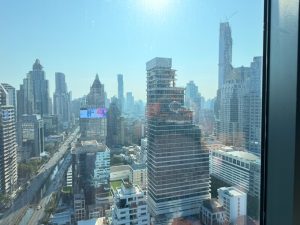
View of the city from our living room
View of the surroundings from the living room of the Suite
Bedroom
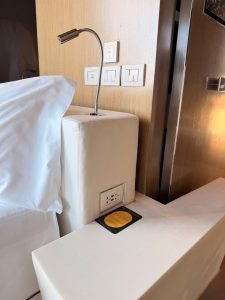
The minimalist Muji decor seen in the living room flows seamlessly into the bedroom, separated by a dark walnut coloured door. The king bed, placed by the wall of the bedroom, took up a bulk of the real estate allocated to the bedroom. The king bed has natural elements designed into its leather headboard. The headboard is designed with columned leather that makes it look like bamboo, reinforcing the Muji theme. To continue the natural theme seen in the Suite, Novotel Johor Bahru City Centre uses a round stone with LED lighting emitting from the bottom as the bedside lamp, which I thought looked like a moon. The sleep quality on the king bed is excellent, which kept me feeling refreshed the next day. The bedside tables on both sides of the king bed are merely small tables with no drawers, which makes the bedroom look clean and is consistent with its minimalist concept. Despite its size, I find there is plenty of space on these bedside tables for me to charge my lifestyle devices overnight. Mounted on the wall facing the king bed is the TV in the bedroom with the same entertainment options as that in the living room. I like how the hotel installed a ledge underneath the TV, which not only is consistent with the minimalist design language, but it also gave us space to stow our smaller items. Another armchair is placed between the floor-to-ceiling window and the king bed, which offered us a place in the bedroom to relax and look out into the bustling cityscape below.
The king bed in the bedroom of the Suite at Novotel Johor Bahru City Centre
Stylish and functional bedside table in the bedroom
The hotel placed a day sofa bed next to the floor-to-ceiling window in the bedroom
The TV in the bedroom faces the king bed with the same entertainment options as that in the living room
Bathroom & Wardrobe
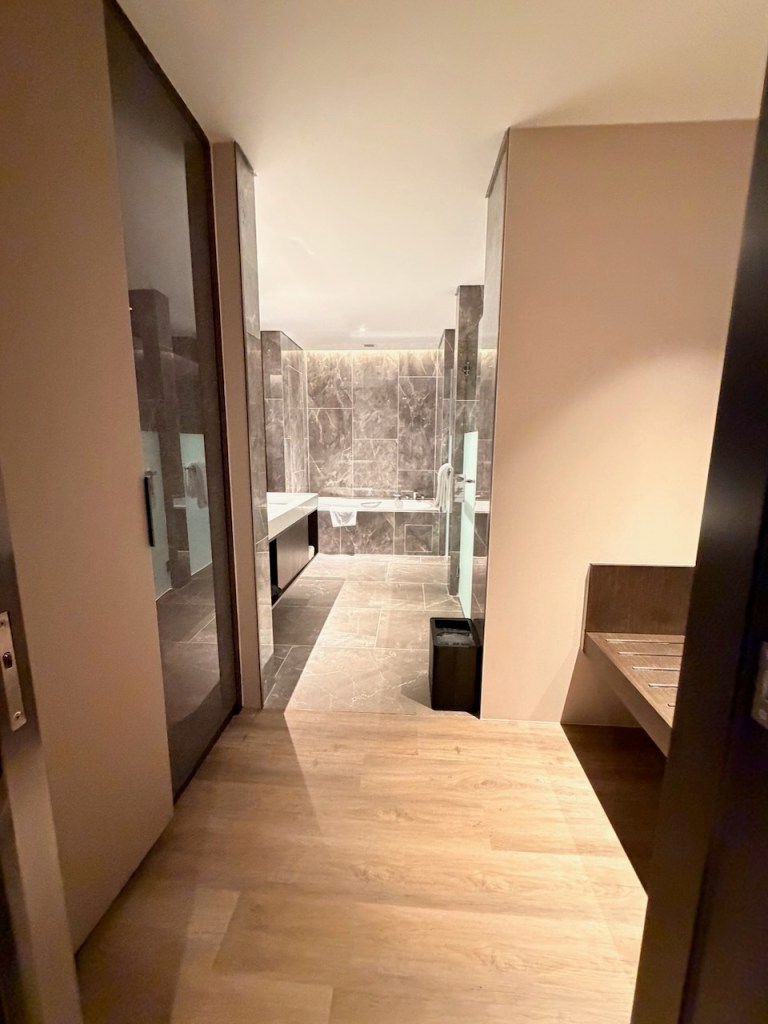
Bathroom seen from the entryway of the Suite at Novotel Johor Bahru City Centre
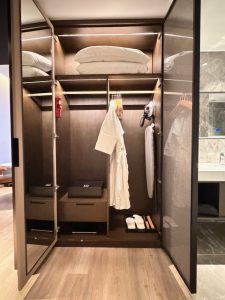
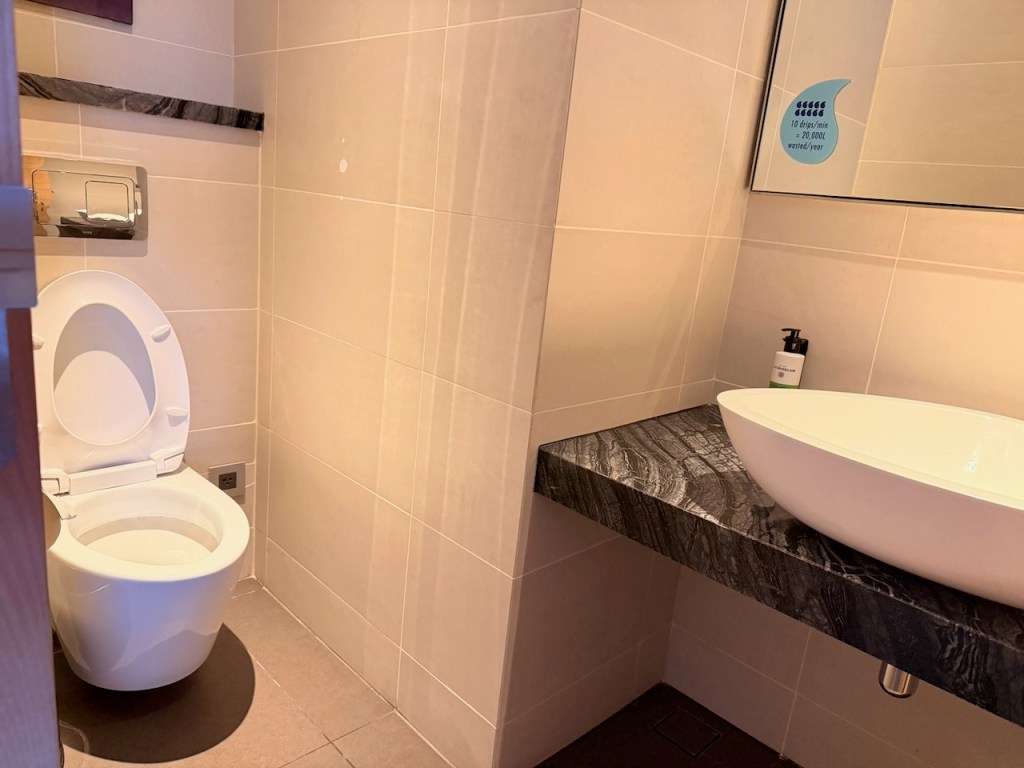
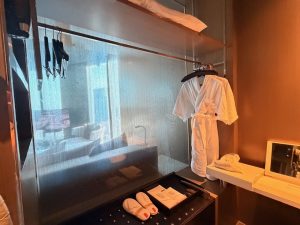
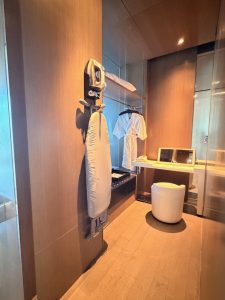
Novotel Johor Bahru City Centre did not fit its Suite with a powder room; rather, the hotel worked around this issue by designing two entrances to the bathroom, one at the entryway and the other from the bedroom. The second entrance from the entryway creates the illusion of having a powder room. The bathroom entrance from the entryway leads to the wardrobe area, fitted with a two-door wardrobe. Both panels of the wardrobe are designed with hanging racks, with the right panel capable of stowing longer clothing. The left panel houses the in-room safe and is fitted with a single large drawer, which we found useful for putting away smaller clothing items. Despite being designed with a hanging rack on the left wardrobe panel, this side of the wardrobe was not furnished with any hangers, and it doesn’t help that the hangers on the right panel are being fixed to the hanging rack, rendering this side of the wardrobe useless. As we were only staying for one night, we did not request additional hangers from the hotel. I like how the hotel fitted a luggage rack opposite the wardrobe, providing guests with the convenience of unpacking their luggage.
Luggage rack in the wardrobe part of the bathroom
The Suite in Novotel Johor Bahru City Centre is fitted with a two-panelled wardrobe, located between the entryway and the bathroom
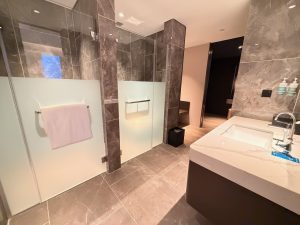
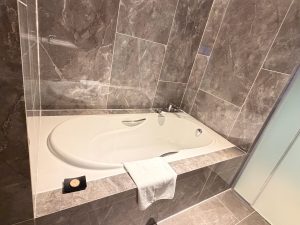
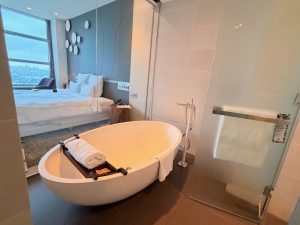
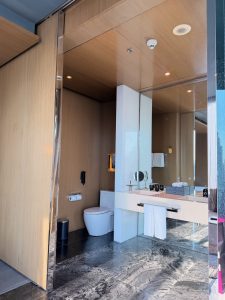
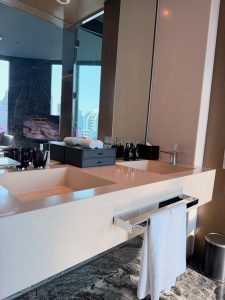
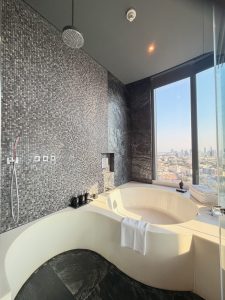
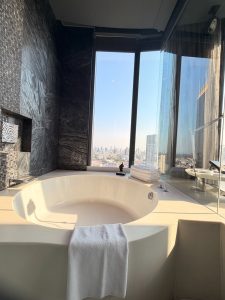
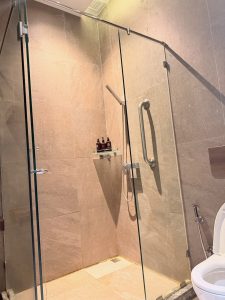
Decked in dark grey marble that exuded a luxurious vibe, the bathroom sits further into the Suite, with direct access from the bedroom. There is only one sink fitted in the bathroom that comes with generous countertop space to place our toiletries. The walk-in shower, fitted with both a regular and rain shower head, and the toilet cubicles sit across from the sink, have generous space allocations. A sizeable bathtub sits furthest into the bathroom from the entrance at the entryway and next to the bedroom entrance. The size of the bathtub was perfect for soaking the tiredness from the shopping outings in the city.
The hotel fitted one sink in the bathroom which gave us plenty of countertop space
As part of Novotel Johor Bahru City Centre’s green effort, the hotel fitted a filtered tap at the sink
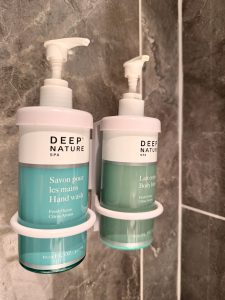
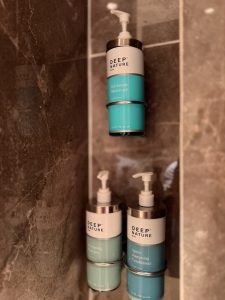
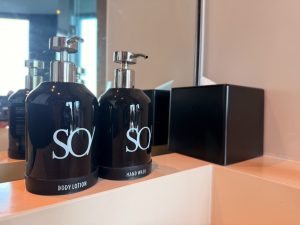
Novotel Johor Bahru uses Deep Nature bathroom amenities
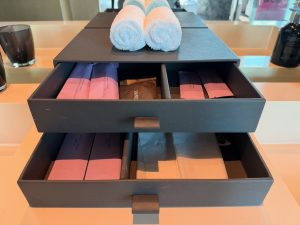
Bathroom amenities at the sink
The walk-in shower and toilet cubicles are located opposite the sink
Novotel Johor Bahru uses Deep Nature shower amenities in their bathroom
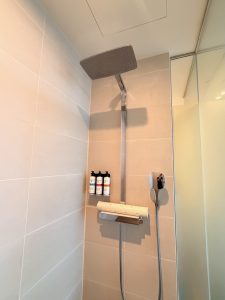
The walk-in shower has a large space and features a rain and regular shower head
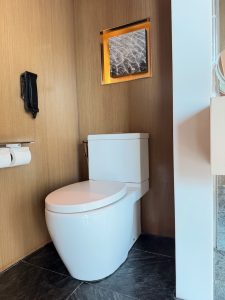
The toilet cubicle in the bathroom
The hotel fitted a large bathtub in the bathroom
Service
The staff at Novotel Johor Bahru City Centre were friendly and welcoming. The staff welcomed us at the reception with the warmest Malaysian smile one could get. Upon checking our reservation, she gave us the option of checking in at the lounge instead of the reception. She escorted us to the lift, gave us access to the Executive Lounge level, and gave us specific instructions on the location of the lounge. The lounge staff who checked us in were very friendly. He invited us to enjoy the evening cocktail while processing our check-in, as the evening cocktail time was ending. Apart from manning the front desk at the lounge, the staff also doubled as server in the lounge, taking our drink orders and bringing the drinks to us. I witnessed the staff patrolling the lounge frequently and clearing our empty plates despite us sitting in one corner of the lounge. The rest of the staff around the hotel were friendly and welcoming. There was no lack of smiles and greetings from the random staff we met in the lift and around the hotel. The staff at the restaurant came across as lukewarm initially, but they were observant and very efficient in clearing empty plates despite our sitting in one corner of the restaurant.
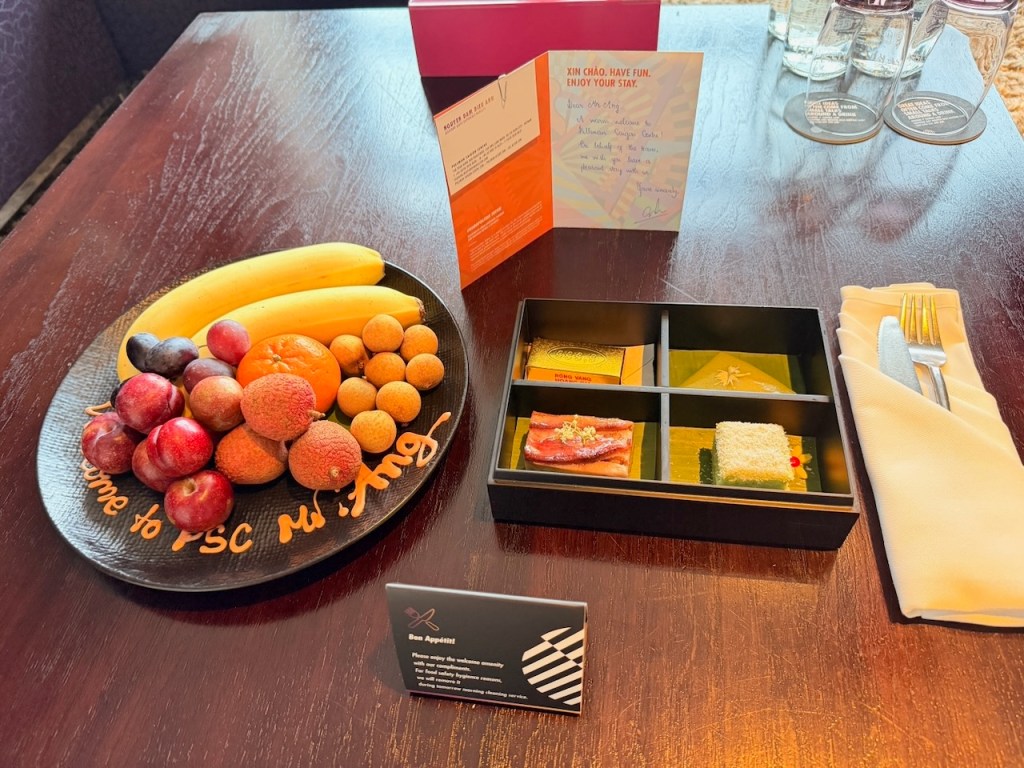
Welcome amenities were placed in the living room waiting for us
Hotel Facilities
Executive Lounge
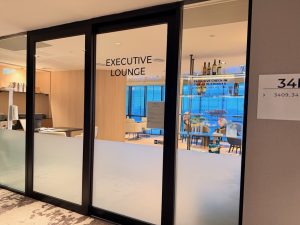
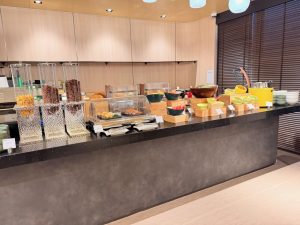
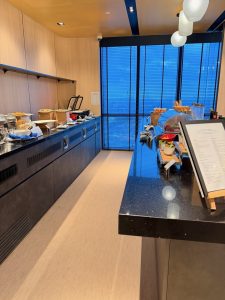
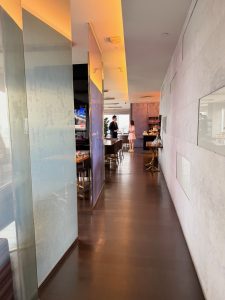
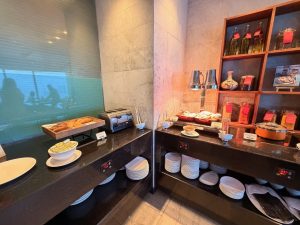
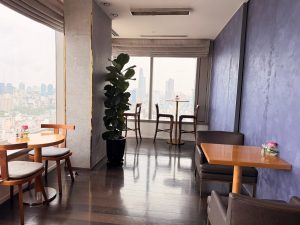
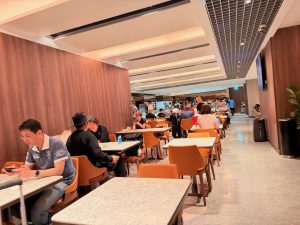
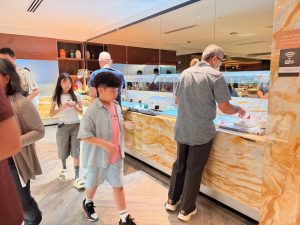
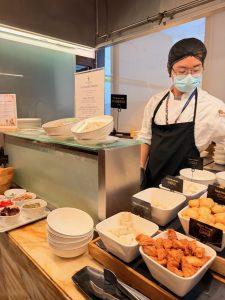
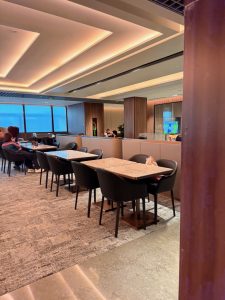
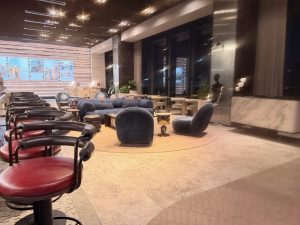
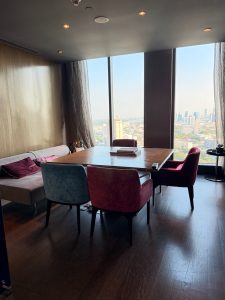
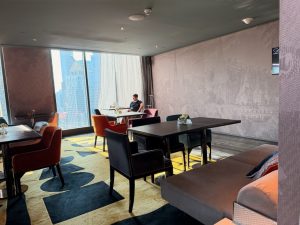
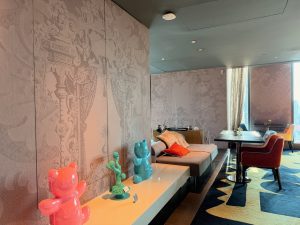
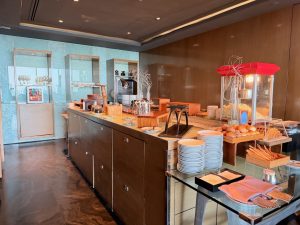
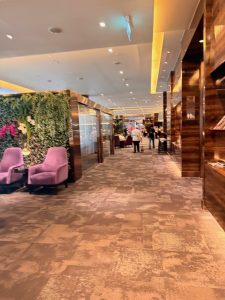
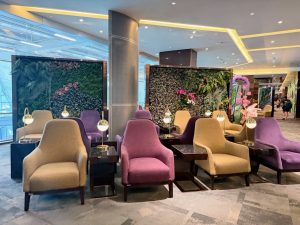
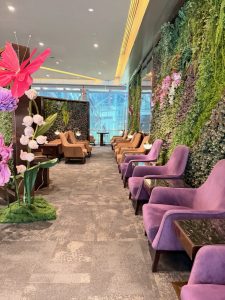
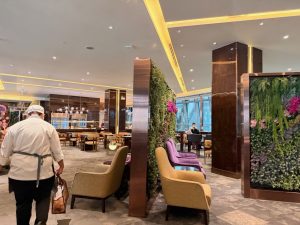
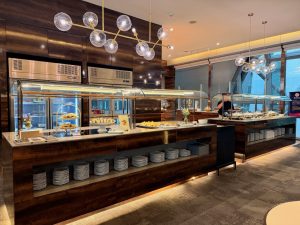
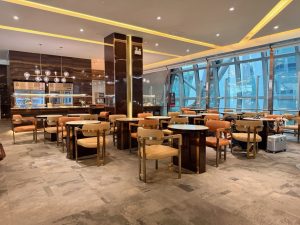
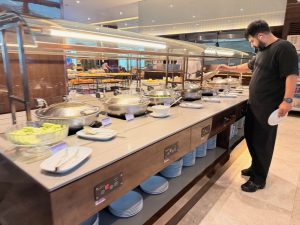
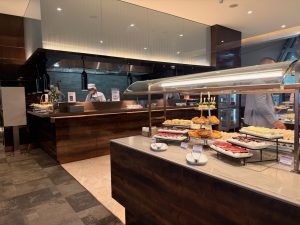
The Executive Lounge at Novotel Johor Bahru City Centre is located on the top floor of the hotel at level 34. The Executive Lounge, decked with natural wood elements, provided us with a great space to relax. Most of the lounge is decked with dining tables for two to four guests, mainly placed next to the floor-to-ceiling window that allowed us to look out into the city. There are a couple of lounge seating areas in the lounge, catering to a larger crowd by the entrance and in one corner of the lounge. There is a small food station at the back of the lounge where evening cocktails and breakfast are served. This is also where we could help ourselves to drinks, ranging from coffee, tea and a variety of soft drinks, next to the food station. Due to the thin crowd at the lounge, I find it a great place to get away from the hustle and bustle of the city.
Entrance to the Ececutive Lounge on level 34 at Novotel Johor Bahru City Centre
Reception in the Executive Lounge
There are plenty of dining seatings in the lounge, mainly near the buffet line
Dining seatings in the Executive Lounge
The Executive Lounge exudes a classy yet relaxing vibe
Dining seatings near the buffet line
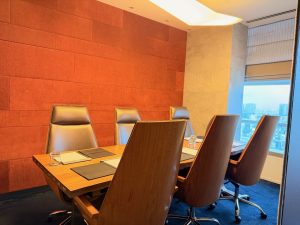
There is a small meeting room in the Executive Lounge
The meeting room in the Executive Lounge
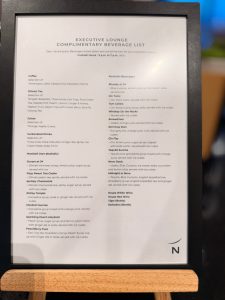
Evening cocktail drinks menu
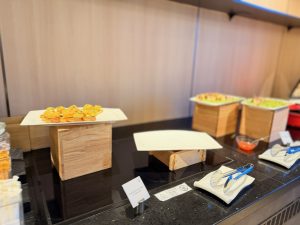
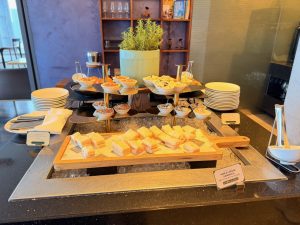
Finger food was served during the evening cocktail
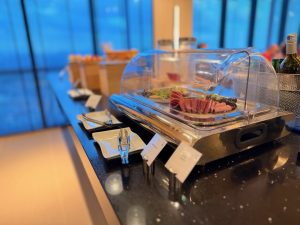
Food served during evening cocktail
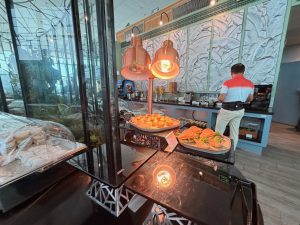
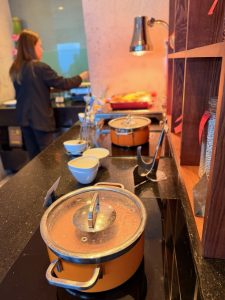
The buffet line in the Executive Lounge
For evening cocktail, I thought the amount of food served was quiet susbsential
Self-serve beverage next to the buffet line
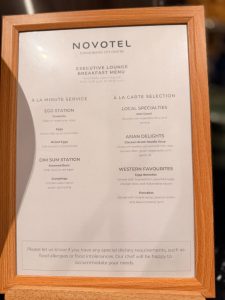
Breakfast is also available in the Executive Lounge
A la Minute menu during breakfast
Breakfast in the Executive Lounge
Swimming Pool
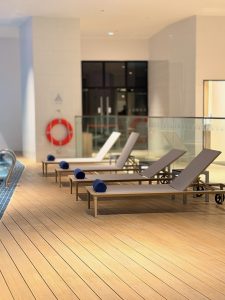
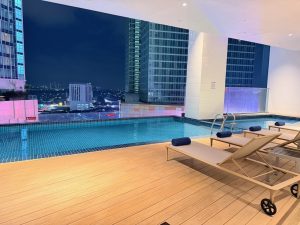
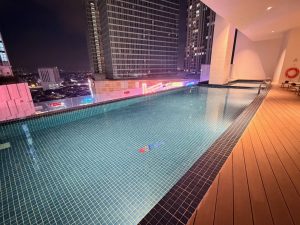
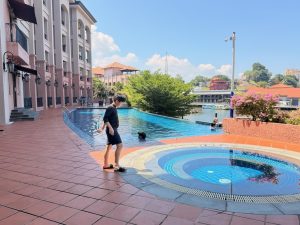
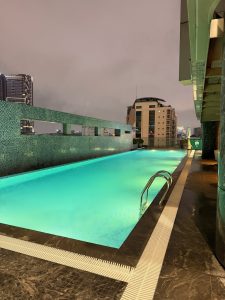
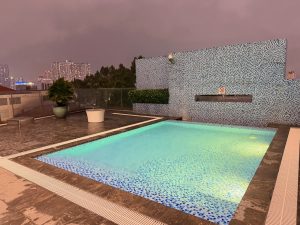
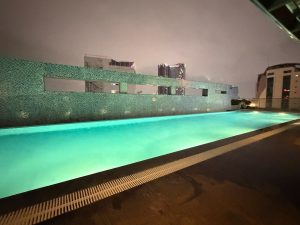
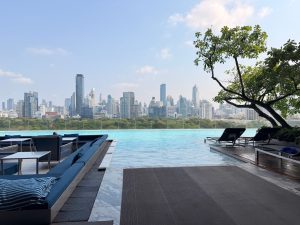
The swimming pool at Novotel Johor Bahru City Centre is situated on the 12th floor of the hotel. The hotel has an infinity pool, which is a tad small, that looks out into the nearby buildings. Despite the small pool, guests would still be able to get some decent swimming laps in the pool. However, as the pool is situated indoors, with only four sundeck chairs, one would find it challenging to soak up the Malaysian sunshine. There is a small wading pool for younger guests next to the lap pool.
There are limited number of sundeck chairs at the hotel’s swimming pool
Novotel Johor Bahru City Centre has an infinity pool
The infinity pool overlooks the city
Gym
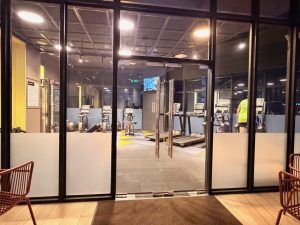
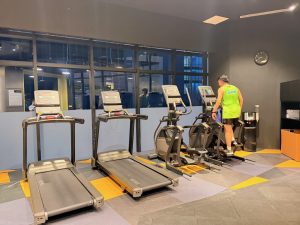
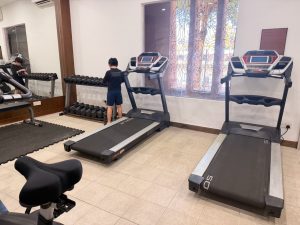
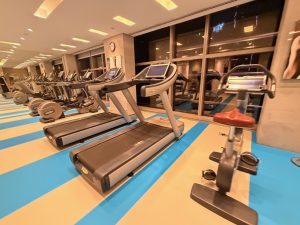
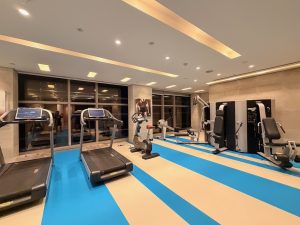
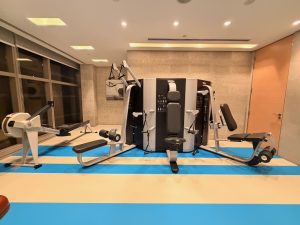
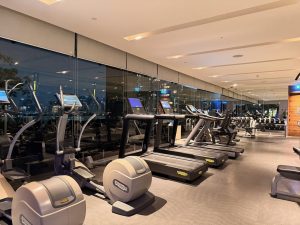
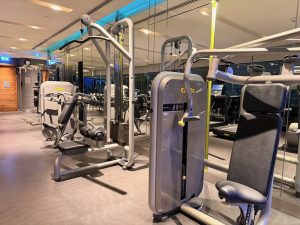
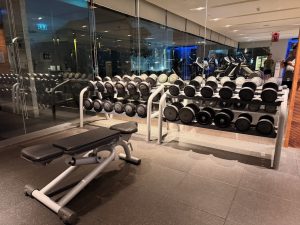
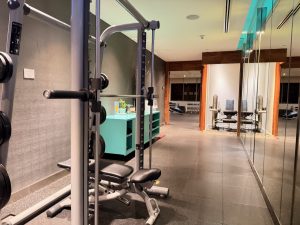
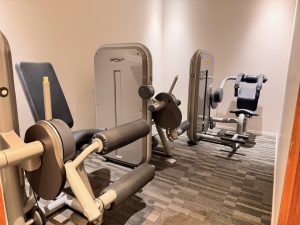
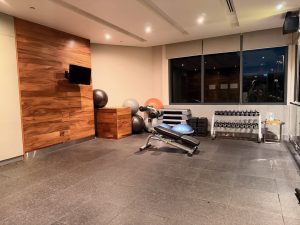
The gym at Novotel Johor Bahru City Centre is located on the 12th floor next to the swimming pool. Despite the small size, guests are still able to get a good workout from the gym. Guests who want a cardio workout can use the four elliptical and treadmill machines, and one of the three stationary bikes. For guests who want functional and strength training, there are the multi-workout machines and the free weights.
Novotel Johor Bahru City Centre has a small gym set up
There is only one strength training machine and some free weights in the gym
Stationary bikes in the gym for cardio workout
There are four other cardio workout machines by the door to the gym
Breakfast @ Food Exchange
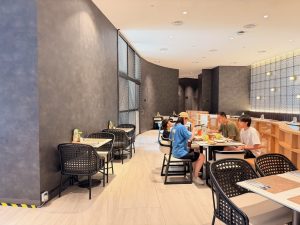
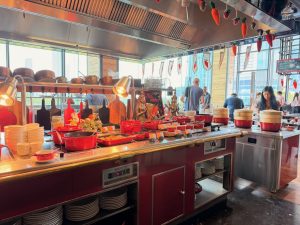
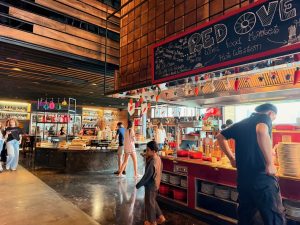
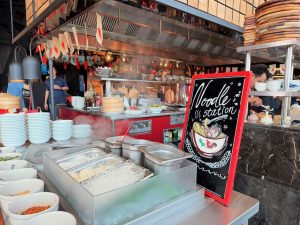
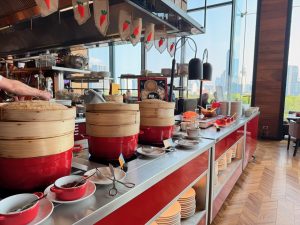
The main breakfast is served at the Food Exchange restaurant located on the 11th floor of the hotel, while Suite guests and higher-tier Accor members can enjoy breakfast from the Executive Lounge on the 34th floor. Food Exchange served a good variety of breakfast, ranging from local delights to Western cuisines. I like how the food is spread out around the restaurant to spread out the crowd getting the food. There are stations dedicated to beverages and the various types of cuisines. The hotel also has an à la minute station serving up various types of eggs and a noodle station. The food quality is average, with most of the food not as hot as I would prefer, but the taste was there. Some food was placed in a push cart for guests to help themselves. We found the Malaysian Nasi Lemak and Malaysian milk tea, Teh Tarik, in one of these push carts. I spotted some carts serving up waffles and pancakes, but they were not manned; unsure if these were available. Breakfast at the lounge is the watered-down version. Despite the limited menu, the lounge serves up both local and Western cuisines for breakfast. There is even a made-to-order menu featuring Western and local cuisines from the three main races in the country. I thought the food at the lounge seemed to look more appealing compared to Food Exchange, despite a smaller range.
Breakfast is served in Food Exchange Restaurant on level 3
There are plenty of seating in the Food Exchange Restaurant
Seating in the restaurant during breakfast
Nasi lemak served in push carts in the restaurant
Local beverages are available at the push carts in front of the restaurant
Warm food selection during breakfast are found near the main buffet area
Salad and greens made available during breakfast
More warm food during breakfast
Drink station during breakfast
A la Minute station serving eggs and noodles
Bread station is located away from the main buffet line
Overall
I had a great stay at Novotel Johor Bahru City Centre. The hotel is located right next to the KSL Shopping Mall with tons of shopping and dining options. Apart from the dining options in the mall, there are numerous eateries next to the hotel, with some operating 24 hours. The well-appointed Suite was relaxing and comfortable, with excellent sleep quality on the king bed. The service at the hotel was great, with staff who were always friendly, cheerful and ready to help guests.
Casa del Rio Melaka is located at the river end of Jonker Walk, the famous weekend night market and the heart of Melaka. The hotel sits on the banks of the Melaka River, giving the rooms at the hotel front row seats to the river. The two major shopping malls, Mahkota Parade and Dataran Palawan, are about a 15-minute walk from Casa del Rio. The hotel is also near the major attractions such as Red Square, Christ Church Melaka and Church of St Paul, making the hotel an excellent choice for exploring these sights. There are several 24-hour convenience stores near the hotel, with the nearest one just across the street from the hotel. Being closer to the heart of Melaka also means there is no lack of shopping and eateries within a stone’s throw from the hotel, making Casa del Rio an ideal spot for exploring the culture and the food in Melaka.
Hotel lobby
Casa del Rio Melaka reception
Outdoor fountain beside hotel lobby
The Suite
Casa del Rio has several types of suites. In fact, for the 2-bedroom suite category alone, the hotel has four configurations. We checked into the 109㎡ Casa Residence 2-Bedroom Suite, which is located in the residence building next to the hotel.
Layout of the Casa Residence 2-Bedroom Suite that we stayed in
Entryway
Unlike most suite layouts, the entryway to the Casa Residence 2-Bedroom Suite lies outside the suite. This entryway is enclosed by a metal gate with storage for shoes and a seat for changing into shoes. Unfortunately, this gate, though it comes with a lock, cannot be locked, as we were not issued the key to lock this gate.
The shoe cabinet is outside the apartment in the entrywayThere is a washer and dryer in this cabinet in the entryway
Kitchen
The living room and pantry of the Casa Residence 2-bedroom Suite, seen from its entrance
The first part of the Casa Residence 2-Bedroom Suite that we came to when entering from its main entrance is the kitchen. The suite is fitted with a full kitchen, with a kitchen sink, a four-stove induction cooker, a full-size fridge, a microwave oven and even a dishwasher. On top of these, the hotel equipped the kitchen with a Nespresso machine and a kettle for our coffee and tea needs. The kitchen is where we got our first glimpse into the Peranakan theme that is present throughout the suite. This Peranakan identity is evident in the use of the cabinets in the pantry. Equipped with a full set of china and cutlery for four, I am certain that one can whip up a meal in the kitchen.
The pantry is furnished with a kitchen table
The apartment as a full fridge stocked with complementary drinks
The pantry has a 4-burner induction cooke and dual sinks
The pantry is equipped with a Nespresso machine and is fully stocked with a set of china for 6 guests
Casa del Rio Melaka also equipped its pantry with a dishwasher
Living Room
The living room has a split-level design, taking up the space on the lower elevation with a short flight of stairs from the kitchen. The living room is furnished with a European-style three-seater sofa and a matching single-seat armchair, surrounding the round coffee table. The living room has a mix of colonial flair seen in the choice of the sofa, the two chandeliers hanging from the ceiling, and the wall-mounted lamps next to the TV. The choice of wooden furniture pays tribute to the Peranakan identity that Melaka is well known for. There is no lack of entertainment options from the flat-screen TV mounted on the wall opposite the sofa. Other than local channels, the TV has Amazon Prime, Netflix and iQiyi to keep us entertained at night after a day’s exploring the town. Wedged between the lounging area and the pantry is a small dining area. The dining area is furnished with a small round dining table for four people, great for consuming our takeaways and street food from Jonker Walk.
The living room of Casa Residence 2-Bedroom Suite
The suite is furnished with a comfortable 3-seater sofa and a large coffee table
There is an additional armchair next to the sofa
There is another dining table for 4 in the living room near the pantry
There is no lack of entertainment in the flatscreen TV in the living room, and the TV console gave us space to stow our shoppings
Master Bedroom
The master bedroom in the Casa Residence 2-Bedroom Suite
The two bedrooms’ entrances face each other, with the master bedroom situated on the right, facing the Melaka River. The master bedroom mainly takes on the Peranakan decor, seen in the massive use of dark wood in the furniture and the design of the furniture. At the entrance of the master bedroom sits a large wardrobe set. These wardrobes are capable of stowing away weeks of clothing. The shelves in the wardrobe gave us additional space to stow our smaller clothing items. The only flaw in the wardrobe is that there is no in-room safe that we can use to keep our valuables. Further into the bedroom, along the same wall as the wardrobe, sits the vanity table with a large mirror hanging on the wall. This table can also double up as a work desk with the power outlet fitted onto the wall, keeping our laptops juiced up while working. Next to the vanity table, facing the king bed, is the TV cabinet with a 43” flat-screen TV having the same entertainment options as that in the living room. The TV cabinet has a similar Peranakan-influenced design to that in the living room, paying tribute to the Peranakan identity of the town.
The master bedroom is furnished with a large wardrobe with 2 large sections dedicated as hanging racks
The last panel is fitted with shelves and drawers that expand the amount of storage for our clothing
The master bedroom is equipped with a TV beside the vanity table, but the TV in our room is not working
The king bed occupies most of the real estate in the master bedroom, topped with a firm mattress that is comfortable to sleep on. However, the pillows are too soft for my liking. On either side of the king bed lies the bedside table that is designed with one drawer and a cabinet. The size of these tables would otherwise be sufficient for us to leave our lifestyle devices to charge overnight if not for the large bedside lamps that took up the entire space of the bedside table. I like how the hotel fitted a window seat by the window in the master bedroom, which not only provides us with a space to relax and look out into the Melaka River, but also gives us additional space to put our backpacks.
The king bed in the master bedroom is very comfortable to sleep on
The window side seat gave us space to place our backpacks and a good spot to look out into Melaka
Master Bathroom
The master bathroom is located opposite the wardrobe and next to the entrance to the bedroom. The European fused with Peranakan design theme flowed into the bathroom, with the cabinets fitted with Peranakan elements and the European design seen in the mosaic on the wall in the walk-in shower and the floor of the bathroom. The overall space allocated to this bathroom is sufficient. I applaud the hotel for making the right decision in only installing one sink instead of dual sinks due to the space limitation. This has given us sufficient countertop space to place our toiletries. The main functional part of the bathroom lies to the left of the sink, with the toilet fitted next to its entrance and the walk-in shower next to the sink. I like the relatively large space allocated to the walk-in shower and the ledge where the hotel places their shower amenities. The allocated space in the walk-in shower allowed us to shower comfortably, while the ledge gave us space to place our facial wash and dental kits. On the other side of the sink, opposite the walk-in shower, is a large bathtub. Despite not having a jacuzzi function, I was able to get a relaxing soak in the sizeable tub.
The toilet in the master bathroom
The walk-in shower in the master bathroom is rather spacious
The master bathroom is fitted with a large bathtub
Shower amenities provided by the hotel
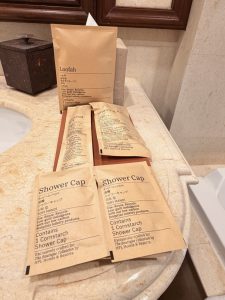
Amenities provided by the hotel
Bedroom 2
The second bedroom in the suite
The smaller Bedroom 2 sits opposite the master bedroom, decorated with a Peranakan theme seen in the details of the furniture. Similar to the master bedroom, Bedroom 2 is furnished with a smaller wardrobe at its entrance. The three-panel wardrobe has a larger two-panel space dedicated to hanging racks and one panel with shelves. Despite being a smaller setup, the wardrobe can still swallow a sizeable amount of clothing. There is a TV cabinet installed next to the wardrobe; however, this furniture seems more like an ornament as there are no TVs installed in this bedroom, though we can use this as an alternate space for storage. The vanity table, the same as the one in the master bedroom, sits in one corner of the bedroom. As Bedroom 2 has a smaller size, the bedroom is furnished with a queen bed that is equally comfortable as that in the master bedroom. Due to the smaller size, the queen bed is only fitted with one bedside table.
Bathroom
The bathroom for Bedroom 2 is located outside between the two bedrooms. The bathroom has a smaller size compared to the master bathroom, fitted with a sizeable walk-in shower, sink and a toilet. The sink in the common bathroom is exactly the same as that in the master bathroom, fitted in one corner of the room. Like the sink in the master bathroom, this sink also gives us ample space to stow our toiletries. The walk-in shower, taking up the space next to the sink, is also quite spacious, so we do not have to engage in an elbow war with walls. The toilet sits next to the entrance to the bathroom.
Balcony
The balcony of the Casa Residence 2-Bedroom Suite at Casa del Rio Melaka is rather large. Facing the Melaka River, the balcony is furnished with a day bed and a set of outdoor tables for two; this part of the suite is perfect for us to relax while looking out into the city and the river.
Service
We received excellent service from the staff at the hotel, from the check-in to the security guard and the housekeeping staff. Our first interaction with the staff at Casa del Rio Melaka was with the security guard at the carpark, who helped us find a good parking spot and reminded us to get the stamp from the reception for our complimentary parking. Nana was the main person from reception with whom we interacted the most. She was very friendly and welcoming. Despite having arrived 5 hours before the standard check-in time, Nana helped us register our arrival and arranged for our early check-in at noon. When escorting us to our apartment, Nana oriented us around the hotel, pointing out the various facilities. She also gave us a brief room tour and added us to WhatsApp for easier coordination. The hotel staff was very responsive on WhatsApp. When we requested additional items, they were delivered in a short period of time. The staff at The Grill restaurant, where we had our breakfast, were equally welcoming. They ensured we were very well taken care of and were very diligent in clearing our empty plates, despite us sitting in one corner of the restaurant.
Hotel Facilities
Breakfast @ The River Grill
Breakfast at the hotel was served in The River Grill, the only restaurant in the hotel. The restaurant uses both a buffet system and a small menu of à la carte buffet style during breakfast. There is quite a number of selections from the buffet, mainly local cuisine and a small selection of Western options. There is also a small counter serving à la minute local noodles at the buffet station. The food was delicious and hearty.
Swimming Pool
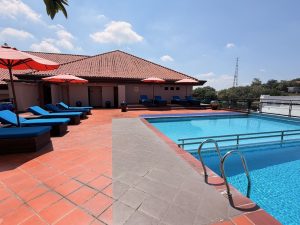
As we were staying at the apartment complex next to the hotel, we had access to both the swimming pool at the hotel and the one at the apartment. The hotel’s rooftop swimming pool is perched on the 4th floor. The rooftop infinity pool is large enough for one to do some decent laps or to laze to cool off from the Melaka heat. There is also a small wading pool to cater for young guests. This rooftop swimming pool is perfect for guests to relax and get a good tan on one of the eight sundeck chairs, as there is no vegetation or high-rise buildings nearby to block out the sun.
The hotel rooftop infinity pool
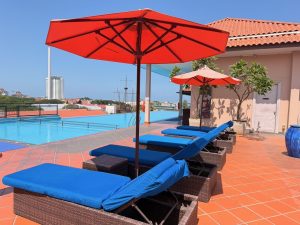
There are limited sundeck chairs at the hotel pool
Jacuzzi function in the pool
Sundeck chairs by the pool
The hotel swimming pool is great for some decent laps
The other pool in the apartment complex sits on level 1 of the apartment building. Here we found a small wading pool and a separate jacuzzi pool. Despite being a lower level, the infinity swimming pool at the apartment complex allows one to do some laps. However, there are limited sundeck chairs. Other than the four sundeck chairs at each end of the pool, we could also use one of the two outdoor tables. Due to the placement of the pool, getting a tan in this pool was a tad more challenging. We also had to bring our towel from the apartment to use the pool (unlike the one from the pool on the hotel side).
There are very few chairs at the apartment side pool
The pool at the apartment is smaller than the hotel side, but still able to get some laps
The jacuzzi beside the pool
Gym
Like the swimming pools, we also had access to two gyms at Casa de Rio Melaka. The hotel’s main gym is also located on the 4th floor, next to the swimming pool. The gym at the hotel is a tad small, equipped with only three cardio machines and a chest press machine. There are some free weights inside the gym for guests to work out other parts of their muscular system.
The weights training area in the hotel gym
Cardio machines in the hotel gym
The other gym is located on the ground floor of the apartment complex. Like the gym in the main hotel, this gym also has a small setup with three cardio machines and a multi-functional strength workout machine. There is also a row of free weights for guests to work out the other parts of their upper body.
Cardio machines in the apartment gym
Strength training machines in the apartment gym
Overall
We had a great stay at Casa del Rio Melaka. The location of the hotel is perfect for those who want to explore the heart of Melaka. It is within a 5-minute walk from Jonker Street and 7 minutes from the museums and attractions in the town. There is no lack of eateries around the hotel, and the nearest convenience shop is right across from the hotel. The apartment we stayed in was perfect for a family and was very well-appointed. The beds were comfortable to sleep on, and the entertainment options on the TV kept us entertained in the evening after exploring the town. The service is excellent at the hotel, where every staff member we met was welcoming and friendly. I would return to this hotel the next time I come to Melaka.
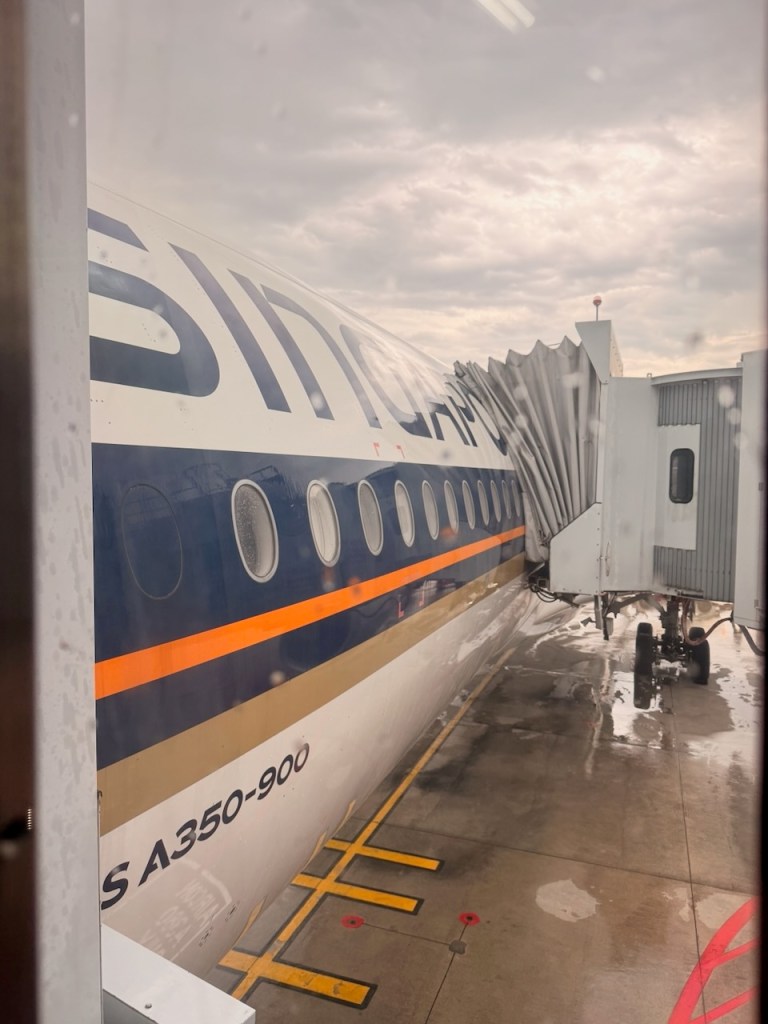
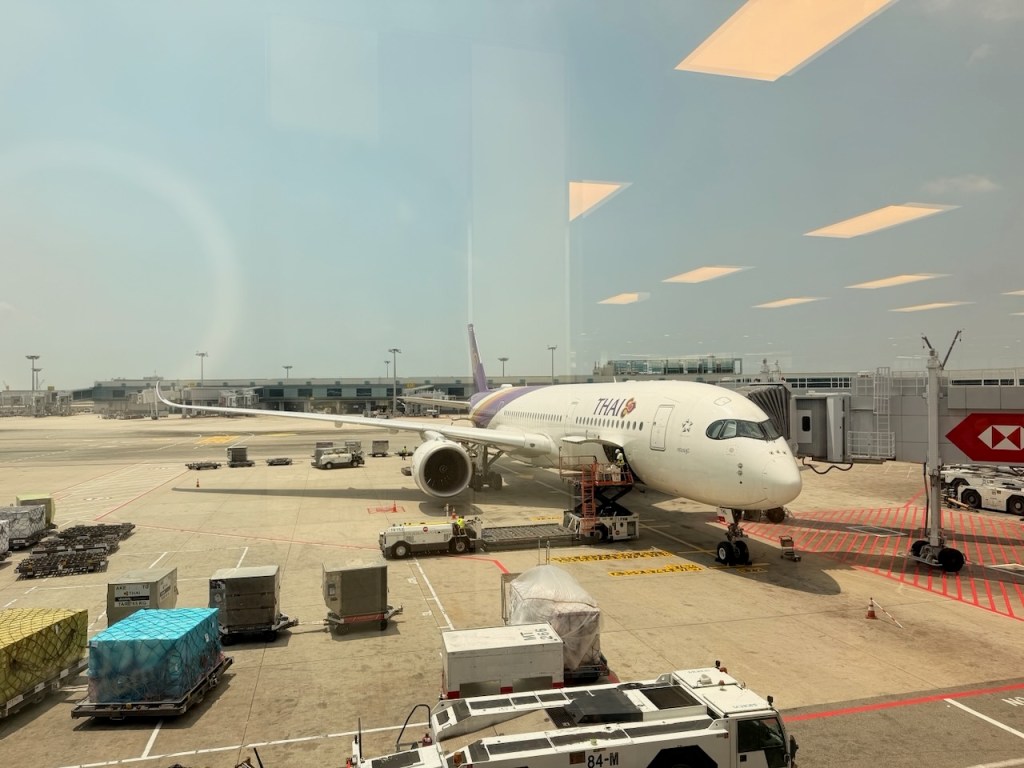
Singapore Airlines A350-900 Long Haul aircraft that we flew on
At the Airport
Check-in
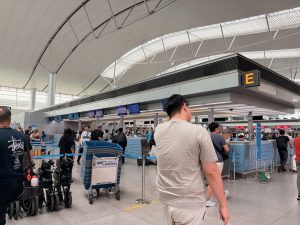
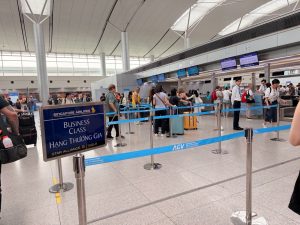
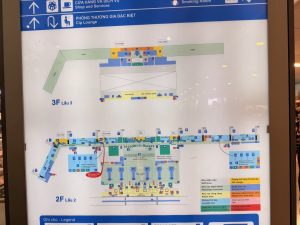
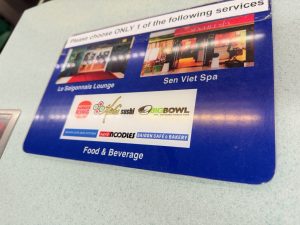
Singapore Airlines flies out of Ho Chi Minh City Tan Son Nhat Airport Terminal 2, dedicated to international departures (domestic destinations depart from Terminal 1). Singapore Airlines operates seven check-in counters from Row E of the terminal in the middle of the departure hall, with Door D1 being the closest entrance to the check-in counters. There are four queues set up at Row E catering for Business Class, Economy Class, Singapore Airlines Elite Gold/Silver members, and Internet Check-in. The two counters serving Business Class passengers are located at the front of the row (E1/E2 are nearer to the terminal’s entrance. There was a ground staff at the line ensuring that only Business Class passengers were allowed in the queue. The agent checking us in was friendly and professional, and processed our check-in with great efficiency. Singapore Airlines had an unusual arrangement for Business Class passengers at Tan Son Nhat Airport. Other than the usual lounge access, we were given two additional options – a USD20 voucher to be spent at eateries in the terminal, or a 30-minute massage. We opted for the lounge access. As two of our friends were flying in Economy Class, the ground staff also issued them with the lounge access pass without us asking for it (two of us were Elite Gold members and were able to bring our friends into the lounge). The ground staff gave us directions to the lounge, our boarding gate and timing before we left the check-in counter.
Singapore Airlines departs from Tan Son Nhat Airport Terminal 2
Door D2 is the closest door to Row E
Singapore Airlines check-in counters are located at Row E
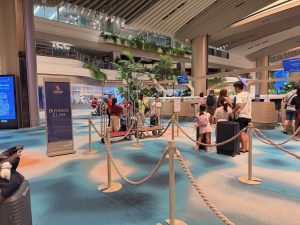
Singapore Airlines Business Class check-in queue
Singapore Airlines operates two Business Class check-in counters today
Tan Son Nhat Airport terminal map
Business Class passengers are given three service options to spend time at the airport while waiting for their flight
Singapore Airlines check-in counters in Tan Son Nhat Airport
Singapore Airlines has two counters for Economy Class and two for passengers who performed web check-in
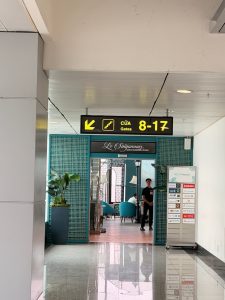
Le Saigonnais Lounge
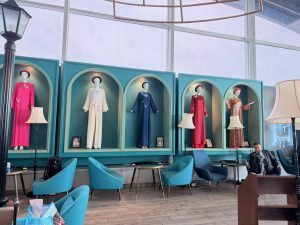
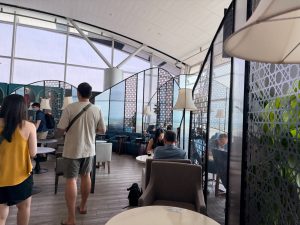
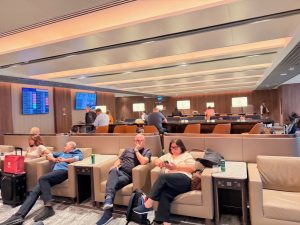
Singapore Airlines does not have a SilverKris Lounge presence in Ho Chi Minh Airport; it uses Le Saigonnais Lounge, a third-party paid lounge serving other airlines, such as Emirates, EVA Air and Japan Airlines. The lounge is located on level 3, in the left corner of Terminal 2 between Gates 17 and 18. Le Saigonnais Lounge is a fairly large lounge with bright natural light, thanks to the floor-to-ceiling windows facing the tarmac. The lounge is decorated with Indochine elements, merging Vietnamese and French elements. The French elements are seen in the European-style lampposts dotted in the part of the lounge near its entrance. The bulk of the lounge has Vietnamese elements, seen in the screens deployed around the lounge; the conical bamboo hat that is so iconic of Vietnam is seen in the decoration on the ceiling of the lounge, as well as the various Vietnamese clothing displayed in the front lounge.
Singapore Airlines passengers are invited to Le Saigonnais lounge
Reception desk in the Le Saigonnais Lounge
The ceiling of the lounge is topped with a traditional Vietnamese conical hat
Le Saigonnais Lounge also serves Business Class passengers of other airlines
The various Vietnamese traditional dresses on display in the lounge
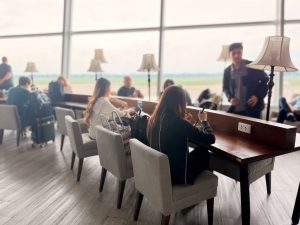
Most of the lounge is furnished with dining tables for two, spreading along the perimeter of the lounge from the entrance to the innermost part. I reckon the best seats are those by the large floor-to-ceiling windows facing the apron, where we could relax and do some plane spotting. The only different types of seating are found at the back of the lounge. There is only one long table at the back of the lounge catering for single travellers who want to do some work before their flight. Le Saigonnais Lounge has a small business centre in the back corner, equipped with three PCs. Beside this business centre, occupying the other back corner, sits a four-seater dining table. There are also some dining tables placed on a raised platform along a set of curved railings next to the buffet area. These would be the best seats for enjoying the food from the buffet due to their proximity,
Seats next to the buffet table are mainly catered for dining
There are more lounge and dining seats at the back of the lounge
There is a computer station at the back of the lounge
The long table at the back fo the lounge is great for solo travellers or travellers who wanted to perform some work
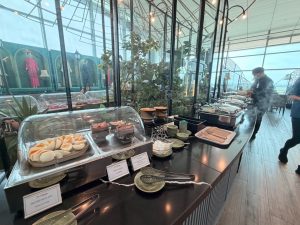
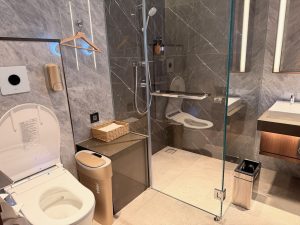
The buffet line is located by the entrance on the oval-shaped kitchen island behind the lounge reception. The food offering is arranged into two sections: half of the oval facing the beverage stations houses the warm food, while the other half facing the lounge is stocked with desserts and starters. I find the food selection to be rather thin, and there is only one Vietnamese food – beef pho on offer. The other food options are seafood fried rice, fried fish, congee with condiments, and a small selection of vegetarian warm food. Half of the dessert section is dedicated to condiments for pho and bread, leaving only half of the dessert section stocked with fruits, mochi and pudding. Despite the small selection, other than the soggy fried fish, the food available is quite delicious. Beverages are found on the table by the wall opposite the buffet line, serving up a good selection of wine, soft drinks and Vietnamese coffee and tea. Le Saigonnais Lounge is equipped with two shower cubicles located inside the toilet. These toilets are more utilitarian than luxurious, with a newly segregated dry area inside each shower cubicle. Usage of these shower facilities is on a first-come, first-served basis and can be requested from the staff at the lounge, who will then provide towels and shower amenities.
Food is organised around the oval island near the reception with the front being desserts and pastries
Hot food are found behind the oval island
Beverage station is found by the wall next to the oval island in Le Saigonnais Lounge
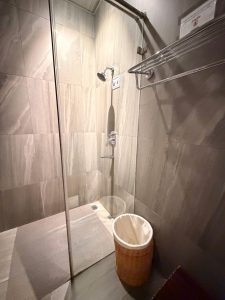
The shower facilities in Le Saigonnais Lounge is located inside the toilet
The Aircraft
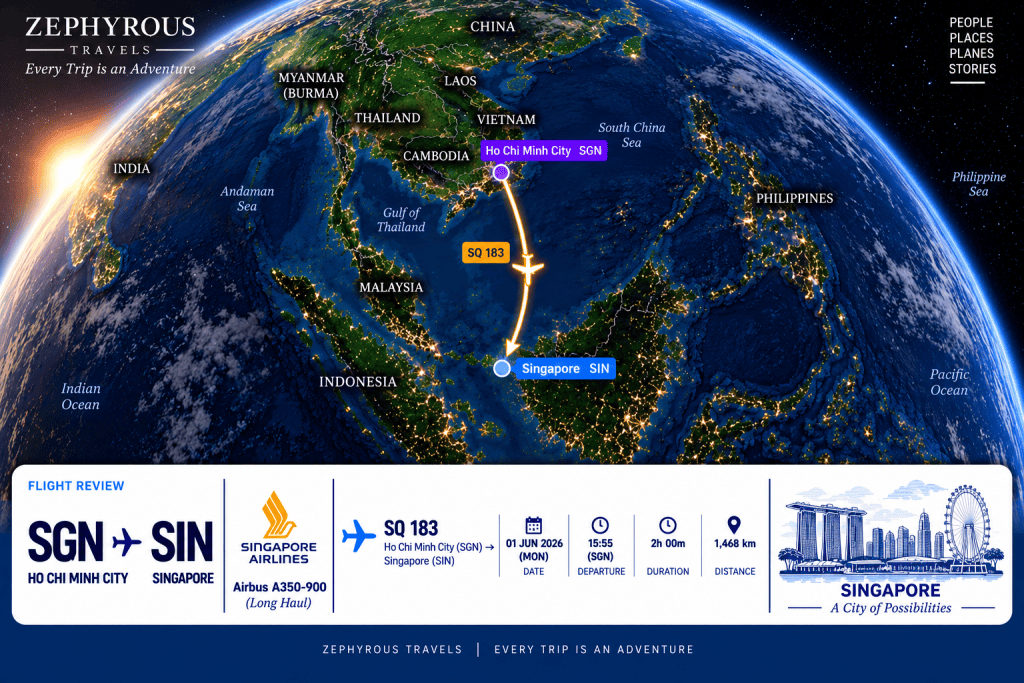
Singapore Airlines operates three daily flights using its A350-900, both Medium Haul and Long Haul variants, as well as its B787-10 aircraft between Ho Chi Minh City and Singapore. We flew on its A350-900 Long Haul aircraft featuring the Jamco Business Class seats (2013 iteration) for this leg.
Singapore Airlines A350-900 Long Haul Variant liverySingapore Airlines A350-900 Long Haul Variant Safety Card
Cabin
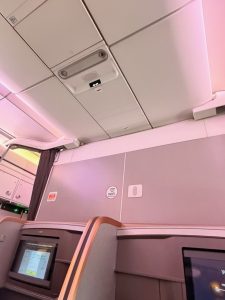
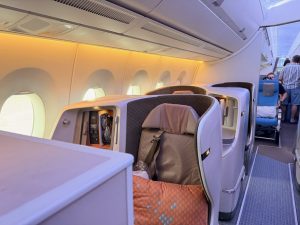
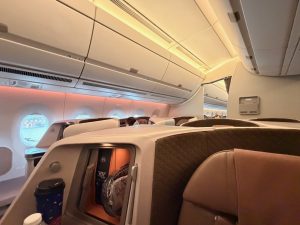
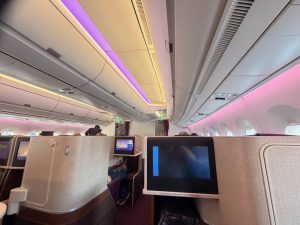
The A350-900 Long Haul aircraft that we took features a three-class cabin: Business, Premium Economy and Economy Class. Singapore Airlines does not sell Premium Economy service on this leg; passengers can opt to pay extra for these Premium Economy seats. However, the food catering will be that of Economy Class. Singapore Airlines A350-900 Long Haul Variant has a total of 253 seats with 42 seats in Business Class, 24 seats in Premium Economy Class and 187 seats in Economy Class. The Business Class cabin is further segregated into the larger forward cabin that houses 26 seats and a smaller aft cabin with 16 seats. Singapore Airlines A350-900 Long Haul Business Class emits a quiet luxury vibe with warmth, balanced and restrained designs. The soft, earthy colour schemes create a smooth environment which lowers visual stress. The airline predominantly uses brown, from the sand colour seen in the footwell and cabinetry to the harsher chocolate brown in the seats and carpet, coupled with the softer warm lighting that creates a relaxing vibe in the cabin and gives the cabin a more residential, hotel-like feel. The lack of overhead bins above the centre row and separating the cabin into forward and aft created an airy and spacious feel in the Business Class cabin.
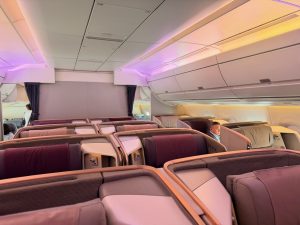
The larger forward Business Class cabin
The larger forward Business Class cabin
The more intimate aft Business Class cabin
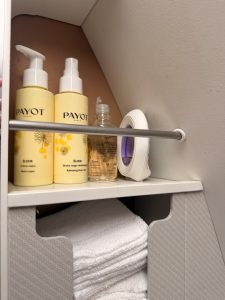
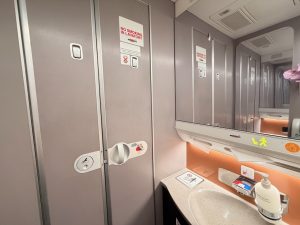
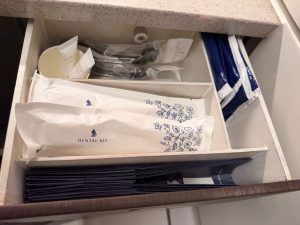
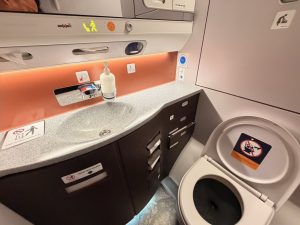
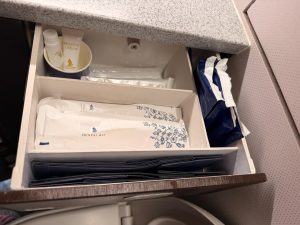
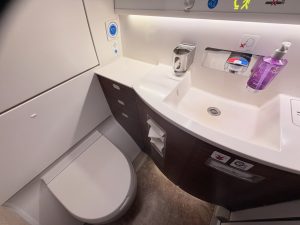
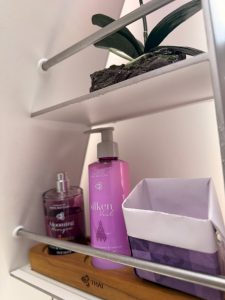
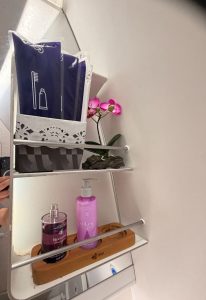
There are three Business Class lavatories on Singapore Airlines’ A350-900 Long Haul variant serving all 42 Business Class passengers. One is located at the front of the aircraft behind the cockpit, and the other two are between the two Business Class cabins. The Business Class lavatories exuded a premium feel with the dark brown wooden laminate fixed onto the sink cabinetry, and the sand brown backsplash at the sink enhances its premium look. The size of these lavatories is pretty much standard, but the mirror made it feel larger than it actually is. Singapore Airlines stocked its Business Class lavatories with additional Payot-branded amenities like lotion, eau de toilette and facial mist. Apart from these premium amenities, Singapore Airlines is one of the few airlines in the world that provides standard amenities such as dental kits and shavers in its lavatories even on a short flight.
Business Class lavatory onboard Singapore Airlines A350-900 Long Haul variant looks premium
Singapore Airlines provides its Business Class passengers with Payot branded amenities
The mirrors in the lavatory made it look bigger than it actually is
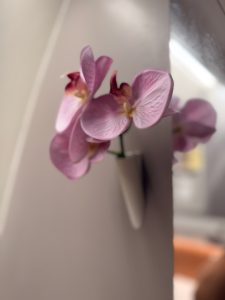
I like how Singapore Airlines places flowers in its lavatories
Singapore Airlines is one of the few airlines in the world that stocks their lavatories with amenities even for a short flight
Seat Features
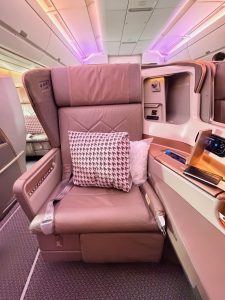
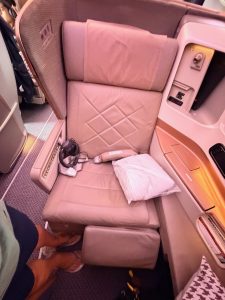
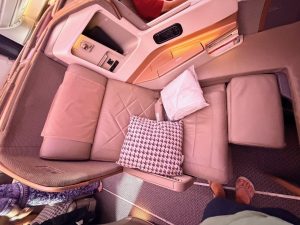
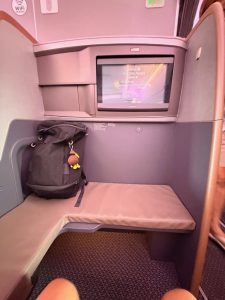
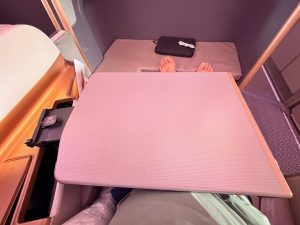
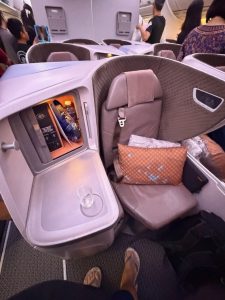
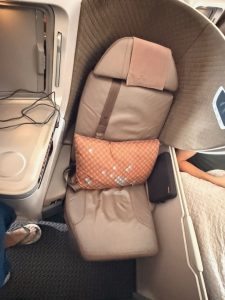
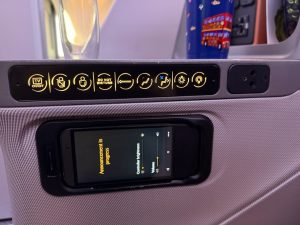
The seats on Singapore Airlines A350-900 Long Haul Business Class are arranged in a 1-2-1 configuration, ensuring all 42 passengers get direct aisle access. Each seat is 28” wide with a pitch of 60” that expands to 73” when converted into a flat bed, making it one of the widest Business Class seats. Like all Business Class seats, Singapore Airlines A350-900 Long Haul Business Class seats have four standard modes: upright, flat bed and two in-between lounge modes. The upright mode is the default mode that we were greeted by the seat at the time of boarding. The wide seat and the thick padding, together with the soft plush leather, made the seat feel very comfortable. The flat bed mode on these seats can only be deployed by flipping the seat over on its back instead of pressing a button on the seat controls that is situated on the inside of the aisle-side armrest. There is a mixed review of the comfort levels in the bed mode, with some passengers complaining about how hard it is despite the duvet set that the airline provided. On top of this, the slanted position with a small footwell does not appeal to every passenger. We were fortunate to be able to snag the bulkhead seats, which feature a larger footrest that spans across the width of the seats, compared to the small angled footwell on the standard seats, which technically allowed us to sleep in various positions. However, I did not manage to flip the seat over to convert to bed mode due to the short flight time. Moreover, the cabin crew already had a hectic schedule feeding all the passengers, and I couldn’t bear to disturb their schedule (based on experience, the cabin crew would put aside their work to help passengers convert the seat into bed mode). The seat in lounge mode, with the calf rest deployed and its back angled, provided additional comfort that allowed me to laze on the seat in a more relaxed posture. Singapore Airlines A350-900 Long Haul Variant comes in two preset lounge modes (based on the two lounge position buttons on the seat control). The first lounge mode has a seat back slightly angled, and the calf rest slightly raised. This is a good mode for meals or work, as it beats sitting long hours in a stiff upright mode. The second lounge mode is closer to a bed mode, but instead of having the seat all the way flat, the seat back is tilted more, and the calf rest closes the gap between the seat and the footrest. I find this mode best for enjoying the in-flight entertainment or for passengers who want to snooze a little after a meal. The seat comfort in lounge mode is made more comfortable by its ability to customise the angle of recline apart from the preset angle. Despite not having a door, I find a good amount of privacy in these Long Haul Business Class seats due to their high-backed, curved, wrap-around shells that act as cocoons. Other than controlling the angle of recline of the seat, the seat control buttons also control the seat lighting and the on/off for the personal TV, as well as call the attendant.
Singapore Airlines A350-900 Long Haul Business Class seat in upright position
Singapore Airlines A350-900 Long Haul Business Class seat in the first lounge mode
The seat’s second lounge mode is closer to a bed, with the calf rest flush to the ottoman
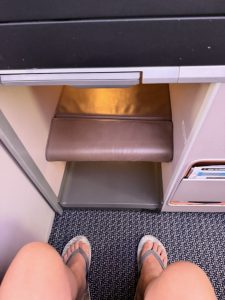
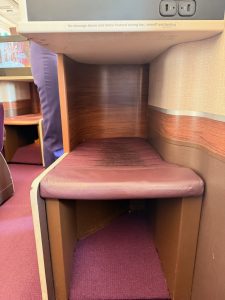
These bulkhead seats has a large ottoman that spreads across the entire width of the seat
The larger ottoman at these bulkhead seats gave me the option to stow stuff on it rather than under it
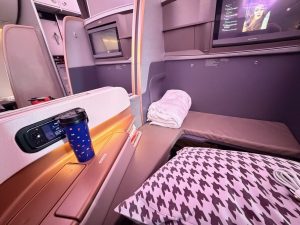
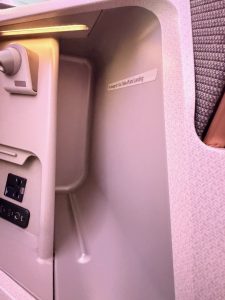
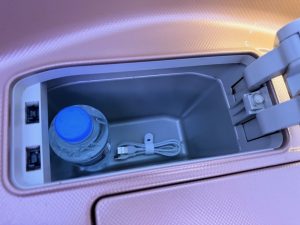
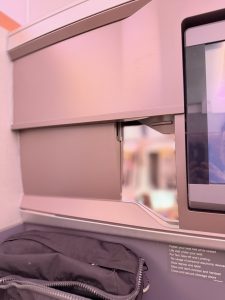
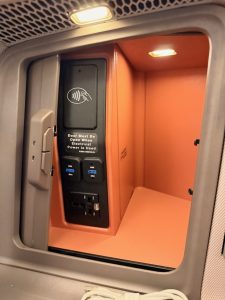
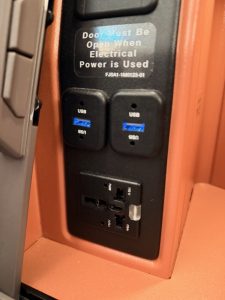
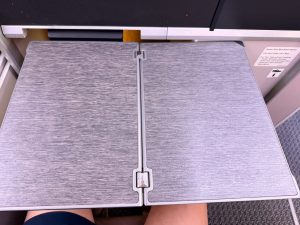
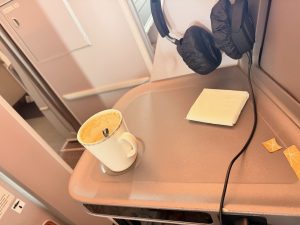
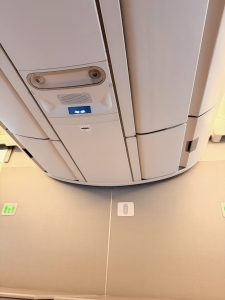
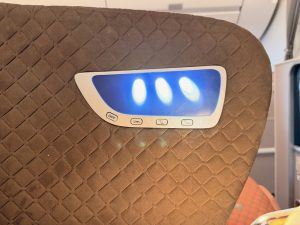
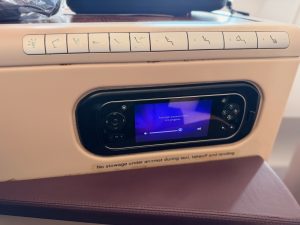
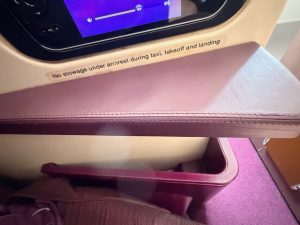
Singapore Airlines A350-900 Long Haul Business Class seats also feature a good amount of storage space. The main storage in the seat is found on the inner armrest area, where there is a fairly deep compartment for us to stow our smaller items. The second storage area is an open shelf beside the seat where we could use to place slimmer items such as laptops and tablets, but items stowed here would have to be removed during taxiing, take-off or landing. As we were sitting in the bulkhead seats, there was significantly more space under the footrest for us to stow our carry-ons and shoes. In the standard Business Class seats, there would be another small compartment beside the TV that can hold small items, but this additional compartment is not present in the bulkhead seats. In the charging department, Singapore Airlines A350-900 Long Haul Business Class seats are fitted with an international power socket and a couple of USB-A charging ports beside the seat. Singapore Airlines A350-900 Long Haul Business Class seats are installed with a large, sturdy seat table, stored in the side console. Due to its solid design, fishing out the table from the side console can be a challenge due to its bulk. When deployed, the large table is perfect for multi-course dining for longer flights or working on a laptop, with spare space for a drink while working. The Singapore Airlines A350-900 Long Haul Business seat is fitted with a set of three reading lights, apart from the ceiling reading light, on the shell of the seat, corresponding to each seat position.
The main storage is in the inner armrest next to the table stowage area
There is a deep open pocket at the side console for books and tablets
The side armrest storage is quite deep
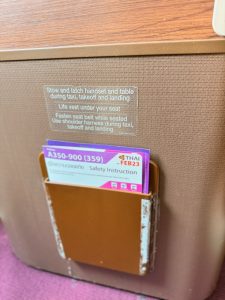
Seat pocket is within reach
The side console features a storage space, additional reading light and charging outlets
There would be another small compartment next to the TV for regular seats, but this is missing for bulkhead seats
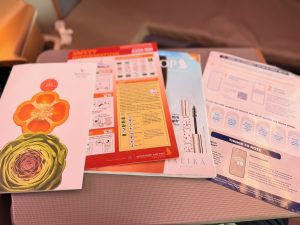
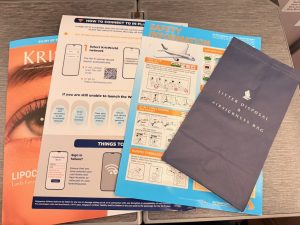
Seat pocket contents
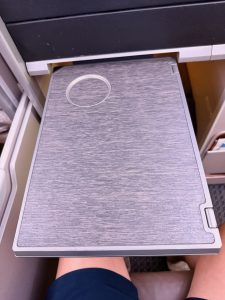
Large sturdy seat table
Overhead reading lights
Another set of reading lights that correspond to the seat angle
Inflight Entertainment
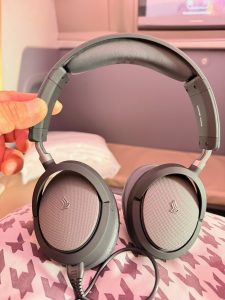
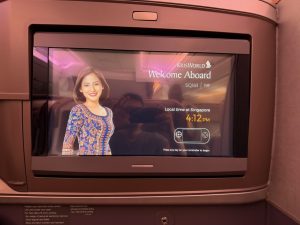
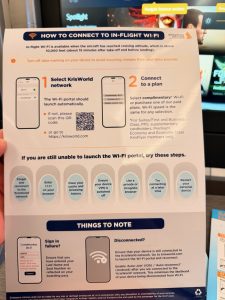
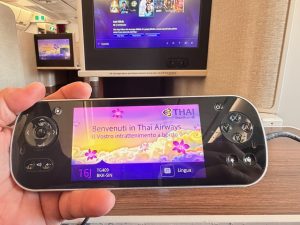
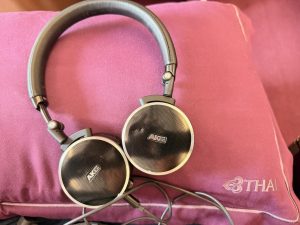
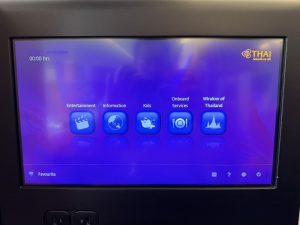
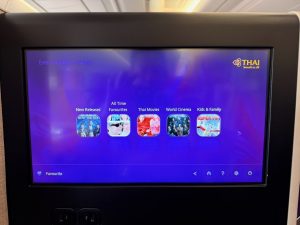
Singapore Airlines A350-900 Long Haul Business Class seats are fitted with a large 18″ HD personal display. The large display made watching movies on KrisWorld a joy, and it felt like a movie theatre in the sky. The sharp, crisp picture from the display is not affected even when lying on the seat in bed mode, thanks to the tilt feature built into the screen. However, as this is an older product, the personal TVs are not fitted with touchscreen functions. We select the movies that we want to watch via the IFE controller, which is designed to resemble a PSP console with a touchscreen function in the middle part of the controller. As the KrisWorld is also packed with games, the IFE controller is also designed with game controls on it. The entertainment library is packed with loads of entertainment options, from the latest Hollywood blockbusters to regional movies to documentaries and even TV shows. KrisWorld is very well catalogued into intuitive menus, making searching for entertainment a breeze. Singapore Airlines provides noise-cancelling headphones to its Business Class passengers, which are very effective in blocking out ambient noise. In fact, I had to remove my headphones when conversing with the cabin crew. Singapore Airlines provides unlimited complimentary wifi to its Business Class passengers, which is only effective for chatting and social media browsing. The slow speed of the internet does not support video streaming. Economy Class passengers who are members of the airline’s loyalty program, KrisFlyer, are also provided with complimentary unlimited internet access throughout the flight.
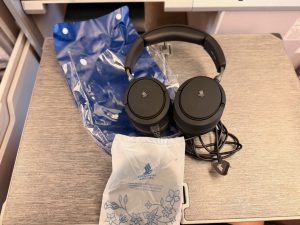
Singapore Airlines provides noise-cancelling headphones to its Business Class passengers
Each A350-900 Long Haul Business Class seat is fitted with a large 18″ IFE screen, but there are no touchscreen functions on these TVs
The IFE controller resembles PSP and is very easy to use
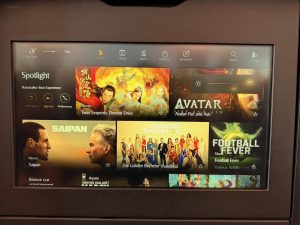
KrisWorld has a huge library of entertainment options, curated in an easy-to-navigate menu
Meal Service
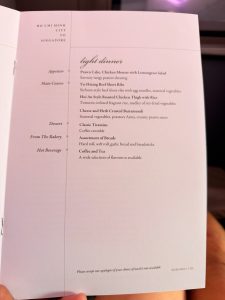
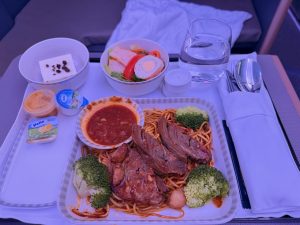
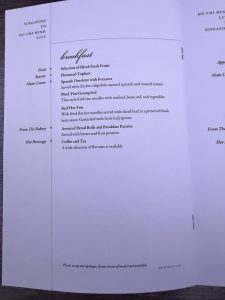
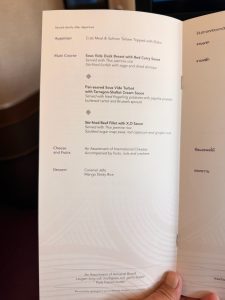
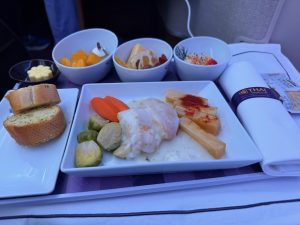
As this was a short flight with a total flight time of 2 hrs, meal service began about 30 minutes after taking off when the aircraft reached cruising altitude. Singapore Airlines offers its “Book the Cook” service to its Business Class passengers, where we can select our choice of meals from an extended menu on top of the three options offered in-flight. However, the “Book the Cook” service is only available at selected airports, such as Singapore, Paris, and Beijing, to name a few, and unfortunately, this service is not available for this flight out of Ho Chi Minh City. The options for mains on this flight were Beef Short Ribs, Roasted Chicken Thigh and Rice, and Herb Crusted Barramundi. I opted for the Beef Short Ribs, which were prepared in Sichuan Style and served with egg noodles. Due to the short flight time, the meal was served on one tray. The prawn cake salad appetiser tasted fresh, and the cakes were delicious. Even without the salad dressing, the vegetables in the salad were fresh and tasty. The beef ribs were tender and could be pulled apart without much force, and went very well with the accompanying sauce. The noodles were not soggy and had a certain crunchiness to them. The coffee cake dessert was equally delicious. It was soft and moist, and the coffee taste was not overpowering.
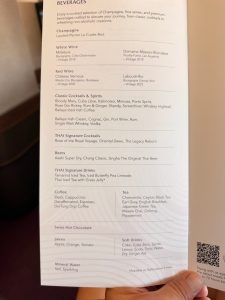
Singapore Airlines Business Class menu
Meal options for today
The beef short rib noodles are delicious. Beef was tender, and the noodles were flavourful
Service
The service we received on board was nothing short of impeccable. After the usual greetings at the door during boarding, and as I was making my way to my seat, I was escorted to my seat by a cabin crew member, Fernanda, who was welcoming Business Class passengers in the cabin. When I learned about my seat number, Fernanda was delighted that I managed to snag this highly sought-after seat. Fernanda came across as friendly and sincere and was able to hold a conversation very well. She was cheerful and took care of us very well. She would return to confirm my meal selection and took the extra care to ensure the dish did not contain any of my allergens by going through the ingredients list. When I requested their signature mocktail to be served after the meal, Fernanda remembered without even being prompted. She was meticulous and used her heart to work. The other crew member, Rachel, serving the aisle where my friends were sitting, came across as cheerful. I saw how she took care of my friends and would always pop by to check in on them to see if they needed more drinks. When it came to my allergen, a male lead steward visited my friend and me to check the severity of our allergy if we accidentally consumed the food. This goes to show the crew went above and beyond to ensure guests were not affected by the food that was served onboard. As I was sitting near the galley, I witnessed a lot of teamwork by the crew, with crew members helping each other out to ensure all passengers were being fed shortly after take-off, maximising the time we had to consume the meal. Despite being a turnaround flight and having worked a 2-hour inbound flight, the crew remained enthusiastic and full of energy.
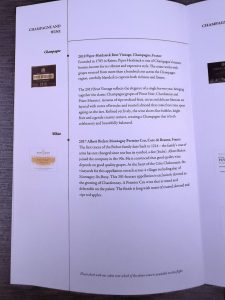
Champagne for pre-departure drink
Afterthought
I had a great flight with Singapore Airlines on board their A350-900 (Long Haul Variant). We managed to snag the best seat in the class – the extremely spacious bulkhead seats without needing to sleep on our side. This seat, due to its design, also offered us plenty of stowage space under the seat. The missing centre overhead bin gave the cabin an airy look. Other than the comfortable and spacious seats, what made this flight pleasant was its crew. The cabin crew were very welcoming and friendly. They were seen helping each other with the passengers ‘ interests in mind. Despite working one 2-hour, hectic flight to Ho Chi Minh City, the crew were still energised.
Pullman Saigon Centre is located on the southwestern edge of District 1 of Ho Chi Minh City, the city’s heart centre. Despite being technically in District 1, the hotel is about 1 to 1½ km from the tourist cluster where most of the iconic attractions are located. This distance is great for those who want the tranquillity of being away from the bustling tourist attractions, and yet still remain relatively close to the heart of Ho Chi Minh City. Most of the attractions can be reached on foot within a 30 min walk from the hotel, and the nearest Bui Vien Walking Street is a mere 5 mins walk. There is no lack of amenities in the vicinity of Pullman Saigon Centre. There are several convenient shops within a 5 min walk from the hotel along Bui Vien Walking Street. We also found numerous eateries right next to the hotel and the nearby Bui Vien Walking Street.
Pullman Saigon Centre facade
Hotel reception on the ground floor
Hotel lobby on the ground floor of the hotel
Hotel Signage
Hotel lobby
The Executive Suite
The 70m² Executive Suite at Pullman Saigon Centre adopts a blend of modern minimalism and contemporary glamour. The clean lines and functional layout complemented the bold colours and textures well to create a sophisticated high-end vibe. The use of a natural wood palette in the flooring brought warmth to the suite. The Executive Suite is spread across four main areas: The living room, the bedroom, the bathroom, and the walk-in wardrobe.
Layout of the Executive Suite at Pullman Saigon Centre
Entryway
The entryway of the Executive Suite simply serves as an area of the suite that connects the main entrance to the rest of the suite. This is also where we had our first look into the contemporary interior theme of the suite. The entryway also serves as a connection to the power room and the walk-in wardrobe of the suite, which in turn links to the bathroom.
The entryway to our Executive Suite is home to the entrance to the powder room and the bathroom
The entryway to our Executive Suite
Powder Room
Like most power rooms, the one in the Executive Suite at Pullman Saigon Centre also houses a toilet and a larger countertop with a sink sitting on it. The powder room employs the same contemporary minimalist decor as the rest of the suite and is an excellent addition to the suite, as our friends would still be able to use the toilet without trespassing into the bedroom.
The powder room in the Executive Suite is fitted with a toilet and a sink
Living Room
The living room in the Executive Suite at Pullman Saigon Centre
Pullman Saigon Centre uses purple to break the otherwise monotony of the heavily wood-themed suite. This purple sofa is capable of housing four to five adults comfortably, enjoying the well-curated local and international channels on the 40″ LED TV mounted on the wall. The large coffee table between the TV and the sofa gave us a great spot to rest our drinks while enjoying the welcome snacks the hotel prepared for us. A small round table, though capable of doubling up both as a dining table and a work desk, serves the work desk function more. There is only one chair furnished at this table, which seemed to suggest that the hotel intended for it to function more as a work desk. The close proximity to the HDMI port and the power outlets at the wall supported the hypothesis that the hotel intended this table to function more as a work desk.
The sofa in the living room matches the colour theme of the suite and is comfortable to sit on
The work desk sits in one corner of the living room, and is a tad small but sufficient for one to do some work
The TV in the living room is hung on the feature wall facing the sofa
The power outlet and HDMI ports are found on a side table next to the work desk
The artwork in the living room brought some life to the otherwise dull setup
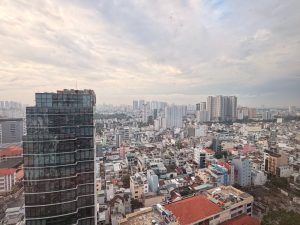
View of Ho Chi Minh City from the living room
View of the city from the Executive Suite
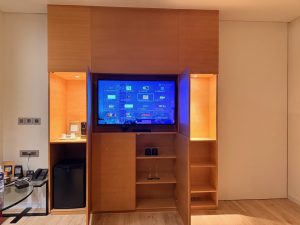
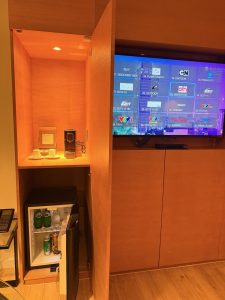
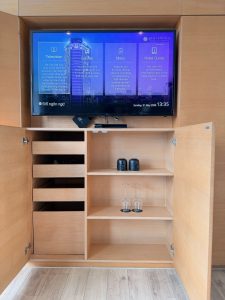
I like how the hotel hides the minibar in the wooden cabinet behind the TV. Doing so creates a clean and minimalistic look in the living room. The mini bar occupies the left cabinet space, with the upper half of the cabinet dedicated to the coffee-making dry pantry. Here is where we find a pseudo Nespresso pod coffee machine with six capsules. Sitting at the lower half of the cabinet space is the mini fridge stocked with a wide range of chargeable beverages. Despite having a large cabinet in the living room, there is limited space for us to put away our shopping. The hotel also uses the cabinet space underneath the TV as another mini bar area with mugs and glasses occupying the shelving on the right side, and tea and an electric kettle taking up the space on the left. The only place in the cabinet that we can use to store any items is the cabinetry space to the right of the TV.
The cabinet around the TV in the living room houses the minibar and gives us some storage space
The hotel furnished the minibar with a pseudo-Nespresso coffee machine
The minibar is on the left of the TV, with the mini fridge sitting in the space below the coffee machine
There are some mugs and glasses in the cabinet space below the TV
The kettle and tea are found in the drawers below the TV
Bedroom
The bedroom in the Executive Suite at Pullman Saigon Centre
The minimalist contemporary design theme flowed into the bedroom, but with a tinge of Scandinavian elements. Most of the bedroom is decked in a natural wooden theme with bold colours. Compared to the living room, the furnishing in the bedroom is simpler. In the centre of the bedroom sits the king bed, placed against the wall with a blue, floral-designed feature wall. The sleep quality on the king bed is good, but the pillows supplied are too soft for my liking. Despite Pullman Saigon Centre supplying a pillow menu, there is only one other choice on the menu. However, when called to request a firmer pillow, the hotel managed to provide the two that I requested. The firmer pillow supplied is only slightly firmer than those that were placed onto the bed. Well, at least this improved my sleep quality. The firmness of the mattress on the king bed left us feeling refreshed the next day. Sticking to the Scandinavian theme, the hotel uses a couple of logs as bedside tables, strategically placed underneath the international power outlet, so we could leave our lifestyle devices charged overnight.
The king bed in the bedroom was comfortable to sleep on
I find it interesting that the hotel uses a log as a bedside table, which gave us a good amount of space to charge our lifestyle devices
Pullman Saigon Centre provides a limited menu of pillows
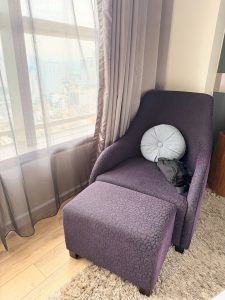
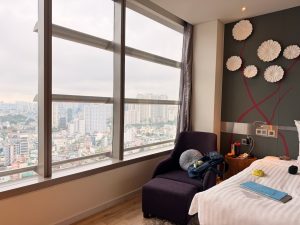
Next to the king bed lies a single armchair with an ottoman placed next to the floor-to-ceiling window that allowed us to look out into the city. This is also a good place to relax, reading a book or watching the other 40″ LED TV in the bedroom. The TV has identical entertainment options to those in the living room. Like that, in the living room, the TV is mounted on the wooden cabinet. However, to our dismay, this cabinet serves no purpose other than as an ornament. The doors on this cabinet are glued shut, which did not allow us to open it to stow any items within it.
The TV in the bedroom that faces the king bed has the same entertainment options as that in the living room
The armchair and ottoman is a great place to sit and look out into the city
The armchair and ottoman in the bedroom
Bathroom & Walk-in Wardrobe
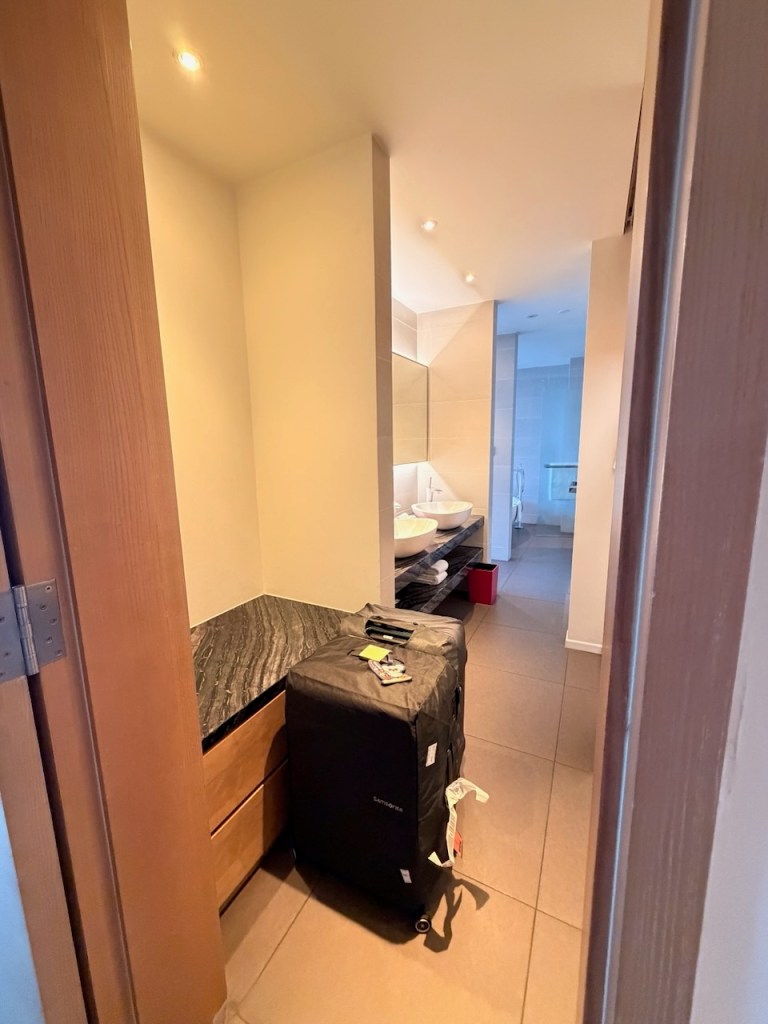
Bathroom seen from the entryway in the Executive Suite
The bathroom has two entrances, from the bedroom and the entryway. I find it weird that the entrance from the bedroom was not fitted with a door. The bathroom uses an elongated design, with the bathtub being placed next to the floor-to-ceiling glass panel that separates the bedrooms from the bathroom. The standalone bathtub is so large that I find it difficult to get a good soak. Lining up in a row in the space opposite the bathtub are the walk-in shower and the toilet. The space afforded to the walk-in shower, which comes fitted with both a rain and regular shower head, is large enough that I did not have to engage in an elbow fight with the walls. Like the other Pullman Hotels around the world, Pullman Saigon Centre treats its guests with the fragrant and luxurious American-branded C.O. Bigelow shower and toilet amenities. The water pressure from both shower heads is excellent, and the water heats up very fast. The toilet next door is fitted with a Japanese bidet.
The standalone bathtub is large, but difficult to get a good soak
The walk-in shower with a rain shower and regular shower head
The toilet in the bathroom is fitted with a Japanese bidet
Further along the length of the bathroom, towards the entryway, is the sink and the wardrobe area. The large dual sinks sit on a black marble countertop, which provides us with plentiful space to lay out our toiletries. Due to the shallow design, I find water splashing out from the sink whenever I accidentally turn the tap to its maximum. The wardrobe in the Executive Suite is located within the bathroom and opposite the sink, in the same row as the shower and toilet. The large wardrobe provided us with tons of space to hang up our clothes. I reckon the wardrobe is capable of hanging up to three weeks of clothing for two guests. I like that the hotel fitted two dual-tiered drawers inside the wardrobe, which not only increases the storage space, but also gives us a space to put away our smaller clothing. The in-room safe is located on top of one of these drawers. Wedged between the sink and the entryway entrance is another set of two dual-tiered drawers with a marble slab as the top. I find this luggage rack is very well situated, which provides guests with the convenience of packing and unpacking their luggage.
Service
We experienced great service at Pullman Saigon Centre, where the staff we met were warm and friendly. At the time we alighted from our airport transfer, the ground floor porter had already taken care of our luggage. We did not have to lay our fingers on our luggage, and they were being delivered to our suite while we were being checked into our rooms. At the reception, the staff checking us in were very friendly and welcoming. My friends were served welcome drinks while we were dealing with the check-in. The staff gave us the option of checking in at the Executive Lounge on level 30, where another staff escorted us to the lounge and handed us over to his colleague, who processed our check-in. At the same time, we were invited to wait at the lounge while they processed our check-in. However, we were not accorded early check-in due to the full booking (according to the staff), and our friends were upgraded to the executive floor. The staff at the lounge were detailed in explaining the perks and exclusions. This is when I found the hotel was very religious in sticking to the terms (not the fault of the staff). While we were accorded lounge access and complimentary breakfast, our friends staying in the other rooms were not. The staff at Food ConneXion were very friendly and welcoming. We were always welcomed with a warm smile on the mornings that we had at the restaurant. The staff here were very cheerful and attentive. They would always patrol the dining floor and clear the plates immediately when they spotted empty plates on the table, or they would be busy serving guests their orders from the warm food station or one of the many flavours of Vietnamese Coffee.
Welcome amenities in the suite
Hotel Facilities
Breakfast @ Food ConneXion
Breakfast is served at Food ConneXion Restaurant located on the 3rd floor of the hotel. From the entrance to Food ConneXion, we were greeted by the pastry station with a good variety of bread, croissants and spreads. This station is also where desserts and fruits are made available. The warm food options, with a good variety of Western, Korean, Chinese, and Indian, are made available along the long buffet table by the wall in front of the kitchen. Here is where we found one station serving up made-to-order beef pho, as well as waffles and pancakes. Other than the pastry station, there are two other kitchen island stations with salads and cold cuts, as well as dim sum and Vietnamese fried rice noodles. I like how the hotel incorporated local flavours, not only in the food but also in the various brews of Vietnamese coffee. I found the food served was of high quality and was very tasty, but the menu pretty much stayed the same throughout the two days I had breakfast at Food ConneXion. I highly recommend the Vietnamese coffee, which is quite tasty and strong, especially the Salted Cream Coffee.
Breakfast is served in Food ConneXion on level 3 of the hotel
Breakfast at Food ConneXion
The pastry station near the entrance of Food ConneXion during breakfast
Food ConneXion has plenty of seats to cater to the breakfast crowd
Chinese options available during breakfast
The hotel serves up a good variety of juice during breakfast
Cold cuts bar in during breakfast
Warm food selection with Vietnamese pho available during breakfast
The Western options at the warm food section in Food ConneXion during breakfast
Executive Lounge
The Executive Lounge at Pullman Saigon Centre is located on the 30th floor, the top floor of the hotel. The lounge is a tad small and does not seem to be able to accommodate a large number of guests. The front part of the lounge is furnished with four purple striped armchairs, creating a cosy living room vibe. This part of the lounge is where we found a small meeting room. Behind the feature wall with a mounted TV lies the dining area. This part of the lounge is furnished with a limited number of dining tables, mainly catering for two guests and one larger eight-seater dining table in the centre of this area. The Executive Lounge has a small buffet area tucked in one corner of the lounge next to the dining area, serving up a small number of finger foods during afternoon tea time. The lounge is a great place to relax, sipping a cool drink, after a day of exploring in Ho Chi Minh City.
The front part of the lounge is furnished with sofas, which is great for larger group gatherings
The corridor in the lounge that leads to the back
There is a small meeting room in the lounge
We were on time for afternoon tea
Finger food available in the lounge during tea time
Food and drinks are served in a small corner at the back of the lounge
Finger food availabel during tea time
There is only one large table that can accommodate to larger groups
Dining seats are found at the back of the lounge, next to the buffet area
Swimming Pool
Pullman Saigon Centre has a lap pool nestled on level 6 of the hotel. The swimming pool is a little on the small side, but it allows guests to get some decent swimming in it. It is a pity that there are a limited number of sundeck chairs around the pool, which would otherwise make it a great spot to get some vitamin D due to the lack of vegetation and nearby buildings that would otherwise cast a shadow onto the pool deck. We also spotted a small poolside bar, hidden inside the hotel building next to the swimming pool. This is one of the spots where ACCOR members can redeem their welcome drinks.
Pullman Saigon Centre has a small pool on level 6
There are a few sundeck chairs at the swimming pool
The sundeck chairs and outdoor chairs at the swimming pool
Despite the small pool set up, Pullman Saigon Centre has a small wading pool for the young ones
Despite the small pool, guests can get some good lapse in it
Gym
The hotel is fitted with a small gym located on the 6th floor, next to the swimming pool. Despite its smaller set-up, the gym is mainly equipped with cardio workout machines, facing the floor-to-ceiling window, treating guests to the view of the bustling Ho Chi Minh City below. There are comparatively fewer strength workout machines, other than two total body workout machines and some free weights.
Cardio workout machines in the gym
The gym in Pullman Saigon Centre on level 6
The multi-functional strength machine in the gym
The gym is also equipped with free weights
Overall
Being located at the edge of District 1 gives Pullman Saigon Centre the advantage of being close to the action, but minus the noise. The Executive Suite at Pullman Saigon Centre is comfortable, modern and very well appointed. The modern minimalist design with a touch of contemporary artworks dotted around the suite brought in some fun in an otherwise monotonous decor. The space allocated to the three main rooms in the suite was sufficient and did not make one feel cramped. The king bed has a great sleeping quality that refreshes us every morning. The service at the hotel is good, and the staff we met were very friendly and welcoming.
As we have pretty much covered the sights in Ho Chi Minh City, which are mainly located in District 1, we tried to look for sights outside of District 1. At the time of my planning, I chanced upon the rich Chinese Culture in District 5.
Temple Hopping in District 5 – Into the Spiritual Culture
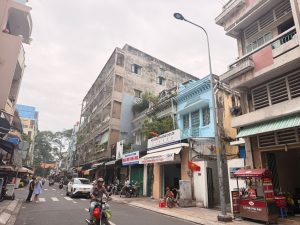
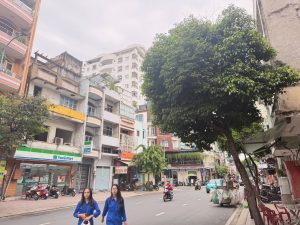
District 5 is where the Chinese immigrants from yesteryears settled down and called this part of Ho Chi Minh City home. There weren’t many sights in District 5, other than several significant Chinese temples and a market that is similar to that in District 1. After visiting the temple, as we were making our way to Binh Tay Market, we noticed District 5 seemed to be a wholesale centre. The interesting thing is that there seems to be some form of organisation of the shops in District 1. We noticed that shops selling the same or similar things tend to be grouped in the same cluster, creating a street that only sells clothes, and yet another with all the shops selling scissors.
Thien Hau Pagoda – The Anchor of Chinese Culture
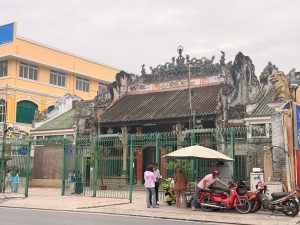
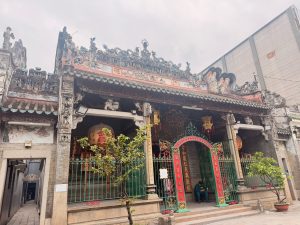
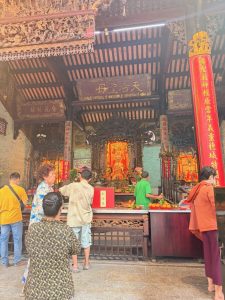
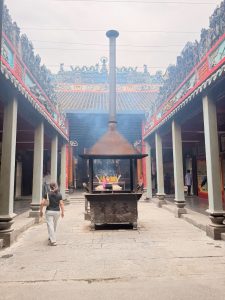
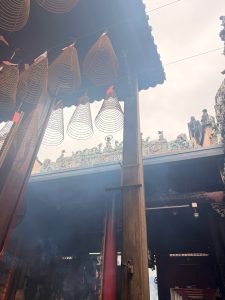
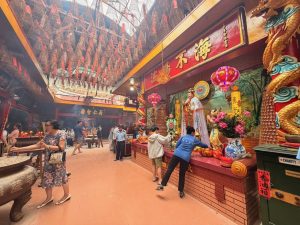
We took a Grab from our hotel to our first stop of the day, Thien Hau Pagoda in Chinatown. Built around 1760, Thien Hau Pagoda is one of the oldest and most historically significant Chinese temples in the city. Almost all original building materials, including the ornate ceramic tiles, reliefs, and incense burners, were imported directly from China. Thien Hau Pagoda is dedicated to the Goddess of the Sea – Mazu. The Chinese believed the Goddess protected them when they traversed the seas. The age of the temple is inscribed on its facade in its exposed red brick dressing and the roof that is marinated with time. The temple is topped with intricate carvings of Chinese mythological characters and animals that are typical of a Chinese temple. Thien Hau Pagoda is a relatively smaller temple with one main hall and an open courtyard in the centre of the temple. A deity sits on each side of the wall after its main entrance. In the centre of the courtyard lies a furnace and a large incense burner. The furnace was believed to have originated from China when the temple was built. From here, we could see more intricate carvings of deities and Chinese mythical animals crowding on the rooftop. In the centre hall sits the deity of the temple – Mazu, dressed in red and elaborately gold-ornamented garments that devotees probably donated. Behind the main hall, the two small side halls worship Guan Gong and the God of Fortune. As Thien Hau Pagoda was not large in size, we left after offering our prayers.
Thien Hau Pagoda in District 5
Close-up look at the facade of Thien Hau Pagoda
Mazu is the main deity installed in Thien Hau Pagoda
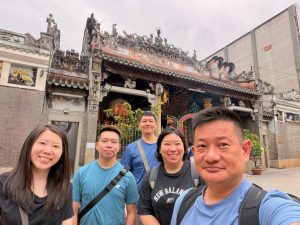
Wefie at Thien Hau Pagoda
Thien Hau Pagoda has a large open-air courtyard in the middle of the temple
The interior of Thien Hau Pagoda
Quam Am Pagoda – The Red and Yellow Temple
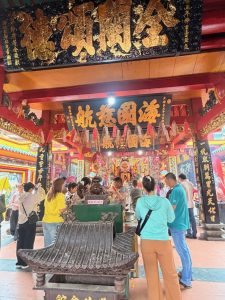
Our next sight in District 5, Quam Am Pagoda, is a 7-minute walk from Thien Hau Pagoda. Decked in a bright red facade, Quam Am Pagoda look newer than Thien Hau Pagoda. But don’t be fooled by the newer facade; Quam Am Pagoda is 20 years older than Thien Hau Pagoda. Built in 1740, it served as a gathering place for the Chinese immigrants to discuss public affairs, help one another, worship gods, and meet their spiritual and cultural demands. Quam Am Pagoda is a bigger temple compared to Thien Hau Pagoda. The interior of this temple looks brighter thanks to its open concept on the sides of the temple that lets a lot of natural light in. The bright red and yellow seen in its facade is also used throughout the temple, contributing to the brightness, together with the LED lights used. In the centre of the front hall is the Goddess of Mercy statue with a more solemn expression. There is a bigger back hall with lots of deities installed along its parameters, where we saw locals coming to pray. The biggest statue is the other Goddess of Mercy with a benevolent expression, and shares the same wall as the one in the front hall. Like the locals, we offered our prayers to the gods in Quam Am Pagoda.
The bright colours painted on the facade of Quam Am Pagoda make it look new despite being around 200 years old
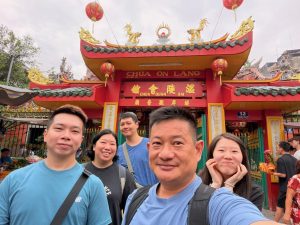
Wefie at the main entrance to Quam Am Pagoda
The interior of Quam Am Pagoda is brightly lit with natural light
The front hall of Quam Am Pagoda
The back hall of Quam Am Pagoda is installed with lots of deities from Chinese mythology
The Goddess of Mercy Statue at the back of the temple has a benevolent look
Binh Tay Market – The Chinese Market
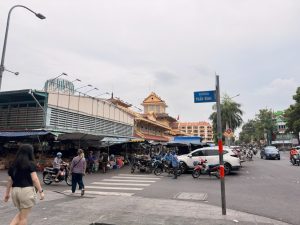
Binh Tay Market is our last stop in District 5, about 10 minutes on foot from Quam Am Pagoda. Along the way, we walked past many shops and realised that most of the shops selling similar items seem to congregate on the same street. Playfully, as we walked past shops selling packaging items, we named the street “Packing Street”, and the one that consists of shops selling toys as “Children Street”. These are, of course, not the official names of these streets, but just us having fun when walking along the street. Other than Quam Am Pagoda, the rest of District 5 seems quiet. Perhaps today was Vesak Day, a day that celebrates the birth, enlightenment and death of Buddha, explaining why more locals are gathering inside the Buddhist temple.
District 5 saw fewer toursits outside of the temples
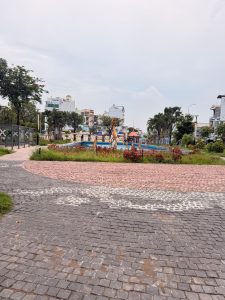
Small garden near Binh Tay Market in District 5
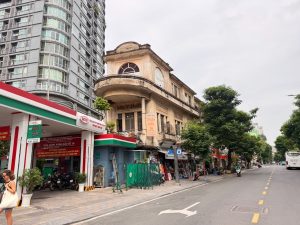
Along the streets of District 5
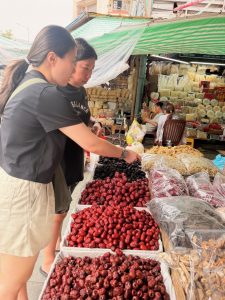
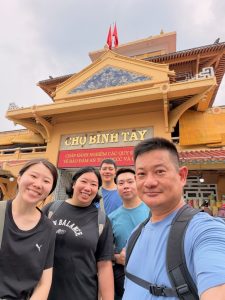
While District 1 has Ben Thanh market, mainly catering to tourists, District 5 has Binh Tay market, which mainly caters to the locals. Binh Tay market is one of the oldest markets in Vietnam, having been around since 1930. Dressed in beige colour, the main building has Chinese elements like dragons and porcelain, topped with Chinese-style roofs. Other than the stalls in the front that see more human traffic flow, the inside of the market is dead, with sparse people shopping and only a handful of shops on the ground floor open for business. However, we noticed the stalls in the surrounding extension of the market seem to have more locals shopping for their daily needs. Seeing there is nothing much we can do here, we got a Grab and went back to our hotel to rest a little and offload the shopping that my friends bought.
Binh Tay Market has Chinese elements in its facade, and felt like catering to the local community
Dried food stall in Binh Tay Market
There are more marketplaces surrounding Binh Tay Market
My friends buying goods from one of the stalls in Binh Tay Market
Wefie with the facade of Binh Tay Market
The stalls surrounding Binh Tay Market
Back to District 1 – Relaxing Shopping Time
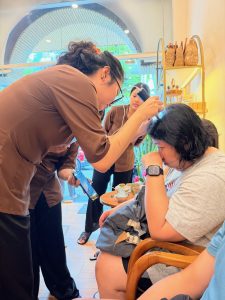
We spent the rest of the afternoon relaxing and shopping in District 1. One of the things that we came to know before visiting Ho Chi Minh City is its famous hair spa. The Vietnamese hair spa is famed for its deep scalp cleansing, followed by a hydrotherapy (a semi-circular gadget that the masseuse uses to apply warm water over our hair like a waterfall). Numerous wellness centres in District 1 offer this service. Before starting the session, the therapist used a microscopic device to show the status of our scalp and promised that our scalp would be clean after the treatment (we did not get the post-treatment scalp scan). The session was relaxing, but I thought hydrotherapy was rather gimmicky. Nonetheless, we had a relaxing time as these packages usually come with a head, neck and shoulder massage. After our hair spa treatment, we walked to the Saigon Centre to do some shopping. There are numerous shops, from luxury to sports brands, in this huge building. However, the supermarket here seems a tad more upmarket and caters mainly for foreigners. Subsequently, we headed to the Winmart (local Vietnamese supermarket) in Vincom Centre, just a 5-minute walk from Saigon Centre. We found Winmart to be a better place to stock up on Vietnamese snacks, as it is better stocked and the prices are lower. We returned to our hotel after some shopping and ordered our dinner via GrabFood.
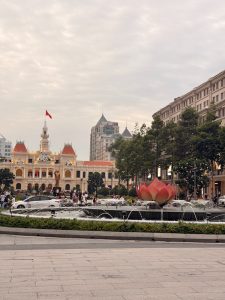
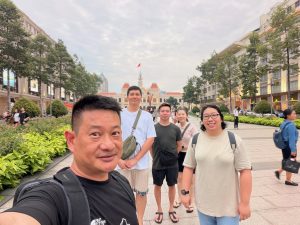
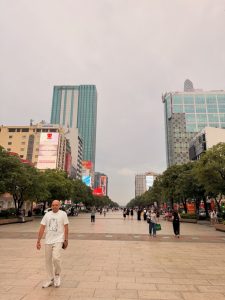
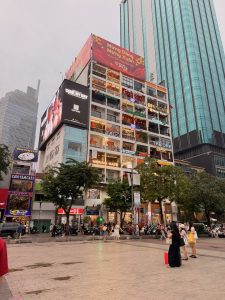
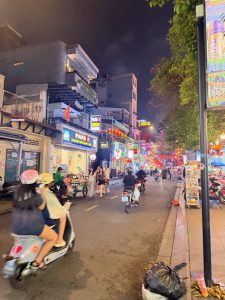
Walking on the streets of District 1
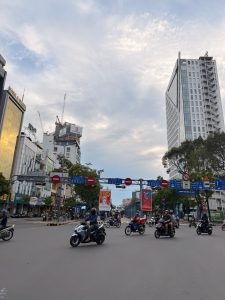
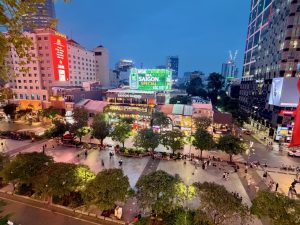
District 1 in Ho Chi Minh City
My friend having her scalp analysed before the hair spa
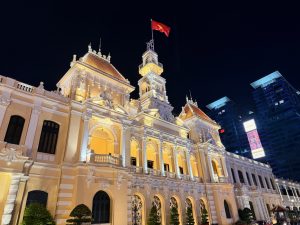
City Hall in District 1 at night
Thoughts on Ho Chi Minh City
I thought there were very limited attractions in Ho Chi Minh City, mainly situated in District 1, which we managed to visit within one afternoon. Having said that, these attractions are located near each other, making it very easy to see them within a short period of time. For those who like to experience the hustle and bustle of the city, cafe hopping, or body wellness massages, Ho Chi Minh City would be a great destination. The city is famed for its many Koi Cafes, where one would literally sit in a sunken pod with koi swimming around them. These Koi Cafes are located a little further from the city centre, but with the affordable cab fare, they are easily reachable. I also thought the cost of the wellness massages was rather affordable, and the quality is good. History buffs or people who want to understand the unification history of the country or the Vietnam War would find this city interesting, with the War Relic Museum and the Independence Palace. However, for those of us who wanted to see more than the city would find it disappointing. There was nothing much nearby to visit, other than Ba Den Mountains and Cu Chi Tunnel. Unlike Hanoi, which has the scenic Halong Bay, Sapa, Ninh Binh, or Danang with Ba Na Mountains, Monkey Hill, and the historic Hue and Hoi An, which make perfect day trips that could extend the trip for additional days. I reckon a three-day trip to Ho Chi Minh City would be sufficient.
Wefie in front of Ho Chi Minh Airport
One final wefie at the jet bridge before we board the plane bound for home
When it comes to attractions, those in Ho Chi Minh City can be completed within a day. Unlike other cities in Vietnam, like Danang and Hanoi, there are not many day trip attractions outside of Ho Chi Minh City. Cu Chi Tunnel is one of the most famous day trip destinations from Ho Chi Minh City. Most of the day trips to Cu Chi Tunnels usually combine with a river cruise down the Mekong River. However, the day trip we embarked on is one that combined Ba Den Mountains instead.
Ba Den Mountain – The Roof of South Vietnam
The drive to Ba Den Mountain took about 2½ hours from Ho Chi Minh City. Ba Den Mountain, dubbed as the roof of South Vietnam, is the highest mountain in this part of the country, standing at 986 m. There are two cableways to get to the top of the mountain: the Van Son route, the direct and faster route; and the Tam An route, where visitors are required to change cable car halfway at Hang Pagoda. We took the Van Son route, which took us about 10 minutes to scale to the top of the mountain. As we ascended from the base station, we were treated to endless farmlands in this part of Vietnam, as well as a large lake – Dau Tieng Lake, which is the largest reservoir that spans across three provinces of South Vietnam.
View of Ba Den Mountain from the carpark
Ba Den Mountain is another mountain theme park by Sun World
The cable car that took us almost 1000m up Ba Den Mountain
We saw endless farmlands as we ascended the mountain
We rode through some low clouds near the top station
My friends in the cable car looking out at the scenary
We alighted the cable car at the top Van Son Station
Coming out of the Van Son cable car station, we were greeted by a large 72m tall bronze Goddess of Mercy statue. The Goddess of Mercy, with her benevolent looks, seem to be blessing the landing under the mountain and those of us who came all the way here to visit the mountain. Before giving us our free time to wander around, our guide brought us to the edge of the viewing platform, introducing us to the surroundings while we looked out into this part of Southern Vietnam. We were given one hour to explore the mountains. After the storytelling, and before he gave us the time to roam around, our guide oriented us to the three major sights in Ba Den Mountain. Unlike similar mountains like Ba Na Mountain near Danang, Ba Den Mountain has no amusement parks; this mountain seems to be built for Buddhism.
Our first look at the 72m Goddess of Mercy Bronze statue on top of Ba Den Mountain
The Goddess of Mercy statue, with a benevolent expression, stood on top of a 5-storey building
As it was Vesak Day, my friends performed the Buddha bath ceremony
Wefie with the statue of the Goddess of Mercy
The lotus pattern arranged using the floating lamps with the Goddess of Mercy statue
View of the surroundings from the top of Ba Den Mountain
There is an exhibition of Buddha statues on the top level of Ba Den Mountain
There are numerous Buddha statues on exhibit here
Some of the items on display at the Buddha exhibition
Buddha altars on exhibit
The first sight on the mountain that we went to was the Laughing Buddha Statue that our guide recommended. To get to the lower platform, we had to take a total of 10 escalators that passed through the inside of the stone Laughing Buddha Statue. The interior is especially apparent when at the bottom of the few escalators, where we could see the layers and layers of stone that stacked up to form the Buddha statue. At the bottom of the escalators is a path that leads to the outdoor lower platform. This is where we could see how big the Laughing Buddha Statue was. We waited briefly for the water show, as our guide recommended. The water show is merely a water fountain display with water sprouting out to the rhythm of the music. The show lasted about 3 minutes. There was nothing much to do at this lower platform, and we headed back up to the main level after the show. As we only had 1 hour here, we used about 20 mins to get to the lower platform and watch the water show, and we made the decision to head straight to the Golden Buddha Statue behind the Goddess of Mercy Statue.
The water show on the lower level in front of the Laughing Buddha
There is a zen garden in the mid-level between the lower and the upper level
One of the five pillars that spans over three levels
One of the many monk statues inside the Laughing Buddha
The interior of the Laughing Buddha is decorated with many monk statues
Wefie in front of the Laughing Buddha
View of the farmlands and the reservoir from the Laughing Buddha viewing platform
The Laughing Buddha is located on the lower levels at the top of Ba Den Mountains
Along the way, we spotted the 5-storey building, at the base of the Goddess of Mercy Statue, housing Buddhist sculptures and art pieces. We would return to visit the gallery if we had sufficient time after the Golden Statue. The Golden Statue sits on top of a small hill behind the gigantic Goddess of Mercy Statue, with very well-marked signs leading us to it along the way. At the top of the hill, the Golden Buddha statue sits solemnly in the middle of an artificial pond. Not just the statue of the Buddha is covered in gold, all the other ornaments like the turtle, lotus flowers and even the rocks are covered in gold. There is nothing much to do here other than offering our prayers to the Buddha. Our 1-hour allocated time is almost up, so we hurried back to Van Son Station, where we met up with our guide and the rest of the tour group. Before heading to our next stop, we stopped by a local restaurant for lunch that is included in the tour price.
The Golden Buddha behind the Goddess of Mercy Statue
Wefie with the Golden Buddha
View of the Goddess of Mercy statue from the Golden Buddha Statue
Cao Dai Temple – First Temple of Caodaism
Our next stop, Cao Dai Temple, is a short 30-minute drive away. Caodaism is a religion that was established in Southern Vietnam in 1926. The religion, now has over 1000 followers, blends the teachings of Buddhism, Taoism, Confucianism, and Catholicism. The main object of worship for this young religion is the Left Eye of God. The Cao Dai Temple is situated in a large compound surrounded by fences and controlled entrance gates. The exterior of the temple blends a little of each religion. The twin towers at the front, the tallest feature of the temple, reminded me of the twin towers of Notre-Dame de Paris. However, it differs from the towers of the original Notre-Dame Cathedral in that these towers are topped with Chinese elements, usually found in Pagodas instead of French Gothic elements. The main structure of the temple, with its three-layered roof design, topped with small Chinese Dragon sculptures, seemed to borrow inspiration from Chinese Temples. The tower in the centre of the temple is a weird one, but it seems like a European design structure. There is another single tower at the end of the temple that resembles the top of a Chinese Pagoda. What is interesting here is the statues of the Big Three in Hinduism: Brahma, Vishnu and Shiva, sitting atop this pagoda structure. The interior of the is decorated with rows and rows of columns with Chinese dragon sculptures. Blue sky with clouds decorated with reflective glasses that symbolise stars is the main fresco on the ceiling. The centre area is only accessible to devotees of Caodaism; visitors would have to walk around the temple by its walls. We were brought one round inside the temple by our guide, who explained that the big spherical structure at the end of the temple is the main object of worship. He also mentioned that there is a celluar at the back of the temple under the sphere where past religious leaders were buried. As interesting as the religion is, I had a weird vibe here. Fortunately, we only stopped here for 15 minutes and were on our way to the highlight of this day tour – Cu Chi Tunnel.
Cao Dai Temple has a mix of Oriental and Western architectural elements
Interior of the Cao Dai Temple
The main object of worship in the Cao Dai Temple
The big three in Hinduism on top of Cao Dai Temple
Cu Chi Tunnel – The Resilience of the Vietnamese
Our next stop, the Cu Chi Tunnel, sits in a forest and is about a 1-hour drive from Cao Dai Temple. Most first-timers to Ho Chi Minh City would make this 2-hour drive trip out of the city to visit the tunnels. Cu Chi Tunnel is a complex tunnel system that stretches 250km underground, which the Vietnamese used to defeat the US military forces during the Vietnam War. The Vietnamese dug the famous tunnels in the middle of the forest to stay hidden, with movements restricted mainly to night. They would live inside the tunnel throughout the duration of the war. The tunnel has facilities such as a kitchen, bedrooms, a war command centre and bunkers, which enabled the Viet Cong to stay hidden in the tunnels for months. After alighting from our van, our guide led us to his giant board that showed the tunnel system on a map. The tunnel network is more complex than I imagined, as not all the tunnels have been discovered to date. There is a model beside the map showcasing the various facilities and how the Viet Cong lived inside the tunnel. We were then brought to a small opening in the ground that could only fit one slim person. This would be where the Viet Congs got in and out of the tunnel and also served as an ambush point.
Wefie at the entrance of Cu Chi Tunnel
Dummy bombs used during Vietnam War
Model showcasing the tunnel complex
Map of the Cu Chi Tunnel network
Cu Chi Tunnel is nestled in a forest
The tunnel entrance on the ground that is small enough to fit a Vietnamese soldier
One of the facilities on exhibit in the forest
Wefie with mannequins showcasing Vietnamese soldiers in their uniform
One of the many film rooms showing a documentary on Cu Chi Tunnel, made using a large trench dug by the Viet Congs
Cu Chi Tunnel in the forest north of Ho Chi Minh City
During the tour of the tunnels, we were also shown the various types of traps that were deployed in defence. These deadly traps were made using materials that were found in this forest and seem very effective. The highlight of the trip is the experience of crawling in one of the tunnels. Our guide told us that this tunnel was enlarged for tourists, and the actual tunnel is a lot smaller. The whole tunnel would take us 5 minutes to crawl through, but we came out from the first exit, which is about 50m from the entrance. There are four exits along the way for tourists who do not want to make it to the end of the experiential tunnel. Throughout our time in Cu Chi Tunnel, we saw small holes on the forest floor that seemed like ant holes were actually ventilation points and a number of chimneys disguised as ant mounds. Although this was my second time visiting the tunnels, I was still fascinated by the resilience of the Vietnamese, living underground for years for survival and in the defence of their land. The tunnel is worth a visit. After visiting Cu Chi Tunnel, we made our way back to Ho Chi Minh City. It was raining heavily by the time we reached the city, but the heavy rain did not really affect us since we wanted to eat at the hotel for their seafood buffet dinner.
This termite mould is actually a ventilation shaft for the tunnel
The tank that was used during the Vietnam War is on display in the Cu Chi tunnel area
This trench showcased how the Vietnamese recycled bombs to use during the war
Various traps that were used to defend the tunnel
Terminate nest simulating how the tunnel dwellers dissipate smoke during cooking
Few of the many traps used for defence during the Vietnam War
We were shown the different types of traps used during the war
Different traps are used in different parts of the tunnel
Wefie before we enter Cu Chi tunnel
Entrance to the Cu Chi Tunnel
My friends entering the tunnel
We had to bend when going into a small section of the tunnel
Inside the Cu Chi Tunnel, which is enlarged for tourists to experience
Our flight from Singapore landed in Ho Chi Minh City around noon, which gave us time to visit the sites in the city in the afternoon. As some of the more significant sights in District 1 were very close to each other, they make for a great group to visit. The airport around noon was busy. As we neared the immigration, we were taken aback by the number of tourists in line clearing customs. True to what we saw on social media prior to our trip, the immigration was packed like sardines. We estimated it would take around 2 hours to clear immigration. We were unsure what had caused the long wait time, as we saw quite a number of counters were opened (unlike our trip to Tokyo a few years ago, where only two counters were opened to clear immigration), and immigration clearance was as fast as it gets. The only logical explanation was the number of passengers coming into the city. Fortunately, we had purchased Fast Track Service that allowed us to join the queue for expats, which saw significantly shorter lines. We cleared immigration in 20 minutes. As we were being driven to our hotel, it suddenly rained cats and dogs. At this point, we were discussing our options for the afternoon and changes to the plans. There was no way we would want to walk around the city in the heavy downpours. The month of May is the transition month between the dry and wet seasons in Ho Chi Minh City, with frequent sudden heavy downpours and blazing hot weather. We were very lucky during this trip, as it was either overcast most of the time, making the weather pleasant, or somehow we avoided the rain when shopping indoors.
We are checked in and ready for our Ho Chi Minh City trip
We arrived in Ho Chi Minh City after a 2-hour flight
The Historic District 1 Circuit
Fortunately, the rain had stopped after we got to our rooms and settled in. Our historic circuit in District 1 started with Independence Palace, then to Notre-Dame of Saigon, Saigon Central Post Office, Book Street and ended with Cafe Apartment.
Independence Palace – Where the Unification Happened
Our first stop of the day is the Independence Palace. This historical landmark witnessed and is the centre of action, playing a significant role in the unification history of Vietnam. Up until 1975, Vietnam was split into two: South Vietnam, with the support of the USA, operated under a republic model; and North Vietnam, with the support of Russia, adopted a communist regime. Thus, the birth of the Vietnam War. The Independence Palace was the centre of action and where important decisions were made during the Vietnam War. The war ended when the North Vietnamese army tank crushed through the front gate of the palace, marking the fall of the South Vietnamese government, unifying the country into one communist regime to this day. The entry fee to the Palace varies, depending on how much one wants to see. The base price for only the Independence Palace costs VND 40,000; Palace and Exhibition (curating the history of Independence Palace) costs VND 80,000; and the all-inclusive price of VND 100,000 includes both entry fee to the Independence Palace and Exhibition as well as an Electric Car ride around the Palace grounds. Initially, we thought the electric car service was a ferrying service around the palace grounds. We were guided to hop onto one car, which brought us around the palace grounds, giving us narrations of the significance of the facilities in the palace grounds. The electric car tour took about 10 minutes, and we were dropped off at the entrance of the palace. I would not recommend this service for those who are short on time or just want to visit the palace.
Our first look at the Independence Palace
Wefie with Independence Palace at its entrance
We are getting ready for our Electric car tour of the palace grounds
Layout of Independence Palace
One of the original aircraft used during the Vietnam War on display in the Independence Palace grounds
We spotted tanks used during the Vietnam War on the grounds of the Independence Palace
Guest House at the back of the Independence Palace
After the electric car tour around the Independence Palace grounds, we headed to the main building. The Independence Palace was the office of the President of South Vietnam and showcased room after room when the palace functioned as the Presidential Office. We started our visit with the rooms on the first floor. On this floor, the first rooms we saw were the State Banquet Hall and the Conference Hall, situated next to the entrance. Both rooms were filled with furniture from the 70s, but in a more elaborate setting. Imagine large rooms with long tables and chairs laid next to each other with chandeliers hanging on top. These rooms look like a page from yesteryears. Despite its age, I thought this furniture was very well preserved. The highlight on the first floor is the Conference Hall in the centre, occupying part of the palace at the back. The Conference Hall is decked in maroon red from carpet to the backdrop on the stage and decorated with multiple chandeliers hanging from the ceiling. This is where the president declared his resignation after the Americans withdrew their support during the Vietnam War. A painting of the Hung Kings, regarded as the first rulers of Vietnam, hung on the wall of the Conference Hall to link the modern Vietnamese State to its ancient origins.
Independence Palace records the significant moments of the unification of Vietnam
The main foyer of the ground floor of Independence Palace
The State Banquet Hall used to host foreign dignitaries
A painting of Hung Kings, believed to be the first kings of Vietnam, hung in the Conference Hall
Wefie in the Conference Hall of the Independence Palace
The Conference Hall on the ground floor was and is still used for receptions
There was nothing much else we could see on the first floor, so we headed to the top floors before making our way down in the building to visit the other rooms. As we were walking towards the 4th floor (the lift only stops on the 3rd floor), we walked past the Cabinet room and the First Lady’s Reception Room. Other than looking at the furniture from the 70s, there seemed to be nothing too interesting on this floor. As we were walking towards the stairs that led to the top floor of the Independence Palace, we saw a small room in a cinema layout. There wasn’t much explanation here, and we can only assume this was used to play movies or propaganda films. The top floor of the palace consists of an air-conditioned room and the rooftop area. Here we saw a helicopter and two red ring markings, which marked the area when bombs were dropped by the North Vietnamese Air Force during the Vietnam War, leading to the subsequent surrender of the South and unification of the country. It is a pity that this significant historic event was not recorded anywhere on this floor. Today, the pavilion on this floor has turned into a place to sell souvenirs and hang out for local visitors to rest and enjoy the air conditioning.
The Cabinet Room, where the President held meetings with his ministers
The First Lady’s Reception Room used to host the wives of vsiting heads of state
View of the Independence Palace grounds and the streets from the top of the palace
There is small cinema on the third floor of the palace
The President’s helicopter, seen on the rooftop of the palace, is always ready for the President’s use
We continued our visit to the Independence Palace on the second floor, where we saw the president’s office, national security council chambers, the vice president’s reception room and some private apartments. At this point, we felt the rooms looked similar and just filled with furniture from yesteryears, so we brushed through the rest of the rooms in the palace. After seeing the rooms on the second floor, we subsequently followed the sign to the bunker in Basement 1. This was the heart of operations during the Vietnam War. There is a president’s office, a bedroom, and rooms and rooms of communications equipment, and also a war room. I reckon visiting the palace is best done with an audio guide, which can be rented at the ticketing counter. The explanations on the walls only mentioned what the rooms are used for, but did not detail the significance of these rooms. Without such a context, we cannot feel the significance of the palace and just see it as another tourist attraction. Our ticket also included entrance to the Exhibition that recorded the transformation of the palace from the Nodorom Palace to the Independent Palace. As we were getting a little “bored” with this place, we skipped the Exhibition and headed to our next stop.
The foyer of the second floor is decorated with a grand carpet with a Vietnamese dragon motif and an elegant chandelier
One of the two President’s reception rooms decked in the royal yellow and an elegant maroon carpet
The other President’s reception room with posh funishings
One of the many reception rooms in the Independence Palace
The command centre next to the President’s office
The command centre in the basement, where the Vietnamese war was fought
Communications centre in the basement of the Independence Palace
The President’s bedroom in the basement during Vietnam War
Last wefie with the Independence Palace before we head out
Notre-Dame Cathedral of Saigon – A Little Bit of French Outside France
Leaving the Independence Palace, we headed to our next destination in District 1, Notre Dame of Saigon. The cathedral was not far from the palace and took us only 7 minutes from its main entrance. As we were walking along the side of the cathedral, we saw some scaffolding, mainly in the front facade of the cathedral. I read online that the cathedral has been under renovation since 2017 and will not be completed until 2027. However, the cathedral was still open to the public during this 10-year renovation period. To our dismay, the cathedral was closed during our visit. Other than taking the “we were here” pictures, there was nothing much we could do here.
Side view of the Notre-Dame
The only thing we can do here is to take a wefie with the Notre-Dame
The facade of Notre-Dame is covered with scaffolding due to ongoing preservation works
Saigon Central Post Office – Oldest Working Post Office
Our next stop is just across from Notre Dame of Saigon, the Saigon Central Post Office. The post office is one of the oldest post offices in Southeast Asia, and it is still functioning today. The facade of the post office looked like some train station in Europe, with European-style casting occupying most of its facade. The beige colour used in the facade made the building look clean and fresh. The interior of the post office looked clean and bright, thanks to the beige colour used and the natural light that would shine through the glass in the central atrium. The interior that is open to the public is relatively small, given how large the post office is. The counters that still serve the locals in their mailing and tax payment needs took up the perimeter of the rectangular concourse. A large portrait of Ho Chi Minh hangs in the centre of the post office, constantly reminding us that this city is named after this legendary leader of Vietnam. Despite the overcast weather, the humid climate motivated us to head into one of the two shops at the wings of the post office in search of air conditioning to cool us off. These shops mainly sell souvenirs representing Vietnam and Ho Chi Minh City. After cooling ourselves down, we headed back out to the main concourse. This is when we saw a booth selling customised stamps. We were able to make stamps with our pictures, either using the instant camera booth or uploading through a link given by the staff. A check with the staff (and subsequently the post office staff) that these stamps can be used as postage. We thought this was a very good souvenir.
The interior of the Saigon Central Post Office
Wefie with the Saigon Central Post Office
The Saigon Central Post Office has a European-influenced facade
Book Street – An Overhyped Street
We did not stay in the Central Post Office for too long, as there was nothing much we could do here, other than posting letters and postcards. We headed out to our next destination, the Book Street. Book Street is just next to the Saigon Central Post Office, and as its name suggests, it is a short street selling books. Visitors, foreign and locals alike, come here for the Instagram photo. We did not see anyone buying or even browsing the books on sale here. The trees overshading the two rows of bookshops on the side of the road, coupled with the numerous Vietnamese flags hanging overhead across the road, indeed made this place very Instagrammable. As this is a very short street, it only took us 2 minutes to walk through it (we did not bother taking Instagram pictures here).
Book Street in District 1 is a very short street with shops selling books and souvenirs
These days these shops on Book Street also sells souvenirs
Book Street in Ho Chi Minh City
Wefie on Book Street
Nguyen Hue Walking Street & Cafe Apartment – Coffee in the Centre of District 1
Our next stop, the Cafe Apartment, is a 10 min walk from Book Street. As we were making our way, we unknowingly walked past the Saigon Opera House, sitting quietly in the corner of the road, seemingly waiting for people to discover it. The Opera House is where the famous AO show is performed. We would love to watch this performance that combines acrobatic and dance moves, contrasting the lives of the locals between the country and the city. It is a pity that the show is not on during the period that we were in Ho Chi Minh City. Nguyen Hue Walking Street is the main boulevard in Vietnam, which is an open space with shops and restaurants on both sides of the road. The Cafe Apartment, a nine-storey building filled with cafes, soon came into our sight. It is not hard to spot the apartment building with most of the cafes facing Nguyen Hue Walking Street. From the street, it appears that not all the premises are being occupied. There are several empty properties that face Nguyen Hue Walking Street. The cafe that we wanted to visit sits on the 5th floor of the apartment building. We were initially excited to find a lift that we could use to access the 5th floor. However, using the lift requires a payment of VND5,000. I find it weird that a public facility that we took for granted is chargeable. Since the cafe sits on the 5th floor, we decided to walk up the narrow staircase. We took a rest at the cafe, having some Vietnamese coffee (I had the egg coffee) and some snacks while enjoying the air conditioning in the cafe. There is also an outdoor balcony seating option that overlooks Nguyen Hue Walking Street at the cafe.
Walking on the Bustling streets of Ho Chi Minh City District 1
We spotted the Opera House sitting quietly on the street
Statue of Ho Chi Minh and the City Hall behind
Wefie on Nguyen Hue Walking Street with the Statue of Ho Chi Minh
Nguyen Hue Walking Street is a pedestrian walkway in the middle of the road
Walking on Nguyen Hue Walking Street
Wefie with the Cafe Apartment
The Cafe Apartment in District 1
View of Nguyen Hue Walking Street from the Cafe Apartment
Wefie in one of the cafes in the Cafe Apartment
Dinner at Secret Garden
After our fair share of coffee break, it is time for our dinner. I had made a booking on day 3 at this off-the-beaten-path restaurant, Secret Garden. However, a couple of our friends will be on a vegetarian diet on day 3. Seeing that we were near the Secret Garden, we made our way to the restaurant for our first dinner in Ho Chi Minh City. The Secret Garden is only a 7-minute walk from Cafe Apartment. The rooftop restaurant serves authentic Vietnamese cuisine that is also reasonably priced. Weirdly, the restaurant sits atop the residential building, hiding in one corner of District 1, where we would have missed it if not for Google Maps. The restaurant is mainly patronised by locals with a handful of foreigners. The staff were friendly, and the food was delicious. After dinner, we headed back to our hotel to rest for the night.
Wefie before we dig into our dinner
The rooftop restaurant where we had our dinner
Bui Vien Walking Street – A Sensory Overload Street
We wanted to pop into one of the few convenience stores near our hotel to get some breakfast, as we will be having an early start tomorrow for our day trip to Cu Chi Tunnel. Using Google Maps, we spotted a shop on the side street opposite our hotel. Unknowingly, we wandered into the famed Bui Vien Walking Street, one of the two main walking streets in Ho Chi Minh City. Unlike Nguyen Hue Walking Street, Bui Vien Walking Street is louder and flashier. The end of the street where we entered from was quieter with cafes, convenience stores and restaurants. But as we walked further into the street, the seemingly peaceful street seemed to be overtaken by pubs and clubs with loud music and girls dancing on the tables outside the pubs under neon lights that constantly shine into our eyes every now and then. Walking on Bui Vien Walking Street, especially at the pub stretch, was a challenge. We were constantly approached by pub staff trying to pull us into their pub for a drink. We did not like this part of the street as it was very noisy with constant irritation from the neon lights. We headed back to our hotel to rest for the night, as we would have an early start and a long day tomorrow.
Bui Vien Walking Street is famous for its nightlife and pubs
Bui Vien Walking Street has a number of restaurants and convienence stores
Our flight path from Singapore to Ho Chi Minh City
At the Airport
Check-in
Singapore Airlines departs from both Singapore Changi Airport Terminal 2 and Terminal 3 with dedicated check-in counters in both terminals. Terminal 3 mainly serves longer routes, and our 2-hour flight, which is classified as a regional flight, departs from Terminal 2. The check-in counters are spread across Rows 3, 5 and 6, with Row 3 serving Business Class and Star Alliance Gold members and Rows 5 and 6 serving Economy Class passengers. Economy Class passengers who hold KrisFlyer Elite Silver status can use the dedicated check-in counter in Row 6. Passengers who want to use the self-check-in kiosks can use the many kiosks located in Row 5. We used the check-in counters in Row 3, with the nearest door being Door 2. There was a small queue at the check-in counter during our arrival, but we did not have to wait for too long for our turn to be checked in, as Singapore Airlines had all four counters manned. Check-in was a breeze, and the ground staff performed our check-in with great efficiency. Before long, we had all four pieces of luggage checked in, and the ground staff gave us the usual information on our boarding gate and the time of boarding.
Singapore Airlines Business Class check-in counters are located at Row 3 in Changi Airport Terminal 2
Singapore Airlines Business Class check-in counters in Changi Airport Terminal 2
The queue for Business Class check-in is thin today
There are four check-in counters for Business Class in Row 3
Singapore Airlines SilverKris Lounge (Terminal 2)
Singapore Changi Airport, being Singapore Airlines’ home port, has two SilverKris Lounges, the larger flagship in Terminal 3 and the more intimate in Terminal 2. As our flight departed from Terminal 2, we headed to the recently renovated SilverKris Lounge in Terminal 2. We were approached at the entrance by the ground staff and welcomed to the lounge after scanning our boarding passes. SilverKris Lounge is decked in earthy colours, exuding a relaxing vibe; coupled with the light classical music playing in the background, the lounge felt polished. A T-shaped corridor extended from the entrance to the toilet at the end and also linked to a corridor that led to the main part of the lounge. The part of the lounge that is closer to the entrance is designed to be a lounging area and is furnished with armchairs that extend from the entrance to this part of the lounge. The back part of the lounge is designated as the buffet area, where Singapore Airlines treats passengers with local cuisine and some Western options. There is a small counter opening that serves made-to-order noodles and Singapore Airlines’ signature laksa. Sitting between the buffet and lounging areas is the main dining area, decked out with dining tables for two. Other than this main dining area, dining tables that can accommodate four to six passengers are also spotted along the wall from the entrance and the side lounge area.
Singapore Airlines motif outside the lounge in Terminal 2
Singapore Airlines SilverKris Lounge is catered to passengers flying in Business Class
There is a help desk in front of the lounge
The row of additional lounge seating in the front part of the lounge, next to its entrance
The front part of the lounge is designed with lounge seating on the left of the central walkway
There are long tables that can accommodate larger goup nearer to the buffet area in the SilverKris Lounge at Terminal 2
While there are more dining seatings on the right side of the central walkway
The part of the SilverKris Lounge that is closer to the buffet area is mainly furnished with dining tables
The dining area near the buffet is placed next to the beverage station
The cold food station is found by the wall in SilverKris Lounge at Changi Airport Terminal 2
There is a noodle station that serves made to order noodles and laksa
Warm food station is found on the kitchen island at the buffet area
There is another larger lounging area at the side of the buffet and dining area. Here is where we found more lounging armchairs for passengers to relax while waiting for their flight. Some high-back chairs were found sitting against the wall at the back of this lounging area, great for passengers who wanted to find a quiet place to work. The lighting and colour scheme at this part of the lounge created a conducive ambience for relaxing. The SilverKris Lounge in Terminal 2 is fitted with 10 shower rooms, near the lounge’s entrance. Each of these shower rooms, decked in light grey tiles and bright lights, is fitted with a toilet and a walk-in shower. I like that the shower room has a dedicated space for us to stow our carry-on.
There is a small dining area in the lounging area next to the buffet station
This part of the lounge is mainly furnished with lounging armchairs and a small number of dining seats
There is a limited number of single-seat high-back pods ideal for working in the lounging area of SilverKris Lounge
There is a large area next to the buffet station furnished with mainly armchairs for passengers to lounge while waiting for their flight
The shower room in SilverKris Lounge at Changi Airport Terminal 2
The Aircraft
Singapore Airlines operates three daily flights using its A350-900, both Medium Haul and Long Haul variants, as well as its B787-10 aircraft between Singapore and Ho Chi Minh City. For this leg, Singapore Airlines deployed its A350-900 Medium Haul aircraft featuring the Stelia Aerospace Symphony Business Class seat.
Singapore Airlines A350-900 Medium Haul Business Class cabin retains the familiar earthy palette, mainly decked in brown on cream and warm neutral colours seen in their A380 and A350 Long Haul products. However, these palettes felt more streamlined, with lighter colours used, such as mocha and orange, exuding a relaxing yet premium vibe. The earthy colour schemes are the main colours used in its seats, from the mocha inner seat shell to the light brown leather seats and the seat trimmings, while terracotta colour fills the inner shells of the side cabinet and the pillow. The light grey used in the side cabinet door and the side table matches the cream colour used in the seat shell very well. The overall colour scheme used in this cabin screams of coherence and harmony, very well suited for a regional daytime flight. The cabin ambience is further enhanced by the light tint of lilac lighting used during boarding, giving off a relaxing and airy sensation. The spaciousness of the cabin is further accentuated by the spreading out of the 40 Business Class seats into two cabins instead of cramming all 40 seats in one single cabin, which can look busy. The larger forward cabin houses 28 seats, giving off a spacious vibe, while the rear cabin houses 12 seats, feeling more intimate, but no less cramped.
Singapore Airlines A350-900 Medium Haul Business Class cabin
The aft Business Class cabin feels more cosy and intimate
The aft Business Class cabin onboard Singapore Airlines A350-900 Medium Haul Aircraft
Mood lighting mid-flight
Like its long-haul variant, Singapore Airlines A350-900 Medium Haul Business Class is served by three lavatories, one upfront just a little shy of the cockpit and the other two between the two Business Class cabins. The premium vibe also flowed into these Business Class lavatories, seen in the dark brown wooden laminate used in the sink cabinet and marble-looking laminate used in the floor. The brown backsplash at the sink enhances the premium look. Singapore Airlines stocked its Business Class lavatories with Payot amenities such as lotion, eau de toilette and facial mist. The standard amenities like the dental kits and shavers are more premium than those found in Economy Class lavatories.
Singapore Airlines A350-900 Medium Haul lavatory
Payot amenities are stocked in the lavatory
Singapore Airlines is one of the few airlines that provides dental kit in its lavatories, even for a short 2-hour flight
Seat Features
Singapore Airlines A350-900 Medium Haul Business Class seats are arranged in a 1-2-1 configuration, ensuring passengers get direct aisle access. With a pitch of 60”, the Singapore Airlines regional Business Class seats provide a good amount of legroom. However, compared to its long-haul cousin, the seat width of 20” (expandable to 22” with armrests lowered) felt a little tight. Passengers sitting next to the window or in one of their “honeymoon” seats might find the entrance to their seat a little narrow, with a gap of only 9” to navigate past the side table. However, when settled into the seats, the soft leather and the thick cushioning made these seats feel very comfortable even in the default takeoff/landing mode. Singapore Airlines promises a lie-flat Business Class seat in all of its aircraft. True to their promise, Singapore Airlines Medium Haul Business Class seats are capable of reclining 180°, turning the seat into a flat bed, which I find comfortable for short or even longer naps. Despite the lack of a sliding door, these Business Class seats provide a good amount of privacy in bed mode due to the high shell back adopted. The soft velvet inner linings of the seat shell felt comfortable and premium. I find a good amount of space for my feet in the footwell, but passengers with larger feet might find it a little cramped. I find the in-between “Lounge” mode to be the most comfortable. Other than the preset angle with a touch of the seat control button, I was able to customise the angle of the seat back recline to find the most comfortable position, while propping up my feet into the footwell. This is the best mode for dining and movie bingeing.
Singapore Airlines regional Business Class seats in take-off/landing mode
Singapore Airlines A350-900 Medium Haul Business Class seat in lounge mode
Singapore Airlines regional Business Class seat fully reclined into a flatbed
Seat control buttons
Legroom is very good on Singapore Airlines’ regional Business Class seats
Singapore Airlines’ regional Business Class seats rival its long-haul variant in terms of storage. Passengers would appreciate the small cabinet above the side table, which is great for storing the smaller items that we wanna keep within reach for the duration of the flight. Although a little tight, I was still able to fit in my 11” iPad and loose small items like my passport and charging cables. The sliding door fitted in this small cabinet also meant we were allowed to use this cabinet even during takeoffs, landings and taxiing. Other than the side cabinet, I was also able to use the space under the footwell to stow my carry-on instead of placing it in the overhead bin. I find the seat pocket a little hard to reach, being positioned near the floor at the entrance to the seat. However, this seat pocket can also be potentially an alternative storage space for slimmer items like a tablet or a magazine. When it comes to power supply, I was able to use the two USB-A power outlets and the international power outlet, which are conveniently fitted into the side cabinet, to have my devices juiced up and ready to use when I deplane. However, I find the charging speed on the USB-A ports a little slow.
Each seat is fitted with a small cabinet for storage of personal items
Each seat is fitted with two USB-A charging ports and one international power outlet in the cabinet
The space below the footwell can also be used to stow carry-on
Seat pocket is located at the entrance of the seat
Seat pocket contents
Singapore Airlines Business Class seats onboard their A350-900 Medium Haul aircraft are fitted with a sizeable and sturdy table. Deploying the seat table was a breeze with the lifting of a lever under the table. The bifold table is stowed under the personal TV and is folded in half when in storage. When fully deployed, the seat table is large enough for passengers to work on their laptops or dine. Apart from the overhead reading light, Singapore Airlines’ regional Business Class seats are also installed with a set of three reading lights on top of the inner seat shell to correspond to the three seat modes.
The Business Class table can be used in half-folded mode for passengers who want the space for their drinks
Business Class seat table when fully deployed
The side table beneath the cabinet can also be used as a cocktail table or to place our stuff for easy access
Overhead reading lights
Additional seat lights
Inflight Entertainment
Singapore Airlines A350-900 Medium Haul Business Class seat is fitted with an 18″ HD touch screen personal TV. The picture quality on these TVs is sharp and crisp, making watching movies on them enjoyable. With the tilt function built into the TV, the picture quality remains sharp even when watching it in bed mode. Singapore Airlines provides its Business Class passengers with noise-cancelling headphones, which are very effective in blocking out ambient noises. In fact, it is so effective that I had to remove my headphones when conversing with the cabin crew. The soft padding in the ear muffs made it comfortable to wear for a prolonged period of time. Each Business Class seat is fitted with a touchscreen IFE controller that resembles a mobile phone. The interface on these IFE controllers is very well designed, enabling a shallow learning curve for their usage. When it comes to entertainment, KrisWorld is decked with hundreds of entertainment options, from movies to TV shows to games. The flight time felt short when we were spoilt for entertainment options. Singapore Airlines provides complimentary Wi-Fi to all its Business Class and loyalty club passengers. However, the internet speed is only capable of supporting social media and chatting functions; one would find it frustrating when streaming videos on YouTube.
Singapore Airlines A350-900 Medium Haul Business Class seat is fitted with an 18″ touchscreen personal TV
The IFE controller resembles a PSP console
Singapore Airlines provides noise-cancelling headphones to its Business Class passengers
Singapore Airlines provides complimentary wifi to its Business Class passengers and its KrisFlyer members in Economy Class
KrisWorld is stocked with a vast library of entertainment options and is very easy to use
Meal Services
The three main course options for this flight out of Singapore were Seafood Phad Thai, Omelette with Potatoes and Beef Hor Fun. On top of these three mains, we were offered six additional options from their “Book the Cook” service. The “Book the Cook” service is an additional meal option that the airline offers for flights above 1½ hours and from selected departure airports. Of the six additional options, three are Singaporean dishes, and the other three are Western cuisine. I opted for the Singaporean Nasi Lemak from the “Book the Cook” menu. Meal service commenced about 30 minutes after takeoff. The Nasi Lemak is delicious and full of flavour. The Sambal Chilli was delicious and flavourful wi, with a generous amount. Other than the fried chicken drumstick, an egg and two pieces of Otah, I also found three prawns swimming in the Sambal Chilli that came with the rice dish. As this was a short flight, all the courses were served on a single tray, with fruits, dessert and yoghurt as an appetiser.
Menu is found in the cabinet
Meal options in Business Class today
Some of the wine available on this flight
The Nasi Lemak that I ordered from the “Book the Cook” service
My friend ordered Chicken Satay from the “Book the Cook” service
Service
The service we received on board was nothing short of impeccable. We were given the usual welcome by the cabin crew at the door during boarding, directing us to the correct aisle for our seats. The crew on board were very friendly and welcoming. I was taken care of by Eunice, who was responsible for my aisle. As soon as I was settled into my seat, Eunice appeared with a tray of welcome drinks, followed by confirmation of the “Book the Cook” meal that I had pre-booked online. Throughout our interactions, Eunice was always wearing a smile and came across as sincere. She addressed me by my first name whenever we met. Despite the short flight time, Eunice was seen patrolling the cabin, jumping into action to clear the tray when she spotted that the passengers were done having their meal. The other cabin crew working in this part of the plane were also very friendly and observant. One would come around with a basket of bread with the widest smile in the sky, while another male cabin crew member jumped into action the moment he saw me having difficulty retrieving my carry-on from the overhead bin.
Afterthought
Singapore Airlines A350-900 (Medium Haul) was a solid product. The seat was very comfortable for a short two-hour hop from Singapore to Ho Chi Minh City, though a little narrow. I was able to get a short nap after takeoff and before the meal, reclining the seat into flat bed mode. In lounge mode, the seat is most comfortable and further customising the degree of recline of the seat made it more comfortable. There were sufficient entertainment options on KrisWorld that made the flight time whiz by quickly. The meal from the “Book the Cook” was flavourful and came in a generous portion. The cabin crew were both professional and welcoming. They were seen wearing their smiles and patrolling the cabin throughout the flight. I had an enjoyable flight with Singapore Airlines.
SO/ Bangkok is located in the heart of Bangkok, opposite the famed Lumpini Park, the largest park in downtown Bangkok. There are a couple of shopping malls near the hotel. One Bangkok, the larger of the two, is diagonally opposite the hotel with shopping and food options. In terms of 24-hour convenience shops, there are two 7-Elevens within a 5-minute walk from the hotel. Despite its central location, SO/ Bangkok is only connected by the MRT and some bus services. To access the BTS, we need to catch the MRT for one stop and change to the BTS at Si Lom. For visitors who are using the BTS to visit the sights or shop in central Bangkok, where the BTS is the only way to get to these sights, they would find SO/ Bangkok a tad cumbersome to get around. There are not many sights, other than Chinatown, that the MRT connects. The MRT also connected us to shopping areas like Patpong and Terminal 21.
SO/ Bangkok facade
Reception on ground floor of the hotel assisting guests
Hote Signage
Hotel lobby on the ground floor
Reception at SO/ Bangkok on level 9
The hotel reception is located on level 9
Hotel lobby has tons of seating for guests to relax
Hotel lobby seatings on level 9
The SO/ Lofty Suite (Water Element)
We originally booked the SO/ One Bedroom Suite, the second-lowest-tiered suite in the hotel. To our surprise, SO/ Bangkok gave us a two-tier upgrade to the SO/ Lofty, the second-highest tiered suite in the hotel. The 99㎡ water-themed SO/ Lofty Suite is one of the four elemental themes on which the hotel designed its rooms. For those who prefer the higher floor, water-themed rooms sit on the top few levels of the hotel.
Layout of the Water Element SO/ Lofty Suite that we stayed in
Entryway
The entryway in the SO/ Lofty Suite is not furnished with any furniture that would otherwise make it easier for guests to take off their shoes. Instead, the plain entryway was designed to be a thoroughfare for guests between the living room and the entrance to the suite. As an introduction to the suite, we were given a glimpse of the dark grey colour scheme used to represent the claim and sophistication of the water element. The designer uses the dark tone and soothing shades of grey to enhance the panoramic city views.
The entryway of our SO/ Lofty Suite
Powder Room
The power room is situated opposite the main entrance to the SO/ Lofty Suite. The stone colour theme at the entryway flowed into the powder room. The light shade of grey on the wall of the powder room complements the darker shade used in the tile, which is one of the ways the designer of the suite uses to create a calm atmosphere. The powder room is only fitted with a toilet and a large sink, and given the space allocated to this room, the sense of calmness also comes from the spaciousness. To reinforce the water theme, SO/ Bangkok hangs a picture of a water ripple in grey tones above the porcelain throne.
The powder room in the SO/ Lofty Suite
Living Room
The shades of grey used in the powder room are replicated in the living room. Here, the lighter stone grey wall colour, together with the darker near black grey used in the tiles of the floor, created a darker interior. It is here where we could really see what the designer meant by letting the bright bustling city be the centre of attention. The darker tones in the living room focus our attention on the bright colours in the City of Angels. The colour used in the living room is slightly more from wooden tones in the TV console and the cabinets at the side of the living room (which we welcomed the abundance of storage here), to the sand coloured floor lamp sited next to the floor to ceiling window quietly provides warm illumination to the living room at night, to the light grey coloured two seater European size sofa. Despite an increase in the variety of colours used, everything flows in harmony. The two-seater fabric sofa, which is sufficient to seat three or even four adults comfortably, is the centrepiece of this part of the suite. Sitting by the walls and facing the 55” LED TV mounted onto the wall opposite, the sofa is where we relax while watching the multiple entertainment options from the TV, from international cable channels to local TV shows. There is something to occupy every age group sitting on the sofa. The larger hourglass-shaped side table functions as more than an ornamental piece. When nothing is placed on top of it, it is an art piece that gives some life in the living room, but when used, it can also function as an additional table area for us to stow our shopping. The single armchair, in the same tone as the sofa, sitting by the floor-to-ceiling window, provides guests of the SO/ Lofty suite with additional sitting space for hosting.
There is a cabinet at the wall in the living room of the SO/ Lofty Suite
The living room in our SO/ Lofty Suite
The comfortabled two-seater sofa in the living room
The living room is equipped with a 55″ LED TV mounted on the wall above the TV cabinet
The TV has lots of channel to keep us entertained while not exploring Bangkok
Bedroom
Perhaps the only space in this water element, the SO/ Lofty Suite, that took a departure from the dark tone is the wardrobe in the bed area. Instead of having a dark tone, this part of the suite is laid with natural wood colour, which seems to be for practical reasons. As there were no views in this part of the site, the lighter colour tones used here allow guests to perform functions that are allocated to this part of the suite better. I like how SO/ Bangkok designed a walk-in wardrobe in the bedroom of the suite, with a sliding door that gave the separation between the wardrobe and the bedroom. The wardrobe space employs an open design fitted with only hanging racks. Other than the ledge below the hanging racks, which we used to place our luggage and the oversized drawer below, we found a lack of shelving for us to stow our smaller clothing items. Shelving space is limited to the two built into the wall of the wardrobe, of which one is used to house the in-room safe. While we still have the other shelving to use, I find it awkward and difficult to access. Fortunately, SO/ Bangkok furnished the vanity table inside the walk-in wardrobe, which we used to place our smaller clothing items on.
The only shelving in the wardrobe is rather difficult to access
The wardrobe has a large hanging rack but few hangers
The walk-in wardrobe in our SO/ Lofty Suite sits between the bedroom and the living room
The vanity table inside the walk-in wardrobe
The sleeping area occupies the rest of the space allocated to the bedroom. The bedroom past the king bed continued the dark grey tones we saw in the living room. Differing from the living room, instead of having grey walls, the bedroom is decked with the same dark marble tiles on the floors and the walls, with only the ceiling painted in the same grey tones as those we saw on the walls of the living room to accentuate the focus on the colour of the city skyline. The king bed is very comfortable to sleep on, with a good selection of pillow options from the pillow menu that SO/ Bangkok pampers its guests to choose from; we woke up feeling refreshed every day. SO/ Bangkok did not use your traditional wooden bedside tables with drawers; in their place were white tables that stood guard on either side of the bed. Unlike the traditional bedside tables, these tables did not come with any drawers, but were sufficiently sized for us to place our lifestyle devices to charge overnight. SO/ Bangkok cleverly fitted the minibar into the suite on the wall just outside the walk-in wardrobe, next to the king bed. The minibar is only visible when the door to the walk-in wardrobe is closed. Despite taking up a small footprint in the suite, the mini bar has everything that makes it a full-functioning mini bar. It houses a Nespresso machine, a kettle and a mini fridge that is stocked with complimentary drinks that are replenished daily. I do, however, find the usage of the coffee machine a little difficult. Due to the space allocated, I would have to pull the machine to the edge of the shelf for the insertion of a coffee pod.
Looking into the bedroom of the suite from the living room
The bedroom in our SO/ Lofty Suite
The king bed in the bedroom is very comfortable to sleep on
SO/ Bangkok has a pillow menu catering to most guests’ preference
The hotel fitted Thai power outlets on both bedside tables
One of the two bedside tables in the bedroom
Mini bar is fitted at the side of the bed along the walls of the walk-in wardrobe
The sliding door to the wardrobe reveals the mini bar in the bedroom
The king bed faces the quadrant floor-to-ceiling windows that curve towards the bed, giving us views of the city from our bed. There is a fairly large space between the windows and the bed. This is where the hotel filled the void with a circular armchair and a small coffee table. This grey fabric chosen for this armchair complemented the dark grey palette used by the designer, continuing the sophistication and calm vibe we had seen in the other parts of the suite. The armchair is very comfortable to sit on, allowing us to laze, focusing our attention on the bustling city. Another 55” LED TV is placed just a little shy of the window facing the king bed. A small work desk facing the city skyline is fitted in one corner of the bedroom, with the power outlets fitted on the ledge beside the work desk. This is a perfect spot for guests to do some work. The ledge also gave us additional space to place things like documents.
Looking out in the rest of the bedroom from the bed area
The work desk is found in a corner of the bedroom next to the bathroom
There is another 55″ LED TV in the bedroom and a oversized armchair for us to relax
The work desk is of a good size
View of Bangkok from the bedroom of or SO/ Lofty Suite
Bathroom
The bathroom was allocated a good amount of space. The massive wooden sliding door separates the bedroom from the other bedroom. Right in front of the sliding door sits a dual sink. For a sink of this size, I thought the countertop space was a tad limited due to the larger-sized sinks the hotel used in the SO/ Lofty Suite. After placing a large amenities box in the centre of the sink, we were left with little space to stow our toiletries. Other than insufficient countertop space, we also found a lack of hanging spaces. There is only one hook in the bathroom, which limits the number of clothes we can hang here. The issue became more pronounced when we needed a space to hang our bath towels to dry for the next day, and at the same time, our clothes when we took a shower. More often than not, we found water splashing out of the sink due to the force from the sink, if we were not careful with turning the water from the tap to the “right” amount of pressure. SO/ Bangkok fitted the porcelain throne on the left side of the sink countertop, behind a shallow wall. There are no doors to segregate the toilet from the rest of the bathroom. The walk-in shower took up the bulk of the area in the bathroom, located to the right of the sink next to the floor-to-ceiling window. I like how the hotel placed the massive round bathtub (by the window) inside the walk-in shower. This allowed us to head straight for the shower after taking a relaxing soak, looking out into the skyline of Bangkok. The bathtub took a while for the water to fill up, partly due to the oversized bathtub and partly due to the weak water pressure.
The bathroom seen from the bedroom
The bathroom is fitted with two large sinks but the countertop space is a little tad
Bathroom amenities
The toilet sits behind a wall in the bathroom
Bathroom amenities provided by SO/ Bangkok
The bathtub is located inside the walk-in shower cubicle
We could see into the Bangkok skyline while soaking in the oversized tub
Service
The service we received in SO/ Bangkok was nothing short of excellence. From the moment we stepped out of our ride from the airport, to the check-in process and the daily interactions with staff members of the hotel, we were made to feel welcome. Everyone we bumped into wore smiles and portrayed the warmth that the Thais were famously known for. The great service started during our arrival at SO/ Bangkok, where we were greeted by the porter at the driveway. As we were talking to the driver of our airport transfer, our luggage was already taken care of by the porter who escorted us to the concierge to confirm our check-in. As we booked to stay in a suite, the porter escorted us to the lounge for checking in, and introduced the locations of the various facilities in the hotel along the way. The porter handed us over to his lounge colleagues, who assisted with our check-in. At the lounge, we were shown to a seat, and the lounge staff disappeared into action, leaving us with welcome drinks while she processed our check-in. Before long, our check-in was completed, and we were on our way to our suite, where the porter had already placed our luggage. That is what I called service! With a well-oiled team working behind the scenes to ensure our stay was seamless, starting from our check-in process.
We were served welcome drink during check-in at the lounge
Welcome drinks redemmed at the poolside bar
Welcome amenities in our suite waiting for us
The lounge staff were always very welcoming whenever I popped into the lounge for a smoke or a drink. We were greeted with the widest smile by Georgia and were always offered drinks. Whether ordering a drink to have it in the lounge or to go for our enjoyment in our suite, nothing seemed too troublesome for the lounge staff. The lounge staff always made us feel welcome at the lounge and would put down their work and give us their full attention. The staff at the Red Oven were welcoming as well. At the entrance during breakfast, we were always greeted by a cheerful staff member with a warm smile while confirming our room number and showing us to our seats. The staff at the Red Oven were always on their toes, attending to guests’ requests. They were very efficient in clearing the used plates on the tables. I had not seen any used plates being left at the table for more than 5 minutes.
Hotel Facilities
Breakfast @ Red Oven
Breakfast is served at the Red Oven restaurant, located on the 7th floor of the hotel. The Red Oven Restaurant serves up a good spread for breakfast, from Western to Asian to Thai cuisine. We were already spoiled for choices just on pastries alone, where the hotel serves a larger variety of bread from the usual suspects to croissants and au pain chocolat, together with a large variety of spreads and jams. For cold food options, the hotel offered cold cuts, smoked ham and salmon, as well as a large variety of salads. While the hot food options were a choice between sausages, bacon and eggs from the Western options, as well as dim sum and sushi from the Asian menu. There is even a small number of Thai dishes in the hot food buffet line. I find it interesting that SO/ Bangkok has a station during breakfast where Thai noodle soup is made to order. For drinks, other than the usual coffee, tea, juices, SO/ Bangkok also serves a wide variety of fruits available for breakfast that provide guests with a hearty and all-around nutrition during the most important meal of the day. There is even ice cream served during breakfast. Despite the spread of food, the menu for breakfast stayed the same throughout the three days of our stay with SO/ Bangkok.
Entrance to Red Oven where we had our breakfast
Bread station at the entrance of the restaurant
The dessert station includes ice cream
The hot food station is situated in the middle of the restaurant
The hot food and cold food stations in Red Oven
There is a noodle station that cooks Thai noodles to order
The dim sum station during breakfast
Breakfast at Red Oven
The breakfast crowd at Red Oven
Club Signature
Club Signature is the Executive Lounge in SO/ Bangkok, nestled on the 25th floor of the hotel building. The Club Signature boasts bold colour schemes with a hint of retro vibe seen in the decor and the choice of furniture. Due to the high ceilings in the main area of the lounge and the balcony that looks out into Lumpini Park, Club Signature felt airy and spacious. The fore lounge has an inviting and cosy vibe with the sofa and a handful of dining tables catering for two, furnished here. Walking into this part of the lounge felt like walking into the living room of a house. There is some outdoor furniture in the balcony that invites guests to relax while looking out into the lungs of Bangkok – Lumpini Park. It felt liberating sitting here and looking out into the city. The back part of the lounge is mainly furnished with dining tables, and is where the retro and funky vibe is most pronounced. Here, the colour choice in the decor is more vibrant and bold. Most of the dining tables here cater for two pax, arranged in front of the floor-to-ceiling window that allows guests to look out into the city. There is a handful of seating that caters to larger groups, in a sofa setting. Club Signature welcomes guests at any time of the day for a drink. But it also caters for afternoon tea and evening cocktails, where guests are treated to finger food to enjoy with the drinks. Guests who want a quieter breakfast experience can pop up to the Club Signature during breakfast hours. The breakfast spread is certainly smaller compared to the Red Oven Restaurant.
Reception outside the Club Signature Lounge
The lounge is adorned by a large fashion painting
The main lounge area
There are dining tables further into the lounge that cater to larger groups
More dining tables at the back of the lounge
There are more dining tables at the back of the lounge
Club Signature lounge has a playful vibe
The food station in Club Signature Lounge
View of the city from the balcony of Club Signature Lounge
There is a balcony at the Club Signature Lounge
The balcony at the Club Signature Lounge
Swimming Pool
SO/ Bangkok has a beautiful infinity pool that overlooks the Lumpini Park. Perched on the 10th floor of the hotel and looking out of the park, swimming in the lap pool felt like swimming in the sky amidst the greenery below the hotel. The swimming pool is large enough for guests to get some decent laps, and a small, separate jacuzzi pool at the end of the pool on the sundeck for guests to relax. In terms of sundeck chairs, about 1/3 of the poolside space is cordoned off for poolside bistrol, leaving 2/3 of the space for sundeck chairs. Despite not being blocked by vegetation, suntanning in the morning can be challenging. The swimming pool will only receive sunlight in the afternoon due to its orientation. It doesn’t help that only a handful of sundeck chairs are arranged in the sun, with the majority of them hiding under the shade. The orientation of the hotel also meant the pool can be quite cold when swimming in the morning.
The swimming pool at SO/ Bangkok overlooks the city skyline and Lumpini Park
The swimming pool at SO/ Bangkok is located on level 10
A jacuzzi in one corner of the swimming pool deck
There is a sunken seating area at the poolside bar
There are plenty of sundeck chairs at the pool, but most of these are under the shade
SO/ Fit Gym
The gym in SO/ Bangkok is located on the 10th floor in front of the swimming pool. For a gym of this size, I thought the number of pieces of equipment and the range of workouts that can be done in the gym were rather limited. For cardio workouts, the gym is equipped with three ellipticals and treadmills, and four stationary bikes facing the swimming pool, allowing only a limited number of guests to use at any one time. Other than the free weights at the end of the gym, guests who wanted to do some strength training were limited to a couple of back machines, two leg machines, and a functional workout machine. I was rather surprised to find a small studio inside the gym.
The cardio machines in the gym are placed in front of the window facing the pool
The gym is also equipped with strength training machines
There is free weight area in the gym
There is a studio in the gym at SO/ Bangkok
More strength training machines hidden in a corner of the gym next to the studio
The studio seems to have been repurposed for core training
Overall
We had a great stay at SO/ Bangkok. The Water Element SO/ Lofty Suite was well-appointed, and the sleep quality on the king bed left us feeling refreshed every day. The service at the hotel was nothing short of impeccable. All the staff whom we bumped into are always wearing their smiles and making guests feel welcome. It felt as though no request was too small, and the staff at the hotel always responded to requests with great efficiency. The location of the hotel is an issue as it is not served by any BTS (where most shopping and sights are located along the BTS lines), but via the MRT. It took us a while to get used to having the MRT as our primary mode of transport (we always used the BTS as the primary means of getting around Bangkok).
The Thai Airways A350-900 that we took between Singapore and Bangkok
At the Airport
Singapore Changi Airport
Check-in
Thai Airways used to depart from Changi Airport Terminal 1, and passengers flying in Royal Silk Class were invited to check in at the SATS Premier Check-in Lounge, where we were invited to a sit-down check-in process with direct access to immigration. Since COVID, the airlines have removed the sit-down check-in experience. The airline shifted its departures to Singapore Changi Airport Terminal 2 in February 2025, with five check-in counters in Row 8 on the right side of the terminal check-in hall. This shift also allows the airline to use the self-service check-in kiosks in the front part of the row. The nearest entrance to the Thai Airways check-in counters is Door 6 of the terminal building. There was a long queue at the economy class check-in counter (termed as assistance). Thai Airways has two other lines at the airport, one for Business Class passengers and another for Star Alliance Gold members. There was no queue at the time of our arrival in these two lines. Thai Airways has one counter for Business Class passengers and Star Alliance Gold members. The ground staff checking us in came across as impatient. There were no smiles from her, nor did she bother to establish rapport. She took a while to complete our check-in, did not even bother to give us information about the lounge that we could use or the boarding gate and time. She merely placed our passports and boarding passes on the counter table.
Thai Airways check-in counters are near Door 5 at Changi Airport Terminal 2
Thai Airways check-in counters are located at Row 8 in Changi Airport Terminal 2
Queues for Royal Silk Class passengers and passengers holding Star Alliance Gold status flying in Economy Class
There is only one counter serving Royal Silk Class passengers in Singapore Changi Airport Terminal 2
Queue for Economy Class passengers who prefer counter check-in
There is one counter each for Royal Silk Class and Star Alliance Gold members
Thai Airways check-in counters at Row 8 in Singapore Changi Airport Terminal 2
There is a long line for Economy Class passengers who wanted to perform counter check-in this morning
Self-check-in kiosk in Singapore Changi Airport Terminal 2
Passengers performing self-check-in and bag drop in Changi Airport Terminal 2
Thai Airways passengers can also opt to use self-check-in kiosks in Changi Airport Terminal 2
There are plentiful self-check-in counters in Terminal 2
Singapore Airlines SilverKris Lounge
Thai Airways used to operate its own lounges when it departed from Terminal 1. The airline closed its Royal Orchid Lounge in 2023 and has been using a contracted lounge since. With its move to Terminal 2, passengers flying in Royal Silk Class were invited to use the contracted SATS Premier Lounge in Terminal 2 (as printed on the boarding pass). Being a contracted lounge, SATS Premier Lounge is always crowded as it has to cater to airlines and lounge access pass holders. Fortunately, as Thai Airways is a member of Star Alliance, we were able to use the Singapore Airlines SilverKris Lounge in Terminal 2. I was pleasantly surprised to find a newly renovated SilverKris Lounge. There was much hype on social media about the renovation of the First Class Lounge, but not much was mentioned about the renovation done to the SilverKris Business Lounge. The moment we approached the lounge, the eagle-eyed staff took the initiative to approach us instead of waiting for us at the entrance of the lounge. The newly renovated lounge felt more polished and relaxing. The walnut brown seen in the wooden walls and the light grey carpeting accentuated the relaxing vibe past the staffed counters at the entrance of the lounge; a row of leather armchairs with marble-top side tables lined up the corridor that leads to the main part of the lounge. SilverKris Lounge at Terminal 2 is equipped with 10 shower rooms next to the toilet across from its entrance. There is a counter where, I guess, passengers can approach the staff to get a queue number during busy times. As the lounge was not crowded at the time of our visit, we could just walk into any of the empty shower rooms. The newly renovated shower rooms, decked in light grey marble, felt luxurious and spacious. There is a toilet facility in every shower room, on top of the walk-in shower cubicle fitted with both a rain shower and a regular shower head. I liked how the airline fitted a small stone table in the shower rooms, catering to passengers with carry-on baggage.
Turning left from the corridor at the entrance, we came to the main part of the lounge. Singapore Airlines furnished the left side of this corridor with the same armchairs, arranged in groups of four, catering to families or larger groups, as those we had seen by the entrance of the lounge. This corridor extended all the way to the back of the lounge, where the buffet line is located. On the right of this corridor, we spotted dining tables, arranged to seat four at each table. The space just shy of the buffet line is also furnished with more dining tables, forming the main dining area in the lounge. Singapore Airlines dedicated the sizeable area next to the main dining area as the lounging area, mainly decked with armchairs. The natural lighting streamed from the frosted glass, making this area feel bright and less claustrophobic. A handful of dining tables are also found in this part of the lounge that can seat up to six. Overall, the renovated lounge is refreshing, comfortable and relaxing.
There is a good mix of lounging and dining areas along the corridor from the entrance of the SilverKris Lounge in Changi Airport Terminal 2
The area at the front part of the lounge is decked with dining tables
Dining tables are arranged just before the buffet section in the lounge
There is another area at the side of the buffet line with more lounging chairs and a few more dining tables
The lounging area of the lounge beside the buffet line
There is a children’s playroom and more lounging area in the lounge
The buffet line is located at the back of the lounge, where we found a cold food selection at the counters by the walls, and hot food options with a good mix of local cuisines laid out on the island. There is a small counter at the side of the buffet area, serving the must-try made-to-order Singapore Airlines Laksa. The beverage stations are located next to the dining area before the buffet line.
The beverage station in the buffet area of the lounge
Ther eis a fridge of cold beverages at the end of the beverage station
The main buffet line serving hot local cuisine
Breakfast selection at the counter by the wall in the buffet station
Ice cream is available during breakfast at the beverage station
Bangkok Suvarnabhumi Airport
Check-in
Thai Airways dedicated the entire Row A to their Premium Passengers, with a bulk of the row set aside for their Royal Silk Class passengers, and a small corner carved out for their First Class passengers. Despite having the whole row of counters, only three were open for processing check-ins. Although there was only one passenger ahead of us, we had to wait a little while for our turn to check in. The ground staff was very friendly and processed our check-in efficiently. Other than the boarding time, she also recommended the nearest lounge that we could use while waiting for our flight. One benefit of flying Thai Airways Royal Silk Class is access to the fast-track immigration lane, located in the same area as their Royal Silk Class check-in counters. This fast-track immigration usually sees few passengers and is also open to passengers flying Business Class on other airlines. Despite being at a busy time when we arrived at the airport, we were through immigration in under 5 minutes.
Door 1 is the nearest door into the airport terminal for Thai Airways Royal Silk Class check-in counters
Thai Airways dedicated Row A to Royal First and Royal Silk Class passengers
Thai Airways dedicated the entire Row A for its Royal Silk Class passengers for checking in
Royal Silk Class passengers are entitled to use the fast-track immigration lane next to the check-in counters
Despite having the entire row, only three counters are open to serve passengers
The fast track security lane, opened to all passengers travelling in Business Class, is located next to Row A in Bangkok Suvarnabhumi Airport
Royal Orchid Lounge (Concourse D)
The Thai Airways Lounge is the default lounge that the signs point to after clearing the fast track security and immigration at the back of Thai Airways check-in counters at Row A. There is an escalator that leads to the lower floor of the airside after immigration. A couple of ground staff at the reception welcomed us with the typical Thai warmth. From there, there are two lounges: the older Thai Airways Royal Silk Lounge on the left and the newer and bigger Royal Orchid Lounge on the right. There are two entrances to the Royal Orchid Lounge, one after the escalator at the fast-track immigration and the other facing Concourse D. From the fast-track entrance, a bar counter where we could order cocktails and mocktails from welcomed us. The presence of green walls and the bright lighting made the lounge feel airy and spacious. The natural wood element seen in most Thai designs and the signature Thai Airways purple are the primary colours used to decorate the lounge. Most parts of the lounge are furnished with lounge armchairs that are dotted in front of the multiple green walls, with two dining areas found next to the buffet lines. There are lots of lounge seats spread across the lounge, mainly on the left side of the lounge, by the windows. The light purple and mustard yellow armchairs and the accompanying side tables made relaxing with a beverage here comfortable.
Thai Airways Royal Orchid Lounge at Concourse D is just one escalator away from the dedicated fast track immigration lane
We were welcomed by the friendly ground staff at the reception of Royal Orchid Lounge
Thai Airways Royal Orchid Lounge sigange
There is a bar counter serving up cocktails and signature Thai beverages at the Fast Track entrance of the lounge
Armchairs are dotted all over the Royal Orchid Lounge for passengers to relax
There are tons of green walls in the lounge bringing live into the lounge
Lounge seatings are mainly arranged around the green walls in the Royal Orchid Lounge
I like the green walls displayed throughout the Royal Orchid Lounge
We spotted a buffet station after the bar by the Fast Track entrance of the Royal Orchid Lounge at Concourse D
Buffet line at the dining area near the Fast Track entrance of the Royal Orchid Lounge
The dining area near the Fast Track entrance is placed in front of the buffet line
Most part of the lounge is furnished with armchairs for passengers to relax before their flight
Lounge seatings in the Royal Orchid Lounge
The Royal Orchid Lounge has two dining areas, one at the fast-track entrance and one near the Concourse D entrance. The dining area near the fast-track entrance is furnished with a number of round dining tables, where we had no problems finding seats. The buffet line at this entrance offered mainly Thai dishes with a small selection of vegetarian options at the hot food line next to the dining area. Desserts and beverages are found on the counters behind the hot food counters. The other pocket of the dining area is near the Concourse D entrance, after the toilet and shower rooms. There seem to be more food options here, with a kitchen island filled with salads and fruits, and another with light snacks. The hot food section is found on the counters against the wall, offering similar Thai food options. There is an à la minute food counter here where chefs serve food cooked to order. The Shrimp Tom Yum Ramen was delicious with a generous amount of shrimp.
The buffet station near to the Concourse D entrance of the Royal Orchid Lounge
On top of the buffet line, we also found a counter that serves made-to-order meals
The beverage station at the buffet station near the Concourse D entrance of the lounge
There are also signature Thai desserts at the made-to-order counter
The Tom Yum Shrimp Ramen that I ordered from the made-to-order counter
The menu at the made-to-order counter changes perodically
The dining area is located next to the buffet station near the Concourse D entrance of the lounge
There are different dining tables catering for differing group sizes
There is a work station amidst the lounging chairs opposite the dining area near the Concourse D entrance of the Royal Orchid Lounge
The green walls amidst the walnut coloured walls gave the lounge a “jungle” vibe
The lounge seating at Royal Orchid Lounge is arranged on one side of the lounge, making a clear segregation between dining and lounging
Inside Thai Airways Royal Orchid Lounge at Concourse D
The entrance reception facing Concourse D
The shower facilities are situated in the middle part of the lounge, between the two dining areas. To use the shower rooms, I approached the staff at the reception outside the toilet, who ushered me to the next available shower room. The shower room was spacious and screamed of luxury. Other than the usual sink and walk-in shower, the shower room is also equipped with a toilet and, most importantly, racks for us to stow our carry-on baggage.
The counter outside the shower rooms where we can make reservations for shower facilities in the lounge
The shower room in Royal Orchid Lounge at Concourse D
The sink and toilet in the shower room
There are quite a number of shower rooms in the lounge
The shower amenities Thai Airways treat its passengers in the shower room
The walk-in shower in the shower room
There is a rack in the shower room where we can place our carry-ons
The Aircraft
Thai Airways flies six flights between Singapore and Bangkok daily, using a mix of B787-8, A350-900, their refurbished A320-200 aircraft, and their new A321neo. We flew in the A350-900 for this trip. Thai Airways has three configurations for this type of aircraft, and we got the v.1 of this aircraft featuring their signature Stelia Solstys seats that are also installed in most of Thai Airways’ long-haul aircraft.
Thai Airways A350-900 v.1 Royal Silk Class cabin incorporated Thai design elements as seen in the heavy use of natural wood finishing. The wood element is seen the moment we step onboard the aircraft, where the galley floor is laid in wood panelling. This wood element flows into the Royal Silk Class cabin in the form of the side table, parts of the seat shell, and the seat pocket. Purple is the colour element used by Thai Airways, derived from the Thai orchid, which symbolises tropical beauty and a blend of modern elegance with traditional Thai culture. The cabin is decked in shades of purple to reflect the brand identity of the airline, as seen in the seats, seat shells, and carpet. There is even a large purple orchid motif on the bulkhead at the back of the Royal Silk Class cabin. The large windows used on the Thai Airways A350-900 let in a lot of natural light, which made the cabin look spacious and enhanced the purple hues used in the cabin, despite housing 32 seats at the front of the aircraft. The bright and airy vibe in the Royal Silk Class cabin is accentuated by the white colour used in the bulkhead and parts of the seat shell.
Thai Airways Royal Silk Class A350-900 (v.1) cabin is decked in the airline’s signature purple colour
Thai Airways A350-900 (v.1) Royal Silk Class cabin
The white walls and the number of seats made the Thai Airways A350-900 (v.1) Royal Silk Class looked spacious
The wood grain on the side table and the literature pocket not only add colour to the cabin, it also add a sense of lux
First look at the Royal Silk Class cabin onboard A350-900 (v.1)
The purple mood lighting used in mid-flight complements the colour scheme of the cabin very well
There are three lavatories serving all 32 passengers in Royal Silk Class, with one located up front and two between the Royal Silk Class cabin and the Economy Class cabin. These lavatories are pretty much standard-sized, but the mirrors used here made it feel larger than it actually is. Thai Airways A350-900 v.1 Royal Silk Class lavatories are located at the front of the cabin. The wooden panelling on the floor and the sink not only pay homage to the Thai design element, but it also makes the lavatory feel premium. I like how the sink in the lavatories feels large, thanks to its rectangular, deep sink design. Thai Airways stocked their Royal Silk Class lavatories with house-brand eau de toilette and hand lotions. However, dental kits were stocked only on the morning SIN-BKK flight and not on our afternoon return flight.
The Royal Silk Class lavatory has a premium feel thanks to the lamented wooden panelling at the sink
The tissue and paper cups in the lavatory
Unlike our SIN-BKK leg, the BKK-SIN leg did not have dental kits stocked in the paper bag beside the hand lotion
The amenities in the lavatory include Eau de Toilette and hand lotion. However the dental kits is only found on this SIN-BKK leg
Seat Features
Thai Airways A350-900 v.1 Royal Silk Class cabin is fitted with 32 seats arranged in a staggered 1-2-1 configuration across eight rows. These seats have a pitch of 60″ and measure 20″ wide, and are the narrowest Royal Silk Class seats the airline has. Despite not being installed with a side door (or panel), these Thai Airways A350-900 v.1 Royal Silk Class seats offer a good amount of privacy, with the high shell back design that somewhat hides passengers, especially those sitting next to the window. Like most Business Class seats, these seats come in three preset modes – the upright, flatbed and lounge mode- which can be converted with a touch of one of the nine seat control buttons located at the side table. In upright mode, the seats felt comfortable thanks to their thick padding and the fabric used in the seats. Another button reclined the seat 180°, converting it into a flatbed. In bed mode, the seat also felt comfortable. My favourite mode is the mode in between, which I termed the “lounge mode”. I was able to get comfortable and relaxed in the angled seat back, with the seat positioned closer to the ottoman for us to rest ur feet on. To ensure passengers get more comfortable in these Royal Silk Class seats, four of the eight seat control buttons allowed us to adjust the angle of seat recline and calf rest, and the position of the upper and lower lumbar support. With such versatility, I was able to find a position of the seat that made me feel comfortable. The other two buttons adjust the reading light and the light at the side table.
Thai Airways Royal Silk Class seat onboard A350-900 (v.1) in take-off/landing mode
Thai Airways A350-900 (v.1) Royal Silk Class seat in lounge mode
Thai Airways A350-900 (v.1) Royal Silk Class seat in flat bed mode
The legroom on the Royal Silk Class seat was excellent
Seat controls is mounted on the armrest next to the side table
The storage situation in the Thai Airways A350-900 v.1 Royal Silk Class cabin is a bit of a let-down. There is only one deep cubby under the inside armrest of the seat for us to stow our stuff. This cubby is ideal only for stowing “taller” items such as a thin book or iPads. The deep design does not allow us to stow smaller items such as our mobile phones, charging cables and passports, as fishing them out would be challenging. The only other place we can stow our stuff is on the side table. However, this side table cannot be used for stowage during taxi, take-off and landing. The space under the footwell is another storage place which we can use to stow our carry-on. The seat pocket in the Royal Silk Class seats is found next to the headrest. However, due to the rigid design and the awkward position, I find storing anything here challenging.
The only storage in these Royal Silk Class seats onboard Thai Airways A350-900 (v.1) is the small cubby under the inside armrest
The side table can only be used to stow items when the aircraft is at crusing altitude
The space below the footwell is another option for us to stow our carry-on
There is another seat pocket at the entrance of the seat, but can hardly used to stow anything
The seat pocket is found above the side table on the Royal Silk Class seat onboard Thai Airways A350-900 (v.1) , but the rigid design prevents us from storing anything
Seat pocket contents
The seat table in Thai Airways A350-900 v.1 Royal Silk Class seats is stowed on the seat shell in front, secured with a ledge. The table is of a good size, which gave us sufficient space to dine or work on our tablets or laptops. I like how the seat table can be swivelled for us to exit the seat without putting it away in its stowage position. The side table in the seat not only serves as a cocktail table, but we were also able to use it for stowing at cruising altitude, keeping our stuff within reach. To keep our devices juiced up, Thai Airways A350-900 v.1 Royal Silk Class seats are fitted with two USB-A charging ports under the personal TV. But I find the charging speed on these USB-A ports to be slow. There is an additional international power outlet at the seat. In addition to the overhead reading light, Thai Airways installed another reading light at the headrest of the seat.
Thai Airways fits its Royal Silk Class seats onboard its A350-900 (v.1) aircraft with a large and sturdy seat table
I like how the seat table can be swivelled so we can get in and out of our seat without putting the table away
Seat table storage in the Royal Silk Class
There are two USB-A charging outlets under the personal TV with very slow charging speed
Beside the overhead reading light, there is another reading light at the side of the Royal Silk Class seat
The standard overhead reading lights
Headphone jack and international power socket is found on the side of the seat
Inflight Entertainment
Thai Airways A350-900 v.1 Royal Silk Class seats are fitted with a 16″ touchscreen personal TV. The picture quality on the personal TV is good, but it can be a tad reflective when the window shades are left open in the day. The touchscreen function on the PTV is very responsive, giving us the option of selecting our entertainment options directly on the TV. The IFE controller, stowed above the armrest, is very intuitive to use. Designed to resemble a PSP handheld device, entertainment options can be selected via the touchscreen panel. The IFE controller also switches on the overhead reading light and has a service button built into it. The noise-cancelling headphones supplied by Thai Airways in the Royal Silk Class are comfortable to wear for a prolonged period of time and are very effective in blocking out ambient sound. However, the headphone protectors had a very bad fit on the headphones. My protectors keep falling out on both legs of the flight. The Thai Airways IFE is stocked with a large library of entertainment options, from the latest Hollywood blockbusters to movies of yesteryear to TV serials. We found a good range of genres to occupy us during our 2-hour flight. There is even a menu of Thai movies to keep us occupied. The Thai Airways A350-900 aircraft is equipped with Wi-Fi offering 60 minutes of complimentary internet to Business Class passengers, accessible with the Wi-Fi code printed on our boarding passes. However, as the Wi-Fi code was not printed on our outbound boarding pass, we only had internet access on our inbound flight. The internet speed offered is only sufficient for social media browsing and chatting.
Thai Airways fitted a 16″ HD Personal TV in each Royal Silk Class seat
The IFE controller onboard is very easy to us
Thai Airways provided noise cancelling headphones to its Royal Silk Class passengers
The IFE menu is very well organised
Entertainment sub-menu that made selection of movies very easy
There is wifi onboard the A350-900 aircraft, but we were only given the code (printed on our boarding pass) for our BKK-SIN leg
Royal Silk Class passengers gets 60 mins of free wifi onboard
Meal
Due to the short flight time between Singapore and Bangkok, instead of serving our meal course by course, the meal was served all at once. Thai Airways offered three meal options on both legs of the flight.
SIN-BKK
Thai Airways served its Royal Silk Class passengers two appetisers. I thought the Tiger Prawn with Smoked Duck was a tad tough, but the overall flavour profile was good. The Pommery mustard did not come across as overpowering and complemented the dish well. The other appetiser on the plate was the Foie Gras, which I only took a bite of, as I am not a Foie Gras person. The Foie Gras has a buttery but gamey aftertaste. Out of the three options for the main course from the in-flight menu: chicken with jasmine rice, braised beef with wine sauce, and prawn with salty egg yolk, I opted for the Chicken Breast with Garlic Chilli Sauce. The chicken was a little tough, but the sauce was flavourful with a hint of spiciness that goes very well with the Jasmine Rice. The dessert comes in two separate bowls, one with the cheese platter and the other with the Mango Crème Brûlée Tart, which was sweet and refreshing.
The meal options for the SIN-BKK leg of the flight
Beverage options for throughout the flight
The Grill Sous Vide Chicken Breast that I opted this morning
I went for the Thai Airways signature drink, the Violet Bliss, as the pre-departure drink
I had more Violet Bliss during meal time
The cabin crew came by with coffee after meal
BKK-SIN
For this leg of the flight, we were served crab meat and salmon tartare as the appetiser. The crunchy roll had more of a vegetable taste rather than the taste of crab or salmon. Nonetheless, the appetiser tasted fresh. The three options for the main course on this flight comprised Duck Breast with Red Curry, Beef Fillet with XO Sauce and Pan-Seared Turbot. I opted for the Turbot, which was well seasoned and moist. The Tarragon Shallot Cream Sauce tasted a little thick and heavy, but it goes very well with the fish. Despite being fried, the fingerling potato was saggy due to a prolonged period of mixing with the sauce. However, the paprika powder packs a punch to the otherwise plain potato. It is a pity that the amount of paprika powder scattered on the potato was insufficient. Like our outbound flight, we were served with two desserts. As I am not a cheese person, I skipped the cheese platter. In the other dessert bowls, there were two small dessert dishes. I did not quite like the Caramel Jelly as I find it overly sweet, but I enjoyed the Mango Sticky Rice. The mangoes were sweet, while the pandan flavour used in the sticky rice was flavourful.
The meal options for our BKK – SIN leg
Beverage options today
I went for the Pan-Seared Sous Vide Turbot tonight
Thai Airways provided physical menu in its Royal Silk Class
More Violet Bliss for pre-departure drink
Cabin crew served warm nuts before meal service
Service
We were very well taken care of by the cabin crew in Royal Silk Class on both legs of the flight. The cabin crew portrayed the warmth and hospitality that the Thais are famed for.
Cabin crew patiently explaining the meal options to other passengers
SIN-BKK
The service onboard this leg was nothing short of impeccable. Apart from the mandatory welcome at the door during boarding, the friendliness of the crew and the excellent service were also experienced throughout the entire 2-hour flight. The moment I settled into my seat, another cabin crew member came around with pre-departure drinks, while another came around with hot towels. The cabin crew working on my aisle introduced herself to us while taking our lunch order. I thought it was very thoughtful for her to inform us of the location of the lavatories. All the crew were very friendly, wearing their smiles throughout the flight, keeping themselves busy patrolling the cabin and clearing the tables. They were very responsive to passengers’ call buttons. The cabin crew working on my aisle constantly asked if I needed more drinks and coffee after the meal.
BKK-SIN
The crew on board this flight also made passengers feel welcome. The warmth and hospitality were immediately felt at the door when the cabin crew welcomed us on board with the widest smile that one can ask for. The observant cabin crew working in the galley at the front of the aircraft noticed us walking past the galley to our seats, dropped their work immediately and made way for us with a smile. We were served welcome drinks the moment we settled into our seats. When dishing out pre-departure towels, the cabin crew explained to every passenger that they were giving out cold towels due to the hot weather. I find this to be a very thoughtful touch. The cabin crew were smiling all the time when interacting with passengers. Throughout the short 2-hour flight time, the cabin crew were seen patrolling the cabin very frequently. All four cabin crew working in Business Class were seen helping each other, serving passengers with food or drink, or clearing trays for passengers. Before landing, the cabin crew would go around thanking every passenger for flying with the airline.
Afterthought
The last time I flew on Thai Airways was before the pandemic. Back then, I found the service level on both Economy and Royal Silk Class to be inconsistent. This time round, I found consistent service on both legs of the flight. The cabin crew were welcoming and sincere. Other than serving food and drinks to the passengers, these diligent cabin crew made flying with Thai Airways very pleasant. The seats looked outdated and showed signs of ageing, and storage in these Royal Silk Class seats was rather limited. However, I found them very comfortable, especially in lounge mode. They are so comfortable that I dozed off while watching movies on the IFE. The food served was of high quality and very delicious. Overall, I had a very pleasant flight on board the Thai Airways A350-900 Royal Silk Class.
Departing from Singapore Changi AirportFlying above the clouds over the city