Macau Day 4 (28 Dec 25): Last Minute Shopping & Departing Macau

This is our final day in Macau, and since our flight departs from Hong Kong International Airport in the evening, we had the flexibility to relax in the hotel or head out for some last-minute shopping. Since our pre-booked bus to Hong Kong is at 3.30 pm, we had a good 3 hours before we needed to leave for the Hong Kong-Zhuhai-Macau Bridge (HZMB) border to catch our bus to Hong Kong International Airport.

Last Minute Shopping at Senado Square

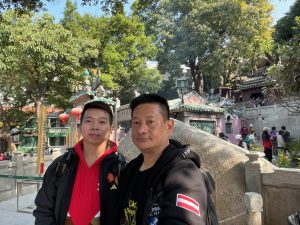
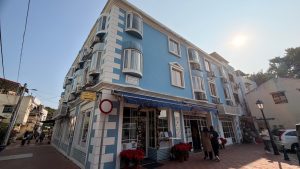
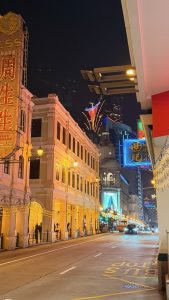
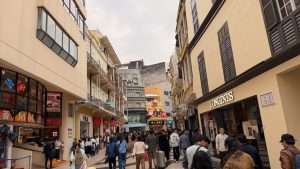
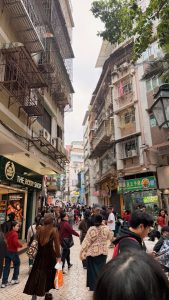
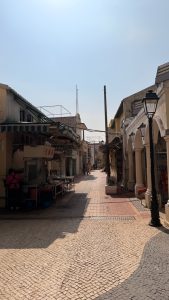
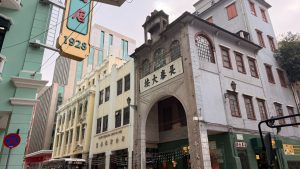
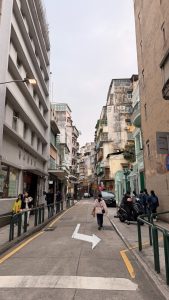
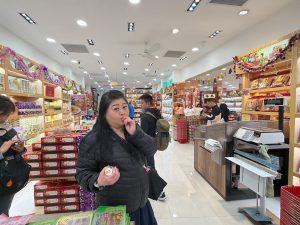
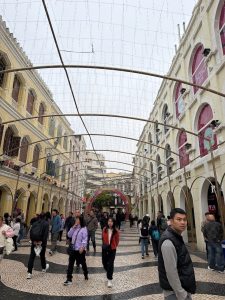
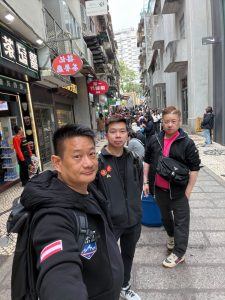
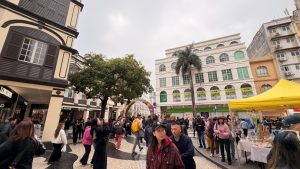
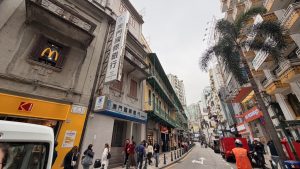
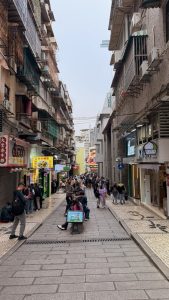
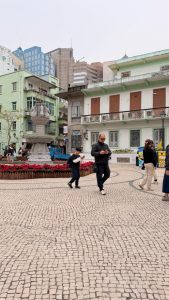
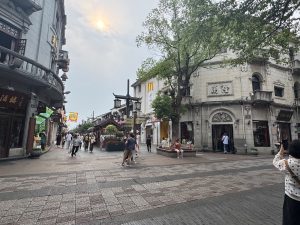
After breakfast, my sister wanted to head out for some last-minute shopping. To make the most of the time we had, we went to Senado Square, which is a stone’s throw from our hotel. Senado Square seemed to be more crowded than on the second day we were here. We spent the remaining 3 hours we had shopping for souvenirs and clothing in Senado Square, making it a great spot for both shopping and sightseeing.

Macau to Hong Kong Airport

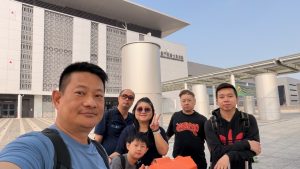
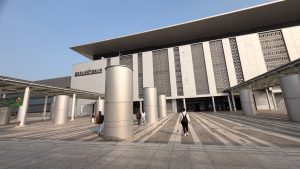
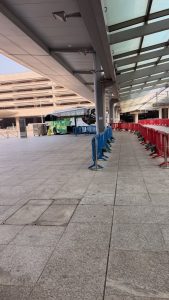
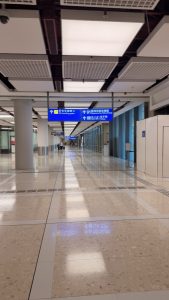
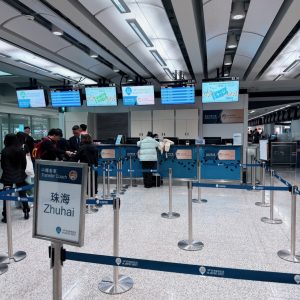
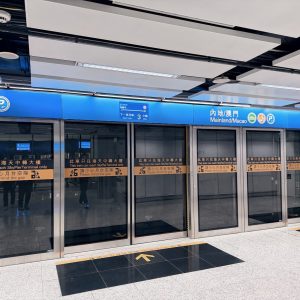
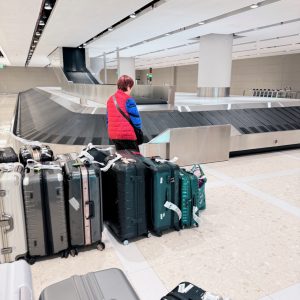
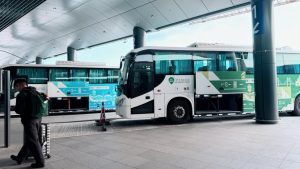
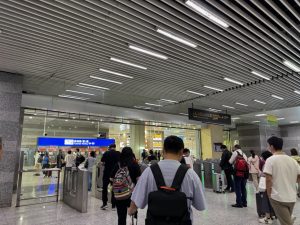
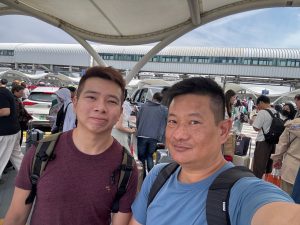
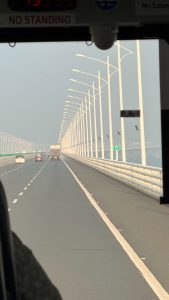
As we flew out of Hong Kong International Airport, we added an additional hour to the airport from Macau. Departing from Macau via bus, only a few airlines allow check-in at the HZMB border. As the airline we are flying is not on this list, we were required to bring our luggage to Hong Kong International Airport and check in at the Sky Pier Terminal (Click here for more information on the airlines eligible for check-in at the HZMB border). Like our entry to Macau, we cleared immigration at the HZMB border relatively fast. Soon, we found ourselves in the immigration area of the border control building, looking for the bus to Hong Kong International Airport. However, after we had found our bus, we were told we were late for check-in. Turns out that we needed to check in for our bus ride 45 minutes before our scheduled departure (we were at the bus at 3.15 pm for our 3.30 pm departure). Fortunately, the next bus departs at 4 pm, 30 minutes after our original bus departs. The helpful staff quickly helped us change our bus tickets and took our luggage. At the Hong Kong International Airport Sky Pier Terminal, check-in was a breeze. After we checked in for our flight and obtained our boarding pass, we were given instructions on where to clear immigration and where to collect our airport tax refund since we technically did not enter Hong Kong.

Afterthought

Macau can be an easy day trip from Hong Kong, provided one leaves early and returns late at night. Given our two full days, there are still areas that we planned for but did not cover. For a slower pace and fuller Macau experience, I thought three full days would be ideal. There are activities such as Go-karting and the Panda conservation centre that are suitable for families. In terms of where to stay, I thought Cotai is suitable for those who are attracted to the glitz and glamour, as well as luxury shopping and casino gaming. For those who want a more authentic Macau experience that is close to the historical attractions, the Macau Peninsula is a great option. In terms of food, I thought Macau’s was not as good as Hong Kong’s. Half the time, we had trouble finding decent food. Perhaps we limited ourselves to Macau Peninsula, where the food is more influenced by Mainland China, or perhaps we did not bother Googling for better restaurants.

Macau Day 3 (27 Dec 25): Coloane Village & Cotai Strip – From the Laidback Village to the Flashy Las Vegas of the East

Having visited the sights on Macau Peninsula yesterday, today we are focused on the sights on the other island of Macau. We started our day by visiting the A-Ma temple, then headed to the south of Macau, and concluded the day with a visit to the Cotai Strip.

A-Ma Temple – The Temple that gave Macau its Name

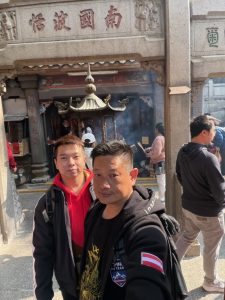
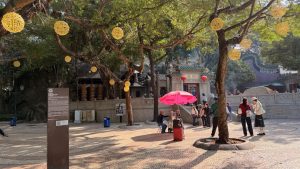
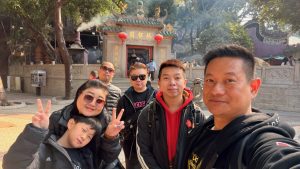
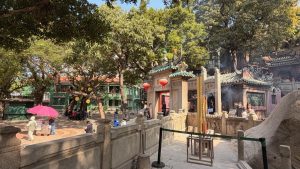
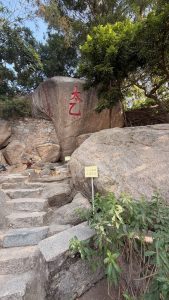
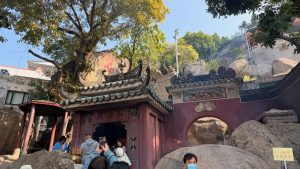
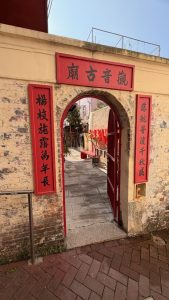
Since we are heading south, it makes sense to visit A-Ma Temple, which is on the southern part of the Macau Peninsula, about a 10-minute bus ride from our hotel. It was believed that the A-Ma Temple existed before Macau and that the territory’s name derives from the temple, which literally means “Bay of A-Ma.” Built in 1488, the temple is the oldest in Macau. The purpose of our visit to A-Ma Temple is to offer our prayers to the deities installed here for protection. The main deity worshipped at A-Ma Temple is the Sea Goddess, Mazu. There are technically four shrines in the temple grounds – two on the ground level and two perched on top of the hill. We first headed to the largest temple structure in A-Ma Temple, Zhengjue Chanlin, which is on the right as we enter. From here, we bought some incense and were guided through the prayer sequence. After going through one round of prayer, we visited the Prayer Hall, the small shrine right in front of the stone arch, to offer our prayers to another Mazu statue installed here.
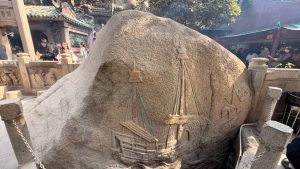
It is time to climb the stairs up the hill to offer our prayers in the remaining two shrines. Perched on the slope, a flight of stairs behind the Prayer Hall is the Benevolent Hall. This hall is believed to be the first and the original shrine in A-Ma Temple. This shrine is even smaller than the Prayer Hall just below, and it also only has the statue of Mazu. The next shrine, the Hall of Guanyin, is perched on the highest point of the temple grounds. This is a relatively large and open shrine that worships the Goddess of Mercy, Guanyin. Apart from offering our prayers here, the “balcony” of this shrine provided a good view of the surroundings. After visiting the four shrines, we headed back to Zhengjiao Chanlin to burn joss paper, where the temple staff offered a prayer for us. Before heading out, we spotted a large rock next to the stone arches. The boat carved into this rock is believed to be the one that brought Mazu to Macau.

Coloane Village – The Quaint Village

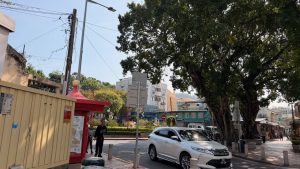
After offering our prayers at A-Ma Temple, we continued our sightseeing. The bus ride from A-Ma Temple to Coloane Village took about 30 minutes. Coloane Village is a laid-back village that was once a pirate hideout due to its many sheltered coastlines. Today, the sleepy village is a great place to escape the tourist-packed areas of Macau. This is also where we found the original Lord Stow Eggtart store, which is significantly less crowded than the one in Taipa.

Chapel of St. Francis Xavier

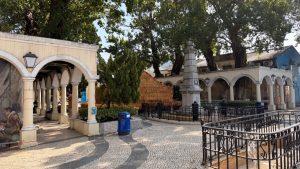
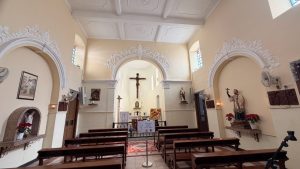
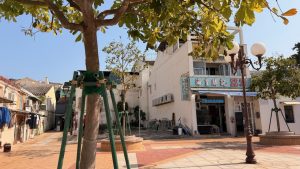
Walking along the coastal road in Coloane Village, our first stop was the Chapel of St. Francis Xavier. Built in 1928, the church is famed for its charming Baroque-style architecture. Adorned in bright yellow colour, this church reminds me of St. Dominic’s Church we visited in Senado Square yesterday. The interior of the church was modest, with only four rows of prayer benches. The square in front of the church is worth a visit. The monument, non-functional water fountains, and Portuguese-style surrounding buildings, the square seems to transport one to an idyllic European Village.

Kun Iam Temple

Our next destination is the Kun Iam Temple, situated 3 minutes’ walk down the lane behind the Chapel of St. Francis Xavier. The temple was built in 1800 and is one of the four temples in Coloane village. The temple was modest in size and could easily be missed if one was not looking for it. Unlike the temples we have visited, the Kun Iam Temple does not have elaborate signage pointing to it. Moreover, its entrance is not on the main thoroughfare. Though modest in size, the Kun Iam Temple, dedicated to the Goddess of Mercy, Guanyin, is also home to several other deities. A helpful temple staff member guided my sibling in the prayer sequence. There is a small gift shop on the side of Kun Iam Temple, where we spent some time looking through the cute Chinese ornaments on sale.

Walking around Coloane Village

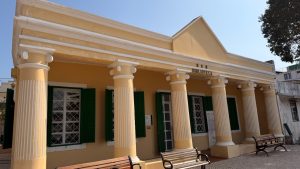
Seeing that there wasn’t much to see around Coloane Village, we decided to grab lunch at one of the two eateries near the bus stop where we alighted. We walked along the same coastal road, Avenida de Cinco de Outubro, that we walked on earlier. Here we found more Portuguese-style buildings, painted in bright, cheerful colours. Of these buildings, the Coloane Village Library stood out the most owing to its bright light yellow colour. Walking on Avenida de Cinco de Outubro, with the sea on one side, felt especially relaxing.

The Cotai Strip – Las Vegas of the East

No trip to Macau is complete without visiting the Vegas of the East along Cotai Strip, which is home to numerous large casinos built on reclaimed land. Cotai Strip got its name simply by combining the names of the two areas it was sandwiched between, Coloane and Taipa.

The Big Three of Cotai – The Parisian, The Venetian & The Londoner

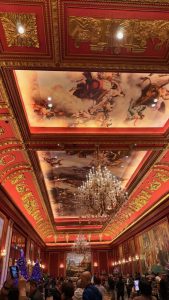
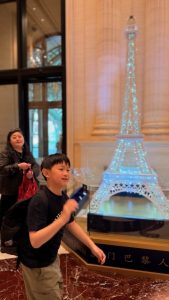
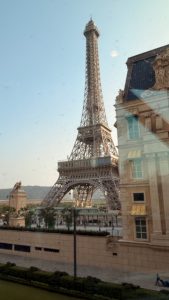
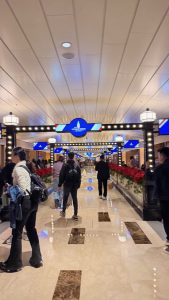
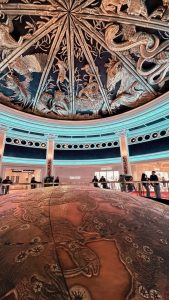
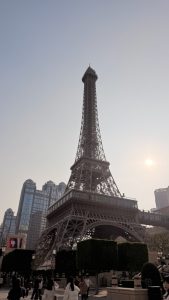
There are two bus stops that buses to Coloane Village pull into. The first one is the one we alighted at, in front of Lord Stow’s Bakery, and the other is slightly further across the road, about a 2-minute walk away. We took the bus to Cotai Strip from the farther bus stop, since everyone leaving the village at the nearer stop, making the chance of finding a seat on the bus slim. The bus ride from Coloane Village to Cotai took about 20 minutes. We started our Cotai Strip visit at the Parisian (on the same side as the bus stop we alighted from) and ended at the Londoner, which is opposite the road where the Sky Cab is. Pulling into the bus stop, the Eiffel Tower replica told us we are in Cotai Strip. Having visited the Eiffel Tower in Paris, I thought this scaled-down replica looked quite real. Inside the Parisian, we saw tons of shops, ranging from luxury boutiques to souvenir shops, lined up side by side. In the big three, casinos occupy the ground floor, while shops and restaurants occupy the floor above it. Other than the hotel check-in lobby, which has elaborate frescoes painted on the ceiling, resembling part of the Versailles. The rest of the Parisian looked like your run-of-the-mill shopping mall with not much character.
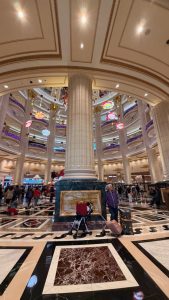
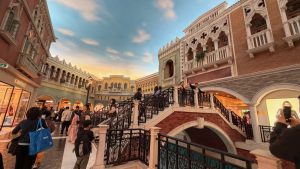
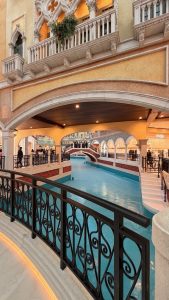
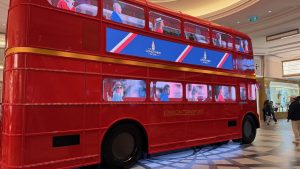
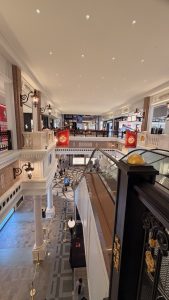
Compared to the Parisian, our next stop, the Venetian, had more characteristics. There is a replica of Venice’s canals and bridges inside the shopping mall, where people ride gondolas and occasionally the singing by the gondola paddler can be heard. The ceiling of the Venetian shopping mall is painted in bright blue skies with clouds, making the mall perpetually having clear skies all year round. The layout of the Venetian was akin to a maze. We spent hours walking round and round and couldn’t seem to exit the Venetian, and only managed to get out when we went to the casino floor. From there, we found signs pointing to the Londoner. Compared to the Venetian, the Londoner feels much plainer, except for a few archways that seem to mimic London Central Station, some London-style phone booths, and a London double-decker bus. The rest of the Londoner, like the Parisian and the Venetian is lined with luxury shops and restaurants.

Foiled Plan to take the Sky Cab

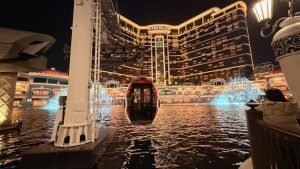
Our initial plan was to take the complimentary Sky Cab ride that loops around the fountain in front of the Wynn Palace in Cotai. However, the long queue for the cable car ride put us off. I learned about an alternative boarding area inside the hotel, but getting there requires more walking and exploring. Since everyone was tired after walking all day, we decided to cut our losses and head back to the Macau Peninsula for dinner.
Senado Square at Night

After dinner near our hotel, since the night was still young, we headed to Senado Square to buy some souvenirs before heading back to the hotel to rest.

Macau Night Market

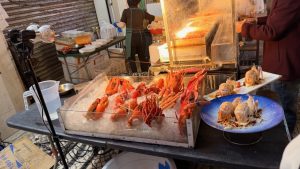
We stumbled upon a night market mainly selling street food in one of the alleyways near our hotel. This lively night market operates only on weekends. The street food on offer was another level. In addition to the usual finger food, we also saw some stalls selling BBQ Boston lobsters. The shops in the alley behind, where the street food stalls were still open, offered visitors the option of buying souvenirs rather than eating street food. Compared to Taiwan’s night markets, this one is really small, but it is worth a look.
Municipal Affairs Bureau

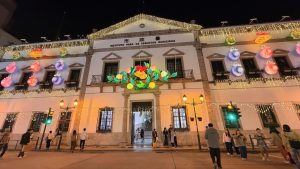
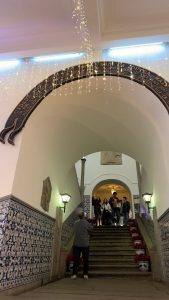
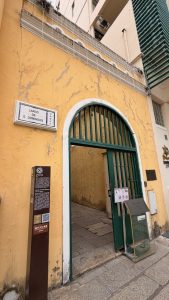
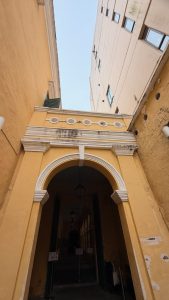
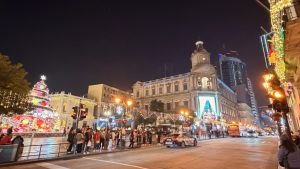
Our final stop for the day is at Senado Square, where we buy souvenirs in case we do not have time to get them tomorrow before we leave Macau. As it was near closing time, most of the shops on Senado Square were either closed or closing. However, we managed to get the stuff we wanted from the shop. Despite being late at night, there was still a crowd in Senado Square. As we were preparing to head back to our hotel, I spotted the Municipal Affairs Bureau doors open. This was the building we were unsure about visiting yesterday, and decided to take a look inside. Apart from a few vending machines and Christmas displays, there is nothing much going on inside the Municipal Affairs Bureau. From its main entrance, a straight path led us to a small courtyard, and that’s about it. However, the Portuguese-style tiles on the building’s walls reminded visitors of Macau’s Portuguese heritage. After staying in the Municipal Affairs Bureau momentarily, we headed back to the hotel to rest for the night.
Macau Day 2 (26 Dec 25): Macau Peninsula – The Historic Centre of Macau & Macau Tower

No trip to Macau is complete without paying a visit to the iconic Ruins of St. Paul, the poster child of Macau. The Ruins of St. Paul, along with the historic sights of Macau, are located in the central part of the Macau Peninsula, not far from our hotel. Since we missed all the sights I had planned for yesterday due to our late arrival in Macau, we started earlier than we had initially planned, hoping to catch up on some of the sights we had missed.

Senado Square – The Heart of Historic Macau

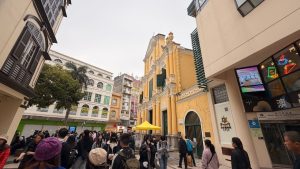
Our first stop of the day started at Senado Square, the centre of Macau Peninsula and where all the action is. The elongated, triangular-shaped Senado Square has been Macau’s urban centre for centuries and is one of the SAR’s top four squares. This square linked us to most of the historic sights on the Macau Peninsula, making it a great place to start visiting them. Aside from being a starting point for the World Heritage Sites of Macau, Senado Square is also a great spot for shopping. There are tons of shopping options, from individual boutiques to department stores to souvenir shops. We even found roadside stalls in one of the alleyways near the main road parallel to Senado Square. As it was the centre of action, Senado Square was jam-packed with people taking pictures, shopping, or simply resting on the many benches installed here. The presence of Christmas decorations installed in the middle of the square not only brings a festive mood but also attracts visitors to stay longer.

Standing on Senado Square, we spotted the Municipal Affairs Bureau across the road. We were unsure whether we could visit the building, as the doors were shut during our stay in Senado Square. We merely kept our distance and took pictures of the building across the road.

Municipal Affairs Bureau opposite Senado Square
St. Dominic’s Church – The Yellow Church

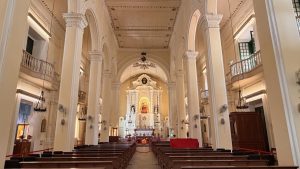
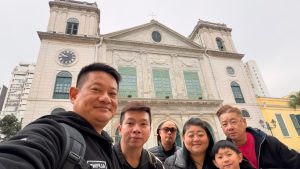
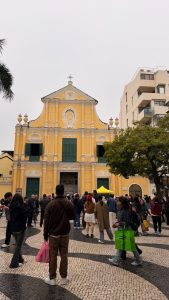
The yellow-coloured St. Dominic’s Church is just a stone’s throw from the centre of Senado Square, making it a perfect second stop. The Baroque-style church was founded in 1587 by three Spanish priests from Mexico and features a good mix of European and Macanese elements in its design, as seen in its Chinese-style roof. The white European floral patterns adorned on the facade of the church are especially pronounced against the yellow walls. The inside of the church was neither as massive as those we had seen in European countries nor as elaborately frescoed. Still, the simple ivory-white interior gave us a sense of peace, contrasting with the busy Senado Square we were in moments ago. We spotted an entrance at the side of the church and decided to check it out. The entrance led us to the back of the church, where a small museum now houses a collection of around 300 artefacts. As it would require us to climb up some stairs, we did not visit the museum and exited the church to continue our walk towards the Ruins of St. Paul.

Cathedral of the Nativity of Our Lady – The Church on the Hill

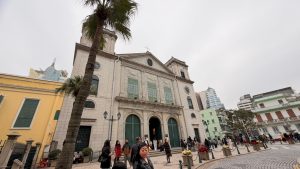
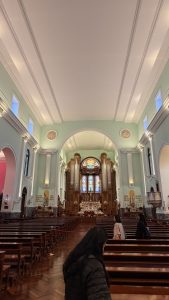
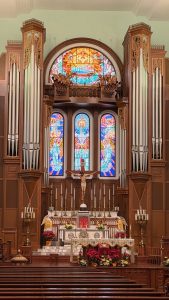
As we were walking around, half shopping and half looking at the sights in Senado Square, we spotted a plain-looking church perched on top of the slope. This is the Cathedral of the Nativity of Our Lady, also known as the Cathedral of Macau, first built in 1576 and redesigned in 1623 into a cathedral. This cathedral is the most influential church in Macau, housing the highest administrative division of Catholic affairs in the city. The interior of the church is painted a light green, with stained glass behind the main altar. Like St. Dominic’s church, the Cathedral of Macau also features a rather plain interior, without the carvings and frescoes seen in the larger cathedrals in Europe. The interior of the cathedral consists only of a large prayer hall. As we were not Catholics, we stayed here only briefly before heading to our next stop, the Ruins of St. Paul.

Lou Kau Mansion – The Accidental Find
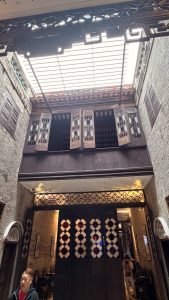
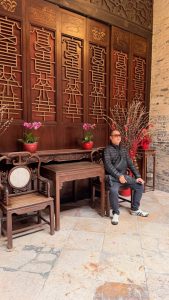
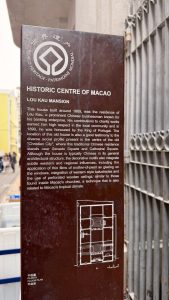
As we were walking towards the Ruins of St. Paul, following Google Maps directions, we stumbled upon a building with open doors, with visitors streaming in and out. Curious, we checked with a staff member standing by the door if the house was open to the public. The friendly staff welcomed us into the house. This is the Lou Kau Mansion, a traditional Chinese-style house built in 1889 in the middle of heavily European-influenced buildings of Senado Square. Despite its Chinese architectural style, traces of European influence can be seen in the house, including the use of stained glass and decorative motifs. Despite being a two-storey house, only a small portion of the house, such as the ground-level fore and aft halls, and a room that is converted into a projection room introducing the history of the house, was open to the public.
Ruins of St. Paul – Vatican of the East

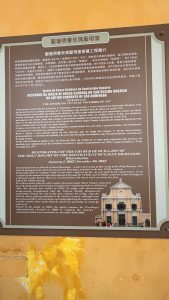
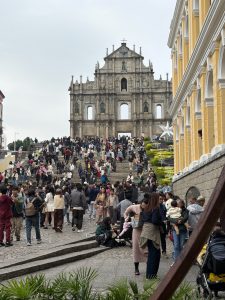
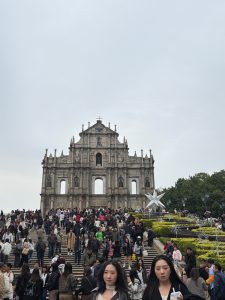
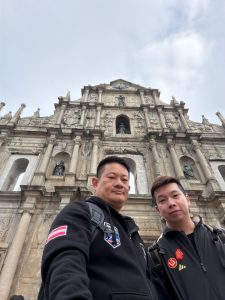
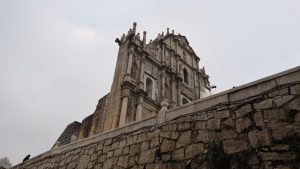
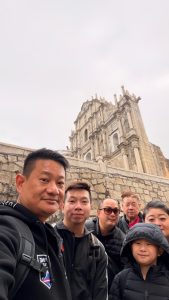
As I was navigating using Google Maps, I was given directions away from signage in Senado Square that pointed to the sight. My mistake was to trust Google Maps too much, so we were drifting in opposite directions. Only when we reached Senado Square did I realise that my position on the maps was erroneous. We spent a good 30 minutes walking around in circles before trusting the street signage pointing to the ruins. We finally reached the icon of Macau – The Ruins of St. Paul. The forever-crowded Ruins of St. Paul was constructed between 1602 and 1640. The church was the largest Catholic Church in East Asia at the time of completion and was given the title Vatican of the East. The original structure consists of five storeys with a large prayer hall. The church was destroyed by a fire during a typhoon in 1853, leaving only its facade. The surviving facade revealed its baroque architecture, with the statue of the Virgin Mary atop the main entrance to the church. The original name of the church, Mater Dei, was still visible on the beam of its main entrance.

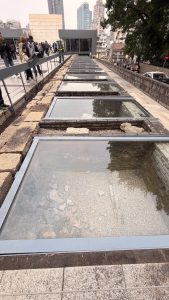
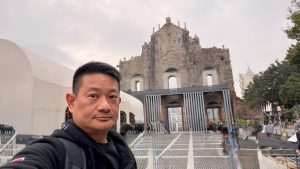
Walking past the facade, we arrived at a large open space where the church used to sit. The original structure of the church can still be visible through the glass floors on both sides of this area. A small building that leads to the lower floors sits at the end of the open area. As we descended the staircase to the lower floor, we could see the church’s surviving structure. A museum houses surviving artefacts used in the church’s everyday life. Compared to the church’s facade, the museum seems to see fewer people, but I thought it was worth a visit. We spent around 5 minutes inside the small museum.

Na Tcha Temple – The Hidden Gem

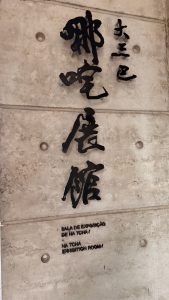
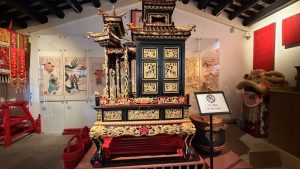
One sight near the Ruins of St. Paul that visitors often miss is the Na Tcha Temple. The single-chambered, small wooden shrine dedicated to the Child God Na Tcha was built in 1888 and has stood at the same spot for more than 100 years. The temple showcases traditional Chinese architecture and symbolises religious freedom during Portuguese rule in Macau. There is a modest Exhibition Room next to the temple, featuring paintings of the legends of the Na Tcha, alongside objects such as the sedan chair and lion heads used during the deity’s birthday celebration. I thought the small square where the exhibition room is situated provides an oasis of tranquillity for people who want a brief break amidst the hectic crowd at the Ruins of St. Paul.

Travessa da Paixao – The Love Lane

The next spot we visited isn’t really a sight; rather, it is an excellent place for those who want a less crowded spot to take pictures with the Ruins of St. Paul. Travessa da Paixão, or Love Lane, got its name from attracting couples who came here for wedding photo shoots. The small alley situated on the left of the ruins, just a few steps from Na Tcha temple, offers a different perspective on the Ruins of St. Paul.

As we were walking to our next destination, the Guia Hill cable car, somehow my Google Maps started to screw me up again. We spent the next 20 minutes walking in circles. It does help that cabs are difficult to find in this part of Macau. As most of us were tired, we eventually gave up going to the hill. Instead, we wanted to head to our next destination, Macau Tower. We wanted to catch a bus to the tower but were told that the buses were travelling in the opposite direction. Eventually, we got directions from a cleaning staff member at a bus depot, who told us where to catch a bus to Macau Tower. Using the directions given to us, we eventually found ourselves in front of our hotel. We went back to put our stuff down and rest a little before hailing a cab from the hotel to Macau Tower.

Macau Tower – The Thrill Seeking Tower

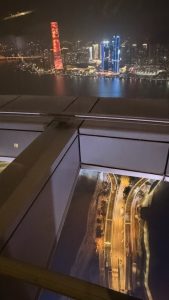
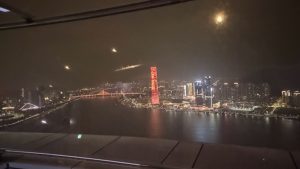
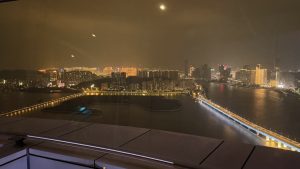
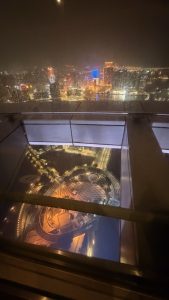
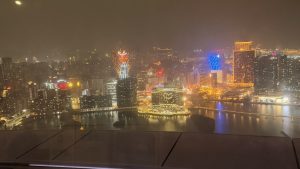
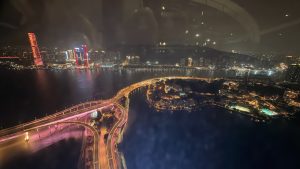
Macau Tower is one of Macau’s landmarks, standing 338m tall. The tower sits in the southern part of the Macau Peninsula, offering visitors a bird’s-eye view of the Pearl River Delta. By the time we arrived at Macau Tower, it was about 1 hour before it closed. We were perhaps one of the last few to be let up the tower. The staff at the bottom of the lift reassured us that we would have sufficient time to visit the tower. There are two observation decks on the tower, the indoor 58-storey and the outdoor 61-storey. Not knowing which floor to exit, we got out on the 58th storey when the lift arrived at that level. As we walked towards the edge of the tower, we figured the 61st floor would give us a better view and headed for the outdoor deck before coming back down. Level 61, being outdoors, was colder than the indoor level below, with the sea breeze constantly blowing in our direction. As level 61 protrudes out more over the edge, it felt as though we were standing without the glass protection. This level is also where thrill seekers can walk around the tower at its edge or even bungee jump off the tower. As it was already near closing time, the station that manages these activities was closed. From the level 61 observation deck, we were treated to a 360° view of the surrounding areas, from the Macau Peninsula on one side to the flashy Cotai area on the other. We could even see the nearby Chinese city of Zhuhai. We stayed here to take some pictures of the surroundings before heading back down to the observation deck on level 58. Back on level 58, the views were not as stunning as those on level 61, but the glass floor there gave us the impression of walking on thin air. However, the scratches visible when the light was pointed upwards from the tower made it difficult to see through. After visiting the tower, we took one of the casino-sponsored free shuttle buses and landed back in the Lisboa area, where we settled for dinner and headed back to the hotel to rest for the night.

Macau Day 1 (25 Dec 25): Macau Peninsula: Arrival at Macau

Arrival in Macau

Macau, a Special Administrative Region of China next to Hong Kong, is often visited as a day trip from Hong Kong. However, we had been to Hong Kong several times and would want to focus on Macau for this trip. Macau has its own airport, with fewer airlines landing compared to its neighbour, Hong Kong. Hence, it makes more sense to fly to Hong Kong and connect to Macau. As we flew into Hong Kong International Airport, we could either clear immigration and enter Hong Kong to take a cross-border bus or ferry from downtown Hong Kong to Macau, or connect directly from the Hong Kong International Airport Sky Pier Terminal, eliminating the need to enter Hong Kong. The Macau Tourism Office ran a promotion during our trip (valid until the end of 2025) that offered visitors a complimentary one-way bus ticket from Hong Kong to Macau (we had to purchase the Macau-to-Hong Kong bus ticket, available here). To get the shuttle bus, we headed to counter E2 after deplaning, located past the immigration counters, where a staff member from the bus company helped us book seats and issue our bus tickets. We did not have to worry about our luggage, as the staff at the bus ticket counter took our luggage claim ticket to retrieve them from the carousel and transfer it to the Sky Pier Terminal. Due to the holiday season, we were only able to get bus tickets for the 4 pm departure from Hong Kong International Airport to Macau (despite arriving at the airport around noon). I should have booked our outbound tickets on the website when purchasing our return ticket, instead of relying on luck for a bus that would depart soon after we landed. Since we had 3 hours before our bus departed, we could spend that time at the small arrival area or the Sky Pier Terminal. As we did not have an outbound flight ticket, we couldn’t even access the airport’s transit lounges (located one level above the arrival area). There isn’t much going on at the arrival area at Hong Kong International Airport. Apart from a few small duty-free shops and a convenience shop, this part of the airport is pretty boring. There is also a restaurant where we spent our time waiting, serving mediocre food and with unfriendly staff. After sitting around for 2 hours, we got bored and took the Automated People Mover to the Sky Pier Terminal. The Sky Pier Terminal is dead, apart from people making their way to Macau or Zhuhai and one small convenience shop; there is nothing much going on here. But at least it had an outdoor area where we could enjoy the views of Hong Kong.

The bus ride from Hong Kong International Airport Sky Pier Terminal to Macau took about 40 minutes. The bus terminated at the Hong Kong-Zhuhai-Macau Bridge (HZMB) border control, where we cleared immigration to enter Macau proper. I’d say the connection between Hong Kong International Airport and Macau was quite seamless. After clearing immigration, which only took mere minutes, I spotted a small family-run shop where we got our mCards – the store value transport card for Macau. My 10-year-old nephew had to pay adult fare, as the child fare is only available for children under 1m. When I was planning this trip, I found that the hotel we stayed at had a regular complimentary shuttle bus to pick up visitors from the border and drop them off at the hotel. However, after spending some time looking, we couldn’t find any buses heading to Ponte 16. It doesn’t help that most of the staff at the bus terminal weren’t exactly helpful with information. After getting several “I don’t knows”, we gave up and took the public bus to our hotel. Fortunately, we bought our mCards at the convenience store just before we left the border control building, which allowed us immediate access to public transport without having to dig through small change. I realised the transport charges are cheaper when using the mCard: instead of the standard MOP6 per trip (regardless of the distance), our card deducted MOP4 for the trip from the border control to the hotel and MOP3 for transportation within Macau. We arrived at our hotel after a 20-minute bus ride. After checking in and settling into our rooms, it was already late. My family wanted to head out for dinner, and I suggested we spend the night watching the Prosperity Tree show at the Wynn Hotel.

Old Macau Casino District: Watching The Prosperity Tree Show

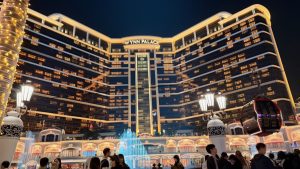
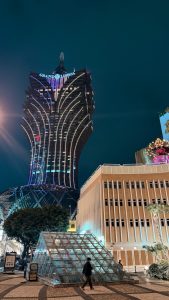
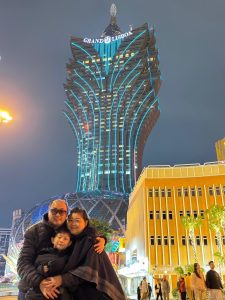
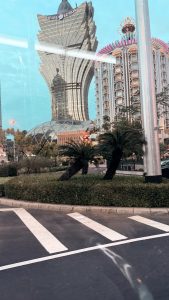
We took bus #26A from the stop opposite our hotel to reach the Lisboa casino district. The Grand Lisboa Casino is one of Macau’s iconic landmarks, known for its lotus-shaped architecture and world-class dining. Grand Lisboa is one of the oldest casinos in Macau, blending east and west elements into its design. One cannot miss the unique building when in this area. One of the things to do in front of the Grand Lisboa Casino is to take a picture with the “billionaire pose” or the “Stanley Ho pose”, where one would cross their arms and stand in front of the casino, mimicking the picture taken of the Godfather of Gaming, Stanley Ho, during a magazine shoot. After taking some pictures, we crossed the road and headed into the Wynn Hotel.

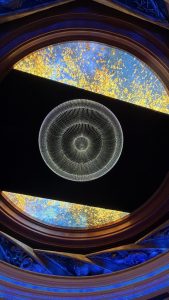
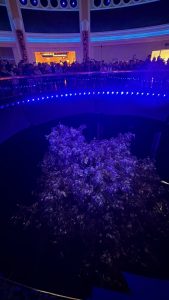
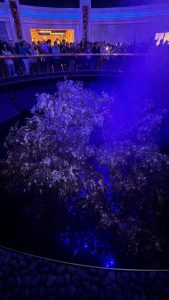
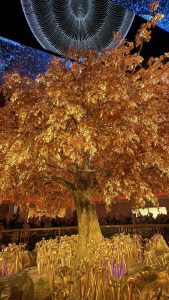
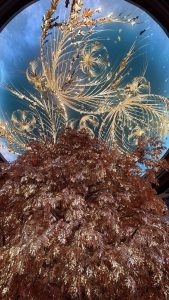
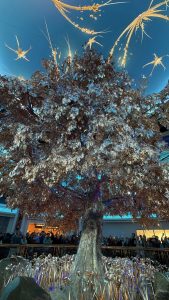
Emerging from the underground pedestrian tunnel and passing through the main door of the hotel, the Prosperity Tree is not difficult to find. The way to the tree is very well marked by signs around the hotel. We arrived 15 minutes past the hour, thinking the show occurred every ½ hour. When the time came, ½ past the hour, there were no signs of the show starting. This is when we realised the show only happens every hour. The Prosperity Tree shows happen every hour on weekdays and every ½ hour on Fridays and weekends. As we already occupied the front-row seats, we did not want to give up our “golden” spots and kept waiting. Soon the hour came, and the show started. The Prosperity Tree is a two-storey tall tree with each of its 98,000 leaves covered in 24-carat gold and brass, symbolising wealth and luck. The 6-minute show began with the ceiling opening to reveal a large LED panel depicting koi fish and Chinese characters for wealth and prosperity. Shortly after, the golden tree emerged from the floor below, accompanied by music and light that depict the vibrant colours of the four seasons. We were here mainly for the wealth and luck that the tree will hopefully bring us. After the show, we headed to a restaurant nearby for dinner before heading back to the hotel to call it a night.

Shanghai Day 4 (17 May 25): Longhua Temple and City God Temple – From the Oldest to the Guardian Temple

We initially planned to visit Yuyuan (豫园) in the morning and spend some time strolling along Yuyuan Old Street before visiting People’s Square in the afternoon. The staff at our hotel’s lounge, whom we spoke to last night, highly recommended that we visit Longhua Temple, which is popular amongst the locals. We changed our plan today to prioritise Longhua Temple and leave Yuyuan as an option if we had the time.

Longhua Temple (龙华寺) – The Oldest Temple in Shanghai

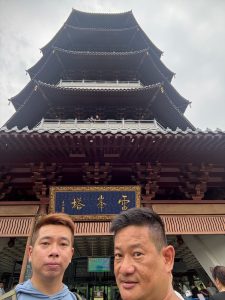
As Longhua Temple is slightly further away from our hotel, we made it our first stop of the day. Getting to Longhua Temple is a breeze; we hopped onto the metro Line 2 and changed at Jingsu for Line 11. Longhua Station is well served by both Lines 11 and 12. There are signs in the metro station that point to Longhua Temple (in both English and Chinese). One cannot miss the ancient wooden tower upon emerging from the metro station.

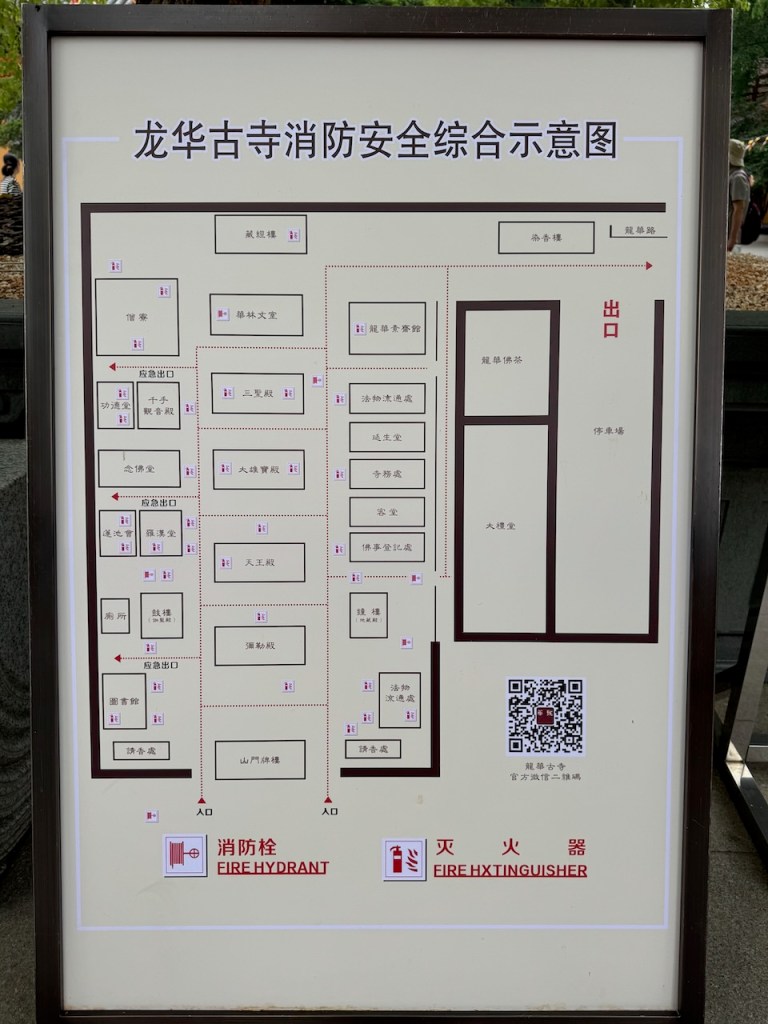
Layout of Longhua Temple

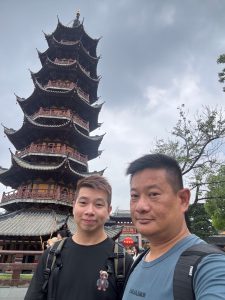
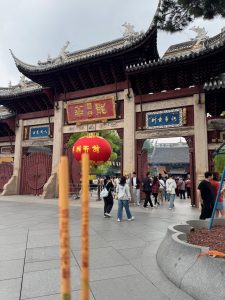
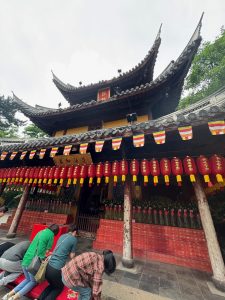
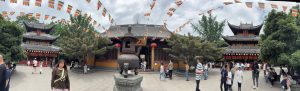
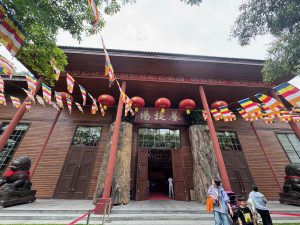
At 1,700 years old, Longhua Temple is the oldest temple in Shanghai and one of the oldest in China. The temple was first built during the Three Kingdoms era in 242 AD and has undergone several rebuilds over the years. Today, the present design of the temple was inherited from the Song Dynasty (960-1279), and Longhua Temple is the largest temple in Shanghai. Entry to Longhua Temple costs RMB 10, which includes a set of three incense sticks for devotees to use during prayers for prosperity and safety. Upon entering the grounds of Longhua Temple, the first thing we saw was the wooden seven-storey Longhua Pagoda. We saw locals walking around the pagoda with unlit incense in their hands. Upon asking, we were told this is a customary procedure when praying in the temple. When in Rome, do what the Romans do. We followed the locals in their prayer procedures. As we walked round the temple, I could catch a glimpse of the interior of the pagoda. The interior of the pagoda appears to retain its original structure, dating back to 977. Other than a set of stairs that lead to the upper level of the pagoda, there seems to be a statue of a man inside the pagoda. We entered the Longhua Temple grounds after doing our three rounds around Longhua Pagoda.

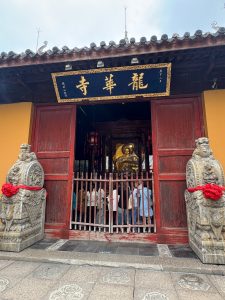
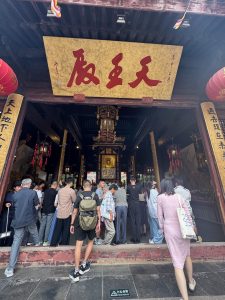
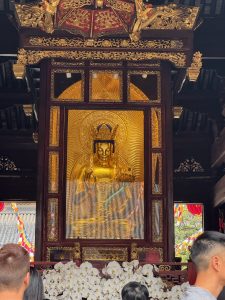
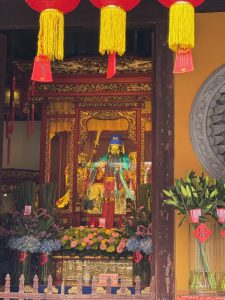
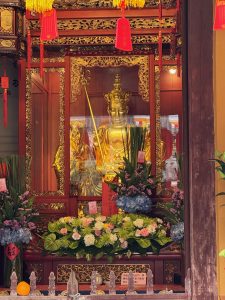
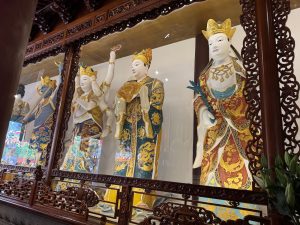
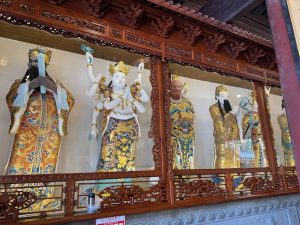
Longhua Temple comprises four main prayer halls, arranged in a straight line along a north-south axis, with several smaller prayer halls situated at the sides of the main halls. Legend has it that it is here the Laughing Buddha attained his Buddhahood. The first prayer hall, the Maitreya Hall (弥勒殿), houses the Maitreya Buddha (also known as the Laughing Buddha) in his manifestation as a monk wearing a cloth bag. The gold-painted Maitreya Buddha, with his signature kind smile, seems to welcome visitors to his temple. The next hall in line after the Maitreya Hall was the Four Heavenly Kings Hall (天王殿). The main Buddha installed in this hall is the Maitreya Buddha in his Buddhahood appearance. This version of the Maitreya Buddha features a calm and kind appearance, a notable departure from the Laughing Buddha image popular in Chinese culture. In addition to the Maitreya Buddha, this hall is also home to the Four Heavenly Kings. The third hall, located behind the Four Heavenly Kings Hall, is the Mahavira Hall (大雄宝殿). This is the main prayer hall in Longhua Temple, where the Buddha, seated on a lotus, and his two disciples, Manjusri Boddhisattva (文殊菩萨) and Samantabhadra (普贤菩萨), are installed at the centre of the prayer hall. The Buddha statues installed in this hall exude a calm and solemn look, as though they are patiently listening to the sorrows of visitors. The Three Sages Hall (三圣殿) is the final hall, the furthest away from the entrance of Longhua Temple. The Buddhas installed here are the Amitabha Buddha (阿弥陀佛), Guanyin Bodhisattva (观音菩萨) and Mahasthamaprapta Bodhisattva (大势至菩萨). The Buddha statues here had a gentle smile on their faces, as though reassuring visitors that everything will be alright.

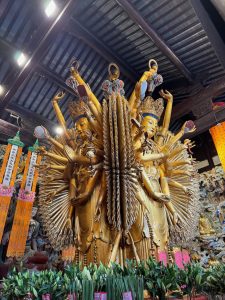
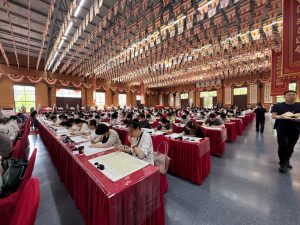
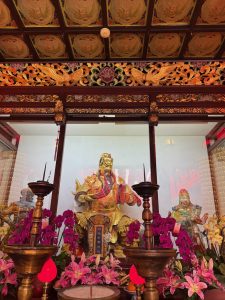
After visiting and offering our prayers in the four main halls, we spent the rest of our time at Longhua Temple retracing our footsteps back to the entrance and visiting the side prayer halls. A hall beside the Three Sages Hall had the statue of Thousand Hands Guanyin (千手观音) installed. Instead of having only one statue, there are three statues of the Thousand Hands Guanyin with their backs against each other, which seems to represent seeing all from all directions. In addition to the Guanyin statue, this hall is also adorned with carvings of Bodhisattvas and Gods cast on the walls of the hall. The other hall that I like is the Arhat Hall (罗汉堂). In the centre of the hall is a dark brown wooden statue of Guanyin, with her lifelike merciful appearance. There are an impressive 500 smaller arhats on the walls surrounding the Guanyin statue in the centre. The two side halls between the first and second main hall are the Drum and Bell Towers, where statues of Guangong (关公) and Earth Store Bodhisattva (地藏王菩萨) are installed respectively. After paying respects to all the Buddha and Bodhisattva statues in the prayer halls, we wandered around the grounds of Longhua Temple. We found a huge hall filled with people quietly sitting in rows copying Buddhist sculptures. Copying these sculptures is a Buddhist practice that trains one’s patience and a calm mind. It was a spectacular sight to see so many people sitting quietly in a large hall doing their things calmly. Leaving Longhua Temple after spending 1½ hours here praying and walking around, we headed for lunch in one of the shopping malls nearby.

City God Temple (城隍庙)- Temple of Guardian God

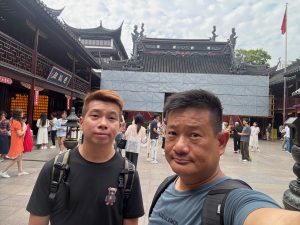
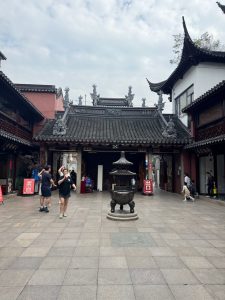
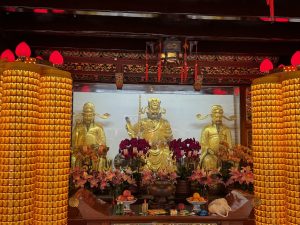
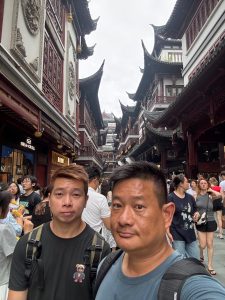
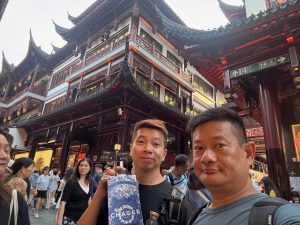
No visit to Shanghai is complete without visiting the City God Temple and Yuyuan Old Street. The City God Temple has been regarded as the guardian temple by the Shanghainese. Entry to City God Temple costs RMB 20. The City God Temple is served by Yu Garden Metro Station on Lines 10 and 14. The City God Temple is compact compared to Longhua Temple. There are three entrances to the City God Temple, the main entrance facing the road, the side entrance that is directly linked to the Yuyuan Old Street shopping arcade and a back entrance at the second prayer hall that serves more like an exit (we are not too sure if this is also used entrance as we did not went up close to explore this area). As we came from the Yuyuan Shopping Arcade, my friend and I used the side entrance. From the side entrance, we immediately arrived at the second and largest courtyard in the City God Temple. This is where the main prayer hall is located, housing one of the two City Gods in this temple. We later learned from one of the staff members that Shanghai has three City Gods, two of which are located in this City God Temple. After offering our prayers, we proceeded to the back of the temple and arrived at the third courtyard. In a relatively small prayer hall, the second City God is housed. At the sides, we found smaller shrines housing Guangong and WenCang (the God of Wisdom).

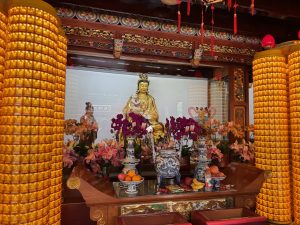
After offering our prayers, we retraced our footsteps and headed back to the second courtyard to offer our prayers to the gods installed in the side shrines there. The God of Fortune and Guanyin were among the more popular gods in the second courtyard, where we saw more people praying. We headed to the first courtyard after praying and shopped for some charms for my family members. The staff advised us to return to the ceremonial hall located between the two City God halls to have our charms blessed. The cleansing ceremony involves a Taoist priest chanting and sprinkling holy water onto our charms. We had pretty much covered everything in the City God Temple in about 45 minutes.

Yuyuan Old Street (豫园老街)

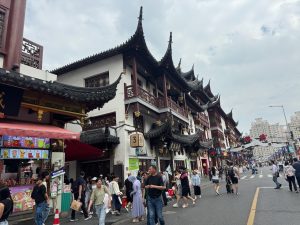
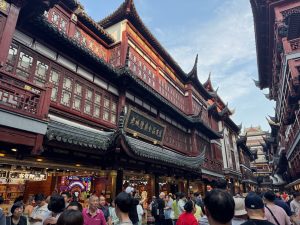
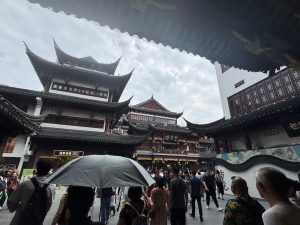
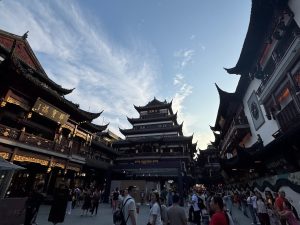
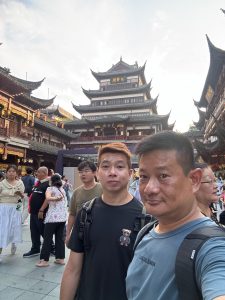
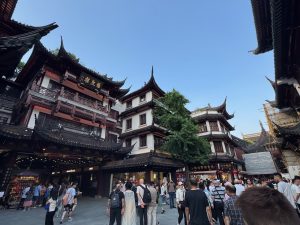
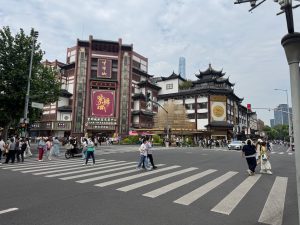
We spent the rest of the afternoon wandering through the labyrinth of Yuyuan Old Street. I thought this was a great place to dive into the vibrancy of Shanghai, with many locals coming here to spend their weekends wandering through shops to buy souvenirs or to eat from the many food street stalls. As we were here on a weekend, we even spotted some local artists coming here to promote their films and shows. We also saw a traditional Chinese dance performance in one of the many open spaces within the shopping arcade. The main Yuyuan Old Street is essentially a huge shopping arcade, housed in ancient Chinese buildings that feature numerous shops, mainly selling souvenirs and snacks, as well as a small number of gold shops. Yuyuan Old Street is also where the locals come to buy gold, where the gold price is generally lower. Most of the gold shops congregate in the area across the road from the main shopping arcade. Despite being a highly touristy spot, we found that the prices of items on Yuyuan Old Street are generally cheaper than those on East Nanjing Road.

Back to Pudong – Our Attempt to Visit Oriental Pearl Tower

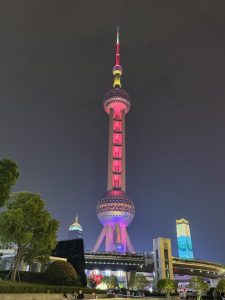
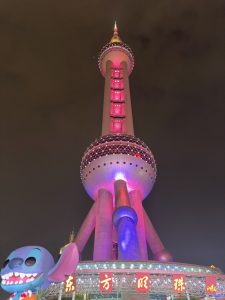
We returned to our hotel to offload some of the stuff we bought from Yuyuan Old Street and headed out across the Huangpu River via the metro to Pudong. Since we had some time before dinner, we wanted to visit the Oriental Pearl Tower, something I had wanted to do 30 years ago when I first visited Shanghai. Back then, the tower had just been completed and had not yet been opened to the public. To get to the Oriental Pearl Tower, we alighted at Lujiazhui Station (since the ferry service had stopped for the day), one stop along Line 2 from East Nanjing Road Station. We emerged from one of the shopping malls and walked the circular overhead pass connected to the mall to arrive at Oriental Pearl Tower. The ticketing booth for the tower is not located on the ground floor of the tower; instead, it is found about 20 m away from the tower. However, by the time we arrived at the tower, admissions had ceased as the tower was closing soon. Other than taking pictures with the tower up close, there was nothing much we could do here.

Dinner Hunting on East Nanjing Road

Since it was way past dinner time, we returned to the Western part of East Nanjing Road (opposite People’s Square Station) to look for dinner. I thought I saw some restaurants on this stretch of the road a few days ago when we walked to this part. We came across a stretch of roadside stalls selling snacks and purchased some tasty lobster dumplings. Most of the restaurants at this hour (it was already approaching 10 pm when we arrived) seem closed. We settled our dinner at a BBQ restaurant in one of the small alleyways; we spotted some restaurants that were still open till late at night. As it was getting late and we had an early flight the next day, we headed back to our hotel on the Bund after dinner. The shops below our hotel were still open, so we bought some street snacks to take back to our room to eat while we packed our luggage for our departure tomorrow morning.

Shanghai Day 3 (16 May 25): From Jing’an District to French Concession

Shanghai is a large city with 18 districts. Today, we planned to visit the sights a little further away from the Bund where we were staying. As it was raining in the morning, we started our day around noon, after the rain stopped.

Jing’an Temple (静安寺) – The Golden Roof Temple

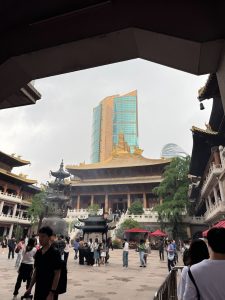
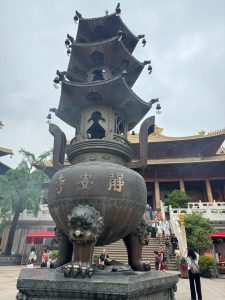
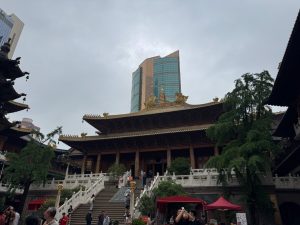
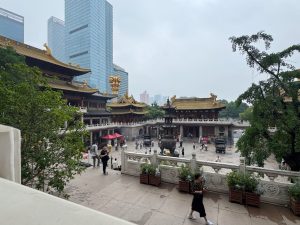
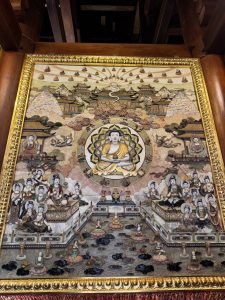
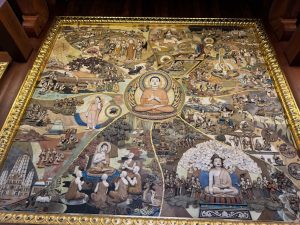
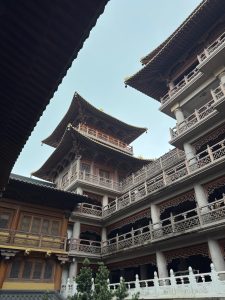
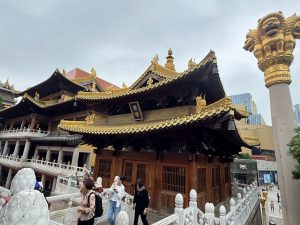
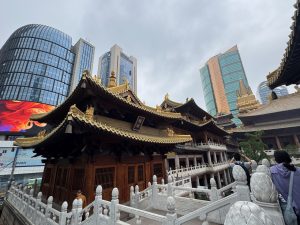
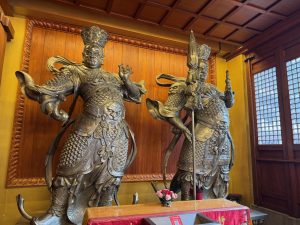
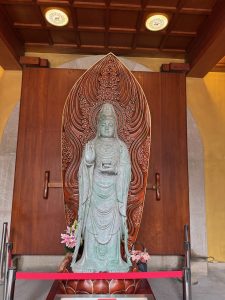
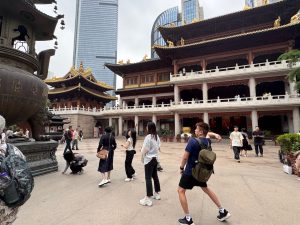
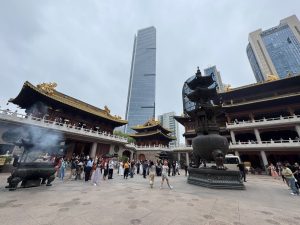
Our first sight today is Jing’an Temple, the principal temple regarded by the Shanghainese. Jing’an Temple is one of the most expensive temples in China, with a construction cost of RMB 2.8 billion. Jing’an Temple is well served by the Jing’an Temple Station, which is an interchange of Lines 2, 7 and 14. Admission to the temple costs RMB 50. Huge shopping malls and small shops surround the temple, creating a bustling scene. However, as we entered the temple grounds, the bustling of the surroundings faded into peace and tranquillity. The only sound came from visitors tossing coins into the two-storey tall furnace in the centre of the courtyard. The roofs of the temple and the mystical animal adorned on them were gold-plated. The bright yellow walls painted on the temple walls enhance the illusion that the temple is made of gold. After offering our prayers, we proceeded to the main prayer hall, which housed a 15-ton, pure silver Buddha. The Buddha statue sits in the middle of the hall, solemnly blessing those who came to offer their prayers. Behind the silver Buddha statue are three painted wood carvings of Buddha. I find the centre carving more significant as it depicts the birth and attainment of nirvana of Buddha.

There are two towers on the facade of the temple: the left is the Drum Tower and the right is the Bell Tower, both of which are accessible from within the temple. Exiting the main prayer hall from the back, we walked on the second level of the adjacent building and came to the Bell Tower. Legend has it that a well is located beneath the Bell Tower, allegedly linked to the sea, with water sprouting from the well. It was believed that the water brought evil, and the locals built Jing’an Temple to ward off these evils. Both the Bell and Drum Towers are closed to the public these days. As the door to the Bell Tower was left ajar, we were able to peek inside the Bell Tower, where we saw a huge bell (hence the name Bell Tower) hanging over what seemed to be a well. The two towers were linked by a central structure, which was formerly used as the main entrance to Jing’an Temple. It is here that we got a great view of not only the inside of Jing’an Temple, but also the outside. The contrast between tranquillity and bustling is especially pronounced here. A gold-plated Laughing Buddha called the centre building on the second level home, together with the statues of the four heavenly kings, guardians of heaven in Chinese mythology. We felt a sense of happiness by looking at this Buddha. The drum tower occupies the left building (seen from the main road of the temple). Compared to the Bell Tower, the Drum Tower appears dull. Peeking through the windows, we could see the solo drum placed inside.

We headed back to the ground level of the temple and found a 3.8m Burmese white jade Buddha statue in a room along the Drum Tower side of the temple. The Buddha statue exudes a compassionate expression. At first glance, one would think that the robe on the jade Buddha was made of cloth, but this is actually part of the jade used for the statue. There is another hall opposite the Jade Buddha statue, where we find a 6.2m tall statue of Guanyin (the Goddess of Mercy), made from a 1000-year-old camphor wood. The lower level of the former entrance has another statue of Guanyin, installed in front of the now-closed entrance. We spent the rest of our time here at Jing’an Temple, exploring the many rooms open to the public, and discovered a prayer room with three Buddha statues located at the back of the temple. As this is a secluded part of the temple, we were the only ones here offering our prayers to the Buddha statues. Before leaving the temple, we spent some time tossing coins into the large furnace in the middle of the courtyard.

Before heading to our next sight, we had lunch in one of the restaurants nearby Jing’an Temple. We were initially attracted by the pastries and rice dumplings sold at the front of the restaurant. Since it was past lunchtime, we settled in for a meal at this restaurant. We only found out that this restaurant is a Michelin one-star establishment after eating there. With our stomachs filled, we are off to our next sight – the French Concession.

French Concession (法租界)

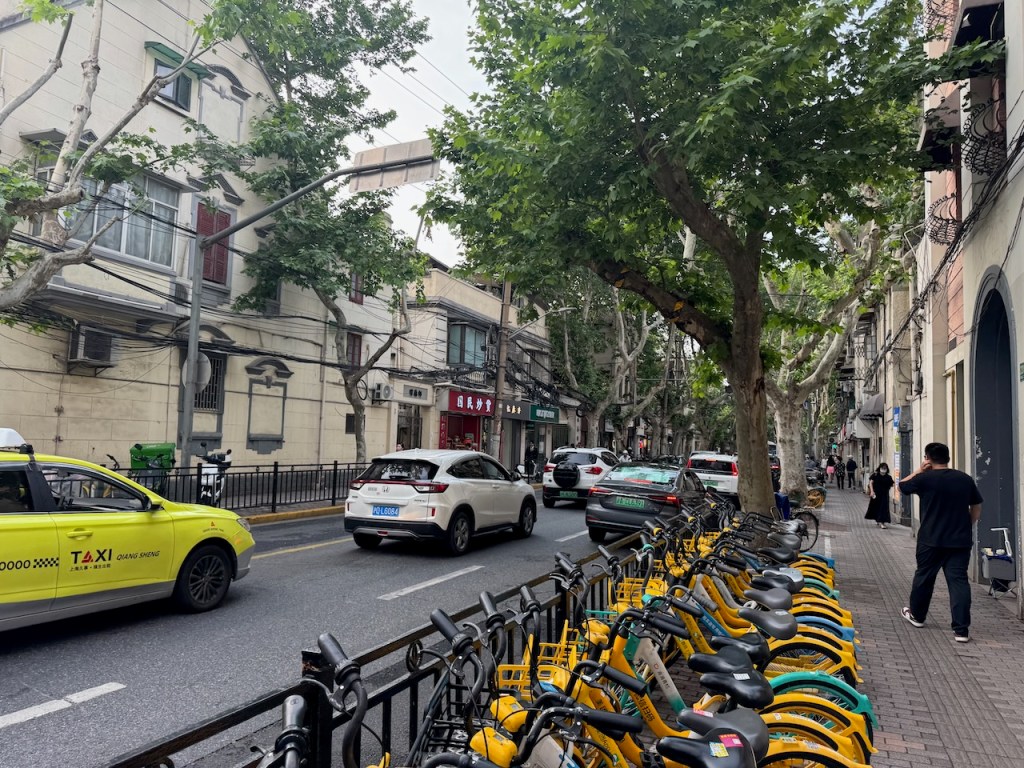
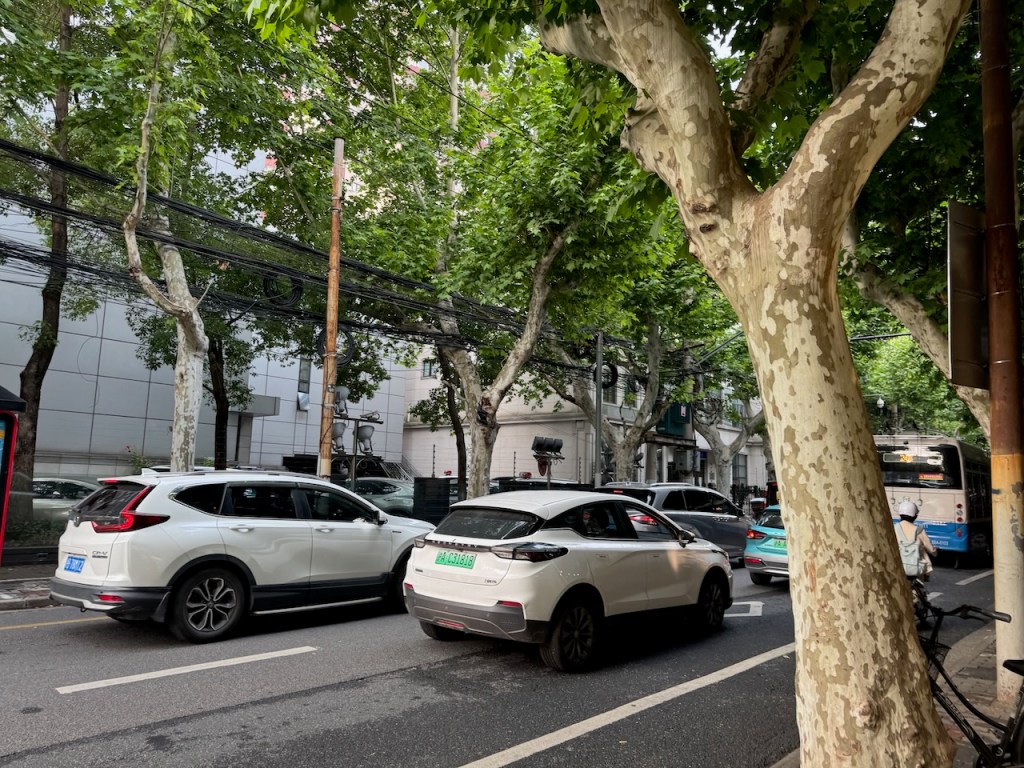
The French Concession was an area administered by the French Government for almost 100 years. To date, the area is still filled with buildings left behind by the French from yesteryear. We were drawn to this area by the former site of the French Concession Joint Courts (法租界公审会廨旧址), which appears to be the only notable attraction in this vicinity. Little did we know that there were more historical buildings in this area. We took the metro from Jian’an Temple Station to Dapuqiao Station and walked along the streets. Our first impression of the French Concession is that the streets in this area have a rustic charm reminiscent of China in the 50s. The trees planted on both sides of the street reminded us of the Champs-Élysées, which we had visited in Paris. Despite heavy traffic, the streets of the French Concession remained peaceful. Our plan was to visit the former site of the French Concession Joint Courts and then head to Tianzifang. As we were walking along the street, we discovered Tianzifang was just to our right. Since we were already here, we made some last-minute changes and took a detour to Tianzifang.

Tianzifang (田子坊)

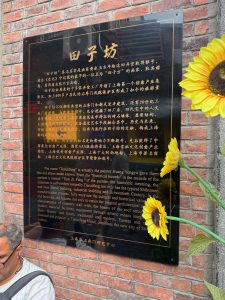
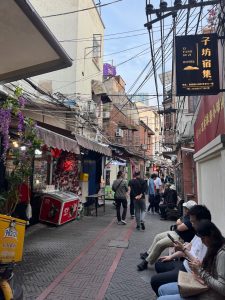
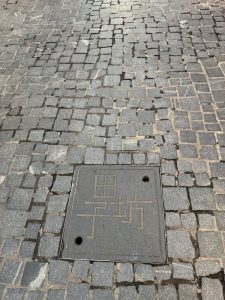
Tianzifang is very well concealed from the outside. Gates surround the area, giving it a residential appearance. We would have missed it if not for the sign hung on the outer gates. Tianzifang is essentially a shopping district comprised of traditional residential buildings that do not conform to any city planning regulations. Walking in Tianzifang gave us the impression that these former residential buildings were built on sites at the will of their former owners. These buildings were not uniform either; we saw different facades of these buildings, some with their bricks exposed, while others were plastered in cement. Some of these buildings even span across the pavement below. It is this irregularity that gave Tianzifang its character and charm. Relinquished of its former role as residential buildings, the buildings in Tianzifang have been repurposed to house boutique shops, souvenir stores, bars and restaurants. Walking in Tianzifang not only felt like strolling through old Shanghai, but it also felt like navigating a maze. Although we are not big shoppers, we still managed to spend an hour browsing through the shops and eventually found a shop selling locally designed T-shirts, which were reasonably priced for their high quality. Generally, we thought the prices in Tianzifang were lower compared to those on East Nanjing Road.

Sinan Open Air Museum (思南露天博物馆)

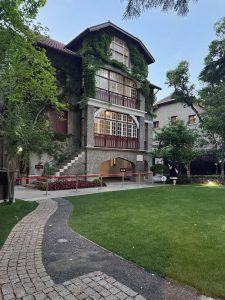
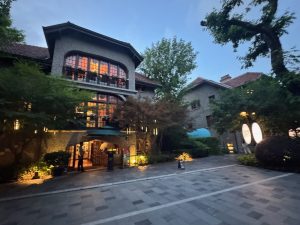
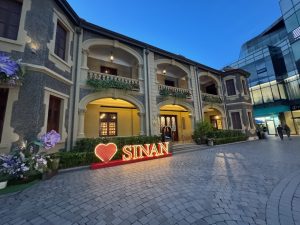
Leaving Tianzifang, we continued our leisure walk to the former site of the French Concession Joint Courts, which lies across the street. When we arrived at the building, it seemed to be a police station and closed to the public. We did not bother entering the premises or asking if the building was open to the public. Seeing it was getting late, we headed to our final destination for the day – Xintiandi. As we followed the directions on our AMap app (China’s equivalent of Google Maps) towards Xintiandi, we came across some European buildings that were very well-preserved. Unknowingly, we have wandered into the Sinan Open Air Museum. Walking amongst the buildings here felt like we were transported to some small town in Europe; we almost forgot we were in Shanghai. Sinan Open Air Museum does not display relics. Every building, every street lamp, every cobblestone street is a relic that showcases European influence in Shanghai’s history. These buildings were once residential mansions but have been converted into restaurants and cafes. As there were not many people walking in this area, the stroll in the Sinan Open Air Museum felt peaceful.

Xintiandi (新天地)

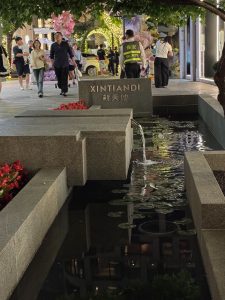
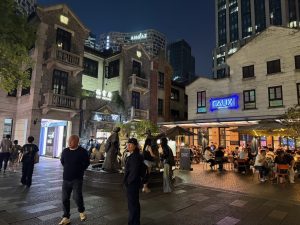
Leaving Sinan Open Air Museum and 15 minutes walk later, we arrived at Xintiandi. Xintiandi is a relatively small area compared to Tianzifang, primarily comprising restaurants and bars, as well as a handful of shops, housed in stone and brick buildings. As it was dinner time, Xintiandi was especially lively with diners chatting and the clinking of wine glasses. Several large shopping malls occupy the land adjacent to Xintiandi. Filled with luxury boutiques and billboards so bright that they illuminated the street. As there wasn’t much for us to do here, except watch people eating and drinking, we didn’t stay long and headed back to our hotel via the subway.

Night View of the Bund

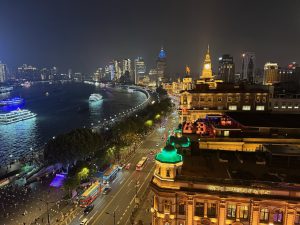
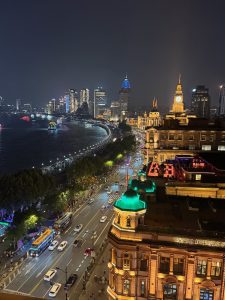
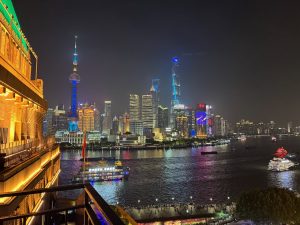
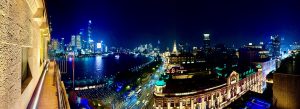
We returned to the hotel around 8:30 pm, before the lounge in our hotel closed. Our butler had pre-arranged for us to visit the rooftop terrace. The staff at the lounge escorted us to the rooftop terrace, where we were treated to a stunning night view of the Bund and Pudong area. Being located on the Bund, facing the Pudong area, the rooftop terrace of our hotel provided an unobstructed view of the buildings in Pudong, illuminated by neon lights. From the roof terrace, we were also able to catch part of the buildings on the Bund dressed in their orange garb. In contrast to the large crowd below at the Bund, the view up here was peaceful.

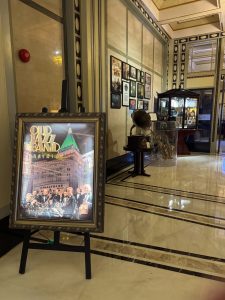
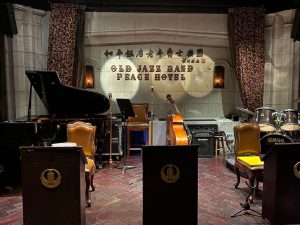
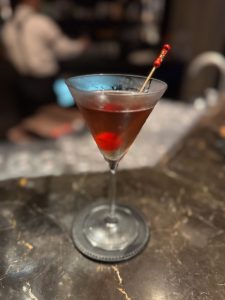
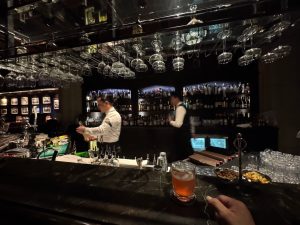
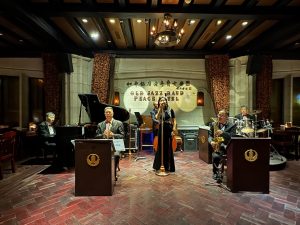
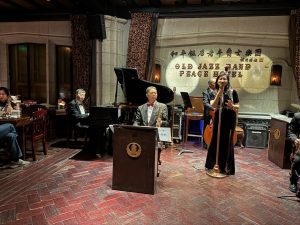
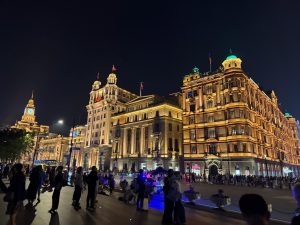
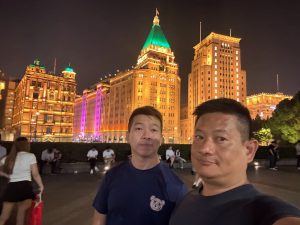
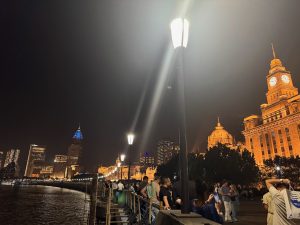
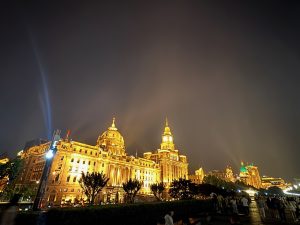
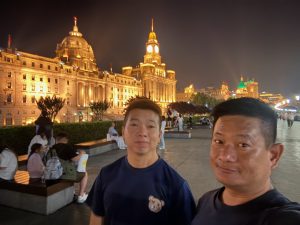
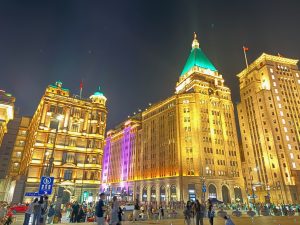
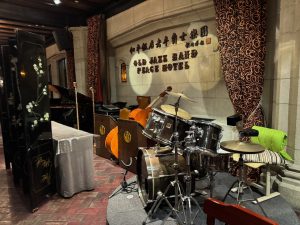
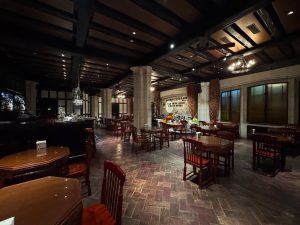
After visiting the roof terrace, we headed to the famed Jazz bar in the Peace Hotel. Our butler had made a reservation for us at the bar to watch the world’s oldest band perform. We were privileged to be given front row seats with an unobstructed view of the band performing. As we did not have a good shot of the Bund, we headed out to the promenade after the jazz performance to take some pictures of the Bund. The buildings on the Bund were especially beautiful at night with the orange light cast onto them. The promenade was bustling with life, with visitors taking pictures of the Pudong skyline and street vendors trying to sell their photography services despite being late at night. We returned to our hotel to rest for the night after taking our fair share of pictures.

Shanghai Day 2 (15 May 25): Day Trip to Hangzhou – Heaven on Earth

There is a Chinese saying: while there is Heaven above, there are Suzhou and Hangzhou on Earth (上有天堂,下有苏杭). This saying compares the scenery of Hangzhou and the gardens in Suzhou to heaven. Since we had some time in Shanghai, we decided to take a day trip to Hangzhou.

From Shanghai to Hangzhou

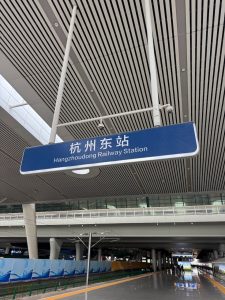
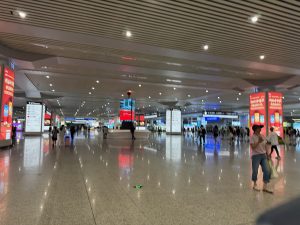
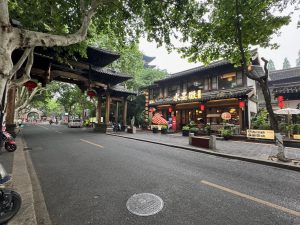
Hangzhou is approximately 179 km from Shanghai, and the fastest way to travel from Shanghai to Hangzhou is by high-speed train, which takes about 1 hour. Shanghai has two train stations: Shanghai Station and Shanghai Hongqiao Train Station. Although slightly farther from where we stayed, we took the train from Shanghai Hongqiao station as there are more connections between the two cities here. Three train stations serve the city of Hangzhou: Hangzhou Station, HangzhouDong Station, and HangzhouXi Station. Hangzhou Station is in the centre of the city, but connections between Shanghai Hongqiao Station and Hangzhou Station were few. HangzhouXi Station is far from the city, while HangzhouDong Station offers more connections and is closer to the city. Train tickets can be bought at the train station or via Trip.com. We purchased our tickets through the Alipay app, which includes a link to the Trip.com microsite.

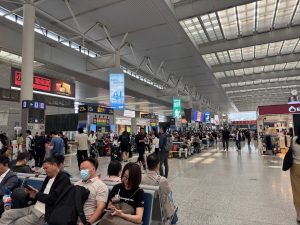
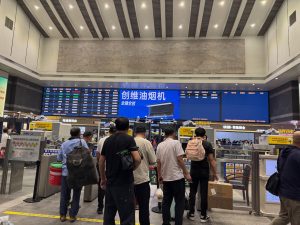
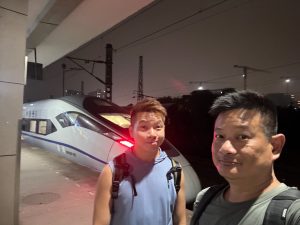
Shanghai Hongqiao Train Station is well-connected to Metro Lines 2 and 10, both of which pass through East Nanjing Road Station, where our hotel is located. It took about 50 minutes on the metro from our hotel to the train station. We set out from our hotel at 7:00 a.m. to catch our 8:15 a.m. train, taking into account the transit time between our hotel and the train station, as well as any other potential delays that might occur along the way. Our train to Hangzhou departs from level 2 of the train station. There are marked signs in both Chinese and English throughout the station that guide us to our destination. We were also not required to collect any tickets before boarding our train. Our passport details have been entered into the train ticketing system. We just need to scan our passports at the manned counter to gain access to the platform. The ride on China’s high-speed train was very smooth and comfortable; we were even given a bottle of water and some snacks for the duration of the ride. To get to the city from the HangzhouDong train station, we can take the metro or hail a cab. As we have limited time in Hangzhou, we went for the cab option. Getting a Didi (China’s Uber equivalent) was super easy. Although we didn’t have a local number, we were still able to use Didi through the Alipay app. There are designated areas in the train station for Didi pickups. At the pick-up point, a large display shows the cabs already pulled in, and we just need to look out for the car’s plate number and head to the parking lot.

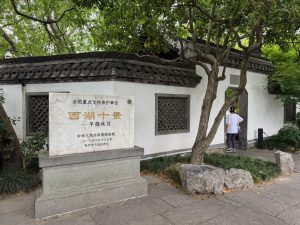
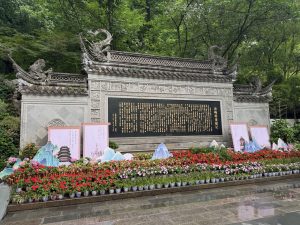
West Lake (西湖)

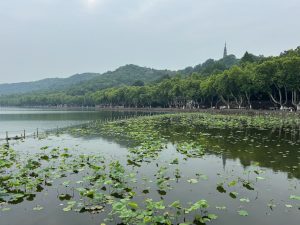
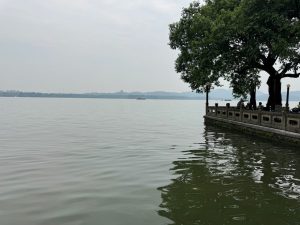
Visiting Hangzhou without coming to West Lake is like going to Paris and not visiting the Eiffel Tower. West Lake is the main attraction in Hangzhou, and it is this lake that gives Hangzhou its title of “Heaven on Earth.”

The West Lake upclose

Baochu Pagoda (保俶塔)

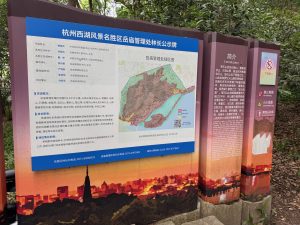
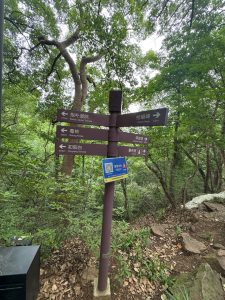
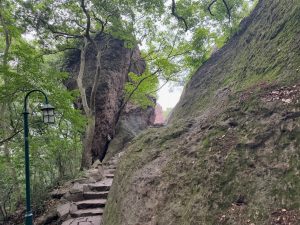
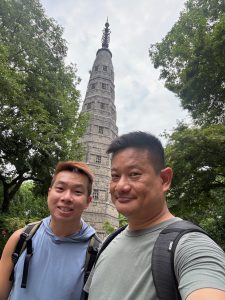
The first sight we visited in Hangzhou was Baochu Pagoda, one of the two pagodas in West Lake. Perched on top of a hill, we thought scaling up this pagoda would give us a great view of the entire West Lake. As our Didi ride came to a stop, we were dropped off at a neighbourhood-looking area. It took us 30 minutes to travel from our drop-off point to Baochu Pagoda. The walk to Baochu Pagoda requires a short hike up a small hill through a forested area. Occasionally, we saw groups of elderly people having fun in the open spaces along the path. As we walked along the path with signs pointing to the pagoda, the forest scenery gave way to rocky formations. The pagoda is not far from a pavement that seemed to wedge between narrow rocks.

Past the rocks, we arrived at an open area, where we could see the pagoda sitting in one corner. From here, we were treated to a view of West Lake. We could see the mountains surrounding the lake as though they were protecting it. The view would be better if not for the trees from the forest below, which partially block the view. Nonetheless, we were able to see the Broken Bridge from one of the many viewpoints here. We wasted no time and approached the Baochu Pagoda. The moment we arrived, we were disappointed to find that the slender pagoda was closed to the public, and we were not able to climb to the top of the pagoda. Since we made it up here, we visited a nearby rock and pavilion before heading back down. As we walked down the staircase next to the pagoda, we noticed that this path was an easier climb. This is when we realised that we should have put the Baochu Pagoda car park as the drop-off point.

Broken Bridge (断桥)

Our next stop was the Broken Bridge, about a 10-minute walk from the Baochu Pagoda. We had a brief rest at Starbucks on the southern part of the lake to escape the heat. The weather was rather humid when we did the climb to Baochu Pagoda. After resting briefly, we walked across the road to the Broken Bridge. The Broke Bridge was essentially a series of three sandbars connected by bridges. This place was given the name “Broken Bridge” as these bridges connecting the three sandbars appear to be broken when viewed from a distance during winter due to the snow. The Broken Bridge was the setting in the Chinese folklore “Legend of the White Snake” (白蛇传), centred around the romance between a man and a White Snake Spirit. Walking on the sandbars of the Broken Bridge brought us close to the West Lake; it felt like walking on the lake itself. We could see Baochu Pagoda sitting atop the hill we were on moments ago, as though she was flexing her beauty on the shores of the lake from the Broken Bridge. Locals taking their leisurely walk along the bridge, boats pulling off from the sandbar, paddling on the lake, and occasionally some locals feeding the ducks on the lake are common sights along the sandbar. Walking on the Broken Bridge was mostly relaxing, but we had to avoid the many tourist trams along the way. As our next stop, Leifeng Pagoda, was a distance away from the Broken Bridge, we initially wanted to take the tourist tram (costs RMB 80 per person). We managed to find one where the seats facing the back were empty. Unfortunately, the driver was on his way for his lunch break. We continued our walk towards the end of the sandbar, looking out for the next tram with the last row empty. Soon, we found ourselves at the end of the sandbar. We spotted some buses making a U-turn. We approached a lady who appeared to be a staff member, and she recommended that we take one of these buses to Leifeng Pagoda, which costs only RMB 2 per person.

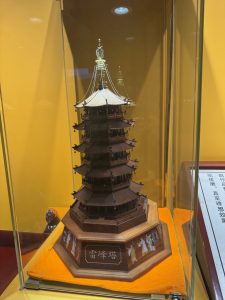
Leifeng Pagoda (雷峰塔)

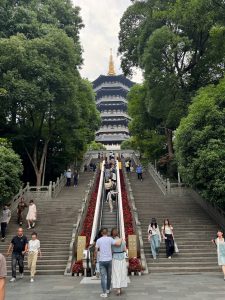
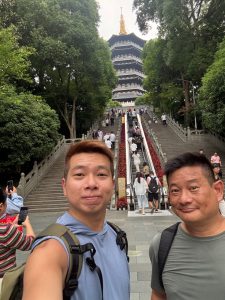
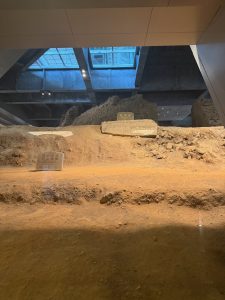
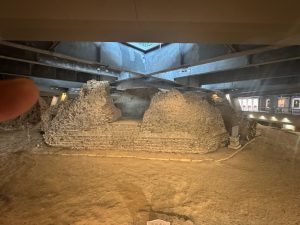
The bus ride to Leifeng Pagoda took only 10 mins, saving us time and a lot of walking. To get to Leifeng Pagoda from the Broken Bridge, we rode the bus for eight stops and alighted at Sutinankou (苏提南口). While the Baochu Pagoda was often described as the beauty of West Lake, in contrast, the bulky appearance of the Leifeng Pagoda was often associated with a monk. The entrance to Leifeng Pagoda costs RMB 40 per person. We visited the basement level first, followed by heading to the ground floor and taking a lift up to the top floor of the pagoda, and slowly making our way down the pagoda. The basement of the Leifeng Pagoda exhibits its original structure. Leifeng Pagoda was originally built in 977 AD as a monument to house the hair of Buddha. The pagoda collapsed due to excessive brick theft and nearby construction work. The pagoda we see today was rebuilt and reopened in 2002. Leifeng Pagoda is also the setting of the story in “Legend of the White Snake”, where the white snake spirit was trapped under the pagoda for years until her son released her. From the original structure on display in the basement, I wonder if the locals linked the collapse of the pagoda to the efforts of the white snake’s son in saving his mother. In addition to the original structures, the basement also features the original bricks and some Buddhist relics.

We headed to the ground floor to take one of the lifts to the top of the pagoda. The lift only stops at level 5 of the 7-storey pagoda; visitors must walk up the remaining two levels. As we emerged from the lift on level 5, we were captivated by the golden underdome of the level, but didn’t spend time looking at it. Our goal is to go to the top of the pagoda. At the top of Leifeng Pagoda, we were treated with an unobstructed view of the West Lake. This offers a far better view of the lake compared to the hills where the Baochu Pagoda is located. From here, we can see the Baochu Pagoda, seemingly emerging from the ground like a needle being stuck, as well as the numerous bridges on West Lake and the islets within the lake. Most of the visitors on this level focus on the view of the lake, and we found fewer crowds at the side facing the hills behind the pagoda. Although not as scenic, the hills stretching to the horizon evoke a certain tranquil vibe. It is a pity that today was a hazy day.

On our way up, via the lift, we saw numerous carvings on each level. We were able to take a closer look at them while walking down the pagoda. Each level depicts carvings of different scenes. The most memorable ones are those on the 5th floor and the 1st floor, depicting the birth and enlightenment of the Buddha, and scenes from “Legend of the White Snake”, respectively. These carvings, other than being a work of art, tell a story on their respective levels. The carvings are intricate, and one can spend hours looking at them. I thought the RMB 40 for the Leifeng Pagoda was worth it, as we got a better view of West Lake compared to the hills of Baochu Pagoda.

QingHefang (清河坊)- The Historic Commercial Centre of Hangzhou

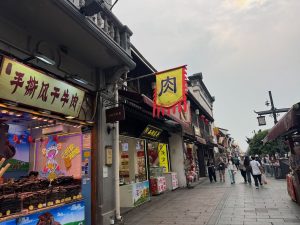
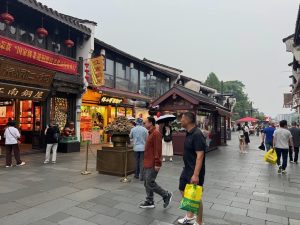
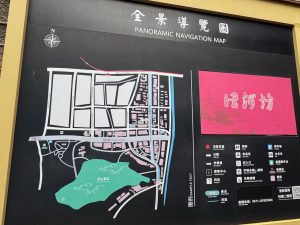
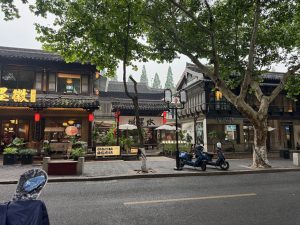
It was already 3 pm by the time we were done with Leifeng Pagoda. We spent the remaining 4 hours in Hangzhou shopping on the iconic Hefang Pedestrian Street (河坊街). As we were feeling a little peckish, we hailed our ride using the Didi app in Alipay, which took us to Hefang Street in 20 minutes, instead of taking the bus (which would have taken us 1 hour). Hefang Street, one of the ancient streets in the Qinghefang commercial centre, is an ancient street where the business and political centre was located. Qinghefang comprises three streets: Hefang Street (河坊街), Wushan Square (吴山广场) and Southern Song Imperial Street (南宋御街). Today, these streets still preserve ancient buildings that have been repurposed as shops selling souvenirs to visitors. Walking along Hefang Street is like stepping right into the pages of history. Despite the numerous shops around, we thought the shops sold mostly the same things; it felt like these shops were copied and pasted, with the same order of shops selling the same things repeated over and over as we walked through the street.

We tried to cover every street on Hefang Street and found ourselves in front of an ancient gate building with the Chinese words “Drum Tower” (鼓楼) inscribed on it. This tower was used to mark time and announce important events in the past. Today, visitors can only walk under the Drum Tower to a street filled with restaurants and eateries. We traced our footsteps back to Hefang Street and came to the Southern Song Imperial Street. Compared to Hefang Street, the Southern Song Imperial Street sees less foot traffic and feels more peaceful. This street is shorter than Hefang Street, with mainly art galleries.

We had 1 hour left before our train back to Shanghai departed. Instead of the HangzhouDong Station, we managed to find a train that departs from Hangzhou Station, about a 25-minute walk from Hefang Street. As we still had some time, we chose to walk to the train station. Along the way, we encountered the peaceful and tranquil side of Hefang Street. We arrived at Hangzhou Station in time for our train, which took us back to Shanghai in one hour. We shopped for food below our hotel before returning to our room to rest for the night.

Shanghai Day 1 (14 May 25): Hello Shanghai -Marvelling the sights in Pudong and the Bund

This is a continuation of our cruise from Shanghai to Fukuoka. We were primarily in Shanghai for the cruise and decided to spend a few more days exploring the city after our cruise trip ended. The last time I was in Shanghai was almost three decades ago, and I thought it was a good time for me to return to the city. Our cruise ship was already docked when we woke up this morning. After having breakfast at one of the restaurants onboard, our Royal Genie (butler) met us at 8.30 am to escort us off the ship, ensuring that our disembarkation was smooth. After meeting the driver that we arranged with our hotel for land transfers within Shanghai, we made our way to the hotel for check-in. The plan today was to take it easy and visit the sites near our hotel.

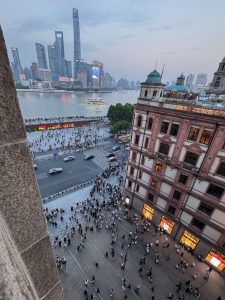
The Bund

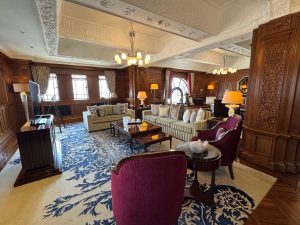
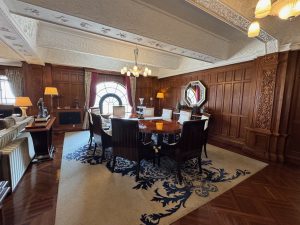
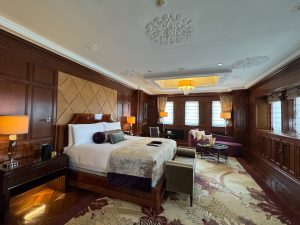
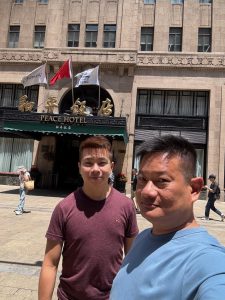
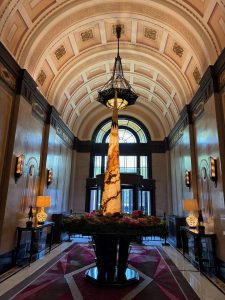
Our hotel is situated on the bank of the Huangpu River on the Bund. The Bund is an iconic stretch of Shanghai, where the old financial centre and activities for the rich and famous are located. Our driver pulled up at the iconic Peace Hotel, where we would call home for the next four nights. At the hotel, we met our butler, Gordon, who gave us a brief orientation of the hotel. Before heading to our room for in-room check-in, Gordon gave us a tour of several suites, including the River View Suite and the Japanese Suite, one of the seven national suites. The highlight of the brief tour was a visit to the Sassoon Suite, the hotel’s Presidential Suite. Perched on the 10th floor, the Sassoon Suite was originally the apartment of Victor Sassoon, the hotel’s original owner. This suite has a vantage point of the Huangpu River and directly faces the Pudong district across the river. Entering this suite, we felt immediately transported back in time to 1920s Shanghai. The suite is very well restored to its original setting. Gordon told us most of the decor we saw in this suite was restored based on the old photos of the suite. We were also told that this suite is the only one with a terrace and that President Obama was a guest in the Sassoon Suite during his visit to Shanghai. After the tour, we were escorted to our room for check-in, where our luggages were already being delivered to the suite.

Our Private Tour of the Iconic Peace Hotel

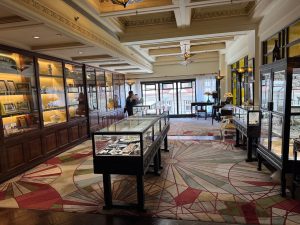
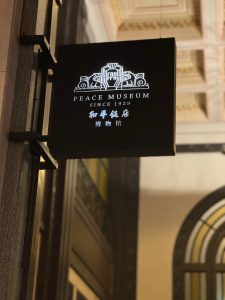
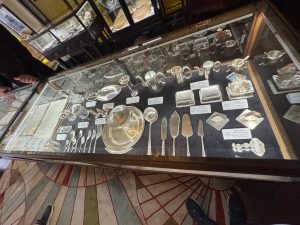
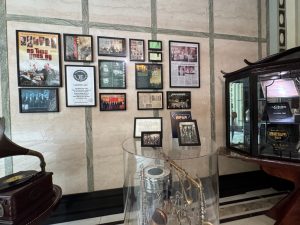
Fairmont Peace Hotel itself is an attraction on the Bund. Its green roof has been an icon on the Bund since the 1920s. Naturally, many significant events took place at the hotel. With such a rich history, the hotel offers complimentary scheduled historic tours of the hotel and its museum, conducted in both English and Chinese. Gordon organised a private historic tour of the hotel for us. We met up with our guide, Richard – the hotel’s historian, at the reception. Our tour began at the hotel’s museum, one floor above the reception. Richard took us through the exhibits in the small museum, from the famous persons who had stayed in the hotel and the suites they had occupied, to the silverware and menus crafted for specific events, to the important events and meetings hosted at Peace Hotel. Richard then brought our attention to a bill that was dated in the 1930s. Although the amount stated in the bill seems small compared to today’s standards, considering inflation and the cost of living at the time, Richard mentioned that the bill was easily equivalent to a year’s salary for a typical Shanghainese in the 1930s. Of the exhibits, the one that intrigued me the most was a small metallic disc. Richard pointed out this was a metallic vinyl record, which stored music played in the Jazz bar back in the days, and a memento for guests. I jokingly remarked that this was the predecessor of CDs.

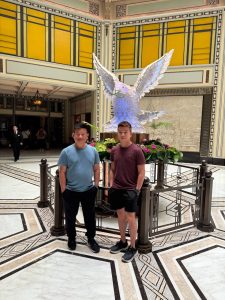
After the tour of the museum, we were brought to the octagon hall, where Richard directed our attention to the large dove sitting in the centre of the hall. This dove is made of 1,500 liuli (琉璃) crystal and weighs more than 1,000 kg to symbolise peace. We were drawn to the metallic murals hanging on the walls of the octagon hall, where Richard pointed out that they depicted the old times in Shanghai. Our tour continues through a hallway where a collection of movies and TV shows that were shot in the Peace Hotel. Our tour concludes at the small hall at the end of the corridor. Richard explained that this was the original main entrance of the hotel, but it had been closed permanently due to feng shui reasons. The significant structure in this original entrance was the split stairs, which are one of the original features since the hotel was built. We were shown a picture of Charlie Chaplin on the stairs.

East Nanjing Road – The Ever-Busy Street

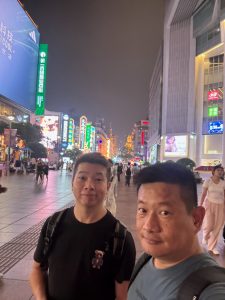
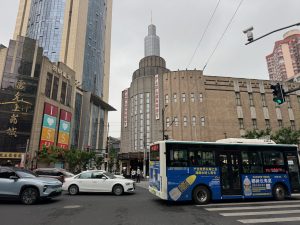
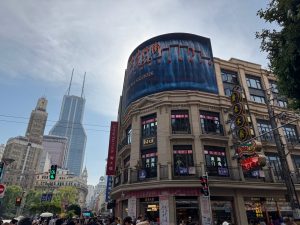
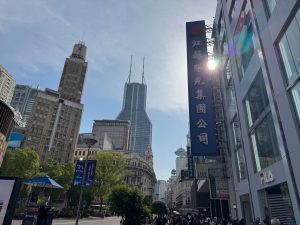
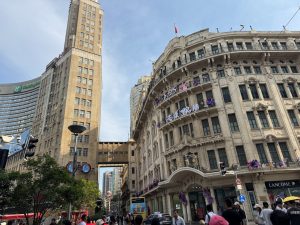
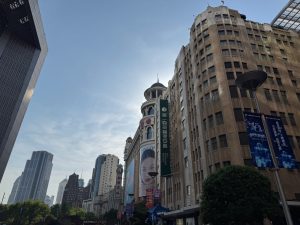
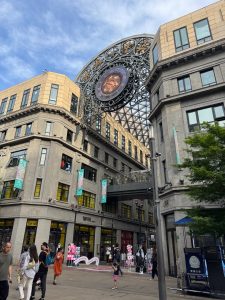
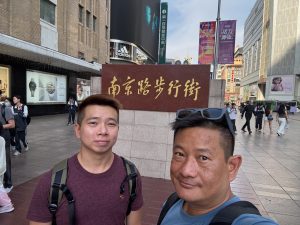
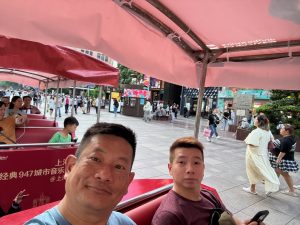
After our tour of the hotel, we returned to our room to rest a little. Soon, hunger pangs hit us, and we headed out to the restaurant that Gordon recommended near the hotel for lunch. After lunch, we wanted to purchase a stored-value metro ticket for Shanghai, which would provide convenience when taking the metro around the city. However, the nearest subway station to our hotel does not sell them, and we had to go one station further to People’s Square Station to get them, which is further down East Nanjing Road. Since we had the intention to stroll along East Nanjing Road, we took this opportunity to walk along the street towards People’s Square Station. East Nanjing Road is always crowded with people, regardless of the day of the week. East Nanjing Road is dotted with buildings that were left behind from the World War era, when the city was divided and ruled by different nations. As a result, we see some buildings with a distinctly European architectural style and others with a distinctly Chinese style. Walking along the street feels like walking in history. There are many smaller shops along East Nanjing Road, mainly selling famous Shanghai snacks and souvenirs, as well as eateries and cafes. We also spotted several larger department stores, where most of the luxury brand goods are housed, and fashion boutiques along the road. After getting our transport cards from People’s Square Station, we had the option of taking the metro one stop back to East Nanjing Road Station or walking back. As we were a bit tired after walking, we hopped onto one of the tourist tram rides (RMB 10 each) and saw East Nanjing Road from a different perspective.

Pudong (浦东) District

We wanted to catch the sunset on the Shanghai Tower, so we headed to the Pudong Area, Shanghai’s financial centre. There are two main ways to access the sights in Lujiazui (陆家嘴): by metro or ferry.

Crossing Huangpu River

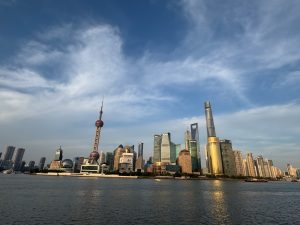
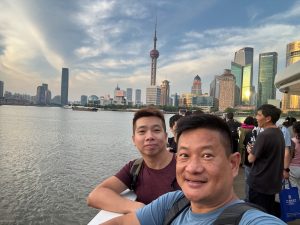
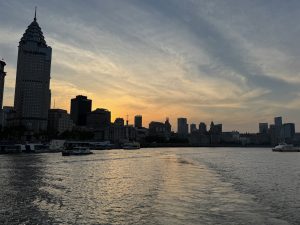
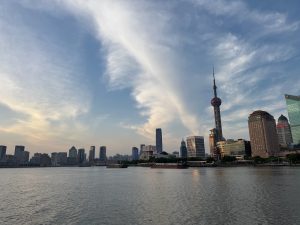
Instead of going underground, where we would miss the iconic sight of having both the Bund and Pudong area in one frame, we opted for the Shanghai Ferry ride across the Huangpu River to Lujiazui. Jingling East Road Ferry Terminal is the nearest ferry pier to East Nanjing Road. To get to the ferry terminal, we headed for the Bund and walked along the promenade. The ferry terminal is a stone’s throw from a lighthouse-looking tower along the promenade. Crossing the Huangpu River via the ferry costs RMB 2, payable with a Shanghai metro card or Alipay. Shanghai Ferry has been transporting Shanghainese since 1911, over 100 years ago. The ferry was the only means for Shanghainese to reach the Pudong area before the tunnels and bridges were built. Today, the Shanghai Ferry primarily serves sightseeing purposes, and the last ferry service across the river concludes at 6:30 pm. The best view of the Huangpu River from the ferry was from the back of the boat on the upper deck. We saw a beeline of people rushing for the upper deck and did likewise. Fortunately, we were able to secure a great spot at the back of the boat to enjoy the view of Shanghai’s iconic landmarks. As the ferry slowly pulled away from the pier, we were treated to a view of the buildings on the Bund. The view was the best in the middle of the river, where we were able to capture landmarks on the Bund and Pudong in one frame.

Shanghai Three Towers (上海三件套)

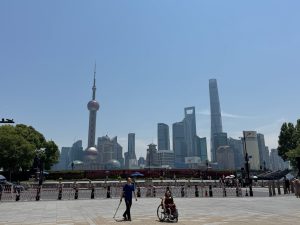
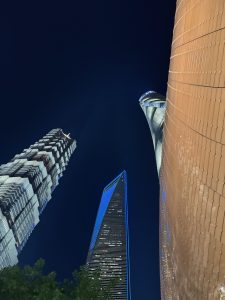
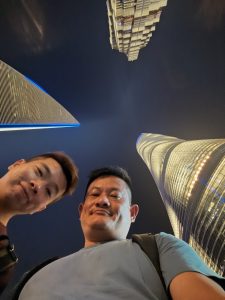
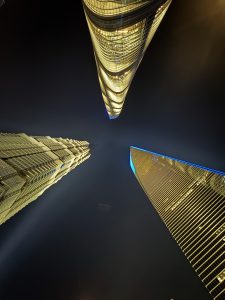
The ferry docked at Dongchang Road Ferry Terminal, and we are officially in the Pudong district. The Pudong area used to be farmland, where no one wanted to stay. Fast forward decades later, the Pudong area is one of the highly sought-after areas with skyrocketing property prices. Pudong had been transformed from farmlands to the city’s financial centre. In the centre of the financial centre lies the Shanghai Three Towers (上海三件套). Our original plan was to catch the sunset from the top of the Shanghai Tower and then return to take night shots of the three towers. Since we were walking past, we took the opportunity to take pictures of the iconic three towers. There is a specific spot where locals gather to take pictures of the three towers is the small open area adjacent to Jin Mao Tower. It is even charted on the Chinese equivalent of Google Maps, as Wang Hong da ka jing dian (网红打卡景点), which translates to a social media influencer’s picture-taking spot. One will not miss the spot, as we saw locals placing their phones on the ground, taking pictures of themselves with the three towers. This is the spot where we can capture the tops of all three buildings – Jin Mao Tower, Shanghai Tower, and Shanghai World Financial Centre, all pointing towards each other in one frame. We tried to follow the locals’ lead and took some pictures before dark. After taking our fair share of pictures, we headed to the Shanghai Tower to view the city from high up.

Shanghai Tower – Night View of the Icons at the Top of Shanghai

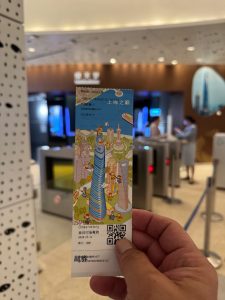
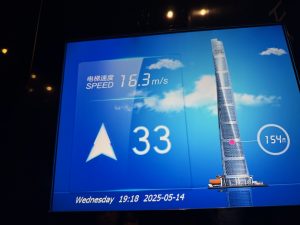
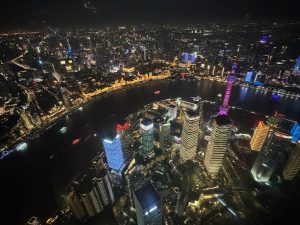
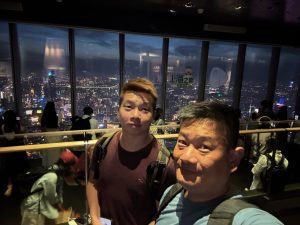
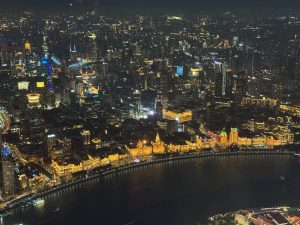
Several towers in the Pudong area offer a view of the Huangpu River and the Bund. On the one hand, I wanted to visit the Oriental Pearl Tower, as I had seen it for the first time 30 years ago. However, this shorter tower may not provide the best view of the Bund. The other tower is the taller Shanghai Tower, which features the highest observation deck in the country. The Shanghai Tower is approximately 632m tall, making it the third-tallest building in the world. Although it is not the tallest building in the world, the Shanghai Tower’s observation deck, at 546m, is higher than that of the Burj Khalifa in Dubai, at 452m. There are two prices for the entrance to the Shanghai Tower. RMB 180 only got us to the observation deck on level 118, while the more expensive RMB 268 ticket includes entrance to the light show on level 126. We bought the more expensive RMB 268 ticket, thinking we would be able to look out into the city at the tower’s highest vantage point. Our first stop was the observation deck at level 118, where a lift sped us up over 500m in under 3 minutes. The view from the observation deck on level 118 was stunning! The limits of Shanghai city seem to stretch beyond the horizon. From here, we were able to see the bend of the Huangpu River and the entire stretch of the Bund, as well as the Oriental Pearl Tower situated next to the river. The view of the city at night was especially beautiful. As we were walking around, we were telling ourselves, “This is just the beginning, the view on level 126 would be better”.

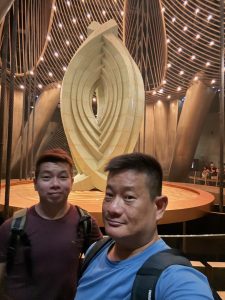
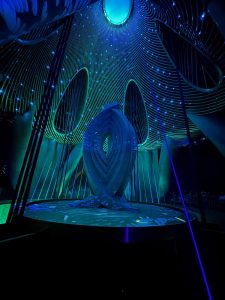
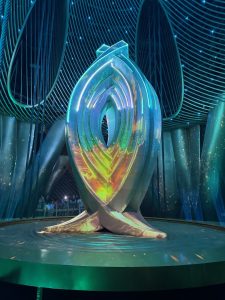
We took another lift up to level 126. Entrance to that level is scheduled at a specific time, probably for crowd control purposes. Our excitement for level 126 turned to disappointment upon arrival at level 126. Instead of the floor-to-ceiling windows we saw on level 118, there were walls enclosing this level. In the centre of the level was a large structure, dubbed the Intelligent Eye of Shanghai. This is the damper of the tower, installed to counter the lateral movement of the tower due to wind or earthquake. Unlike the damper in most buildings, which is typically spherical, the damper on the Shanghai Tower resembles the eye of a dragon. We were urged to spread out for a light show. This is when we realised the timed entrance to this floor is actually for the light show. As beautiful as it might be, we felt a little bored since we weren’t exactly into light shows. The light show lasted about 10 minutes. We felt paying the extra for access to level 126 without the view of the city was not worth the money. Unless one is into light shows, I’d rather spend the additional money on food.

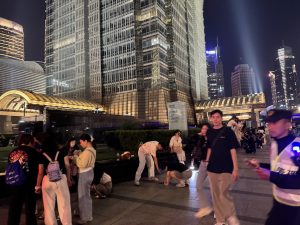
We descended the tower for dinner after the light show. We only managed to find a restaurant at the tower that was still open. After dinner, we returned to the photo spot to take night shots of the Shanghai Three Towers before returning to our hotel via the metro to rest early. We had an early start tomorrow, catching the high-speed train to Hangzhou.