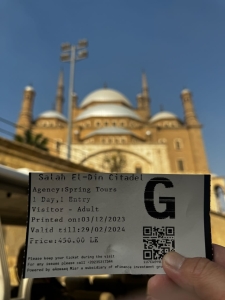
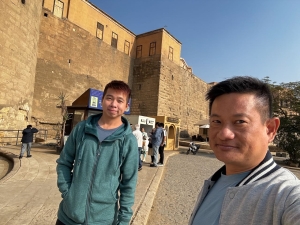
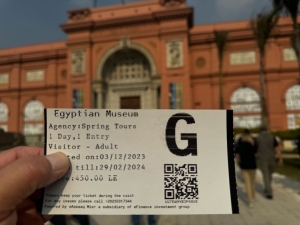
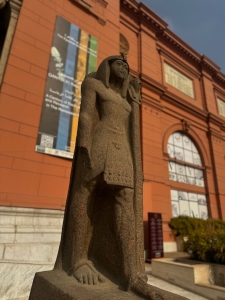
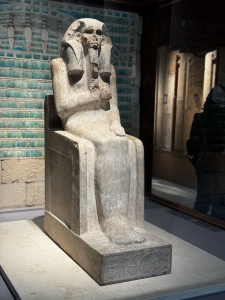
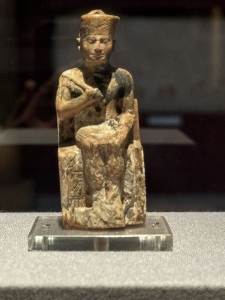
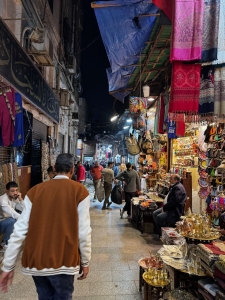
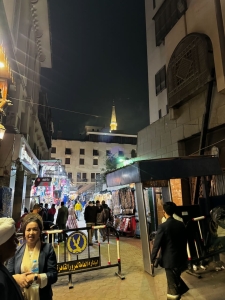
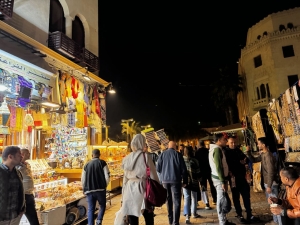
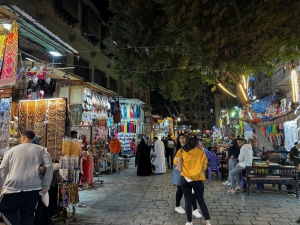
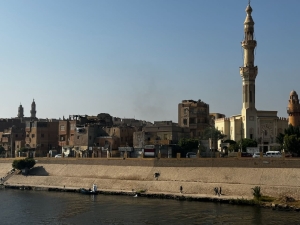
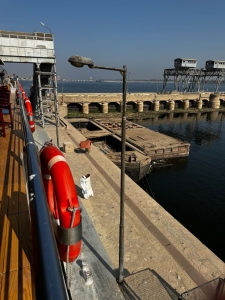
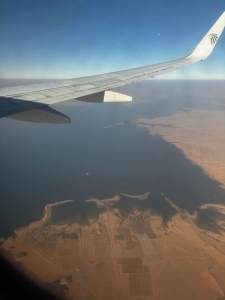
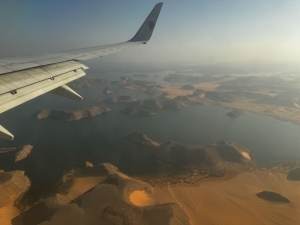
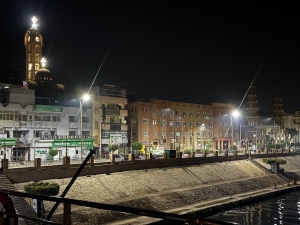
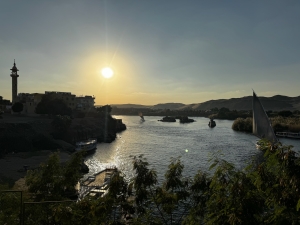
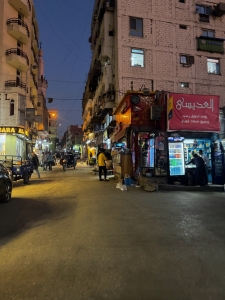
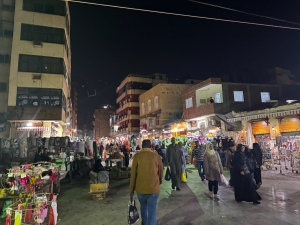
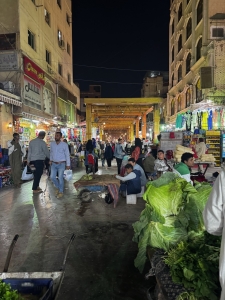
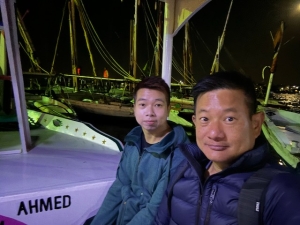
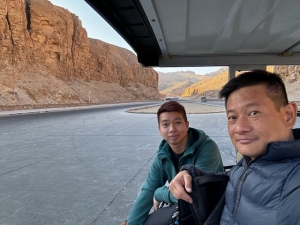
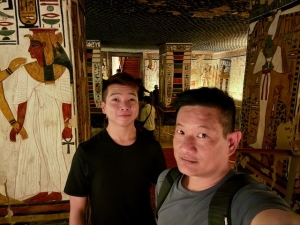
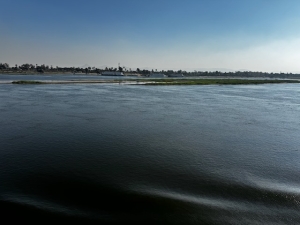
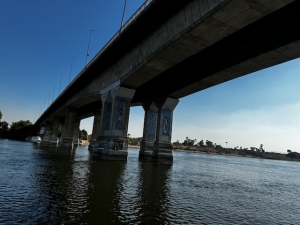
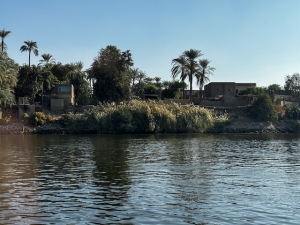
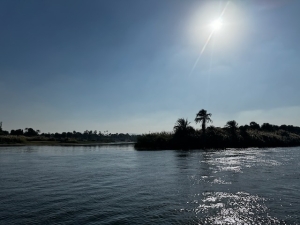
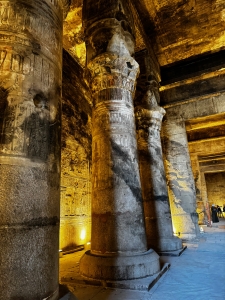
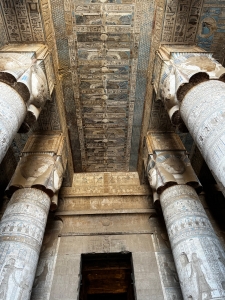
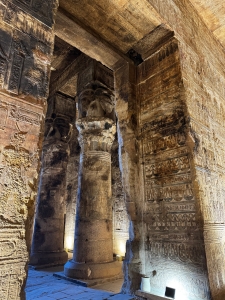
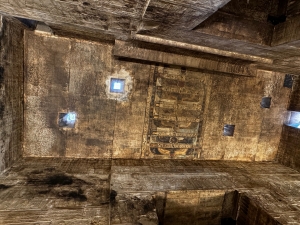
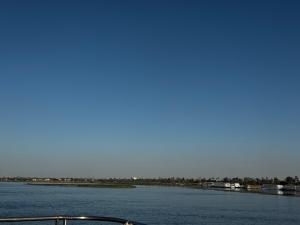
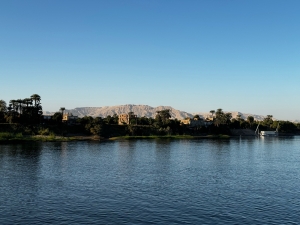
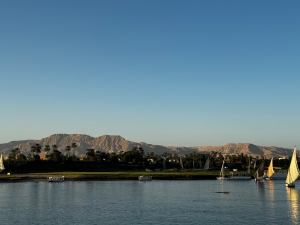
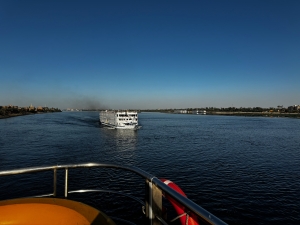
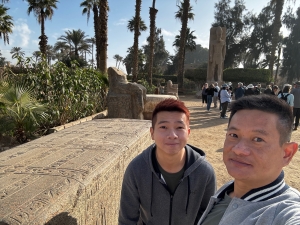
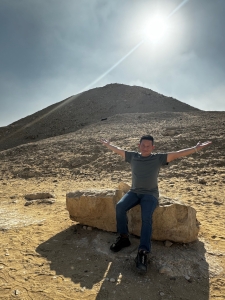
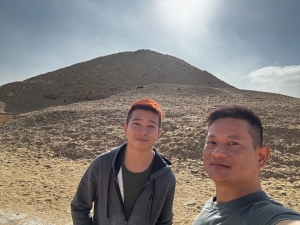
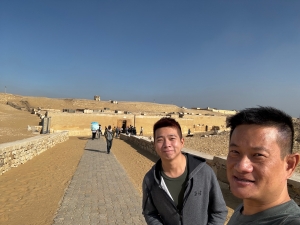
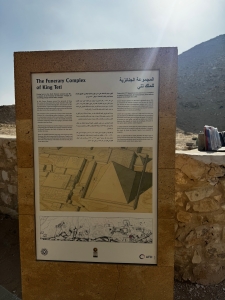
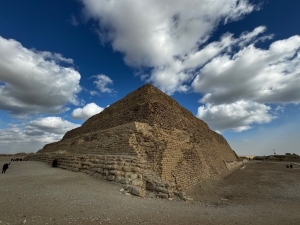
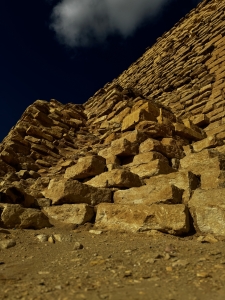
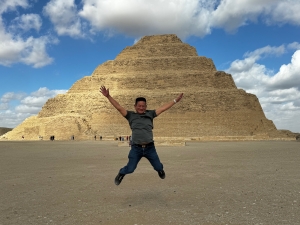
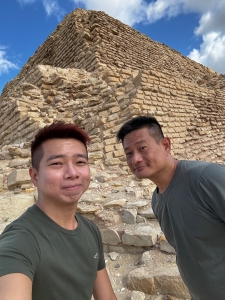
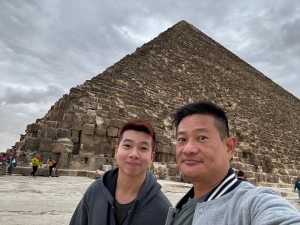
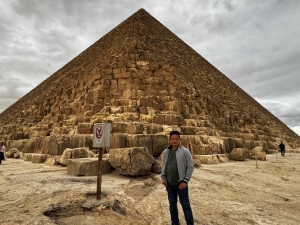
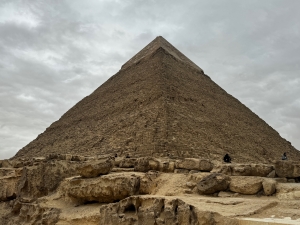
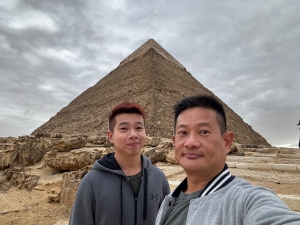
It is our last day visiting sights in Egypt, and we had two sights on the list today. After landing in Cairo, we headed straight to the sights from the airport. We visited the Citadel of Salah El-Din and the Egyptian Museum before bidding farewell to our Tour Director, Ahmed. As we had the rest of the day to ourselves, my friend and I visited Khan El-Khalili Bazaar at night.
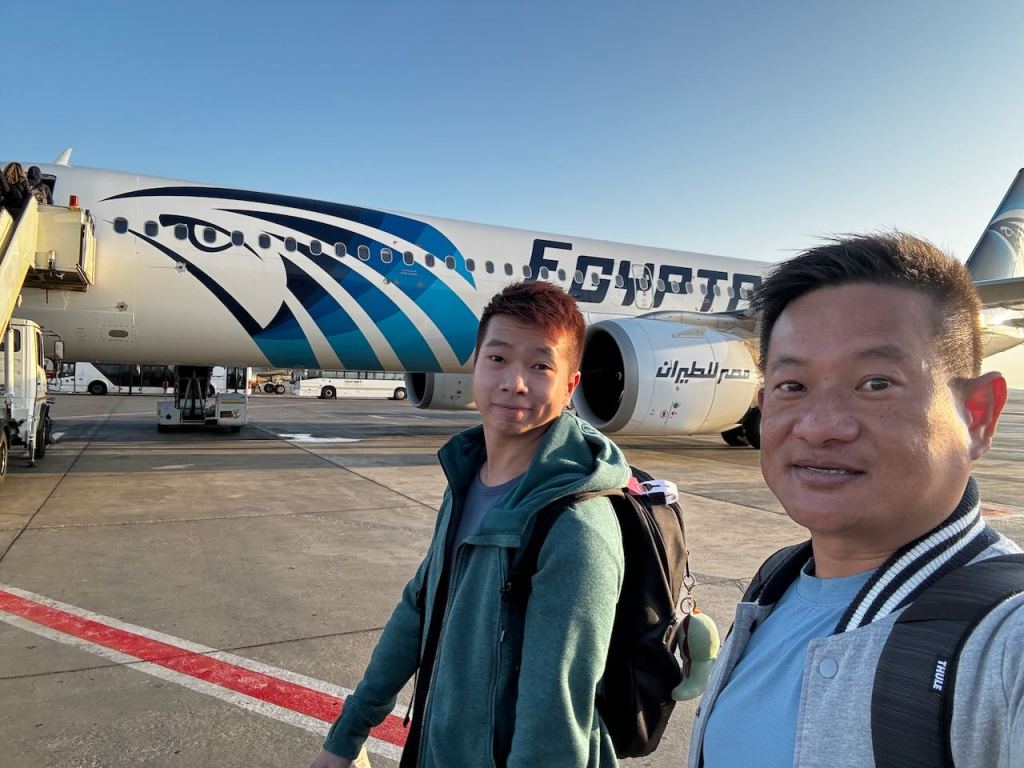
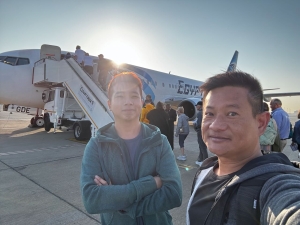
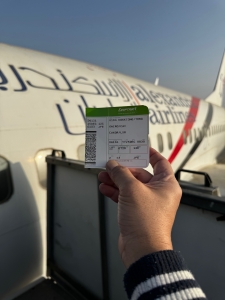
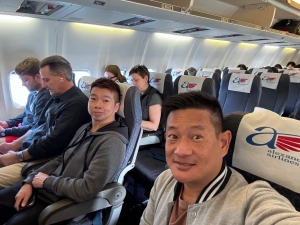
Getting on our domestic flight bound for CairoGetting ready to fly to Cairo
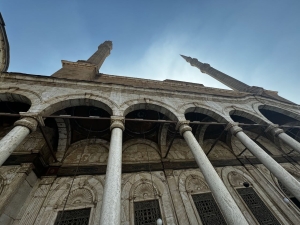
Salah El-Din Citadel – Home to the Egyptian Rulers and the Alabaster Mohamed Ali Mosque
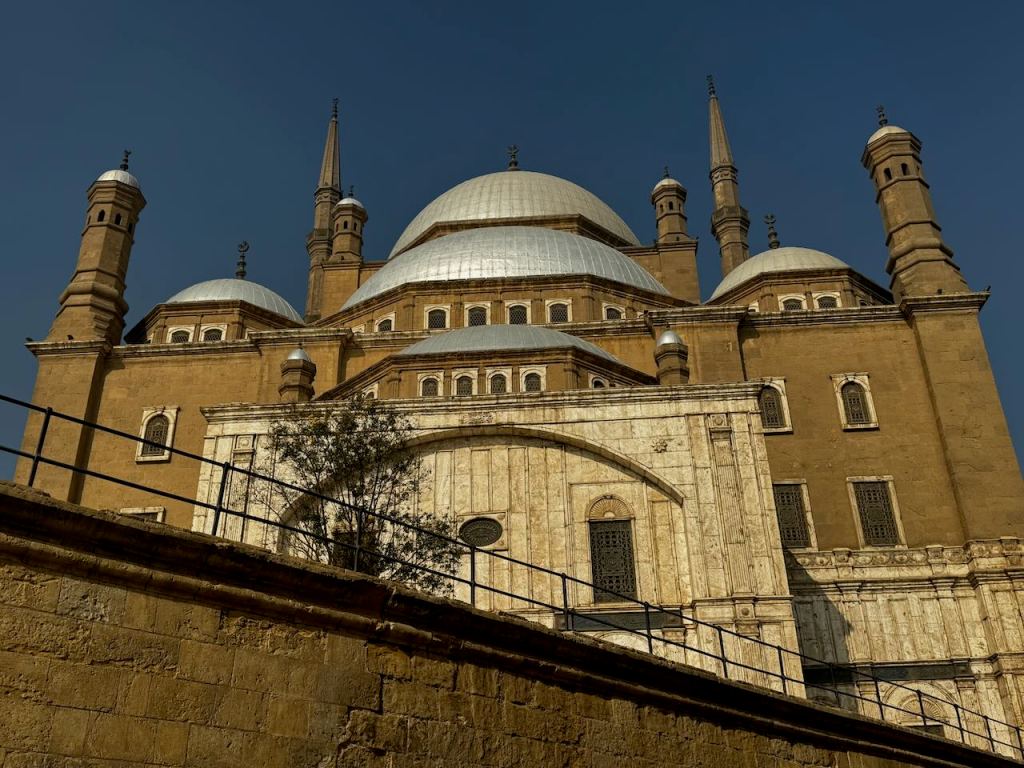
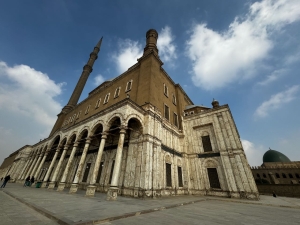
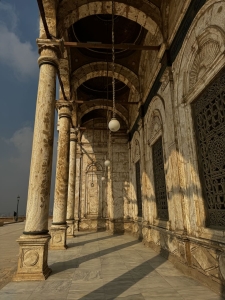
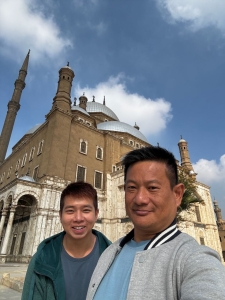
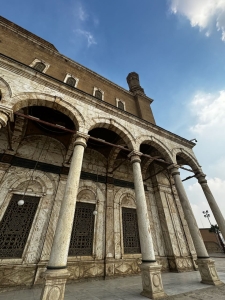
Alabaster Mosque in Salah El-Din Citadel
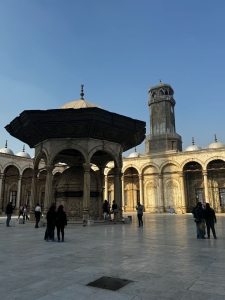
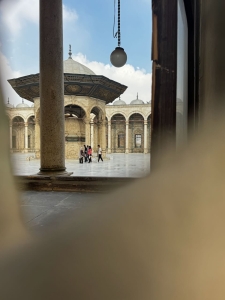
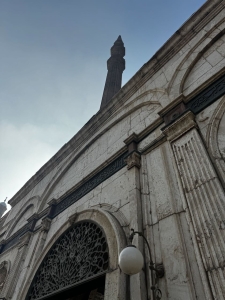
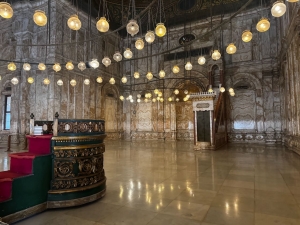
Our day started early, catching the first flight from Luxor to Cairo. We headed straight to the first sight of the day – Salah El-Din Citadel, after landing in Cairo. The Salah El-Din Citadel was the home of the Egyptian kings in Cairo for more than 700 years. Due to its location, being perched on steep rocky hills, this place made it perfect for the Egyptian rulers to rule the country. Ahmed told us numerous attempts to scale the walls and attack the royals had been planned, but all failed. The fort walls and some watch towers that once protected the citadel were iconic of this sight. In the centre of the citadel sites sits the Muhammad Ali Mosque, commonly known as the Alabaster Mosque. Ahmed took us on a buggy to the mosque resembling the Blue Mosque in Istanbul. According to Ahmed, the Alabaster Mosque was heavily influenced by the Ottoman architectural style. The floor of the courtyard of the Alabaster Mosque was decked out in what seemed like marble. We spotted a lone pavilion in the centre of the courtyard, a fountain with an elaborately carved wooden roof. Perched on top of one of the colonnades is a clock tower. According to Ahmed, this clock tower was given by the French in exchange for the obelisk in front of Luxor Temple. The clock tower never worked, while the obelisk still sits in Place de la Concorde in Paris. Ahmed jokingly commented the Egyptians got the shorter end of the bargain.
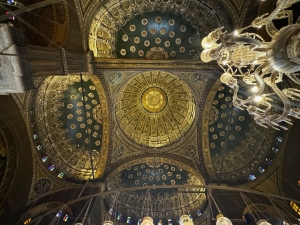
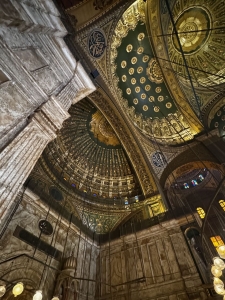
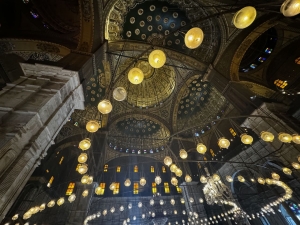
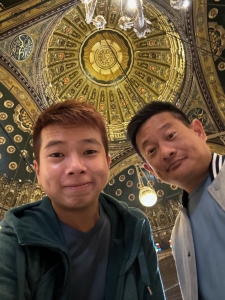
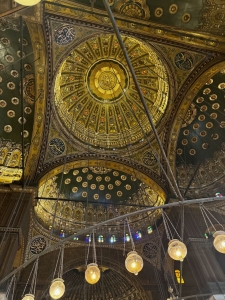
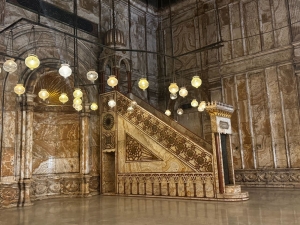
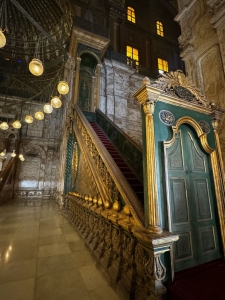
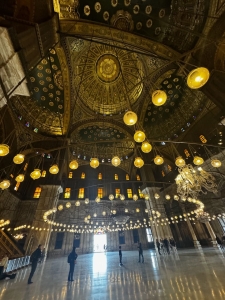
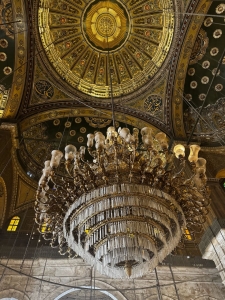
We entered the Alabaster Mosque, where the grandeur of the mosque was immediately felt the moment we stepped inside. Looking up at the ceiling, we could see the central dome that seemed to reach the sky, accompanied by four semi-circular shorter domes. The ceiling was impressive and colourful. The main dome was decked out in golden colours, while the four semi-circular domes were painted green. Intricate and beautiful Islamic artworks are decorated on these domes. Apart from the rustic, gigantic chandelier hanging from the top of the main dome, Ahmed told us there are 365 globe-shaped lights in the mosque, each representing a day of the year. We were brought near the mosque’s Mihrab, where the Imam would lead the prayer. Ahmed demonstrated how the sound reflected off the Mihrah, amplifying to the entire mosque. Beside the Mihrab sits two minbars (a platform with a staircase), one made of alabaster decked in white and another taller one made of wood in green. Ahmed brought our attention to the catwalk on the second floor of the mosque. This catwalk was built so that women, who usually pray on the second level due to modesty issues, disagreeing with the preaching of the Imam could walk to the minbar and challenge the Imam, signally gender equality in Egypt.
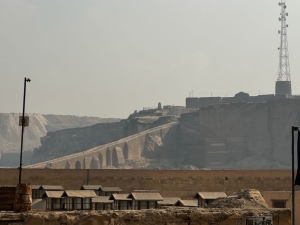
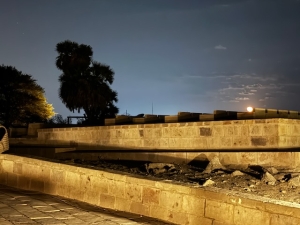
We were given some time to wander around the mosque. My friend and I went outside the mosque, where the best pictures of the mosque can be taken. We came to a lookout point, which Ahmed told us was an aqueduct that used to supply the Salah El-din Citadel with water.
Old Egyptian Museum – Home of Millenia of Egyptian Treasures
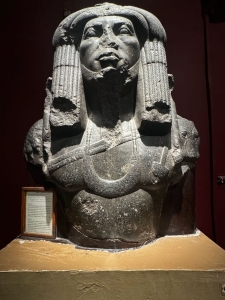
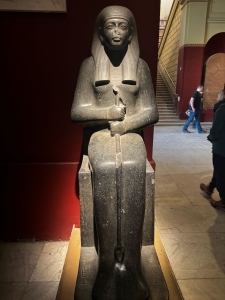
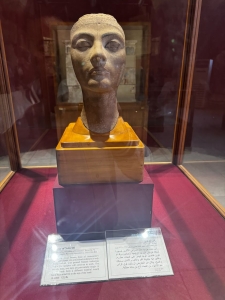
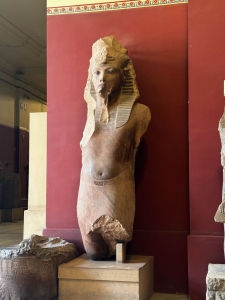
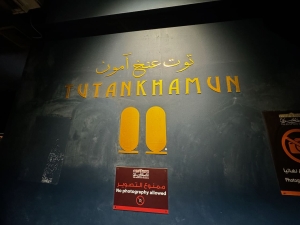
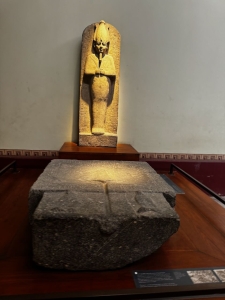
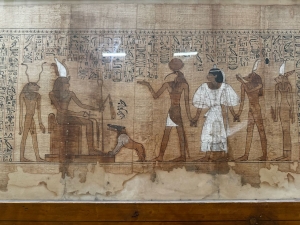
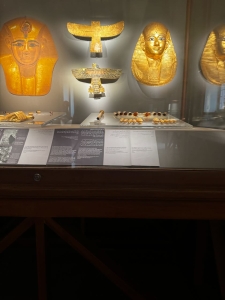
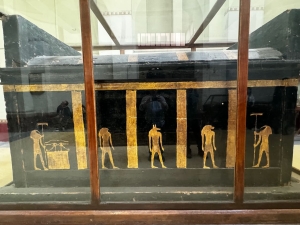
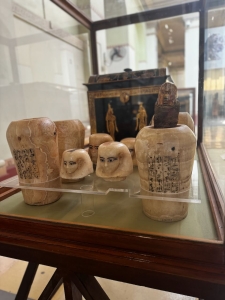
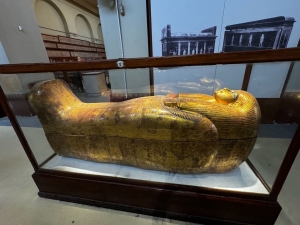
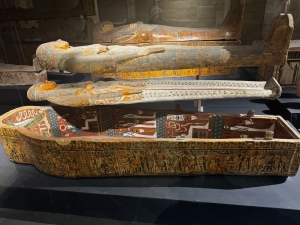
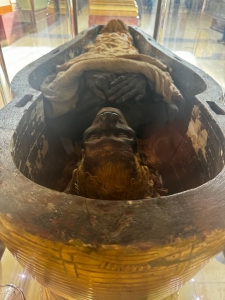
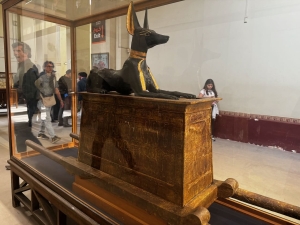
We left the Alabaster Mosque for our next (and last) stop of the trip – the Old Egyptian Museum. This museum is situated in the heart of downtown Cairo and houses a majority of the Egyptian artefacts recovered from the tombs of the pharaohs. According to Ahmed, the Old Egyptian Museum has the largest collection of Egyptian antiquities, and it would take several months to finish viewing all the exhibits. The important treasures are all on display here in the Old Egyptian Museum, including a collection of King Tutankhamun. Ahmed showed us the more significant collections in the museum, including a statue of Queen Hatshepsut depicted as a man, which was important for her to be taken seriously. Ahmed warned us about the staff of King Tutankhamun aggressively enforcing the no-picture rule in the exhibition hall.
We were allowed to wander around the museum to view the exhibits. My friend and I headed to King Tutankhamun’s exhibit. I saw two staff members in the enclosure aggressively, ensuring visitors did not take pictures inside. We saw a few visitors being shouted at for even touching their cameras. We spent the next 20 mins looking at mummies, coffins and other exhibits. My friend and I are not museum-goers (although we like to listen to the history of the sights we visit), so we left the museum and spent the rest of the time in a cafe outside the museum.
As we had an early start today, the group opted not to visit the bazaar and return to the hotel for rest. That would make the Old Egyptian Museum the last item on the list of sights that the tour company planned. We bid farewell to Ahmed, who was knowledgeable and with whom we learned so much about Egyptian history, culture and evolution. We waited till 3 pm for our rooms to be ready and checked into our room.
Evening Stroll Through the Colourful Khan El-Khalili Bazaar
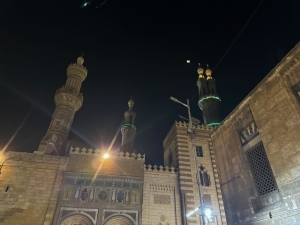
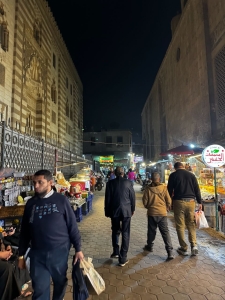
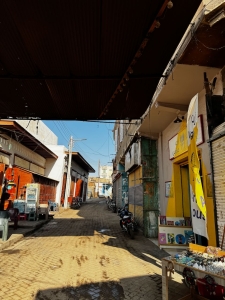
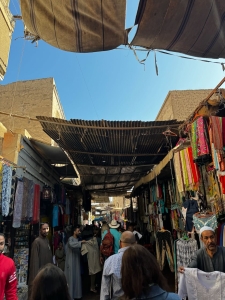
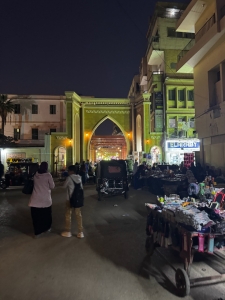
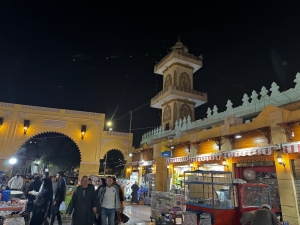
As the day was still young, my friend and I headed to a nearby shopping mall. However, the hotel we stayed in was nowhere near any shopping mall. We checked with the concierge, who recommended visiting Khan El-Khalili bazaar. My first impression of the bazaar was lively. The Egyptians only came out shopping or hanging out with their friends at night. We were approached by a shopkeeper asking if we wanted to buy some wares and where we were going. We told him we were looking around. To our surprise, instead of pushing his wares and bugging us, the very friendly shopkeeper gave us a simple orientation of the bazaar and some directions on parts of the bazaar that we should visit. We walked around the shops and saw this part of the bazaar mainly caters to the daily grocery needs of the locals. We saw shops selling spices and even a market selling fresh produce. We heeded the directions from the shopkeeper we met earlier and crossed the road to the other part of the bazaar. This part of the bazaar is even livelier, with locals and tourists walking around shopping. Some restaurants in this part of the bazaar are where we see locals dining or hanging out with their friends. The brightly lit shops and street and shopkeepers promoting their wares make this place lively. However, only tourists bought stuff from this part of the bazaar. The bazaar sells mainly Egyptian souvenirs, which I thought the Khan El-Khalili bazaar seems like a bazaar catered for tourists. Despite the crowd and the noise, we found walking around in Khan El-Khalili bazaar very safe. We made a short stop at Tahir Square before returning to our hotel to pack up and rest early for the night, as we had an early flight to catch tomorrow.
Conclusion to our Madien Trip to Egypt
Today marks our final day in Egypt. Throughout the trip, I was glad that we did not travel the country independently. We chose to take up a package tour (which I tried to avoid for the longest time) as there are too many things to see in Egypt, even for one sight. Without a guide to explain and guide us where and what to look at, we would have been overwhelmed by the number of hieroglyphs and engraving on the walls of the temple. Without a guide, we would not be able to understand what we saw. Moreover, most sights are very far from each other, and if we were to travel independently, we would not see as many sights as we did. The guide also advised us on the price and how to deal with touts, which were very useful during our trip. I thought Egypt was a very safe country to travel to. We did not have to worry about thefts and pickpockets, and we did not feel we had to guard against pickpockets throughout our trip. The locals are ready to help travellers if they are lost or can’t communicate in Egyptian. There are touts and paddlers, but these only appear in tourist sights and represent a small portion of the population. We found the Egyptians to be sincere and helpful. My friend and I enjoyed our maiden trip to Egypt.
Today is another light day with only one sight to visit. We spent 1 hour visiting the Temple of Khnum (more commonly known as Esna Temple) and a short walk around the bazaar in Esna Town. The rest of the day was spent sailing back to Luxor.
Esna Temple – The Temple of The God of Creation, Khnum
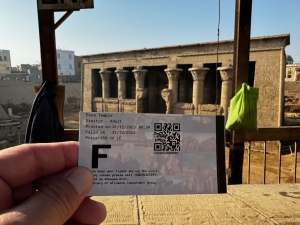
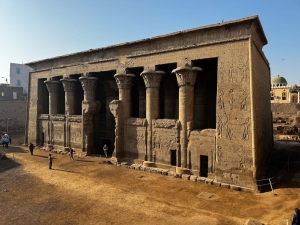
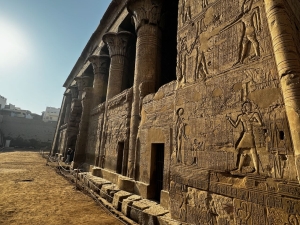
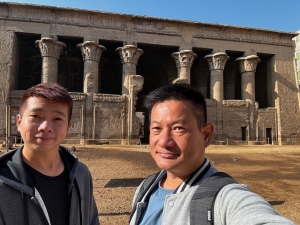
We started our day at 8.30 am, visiting the Esna Temple dedicated to Khnum, the ram-headed God of Creation. The temple was a mere 5-minute walk from the dock through a bazaar and sits in a large pit about 10m from the street level. Esna Temple is unlike the other temples we visited; it has only one rectangular building. The temple’s facade was decorated with reliefs of Khnum, his consort Menhyt and their son Heka. There are also reliefs of the king making offerings to the gods.
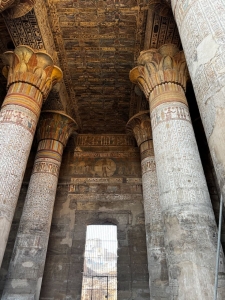
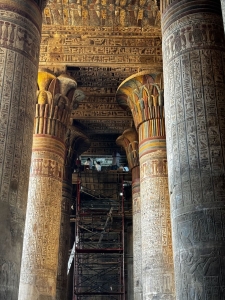
The whole Esna Temple seems to only consist of the hypostyle hall, and I saw another door opposite the main entrance to Esna Temple that leads to an open space behind the temple. We were told that the temple was buried under sediments for thousands of years, and most parts of the temple were still being discovered. Despite not having the sanctuary or rooms like the other Egyptian temples did, I was still blown away by the vibrant colours and the amount of work that went into the construction of the hypostyle hall. Ahmed told us the colours we saw on the ceilings and the pillars were original since the temple’s construction. Restoration works are still ongoing to preserve the temple interior. A relief of Khnum was visible over the beam of the door that led to the open space, seemingly telling visitors who the boss of this temple was.
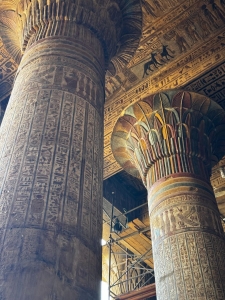
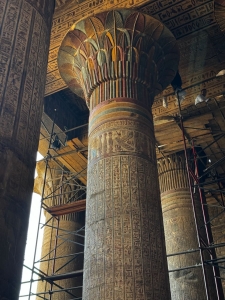
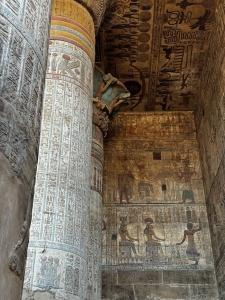
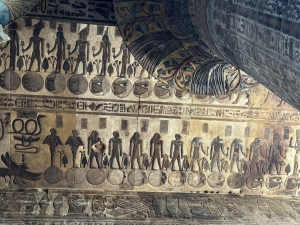
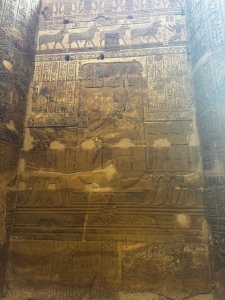
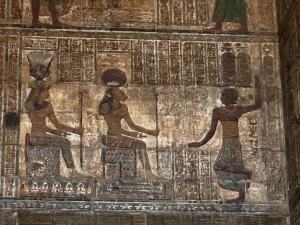
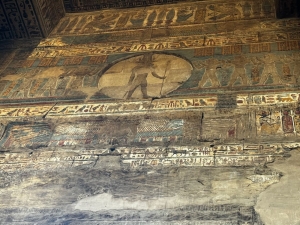
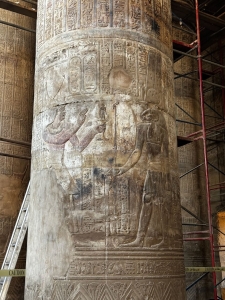
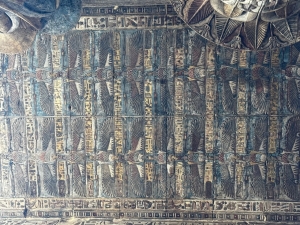
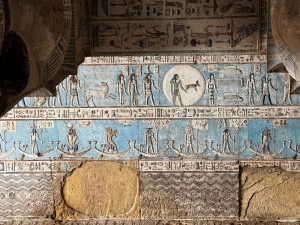
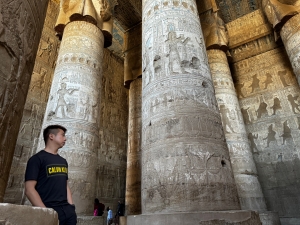
Ahmed brought us to a side of the temple and directed our attention to a relief on the high up on the wall. This relief showed a lion-headed Goddess, Menhyt, being entertained by Heka with Isis sitting behind her. Menhyt was believed to be the consort of Khnum, and Heka was their child. Our attention was then directed to the ceiling above us, with a relief depicting all the Gods in Egyptian mythology, with moon phases carved below these gods. The carving was intricate, and despite being high up on the ceiling, we could still make out which gods were being represented here. Ahmed pointed to another relief on the ceiling depicting Heka on a boat with Isis, Hathor, Thott and Ma’at being pulled by three dogs. Ahmed next brought our attention to the pillars that supported the ceiling of the hypostyle hall. Unlike the pillars of the temples we have seen so far, each of these 18 pillars inside the temple had different designs on the top, and the hieroglyphs engraved onto them provided detailed instructions on the rituals performed. We spent a few minutes spotting the differences between these pillars and admiring the reliefs on the ceiling.
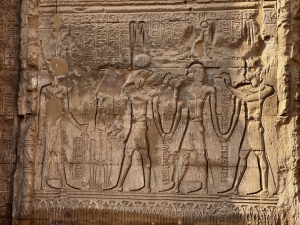
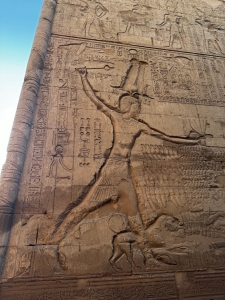
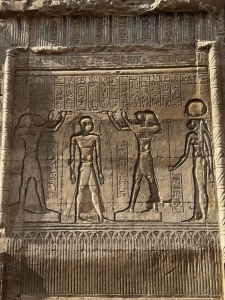
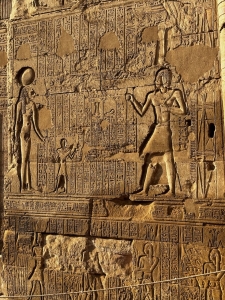
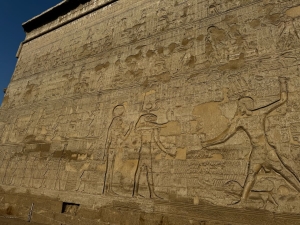
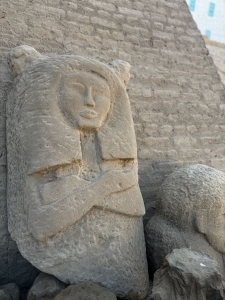
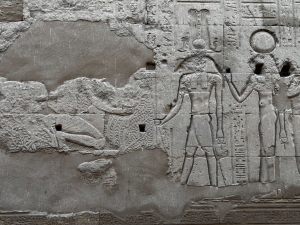
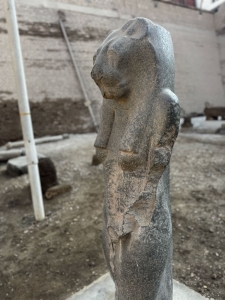
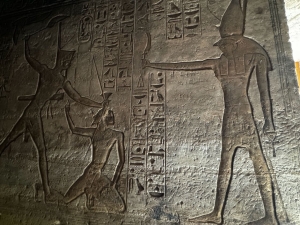
We headed outside the temple, where Ahmed explained the reliefs on the temple’s outer walls. There is a relief depicting Menhyt and Hathor blessing the king of Egypt with Khnum looking on. But the most interesting relief is the one where the king was being purified by Gods Thoth and Horus with Menhyt looking on. Yet another relief depicts the king slaying his enemy with Khnum and Menhyt by his side. This is not the first time we have seen such reliefs; these reliefs were repeated in the other temples, but this time, the main deities of Esna Temple – Khnum and Menhyt were with the king. We explored the temple grounds a little before hitting the streets; after all, there was nothing much to see in the temple. We saw a couple of statues of Hathor and Menhyt placed in one corner of the temple grounds and some locals who seemed to be excavating to look for more parts of Esna Temple.
Esna Bazaar
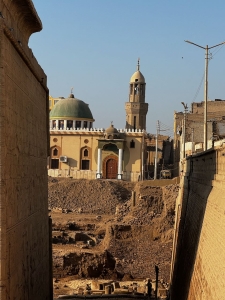
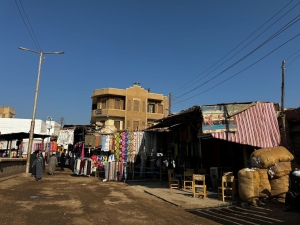
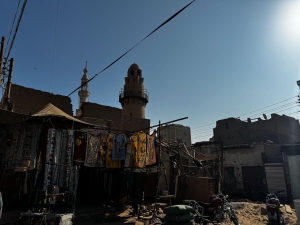
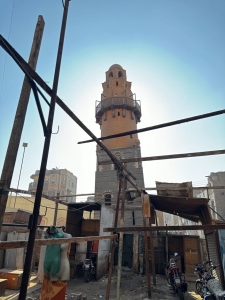
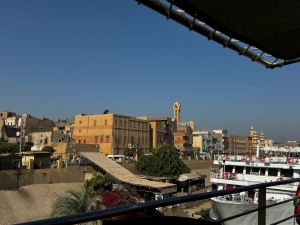
It did not take us too long to realise there was nothing much for us to see in Esna Temple. We headed to look around this part of Esna Town that surrounds Esna Temple. This part of the town is mostly occupied by shops selling souvenirs to tourists visiting the Esna Temple. The things sold were not too much different from the other tourist sights we have seen. Walking around the bazaar, I noticed some buildings, particularly a mosque minaret, leaning toward one side. According to Ahmed, these buildings were built on soft ground that caused them to lean to one side. The new buildings around the bazaar were built using donations from the USA. We were not keen on buying souvenirs, so we returned to our riverboat, preparing to slip off towards Luxor.
Cruising Back to Luxor
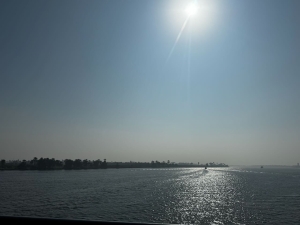
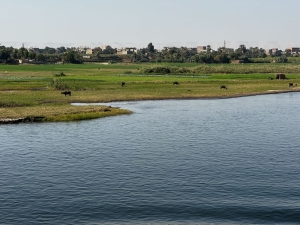
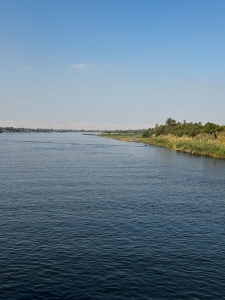
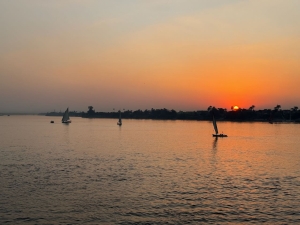
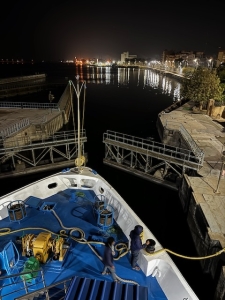
Our riverboat left Esna at around 10 am. We would spend the rest of the day relaxing by the Nile, watching the ever-changing scenery past us as we sailed back to Luxor. Along the way, we again sailed through the Esna Lock and saw how the water was being drained within the lock so we could continue our passage northwards. While the lock operations were interesting, I found the vendors more interesting. These vendors paddled on small boats near our riverboat to sell wares. These vendors had very good aim and strength to throw their wares up four decks of the boat. They would paddle near the lock and climb up to the lock to secure sales. After passing through Esna Lock, we relaxed by the sundeck a little before heading to the restaurant for lunch. We spent some time packing as we would need to leave our luggage at our door by 5.30 am tomorrow for our flight back to Cairo.
It was a light day today as we only had one sight to visit. Today is when the riverboat turned around to sail back north towards Luxor. We had the whole morning free and were given the option (at additional cost) to visit the ancient temples of Abu Simbel.
Abu Simbel Temples – Temple of Rameses II with Colossal Statues and A Temple for Queen Nefertari
Great Temple of Rameses II and Temple of Nefertari in Abu Simbel
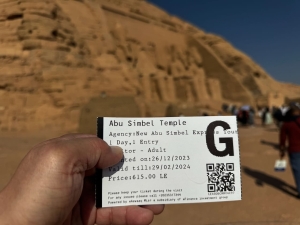
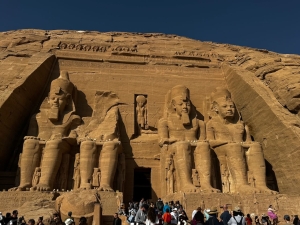
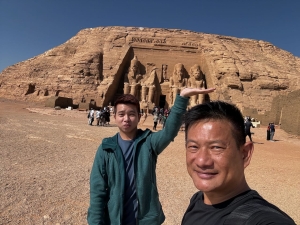
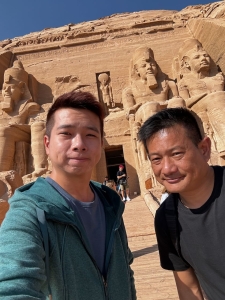
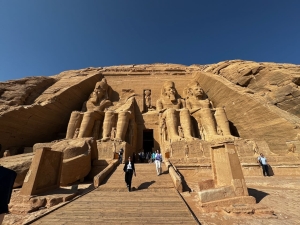
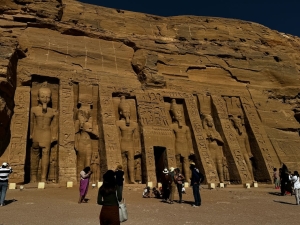
Abu Simbel Temples are as iconic as the Great Pyramids of Giza in Egypt, characterised by the four colossal statues on its facade. Before this trip, I had thought the temple with the four statues was the only one in Abu Simbel. However, I learned there are two temples in Abu Simbel.
The Southern Egypt Icon – The Great Temple of Rameses II
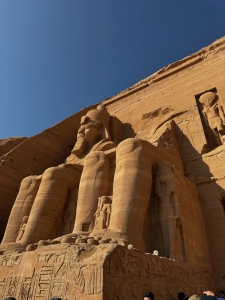
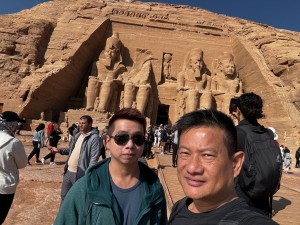
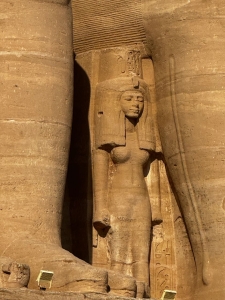
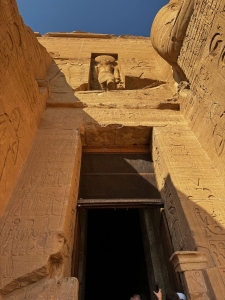
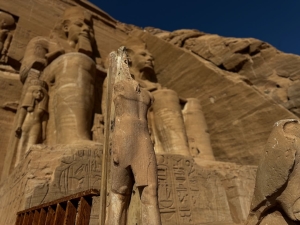
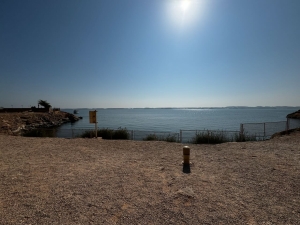
The four colossal statues sitting against a mountain backdrop come into mind when mentioning Abu Simbel. This is the bigger of the two temples in Abu Simbel, the Great Temple of Rameses II. The four statues, sitting next to each other facing Lake Nasser, were statues of Rameses II. The statues were very well preserved, and the smiling features of Rameses II were still visible after 3,000 years since its construction. The temple was shifted about 200m back from its original location as the building of Aswan High Dam would have submerged the temple. One of the four Rameses II statues suffered damage from the waist up (due to an earthquake), giving the temple facade an iconic character. Our guide told us there was an attempt to restore the statue during the shift, but it was not done as not all the parts of the statue were found. Today, we can see the damaged parts of the statue placed in front of it, exactly how it was when the temple was nearer Lake Nasser. Next to the shin of the Rameses II statues stood a smaller statue of his beloved queen, Nefertari. There are some other statues further in, which we were told are some of the king’s children. The temple is dedicated to the Egyptian God Re-Horakhty, whose statue can be seen standing above the main entrance to the temple. Tour guides are not allowed into the temple with us like the tombs in the Valley of the Kings. Our guide brought us to the front of the temple and explained the key features we should look for when we entered the temple grounds.
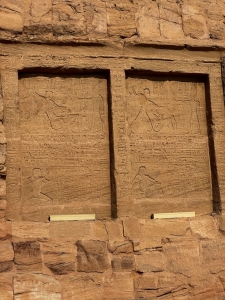
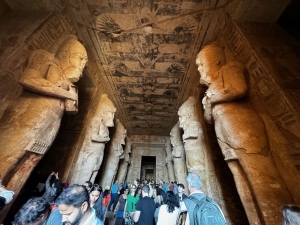
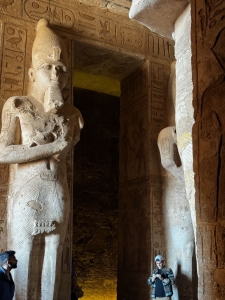
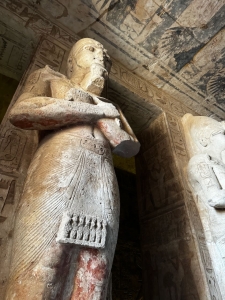
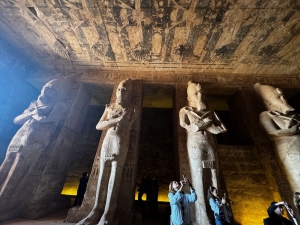
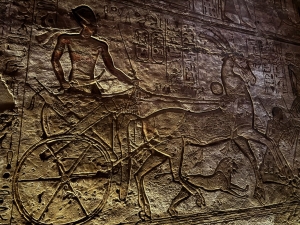
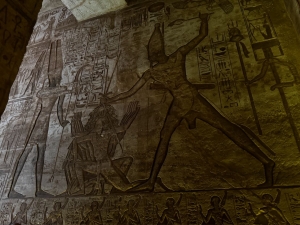
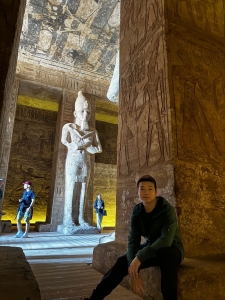
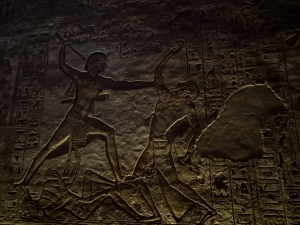
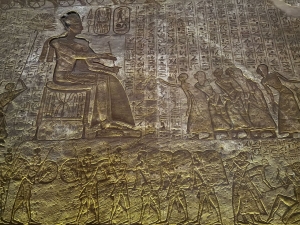
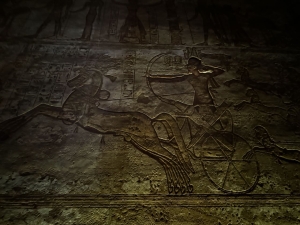
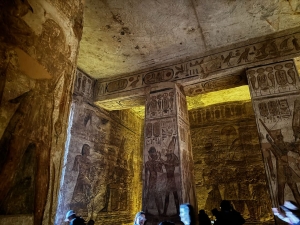
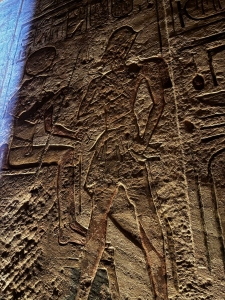
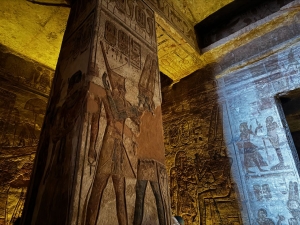
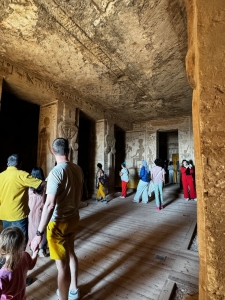
The first room that we came into when entering the temple was the hypostyle hall. Unlike those we have seen in the Step Pyramids or Karnak Temple, the hypostyle hall was just two rows of pillars supporting the temple’s roof. Also unique to the Great Temple of Rameses II, the pillars are not the usual columns with open or closed flower buds. Instead, we saw statues of Rameses II as the pillar of the hypostyle hall. These statues were in great shape with facial features, and even the linings on his kilt were still visible. It is in this hypostyle hall that we see how big an ego Rameses II has. The hall is filled with reliefs of his victories over his enemies, slaying his enemies, or ruling over his subjects. There is no relief showing him making offers to any gods here in the hypostyle hall.
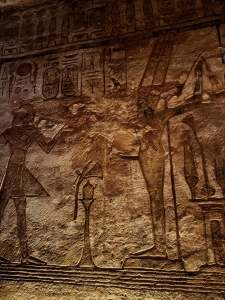
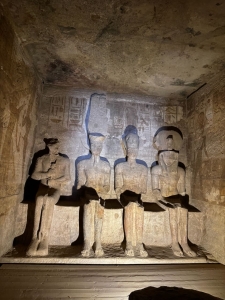
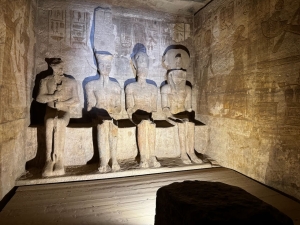
A small room is held by four pillars between the hypostyle hall and the sanctuary. This room is filled with detailed carvings of Rameses II standing next to the god Osiris, who seems to be blessing the king as though Osiris is legitimising his rule over Egypt. We headed into the temple sanctuary, where our guide had told us about the four statues sitting in the sanctuary. Rameses II saw himself as a deity and was seen sitting side-by-side with the other three gods to which this temple was dedicated. We saw the statues of Ptah, Amun-Ra, Rameses II as a god, and Re-Horakthy from left to right. Our guide told us that the temple was built to align with the sunlight and that on 22 Feb and 22 Oct every year, sunlight will enter the temple straight into the sanctuary and shine onto the statues of Amun-Ra, Rameses II, and Ra-Horakthy, leaving Ptah in the dark as he was the god of the underworld.
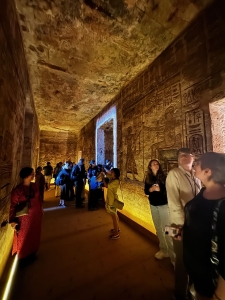
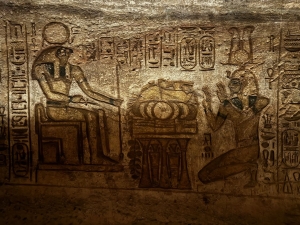
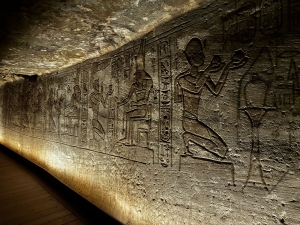
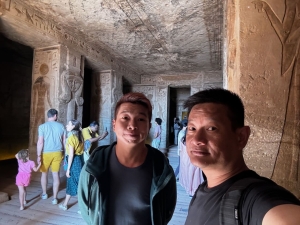
After taking pictures of the sanctuary, we visited the rooms on the sides of the hypostyle hall. These rooms were used as storerooms. The reliefs in these storerooms showed a humble side of Rameses II making offerings to the various Egyptian Gods. These rooms are the only parts of the temple where we saw Rameses II kneeling before these gods and respecting them as divine beings. The Great Temple of Rameses II was impressive on the exterior, but I found the space inside was modest compared to Karnak Temple, Hathor Temple and even Kom Ombo Temple. We tried to stay here as long as possible, taking pictures and looking for the reliefs our guide had told us before. However, the temple was full of visitors, which put us off from staying any longer. We headed out of the temple to take pictures of the temple from the exterior and of Lake Nasser. After all, the temple outside looks more impressive.
The Temple of Nefertari
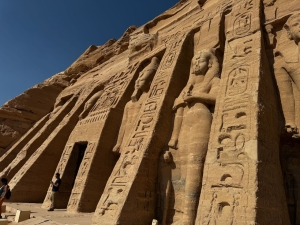
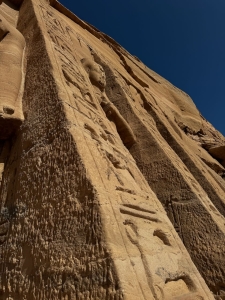
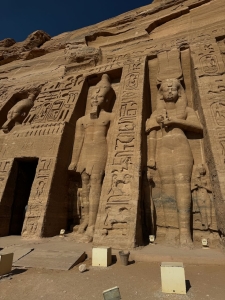
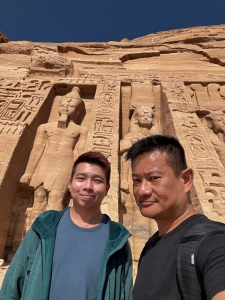
We headed to the smaller temple next to the Great Temple of Rameses II, which Rameses II built for his queen Nefertari. The temple’s facade is similar to his Great Temple in that the facade is adorned with six statues carved out from the walls. On each side of the entrance are two statues of Rameses II, with the statue of Nefertari in between. Rameses II was portrayed on these statues as being taller than Nefertari. Our guide mentioned that Rameses II had such a big ego that he even installed two statues of himself on the face of the temple he built for his queen. These six statues were in excellent condition, and we could see the detailed facial expressions and how the king and queen looked from these statues. The children they had together were the smaller statues by the legs of the Rameses II and Nefertari.
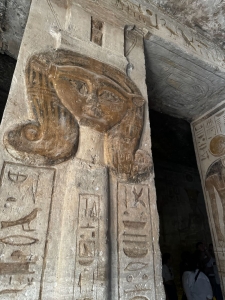
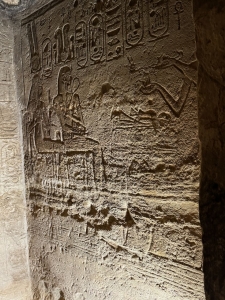
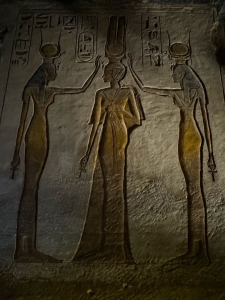
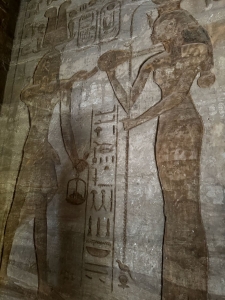
The Temple of Nefertari is much smaller than the Great Temple, consisting of a small six-pillared hypostyle hall and the sanctuary. This temple was dedicated to the Goddess Hathor, where we can see her face carved into the pillar, like those we saw in Dendera. There are some interesting murals engraved in the hypostyle hall of the wall. We saw one depicting Rameses II slaying his enemy, with Horus presenting him with a weapon to do so. There is an engraving on the wall depicting the cornation of Nefertari as a queen by Hathor and Isis. Other murals depicted either Rameses II making offerings to Horus or Nefertari making offerings to Hathor and Isis.
The sanctuary lies in the innermost part of the temple, flanked by two storerooms on each side. The sanctuary housed the sacred statue and an image that depicts the king making offerings to the statue. We even spotted an image of Nefertari receiving Hathor in her cow form on a boat. The size of the temple is so small that we only spent 6 mins to finish touring the temple. We met up with our group for our flight back to Aswan.
Cruising Back to Luxor
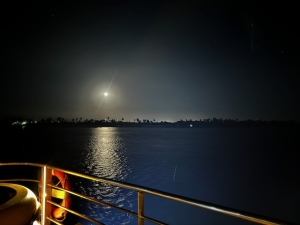
The rest of the day was planned to turn the riverboat around and sail back to Luxor with a short pitstop at Esna. As we woke up rather early today, we took a short nap after lunch and spent the rest of the day on the sundeck, watching the scenery of the Nile as we sailed back north. As there were limited things we could do onboard (the TV had limited entertainment), we went up to the sundeck to watch the sunset and moonrise in the evening. Our riverboat reached Esna at around midnight in good time for our early morning excursion to the Esna Temple the next day.
We had another light day today. We started the morning with a boat ride to the Temple of Isis on Philae Island, then drove to Aswan High Dam. After a couple of stops for shopping, we continued our tour with a visit to the unfinished obelisk and spent the afternoon on a boat ride around Elephantine Island for bird watching. We ended the day at Philae Island for a Sound and Light show of the Temple of Isis.
The Last Temple of Ancient Egypt – Temple of Isis, Mother of Egyptian Gods
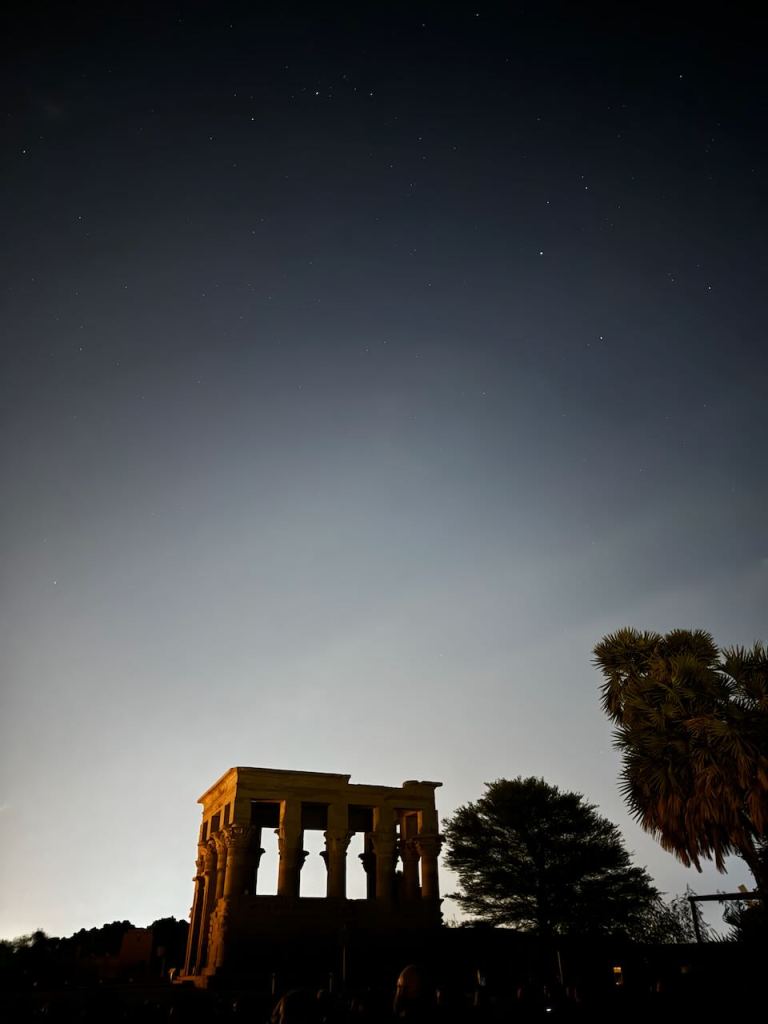
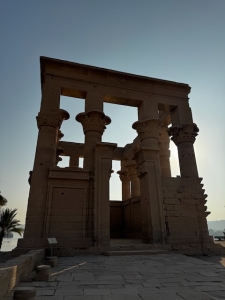
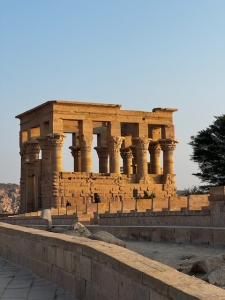
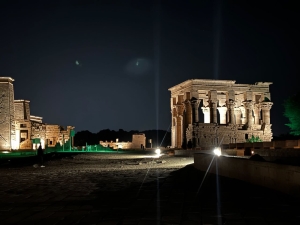
Kiosk of Trajan, a symbol of the Temple of Isis
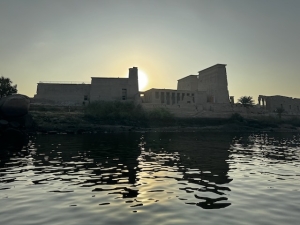
Temple of Isis
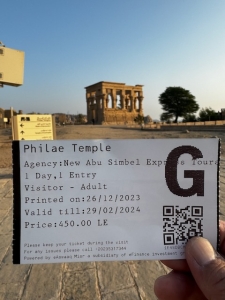
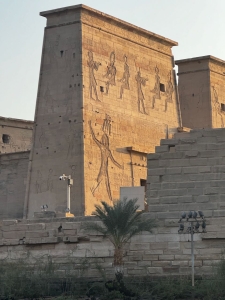
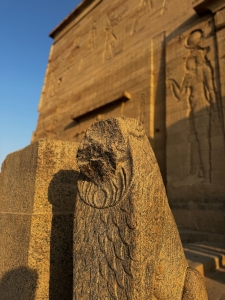
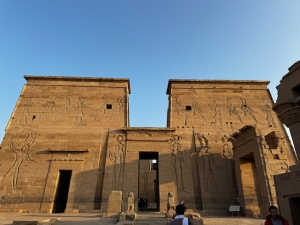
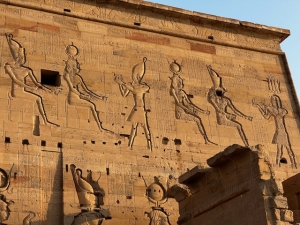
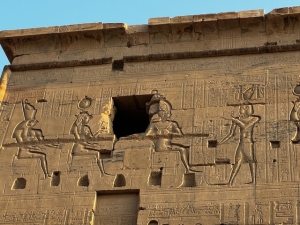
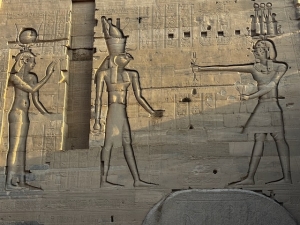
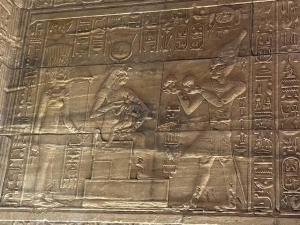
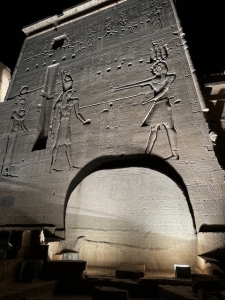
Our first stop of the day was the Temple of Isis on Philae Island. The island can only be accessible via boat, which can be boarded past the ticketing counter on the mainland. However, the ticket price for the temple did not include the boat ride. Getting a boat ride to the temple requires huggling with one of the many boatmen at the ramp. The boat ride took around 10 minutes; we passed by Nubian houses painted in bright colours that reminded me of the houses in Burano in Venice we visited last year. The ancient Egyptians believe the Goddess Isis scattered this part of the Nile with cataracts that broke up the forces of the current, offering them protection. Hence, they also regarded Isis as the Goddess of Protection and built a temple here to worship her. From Philae Island’s landing point, the first thing that caught my attention was a tall pylon standing majestically with reliefs showing which Egyptian God was in charge at this temple. Amongst all the reliefs, the largest relief portrayed the king of Egypt slaying his enemies in the presence of Isis. On top of this were reliefs portraying the king making offerings to Osiris, Isis, Horus and Hathor. A couple of stone lions are standing guard by the entrance of the first pylon, welcoming guests to the Temple dedicated to Isis.
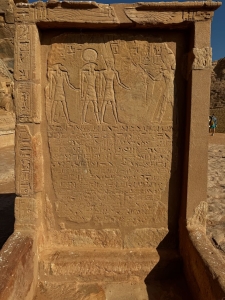
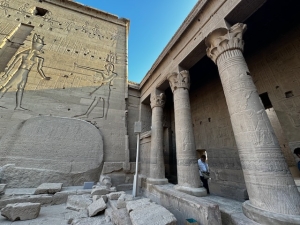
Passing through the first pylon brought us to a small courtyard, where the second pylon was immediately visible. Here, we saw the pharaoh making offerings to Osiris with Isis standing behind him and another relief depicting the king making offerings to Horus with Hathor standing behind him. Our tour director, Ahmed, brought our attention to a large stone sitting to the right of the entrance of the second pylon and told us this piece of rock served as a notice board in ancient times for the temple, which recorded the rules for entering the temple.
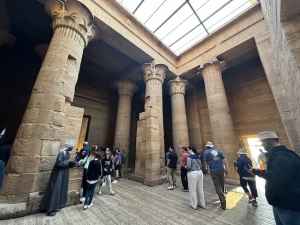
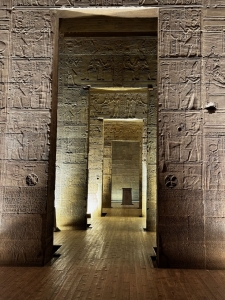
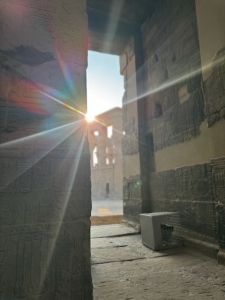
As we were walking towards the sanctuary, Ahmed focused our attention on an altar with a square hole cut into the wall. The cross on the altar and above the depression on the wall were signs that Christians once carved a space in the temple; after the temple was built, they occupied a corner of the temple to worship their God alongside the Egyptians. The two innermost rooms on either side of the sanctuary had murals depicting the king making offerings to Isis. The sanctuary room in the centre has a huge stone altar in the centre and was adorned with more murals of the king making offerings to the various gods on the side walls. There is even a relief showing Isis breastfeeding the king with her face chipped away. The centre wall of the sanctuary was filled with reliefs of the king making offerings to Isis. We walked around the interior of the Temple of Isis and found some spots that were not crowded to take pictures. We found an entrance that we thought allowed us to take some nice pictures of the temple’s interior.
Kiosk of Trajan
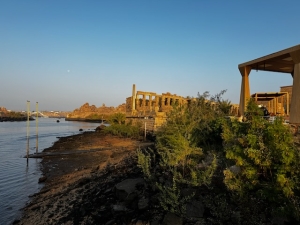
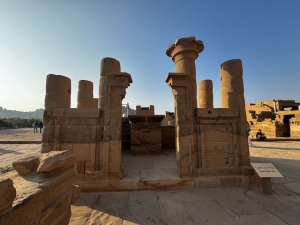
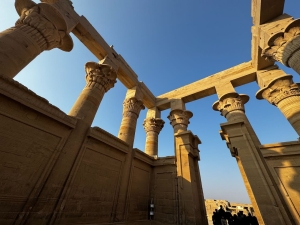
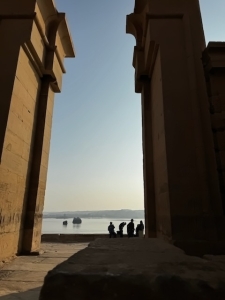
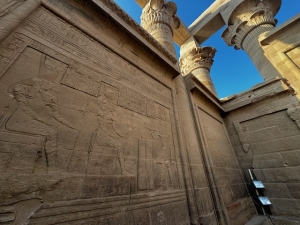
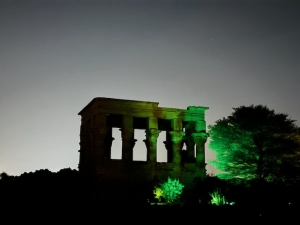
We exited the temple to take pictures of its exterior. There weren’t many engravings on the temple’s exterior (where we stood). The right side of the temple was scattered with ruins that seemed to be chambers or rooms for the priests. However, a lone structure caught our attention with its unique structure. The Kiosk of Trajan sits in what seems to be an isolated part of the temple grounds. The lower half of the Kiosk of Trajan was constructed with stones that had similar building techniques as the Temple of Hathor we saw a few days ago, and the top part of the kiosk had pillars supporting the beam. The top part of the Kiosk of Trajan reminded me of the Greek-styled Temple of Concordia that we visited in Sicily, Italy, last year, but with the Egyptian elements of open lotus buds typical of the pillars in a hypostyle hall. The Kiosk of Trajan was never unfinished during the temple’s heyday, which could be why we did not see any traces of the roof. The engravings on the kiosk, mainly on its interior, depicted the king making offerings to Hathor with Horus sitting behind her. One side of the Kiosk of Trajan afforded us a spectacular view of the Nile. This part of the Nile was very peaceful. We could see some of the small cataracts and lush greenery by the banks of the Nile. There weren’t any boats plying on this part of the Nile, a stunning view.
The High Dam – Preventor of the Floods (and Crocodiles)
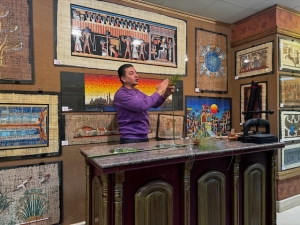
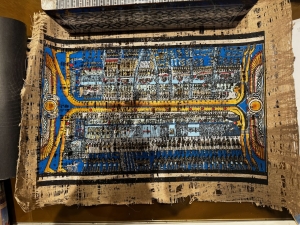
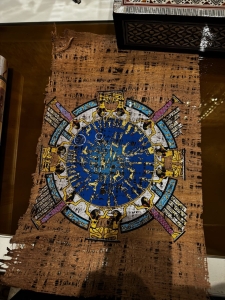
We made three brief shopping stops after Philae Island. The first shop sells papyrus, and we were shown how papyrus was made. The art pieces on sale were beautifully painted, some depicting scenes of famous sights in Egypt, such as the pyramids. I got a papyrus art portraying the sky goddess Nut, and my friend got the Dendera Calendar and a painting of the Ankh, the ancient Egyptian symbol of life. We also stopped at a perfume shop and an Egyptian cotton shop.
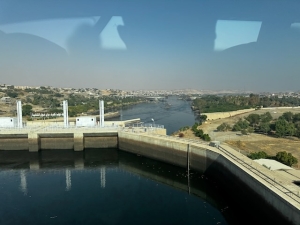
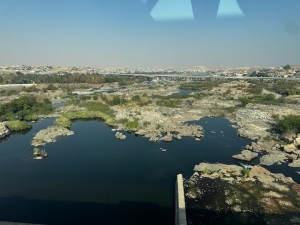
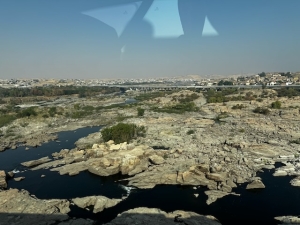
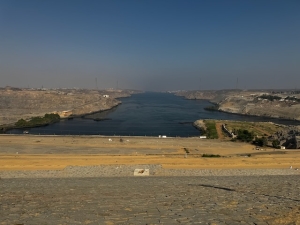
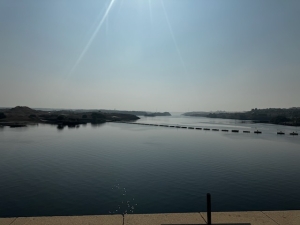
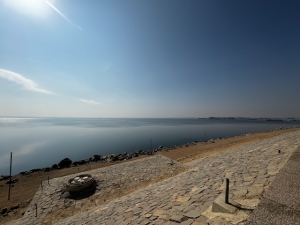
After the brief stops at the shops, we continued our journey and headed to our next sight – the Aswan High Dam. Life along the Nile was plagued with annual floods before the dam was built. The building of this dam not only controlled the flood but also provided the country with hydroelectric power. The building of the dam also controls the crocodiles that used to swim up and down the River Nile. Today, there are hardly any traces of crocodiles on the Nile north of the dam. Ahmed said the crocodiles are now kept in a crocodile sanctuary south of the dam. The drive to the dam was not that long, but we had to wait a while as the number of vehicles allowed there was controlled. There is only one spot where all the vehicles seem to be gathered for their visit to Aswan High Dam. This spot offered us the view of the Nile on one side and the view of Lake Nasser, where the river continues to flow to Kenya. Standing on the dam, looking down the Nile side, gave me the impression that this is where the Nile ends (but the river continues several thousand kilometres south). I saw barren lands on either side of the river bank that snakes its way towards the north of Egypt, with very sparse vegetation. On the southern side of the dam, the Lake Nasser side, the wide-bodied Nile looked more like a lake that stretched beyond the horizon.
Unfinished Obelisk – A Stone Stuck in the Rocks
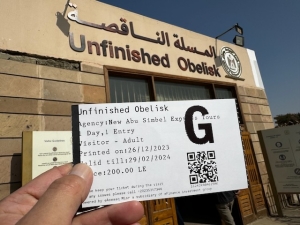
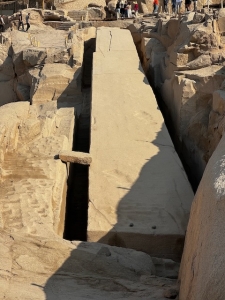
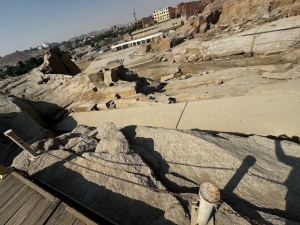
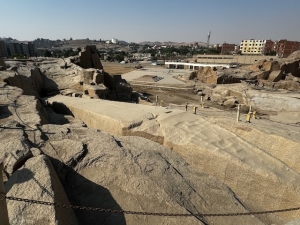
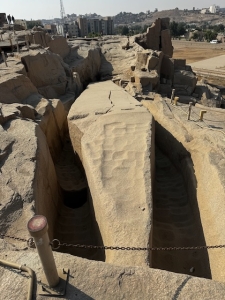
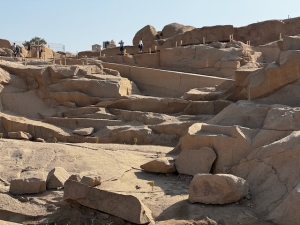
The Unfinished Obelisk rests in what seems like a quarry. From the outside of the gated compound, we can only see a flat piece of rock lying on its back. This obelisk was believed to have been commissioned by Queen Hatshepsut for Karnak Temple, but work was not performed on it as the multiple cracks would render this stone unusable as an obelisk. The stone has been resting in this spot for 3,500 years. Our visit to the Unfinished Obelisk was brief as well. There is one staired pathway that leads visitors around and to the spot that overlooks the obelisk and back down to the entrance. At this spot, we could see the shape of the raw Obelisk with its rough, unpolished, unmarked surface. Other than the obelisk, there is nothing much here for anyone to see. I wouldn’t have come here if I was travelling on my own. We left the obelisk after a short 10-minute stay. Leaving the Unfinished obelisk, we headed back to the boat for lunch.
Birding Watching on the Nile with an Expert Naturalist
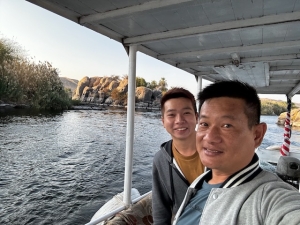
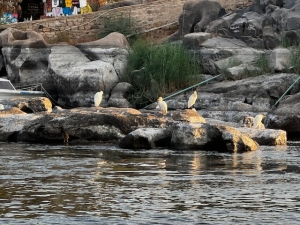
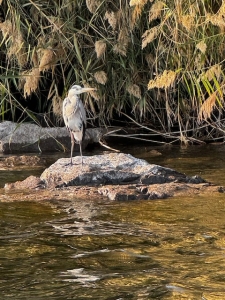
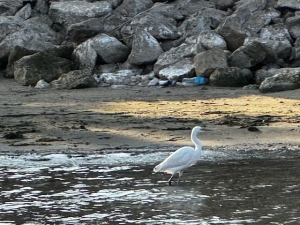
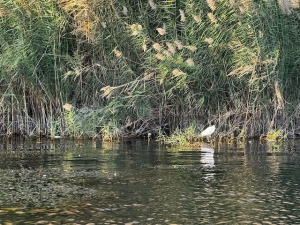
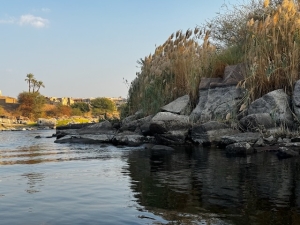
We were apprehensive about joining the bird-watching tour, which was arranged as part of the tour package. After all, what is there to see about birds on the Nile? My friend suggested we join the tour since it has already been included in our package. Our expectations for this itinerary are quite low to begin with. We were taken on a motorboat to the cataracts near where our riverboat was docked. The naturalist narrated what bird species usually come to this part of the country and told us about the governor’s house and the nearby tomb. The boat took us around Elephantine Island and Kitchener Island (the two islands nearest to our riverboat). We spotted mainly herons hunting on the banks of the River Nile and perching on the rocks sticking out of the river. Our guide excited whenever he spotted a kingfisher; it could be that kingfishers were in a difficult spot on the Nile. He signalled the boat’s coxswain to slow down and not startle the birds while trying to drift close enough for us to see the bird. Actually, this is not too bad of a tour. We got to see some birds, but what sold me more was the scenery of the sand dunes of the Sahara Desert that we got so close to that I enjoyed more. To me, it is more of a joy ride on the Nile.
Sound and Light Show at Philae Temple – Listening to the Tales of Isis
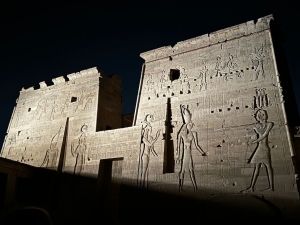
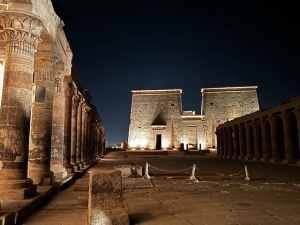
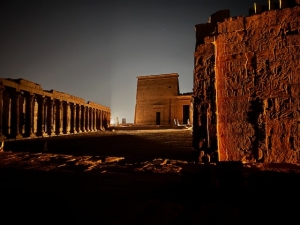
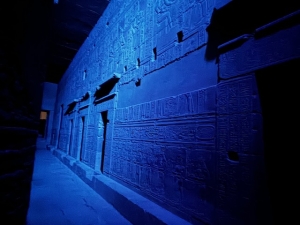
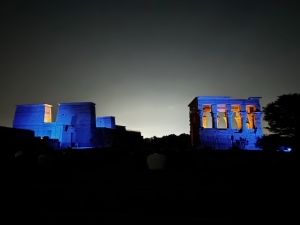
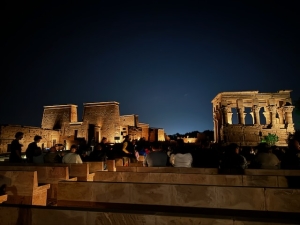
Our last stop of the day is the Sound and Light show at the Temple of Isis back at Philae Island. Since we had already seen what we needed to see of the temple in the morning, I came onto this itinerary mainly for the night light of the temple. The show started at the colonnades in front of the first pylon of the Temple of Isis. After some narrating, we were guided to the courtyard between the first and second pylons. After the narration in this part of the temple, we were ushered into the temple, past the sanctuary to the next venue of the show, the open-air auditorium facing the Kiosk of Trajan. The show is more of some lighting randomly shining on the temple walls and voice actors role-playing Egyptian Gods such as Isis, Osiris, Horus, etc. The show told the tales of Isis and how the temple came to be. I thought the story was interesting but a little lengthy. After all, I came for the night lights on the various structures at Philae Island and did not pay much attention to the storytelling part. I am not a fan of the sound and light show and would not have come if I were to travel to Egypt independently. We rested early tonight after dinner as we would have to wake up early for our excursion to Abu Simbel tomorrow.
It was another day of light visits with only one major site planned. I like how the tour company lightens the following day after a heavy day of sightseeing. Kom Ombo Temple is just at the doorstep of where our riverboat docked. The rest of the day was spent cruising up the Nile towards Aswan city centre, a felucca ride on the Nile and an afternoon tea.
Kom Ombo Temple – The Temple of Two Gods and Central Hosptial of Ancient Egypt
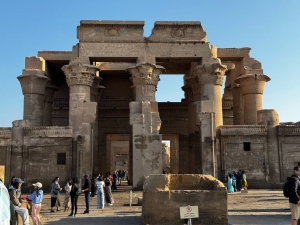
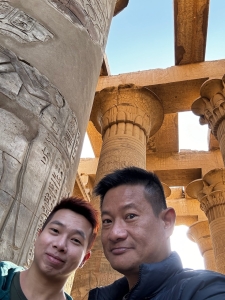
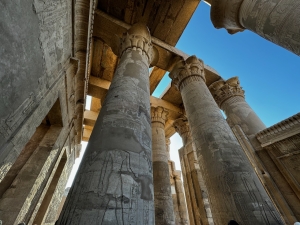
The double-temple of Kom Ombo dedicated to Horus and Sobek
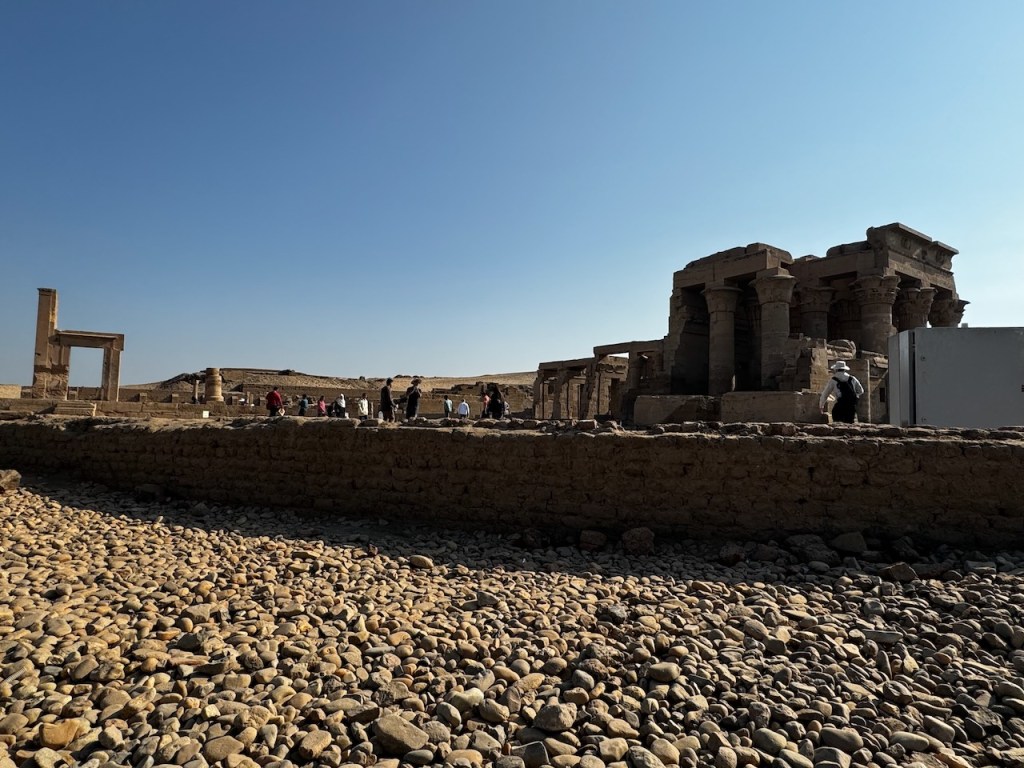
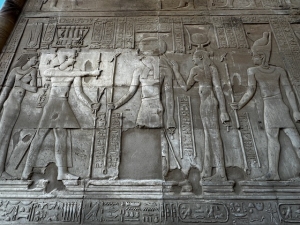
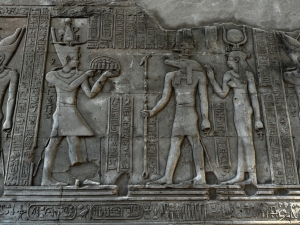
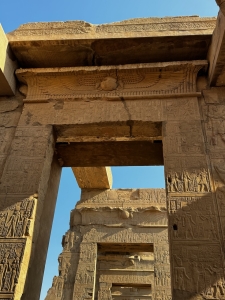
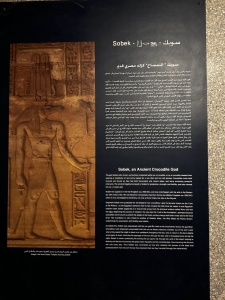
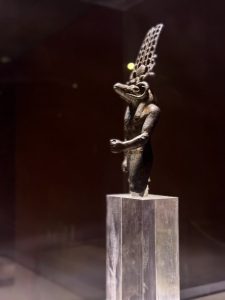
Kom Ombo Temple is a unique temple, both in its structure and in its purpose. The temple still follows the traditional layout of any Egyptian temples we have visited: a main entrance, a hypostyle hall, a courtyard and a sanctuary. Ancient Egyptian temples were usually dedicated to one God, but the Temple of Kom Ombo was dedicated to two gods, Horus and Sobek. According to Ahmed, all Egyptian gods have two sides: the benevolent and the vicious side. Hathor has her calmer cow side and her vicious lioness side. Similarly, Horus has two sides: his calmer falcon side and his vicious crocodile side. This temple is dedicated to both sides of the God – Horus (the falcon) and Sobek (the crocodile).
Kom Ombo Temple
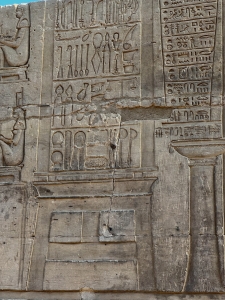
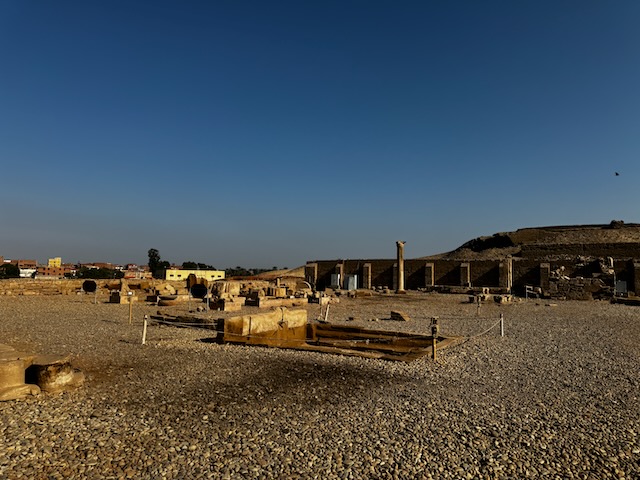
Kom Ombo Temple was situated at the waterfront of the Nile and was in a state of ruins. Even the pylon that was supposed to surround the temple was nowhere to be seen. We immediately saw an entrance that led to the hypostyle halls with only two rows of tall pillars that seemed to hold up part of the roof. The rear end of the temple was being pieced back together by archaeologists. Much of the back section and the sanctuary were now reduced to a few walls that used to form the temple’s structure. Despite being in ruins, there are still stories to be told of this temple. Ahmed brought us to the back of the temple to show us a relief depicting medicine tools used during ancient Egyptian times. This temple was symmetrical and lay in the centre between Lower and Upper Egypt. Ahmed accounted that due to its location, people from both sides of Egypt would come to this temple to seek medical attention (hence the relief of medical tools). Ahmed brought us further towards the centre of the wall and pointed to a relief featuring the Goddess of balance, Ma’at. He told us this is the central axis of the temple and the dividing line between the Horus side (left) and the Sobek side (right) of the temple. Every relief left of this imaginary line featured Horus and reliefs on the right depicted Sobek. Ahmed brought us to a well situated in the temple’s open area to the left. Before the Aswan dam was built, flooding of the Nile was a common sight. The Egyptians used this well to gauge the well’s water level to determine if a flood was coming. After the short explanation, Ahemd gave us time to look around the temple and encouraged us to visit the Crocodile Museum next door if we had the time.
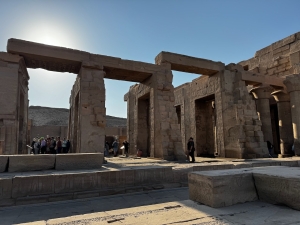
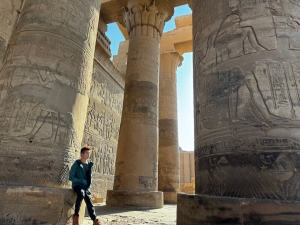
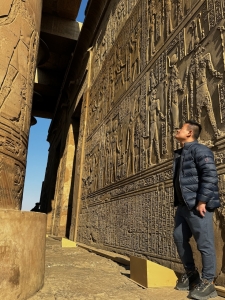
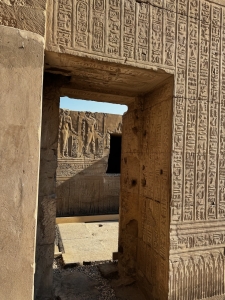
We headed towards the main entrance of Kom Ombo to mainly take pictures of the hypostyle hall. Despite the temple not being in great condition and being smaller than those hypostyle halls we have seen in temples like Karnak and Dendera, the hypostyle hall in Kom Ombo is still magnificent. Standing tall supporting beams and whatever remains of the roof, each pillar featured an open bud papyrus plant carved with detailed reliefs. We saw pillars and walls carved with images of Horus on the left side of the temple and Sobek on the right side. The hypostyle hall in Kom Ombo made a great photo spot, especially in the morning, with sun rays peeking through the pillars. The wall, facing the Nile with a large entrance into the temple, was also split symmetrically between the Horus and Sobek sides, with images of each deity carved onto their respective sides. On Horus’s side, we could see an Egyptian King making offers to Horus with his wife Hathor standing behind him. Similarly, on the Sobek side, we saw the king making offerings to Sobek with his wife Renenutet standing behind him. What we saw on the Horus side was repeated with Sobek on the Sobek side of the temple. We could see the amount of effort that went into engraving the temple; even whatever remained of the ceilings looked like a masterpiece. My friend and I were looking for a spot in the temple with the least crowd and ended up mainly on the Sobek side of the temple. We went outside the temple to look for Instagram-worthy photo spots only to realise the open area had no Instagramable spots except for a picture with the temple as the background.
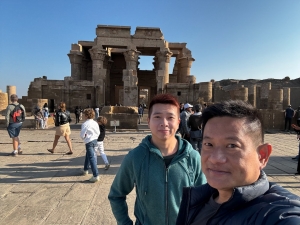
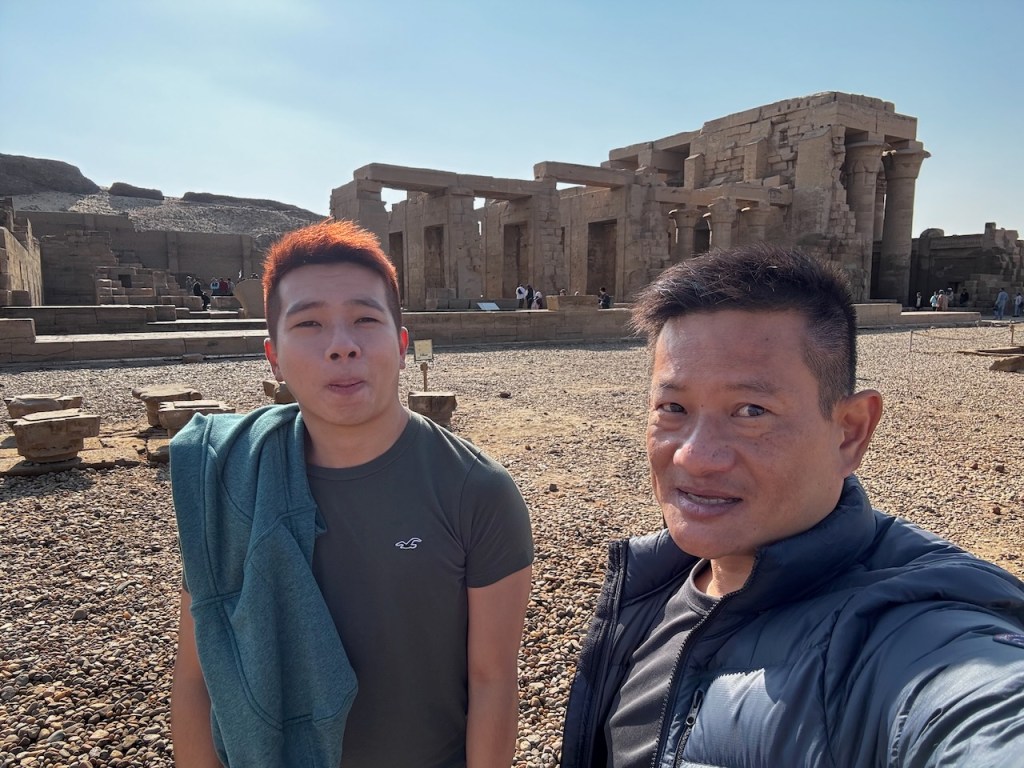
There are not many things to see outside the Kom Ombo TempleWefie with Kom Ombo Temple
Mummified Crocodiles in the Crocodile Museum
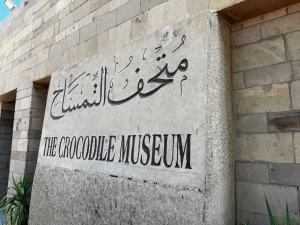
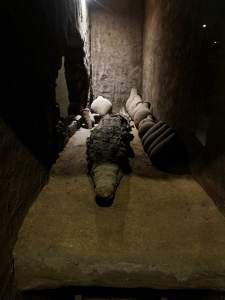
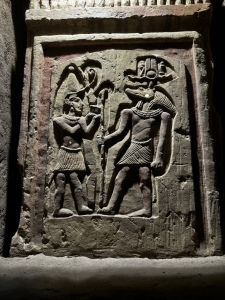
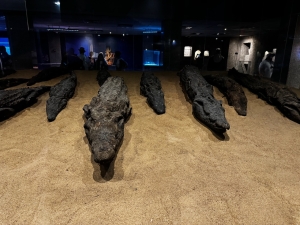
We looked at the time and realised we still had around 20 mins before the all-aboard time. We decided to check out the Crocodile Museum next to Kom Ombo temple, which was on our way out. The Crocodile Museum is a fairly small enclosed area displaying mummified crocodiles. When we entered the museum, we were greeted by a large tank displaying log-like crocodiles that seemed to have dried out over the years. We weren’t too sure if these were the mummified crocodiles being taken out of their linen. Throughout the museum, we saw reliefs and small statues of Sobek, and it seemed that this museum was dedicated to Sobek. We finally see some mummified crocodiles displayed in one corner of the museum. We spent less than 10 minutes inside the Crocodile Museum due to its small size and returned to our riverboat well before the all-aboard time.
Continue our Cruise along the Nile Towards Aswan
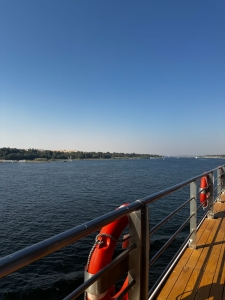
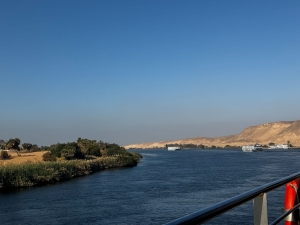
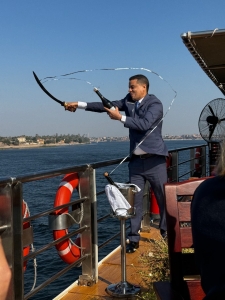
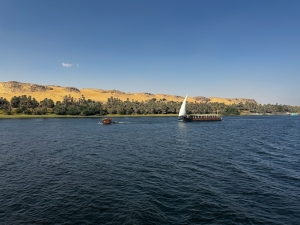
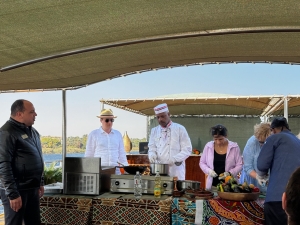
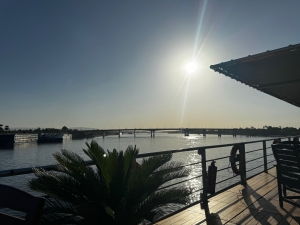
Our riverboat left the dock and continued sailing south to Upper Egypt towards Aswan City. We spent the whole morning on the sundeck, watching the Nile slip past us as we made our way to Aswan City. The sundeck is a great place to chill with the breeze of the Nile softly brushing our faces. Occasionally, we would spot feluccas sailing on the Nile, and in other instances, we would sail past locals fishing on the Nile. The ship crew prepared some light snacks for guests chilling out on the sundeck. The sundeck has some activities this morning, starting with opening a bottle of champagne, followed by a yoga session taught by the talented masseuse onboard. We even watched the cooking demonstration by the head chef of the boat cooking Egyptian snacks. We returned to our room to rest after lunch and occasionally popped up to the sundeck for some Nile breeze.
Felucca Ride on the Nile – Ride the Winds of the Nile of Ancient Egyptian
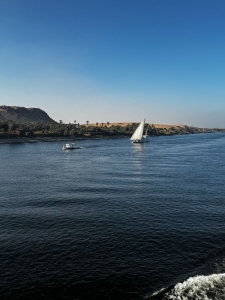
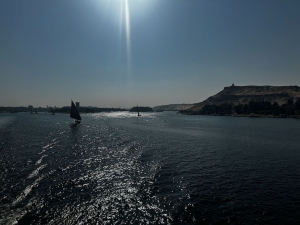
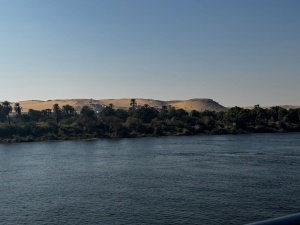
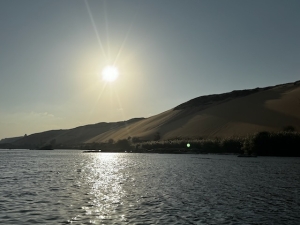
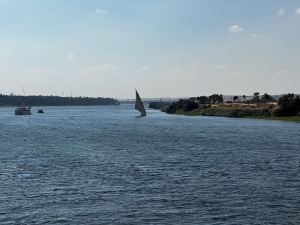
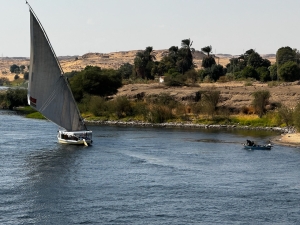
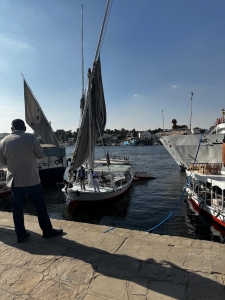
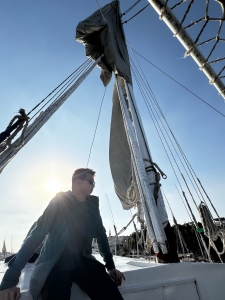
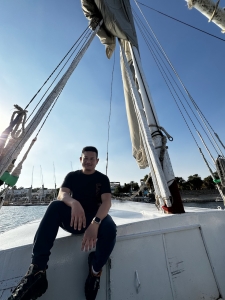
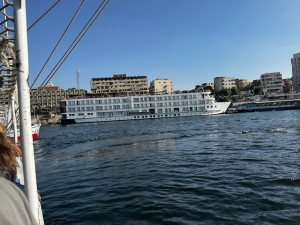
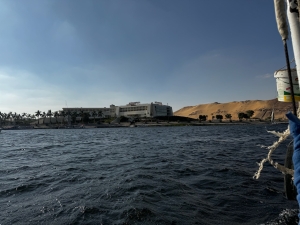
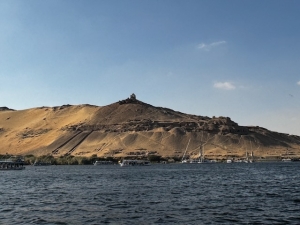
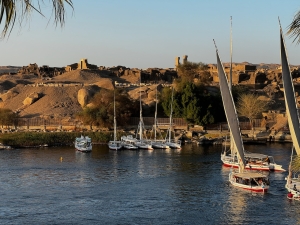
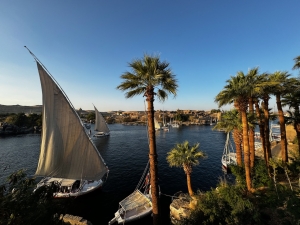
Not long after chilling in our cabin, we realised we were about to dock at Aswan City. We misread the timing to gather for our scheduled felucca ride this afternoon. By the time we were at the lobby of our riverboat, our group had left without us. Luckily, Ahmed arranged for us to join the other group for the afternoon felucca ride. The felucca is a traditional Egyptian sailboat powered entirely by wind, used to transport goods for trading and fishing. Today, the felucca is mainly used to ferry tourists. As we sailed quietly along the Nile, our guide oriented us to the landmarks along this part of the River Nile and how these small islets (known as cataracts) help prevent massive Nile flooding. We were told that the Movenpick hotel today, which sits on Elephantine Island, used to be the residence of the governor of Aswan. Today, the hotel chain bought the island and developed more hotel buildings on this island. At the far end, we saw the dunes of the Sahara desert. The ride on the felucca is peaceful and allows us to see the Nile differently.
Afternoon Tea with a View of the Cataract
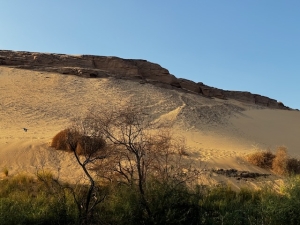
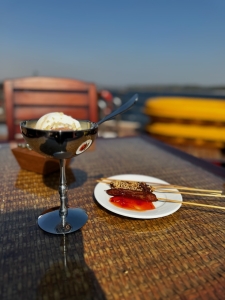
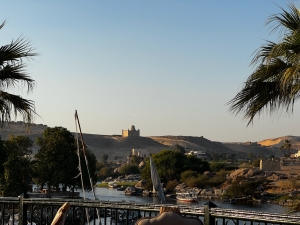
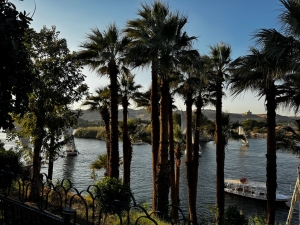
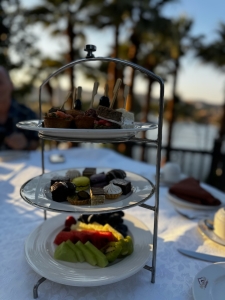
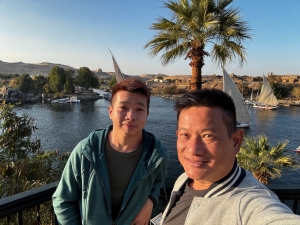
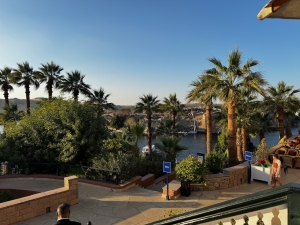
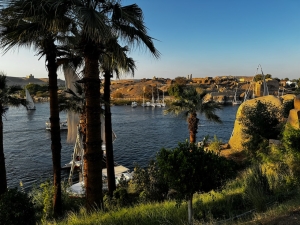
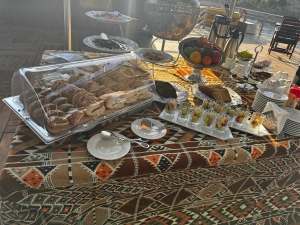
After the ride, we returned to our cabin onboard our boat to catch a short nap since we had an hour to spare till our next activity. Our last official activity for the day was having afternoon tea at the Old Cataract Hotel overlooking the Nile. We took a short drive to a hotel nearby, Sofitel Legend Old Cataract Aswan, for our afternoon tea session. The view from the deck was amazing! We could see the islets that were once believed to have been planted on the Nile by the Goddess Isis to protect the Egyptians from the forces of the Nile. We could also see the sandy dunes of the Sahara desert and a lone building sitting atop the dune. There are several feluccas, and some were filled with tourists experiencing riding on the felucca. The food from the afternoon was good, but the view from the deck stole the show for the session.
Aswan Old Market – Megamarket of the Egyptians
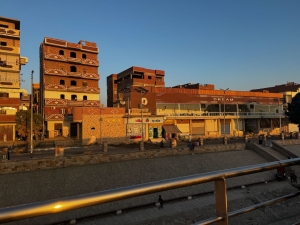
We returned to our riverboat around 5.30 pm; dinner onboard would not be served until 7 pm. We asked Ahmed if we could head out into the town to explore the bazaar we saw on our way back. Ahmed was very encouraging and assured us it was safe to walk around. We spent the next hour in the bazaar. We started with the bazaar opposite where we docked, which had a “Tourism Market” sign installed at the beginning of the street. This so-called market was boring. We only saw a few shops and an empty street. I recalled seeing a market (named “Old Market”) just a few blocks away, which seemed crowded with locals, and made our way there. This is the real bazaar that the locals come to. This huge market that seemed to go on and on with stall after stall was beaming with life! There are stalls selling everything the locals use for their daily livelihood: clothing, shoes, vegetables, meat, you name it. There are even restaurants and cafes where the locals hang out to have a meal or socialise with their friends. There is a small section that sells souvenirs to tourists. I thought it was interesting strolling in the Old Market, and it was colourful and lively. True to what Ahmed said, the market was very safe, and we did not have to worry about being mugged or pickpockets.
This blog post will be long; we did so many things in the span of one morning. We had a heavy day in the morning, visiting the tombs of kings and queens of ancient Egypt on the West Bank of the Nile. To the ancient Egyptians, the east represented life and would have living activities on the East Bank of the Nile, while the west was allocated funerary activities to the West Bank of the Nile. We ended the day with a cruise up the Nile towards Aswan, passing through the Esna Lock.
Sunrise Hot Air Balloon Ride – Marvelling the West Bank Sights from the Sky
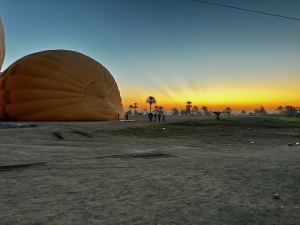
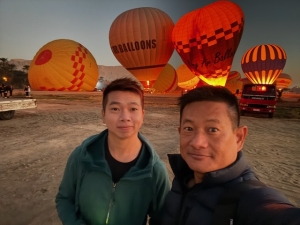
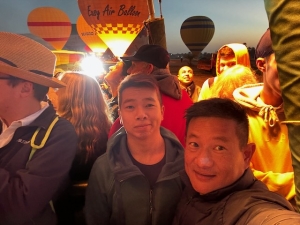
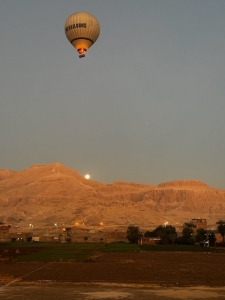
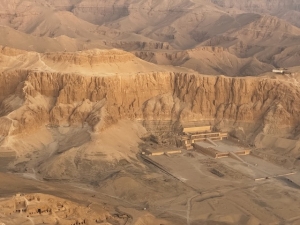
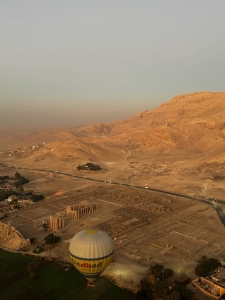
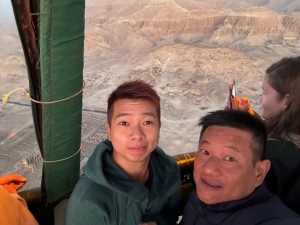
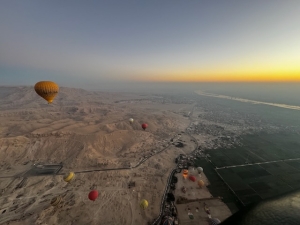
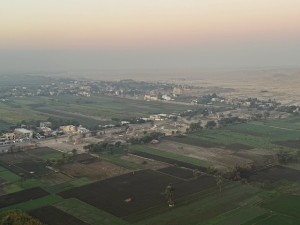
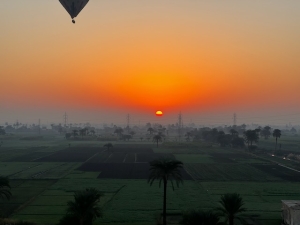
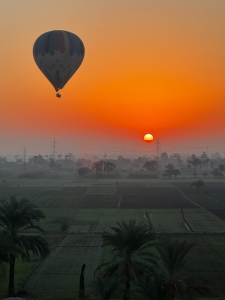
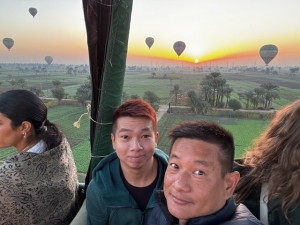
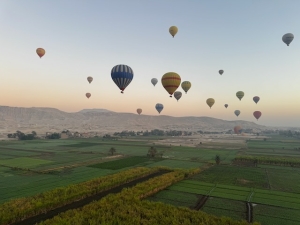
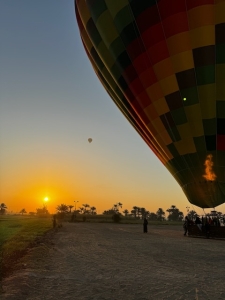
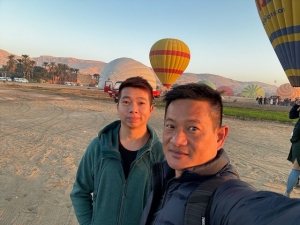
We had an early start today for the optional hot air balloon ride on the West Bank of the Nile (costing USD 140). We were driven to a nearby dock, took a small motor boat across the Nile and drove further into the desert. We could see some hot air balloons floating off the sky while ours were just being set up. It did not take the crew too long to set up the balloon. We could see the sun’s rays peeking over the horizon over the east and at the mountains to the west; the moon seemed to be signing off to rest for the day.
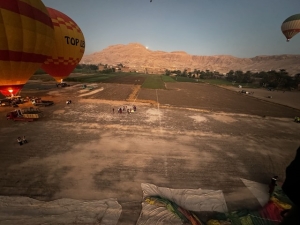
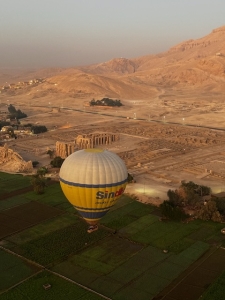
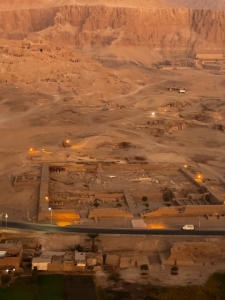
As our balloon slowly made its way up into the sky, we could see the entire farmland next to our hot air balloon take-off spot. It did not take too long for us to be at the same height as the mountain ranges behind. Our pilot guided our attention to the Valley of the Queens, wedged between the mighty pyramid-shaped mountain ranges and the road. But from where I was, it looked like some small holes in a pile of rock. The only landmark I could recognise (from the books and YouTube videos) was Queen Hatshepsut’s Temple, tucked far into the base of the mountain ranges. Nearer to us was a large complex in ruins. Over the highest mountain, I could see the moon shining its light at its brightest, as though the Egyptian moon god, Khonsu, was welcoming us, illuminating the otherwise dark sky. The spotlights at the monuments looked more and more like stars in the sky, dotting all over the brown desert ground below us as we got higher. Very soon, I could see the top of the highest peak of the mountain ranges that stood guard as though protecting the final resting place of the ancient Egyptian royals. The view was magical and worth every penny we paid for this ride. We floated towards what looked like an ancient Egyptian city. In the centre, a group of tall pillars seemingly made up of the hypostyle hall of a temple. Viewing an entire ancient Egyptian town from high above was truly spectacular.
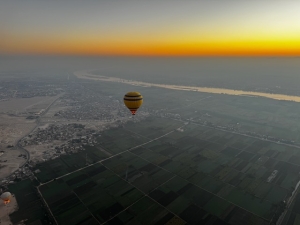
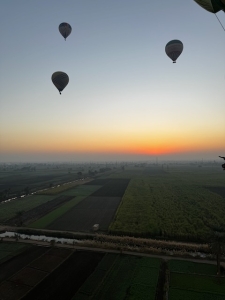
As the pilot turned the balloon around, the brown desert landscape gave way to green fields of farming crops, and the Nile slowly came into our vision as though she was saying hello to us. The green landscape continues to stretch endlessly beyond the Nile. We were floating above some farmlands as the landscape below us turned from brown deserts to green fields. It was time to descend for landing, and we could see the sun slowly emerging from the earth below, as though the Egyptian Sun God, Ra, was greeting us with his warm smile. We floated over some farmlands and a gentle touchdown. We were back to earth. The entire ride took only 45 mins, but it gave us a different perspective of the sight we will see later in the morning.
Colossi of Memnon: Twin Statues of Amenhotep III, Entrance to a Temple
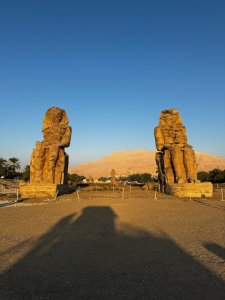
After landing, we were driven to a cafe to meet with the rest of our tour group. Our Tour Director, Ahmed, urged us to pop by the two large statues by the roadside. They are the Colossi of Memnon – the statues of Amenhotep III. The statue on the right was in very bad shape as if someone had knocked it over and attempted to piece everything back. Ahmed told us that this was the work of the Romans, though haphazardly, at least they tried their best. Other than the statues, we also saw a few rocks and a few other statues dotted around the area. While writing this blog post, I did a little research on the Colossi of Memnon. These statues of Amenhotep III that we saw sat at the entrance of a funerary temple Amenhotep III built and dedicated to Amon-Ra. However, we did not see any structure near the statues, as they are still being excavated.
Valley of the Kings – The Resting Place of the King of Egypt
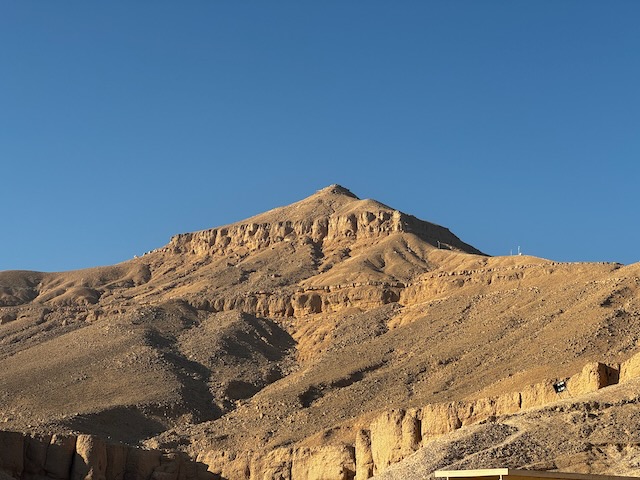
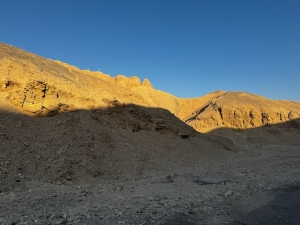
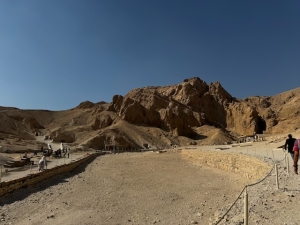
This area was chosen for the burial ground of the kings due to the numerous pyramid-shaped mountains such as this one.
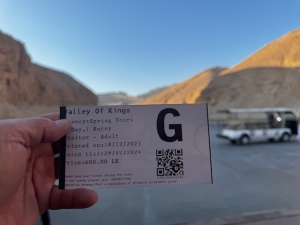
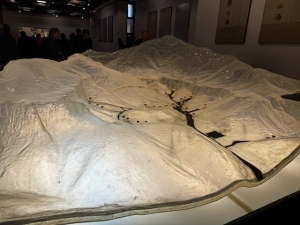
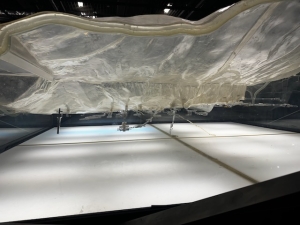
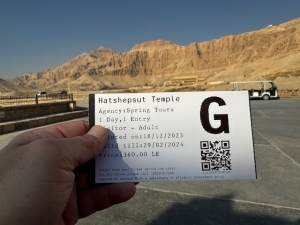
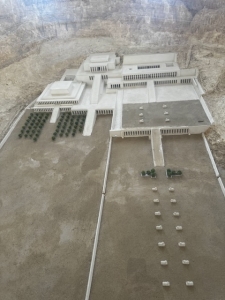
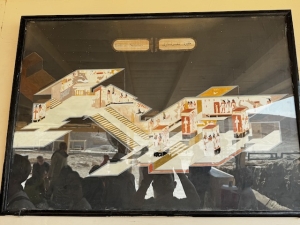
We headed to the Valley of the Kings, a barren mountainous area with no signs of life, where the Egyptian Kings of the New Kingdom were laid to rest for eternity. Some of these tombs were 3,500 years old. Ahmed told us that the tombs in the Valley of the Kings are opened on a rotation basis. He called in to check which group of tombs were opened today and chose what he deemed to be the more impressive tombs to show us. The ticket (cost LE600) only allowed entry to three tombs amongst those that were opened. Before leading us into the Valley of the Kings, Ahmed showed us a model of the valley in the visitor’s centre, which depicted the tombs in the entire valley and the underground locations of each of the 63 tombs in the valley.
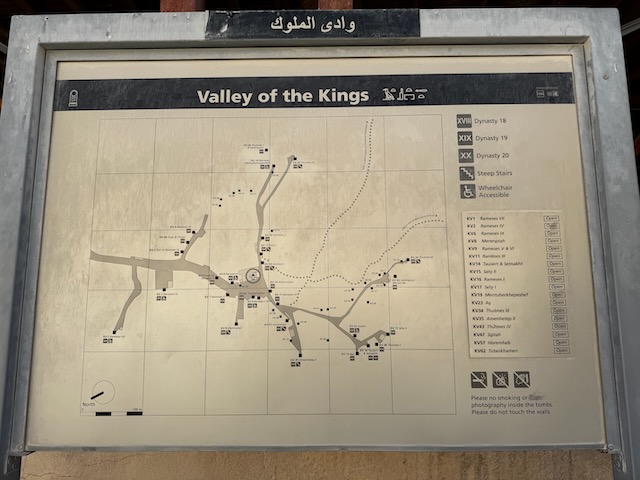
Map detailing all the tombs in Valley of the Kings
The model that captures all the tombs in the Valley of the Kings
The model even captured the underground burial chambers of each tomb
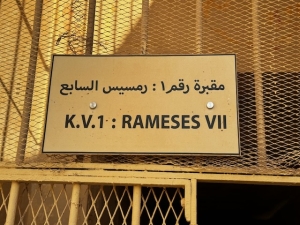
KV1: Tomb of Rameses VII
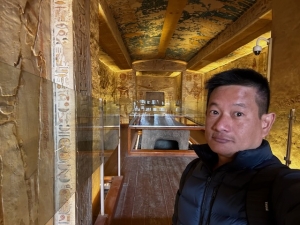
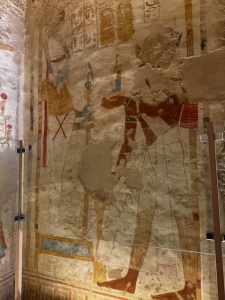
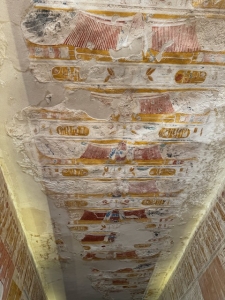
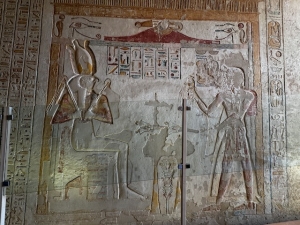
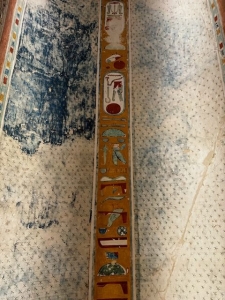
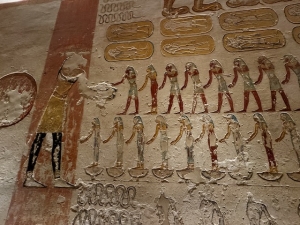
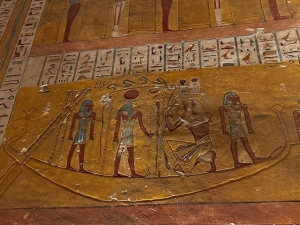
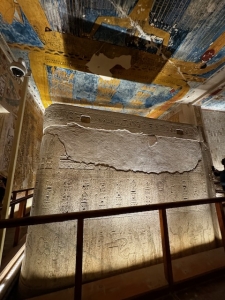
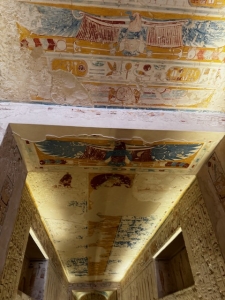
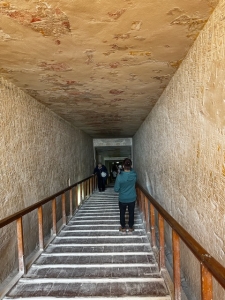
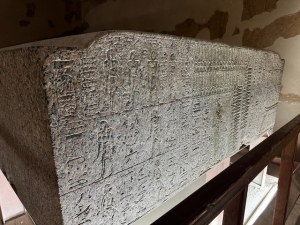
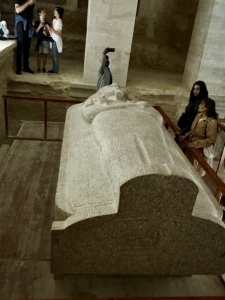
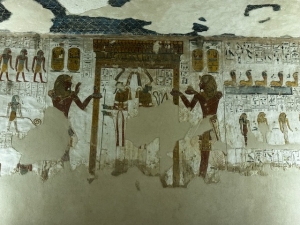
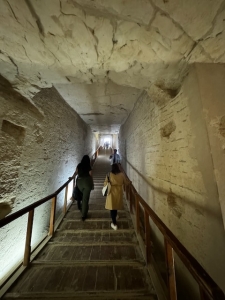
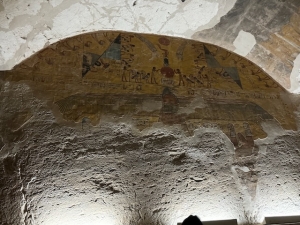
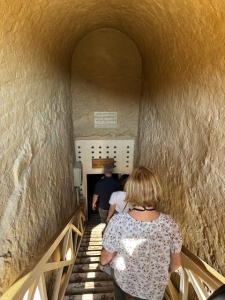
The first tomb we visited was the Tomb of Rameses VII, the nearest tomb to the visitors’ centre in Valley of the Kings. The tomb is relatively small, with one downward-sloping corridor leading to the burial chamber. This corridor looked vibrantly decorated with bright yellow and ceilings with red falcons. The corridor walls were restored to a good scale, and we can see some hieroglyphs and scenes of presumed priests in the funeral possession of the dead king. The walk to the burial chamber was short (under 1 min), where we saw a large sarcophagus encased in a glass casing in the centre. Staff at the tomb enthusiastically pointed it out and told us this was the sarcophagus where Rameses VII’s coffin was placed. He encouraged us to look inside where the sarcophagus used to lay, where we only saw some stones today. The walls in the burial chamber were more vivid in colour, showing scenes of Egyptians praying to what seemed like earth. I particularly like the vibrant blue painting of the Sky Goddess Nut over a group of Egyptian Gods, painted on the entire ceiling above the coffin in the burial chamber. At the chamber’s far end was a depression carved out of the walls with a painting of a boat on top. The tomb of Rameses VII felt celebratory.
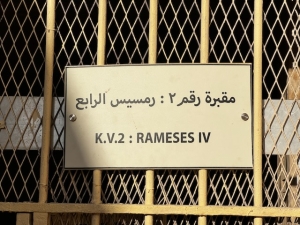
KV2: Tomb of Rameses IV
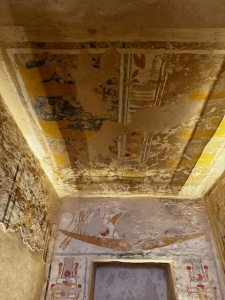
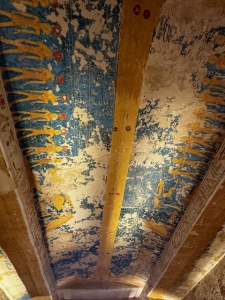
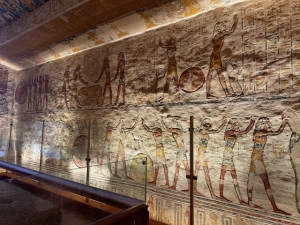
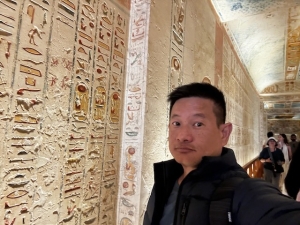
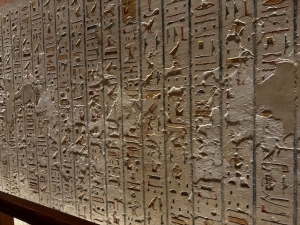
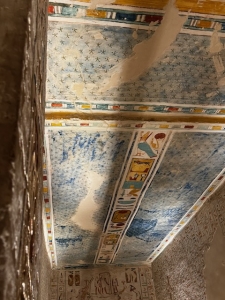
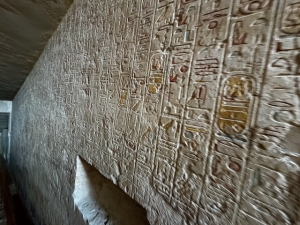
The next tomb we visited was about 3 minutes on foot from the tomb of Rameses VII. This tomb is longer than the previous one, with two sloping corridors. The corridor near the entrance is adorned with rows and rows of hieroglyphs. The tomb walls became gradually more colourful as we walked further into the tomb. There was a scene on the wall depicting priests paying respect to the God Khnum, protector of the Nile. More depictions are associated with the God Khnum along the corridor further into the tomb. The ceiling of this corridor was painted blue and filled with stars. The burial chamber sits at the end of the corridor, where the king’s sarcophagus was placed, and it has carvings of hieroglyphs on the upper part and scenes of what seems like the pharaoh making an offering to a god. The ceiling of the burial chamber was very detailed in its depiction. We saw a different scene of the Sky Goddess Nut eating the sun, supported by the God of Air, Shu. Unlike Rameses VII’s tomb, there is an annexe with three smaller rooms behind the burial chamber. Even this area is brightly painted with detailed hieroglyphs and reliefs. As this area was cordoned off, we cannot distinguish what scenes were depicted in the chambers in the annexe. Like the tomb of Rameses VII, this tomb is equally colourful and feels more like an art gallery.
KV 8: Tomb of Merenptah
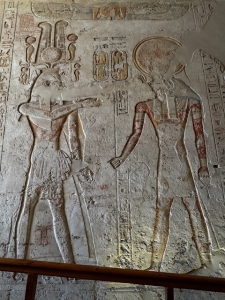
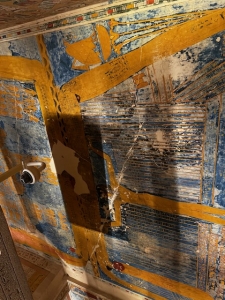
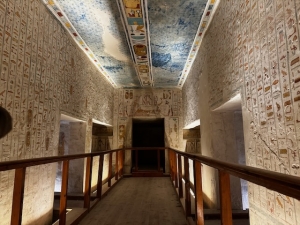
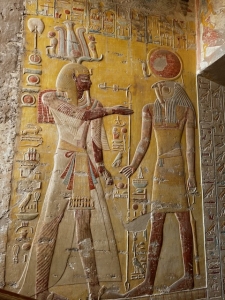
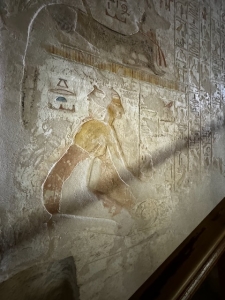
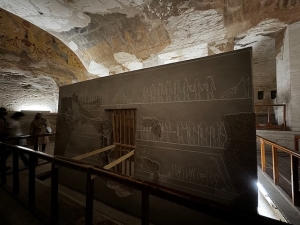
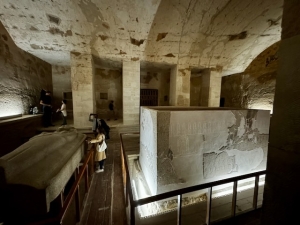
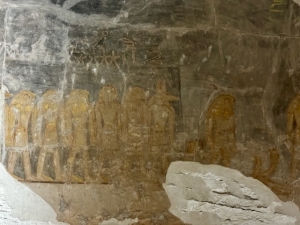
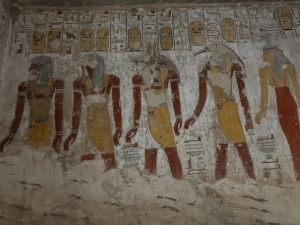
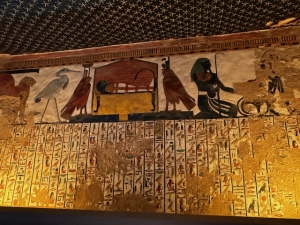
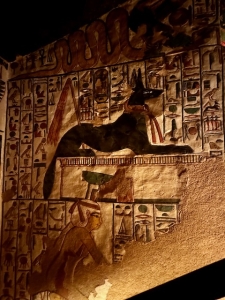
As our ticket only entitled us entry to three tombs, Ahmed gave us a choice of visiting a deep tomb or a colourful tomb. My friend and I chose the deep tomb, the Tomb of Merenptah, with three downward-sloping corridors. Unlike the previous two tombs, the Tomb of Merenptah appears dull, partly due to the long and deep design of the tomb and partly due to the state of the tomb. At the door of King Merenptah’s tomb, a beautiful relief of Osiris and Horus greeted visitors and decked in colours. The first of the three sloping corridors was in its original sand colour, filled with countless faded coloured hieroglyphs. The combination of faded colouring on the walls, long dark corridors, and sparsely restored ceilings gave this tomb a dull look. The hieroglyphs occupied most of the space on the walls of the second corridor. Occasionally, relief of Isis kneeling with Anubis in his animal form on top or painting some Egyptian gods on a boat being pulled by priests would appear in the sea of hieroglyphs. There is a relief of Anubis and Thoth carved into the space between the second and third corridors. However, these paintings and the colours on the walls were faded. The third corridor nearest the burial chamber was very plain and simple. There were no reliefs nor hieroglyphs engraved into this part of the tomb. Just before we reached the main burial chamber, there was a small landing where a smaller sarcophagus with elaborate engravings on the lid was found. This was installed by the ancient Egyptians to confuse tomb raiders, making them think this was the tomb of King Merenptah. Passing this landing, a short corridor led us to the main burial chamber. The burial chamber was huge, housing two sarcophagi, a mummy styled off to the side, and a huge rectangular sarcophagus in the centre. Around these two sarcophagi were some empty rooms. The sarcophagus in the centre, where King Merenptah laid for his eternal rest, had some modern-day carvings and very little of its original facade left. Some paintings were high up on the burial chamber walls and little paintings on the ceiling left. I can only see a small panel of Egyptian Gods like Anubis, Amon, and Horus paying respect to some other God, with a faint light blue sky in the background. Due to flood damage, very little reliefs of King Merenptah’s tomb were left.
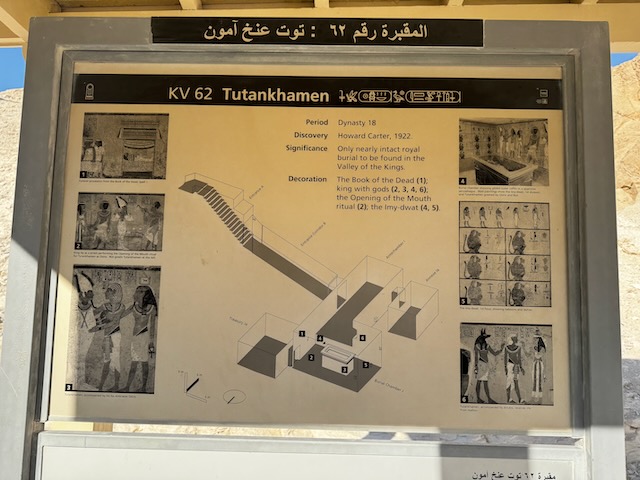
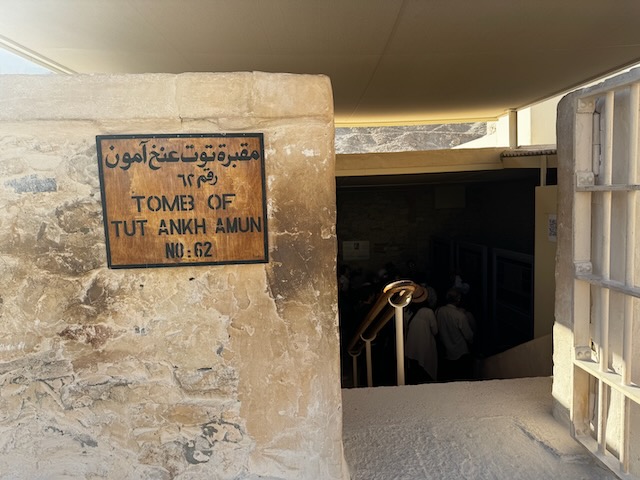
We met up with the rest of the group, and Ahmed pointed to King Tutankhamun’s tomb and told us to take pictures if we wanted. We did not go in as it was crowded and required us to pay an additional fee to visit this tomb.
Map of King Tut’s tombEntrance to King Tut’s tomb
Queen Hatshepsut’s Temple – An Impressive Building at the Foot of the Mountains
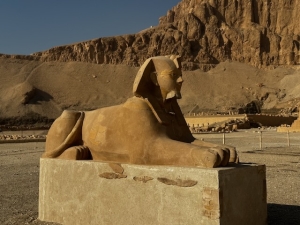
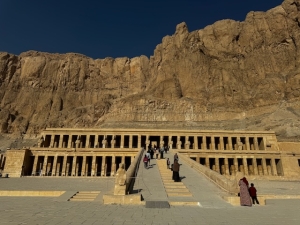
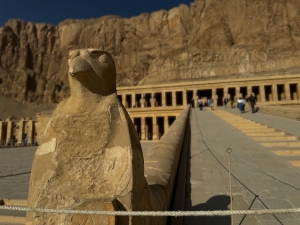
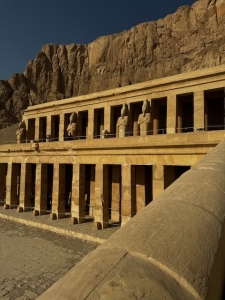
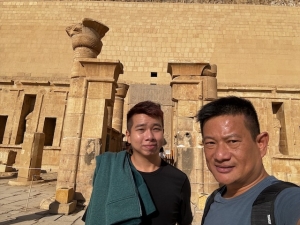
Our next stop was Queen Hatshepsut’s Temple, a short drive from the Valley of the Kings. Queen Hatshepsut’s Temple was an icon of the West Bank of the Nile in Luxor. Almost all the books or pictures would use her temple as a landmark picture to represent this part of Egypt. The three-storey temple, dedicated to the God Amun, was intended to be used as the mortuary temple for Queen Hatshepsut. Queen Hatshepsut’s body was buried in the Valley of the Kings as the first female pharaoh of Egypt. The temple was tucked into the mountain’s base, where the Valley of the Kings was on the other side. The first relic we saw at the temple was the remaining Sphinx on the ground floor with the face of Queen Hatshepsut, which she used to exert her legitimate rule of the country. The temple’s ground floor was occupied by a row of pillars that seemed to support the upper floors of the temple. We skipped this part of the temple and went to the second level. The architectural style on the second floor of Queen Hatshepsut’s Temple adopted the same features as the first floor. There doesn’t seem to be too much going on at this level, which seems to be mainly rows of pillars supporting the third floor. The ramp that extends out on the second floor was adorned with a falcon figurine with a snake body.
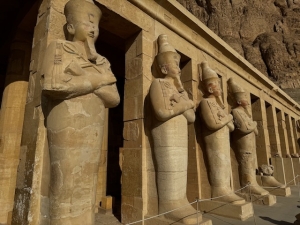
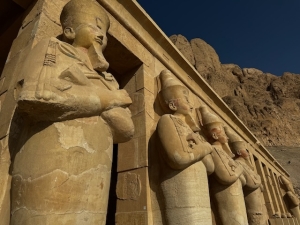
The main highlight of the temple is on the top floor. As soon as we emerged from the ramp, we were greeted by a row of statues of Osiris. Passing the statues of Osiris, we arrived at a small courtyard, where the entrance to the sanctuary was adorned with reliefs depicting Queen Hatshepsut wearing the crown of Lower and Upper Egypt. The sanctuary was a small space. Despite the reliefs here being heavily defaced, we were still impressed by the number of reliefs and the vibrant colours that once glorified this chamber. We could still make out that most of these reliefs depicted Queen Hatshepsut as a man paying respect to Amun. As with the tombs in the Valley of the Kings, the ceiling in this chamber was decked out with stars. A small annexe at the back of the chamber is sealed off to visitors, with statues of Amun on the sides of its entrance. A staff member told us this was where Queen Hatshepsut was mummified.
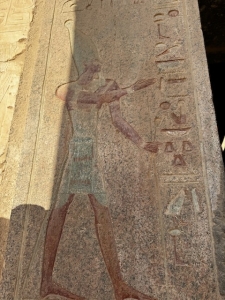
We returned to the courtyard and saw another entrance leading to a separate part of the open courtyard. There does not seem to be too much going on here, except for a large altar (we later found out a Ra idol was installed here). But what was interesting was the relief on the doorway, which depicted Queen Hatshepsut as a man (the false beard was very visible) receiving blessings from Amun and Ra. We went around the temple’s top floor to take more pictures and met with the rest of the group for our next destination.
Valley of the Queens – The Beautiful Tomb of Nefertari
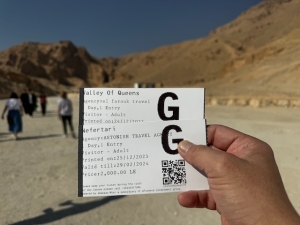
The Valley of the Queens was a short drive from Hatshepsut’s Temple and is where the ancient Egyptians buried their Queens, princes, princesses and nobles. The only tomb we visited at the Valley of the Queens was the 3,500-year-old Tomb of Nefertari, the beloved queen of Rameses II. To gain access to the tomb, the tour company had to buy two tickets, one for the entrance to the valley and another to access the tomb. The Tomb of Nefertari was the most expensive of the sites we visited on this trip, costing LE2,000. Outside the tomb, there was some form of an unstructured queuing system. We were told to wait at the pavilion for our turn, as visitors were only allowed to view the tomb in small groups (of around 15 to 20). A sign in the waiting area stated the visitation of the tomb was limited to 10 minutes per group. The queuing system at the tomb was whoever tour guide made the most noise got to enter the tomb first, while those independent travellers had to wait at the back of the line, praying that they would be called. We saw a group who came after us being given priority to enter. I approached the staff managing the queue at the entrance and informed him that we had been waiting for our turn. After he let the previous group in, he turned to us and invited us to join the queue to be the next group to enter.
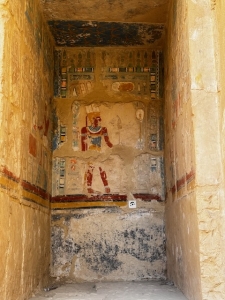
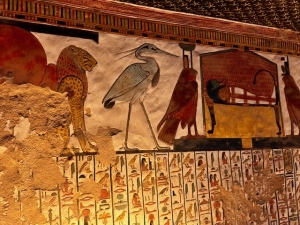
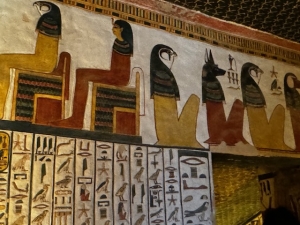
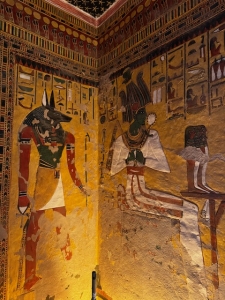
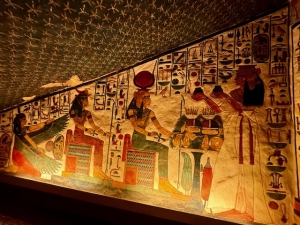
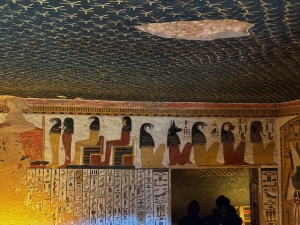
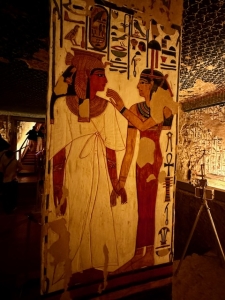
Walking into the Tomb of Nefertari was like walking into an art gallery. The entire tomb was colourful and intricately adorned with reliefs of the late queen. This has got to be the most beautiful tomb we saw today. The entrance staircase led us into a small chamber where we saw vibrantly coloured reliefs engraved onto the wall depicting some of the Egyptian gods. In one particular relief, these gods, in their animal form, came before the body of Queen Nefertari to mourn her death. We saw a path that branched off to another chamber, which was closed to visitors, where I saw some personnel working and perhaps restoring the chamber. There is another staircase that leads us to the main burial chamber. At this staircase, we got our first look at Queen Nefertari. Queen Nefertari looked beautiful, pure and approachable from the engraving on the wall.
A vibrantly painted relief depicting Egyptian Gods in the first chamber at the Tomb of Nefertari. There seems to be some work in the other smaller chamber.
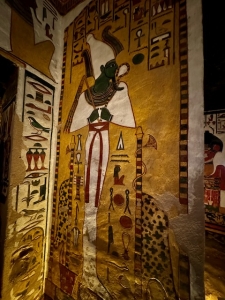
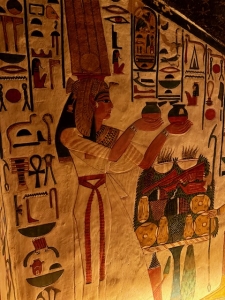
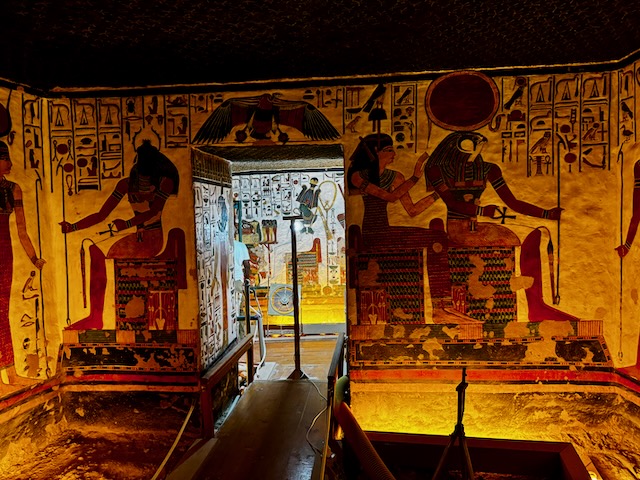
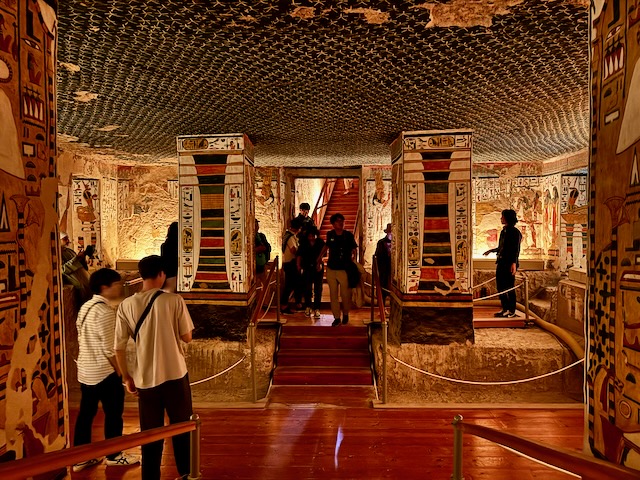
The burial chamber is rather sizeable, with more colourful reliefs of the Egyptian gods, but we did not see the sarcophagus of the late queen. A colourful relief of Queen Nefertari paying respects to Osiris, Hathor and Anubis was engraved onto the innermost wall of the chamber, and another depicting genies guarding the gate to the afterlife was engraved on each side of the wall. In the centre of the burial chamber stood four pillars, each painted with Osiris. The inner two pillars were engraved with Queen Nefertari receiving blessings from Anubis, Isis, Nephthys and Hathor. There are three smaller chambers here in the main burial chambers, and according to the staff working in the tomb, the remains of mummified Queen Nefertari were found abandoned inside the innermost (centre ) chamber. We walked around, trying to take as many pictures as our 10 minutes allowed us. Another staff at the entrance came to the main burial chamber and told everyone our 10 minutes were up. Reluctantly, we exited the tomb.
The burial chamber in the Tomb of Nefertari
Sailing up the Nile to Aswan
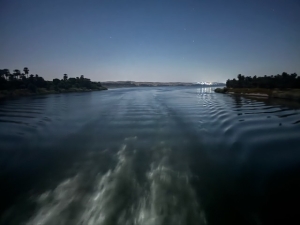
We ended our day of sight visits after the Tomb of Nefertari and returned to the riverboat for lunch. Wow, we did quite a lot in the space of the morning. The plan for the rest of the day was to relax while the boat sailed up the Nile towards our next port of Aswan. The boat slipped off at 1 pm, after all guests were embarked. We lazed around the sundeck (our favourite hang-out spot), taking in the scenery and witnessing how the locals used the River Nile daily.
We took a few hours of afternoon nap to recharge. The boat crossed the Esna Lock at night, where we could see the difference in water level at the lock. We were the very few people up here watching the boat entering a pan, which was slowly flooded to match the water level after the lock. The event was quite smooth and relatively fast. After passing Esna Lock, the boat went through another lock. We understood from the ship crew that the second lock was an older lock built by the British but is currently out of order. The boat spent the rest of the night sailing. The River Nile at night was even more peaceful. We reached our next stop, Kom Ombo, at around 5 am, where we would visit the Temple of Kom Ombo later in the morning.
Today, we visited two sights in Luxor, Dendera and Luxor Temple. We had another early start, leaving the riverboat at 7.30 am for a 2-hour drive to the Dendera, otherwise known as the Temple of Hathor. We arrived at the temple before the huge crowds came in. In the afternoon, we sailed along the River Nile and docked back to Luxor for our visit to Luxor Temple in the evening.
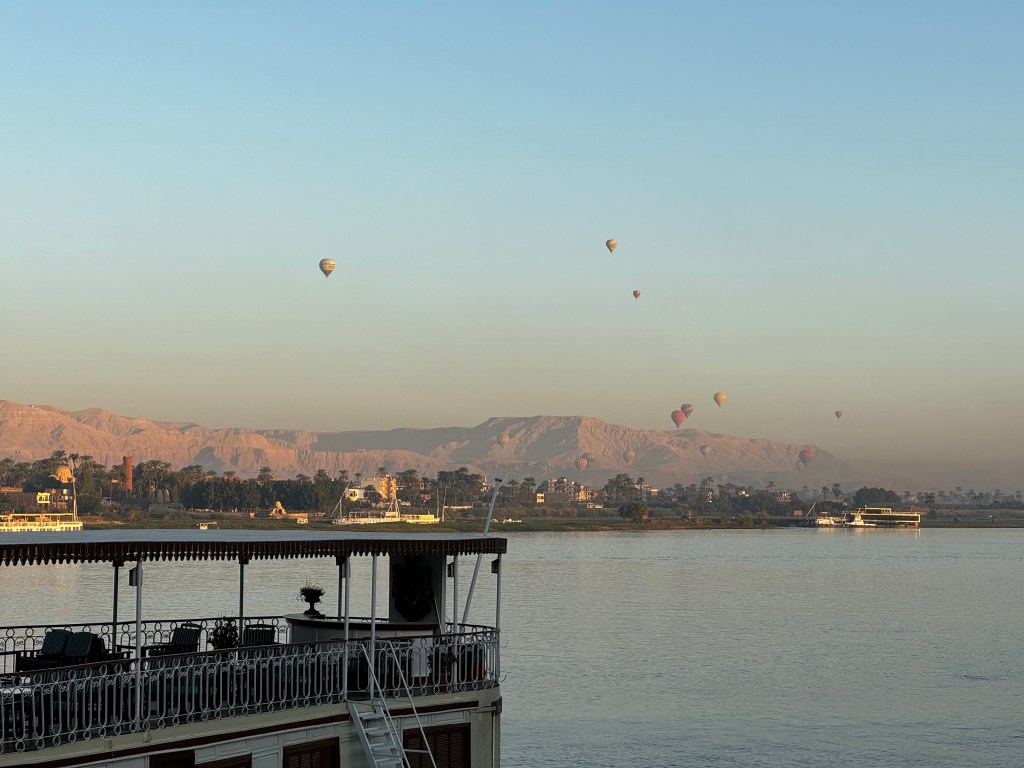
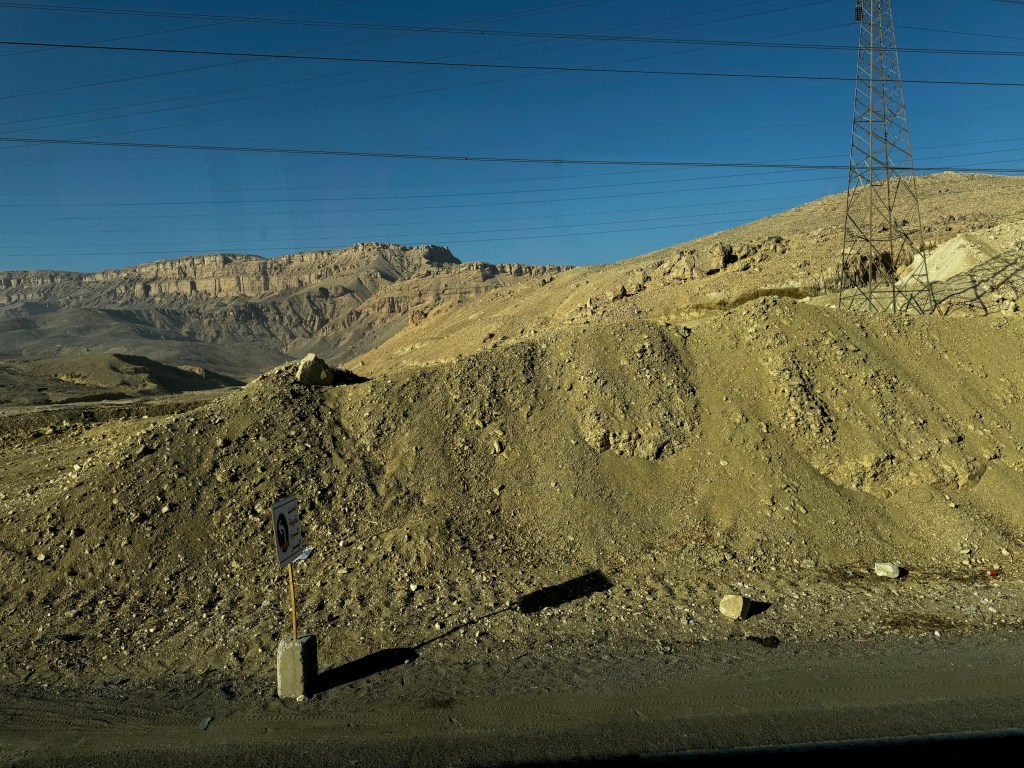
We saw hot air balloons over the West Bank of the Nile in the early morning.On our way to Dendera
Dendera Temple – A Temple Dedicated to the Nurturing Goddess of Hathor
Hathor is the Goddess of birth and motherhood when assuming the form of a cow. She is often seen with cow ears and sun disc in human form. When provoked, Hathor will turn into a lioness and attack.
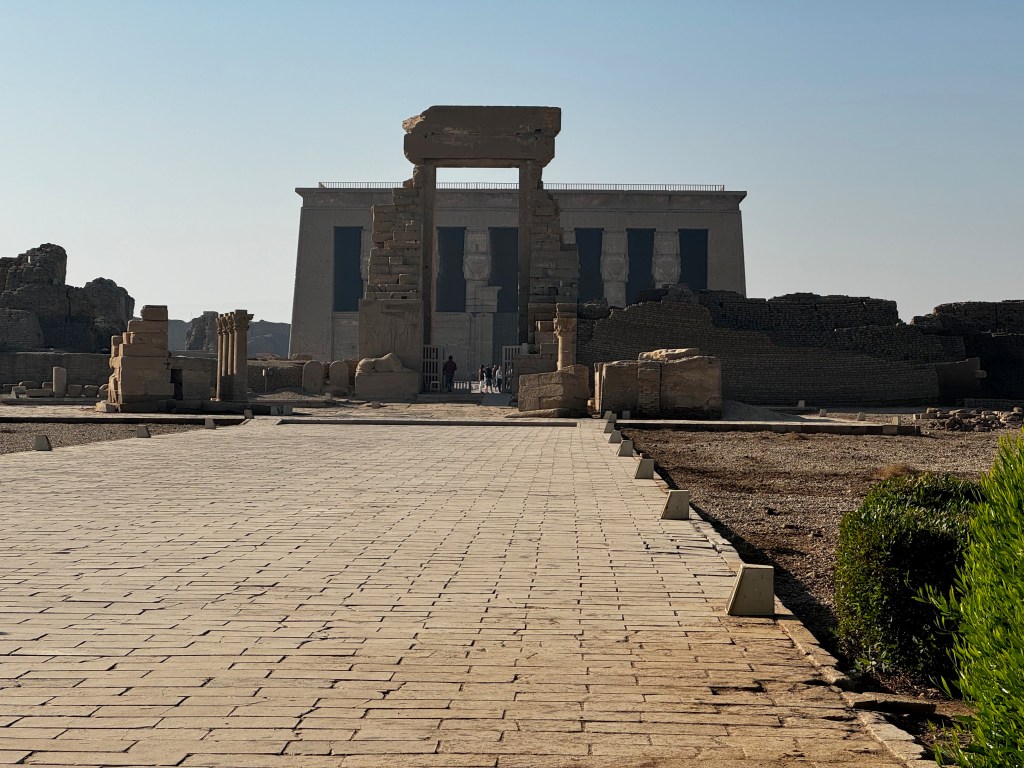
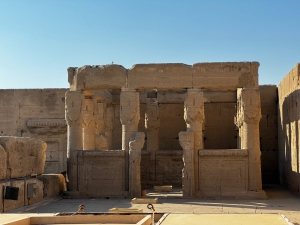
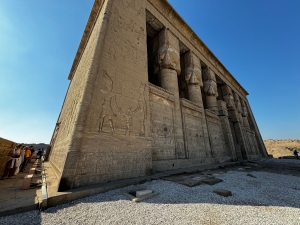
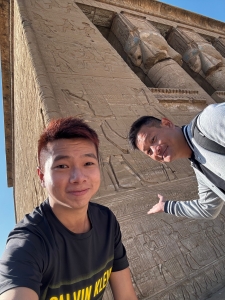
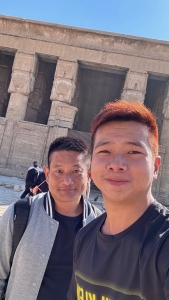
Hathor Temple in Dendera
The Engravings on the First Floor
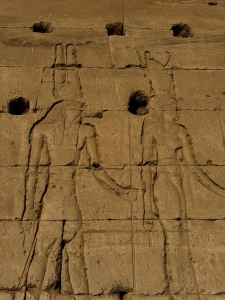
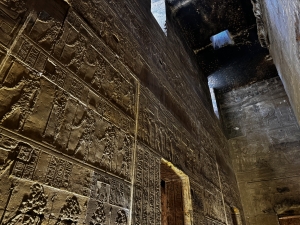
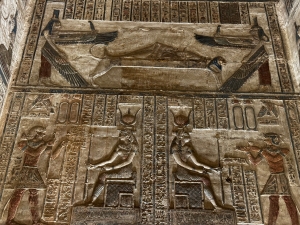
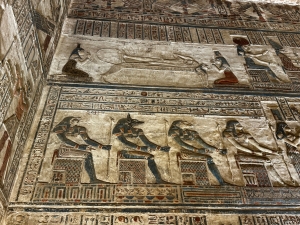
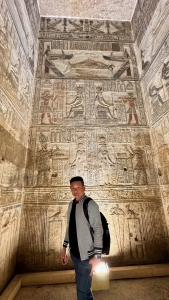
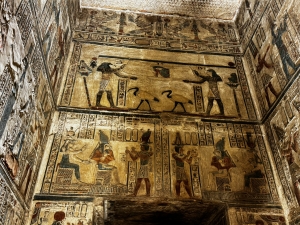
Our Toud Director, Ahmed, brought us straight through the outer hypostyle hall to a chamber that was covered with soot. This chamber is filled with inscriptions depicting the pharaohs paying tribute to Hathor. A common feature of these panels is that Hathor is always depicted sitting in the centre and her husband, Horus, sitting behind her, receiving tributes from Egyptian kings. According to Ahmed, in Egyptian society, the God/Goddess which the temple was built for will always take centre stage, regardless of sex. Our attention is brought to another panel of engraving that shows scenes of Hathor receiving tributes from the other gods. We could distinctively see some burnt marks across some of these wall panels. It was believed that tomb raiders set fire to this temple when they entered to empty its coffers. Ahmed brought our attention to the holes in the ceiling, explaining the ancient wisdom of including these holes to illuminate the temple and for air circulation, especially in the summer.
The Roof Level
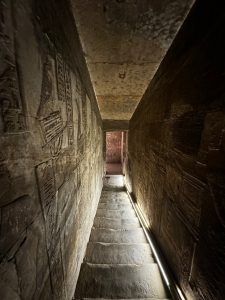
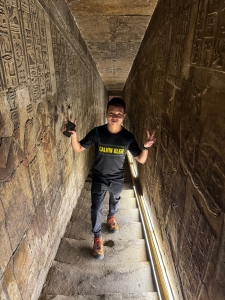
We were led up a flight of stairs, narrow enough for one person to pass through, consisting of a series of 90° turns. Hathor was so revered by the ancient Egyptians that they even adorned this staircase with engravings of the Goddess. We reached the rooftop level of Hathor Temple at the end of the staircase. Emerging from the staircase, Ahmed immediately brought our attention to the lining of the walls and the floor we were standing on. He pointed out that the inconsistent lining was done to prevent earthquakes, which allowed the stone blocks to lock in place for millennia. This was especially important for the flooring, which also formed the ceiling of the floor below. A small chamber sits a little further from the entrance to the rooftop floor, with its pillars engraved with the face of Hathor. The walls of this chamber depicted Egyptian kings paying tribute to Hathor and Horus. What is more interesting is an engraving on the walls behind this semi-open chamber depicting Hathor receiving blessings from Amun-Ra, with Horus standing behind Hathor as a supporting figure. Priests working in the temple would bring the statue of Hathor up to this chamber every new year for the goddess to receive blessing and be rejuvenated by the first sun ray of the year.
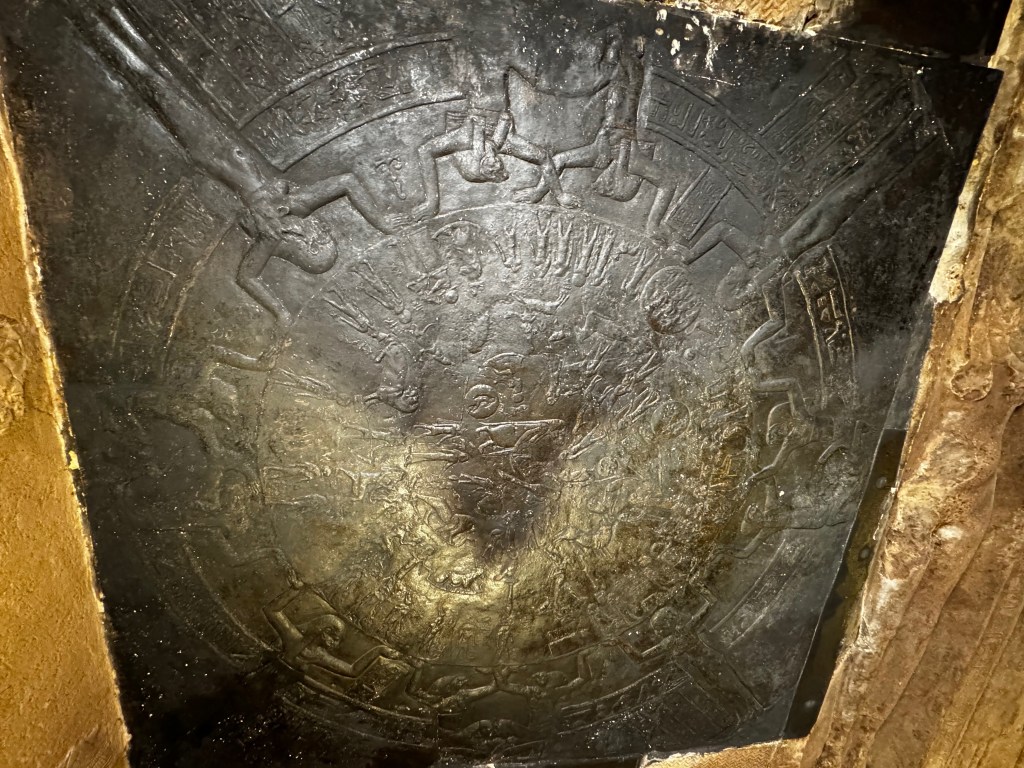
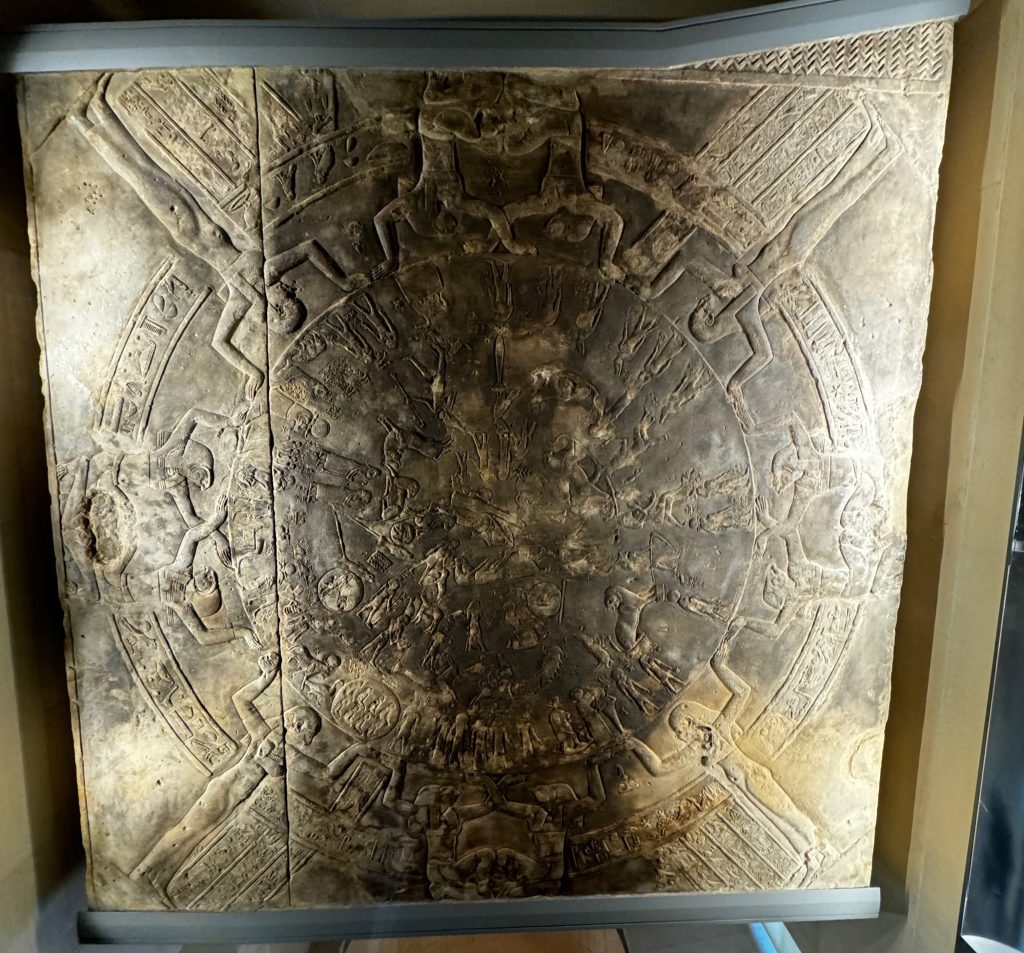
The Dendera Calendar
We were brought into another chamber on the roof level, a stone’s throw away from the chamber. This would be the most significant chamber of the entire temple. Our attention was directed to a blackened big stone slab above us on the ceiling. This was the Dendera zodiac calendar, which was how the ancient Egyptians viewed the cosmic. Ahmed guided our attention closely to the different figures depicted on this stone. Four women are standing, each precisely in the four cardinal directions (N, S, E and W), while the four pairs of falcon-head figures kneeling occupy the ordinal directions (NE, SE, NW and SW). In the centre of these characters lies a detailed map of all the zodiacs in the sky. Indeed, I could see zodiac signs such as Taurus, Pieces, Scorpio, etc. What impressed me was that this calendar was at least 2,000 years old. To our dismay, Ahmed told us that this was a replica and the real one was stolen and was being displayed in the Louvre in Paris (because of this, I was determined to give the Louvre a visit after my Egypt trip).
The replica Dendera Calendar that I took in Hathor TempleThe original Dendera Calendar that I took in the Louvre, Paris, 1 week after my visit to Egypt
Back to the First Floor
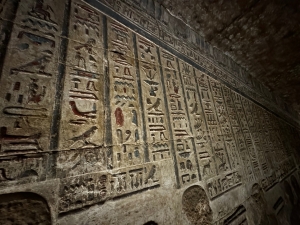
We were led down to the first floor via a long flight of stairs adorned with countless hieroglyphs engraved onto either side of the walls with colours that had existed since the temple was built. We were led into another room with reliefs depicting pharaohs making offerings to Hathor and scenes of pharaohs sitting on their throne receiving blessings from Hathor in the presence of other gods. There is even a scene showing Horus assuming the king of gods after his father Osiris’s death. This chamber is filled with stories of Egyptian mythological lore that, without the explanation by Ahmed, we would have seen it as merely some engraving.
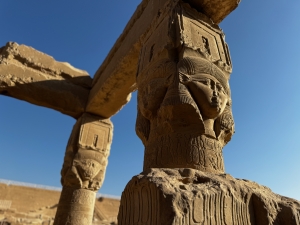
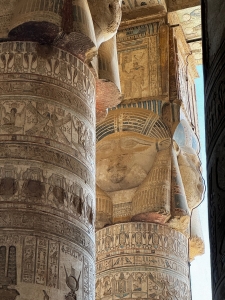
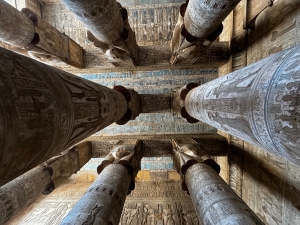
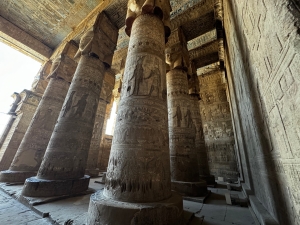
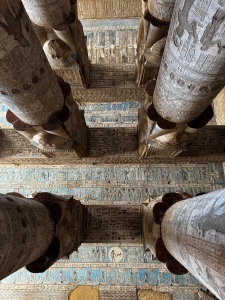
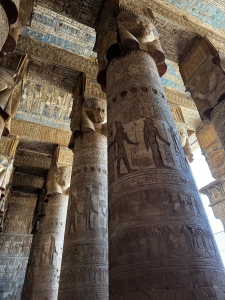
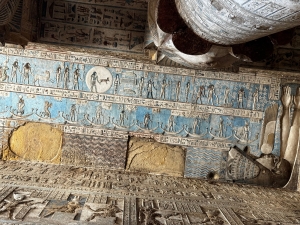
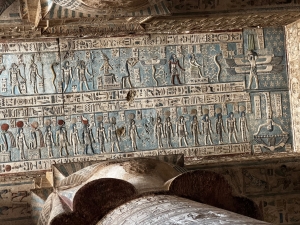
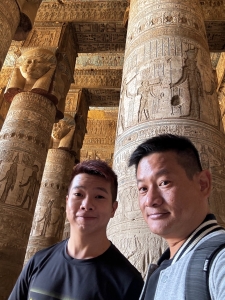
We stopped at the hypostyle hall in Hathor Temple before heading outside. The outer hypostyle hall was massive. Standing here amongst the gigantic pillars with the faces of Hathor carved on four sides of the pillars can certainly make one feel small. I couldn’t help but feel a sense of anger when I saw most of Hathor’s faces on these pillars were defaced. The pillars and the ceilings were dressed in vivid colours that had withstood the test of time and were painted since the building of this temple. There were so many stories that each of these pillars would tell, but what caught our attention was the engravings on the ceiling. The blue and colourful ceilings depict an Egyptian night sky with some constellations representing Egyptian Gods.
Outside the temple
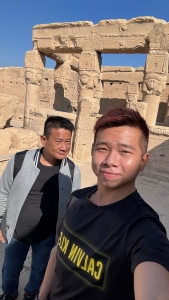
We were brought outside the temple and shown the gigantic engravings on the other walls of Hathor Temple. We saw depictions of Egyptian kings paying tribute to Hathor and Horus and a bust of Hathor in her lioness form sitting high up the temple’s wall. There were two inscriptions that Ahmed wanted to show us; the first one, depicting all the crowns worn by the kings of Egypt, was often missed by visitors to Hathor Temple. The second and more interesting engraving is the one that depicts Cleopatra as a Goddess (wearing the crown of Hathor) paying tribute to Hathor with her son. We were given some time to explore the temple grounds before returning to the riverboat.
Another Day of Cruising Along the Nile
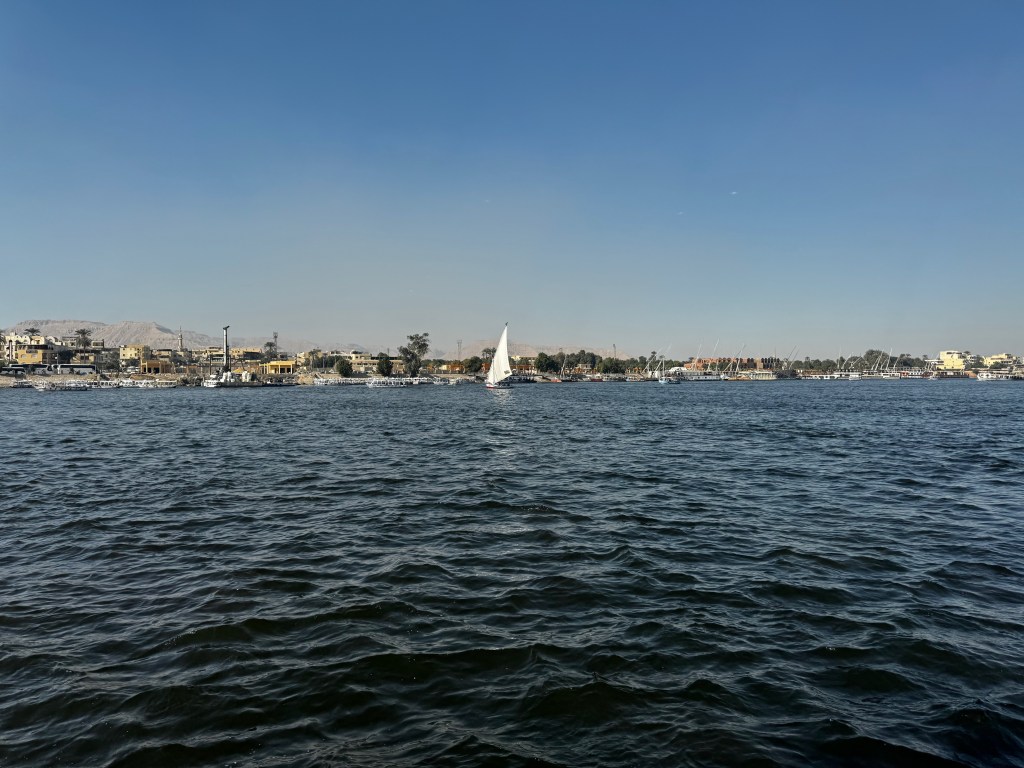
We returned to the riverboat around noon. The boat will spend the afternoon cruising on the River Nile while giving us time to rest (due to the early waking up). The boat also offered free massage for anyone who needed it. We just wandered around the boat and spent most of the time relaxing on the sundeck, watching life along the River Nile. Despite sailing on the same route as yesterday, cruising along the calm River Nile, listening to waves hitting the ship hull and occasionally children playing along the Nile was very relaxing. I can never get bored of the beautiful scenery the River Nile offers. We docked back to Luxor at around 4 pm, in time to visit our second site of the day – Luxor Temple.
We had an afternoon cruise along the River NileThe scenes on the River Nile
Temple of Luxor – A Temple for the Sun God Amun
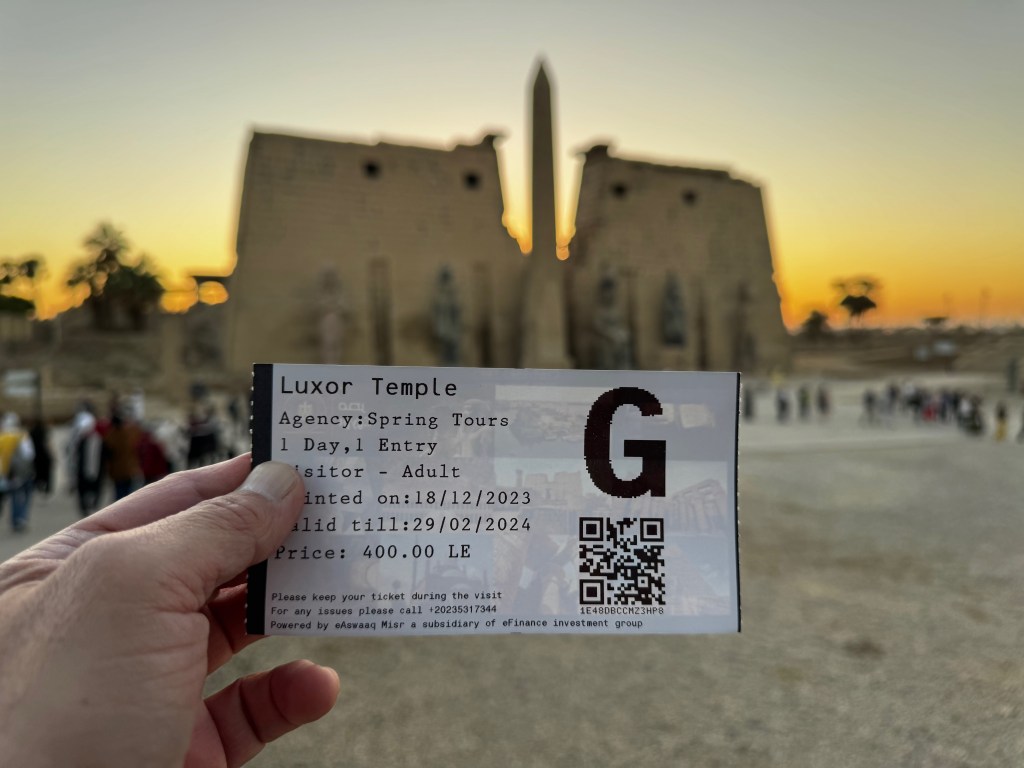
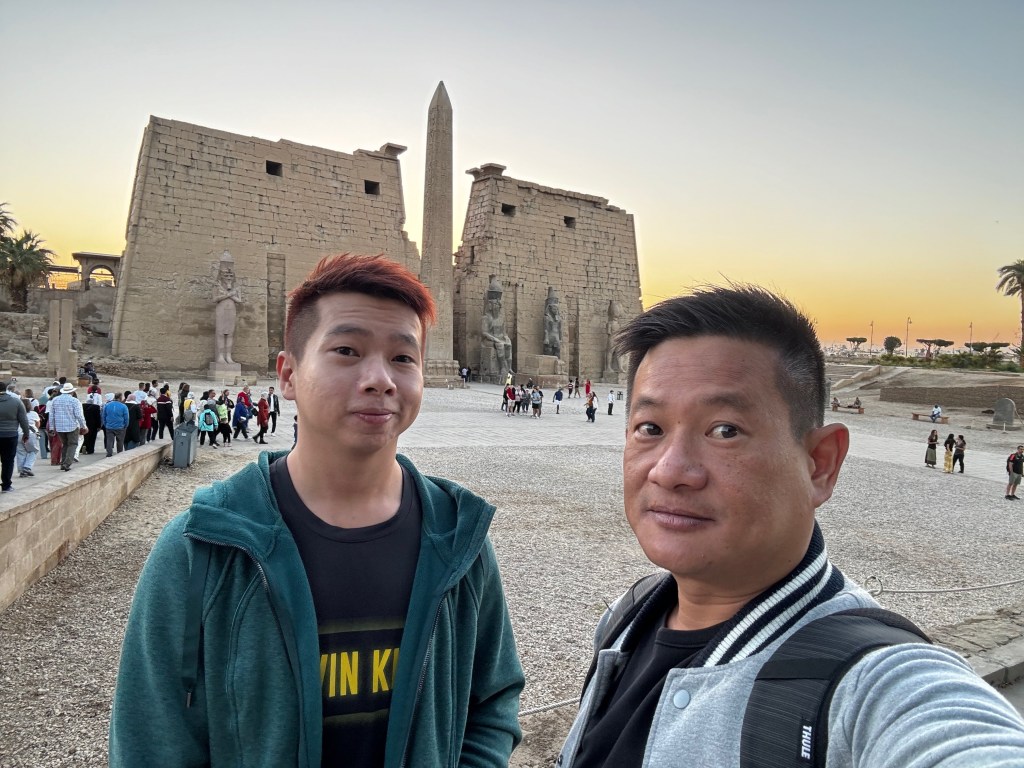
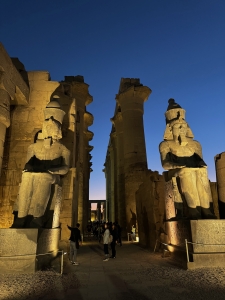
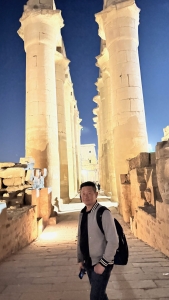
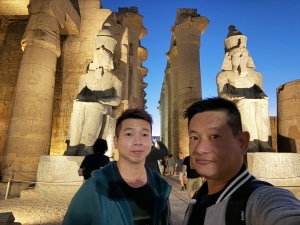
Evening visit to Luxor TempleTaking a quick wefie with Luxor Temple before we head inside
The Double Sanctuary of Luxor Temple
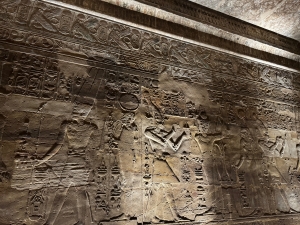
Luxor Temple is situated by the River Nile in the heart of Luxor. This temple is relatively small, compared to Karnak and Hathor Temples and was dedicated to the God Amun. Luxor Temple is connected to Karnak Temple by the 2km avenue of the Sphinxes. The moment we reached Luxor Temple, we marched straight to the sanctuary, which consists of a chamber within a larger chamber. The smaller chamber was later built by Alexander the Great when he assumed the King of Egypt, but this was not the chamber we were interested in. Ahmed brought us to the side of the larger chamber, which was the original sanctuary built by Amenhotep II. Our attention was directed to a relief (which was defaced) engraved onto the wall depicting Amenhotep III, wearing the crown of Upper Egypt, making offerings to the God Amun standing behind him. This was the original engraving in the temple, which was over 3,400 years old.
The Christian Chapel
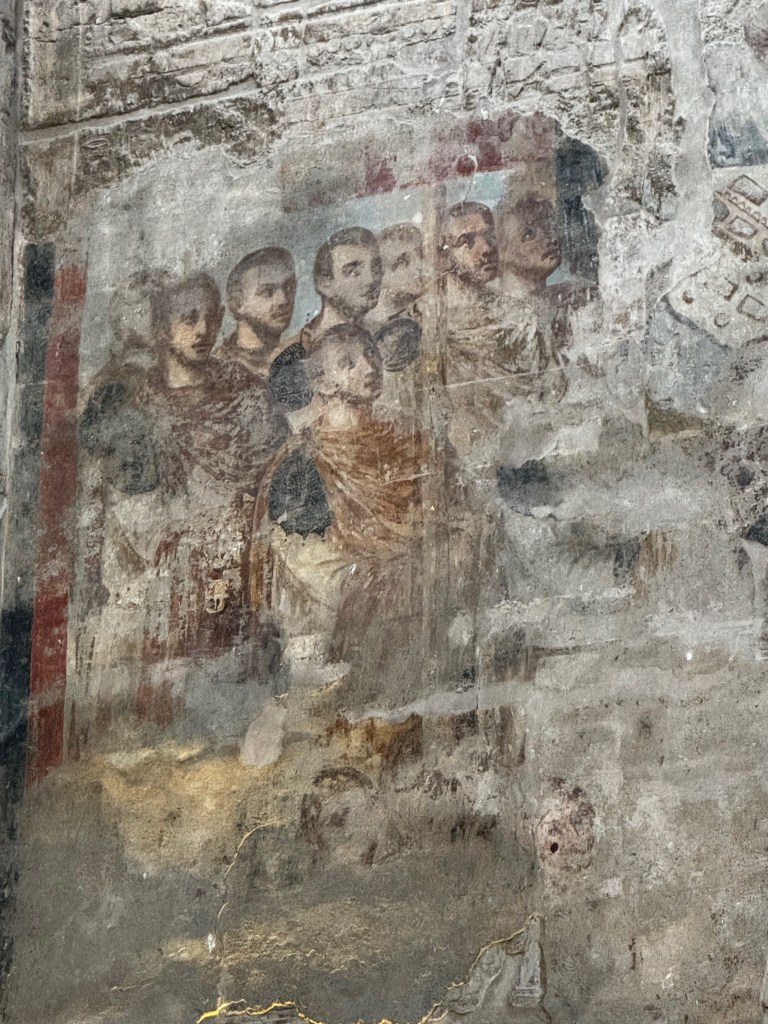
We retraced our footsteps, moving past a row of columns to a small open space. Here, Ahmed explained this area was converted to a church when the Romans occupied Egypt during Alexander the Great’s reign. The original reliefs were plastered over to make way for Christian artwork. He pointed to one corner, where we can see a group of men in Early European dress, and told us that these were the same men who attended Jesus’s last supper. Ahmed explained the best time to see these reliefs was at dusk (around the time we were in Luxor Temple); this is when we understood why he started from inside out. Ahmed then pointed to a concave structure above the doorway we had just come through and told us there were paintings of the four archangels.
This painting is found on one corner of the wall and depicts the attendees of the Last Supper.This concave structure was plastered on with paintings of the four archangels.
The Courtyards
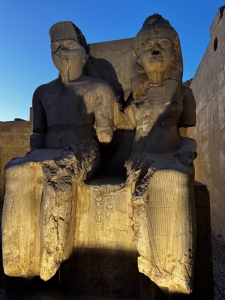
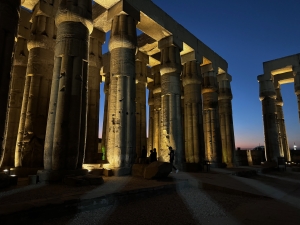
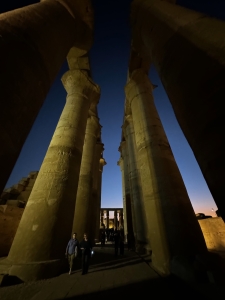
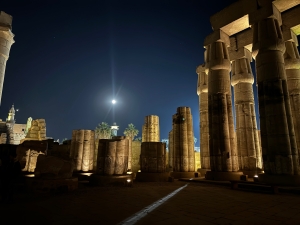
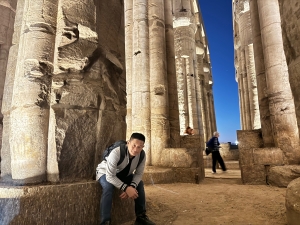
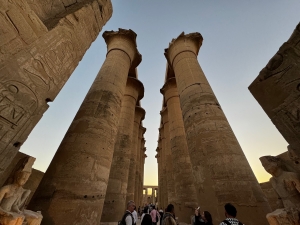
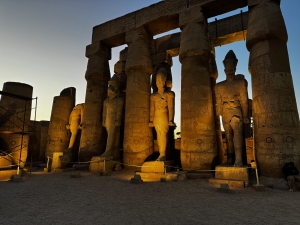
We retraced our footsteps to the inner (and larger) courtyard. This courtyard was filled with columns at the sides, and the builders seemed to leave the centre part open deliberately. The star of the show for this part of the temple was the statues of King Tutankhamun and his wife Ankhesenamun sitting on the throne. Despite having minor defacement on the statue of King Tut, we can see that the royal couple was relatively young from the facial features of the Queen (King Tut died at the age of 19 anyway).
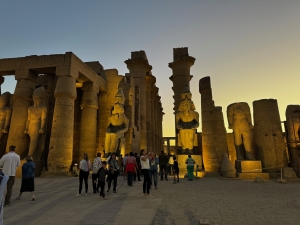
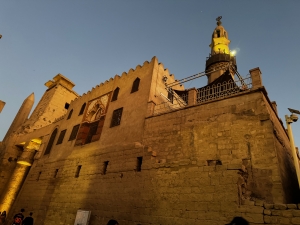
The outer courtyard, which is smaller than the inner courtyard, gave us clues about who was responsible for building this part of Luxor Temple. This area was filled with statues of Rameses II at the sides. What was interesting about this courtyard was the entrance to a mosque. Ahmed told us the mosque that we see up on the walls of Luxor Temple was built when the temple was buried underground. He pointed to what seemed like a larger window and told us that was the original entrance to the mosque! The entrance was high up from where we were, as though it was floating in the air.
The Facade of Luxor Temple
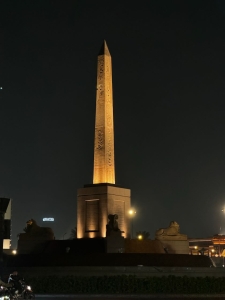
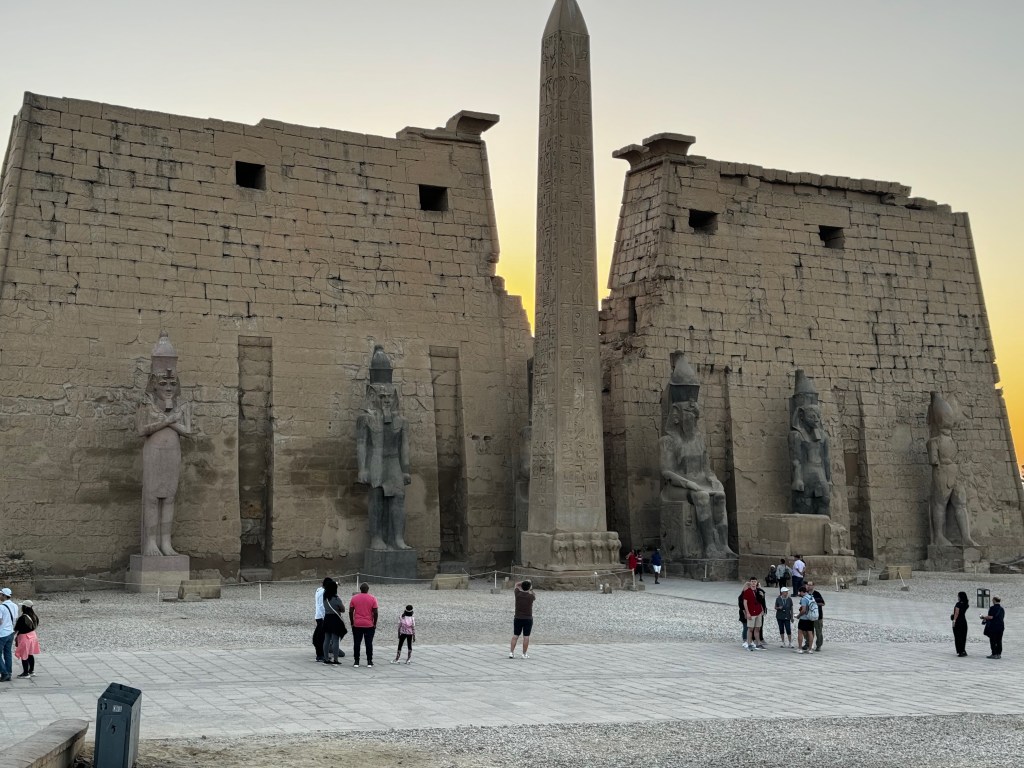
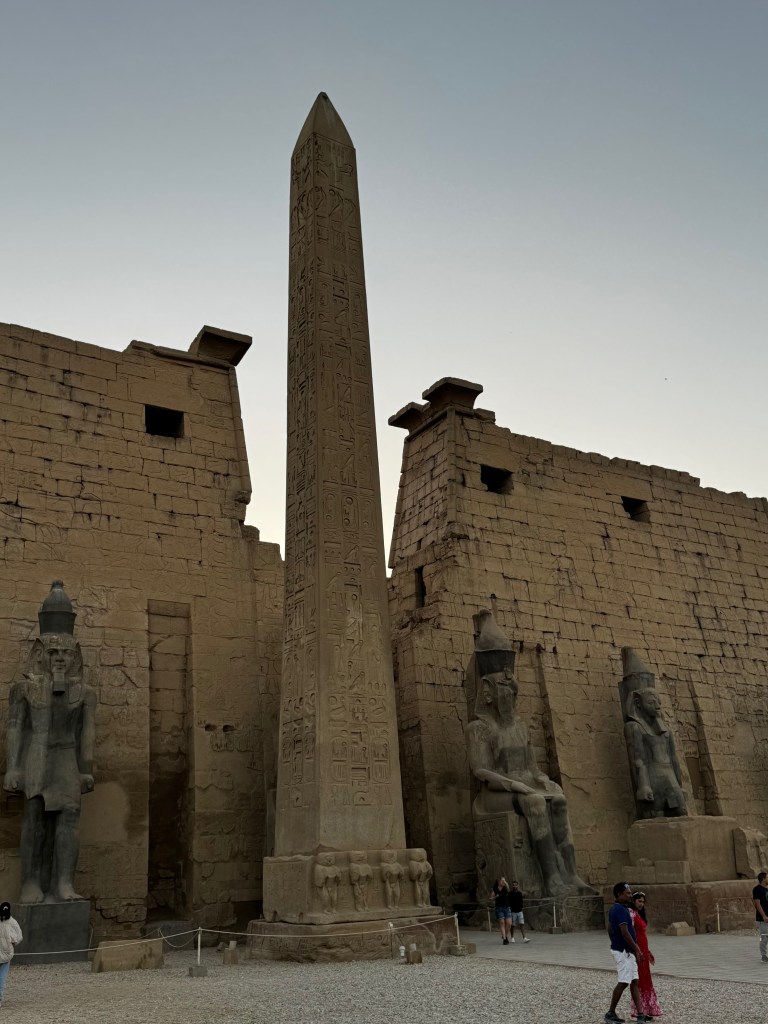
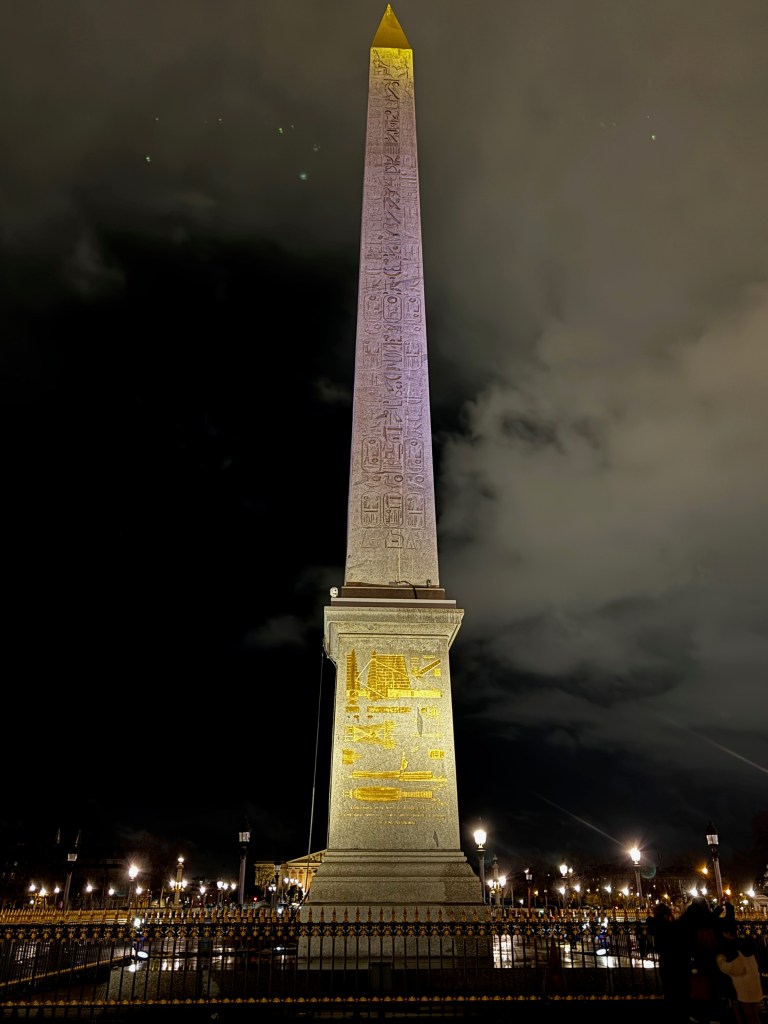
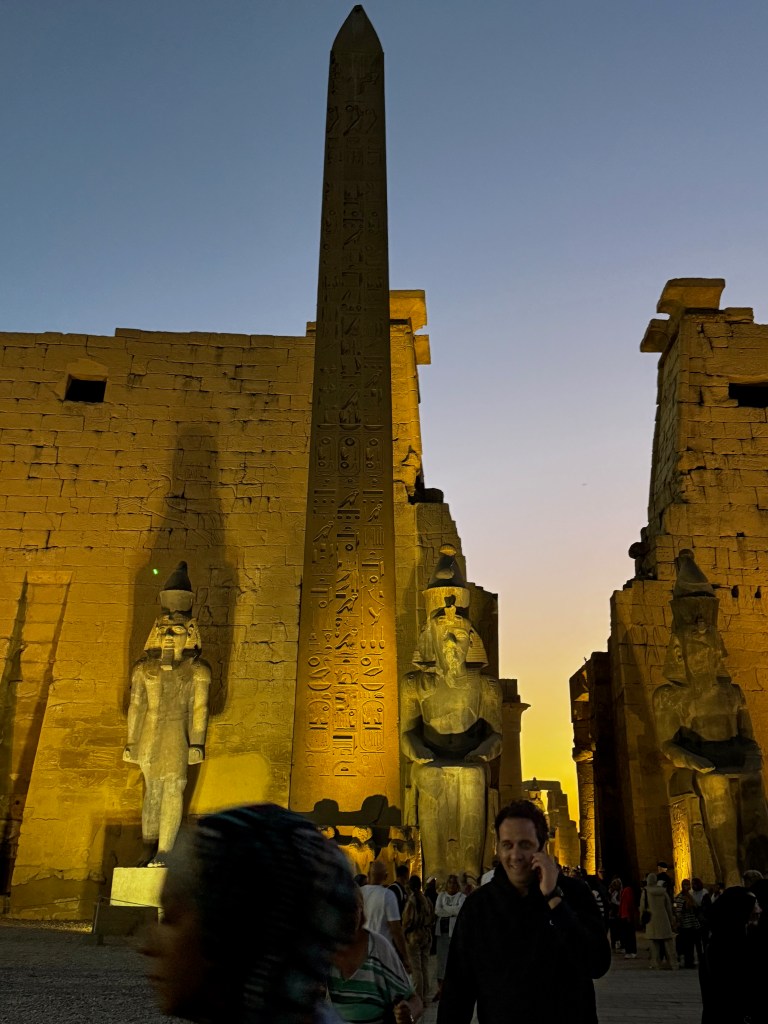
Our last stop was the facade of Luxor Temple. Here, we could see six statues of Rameses II statues. The more interesting fact that was told to us was the lone obelisk at the entrance to the temple. As with most Egyptian architecture, to achieve ma’at (balance), all things were supposed to be symmetrical. There were originally two obelisks sitting at the doorstep of Luxor Temple. The other obelisk was given by one to the king to the French King and is currently sitting in Place de la Concorde in Paris. After the explanations, Ahmed gave us time to reenter the temple and take as many pictures as we wanted. My friend and I headed back into the sanctuary to take more pictures of the relief we had missed out on earlier. We ended the day earlier as we would be required to wake up early the next morning for the optional hot air balloon ride over the West Bank of the Nile, seeing the necropolis of past kings and queens from the sky.
Luxor Temple is a place of worship for a few religions
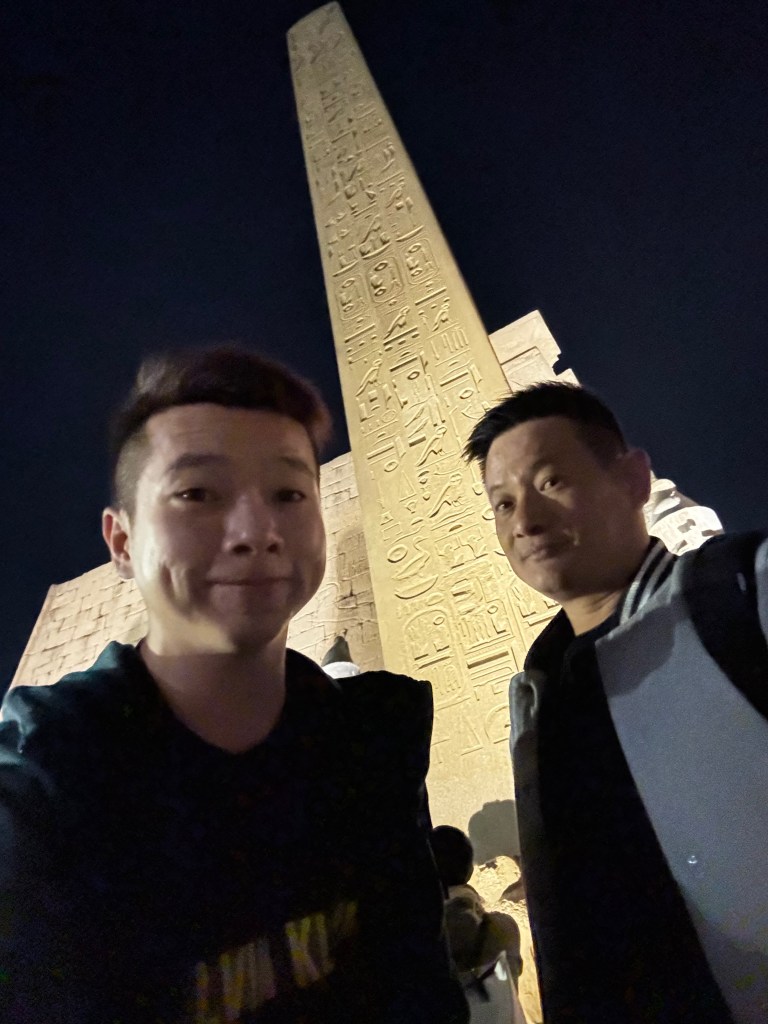
The obelisk in Luxor TempleThe other twin obelisk in Paris that I took 1 week after my trip to EgyptFacade of Luxor Temple at night Taking a wefie with the remaining obelisk in Luxor Temple
Having a heavy day visiting four major sights in Cairo yesterday, our itinerary is lighter today, with only one sight to visit, the Karnak Temple. We would have the whole afternoon relaxing while cruising down the River Nile on our River Boat, which we called home for the next seven days.
Karnak Temple – The Largest Temple Built by Men
The main entrance to Karnak Temple
After an uneventful 1 hour domestic flight from Cairo to Luxor, we immediately started our day with a visit to Karnak Temple, the only item planned for the day. After collecting our luggage, we whizzed off to Karnak Temple on the bus with our luggage. Karnak Temple is about a 20-minute drive from Luxor Airport. Along the way, Ahmed directed our attention to the Avenue of Sphinx, which connects Karnak Temple to Luxor Temple.
The Courtyard
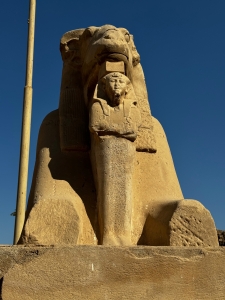
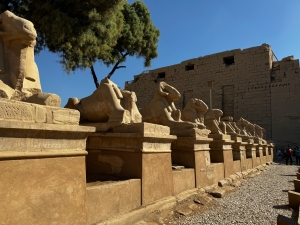
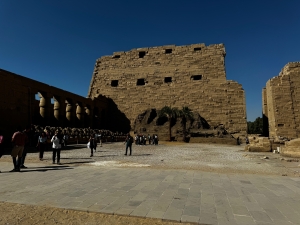
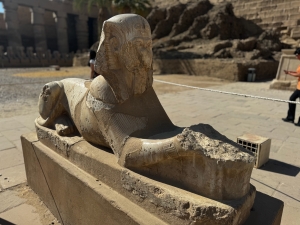
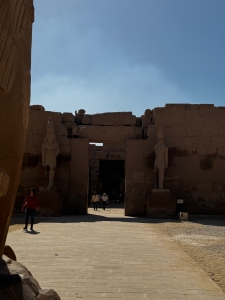
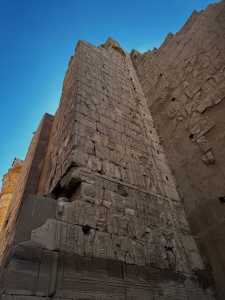
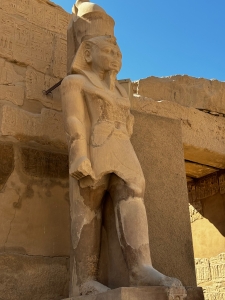
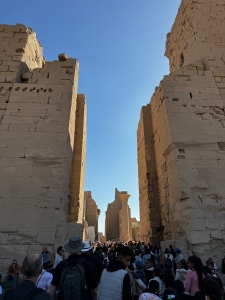
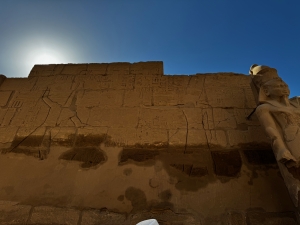
Karnak Temple was dedicated to the Egyptian God Amun, who brought the sun, light and creation to the world. Amun was also revered as the chief protector of the pharaohs of Egypt. The temple was built over the rein of several Egyptian kings, each adding to the size of the temple to what we see today. We crossed a bridge filled with Sphinxes lined up on both sides like guards welcoming the king. Each Sphinx was immaculately created, leaving no details behind. Despite some being defaced, we can still feel the solemnness exuding from these Sphinxes. We passed a couple of high walls, the first pylons to the temple, and arrived at the courtyard of the Karnak Temple. Ahmed pointed to the holes on the pylon surface and explained these were the windows to the chambers of the guards and people who served the temple. In its unfinished state, the pylon already looks as though it is soaring into the sky; I can’t imagine how tall this pylon will be when completed. Our attention was then shifted to the Sphinx statues lined up at the sides of the courtyard. Unlike those we saw in Giza, these Sphinxes (and those on the bridge we crossed) have a ram head instead of a human head. The ram-headed Sphinxes told visitors the temple is dedicated to the God Amun. Our attention shifted to the statue standing tall next to the inner pylon. This is a statue of Rameses II, with his wife depicted as a small statue standing before him. Ahmed explained that the king’s stature stood tall at the temple entrances but would gradually get smaller as we approached the temple’s Sanctuary. This is to signify the presence of the gods humbles the Pharaohs.
Hypostyle Hall
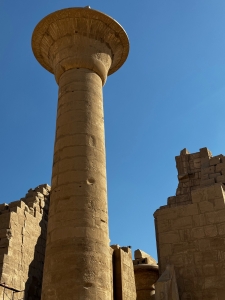
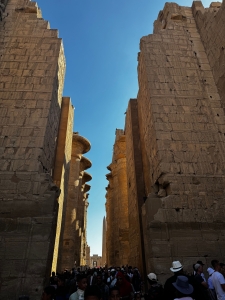
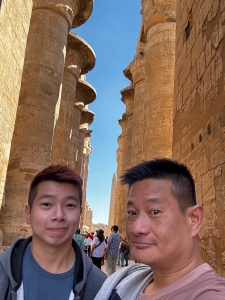
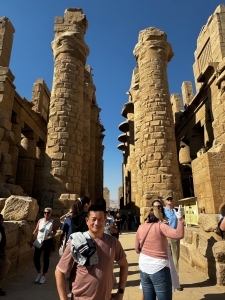
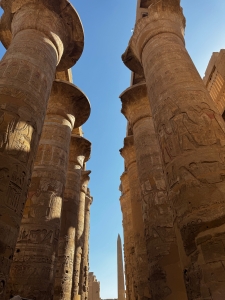
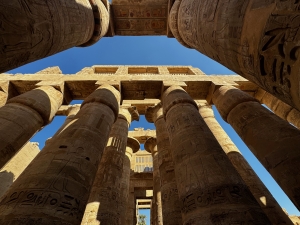
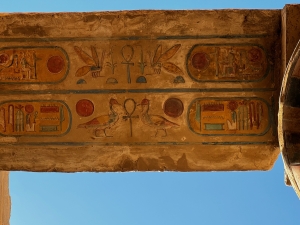
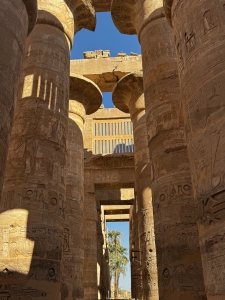
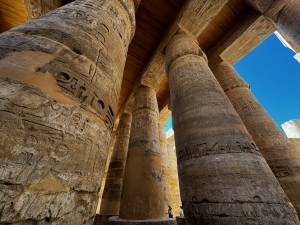
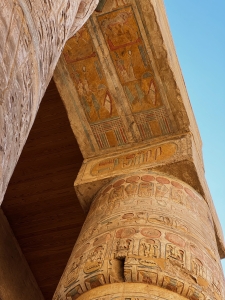
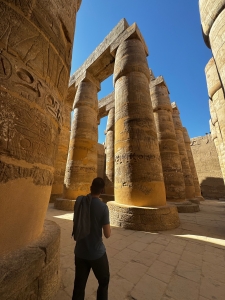
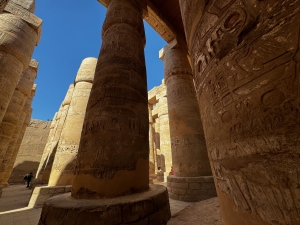
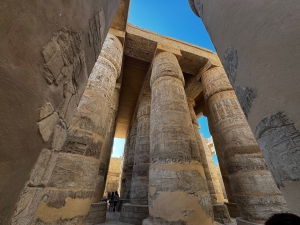
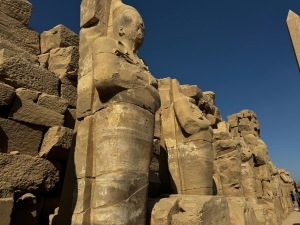
Passing through the second pylon, we arrived at the hypostyle hall, essentially a hall of pillars which would have supported the temple’s roof in its heyday. Unlike the one we saw at the Step Pyramids in Saqqara, the hypostyle hall here in Karnak Temple was on a much larger scale. Ahmed guided our sight to the top of the columns and explained that the colours we saw were original since the temple was built. We could see the vibrant colours adorning the top part of the pillars that survived the millenias as though they were painted yesterday. Each pillar has intricate carvings depicting scenes of religious ceremonies and rituals performed by the pharaohs, priests and gods. Ahmed shifted our attention to the grill-like stone structure at the top of these pillars and explained these grills were not randomly placed there but were designed by the builders to allow sunlight in to illuminate the hypostyle hall. I can imagine how dark it would be when this hall was covered with its thick stone roofs, these grills would provide sufficient illumination to the hall.
Obelisk of Hatshepsut
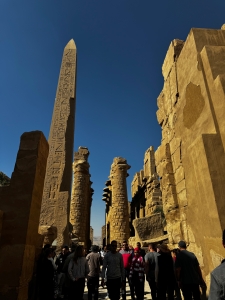
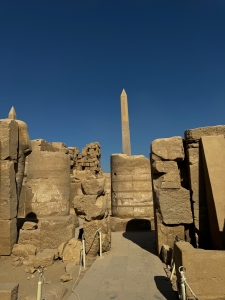
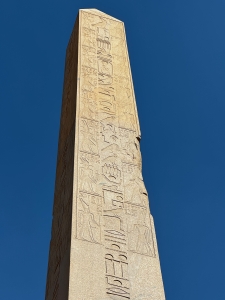
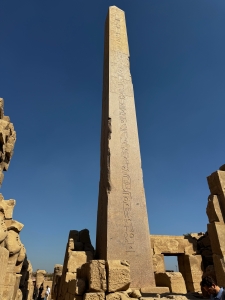
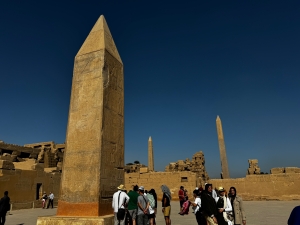
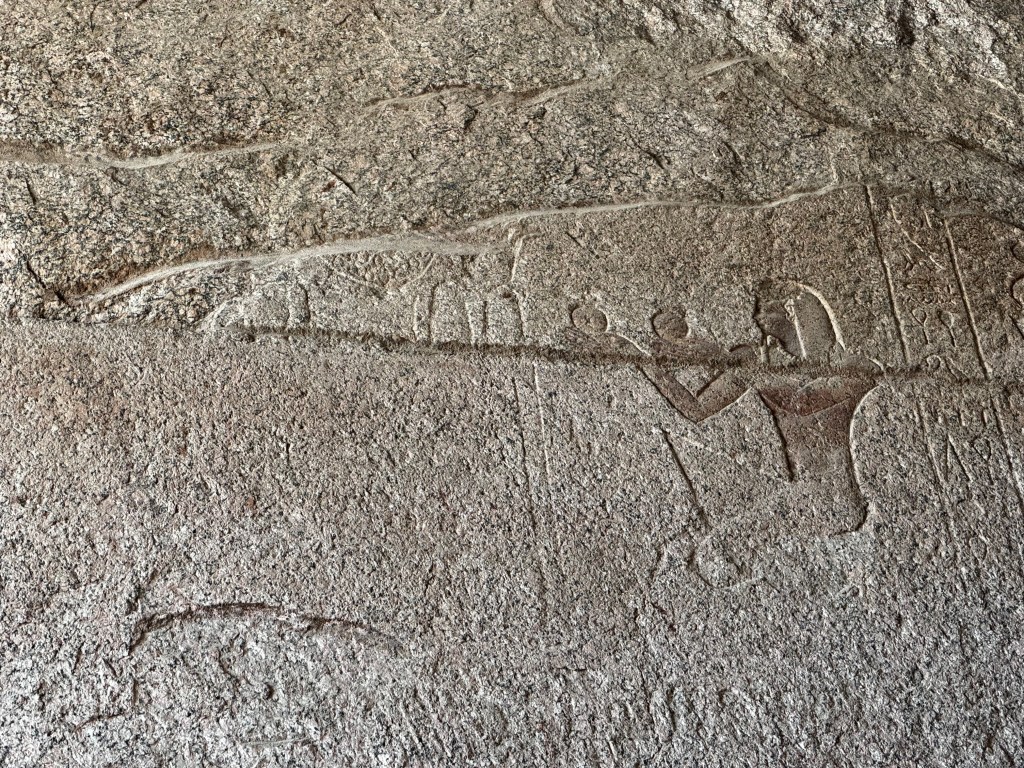
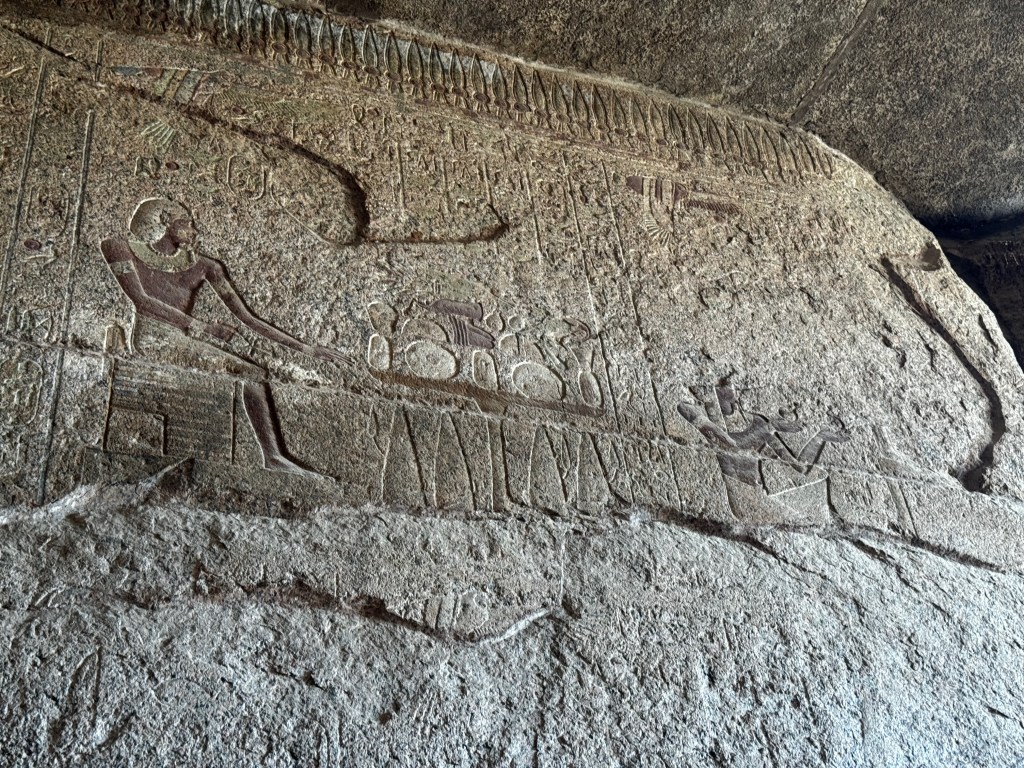
We were guided through the massive columned hypostyle hall to an open area with several Obelisks. There are a total of about 20 obelisks being erected in Karnak Temple, but only three remain standing today. Ahmed pointed to one particular obelisk and told us this was erected by Queen Hatshepsut, pointing out the hieroglyphs inscribed on the stone structure. This is the tallest standing obelisk in the entire temple, which has stood the test of time, standing unwavering to the elements for more than 3,700 years. Hatshepsut erected two obelisks; one fell and was displayed near the sacred lake.
Sanctuary
Passing Queen Hatshepsut’s obelisk, we were led into a small stone building – the Sanctuary, where the reining pharaohs worshipped Amun. Today, this small, dark room was empty. However, reliefs on the walls of the Sanctuary tell the tale of the pharaoh worshipping Amun. We were given about 30 mins to walk around, explore the rest of Karnak Temple, and take pictures.
Ramesses II performed rituals to Amun.Scenes in the Sanctuary depicting Ramesses II perform rituals to Amun
Sacred Lake
Our first stop is to head to the Sacred Lake. We were here for the cafe to get some drinks (not because we wanted to visit the lake). The Sacred Lake is a huge rectangular pool of water that seems man-made. This lake was significant as the priests would purify themselves daily before rituals. A large stone scarab sitting on a stone pillar was placed next to the Sacred Lake. Ahmed told us about the local urban legend that walking three times around the scarab will make one rich, five times bring one good luck, and seven times to bear children. I am sure there are other parts of Karnak Temple that we did not visit; however, those that Ahmed brought us through were the significant parts. We headed back to the hypostyle hall for more pictures before braving through the gauntlet of vendors at the exit to meet with the rest of the group.
Relaxing Cruise on the Nile
Karnak Temple was the only sight we saw today. Leaving Karnak Temple, we were driven to our riverboat through Luxor City and into a quiet neighbourhood by the Nile, where our riverboat docked. We were warmly welcomed by the staff member who passed us our keycard and brought us to our cabin. We took some time to orientate ourselves in our cabin and the sundeck on the boat before heading for lunch. Lunch was served in buffet style, with mainly Western options.
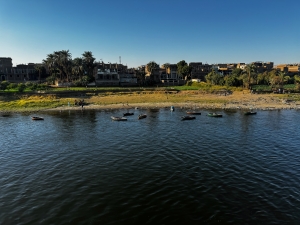
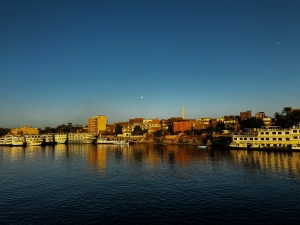
We headed back to the sundeck to enjoy the leisure cruise on the River Nile. The calm waters and gentle breeze blowing into our faces as we cruise the Nile made it feel relaxing. There was no hooking of cars, no noisy chatters; all we heard were the sounds of the wave gently hitting the boat. We saw how the locals use the Nile for their daily life as we were sailing: going about fishing on the Nile, playing on the banks of the Nile, and a few other riverboats cruising on the Nile. We were on the sundeck, soaking up the atmosphere and peacefulness on the Nile. We got ourselves a few finger food and coffee from the refreshment table the crew set up and continued enjoying the Nile’s tranquillity. The boat made a U-turn at a bridge and returned to where we came from. We watched the sunset over the west bank of the Nile on one of the sundeck chairs placed at the pool area of the deck and our day ended with a sumptuous welcome dinner.
It was the first official day of our trip today, and it was a heavy day full of site visits. So, this will be a long post. We met up with our tour director, Ahmed, an Egyptologist and the rest of the tour group. Ahmed told us that he made some changes to the schedule as it would make more sense to visit Memphis first to set the context and bring us through the historical timeline of ancient Egypt.
Memphis – The First Capital of Egypt
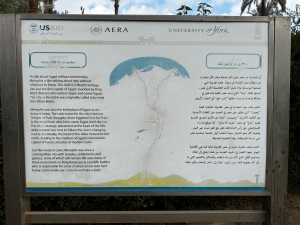
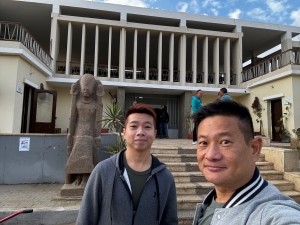
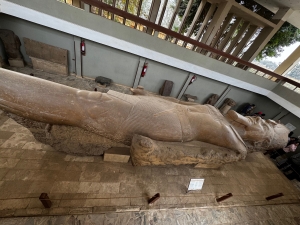
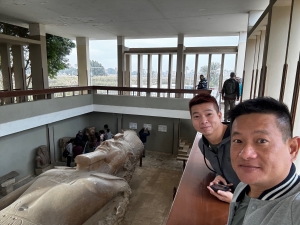
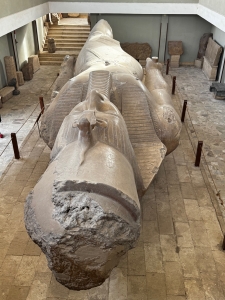
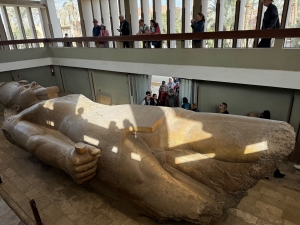
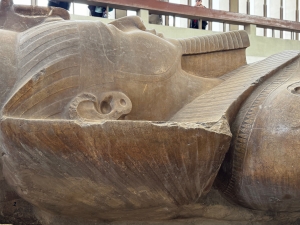
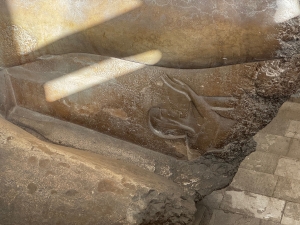
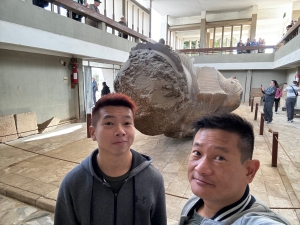
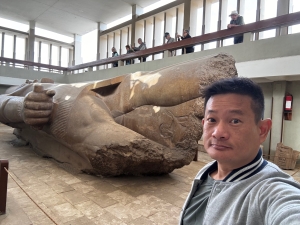
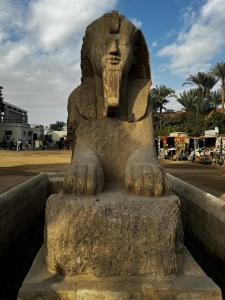
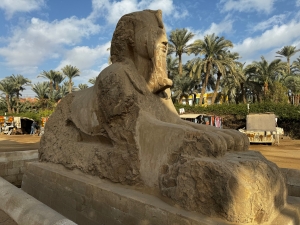
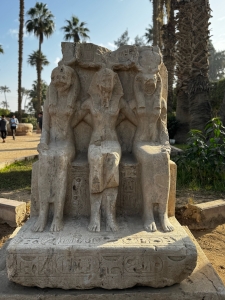
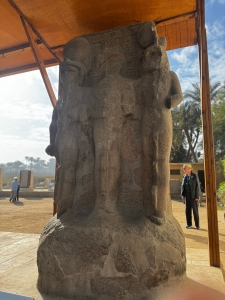
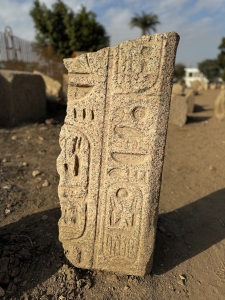
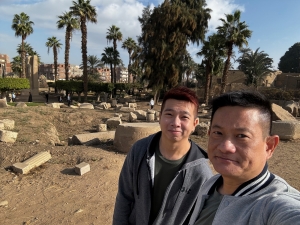
Memphis is essentially a relatively small plot of land with one single building. Memphis was the first capital of Egypt, where Ramesses the Great, aka Ramesses II, ruled Upper and Lower Egypt. This was once the capital of Egypt. Memphis was a metropolis with walls surrounding the city centre during its heyday. Today, we only saw farmlands and a plot of land surrounded by a single metal fencing. We were brought to the lone building, a stone’s throw from the main entrance. Ahmed explained Memphis was where the statue of Ramesses II was uncovered. This place used to be an open-air museum, with this colossal statue exposed to the elements. The building we were standing in was built later to protect the statue from the elements.
We were brought to the second floor of the building, where Ahmed brought our attention to the large statue with broken lower limbs and its weapons missing. This is the statue of Ramesses II. His facial features and some of the detailed engravings are still visible. The hilt of the weapon on the waist of Ramesses II was tilting to the right, meaning the king could only draw his weapon with his left hand. This is significant because Ramesses II was a benevolent ruler who would only resort to force as a last option. Ahmed narrated the significance of the false beard on his chin, which was braided with the hairs of his forefathers to signify wisdom. The straight beard on the chin of Ramesses II also meant this statue was made when the ruler was alive. We were also told to look out for the engravings of Nefertari, Ramesses II’s queen, on the inner thigh. Before giving us free time to wander in the rest of the museum, Ahmed reminded us about the world’s second-largest Sphinx displayed in the courtyard.
When we saw the Sphinx, we disbelieved that it was the world’s second-largest Sphinx, after the Sphinx at the Great Pyramids. From the looks of it, it did not strike us as large. The facial features on the Sphinx are still very clear, and the body is still intact, as though it was being produced yesterday. The rest of the courtyard was dotted with ruins and some whole statues, as though the Egyptologists were still trying to figure out which part of the puzzle these fit into. I thought the Ramesses II statue and the Sphinx were the two items worth looking at in Memphis. However, without a guide, it would be difficult for anyone to understand the significance of these statues.
A Short Stop at the Carpet School
Our next destination after Memphis was the carpet school, where we were shown the different techniques used to weave a carpet. A student will spend three years on average on the most basic carpet technique before moving to more complex techniques. This carpet school also provided a skill set for the locals to gain employment. I was impressed by the speed and the time it took to weave just a simple design, let alone a more complex, dual-sided carpet. We were given a chance to purchase some carpets after the brief.
Pyramid of Teti – The Most Well-Preserved Tomb of a King
We were driven back to the deserts after a 30-minute stop at the Carpet School. Ahmed told us he would bring us to a bonus spot to see the interior of a pyramid. I liked how Ahmed was straightforward in telling us not to waste money to enter the crypts of the Great Pyramid as the tombs were not as well preserved, and there were no inscriptions on the walls. This tomb he will bring us still has the inscriptions and did not incur additional charges. As we drove up a plateau, we could see the distinction in vegetation in the surroundings. Below us was filled with lush greeneries, while the plateau we were on was desert with no signs of life. Ahmed indicated the spot we were in was the start of the Great Sahara Desert that stretches across the African Continent to the Atlantic Ocean. We saw the step pyramids and some piles of rocks as we were driving towards the carpark. According to Ahmed, the pile of rocks we saw were all pyramids but were blasted by an English explorer in search of the pharaoh’s treasures. It is a shame that these tombs were destroyed for one man’s greed.
There is only one path from the carpark to the pyramid’s entrance. Despite being destroyed by explosives, we could still make out the general shape of the pyramid from the pile of rocks that sat above its entrance. A small door with a ramp leads to the interior of the pyramid with a gentle recline, but transversing the dark ramp, which was only illuminated by the light from the entrance and some lights in the chamber below, would require one to do a 90° bend. Definitely not for those with claustrophobia. A small room with lots of headroom awaits us at the end of the tunnel. This room has no inscriptions on the walls, making it difficult for anyone to determine who owns the tomb.
There are two small doors on either side of the room. It was amazing how the pyramid builders filled these two small corridors with hieroglyphic inscriptions. We were led through one of the small doors to the main chamber, where a sarcophagus sits at the end of the room. This would be where King Teti’s coffin was discovered. The roof of this chamber was engraved with stars as though allowing the late king to look into the night sky, and the walls were filled with hieroglyphs. The amount of hieroglyphs was massive, each detailing the life events of the late king. The exterior of the sarcophagus was simple; the staff at the tomb pointed out the hieroglyphs inside the sarcophagus, which had the name of the king engraved in hieroglyphs. We were led into the other door from the main chamber, which would store all the offerings for the king. This is a much simpler room with no hieroglyphs engraved into the walls. It is an amazing experience to have been able to enter a pyramid and see the well-preserved burial chambers of an Egyptian king.
The Step Pyramid of Saqqara – Predecessor of the Great Pyramids
The Step Pyramid of King Djoser
Our next stop is the Step Pyramid of King Djoser, a 5-minute drive from the Pyramid of King Teti. Before entering the complex that leads to the Step Pyramid of Saqqara, Ahmed led us to the complex’s exterior. He explained the wisdom of the ancient Egyptians and their smart engineering principles when building the pyramids and the buildings. All these buildings were built at about 80° inwards, so when an earthquake hits, these buildings stay intact as the force of the stone blocks acts against each other to prevent collapse. Ahmed led us into the complex building through a corridor with columns with a brick wall extending to the back wall, forming 24 individual semi-open spaces. Ahmed explained that these semi-open spaces were chambers used to install statues of the gods worshipped in each state of Egypt. During its heydays, this corridor will be filled with statues of gods.
At the end of the corridor, we came to a huge open space, where the Step Pyramid of King Djoser sits at the back of the courtyard. This 4,700-year-old Step Pyramid is the oldest pyramid built by the ancient Egyptians, whose chief architect was Imhotep. Ahmed explained that traditionally, the pyramids were built in time for the death of kings, and the original Step Pyramid was smaller in size. However, when the Step Pyramid was completed, King Djoser was still healthy. Imhotep was an ambitious architect who wanted to challenge himself by building a larger pyramid. Instead of tearing down and rebuilding, Imhotep added to the pyramid’s dimensions from the base up, retained the 80° inward incline of the stone blocks, and made it in time to prepare for King Djoser’s demise. This Step Pyramid would subsequently be the basis for constructing the Great Pyramids of Giza. Looking at the six-layered Step Pyramids from the courtyard, I was truly impressed with the engineering feat achieved 4,700 years ago. Each stone block did not look that large from afar. But as we walked up to the pyramid, we were in awe of the sheer size of each block. Up close, the pyramid looks like a pile of rocks stacking on top of each other, but from afar, each stone block was stacked with a purpose and precision to form this megastructure of the ancient world. There was a ramp leading into the pyramid; I am not sure if we were required to pay additional to enter the pyramid. Also, in the interest of time, we explored the courtyard instead.
Panoramic shot of the Step Pyramid
As we walked up a slope, we could see the Great Pyramids of Giza and numerous destroyed pyramids sitting in a distance. Miles and miles of sand stretch as far as our eye can see, seemingly with no end. We also spotted the Bent Pyramids sitting far into the desert. This Bent Pyramid was thought to be a transition from the Step Pyramids to the smooth-sided pyramids, such as those of King Khufu (aka the Great Pyramid in Giza). We spotted some building ruins at the side of the courtyard at Saqqara. What was interesting was a deep trench with a staircase leading deep into the earth. This could be where the ancient Egyptians entered the tomb to serve King Djoser after his death. After visiting the Step Pyramid of Kind Djoser, we head for a delicious Egyptian lunch before heading for the highlight of the entire trip – The Great Pyramids of Giza.
The Great Pyramids – The Wonder of the Ancient World
The pyramid of Khufu, the largest pyramid in the world, stood for 4,500 years.
We were driven to the main entrance to the Great Pyramids of Giza (the one near our hotel). As with all monuments in Egypt, we would need to send our bags through X-ray machines and pass through metal detectors. As we were driving to the carpark, Ahmed told us that the 4,500-year-old Pyramid of Khufu, the world’s largest pyramid, soared 146m into the sky, with the next two pyramids being built smaller than the one before. This was done to respect their predecessor and their achievements for the country. The magnificent Pyramids of Khufu and Khafre were the skyscrapers of the ancient world. No wonder it clinched the title of one of the seven wonders of the ancient world til today. Ahmed guided our attention to the tip of the Pyramid of Khafre, where the top part was still covered in smooth stone, and this would be how the pyramids would look when they were completed. Due to erosion, we were left with the interior stone exposed to the world. We were also advised on how to deal with the touts around the pyramid grounds. Before long, we arrived at the carpark, where we were given some free time to wander around the Great Pyramids. The carpark wedges between the two larger pyramids, the Pyramid of Khufu (the largest) and the Pyramid of Khafre. We had spent some time sitting on a bench, drinking the tea our driver offered us, taking in the majestic sight these two pyramids offered. The feeling was so surreal that we couldn’t believe we were actually at ground zero, looking at these magnificent giants that have intrigued the world for centuries.
We were given 30 minutes to take pictures and explore the grounds of the two pyramids. We got going after drinking the tea. Our first stop was the Great Pyramid of Khufu. It is one thing to see the pyramid from a distance; it is another to get close to it. Each stone is as tall as a grown man, and from the base of the pyramid, looking up to the top, there were countless of these stones. We can’t help but wonder how the ancient Egyptians did it. How were they able to build something like it at the edge of the desert with no modern equipment, which has stood for nearly five millennia? We went up close to touch some of the stones at the base of the Pyramid of Khufu, marvelling at the extraordinary feat achieved by the ancient Egyptians. Along the way, we were approached by the touts asking if we wanted a camel ride or taking some photos with the camels. No wonder this area was titled the Tout Central of Egypt. As we were taking some photos, we were approached by one of these touts offering to show us a place to take some photos. As we were minding our business, the tout suddenly turned and asked for money, stating that we were taking photos at the spot he recommended. He hustled us for 10 minutes, and I told my friend to walk on and ignore him. I assertively told him no when he grabbed my friend by his arm and pulled him to walk next to me, with me sandwiched between the tout and my friend. This is when the tout gave up and went hunting for the next target. Most touts are not as aggressive here, and they would leave us alone when we politely told them no. Having shaken off the tour, we went around to take pictures of the Pyramid of Khufu. Ahmed told us the best spot to take pictures is the corners of the pyramids. We were glad that we followed his advice. We could capture the pyramid shape and majesty of the structure at its corners.
Walking one round by the parameters of the Pyramid of Khufu, dealing with the aggressive tout and taking pictures already took us 20 minutes. We were only left with minutes to take pictures of the Pyramid of Khafre (the one with the smooth top). We did not have sufficient time to go next to this pyramid, but we got close enough to see the smooth surface that still occupied the top of the pyramid, like the snow on a mountain. Despite not being the largest pyramid, the Pyramid of Khafre was still impressive. We went near enough to take pictures with the pyramid before returning to the bus. We were driven to a spot where we could take good shots of the three pyramids together. Standing beside the Pyramids of Khufu and Khafre, the last pyramid, the Pyramid of Menkaure, seem like a child. We were offered 5 mins of photo time, sufficient for us to take our pictures with the three pyramids in one shot.
The Sphinx – Guardian of the Great Pyramids
The Sphinx at the Great Pyramids of Giza
Our final stop of the day is the Sphinx, sitting in front of the Pyramids as though it was their guardian over the thousands of years. As we were driving towards the Sphinx, Ahmed told us to get our cameras ready as this was the only chance we could take pictures of the Sphinx in front of the Pyramid if we timed it correctly. We were given time to wander inside a complex and get next to the Sphinx. The complex was very plain and seemingly had nothing going on. We squeezed past a door, and there she was, the giant Sphinx guarding the pyramids. Despite not being as large as the pyramids, the structure was still impressive. We can only view it from a distance as some archaeological works are still ongoing at the Sphinx. The crowd at the Sphinx was massive, yet we managed to grab some great spots taking pictures of this giant structure. We could see an entrance leading into the Sphinx from where we stood. Soon, it was time for us to return to the bus. The number of tourists at the site and the small space allocated for visitors to see the Sphinx did not warrant too much time to be allocated here. We headed back to the hotel and spent the night dining at the restaurant in our hotel for the Christmas buffet dinner that the tour company had arranged, getting to know our group members better. We retired early to our respective rooms as we had an early flight to Luxor tomorrow.
We ended the day with a great night view of the Great Pyramids from the balcony of our room.
Originally, we wanted to visit Egypt in 2020, but this was when the pandemic hit the world. As we watched borders all over the world shut down, our hopes were smashed as we saw the world coming to a halt to deal with the pandemic. “One day, we shall pick up where we left off and embark on our trip to Egypt,” we thought. Three years later, we picked up where we left off and were eager to finally embark on our journey to one of the world’s oldest civilisations. Usually, I am not a fan of package tours due to their lack of flexibility. However, Egypt is a huge country with many stories to learn, and it can be challenging to navigate independently. Throughout this trip, we learned that some sites are far apart, which would be inefficient unless we drive or hire a driver for the whole day. Moreover, our experience in Pompeii last year taught us that it can be overwhelming without someone to narrate and guide us where to look, especially in Egypt, where every site has so much going on. Hence, we decided to take a package tour to this land of rich ancient civilisation.
Arrival at Cairo
The day finally came for our long-anticipated trip to Egypt. There are no direct flights to Cairo from Singapore, so we had to make a transit somewhere. We spent the whole of 22 Dec 23, travelling across three continents, from Asia to Europe and finally to Africa. Some 20-odd hours later, we finally landed in Cairo, the gateway to the world’s greatest and earliest civilisation. We arrived at Cairo International Airport around 5 am; immigration clearance was surprisingly fast and fuss-free. We were guided to a room for express clearance, and the immigration officer just stamped our passports without checking if we had visas or any other documents. We were through immigration within 5 minutes. We met with our travel concierge, who was already waiting at the baggage claim area. He guided us to the carousel where our luggage would be delivered.
After picking up our luggage, we whizzed through Cairo to our hotel, where we called home for the next two nights. Along the way, our travel concierge pointed our attention to some important landmarks in Cairo. My first impression of driving through the streets of Cairo was that this country seemed like a mess. We saw stones lying just by the roadside and what seemed to be construction or excavation. There are some nice buildings with completed facades and large balconies. However, many other buildings are either missing a wall or being torn down. We learned from our tour director (later) that the entire city of Cairo is in the midst of restructuring, and the buildings without walls were illegally built.
Leisure Day at Cairo
Soon, we saw the great pyramids of Giza and arrived at our hotel. As today is arrival day for the rest of the tour group members, the tour company left it empty for the group to arrive. For those who arrive early, we could catch some rest or explore Cairo on their own. The long hours of travel took a toll on our bodies, but the weariness wore off the moment we saw the Great Pyramids from the balcony of our room. We spent the next 1 hour wandering around the hotel grounds and its beautiful gardens, taking pictures of the pyramids before fatigue set in, admiring the incredible feat of engineering the ancient Egyptians created. It is one thing to see the Great Pyramids on the internet and in books, but seeing it with our own eyes feels surreal. We wandered outside the safety walls of the hotel grounds to get some drinks and food as we felt peckish. There were some shops directly opposite the main entrance of the hotel. As the stuffs were not priced, we were cautious about buying from these shops. We ventured into the gas station just behind the hotel to get our supplies of drinks and snacks before returning to the hotel for a nap.
We caught a few hours of rest. We woke up refreshed and ready to explore Cairo a little as we refused to be “imprisoned” within the boundaries of the hotel site. I had wanted to visit the old Cairo district, but the journey from the hotel seemed a tad too far. We checked with the concierge at the hotel to see if there were any malls nearby. The staff at the concierge recommended the Mall of Egypt, where we ended up for dinner and an evening stroll. We hailed an Uber and were brought to the Mall of Egypt in 30 minutes. The mall was large and well stocked with shops of all kinds, international and luxury brands. There was even a hypermarket, Carrefour, at the Mall of Egypt. We also spotted a cinema and an indoor snow park within the mall. There is no lack of restaurants and cafes where the locals enjoy a leisurely afternoon tea time. A large food court is selling more affordable food from all over the world. The Mall of Egypt is your standard run-of-the-mill shopping mall with similar DNA to any shopping mall worldwide. After dinner, we strolled in the mall, checking out what boutiques were operating there. We headed back to the hotel to rest for the night after dinner; after all, we would have an early start the following day.
Enjoying the view of the Great Pyramids of Giza from the balcony of our hotel room