At the Airport
Check-in
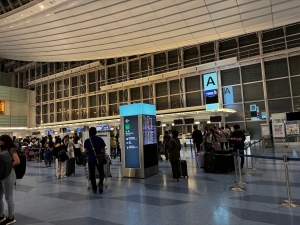
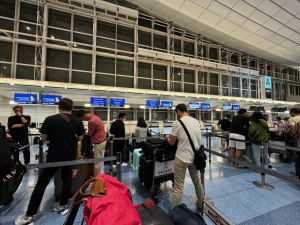
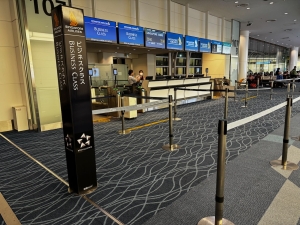
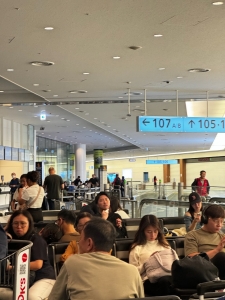
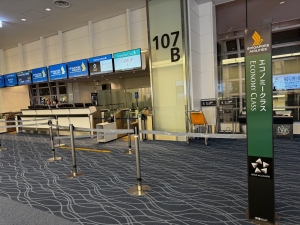
Singapore Airlines departs from Terminal 3 at Tokyo Haneda Airport. Singapore Airlines operates 10 check-in counters, four dedicated to Business Class passengers from Row A, tucked to the rightmost side of the terminal. There are three queues at the check-in counters, one for Business Class and Economy Class and another for passengers who had performed check-in using the self-check-in kiosks. As we were at the counter before they opened, a relatively long queue had already formed at our arrival. Due to the flight being full and everyone at the airport early, it took us about 25 mins to complete our check-in. Our check-in took a little longer than usual due to issues with our seat assignment, but the friendly ground staff managed to help us resolve these issues and processed our check-in within 10 minutes. The friendly ground staff gave us directions to the ANA lounge’s location and reminded us that we could use the Fast Track lane for immigration clearance.




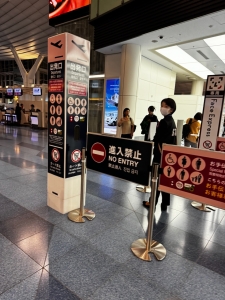

Boarding at Haneda was well organised, with well-marked queues for Business and Economy Class passengers. Singapore Airlines boarded passengers with young children before opening boarding to Business Class and status passengers.


ANA Lounge
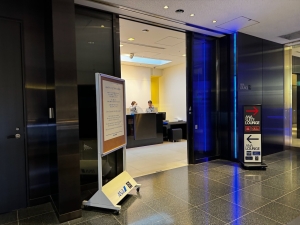
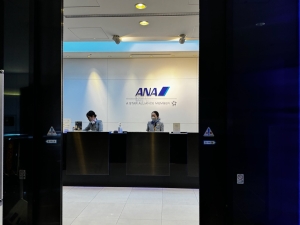
Singapore Airlines does not operate its lounge in Haneda Airport, passengers flying in Business Class out of Haneda Airport were entitled to use the ANA Lounge on Level 4 of the terminal. The entrance to the ANA Lounge at the airport terminal is opposite Gate 110, about a 2-minute walk from the immigration clearance. There are well-marked signs pointing us to the lounge. We were warmly greeted by the two ground staff at the entrance and welcomed to the lounge after they scanned our boarding passes. ANA Lounge at Haneda Airport is a huge lounge with distinct dining and lounging areas.



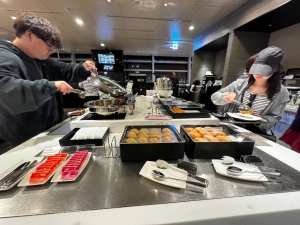
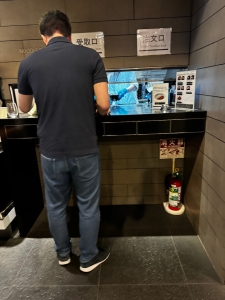
The dining area in the ANA Lounge extends from the buffet area to the centre of the lounge, occupying most of the real estate in the centre. The dining area is fitted with bar-type seating, mainly facing the tarmac, and tables that seat two pax in each table that occupy the centre of the lounge. Despite the lounge being crowded during our visit, we had no issues looking for an empty table. ANA Lounge serves food buffet style, with the exception of made-to-order ramen. The buffet and beverage stations are located on the left of the lounge from its entrance. ANA Lounge mainly serves Japanese food, mainly different types of sushi, onigiri, and Japanese curry rice. I found the food in the ANA Lounge to be delicious, especially the curry rice. There is a good range of beverages in ANA Lounge, and I find the automatic beer dispensing machines interesting.
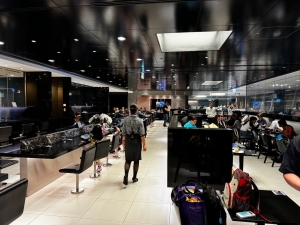
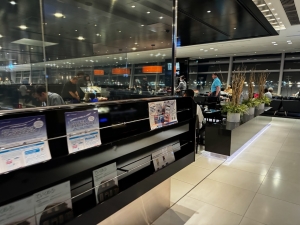
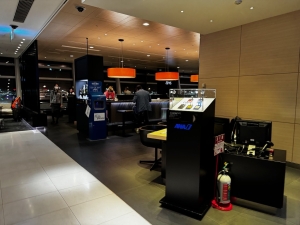
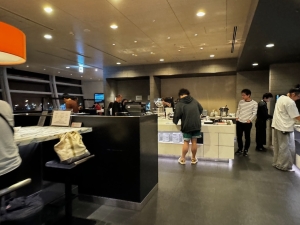



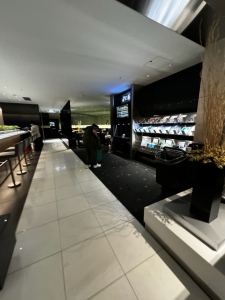
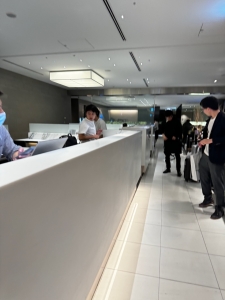
The lounging area in ANA Lounge is mainly arranged next to the floor-to-ceiling window facing the tarmac. The lounging areas are distinct from the dining area in terms of the type and colour of flooring used. While the dining area uses white tiles, the lounging area uses black carpet that exudes a sense of relaxation and elegance. Matched with black coloured leather seat armchairs, the seating in the lounging area by the window is arranged in rows of four facing each other. I spotted several open rooms dedicated to lounging, decked with leather armchairs and earthy wooden decor that aids in relaxing for the passengers. The area furthest from the entrance to the lounge and at the other end of the dining area is dedicated to passengers’ work. Unlike the lounging area, which predominately uses earthy tones and warm lighting, the work area is decked in white colour and uses white lighting to promote productivity.



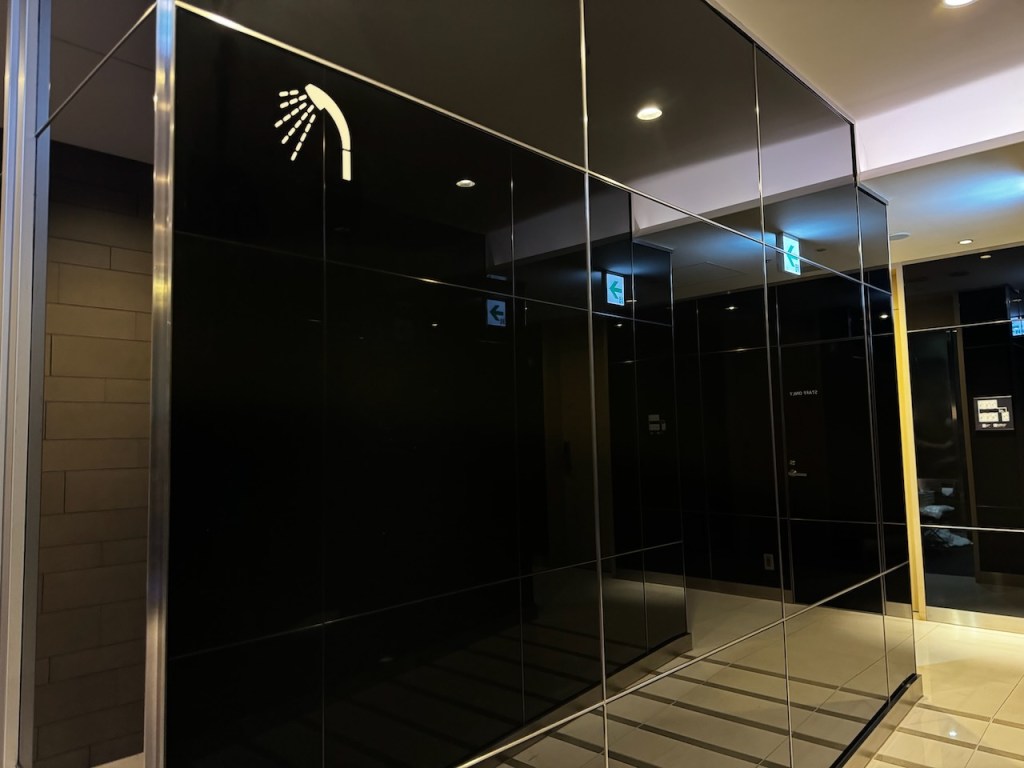
ANA Lounge is equipped with showering facilities. We had to book using the kiosk next to the entrance, opposite the ANA Lounge reception, to use these facilities. Due to the lounge being crowded during our visit, the wait time for the showering facilities took more than 2 hours. We ended up not using the showering facilities as our boarding time was approaching.
The Aircraft
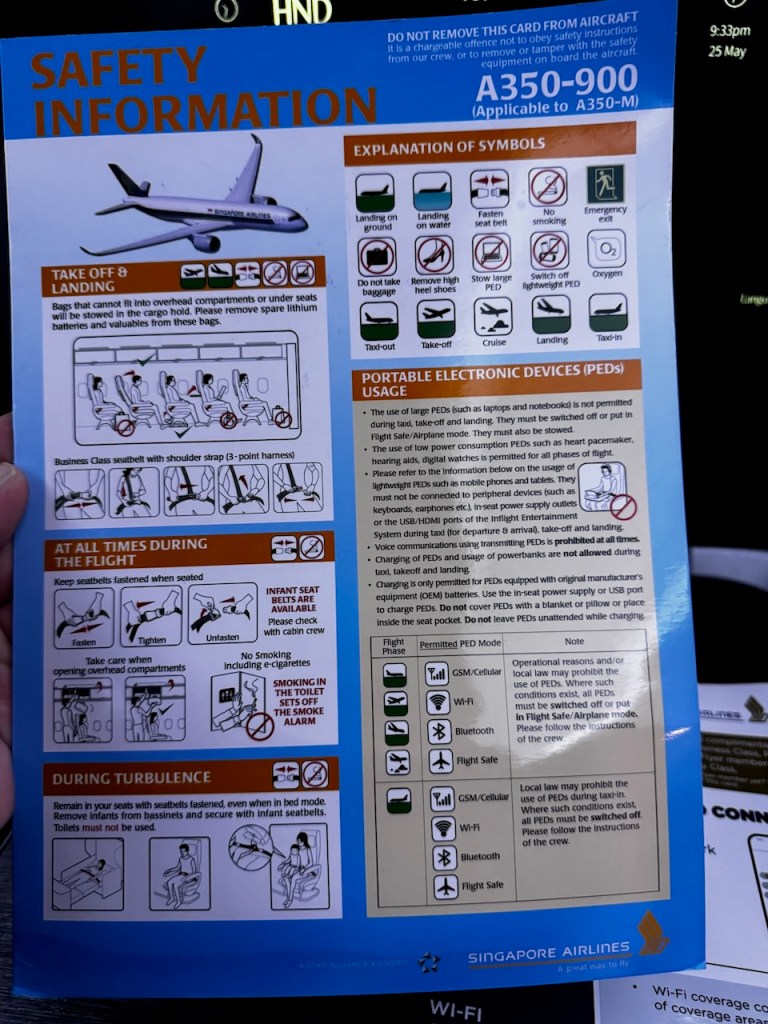
Singapore Airlines operates two types of aircraft from Haneda International Airport: the B777-300ER, configured with a long-haul Business Class product, and the A350-900, fitted with narrower medium-haul Business Class seats. For this flight, we flew on Singapore Airlines’ A350-900 medium-haul product.

The Cabin
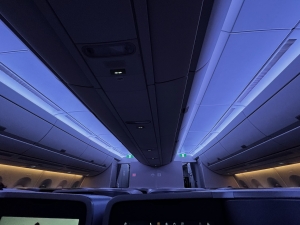
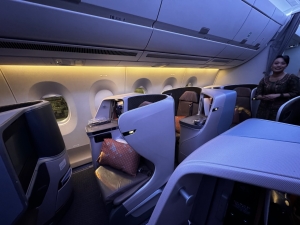
Singapore Airlines A350-900 Medium Haul variant adopts an earthy tone, apparent in the choice of colour in their seats and the carpet. These earthy tones, coupled with the lilac lighting used during boarding, aided the relaxation of passengers. The earthy tone in the Business Class seats predominantly uses different shades of brown in the leather, the padding on the seat, and the hard plastic part of the seat. Singapore Airlines A350-900 Medium Haul variant has 40 Business Class seats spread into two cabins. The large forward cabin houses 28 seats, while the smaller rear cabin has 12 seats. Seats in the Business Class cabins are arranged in a stagger 1-2-1 configuration.

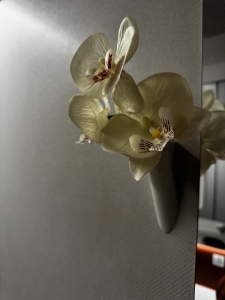
Three lavatories serve all 40 passengers in Business Class: one up front just behind the cockpit, while the other two are sandwiched between the two Business Class cabins. The earthy tone in the Business Class cabins also flowed into the lavatories. The use of brown leathered backsplash in the sink area, coupled with the dark brown wooden panelling used on the cabinetry of the sink area, gave it a luxurious vibe. Singapore Airlines Business Class lavatories onboard the A350-900 Medium Haul aircraft are very well stocked with amenities. Besides the luxurious British-branded Penhaligon’s amenities, such as facial mist and hand lotion, the lavatories are also packed with premium dental kits (different from those found in Economy Class lavatories), shavers and handkerchiefs.



The Seat
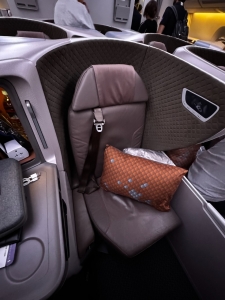
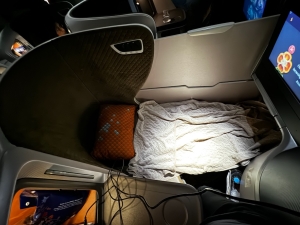
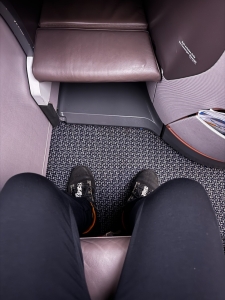
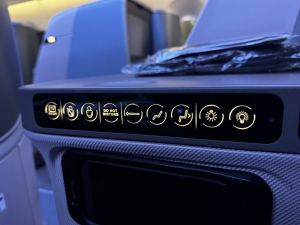
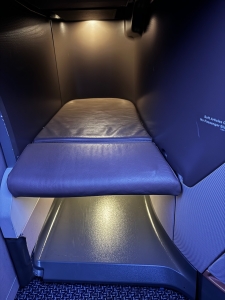
Compared to its Long Haul variant cousin, I found the Business Class seats onboard Singapore Airlines A350-900 Medium Haul a little narrow. Each of the 40 Business Class seats has a seat pitch of 60″ and measures 20″ wide (compared to the long haul variant’s 28″ width). However, the width of these seats can be expanded to 26″ when the armrests are lowered. These Business Class seats came in three modes: upright, lounge, and bed modes, which are controllable via the touchscreen seat control panel located inside the armrest on the aisle (or window) side. Besides controlling the seat modes, the seat control panel also allowed passengers to control the lighting and call for flight attendants. The upright mode is the standard mode, and the first mode that greets passengers during boarding is used during take-offs and landings. While the seat is comfortable due to its thick padding, I found the upright mode to be the most uncomfortable seating mode, mainly due to the positioning of the seat. I thought the lounge mode was the most comfortable of the three modes. Reclined at an angle, the lounge mode allowed me to relax in various sitting postures. The ability to adjust the angle of the recline and how close I wanted the seat to be from the leg rest in the seat enhances the comfort of this seating mode. The bed mode reclines the Singapore Airlines Business Class seat to 180°, converting to a truly flatbed with the touch of a button, great for passengers who want to catch our 40 winks in the sky. However, I find reclining the seat to its 180° flatbed a tad uncomfortable as my head is a little too low (it did not help to elevate even with the pillow that Singapore Airlines provided). I found that adjusting the angle of the headrest slightly upwards improves comfort in bed mode.

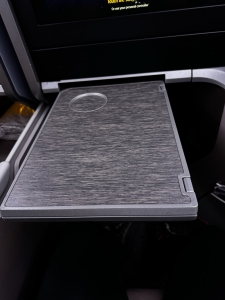
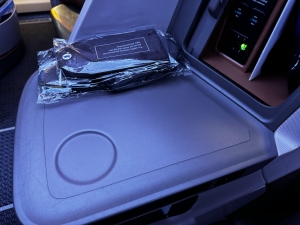
Singapore Airlines fitted its A350-900 Medium Haul variant with a large, sturdy table stowed under the personal TV screen in the seat. The table can be deployed effortlessly with a lift of a lever under the table. The table was folded in half when fished from its stowage position, which was great for passengers who only wanted a small area to place their snacks or drinks. When fully deployed, the table covers the entire seat width, perfect for passengers to work on their laptops. The only flaw in these tables is the lack of swivel function. Coupled with the narrow entrance to the seat (for those sitting by the window), the table would have to be kept in its stowage position for passengers to move in and out of their seats. Singapore Airlines designed a small tabletop with a console above the seat’s armrest. This small table functions as a cocktail table, where the cabin crew would place our drinks and serve as an alternate space for temporary storage. I found this side table very convenient and useful for me to leave my stuff on during cruising.

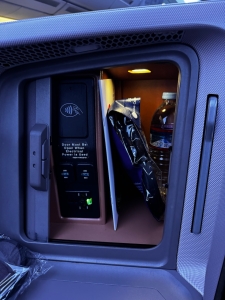
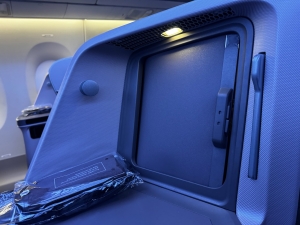
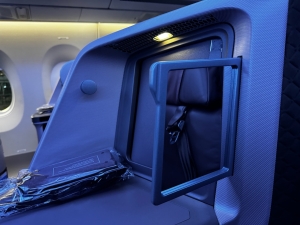
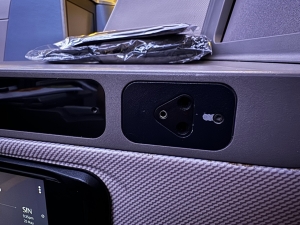
While the long-haul variant has ample storage space, the storage in the medium-haul Business Class version of Singapore Airlines A350-900 aircraft is a little lacking. Singapore Airlines fitted a small cabinet above the side table with a sliding door, which allowed passengers to stow items such as tables and passports even during take-offs and landings. The in-seat power outlet and USB-A charging port are also found in this cabinet, but only accessible when the cabinet door is opened (this design makes sense since we cannot charge our mobile devices during take-offs and landings). Besides the cabinet, I found the space under the footwell a great storage space for our carry-ons, although most people would place their shoes inside after changing into the provided slippers. The seat pocket can be used as an alternate space for storage. However, due to the position of the seat pocket, which is close to the floor and next to the aisle (at least for my seat), I find placing things here a little inconvenient to reach.



Inflight Entertainment
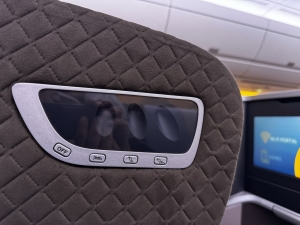
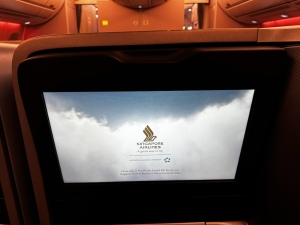
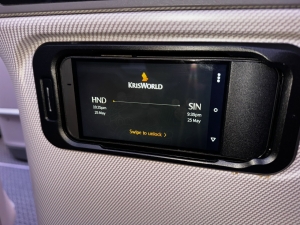
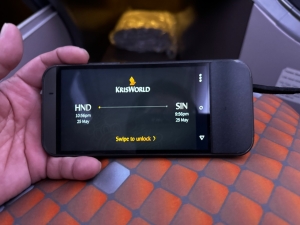
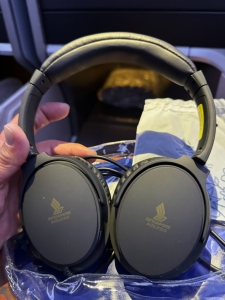
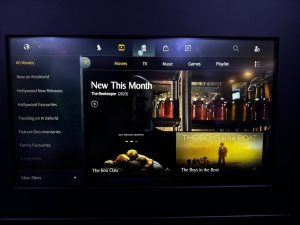
Singapore Airlines did not disappoint when it came to Inflight Entertainment. Each Business seat onboard their A350-900 Medium Haul variant is fitted with a large 18″ touchscreen HD TV. The picture quality was excellent, and the TV’s ability to tilt ensures that the picture quality stays sharp when passengers watch movies in any seat mode. The IFE can be controlled via the IFE controller or directly using the touchscreen function on the TV. The IFE controller is very intuitive to use, resembling a mobile phone. There aren’t any physical buttons on the IFE controller, controlling the TV functions is done via the touchscreen panel on the controller. Both the touchscreen functions on the TV and the IFE controller are very responsive. Singapore Airlines provides its Business Class passengers with good quality noise cancelling headphones, which are comfortable to wear for long periods. Passengers flying with Singapore Airlines are treated to a huge selection of entertainment from the KrisWorld. KrisWorld has a huge library of shows, from the latest blockbusters to classic movies on the movie selection page to TV episodes. There is even a game section stored in KrisWorld’s archives. Entertainment options are well catalogued in the various menus for easy access.



Meal
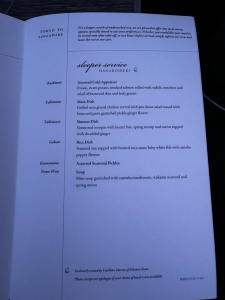
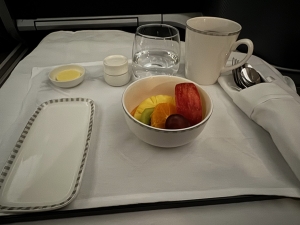
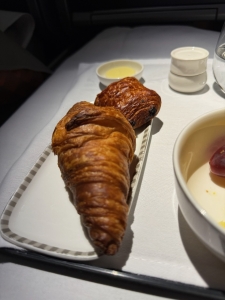
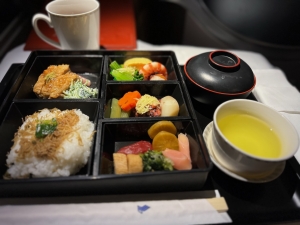
Singapore Airlines used to serve two meals pre-pandemic for its Sleeper Service flights, but things seem to have changed recently. I recall that I was served supper and breakfast on my 6-hour Sleeper Service flight from Singapore to Seoul. However, from my experience on the outbound and this flight, we were only served one meal to be taken either after take-off or before landing. I cannot confirm if we will be served another meal if requested from the cabin crew. Like the flights out of Singapore, Singapore Airlines also offers the “Book-the-Cook” service for all Business Class passengers flying out of Haneda Airport. As Haneda is not Singapore Airlines’ home port, the choices for “Book-the-Cook” for flights departing Haneda are smaller compared to flights departing from Singapore. I did not use this service for this flight and opted for the Japanese Option—Hanakoireki by Mr Yoshihiro Murata. I had heard that the airline served great Japanese meals for flights out of Japan. The meal was served in a typical Japanese bento box with all the options in front of the passengers. The soy-glazed chicken was tasty and not too dry, but the rest tasted mediocre. I also found the meal portion to be a little on the small side. My sister opted for the Tonkotsu Ramen from the “Book-the-Cook” menu for my nephew. She commented the broth tasted salty.



Service
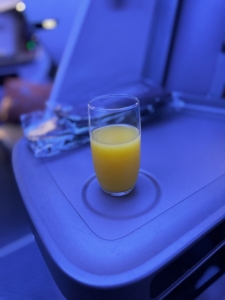
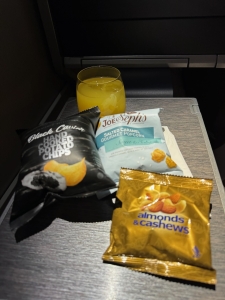
The service on this flight was great, and the cabin crew portrayed Singapore Airlines’ hospitality and efficiency. The cabin crew warmly welcomed us during boarding, and we were promptly shown to our seats by another cabin crew at boarding. As there were some seat swaps for my sister and her family, the cabin crew serving our aisle patiently went through the seat arrangements with me to ensure the meals were served to the correct person. As soon as we were seated, another cabin crew offered us welcome drinks. Throughout the flight, the cabin crew were seen patrolling the cabin and offering drinks and snacks to any waking passenger, despite being on a red-eye flight. During meal service, the cabin crew would gently wake passengers who opted for our meals to be served before landing and promptly set up the table and served the meals.


Afterthought
Singapore Airlines A350-900 Medium Haul Business Class is narrower compared to its long haul variant. Nonetheless, the seat was still comfortable, and I was able to get a few hours of sleep on this red-eye flight. The service onboard was great, and the crew was observant and diligent in patrolling the cabin in the middle of the night. KrisWorld has a huge library of entertainment options, well laid in an initiative menu, which made the flight time seem short. I had a great time on this flight with Singapore Airlines.