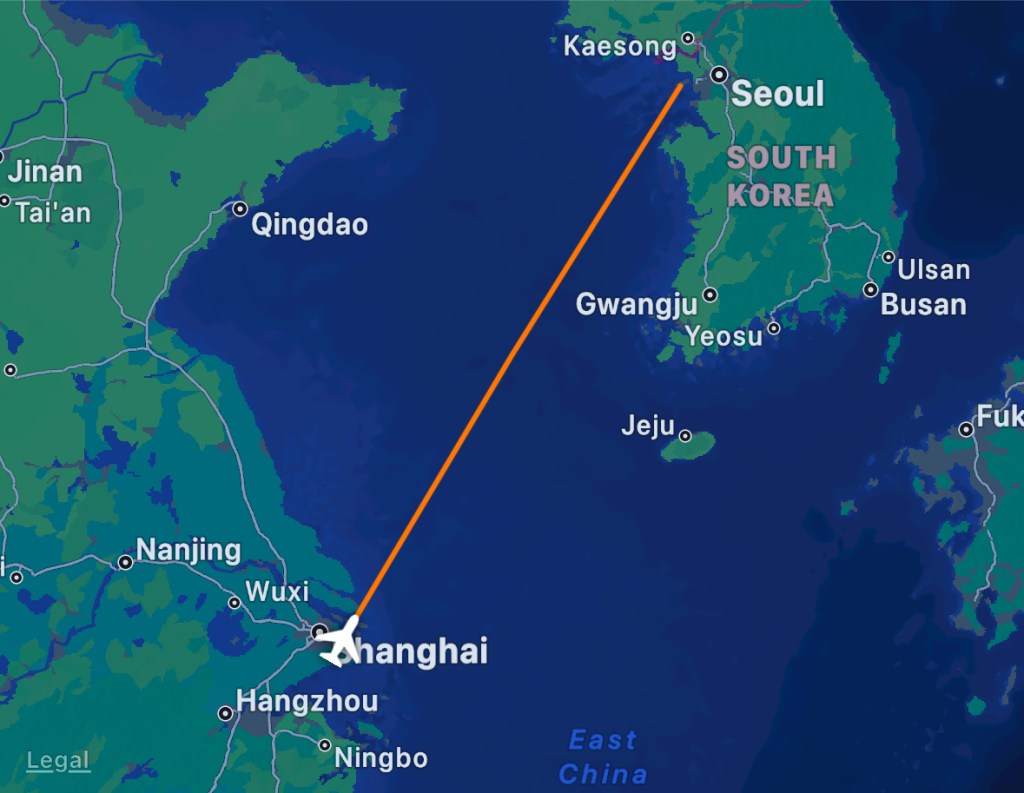
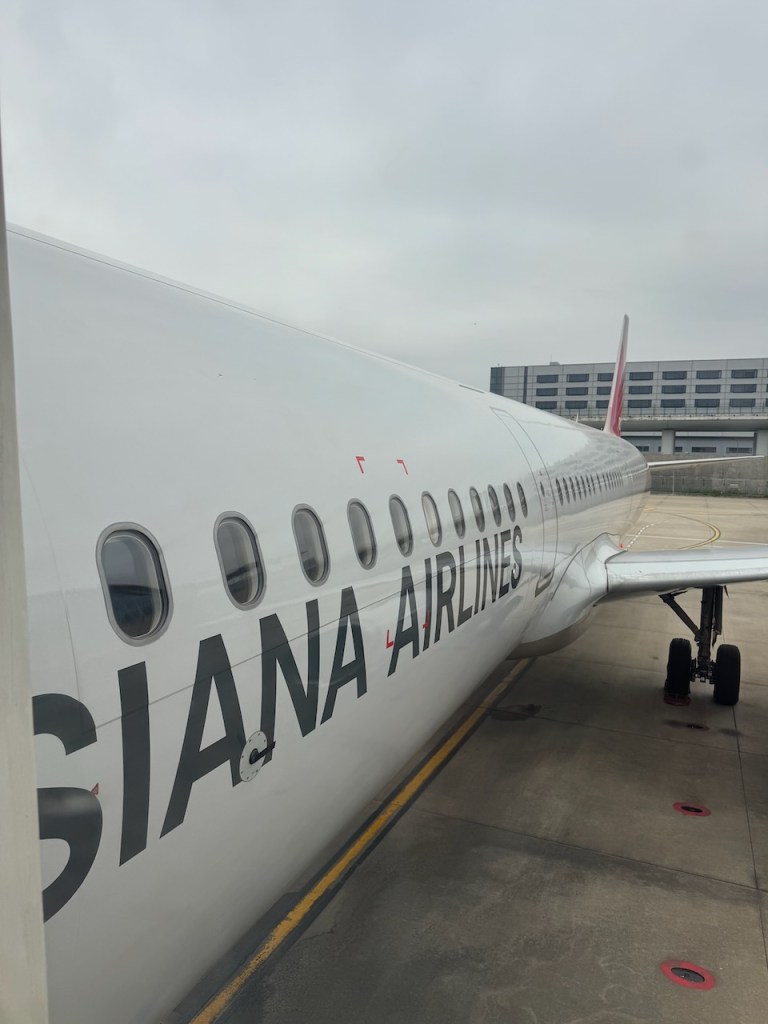
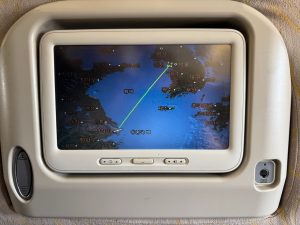
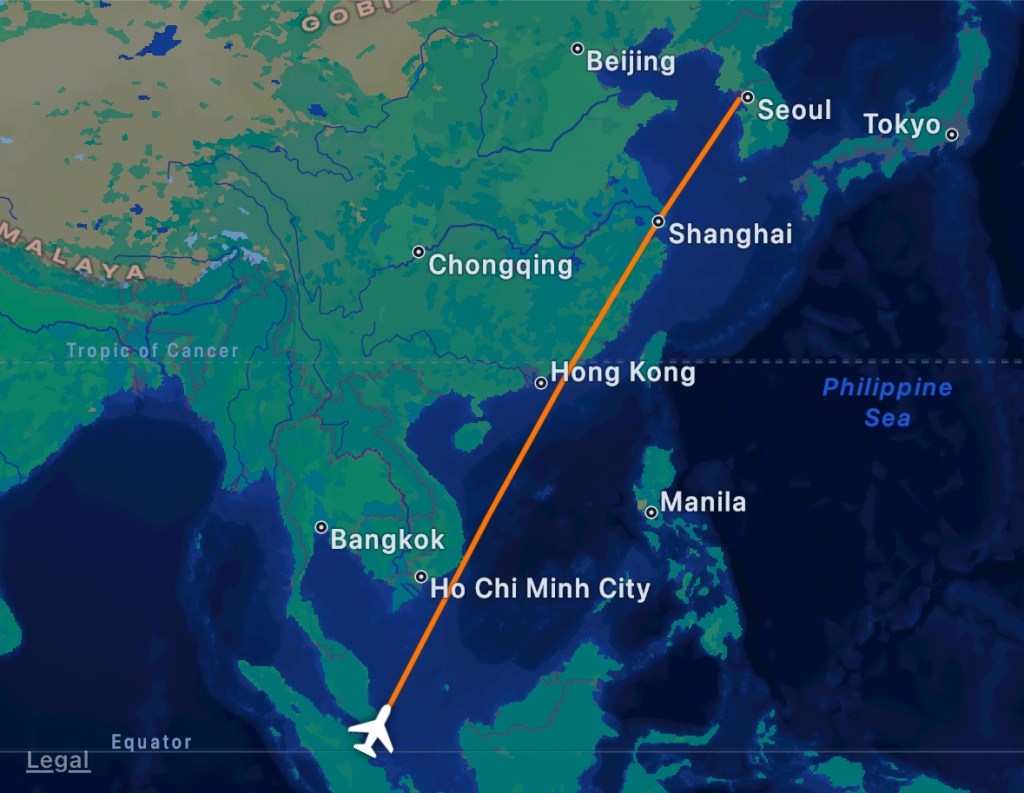
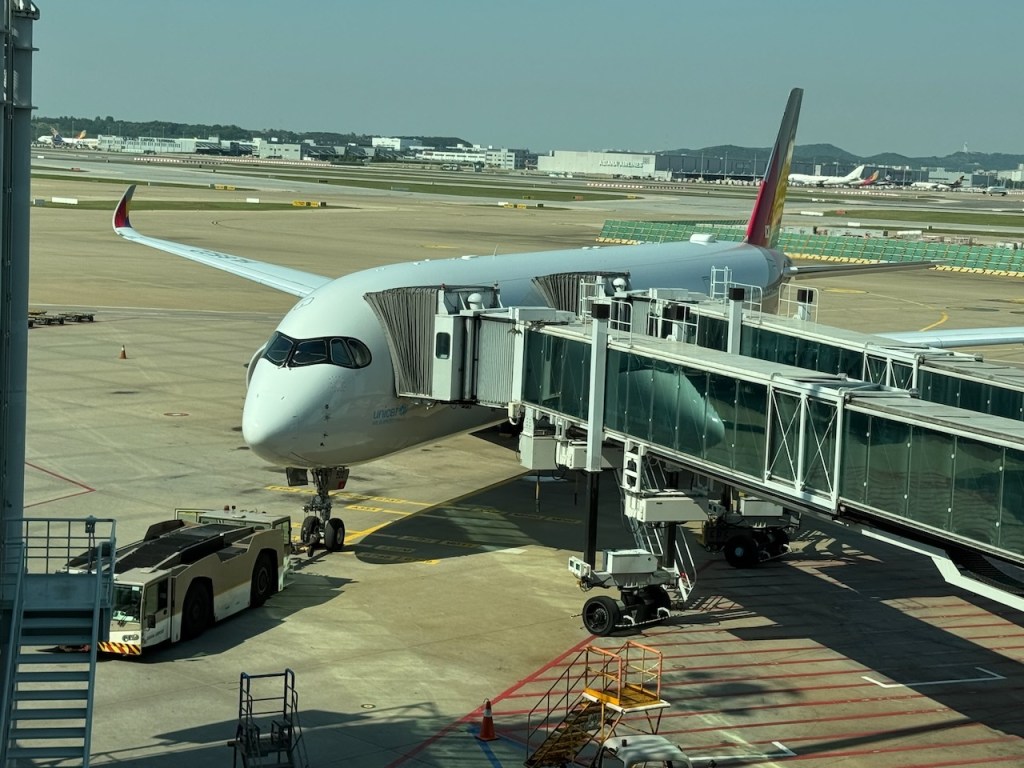
The flight path OZ368 flew from Shanghai to SeoulAsiana A321-200 that flew us from Shanghai to Seoul
At the Airport
Check-in
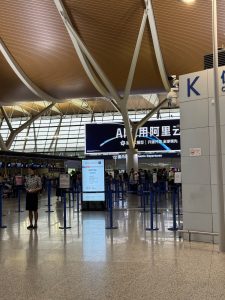
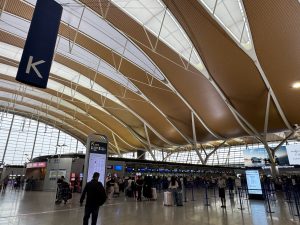
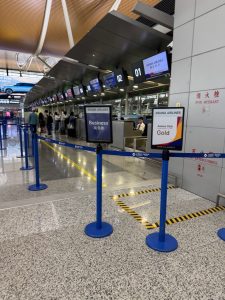
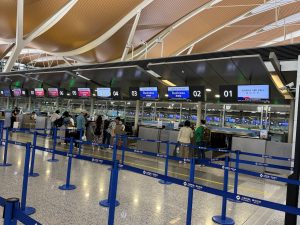
Shanghai has two international airports, Pudong and Hongqiao. Our Asiana Airlines flight departs from Shanghai Pudong Airport Terminal 2, which predominantly serves Star Alliance carriers. Asiana Airlines operates 10 check-in counters in Row K, the second row of counters from the left of the terminal building. There are two queues serving three groups of passengers at Shanghai Pudong Airport, and Economy Class passengers get their own line. In contrast, Star Alliance Gold and Business Class passengers are served in another line. The entrance to the Business Class queue was guarded by one of the ground staff to ensure only Business Class passengers were allowed in the queue. As we were one of the last few to check-in, there was no queue at the Business Class line (and Economy Class for that matter). The check-in experience fell short of typical Business Class standards. The ground staff came across as couldn’t care less and took his time to process our check-in. And when there were some issues with our seating, the ground staff took the time to confirm our seats over the phone without providing any updates on the status of the situation. He did not even bother telling us where to go after he processed our check-in (Shanghai Pudong Airport has two separate airside areas for domestic and international departures). The only information we were given was to head to the D77 Business Lounge after immigration.
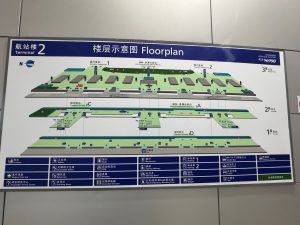
Shanghai Pudong Airport layout
Asiana Airlines deployed a ground staff to guard the Business Class check-in queue
Asiana Airlines check-in counters are located in Row K
Asiana Airlines check-in queue at Shanghai Pudong Airport
Business Class and Star Alliance Gold members uses the same check-in queue
Asiana Airlines operates 8 check-in counters at Shanghai Pudong Airport
China Eastern D77 Business Class Lounge
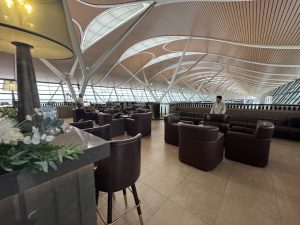
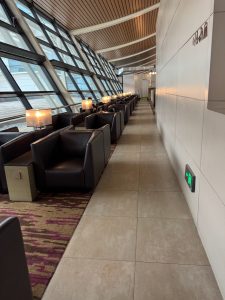
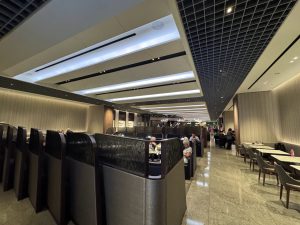
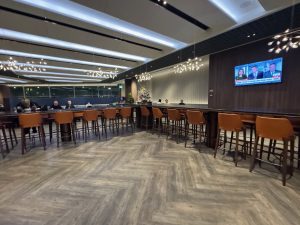
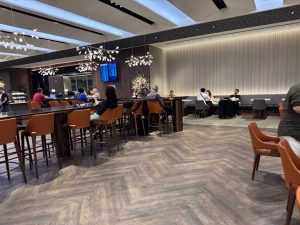
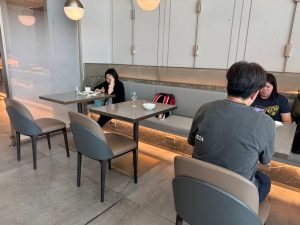
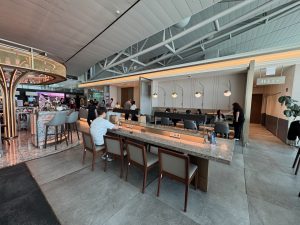
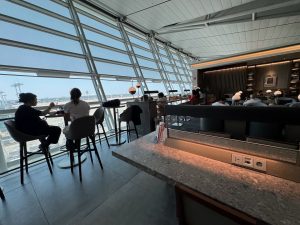
Asiana Airlines does not operate its Business Lounge in Shanghai Pudong International Airport. Instead of using the Star Alliance partner, D71 Air China Lounge, we were assigned to use the SkyTeam group partner, China Eastern Airlines D77 Business Class Lounge. I suppose this arrangement was intended to provide convenience for Asiana Airlines Business Class passengers, as the China Eastern Airlines Lounge was closer to our boarding gate. The China Eastern D77 Business Class Lounge, near Gate 77, is also accessible to Priority Pass holders. It serves many other airlines not affiliated with the SkyTeam group. Coming up from the escalator, the friendly lounge staff welcomed us to the lounge. China Eastern D77 Business Class Lounge felt airy and spacious as it shares the same ceiling as the airport terminal. The decor in the lounge mainly utilises natural wood that exudes a relaxing vibe. The front part of the lounge is primarily furnished with dining tables and chairs for four, which are also found near the bar area at the rear of the lounge. The seating in the centre of the lounge, next to the buffet lines, primarily consists of lounge armchairs that accommodate four or six people. Despite the armchair arrangement, we were also able to consume the food from the lounge comfortably in these seats. I also spotted a high table with power outlets for passengers to work on. While there are some individual high table pods on the adjacent side of the lounge, catering to passengers who prefer more privacy.
China Eastern D77 Business Class Lounge is located near Gate D77
Airlines and lounge programmes served by China Eastern D77 Business Class Lounge
The reception at China Eastern D77 Business Class Lounge
The seating at the entrance of the lounge mainly comprises dining table for four
The seating in the lounge next to the buffet counter
There is a tall table for passengers to do some work before their flight
The lounge is also furnished with armchairs near the entrance of the lounge
The seatings at the back of the lounge, next to the bar
There are individual pods in the lounge for passengers who wanted more privacy
The seating at the corridor adjacent to the entrance corridor
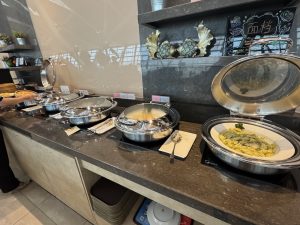
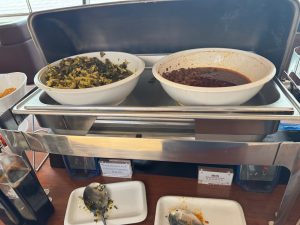
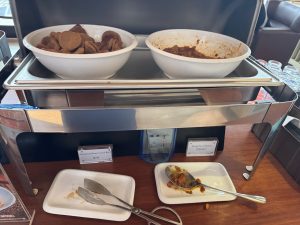
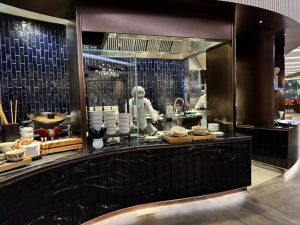
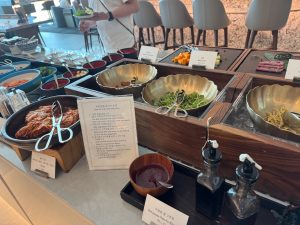
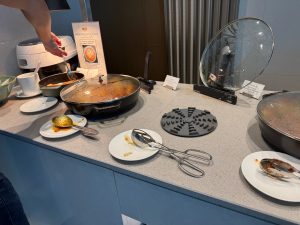
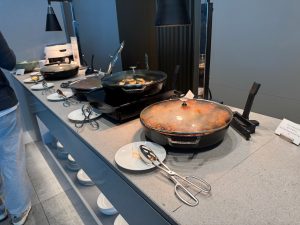
The food offered in the China Eastern D77 Business Class Lounge was quite extensive. There are two buffet lines in the lounge offering different food options. The buffet table located along the main entrance corridor primarily serves hot food, offering five options that range from curry chicken to fried rice to dim sum. The buffet table in the adjacent corridor mainly serves cold food and bread, from salads to fresh-cut fruits. It is here that I spotted a noodle counter, serving four options of made-to-order noodles. The additional condiments to complement the noodles are located opposite the noodle window. China Eastern D77 Business Class Lounge also features a bar that serves spirits and wine, but it was not open during my visit. There are no shower facilities in the China Eastern D77 Business Class Lounge.
The hot food buffet line offers a good variety of options
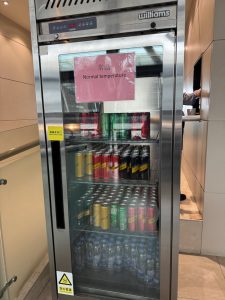
Passengers are free to help themselves with the many beverages in the fridge
The cold food buffet line in China Eastern D77 Business Class Lounge
The noodle bar offers made-to-order noodles
Menu in the noodle bar
Pastries are found in the cold food buffet line
Condiments for passengers to enhnace their noodles from the noodle bar
More condiments for the noodles
The noodle I ordered from the noodle bar
The Aircraft
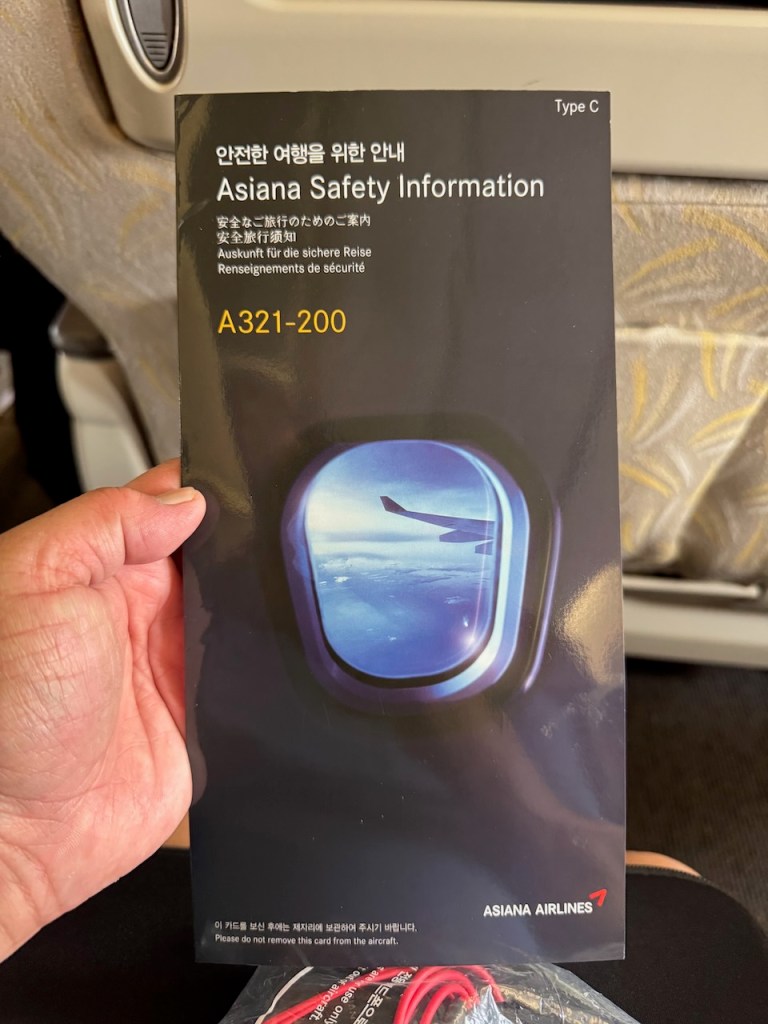
Asiana Airlines operates A330-300 and A321-200 aircraft between Shanghai Pudong Airport and Seoul. We flew on the A321-200 aircraft, which the airline has in two variants: one in an Economy Class configuration and the other with a small Business Class section.
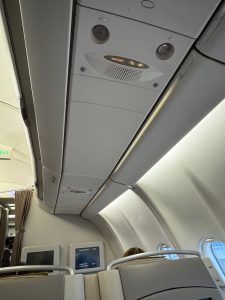
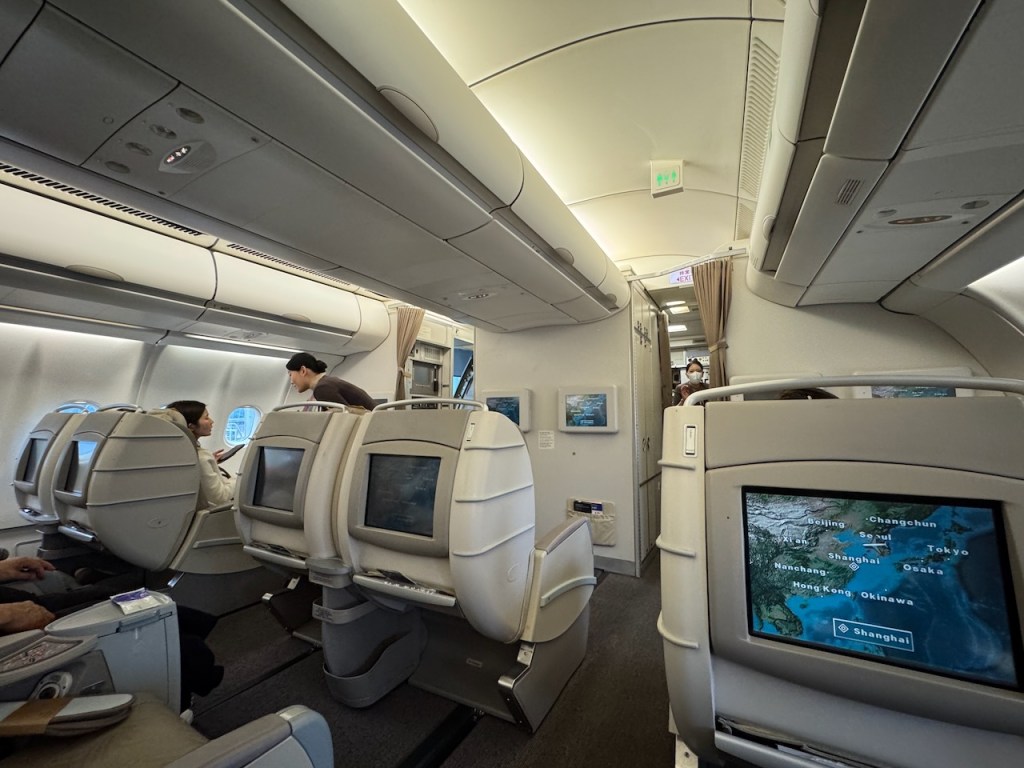
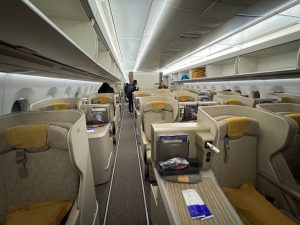
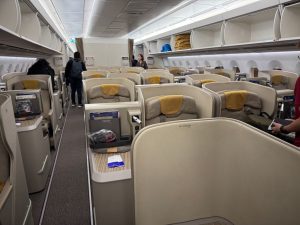
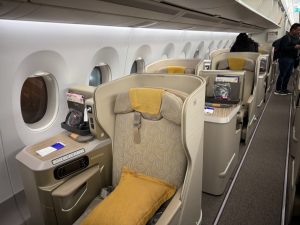
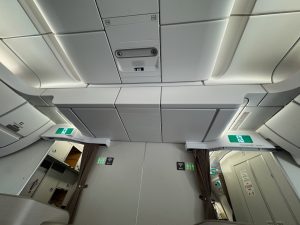
The colour theme used on the larger Asiana Airlines aircraft is also found in this narrow-body aircraft. The A321-200 Business Class cabin had a bright and airy feel, with a royal vibe. The seats in the cabin are upholstered in beige, and the headrest covers and pillows are adorned with yellow, a symbol of royalty and nobility in the Korean culture. The cabin was bright, thanks to the use of white lights, which gave it an airy feel. The Business Class cabin is equipped with only three rows of two seats in a 2-2 configuration.
Asiana Airlines A321-200 Business Class cabin
Asiana Airlines A321-200 has a small Business Class cabin
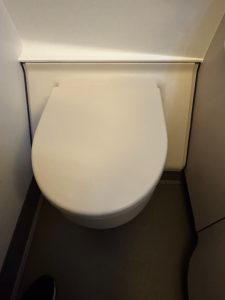
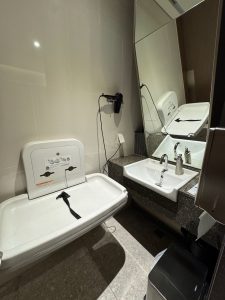
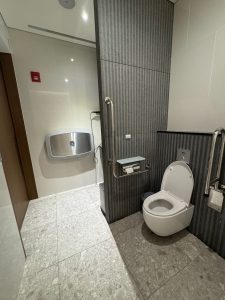
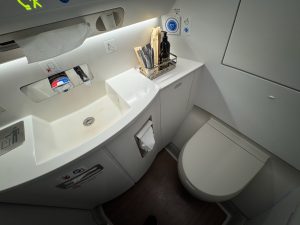
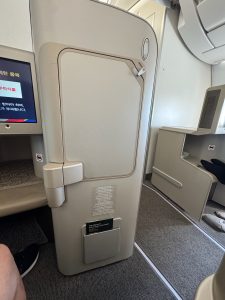
There is only one lavatory behind the cockpit serving all 12 Business Class passengers. As this is a smaller plane, the lavatory felt a little cramped compared to the airlines’ wider-body aircraft. However, it has the necessities of a lavatory. The lavatory does not come across as posh or any different from that in Economy Class. Still, I noticed additional amenities, such as dental kits and mouthwash, in addition to the L’Occitane lotion and facial mist, which were made available in the Business Class lavatories.
Asiana Airlines A321-200 Business Class lavatory
Toilet in the lavatory
Dental kits, mouth wash and lotions are available in the lavatory
The tissues by the sink of the lavatory
The Seat
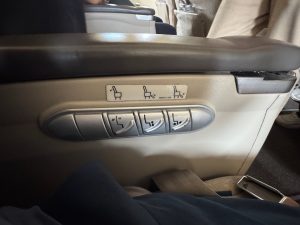
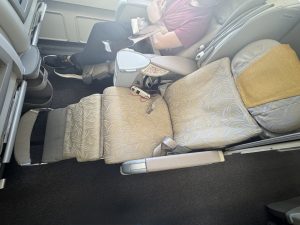
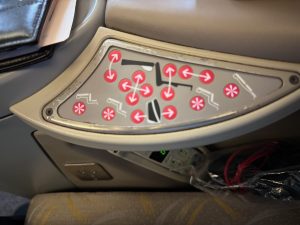
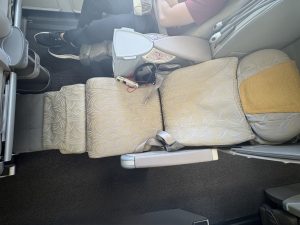
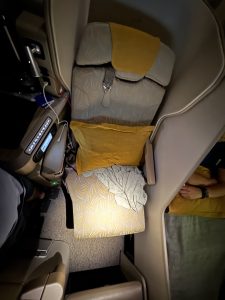
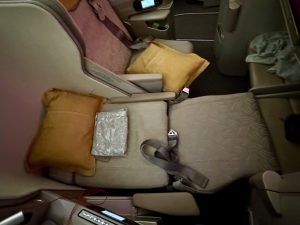
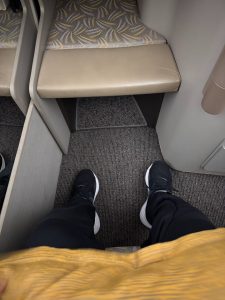
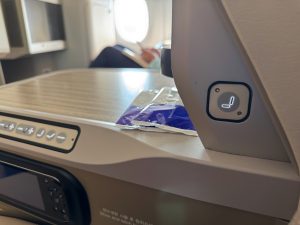
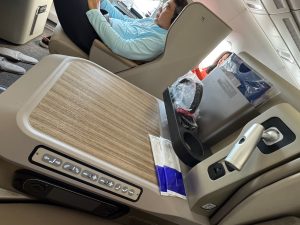
Asiana Airlines A321-200 Business Class seats have a seat pitch of 40″ and are 22″ wide. As this is a recliner seat, it does not come in flatbed mode but is capable of reclining up to 5″. The seat controls consist of three mechanical levers that control the deployment of the calf rest, the extension of the calf rest, and the seat back recline. When the seat is reclined and the calf rest is being deployed, the seat feels comfortable enough for me to doze off in it, thanks to its thick cushioning. However, due to ageing, I found difficulty in activating some of the seat functions with these seat controls.
Asiana Airlines A321-200 Business Class seats in take-off/landing position
Asiana Airlines A321-200 Business Class seat fully reclined
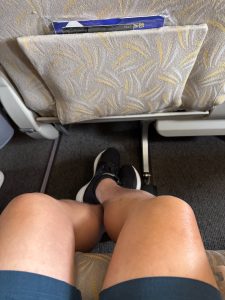
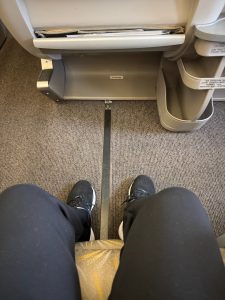
Legroom was excellent in these seats
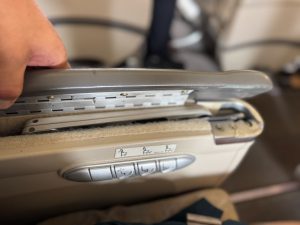
The seat controls are mechanical buttons that don’t really work well due to ageing
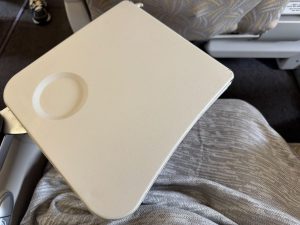
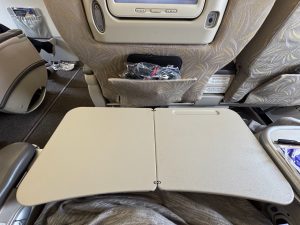
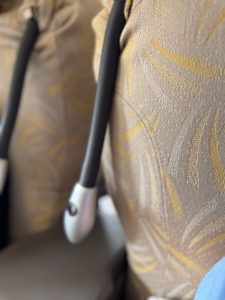
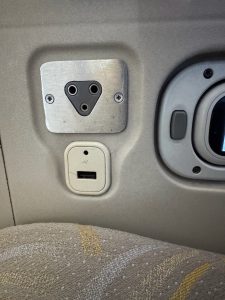
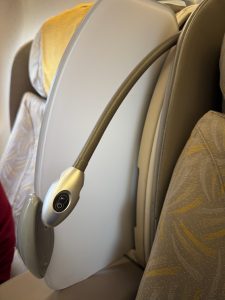
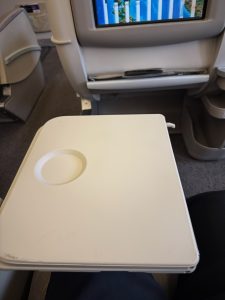
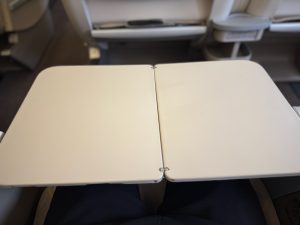
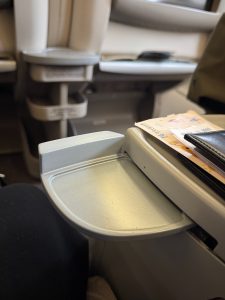
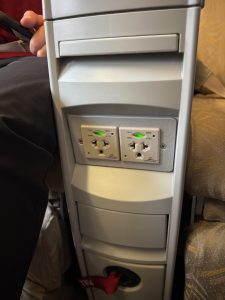
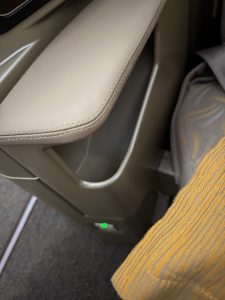
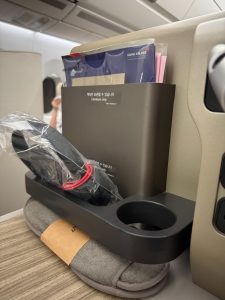
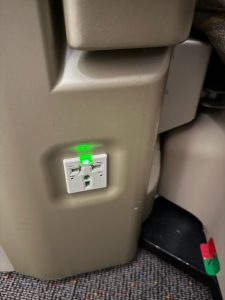
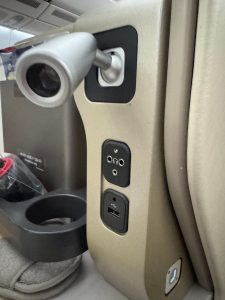
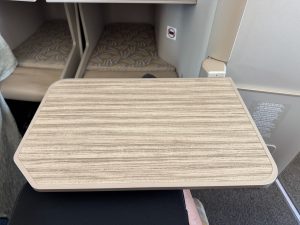
When it comes to storage, the only place we can store anything is in the seat pocket in front of us. There are no additional cubby holes for us to store our stuff. Fortunately, this seat pocket is large enough for me to place my iPad and some small items. Asiana Airlines A321-200 Business Class seats are fitted with a small cocktail table stored in the centre console between the two seats. The seat table is hidden in the armrest and is quite sizable when fully deployed. Other than the reading light above us, there is also a reading light that sticks out of the seat below the headrest. Asiana Airlines A321-200 Business Class seats are equipped with a USB-A charging outlet situated beneath the armrest, alongside two international power sockets in the centre console, allowing us to charge our lifestyle devices.
The only storage in the Business Class seat is the seat pocket in front
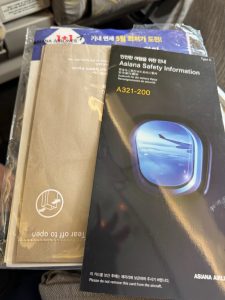
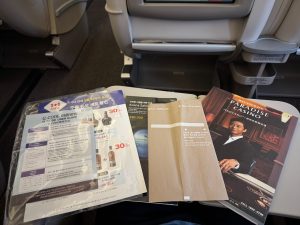
Seat pocket contents
A secondary cocktail table pops out from the centre console. The table top between the armrests can also be used as a cocktail table
The seat table is stowed inside the armrest
The seat table when fished out of its storage
The seat table when fully deployed
Other than the overhead reading light, there is another reading light beside the seat
Each Business Class seat is fitted with an international power outlet
The Business Class seat is also fitted with a USB-A charging port under the headphone jack
Inflight Entertainment
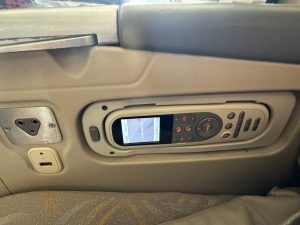
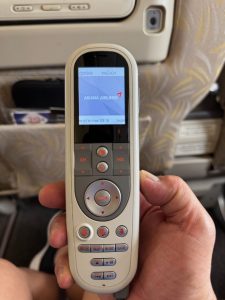
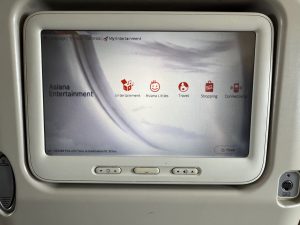
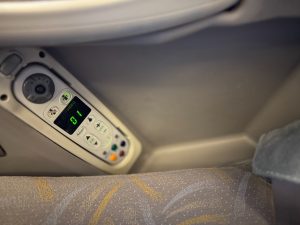
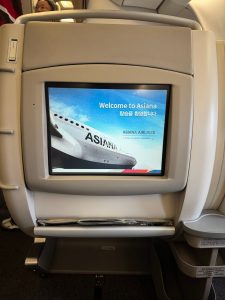
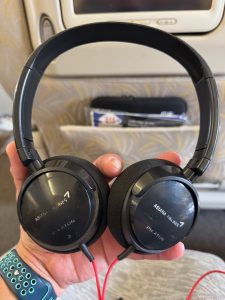
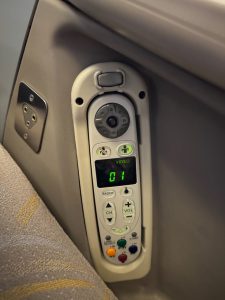
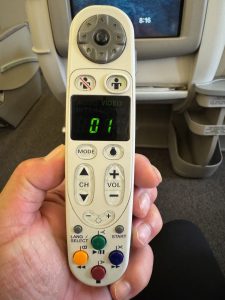
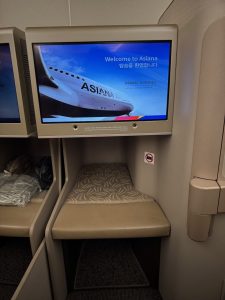
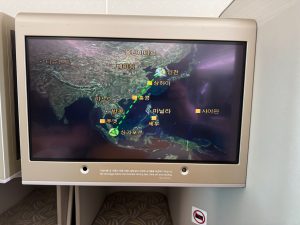
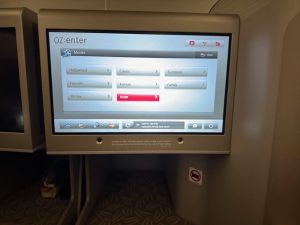
Each Business Class seat onboard Asiana Airlines A321-200 is fitted with a 10.6″ personal TV screen. As this is an older product, these TV screens have rather grainy picture quality by today’s standards and do not come with touchscreen functions. Selection of inflight entertainment is solely via the IFE controller, stowed under the armrest of the centre console. The IFE controller was rather old school. In the front, there are buttons that control the overhead reading lights and the flight attendant call button, as well as buttons for entertainment selection. A QWERTY keyboard is located on its back. The headphones provided by Asiana Airlines to Business Class passengers do not feature noise-cancelling functions, but are very comfortable to wear over a prolonged period. The Asiana Airlines A321-200 features the older OZ:enter IFE menu, which was designed for use with non-touchscreen TVs. The menu is well-organised, and finding the entertainment I want was a breeze. The OZ:enter is stocked with smaller entertainment options compared to their A350-900 aircraft. However, I was still able to find the latest Hollywood blockbusters, Korean movies and TV shows. For a 2-hour flight, I thought the contents of OZ:enter are sufficient to keep passengers entertained.
The seat back on Asiana A321-200 Business Class
Each Business Class seat is fitted with a 10.6″ personal TV
IFE controller is stored under the armrest
IFE controller in onboard Asiana A321-200 is rather old school
The back side of the IFE Controller has a QWERTY keyboard
Asiana Airlines Business Class headphones do not come with noise cancelling function
OZ:enter main menu selections
OZ:enter sub-menu selection
Meal
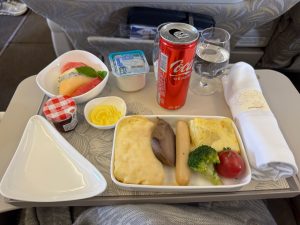
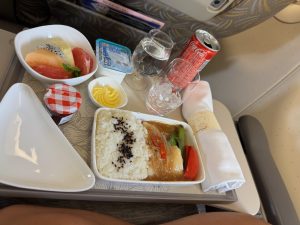
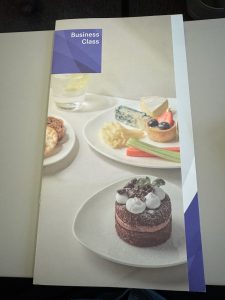
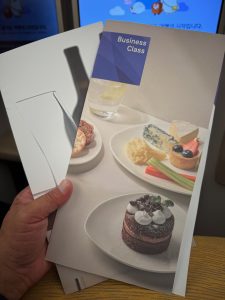
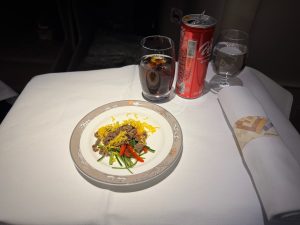
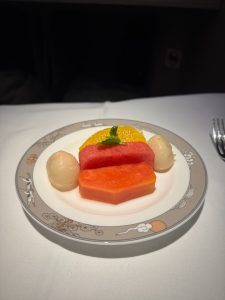
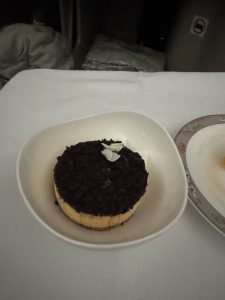
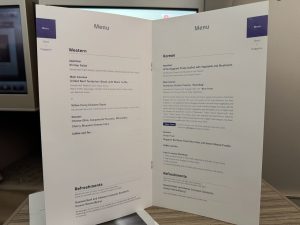
For the short 2-hour flight today, Asiana Airlines provides Business Class passengers with full meals. The two main course options for our flight today are Braised Dory fish and Egg Crepe. I had the Egg Crepe, served with fresh-cut fruits and a yoghurt. The scrambled eggs had a slightly flaky texture, but the ham was well-seasoned, and the sausage was not overly dry. My friend opted for the Dory fish, which tasted a little bland. Overall, I thought the meal served on this flight was quite hearty for breakfast.
Breakfast option for today’s flight
The Egg Crepe I chose for breakfast today
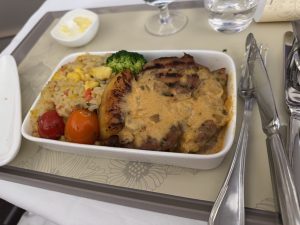
My friend opted for the Briased Dory Fish
Service
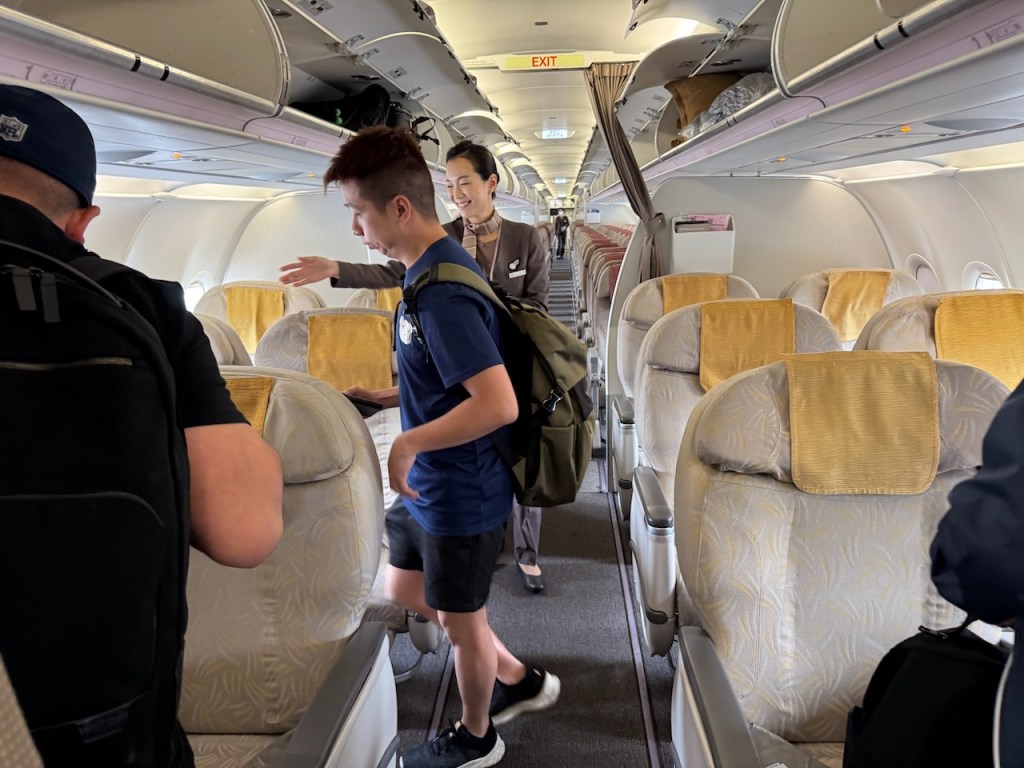
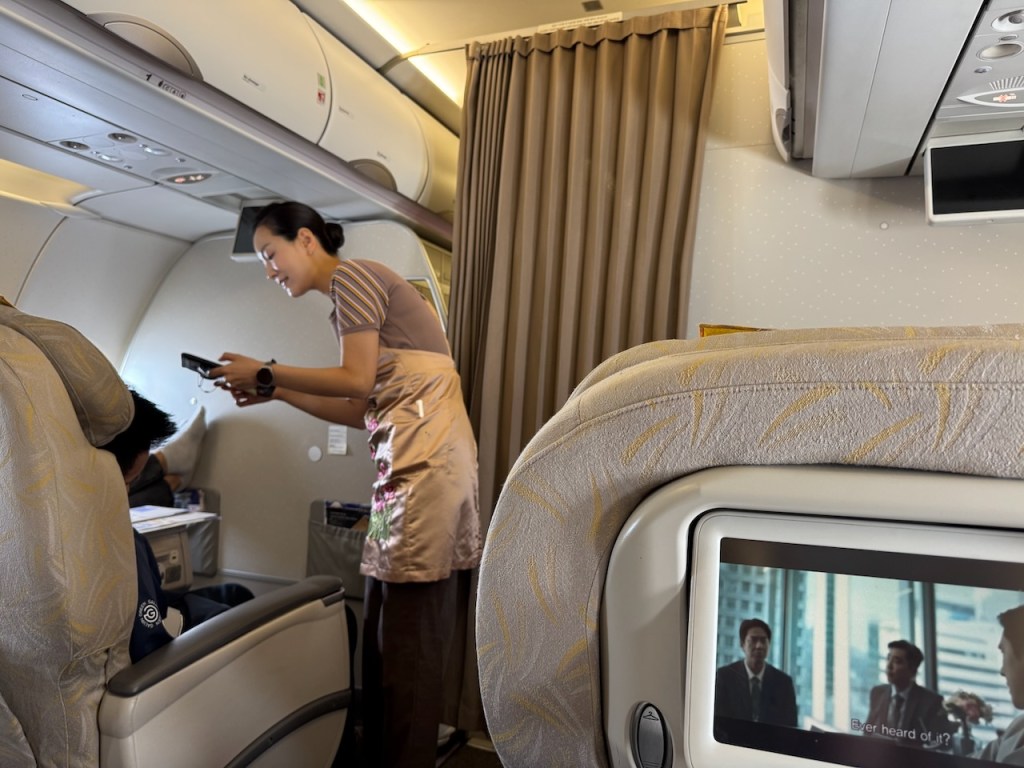
The service onboard this flight is one of the better services I’ve experienced with Asiana Airlines. Apart from the usual greetings at the door, we were being escorted to our seats. The cabin crew came across as friendly and welcoming throughout the entire flight. They were seen volunteering their help to passengers with their carry-ons and continually checking on them. Meal orders were taken and promptly served shortly after the seatbelt signs were turned off. Despite the short flight and the tight schedule, the cabin crew were seen patrolling the cabin frequently. Upon spotting that we had finished our meal, the eagle-eyed cabin crew promptly cleared our meal trays and topped up our drinks. Apart from the slippers provided in the seat, no other amenities were provided. Additional amenities such as pillows and blankets were made available upon request.
Cabin crew escorting us to our seats with a warm smileCabin crew taking orders after seatbelt signs are turned off
Afterthought
Asiana Airlines A321-200 was an older aircraft. Despite its ageing equipment and lack of storage space, I found the Business Class seat to be comfortable, thanks to the thick cushioning used in these seats. For a short 2-hour flight, it didn’t bother me that these Business Class seats don’t have a flat bed function. The service onboard this flight was excellent. The cabin crew came across as personable and attentive. They were seen helping passengers with their seats and luggage. I had a pleasant experience with Asiana Airlines in their A321-200 Business Class.
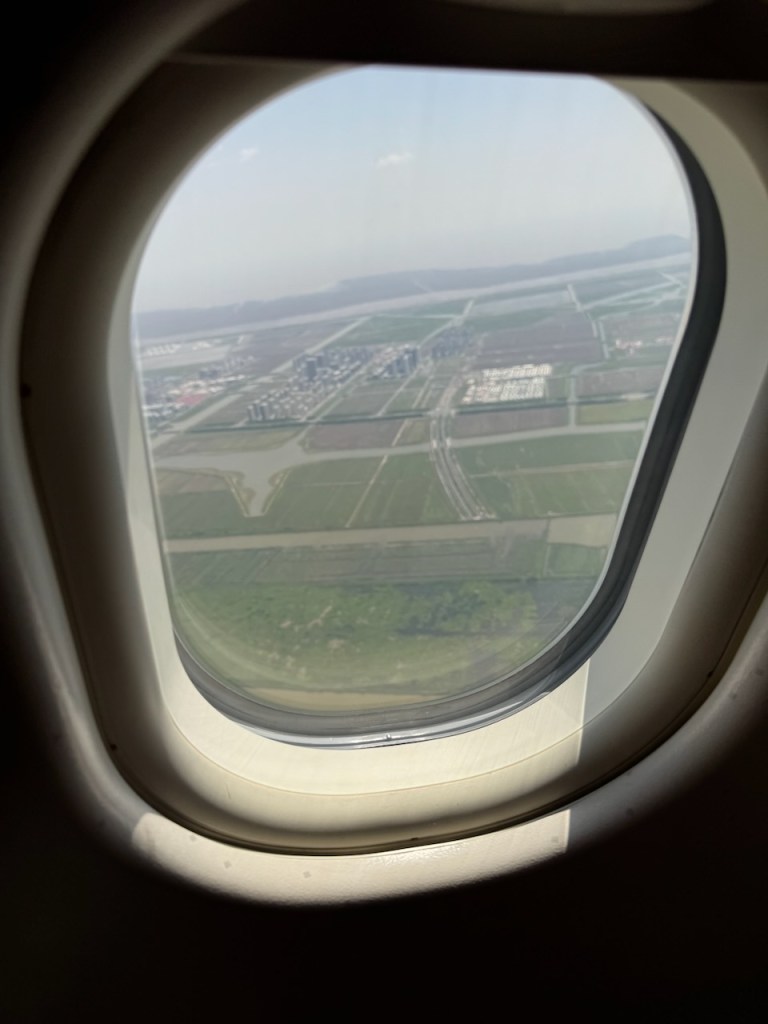
Taking off from Shanghai Pudong AirportWe are preparing for landing in Seoul Incheon Airport
The flight path that OZ361 that took us from Seoul to ShanghaiAsiana A330-300 that took us to Shanghai
At the Airport
Incheon Airport
Security Clearance
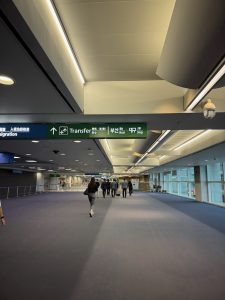
As this was a connecting flight from Singapore, and we were already checked through to Shanghai, we did not experience the check-in process at Incheon Airport. The security clearance for transit flights at Incheon Airport was very straightforward. We followed the crowd towards immigration, but instead of continuing, we took a turn at the transit door, which was prominently marked with bright green signs along the way. The security clearance process was very straightforward and took us 5 minutes to clear. After security clearance, we headed to the lounge.
Transiting through Incheon Airport
We followed the green transfer sign to the transfer security checks
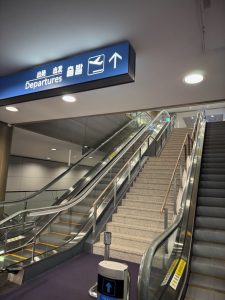
After clearing the security checks, we arrived at two escalators that brought us to the departure hall
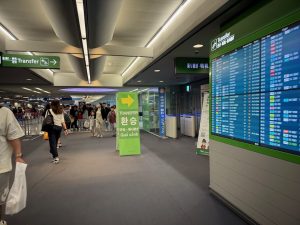
The transfer security counters are located opposte the immigration lines
SilverKris Lounge
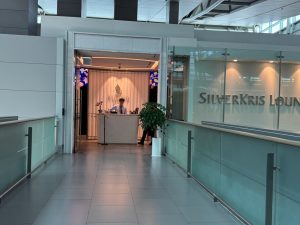
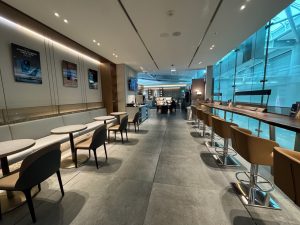
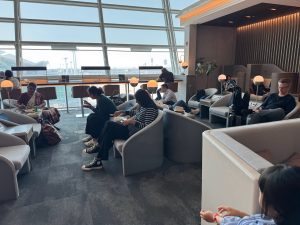
We had the option of either visiting the Asiana Business Lounge or the Singapore Airlines’ SilverKris Lounge, as Asiana Airlines is part of the Star Alliance network. When we visited the Asiana Lounge during our flight from Incheon to Singapore in March of this year (read about my lounge experience here), we found the lounge to be very disappointing. Therefore, we opted to use the Singapore Airlines SilverKris Lounge, located near Gate 29, instead. The main part of the SilverKris Lounge exudes a bright and airy feel, thanks to the use of white in the furniture and walls, as well as its placement next to the windows that look out onto the apron. The earthy colour used on the walls and the warm lighting exude a cosy vibe, while the marble used on the tables, buffet counter, and bar counters gives a luxurious vibe. The dining tables are mainly arranged against the walls in the lounge, while the lounging seats are arranged in the centre. The workstations, in the form of long tables with individual power outlets, were dotted around the lounge. The first thing that caught my attention was the bar island in the middle of the lounge, where cocktails and drinks were being made on the spot. The buffet counter, offering more options than the Asiana Lounge next door, features five hot food options and is located by the walls opposite the bar.
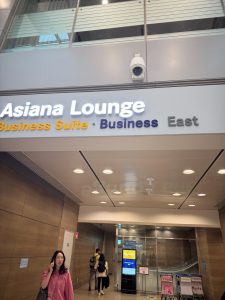
Singapore Airlines SilverKris Lounge is located near Gate 29, at the same area as Asiana Business Lounge East
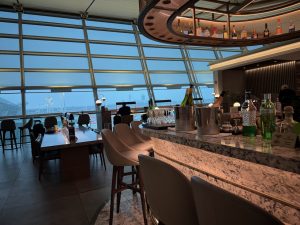
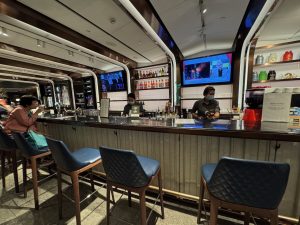
The bar in the centre of the lounge and the lounge has superb views of the apron
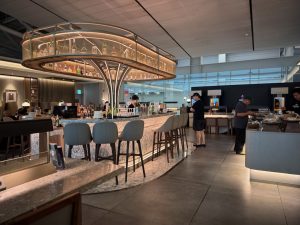
The bar in the centre of the lounge and the buffet line is situated opposite the bar
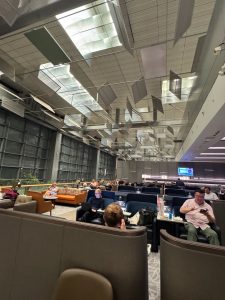
There are some dining tables right after the entrance to the lounge
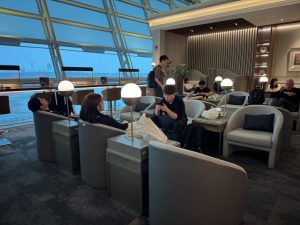
The main part of the lounge are mainly furnished with armchairs for passengers to relax
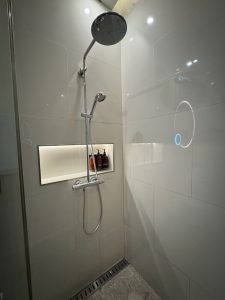
The SilverKris Lounge at Incheon International Airport is equipped with three shower rooms. These spacious shower rooms were equipped with a toilet and a sizeable walk-in shower. I like the bench in each shower room, which provided us with a space to place our carry-ons. There is also a beauty corner in the SilverKris Lounge where passengers can try out LED masks before their flight. However, I did not spot anyone manning this counter and am unsure if this service is still available at the time of my visit.
The shower room in SilverKris Lounge at Incheon Airport
The walk-in shower is equipped with both rain and regular shower heads
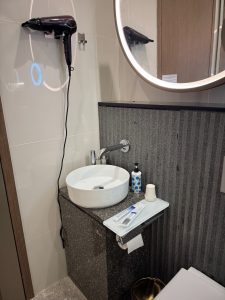
The sink in the shower room
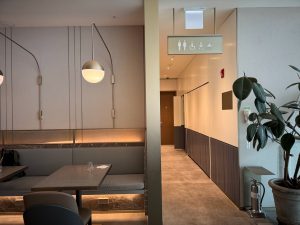
The entrance to the shower rooms and toilets are in the main lounge area
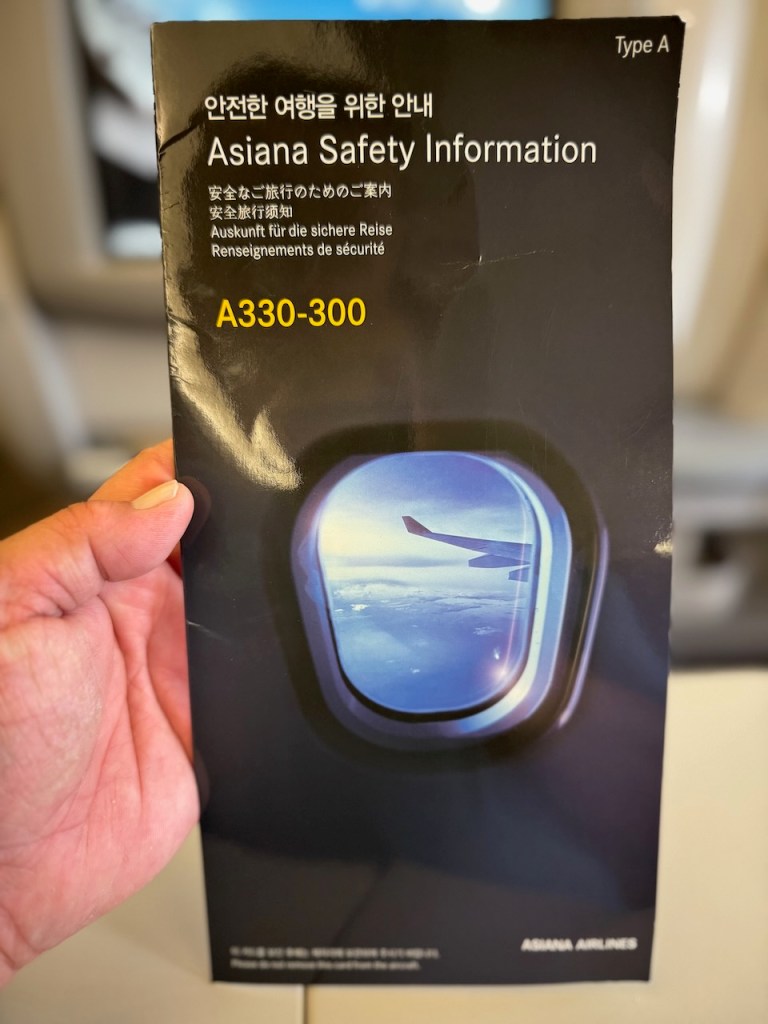
Asiana Airlines operate two types of aircraft between Seoul and Shanghai, the single aisle A320-300 and the widebody A330-300. We flew on the A330-300 aircraft for this flight.
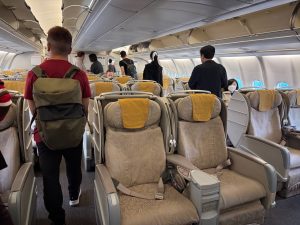
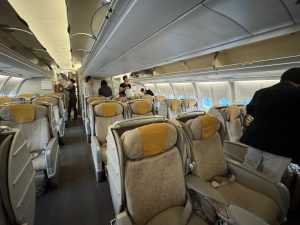
Asiana Airlines’ A330-300 Business Class cabin had a bright and airy feel, with a royal vibe. The seats in the cabin are decked in beige, which matches the cream-coloured seat shells. The headrest cover and pillows are adorned in yellow, a symbol of royalty and nobility in Korean culture. The airline chooses brown carpeting that matches the beige and yellow theme in the cabin. The cabin looked bright, thanks to the use of white lights. Asiana Airlines’ two-class A330-300 is configured with 30 Business seats in a single cabin and 286 Economy Class seats spread over two sections. The Business Class seats on Asiana’s A330-300 are arranged in a 2-2-2 configuration, which appears somewhat dated, as most airlines configure Business Class in their wide-body jets in a 1-2-1 arrangement.
Asiana Airlines’ A330-300 Business Class cabin looked clean and airy
Asiana Airlines A330-300 Business Class cabin is decked in beige and yellow colours
Asiana Airlines A330-300 Business Class cabin
Two lavatories serving the 30 Business Class passengers are located at the front part of the aircraft. The lavatories felt a little cramped, but I still found sufficient space to use the bathroom. The plastic materials used in the lavatory do not lend it a premium feel. I wouldn’t have thought this lavatory served Business Class passengers if not for the additional amenities such as dental kits, combs, and mouthwash on top of the L’Occitane hand lotion and facial mist.
Asiana Airlines A330-300 Business Class lavatory
The mirrors made the lavatory appear bigger than it is
Asiana Airlines Business Class lavatory is very well stocked with amentiies despite a short flight
The Seat
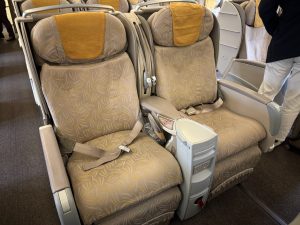
Asiana Airlines A330-300 Business Class seats have a pitch of 58″ and measure 21″ wide. As this is an older Business Class product, the seat can only be converted into an angled flatbed with a maximum recline of 170°. These Business Class seats come in three modes: upright, lounge, and flatbed. However, the seat control features four preset modes. There seem to be two lounge modes. In upright mode, the seat felt comfortable due to its thick padding. In flatbed mode, although not a true 180° flatbed, I did not experience any sliding effect due to the friction created by the fabric used in these seats. Lounge mode is my favourite mode, as it allows me to truly relax in the seat. The only difference between the two lounge modes is the angle of recline. There are numerous ways to configure lounge mode on Asiana Airlines’ A330-300 Business Class seats, rendering these two preset lounge modes somewhat redundant. We were able to adjust the seat to the desired angle and the extent of the calfrest extension using the numerous buttons on the seat control. There are even buttons to control the amount of lumbar support we want, which is unfortunately not available in the newer Business Class products.
Asiana Airlines A330-300 Business Class seats, arranged in 2-2-2, in its upright position
The legrom in these Business Class seats were execellent
Asiana Airlines A330-300 Business class seat in the second lounge mode which is more reclined
The Business Class seat in lounge mode, an angled position more for passengers to relax in after take-off
Seat controls look complicated
Asiana Airlines A330-300 Business class seat fully reclined, though not flatbed, but still very comfortable
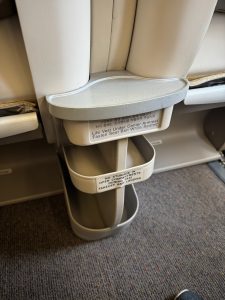
Storage is perhaps the biggest issue on Asiana Airlines Business Class flights, as I experienced during my previous flight on the A350-900 and this flight on their A330-300. However, I thought there was slightly more storage space in Asiana Airlines’ A330-300 Business Class. The only storage in these seats is limited to the small cubby hold underneath the inside of the armrest in the centre console. This small cubby hole is sufficient for me to place my passport, mobile phone and charging cables. Additionally, a two-tiered cubby hole is located in front of the seat, offering us more storage options. Passengers with tablets can stow them in the seat pocket during take-off and landing, which is sizeable enough to hold even a laptop. I did not find any space at the footwell to stow our carry-on due to the angled flatbed design of these Business Class seats. All carry-on items would have to be placed in the overhead bin.
The cubby hole in the inside of the armrest is sizable enough to fit my mobile phone, passport and charging cable comfortably with some spaces left
There is a two-tiered open shelf in front of the seat which can hold bottles of water or shoes
The seat pocket on Asiana Airlines’ A330-300 Business Class seats are large enough to hold a tablet or laptop
Seat pocket contents
On top of the overhead reading lights, Asiana Airlines’ A330-300 Business Class seats are also fitted with a reading light between the two seats, which I find redundant. The brightness of these reading lights can be adjusted, but to turn them off, we had to cycle through all the lighting brightness settings. The seat table is stowed in the armrest and folded in half when in storage. It is quite large and sturdy when fully deployed, allowing passengers to work on their laptops. Apart from the seat table, Asiana Airlines designed two cocktail tables into their A330-300 Business Class seats. One uses the space on top of the armrests between the seats, and another is a flip-out small table located in the centre console between the seats. As an older aircraft, Asiana Airlines’ A330-300 Business Class seats did not come fitted with any USB charging ports, so we would have to rely solely on the international power outlets in the centre console to charge up our lifestyle devices.
Asiana Airlines A330-300 Business Class seats are fitted with overhead reading lights
There is another reading light fitted onto the side of each Business Class seat
The seat table is stored in the armrest of the seat
The seat table is folded in half when extracted from its storage
The seat table is rather sizeable when fully deployed
There is a small cocktail table in every Business Class seat
These power outlets are the only way we can charge our mobile devices
Inflight Entertainment
Asiana Airlines’ A330-300 Business Class seats are equipped with a 15.4″ personal TV. The picture quality on these IFE screens is quite bad and grainy. Despite the poor picture quality, we were still able to watch shows on OZ:enter. As these are the older Business Class product, these Business Class personal TV screens do not come with touchscreen functions, and the selection of our choice of entertainment requires us to use the IFE controller. These IFE controllers have buttons to choose the entertainment and a phone on the back. The headphones that Asiana Airlines provides to its Business Class passengers look rather cheap. Despite their lack of noise-cancellation functions and cheap appearance, these headphones are quite comfortable to use. OZ:enter, Asiana Airlines’ IFE system, is stocked with entertainment options ranging from the latest Hollywood blockbusters to TV shows from yesteryear. Despite its aged appearance, the entertainment options are well-organised, arranged in five main menu options and further segregated into sub-menus, making it very easy to search for our preferred entertainment options. There is also no Wifi on Asiana Airlines’ A330-300 aircraft.
Asiana Airlines fitted a 15.4″ IFE screen in their A330-300 Business Class seat
The OZ:enter interface is quite straightforward to use, but looked dated
The headphones that Asiana Airlines provides their Business Class passengers
The IFE controller is stowed at the cubby hole in the armrest next to the headphone jack
The front of the IFE controller on Asiana Airlines A330-300 Business Class
The backside of the IFE controller is a phone
Meal
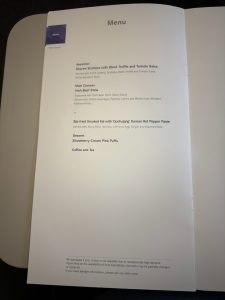
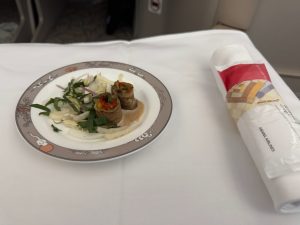
Asiana Airlines provided a full three-course meal, served in one setting, to all their passengers despite the short 2-hour flight time. Similar to my previous experience in their Business Class, we were also given two options for today’s breakfast: Beef Stew for the Western option and Smoked Eel with rice for the Korean option. I opted for the Korean main course option. The seared scallop appetiser was fresh and well-seasoned with a hint of ocean freshness, and the Strawberry Cream Puff dessert was delicious and not overly sour. However, I can’t say the same for the Smoked Eel main course. The eel tasted flavourful with the Gochujang sauce, but it was a little rubbery and tough.
Menu was distributed after the doors to the aircraft were closed
Meal options for this flight
The eel with right that I chose
Service
The only amenity available for this short flight is a pair of slippers and a couple of wet wipes, placed on our seats. Pillows and blankets are only available on request. As with my previous flight, Asiana Airlines did not serve welcome drinks to their Business Class passengers during boarding. However, the service onboard this flight is much better than my experience on the previous flight we just got off. The cabin crew were much friendlier and more willing to assist passengers. Apart from the standard greeting at the door, distributing the menu and taking orders for our choice, the cabin crew was observed to go above and beyond the standard procedures. They were seen ready to guide passengers to their seats and render assistance to passengers with stowing their luggage in the overhead bin. The cabin crew were seen working as a team, like clockwork, elevating each other’s work so that passengers could receive the service befitting of Business Class. I was pleasantly surprised when the cabin manager went around the cabin introducing herself to every passenger and thanking us for flying with Asiana Airlines. This is something we no longer see today, even among the highly acclaimed so-called 5-star airlines. The cabin crew were observed to be diligent and frequently patrolled the cabin, checking if passengers required any assistance. They were also efficient when it came to distributing meals and ensuring they had sufficient time to finish.
The inflight manager introducing herself to all passengers in Business ClassThe friendly and professional cabin crew distributing meal
Afterthought
The Asiana Airlines A330-300 is an older aircraft, but its thickly padded seats and a variety of seating positions, customisable to every passenger’s needs, made flying this aircraft on a short-haul route very comfortable. It did not bother me that the seats did not recline to 180°, as we did not use that mode due to the short 2-hour flight time. The catering was a mixed experience, while the appetisers and desserts were tasty, the Korean main course was tough and rubbery. The service onboard is the best I have experienced on Asiana Airlines so far. Cabin crew were observant and appeared to be ready to assist passengers.
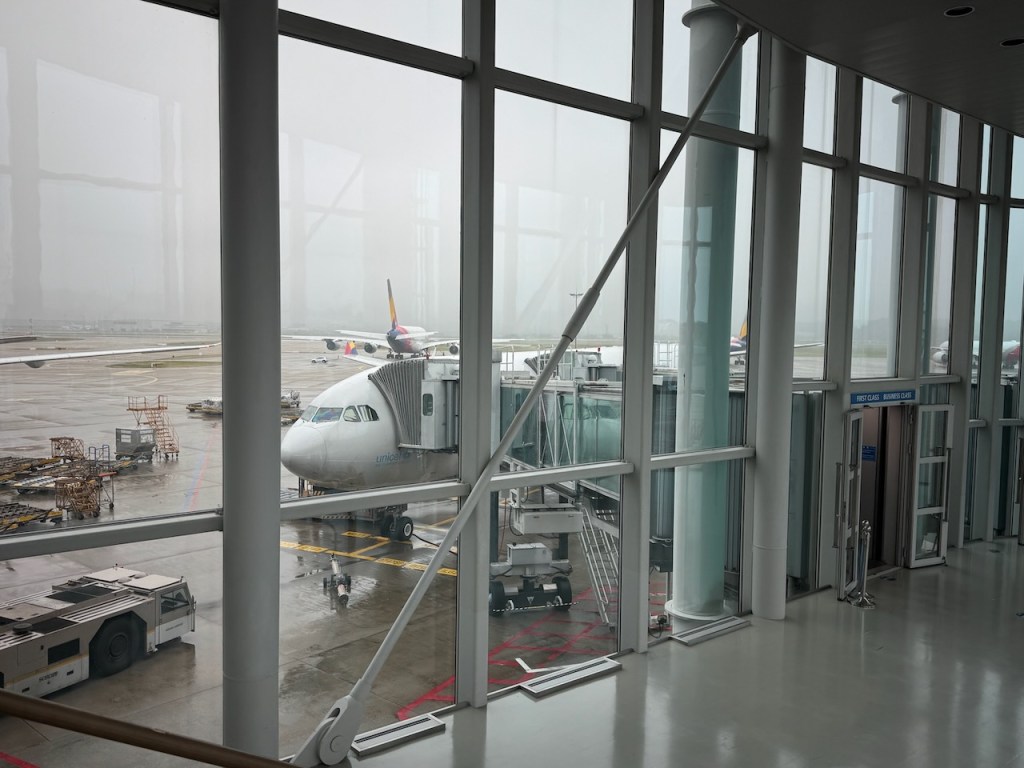
Asiana Airlines A380 taking off before us in Incheon AirportWe are approaching our landing in Shanghai Pudong Airport
The flight path of OZ752 and OZ751 flying between Singapore and SeoulAsiana Airlines A350-900 that flew us between Singapore and Seoul
At the Airport
Singapore Changi Airport
Check-in
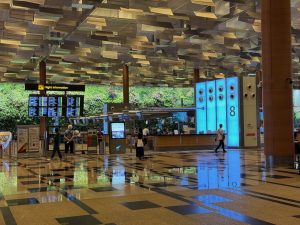
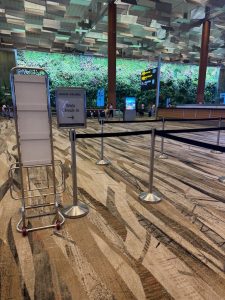
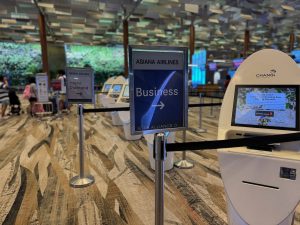
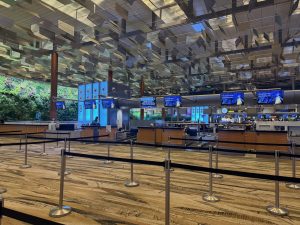
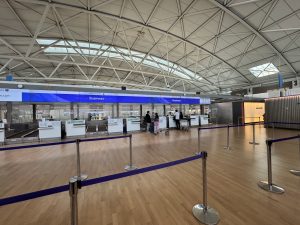
Asiana Airlines departs from Changi Airport Terminal 3. The airline operates check-in counters in Row 8, to the right of the terminal building, with Door 6 being the nearest door to these counters. Of the seven check-in counters, two are dedicated to Business Class passengers, one to their Diamond-tier members, two for Economy Class passengers, and another two for passengers who have completed their check-in online. Asiana Airlines check-in counters open 3 hours before the flight. As we arrived slightly ahead of the counter opening time, we used Asiana Airlines’ early check-in counter in counter 7. Although not located in a dedicated Business Class counter, the ground staff’s check-in experience was very pleasant. The staff welcomed us and were very efficient in processing our check-in, and we were checked in within 5 minutes. Before sending us off to our boarding gates, the friendly ground staff presented us with a lounge invitation and provided us with directions to the two lounges we could use.
Changi Airport Terminal 3 map and Asiana Airlines check-in counters are located in Row 8
Asiana Airlines has 2 check-in counters for its Business Class passengers
Asiana Airlines check-in counters are located in Row 8 of the terminal
Besides Economy Class, there is also a line for passengers who had completed online check-in
Asiana Airlines has dedicated queues for its Business and Diamond members
Counter 9 caters for passengers who wanted to check-in early
Asiana Airlines check-in counters in Singapore Changi Airport Terminal 3
SilverKris Lounge
Flying out of Singapore, Asiana Airlines Business Class passengers can use the SATS Premier Lounge or Singapore Airlines SilverKris Lounge in Terminal 3. Both lounges are located near each other, one floor above the airside departure hall. We went to the SilverKris Lounge. The escalator diagonally opposite Bacha Coffee brings us directly to the lounge entrance. As the flagship lounge in their home port, the Singapore Airlines SilverKris Lounge did not disappoint. The lounge was spacious, with clearly marked areas for relaxing and dining. The area to the right of the main entrance houses the lounging area, which is mostly furnished with armchairs. There are also some high tables with power outlets that double up as work tables for passengers who want to get some work done. Singapore Airlines thoughtfully included a small buffet area in this part of the lounge, allowing passengers to grab some small bites without having to walk over to the main buffet line on the other side of the lounge. The bar is also located to the right of the entrance to the SilverKris Lounge, where passengers can select from a wide range of drinks, including cocktails and mocktails, from the extensive drink menu.
Singapore Airlines SilverKris Lounge entrance
The area to the right of the entrance is mainly furnished with armchairs for passengers to relax
The lounging area in the SilverKris Lounge is mainly furnished with loungers and armchairs
There are some high tables for passengers who wanted to do some work or larger group passengers
The lounging area in the SilverKris Lounge
The lounging area has high ceilings that made this part of the lounge feels airy
The bar in the lounge is located in the lounging area
Cocktails on offer in the bar
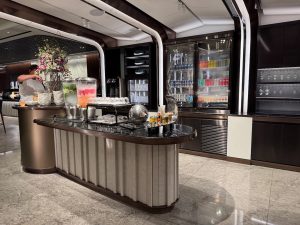
Singapore Airlines set up a small buffet line in the lounging area with mainly finger food and beverage stations
The area to the left of the SilverKris Lounge entrance primarily houses the dining area, where the main buffet line and showers are located. In addition to the dining tables and chairs for two people, a small lounging area is furnished with armchairs, located closer to the entrance in this part of the lounge. This is also where the toilets and shower rooms are located. There is another lounging area in a separate area opposite the buffet line. I like how Singapore Airlines has allocated a significant portion of the SilverKris lounge to dining seating in this area. Being housed in the same space as the main buffet line creates convenience for passengers to access the extensive food offerings, which include local dishes. On top of food from the buffet line, passengers can also order made-to-order noodles from the two food stations at either end of the buffet line. I highly recommend the laksa served at the SilverKris Lounge.
Most part of the lounge is furnished with dining table for two
The small lounging space in the dining area of the SilverKris Lounge
There is another lounging area that was previously used for First Class passengers in the dining area of the lounge
Other than the usual dining tables, there are a number of high tables i the dining area to cater for larger groups
The dining area in the SilverKris Lounge
Beverage station in the dining area
The main buffet line in the dining area has a quite a number of options for passengers
One of the two cook-to-order stations in the dining area of the lounge
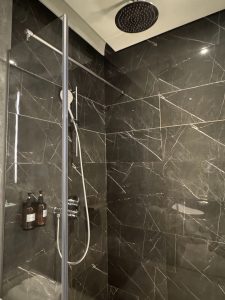
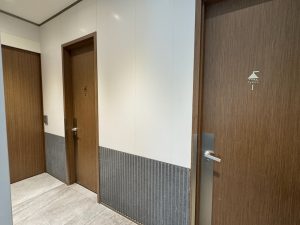
There are several shower rooms in this lounge, which are usually quite popular. Fortunately, there is hardly a queue for them during our visit. To use these shower rooms, we simply had to approach the staff stationed at the toilets to obtain a buzzer. The shower rooms in SilverKris Lounge are sizeable and well-designed, exuding luxury with their dark grey marble walls and light grey marble flooring. In addition to the large walk-in shower, equipped with both rain and regular shower heads, the shower rooms are also fitted with a toilet.
The shower room in SilverKris Lounge
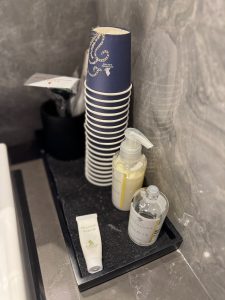
Bathroom amenities made available in the shower rooms
The walk-in shower is fitted with a rain and regular shower heads
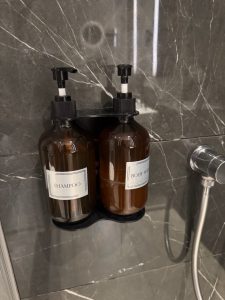
Singapore Airlines uses some generic brand shower amenities in the shower room
Incheon International Airport
Check-in
Asiana Airlines has a dedicated area for Business Class passengers at Row A of Incheon International Airport Terminal 1, located at the extreme right of the terminal. The Business Class check-in counters are located in an enclosed area, where a staff member is stationed to ensure only Business Class passengers can be admitted. Asiana Airlines has four check-in counters here serving Business Class passengers. There was no queue during our visit to the Business Class check-in area. As we did not have to perform check-in, we did not experience the check-in service at these counters. We could have used either the Asiana Lounge or the Singapore Airlines SilverKris Lounge, located at the airside, and opted for the Singapore Airlines SilverKris Lounge. From our experience at the Asiana Lounge on Mar 25, we felt the lounge was rather underwhelming.
Asiana Airlines Business Class passengers can check-in at Row A of the terminal
The area feels private and exclusive and there is a staff to ensure only Business Class passengers are admitted to the check-in area
Asiana Airlines Business Class check-in counters in Row A
SilverKris Lounge
The Singapore Airlines SilverKris Lounge is located opposite Gate 29, one floor above the east side of the departure hall. The SilverKris Lounge at Incheon Airport exudes luxury with its use of marble walls at the entrance. The bar in the centre of the lounge captures one’s attention, serving a range of cocktails, mocktails, and iced coffee. The dining seats in the lounge are primarily arranged along the walls, with most of these seats located in the area after the reception, and four of these seats next to the buffet line. The main part of the lounge is primarily furnished with armchairs and small side tables, as well as a limited number of high-back armchairs. There are several long tables, mainly located near the bar and along the perimeter of the lounge, which can accommodate larger groups or serve as a workstation.
SilverKris Lounge Incheon entrance
This dining area after the entrance to the lounge is quieter
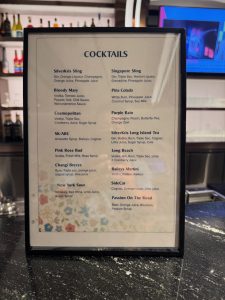
The bar in the middle of the lounge serving cocktails and ice coffee
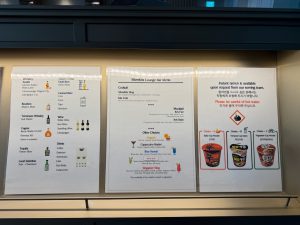
Bar drink menu
The lounging area mainly occupies the centre of the lounge and are arranged around the bar
More dining area in the lounge next to the buffet line
There are some work stations that also doubles up as dining area in the lounge
The work table and the lounging area in the SilverKris Lounge
There are some high tables that faces the apron
There is a corner displaying K-beauty technology, but have to drop a name card for someone to contact to use
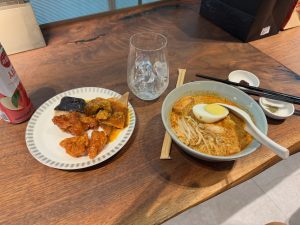
Singapore Airlines SilverKris Lounge offer a small selection of hot food, but still more choices compared to the Asiana Airlines Lounge next door. In addition to the hot food selection, a counter serves cold dishes, including salads, bread, and cold cuts. The famous Singapore Airlines Laksa is available at this SilverKris Lounge, and can be ordered from the staff at the buffet line. The SilverKris Lounge is fitted with three shower rooms and is mostly empty during both our visits to the lounge. The shower rooms are a little small, but they are still fitted with a toilet on top of the walk-in shower. There is no dedicated space for me to stow my carry-on, other than on top of the toilet. However, I appreciate that shower facilities are available here and the absence of a queue.
The salad and cut bar in the lounge
Some of the salad options on offer in the lounge
Hot food options served in SilverKris Lounge
Hot food options in the lounge
The laksa that I ordered from the staff at the buffet line
There are 3 shower rooms in the SilverKris Lounge
The sink area in the shower room and due to the limited spaced, I had to deploy the nappy station to place my backpack
I was assigned the handicap shower room, which is slightly larger than the other two shower rooms
The walk-in shower in the shower room
Shower room amenities
Singapore Airlines uses generic brand bath amenities in their shower room in Incheon Airport
The Aircraft
Asian Air operates A350-900 aircraft for this flight between Singapore and Seoul, featuring their “newest” Business Smartium Seats.
Asiana Airlines’ A350-300 Business Class cabin had a bright and airy feel, with a royal vibe. The seats in the cabin are decked in beige, which matches the cream-coloured seat shells. The headrest cover and pillows are adorned in yellow, a symbol of royalty and nobility in Korean culture. The airline chose brown carpeting that complements the beige and yellow colour used in the seats very well. The cabin felt bright and airy, thanks to the extensive use of white lights. Asiana Airlines’ three-class A350-300 is configured with 28 Business Class seats in a single cabin, 36 Economy Smartium seats (essentially Economy Class seats with longer seat pitch), and 247 Economy Class seats spread over two sections. The Business Class seats on Asiana’s A350-300 are arranged in a 1-2-1 configuration.
Asiana Airlines Business Class cabin is decked in beige with spots of yellow
Asiana Airlines’ A350-900 Business Class cabin looked airy due to the missing middle overhead compartment
Asiana Airlines A350-900 Business Class cabin
The front of the Business Class cabin
There are only two lavatories located at the front of the Business Class cabin, serving all 36 passengers onboard the Asiana Airlines A350-900 aircraft. The lavatory feels a little smaller than those of the same type of aircraft operated by other airlines, and the choice of fittings in these lavatories does not convey a premium feel. Perhaps the only differentiating factor between these lavatories is the additional amenities, such as dental kits, combs, and mouthwashes, in addition to the L’Occitane body cum hand lotion, and Eau de Toilette, available in these two Business Class lavatories.
Asiana Airlines A350-900 Business Class lavatory
Amenities available in the lavatory
The sink in the lavatory
The Seat
Asiana Airlines named its Business Class seats the Business Smartium seats (which is hardly “smart”). The Business Smartium seats are arranged in a staggered 1-2-1 configuration, with even-numbered seats placed next to the window, while odd-numbered seats have the side table next to the window. Each Business Smartium seat has a pitch of 77″ and measures 22″ wide, which I find the seats a little narrow. Like most long-haul Business Class seats, Asiana Airlines’s Business Smartium seats also come in upright, lounge and flatbed modes. While these Business Smartium seats were sufficiently padded to prevent one from feeling the knicks and crannies of the seat, they are not exactly thick enough for me to want to stay seated for prolonged periods. In bed mode, Asiana Airlines’ Business Smartium seats can be reclined 180°, turning the seat into a bed. The high shell back design of the seat provided some privacy, especially for passengers not seated next to the aisle. In between the flatbed and the upright mode is my favourite lounge mode, where the seat is adjusted to an angle for greater comfort. Other than the preset angle, the seat angle can be further adjusted to suit one’s preference using the seat control buttons situated above the armrest on the side table console.
Asiana Airlines Business Smartium seat
Asiana Airlines Business Smartium seat in upright mode for take-offs and landings
Asiana Airlines Business Smartium seat in lounge mode and this is a more comfortable mode
Asiana Airlines Business Smartium seat in flatbed mode where the armrests were automatically lowered to provide more width
Legroom on these Business Smartium seats were execellent
Asiana Airlines Business Smartium seat controls
There is another button at the side to return the seat from flatbed to upright mode
The biggest issue I have with Asiana Airlines’ Business Smartium seats is their limited storage space. There weren’t any cabinets on the side table console for us to stow our smaller items. The only storage space in these Business Smartium seats is the pathetically small cubby holes under the armrest next to the side table console. Even this cubby is too small to fit my passport or mobile phones. Most of the time, I either have to hold on to my belongings (since placing them in the footwell was not an option during takeoffs and landings) or place them on my seat next to where I am seated. When it comes to power outlets, Asiana Airlines’ Business Smartium seats are equipped with a USB-A charging outlet located above the side table, which charges at a slow rate. There is another power socket in the seat, but it is located below the armrest cubby hole, which means passengers wanting to use this socket would require a long charging cable. I also found it weird that Asiana Airlines’ Business Smartium seats have two seat pockets. One is beside the seat by the side console table, and the other is near the floor under the seat table storage, which is a missed opportunity for the airlines to provide their Business Class passengers with more storage space. The Business Smartium seats feature a dedicated spot to hold bottled water, available upon request, and a headphone holder located in front of the seat pocket, adjacent to the seat. Another spot for storage is the space under the footwell underneath the TV screen.
Despite its flaws, I like the design of the seat table in these Business Smartium seats. The seat tables can be conveniently pivoted, allowing passengers to exit their seats without needing to return the table to its storage position. In addition to the reading lights above the seat, Asiana Airlines’ Business Smartium seats are equipped with another reading light located next to the seat.
The seat table is sturdy and sizeable
The seat table in its storage position
The reading light is mounted above the side table, which is sizeable and gives us an alternate stowage space, but can only be used when in cruising altitude
There is no overhead bin in the centre and the overhead reading light seem a little far
Inflight Entertainment
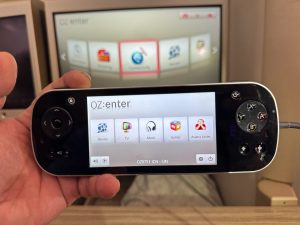
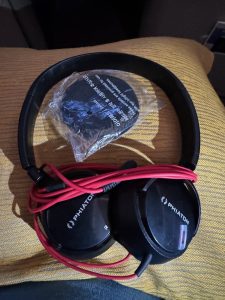
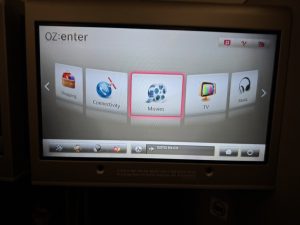
Asiana Airlines’ Business Smartium seats are equipped with a large 18.5″ personal monitor with touchscreen function. I thought the picture quality was mediocre, not sure if it was due to ageing. Although the screen does not have a tilting function, I was still able to watch movies on it while lying in bed mode. Asiana Airlines’ Inflight Entertainment is also equipped with an easy-to-use PSP-like IFE controller. The IFE controller primarily utilises the touchscreen function to manage the various entertainment options curated by the airline for its passengers. The headphones supplied by Asiana Airlines are comfortable to use, but the lack of noise cancellation functions meant we had to combat listening to the audio from the show we were watching with the ambient noise from the cabin and the engines throughout the flight. Asiana Airlines termed its entertainment system OZ:enter, where entertainment options are catalogued into Movies, TV, Music, Shopping and Connectivity. The Movie menu is further categorised into regions for faster selection. I’d say OZ:enter has a large variety of entertainment, from the latest Hollywood blockbusters to the latest Korean and Asian movies, as well as TV series that kept me entertained when I wasn’t sleeping.
Asiana Airlines Business Smartium seats are equipped with an 18.5″ touchscreen TV
Asiana Airlines’ Business Class IFE screen looks sharp
IFE controller is a PSP-like device which is easy to use
Asiana Airlines headphones does not come with noise cancellation function, but are comfortable to use
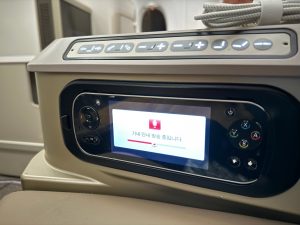
The IFE controller is stored under the seat controls
OZ:enter menu interface
Each OZ:enter menu has a sub-menu which makes it easy to find the show we wanted to watch
Meal
Asiana Airlines serves one meal throughout the 6-hour flight between Singapore and Seoul. Onboard these flights, apart from the main meal, the airlines also serve up instant ramen on demand to passengers who are peckish after the main meal. Meals include a choice of Korean and Western options.
SIN – ICN
The cabin crew serve meals about 1 hour after takeoff to maximise sleep time for passengers. For this leg, the menu comprises two Western options: Prawn Pasta and Braised Chicken, while the Beef Bibimbap is served under the Korean option. I chose the Korean option, where meals were served on beautiful Korean-patterned china. Meals were served course by course, and the stuffed cucumber with beef appetiser was delicious. The Korean main course came in a set with rice, soup, kimchi, and pickled quail eggs, accompanied by beautifully presented vegetables and stir-fried beef. The bibimbap did not disappoint. The Korean Gochujang harmonises the rice with the bowl of vegetables and beef. Fruits and Korean bean jelly, accompanied with rice crackers, were served as dessert. While I swapped my dessert with my friend, the fruits served were sweet and juicy. I was not given options to choose from the bread basket for the Korean option I chose. My friend opted for the Braised Chicken Western option and was presented with the bread basket for his selection of bread after the salad with salmon appetiser was served. I had a bite of the salmon and thought it was a little dry. The Braised Chicken main course was delicious and flavourful. I had my friend’s Oreo Tiramisu dessert, which was very tasty. Overall, I thought the Korean option was far tastier.
Business Class menu were distributed by the cabin crew after we settled into our seats
My appetiser of stuffed cucumber with beef
For the main course from the Korean menu, we were served beef bibimbap
Fruits for dessert served in a Korean printed china
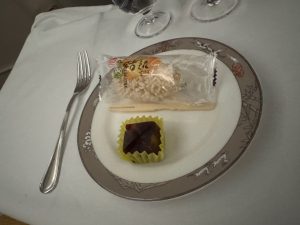
Chest nut and fried rice cake for dessert in the Koran menu
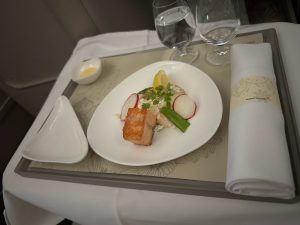
My friend started his meal with salad and salmon
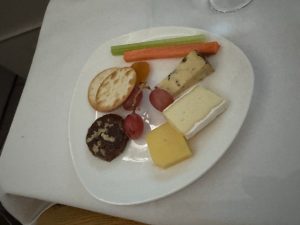
The cheese platter served as a dessert for the Western menu
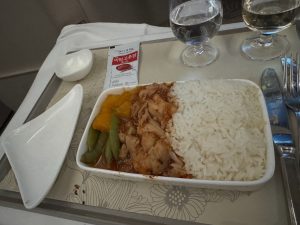
My friend opted for the braised chicken for mains
The Oreo cheesecake dessert from the Western menu
ICN – SIN
Meals were also served approximately 1 hour after takeoff. For this flight, grilled beef tenderloin and yellow curry chicken steak were the two main courses from the Western option that passengers could choose. As for the Korean option, Ssambap was the only option for dinner. I opted for the Ssambap, which is beef bulgogi served with rice, complete with kimchi, soup, and a cold steamed egg. The way to eat Ssambap is to wrap the beef in the many vegetable leaves that came with the meal, topped with rice and Gochujang. My Korean option meals began with eggplant as an appetiser, which is rich in flavour. The beef in the Ssambap was very well seasoned and tender, and the kimchi was very flavourful. For dessert, I was served fruits, followed by a Red Bean rice cake (which I exchanged with my friend for his dessert). My friend opted for the chicken curry Western option, and I sampled both the shrimp and the chicken. The shrimp in the salad tasted fresh, and the curry chicken was delicious and tender. I had my friend’s Cherry Blossom Cheese Cake for dessert. The cake is fluffy, but I did not taste any cherry blossom flavour.
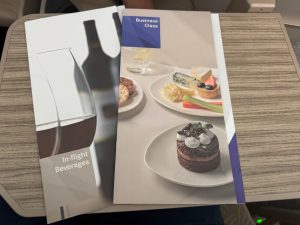
Business Class drink and food menu
The food options we had for this flight
I was served grill eggplant with vegetables as appetiser from the Korean menu
I had Ssambap for main course
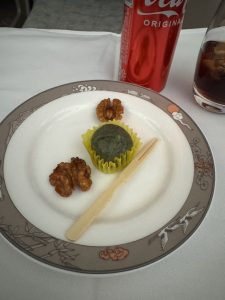
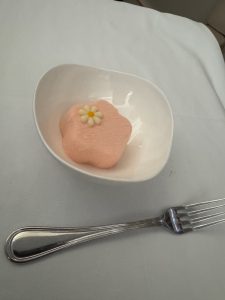
Red bean rice cake and walnut cookies from the Korean menu for dessert
My friend was served shrimp salad as a starter
The cherry blossom cheesecake from the Western menu was fluffy
Yellow curry chicken that my friend chose as a mains from the Western menu
Service
SIN – ICN
I found the service on this leg of the flight to be mediocre and unmemorable. The cabin crew came across as task-oriented, as if they were simply checking off whatever their SOP required. They are by no means rude or anything, but just felt a little scripted. We received the usual greetings at the door and were guided to the aisle for our seats. Cabin crew were not seen helping passengers to locate a spot for our bags, nor seen patrolling the cabin after meal service. Having said that, I observed the cabin crew was very responsive when I accidentally pressed the call attendant button. I’m not sure if it’s a practice by Asiana Airlines, but we were not served welcome drinks during boarding or warm nuts while meals were being prepared.
The slippers is the only inflight amenity that was given out in Asiana Airlines’ Business Class
ICN – SIN
The service for this leg is much better than my outbound leg. The cabin crew were always wearing their smiles, and nothing seemed too small to bother them. We were warmly welcomed by the cabin crew at the door and directed to our seats for direct access. When seated, another cabin crew member came by, introducing herself and providing a brief orientation of the cabin, including the location of the lavatories and where we could store our luggage. As Asiana Airlines’ A350-900 business Class cabins are not fitted with a centre overhead bin, and the one nearest to mine was all occupied. When I raised this issue with the cabin crew, she immediately put down her task and helped me find a space near my seat to place my carry-on. The cabin crew were very responsive to the call attendant buttons and immediately responded whenever I requested drinks and extra snacks. They were efficient in fulfilling my orders and always did it with a smile. Despite finding it weird, I liked how the cabin crew go around serving pre-landing drinks. Despite the efforts of the female cabin crew, the attitude of an elderly male cabin crew member, presumably the cabin manager, was less than desirable. He was hardly seen around the cabin, and when he popped out from his hiding, I hardly saw any smile on his face. When he goes around serving passengers, it seems that he does not want to be here. Fortunately, he stayed hidden most of the time, and we were able to enjoy the service from the rest of the female cabin crew.
Afterthought
Overall, I had a good flight with Asiana Airlines. The seats are comfortable, but I find them a little narrow, which might impede the sleeping position. My biggest issue with Asiana Airlines Business Smartium seats is the lack of storage space. There is only one small cubby hole that is already full when I store my mobile phone, cable, and charging cable. I thought Asiana Airlines wasted the space by having two seat pockets, when the space allotted to the seat pocket by the side table can be used to provide more storage for passengers. The food served onboard is delicious and of high quality. Services seem inconsistent across the two legs of my flights. Our outbound leg was served by cabin crew who had lukewarm interactions with passengers and were mostly out of sight, except when taking orders for our meal choices and serving food. The service for our inbound flight was much better, as the cabin crew were personable and approachable, always serving with a smile. I enjoyed my inbound flight better.