At the Airport
Incheon Airport
Security Clearance
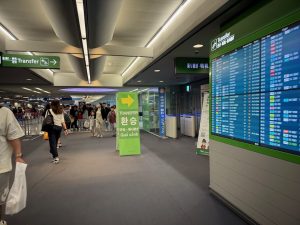
As this was a connecting flight from Singapore, and we were already checked through to Shanghai, we did not experience the check-in process at Incheon Airport. The security clearance for transit flights at Incheon Airport was very straightforward. We followed the crowd towards immigration, but instead of continuing, we took a turn at the transit door, which was prominently marked with bright green signs along the way. The security clearance process was very straightforward and took us 5 minutes to clear. After security clearance, we headed to the lounge.

SilverKris Lounge
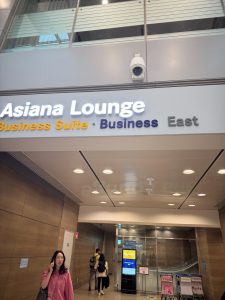
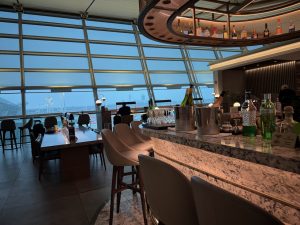
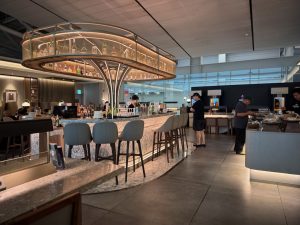
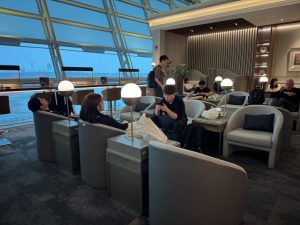
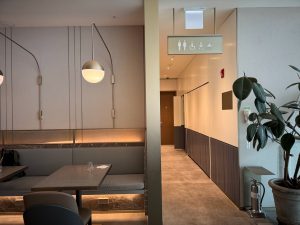
We had the option of either visiting the Asiana Business Lounge or the Singapore Airlines’ SilverKris Lounge, as Asiana Airlines is part of the Star Alliance network. When we visited the Asiana Lounge during our flight from Incheon to Singapore in March of this year (read about my lounge experience here), we found the lounge to be very disappointing. Therefore, we opted to use the Singapore Airlines SilverKris Lounge, located near Gate 29, instead. The main part of the SilverKris Lounge exudes a bright and airy feel, thanks to the use of white in the furniture and walls, as well as its placement next to the windows that look out onto the apron. The earthy colour used on the walls and the warm lighting exude a cosy vibe, while the marble used on the tables, buffet counter, and bar counters gives a luxurious vibe. The dining tables are mainly arranged against the walls in the lounge, while the lounging seats are arranged in the centre. The workstations, in the form of long tables with individual power outlets, were dotted around the lounge. The first thing that caught my attention was the bar island in the middle of the lounge, where cocktails and drinks were being made on the spot. The buffet counter, offering more options than the Asiana Lounge next door, features five hot food options and is located by the walls opposite the bar.

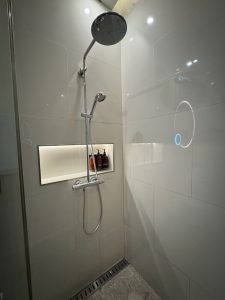
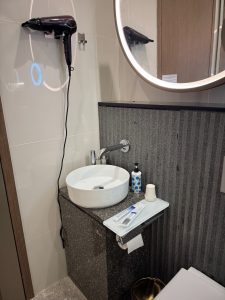
The SilverKris Lounge at Incheon International Airport is equipped with three shower rooms. These spacious shower rooms were equipped with a toilet and a sizeable walk-in shower. I like the bench in each shower room, which provided us with a space to place our carry-ons. There is also a beauty corner in the SilverKris Lounge where passengers can try out LED masks before their flight. However, I did not spot anyone manning this counter and am unsure if this service is still available at the time of my visit.



The Aircraft
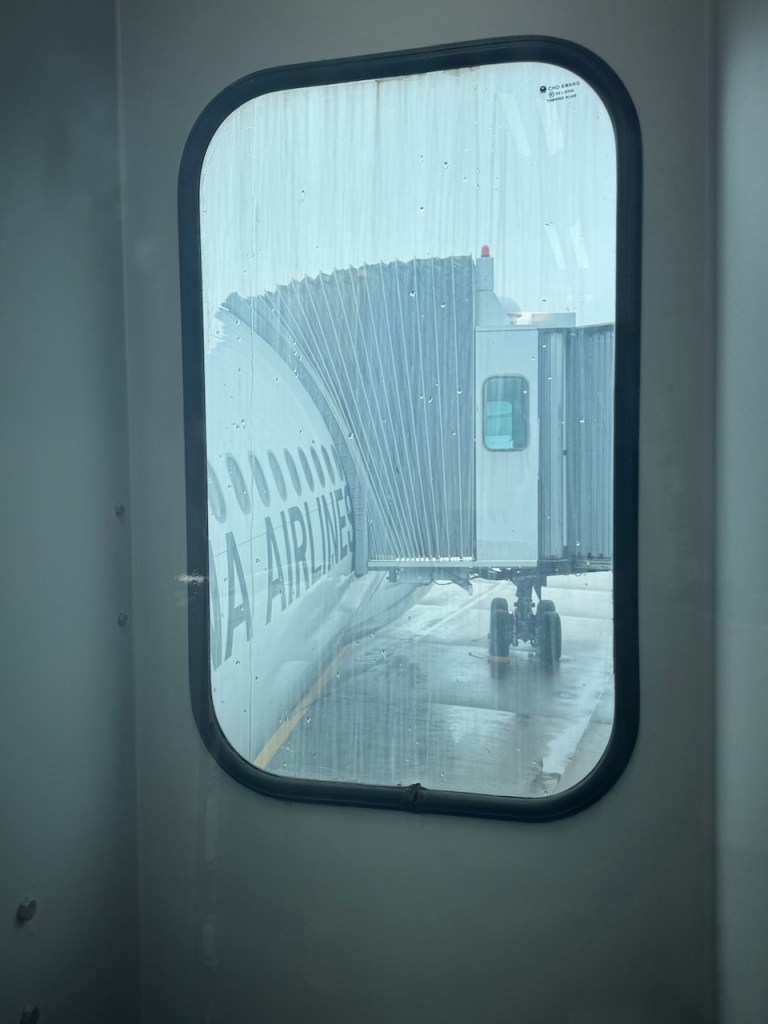
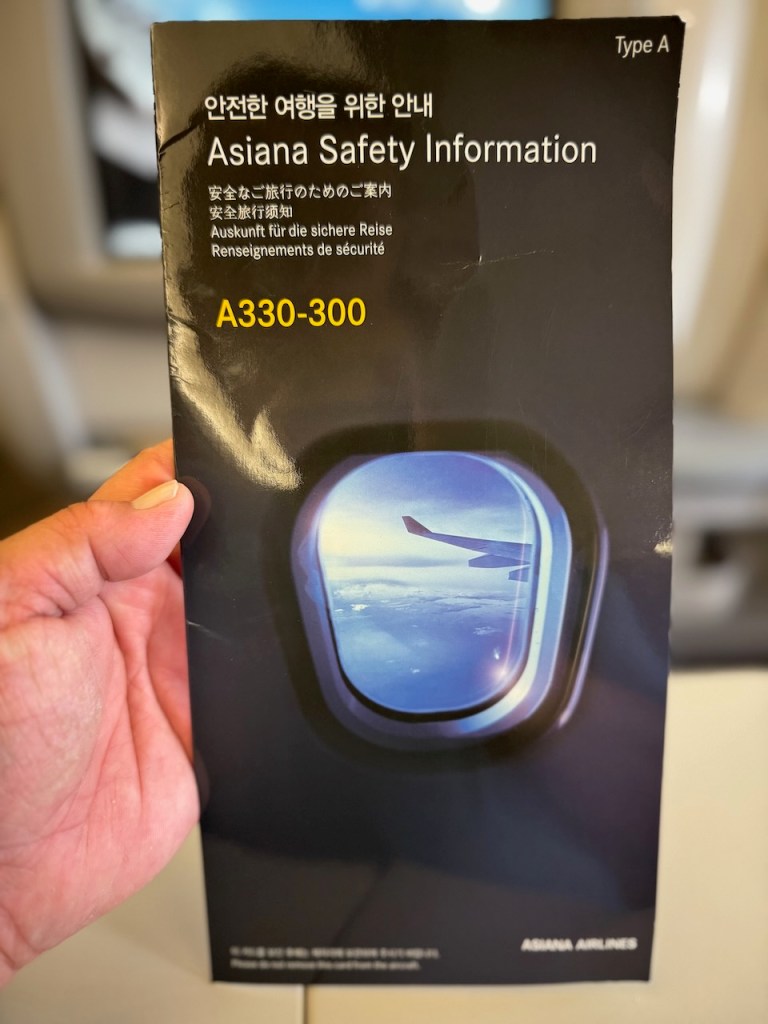
Asiana Airlines operate two types of aircraft between Seoul and Shanghai, the single aisle A320-300 and the widebody A330-300. We flew on the A330-300 aircraft for this flight.
The Cabin
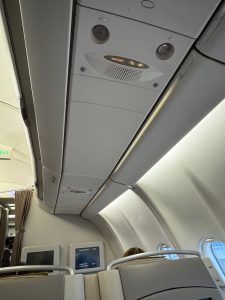
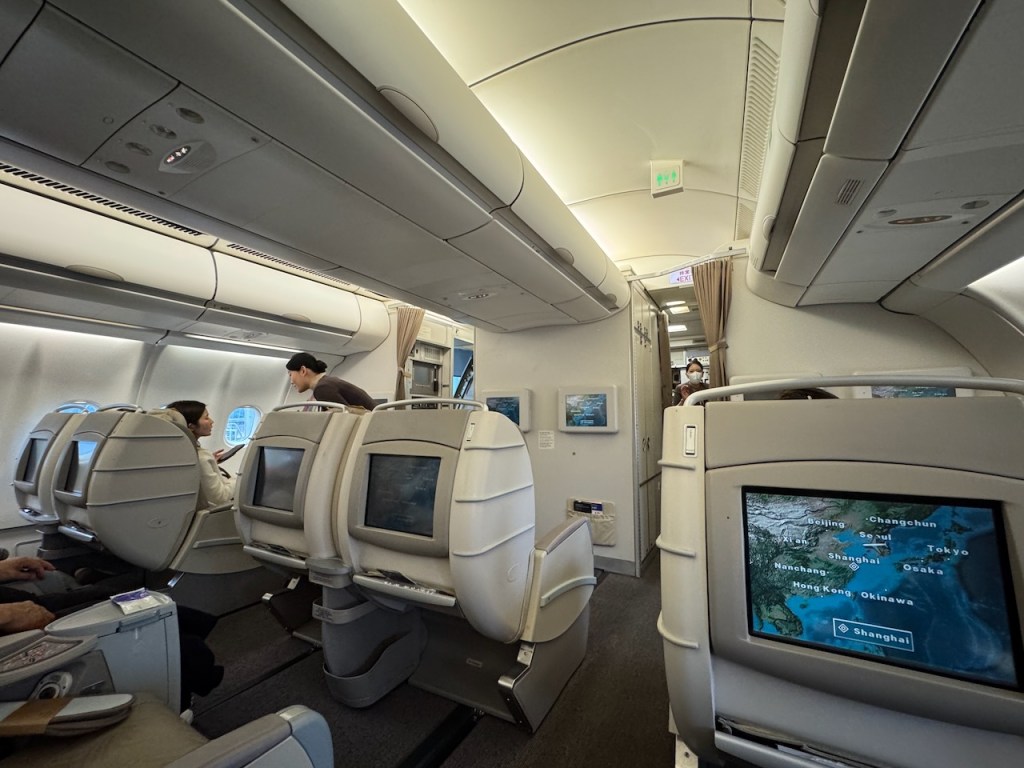
Asiana Airlines’ A330-300 Business Class cabin had a bright and airy feel, with a royal vibe. The seats in the cabin are decked in beige, which matches the cream-coloured seat shells. The headrest cover and pillows are adorned in yellow, a symbol of royalty and nobility in Korean culture. The airline chooses brown carpeting that matches the beige and yellow theme in the cabin. The cabin looked bright, thanks to the use of white lights. Asiana Airlines’ two-class A330-300 is configured with 30 Business seats in a single cabin and 286 Economy Class seats spread over two sections. The Business Class seats on Asiana’s A330-300 are arranged in a 2-2-2 configuration, which appears somewhat dated, as most airlines configure Business Class in their wide-body jets in a 1-2-1 arrangement.

Two lavatories serving the 30 Business Class passengers are located at the front part of the aircraft. The lavatories felt a little cramped, but I still found sufficient space to use the bathroom. The plastic materials used in the lavatory do not lend it a premium feel. I wouldn’t have thought this lavatory served Business Class passengers if not for the additional amenities such as dental kits, combs, and mouthwash on top of the L’Occitane hand lotion and facial mist.


The Seat
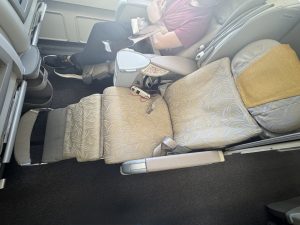
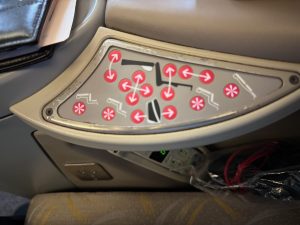
Asiana Airlines A330-300 Business Class seats have a pitch of 58″ and measure 21″ wide. As this is an older Business Class product, the seat can only be converted into an angled flatbed with a maximum recline of 170°. These Business Class seats come in three modes: upright, lounge, and flatbed. However, the seat control features four preset modes. There seem to be two lounge modes. In upright mode, the seat felt comfortable due to its thick padding. In flatbed mode, although not a true 180° flatbed, I did not experience any sliding effect due to the friction created by the fabric used in these seats. Lounge mode is my favourite mode, as it allows me to truly relax in the seat. The only difference between the two lounge modes is the angle of recline. There are numerous ways to configure lounge mode on Asiana Airlines’ A330-300 Business Class seats, rendering these two preset lounge modes somewhat redundant. We were able to adjust the seat to the desired angle and the extent of the calfrest extension using the numerous buttons on the seat control. There are even buttons to control the amount of lumbar support we want, which is unfortunately not available in the newer Business Class products.
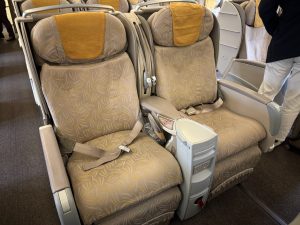
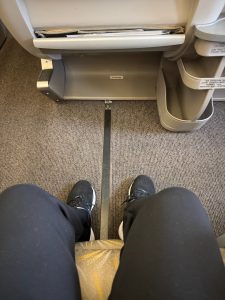

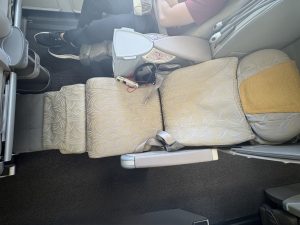
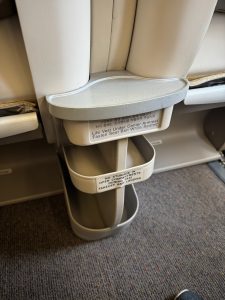
Storage is perhaps the biggest issue on Asiana Airlines Business Class flights, as I experienced during my previous flight on the A350-900 and this flight on their A330-300. However, I thought there was slightly more storage space in Asiana Airlines’ A330-300 Business Class. The only storage in these seats is limited to the small cubby hold underneath the inside of the armrest in the centre console. This small cubby hole is sufficient for me to place my passport, mobile phone and charging cables. Additionally, a two-tiered cubby hole is located in front of the seat, offering us more storage options. Passengers with tablets can stow them in the seat pocket during take-off and landing, which is sizeable enough to hold even a laptop. I did not find any space at the footwell to stow our carry-on due to the angled flatbed design of these Business Class seats. All carry-on items would have to be placed in the overhead bin.
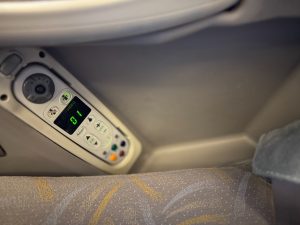

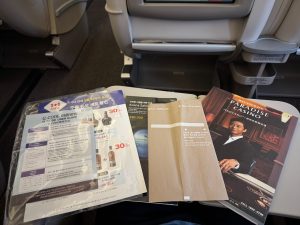
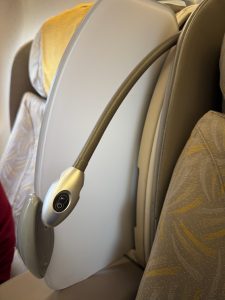
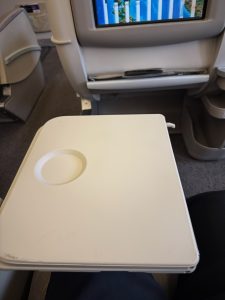
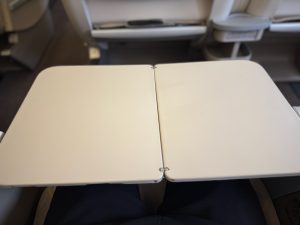
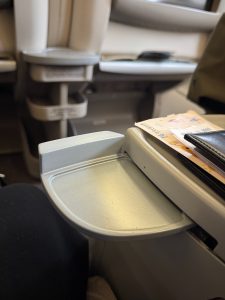
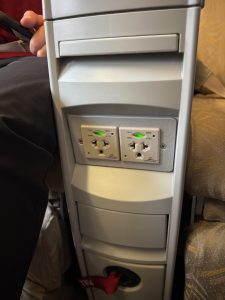
On top of the overhead reading lights, Asiana Airlines’ A330-300 Business Class seats are also fitted with a reading light between the two seats, which I find redundant. The brightness of these reading lights can be adjusted, but to turn them off, we had to cycle through all the lighting brightness settings. The seat table is stowed in the armrest and folded in half when in storage. It is quite large and sturdy when fully deployed, allowing passengers to work on their laptops. Apart from the seat table, Asiana Airlines designed two cocktail tables into their A330-300 Business Class seats. One uses the space on top of the armrests between the seats, and another is a flip-out small table located in the centre console between the seats. As an older aircraft, Asiana Airlines’ A330-300 Business Class seats did not come fitted with any USB charging ports, so we would have to rely solely on the international power outlets in the centre console to charge up our lifestyle devices.

Inflight Entertainment
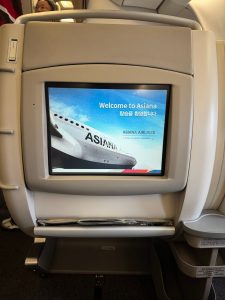
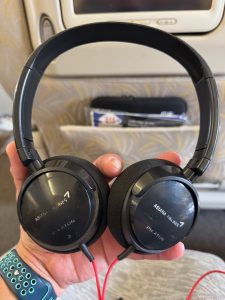
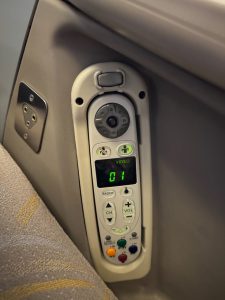
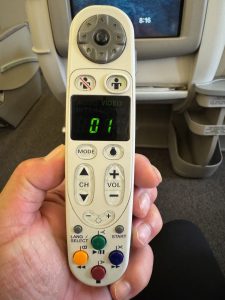
Asiana Airlines’ A330-300 Business Class seats are equipped with a 15.4″ personal TV. The picture quality on these IFE screens is quite bad and grainy. Despite the poor picture quality, we were still able to watch shows on OZ:enter. As these are the older Business Class product, these Business Class personal TV screens do not come with touchscreen functions, and the selection of our choice of entertainment requires us to use the IFE controller. These IFE controllers have buttons to choose the entertainment and a phone on the back. The headphones that Asiana Airlines provides to its Business Class passengers look rather cheap. Despite their lack of noise-cancellation functions and cheap appearance, these headphones are quite comfortable to use. OZ:enter, Asiana Airlines’ IFE system, is stocked with entertainment options ranging from the latest Hollywood blockbusters to TV shows from yesteryear. Despite its aged appearance, the entertainment options are well-organised, arranged in five main menu options and further segregated into sub-menus, making it very easy to search for our preferred entertainment options. There is also no Wifi on Asiana Airlines’ A330-300 aircraft.


Meal
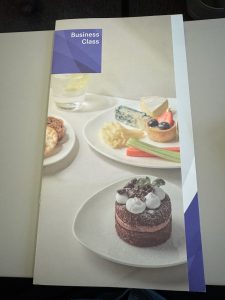
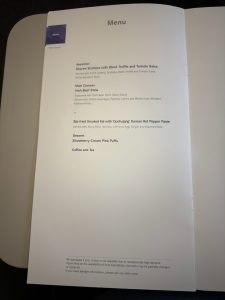
Asiana Airlines provided a full three-course meal, served in one setting, to all their passengers despite the short 2-hour flight time. Similar to my previous experience in their Business Class, we were also given two options for today’s breakfast: Beef Stew for the Western option and Smoked Eel with rice for the Korean option. I opted for the Korean main course option. The seared scallop appetiser was fresh and well-seasoned with a hint of ocean freshness, and the Strawberry Cream Puff dessert was delicious and not overly sour. However, I can’t say the same for the Smoked Eel main course. The eel tasted flavourful with the Gochujang sauce, but it was a little rubbery and tough.

Service
The only amenity available for this short flight is a pair of slippers and a couple of wet wipes, placed on our seats. Pillows and blankets are only available on request. As with my previous flight, Asiana Airlines did not serve welcome drinks to their Business Class passengers during boarding. However, the service onboard this flight is much better than my experience on the previous flight we just got off. The cabin crew were much friendlier and more willing to assist passengers. Apart from the standard greeting at the door, distributing the menu and taking orders for our choice, the cabin crew was observed to go above and beyond the standard procedures. They were seen ready to guide passengers to their seats and render assistance to passengers with stowing their luggage in the overhead bin. The cabin crew were seen working as a team, like clockwork, elevating each other’s work so that passengers could receive the service befitting of Business Class. I was pleasantly surprised when the cabin manager went around the cabin introducing herself to every passenger and thanking us for flying with Asiana Airlines. This is something we no longer see today, even among the highly acclaimed so-called 5-star airlines. The cabin crew were observed to be diligent and frequently patrolled the cabin, checking if passengers required any assistance. They were also efficient when it came to distributing meals and ensuring they had sufficient time to finish.

Afterthought
The Asiana Airlines A330-300 is an older aircraft, but its thickly padded seats and a variety of seating positions, customisable to every passenger’s needs, made flying this aircraft on a short-haul route very comfortable. It did not bother me that the seats did not recline to 180°, as we did not use that mode due to the short 2-hour flight time. The catering was a mixed experience, while the appetisers and desserts were tasty, the Korean main course was tough and rubbery. The service onboard is the best I have experienced on Asiana Airlines so far. Cabin crew were observant and appeared to be ready to assist passengers.