Having a heavy day visiting four major sights in Cairo yesterday, our itinerary is lighter today, with only one sight to visit, the Karnak Temple. We would have the whole afternoon relaxing while cruising down the River Nile on our River Boat, which we called home for the next seven days.
Karnak Temple – The Largest Temple Built by Men
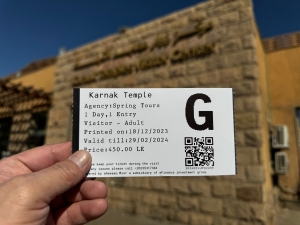
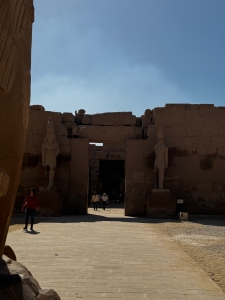
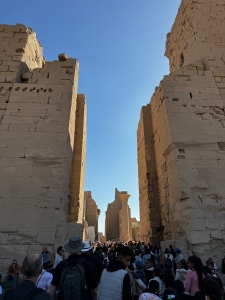
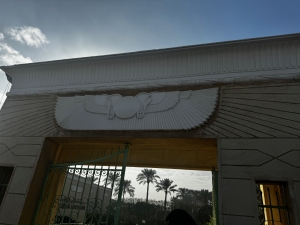
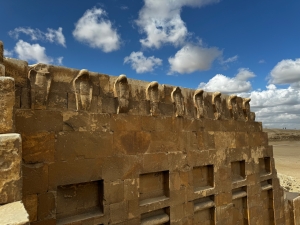
The main entrance to Karnak Temple
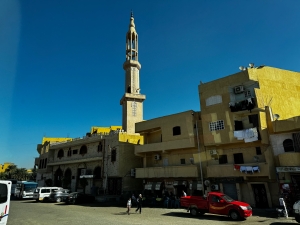
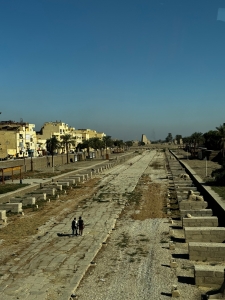
After an uneventful 1 hour domestic flight from Cairo to Luxor, we immediately started our day with a visit to Karnak Temple, the only item planned for the day. After collecting our luggage, we whizzed off to Karnak Temple on the bus with our luggage. Karnak Temple is about a 20-minute drive from Luxor Airport. Along the way, Ahmed directed our attention to the Avenue of Sphinx, which connects Karnak Temple to Luxor Temple.
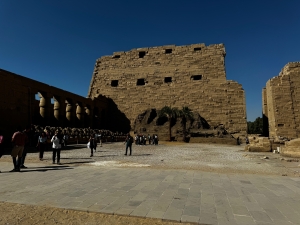
The Courtyard
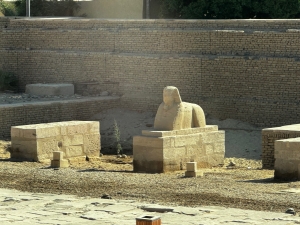
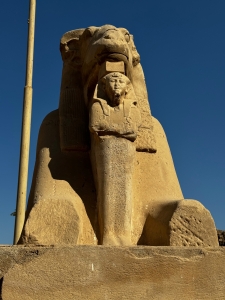
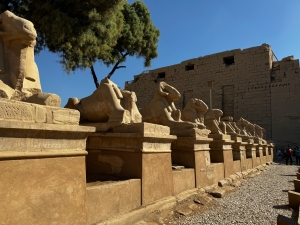
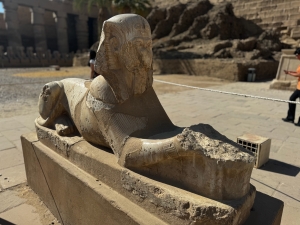
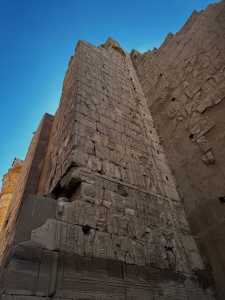
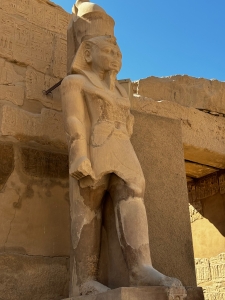
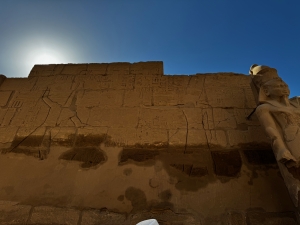
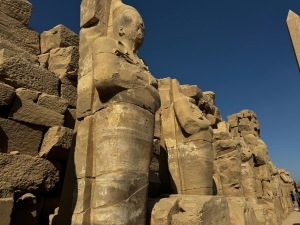
Karnak Temple was dedicated to the Egyptian God Amun, who brought the sun, light and creation to the world. Amun was also revered as the chief protector of the pharaohs of Egypt. The temple was built over the rein of several Egyptian kings, each adding to the size of the temple to what we see today. We crossed a bridge filled with Sphinxes lined up on both sides like guards welcoming the king. Each Sphinx was immaculately created, leaving no details behind. Despite some being defaced, we can still feel the solemnness exuding from these Sphinxes. We passed a couple of high walls, the first pylons to the temple, and arrived at the courtyard of the Karnak Temple. Ahmed pointed to the holes on the pylon surface and explained these were the windows to the chambers of the guards and people who served the temple. In its unfinished state, the pylon already looks as though it is soaring into the sky; I can’t imagine how tall this pylon will be when completed. Our attention was then shifted to the Sphinx statues lined up at the sides of the courtyard. Unlike those we saw in Giza, these Sphinxes (and those on the bridge we crossed) have a ram head instead of a human head. The ram-headed Sphinxes told visitors the temple is dedicated to the God Amun. Our attention shifted to the statue standing tall next to the inner pylon. This is a statue of Rameses II, with his wife depicted as a small statue standing before him. Ahmed explained that the king’s stature stood tall at the temple entrances but would gradually get smaller as we approached the temple’s Sanctuary. This is to signify the presence of the gods humbles the Pharaohs.
Hypostyle Hall
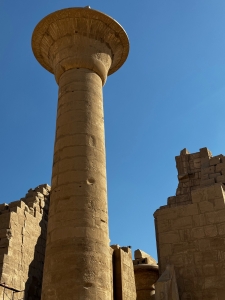
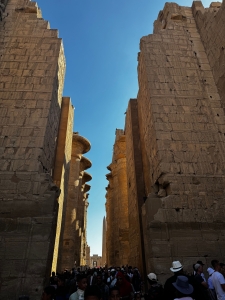
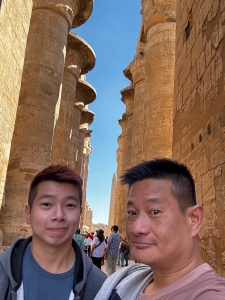
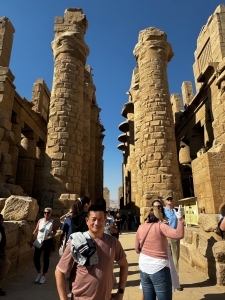
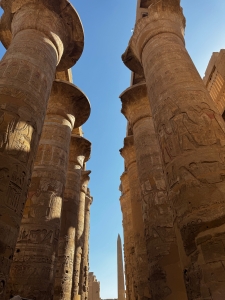
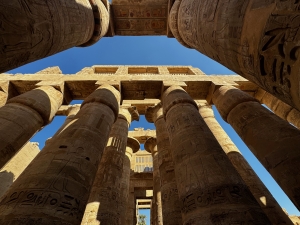
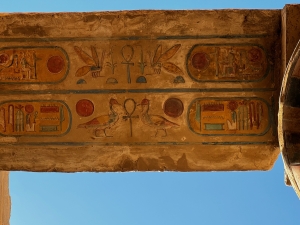
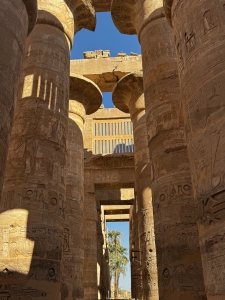
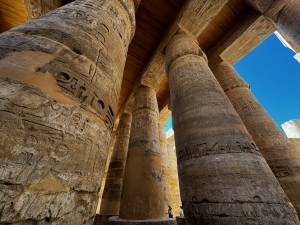
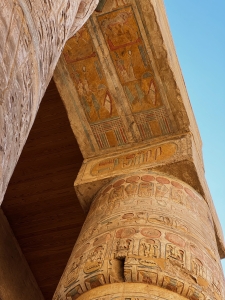
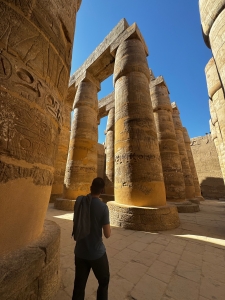
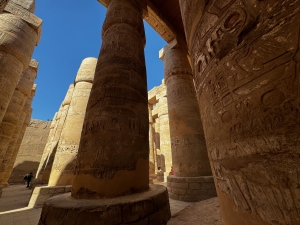
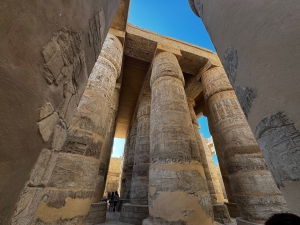
Passing through the second pylon, we arrived at the hypostyle hall, essentially a hall of pillars which would have supported the temple’s roof in its heyday. Unlike the one we saw at the Step Pyramids in Saqqara, the hypostyle hall here in Karnak Temple was on a much larger scale. Ahmed guided our sight to the top of the columns and explained that the colours we saw were original since the temple was built. We could see the vibrant colours adorning the top part of the pillars that survived the millenias as though they were painted yesterday. Each pillar has intricate carvings depicting scenes of religious ceremonies and rituals performed by the pharaohs, priests and gods. Ahmed shifted our attention to the grill-like stone structure at the top of these pillars and explained these grills were not randomly placed there but were designed by the builders to allow sunlight in to illuminate the hypostyle hall. I can imagine how dark it would be when this hall was covered with its thick stone roofs, these grills would provide sufficient illumination to the hall.
Obelisk of Hatshepsut
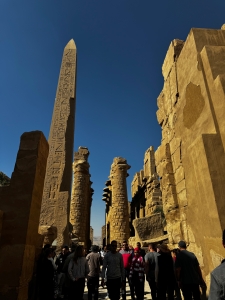
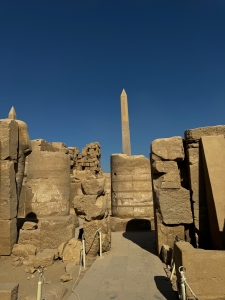
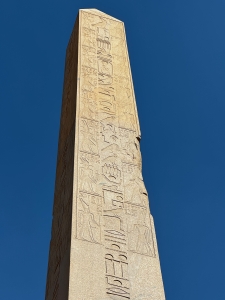
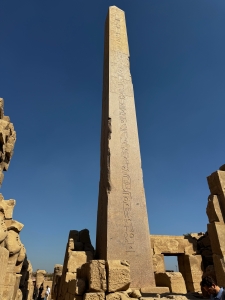
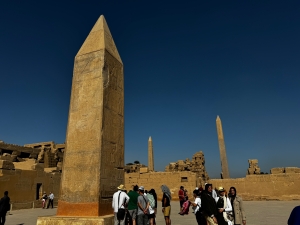
We were guided through the massive columned hypostyle hall to an open area with several Obelisks. There are a total of about 20 obelisks being erected in Karnak Temple, but only three remain standing today. Ahmed pointed to one particular obelisk and told us this was erected by Queen Hatshepsut, pointing out the hieroglyphs inscribed on the stone structure. This is the tallest standing obelisk in the entire temple, which has stood the test of time, standing unwavering to the elements for more than 3,700 years. Hatshepsut erected two obelisks; one fell and was displayed near the sacred lake.
Sanctuary
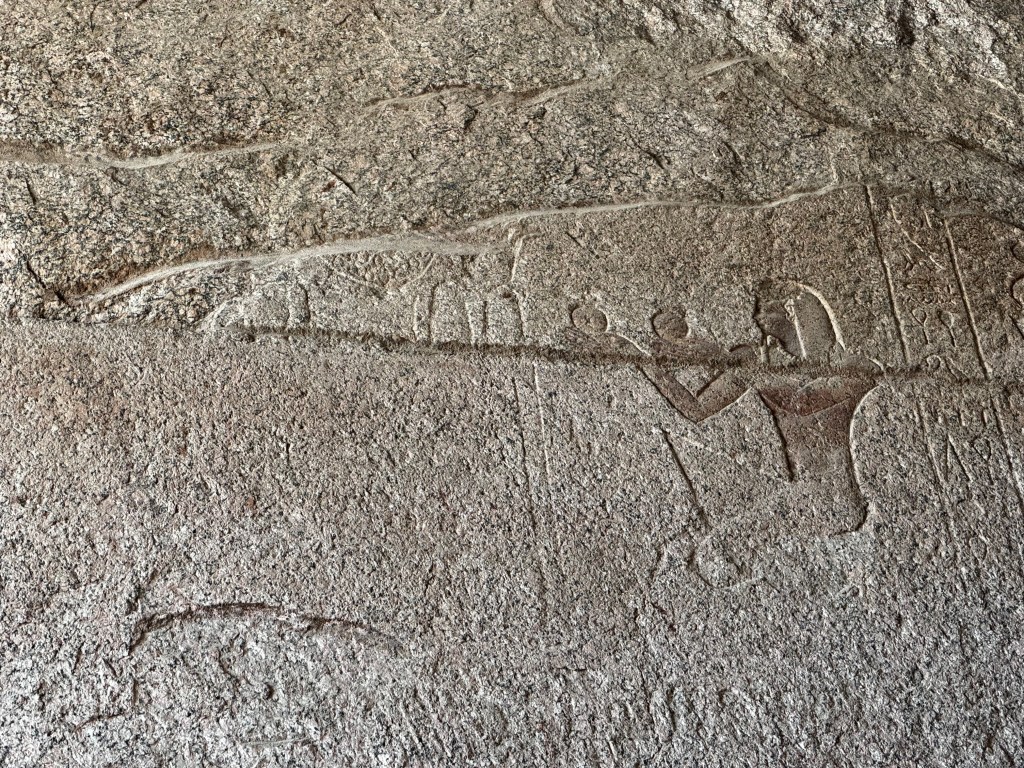
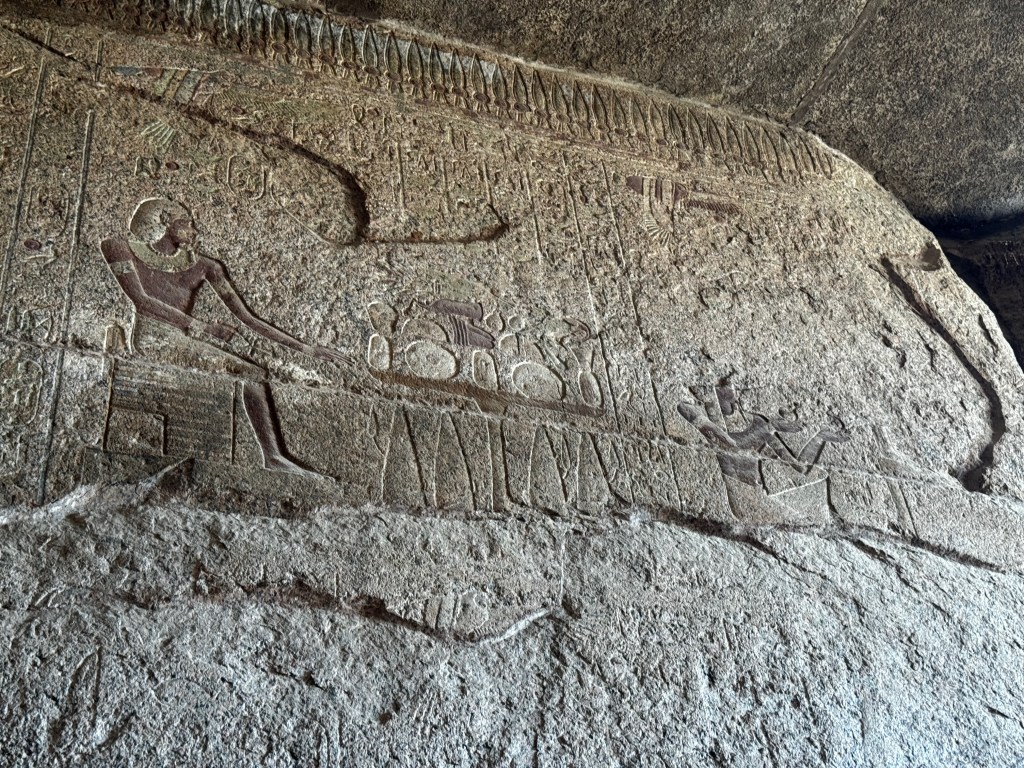
Passing Queen Hatshepsut’s obelisk, we were led into a small stone building – the Sanctuary, where the reining pharaohs worshipped Amun. Today, this small, dark room was empty. However, reliefs on the walls of the Sanctuary tell the tale of the pharaoh worshipping Amun. We were given about 30 mins to walk around, explore the rest of Karnak Temple, and take pictures.
Ramesses II performed rituals to Amun.Scenes in the Sanctuary depicting Ramesses II perform rituals to Amun
Sacred Lake
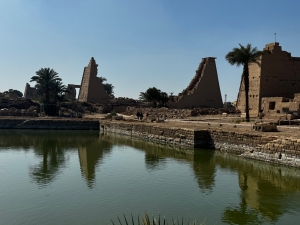
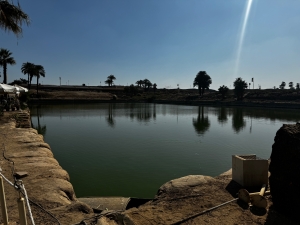
Our first stop is to head to the Sacred Lake. We were here for the cafe to get some drinks (not because we wanted to visit the lake). The Sacred Lake is a huge rectangular pool of water that seems man-made. This lake was significant as the priests would purify themselves daily before rituals. A large stone scarab sitting on a stone pillar was placed next to the Sacred Lake. Ahmed told us about the local urban legend that walking three times around the scarab will make one rich, five times bring one good luck, and seven times to bear children. I am sure there are other parts of Karnak Temple that we did not visit; however, those that Ahmed brought us through were the significant parts. We headed back to the hypostyle hall for more pictures before braving through the gauntlet of vendors at the exit to meet with the rest of the group.
Relaxing Cruise on the Nile
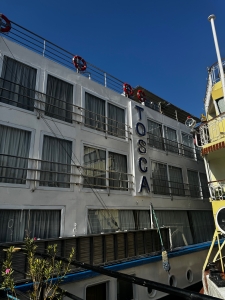
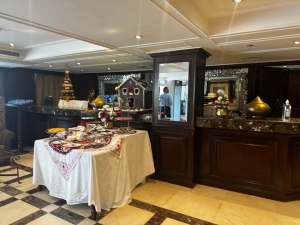
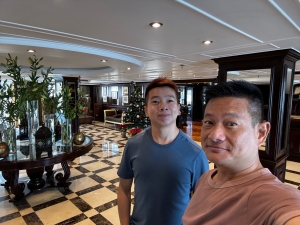
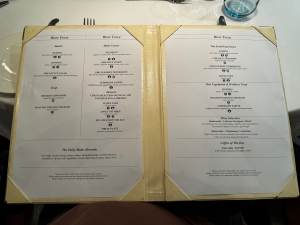
Karnak Temple was the only sight we saw today. Leaving Karnak Temple, we were driven to our riverboat through Luxor City and into a quiet neighbourhood by the Nile, where our riverboat docked. We were warmly welcomed by the staff member who passed us our keycard and brought us to our cabin. We took some time to orientate ourselves in our cabin and the sundeck on the boat before heading for lunch. Lunch was served in buffet style, with mainly Western options.
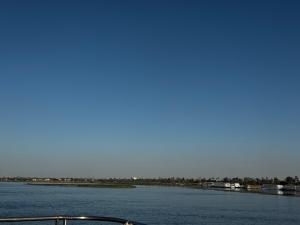
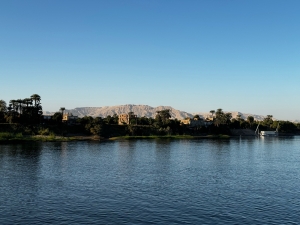
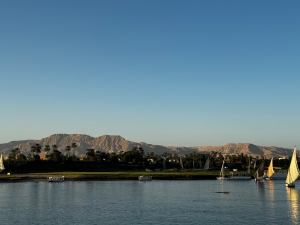
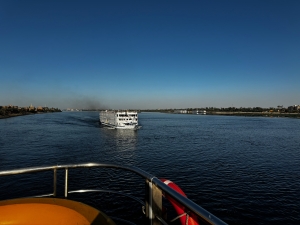
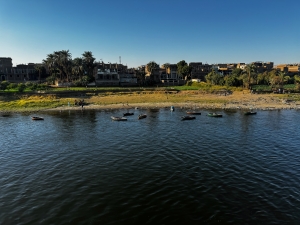
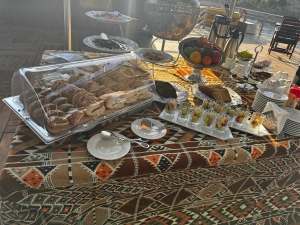
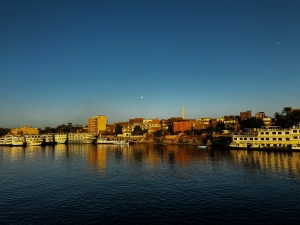
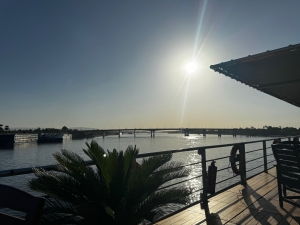
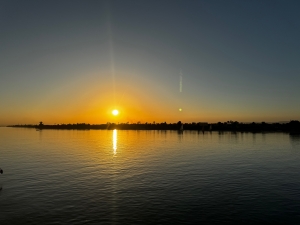
We headed back to the sundeck to enjoy the leisure cruise on the River Nile. The calm waters and gentle breeze blowing into our faces as we cruise the Nile made it feel relaxing. There was no hooking of cars, no noisy chatters; all we heard were the sounds of the wave gently hitting the boat. We saw how the locals use the Nile for their daily life as we were sailing: going about fishing on the Nile, playing on the banks of the Nile, and a few other riverboats cruising on the Nile. We were on the sundeck, soaking up the atmosphere and peacefulness on the Nile. We got ourselves a few finger food and coffee from the refreshment table the crew set up and continued enjoying the Nile’s tranquillity. The boat made a U-turn at a bridge and returned to where we came from. We watched the sunset over the west bank of the Nile on one of the sundeck chairs placed at the pool area of the deck and our day ended with a sumptuous welcome dinner.
It was the first official day of our trip today, and it was a heavy day full of site visits. So, this will be a long post. We met up with our tour director, Ahmed, an Egyptologist and the rest of the tour group. Ahmed told us that he made some changes to the schedule as it would make more sense to visit Memphis first to set the context and bring us through the historical timeline of ancient Egypt.
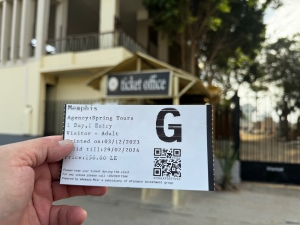
Memphis – The First Capital of Egypt
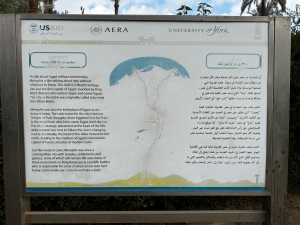
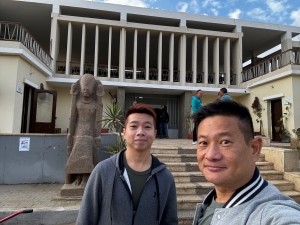
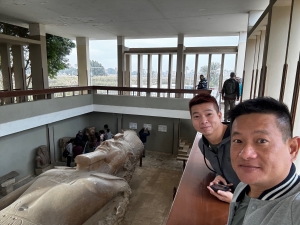
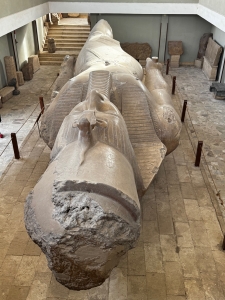
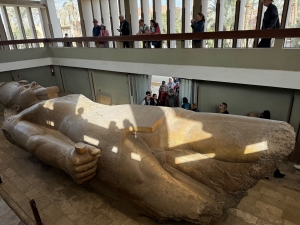
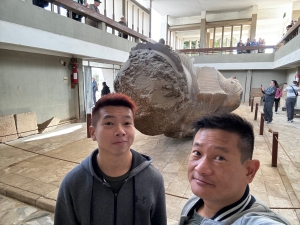
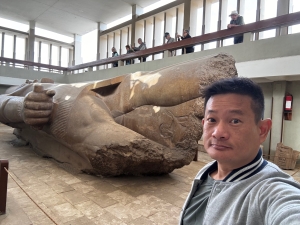
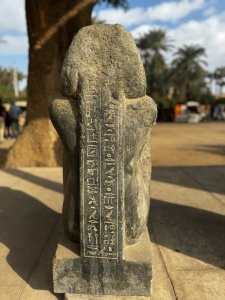
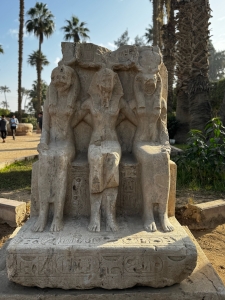
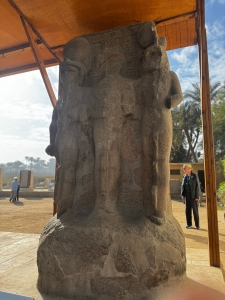
Memphis is essentially a relatively small plot of land with one single building. Memphis was the first capital of Egypt, where Ramesses the Great, aka Ramesses II, ruled Upper and Lower Egypt. This was once the capital of Egypt. Memphis was a metropolis with walls surrounding the city centre during its heyday. Today, we only saw farmlands and a plot of land surrounded by a single metal fencing. We were brought to the lone building, a stone’s throw from the main entrance. Ahmed explained Memphis was where the statue of Ramesses II was uncovered. This place used to be an open-air museum, with this colossal statue exposed to the elements. The building we were standing in was built later to protect the statue from the elements.
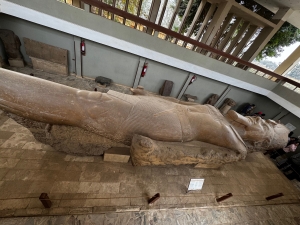
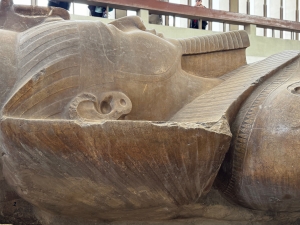
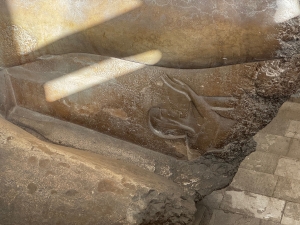
We were brought to the second floor of the building, where Ahmed brought our attention to the large statue with broken lower limbs and its weapons missing. This is the statue of Ramesses II. His facial features and some of the detailed engravings are still visible. The hilt of the weapon on the waist of Ramesses II was tilting to the right, meaning the king could only draw his weapon with his left hand. This is significant because Ramesses II was a benevolent ruler who would only resort to force as a last option. Ahmed narrated the significance of the false beard on his chin, which was braided with the hairs of his forefathers to signify wisdom. The straight beard on the chin of Ramesses II also meant this statue was made when the ruler was alive. We were also told to look out for the engravings of Nefertari, Ramesses II’s queen, on the inner thigh. Before giving us free time to wander in the rest of the museum, Ahmed reminded us about the world’s second-largest Sphinx displayed in the courtyard.
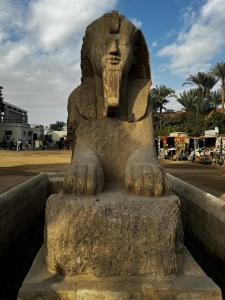
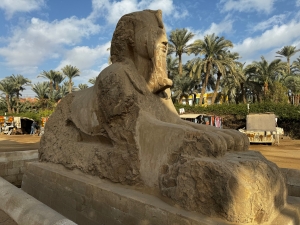
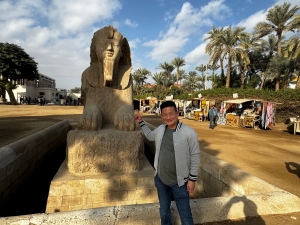
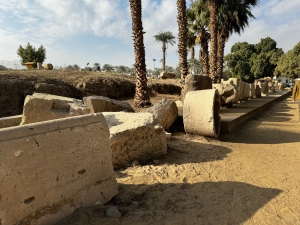
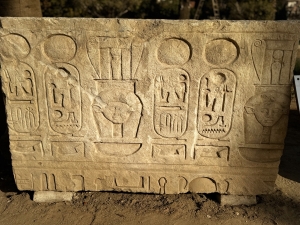
When we saw the Sphinx, we disbelieved that it was the world’s second-largest Sphinx, after the Sphinx at the Great Pyramids. From the looks of it, it did not strike us as large. The facial features on the Sphinx are still very clear, and the body is still intact, as though it was being produced yesterday. The rest of the courtyard was dotted with ruins and some whole statues, as though the Egyptologists were still trying to figure out which part of the puzzle these fit into. I thought the Ramesses II statue and the Sphinx were the two items worth looking at in Memphis. However, without a guide, it would be difficult for anyone to understand the significance of these statues.
A Short Stop at the Carpet School
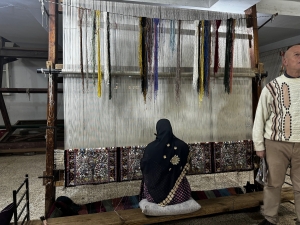
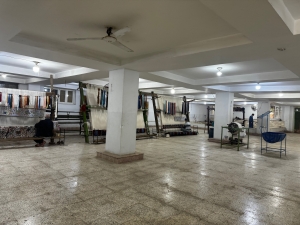
Our next destination after Memphis was the carpet school, where we were shown the different techniques used to weave a carpet. A student will spend three years on average on the most basic carpet technique before moving to more complex techniques. This carpet school also provided a skill set for the locals to gain employment. I was impressed by the speed and the time it took to weave just a simple design, let alone a more complex, dual-sided carpet. We were given a chance to purchase some carpets after the brief.
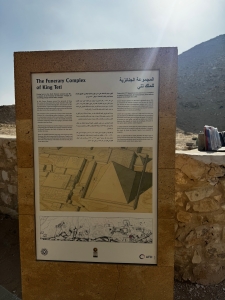
Pyramid of Teti – The Most Well-Preserved Tomb of a King
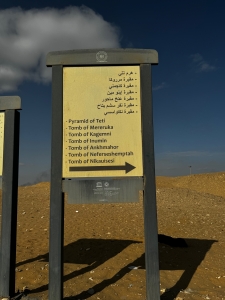
We were driven back to the deserts after a 30-minute stop at the Carpet School. Ahmed told us he would bring us to a bonus spot to see the interior of a pyramid. I liked how Ahmed was straightforward in telling us not to waste money to enter the crypts of the Great Pyramid as the tombs were not as well preserved, and there were no inscriptions on the walls. This tomb he will bring us still has the inscriptions and did not incur additional charges. As we drove up a plateau, we could see the distinction in vegetation in the surroundings. Below us was filled with lush greeneries, while the plateau we were on was desert with no signs of life. Ahmed indicated the spot we were in was the start of the Great Sahara Desert that stretches across the African Continent to the Atlantic Ocean. We saw the step pyramids and some piles of rocks as we were driving towards the carpark. According to Ahmed, the pile of rocks we saw were all pyramids but were blasted by an English explorer in search of the pharaoh’s treasures. It is a shame that these tombs were destroyed for one man’s greed.
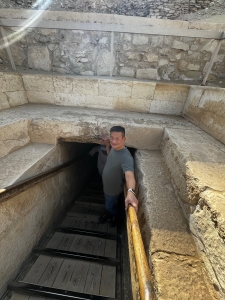
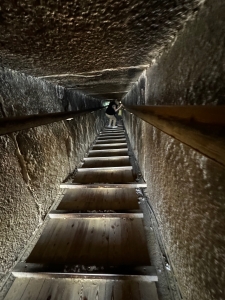
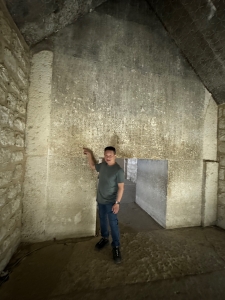
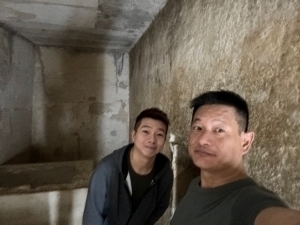
There is only one path from the carpark to the pyramid’s entrance. Despite being destroyed by explosives, we could still make out the general shape of the pyramid from the pile of rocks that sat above its entrance. A small door with a ramp leads to the interior of the pyramid with a gentle recline, but transversing the dark ramp, which was only illuminated by the light from the entrance and some lights in the chamber below, would require one to do a 90° bend. Definitely not for those with claustrophobia. A small room with lots of headroom awaits us at the end of the tunnel. This room has no inscriptions on the walls, making it difficult for anyone to determine who owns the tomb.
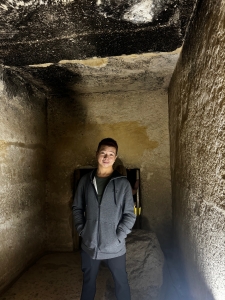
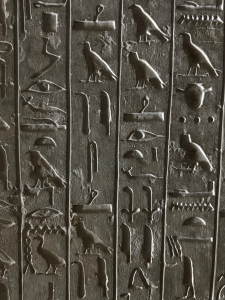
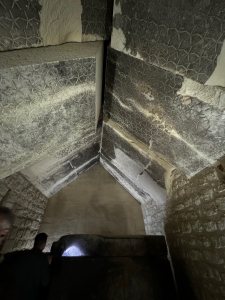
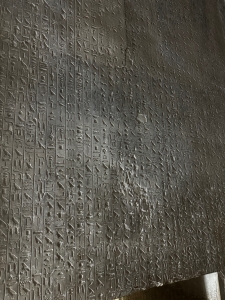
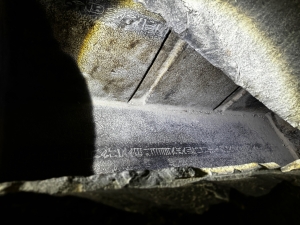
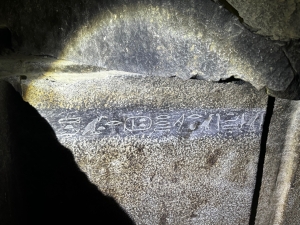
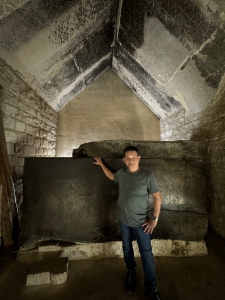
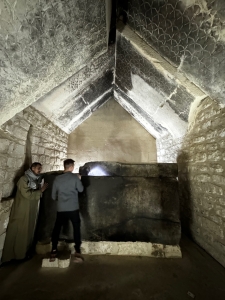
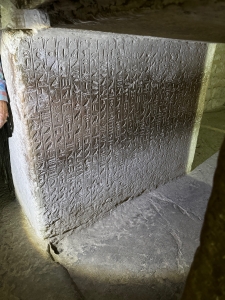
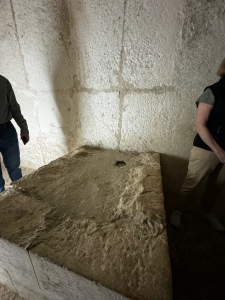
There are two small doors on either side of the room. It was amazing how the pyramid builders filled these two small corridors with hieroglyphic inscriptions. We were led through one of the small doors to the main chamber, where a sarcophagus sits at the end of the room. This would be where King Teti’s coffin was discovered. The roof of this chamber was engraved with stars as though allowing the late king to look into the night sky, and the walls were filled with hieroglyphs. The amount of hieroglyphs was massive, each detailing the life events of the late king. The exterior of the sarcophagus was simple; the staff at the tomb pointed out the hieroglyphs inside the sarcophagus, which had the name of the king engraved in hieroglyphs. We were led into the other door from the main chamber, which would store all the offerings for the king. This is a much simpler room with no hieroglyphs engraved into the walls. It is an amazing experience to have been able to enter a pyramid and see the well-preserved burial chambers of an Egyptian king.
The Step Pyramid of Saqqara – Predecessor of the Great Pyramids
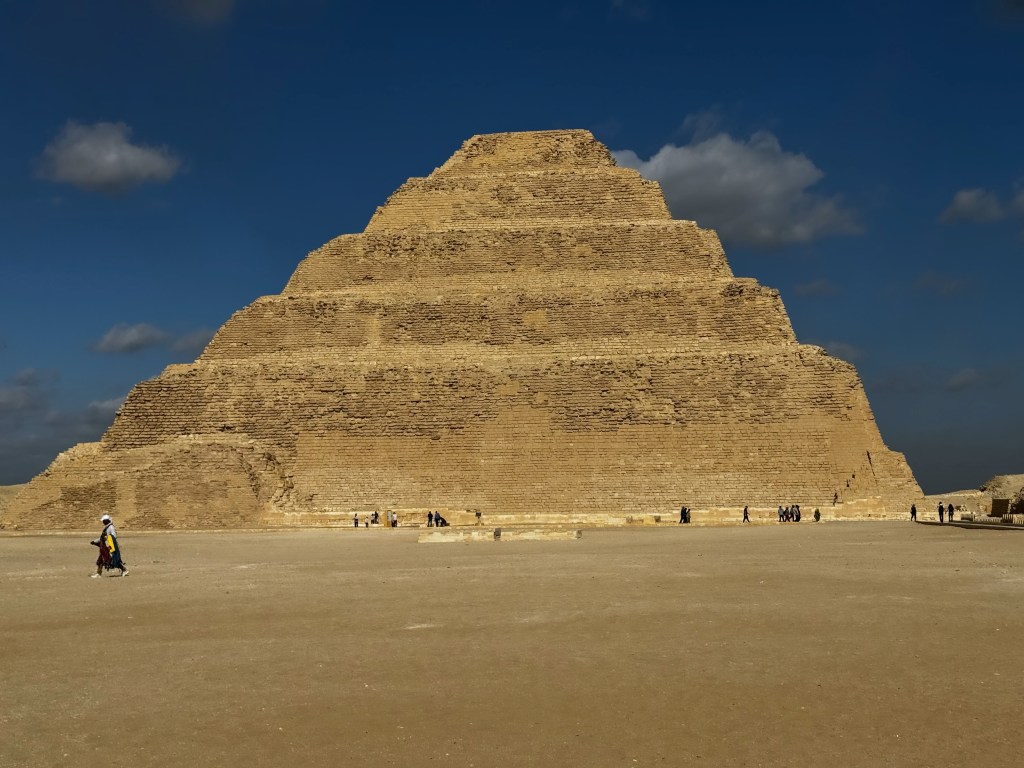
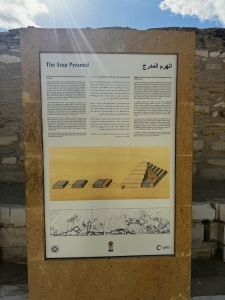
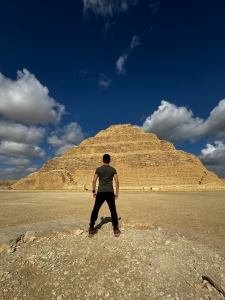
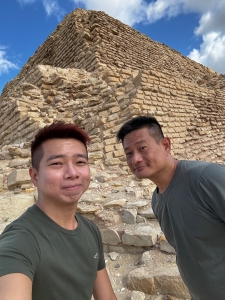
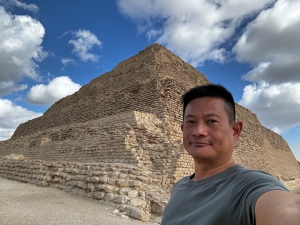
The Step Pyramid of King Djoser
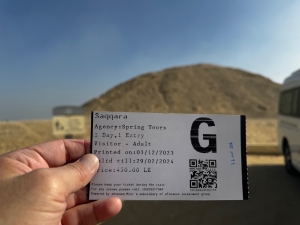
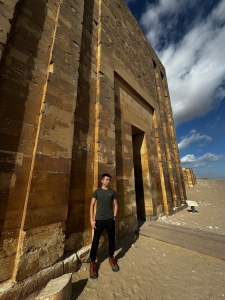
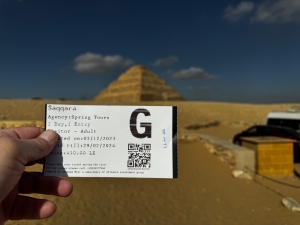
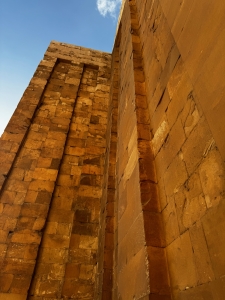
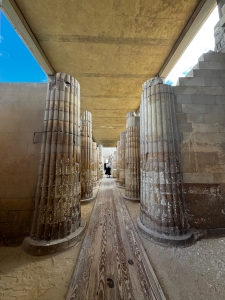
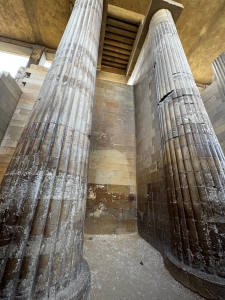
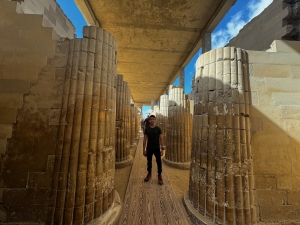
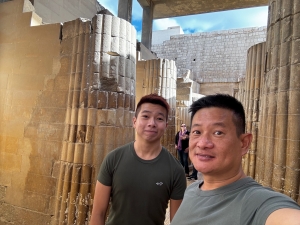
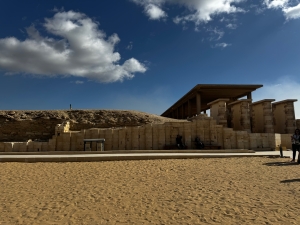
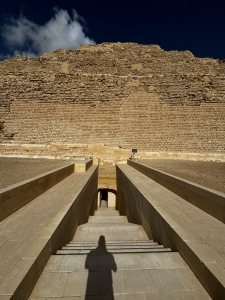
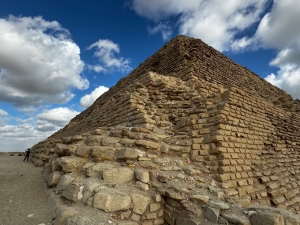
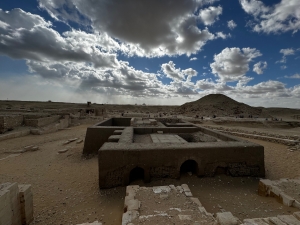
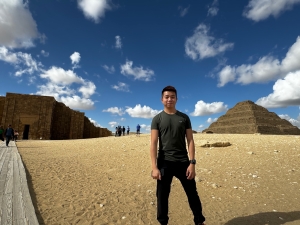
Our next stop is the Step Pyramid of King Djoser, a 5-minute drive from the Pyramid of King Teti. Before entering the complex that leads to the Step Pyramid of Saqqara, Ahmed led us to the complex’s exterior. He explained the wisdom of the ancient Egyptians and their smart engineering principles when building the pyramids and the buildings. All these buildings were built at about 80° inwards, so when an earthquake hits, these buildings stay intact as the force of the stone blocks acts against each other to prevent collapse. Ahmed led us into the complex building through a corridor with columns with a brick wall extending to the back wall, forming 24 individual semi-open spaces. Ahmed explained that these semi-open spaces were chambers used to install statues of the gods worshipped in each state of Egypt. During its heydays, this corridor will be filled with statues of gods.
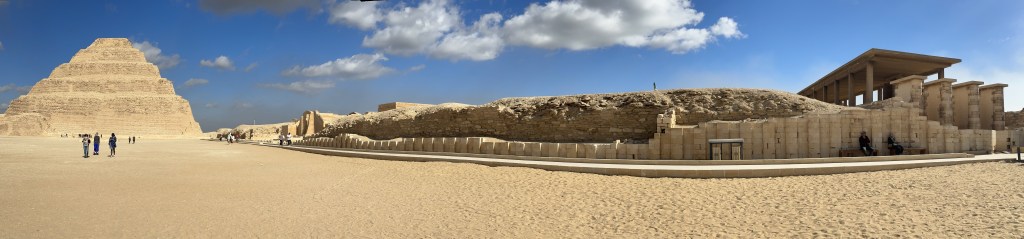
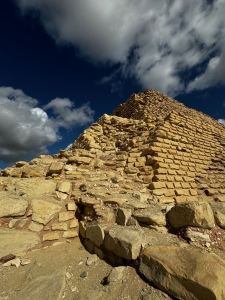
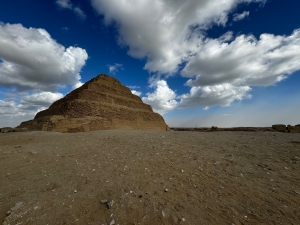
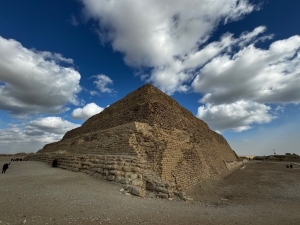
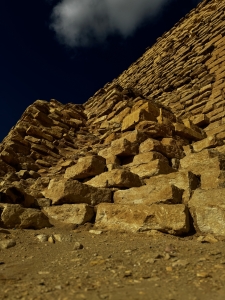
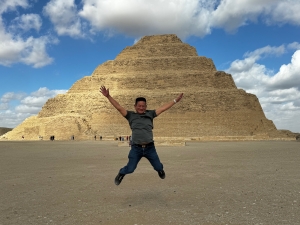
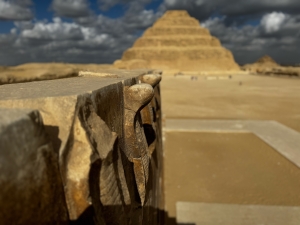
At the end of the corridor, we came to a huge open space, where the Step Pyramid of King Djoser sits at the back of the courtyard. This 4,700-year-old Step Pyramid is the oldest pyramid built by the ancient Egyptians, whose chief architect was Imhotep. Ahmed explained that traditionally, the pyramids were built in time for the death of kings, and the original Step Pyramid was smaller in size. However, when the Step Pyramid was completed, King Djoser was still healthy. Imhotep was an ambitious architect who wanted to challenge himself by building a larger pyramid. Instead of tearing down and rebuilding, Imhotep added to the pyramid’s dimensions from the base up, retained the 80° inward incline of the stone blocks, and made it in time to prepare for King Djoser’s demise. This Step Pyramid would subsequently be the basis for constructing the Great Pyramids of Giza. Looking at the six-layered Step Pyramids from the courtyard, I was truly impressed with the engineering feat achieved 4,700 years ago. Each stone block did not look that large from afar. But as we walked up to the pyramid, we were in awe of the sheer size of each block. Up close, the pyramid looks like a pile of rocks stacking on top of each other, but from afar, each stone block was stacked with a purpose and precision to form this megastructure of the ancient world. There was a ramp leading into the pyramid; I am not sure if we were required to pay additional to enter the pyramid. Also, in the interest of time, we explored the courtyard instead.
Panoramic shot of the Step Pyramid
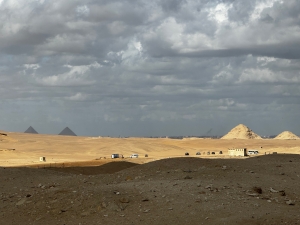
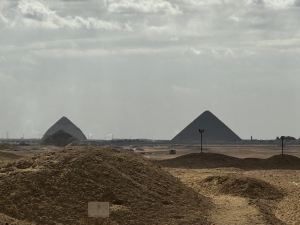
As we walked up a slope, we could see the Great Pyramids of Giza and numerous destroyed pyramids sitting in a distance. Miles and miles of sand stretch as far as our eye can see, seemingly with no end. We also spotted the Bent Pyramids sitting far into the desert. This Bent Pyramid was thought to be a transition from the Step Pyramids to the smooth-sided pyramids, such as those of King Khufu (aka the Great Pyramid in Giza). We spotted some building ruins at the side of the courtyard at Saqqara. What was interesting was a deep trench with a staircase leading deep into the earth. This could be where the ancient Egyptians entered the tomb to serve King Djoser after his death. After visiting the Step Pyramid of Kind Djoser, we head for a delicious Egyptian lunch before heading for the highlight of the entire trip – The Great Pyramids of Giza.
The Great Pyramids – The Wonder of the Ancient World
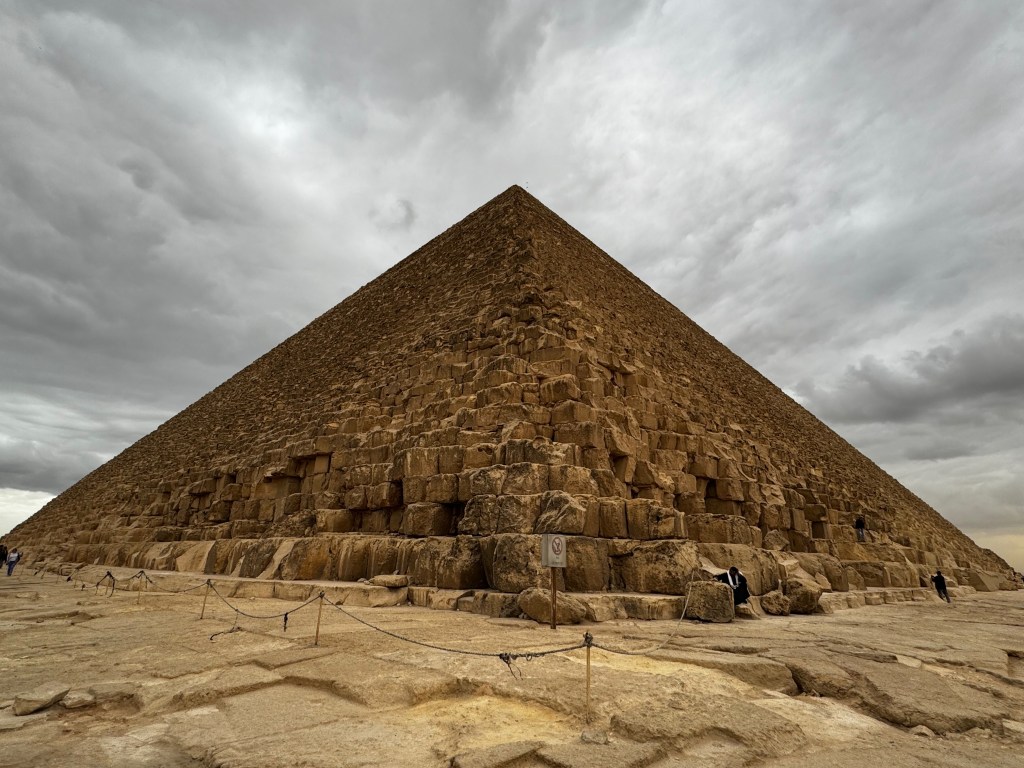
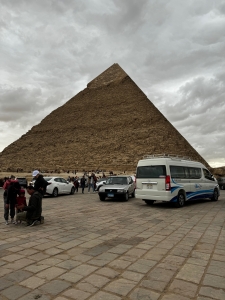
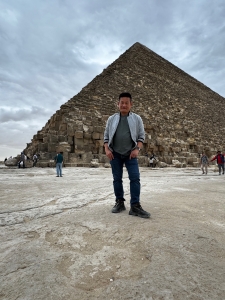
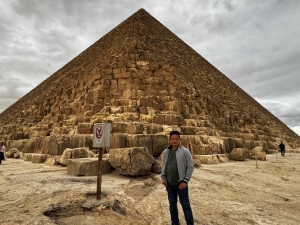
The pyramid of Khufu, the largest pyramid in the world, stood for 4,500 years.
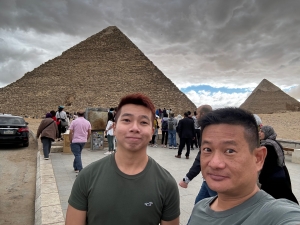
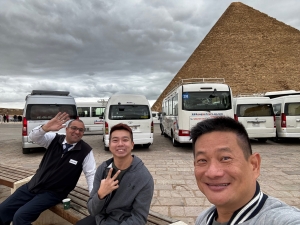
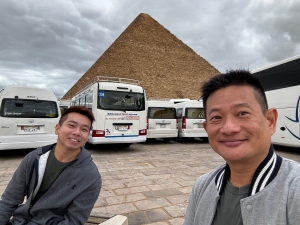
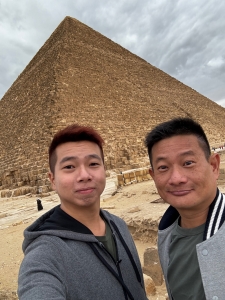
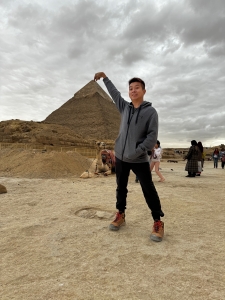
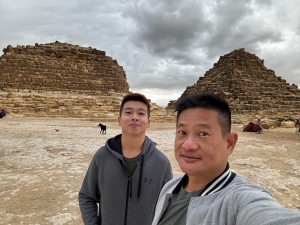
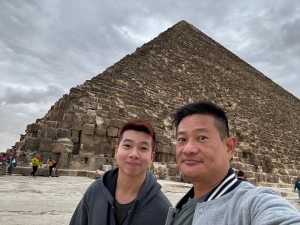
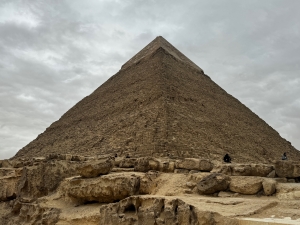
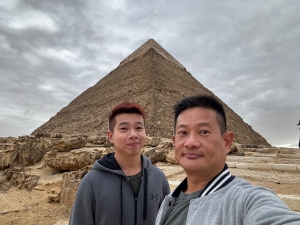
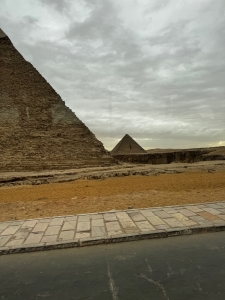
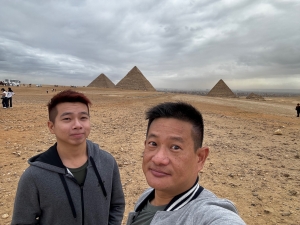
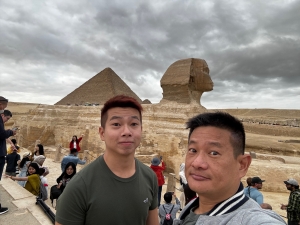
We were driven to the main entrance to the Great Pyramids of Giza (the one near our hotel). As with all monuments in Egypt, we would need to send our bags through X-ray machines and pass through metal detectors. As we were driving to the carpark, Ahmed told us that the 4,500-year-old Pyramid of Khufu, the world’s largest pyramid, soared 146m into the sky, with the next two pyramids being built smaller than the one before. This was done to respect their predecessor and their achievements for the country. The magnificent Pyramids of Khufu and Khafre were the skyscrapers of the ancient world. No wonder it clinched the title of one of the seven wonders of the ancient world til today. Ahmed guided our attention to the tip of the Pyramid of Khafre, where the top part was still covered in smooth stone, and this would be how the pyramids would look when they were completed. Due to erosion, we were left with the interior stone exposed to the world. We were also advised on how to deal with the touts around the pyramid grounds. Before long, we arrived at the carpark, where we were given some free time to wander around the Great Pyramids. The carpark wedges between the two larger pyramids, the Pyramid of Khufu (the largest) and the Pyramid of Khafre. We had spent some time sitting on a bench, drinking the tea our driver offered us, taking in the majestic sight these two pyramids offered. The feeling was so surreal that we couldn’t believe we were actually at ground zero, looking at these magnificent giants that have intrigued the world for centuries.
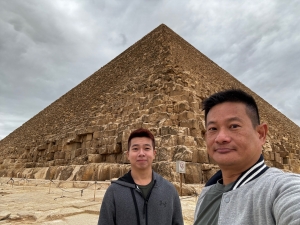
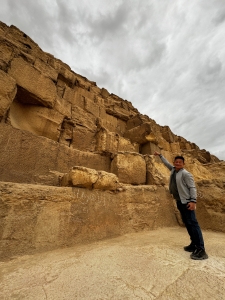
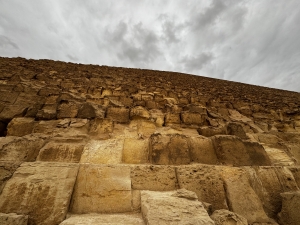
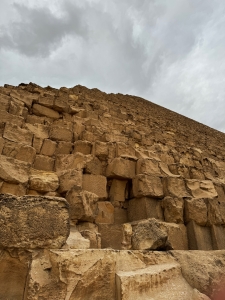
We were given 30 minutes to take pictures and explore the grounds of the two pyramids. We got going after drinking the tea. Our first stop was the Great Pyramid of Khufu. It is one thing to see the pyramid from a distance; it is another to get close to it. Each stone is as tall as a grown man, and from the base of the pyramid, looking up to the top, there were countless of these stones. We can’t help but wonder how the ancient Egyptians did it. How were they able to build something like it at the edge of the desert with no modern equipment, which has stood for nearly five millennia? We went up close to touch some of the stones at the base of the Pyramid of Khufu, marvelling at the extraordinary feat achieved by the ancient Egyptians. Along the way, we were approached by the touts asking if we wanted a camel ride or taking some photos with the camels. No wonder this area was titled the Tout Central of Egypt. As we were taking some photos, we were approached by one of these touts offering to show us a place to take some photos. As we were minding our business, the tout suddenly turned and asked for money, stating that we were taking photos at the spot he recommended. He hustled us for 10 minutes, and I told my friend to walk on and ignore him. I assertively told him no when he grabbed my friend by his arm and pulled him to walk next to me, with me sandwiched between the tout and my friend. This is when the tout gave up and went hunting for the next target. Most touts are not as aggressive here, and they would leave us alone when we politely told them no. Having shaken off the tour, we went around to take pictures of the Pyramid of Khufu. Ahmed told us the best spot to take pictures is the corners of the pyramids. We were glad that we followed his advice. We could capture the pyramid shape and majesty of the structure at its corners.
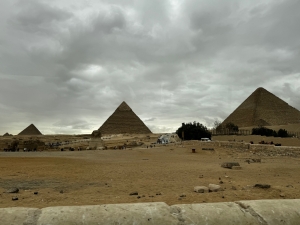
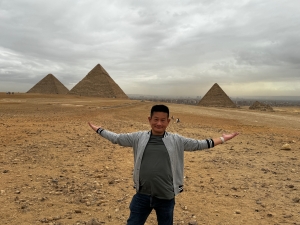
Walking one round by the parameters of the Pyramid of Khufu, dealing with the aggressive tout and taking pictures already took us 20 minutes. We were only left with minutes to take pictures of the Pyramid of Khafre (the one with the smooth top). We did not have sufficient time to go next to this pyramid, but we got close enough to see the smooth surface that still occupied the top of the pyramid, like the snow on a mountain. Despite not being the largest pyramid, the Pyramid of Khafre was still impressive. We went near enough to take pictures with the pyramid before returning to the bus. We were driven to a spot where we could take good shots of the three pyramids together. Standing beside the Pyramids of Khufu and Khafre, the last pyramid, the Pyramid of Menkaure, seem like a child. We were offered 5 mins of photo time, sufficient for us to take our pictures with the three pyramids in one shot.
The Sphinx – Guardian of the Great Pyramids
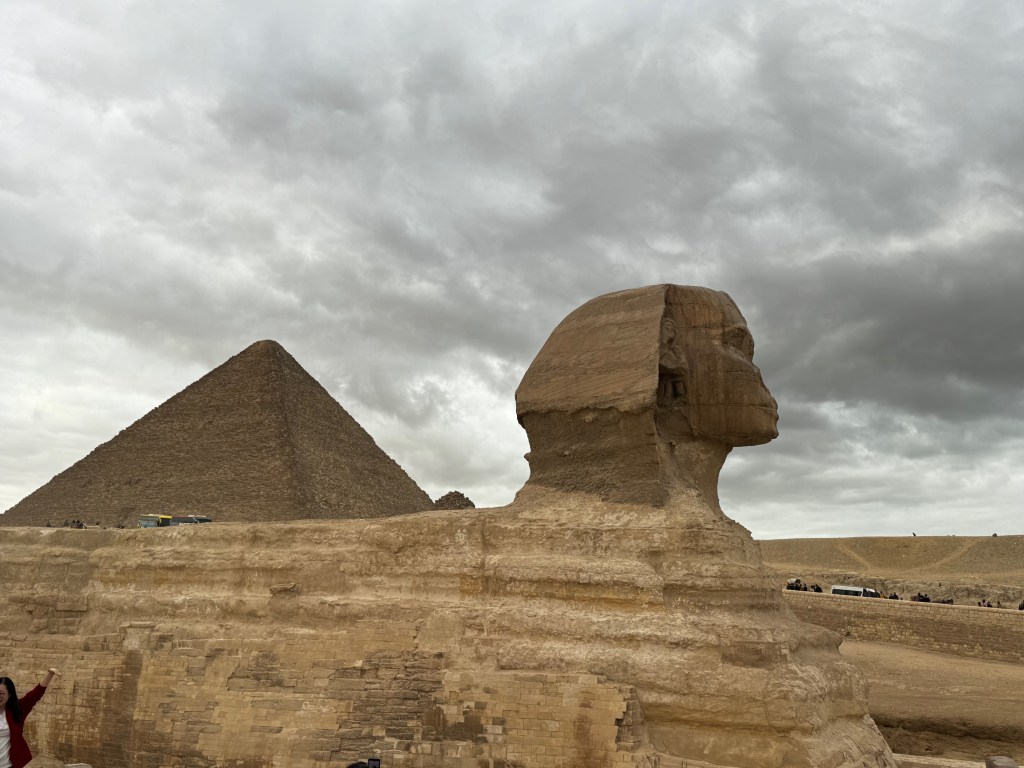
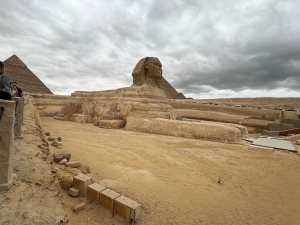
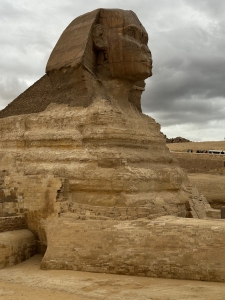
The Sphinx at the Great Pyramids of Giza
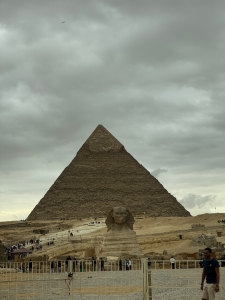
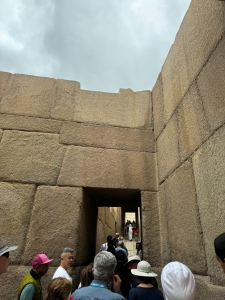
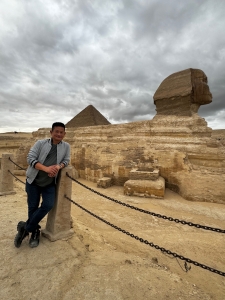
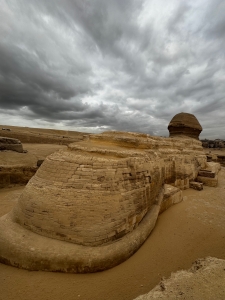
Our final stop of the day is the Sphinx, sitting in front of the Pyramids as though it was their guardian over the thousands of years. As we were driving towards the Sphinx, Ahmed told us to get our cameras ready as this was the only chance we could take pictures of the Sphinx in front of the Pyramid if we timed it correctly. We were given time to wander inside a complex and get next to the Sphinx. The complex was very plain and seemingly had nothing going on. We squeezed past a door, and there she was, the giant Sphinx guarding the pyramids. Despite not being as large as the pyramids, the structure was still impressive. We can only view it from a distance as some archaeological works are still ongoing at the Sphinx. The crowd at the Sphinx was massive, yet we managed to grab some great spots taking pictures of this giant structure. We could see an entrance leading into the Sphinx from where we stood. Soon, it was time for us to return to the bus. The number of tourists at the site and the small space allocated for visitors to see the Sphinx did not warrant too much time to be allocated here. We headed back to the hotel and spent the night dining at the restaurant in our hotel for the Christmas buffet dinner that the tour company had arranged, getting to know our group members better. We retired early to our respective rooms as we had an early flight to Luxor tomorrow.
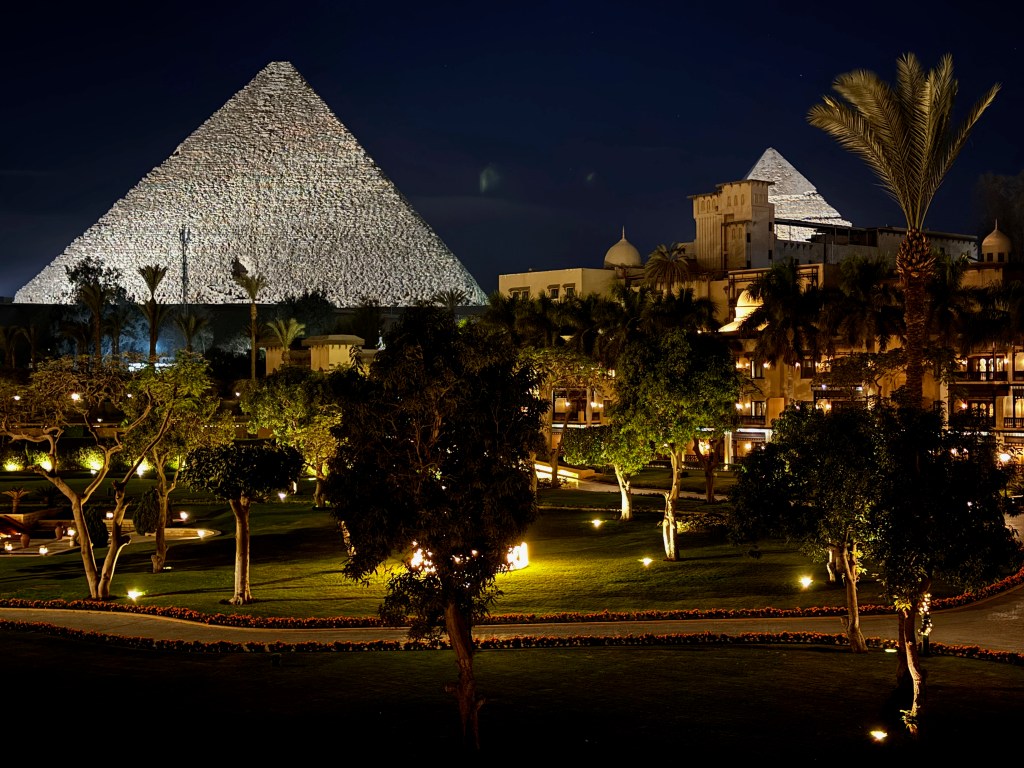
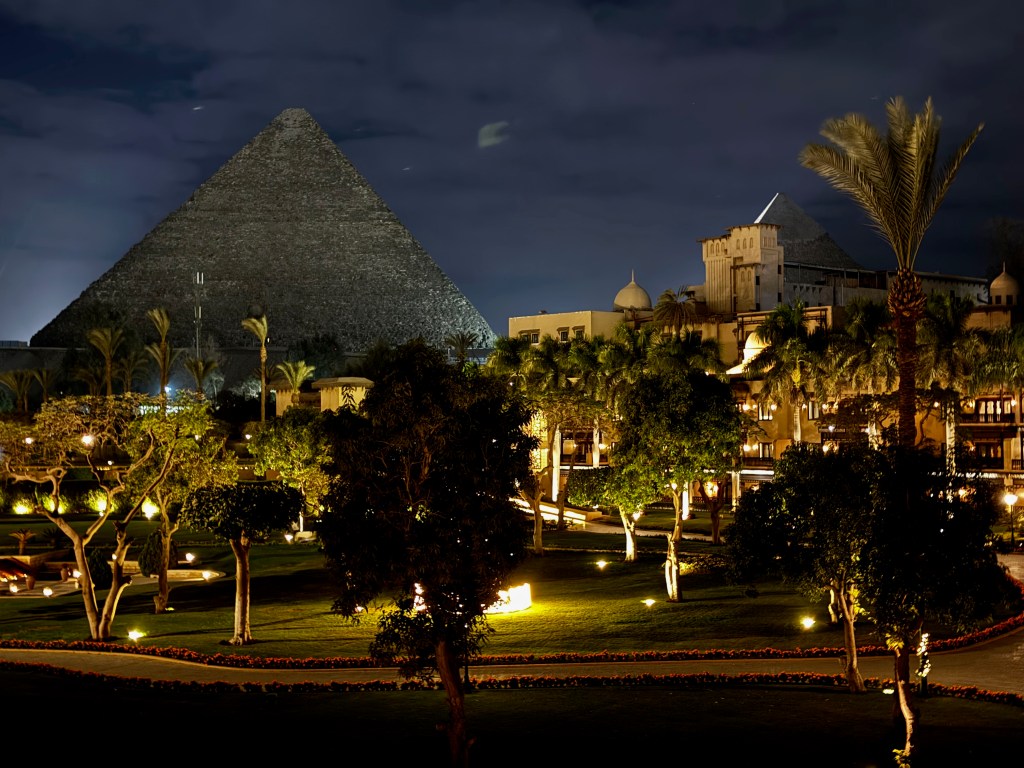
We ended the day with a great night view of the Great Pyramids from the balcony of our room.
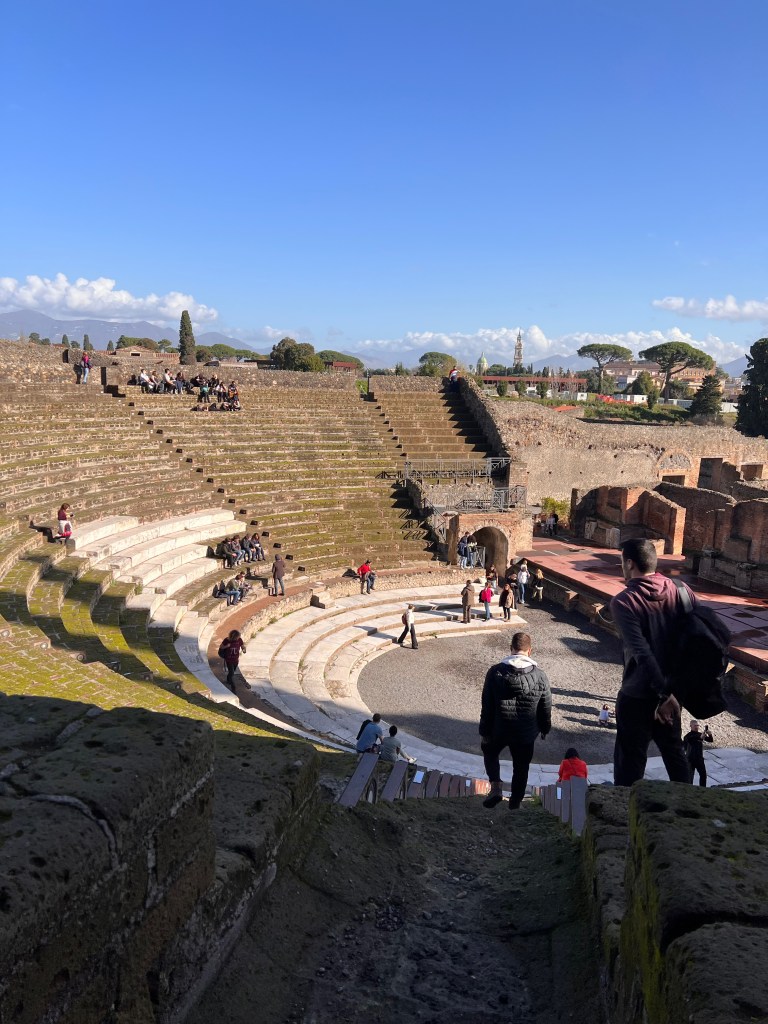
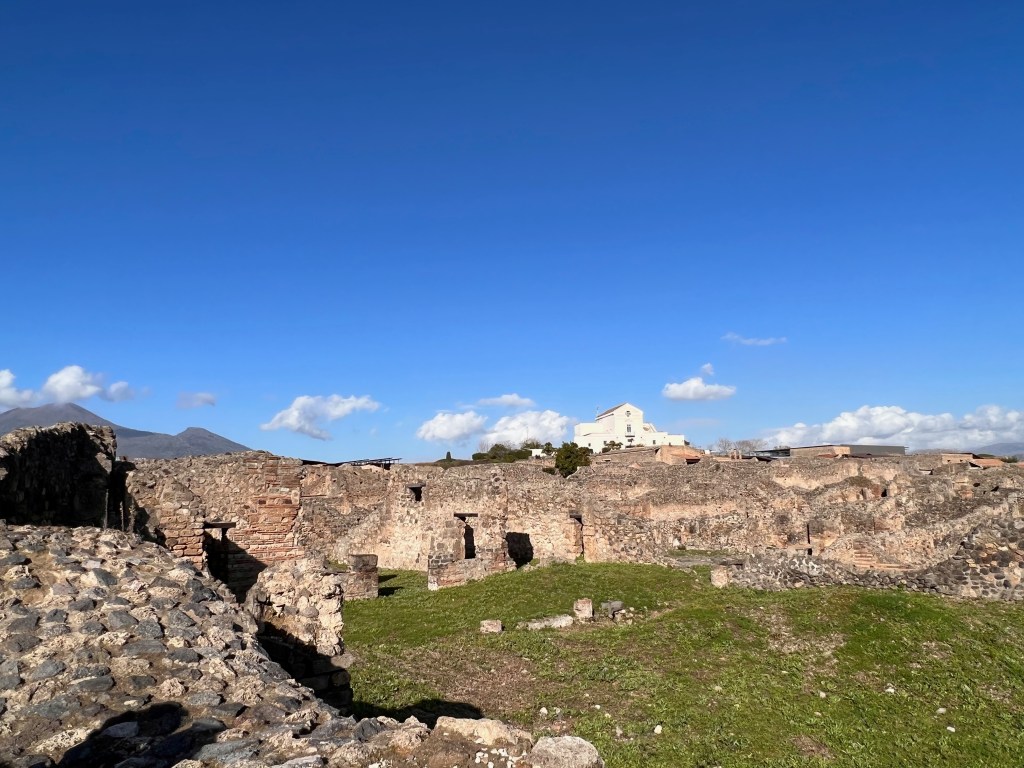
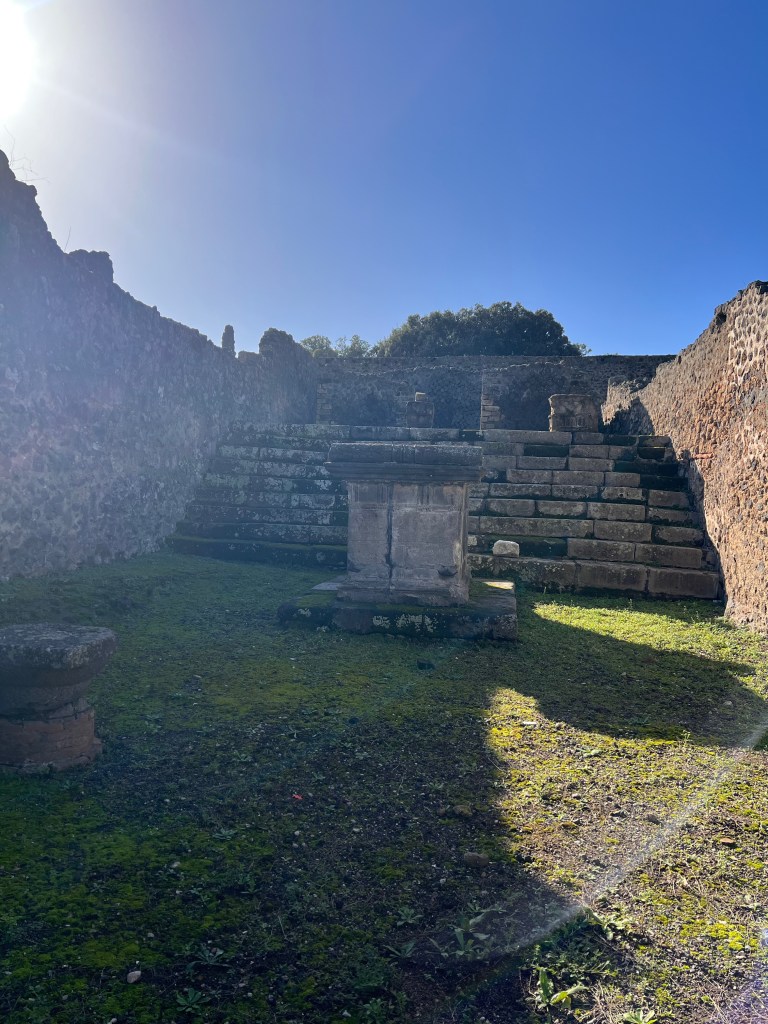
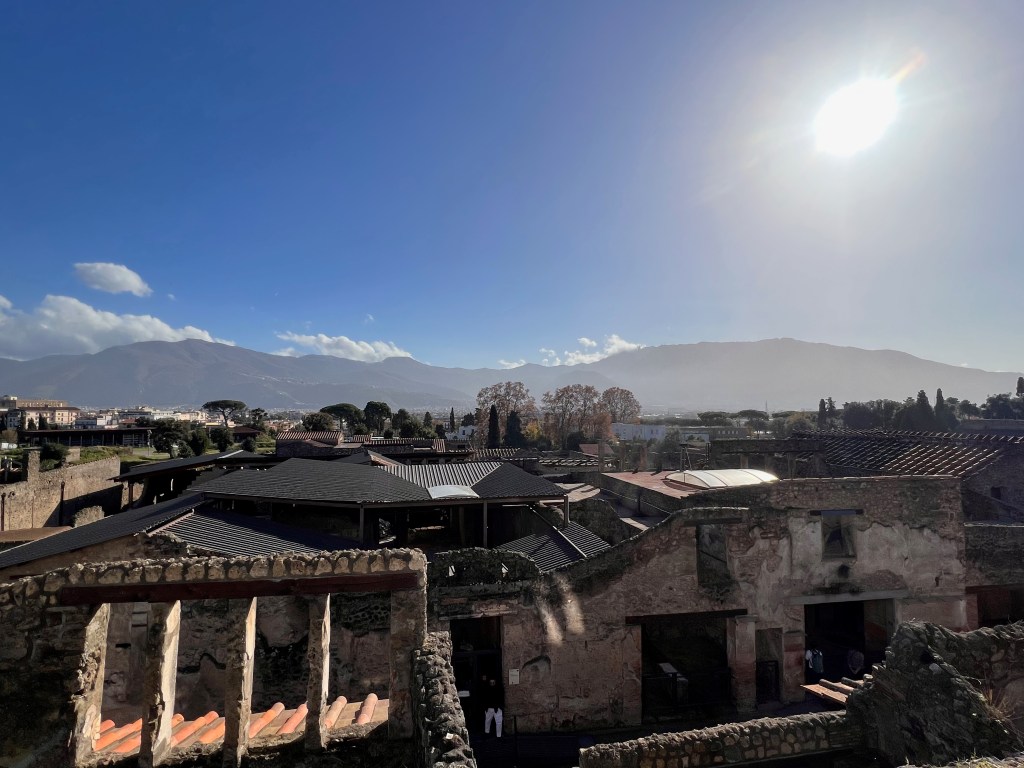
Originally, we wanted to visit Egypt in 2020, but this was when the pandemic hit the world. As we watched borders all over the world shut down, our hopes were smashed as we saw the world coming to a halt to deal with the pandemic. “One day, we shall pick up where we left off and embark on our trip to Egypt,” we thought. Three years later, we picked up where we left off and were eager to finally embark on our journey to one of the world’s oldest civilisations. Usually, I am not a fan of package tours due to their lack of flexibility. However, Egypt is a huge country with many stories to learn, and it can be challenging to navigate independently. Throughout this trip, we learned that some sites are far apart, which would be inefficient unless we drive or hire a driver for the whole day. Moreover, our experience in Pompeii last year taught us that it can be overwhelming without someone to narrate and guide us where to look, especially in Egypt, where every site has so much going on. Hence, we decided to take a package tour to this land of rich ancient civilisation.
Arrival at Cairo
The day finally came for our long-anticipated trip to Egypt. There are no direct flights to Cairo from Singapore, so we had to make a transit somewhere. We spent the whole of 22 Dec 23, travelling across three continents, from Asia to Europe and finally to Africa. Some 20-odd hours later, we finally landed in Cairo, the gateway to the world’s greatest and earliest civilisation. We arrived at Cairo International Airport around 5 am; immigration clearance was surprisingly fast and fuss-free. We were guided to a room for express clearance, and the immigration officer just stamped our passports without checking if we had visas or any other documents. We were through immigration within 5 minutes. We met with our travel concierge, who was already waiting at the baggage claim area. He guided us to the carousel where our luggage would be delivered.
After picking up our luggage, we whizzed through Cairo to our hotel, where we called home for the next two nights. Along the way, our travel concierge pointed our attention to some important landmarks in Cairo. My first impression of driving through the streets of Cairo was that this country seemed like a mess. We saw stones lying just by the roadside and what seemed to be construction or excavation. There are some nice buildings with completed facades and large balconies. However, many other buildings are either missing a wall or being torn down. We learned from our tour director (later) that the entire city of Cairo is in the midst of restructuring, and the buildings without walls were illegally built.
Leisure Day at Cairo
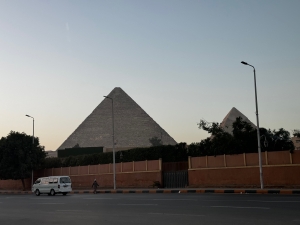
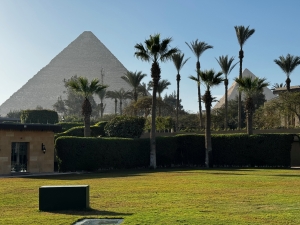
Soon, we saw the great pyramids of Giza and arrived at our hotel. As today is arrival day for the rest of the tour group members, the tour company left it empty for the group to arrive. For those who arrive early, we could catch some rest or explore Cairo on their own. The long hours of travel took a toll on our bodies, but the weariness wore off the moment we saw the Great Pyramids from the balcony of our room. We spent the next 1 hour wandering around the hotel grounds and its beautiful gardens, taking pictures of the pyramids before fatigue set in, admiring the incredible feat of engineering the ancient Egyptians created. It is one thing to see the Great Pyramids on the internet and in books, but seeing it with our own eyes feels surreal. We wandered outside the safety walls of the hotel grounds to get some drinks and food as we felt peckish. There were some shops directly opposite the main entrance of the hotel. As the stuffs were not priced, we were cautious about buying from these shops. We ventured into the gas station just behind the hotel to get our supplies of drinks and snacks before returning to the hotel for a nap.
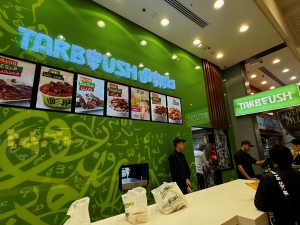
We caught a few hours of rest. We woke up refreshed and ready to explore Cairo a little as we refused to be “imprisoned” within the boundaries of the hotel site. I had wanted to visit the old Cairo district, but the journey from the hotel seemed a tad too far. We checked with the concierge at the hotel to see if there were any malls nearby. The staff at the concierge recommended the Mall of Egypt, where we ended up for dinner and an evening stroll. We hailed an Uber and were brought to the Mall of Egypt in 30 minutes. The mall was large and well stocked with shops of all kinds, international and luxury brands. There was even a hypermarket, Carrefour, at the Mall of Egypt. We also spotted a cinema and an indoor snow park within the mall. There is no lack of restaurants and cafes where the locals enjoy a leisurely afternoon tea time. A large food court is selling more affordable food from all over the world. The Mall of Egypt is your standard run-of-the-mill shopping mall with similar DNA to any shopping mall worldwide. After dinner, we strolled in the mall, checking out what boutiques were operating there. We headed back to the hotel to rest for the night after dinner; after all, we would have an early start the following day.
Enjoying the view of the Great Pyramids of Giza from the balcony of our hotel room
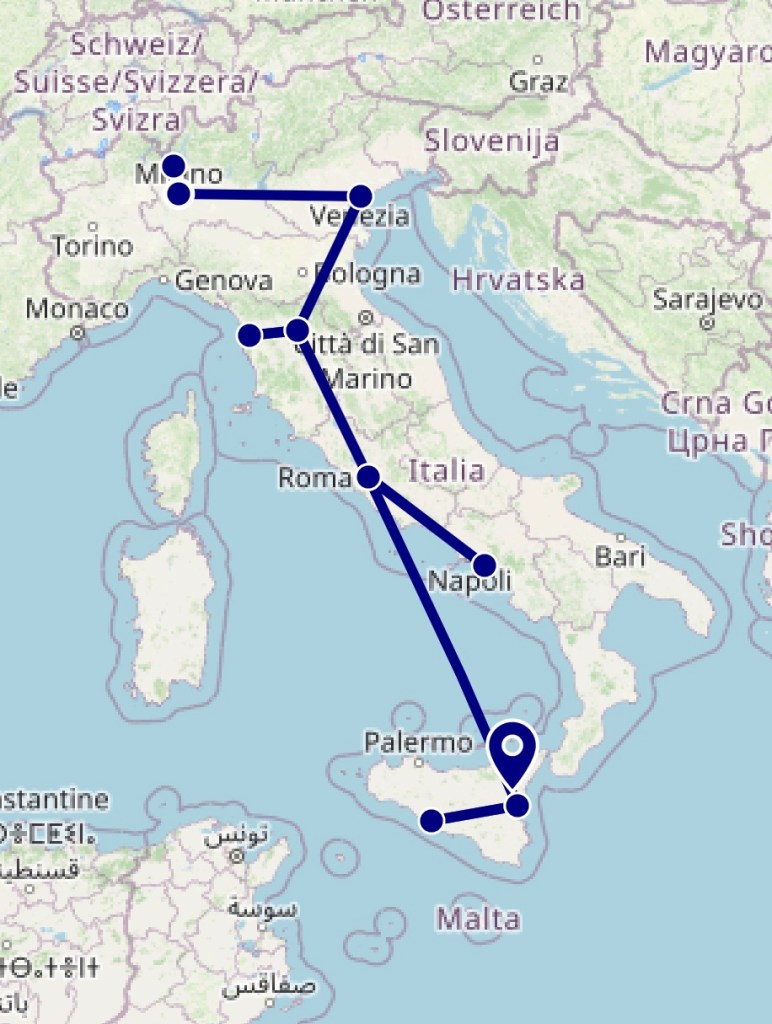
Today marks the conclusion of our maiden trip to Italy and my first-ever trip to Europe. We dreaded the arrival of this day, as we had such great fun in Italy. We started our trip not knowing what to expect in Italy and how it will turn out. We were initially quite worried about our trip as we heard a lot about the pickpockets in major cities, the flooding in Venice and the scammers in Rome. As we travelled throughout the country, we came to release the country was very safe, and our worries were unfounded. We thought the Italians were cold initially, but they were very friendly and helpful once we chatted with them. The travels between cities were easy and efficient, thanks to the high-speed rail infrastructure. Looking back, I thought we could spend one more day in Milan, as we only had essentially half a day in Milan. There is more to see and do in Milan that cannot be covered in half a day. We could also cater more time for shopping. I only catered one day for shopping, thinking The Mall Firenze could satisfy our shopping needs, but it turned out The Mall was disappointing. As a result, we had to forego some sights in our plan. We had some fun experiences during the trip, climbing the Leaning Tower of Pisa, scaling up the dome of St Peter’s Basilica, getting lost in Venice, climbing up Mt Etna, etc. A summary of our 13-day journey through Italy:
Day 1: Milan – Arrival at Milan, Duomo di Milano, Galleria Vittorio Emanuele II
Day 2: Milan – Lake Como (Verona, Bellagio, Como), Naviglio Grande
Day 3: Venice – Venice City on foot
Day 4: Venice & Florence – San Marco Campanile, San Giorgio Maggiore, Burano; Florence City at night (Duomo, Piazza della Signoria, Ponte Vecchio)
Day 5: Florence – Shopping at The Mall Firenze
Day 6: Pisa – Leaning Tower of Pisa and Pisa Cathedral
Day 7: Florence & Rome – David in Galleria dell’Accademia, Duomo, Trevi Fountain, Pantheon
Day 8: Rome – Colosseum and Palatine Hills
Day 9: Naples – Pompeii, Sorrento
Day 10: Vatican City – St Peter’s Basilica, Vatican Museum and Sistine Chapel
Day 11: Catania – Roman Amphitheater, Duomo,
Day 12: Agrigento – Valley of Temples
Day 13: Catania – Mt Etna
Day 14: Departure
Recap of our journey through Italy
Arrival at Istanbul
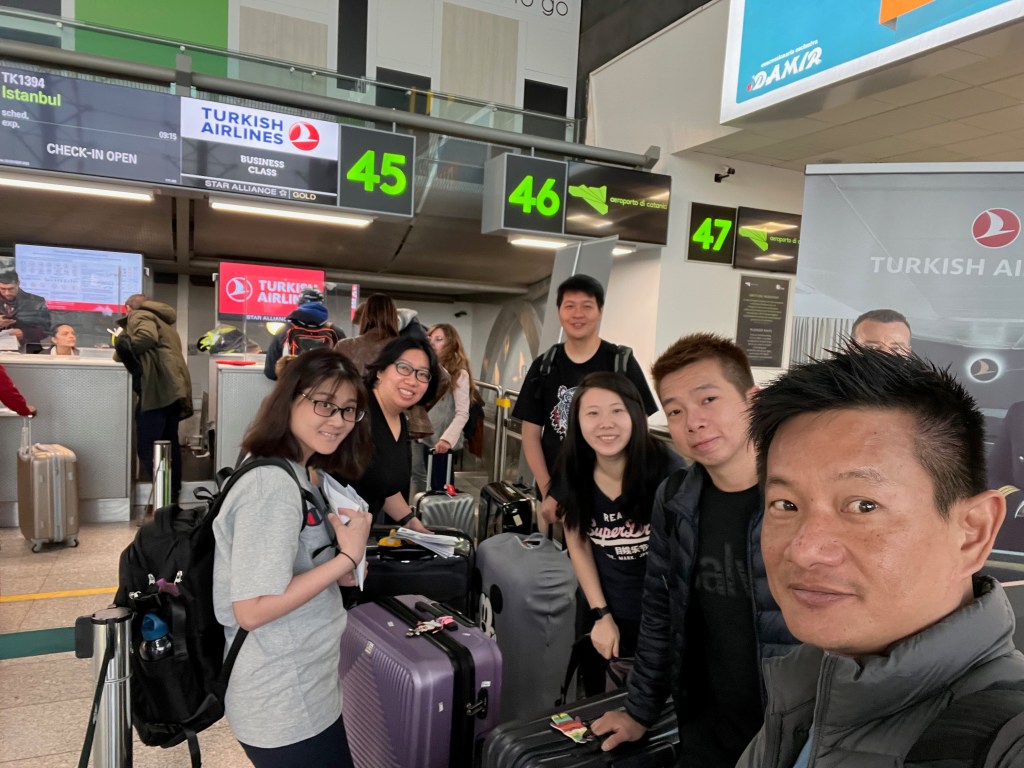
Our flight out of Catania to Istanbul was scheduled for 9.10 am. We left for the airport at 6 am, as we needed sufficient time to validate the tax-free purchases we had made for the past 13 days in Italy. We headed for the tax-free counter the first thing we arrived at Catania airport, located at the right corner of the airport terminal from the entrance in a very inconspicuous corner. After validating our tax forms, we proceeded to the airline counter to check in. Looking at the time, we still have some time left to enjoy a light bite at the airline lounge. Our flight finally took off at 10.20 am (some delays due to overbooking), and we landed in Istanbul at around 3 pm local time. Our plan today was to join the free tour that would bring us to some of the famous sights in Istanbul provided by Turkish Airlines. Turkish Airlines offered several tours in the city throughout the day (you can refer here for the Touristanbul schedules and itineraries) with different tour itineraries. However, I misread the timing, and we ended up taking only the shopping tour.
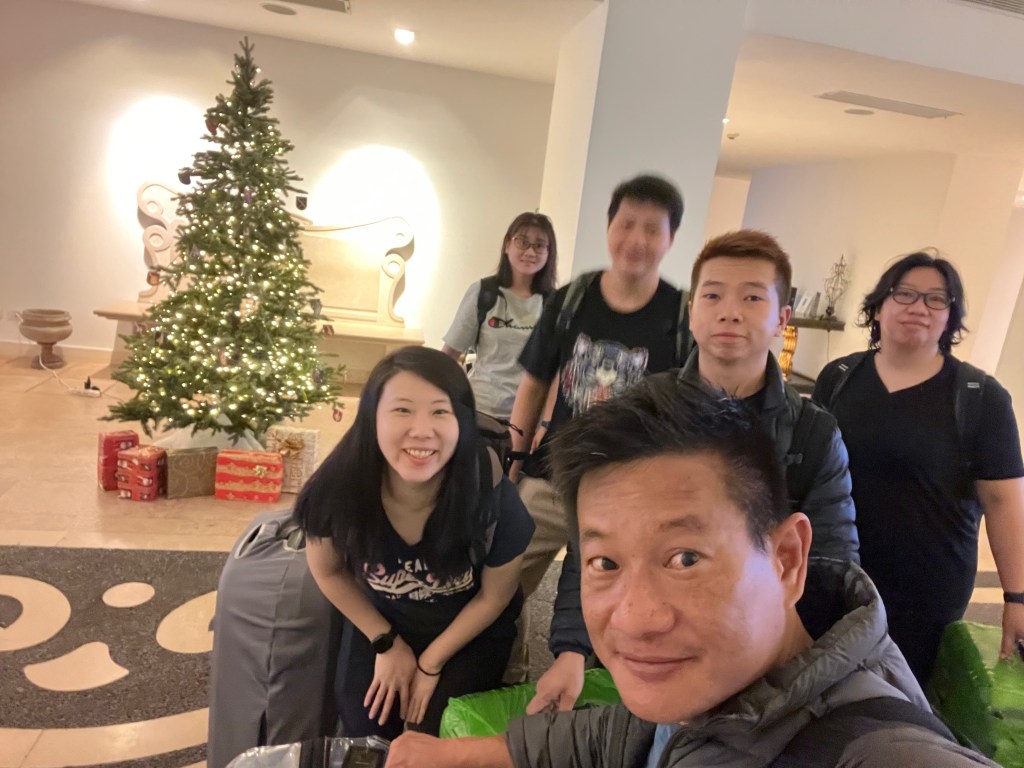
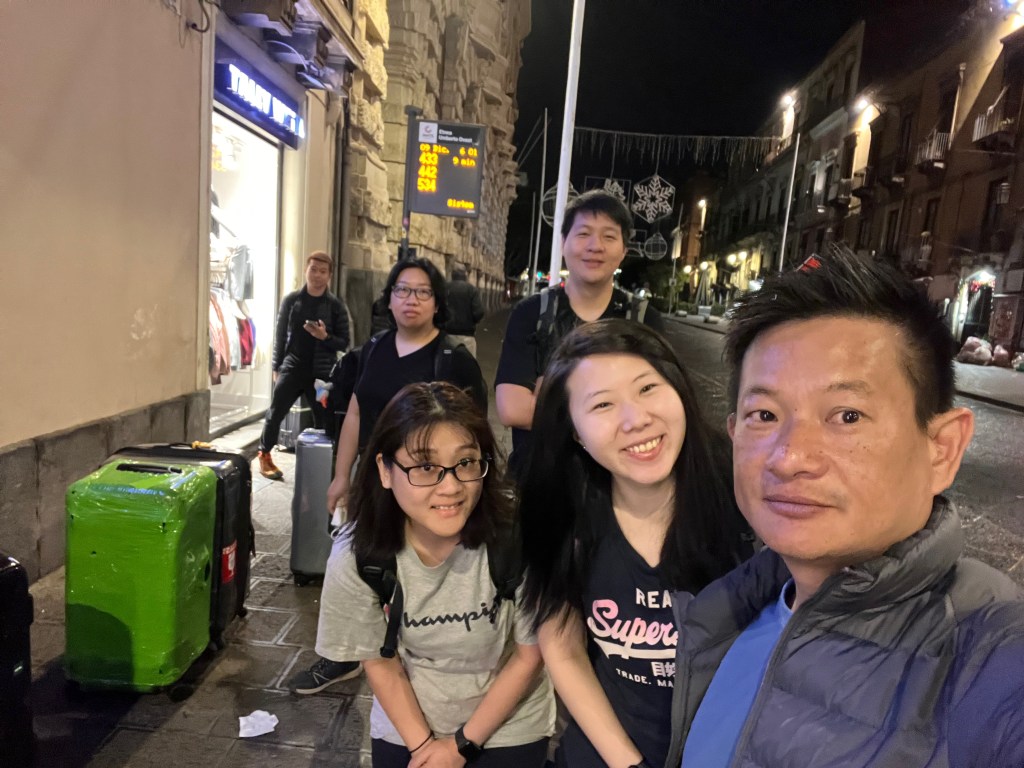
Wefie at the hotel’s lobby before we head to the airportWeifie on the street of Catania
The airport bus is arriving.
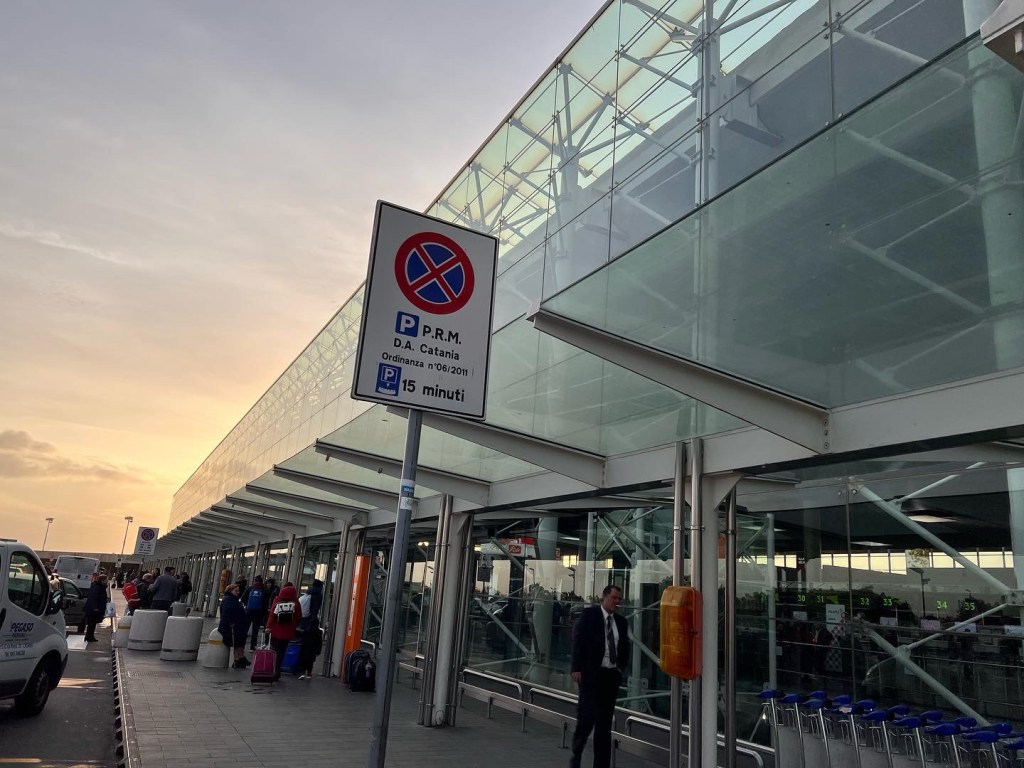
Wefie at the airport entranceCatania Airport, where we end our Italian trip
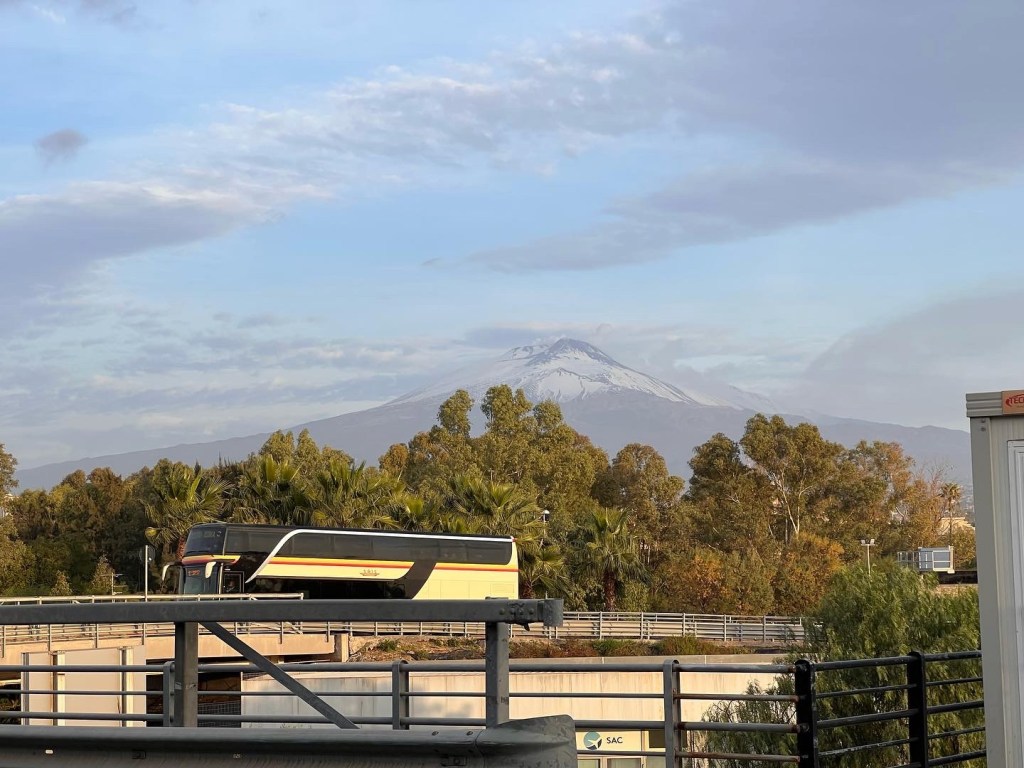
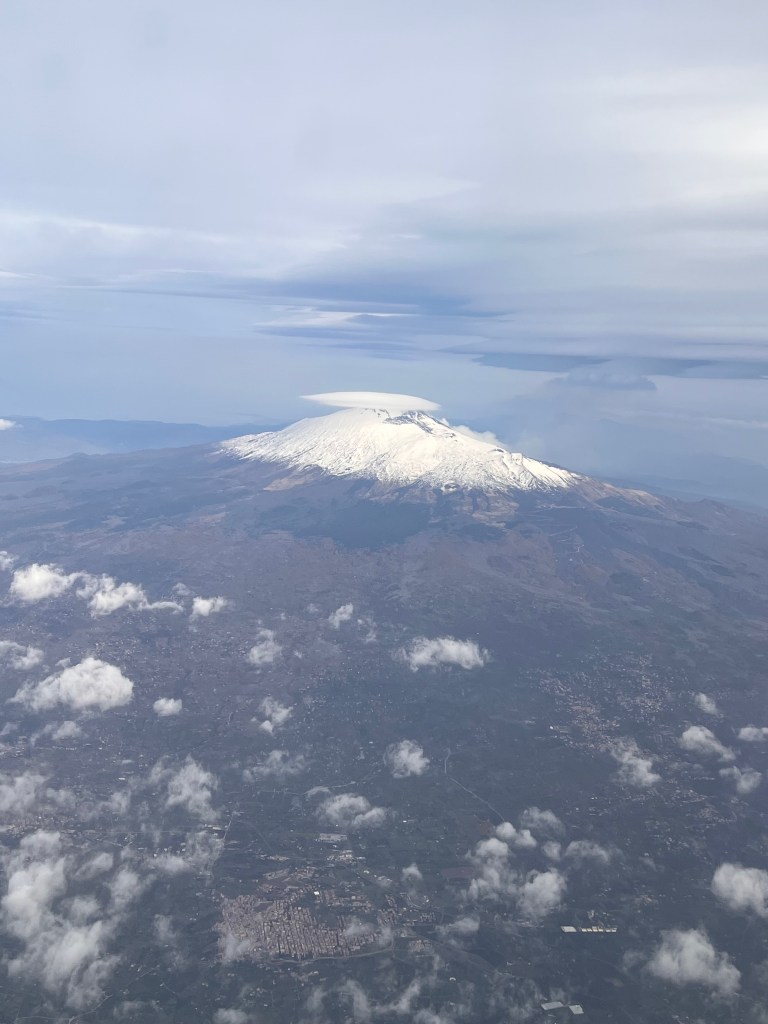
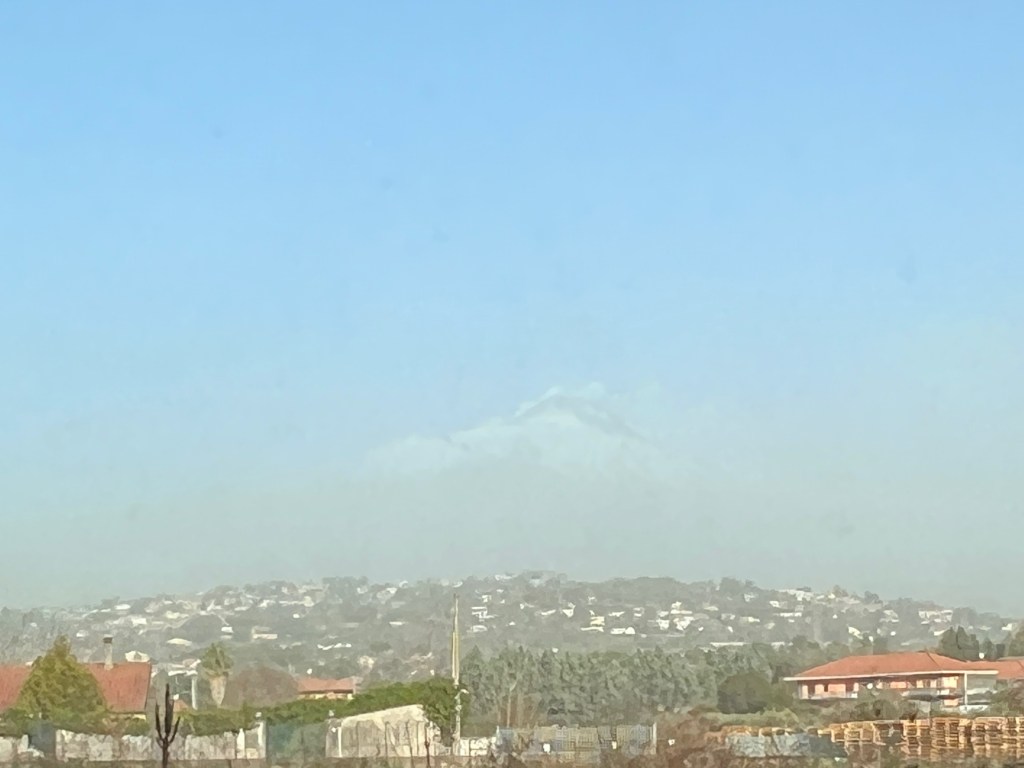
Last look at Mt Etna from Catania airport
Wefie at the airport before checking inReady to check in on our Turkish Airlines flight back home
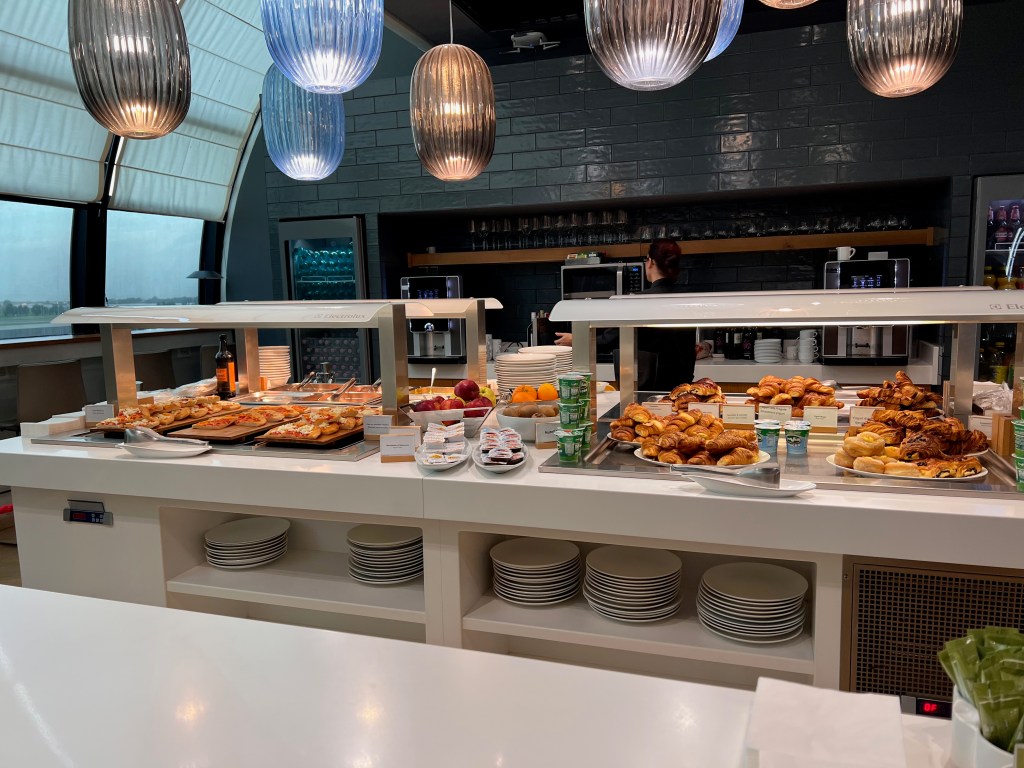
We have a light breakfast at the lounge in Catania airport
Wefie in the airportWe are waiting in line for boardingthere seem to be some situations during boardingWefie while waiting in line to boardMt Etna from the aircraft
My friends on the jetbridge to our flight
We are the only passengers in the cabin
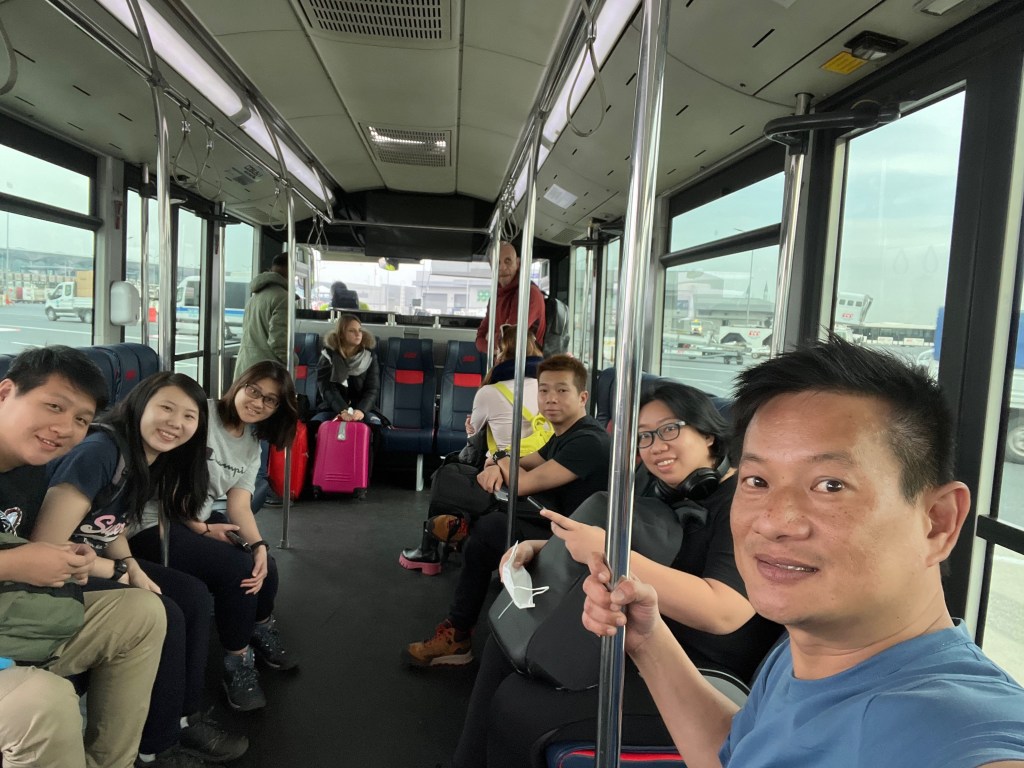
View of Mt Etna from the airSomewhere in TurkiyeOn the airport bus to the terminalLanded safely at Istanbul Airport
Shopping in Galataport, Istanbul
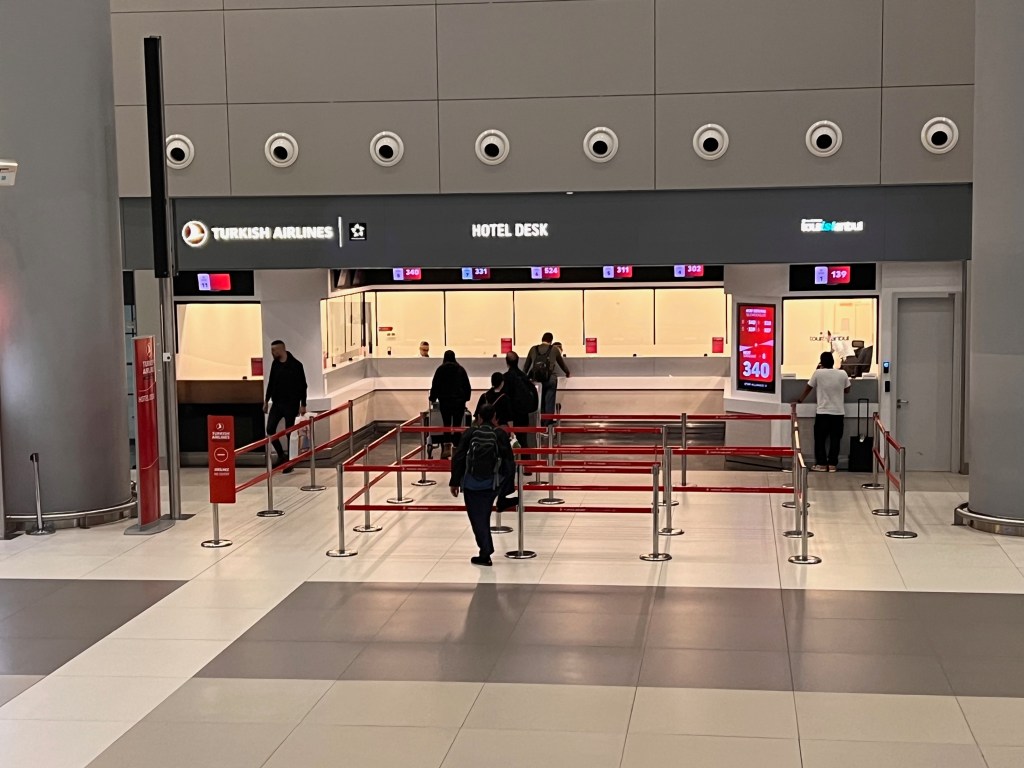
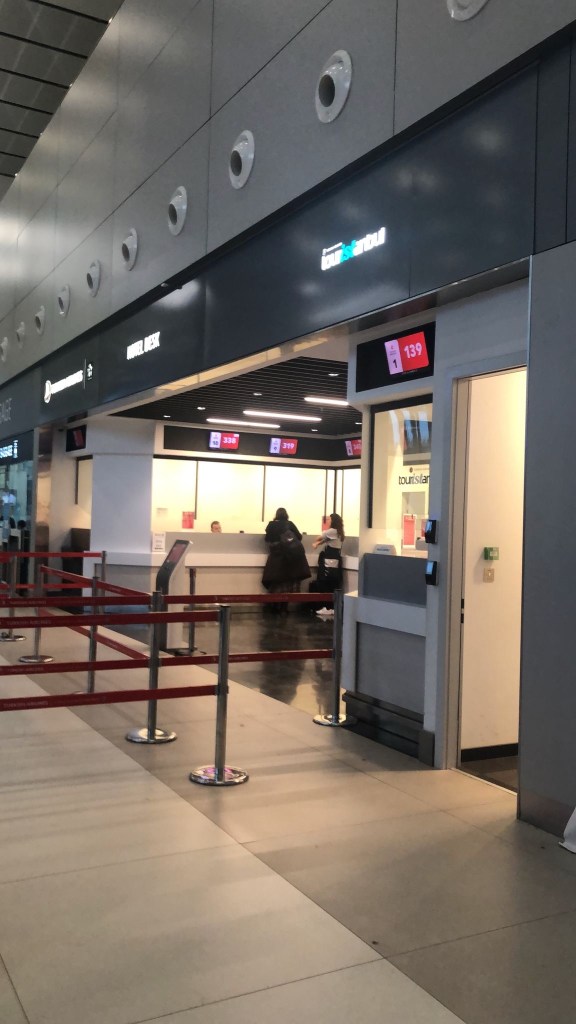
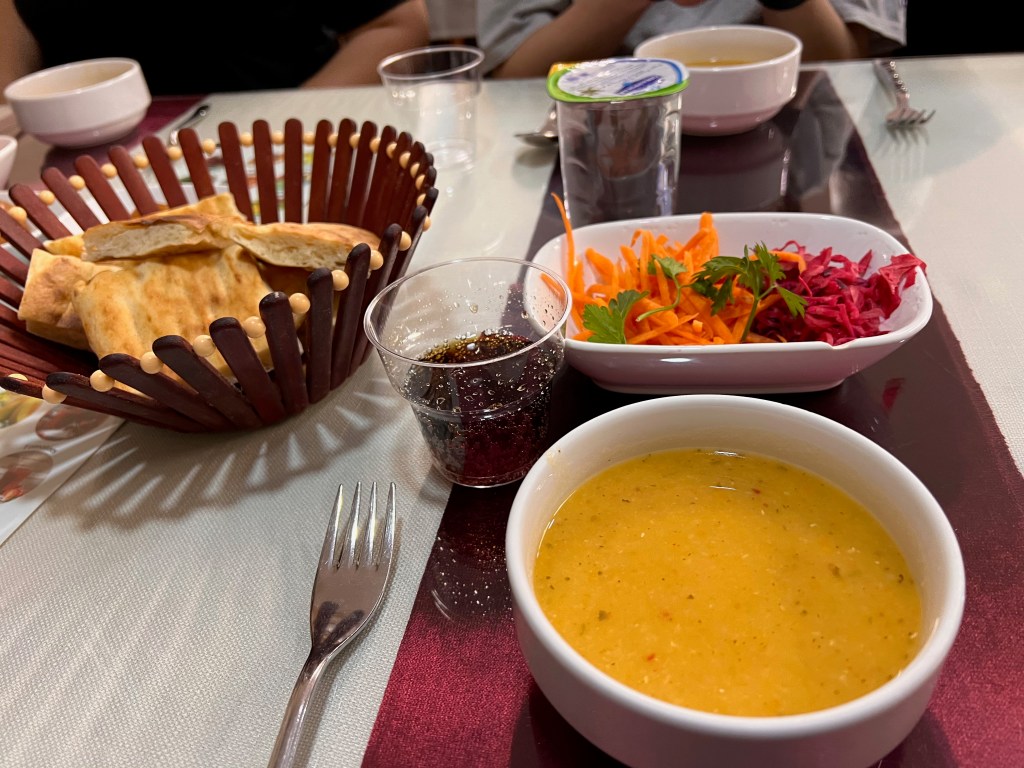
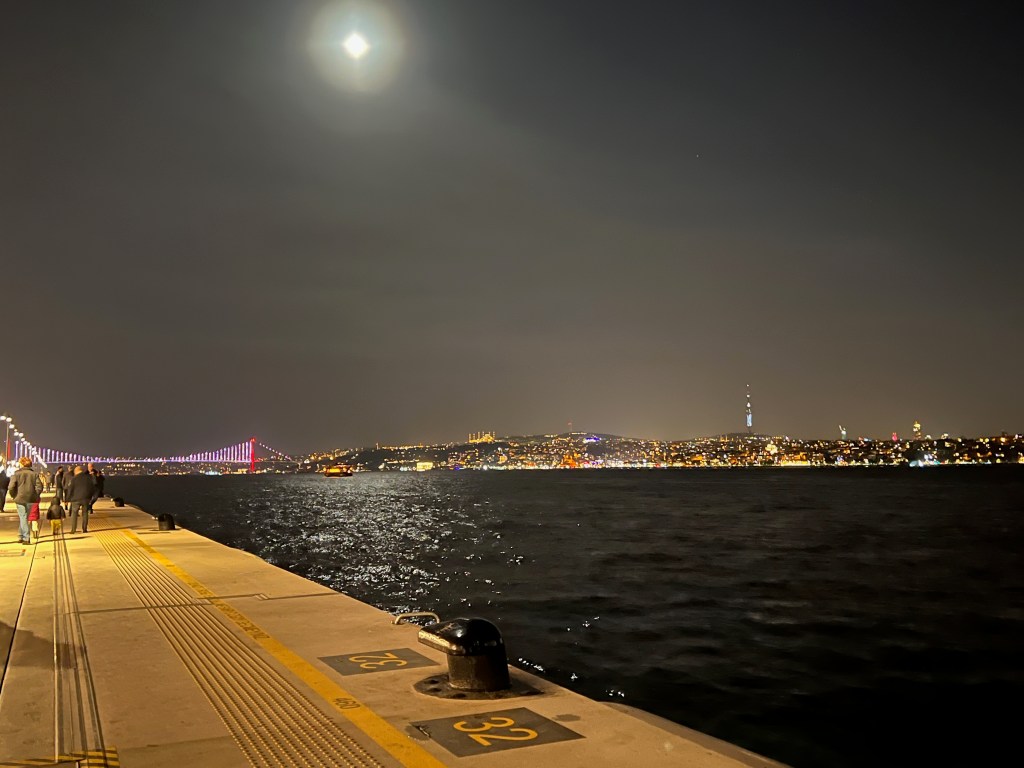
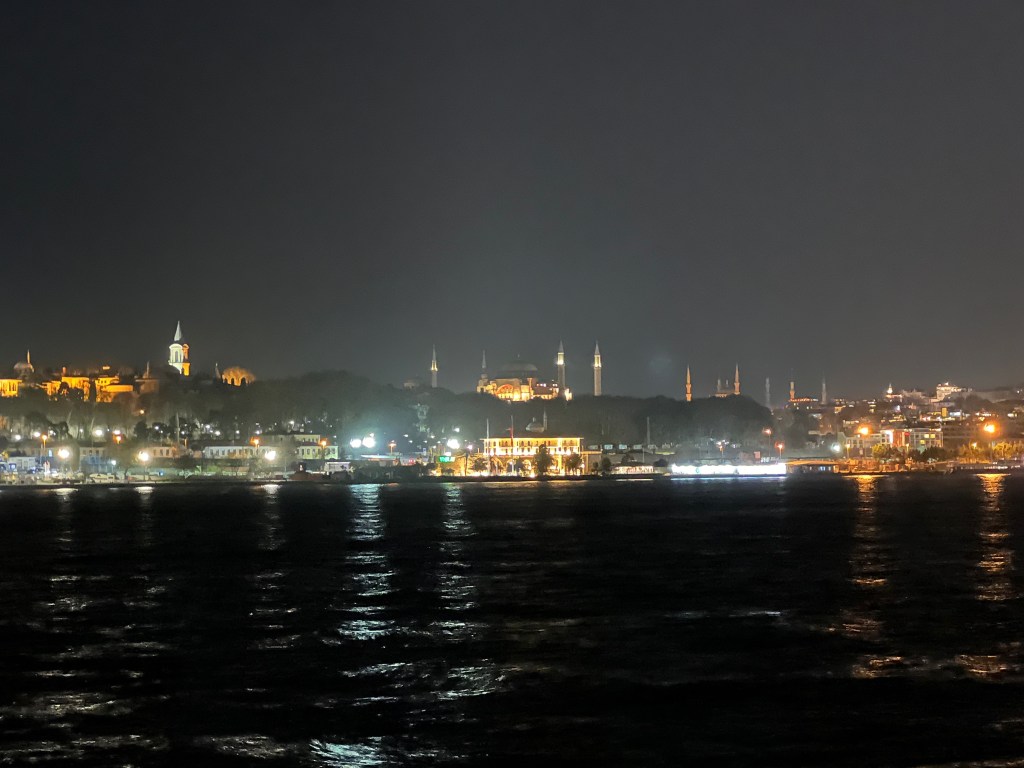
To register for the tour, we cleared immigration and looked for the Turkish Airline’s “Hotel Desk” counter. The way to the immigration was a tad far, and we had to ask the airport staff for directions to the immigration (it is not easy to find from the airside area) and then to the Hotel Desk counter to register for the complimentary tour provided by Turkish Airlines. Our tour begins with a Turkish dinner at a restaurant (paid for by Turkish Airlines). The food was delicious, and the meat served was tender. After dinner, we were driven to Galataport for the shopping trip. Galataport is a coastal, open-air shopping mall situated next to the Bosporus sea on the Europe side of the city. There weren’t many shops at the shopping mall selling goods. I estimated about 70% of the shops are restaurants. We spent the 1 hr allocated for shopping and walking along the coastline for the night Istanbul views of the Bosporus Sea. I’d say the shopping tour was a tad boring. I wouldn’t recommend the shopping tour as there was nothing at the mall to shop for. After the tour, we were driven back to the airport, where we took a shower and got ready for our flight home. Our flight departed Istanbul at 1.55 am, marking the end of our trip to Italy.
The Turkish Airlines Hotel Desk, where we booked our complimentary tour of Istanbul
The Hotel Desk in Istanbul is very difficult to find
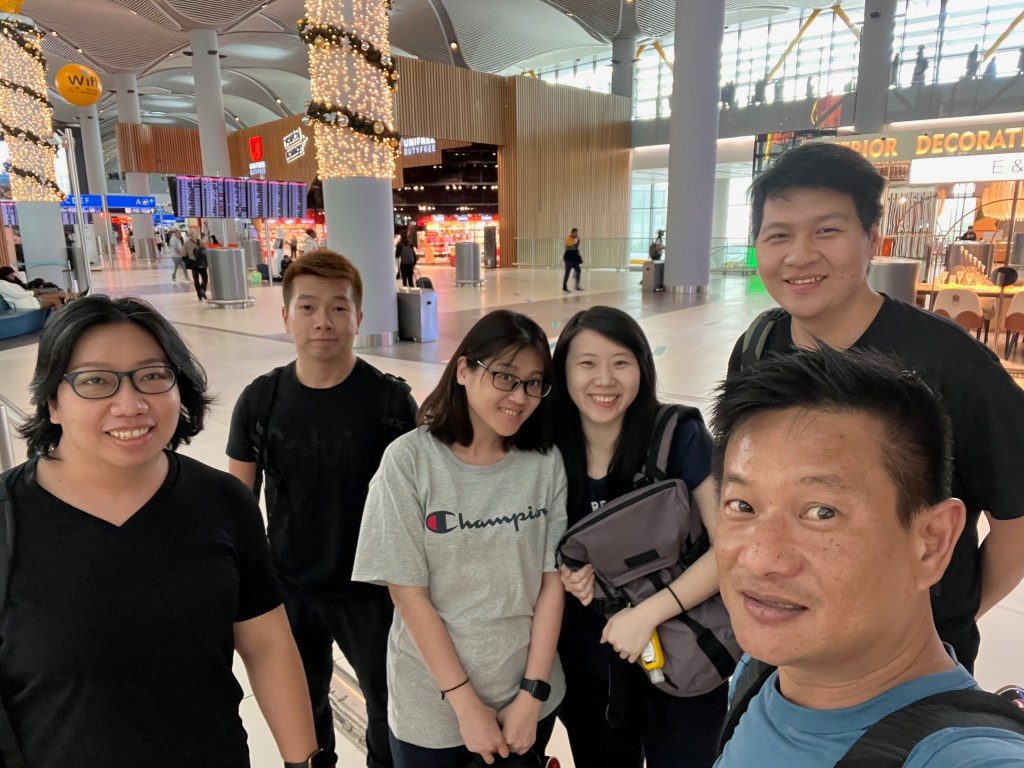
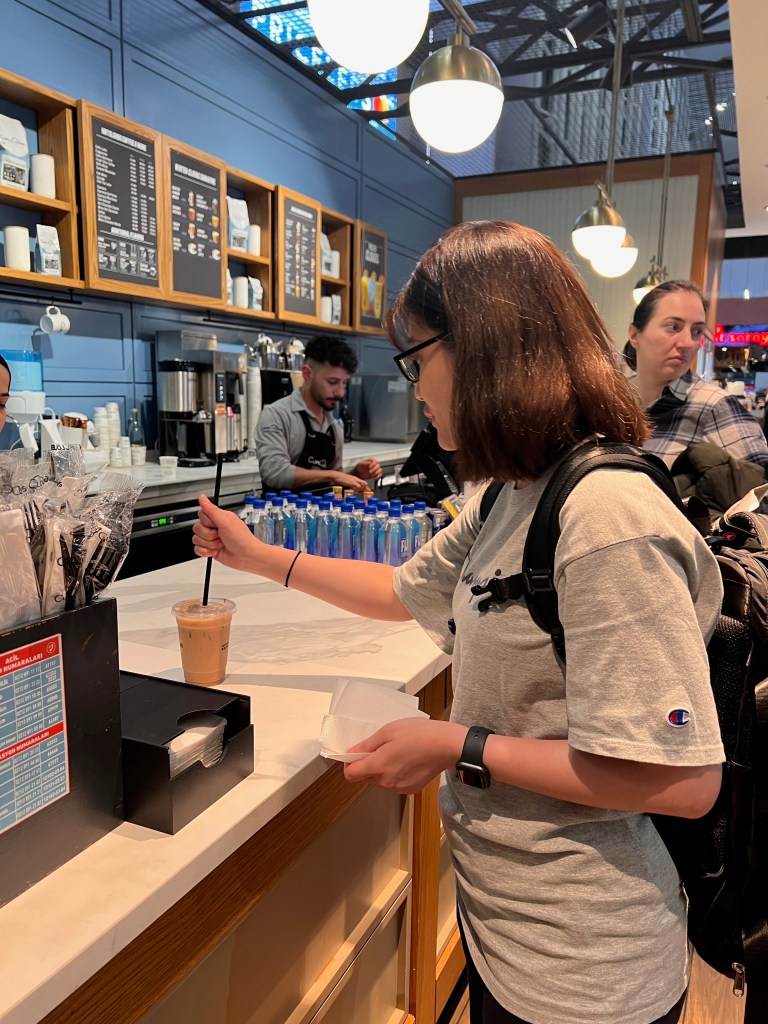
My friend ordering a coffee in Istanbul airport while waiting for our tourMy friends waiting patiently for the tour of IstanbulOn the tour bus to take us to GalataportMy friends on the bus to Galataport
My friend just got off the bus.
Turkish airlines provided us with Turkish food as part of the tourWefie outside the restaurant in IstanbulWeife in Galataport, IstanbulA mosque outside GalataportClock tower in GalataportMy friend with the mosque outside GalataportWefie with the clock tower in Galataport Bosporus Sea seen from GalataportIstanbul seen from GalataportView of Bosporus Sea from GalataportWe can see part of Istanbul beyond the Bosporus Sea.
The shopping options at Galataport are very limited
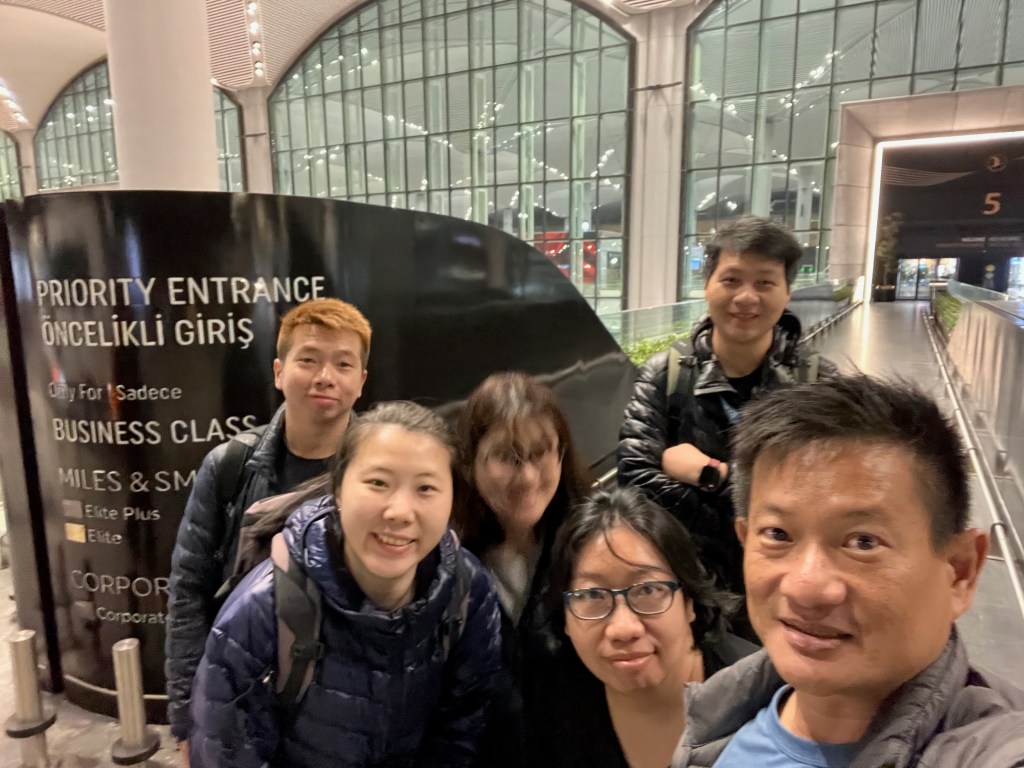
Back to Istanbul airportWe used the Business Class entrance to cut short our wait time.On the lift to the lounge in Istanbul airportWaiting to board at the boarding gate at Istanbul airportWefie onboard a flight on Turkish Airlines bound for SingaporeMy friends comfortably settling into their seats for the next 13 hrsWefie onboard our Turkish Airlines flightMy friends getting ready for our long flight home.
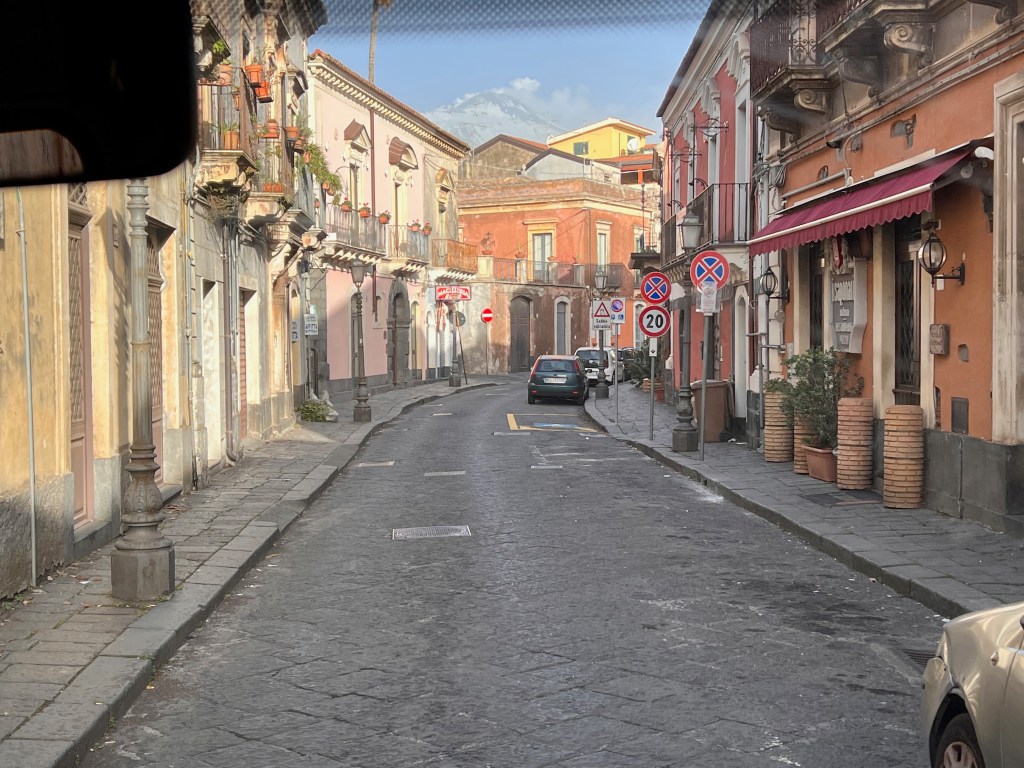
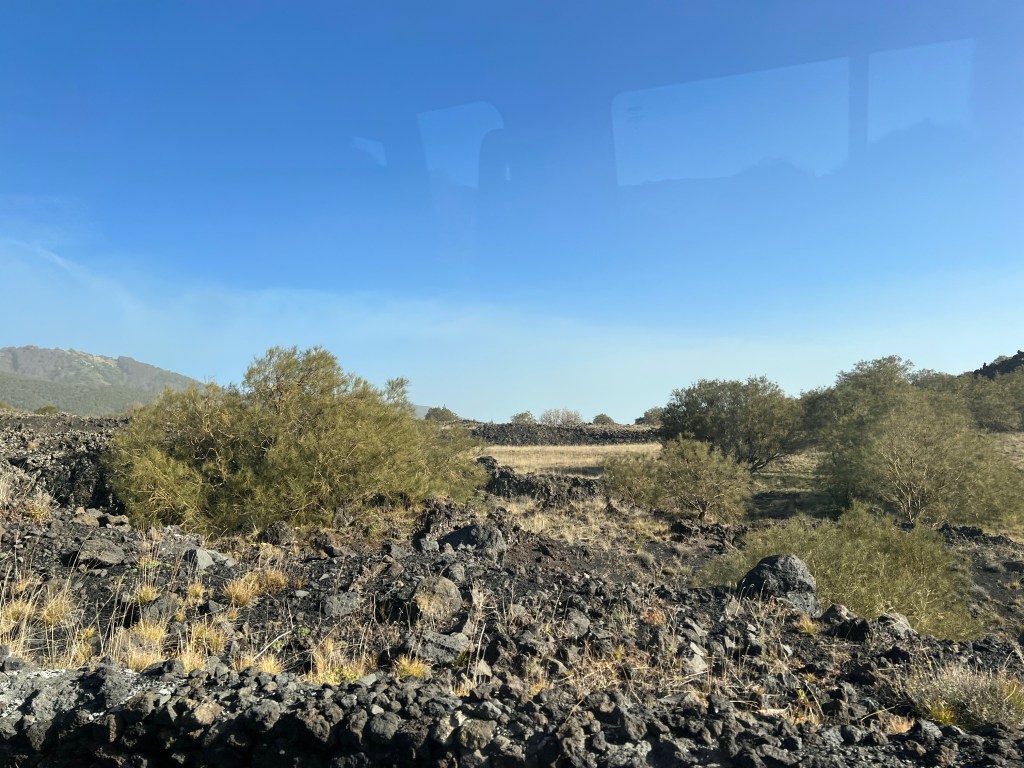
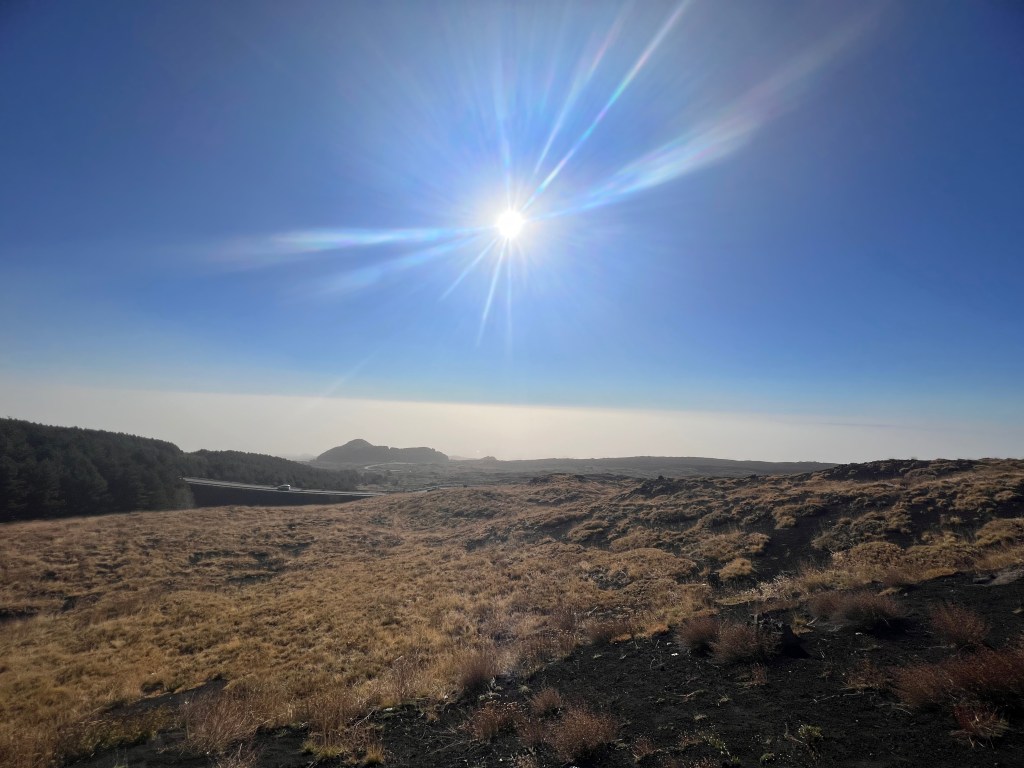
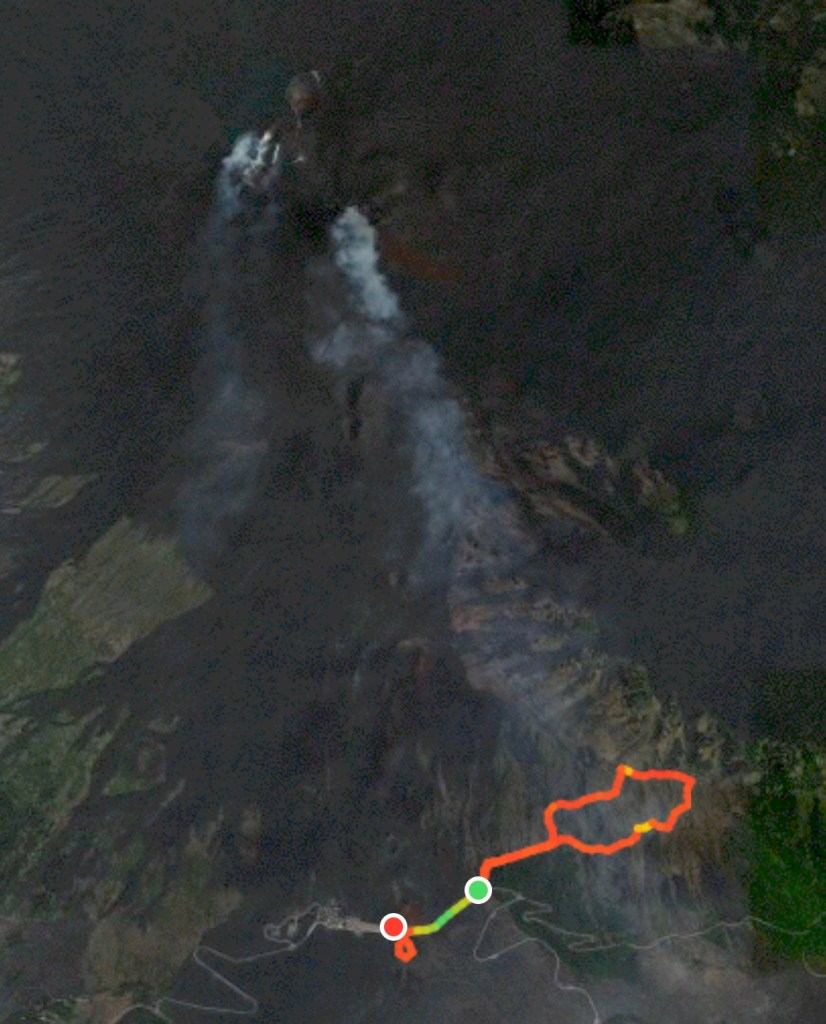
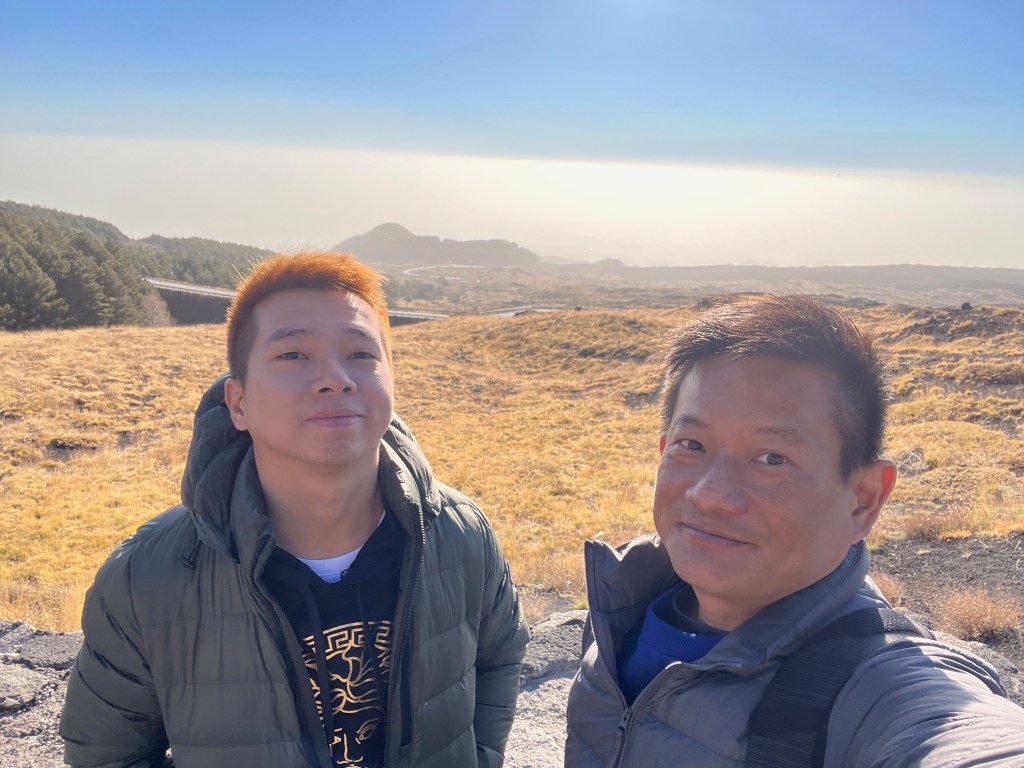
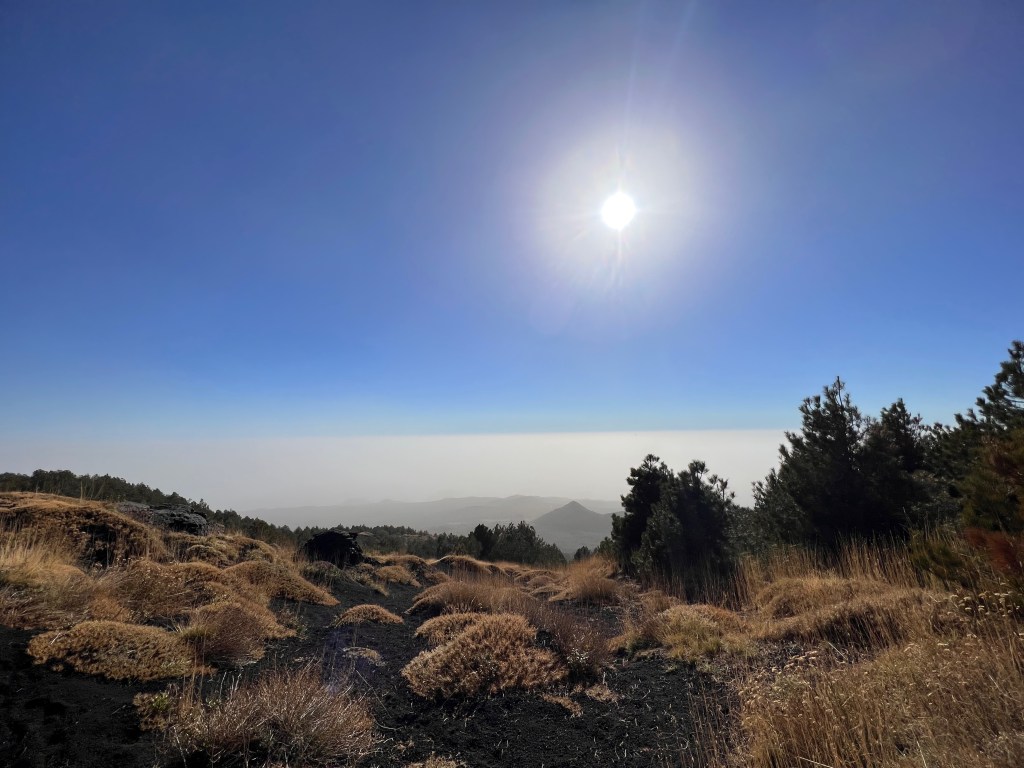
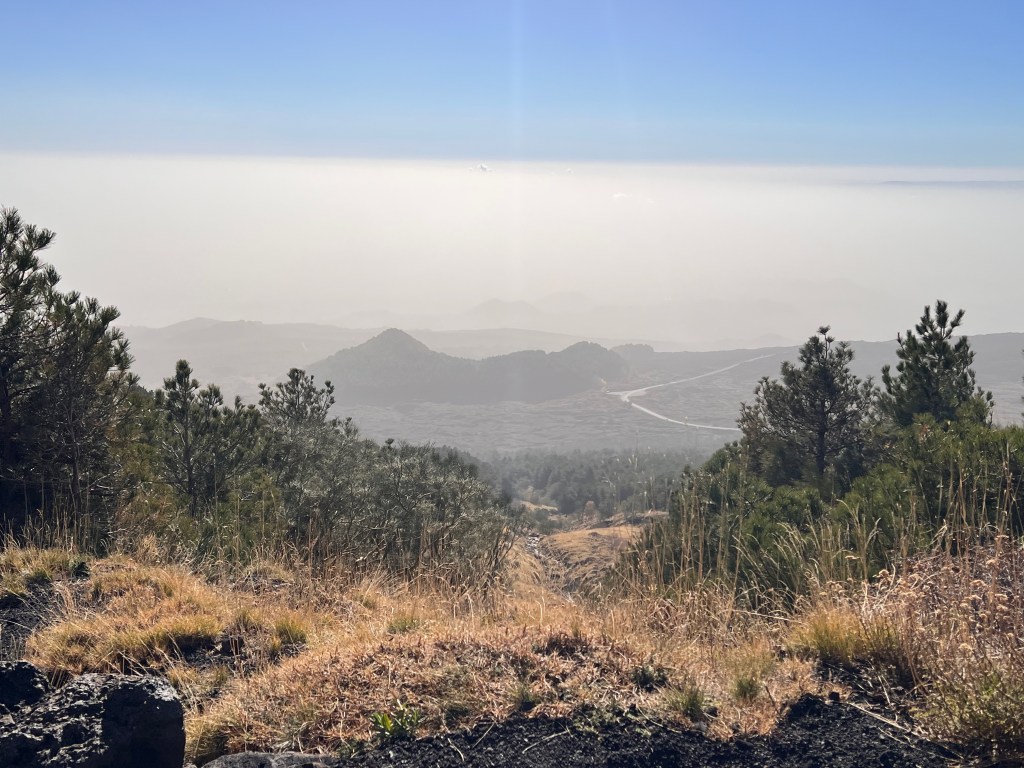
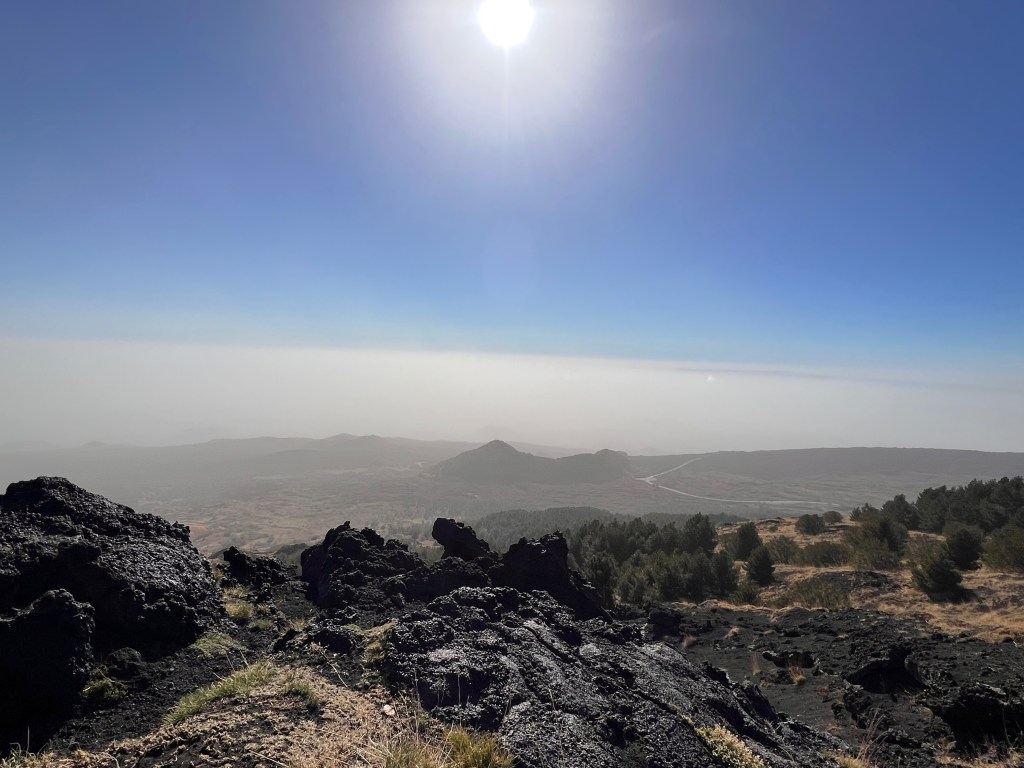
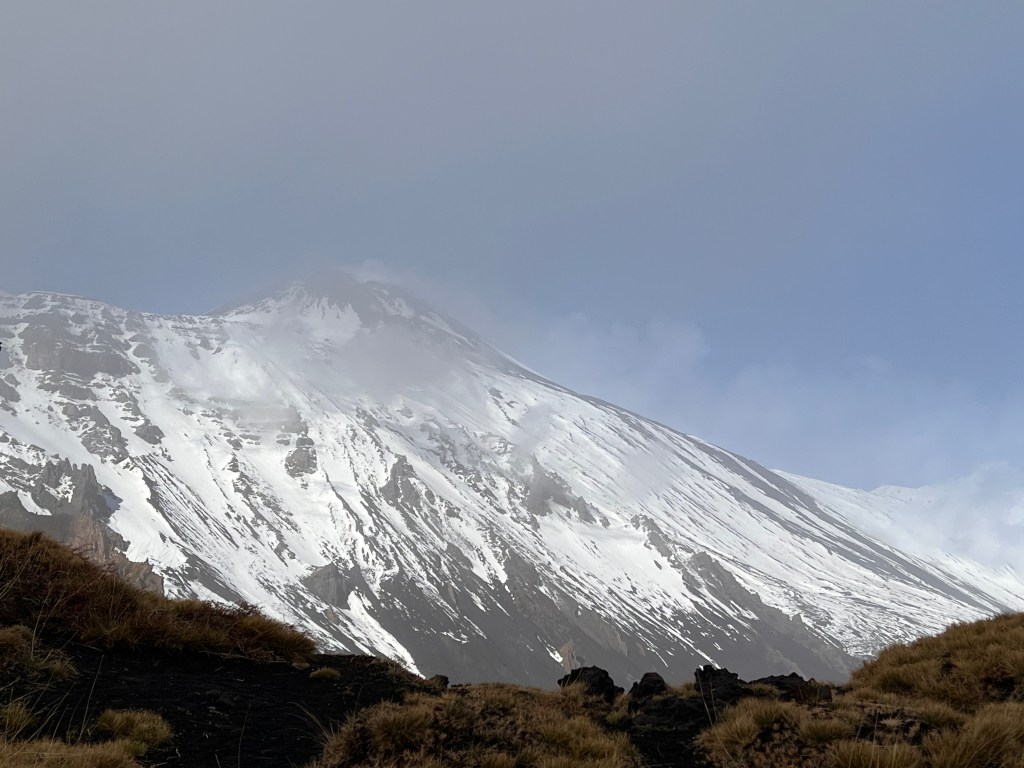
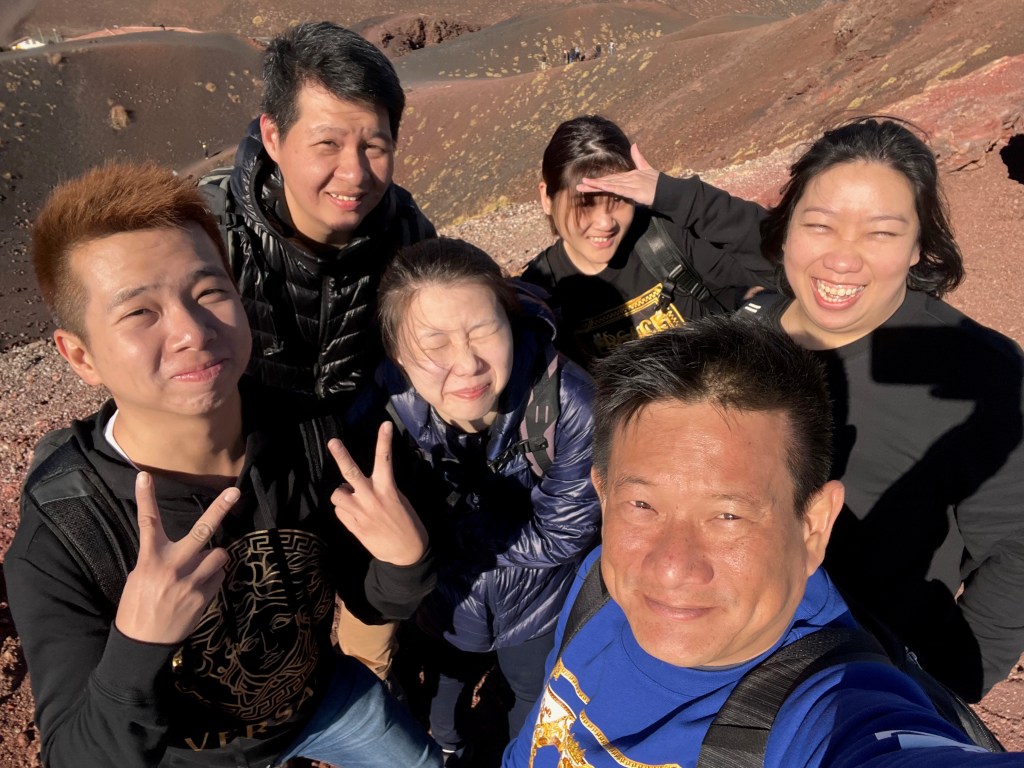
Today would be another highlight of our trip, we are hiking up Mt Etna, the tallest active volcano in Europe. This is the very reason we included Catania in our Italian itinerary. We booked our guided tour with EtnAround, who was highly knowledgeable on the history, fauna and flora on Mt Etna (the same tour can be booked from here). We met up with one of our guides, Alessio, at the pick-up point at 8.30 am. Alessio drove us to one of the towns at the foot of Mt Etna to meet up with the tour leader, Marco, and the rest of the group and to get our sandwiches for lunch at Mt Etna. Along the way up to Mt Etna, Alessio continued introducing the flora at the base of Mt Etna. Before long, we reached a carpark of some sort. This was the starting point of our hike on Mt Etna. Marco explained that we were at 1,800m above sea level and would hike up to around 2,500m on the volcano before heading back down. As Macro and Alessio were preparing the gear for the group, we took the chance to take pictures of the surroundings. We could only see a vast piece of land and the road leading up to a small crater sitting far in the background.
Early morning on the streets of Catania
We can faintly see Mt Etna that we will be scaling today
Driving through the streets in one of the towns at the base of Mt EtnaIn the van to Mt EtnaWe can see Mt Etna at our pit stop to grab takeaway lunchWefie, while waiting for our lunch to be ready
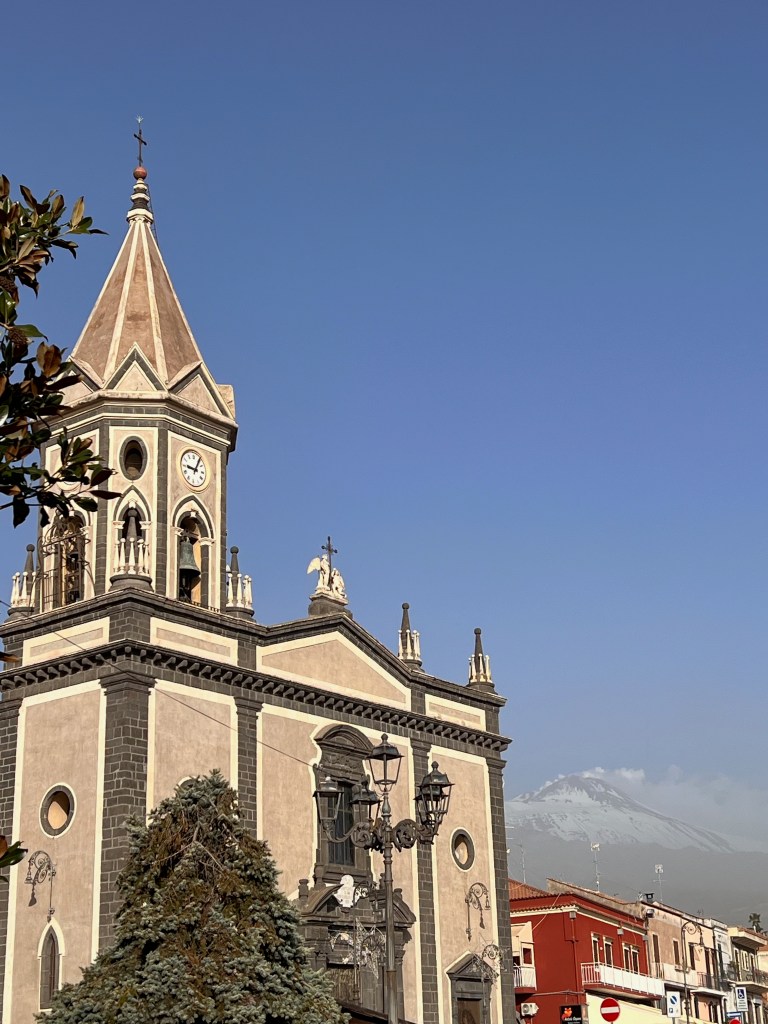
A church in the town with Mt Etna in the background
Our guide, Alessio, told us this is the way people used and still travel in this town
And Our Hike Begins…
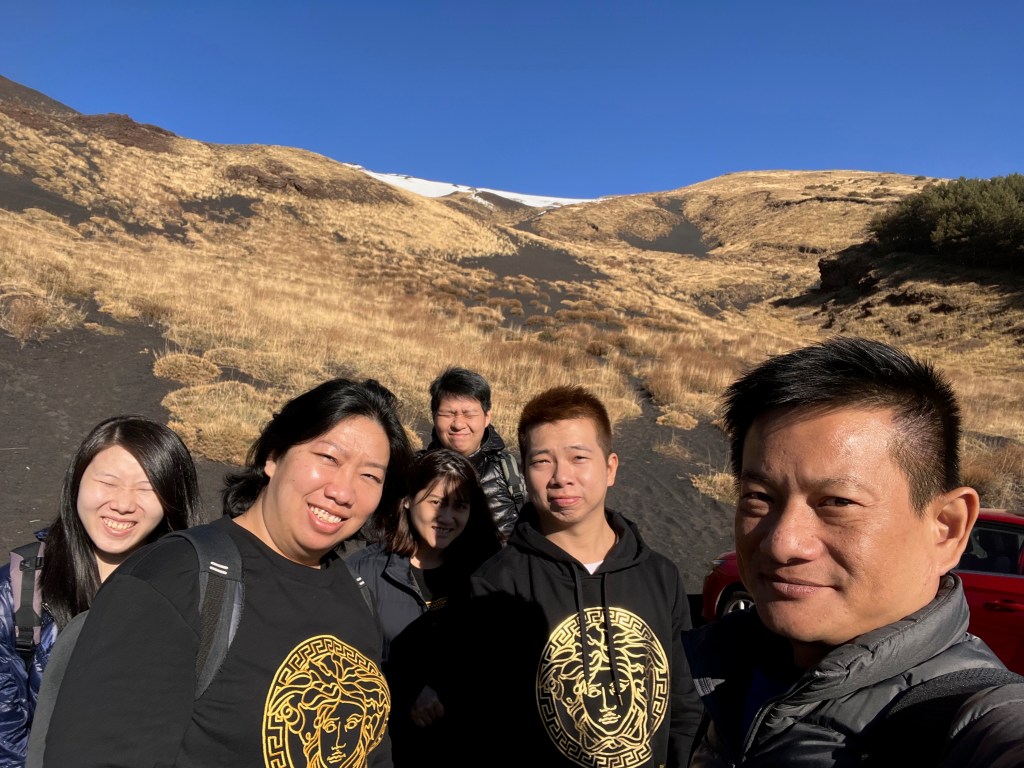
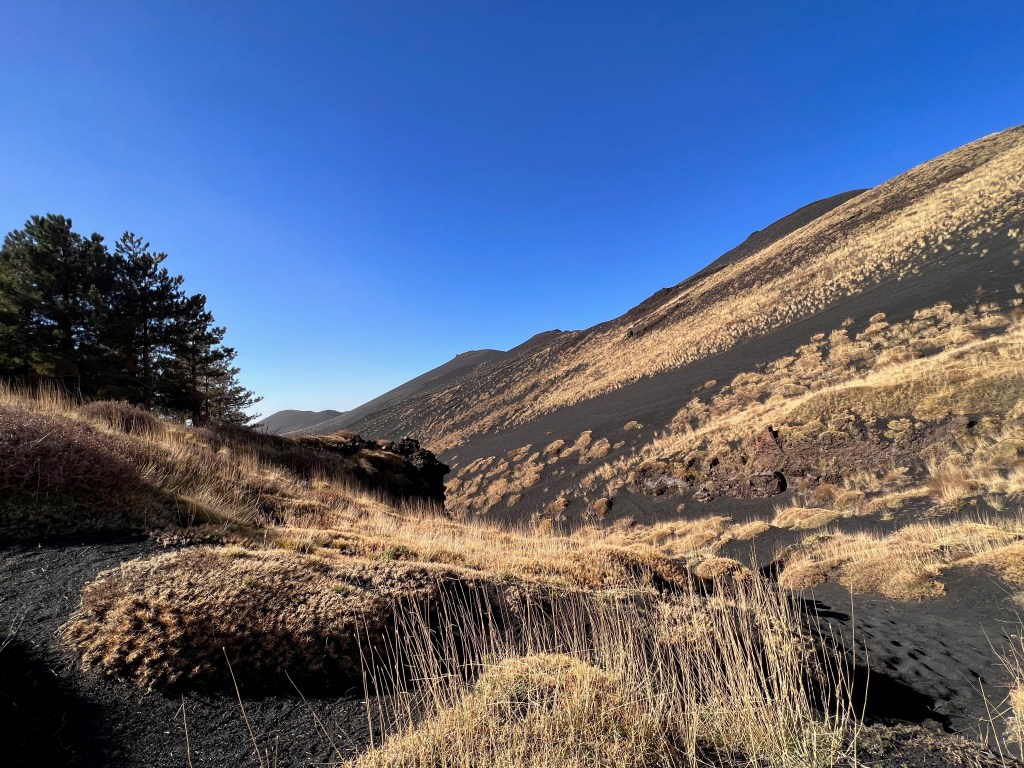
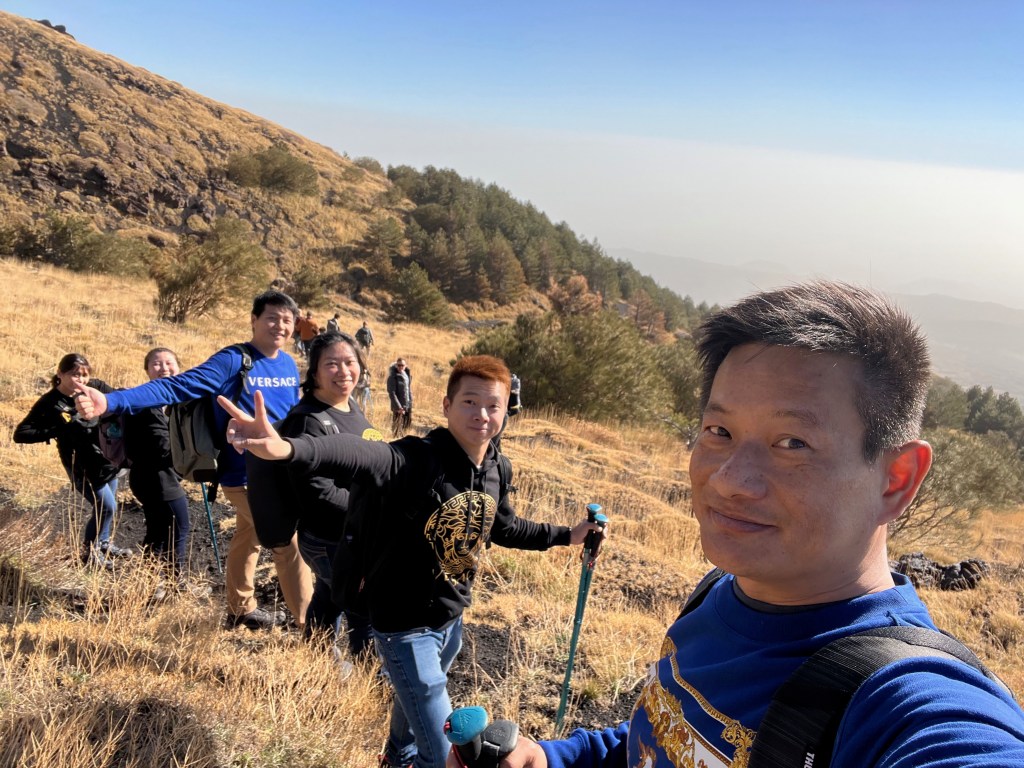
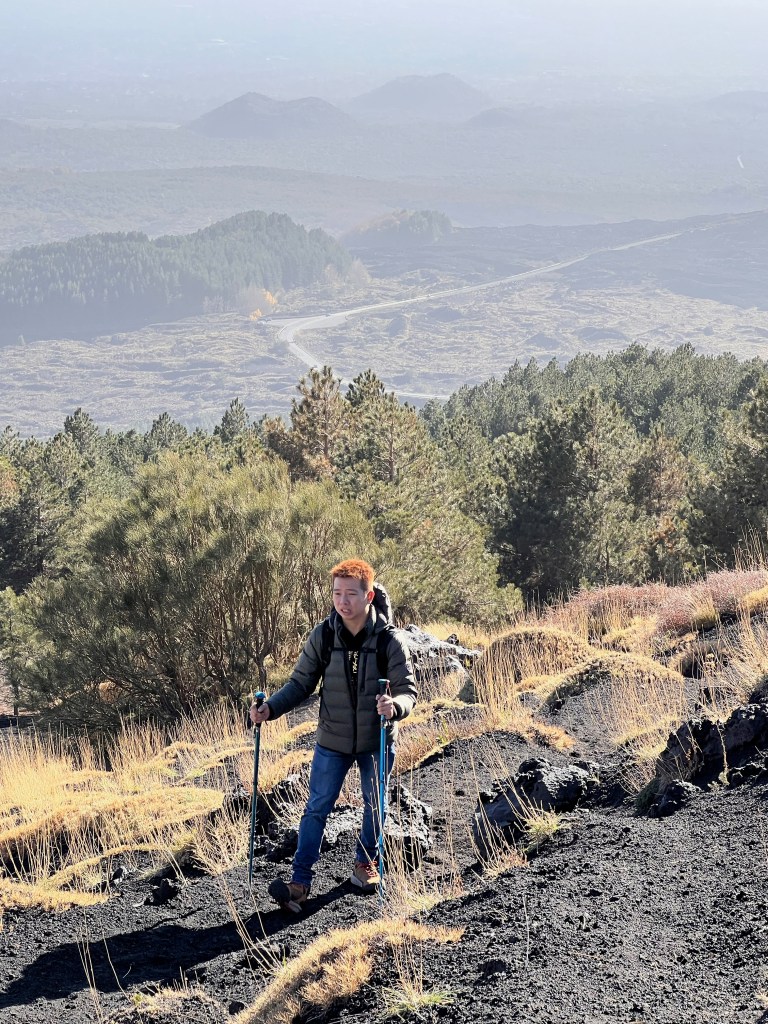
As we were starting our hike, we faced a tall slope that seemed to lead nowhere. We saw the peak of Mt Etna hiding behind the hill as though she was peeking at us. We were very excited with our first step on the volcano terrain was unlike what we thought. The soil on the volcano was soft and grainy. This feels more like the sands of a beach but looser as our feet begin to sink into the ground. The first part of the trek was easy, as the path gradient was gentle. Along the way, Marco explained the importance of the flora we saw spreading around the area we were stepping into. Alessio, who was at the back of the group to ensure that none of us was lost during the hike, constantly looked around the ground and sometimes picked up rocks he found on the ground. Alessio explained to the pack of us at the back of the group that this was a volcanic rock that came out of the crater. Anything larger will be capable of causing hurt to humans and properties.
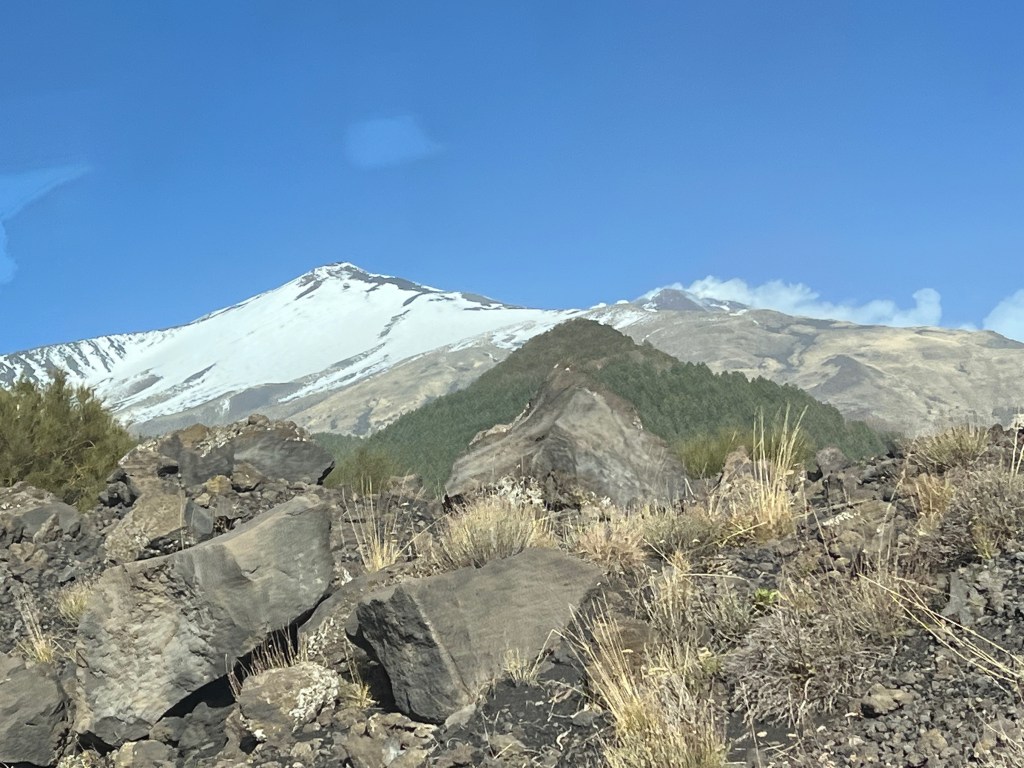
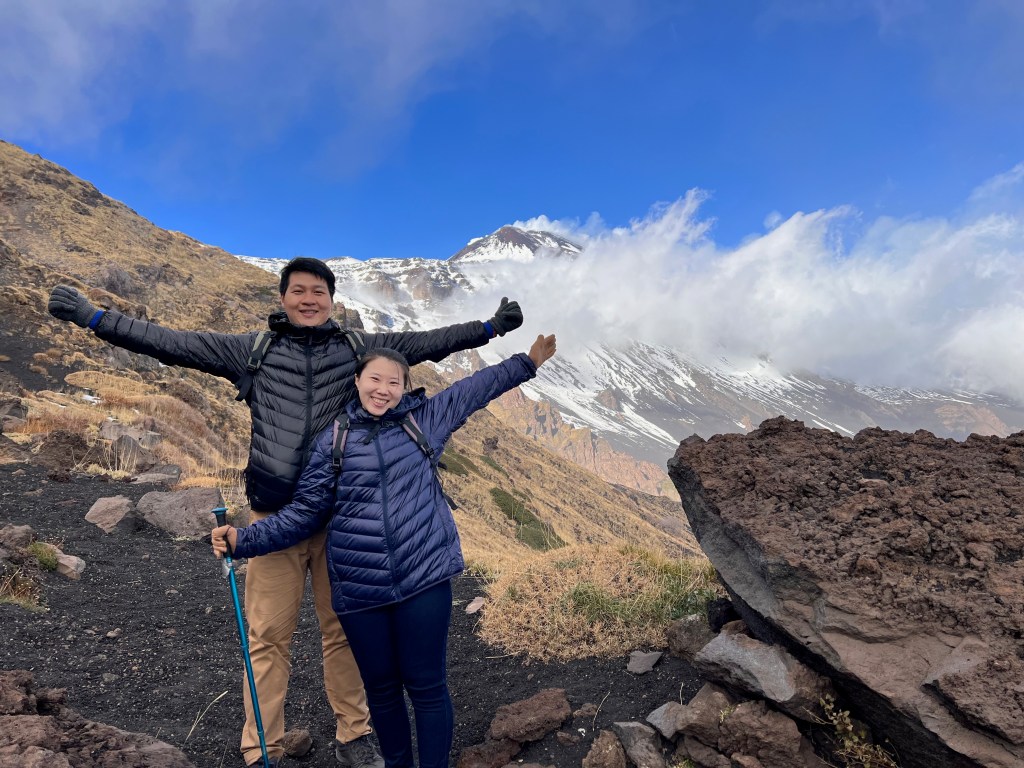
We can see the peak of Mt Etna as we were driving up to our start pointFlora on Mt EtnaThe surroundings on Mt Etna at our start pointGetting ready for our hike on Mt EtnaMy friend and I at Mt EtnaThe view at the 1800m mark of Mt EtnaTaking a wefie before we start our hike
The route we took today on Mt Etna
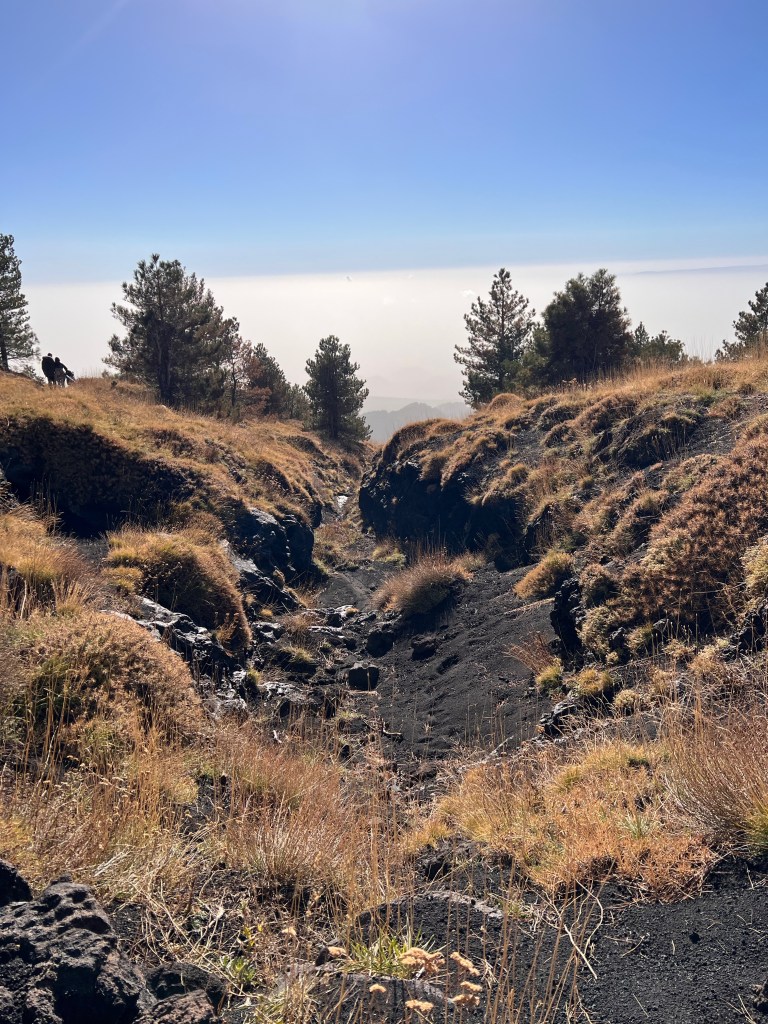
Wefie on Mt EtnaThe flora at the start of our hiking trailWe took the opportunity to take some pictures as Marco explained the surroundings to us.My friend with a volcanic stone Alessio found on the groundIt feels like we are above the clouds at this altitudeMy friend and I taking a wefie during the hikeConituing our hike on Mt EtnaWe got a magnificent view of Mt Etna.Marco told us this is a lava canal created ages agoWe see some light snow (or ice??) on the pathThe canal is created by lava so it can flow down the volcanoMy friends on Mt Etna with the peak peeking outThe view we got on the path during the hike on Mt EtnaLava rocks over the beautiful scenery on Mt EtnaMore lava rocks on Mt EtnaTaking a wefie on our hike on Mt EtnaMy friends with Mt Etna are still spilling white fumes.
Wefie on Mt Etna with her fuming peak
My friend on Mt Etna trialWefie as we are nearing the highest point of our hikeMy friend turning around with Mt Etna My friend with the fuming Mt Etna’s peakMy friend on the trial
Lunch with a View
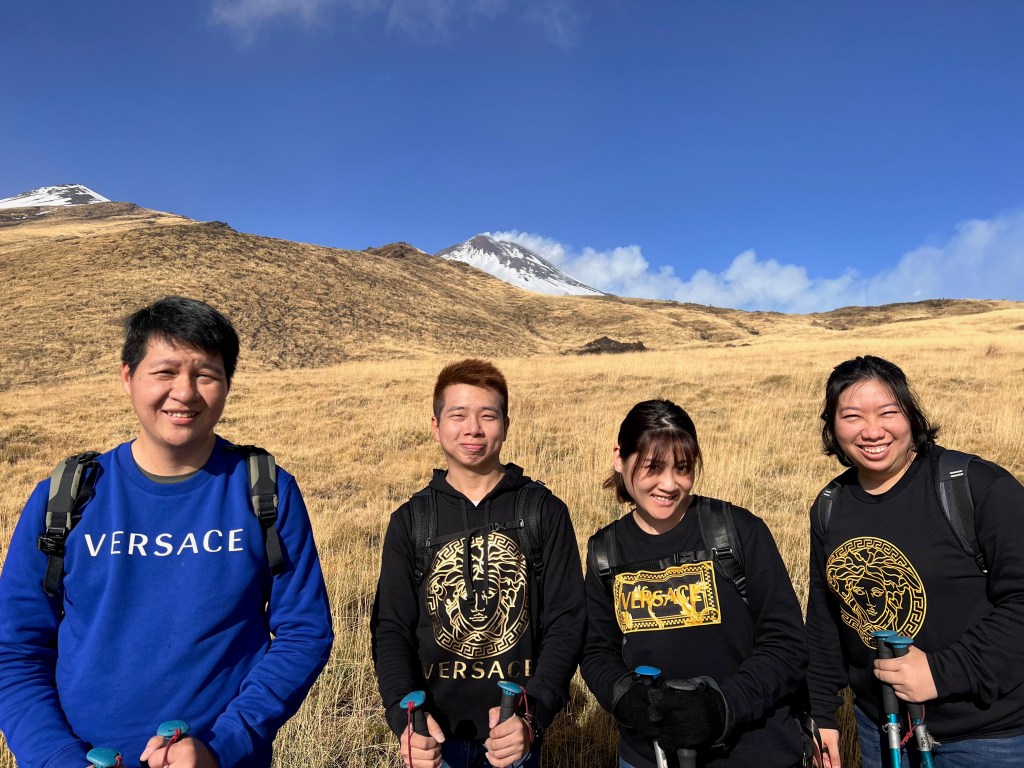
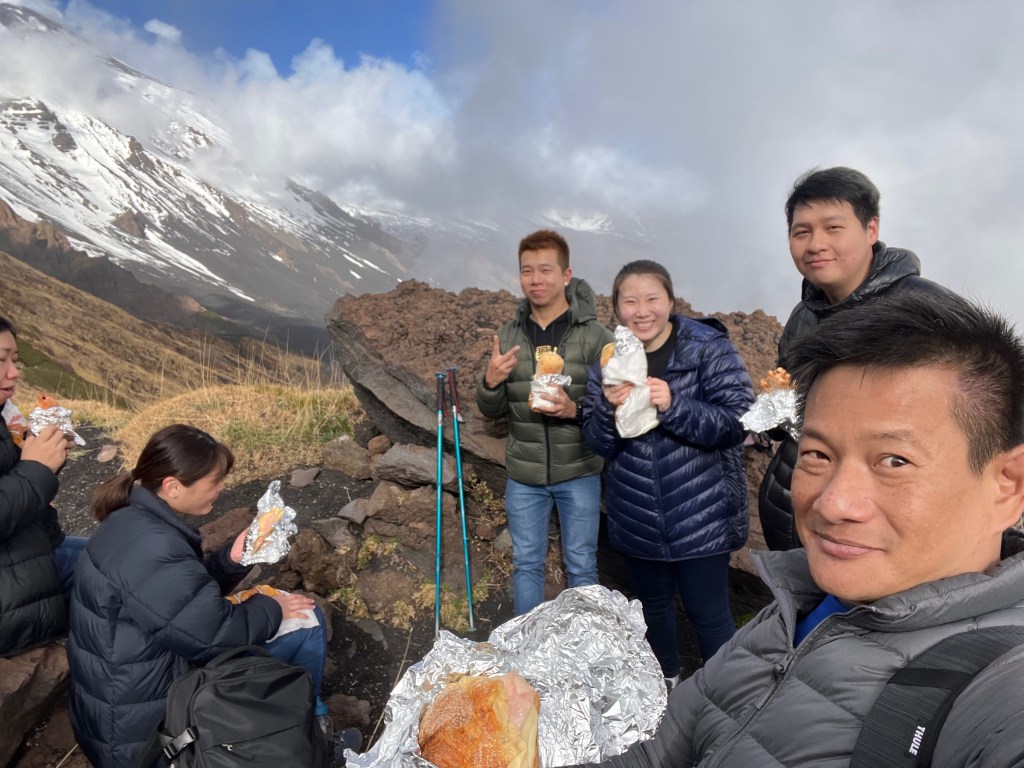
As we continued our hike up Mt Etna, we reached a grassland. Walking on this part of the volcano feels like walking on flat ground. At the trail’s end, we came across some boulders that we would have to scale. As we climbed up these boulders, the peak of the snow-covered Mt Etna with fumes of white smoke emitting was in our sight. We were amazed by this incredible view of the gentle lady that we were on. Looking out into the area, we saw a crater-like depression that seemed to stretch forever. As we were walking along the path, the path got narrower and narrower to the point that it was just as wide as two feet wide. One misstep would mean we would fall into the valley below, and there were no barricades would shield us from the potential danger of falling over. However, we had trust in Marco and Alessio that we were well watched over. Marco announced that we would stop for lunch at the trail’s end. We all found a huge boulder to sit on and started munching on the sandwich we had bought earlier. What we saw ahead was the peak of Mt Etna with her endless white fumes and, at times, low clouds passing over her. The view is a one in a million! This is a perfect spot to have lunch while looking at Mt Etna and enjoying the mountain breeze.
My friends on our way to the 2500m height of Mt Etna
Me on the trail at about 2500m on Mt EtnaMy friends with the magnificent view on Mt EtnaThe peak of Mt Etna is so near but so farWefie with the peak of Mt Etna at 2500m markWe see low clouds over the peak of Mt EtnaView of the surrounding from 2500m high on Mt EtnaMy friend with the peak of Mt EtnaMy friend at the 2500m mark on Mt Etna and her peakMy friends with the snow-capped peak of Mt EtnaMy friends on the highest point of our hike
Lunchtime at 2500m high on Mt Etna
The view we got here is one in a millionView of surroundings on 2500m mark on Mt Etna
The Return Journey
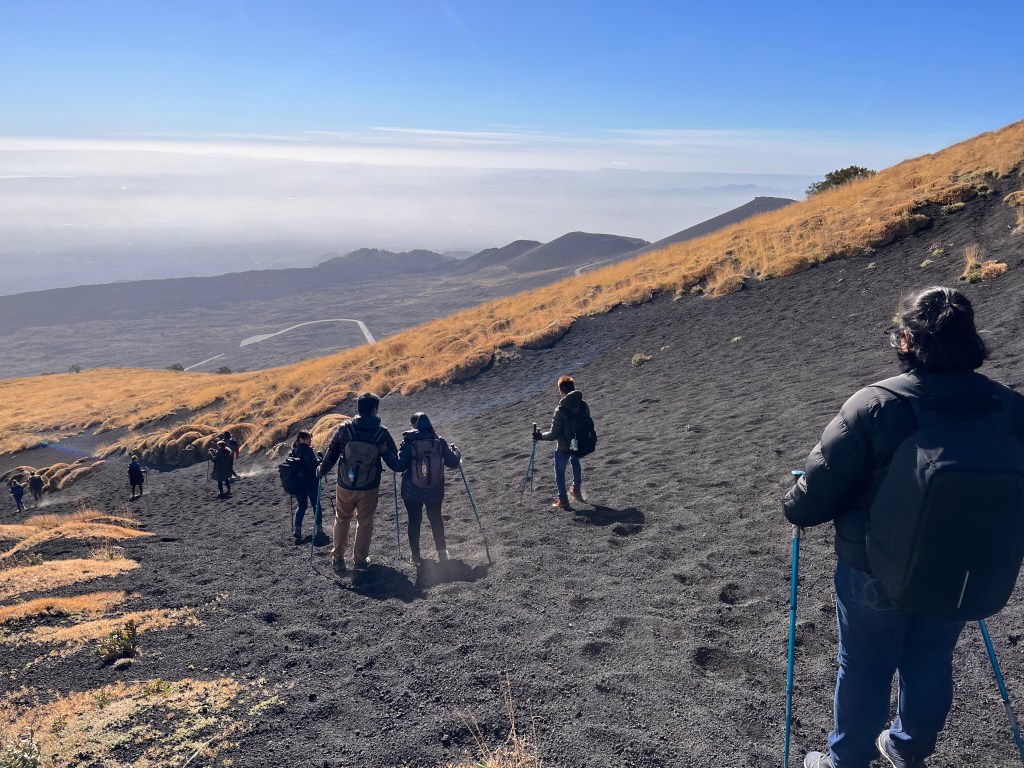
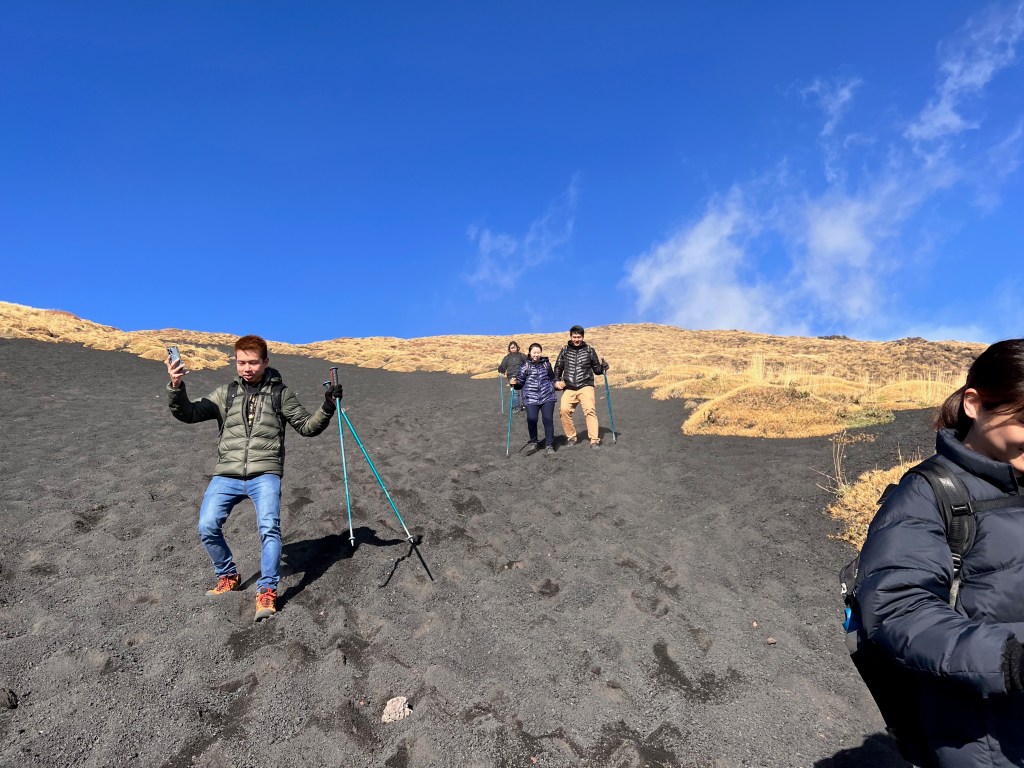
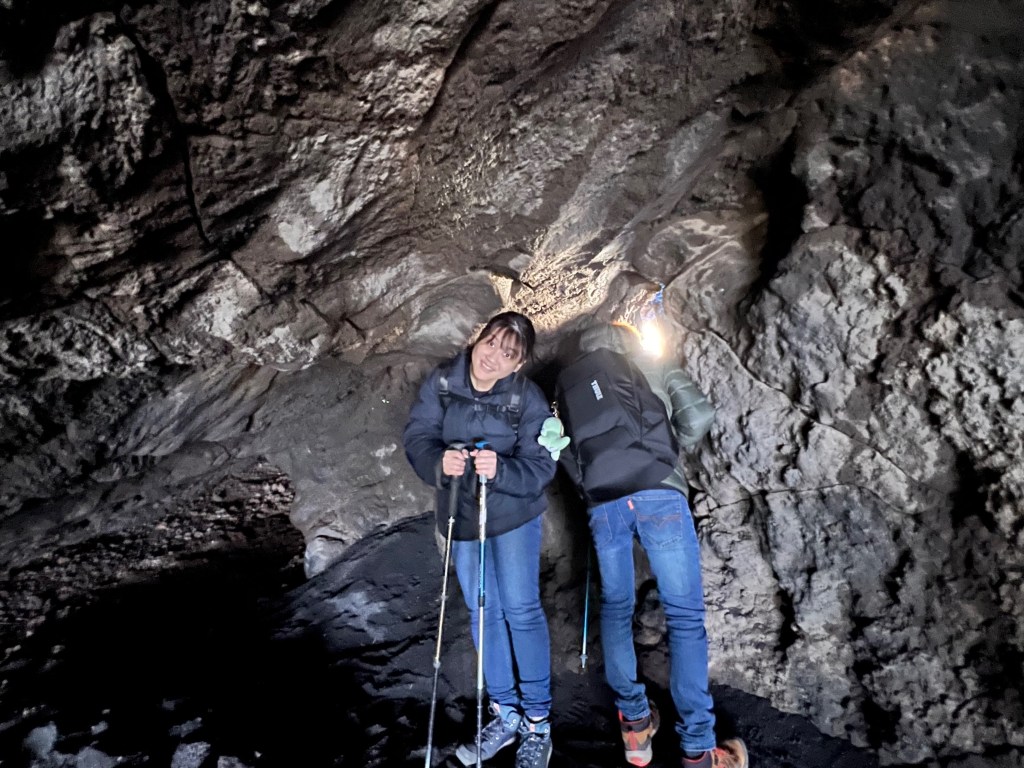
After 15 mins, Macro announced for us to start our hike down to where we started. Instead of going through the same route, we took a different way. We hiked upslope and boulders, putting the view of Mt Etna behind us. As we walked, we came to a part where we needed to descend. Alessio assured us we could run down the slope without worrying that we would tip over the edge. I had a go at it, and it was fun (though I thought it would be more fun if we had some sledge down the slope). The volcanic ashes here are more coarse and looser. We soon come across a lava channel. Gone was the lava that once flowed through this channel. All that remained were rocks that the lava had once smashed through. Another downslope later, Marco brought us to a lava cave. He explained how this cave was formed and how the locals used this cave. We were taken inside to feel the temperature difference. We continued on the path, and suddenly the path felt familiar. This was where we were when we hiked up. I exclaimed to my friends. We are near the end of the hike. Soon after, we can see the vehicles we drove up on.
My friend on trial down back to the vanThis part is very sandy, and Alessio recommended we run down the slopeMy friends making careful steps down the slopeThe view from the downslope is majestic, too bad most of us are too concerned with watching our steps instead of looking up.My friend is trying to run down the slope.
We are at the bottom of the slop
My friend inside the lava caveMacro told us this is the best place to take pictures fromTaking a wefie at the entrance to the lava caveContinuing our hike down to our vanMy friend stopped for a photo
My friend on the path of our Mt Etna hike
My friends on their way down Mt Etna
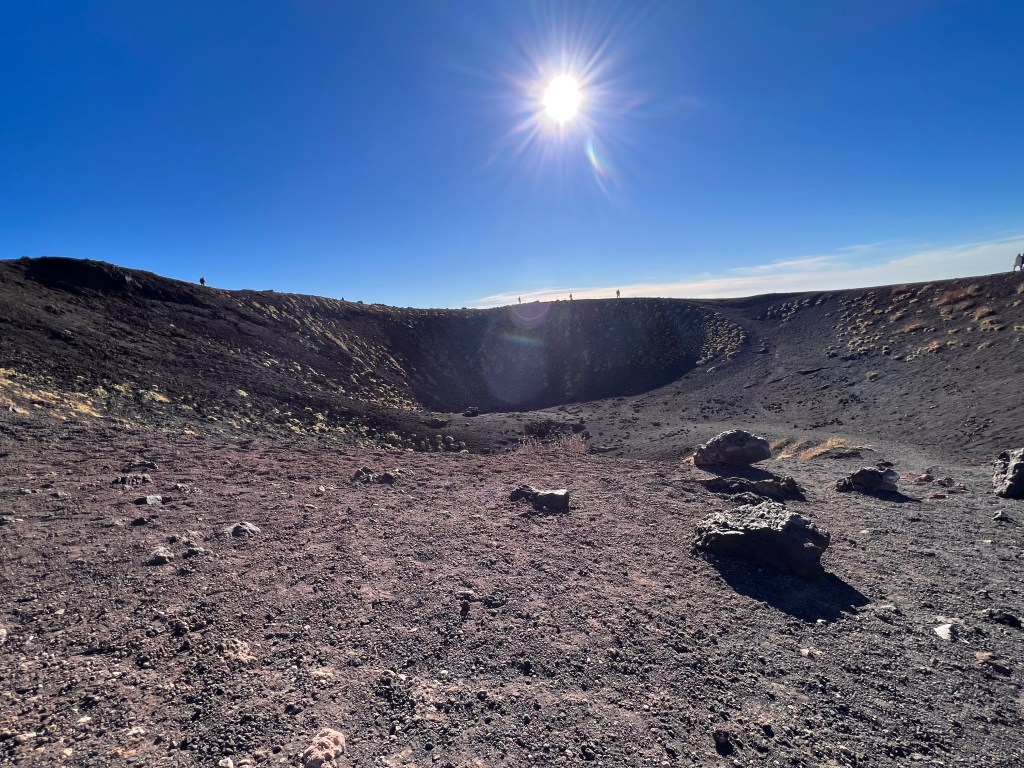
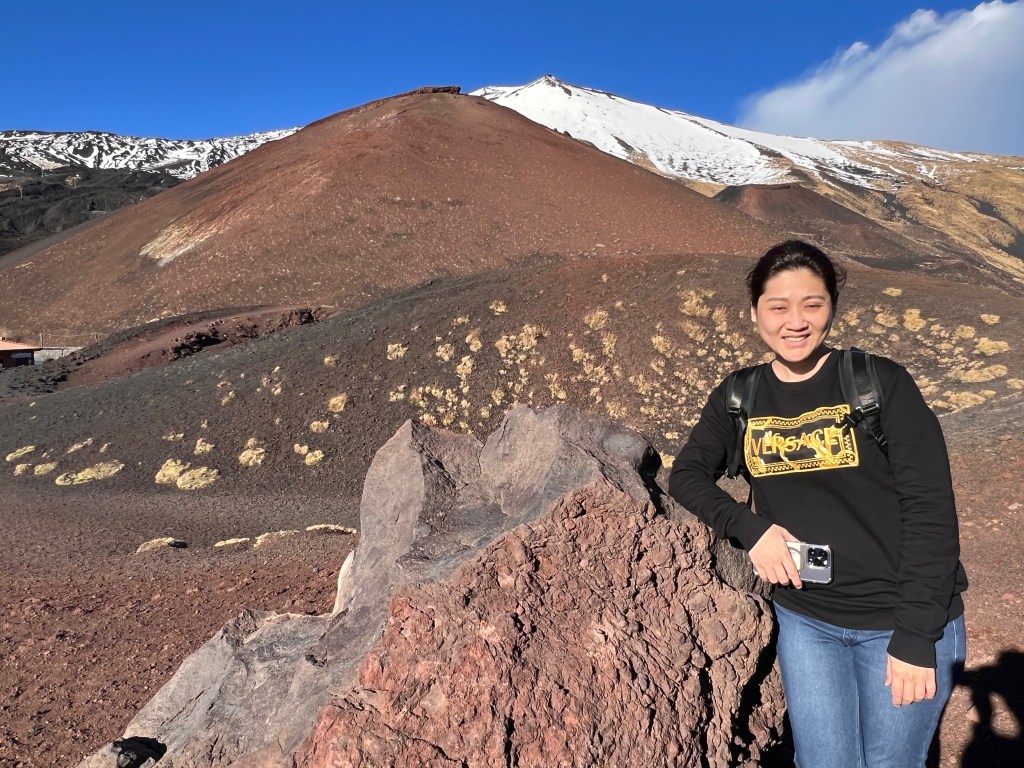
After returning to our vehicles, Alessio said we would stop by a cafe on Mt Etna for coffee. So we were driven to a cafe which was closed. At this point, we realise that the destination is not this cafe but the crater behind the cafe. The short walk around the crater allowed us to see what a crater looked like. Alessio explained this is just one of the hundreds of craters on Mt Etna, and every year the volcanologists would find one new crater on Mt Etna. After the crater visit, we had some coffee, and soon it was time for us to bid Mt Etna farewell.
A volcano crater on Mt EtnaAnother view of the volcano craterView from the volcano craterMy friend on the volcano crater with the peak of Mt Etna behindAnother view from the craterWefie with the view from the craterTaking another wefie with the crater
Few of the many craters on Mt Etna
The peak of Mt Etna and the crater
Last Look at Catania
Alessio drove us back to Catania. The plan today was that if we got back to Catania at around 3 pm, we might still be able to squeeze in a visit to Ursino Castle, just 15 mins walk from our hotel. We arrived at Catania city at around 4.30 pm. There is little time for us to visit the castle before it closes. We walked to the city centre for our last dinner in Italy. We asked the friendly waitress about the fried rice ball we had heard so much about during dinner. She gave us some recommendations, and one of them is located about 5 mins walk from our hotel. We headed to get some rice balls and picked up gelatos before returning to the hotel to pack our luggage for our journey home tomorrow.
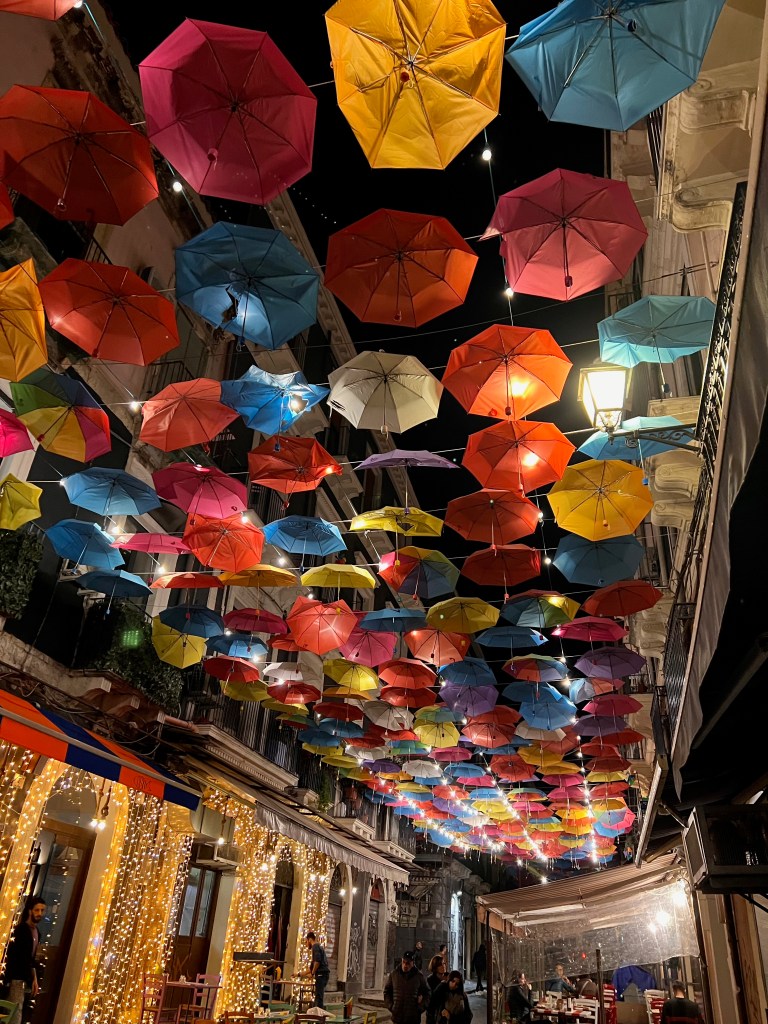
The street of umbrellas in Catania near Piazza del DuomoWefie under the street of umbrellas
Our last dinner in Italy
Catania seems more lively tonight.We took a stroll to Porta Garibaldi after dinner.The shop that sells Catania’s best fried rice ballsOur last gelatos in ItalyHaving gelato on the street of Catania
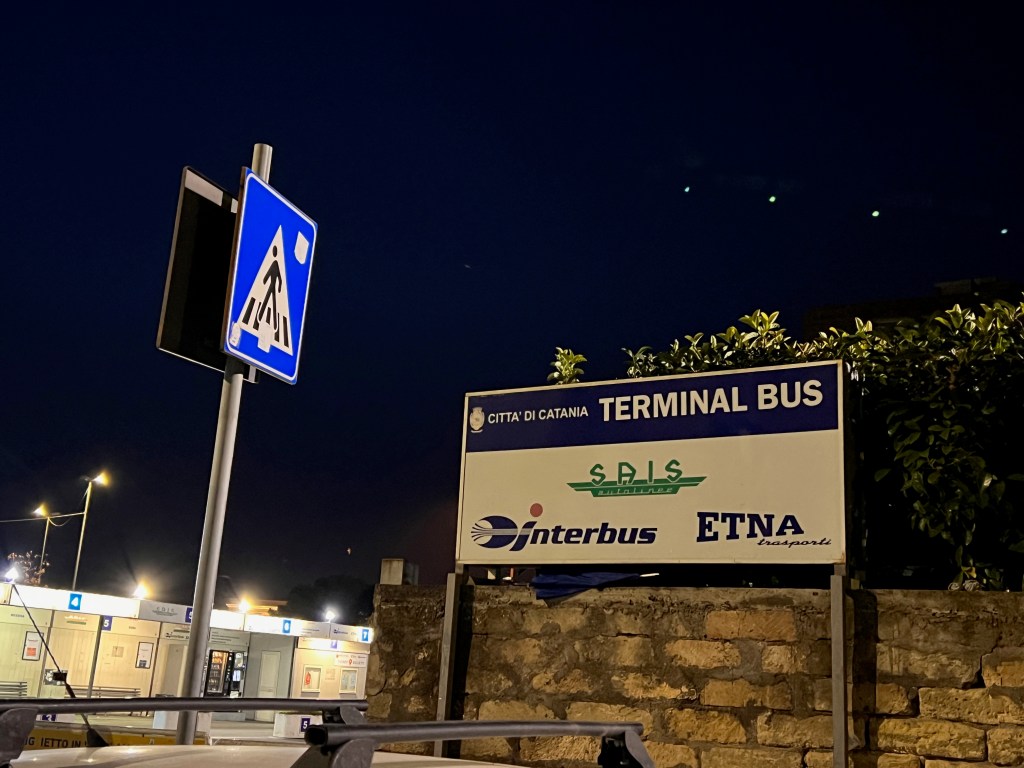
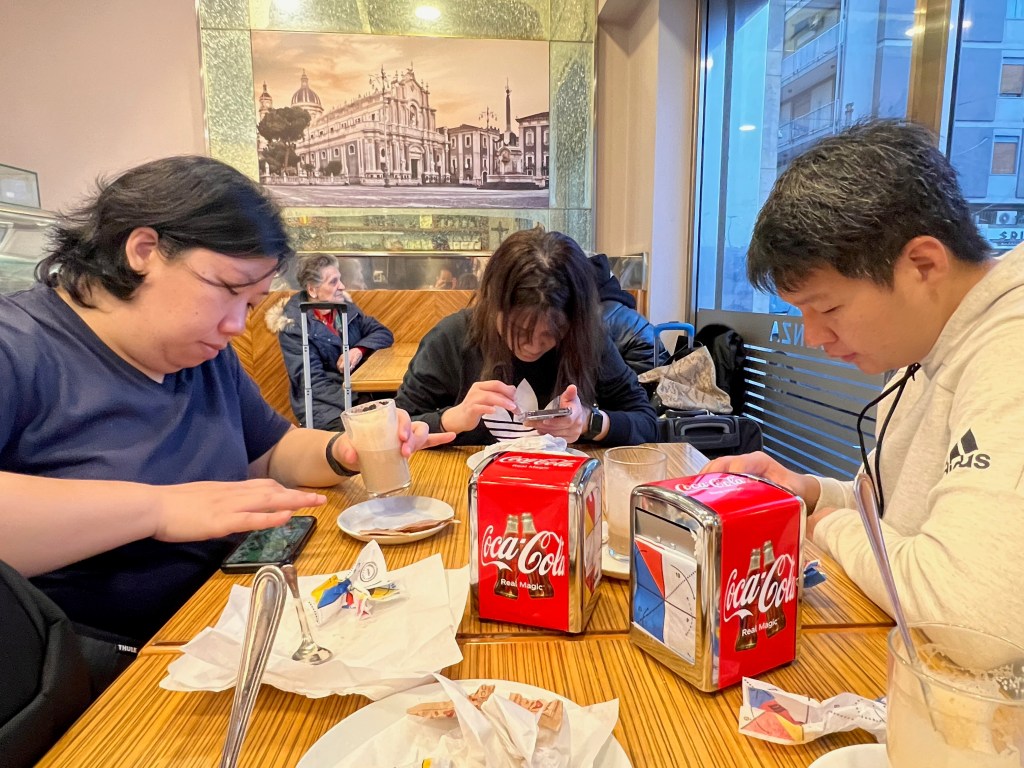
The bus we were supposed to be on to Agrigento was initially scheduled for 7.20 am but was brought forward to 6.30 am. We had an early start and made our way by foot to the bus terminal, located about 20 minutes from our hotel. We cut it very fine when we arrived at the bus departure venue. The bus we booked did not depart from the bus station but along a nearby street. We were looking for the bus we were supposed to be on, and our bus had left the stop by the time we found it. We asked around to see if we could get the bus company to help us contact the bus driver, but alas, there was no booth set up by the bus company, and there was no way we could reach the bus driver. Walking around, we saw the SAIS company booth and purchased the tickets to Agrigento. The next bus will not leave until 1 hour later. Since we had some time to kill, we had breakfast at the cafe opposite the bus station. After this little episode, I realised there is no need to pre-purchase bus tickets to Agrigento as there are multiple departures from Catania. The bus ride to Agrigento took around 3 hrs. The moment we arrived, we verified that our bus to Catania later in the afternoon would leave at the same place where we were being dropped off. One cafe latte later, we bought our bus ticket to Valley of Temples from the SAIS office diagonally opposite the bus terminal.
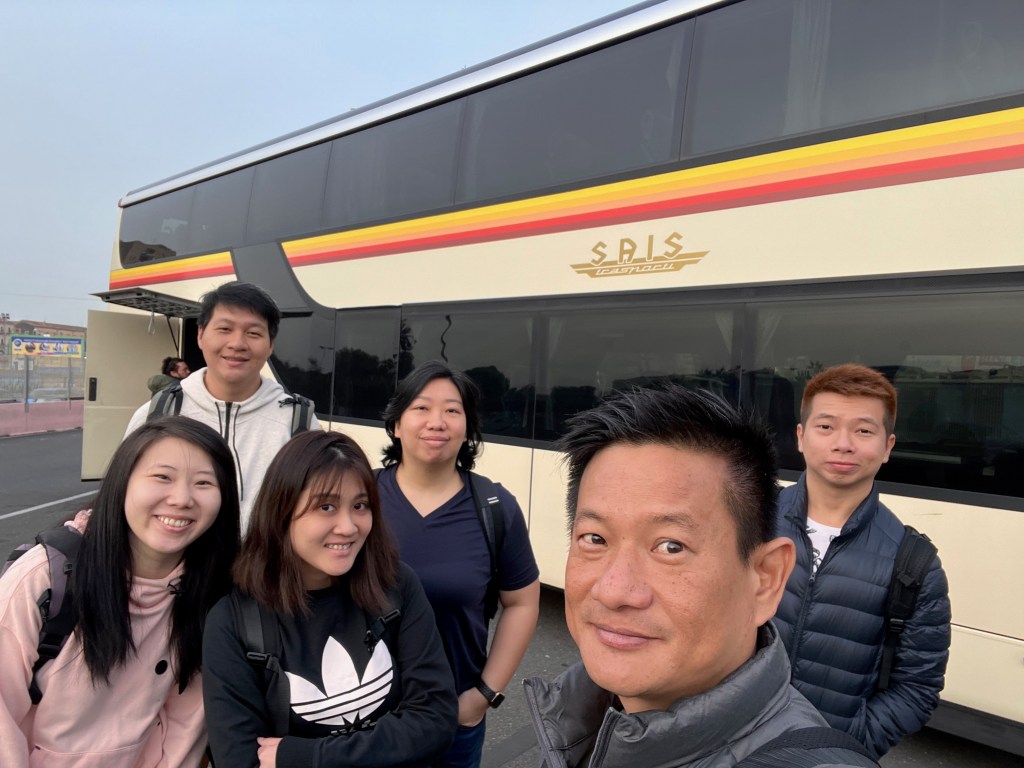
Our original booking on Itabus did not leave from this terminal but from the street facing the row of bus company shops.My friends killing time playing HayDay while waiting for our next bus to Agrigento.The bus that took us from Catania to AgrigentoWefie on the double-decker bus to AgrigentoThis is the street where our Itabus leaves CataniaScenes from Catania to Agrigento We saw some farms on the way to Agrigento Scenes from Catania to Agrigento Scenes from Catania to Agrigento
2,500 of Greek History at Valley of the Temples
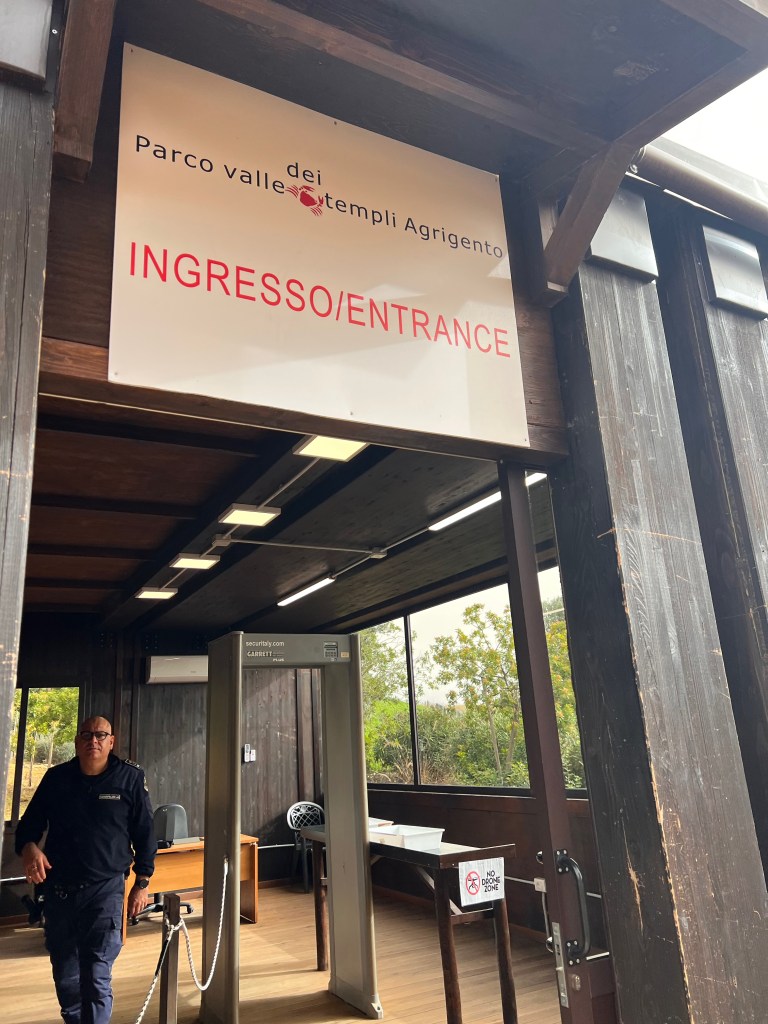
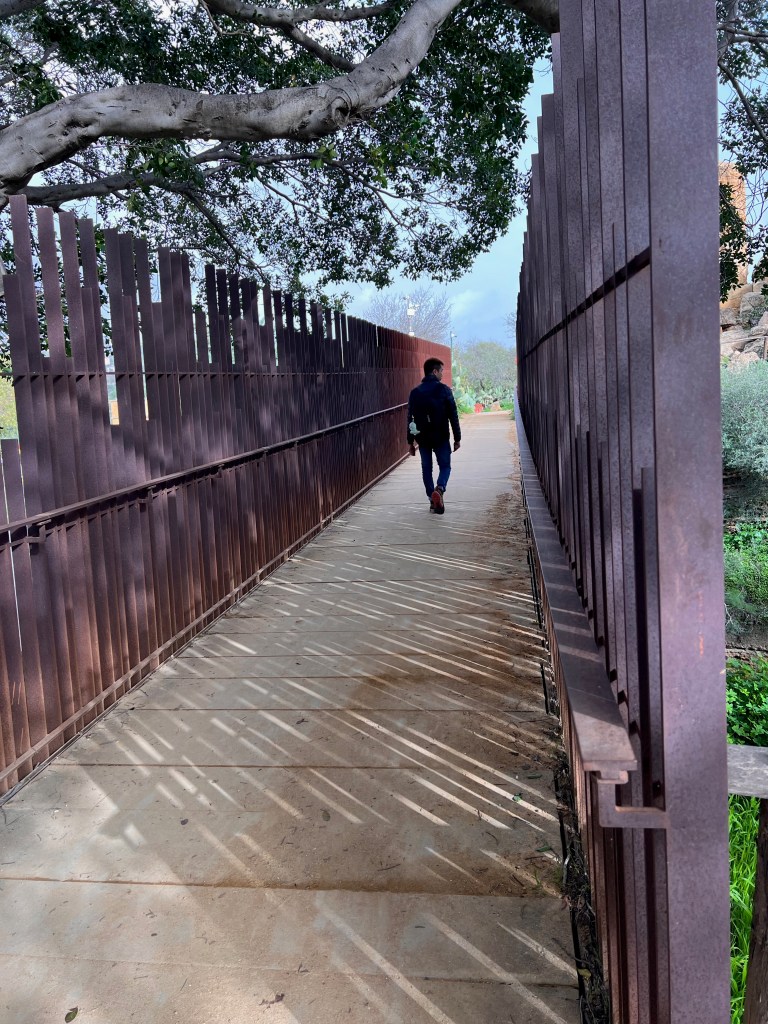
There are several buses to get to the Valley of Temples (refer to the bus schedules from Agrigento here). There are two main entrances to the Valley of Temples, we started our tour of the valley from the western Porta Quinta entrance, where bus #1 stops. Using the official app, we did a self-guided tour for this day trip to the Valley of Temples. I find the official app for the Valley of Temples very useful (you can download it here for free, scroll down to “Offical App” on the webpage) as it has a designated route that we can take from either of the entrances together with an audio clip that we can listen to when we arrived at the various landmarks. The Valley of Temples wasn’t crowded when we were there due to the low travel season. It took us about 2 hrs to follow the recommended route provided by the app.
My friends played scratch while we rested for coffee in Agrigento My friends, in front of the cafe, we played scratchyWe took bus service #1 from this bus terminal to Valley of TemplesMy friend at the bus stop of Valley of TemplesThe entrance to the Valley of Temples
Taking a wefie after passing through the entrance of Valley of Temples
The Entrance: Gate Five, Temple of Dioscuri, Temple of Olympian Zeus
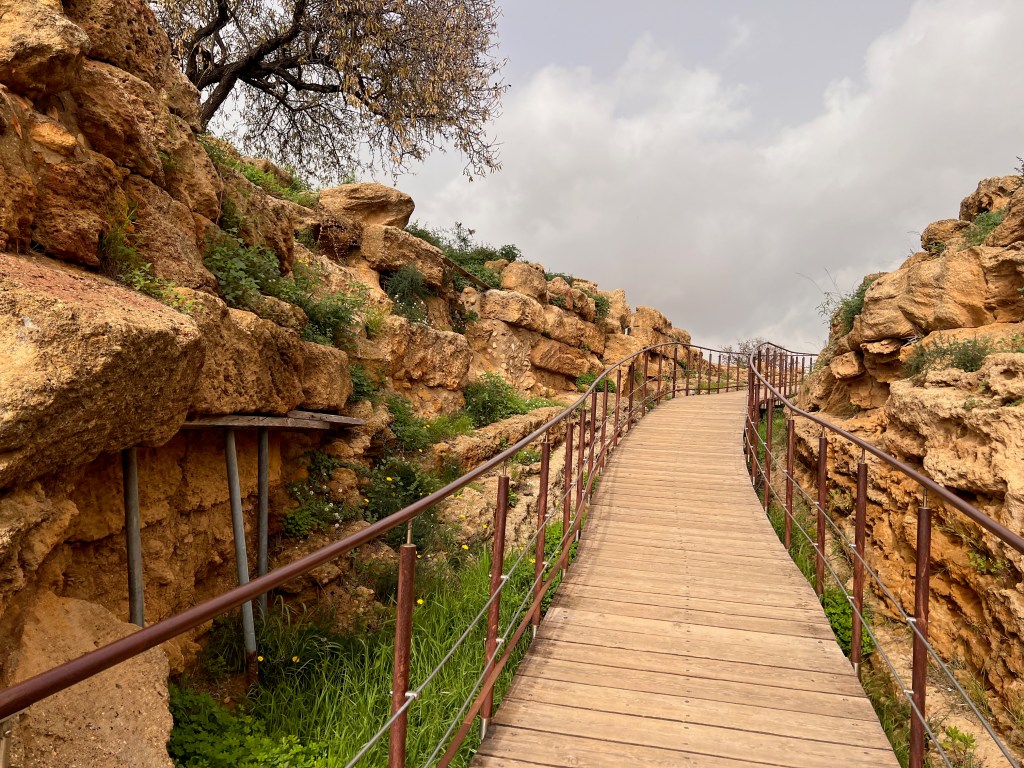
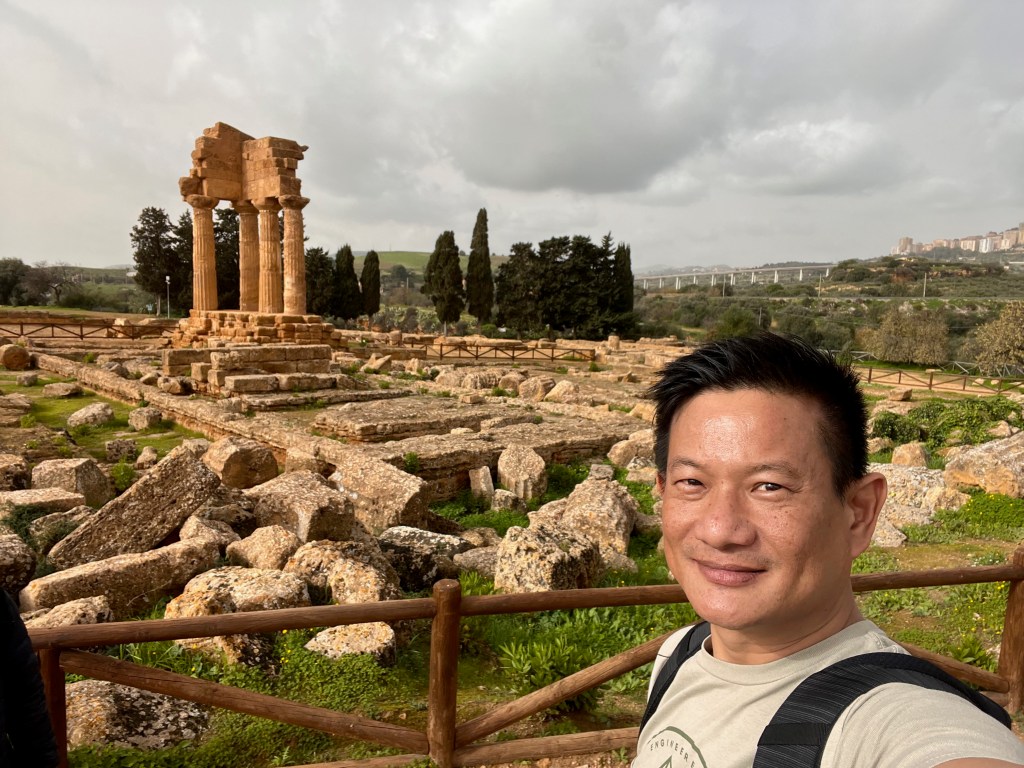
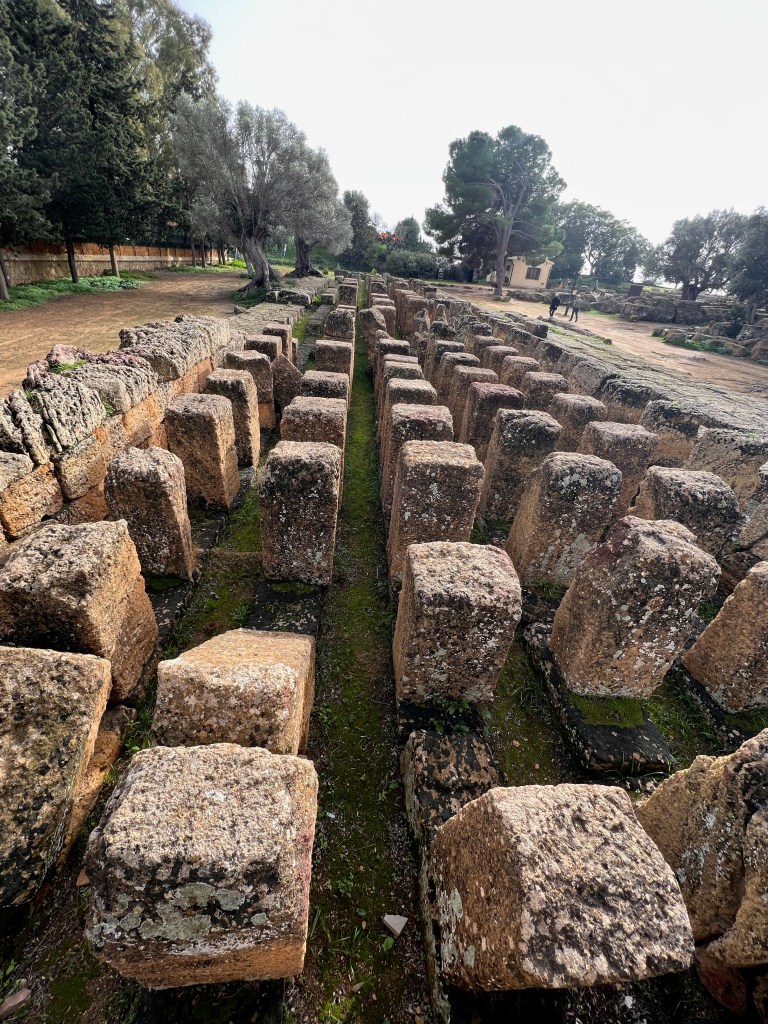
Coming into the Valley of Temples through the Porta Quinta entrance, past the ticketing counters, we saw a vast piece of land with nothing but stone walls. There is a wooden path passing in the middle of these walls. Gate Five is essentially the outer wall of the Valley of Temples. Walking past Gate Five, the first set of ruins came into our sight. Only four pillars of the Temple of Dioscuri remained over the land it once stood. We can only roughly make out the size of the temple based on the ruins scattered around, which suggests this is one of the smaller temples in the Valley of Temples. We walked around the temple, hoping to get some pictures of the temple from different angles.
Gate Five in Valley of Temples is a wall of stones with well-paved paths
The Temple of Dioscuri is reduced to one corner of four pillarsMy friends at the Temple of Dioscuri in the Valley of Temples Me with the Temple of Dioscuri in the Valley of TemplesSome of the fallen pillars of the Temple of DioscuriTemple of Dioscuri in the Valley of TemplesThe ruins that were part of the Temple of DioscuriMy friends exploring the ruins Temple of Dioscuri in the Valley of TemplesI spot a photo bomber
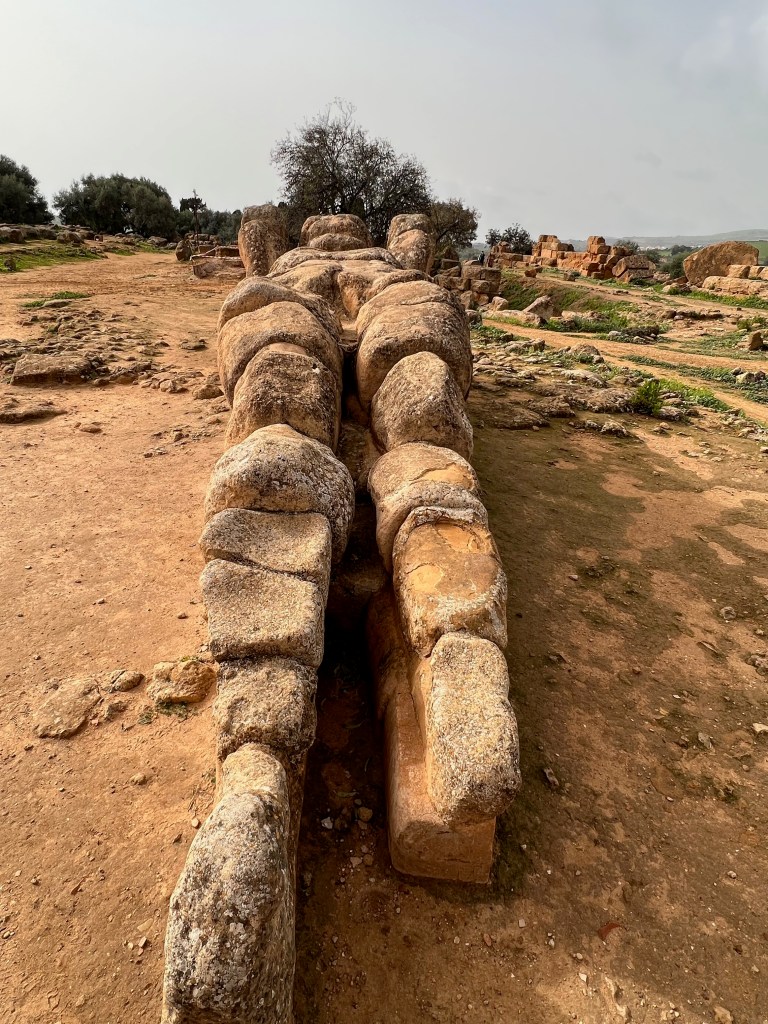
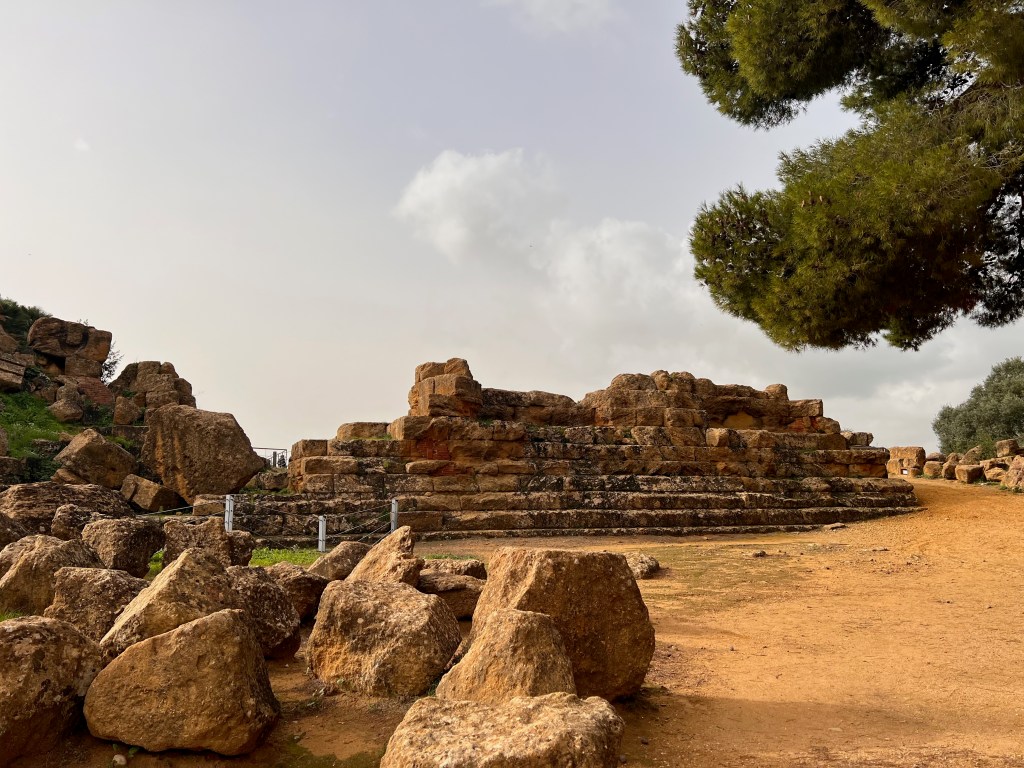
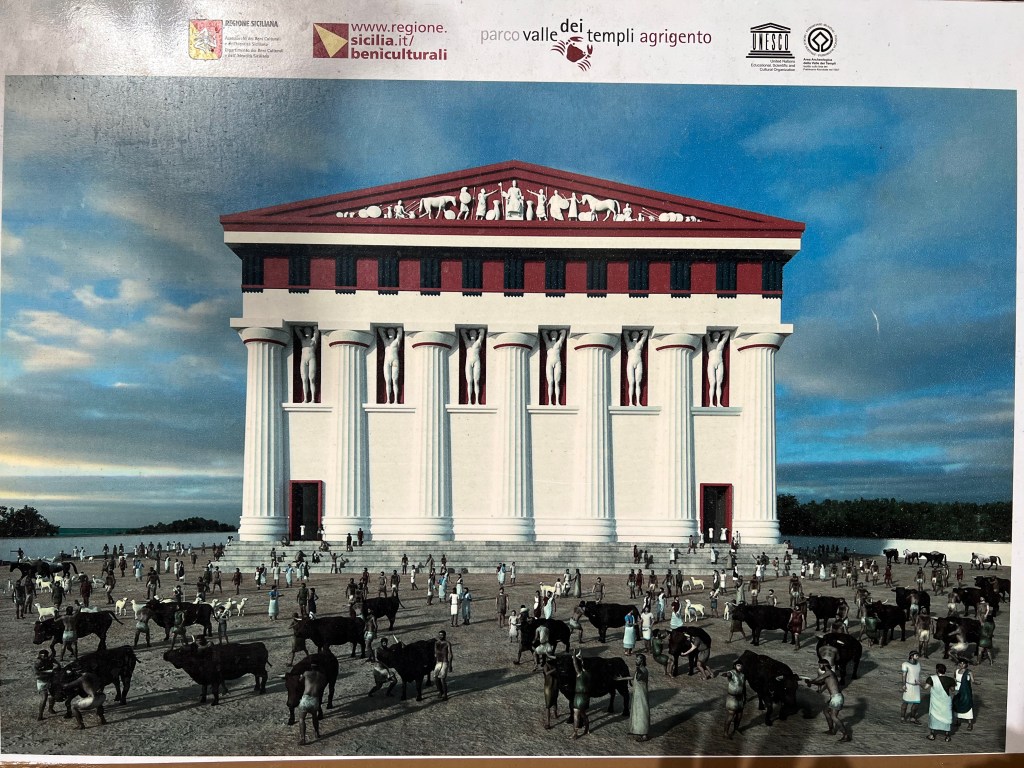
We continued our walk, following the route suggested by the app, and came to the Temple of Olympian Zeus, which is located up a slope. A picture shows how this temple looked during its hay day. What I like about the app is we were given the option of listening to the narration on the ruins that we saw (unlike the audio guide in Pompeii). From the narration, we sought out a statue fallen on the floor, which was supposed to symbolise the Carthaginians defeated by the Greeks long ago. It is a way the victors humiliate the Carthaginians. We thought the Temple of Olympian Zeus was rather large from the fallen statue. Although reduced to only stones here and there, parts of the temple walls still stand. We headed down the slope to a rectangular depression filled with uniformly carved stones. These stones were laid out orderly, and we learnt from the app that this is the main altar to the Temple of Olympian Zeus. From the size of this altar, I can imagine how grand and massive this temple would be in its prime.
The statue that was on the facade of the Temple of Olympian Zeus
Part of the walls of the Temple of Olympian Zeus Another view of the massive statue on the facade of the Temple of Olympian Zeus We can see Agrigento from the Temple of Olympian Zeus Wefie on the grounds of the Temple of Olympian Zeus This was how the Temple of Olympian Zeus looked in its primeAlter in the Temple of Olympian ZeusThe massive main altar in the Temple of Olympian ZeusMy friend on the main altar of the Temple of Olympian Zeus
The Mid-block: Golden Gate, Temple of Hercules
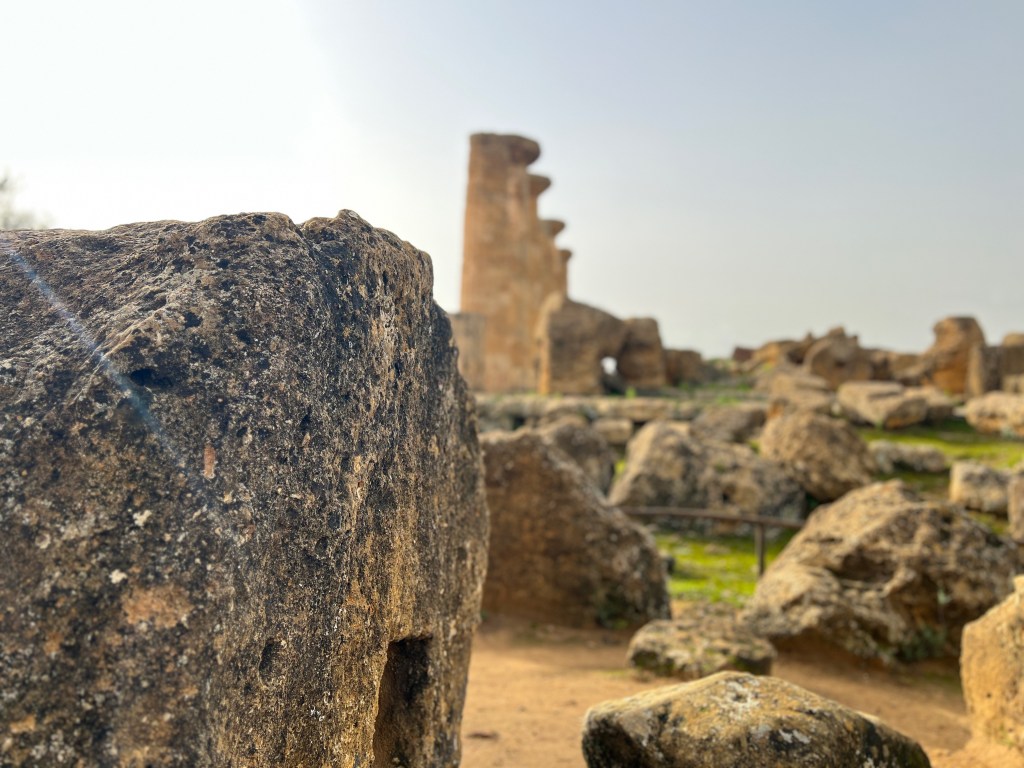
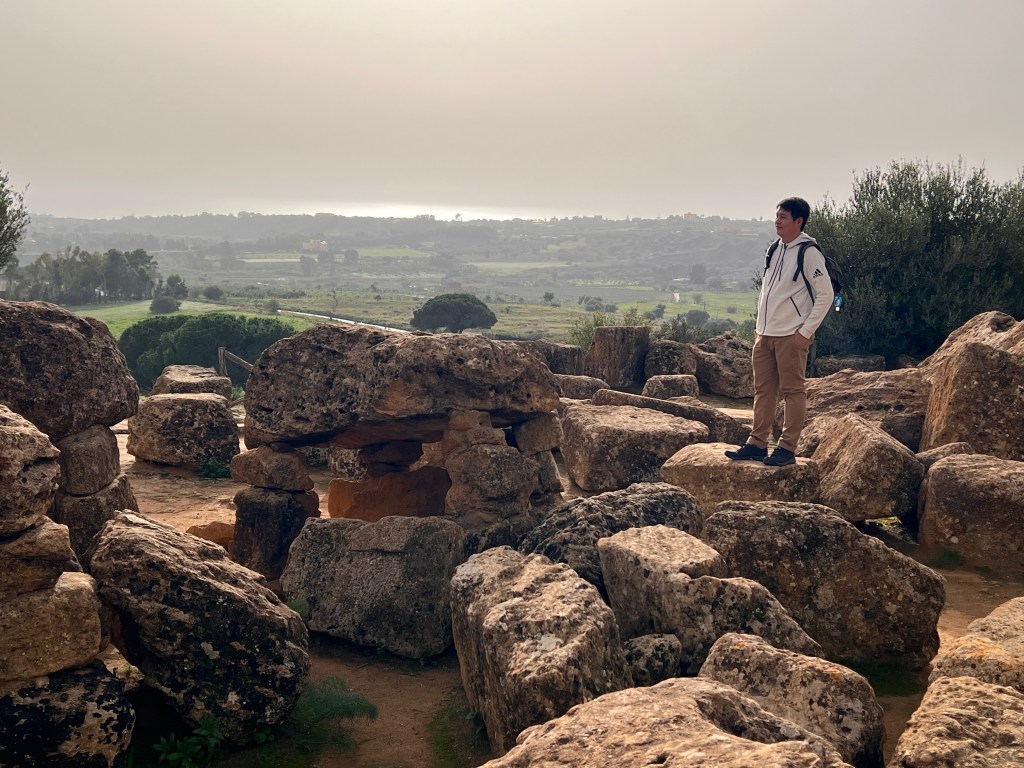
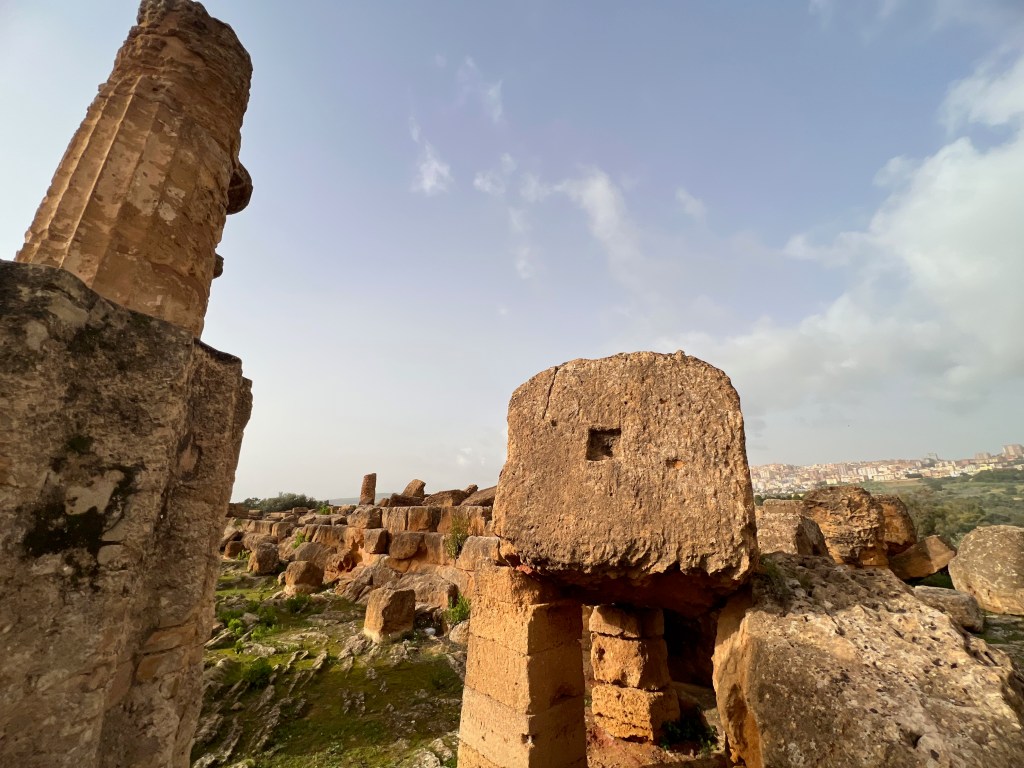
Walking away from the Temple of Olympian Zeus, the path led us up a slope and through a bridge. Unlike the Golden Gate in the States, the Golden Gate here does not refer to the bridge we were about to cross. Instead, it refers to the path beneath it. From the app, we came to know that this path was used as an entrance to the temple from the city’s port. Today it is replaced by a road used by cars. A short walk from the Golden Gate, we came to the first of the less destroyed temples – the Temple of Hercules. More columns and pillars are standing compared to the Temples of Dioscuri and Olympian Zeus that we saw nearer the Porta Quinta entrance. Not only did we see an almost complete set of pillars on one side of the Temple of Hercules, we saw some remnants of the inner pillars, the steps that lead into the temple, and the raised ground on which it was being built. The Temple of Hercules provided us with some great photo opportunities.
The Golden gate in the Valley of Temples
We can see the remains of the Temple of Hercules.Ruins of the Temple of Hercules in the Valley of TemplesThe Temple of Hercules is reduced to pillarsMy friend with the Temple of Hercules in the backgroundMy friend looking out into the views from the Temple of HerculesRemains of the Temple of HerculesWe saw some goats in the Valley of Temples.
The Highlights: Temple of Concordia, Temple of Juno
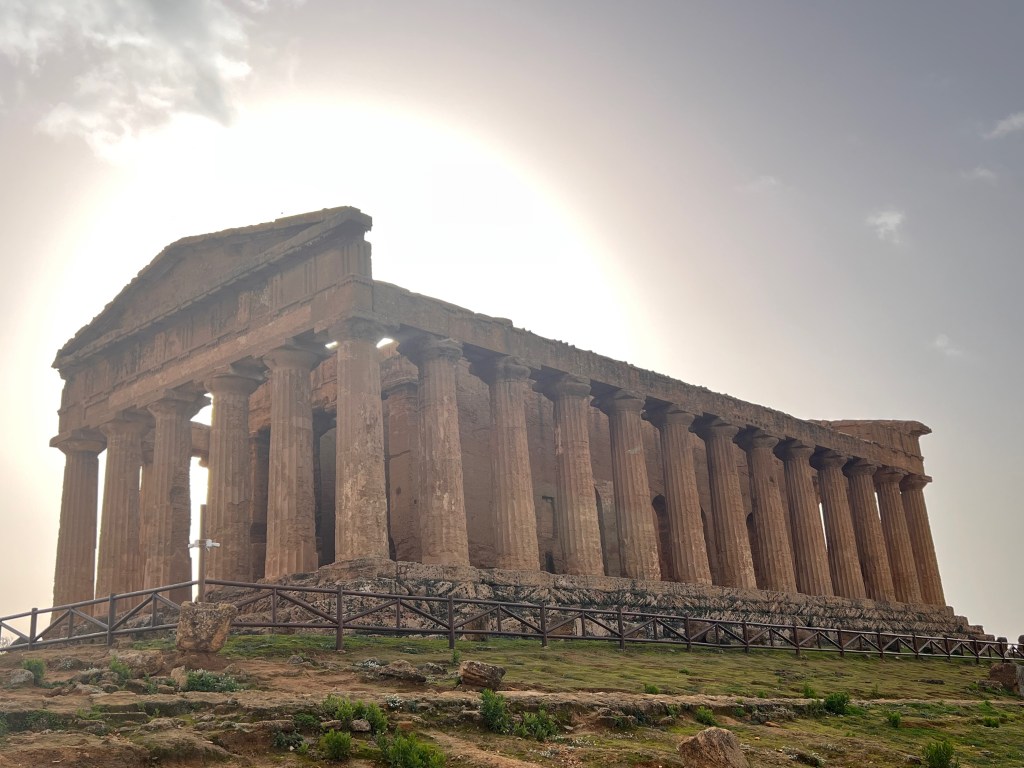
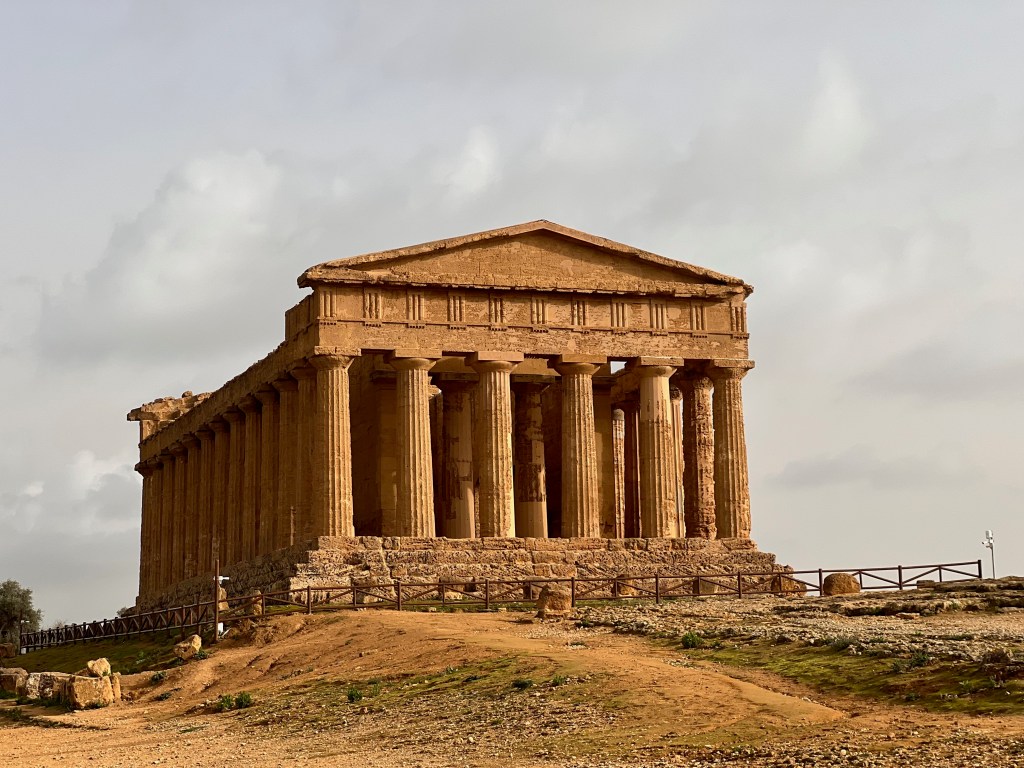
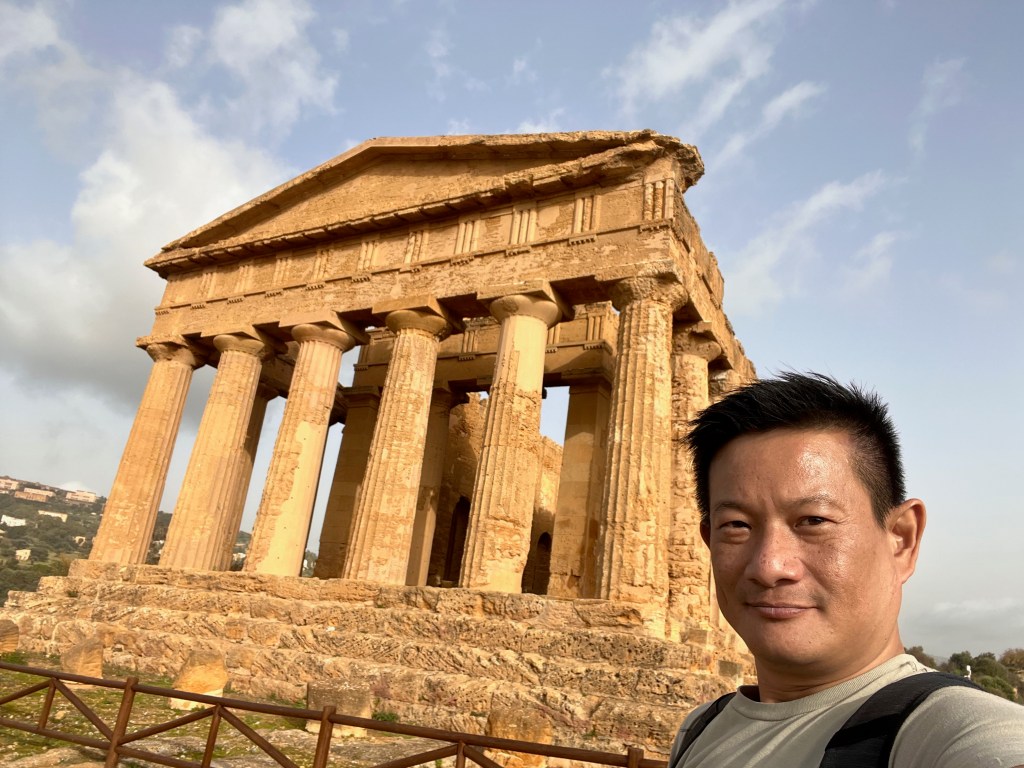
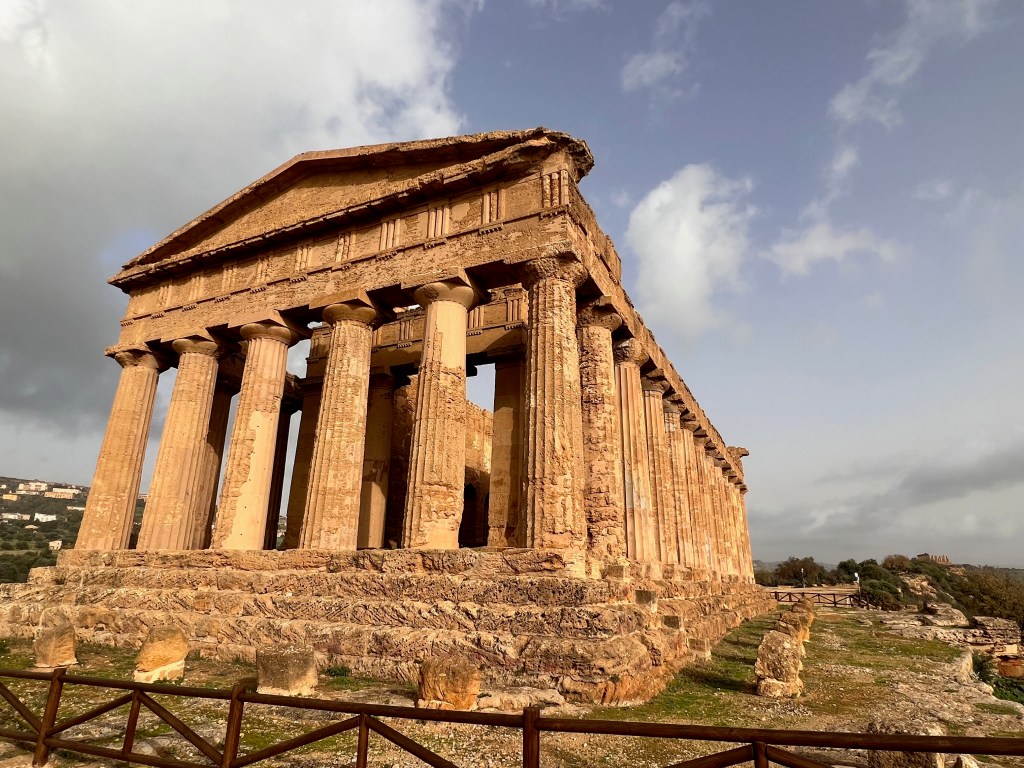
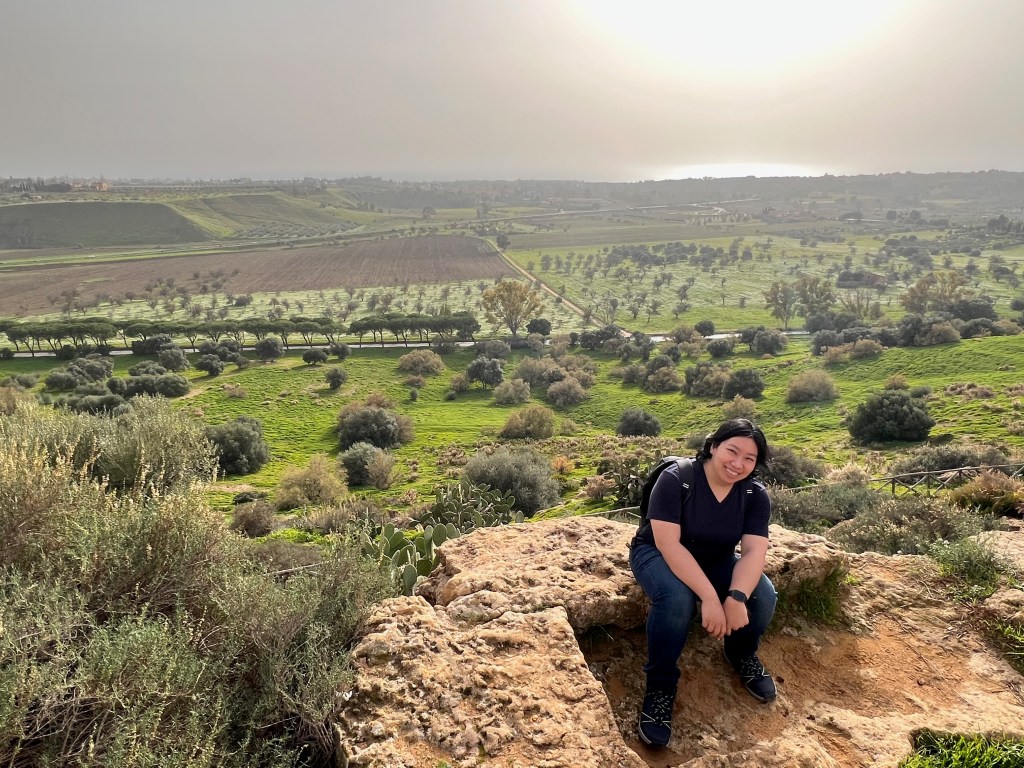
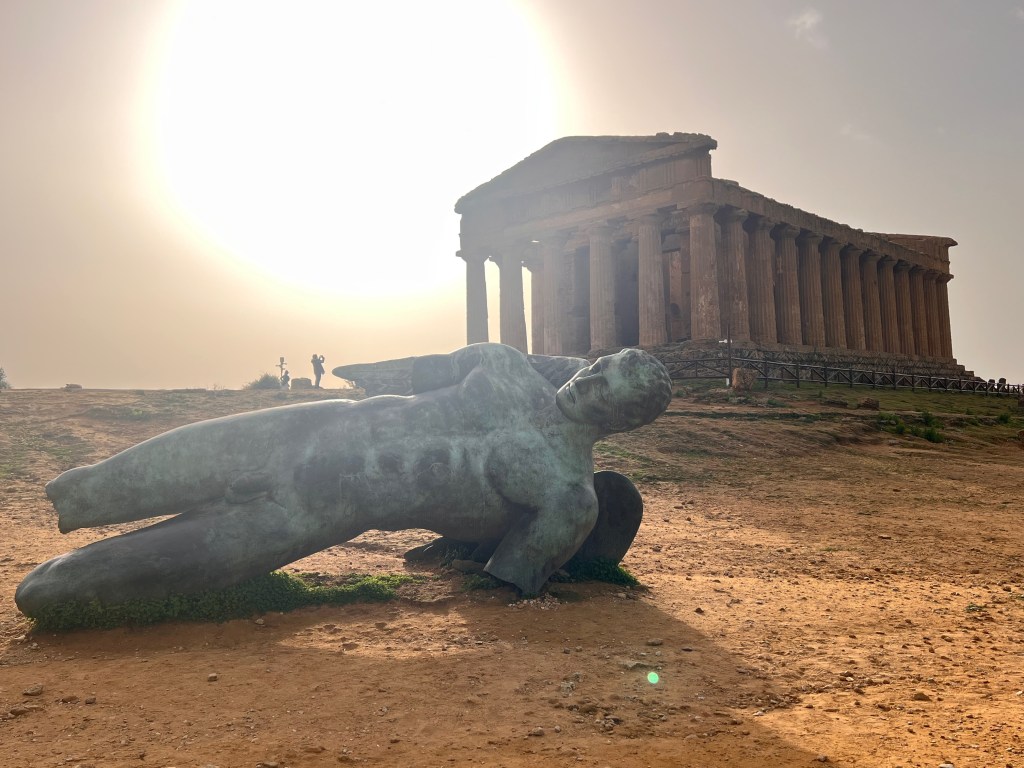
Walking along the path, putting the Temple of Hercules behind us, we came to the highlight and the poster child of the Valley of Temples – the Temple of Concordia. We had a pleasant stroll towards the Temple of Concordia. The openness of the path allowed us to see the city of Agrigento from a distance. Before we knew it, we arrived at the Temple of Concordia. We spotted photos of this temple in airports and train stations promoting Sicily. The Temple of Concordia is the most well-preserved Greek architecture outside of Greece. The building resembles the Parthenon in Athens but on a smaller scale. It has a very distinctive Greek-styled structure. We were all awed by the sight of the Temple of Concordia the moment we saw it from a distance. The temple stood strong after 2,500 years, with its distinctive inner sandstone colour structure surrounded by numerous outer pillars supporting a partial roof resting on a four-step platform. This is history coming to life! As the Temple of Concordia is built near a cliff, the view over the vast land in this part of Sicily is equally stunting. We can see the agricultural fields and the sea over the horizon. Looking out into the massive land beneath the Temple of Concordia gave me a sense of zen. As we were walking towards our next landmark, we spotted the broken bronze statue of the fallen Icarus lying dramatically near the base of the Temple of Concordia. The presence of this statue gave the Temple of Concordia a robust Greek identity.
The magnificent Temple of Concordia, the most well-preserved Greek architecture
Temple of Concordia, with its Greek-influenced structureMe at the Temple of ConcordiaWefie with Temple of ConcordiaThe Temple of Concordia is better preserved than some Greek buildings in Greece.Another wefie with the Temple of ConcordiaMy friends with a view of the vast land at the Temple of ConcordiaMy friend with the view of Sicily at the Temple of ConcordiaMy friend sitting on the ruins next to the Temple of Concordia Another view of the Temple of ConcordiaMy friend and I with the Temple of Concordia
Statue of Fallen Icarus in front of the Temple of Concordia
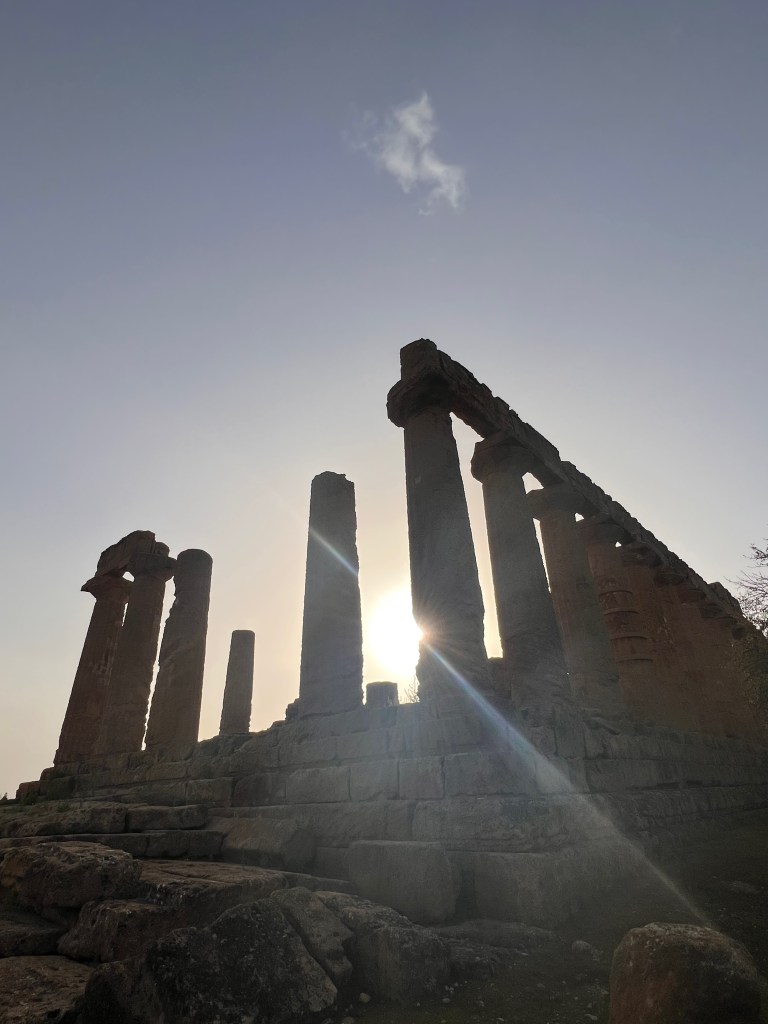
We continued our path as recommended by the app and came to a flight of stairs, where our last stop for the trip in the Valley of Temples would conclude. The Temple of Juno is perched on the top of the stairs at the highest point in the Valley of the Temples. Unlike the Temple of Concordia, the Temple of Juno has only its outer pillars left and some beams that these pillars hold. The size of the Temple of Juno is roughly the same as the Temple of Concordia. Although the Temple of Juno did not age, it radiated a certain charm of ancientness. As with the Temple of Concordia, the view of the plains below from the Temple of Juno is fantastic. Moreover, we could see the Temple of Concordia nesting from afar.
The Temple of Juno though not as well preserved as the Temple of Concordia, is still an impressive temple.
Walking towards the Temple of JunoScenic views on our way to the Temple of JunoThere are more pillars still standing in the Temple of JunoThe Temple of Juno is impressiveMy friends with the Temple of JunoMy friend posing with Temple of Juno
Mandatory wefie at Temple of Juno
Another view of the Temple of Juno
The view of Sicily from the Temple of JunoWe can see the sea in southern Sicily from the Temple of Juno.
My friends at the Temple of Juno with the Temple of Concordia afar
Returning to Catania
We were pretty mindful of the time. After finishing with the Temple of Juno, we were left with 1 hr before our bus back to Catania departed. We exited the Valley of Temples from the Temple of Juno exit. From here, we were not quite sure which bus runs through. We did a quick check with the staff at the ticketing office and were told that Bus #2 comes here, but it would take around 1 hr to get back to Agrigento city as the bus would make a loop at the beach nearby. Our only option is to grab a cab from Juno Exit to Agrigento if we were to make it for our bus back to Catania. The helpful ticketing staff helped us book a taxi to take us back to Agrigento, which brought us back to the city in good time for our ride back to Catania.
We made it back to Agrigento in good time for our bus back to CataniaAnother wefie before we leave Agrigento
The bus that took us back to Catania
On the bus bound for CataniaThe city of Agrigento seen from the bus
We embarked on the 3 hr bus ride back to Catania. When we arrived, it was time for dinner. We decided to have seafood for dinner tonight, as Catania is by the sea, so the seafood should be fresh. I did a quick Google search and found a highly-rated restaurant nearby the bus station. The food was excellent, and the seafood was indeed fresh. As the night was young, we returned to the hotel for a movie night, packing back with us gelatos and snacks. After that, we had to rest and get our bodies ready for the hike of our lifetime tomorrow, trekking up the tallest active volcano in Europe – Mt Etna.
We spotted some roadside dining near the train stationWe made it back to Catania, posing in front of the Catania train station
We left the hotel in Rome at 8.30 am to catch our 10 am flight from Rome to Catania. The night before, we requested the reception at our hotel to help us book a cab, which cost us €70. We would have paid roughly the same amount if we were to take the train to the airport. We thought booking the cab was a great idea, as this saved us the effort of lugging our luggage on the uneven Roman roads we experienced the first day we arrived in Rome. The ride from our hotel in Rome to Fiumicino Airport took around 40 mins. After checking in, we headed for the lounge for breakfast before heading to our flight to Catania.
Morning view of the Roman streets from the balcony of our room
My friends loading our luggage onto our transport to the airportTaking our last wefie at the hotel, we called home for the past four nightsWe are approaching Rome Fiumicino airport.Taking a wefie outside Rome Fiumicino airport terminal
We have completed our check-in for our flight to Catania
Walking through the duty-free area of Rome Fiumicino airportWalking towards the lounge for our breakfastBreakfast is servedWefie at the boarding gateThe bird that would take us to CataniaA quick wefie at the jet bridge to our aircraftGetting ready to fly to the final destination of our Italian tripMy friends on the ITA Airways flight bound for Catania
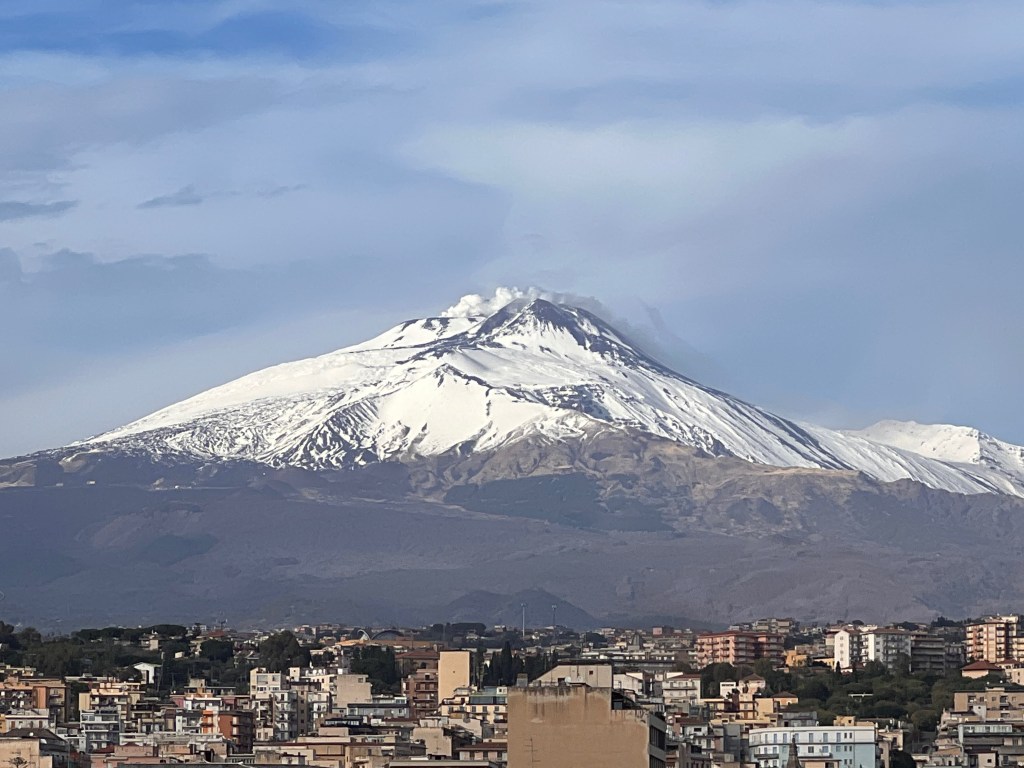
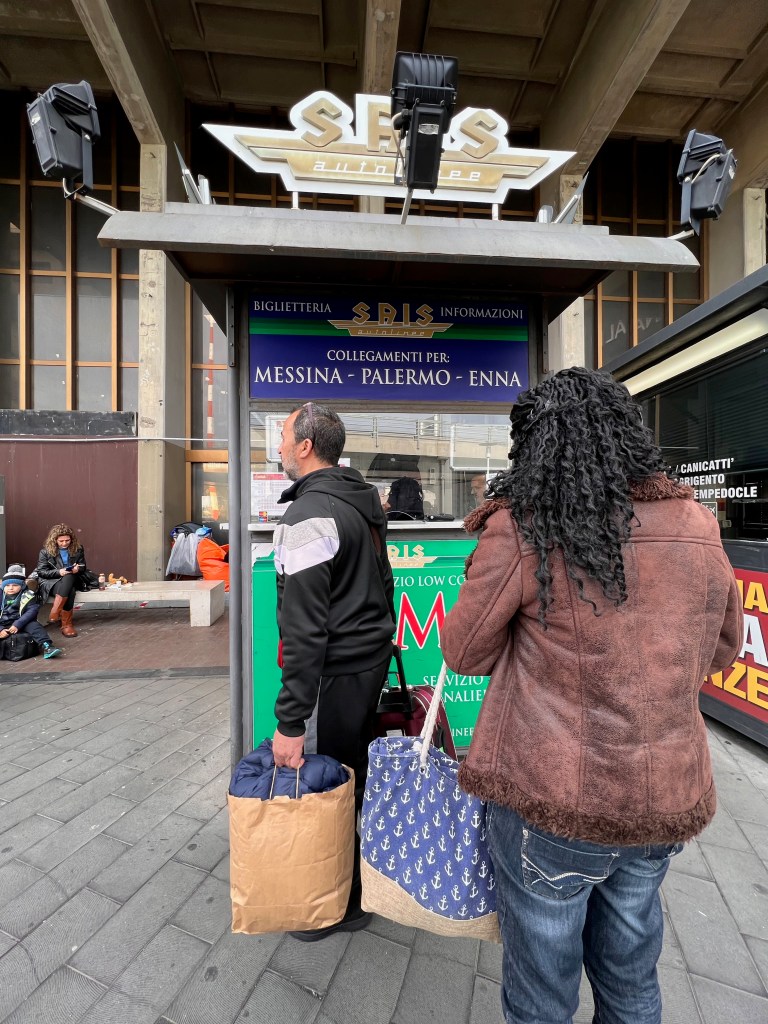
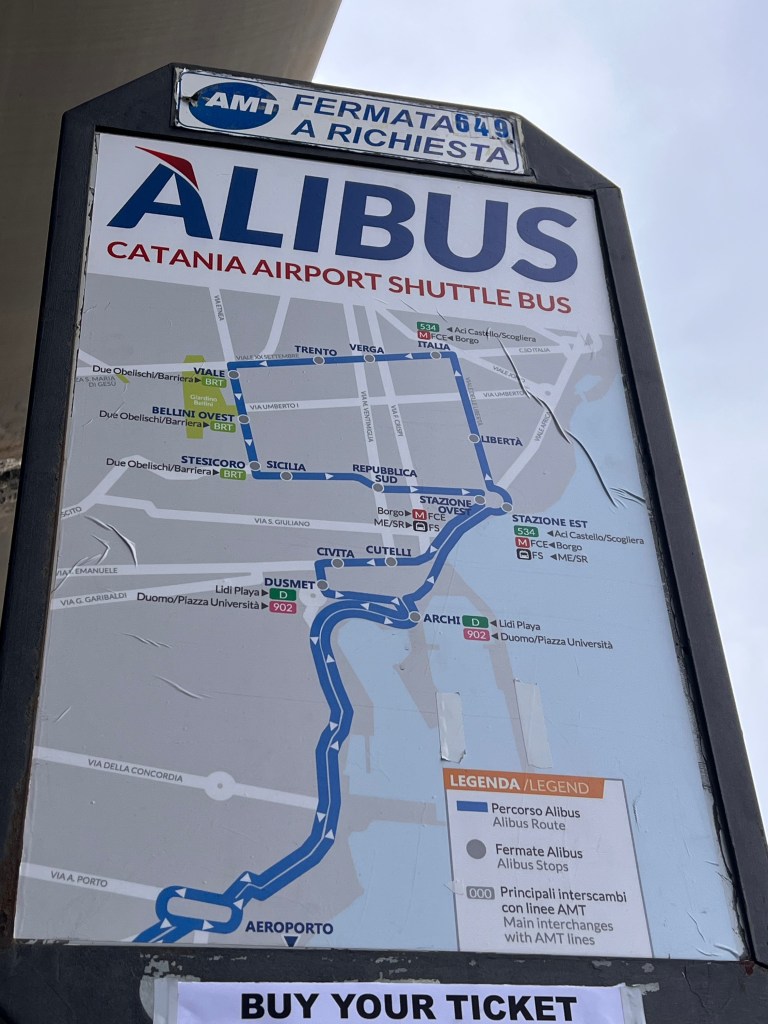
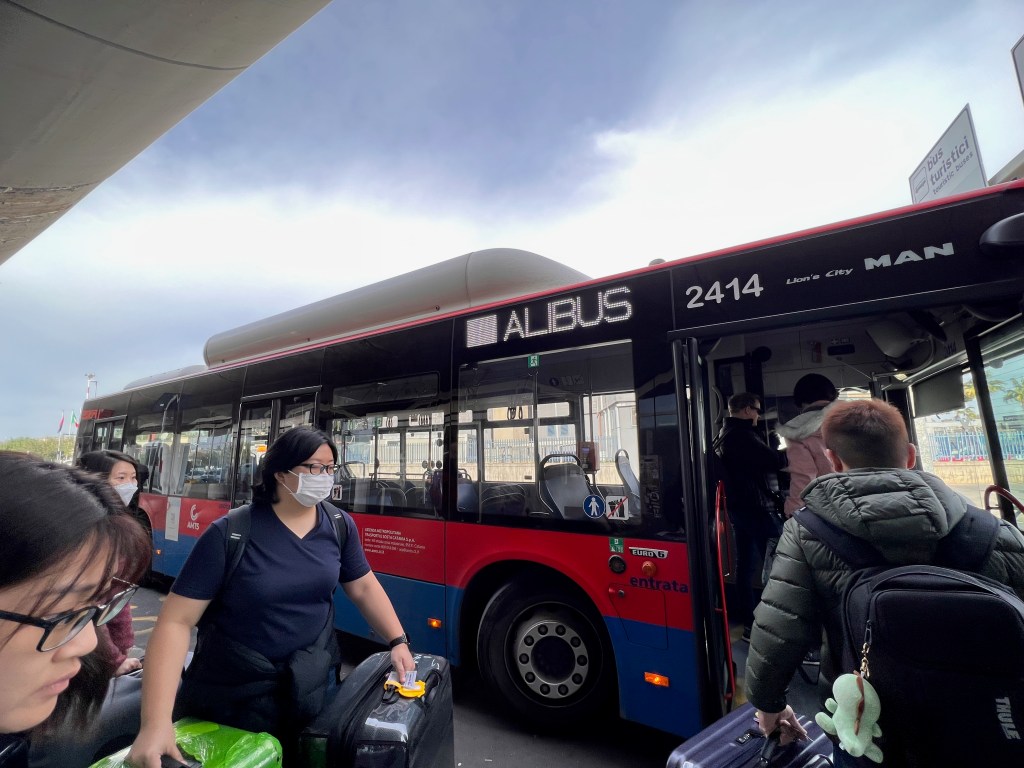
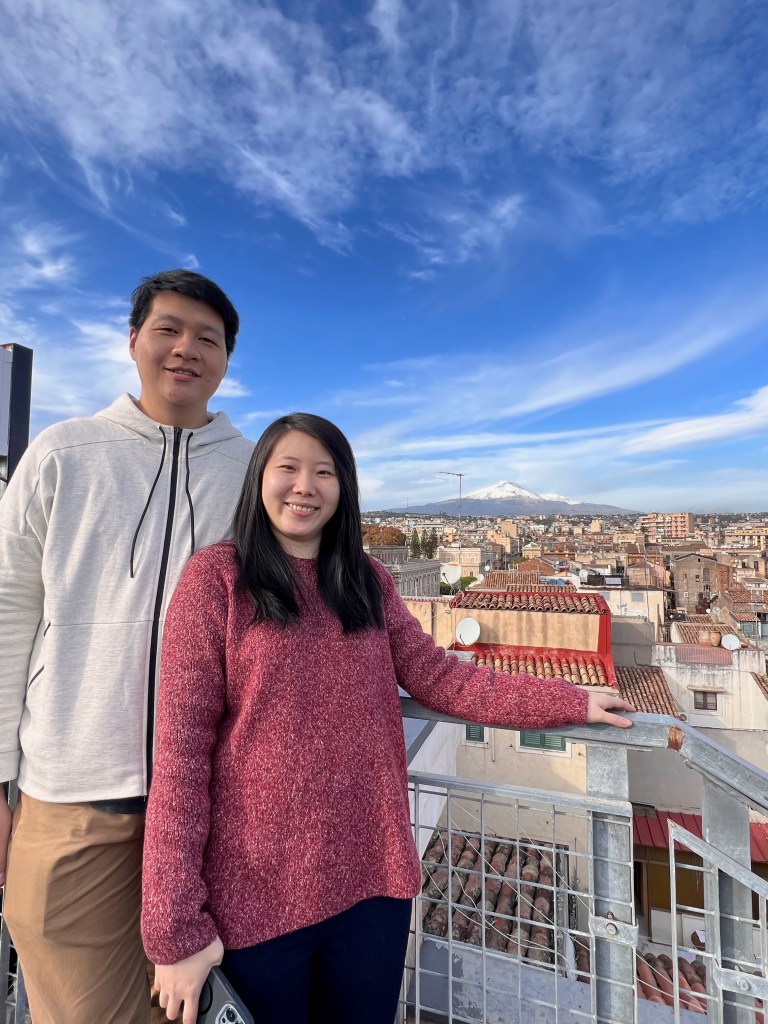
Our flight to Catania landed on time for the 1 hr ride from Rome to Catania. After collecting our luggage, we proceeded to get bus tickets to Catania. From my research, there is a bus that would bring us directly to our hotel in the centre of Catania. We exited the Catania airport terminal on the right to get the tickets and found three ticket booths. We bought our bus tickets from the booth furthest from the entrance to the Airport terminal with the sign “SAIS: Messina -Palermo-Enna”. The ticketing staff gave us directions to the bus top in front of the terminal building with the symbol “ALiBus”, where we took the airport bus. A bus ticket to Catania ticket costs €4 one way. The bus ride to Catania City centre took around 30 mins, and we were helped by the friendly bus driver who ensured that we alighted at the correct stop. After settling into our hotel rooms, we headed to the hotel’s rooftop restaurant, where we could lunch with the stunning view of the snow-capped Mt Etna.
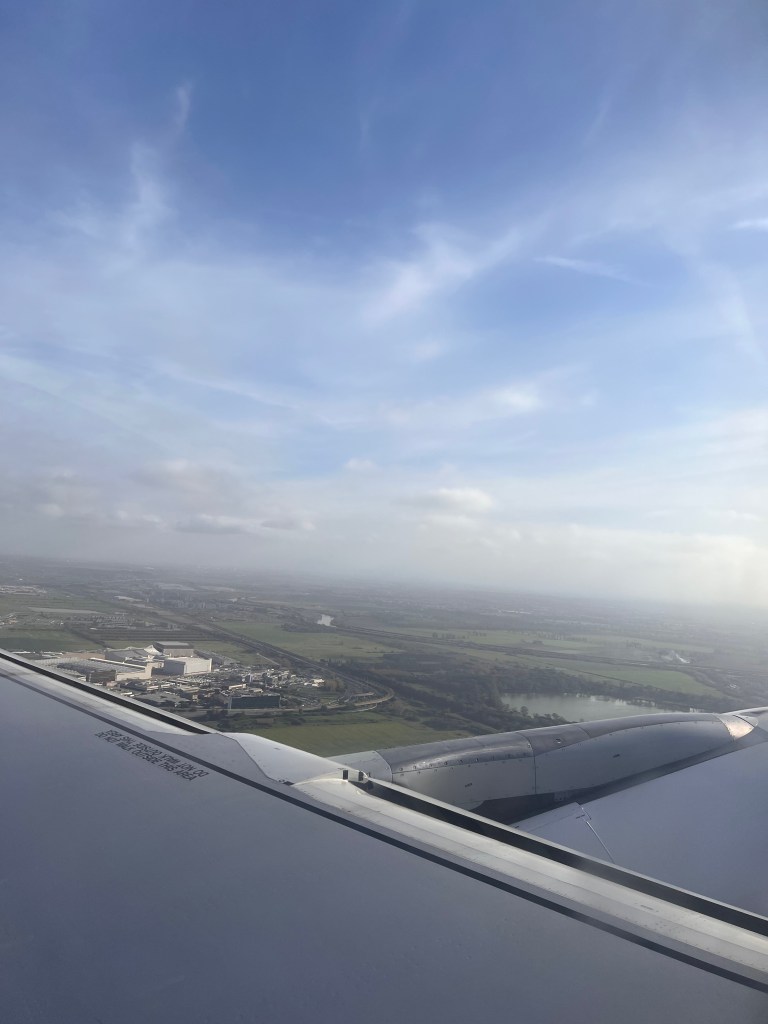
Taking off from Rome Fiumicino airportCrossing the shoreline of Scilly
We have arrived at Catania.
The majestic Mt Etna is covered with snow
This booth where we got our bus tickets toThe airport bus routeAirport bus to Catania scheduleMy friends were busy loading our luggage onto the airport bus.Wefie on the airport shuttle bus to CataniaMy friends on the shuttle bus to Catania
My friend and I with the view of Mt Etna
My friends with the view of the snow-capped Mt EtnaMy friend with the view of Mt Etna
Exploring Catania’s City Centre
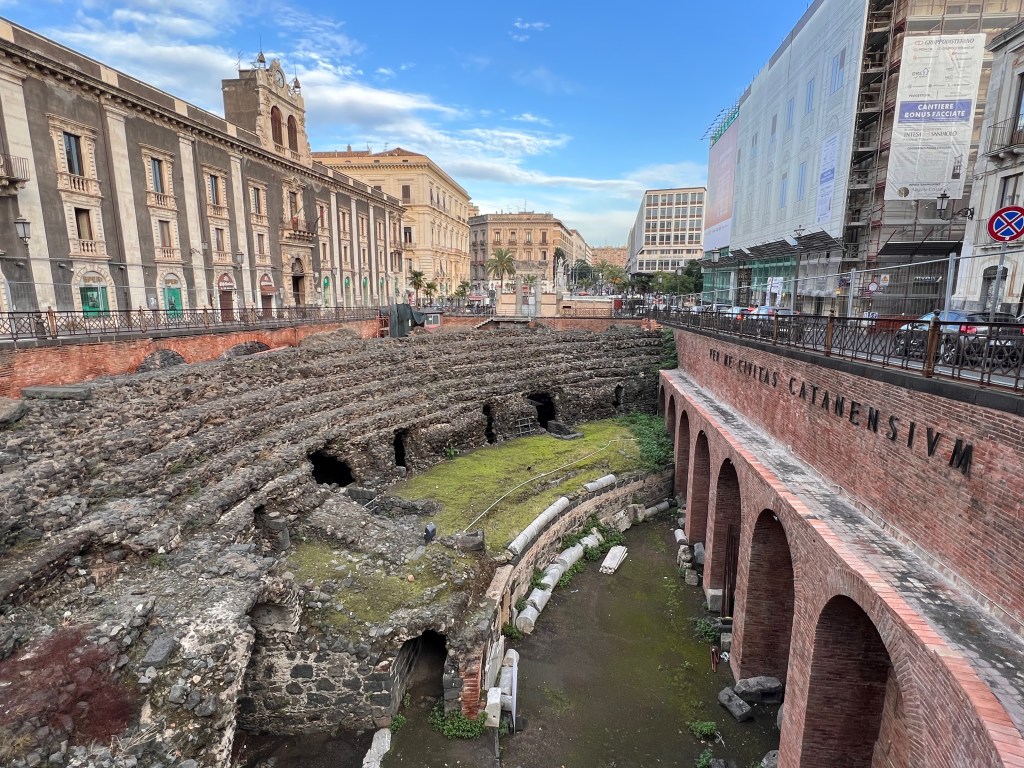
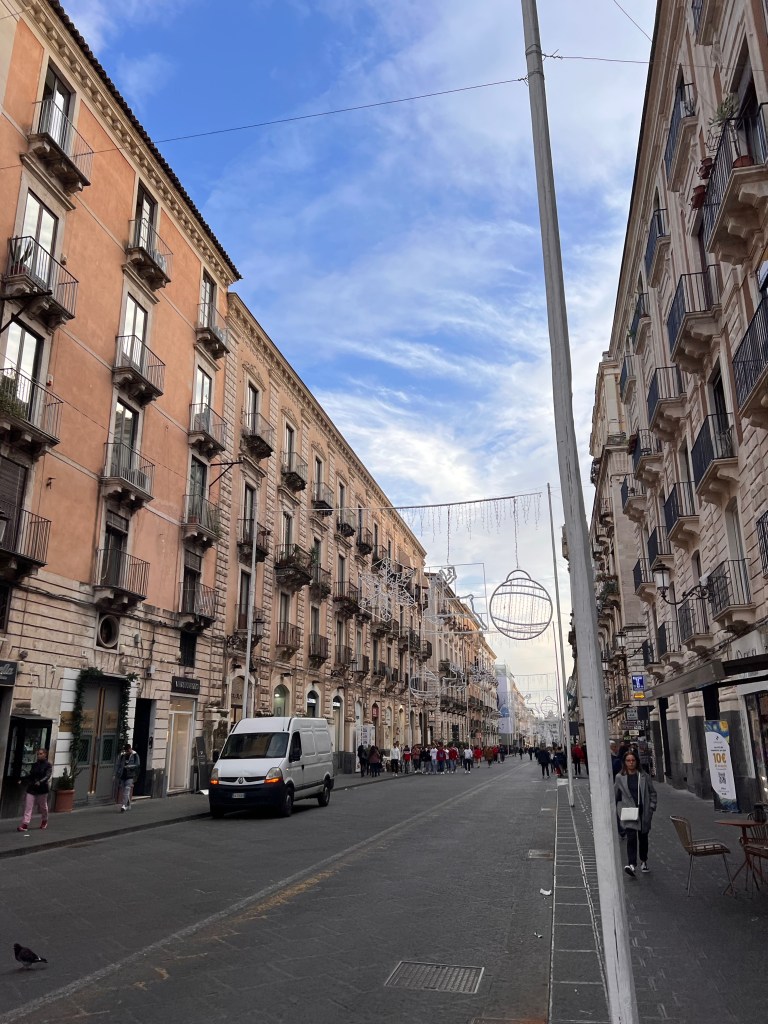
We kept our itinerary light today and explored the nearby Catania City Centre, which is highly walkable. The city’s town centre is located 10 mins walk down the street from our hotel. Along the way, we stopped by the Roman Amphitheater of Catania. The Roman Amphitheater sits on a large sinkhole in the middle of the streets, or it could be the whole city is built on top of the old city like Mexico City. It is a shame that we could only see the Roman Amphitheatre from street level as the entrance was closed when we visited. The Roman Amphitheater of Catania looks similar to the one we saw in Pompeii. We can still see the semi-circular seatings facing a stage. The entrances to the Amphitheater were still visible after standing here for more than 2,000 years. As we could not get into the Amphitheater, we continued our walk to the city centre.
The ruins of the Roman Amphitheatre in Catania
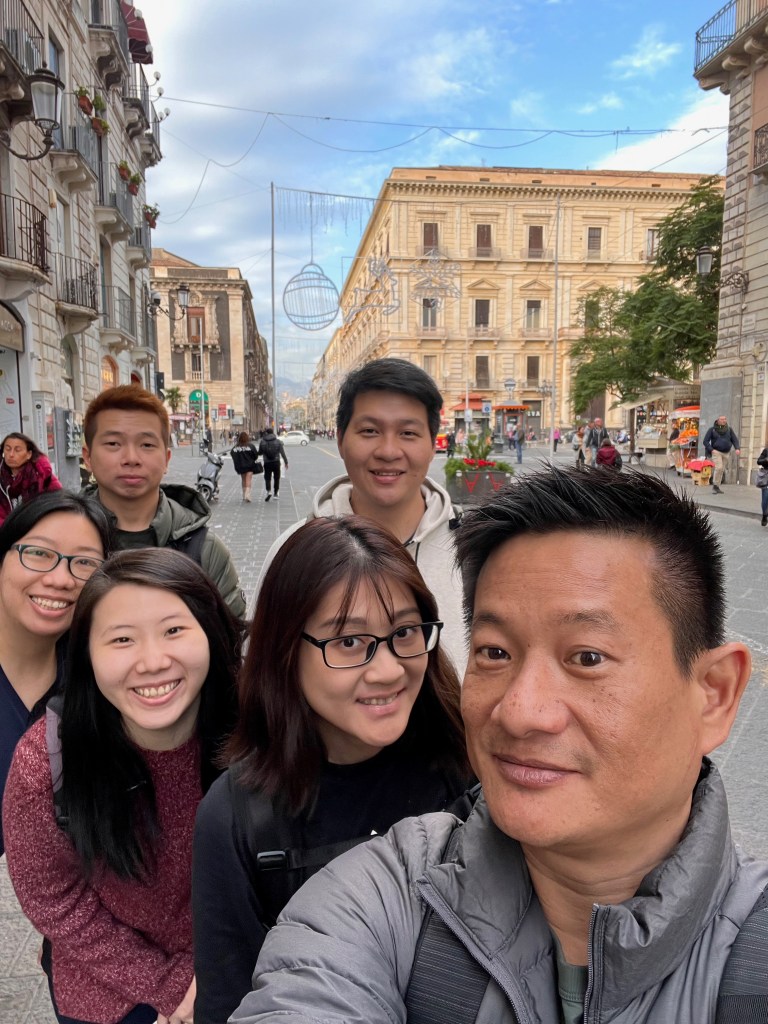
We can only view the Roman Amphitheatre from the street levelWe can see the seating area of the Roman Amphitheatre in CataniaStreet building near the Roman Amphitheatre in CataniaExploring the streets of CataniaWalking on the streets of CataniaTaking a wefie as we walk on the streets of Catania
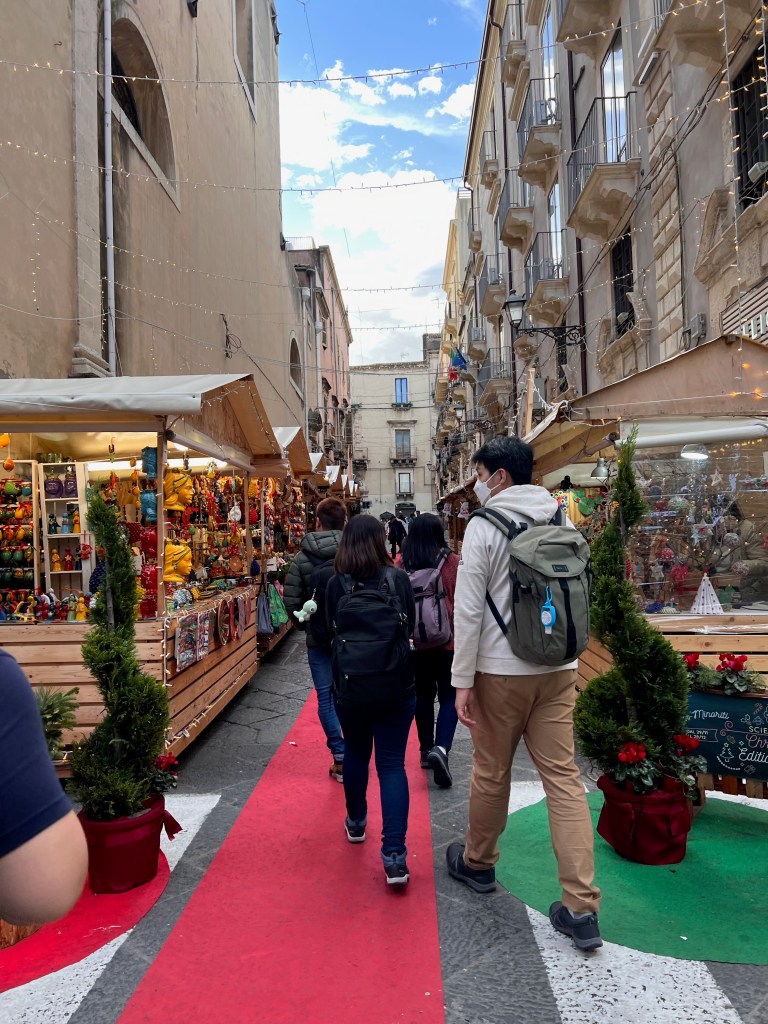
As we walked to Piazza del Duomo, the city centre of Catania, we saw a Christmas market being set up at Piazza Università. Stores were selling locally produced food items like jams, chocolates and candies. There weren’t many stores at the Christmas market at the point of our visit, and maybe the Catanians were still setting up the market. Nevertheless, my friends got excited about the Christmas market and went on a shopping spree for the goods on sale. Despite the market’s small scale, the locally produced food was delicious and affordable.
We spotted a Christmas market in CataniaChristmas market on the streets of CataniaWefie at the Christmas market in Piazza UniversitàThe Catanians are busy preparing for Christmas in Piazza UniversitàMy friends with their purchase in the Christmas market in Piazza UniversitàMy friends in Piazza Università
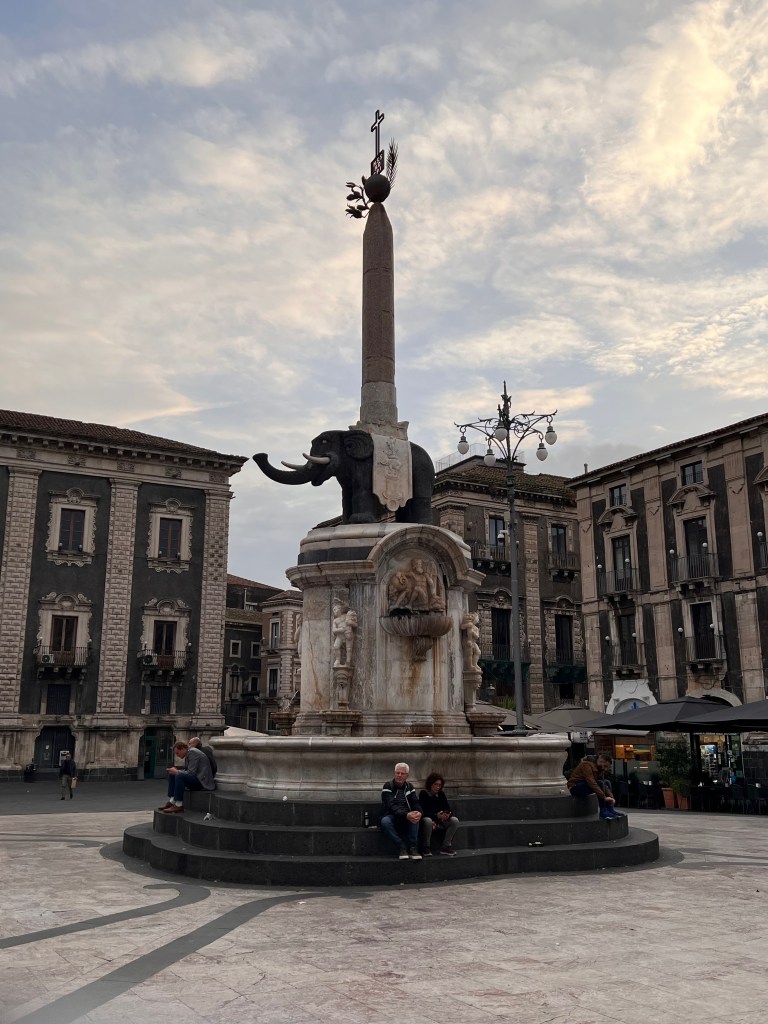
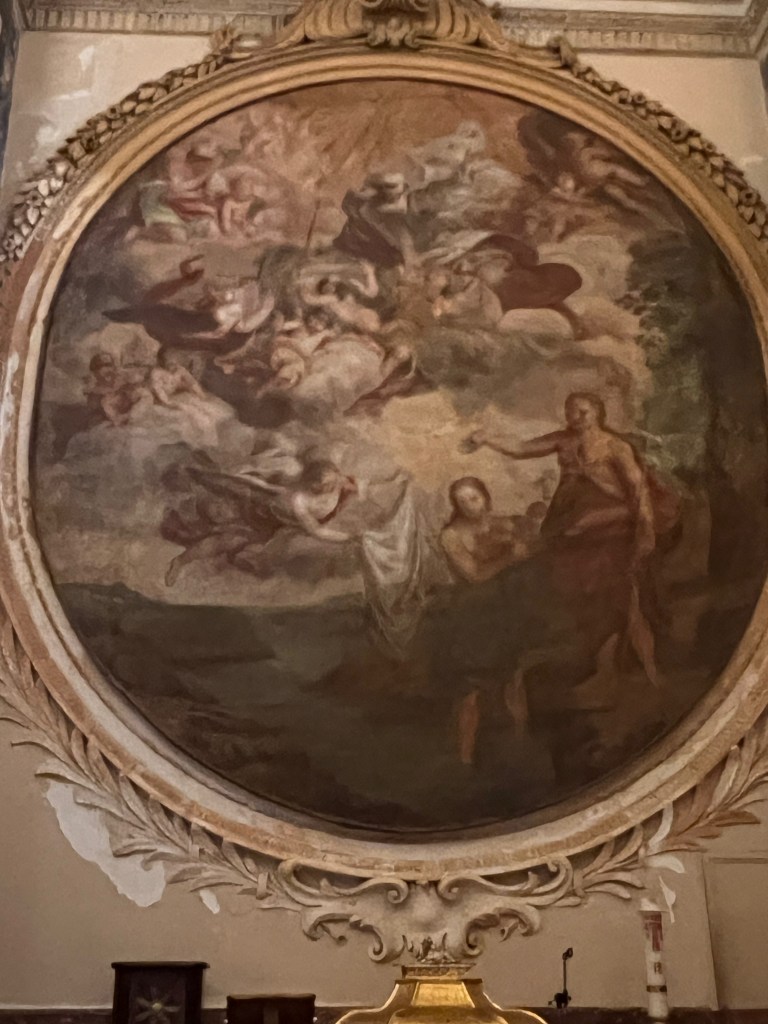
I brought my friends to the symbol of Catania, a statue of an Elephant with an obelisk sitting in the centre of Piazza del Duomo just a stone’s throw away from Piazza Università. The elephant is made of lava and black basalt, and the Catanians believe this elephant symbolises good luck and would protect them from the Eruptions of Mt Etna. The major landmarks in Catania are located around Piazza del Duomo. Catania’s Duomo – Cattedrale di Sant’Agata is located across from the elephant statue. The Cattedrale di Sant’Agata is the largest cathedral in Catania, and its facade is adorned with sculptures. The cathedral’s interior is simple, and the paintings look as though they have not been restored. Other than a place for worshipping, we found some tombs inside the cathedral. One of the famous people buried here is Bellini, a famous opera composer born in Catania. There is also a glass casket of one of the Popes inside the cathedral.
The Elephant Statue – the symbol of Catania in Piazza del Duomo
Cattedrale di Sant’Agata the Duomo of Catania
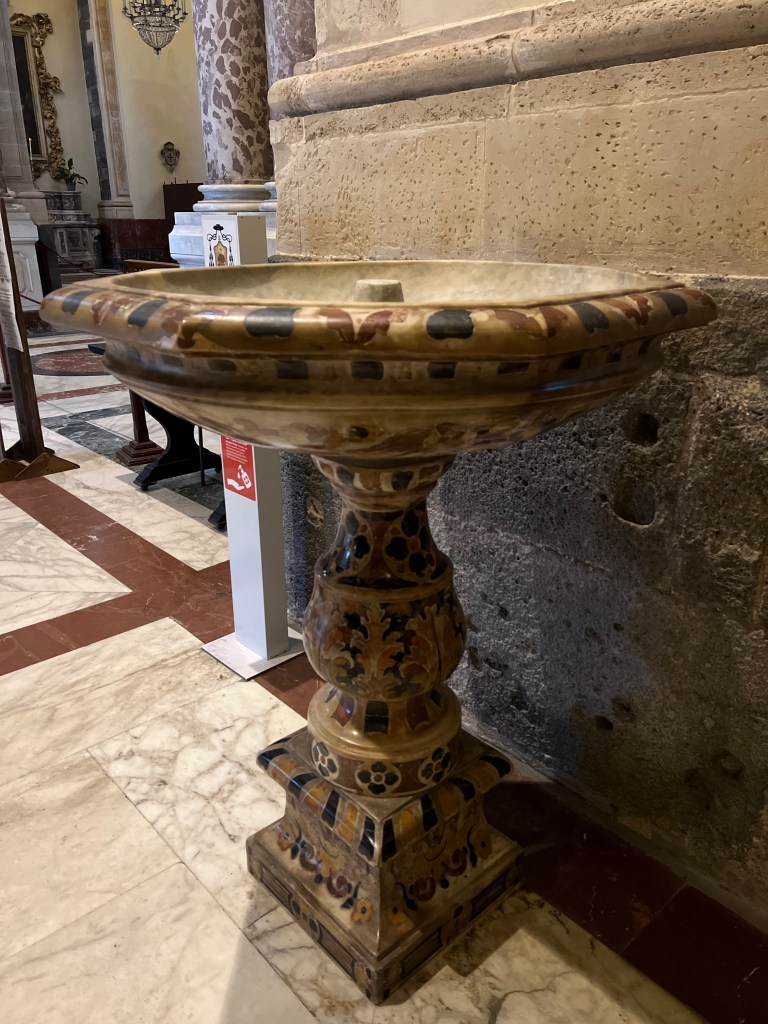
Marble fountain in Cattedrale di Sant’AgataThe artwork in Cattedrale di Sant’Agata seems in need of restorationPainting in the ceiling of Cattedrale di Sant’AgataInside Cattedrale di Sant’AgataMain altar in Cattedrale di Sant’Agata
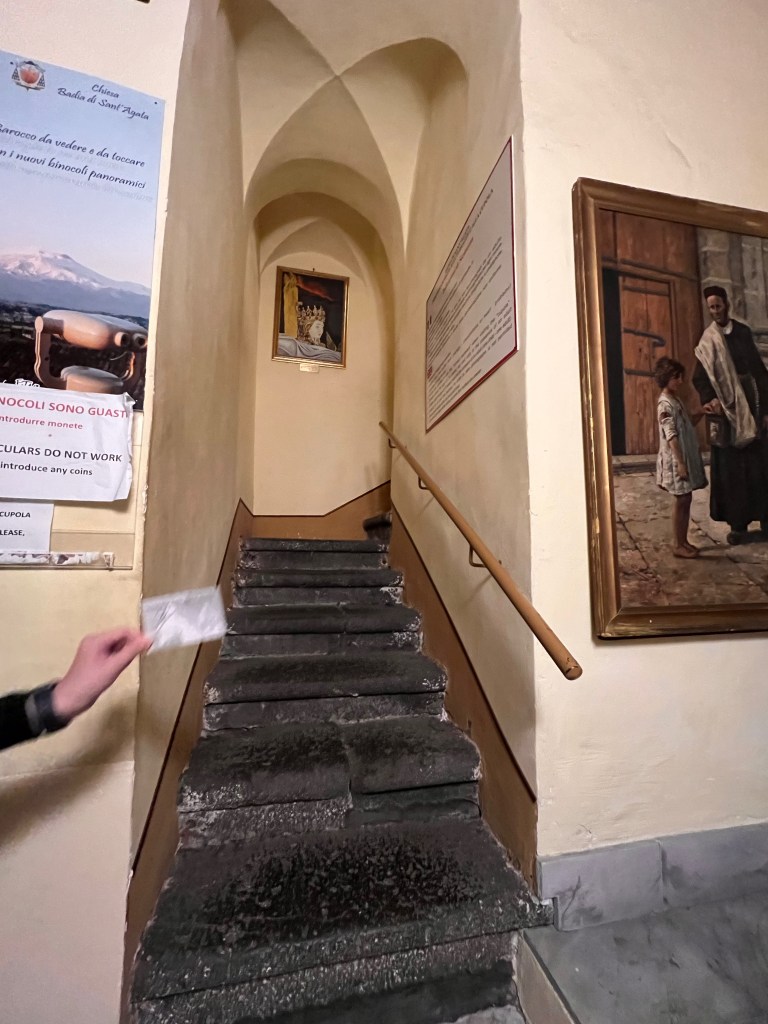
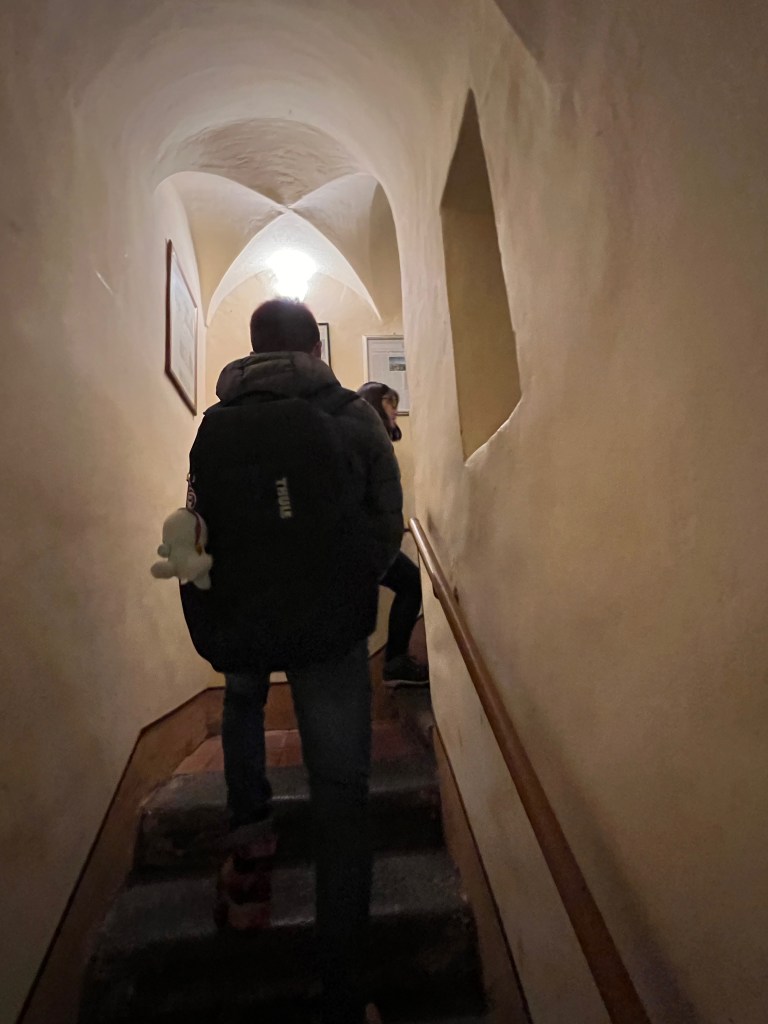
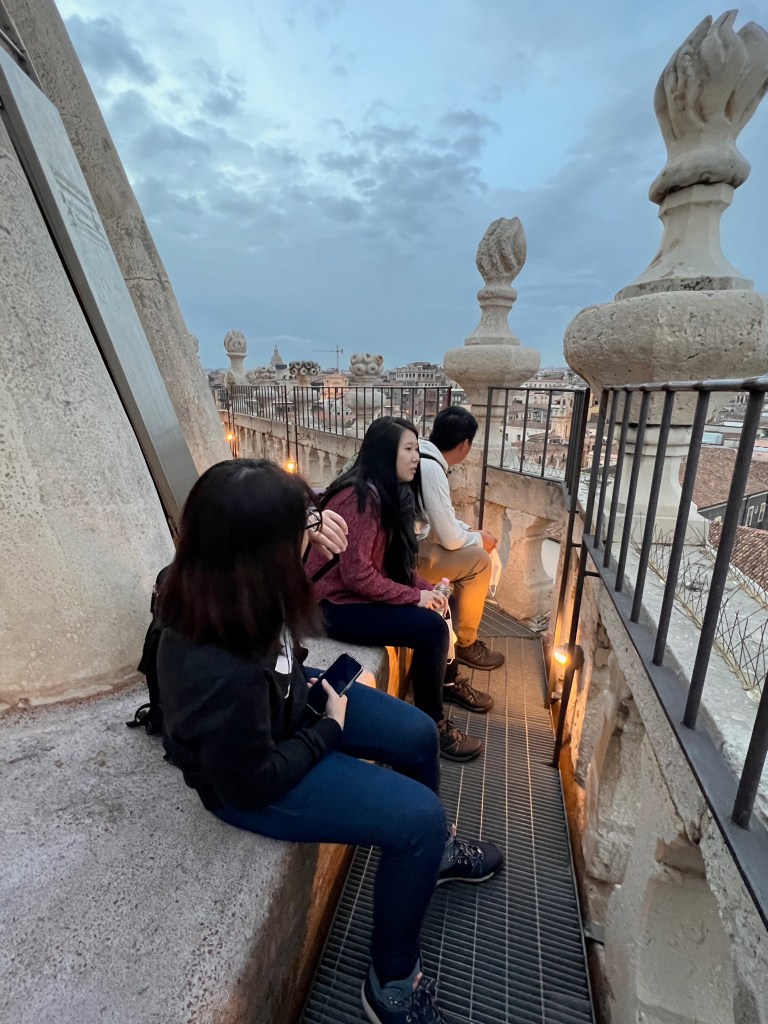
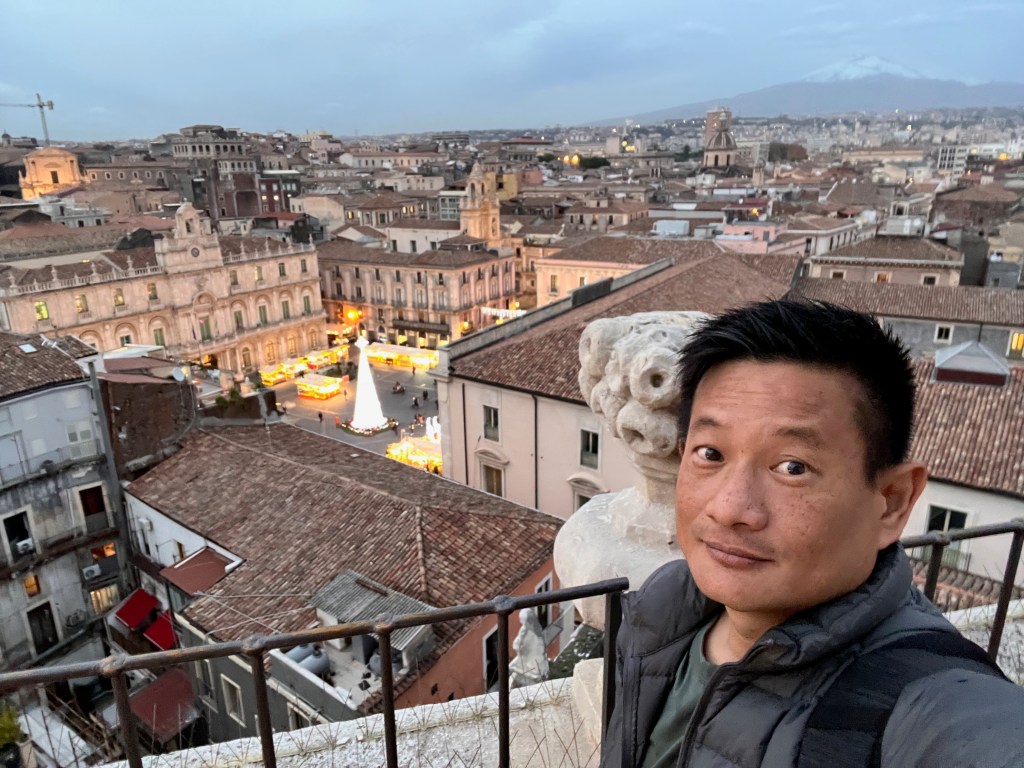
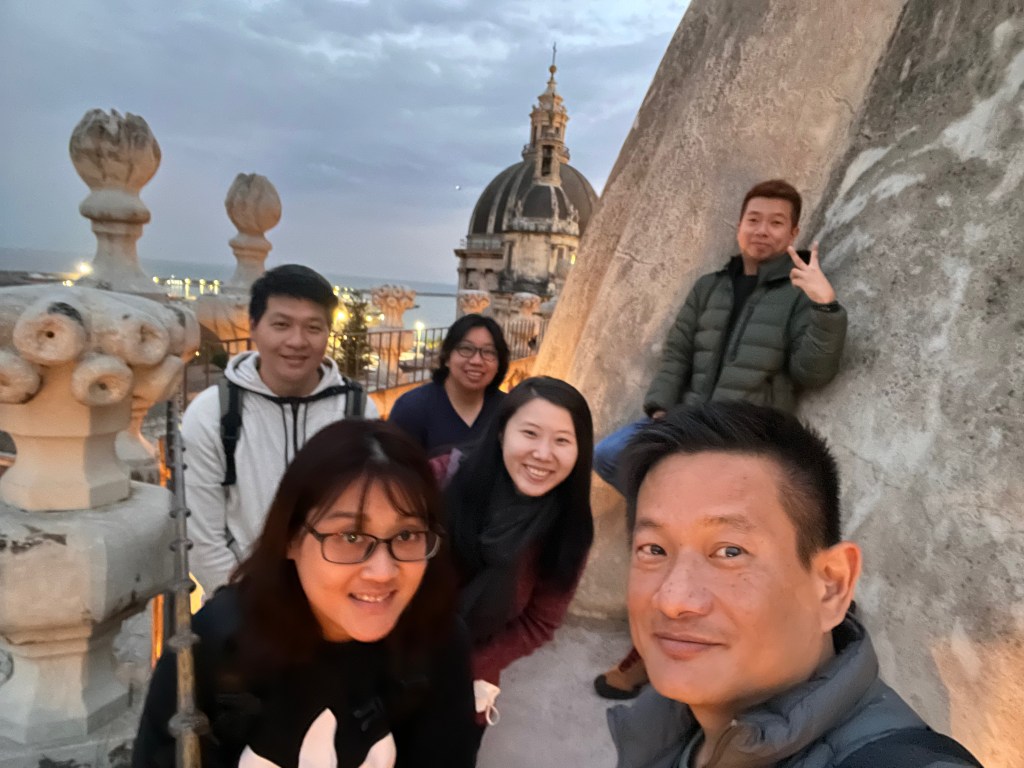
We went for the dome climb at Chiesa della Badia di Sant’Agata which sits right across from Cattedrale di Sant’Agata on the recommendations from vloggers for a sunset view. The climb to the rooftop costs €5 and takes 170 steps. The stairs are generally easy to scale, except the last few steps on a spiral staircase might be a tad tight for some people. The top of Chiesa della Badia di Sant’Agata is a circular path surrounding the cathedral’s dome. We got a 360° view of Catania city, Mt Etna, and the ports. The view was breathtaking and worth every penny of the €5 we paid. It is a great spot to escape the hustle and bustle of Catania City, not as if the city was busy tonight. If not for today’s overcast sky, we would have seen the sunset from the dome of Chiesa della Badia di Sant’Agata. As the sun retires from a day’s work, the lighting replaced the light from the sun; we thought it was a sign for us to get going. We ended the day with a dinner nearby and returned to our hotel early for our early bus to Agrigento tomorrow.
Chiesa della Badia di Sant’Agata which we climbed to the dome for a view of Catania
Start of the 170 steps, climb to the dome of Chiesa della Badia di Sant’Agata.The initial steps are relatively wide.My friend on the spiral section of the stairs to the domeThe final section of the spiral staircase to the dome is a little tightMy friends taking a rest after reaching the top of the dome in Chiesa della Badia di Sant’AgataView of Mt Etna from the dome of Chiesa della Badia di Sant’AgataCattedrale di Sant’Agata seen from the domeMe with the view of Piazza Università from the domeMy friend with the view of Piazza del Duomo on the domeMy friends resting and enjoying the view from the dome of Chiesa della Badia di Sant’Agata. The spiral staircase that we climbed up to get to the domeWefie on the dome of Chiesa della Badia di Sant’AgataWefie with a view of Piazza del Duomo at night
Mt Etna looms in the background, seen from the dome of Chiesa della Badia di Sant’Agata.
My friends on the dome with the night lights on Cattedrale di Sant’AgataWefie with the night lights on Cattedrale di Sant’AgataMy friends on the spiral staircase with the night view of Mt EtnaMy friends on the spiral staircase at night
My friend and me at the dome of Chiesa della Badia di Sant’Agata before we head back down
My friends at the base of the staircase from the dome of Chiesa della Badia di Sant’AgataResting for fruit juice after our climb of the domeWefie at Piazza del Duomo at night Wefie with the Christmas lightings on Piazza Università at nightFountain near the fish market in CataniaMy friend, with the Christmas lighting on the streets of Catania
No trip to Italy would be complete without visiting Vatican City for first-timers. When researching what to see in Vatican City, climbing the dome of St Peter’s Basilica was unanimously recommended by all bloggers/Vloggers who came to this fantastic country. We wanted a guided tour of the Vatican City, as a guide would give us better context (not to mention the skip-the-line). Unfortunately, few companies offer tours incorporating St Peter’s Basilica Dome climb, Vatican Museum and Sistine Chapel. We found such a tour package provided by The Roman Guy at a reasonable price and booked a complete tour of the Vatican City with them (access the tour we booked here). Our tour was supposed to start at 8.30 am but was shifted to 7.30 am. We took the Metro from our hotel and alighted at Ottaviano Station. From Ottaviano Metro Station, it is an 8 min walk to the meeting point.
We managed to catch the sun rising at St Peter’s Square
Fontana delle Naiadi across the entrance to Repubblica Metro StationMy friend posing at the Repubblica Metro StationWalking to Vatican City from Ottaviano Metro StationWe see the dome of St Peter’s Basilica while walking to meet our guideOur first look at Vatican CityWefie before we head to the security check of Vatican City
Climbing up to the top of St. Peter’s Basilica Dome
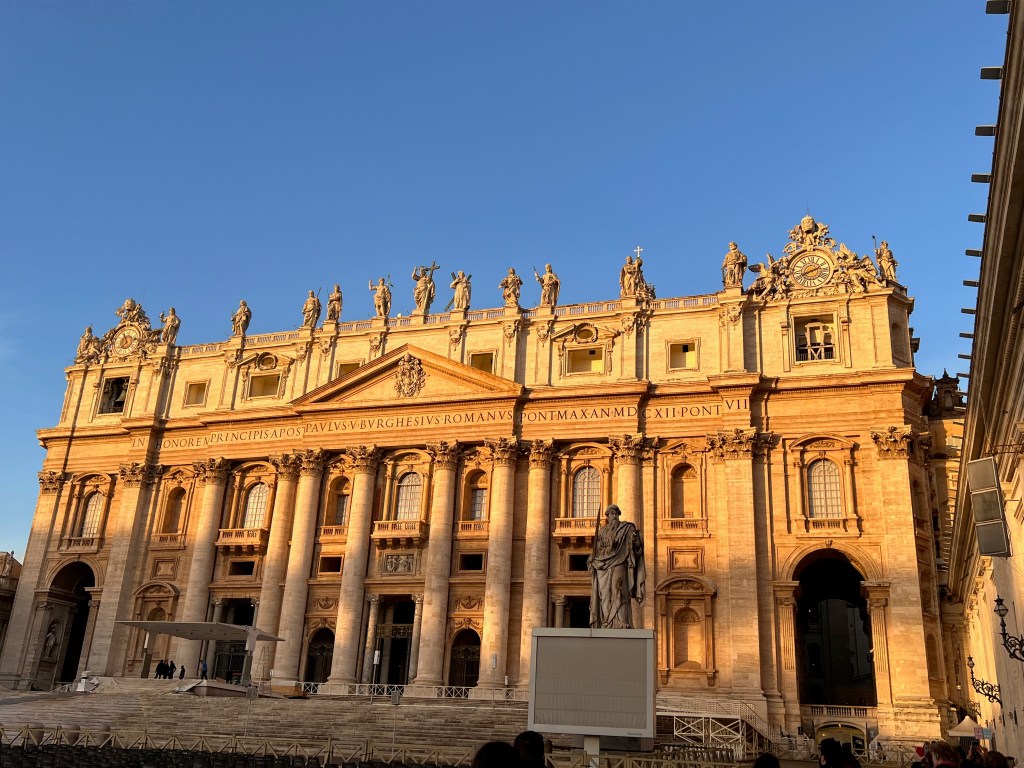
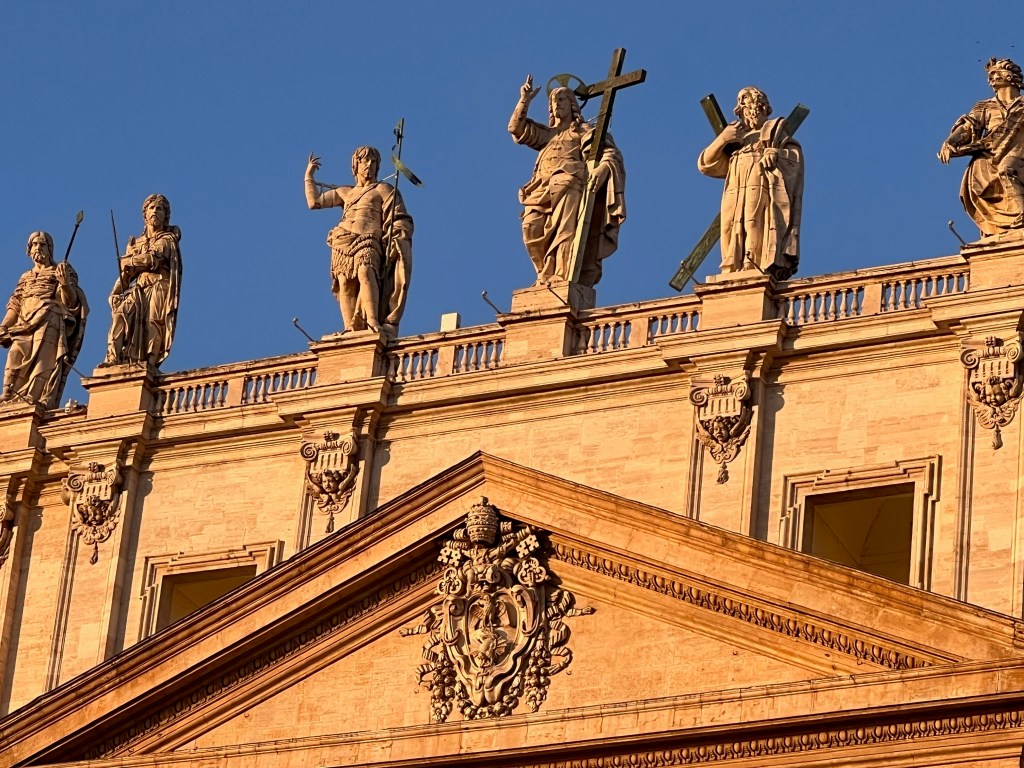
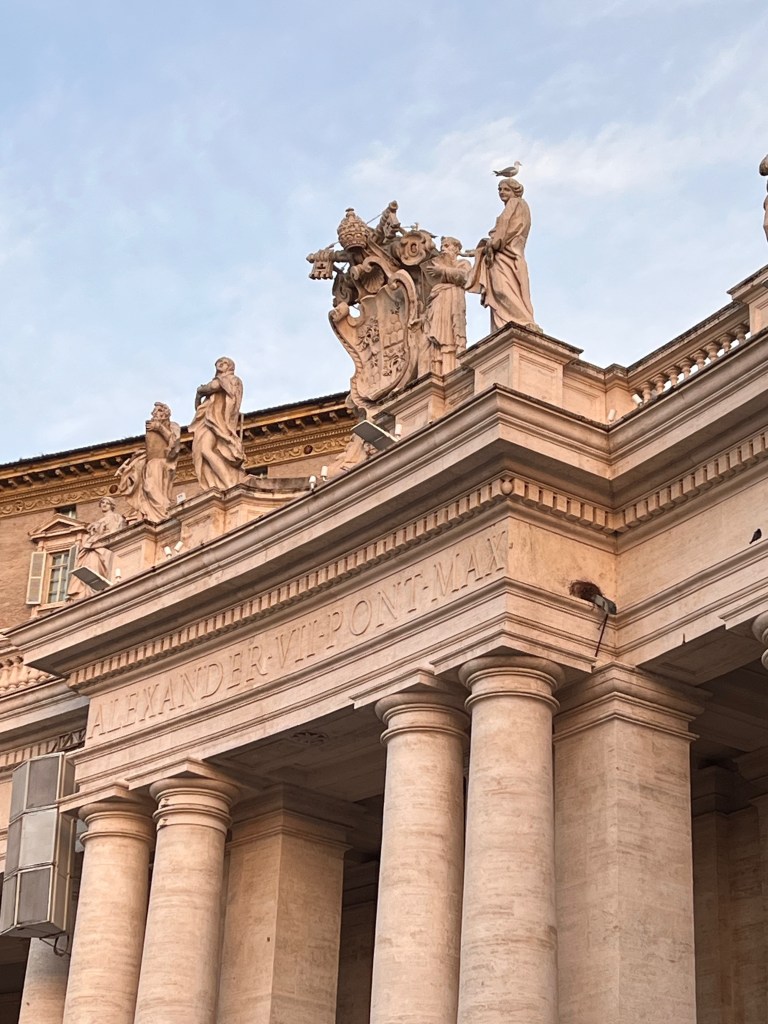
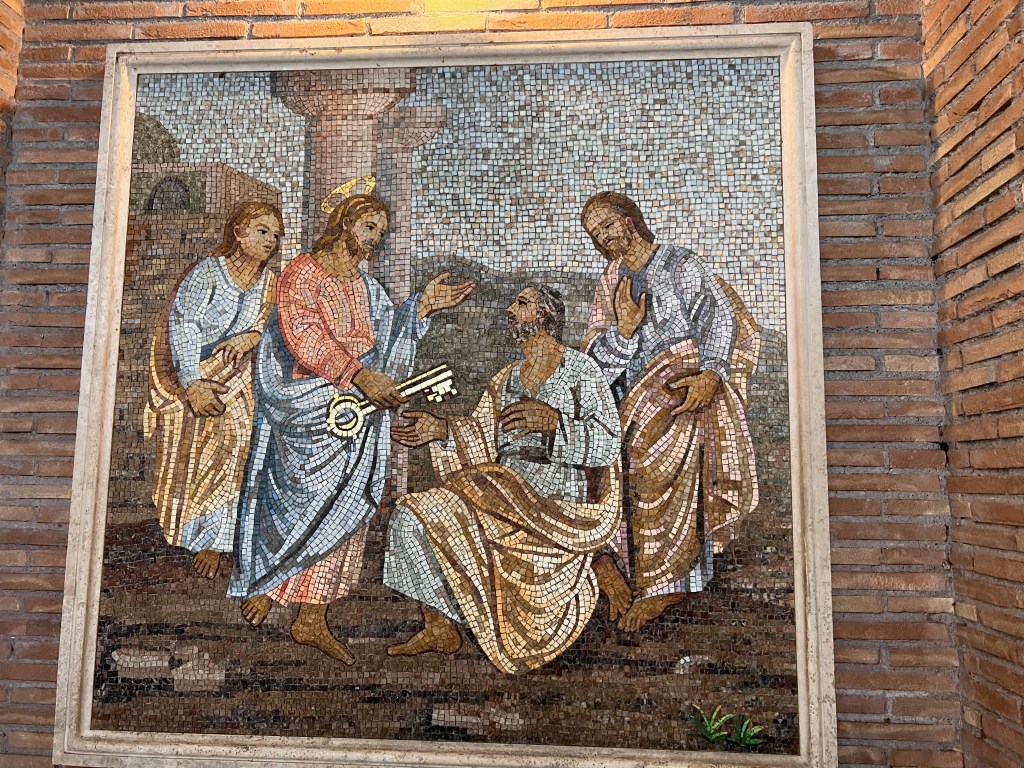
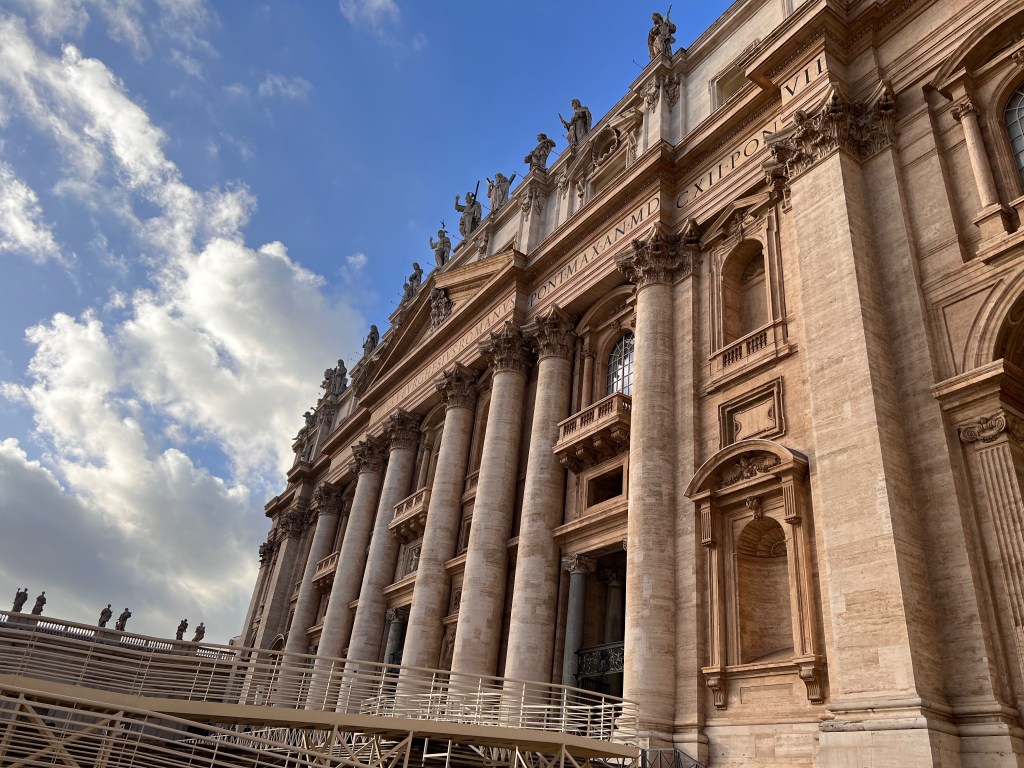
After meeting with our tour guide, Raffa, we were brought to the queue waiting to enter St Peter’s Basilica. As we were walking to join the queue to enter St Peter’s Basilica, Raffa introduced the group’s surroundings, such as where the Pope’s bedroom is and the history of St Peter’s Basilica. I wasn’t paying attention to Raffa’s narrations, my eyes were stuck in awe of the massiveness of the basilica and the numerous statues installed on the rooftop of the cathedral, wandering to myself how on earth did they manage to get those statues up on the rooftop during antiquity times. Raffa brought our attention to the obelisk standing in the middle of St Peter’s Square, which is 4,500 years old. The doors to the basilica were supposed to open at 8 am. As we were waiting in the queue to enter, I noticed the queue was getting longer, and the doors to the basilica weren’t even open yet. The doors finally opened at 8.15 am, and we were led through the side of the basilica to a courtyard and waited there again. Raffa told us that the elevator we were supposed to take to the terrace level of the dome was out of order. The basilica staff was sorting out how do we get to the terrace level. Soon after, we were led inside the basilica through one of the side doors. Raffa commented this was the first time she’s been through the side door, and we indeed got a unique experience. As we walked to the “backup” elevator, Raffa told us there wasn’t a single painting in St Peter’s Basilica. Instead, all the so-called images that we saw were mosaics. A single piece of small Vatican mosaic (roughly the size of a notebook) would cost around €4,000. We took the elevator to the terrace level. There are a total of 551 steps to the top of the dome. Taking the elevator, we skipped climbing up more than 200 steps.
Sun rising over St Peter’s Square
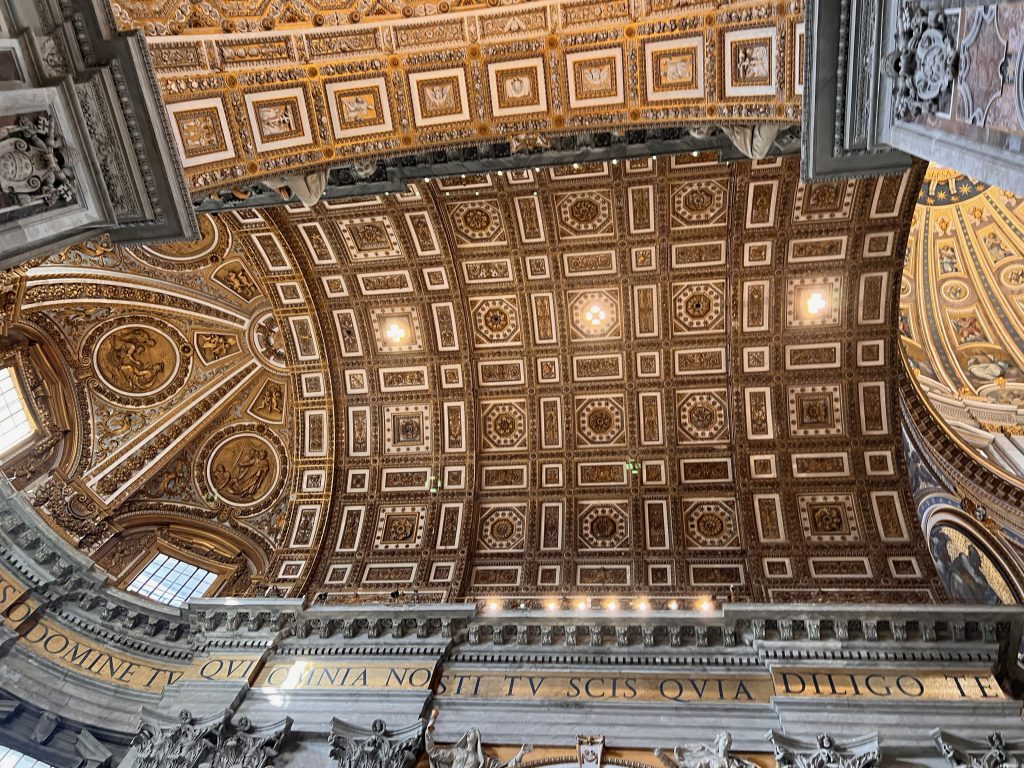
Facade of St Peter’s Basilica Sunrise over St Peter’s SquareStatue of Christ and 12 other statues perched on top of St Peter’s BasilicaMy friends at St Peter’s SquareTaking a quick wefie at St Peter’s SquareStatues on the buildings in Vatican CityStatue of St Peter One of the Pope’s guardThe ceiling in the foyer of St Peter’s BasilicaThe golden Holy Door only opens once every 25 years (the next time it will open is in 2025)Mosaic of Jesus giving St Peter the two keysThe ceilings in St Peter’s Basilica are very impressiveWaiting for our elevator to the terrace level of the St Peter’s Basilica
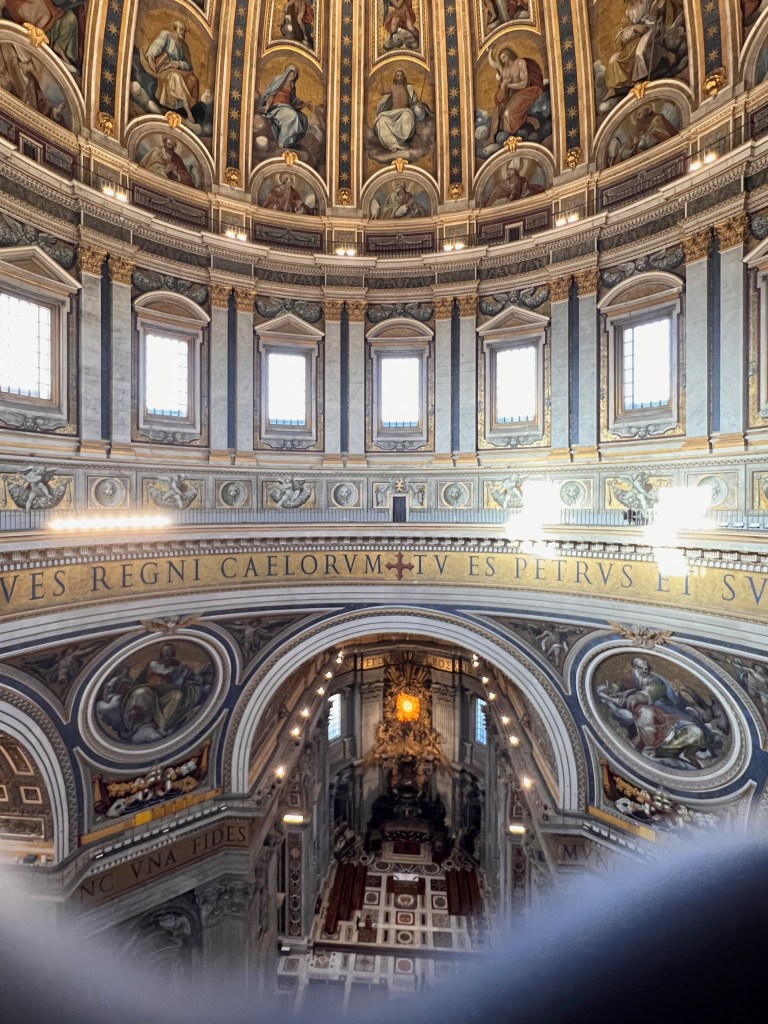
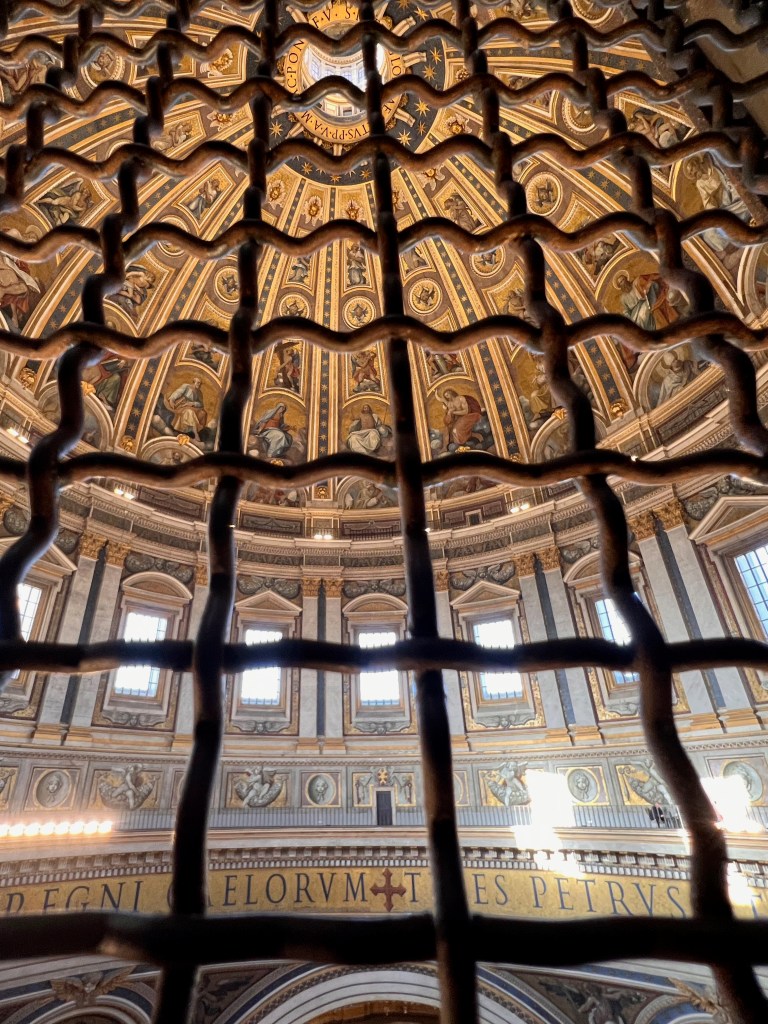
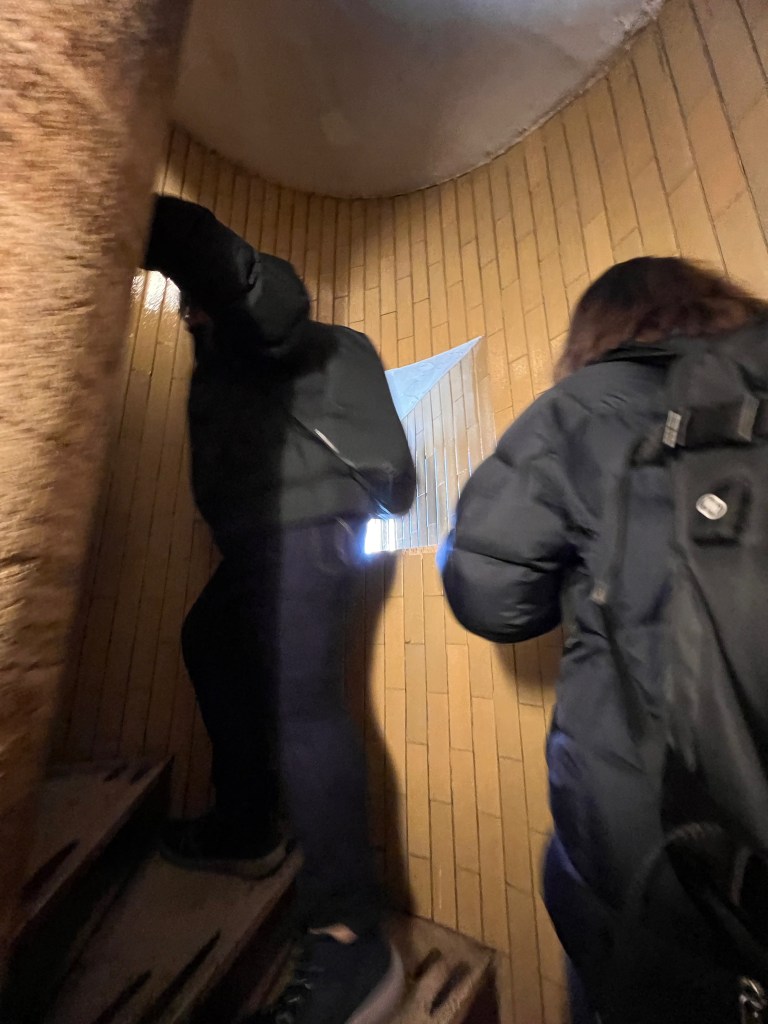
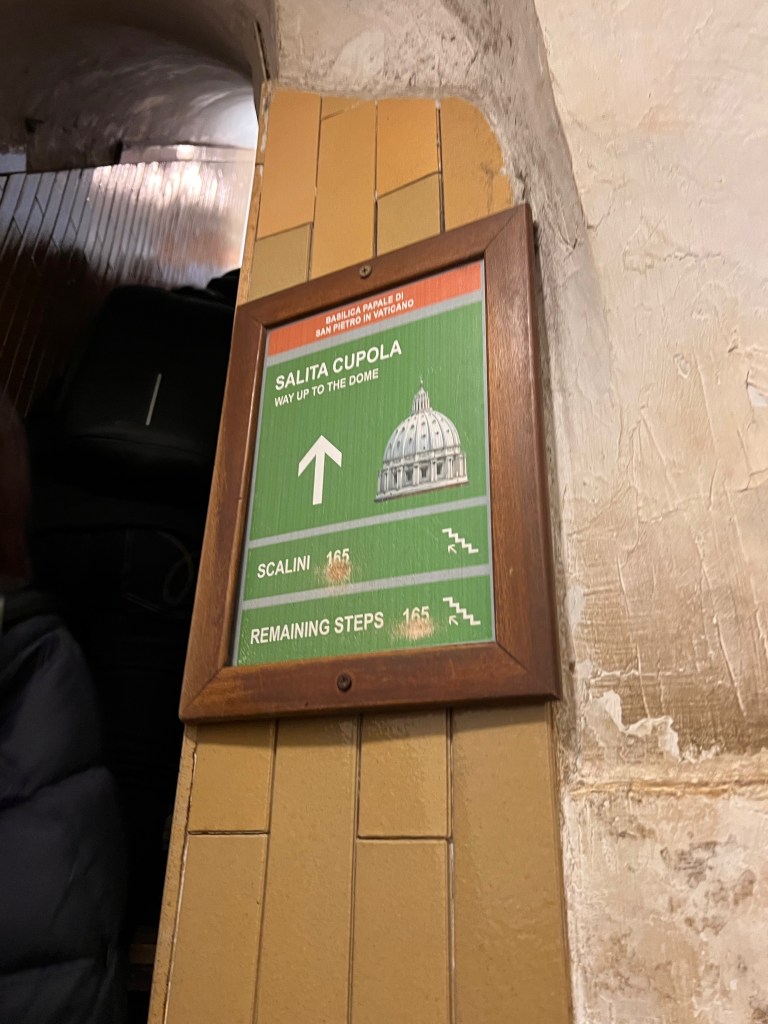
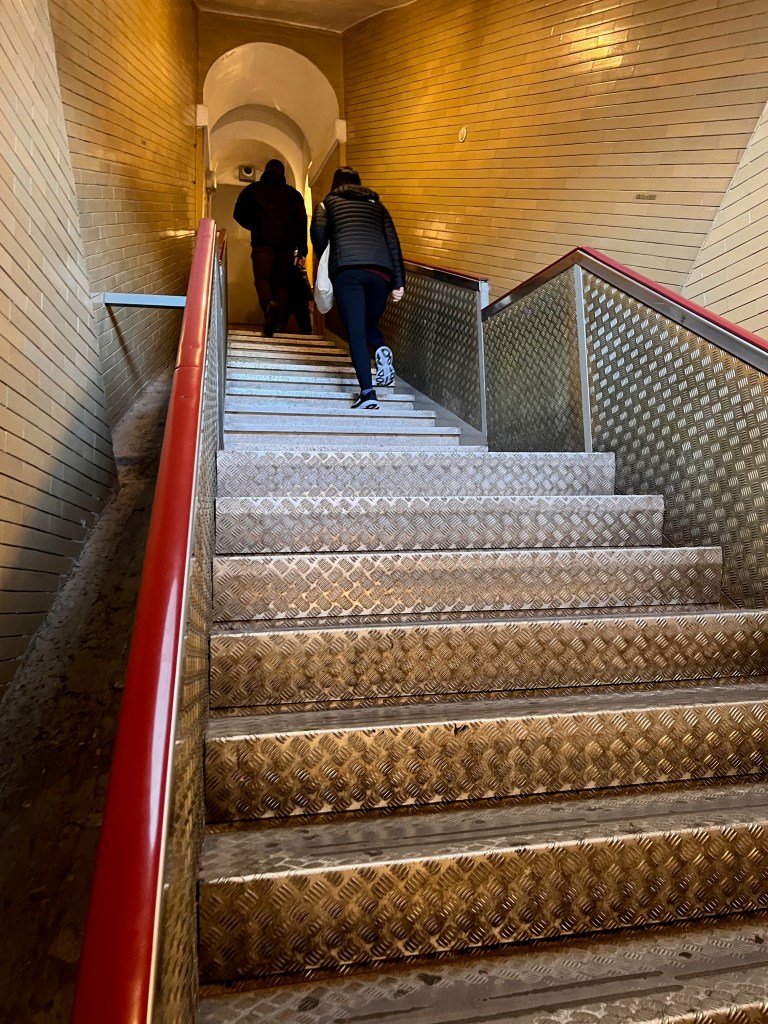
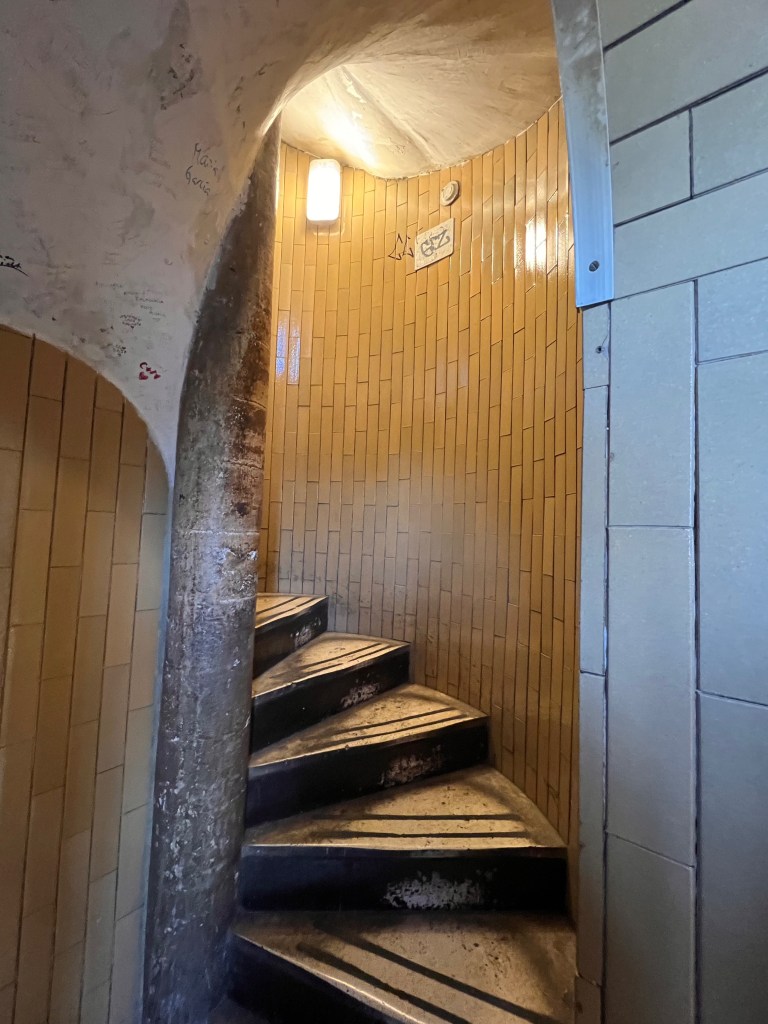
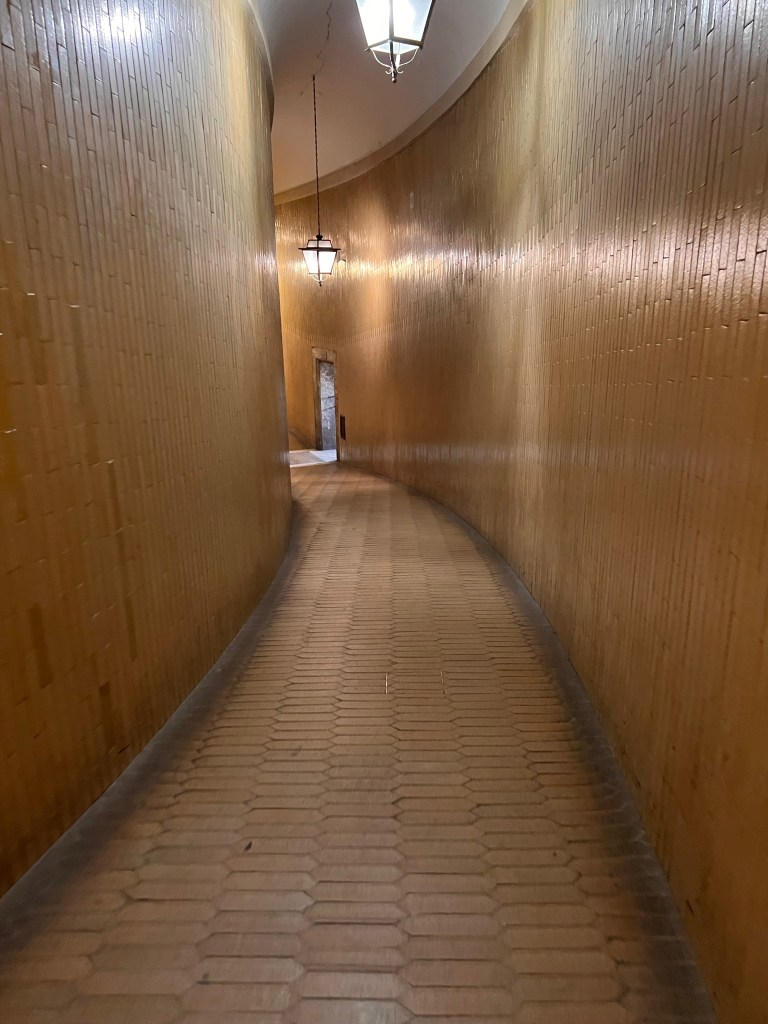
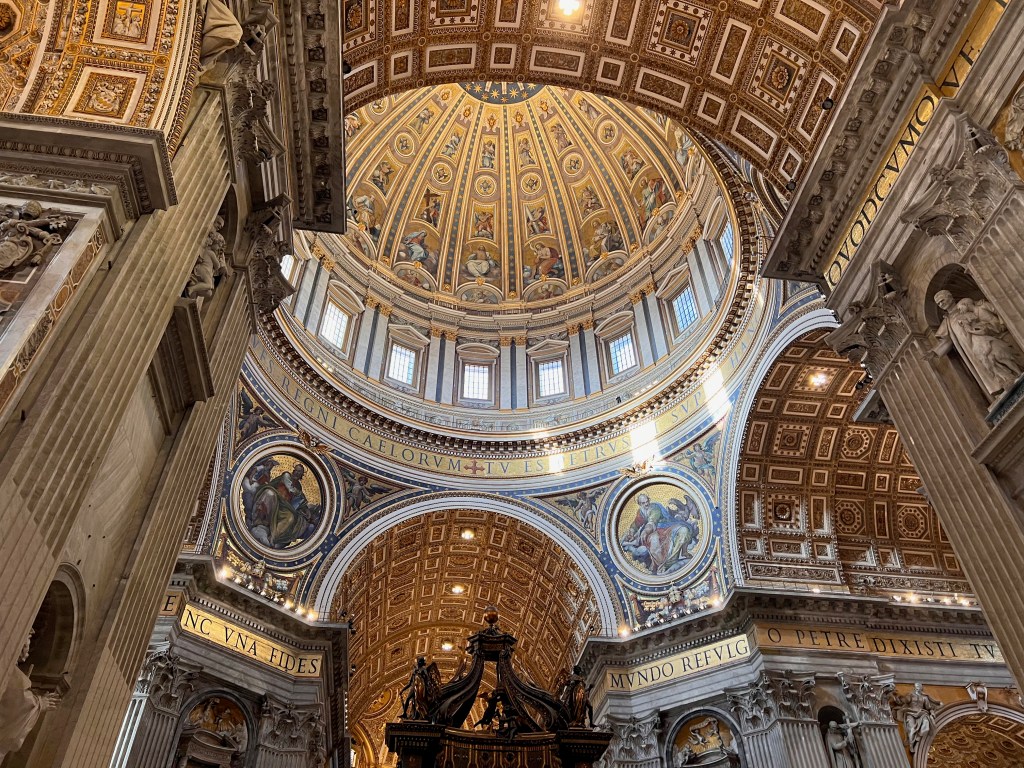
Raffa then brought us up a small flight of stairs into the dome of St Peter’s Basilica. Inside we saw the mosaic artwork under the dome. If not for Raffa’s explanation, I would have thought those were paintings. These artworks are more impressive after we learnt they are mosaics, painstakingly put together ceramic by ceramic under the dome. It was a shame that we were only given 5 mins to walk through this dome level. We used whatever little time we had to admire the work of the builders of St Peter’s Basilica. We were given directions on where to get to the top of the dome (Raffa had hurt her leg, and she could not climb with us). The dome climb started with an easy slope, as we progressed higher into the dome, the stairs became narrower, and at one point (I think it must be near to the slope in part of the dome), the amount of headroom we had was very limited. Finally, after some 200-plus steps, we came to a small spiral staircase wedged into a single marble pillar. This marks the last few steps to the top of the dome.
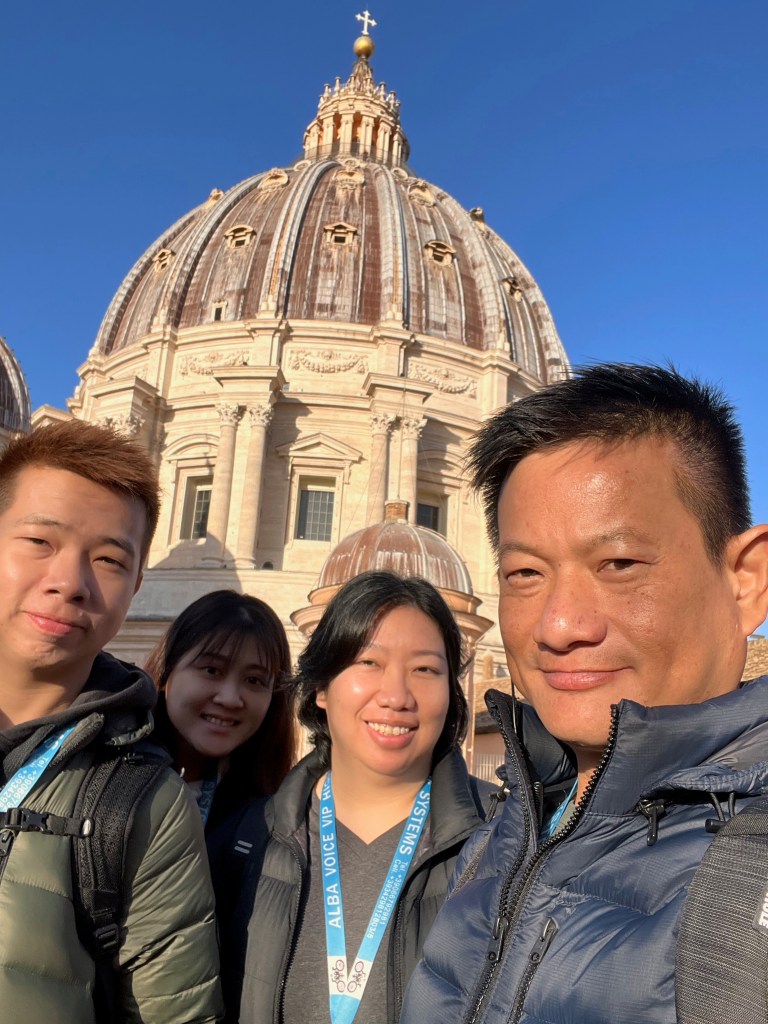
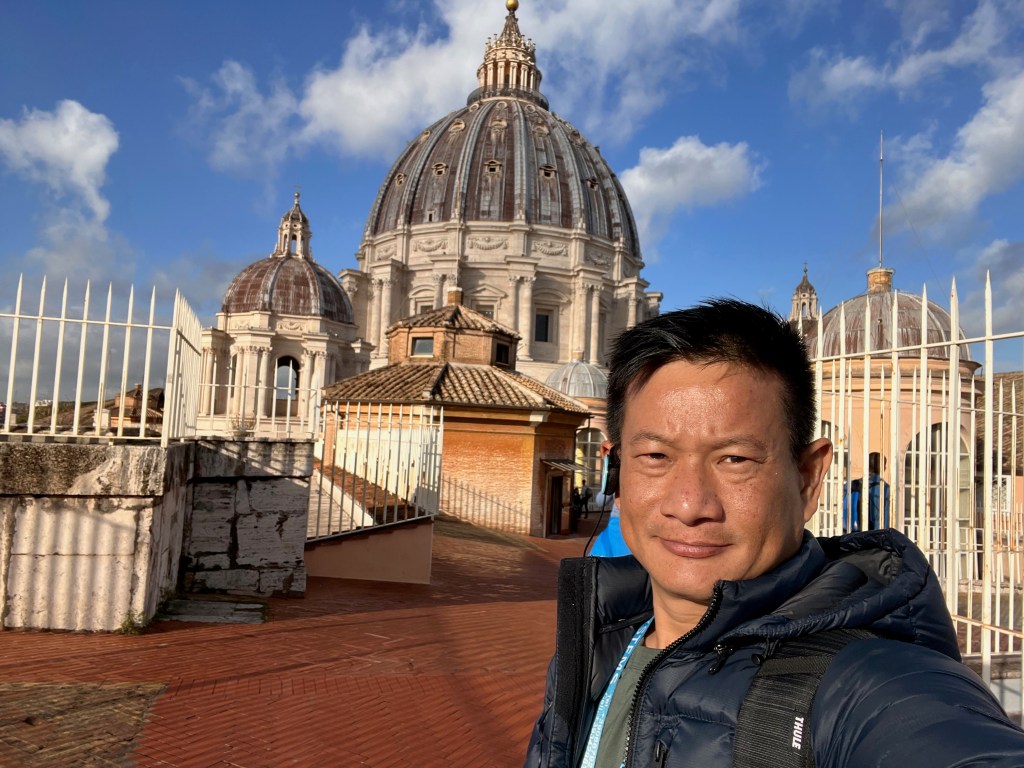
St Peter’s Basilica dome from the terraceView of St Peter’s Square from the terrace of St Peter’s BasilicaMy friend posing on the terrace of St Peter’s Basilica
Taking a wefie at the terrace level of St Peter’s Basilica
Wefie with the dome before we climb itThe dome of St Peter’s BasilicaThis is the most impressive view of the mosaic art under the St Peter’s Basilica dome.The mosaic artwork is awe-inspiring.
View of the mosaic artwork under the dome of St Peter’s Basilica
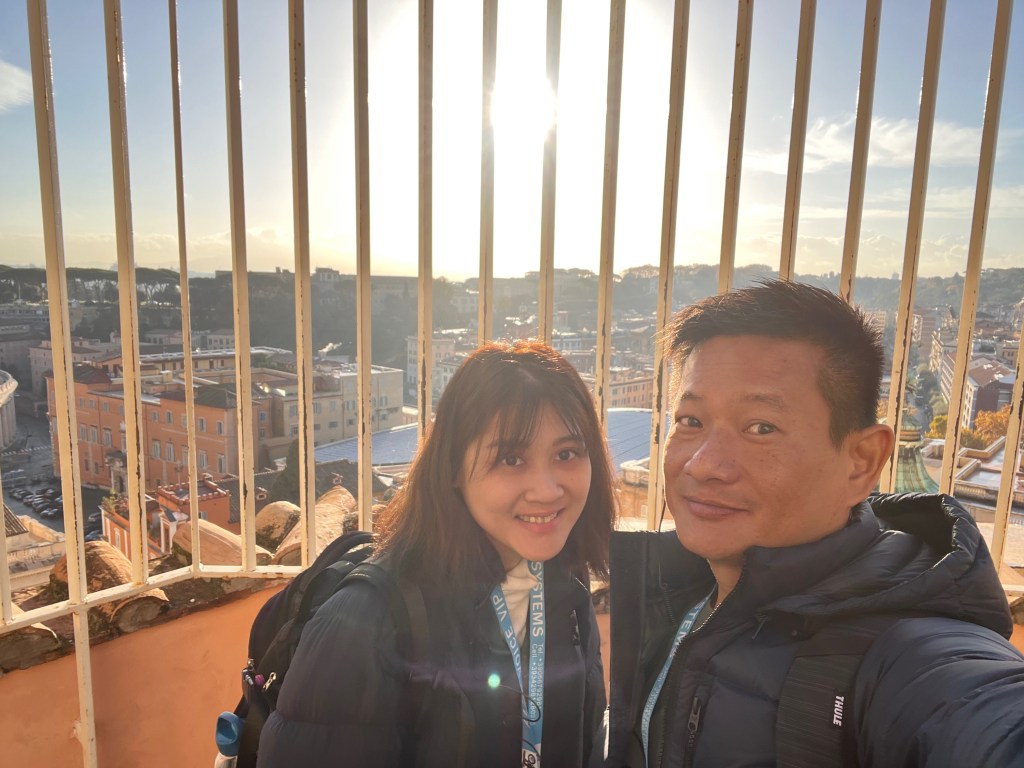
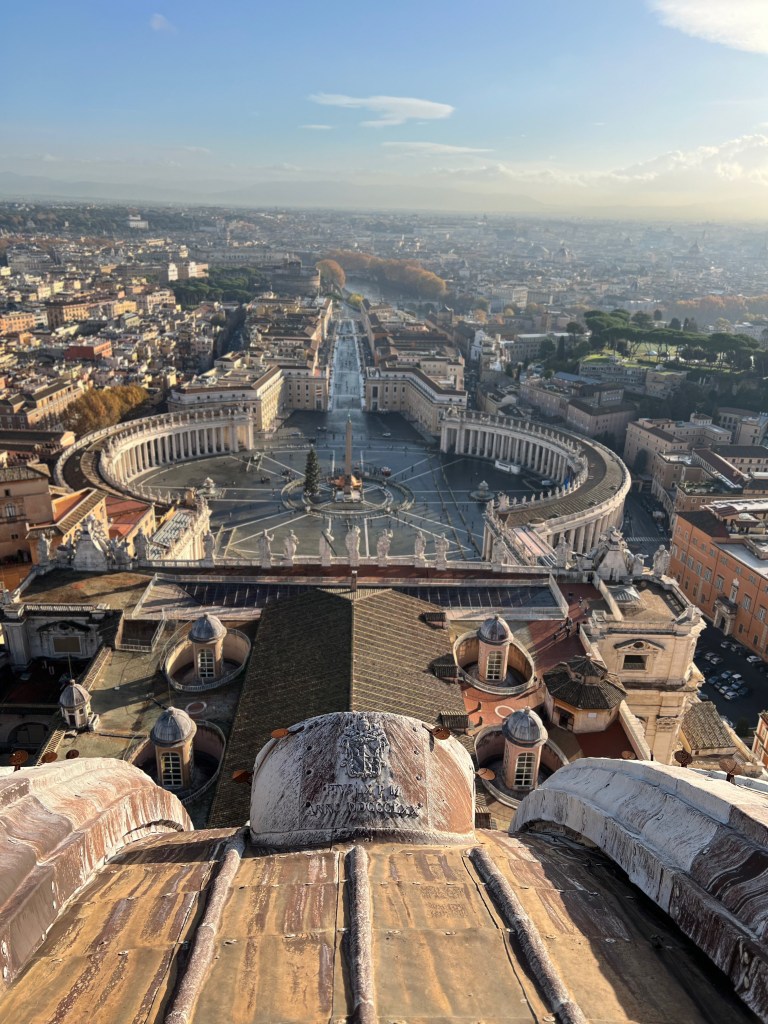
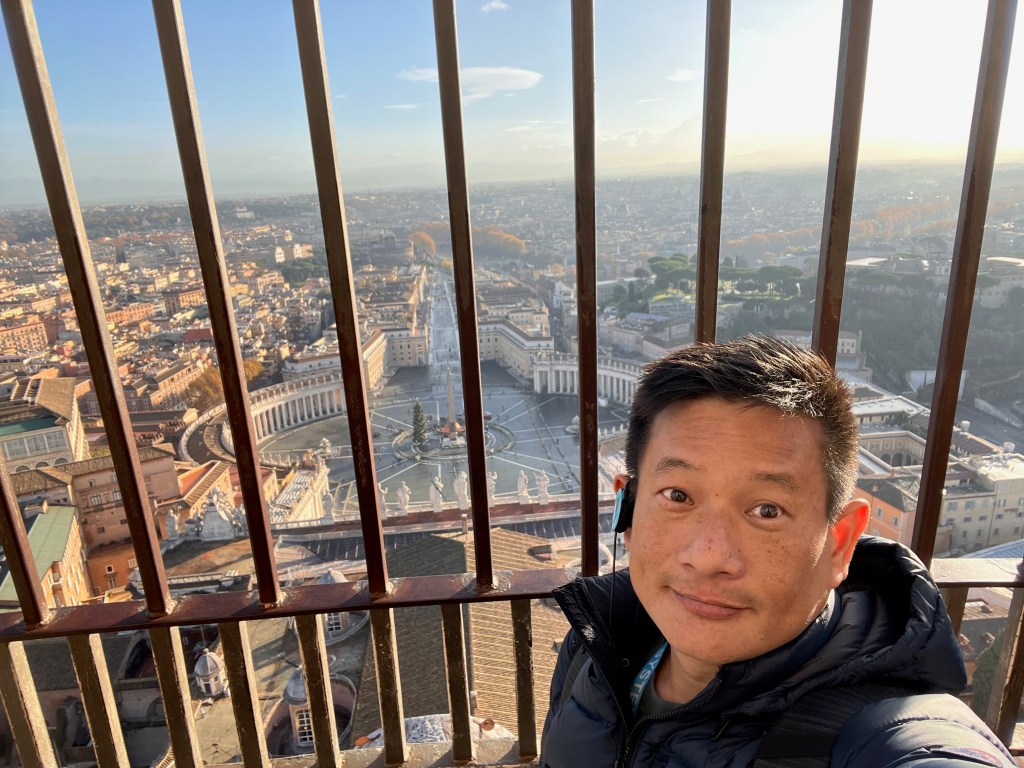
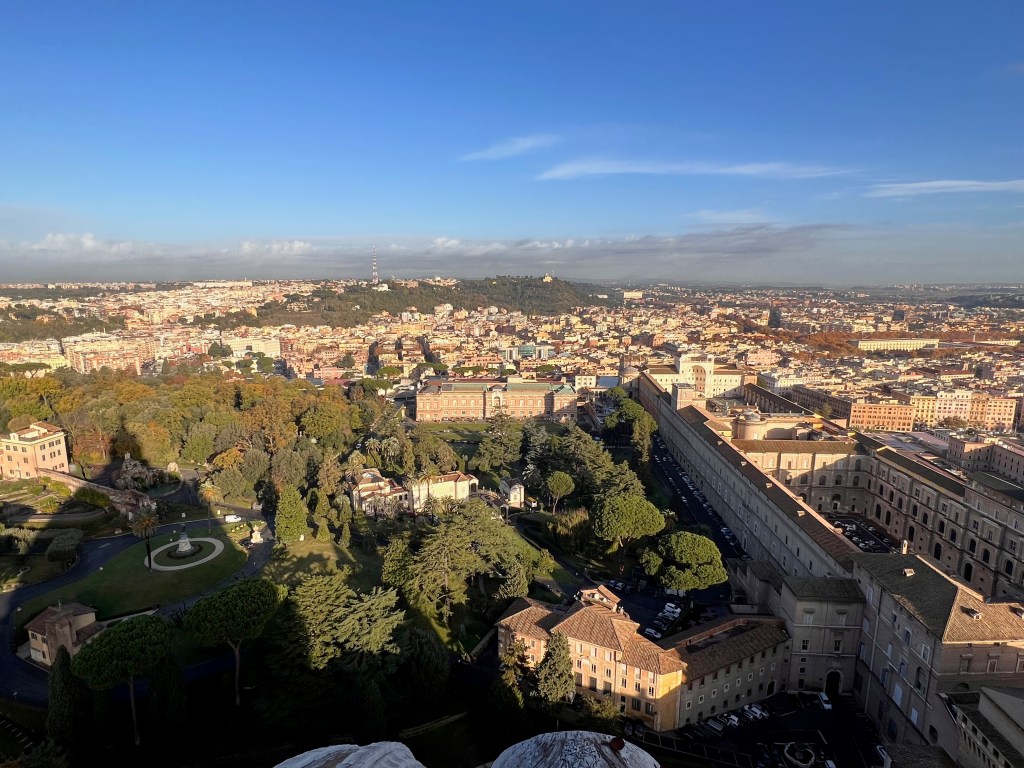
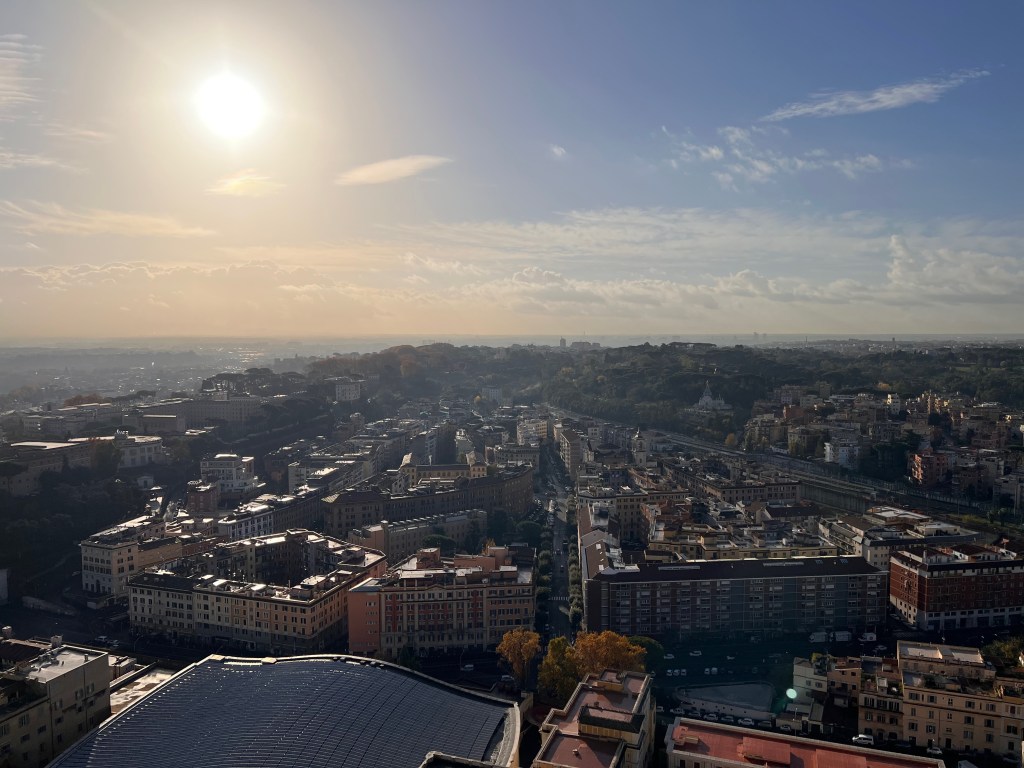
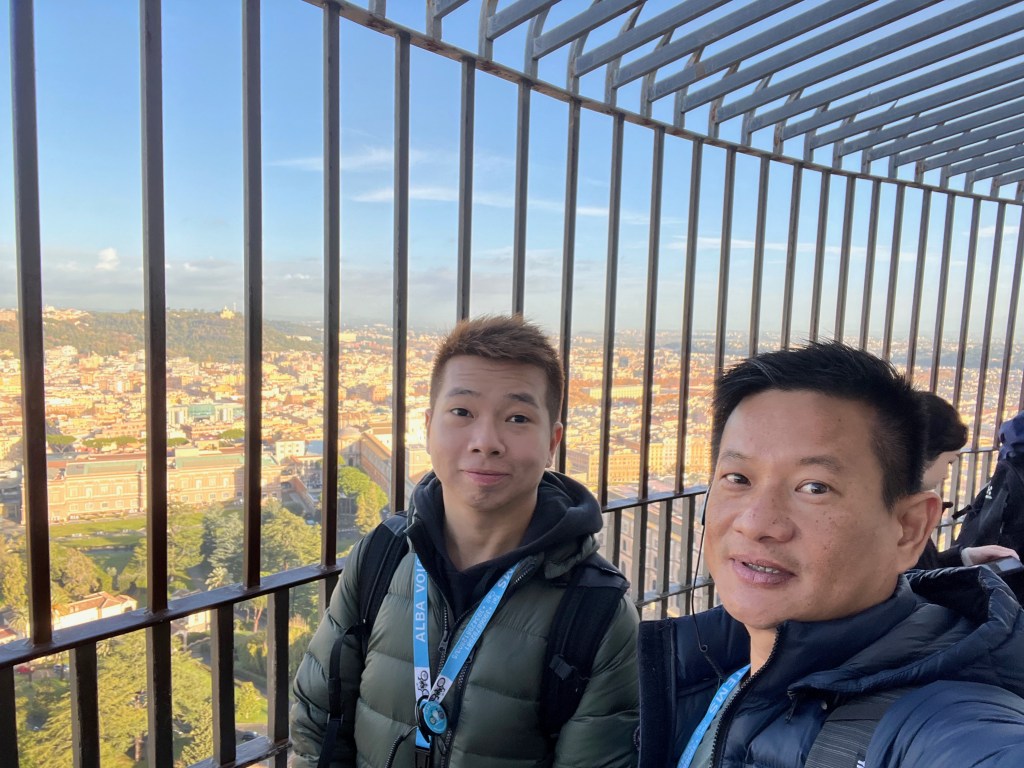
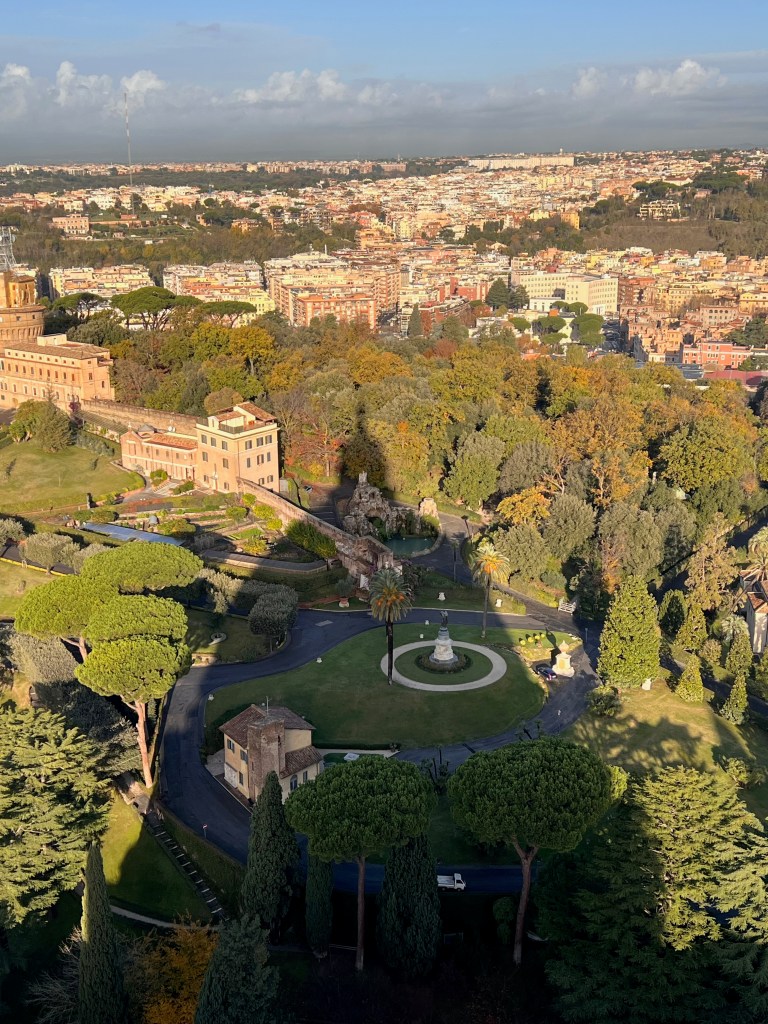
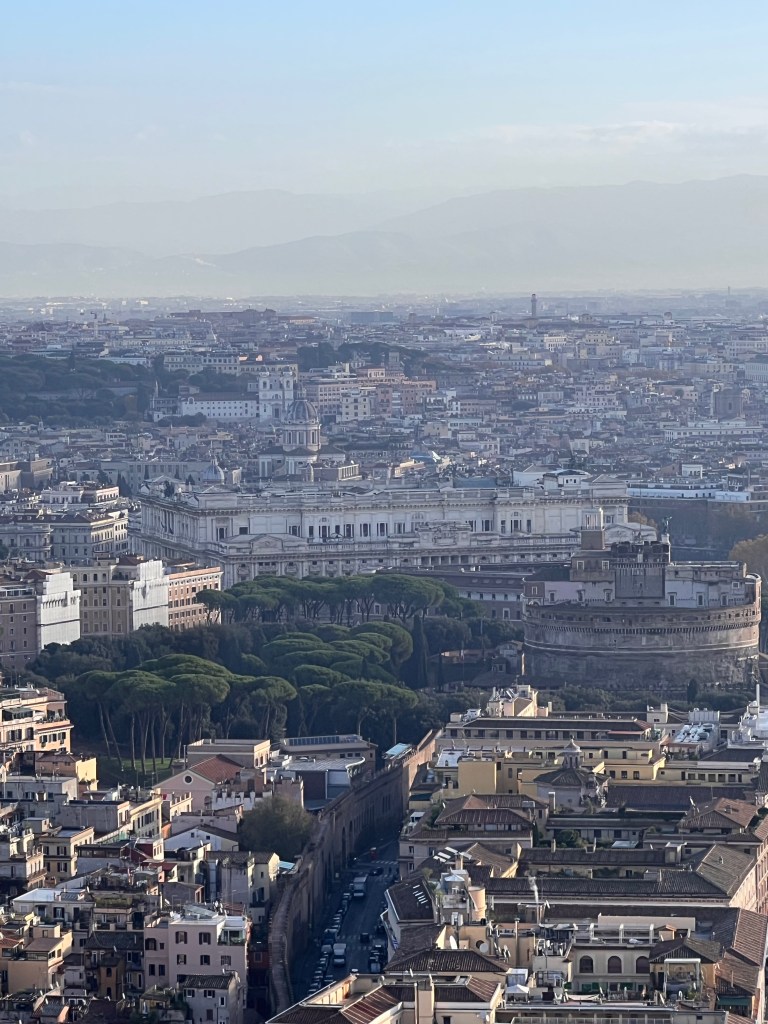
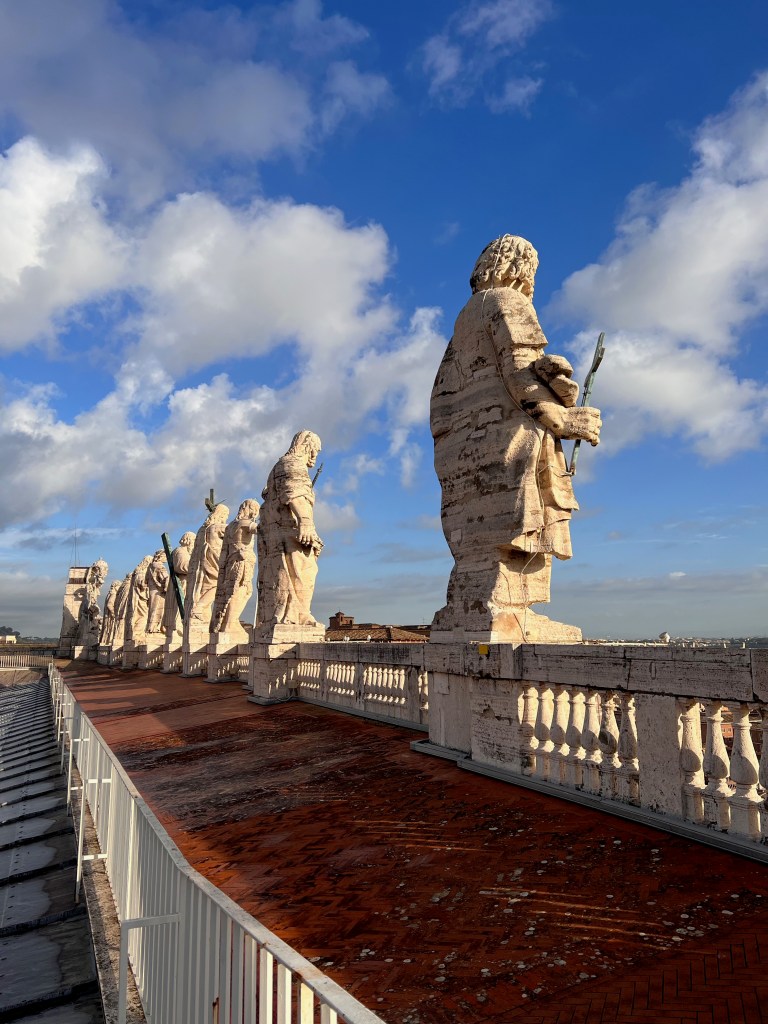
We were all in wonderment when our sight shifted from the narrow, enclosed stairways to the open space in front of us. The sight in front of us was the endless view of Rome, we could see as far as the horizon stretched. But instead of focusing on the distant views, I narrowed my vision to St Peter’s Square. Numerous content creators have mentioned the view of the square from the top of St Peter’s Basilica dome was amazing. Indeed, true to their words, I could see the 13 statues on top of St Peter’s Basilica, the circular St Peter’s Square, and a little beyond that, a road leading to St Peter’s Basilica. The view of the quiet morning St Peter’s Square, sparsely dotted with visitors, is priceless. With the crowd level, we can almost feel the tranquillity of the otherwise busy and crowded square in the morning. As much as I didn’t want to peel my eyes off the peaceful St Peter’s Square, I noticed I was hogging the spot. I moved around the dome to admire Rome from what felt like the top of Rome. I could see the nearby Castel Sant’Angelo marked by its iconic cylindrical brown tower from the top of the dome. I was trying to see if I could spot the Colosseum from the dome. I started by looking for the Tiber River and looked for the Colosseum. However, I wasn’t able to spot the iconic landmark of Rome. Nonetheless, the views from the top of the dome were amazing. We had an unobstructed 360° view of Vatican City and Rome from the top of the dome. Soon my friend started to remind us of the time we had to head back down to meet Raffa for the next part of our tour – the St Peter’s Basilica.
View of St Peter’s Square from the top of St Peter’s Basilica
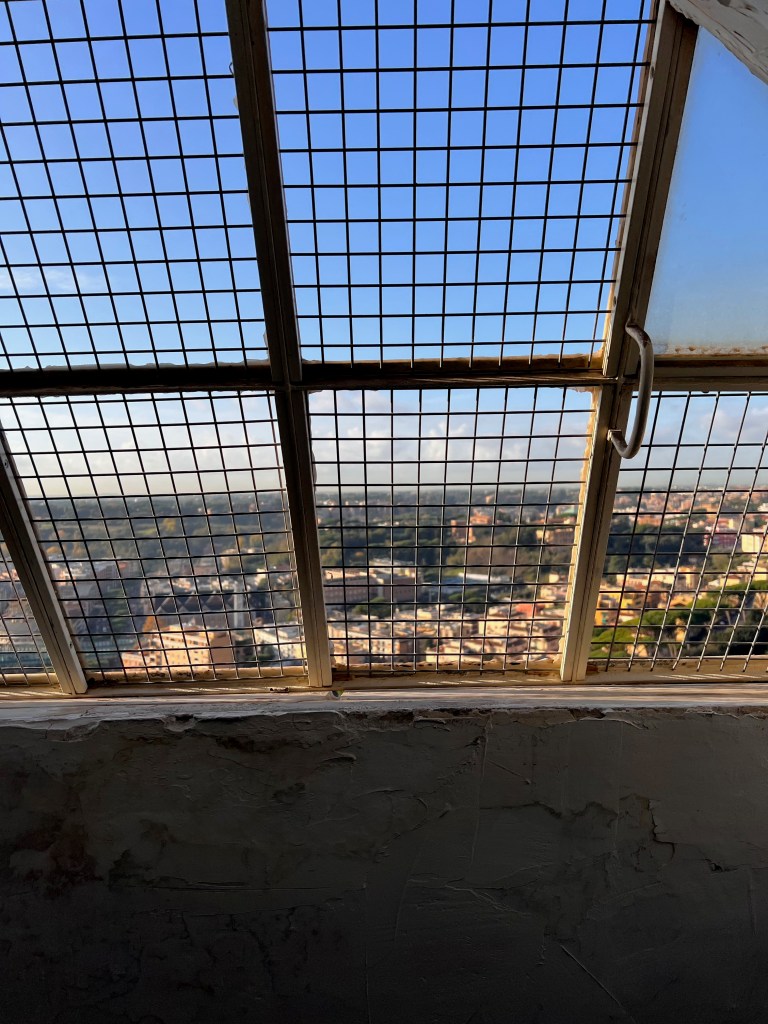
Climbing to the top of St Peter’s Basilica domeDirection signs to the top of St Peter’s BasilicaView of Rome from the stairs to the top of St Peter’s Basilica domeThis is one of the easier stairs to climb to the top of St Peter’s BasilicaThe last flight of stairs brought us to the top of St Peter’s Basilica domeView of Rome from the dome of St Peter’s BasilicaMe with the view of St Peter’s Square from the domeView of Rome from the top of the domeAnother view of Rome from the top of the dome of St Peter’s BasilicaMy friend and I at the top of St Peter’s BasilicaSilhouette of St Peter’s Basilica dome casting on top of Vatican CityWe can see Castel Sant’Angelo (the rounded building) from the domeThe top part of the dome that is closed to the publicView of Vatican City and Rome Another superb view of Rome from St Peter’s Basilica domeWefie at the top of the St Peter’s Basilica domeOne final wefie on the top of the dome before we head back down.
My friends showing how tight some parts of the stairs to the dome is
Heading back down the narrow part of the stairsAnd the spiral partThis is one of the easier part of the stairs downThe last “mile” of the stairs down is a ramp that leads us to the exitLooking back at the part of the dome we just came down fromMe with the dome of St Peter’s BasilicaBack view of the statues facing St Peter’s SquareWe took this flight of stairs down to the ground floor of St Peter’s Basilica.
St Peter’s Basilica
We met with Raffa, who took us through some of the more significant mosaics displayed in St Peter’s Basilica. After a couple of mosaics, Raffa brought us to the underground Vatican Necolpolis of St Peter’s Basilica, where we were shown the tomb of St Peter and the Popes of the basilica. The body of St Peter was buried underneath an elaborate marble-clad chamber, enclosed behind a glass panel. While we did not see the body of St Peter, we can feel the solemnness of the tomb. There are marble coffins of the other popes in the necropolis, but the tomb of St Peter is the most elaborate. As we were heading up to the ground level of the basilica, Raffa pointed to the base of a column and remarked that it was one of the pillars from the original St Peter’s Basilica. The first part of our tour of the Vatican City ended with a visit to the Vatican Necropolis. We returned to the meeting point for a 20 min break. As we hadn’t had our breakfast, we sat in the cafe munching on a croissant and cafe latte for breakfast.
The magnificent mosaic art under the dome of St Peter’s Basilica
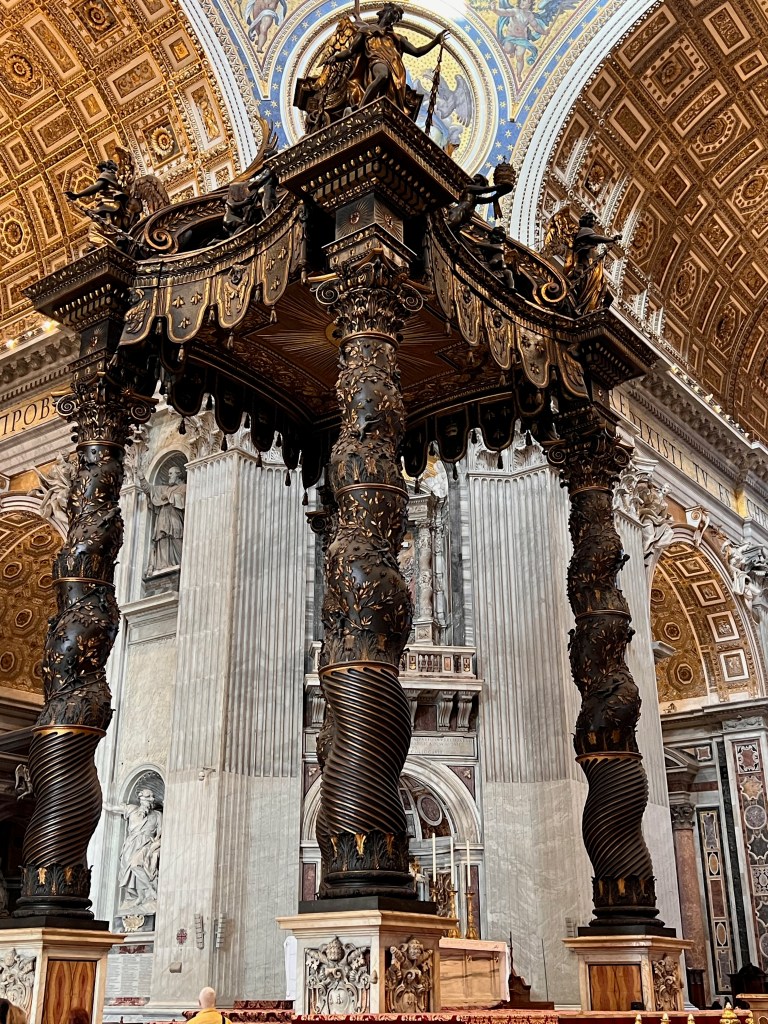
St Peter’s Baldachin in the centre of St Peter’s Basilica, where St Peter is buried
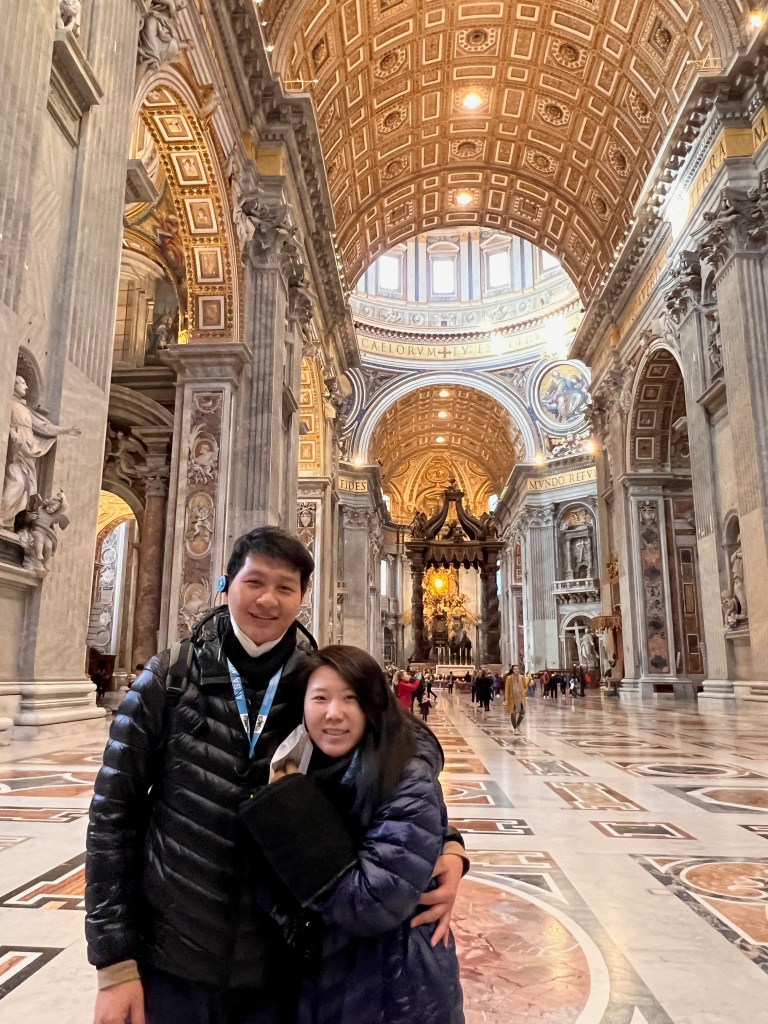
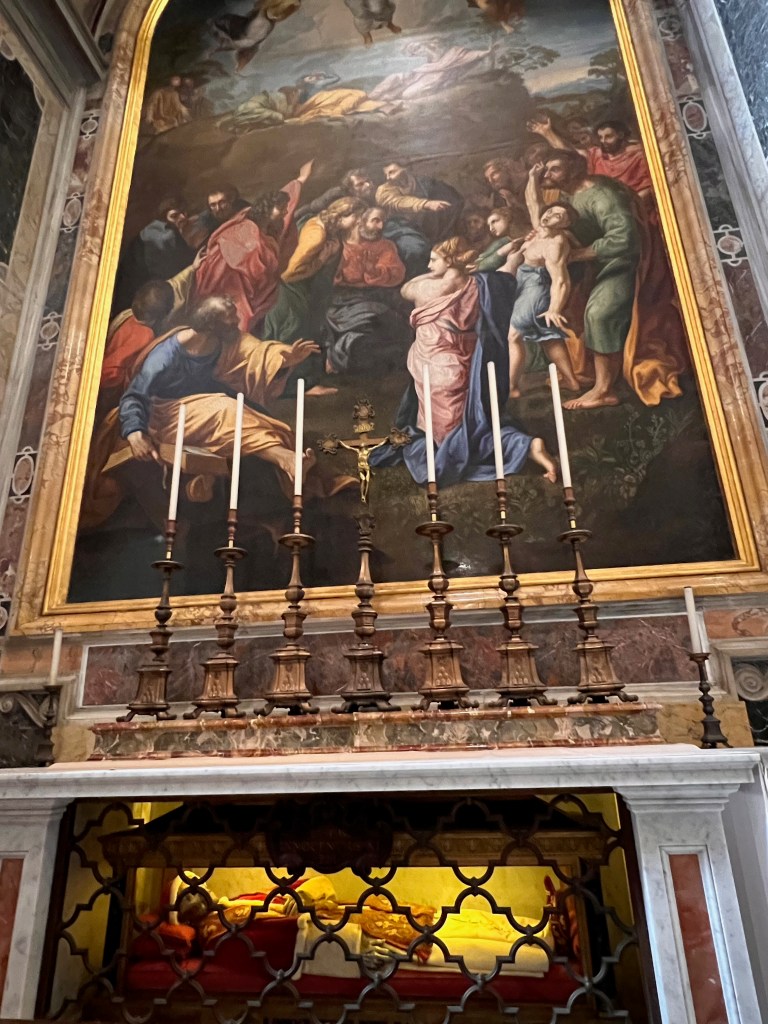
My friend helping Raffa with the tour guide stickInside St Peter’s BasilicaThe incredible mosaic artwork on the ceiling of St Peter’s BasilicaMy friends inside the magnificent St Peter’s BasilicaMortal remains of Pope Innocent XI under the Altar of the Transfiguration in St Peter’s Basilica.Mosaic artwork on the Altar of Lie in St Peter’s Basilica
The ceiling of St Peter’s Basilica
Statue of St Andrew inside St Peter’s BasilicaOne final look at St Peter’s BasilicaA quick wefie before we leave St Peter’s BasilicaHaving our light breakfast before the next part of the tour
Vatican Museum and Sistine Chapel
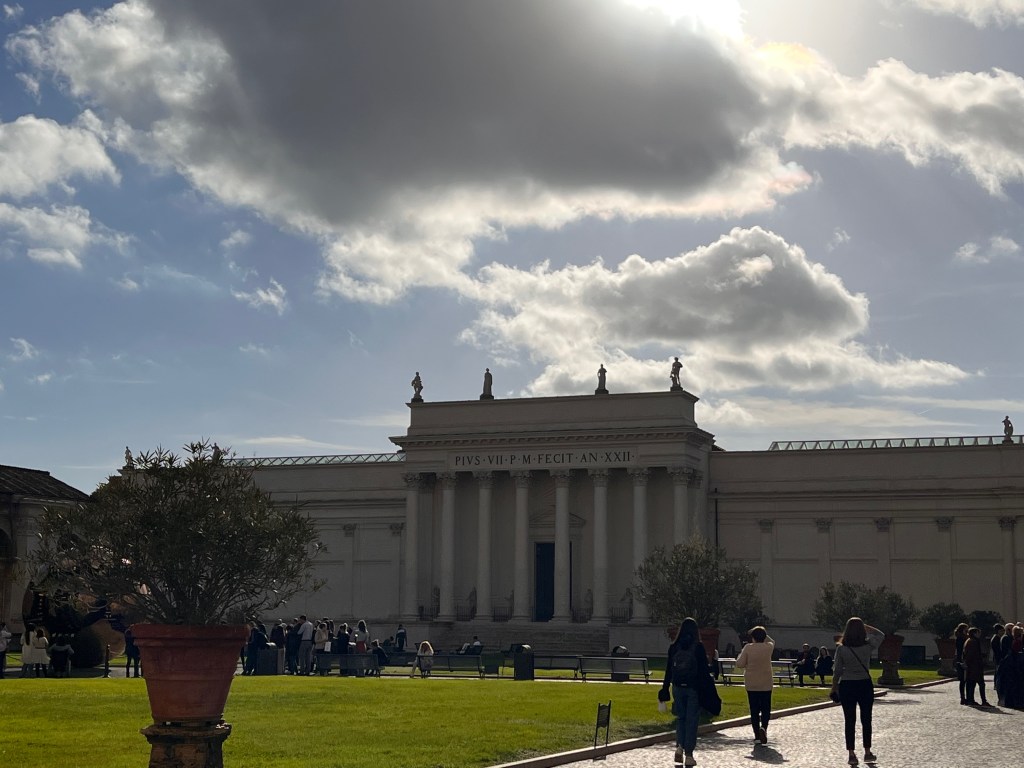
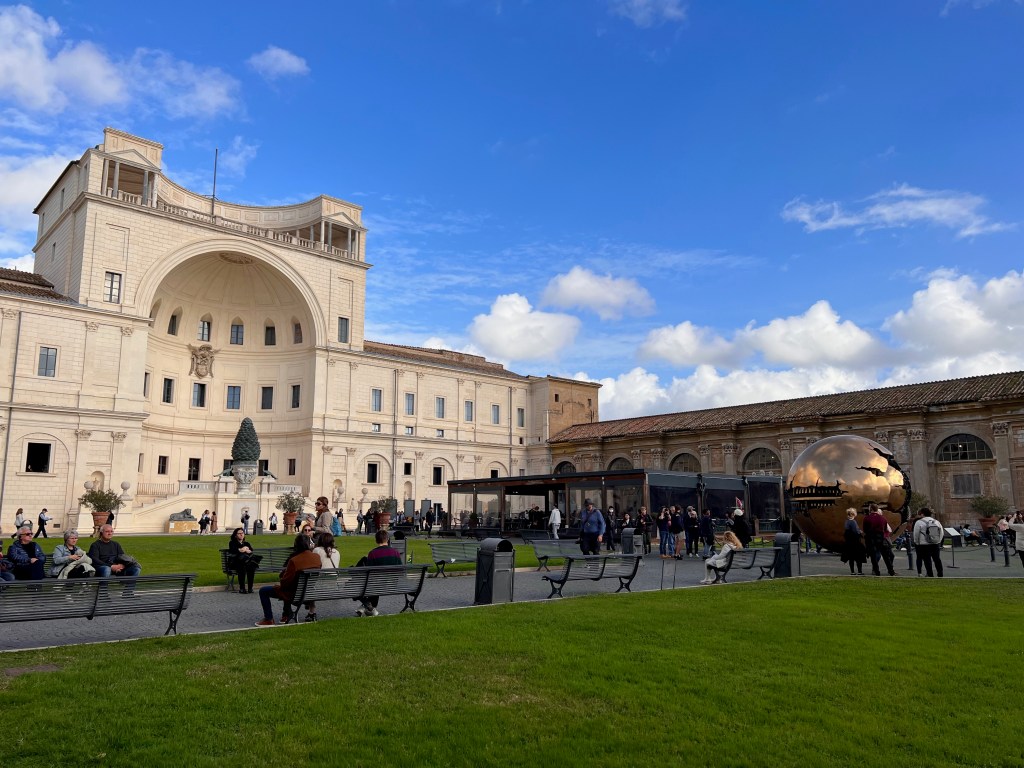
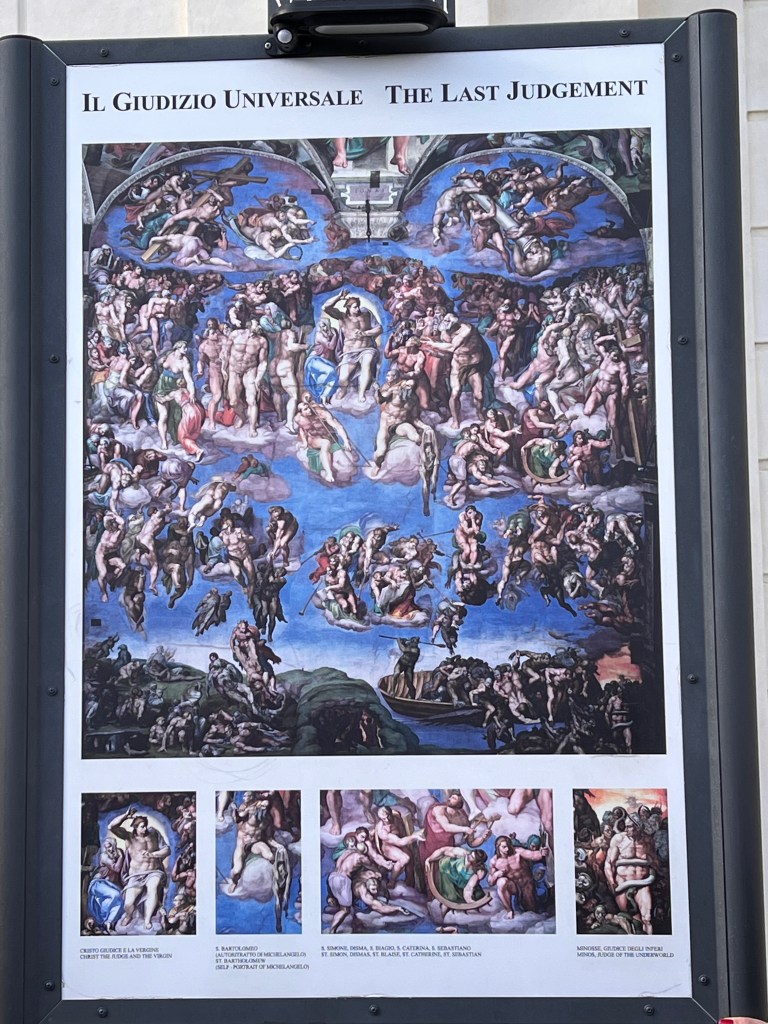
After our short break, Raffa continues to bring us on a tour of the Vatican Museum and Sistine Chapel. Vatican Museum houses mainly the art collections of the Popes throughout the years. We spotted a crowd at the entrance of the Vatican Museum, and it seemed like the local school was bringing their students on an excursion to the Vatican Museums. As we were part of the tour group and had skip-the-queue access, we whizzed past the crowd and quickly got into the museum. Before Raffa brought us into the museum, she ushered us to the lawn within the museum grounds. Here she explained the paintings that we will see in the Sistine Chapel, pointing out some of the details of the paintings that we would see on the chapel ceiling.
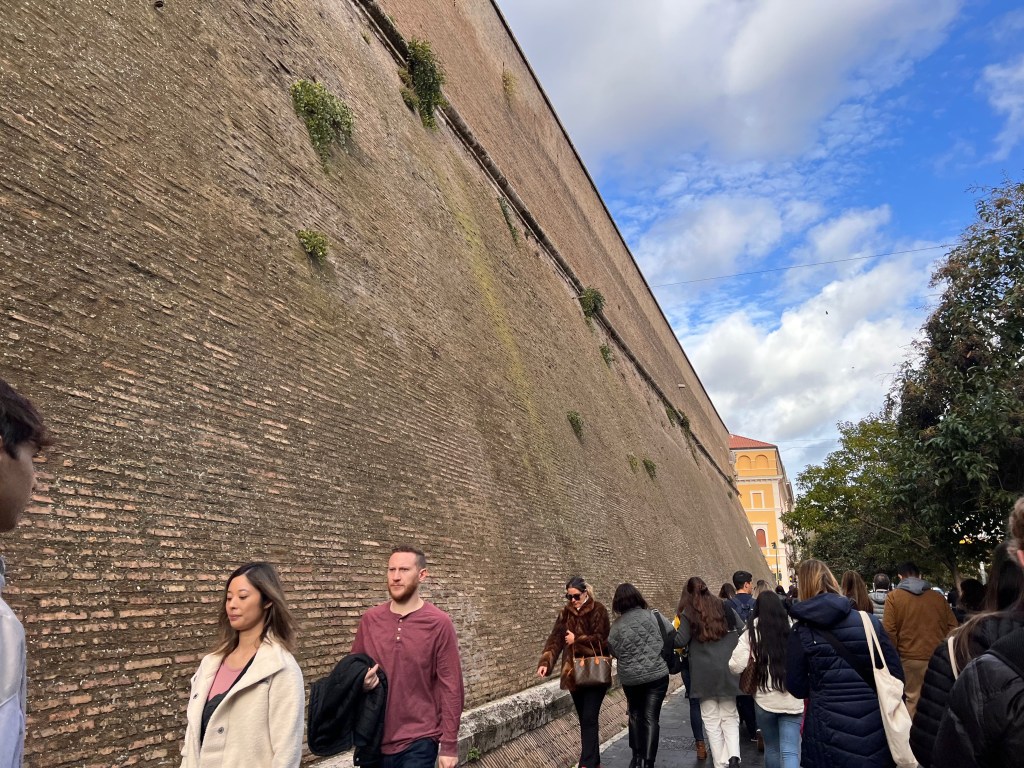
Walking outside the walls of Vatican City Wefie at the entrance of the Vatican MuseumEntrance to Vatican MuseumAt the entrance of the Vatican MuseumGarden of Vatican MuseumThere is a vast lawn inside Vatican Museum.
A large statue of an acorn in the gardens of the Vatican Museum
Another view of the garden in the Vatican Museum
A signboard explaining the Painting of the Last Judgement that we will see in the Sistine ChapelA signboard explaining the paintings on the ceiling of the Sistine Chapel
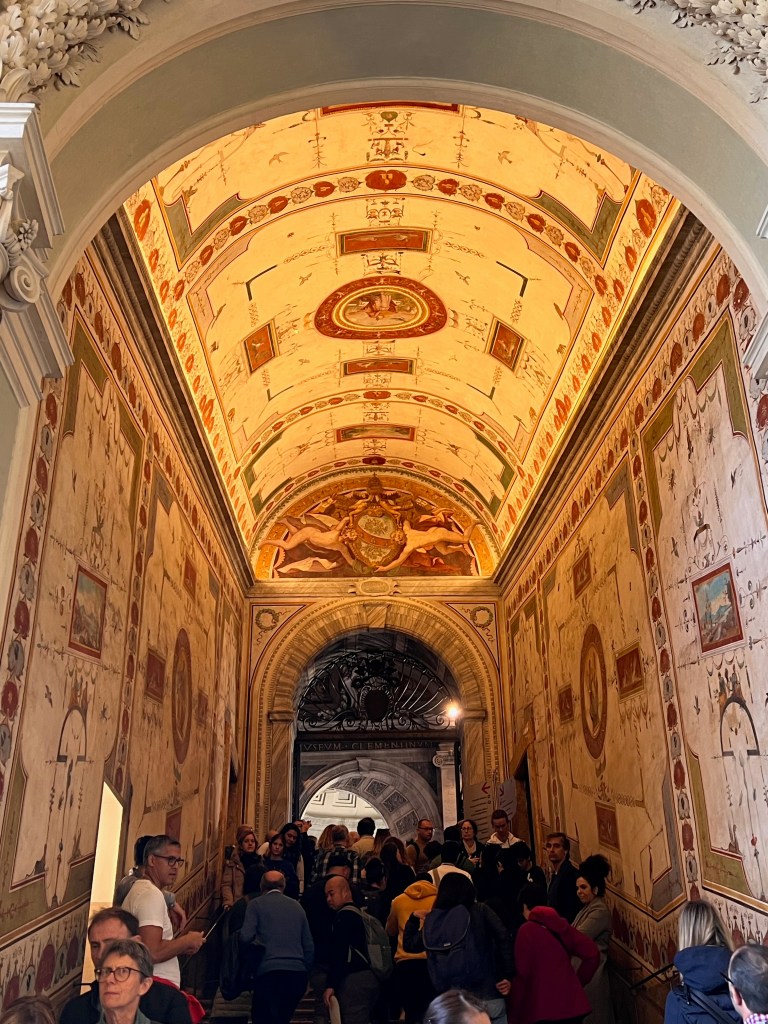
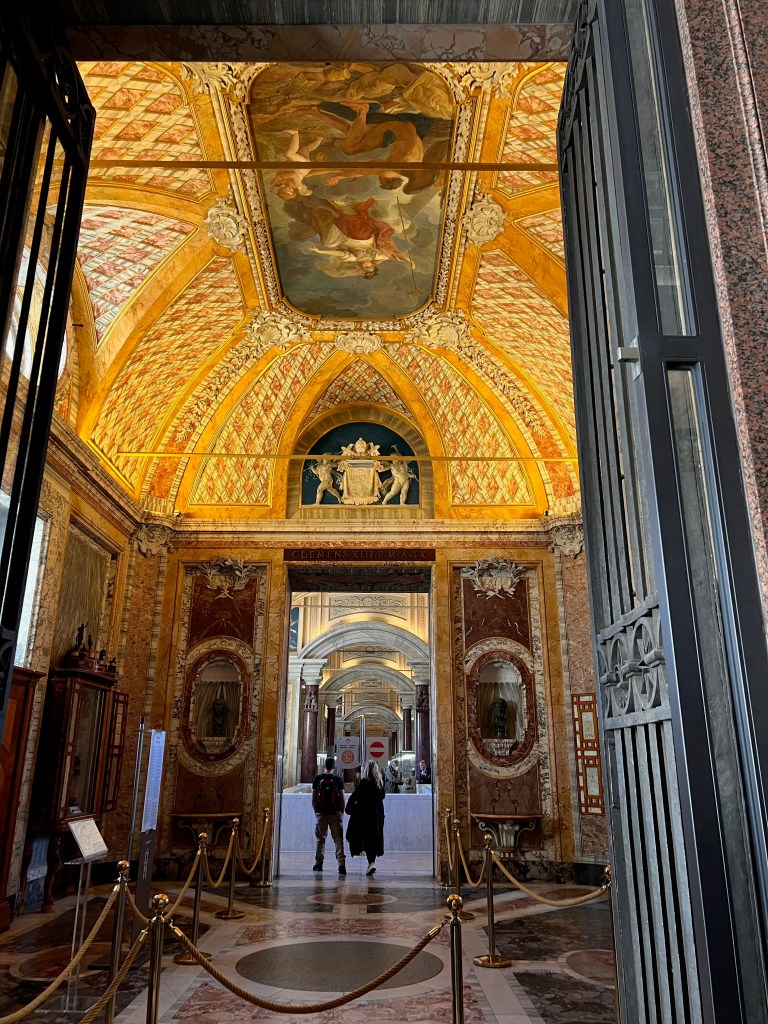
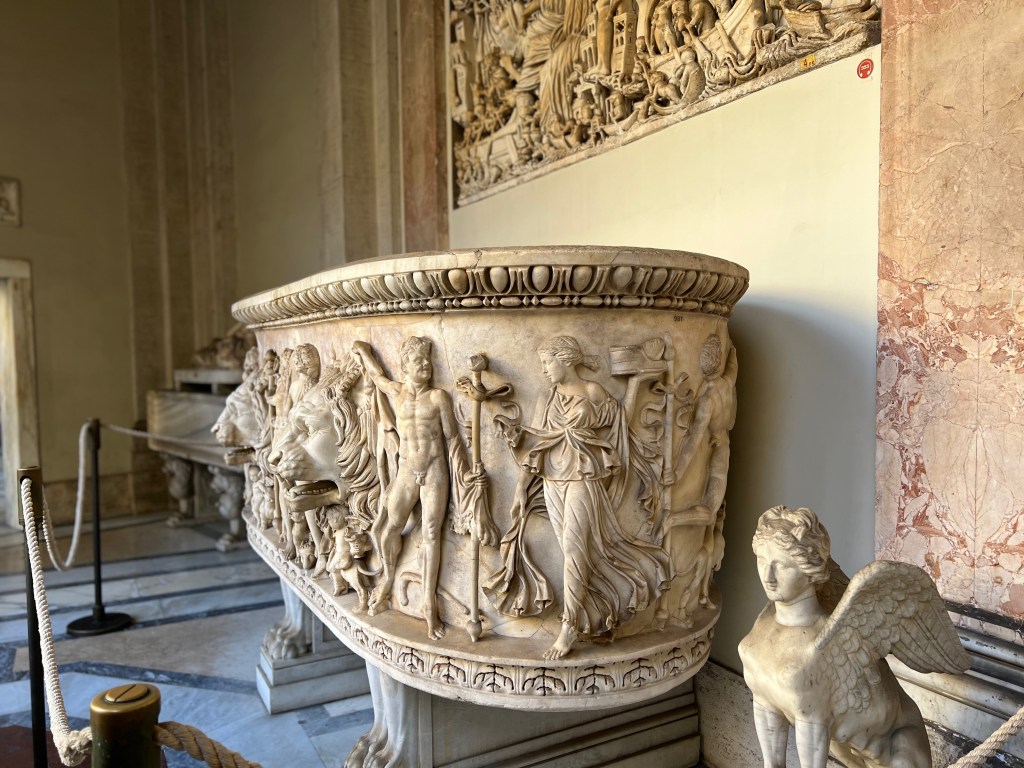
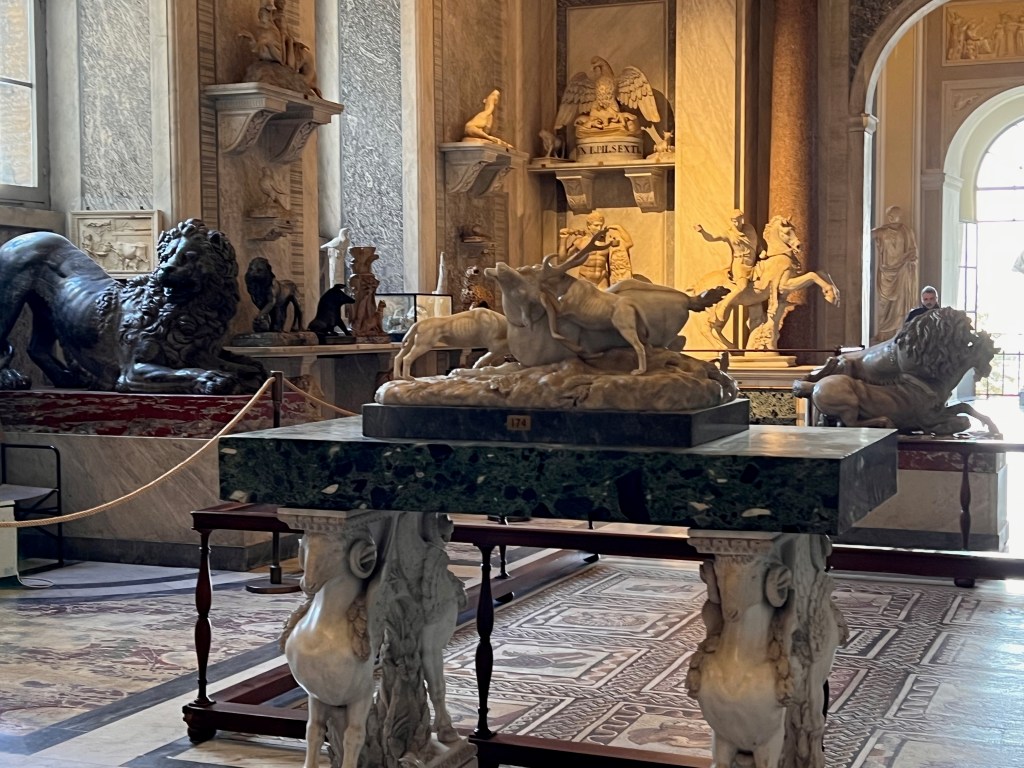
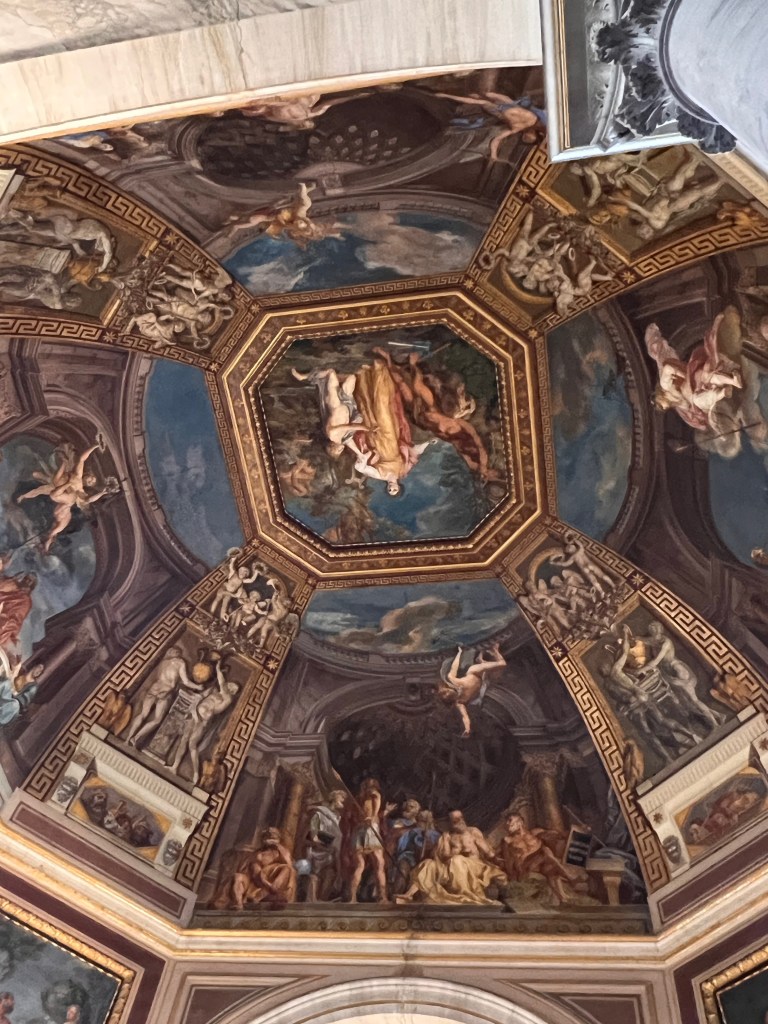
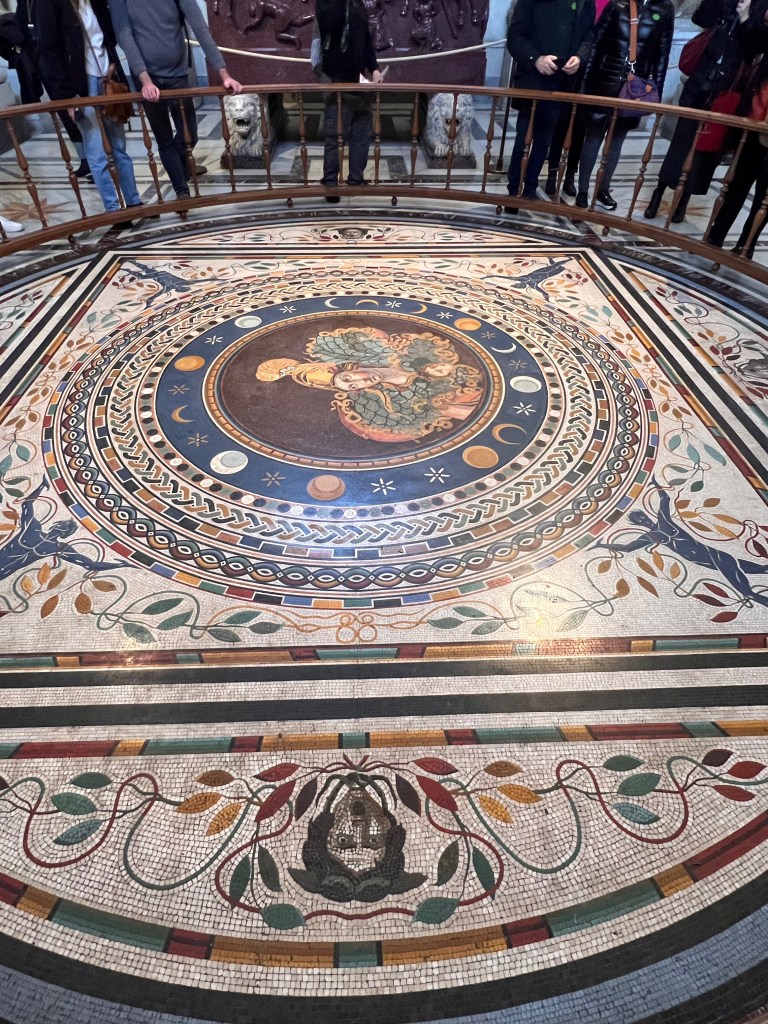
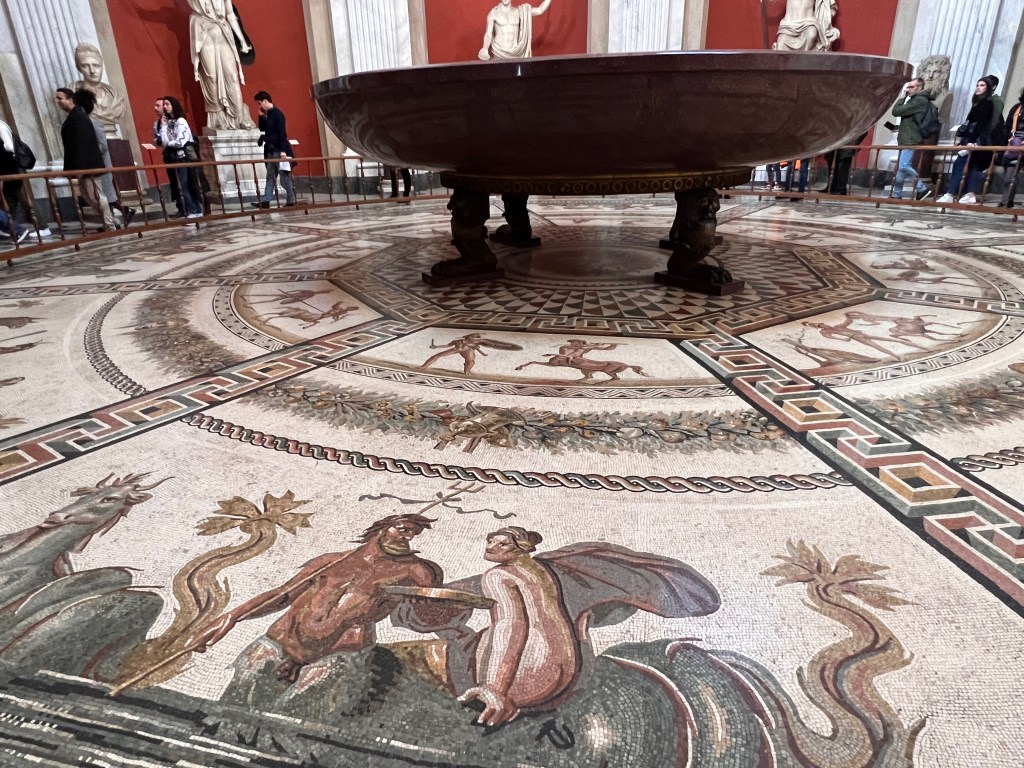
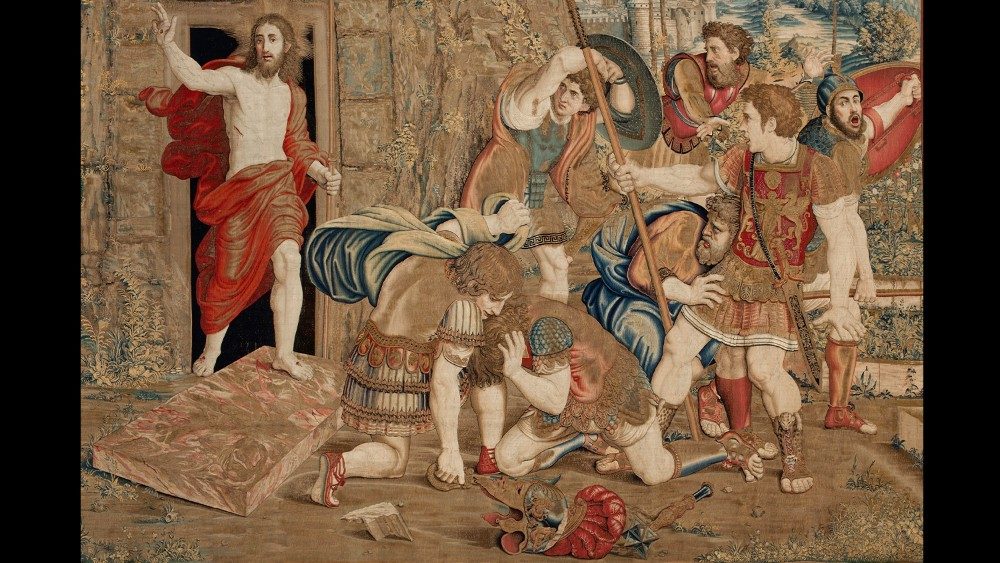
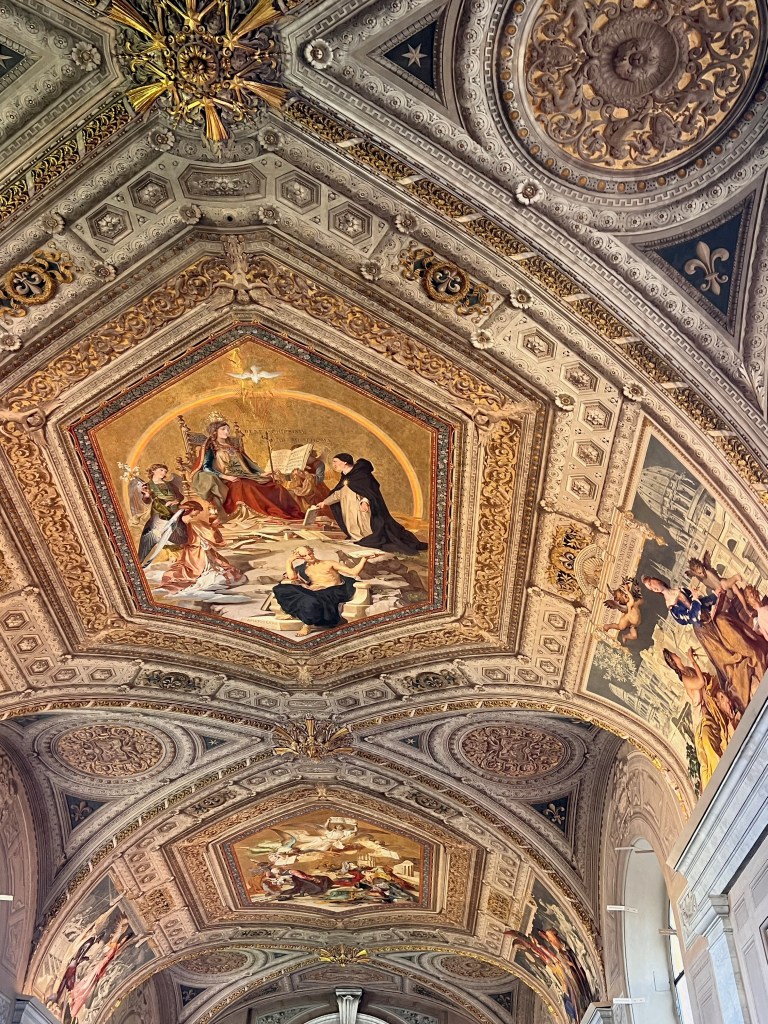
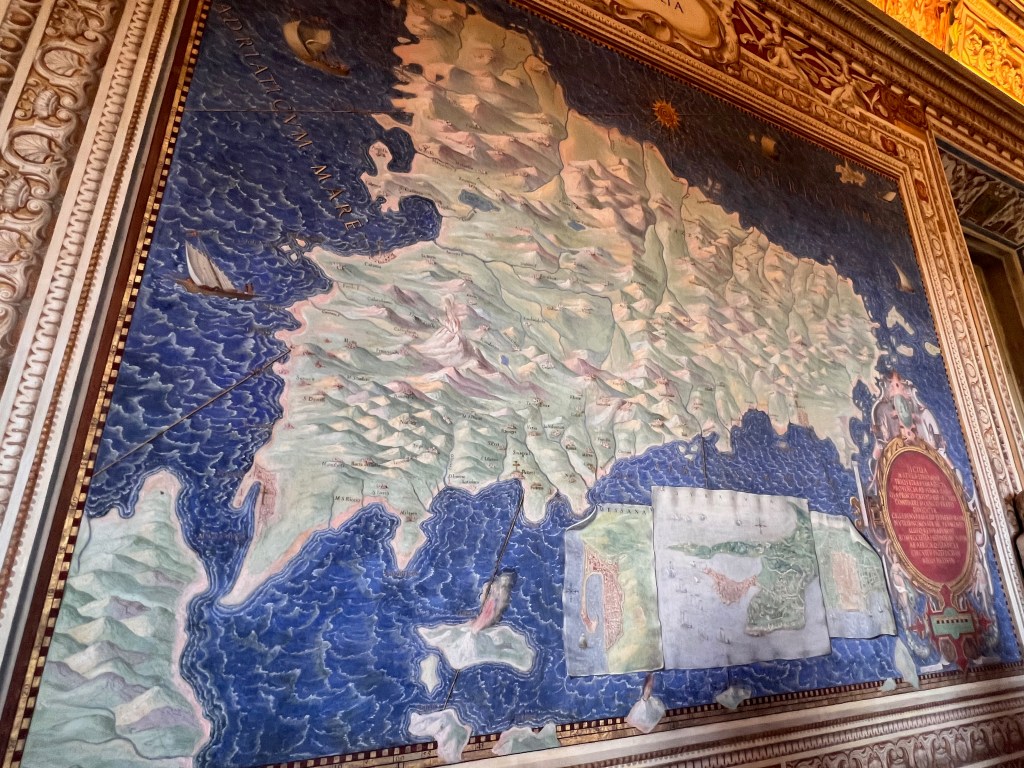
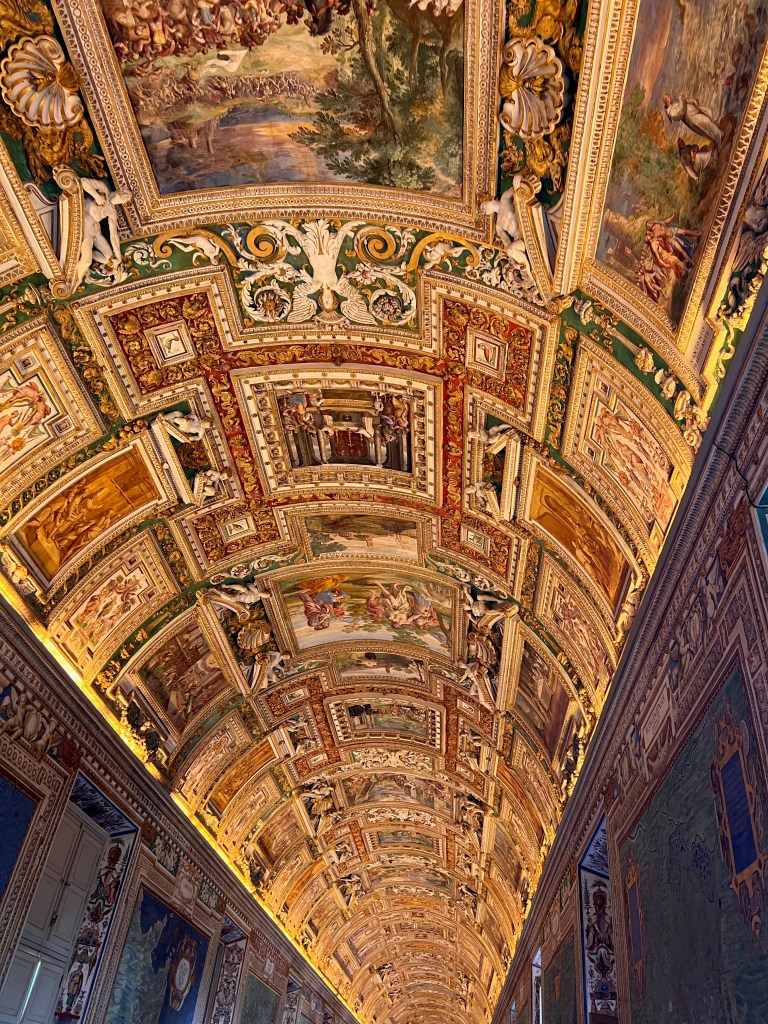
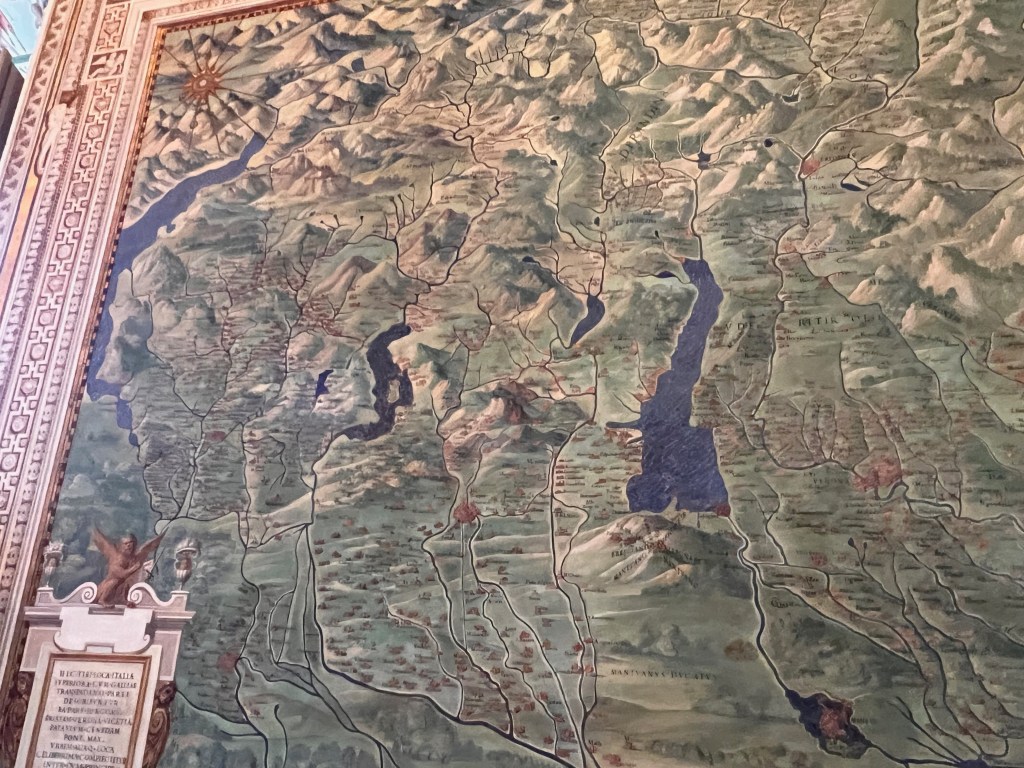
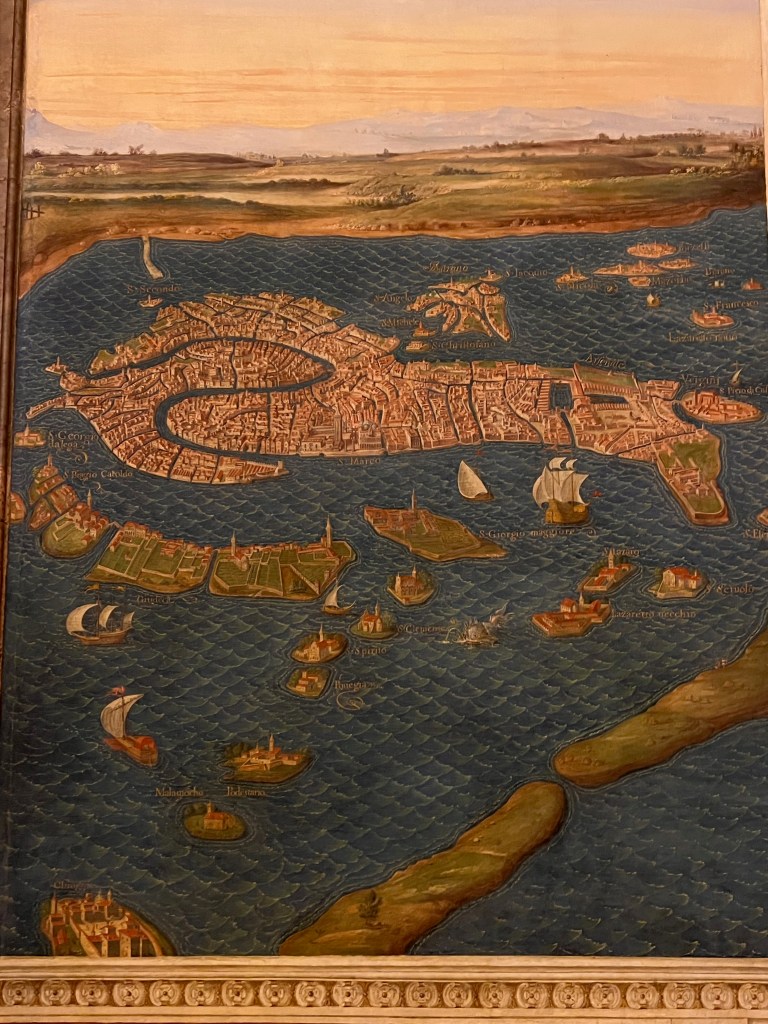
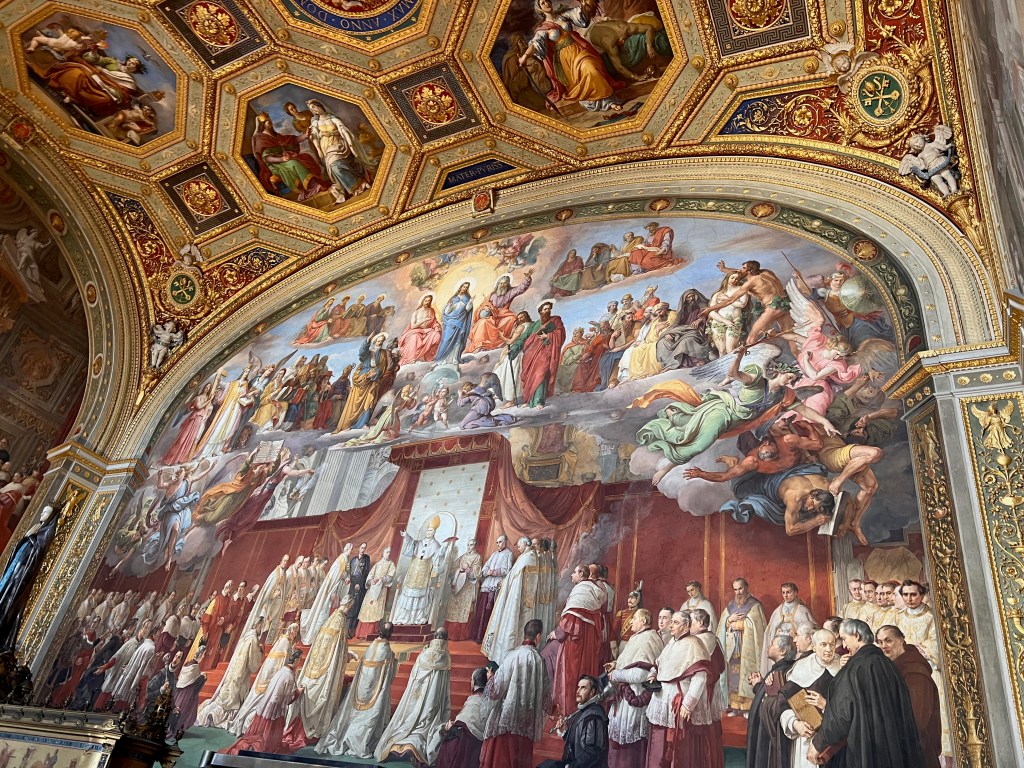
We were brought into the museum shortly after she narrated the paintings. The first few exhibits we saw at the Vatican Museum were sculptures collected by the Popes of St Peter’s Basilica. I thought the most interesting sculpture we saw was the big red marble bathtub of Emperor Nero, which was carved out of a rare purple marble from Egypt. Even though this area displays sculptures, the ceilings of this section are elaborately painted with murals. The section sections were corridors after corridors of paintings, some of which were painted by famous artists such as Raphael, Michangelo, etc. Raffa explained that Raphael even painted himself in some of these paintings as one of the commoners. Not all artworks are paintings. There is a section displaying Tapestry. I thought the most interesting art piece was the Tapestry of Christ, where a particular technique is used such that Jesus’s eyes and feet will follow you if one moves from left to right. There is even a section of tapestries detailing the map of the various parts of Italy, which Raffa explained is very accurate geographically. I like how Raffa showed us the more significant artworks without going through every single art piece. Towards the end of the tour, Raffa showed us the way into the Sistine Chapel, where we received blessings from a priest of the Vatican City. Raffa gave us time to look at the artwork on the ceiling and the wall in Sistine Chapel.
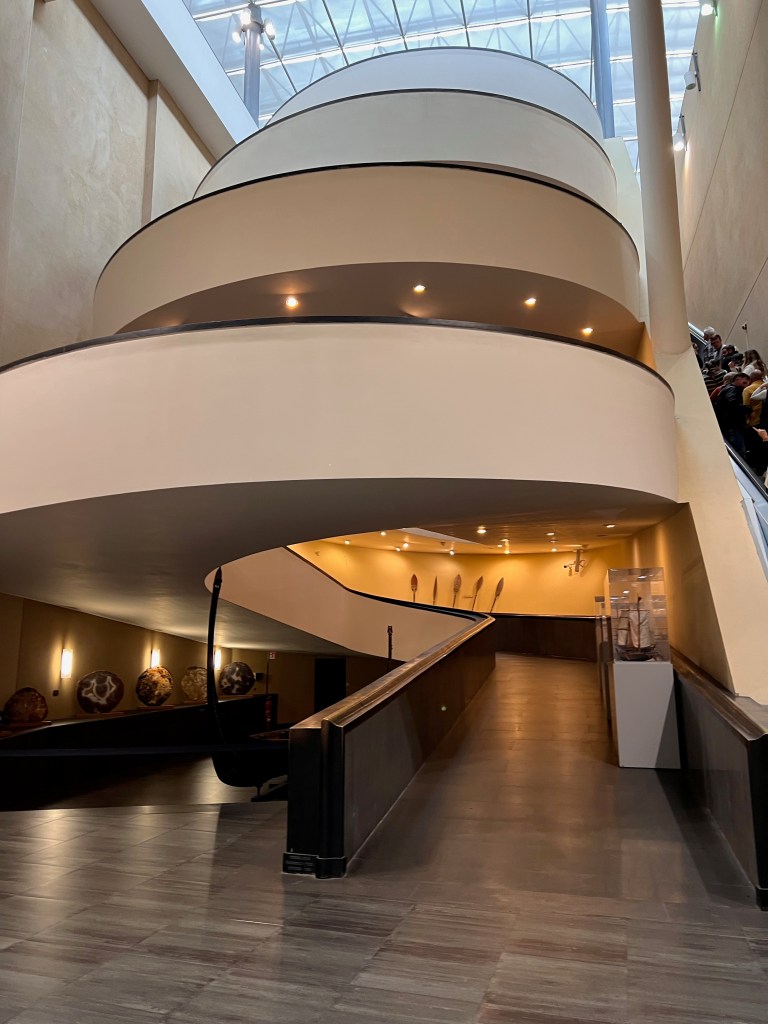
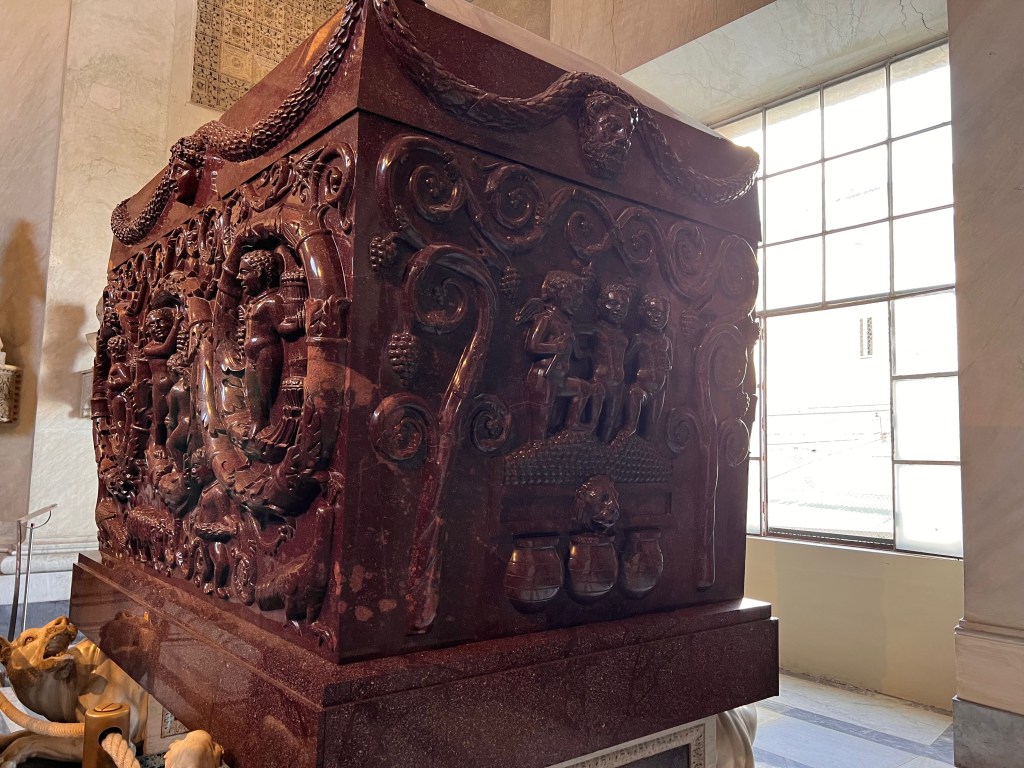
Artworks in the Vatican MuseumEven the ceilings of the Vatican Museum are pieces of artInside the Vatican MuseumArtworks in the Vatican MuseumCourtyard of the Vatican MuseumsArtworks in the Vatican MuseumArtworks in the Vatican MuseumArtworks in the Vatican MuseumPaintings on the ceiling of the Vatican MuseumArtworks in the Vatican MuseumDome inside the Vatican MuseumMosiac artwork on the floor of the Vatican MuseumEmperor Nero’s marble bathtubRed marble chest displayed in the Vatican Museum
The Resurrection of Christ Tapestry in the Vatican Museum, where the eyes and foot of Christ will follow the viewer. Photo credit: The Roman Guy Travel Blog https://theromanguy.com/tours/italy
Artworks in the Vatican MuseumArtworks on the ceiling of the Vatican MuseumArtworks on the ceiling of the Vatican MuseumArtworks depicting maps of parts of Italy in the Vatican MuseumArtworks on the ceiling of the Vatican MuseumArtworks depicting maps of parts of Italy in the Vatican MuseumArtwork of maps Venice in the Vatican MuseumArtworks in the Vatican MuseumArtworks on the ceiling of the Vatican MuseumRaphael painted himself as the second man on the left in this paintingArtworks on the ceiling of the Vatican MuseumThe painting that was depicted in the tickets to the Vatican MuseumMy friend posting a postcard to herself in the Vatican MuseumThe spiral staircase inside Vatican Museum
Shopping at Spanish Steps
After we bid farewell to Raffa, we came to the end of the tour. Our original plan was to visit Castel Sant’Angelo since it is very close to Vatican City. However, since this was our last day in Rome and there would not be any luxury brand shopping for the final leg of our trip in Catania, my friends opted to shop at the boutiques near Spanish Steps. Before we started shopping, we headed to the restaurant Raffa recommended for lunch. Raffa recommended an authentic Italian trattoria for lunch, and we enjoyed the food served there. After lunch, we made our way to Spanish Steps and took obligatory shots of the Spanish Steps for our friends who weren’t here the night before. We spent the rest of the afternoon shopping around the Spanish Steps and returned to the hotel to pack and rest early for the night. We had an early flight to catch the next day, bound for Catania, Sicily.
We had lunch at the restaurant Raffa recommended
Wefie on the streets outside the restaurant
We are back at Spanish StepsPiazza di SpagnaWefie on the streets of Piazza di SpagnaMy friends who missed out on our trip to Spanish Steps a few nights agoOur last wefie at the shopping strip of Piazza di Spagna
I have always wanted to visit Pompeii since 10 years ago when I planned a trip to Italy that never happened. As I was planning the trip to Pompeii, I learned that like many sights in Italy, Pompeii offers free entrance to visitors on the first Sunday of every month. Our trip to Pompeii coincides with the first Sunday of December, and we managed to get free tickets to Pompeii (get tickets to Pompeii on their official website here). To get to Pompeii, we need to align at Pompeii Scavi Station, opposite the entrance to the Pompeii Archaeological site. We took the 1hr high-speed train ride from Roma Termini Station to Napoli Centrale Station. From there, we took the Circumvesuviana train to Pompeii. The Circumvesuviana line is just a short walk from the central train station within the train station building. Well-marked signs led us to the ticketing booth and the platforms where the train would depart. The train ride from Napoli Centrale Station to Pompeii Scavi took about 40 mins.
Walking to Roma Termini early in the morningTaking a wefie as we walked to Roma TerminiOn the streets of RomeWefie with Roma Termini in the backgroundBuilding next to Roma TerminiTaking a wefie at Roma TerminiWe are on our way to Naples.Arrival at Napoli Centrale with our trainThe way to Circumvesuviana is very well markedTicketing counter where we got our tickets to Pompeii ScaviWe got our tickets to Pompeii ScaviThe train that took us to Pompeii ScaviWe have arrived at Pompeii Scavi
Wandering Around Pompeii
True to my research, the Pompeii Scavi Station is located about 2 mins walk diagonally across the entrance to Pompeii. At the door of Pompeii, we chanced upon a booth renting audio guides and decided to rent it to give us some context to the ruins we saw. Unfortunately, none of the Pompeii guide apps I downloaded was useful before our Italian trip. Pompeii is a vast site, and these apps did not recommend any routes we could take to explore the areas more fruitfully. We thought the audio guide would do just that, but we soon learnt the audio guide wasn’t any more helpful.
The Pompeii Scavi station is just next to Pompeii
Entrance to PompeiiEntrance to Pompeii
The Public Baths – Entrance to the World of the Pompeiians
We were initially very enthusiastic and hardworking in following the directions and clicking on every audio file on the audio guide for each of the ruins we passed through. However, this enthusiasm did not last when we came to the Forum of Pompeii. The first few ruins were easy to navigate as only one path led through the sites from the entrance. Following the audio guide, we visited the first ruins, the Suburban Baths in Pompeii. We religiously followed the directions in the audio guide, going through the baths and looking at the murals mentioned in the audio guide. I must admit the audio guide did a great job narrating the building and what it was used for. After the Suburban Baths, we followed the numbering on the audio guide, listening to the introduction on the next thing we saw, the Marina gates and walls. Interestingly, the people of Pompeii used to be able to look out into the Bay of Naples from Pompeii as they walked from the city to the Suburban Baths, hence the name Marina gates. Today, the heavy build-up outside Pompeii obstructed this view.
Suburban Baths are the first building we see at the entrance of PompeiiWefie at the entrance with Suburban Baths behind usPaintings inside the Suburban Baths This is where the water will come into the bathsOne of the baths in Suburban Baths Inside the Suburban Baths Wefie in the Suburban Baths The main water storage in the Suburban Baths Walking towards the Marain gatesWefie in the Marain gates
Temples & Forum of Pompeii – Where the Pompeiians Gathered
A few ruins later, along the path from the entrance, we came to the ruins of the Temple of Apollo. This large temple was dedicated to the Greek God of the Sun and Light, Apollo. We saw a couple of bronze statues of Apollo near the main roads in the ruins. What remained of the temple were some columns and a platform that presumably houses the temple’s main altar. After the Temple of Apollo, we came to a vast open space. This is the Forum of Pompeii. A bronze centaur statue holding a spear called home at one end of the Forum, facing Mt Vesuvius, the volcano that swallowed the entire city. It is here at the Forum of Pompeii where the audio guide shows its weakness. There were no recommended routes that we could take to make the most of our trip to Pompeii. All we did was see which ruins were closest to the forum and found that to be the next point, we merely clicked on what we thought the ruin was on the audio guide and listened to its introduction. At times, the labelling of the ruins is different from the audio guide. At this point, we were still diligent in listening to all narration of the ruins we came across on the audio guide. We headed to the Basilica of Pompeii, located on the right side of the path we came from, which we thought was the most significant ruin next to the Forum of Pompeii. The Basilica was a two-storey building, and we can still make out the two-level reminds of the building. Most of the Basilica was reduced to rumbles, except for a few columns and stones here and there.
Some commercial buildings after Marina GatesWefie with the ruins in PompeiiRuins of the Temple of Apollo in PompeiiStatue of ApolloPillars of the Temple of ApolloTemple of Apollo in PompeiiWefie at the Temple of Apollo
The Forum of Pompeii is a large open space that one cannot miss whilst in Pompeii.
The Forum of Pompeii is a large square to the south of the town.Wefie at Forum of Pompeii
Pillars that used to support some buildings at the Forum of Pompeii
Forum of Pompeii with Mt VesuviusMe at the Forum of PompeiiThe bronze centaur statue in the Forum of PompeiiRuins of the Basilica of PompeiiThe Basilica of Pompeii is a reasonably large buildingMy friend in the Basilica of PompeiiWefie at the Basilica of PompeiiView of Naples from Pompeii
Amphitheatres – Where the Pompeiians Got Entertained
After exiting the grounds of the Basilica of Pompeii grounds, we walked along the streets nearby, passing some locked-up buildings that we thought were uninteresting. We arrived at the Triangular Forum and Doric Temple shortly. This was when our patience ran dry with the audio guide, we did not bother to listen to it but merely used it as a map to navigate around the archaeological site of Pompeii. At the Triangular Forum and Doric Temple, all we saw was a row of Roman columns, which I presume supported the Doric Temple and an open space planted with trees. As we continued on the road passing the temple, our path led us to the Large Amphitheatre. This was where the people of Pompeii came to get entertained. The amphitheatre is built on a depression on the ground, with steps acting as seats for the spectators. Unlike the Colosseum, which was used for execution and cruel games, the Large Amphitheatre was used for poetic and dramatic performances. The Large Amphitheatre was well preserved and is by far the most impressive structure we have seen in Pompeii today.
The streets of PompeiiThe streets of PompeiiMy friends walking on the streets of PompeiiTriangular Forum and Doric Temple
The Large Amphitheatre where the Pompeiians come for entertainment
The Large Amphitheatre in PompeiiMy friends walking down the Large Amphitheatre
After sitting around at the Large Amphitheatre and enjoying the views of watching visitors plying up and down the site, our stomachs started to gruel. Looking at the time, I see it is already past lunch. We consulted our audio guides and spotted a building with a fork and spoon symbol. Thinking that might be a restaurant where we could settle our lunch, we made our way using the map function on the guide. The audio guide led us to the Small Amphitheatre next to the Large Amphitheatre. The Small Amphitheatre is much like the Large Amphitheatre but on a smaller scale and has no VIP sittings like the Large Amphitheatre. We also passed by Tempio di Vespasiano, a smallish building (looking at the walls surrounding the temple) with only one altar platform located very near the entrance of the building. After walking for another 10 mins, we came to the restaurant marked out on the audio guide. There were buildings, but the shops in these buildings seemed closed. We immediately consulted the map on our audio guide again and found a cafe marked out north of the Forum of Pompeii. This is where we had sandwiches for lunch and rested a little.
The Small Amphitheatre is located next to the Large Amphitheatre
Some random ruins near the Large AmphitheatreTempio di Vespasiano near the Large AmphitheatreView of the ruins of PompeiiHaving our lunch at the Forum of PompeiiMe the at Forum of Pompeii with Mt VesuviusWefie at Forum of PompeiiWefie at the cafe where we got our lunchWefie at the cafe where we got our lunch
Garden of Fugitives – Where the Pompeiians Perished
By this time, we were pretty much getting bored with Pompeii. The audio guide was of no use in helping our visit to Pompeii in a more organised and meaningful way. It is merely a device that provides narratives and a map of Pompeii. During lunch, we decided to skip the rest of the ruins and head straight to the Garden of the Fugitives, where we could see the casts of Pompeiians. After lunch, we followed the map on the audio guide and arrived at the Garden of the Fugitives. It is believed that the casted victims of the explosion of Mt Vesuvius were found in the Garden of the Fugitives. The casted mummies of the victims were displayed in a glass casing. We could see most of the victims were covering themselves, with some shielding the young ones from the deadly explosion of Mt Vesuvius. After taking some pictures of the casts, we had enough of Pompeii and continued to our next destination for today.
Walking to Garden of the FugitivesThere is a vineyard just outside the Garden of the FugitivesTcaststs capturing the last moments of Pompeiians in the Garden of the FugitivesCasts in the Garden of the FugitivesCasts in the Garden of the FugitivesWalking back to the entrance in PompeiiOne last look at the Forum of Pompeii with Mt Vesuvius
Out Last wefie at Pompeii
Near the exit, we spotted a building – the Antiquarium running some exhibitions. We entered Antiquarium to check out the exhibits. Amongst the exhibits that showcase the lives and arts of Pompeii, more casts were being displayed at the Antiquarium. These casts were more explicit in their expressions and the victims’ posture before they died almost 2,000 years ago.
Mt Vesuvius, the volcano that perished Pompeii
Casts displayed in AntiquariumCasts displayed in AntiquariumCasts displayed in AntiquariumCasts displayed in AntiquariumCasts displayed in Antiquarium
Bay of Naples from Sorrento
When we were resting for lunch, I asked my friends if they’d prefer to roam around Naples or wanted to see some gorgeous views of the Bay of Naples. Without hesitation, they all agreed to go for the idea. I did a quick Google search on how to get to Sorrento and where the best views were. After exiting Pompeii, we took the Circumvesuviana train to Sorrento. The train ride from Pompeii Scavi took around 30 mins. Leaving the train station, we made our way to Villa Comunale di Sorrento, a public park that offers views of the Bay of Naples. Villa Comunale di Sorrento was around 10 mins walk from Sorrento Station. Following the directions given by Google Maps, walking through the part of Sorrento town near the train station, we arrived at an open park. It was almost sunset when we reached Villa Comunale di Sorrento, where we were treated to the spectacular view of the bay. The view was incredibly charming during sunset, with the pink hue decorating the sky. We could see Mt Vesuvius sitting directly across the bay. As the sun set, the daylight was replaced with lights illuminated by buildings and streetlights. We did not stay at Villa Comunale di Sorrento for long as we would still need 1½ hrs to travel back to Napoli Centrale Station to catch our train back to Roma Termini. It was already dark when we reached Sorrento Station and managed to catch the train back to Napoli with 20 mins to spare before our train back to Rome. I told my friends we must at least try the Napoli pizza as the pizza was invented in the city we were in. We followed the signs to a pizzeria and got ourselves a pizza takeaway. The chef made our pizza right before our eyes in under 5 mins. We wanted to bring the pizza back to our hotel in Rome to eat. But on the train, we could not resist the temptation of the pizza and ate it on the train. We returned to our hotel to rest early for the night as we had to wake up very early for our Vatican City guided tour tomorrow.
My friend with the train that will take us to SorrentoWe arrived at Sorrento train stationOn the streets of SorrentoChristmas deco on the streets of SorrentoWe see the sea as we walk along the streets of SorrentoStreets of SorrentoStreets of SorrentoStreets of SorrentoBay of Naples from Villa Comunale di SorrentoWe got an excellent sunset view from Villa Comunale di Sorrento.
We could see Mt Vesuvius from Villa Comunale di Sorrento
View of the Bay of Naples from Villa Comunale di Sorrento
Wefie with the gorgeous scenery of the Bay of NaplesMy friend with the Bay of Naples
View of the Bay of Naples from Villa Comunale di Sorrento
Me with the Bay of Naples and Mt VesuviusMy friend with Bay of Naples at Sunset
Taking our last wefie at Villa Comunale di Sorrento before we leave
Sorrento at nightSorrento at night
Taking a quick wefie before our train leaves Sorrento
Wefie at Napoli CentraleWefie with the pizza we bought for our train ride back to Rome
Today, we embarked on one of the highlights of our Italian Trip, visiting the Colosseum. Visits to Rome or Italy for first-timers will not be complete without visiting Colosseum, the ultimate icon of Italy and Rome and one of the world’s new seven wonders. I thought a guided tour of the Colosseum would give us more context and history during our visit to such an important monument left behind by the ancient Romans. Several companies organise tours to the Colosseum, and few offer Colosseum underground tours. The underground of the Colosseum has been open to the public in recent years. However, access to the underground is only possible with guided tours. On September 22, I received an email from the tour company we booked stating that the Italian government is starting to restrict the number of underground entries daily. Therefore, being able to see the Colosseum underground becomes more precious. After some research on the internet, I read rave reviews of the tour company – the Roman Guy (access the Colosseum tour that we booked here) that offers the Colosseum underground tour at a reasonable price. So we went ahead and booked our underground tours with them. Our tour of the Colosseum starts at 9.30 am. We left our hotel early for breakfast before our tour. Unfortunately, it began to rain at the time we left our hotel.
The walk to the Colosseum from our hotelWe could see the Colosseum after 10 mins walk
Our first look at the Colosseum
We had a light breakfast before our tour
My friends were busy having breakfast
Colosseum – Arena Built for the Romans
After breakfast, we went to the meeting point to meet our guide, Serena, for the Colosseum Tour. The rain started to get heavier as we walked towards the Colosseum, and by the time we reached the Colosseum, it had started to pour very heavily. Serena, while walking us towards the entrance to the underground access, explained in detail what the Colosseum looked like and how it was built. We learnt from Serena that the Colosseum was decked with a marble facade, and marble statues were installed on each of the arches of the world’s largest amphitheatre. As we approached the underground entrance, Serena went to check out the situation for underground access as she explained there were rumours that the underground might be closed due to the flood caused by the rain. She went to ask other tour guides and started asking the staff. Finally, one of the staff announced the underground was closed due to the flood level. Serena explained the underground of the Colosseum has been prone to flooding since ancient times due to the poor waterproofing design, the flood would have been dangerous for visitors due to the possibility of electrocution from the electric cables installed in modern days for lighting.
Our first up-close encounter with the Colosseum
Our first look at the interior of the ColosseumWe were excited at the Colosseum tourWefie in the ColosseumOne of the entrances that spectators used to the ColosseumTaking another wefie in the ColosseumThe ceiling of the ColosseumOne of the pillars that fell in the ColosseumAn ancient equestrian statue on the ground floor of the ColosseumRuins inside the ColosseumTaking a quick wefie with the equestrian statues in the Colosseum
Inside the Colosseum
After receiving the bad news, Serena changed the plan on the fly. She started the tour with the second level of the Colosseum, followed by the arena floor. The stairs to the Colosseum’s second floor were higher than your usual stairs. Serena reminded us to hold on to the handrails when making our way up. Despite the staircase being higher, compared to the ones in Ang Kor Wat that I visited years ago, the stairs in the Colosseum are wider, making climbing easier. On the second floor, before she brought our attention to the artefacts on display, Serena brought us away from the crowd to an opening that looked out into a building across the road. This was where the training school for the gladiators used to be. A tunnel brought the teenage gladiators from the school to the Colosseum for battles.
My friend on the stairs inside the ColosseumThe site where the gladiator training school used to sit opposite the ColosseumPeeking into the seating area of the ColosseumTop of the pillar that used to support the ColosseumPulley system used in the Colosseum
Serena started introducing the artefacts on display, from the carvings to the columns that supported the Colosseum to how the enslaved people worked manually to lift the platform from underground to the arena floor. Serena was very detailed and only focused our attention on the important artefacts. As we walked through the artefacts, Serena pointed to carvings on some stones. Next, she explained the graffiti left behind by the spectators, and from these graffiti, we can make out the scenes on the arena floor during gladiatorial battles. There is even one graffiti showing the street food that spectators would buy during the show. Serena then brought our attention to models of the Colosseum in its full glory and even one showing the plan for converting the Colosseum into a church.
Graffiti depicting the battle scene in the ColosseumMosaics found in the ColosseumAnother graffiti depicting the snacks sold during the showModel of the Colosseum when it was planned to be used as a churchGraffiti of a gladiatorWefie inside the Colosseum
Seating Area and the Arena Floor of the Colosseum
We were led outside to the seating area of the Colosseum. Serena was very detailed in explaining who would sit where in the world’s largest amphitheatre. As we were walking one round on the spectator level of the Colosseum, Serena started to explain the exposed underground system in the Colosseum. The entire Colosseum is oval, and we can see the entirety of the amphitheatre at certain spots. Today, we can hardly make out the seating. Also gone were the awnings used to shade the spectators of the elements, but the Colosseum still emits a sense of masculinity and power. It is very different standing in the 2,500-year-old monument and seeing it in pictures and videos. Time has not been kind to the Colosseum, the amphitheatre has gone through flood, earthquakes, lootings and vandalism, but yet after 2½ millennia, the monument still stands firmly in the heart of Rome.
Our first look at the interior of the Colosseum
My friend and I at the seating area of the ColosseumMy friend posing at the seating area of the ColosseumView of the area floor of the ColosseumView of the labyrinth underground of the ColosseumMy friend with the view of the arena floor of the ColosseumA collapsed section of the seating area in the Colosseum
After giving us time to take pictures on the second level of the Colosseum, Serena brought us to the Arena Floor of the Colosseum. Here, Serena explained the underground system in greater detail and even pointed out where we would be if we were underground. She also pointed out the floods that can be visible on the Arena Floor. Although the Colosseum was past its prime glory, standing on the arena level of the monument, we can imagine it must be daunting for the gladiators to put up a performance, literally fighting for their lives in front of 50,000 spectators. I can spend more hours here on the Colosseum, and the views will not get old. It is a shame we have only mere hours here, and soon we were led outside the Colosseum, marking the end of our 2-hour tour of the Colosseum.
The underground area of the Colosseum
We could see the underground was being flooded due to the rainA closer look at the flood in the underground section of the ColosseumRuins inside the ColosseumWe could see the complex underground system from the arena floor of the Colosseum.Closer view of the underground that was cancelled due to the downpourWefie with e underground system of the ColosseumMy friend and I on the ground floor of the Colosseum
Our last wefie inside the Colosseum
My friend and I outside the ColosseumWe thought this was an excellent place for a wefie with the Colosseum.
Palatine Hill – The Birth Place of Rome
The Roman Forum and Palatine Hill were the next part of the tour. As we were walking to the entrance, it started to rain again. Our first stop is Palatine Hill, one of the seven hills in Rome. Here, the legend of Romulus and Remus, the founders of Rome, was found and raised by a she-wolf. This hill is also where the Roman Kingdom was found. Serena wanted to bring us to the terrace on Palatine Hil, which she claimed to be the best view of the entire Roman Forum. She introduced us to the Teatro Del Fontanone, where she started from the base, a sheltered and fenced-off area. Next, Serena brought our attention to the painting on the roof. From here, I couldn’t make out the fountain, and the painting on its ceiling was barely visible. As we climbed the stairs to the top of Palatine Hill, Serena introduced the Basilica di Massenzio. Though most of the basilica is gone, we can still make out the massive size of the basilica based on how tall the remaining structure is. As we were moving up the stairs, the top part of Teatro Del Fontanone was visible. I thought there was nothing spectacular about the fountain; it was merely a pool with water flowing from the top of the building. We continued to the terrace, where the view wowed us in front of us. Being the highest point in Roman Forum, Palatine Hill offered us a view of the entire Roman Forum and as far as Capitoline Hill right across from where we were. Although the whole Roman Forum today is reduced to a vast archaeological dig site and tourist site, we can still make out the streets and the remaining buildings. Serena pointed to us the central street in the Forum that cuts across the Forum. From there, she briefly told us what each building was. We did not stay on the terrace for long (and I think we saw what we were meant to see, so there was no need to stay here for too long), Serena brought us to the Roman Forum next.
The Arch of Constantine at the Roman ForumClose-up shot of the Arch of ConstantineCarvings on the Arch of Constantine Another view of the Arch of ConstantineWalking down the Roman ForumPillars of the Temple of Venus and Rome that remainPillars of the Temple of Venus and Rome that remain
Ruins of shops in the central shopping stripe in ancient Rome
Inside the Teatro Del FontanonePainting in the Teatro Del FontanoneThe top part of Teatro Del FontanoneOrange orchard at the terrace of the Roman ForumBasilica di Massenzio across the Roman ForumPanoramic view of the Roman Forum on Palatine Hill
We got a great view of the Roman Forum from the terrace on Palatine Hill.
Another view of the Roman Forum from the terrace on Palatine HillI can never get enough of the view of the Roman Forum on Palatine HillMy friend and I with the view of the Roman ForumWe got a great shot of the Roman Forum on Palatine Hill.
Roman Forum – The Heart of Ancient Rome
There are tons of ruins on the Roman Forum, most of which are insignificant residential buildings. I thought one of the advantages of having a guided tour is that the guide would point out the more significant buildings and explain what that was. Serena did just that. It started raining as we were being led to the first building. Despite the rain, Serena remained dedicated to continuing narrating stories of the next building we saw. The first building we saw was Tempio di Romolo, with the distinctive feature of a round foyer and its huge bronze doors. The next building we saw was the Tempio di Antonino e Faustina. Serena drew our attention to the Roman columns in front of the temple and the level it was built on. Serena explained the Roman Forum used to be on a higher elevation, but due to the earthquake, part of the elevation collapsed to where it is currently. We did not enter the temple as it was closed for restoration work.
Tempio di Romolo on Roman ForumTempio di Antonino e Faustina is perhaps one of the more well-preserved buildings on the Roman Forum.One of the ruins we saw in the Roman ForumTaking a wefie on the Roman Forum
Taking a wefie on Roman Forum
As we were being led to the exit of the Roman Forum, walking through the district’s main street, Serena pointed out an inconspicuous single-storey structure. This is where Julius Caesar’s body was burnt after he died. As a group was there, plus the rain, we did not go nearer to see. Our tour ended at around 1.30 pm. By this time, we were drenched, and the rain had stopped. After bidding farewell to Serena, we walked around the roman ruins to take more pictures and to dry ourselves. At this point, we appreciated the presence of a guide as they could point to us what the essential ruins were. If not for Serena, we would be looking at a bunch of rumbles and thought all of these ruins were crucial landmarks.
Curia Lulia, the senate house during the ancient Roman eraTemple of Venus Genetrix was reduced to three pillarsMiliarium Aureum in the Roman ForumSeptimius Severus Arch at the other end of the Roman ForumThe building where Julius Ceasar was crematedThe Roman Forum is full of ancient treasuresThe Roman Forum next to the ColosseumThe 2,500-year-old Roman ForumTaking our last wefie on the Roman Forum
Capitoline Hill – The Epicentre of the Roman Empire
At this point, we were getting a little bored with the ruins and were hungry. We exited the Roman Forum and ruins and wanted to look for food. Coming out from the exit, we were immediately targeted by some black guys trying to sell us overpriced souvenirs. I told my friends to ignore them and keep walking. These sellers only paddled their wares at the exits of the sites and did not follow us. We walked around looking for Osteria or Trattoria for an authentic Italian lunch. Near the Colosseum area, all we saw were Ristorante, which we recalled the reception at our hotel reminded us to avoid. As we were walking further from the Colosseum, one of my friends suggested we head down a flight of stairs to see if we could find something to eat there. Luckily we heeded his suggestion, we found an Osteria that served authentic Italian food. The restaurant was simple in its decor, but the food was terrific. We hardly saw any tourists and were the third table of foreigners.
We found an osteria for lunch.My friends are deciding what to eat for lunch.The traditional carbonara
The facade of the osteria doesn’t look much, but the food is fantastic.
After lunch, two of my friends returned to the hotel to rest as they were not feeling well. The reminding four of us headed back to explore Capitoline Hill, located next to the Roman Forum. We made our way to Campidoglio on Capitoline Hill. I read that we will be able to see a beautiful sunset from here. Unfortunately, we were soon disappointed as all we saw was a Bronze statue surrounded by buildings. These buildings are museums that we did not bother to check out. But we thought the Campidoglio looked beautiful, with the night lights illuminating during dusk. As we were walking downs a flight of stairs, we spotted another flight of stairs that seemed to lead to a white marble building supported by tall roman columns. As we headed up the stairs, we saw people walking around behind the fenced-off area under the columns. Thinking there might be an entrance at the top of the stairs, we headed up the stairs. On top of the stairs, we came across the Basilica di Santa Maria in Ara coeli. We went into the basilica, thinking we could enter the fenced-off area inside. The interior of Basilica di Santa Maria in Ara coeli was grand, and the church has intricate carvings on its ceilings and vibrant paintings on the walls and ceilings where the main altar is. As we were more interested in looking for the entrance to the fenced-off area, we paid little attention to the artwork in the basilica. After walking around, we were disappointed that we did not find any entrance to the fenced-off area. We left the basilica soon after.
The street of Rome is full of Christmas moodTaking a wefie in the streets of RomeWe spot a protest on the streets of RomeMy friends walking down the stairs in Rome
Piazza del Campidoglio in the evening
Roman statue guarding Campidoglio Wefie with the Roman statue at Campidoglio Roman statue guarding Campidoglio Statue of a Roman Emperor in the middle of Piazza del Campidoglio Wefie in CampidoglioThe stairs to Basilica di Santa Maria in Ara coeliThe ceiling of Basilica di Santa Maria in Ara coeliThe main altar in Basilica di Santa Maria in Ara coeli
Wefie at the top of the stairs to Basilica di Santa Maria in Ara coeli
It was already getting dark, and we wanted to revisit the Pantheon and see if we could get inside. We saw a structure that looked much like the Colosseum, the Temple of Apollo Sosianus. My friend remarked that it is the building that Serena had told us about earlier, which the Colosseum is modelled after. Indeed we could see the “complete” oval shape that the Colosseum looked when it was in its prime and the many of the iconic arches that gave the Colosseum its character. However, there seems to be a building built on top of the temple, which might have been built many years after the building was in ruins. We did not venture further and took some pictures instead, as we wanted to get to the Pantheon before it closed. Not long after, we reached the Pantheon and were delighted to find no queue to enter the building. At first, we thought we were lucky, but after asking a staff guarding the entrance, we were told there was a mass inside the Pantheon, and the attraction will be closed for the next 45 mins. What a shame. For the second time, we missed the opportunity to enter the Pantheon to marvel at the unreinforced dome. We could stand there and wait for 45 mins, but we thought this was a waste of time and headed to the Spanish Steps.
Temple of Apollo Sosianus at nightThe Temple of Apollo Sosianus looks like the Colosseum.
The Pantheon at night
Peeping inside the PantheonWefie in front of the Pantheon
Spanish Steps – Heart of Rome
This time, we again put our trust in Google Maps to lead us to Spanish Steps. Google Maps did not disappoint us this time, and we were led past a busy shopping area with luxury boutiques. We did a little shopping while making mental notes on where to shop in Rome if we needed to come back in the next few days while we were in Rome. Soon after, we found ourselves in front of the Spanish Steps, a flight of stairs leading to the church of Trinita di Monti. One cannot miss the white church that shines even brighter under the night lights. We headed up the stairs and went into the church. Inside the church, there were motives for Christ’s life after his crucifixion and ascension to heaven. The main altar is fenced off, which could be opened if there is mass. We did not stay here for too long as our main goal is taking pictures of the Spanish Steps. Heading outside the church, the view of Rome from the top of the Spanish Steps was amazing, especially the night streets lit up with Christmas lights. A few more pictures later, we decided to return to the hotel and once again put our trust in Google Maps. We followed the directions given by Google Maps, which led us to the banks of the Tiber River, the river that flows through Rome. After walking along the banks for 20 mins, following the directions given by Google Maps, we found ourselves back where we started. Google Maps brought us one big round!! Well, I thought this might be a blessing in disguise. If not for Google Maps, we wouldn’t have come to the Tiber River. We got our bearings using the landmarks we had passed by previously and headed back to the hotel, only using Google Maps to confirm we were on the right track.
Walking in the shopping district in RomeShopping district in RomeWefie in Rome
Spanish steps at night
Spanish steps at nightView from the top of the Spanish stepsView of the shopping district from the top of Spanish stepsWefie with the Spanish stepsArtwork inside the Church of Trinita di MontiThe main altar in the Church of Trinita di MontiPainting inside the Church of Trinita di MontiChurch of Trinita di Monti on the top of the Spanish StepsThe district on top of the Spanish StepsTiber River at nightTiber River at night