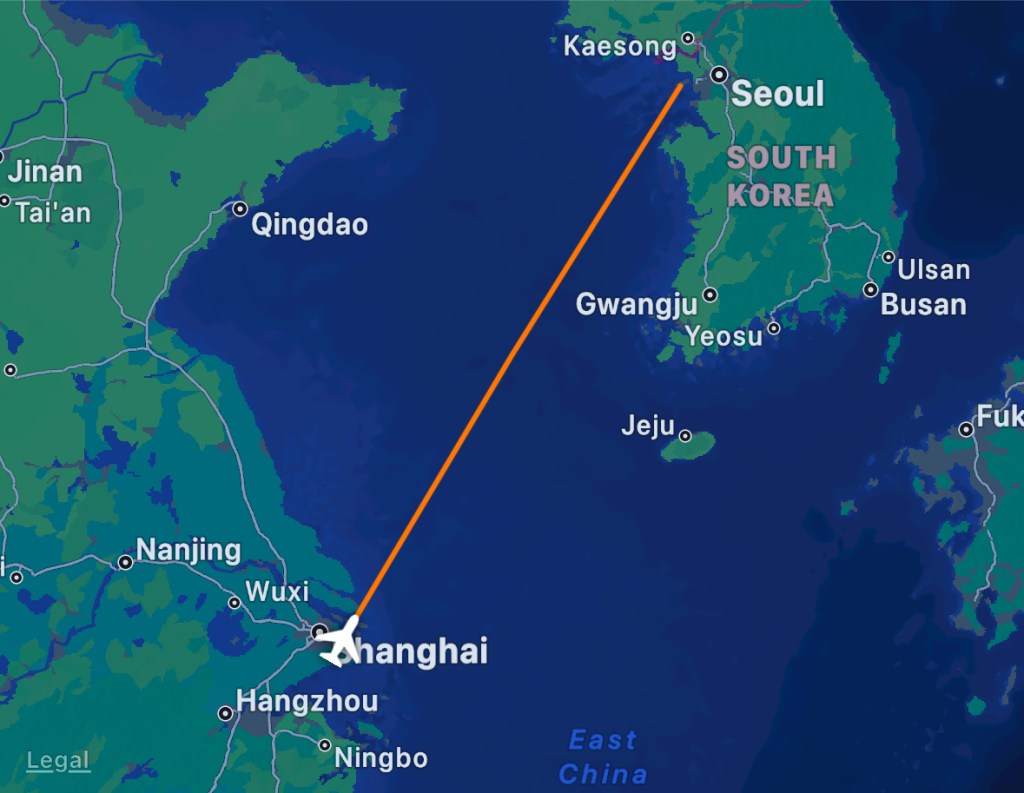
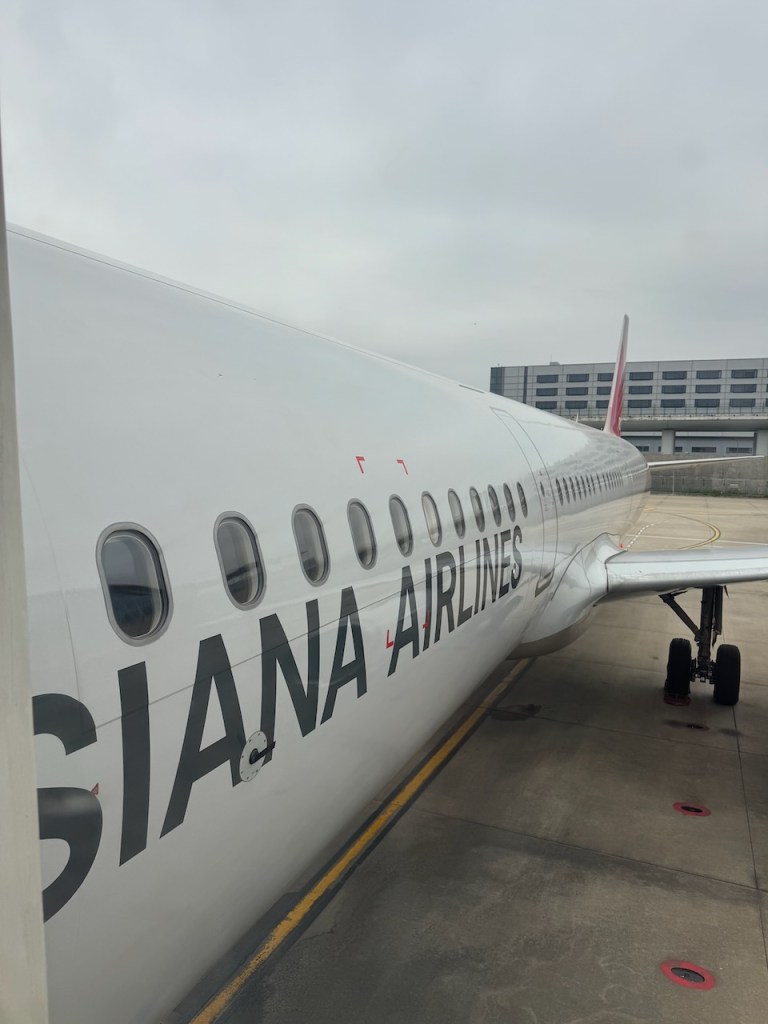
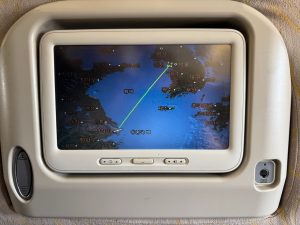
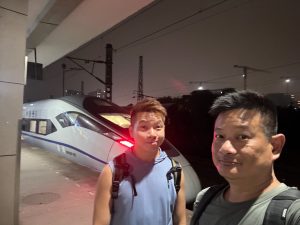
The flight path OZ368 flew from Shanghai to SeoulAsiana A321-200 that flew us from Shanghai to Seoul
At the Airport
Check-in
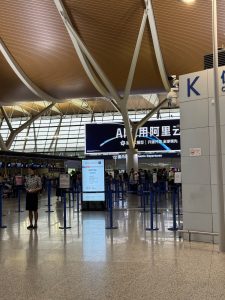
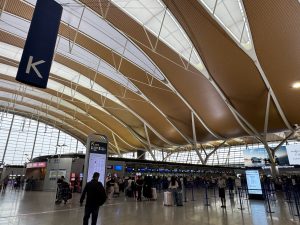
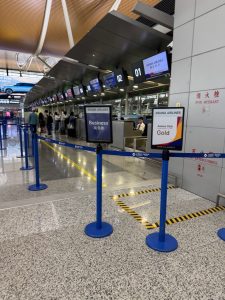
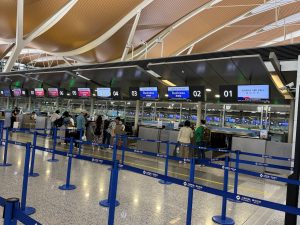
Shanghai has two international airports, Pudong and Hongqiao. Our Asiana Airlines flight departs from Shanghai Pudong Airport Terminal 2, which predominantly serves Star Alliance carriers. Asiana Airlines operates 10 check-in counters in Row K, the second row of counters from the left of the terminal building. There are two queues serving three groups of passengers at Shanghai Pudong Airport, and Economy Class passengers get their own line. In contrast, Star Alliance Gold and Business Class passengers are served in another line. The entrance to the Business Class queue was guarded by one of the ground staff to ensure only Business Class passengers were allowed in the queue. As we were one of the last few to check-in, there was no queue at the Business Class line (and Economy Class for that matter). The check-in experience fell short of typical Business Class standards. The ground staff came across as couldn’t care less and took his time to process our check-in. And when there were some issues with our seating, the ground staff took the time to confirm our seats over the phone without providing any updates on the status of the situation. He did not even bother telling us where to go after he processed our check-in (Shanghai Pudong Airport has two separate airside areas for domestic and international departures). The only information we were given was to head to the D77 Business Lounge after immigration.
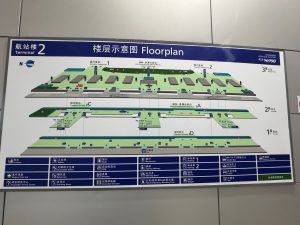
Shanghai Pudong Airport layout
Asiana Airlines deployed a ground staff to guard the Business Class check-in queue
Asiana Airlines check-in counters are located in Row K
Asiana Airlines check-in queue at Shanghai Pudong Airport
Business Class and Star Alliance Gold members uses the same check-in queue
Asiana Airlines operates 8 check-in counters at Shanghai Pudong Airport
China Eastern D77 Business Class Lounge
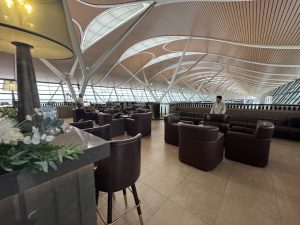
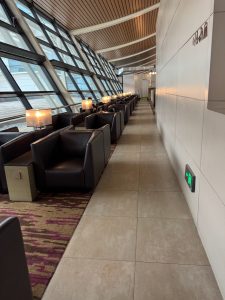
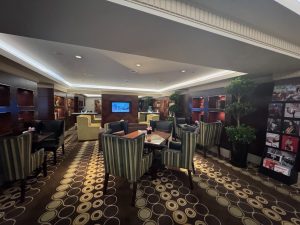
Asiana Airlines does not operate its Business Lounge in Shanghai Pudong International Airport. Instead of using the Star Alliance partner, D71 Air China Lounge, we were assigned to use the SkyTeam group partner, China Eastern Airlines D77 Business Class Lounge. I suppose this arrangement was intended to provide convenience for Asiana Airlines Business Class passengers, as the China Eastern Airlines Lounge was closer to our boarding gate. The China Eastern D77 Business Class Lounge, near Gate 77, is also accessible to Priority Pass holders. It serves many other airlines not affiliated with the SkyTeam group. Coming up from the escalator, the friendly lounge staff welcomed us to the lounge. China Eastern D77 Business Class Lounge felt airy and spacious as it shares the same ceiling as the airport terminal. The decor in the lounge mainly utilises natural wood that exudes a relaxing vibe. The front part of the lounge is primarily furnished with dining tables and chairs for four, which are also found near the bar area at the rear of the lounge. The seating in the centre of the lounge, next to the buffet lines, primarily consists of lounge armchairs that accommodate four or six people. Despite the armchair arrangement, we were also able to consume the food from the lounge comfortably in these seats. I also spotted a high table with power outlets for passengers to work on. While there are some individual high table pods on the adjacent side of the lounge, catering to passengers who prefer more privacy.
China Eastern D77 Business Class Lounge is located near Gate D77
Airlines and lounge programmes served by China Eastern D77 Business Class Lounge
The reception at China Eastern D77 Business Class Lounge
The seating at the entrance of the lounge mainly comprises dining table for four
The seating in the lounge next to the buffet counter
There is a tall table for passengers to do some work before their flight
The lounge is also furnished with armchairs near the entrance of the lounge
The seatings at the back of the lounge, next to the bar
There are individual pods in the lounge for passengers who wanted more privacy
The seating at the corridor adjacent to the entrance corridor
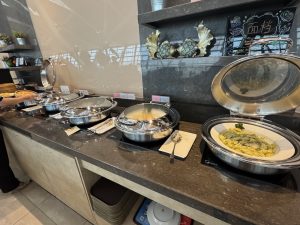
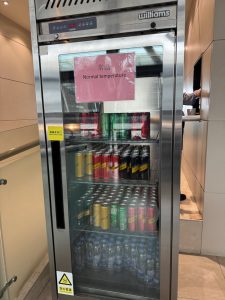
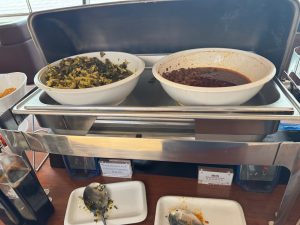
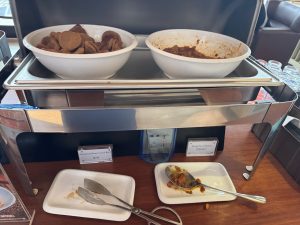
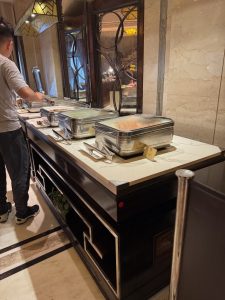
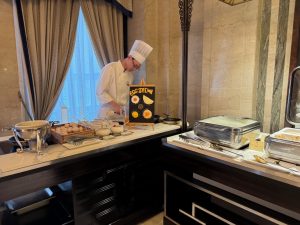
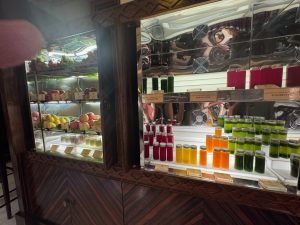
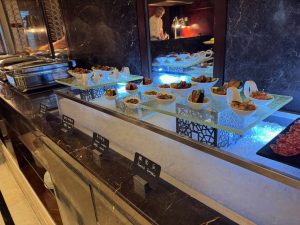
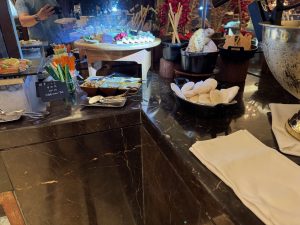
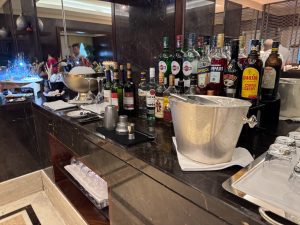
The food offered in the China Eastern D77 Business Class Lounge was quite extensive. There are two buffet lines in the lounge offering different food options. The buffet table located along the main entrance corridor primarily serves hot food, offering five options that range from curry chicken to fried rice to dim sum. The buffet table in the adjacent corridor mainly serves cold food and bread, from salads to fresh-cut fruits. It is here that I spotted a noodle counter, serving four options of made-to-order noodles. The additional condiments to complement the noodles are located opposite the noodle window. China Eastern D77 Business Class Lounge also features a bar that serves spirits and wine, but it was not open during my visit. There are no shower facilities in the China Eastern D77 Business Class Lounge.
The hot food buffet line offers a good variety of options
Passengers are free to help themselves with the many beverages in the fridge
The cold food buffet line in China Eastern D77 Business Class Lounge
The noodle bar offers made-to-order noodles
Menu in the noodle bar
Pastries are found in the cold food buffet line
Condiments for passengers to enhnace their noodles from the noodle bar
More condiments for the noodles
The noodle I ordered from the noodle bar
The Aircraft
Asiana Airlines operates A330-300 and A321-200 aircraft between Shanghai Pudong Airport and Seoul. We flew on the A321-200 aircraft, which the airline has in two variants: one in an Economy Class configuration and the other with a small Business Class section.
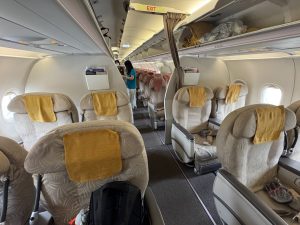
The colour theme used on the larger Asiana Airlines aircraft is also found in this narrow-body aircraft. The A321-200 Business Class cabin had a bright and airy feel, with a royal vibe. The seats in the cabin are upholstered in beige, and the headrest covers and pillows are adorned with yellow, a symbol of royalty and nobility in the Korean culture. The cabin was bright, thanks to the use of white lights, which gave it an airy feel. The Business Class cabin is equipped with only three rows of two seats in a 2-2 configuration.
Asiana Airlines A321-200 Business Class cabin
Asiana Airlines A321-200 has a small Business Class cabin
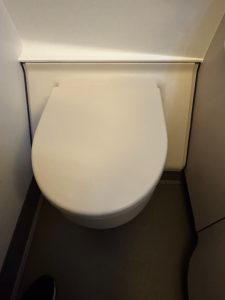
There is only one lavatory behind the cockpit serving all 12 Business Class passengers. As this is a smaller plane, the lavatory felt a little cramped compared to the airlines’ wider-body aircraft. However, it has the necessities of a lavatory. The lavatory does not come across as posh or any different from that in Economy Class. Still, I noticed additional amenities, such as dental kits and mouthwash, in addition to the L’Occitane lotion and facial mist, which were made available in the Business Class lavatories.
Asiana Airlines A321-200 Business Class lavatory
Toilet in the lavatory
Dental kits, mouth wash and lotions are available in the lavatory
The tissues by the sink of the lavatory
The Seat
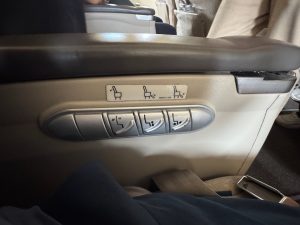
Asiana Airlines A321-200 Business Class seats have a seat pitch of 40″ and are 22″ wide. As this is a recliner seat, it does not come in flatbed mode but is capable of reclining up to 5″. The seat controls consist of three mechanical levers that control the deployment of the calf rest, the extension of the calf rest, and the seat back recline. When the seat is reclined and the calf rest is being deployed, the seat feels comfortable enough for me to doze off in it, thanks to its thick cushioning. However, due to ageing, I found difficulty in activating some of the seat functions with these seat controls.
Asiana Airlines A321-200 Business Class seats in take-off/landing position
Asiana Airlines A321-200 Business Class seat fully reclined
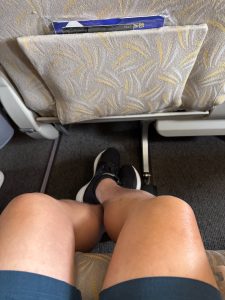
Legroom was excellent in these seats
The seat controls are mechanical buttons that don't really work well due to ageing
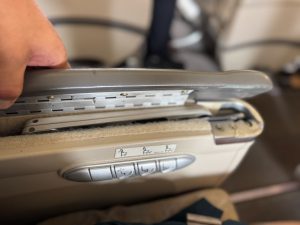
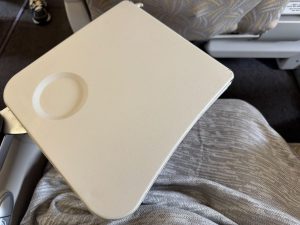
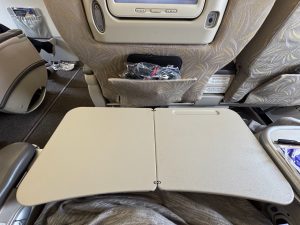
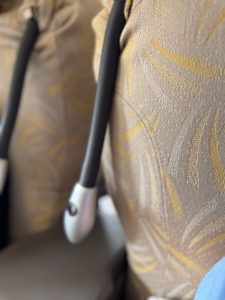
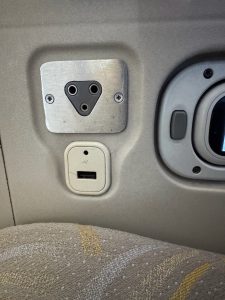
When it comes to storage, the only place we can store anything is in the seat pocket in front of us. There are no additional cubby holes for us to store our stuff. Fortunately, this seat pocket is large enough for me to place my iPad and some small items. Asiana Airlines A321-200 Business Class seats are fitted with a small cocktail table stored in the centre console between the two seats. The seat table is hidden in the armrest and is quite sizable when fully deployed. Other than the reading light above us, there is also a reading light that sticks out of the seat below the headrest. Asiana Airlines A321-200 Business Class seats are equipped with a USB-A charging outlet situated beneath the armrest, alongside two international power sockets in the centre console, allowing us to charge our lifestyle devices.
The only storage in the Business Class seat is the seat pocket in front
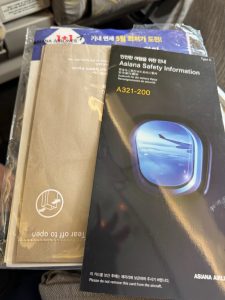
Seat pocket contents
A secondary cocktail table pops out from the centre console. The table top between the armrests can also be used as a cocktail table
The seat table is stowed inside the armrest
The seat table when fished out of its storage
The seat table when fully deployed
Other than the overhead reading light, there is another reading light beside the seat
Each Business Class seat is fitted with an international power outlet
The Business Class seat is also fitted with a USB-A charging port under the headphone jack
Inflight Entertainment
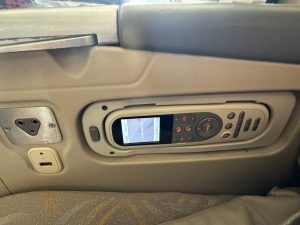
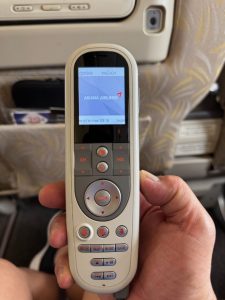
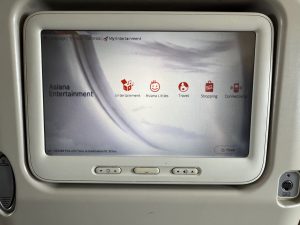
Each Business Class seat onboard Asiana Airlines A321-200 is fitted with a 10.6″ personal TV screen. As this is an older product, these TV screens have rather grainy picture quality by today’s standards and do not come with touchscreen functions. Selection of inflight entertainment is solely via the IFE controller, stowed under the armrest of the centre console. The IFE controller was rather old school. In the front, there are buttons that control the overhead reading lights and the flight attendant call button, as well as buttons for entertainment selection. A QWERTY keyboard is located on its back. The headphones provided by Asiana Airlines to Business Class passengers do not feature noise-cancelling functions, but are very comfortable to wear over a prolonged period. The Asiana Airlines A321-200 features the older OZ:enter IFE menu, which was designed for use with non-touchscreen TVs. The menu is well-organised, and finding the entertainment I want was a breeze. The OZ:enter is stocked with smaller entertainment options compared to their A350-900 aircraft. However, I was still able to find the latest Hollywood blockbusters, Korean movies and TV shows. For a 2-hour flight, I thought the contents of OZ:enter are sufficient to keep passengers entertained.
The seat back on Asiana A321-200 Business Class
Each Business Class seat is fitted with a 10.6" personal TV
IFE controller is stored under the armrest
IFE controller in onboard Asiana A321-200 is rather old school
The back side of the IFE Controller has a QWERTY keyboard
Asiana Airlines Business Class headphones do not come with noise cancelling function
OZ:enter main menu selections
OZ:enter sub-menu selection
Meal
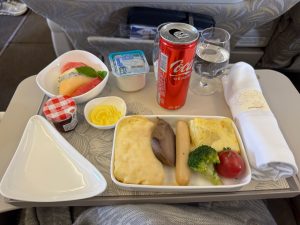
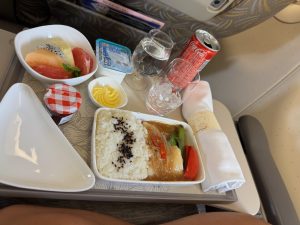
For the short 2-hour flight today, Asiana Airlines provides Business Class passengers with full meals. The two main course options for our flight today are Braised Dory fish and Egg Crepe. I had the Egg Crepe, served with fresh-cut fruits and a yoghurt. The scrambled eggs had a slightly flaky texture, but the ham was well-seasoned, and the sausage was not overly dry. My friend opted for the Dory fish, which tasted a little bland. Overall, I thought the meal served on this flight was quite hearty for breakfast.
Breakfast option for today's flight
The Egg Crepe I chose for breakfast today
My friend opted for the Briased Dory Fish
Service
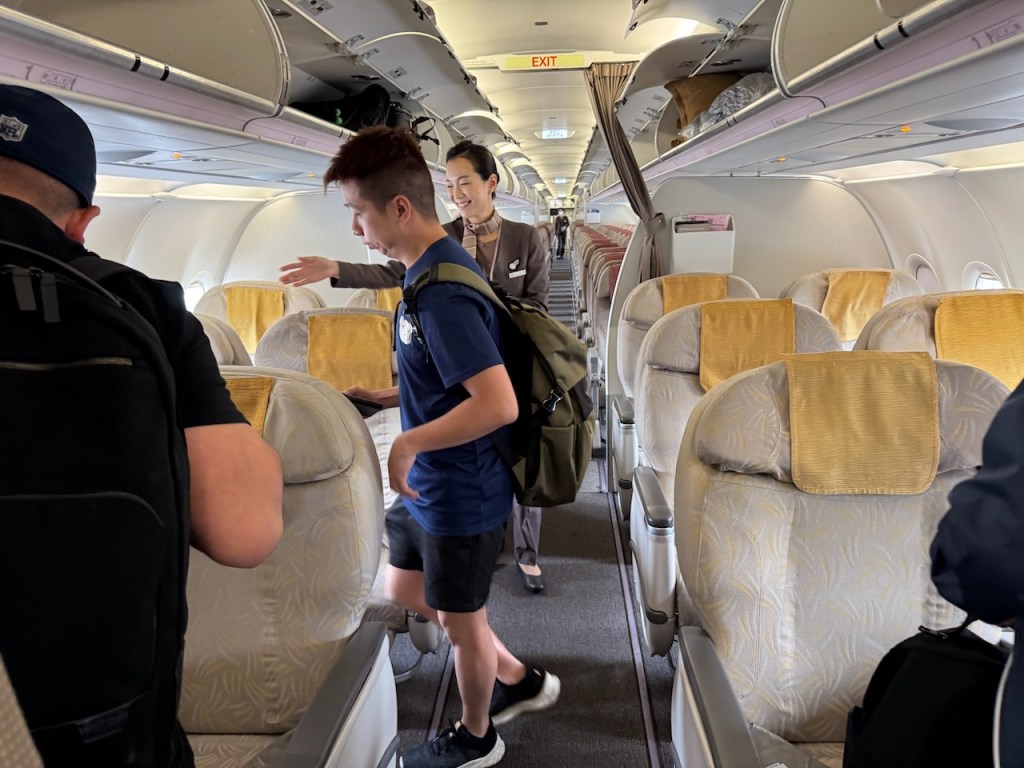
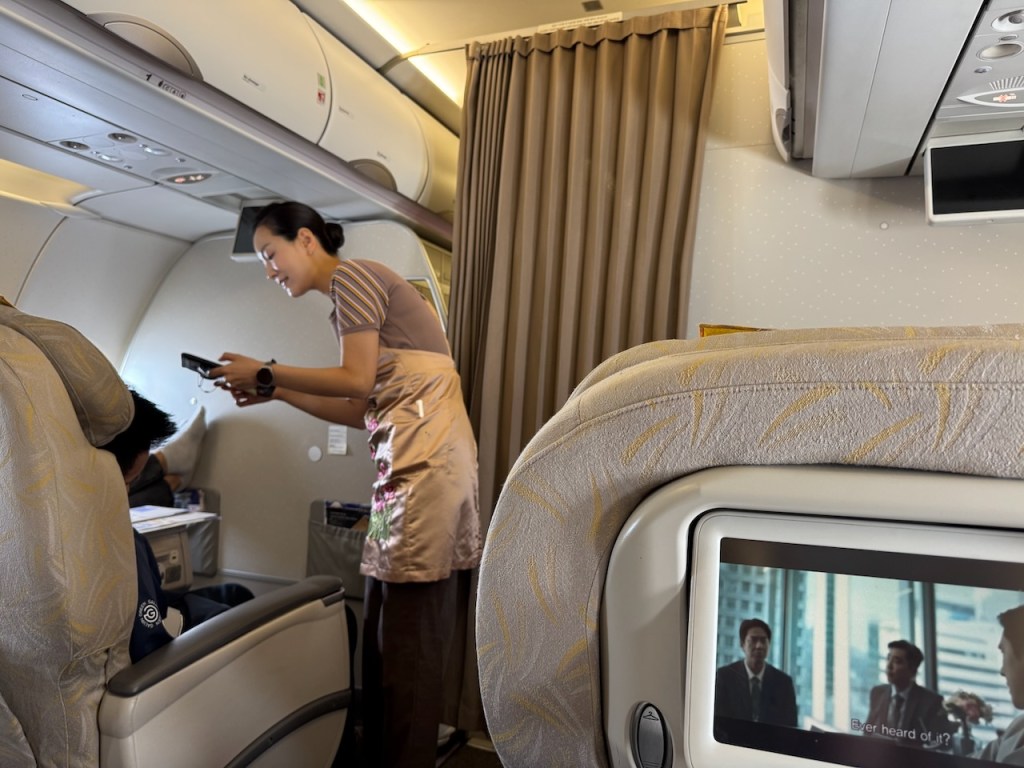
The service onboard this flight is one of the better services I’ve experienced with Asiana Airlines. Apart from the usual greetings at the door, we were being escorted to our seats. The cabin crew came across as friendly and welcoming throughout the entire flight. They were seen volunteering their help to passengers with their carry-ons and continually checking on them. Meal orders were taken and promptly served shortly after the seatbelt signs were turned off. Despite the short flight and the tight schedule, the cabin crew were seen patrolling the cabin frequently. Upon spotting that we had finished our meal, the eagle-eyed cabin crew promptly cleared our meal trays and topped up our drinks. Apart from the slippers provided in the seat, no other amenities were provided. Additional amenities such as pillows and blankets were made available upon request.
Cabin crew escorting us to our seats with a warm smileCabin crew taking orders after seatbelt signs are turned off
Afterthought
Asiana Airlines A321-200 was an older aircraft. Despite its ageing equipment and lack of storage space, I found the Business Class seat to be comfortable, thanks to the thick cushioning used in these seats. For a short 2-hour flight, it didn’t bother me that these Business Class seats don’t have a flat bed function. The service onboard this flight was excellent. The cabin crew came across as personable and attentive. They were seen helping passengers with their seats and luggage. I had a pleasant experience with Asiana Airlines in their A321-200 Business Class.
Taking off from Shanghai Pudong AirportWe are preparing for landing in Seoul Incheon Airport
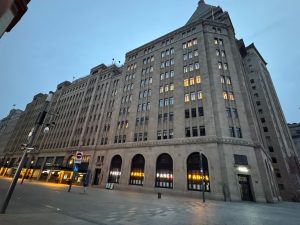
The Fairmont Peace Hotel is the most iconic hotel on the Bund in Shanghai. One cannot miss the hotel, with its iconic green metallic roof, a landmark that is part of the Bund skyline. The Fairmont Peace Hotel is situated at the end of East Nanjing Road on the Bund, where shopping options are plentiful, ranging from large shopping malls and department stores to small shops selling souvenirs and snacks. There are also several 24-hour convenience shops and multiple eateries, from street food to restaurants, within a 5-minute walk from the hotel. The hotel is conveniently located near East Nanjing Road Station, the nearest subway station, just a 5-minute walk away, providing easy access to explore Shanghai by metro. Guests wanting to visit the Pudong area across the Huangpu River also have the option of taking the Shanghai Ferry from Jinling East Road Ferry terminal, which is about a 10-minute walk along the Bund.
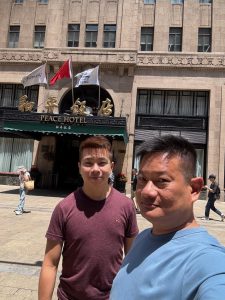
Fairmont Peace Hotel facade
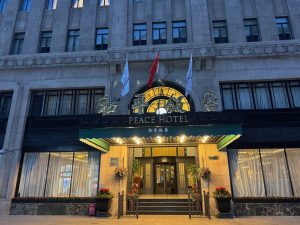
The original main entrance of Fairmont Peace Hotel which is now closed
The entrance to the hotel
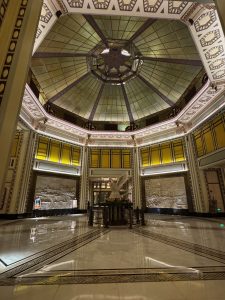
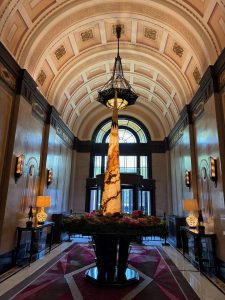
The hotel foyer with the Peace dove
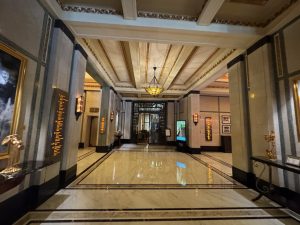
Hotel lobby
Hotel Reception next to the entrance
The concerige in the hotel is opposite the reception
Hotel directory
The entrance to the hotel exudes a old Shanghai charm
The side entrance of the hotel which is closed after 11pm
The Suite
We checked into the 1-Bedroom Suite in Fairmont Peace Hotel. The suite has a floor area of 89㎡, with dedicated spaces for the living room, bedroom, bathroom, and even a walk-in closet.
Layout of the 1-Bedroom Suite at Fairmont Peace Hotel (not drawn to scale)
Entryway
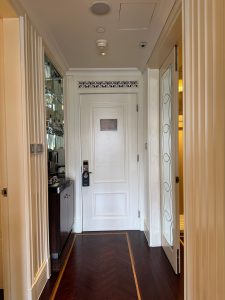
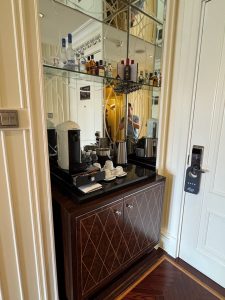
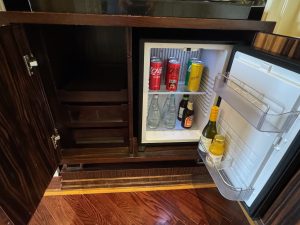
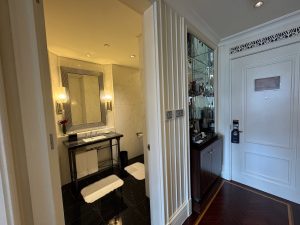
We could see the old Shanghai colonial decor from the entryway to our 1-bedroom suite at Fairmont Peace Hotel, featuring dark wooden flooring and plastered walls. In addition to serving as a transitional space between the living room and main entrance, the mini bar, fully stocked with snacks and drinks ranging from soda to liquor, is discreetly tucked into a niche next to the main entrance of the suite. I was pleasantly surprised to find the latest Nespresso Vertuo machine equipped in the mini bar area. The mini fridge is housed in a dark wooden cabinet in the minibar area. The entryway was also home to the entrance to the powder room and the walk-in wardrobe, which had direct access to the bathroom.
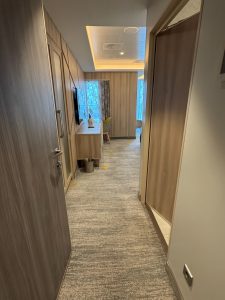
Entryway to the 1-Bedroom Suite, where the minibar is situated and entrances to the walk-in wardrobe and powder room
The mini bar in the suite is located next to the entrance
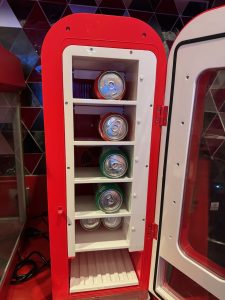
The mini fridge is stocked with overpriced drinks
The mini bar is equipped with the latest Nespresso Vertuo coffee machine
Powder Room
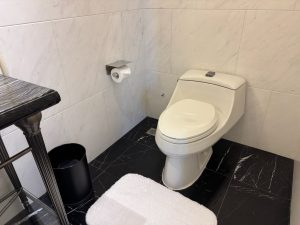
The powder room, furnished with a sink and a toilet, is located on the right side of the entryway and provides an alternative location for using the toilet. Decked in white and black marble, the powder room exudes the classical luxury vibe characteristic of the other parts of the suite.
The powder room entrance is next to the minibar in the entryway
The sink in the powder room
The toilet in the powder room
Living Room
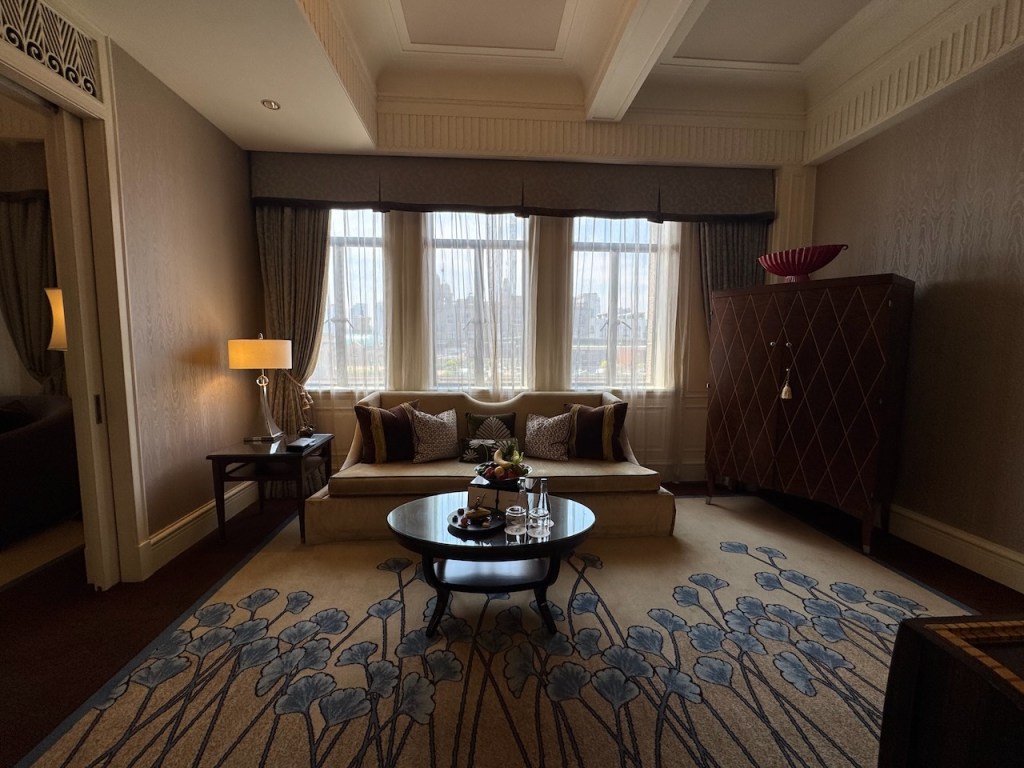
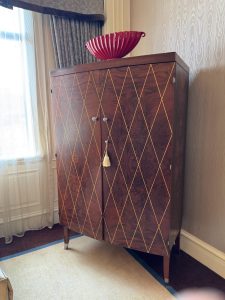
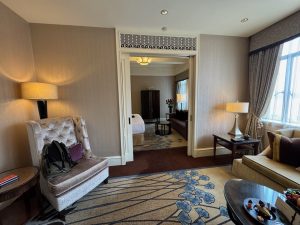
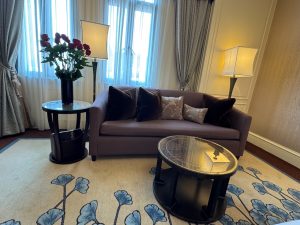
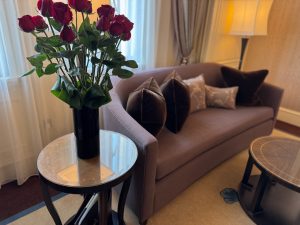
The living room of the 1-Bedroom Suite, occupying approximately half of the suite’s space, is adorned with French Colonial decor, from the beige patterned walls to the intricate carvings on the beams and ceiling. Topped with a floral-patterned hanging light on the ceiling, we were swarmed with a luxurious vibe in the living room. The beige fabric three-seater sofa, sitting next to the window and facing the entryway, immediately invites guests to take a seat and enjoy the view of the Bund. A small dark brown coffee table, decked with welcome amenities, together with the table lamp resting on the side table in a corner, gave us a cosy feel. I find the TV cabinet’s placement a little off, as it is positioned next to the sofa rather than facing it, which makes watching programmes on the 55″ LED TV a tad difficult. I also find a lack of storage space in the living room and the suite. The TV cabinet provided us with the only storage space for temporarily storing the items we had bought. When it comes to entertainment, TV channels offer only a handful of English channels, while the majority of channels are in Chinese. Fairmont Peace Hotel makes up for the lack of English channels by treating guests to a complimentary small catalogue of on-demand English movies (selectable under “Joy Cinema”).
The living room of the 1-Bedroom Suite
The living room of the 1-Bedroom Suite is furnished with a comfortable sofa and a coffee table
The side table beside the sofa in the living room
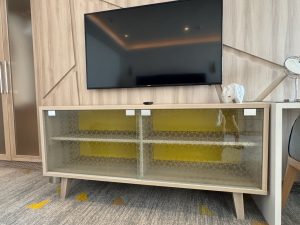
The TV cabinet, our only means of storage in the suite, is placed at an odd angle for TV watching on the sofa
The TV cabinet in the living room sits in one corner
View of the Bund from our living room
The high-back armchair, tucked in a corner of the suite next to the entrance to the entryway, invites the suite’s occupants to relax and enjoy a cup of coffee or read a book. The living room in the 1-Bedroom Suite at Fairmont Peace Hotel is furnished with a fairly large work desk, placed by the wall of the powder room. Despite being fitted with a table lamp, I still find plenty of space to work on the work desk.
The workdesk in the living room is placed facing the sofa
The workdesk in the living room
There is a highback armchair next to the workdesk in the living room of our 1-Bedroom Suite
Bedroom
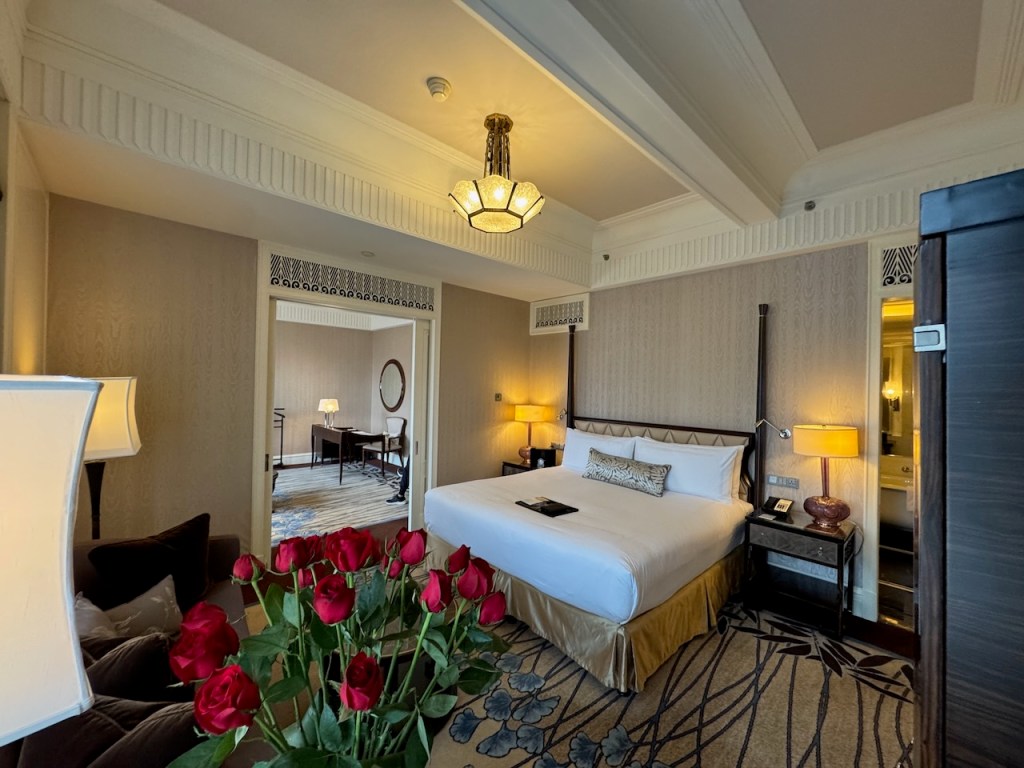
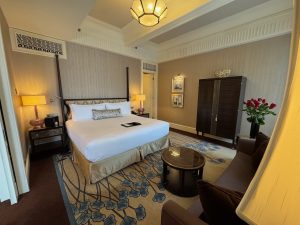
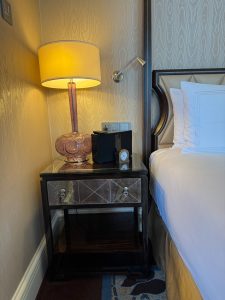
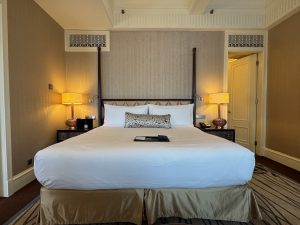
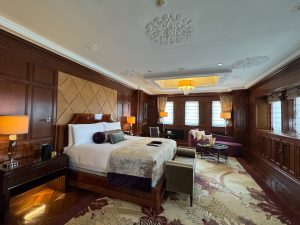
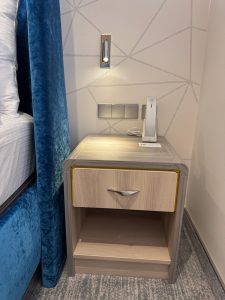
The French Colonial decor also dominated the interior of the bedroom. The king bed was luxurious and very comfortable to sleep on, thanks to its firm mattress. However, the sleep quality was impaired by the pillows, which were too soft for my liking and gave me a neckache the next morning. Although I was unable to find a list of pillow options, the Fairmont Peace Hotel was able to provide the buckwheat and foam pillows that I requested, which significantly improved the sleep quality on the king bed. I thought the space afforded by the bedside tables for us to place our lifestyle devices was generous. In addition to the phone/alarm clock and the large bedside lamps, we still find plenty of space for us to charge our mobile devices overnight. The two drawers in each of the bedside tables allowed us to store our belongings neatly.
The bedroom of the 1-Bedroom Suite at Fairmont Peace Hotel
The king bed in the bedroom of our 1-Bedroom Suite at Fairmont Peace Hotel
Entrance to the bedroom of our suite
The bedside table had a lot of space for us to place our lifestyle devices
The other bedside table is located at the entrance to the bathroom
The king bed in the 1-Bedroom Suite offered us excellent sleep quality
The TV cabinet is placed against the wall and not facing the king bed. Fortunately, we were able to swivel the TV to face the bed, allowing us to enjoy the same entertainment as the TV in the living room. The bedroom is also furnished with a two-seater sofa and another coffee table, placed opposite the king bed by the window. Perhaps the hotel intended for guests to sit on this sofa and watch the bustle of the East Nanjing Road below, or to peek out into the Bund from the comfort of our suite.
There is another 2-seater sofa in the bedroom
The side table of the sofa is adorned with fresh roses
The sofa in the bedroom is placed in front of the king bed
The TV cabinet in the bedroom is placed in an odd angle, making watching from bed a little difficult
View of the Pudong skyline from the window of our bedroom
Bathroom
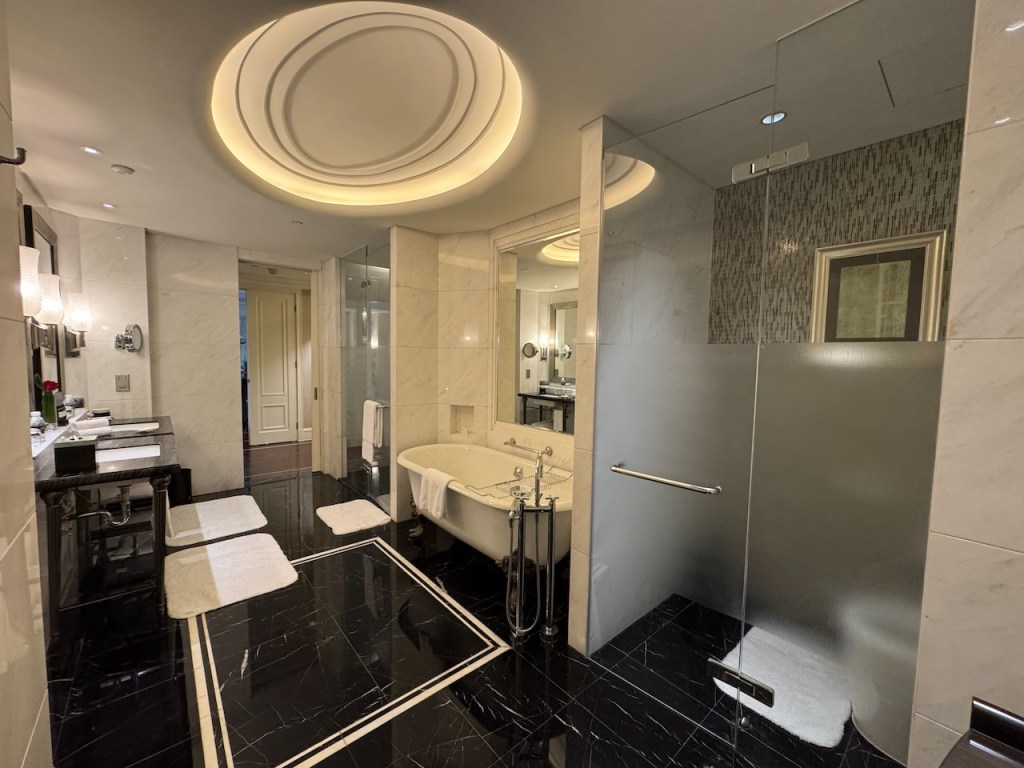
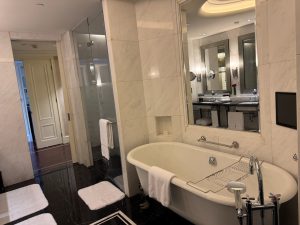
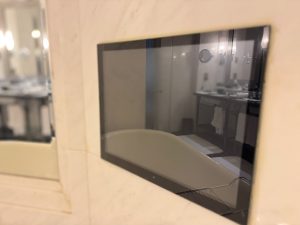
The bathroom can be accessed via the door in the bedroom or the walk-in wardrobe. Being connected to the wardrobe gave us the convenience of accessing our clothing. The bathroom is adorned with white marble, which lends it a luxurious ambience. From the bathroom entrance, the first thing that caught my eye was the deep-seated bathtub nestled by the wall furthest from the entrance. The bathtub was perfect for us to soak away the fatigue we had accumulated from exploring Shanghai. Despite having a small TV installed at the bathtub, I find it rather useless, as the angle at which it was installed made it nearly impossible to watch while soaking in the bathtub.
The bathroom of the 1-Bedroom Suite
The standalone bathtub in the bathroom
The bathtub is placed between the walk-in shower and the toilet
Despite the TV installed at the bathtub, the angle makes it impossible to watch while soaking
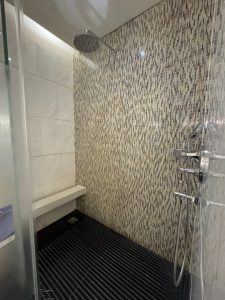
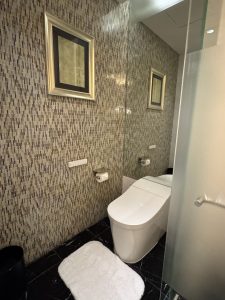
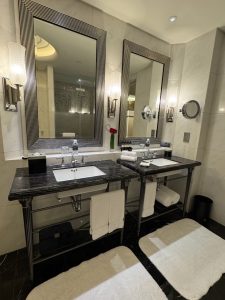
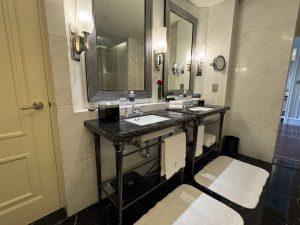
The walk-in shower and toilet cubicles are installed on either side of the bathtub. The walk-in shower, fitted with a rain shower and a regular shower head, was quite sizeable and even had a bench fitted inside. The toilet on the opposite side is fitted with a Japanese-style bidet, which is also quite sizeable. The bathroom in the suite is fitted with two sinks, opposite the walk-in shower. The countertop space on each of these sinks is very generous, allowing us to place our toiletries without having to resort to a game of Tetris. As if the space is not enough, the hotel further increases the countertop space by installing another ledge underneath the large mirrors in the bathroom. The hotel also provided a vanity table in the bathroom, located outside the toilet cubicle, but we merely used this table to store our toiletries bag.
Walk-in shower in the bathroom is fitted with a rain shower and regular shower head
The toilet features a Japanese-style bidet
The sink in the bathroom
The sink in the bathroom is essentially two individual tables, which offer plentiful countertop space
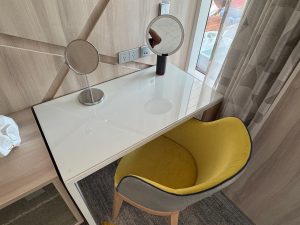
The vanity table is placed in the bathroom, next to the toilet
Bathroom amenities provided by Fairmont Peace Hotel
Fairmont Peace Hotel supplies Le Labo shower amenities for its guests
Walk-in Wardrobe
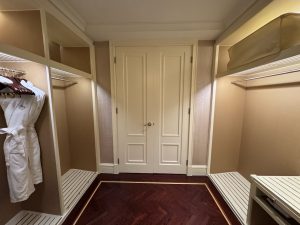
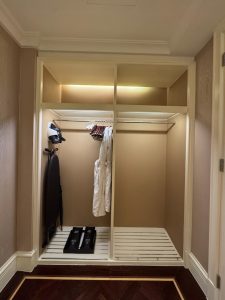
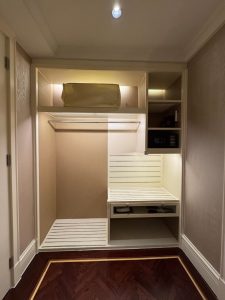
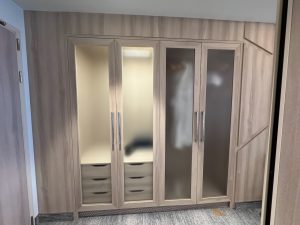
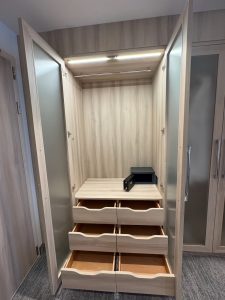
The walk-in wardrobe sits between the bathroom and the entryway and can be accessed from both parts of the 1-Bedroom Suite. I like how the Fairmont Peace Hotel carved out a space as a walk-in wardrobe and made it accessible from the bathroom. The hotel fitted two large open wardrobes facing each other in this space, but with more hanging space than storage space. I thought there was plenty of space to hang up at least 2 weeks’ worth of clothing, but the limiting factor is the number of hangers, which I am fairly certain the hotel will be able to provide when requested. One of these wardrobes is fitted with only hanging racks, providing space for us to store our luggage after unpacking. The other wardrobe has a similar design, but features a three-tiered open shelf and a single drawer. Despite having these designed into the wardrobe, they only increase the storage space for smaller clothing items slightly. The in-room safe is located on the open shelf.
The walk-in wardrobe is an closed off space between the bathroom and the entryway of the 1-Bedroom Suite
One of the wardrobes only has spaces for hanging clothes
The other wardrobe has less hanging space, but more storage space. This is also where the in-room safe is located.
Service
The service around the hotel is generally very good. All the staff that we met during our stay made us feel welcome and were always wearing their smiles. The doormen at the main entrances would always be one step ahead of us and open the door for us. The reception staff were always ready to assist guests in answering any questions regarding the city and the hotel. The staff at the Fairmont Gold Lounge were always welcoming. We visited the lounge twice and were always greeted with a warm welcome by the staff. We requested to visit the rooftop terrace at night, and the lounge staff brought us up, sharing with us the best views and photo spots.
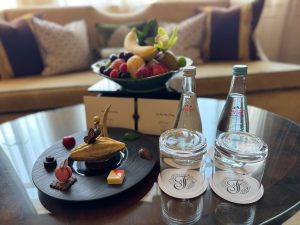
Welcome amenities in our suite
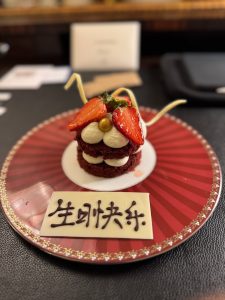
The hotel had a small birthday cake for me during our stay
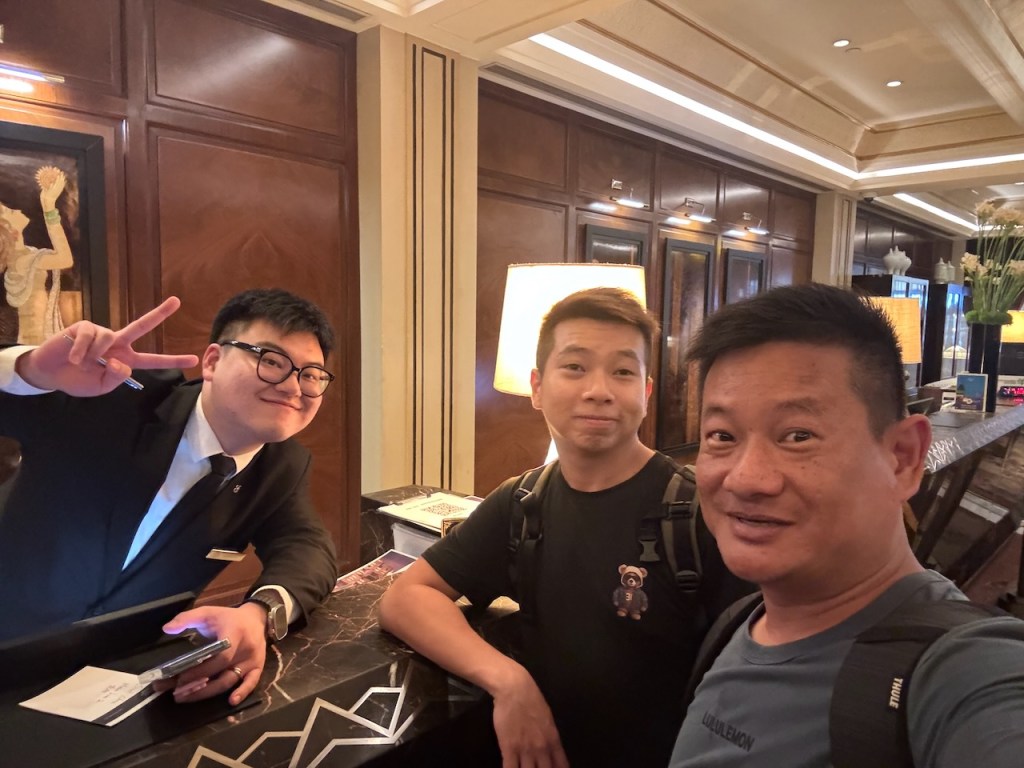
Gordon, the Fairmont Gold butler, got in touch with us months before our arrival. Following our initial email to the hotel, checking on the suite we will be staying in and other options that were available to us. Gordon was very responsive and patient in answering our questions. He also helped us arrange for our private transfer between the airport, the cruise terminal and the hotel, so our trip would not be affected. He was also present during our check-in and made us feel welcomed. Gordon also arranged a private historic tour of the hotel and a private visit to the roof terrace, where we enjoyed a privileged nighttime view of the Bund and Pudong area. Gordon generously shared his local knowledge with us, enabling us to plan our stay in Shanghai effectively. Gordon’s efforts were pivotal in making our stay in Shanghai enjoyable.
Wefie with our Fairmont Gold Butler – Gordon
Hotel Facilities
Breakfast @ Jasmine Lounge
Breakfast at Fairmont Peace Hotel was served at the Jasmine Lounge, located on the Ground Floor of the hotel, next to the Jazz Bar. I’d say there is quite a good spread of food available during breakfast. For Western options alone, we were spoiled for choice, with a large variety of salads and cold cuts, as well as a wide selection of pastries, in addition to the hot favourites of bacon, eggs, and hash browns. What makes the breakfast served at Jasmine Lounge stand out is the equally large menu of Shanghainese options. We could choose from dim sum, Shanghainese street noodles, pot stickers, and Shanghainese pancakes. The food quality served during breakfast was excellent. Having said that, I did not notice any menu changes throughout my three-night stay at the hotel.
Entrance ot Jasmine Lounge
The breakfast dining area has lots of seatings
The pastry table for breakfast
Western hot food section
Egg station is located at the Western hot food section
There is a good variety of bread served during breakfast
There are lots of options for breakfast at Fairmont Peace Hotel
Soup station during breakfast
Chinese counters, including a made-to-order noodle bar and dim sum
Fruits and freshly squeezed juices for breakfast
Fairmont Gold Lounge
The Fairmont Gold Lounge is located on the 9th floor of the hotel, accessible to suite guests and Accor members with platinum or higher status. The Fairmont Gold Lounge employs an earthy tone, which feels very relaxing, while the chandelier hanging on the ceiling exudes a luxurious vibe. The relaxing feeling was even more pronounced when the lounge was empty most of the time during our visit, contrasting with the bustling scene on East Nanjing Road below. The lounge is dotted with dining tables with four accompanying chairs, creating a great space for guests to relax as a group or for business meetings. There is a part of the lounge that feels more like a living room, with couches placed in front of the TV. There are only a handful of tables that were furnished with sofa seats, allowing guests to chill.
Reception of the Fairmont Gold Lounge
The Fairmont Gold Lounge in Fairmont Peace Hotel
There are plenty of seatings in the Fairmont Gold Lounge
Fairmont Gold Lounge exudes a luxurious vibe
The food section is at the back of the lounge
We were only at the lounge on one occasion (due to spending most of our time exploring Shanghai), and we visited during their evening cocktail hour. The Fairmont Gold Lounge serves hors d’oeuvres during afternoon tea and evening cocktail time in a buffet area at the back of the lounge. Considering the evening cocktail where food is served in bite-size portions, there is a great variety of food available. From cold cuts like smoked tuna, prawns, and octopus to hot food options like fried dumplings, sweet and sour fish, and even a station with smoked duck, to pastries, I thought the variety served during the evening cocktail was quite substantial. Guests are free to help themselves with the variety of spirits and soda.
The food stations in the Fairmont Gold Lounge during evening cocktail
Finger food was available during evening cocktail
Desserts served during evening cocktail at the Fairmont Gold Lounge
Bread and cheese served during evening cocktail
Spirits are self-served during evening cocktail at the Fairmont Gold Lounge
Swimming Pool
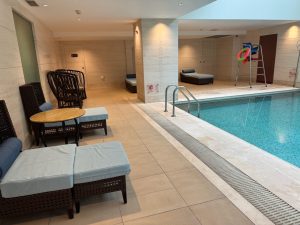
The Fairmont Peace Hotel is fitted with an indoor pool located on the 1st floor, accessible via the same entrance as the hotel’s in-house spa, Willow Stream. The pool is a little on the small side, but still allows guests to do some decent laps. The pool is slightly heated, allowing guests to swim comfortably. There is a limited number of poolside chairs available at the pool, which allows only a small number of guests to use the pool at a time. Fortunately, the pool does not seem to be popular with guests at the hotel. During our visit to the pool, there were no other guests present. There is a sauna facility in the changing room.
Fairmont Peace Hotel has a small indoor swimming pool
The entrance to the swimming pool is at the Willow Stream Spa on level 1
There is limited poolside furniture at the swimming pool
Gym
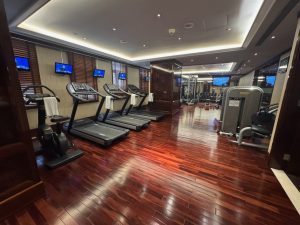
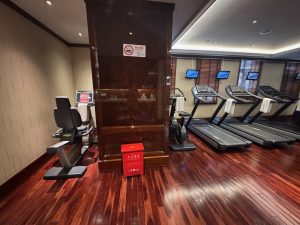
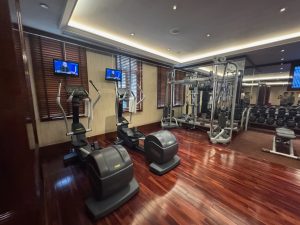
The hotel also has a small gym, located on level 1 in the same area as the Willow Stream spa and the swimming pool. Despite its small size, the gym is well equipped with workout machines for cardio and strength training. For cardio training, guests can work out on the stationary bikes, the three treadmills, and the elliptical machine. The gym is equipped with machines that work out every muscle in the body, including a machine for the abs. On top of these strength training machines, the gym is also equipped with a set of free weights. In addition to the equipment on the main gym floor, the Fairmont Peace Hotel also features a yoga studio for guests to practice yoga. I am not sure if the hotel offers any yoga lessons, as there were no indications that it does.
The gym at Fairmont Peace Hotel
The cardio workout machines in the gym
There are some free weights in the gym of the hotel
Free weight area in the gym
The gym also has a small yoga studio
The strength workout machines in the gym of Fairmont Peace Hotel
Overall
We had a wonderful stay at the iconic Fairmont Peace Hotel in Shanghai. Being located on the Bund, we had a great view of the Pudong skyline, the icon of Shanghai, from our hotel room. The hotel is also well-connected to the rest of the city via the metro, with the nearest station, East Nanjing Road Station, just a 5-minute walk away. The 1-Bedroom Suite is comfortable with sufficient furnishing for us to enjoy the suite without over-cluttering it. The sleep quality on the king bed was excellent, which left us feeling refreshed every single night. The service at the hotel was top-notch, from the moment we arrived to our daily interactions with the staff; everyone made us feel welcome, and nothing seemed too small to bother them.
We initially planned to visit Yuyuan (豫园) in the morning and spend some time strolling along Yuyuan Old Street before visiting People’s Square in the afternoon. The staff at our hotel’s lounge, whom we spoke to last night, highly recommended that we visit Longhua Temple, which is popular amongst the locals. We changed our plan today to prioritise Longhua Temple and leave Yuyuan as an option if we had the time.
Longhua Temple (龙华寺) – The Oldest Temple in Shanghai
As Longhua Temple is slightly further away from our hotel, we made it our first stop of the day. Getting to Longhua Temple is a breeze; we hopped onto the metro Line 2 and changed at Jingsu for Line 11. Longhua Station is well served by both Lines 11 and 12. There are signs in the metro station that point to Longhua Temple (in both English and Chinese). One cannot miss the ancient wooden tower upon emerging from the metro station.
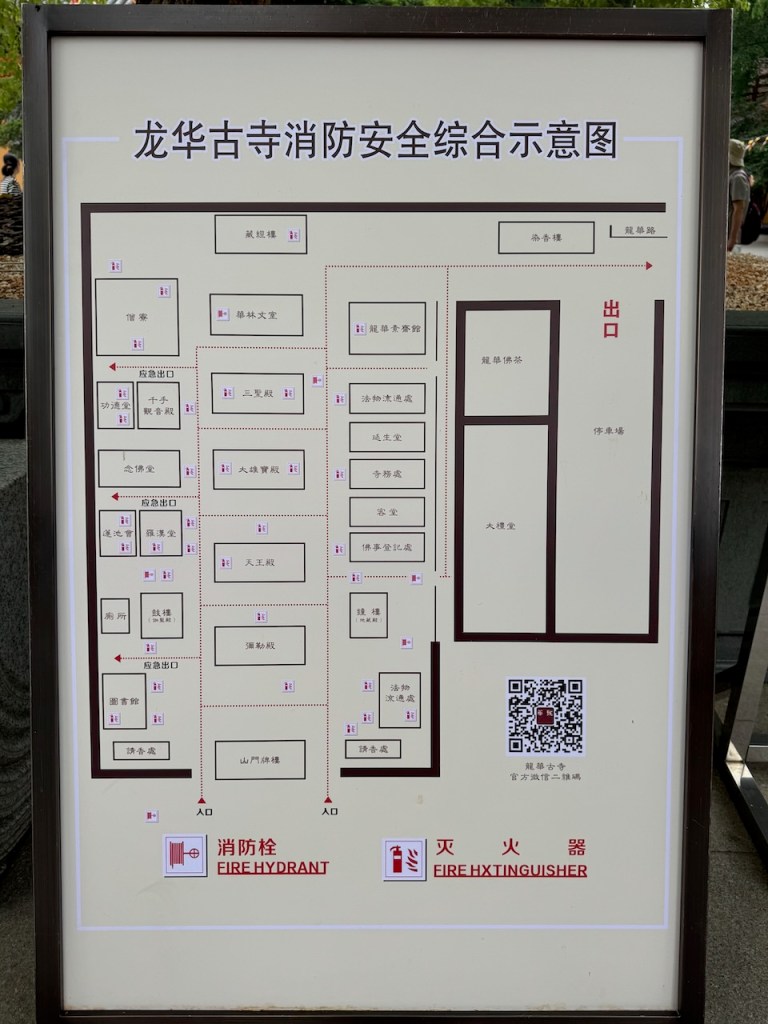
Layout of Longhua Temple
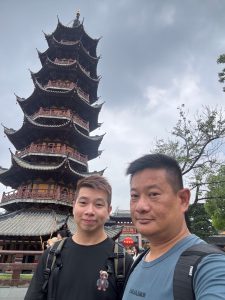
At 1,700 years old, Longhua Temple is the oldest temple in Shanghai and one of the oldest in China. The temple was first built during the Three Kingdoms era in 242 AD and has undergone several rebuilds over the years. Today, the present design of the temple was inherited from the Song Dynasty (960-1279), and Longhua Temple is the largest temple in Shanghai. Entry to Longhua Temple costs RMB 10, which includes a set of three incense sticks for devotees to use during prayers for prosperity and safety. Upon entering the grounds of Longhua Temple, the first thing we saw was the wooden seven-storey Longhua Pagoda. We saw locals walking around the pagoda with unlit incense in their hands. Upon asking, we were told this is a customary procedure when praying in the temple. When in Rome, do what the Romans do. We followed the locals in their prayer procedures. As we walked round the temple, I could catch a glimpse of the interior of the pagoda. The interior of the pagoda appears to retain its original structure, dating back to 977. Other than a set of stairs that lead to the upper level of the pagoda, there seems to be a statue of a man inside the pagoda. We entered the Longhua Temple grounds after doing our three rounds around Longhua Pagoda.
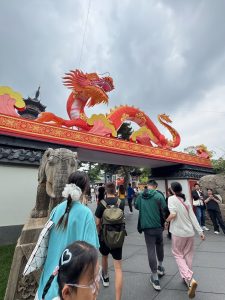
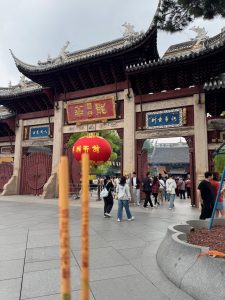
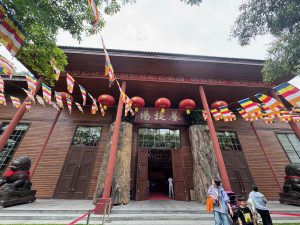
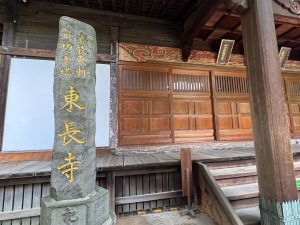
Longhua Temple entrance
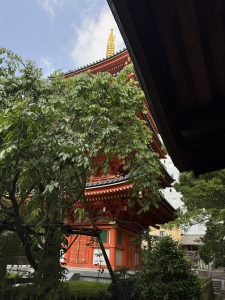
The wooden 7-storey Pagoda
Wefie with the ancient Longhua Pagoda
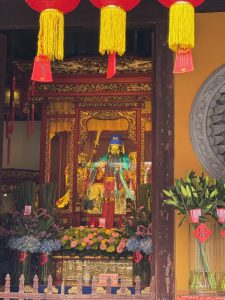
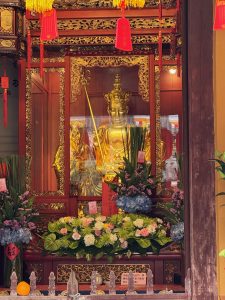
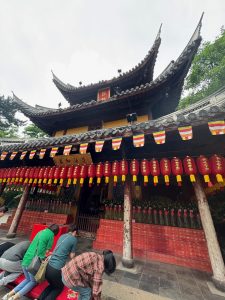
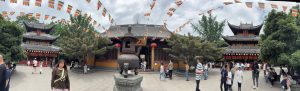
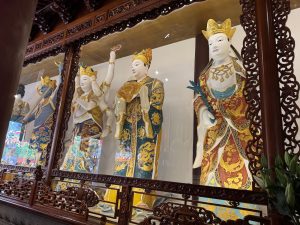
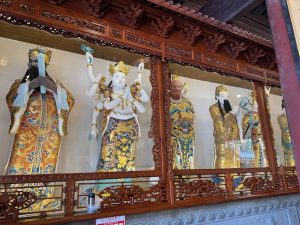
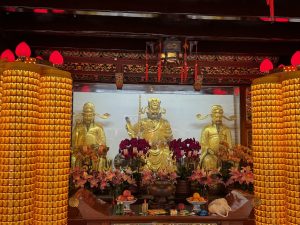
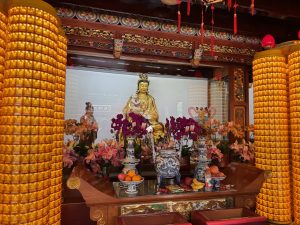
Longhua Temple comprises four main prayer halls, arranged in a straight line along a north-south axis, with several smaller prayer halls situated at the sides of the main halls. Legend has it that it is here the Laughing Buddha attained his Buddhahood. The first prayer hall, the Maitreya Hall (弥勒殿), houses the Maitreya Buddha (also known as the Laughing Buddha) in his manifestation as a monk wearing a cloth bag. The gold-painted Maitreya Buddha, with his signature kind smile, seems to welcome visitors to his temple. The next hall in line after the Maitreya Hall was the Four Heavenly Kings Hall (天王殿). The main Buddha installed in this hall is the Maitreya Buddha in his Buddhahood appearance. This version of the Maitreya Buddha features a calm and kind appearance, a notable departure from the Laughing Buddha image popular in Chinese culture. In addition to the Maitreya Buddha, this hall is also home to the Four Heavenly Kings. The third hall, located behind the Four Heavenly Kings Hall, is the Mahavira Hall (大雄宝殿). This is the main prayer hall in Longhua Temple, where the Buddha, seated on a lotus, and his two disciples, Manjusri Boddhisattva (文殊菩萨) and Samantabhadra (普贤菩萨), are installed at the centre of the prayer hall. The Buddha statues installed in this hall exude a calm and solemn look, as though they are patiently listening to the sorrows of visitors. The Three Sages Hall (三圣殿) is the final hall, the furthest away from the entrance of Longhua Temple. The Buddhas installed here are the Amitabha Buddha (阿弥陀佛), Guanyin Bodhisattva (观音菩萨) and Mahasthamaprapta Bodhisattva (大势至菩萨). The Buddha statues here had a gentle smile on their faces, as though reassuring visitors that everything will be alright.
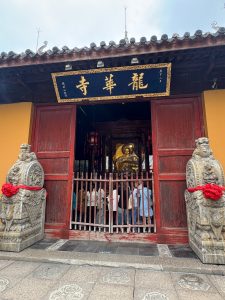
The official entrance to Longhua Temple
The first prayer hall - Maitreya Hall in the central axis
Maitreya Hall houses the Maitreya Buddha in the familar Laughing Buddha appearance
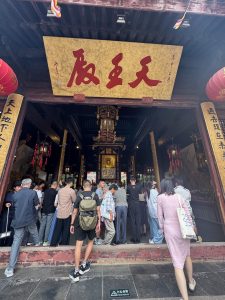
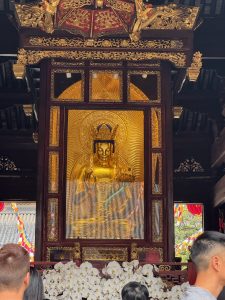
Four Heavenly Kings Hall is the second hall in the central axis, housing Maitreya Buddha in his Buddhahood appearance and the four heavenly kings
Maitreya Buddha in his Buddhahood appearance
Mahavira Hall is the third hall with Buddha and his two Bodhisattva disciples beside him
The third courtyard in Longhua Temple
Weife in the grounds of Longhua Temple
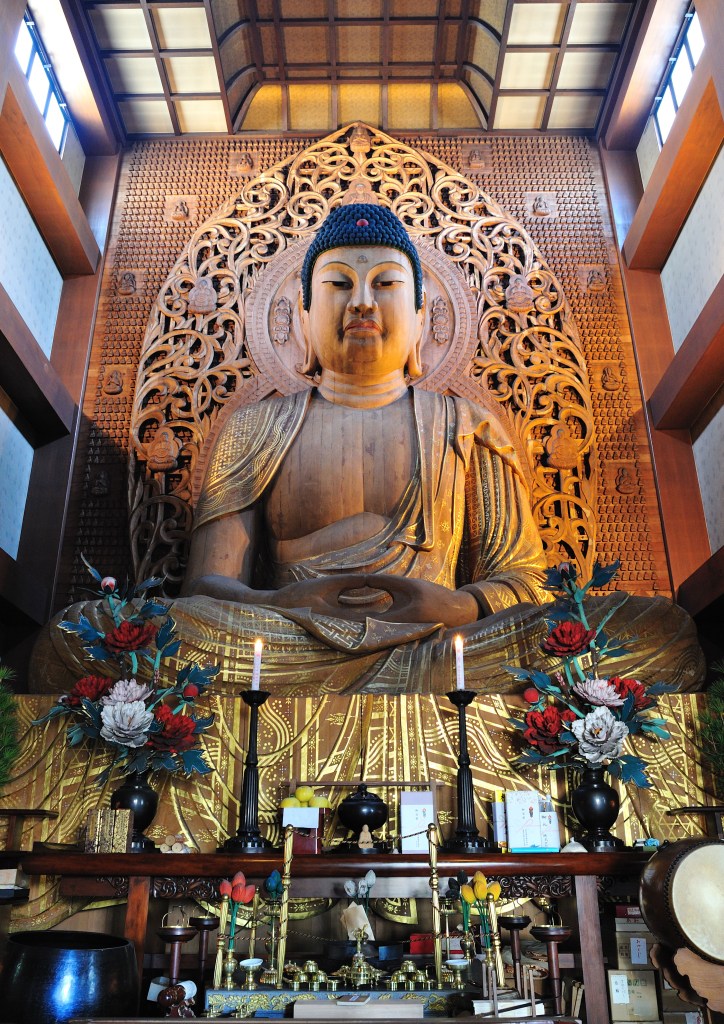
The final hall - the Three Sages Hall with Amitabha Buddha in the centre, Guanyin Bodhisattva in male form to his left and Mahasthamaprapta Bodhisattva to his right
The Three Sages Hall in Longhua Temple is the fourth prayer hall in the central axis
The Sutra library, which houses the scriptures that the Tang monk brought from India
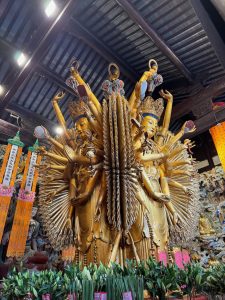
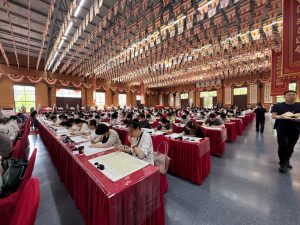
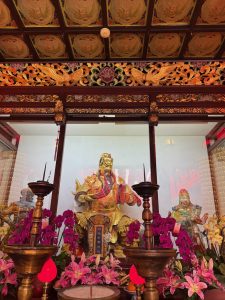
After visiting and offering our prayers in the four main halls, we spent the rest of our time at Longhua Temple retracing our footsteps back to the entrance and visiting the side prayer halls. A hall beside the Three Sages Hall had the statue of Thousand Hands Guanyin (千手观音) installed. Instead of having only one statue, there are three statues of the Thousand Hands Guanyin with their backs against each other, which seems to represent seeing all from all directions. In addition to the Guanyin statue, this hall is also adorned with carvings of Bodhisattvas and Gods cast on the walls of the hall. The other hall that I like is the Arhat Hall (罗汉堂). In the centre of the hall is a dark brown wooden statue of Guanyin, with her lifelike merciful appearance. There are an impressive 500 smaller arhats on the walls surrounding the Guanyin statue in the centre. The two side halls between the first and second main hall are the Drum and Bell Towers, where statues of Guangong (关公) and Earth Store Bodhisattva (地藏王菩萨) are installed respectively. After paying respects to all the Buddha and Bodhisattva statues in the prayer halls, we wandered around the grounds of Longhua Temple. We found a huge hall filled with people quietly sitting in rows copying Buddhist sculptures. Copying these sculptures is a Buddhist practice that trains one’s patience and a calm mind. It was a spectacular sight to see so many people sitting quietly in a large hall doing their things calmly. Leaving Longhua Temple after spending 1½ hours here praying and walking around, we headed for lunch in one of the shopping malls nearby.
Guangong installed in the Drum Tower
Earth Store Bodhisattva installed in the Bell Tower
Wefie with the Bell Tower in Longhua Temple
The Bell Tower is one of the two towers in the courtyard between the first and second main prayer halls
The Drum Tower in Longhua Temple
Panoramic view of the second main prayer hall with the Bell and Drum Towers in Longhua Temple
More Bodhisattvas on display in the temple
Display of Bodhisattvas in Longhua Temple
The Thousand Hand Guanyin in Longhua Temple
The Guanyin installed in the Guanyin Hall
This is another Guanyin Hall located in one of the side halls. This wood carved Guanyin is depicted withe 500 Arhats
The large hall where devotees come and copy Buddhist sculptures
Devotees copying Buddhist sculptures in Longhua Temple
City God Temple (城隍庙)- Temple of Guardian God
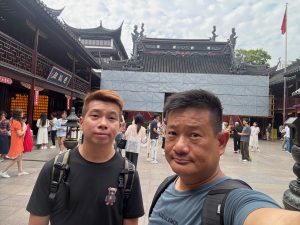
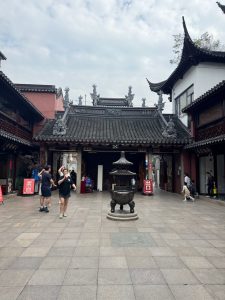
No visit to Shanghai is complete without visiting the City God Temple and Yuyuan Old Street. The City God Temple has been regarded as the guardian temple by the Shanghainese. Entry to City God Temple costs RMB 20. The City God Temple is served by Yu Garden Metro Station on Lines 10 and 14. The City God Temple is compact compared to Longhua Temple. There are three entrances to the City God Temple, the main entrance facing the road, the side entrance that is directly linked to the Yuyuan Old Street shopping arcade and a back entrance at the second prayer hall that serves more like an exit (we are not too sure if this is also used entrance as we did not went up close to explore this area). As we came from the Yuyuan Shopping Arcade, my friend and I used the side entrance. From the side entrance, we immediately arrived at the second and largest courtyard in the City God Temple. This is where the main prayer hall is located, housing one of the two City Gods in this temple. We later learned from one of the staff members that Shanghai has three City Gods, two of which are located in this City God Temple. After offering our prayers, we proceeded to the back of the temple and arrived at the third courtyard. In a relatively small prayer hall, the second City God is housed. At the sides, we found smaller shrines housing Guangong and WenCang (the God of Wisdom).
Panoramic shot of the main courtyard in City God Temple
The City God in the main prayer hall in the middle of the temple
There is another City God in the prayer hall at the back of the temple, behind the prayer hall of the first City God
Wencang who is also reffered as the God of Wisdom installed in a shrine next to the second City God prayer hall
Some of the 60 Taitsui in City God Temple
The main courtyard in City God Temple, the main prayer hall was under restoration during our visit
Guangong is also known as the God of Courage
Wefie in the main courtyard of City God Temple
After offering our prayers, we retraced our footsteps and headed back to the second courtyard to offer our prayers to the gods installed in the side shrines there. The God of Fortune and Guanyin were among the more popular gods in the second courtyard, where we saw more people praying. We headed to the first courtyard after praying and shopped for some charms for my family members. The staff advised us to return to the ceremonial hall located between the two City God halls to have our charms blessed. The cleansing ceremony involves a Taoist priest chanting and sprinkling holy water onto our charms. We had pretty much covered everything in the City God Temple in about 45 minutes.
The main entrance to City God Temple
The first courtyard after passing through the main entrance to the temple
Wefie while waiting for our charms to be blessed by the priest in the temple
God of Wealth is installed in one of the side shrines in the main courtyard
Guanyin in another side shrine in the main courtyard of the temple
Yuyuan Old Street (豫园老街)
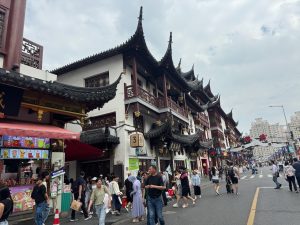
We spent the rest of the afternoon wandering through the labyrinth of Yuyuan Old Street. I thought this was a great place to dive into the vibrancy of Shanghai, with many locals coming here to spend their weekends wandering through shops to buy souvenirs or to eat from the many food street stalls. As we were here on a weekend, we even spotted some local artists coming here to promote their films and shows. We also saw a traditional Chinese dance performance in one of the many open spaces within the shopping arcade. The main Yuyuan Old Street is essentially a huge shopping arcade, housed in ancient Chinese buildings that feature numerous shops, mainly selling souvenirs and snacks, as well as a small number of gold shops. Yuyuan Old Street is also where the locals come to buy gold, where the gold price is generally lower. Most of the gold shops congregate in the area across the road from the main shopping arcade. Despite being a highly touristy spot, we found that the prices of items on Yuyuan Old Street are generally cheaper than those on East Nanjing Road.
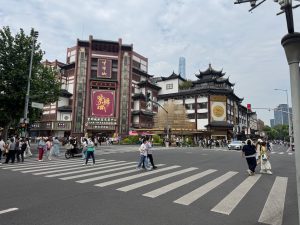
There is a hotel in the Yuyuan Old Street shopping area
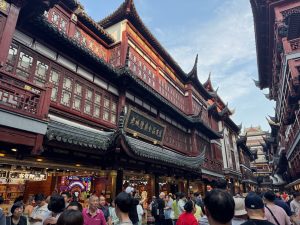
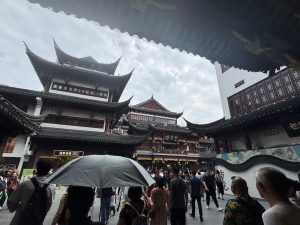
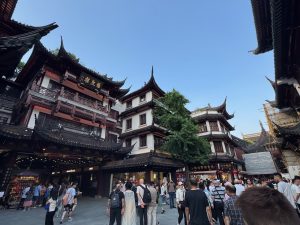
Shops here are housed in ancient Chinese buildings
There are some spots for street performance at Yuyuan Old Street
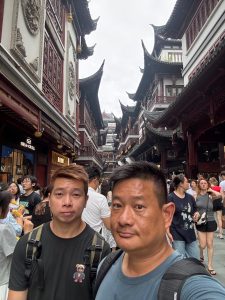
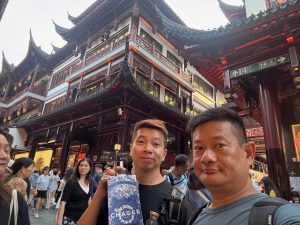
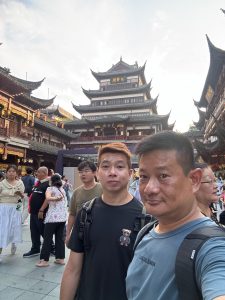
Wefie with the buildings in Yuyuan Old Street
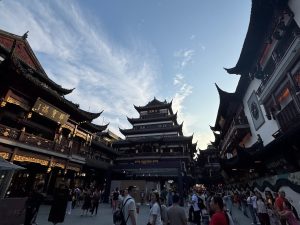
The ancient buildings at Yuyuan Old Street make it a great spot for photo taking
These ladies, dressed in ancient Chinese clothing, on the balcony of this building, are to attract customers to their restaurant
Yuyuan Old Street got its name due to the ancient buildings the shops are housed in
Walking in one fo the alleys in Yuyuan Old Street
The buildings in Yuyuan Old Street
Although we know these are new buildings, but walking here feels like walking back in time
Wefie in Yuyuan Old Street
This is one of the few gold shops in this part of the shopping arcade
My friend buying smelly tofu from the street food vendor
Yuyuan Old Street
These shops across the road from the main shopping arcade sells gold
The gold prices at Yuyuan Old Street is renowned to be competitive
Back to Pudong – Our Attempt to Visit Oriental Pearl Tower
We returned to our hotel to offload some of the stuff we bought from Yuyuan Old Street and headed out across the Huangpu River via the metro to Pudong. Since we had some time before dinner, we wanted to visit the Oriental Pearl Tower, something I had wanted to do 30 years ago when I first visited Shanghai. Back then, the tower had just been completed and had not yet been opened to the public. To get to the Oriental Pearl Tower, we alighted at Lujiazhui Station (since the ferry service had stopped for the day), one stop along Line 2 from East Nanjing Road Station. We emerged from one of the shopping malls and walked the circular overhead pass connected to the mall to arrive at Oriental Pearl Tower. The ticketing booth for the tower is not located on the ground floor of the tower; instead, it is found about 20 m away from the tower. However, by the time we arrived at the tower, admissions had ceased as the tower was closing soon. Other than taking pictures with the tower up close, there was nothing much we could do here.
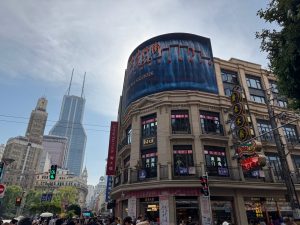
The street below our hotel is crowded with people
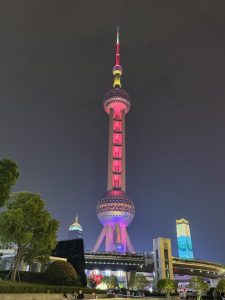
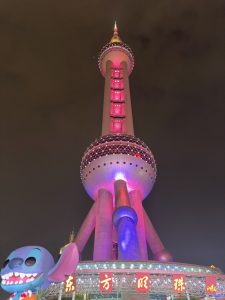
Oriental Pearl Tower at night
We were at the base of the tower, trying our luck to go up to the top sphere
Wefie with Oriental Pearl Tower upclose
Dinner Hunting on East Nanjing Road
Since it was way past dinner time, we returned to the Western part of East Nanjing Road (opposite People’s Square Station) to look for dinner. I thought I saw some restaurants on this stretch of the road a few days ago when we walked to this part. We came across a stretch of roadside stalls selling snacks and purchased some tasty lobster dumplings. Most of the restaurants at this hour (it was already approaching 10 pm when we arrived) seem closed. We settled our dinner at a BBQ restaurant in one of the small alleyways; we spotted some restaurants that were still open till late at night. As it was getting late and we had an early flight the next day, we headed back to our hotel on the Bund after dinner. The shops below our hotel were still open, so we bought some street snacks to take back to our room to eat while we packed our luggage for our departure tomorrow morning.
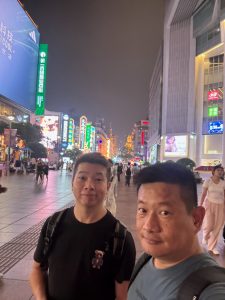
Wefie on East Nanjing Road before we go hunting for dinner
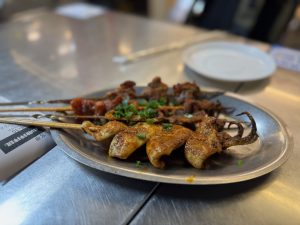
The grilled food was delicious and tender
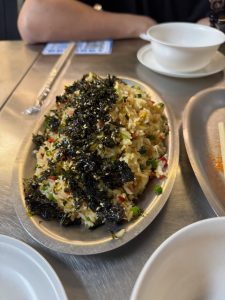
We had fried rice at this restaurant we found in a small alleyway
Shanghai is a large city with 18 districts. Today, we planned to visit the sights a little further away from the Bund where we were staying. As it was raining in the morning, we started our day around noon, after the rain stopped.
Jing’an Temple (静安寺) – The Golden Roof Temple
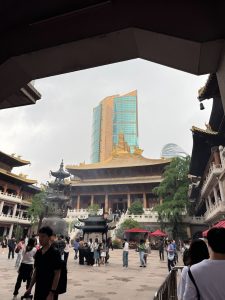
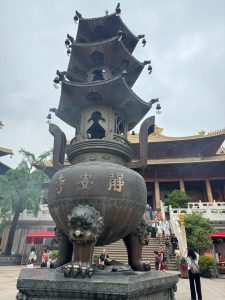
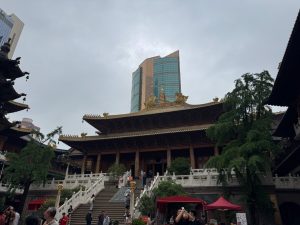
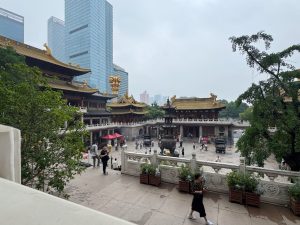
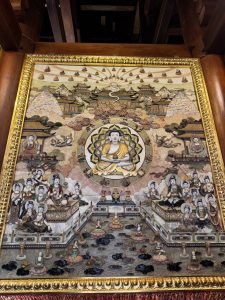
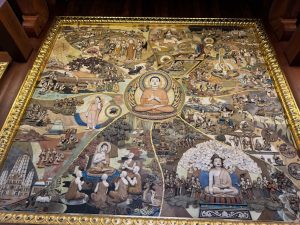
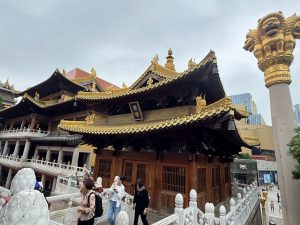
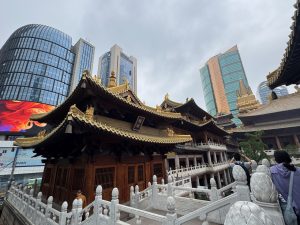
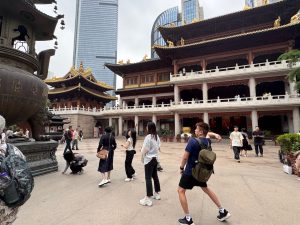
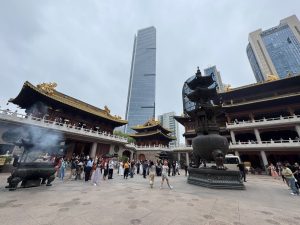
Our first sight today is Jing’an Temple, the principal temple regarded by the Shanghainese. Jing’an Temple is one of the most expensive temples in China, with a construction cost of RMB 2.8 billion. Jing’an Temple is well served by the Jing’an Temple Station, which is an interchange of Lines 2, 7 and 14. Admission to the temple costs RMB 50. Huge shopping malls and small shops surround the temple, creating a bustling scene. However, as we entered the temple grounds, the bustling of the surroundings faded into peace and tranquillity. The only sound came from visitors tossing coins into the two-storey tall furnace in the centre of the courtyard. The roofs of the temple and the mystical animal adorned on them were gold-plated. The bright yellow walls painted on the temple walls enhance the illusion that the temple is made of gold. After offering our prayers, we proceeded to the main prayer hall, which housed a 15-ton, pure silver Buddha. The Buddha statue sits in the middle of the hall, solemnly blessing those who came to offer their prayers. Behind the silver Buddha statue are three painted wood carvings of Buddha. I find the centre carving more significant as it depicts the birth and attainment of nirvana of Buddha.
The original main entrance of Jing'an Temple
Our first glimpse of Jaing'an Temple's interior
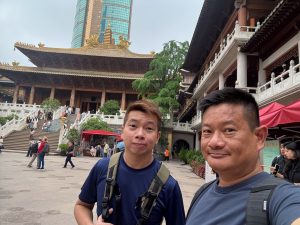
Wefie at the courtyard of Jing'an Temple
The two-storey tall furnace in the middle of Jing'an Temple's courtyard
Jing'an Temple sits in the midst of tall buildings
The 15-ton Buddha made of pure silver sitting in the main prayer hall
The main prayer hall of Jing'an Temple where the 15-ton pure silver is located
The courtyard of Jing'an Temple seen from the front of the main prayer hall
Carving of Buddha and the bodhisattvas
The centre art piece carving located behind the silver Buddha depicts the life of Buddha
The pagoda in Jing'an Temple seen from back of the main prayer hall
Wood carving of Buddha with his followers located behind the silver Buddha
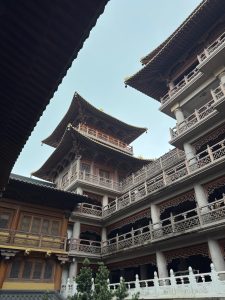
There are two towers on the facade of the temple: the left is the Drum Tower and the right is the Bell Tower, both of which are accessible from within the temple. Exiting the main prayer hall from the back, we walked on the second level of the adjacent building and came to the Bell Tower. Legend has it that a well is located beneath the Bell Tower, allegedly linked to the sea, with water sprouting from the well. It was believed that the water brought evil, and the locals built Jing’an Temple to ward off these evils. Both the Bell and Drum Towers are closed to the public these days. As the door to the Bell Tower was left ajar, we were able to peek inside the Bell Tower, where we saw a huge bell (hence the name Bell Tower) hanging over what seemed to be a well. The two towers were linked by a central structure, which was formerly used as the main entrance to Jing’an Temple. It is here that we got a great view of not only the inside of Jing’an Temple, but also the outside. The contrast between tranquillity and bustling is especially pronounced here. A gold-plated Laughing Buddha called the centre building on the second level home, together with the statues of the four heavenly kings, guardians of heaven in Chinese mythology. We felt a sense of happiness by looking at this Buddha. The drum tower occupies the left building (seen from the main road of the temple). Compared to the Bell Tower, the Drum Tower appears dull. Peeking through the windows, we could see the solo drum placed inside.
The bell hanging over a well in the Bell Tower
The Bell Tower is the building on the right above the main entrance to the temple
Wefie with the Bell Tower
We were able to get a great view of Jing'an Temple's interior from the second level
The Drum Tower is the left building on the second level of the main entrance
A laughing Buddha is installed in the building above the original main entrance of Jing'an Temple
View of the main road in front of Jing'an Temple from the second level of its main entrance
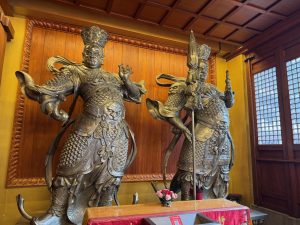
The heavenly kings on the same room as the laughing Buddha
The other two heavenly kings in the building above the main entrance
We headed back to the ground level of the temple and found a 3.8m Burmese white jade Buddha statue in a room along the Drum Tower side of the temple. The Buddha statue exudes a compassionate expression. At first glance, one would think that the robe on the jade Buddha was made of cloth, but this is actually part of the jade used for the statue. There is another hall opposite the Jade Buddha statue, where we find a 6.2m tall statue of Guanyin (the Goddess of Mercy), made from a 1000-year-old camphor wood. The lower level of the former entrance has another statue of Guanyin, installed in front of the now-closed entrance. We spent the rest of our time here at Jing’an Temple, exploring the many rooms open to the public, and discovered a prayer room with three Buddha statues located at the back of the temple. As this is a secluded part of the temple, we were the only ones here offering our prayers to the Buddha statues. Before leaving the temple, we spent some time tossing coins into the large furnace in the middle of the courtyard.
The Buddha made of Burmese Jade
Guanyin carved out of a thousand-year-old camphor wood
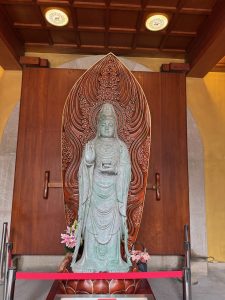
There is another Guanyin made of jade that standing in front of the original main entrance
The quiet prayer hall at the back of the temple that do not see any crowd
My friend tossing a coin into the furnace in the courtyard of Jing'an Temple
Map of Jing'an Temple
Wefie with the main prayer hall before we leave the temple
One final shot of the main entrance building of Jing'an Temple
Before heading to our next sight, we had lunch in one of the restaurants nearby Jing’an Temple. We were initially attracted by the pastries and rice dumplings sold at the front of the restaurant. Since it was past lunchtime, we settled in for a meal at this restaurant. We only found out that this restaurant is a Michelin one-star establishment after eating there. With our stomachs filled, we are off to our next sight – the French Concession.
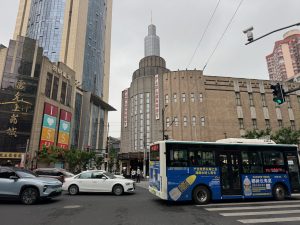
The streets next to Jing'an Temple
We were attracted to this restuarant by the dumplings they sell
Wefie in the restaurant while waiting for our food
We had the crab meat noodles, which was delicious and full of crab meat
French Concession (法租界)
The French Concession was an area administered by the French Government for almost 100 years. To date, the area is still filled with buildings left behind by the French from yesteryear. We were drawn to this area by the former site of the French Concession Joint Courts (法租界公审会廨旧址), which appears to be the only notable attraction in this vicinity. Little did we know that there were more historical buildings in this area. We took the metro from Jian’an Temple Station to Dapuqiao Station and walked along the streets. Our first impression of the French Concession is that the streets in this area have a rustic charm reminiscent of China in the 50s. The trees planted on both sides of the street reminded us of the Champs-Élysées, which we had visited in Paris. Despite heavy traffic, the streets of the French Concession remained peaceful. Our plan was to visit the former site of the French Concession Joint Courts and then head to Tianzifang. As we were walking along the street, we discovered Tianzifang was just to our right. Since we were already here, we made some last-minute changes and took a detour to Tianzifang.
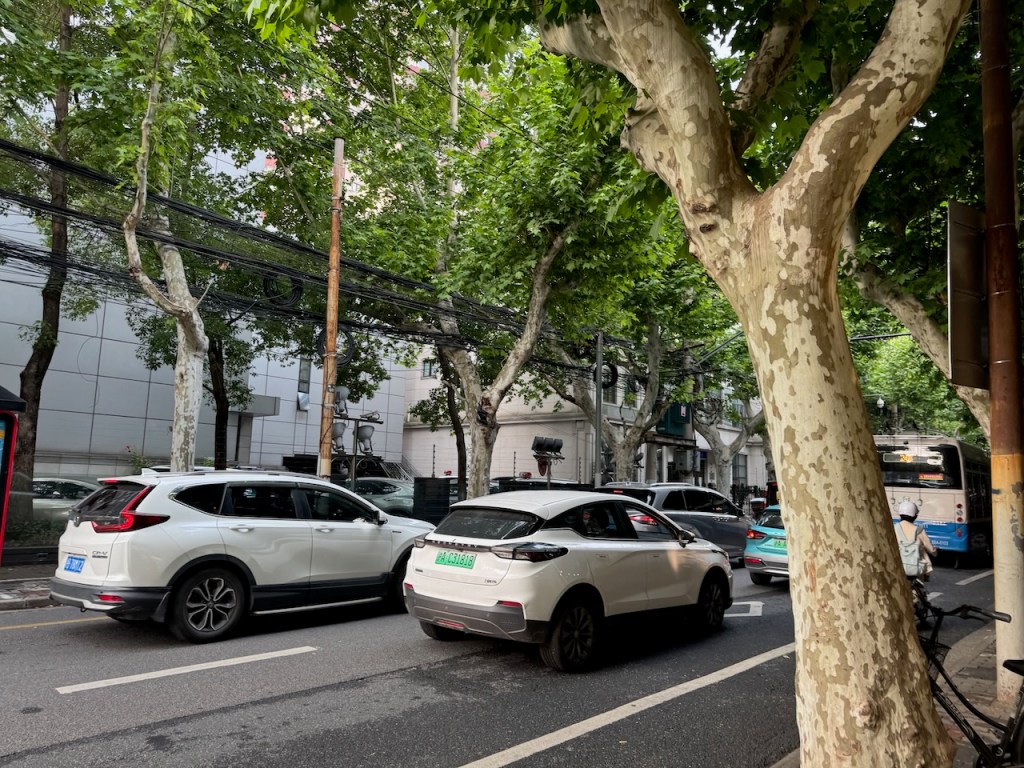
The streets of the French Concession is lined with treesDespite the busy traffic, French Concession exudes a sense of calm
Tianzifang (田子坊)
Tianzifang is very well concealed from the outside. Gates surround the area, giving it a residential appearance. We would have missed it if not for the sign hung on the outer gates. Tianzifang is essentially a shopping district comprised of traditional residential buildings that do not conform to any city planning regulations. Walking in Tianzifang gave us the impression that these former residential buildings were built on sites at the will of their former owners. These buildings were not uniform either; we saw different facades of these buildings, some with their bricks exposed, while others were plastered in cement. Some of these buildings even span across the pavement below. It is this irregularity that gave Tianzifang its character and charm. Relinquished of its former role as residential buildings, the buildings in Tianzifang have been repurposed to house boutique shops, souvenir stores, bars and restaurants. Walking in Tianzifang not only felt like strolling through old Shanghai, but it also felt like navigating a maze. Although we are not big shoppers, we still managed to spend an hour browsing through the shops and eventually found a shop selling locally designed T-shirts, which were reasonably priced for their high quality. Generally, we thought the prices in Tianzifang were lower compared to those on East Nanjing Road.
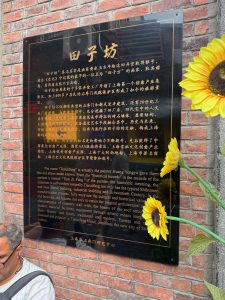
A plaque introducing Tianzifang
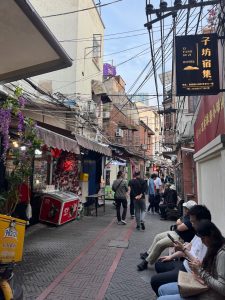
Walking in the streets of Tianzifang
Tianzifang has this rustic charm
One of the streets in Tianzifang
Shops in Tianzifang are housed in repurposed residential buildings
Wefie with the sign of Tianzifang
The streets in Tianzifang are narrow, which gives it its charm
Wefie on the street of Tianzifang
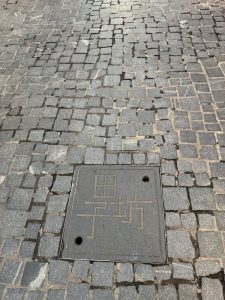
Tianzifang logo on the cobberstone ground
Wefie in Tianzifang
Sinan Open Air Museum (思南露天博物馆)
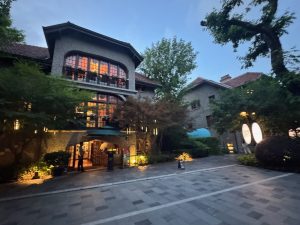
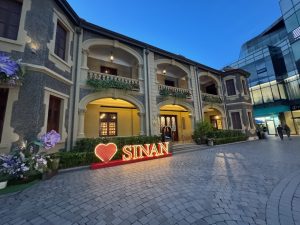
Leaving Tianzifang, we continued our leisure walk to the former site of the French Concession Joint Courts, which lies across the street. When we arrived at the building, it seemed to be a police station and closed to the public. We did not bother entering the premises or asking if the building was open to the public. Seeing it was getting late, we headed to our final destination for the day – Xintiandi. As we followed the directions on our AMap app (China’s equivalent of Google Maps) towards Xintiandi, we came across some European buildings that were very well-preserved. Unknowingly, we have wandered into the Sinan Open Air Museum. Walking amongst the buildings here felt like we were transported to some small town in Europe; we almost forgot we were in Shanghai. Sinan Open Air Museum does not display relics. Every building, every street lamp, every cobblestone street is a relic that showcases European influence in Shanghai’s history. These buildings were once residential mansions but have been converted into restaurants and cafes. As there were not many people walking in this area, the stroll in the Sinan Open Air Museum felt peaceful.
Map of Sinan Open Air Museum
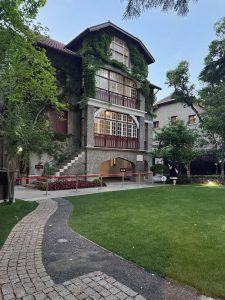
One of the mansions in Sinan Open Air Museum
These old mansions left behind by the French are mostly repurposed into restaurants
wefie with one of the buildings in Sinan Open Air Museum
Wefie in Sinan Open Air Museum
One of the colonial buildings in Sinan Open Air Museum
Xintiandi (新天地)
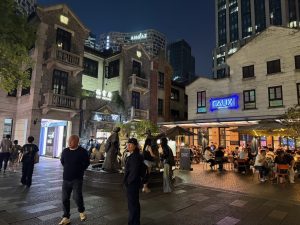
Leaving Sinan Open Air Museum and 15 minutes walk later, we arrived at Xintiandi. Xintiandi is a relatively small area compared to Tianzifang, primarily comprising restaurants and bars, as well as a handful of shops, housed in stone and brick buildings. As it was dinner time, Xintiandi was especially lively with diners chatting and the clinking of wine glasses. Several large shopping malls occupy the land adjacent to Xintiandi. Filled with luxury boutiques and billboards so bright that they illuminated the street. As there wasn’t much for us to do here, except watch people eating and drinking, we didn’t stay long and headed back to our hotel via the subway.
Shanghai inherited some of the charming old buildings left by the Europeans
Our first glimpse of Xintiandi across the road
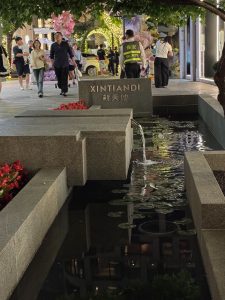
With this sign, we are sure we arrived in Xintiandi
There are a handful of retail shops in Xintiandi
The buildings in Xintiandi are very European
Xintiandi is busy tonight
Wefie in Xintiandi
The Xintiandi shopping mall
Most of the shops in Xintiandi are restaurants
There are several big shopping malls in Xintiandi
Night View of the Bund
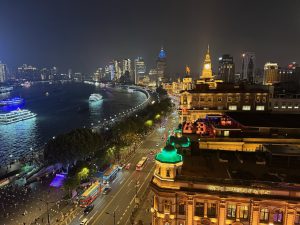
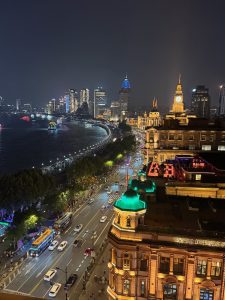
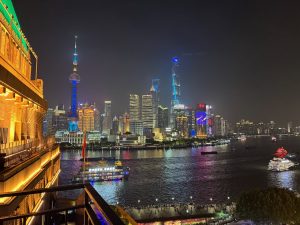
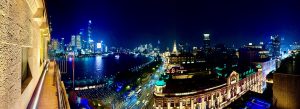
We returned to the hotel around 8:30 pm, before the lounge in our hotel closed. Our butler had pre-arranged for us to visit the rooftop terrace. The staff at the lounge escorted us to the rooftop terrace, where we were treated to a stunning night view of the Bund and Pudong area. Being located on the Bund, facing the Pudong area, the rooftop terrace of our hotel provided an unobstructed view of the buildings in Pudong, illuminated by neon lights. From the roof terrace, we were also able to catch part of the buildings on the Bund dressed in their orange garb. In contrast to the large crowd below at the Bund, the view up here was peaceful.
We got a great view of the Bund from the roof terrace of Peace Hotel
The iconic green roof of Peace Hotel and the skyline of Pudong
View of the Bund and Shanghai Three Towers across the river
Night view of the Bund is especially charming
The skyline of Pudong area
Panoramic view of the Bund from the roof terrace of Peace Hotel
The night view of the Bund and Pudong from the roof of Peace Hotel
Taking a picture on the roof with the skyline of Pudong
The roof terrace of Peace Hotel is a large area
The iconic green roof of the Peace Hotel
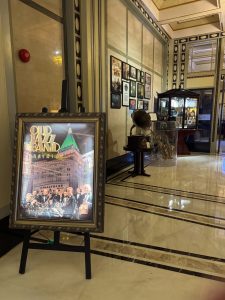
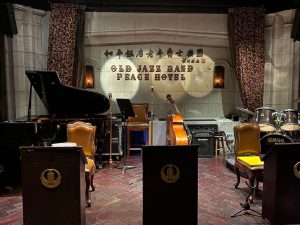
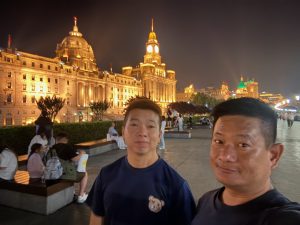
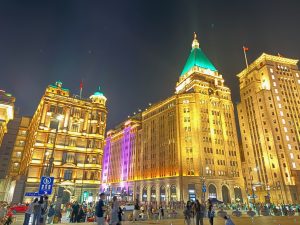
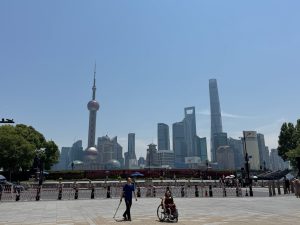
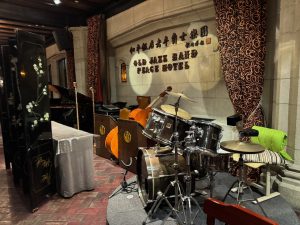
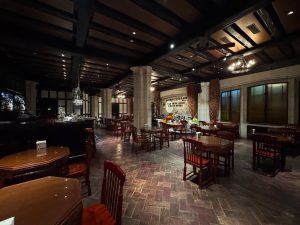
After visiting the roof terrace, we headed to the famed Jazz bar in the Peace Hotel. Our butler had made a reservation for us at the bar to watch the world’s oldest band perform. We were privileged to be given front row seats with an unobstructed view of the band performing. As we did not have a good shot of the Bund, we headed out to the promenade after the jazz performance to take some pictures of the Bund. The buildings on the Bund were especially beautiful at night with the orange light cast onto them. The promenade was bustling with life, with visitors taking pictures of the Pudong skyline and street vendors trying to sell their photography services despite being late at night. We returned to our hotel to rest for the night after taking our fair share of pictures.
The Old Jazz Bar in Peace Hotel
Artefacts of the Jazz band at the entrance to the bar
Waiting for the Jazz Band in the bar
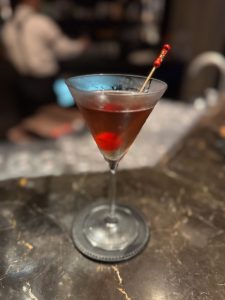
Having a cocktail while enjoying the jazz music
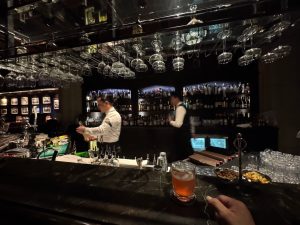
The bartenders at the jazz bar
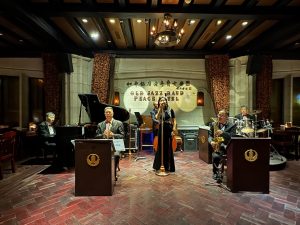
The jazz band getting ready to perform for the audience
Wefie with the Jazz band in Peace Hotel
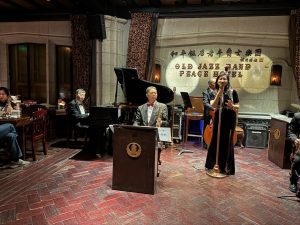
The jazz band entertaining us
The jazz band in Peace Hotel
The buildings on the Bund at night
The iconic Peace Hotel on the Bund
Wefie with the Peace Hotel on the Bund promenade
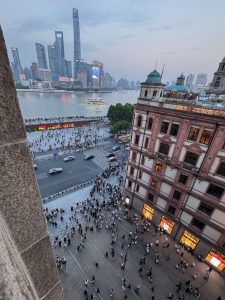
The Bund at night is crowded with people
It is difficult to capture all the buildings on the Bund in one frame
There is a Chinese saying: while there is Heaven above, there are Suzhou and Hangzhou on Earth (上有天堂,下有苏杭). This saying compares the scenery of Hangzhou and the gardens in Suzhou to heaven. Since we had some time in Shanghai, we decided to take a day trip to Hangzhou.
From Shanghai to Hangzhou
Hangzhou is approximately 179 km from Shanghai, and the fastest way to travel from Shanghai to Hangzhou is by high-speed train, which takes about 1 hour. Shanghai has two train stations: Shanghai Station and Shanghai Hongqiao Train Station. Although slightly farther from where we stayed, we took the train from Shanghai Hongqiao station as there are more connections between the two cities here. Three train stations serve the city of Hangzhou: Hangzhou Station, HangzhouDong Station, and HangzhouXi Station. Hangzhou Station is in the centre of the city, but connections between Shanghai Hongqiao Station and Hangzhou Station were few. HangzhouXi Station is far from the city, while HangzhouDong Station offers more connections and is closer to the city. Train tickets can be bought at the train station or via Trip.com. We purchased our tickets through the Alipay app, which includes a link to the Trip.com microsite.
Shanghai Hongqiao Train Station is directly linked to the metro station
Inside the basement of Shanghai Hongqiao Train Station
There are automated ticketing machines for passengers to purchase train tickets
There are well-marked signs pointing passengers to the departure hall
The waiting room at the departure hall of the train station
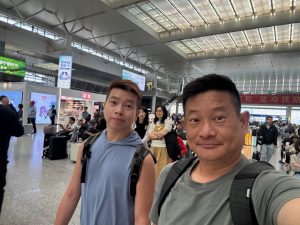
Wefie at the departure hall while waiting for our train
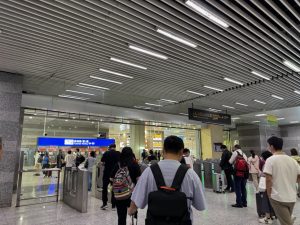
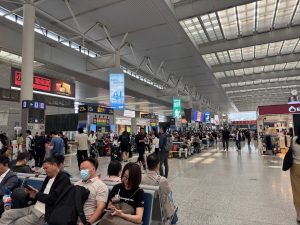
Shanghai Hongqiao Train Station is well-connected to Metro Lines 2 and 10, both of which pass through East Nanjing Road Station, where our hotel is located. It took about 50 minutes on the metro from our hotel to the train station. We set out from our hotel at 7:00 a.m. to catch our 8:15 a.m. train, taking into account the transit time between our hotel and the train station, as well as any other potential delays that might occur along the way. Our train to Hangzhou departs from level 2 of the train station. There are marked signs in both Chinese and English throughout the station that guide us to our destination. We were also not required to collect any tickets before boarding our train. Our passport details have been entered into the train ticketing system. We just need to scan our passports at the manned counter to gain access to the platform. The ride on China’s high-speed train was very smooth and comfortable; we were even given a bottle of water and some snacks for the duration of the ride. To get to the city from the HangzhouDong train station, we can take the metro or hail a cab. As we have limited time in Hangzhou, we went for the cab option. Getting a Didi (China’s Uber equivalent) was super easy. Although we didn’t have a local number, we were still able to use Didi through the Alipay app. There are designated areas in the train station for Didi pickups. At the pick-up point, a large display shows the cabs already pulled in, and we just need to look out for the car’s plate number and head to the parking lot.
The high speed train that we took from Shanghai to Hangzhou
Wefie in our first class seat on the highspeed train
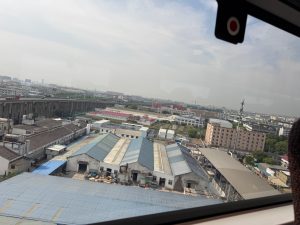
Zooming past Greater Shanghai
We were given a snack box and a bottle of tea or water on the train
Train staff distributing snacks for this short 1-hour ride
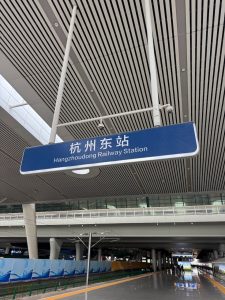
We arrived at Hangzhoudong Train Station
Wefie with the train that took us from Shanghai to Hangzhou
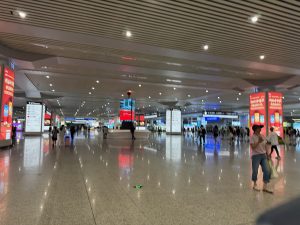
Inside Hangzhoudong Train Station
The waiting room for ride hailing pick up where our eyes were glued to the screen to check which pick up bay our ride was assigned to
West Lake (西湖)
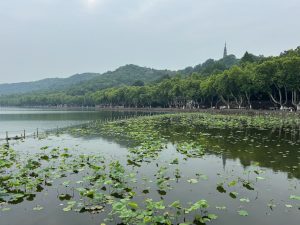
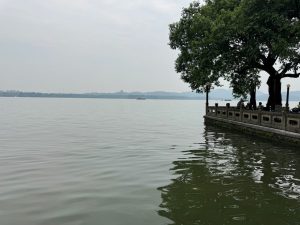
Visiting Hangzhou without coming to West Lake is like going to Paris and not visiting the Eiffel Tower. West Lake is the main attraction in Hangzhou, and it is this lake that gives Hangzhou its title of “Heaven on Earth.”
The West Lake upclose
Baochu Pagoda (保俶塔)
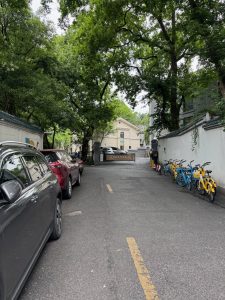
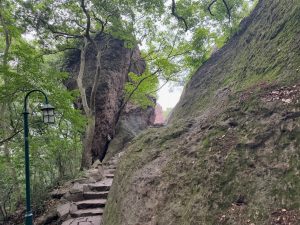
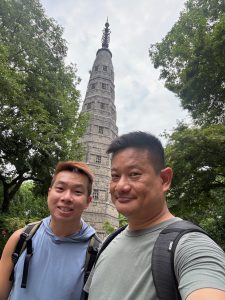
The first sight we visited in Hangzhou was Baochu Pagoda, one of the two pagodas in West Lake. Perched on top of a hill, we thought scaling up this pagoda would give us a great view of the entire West Lake. As our Didi ride came to a stop, we were dropped off at a neighbourhood-looking area. It took us 30 minutes to travel from our drop-off point to Baochu Pagoda. The walk to Baochu Pagoda requires a short hike up a small hill through a forested area. Occasionally, we saw groups of elderly people having fun in the open spaces along the path. As we walked along the path with signs pointing to the pagoda, the forest scenery gave way to rocky formations. The pagoda is not far from a pavement that seemed to wedge between narrow rocks.
We initial climb started with a leisure walk uphill through a neighbourhood
The beginning of our climb through a forest to Baochu Pagoda
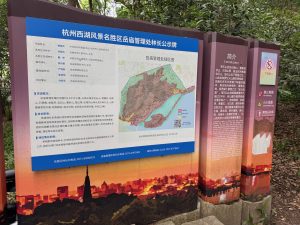
Introduction to the hill we were going to climb
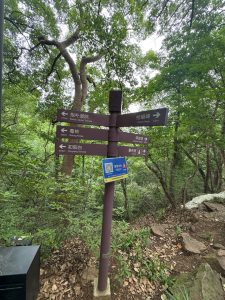
There are signs like this on the pavement pointing us the right direction
My friend posing in the pavement between the rocks
The climb is almost ending
Past the rocks, we arrived at an open area, where we could see the pagoda sitting in one corner. From here, we were treated to a view of West Lake. We could see the mountains surrounding the lake as though they were protecting it. The view would be better if not for the trees from the forest below, which partially block the view. Nonetheless, we were able to see the Broken Bridge from one of the many viewpoints here. We wasted no time and approached the Baochu Pagoda. The moment we arrived, we were disappointed to find that the slender pagoda was closed to the public, and we were not able to climb to the top of the pagoda. Since we made it up here, we visited a nearby rock and pavilion before heading back down. As we walked down the staircase next to the pagoda, we noticed that this path was an easier climb. This is when we realised that we should have put the Baochu Pagoda car park as the drop-off point.
We got a good view of the Broken Bridge and the West Lake at the top of the hill
The slender Baochu Pagoda, which is closed to the public for climbing
Introduction to Baocchu Pagoda
Wefie with the Longevity Rock on top of the hill
Wefie with Baochu Pagoda
Wefie in front of a pavilion on top of the hill
Another view of West Lake and the Broken Bridge
Taking a wefie at the easier way up to Baochu Pagoda
Broken Bridge (断桥)
Our next stop was the Broken Bridge, about a 10-minute walk from the Baochu Pagoda. We had a brief rest at Starbucks on the southern part of the lake to escape the heat. The weather was rather humid when we did the climb to Baochu Pagoda. After resting briefly, we walked across the road to the Broken Bridge. The Broke Bridge was essentially a series of three sandbars connected by bridges. This place was given the name “Broken Bridge” as these bridges connecting the three sandbars appear to be broken when viewed from a distance during winter due to the snow. The Broken Bridge was the setting in the Chinese folklore “Legend of the White Snake” (白蛇传), centred around the romance between a man and a White Snake Spirit. Walking on the sandbars of the Broken Bridge brought us close to the West Lake; it felt like walking on the lake itself. We could see Baochu Pagoda sitting atop the hill we were on moments ago, as though she was flexing her beauty on the shores of the lake from the Broken Bridge. Locals taking their leisurely walk along the bridge, boats pulling off from the sandbar, paddling on the lake, and occasionally some locals feeding the ducks on the lake are common sights along the sandbar. Walking on the Broken Bridge was mostly relaxing, but we had to avoid the many tourist trams along the way. As our next stop, Leifeng Pagoda, was a distance away from the Broken Bridge, we initially wanted to take the tourist tram (costs RMB 80 per person). We managed to find one where the seats facing the back were empty. Unfortunately, the driver was on his way for his lunch break. We continued our walk towards the end of the sandbar, looking out for the next tram with the last row empty. Soon, we found ourselves at the end of the sandbar. We spotted some buses making a U-turn. We approached a lady who appeared to be a staff member, and she recommended that we take one of these buses to Leifeng Pagoda, which costs only RMB 2 per person.
Panoramic view of the West Lake from ground zero
Wefie with West Lake
One of the bridges on the Broken Bridge
We were able to see Baochu Pagoda from West Lake
One of the boats for tourists to hire on West Lake
Panoramic view of the Broken Bridge
Mandarin ducks swimming on West Lake
Wefie on Broken Bridge
Another perspective of West Lake
One of the buildings by the shore of West Lake
Leifeng Pagoda (雷峰塔)
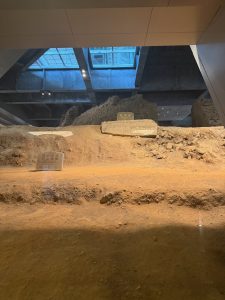
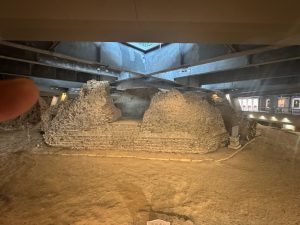
The bus ride to Leifeng Pagoda took only 10 mins, saving us time and a lot of walking. To get to Leifeng Pagoda from the Broken Bridge, we rode the bus for eight stops and alighted at Sutinankou (苏提南口). While the Baochu Pagoda was often described as the beauty of West Lake, in contrast, the bulky appearance of the Leifeng Pagoda was often associated with a monk. The entrance to Leifeng Pagoda costs RMB 40 per person. We visited the basement level first, followed by heading to the ground floor and taking a lift up to the top floor of the pagoda, and slowly making our way down the pagoda. The basement of the Leifeng Pagoda exhibits its original structure. Leifeng Pagoda was originally built in 977 AD as a monument to house the hair of Buddha. The pagoda collapsed due to excessive brick theft and nearby construction work. The pagoda we see today was rebuilt and reopened in 2002. Leifeng Pagoda is also the setting of the story in “Legend of the White Snake”, where the white snake spirit was trapped under the pagoda for years until her son released her. From the original structure on display in the basement, I wonder if the locals linked the collapse of the pagoda to the efforts of the white snake’s son in saving his mother. In addition to the original structures, the basement also features the original bricks and some Buddhist relics.
Leifeng Pagoda seen from the bus stop
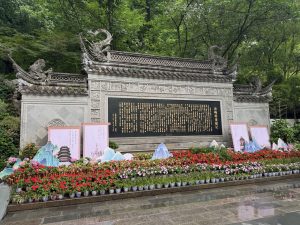
The record of the reconstruction of Leifeng Pagoda
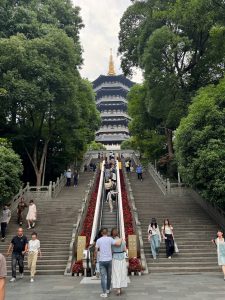
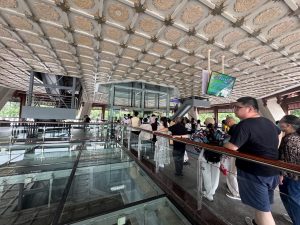
Leifeng Pagoda is served by two escalators bringing visitors to the base of the pagoda
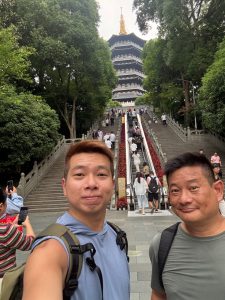
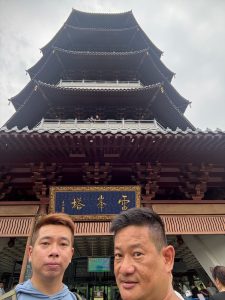
Wefie with Leifeng Pagoda
The original structure of Leifeng Pagoda on display at its basement
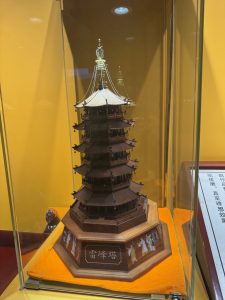
Replica of Leifeng Pagoda
Buddhist relics on display at the basement of Leifeng Pagoda
The original structure of Leifeng Padoga on display at its basement
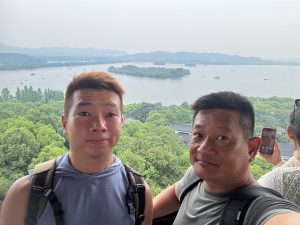
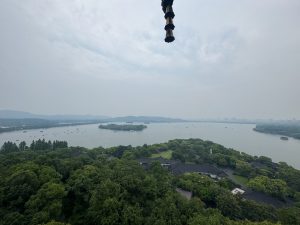
We headed to the ground floor to take one of the lifts to the top of the pagoda. The lift only stops at level 5 of the 7-storey pagoda; visitors must walk up the remaining two levels. As we emerged from the lift on level 5, we were captivated by the golden underdome of the level, but didn’t spend time looking at it. Our goal is to go to the top of the pagoda. At the top of Leifeng Pagoda, we were treated with an unobstructed view of the West Lake. This offers a far better view of the lake compared to the hills where the Baochu Pagoda is located. From here, we can see the Baochu Pagoda, seemingly emerging from the ground like a needle being stuck, as well as the numerous bridges on West Lake and the islets within the lake. Most of the visitors on this level focus on the view of the lake, and we found fewer crowds at the side facing the hills behind the pagoda. Although not as scenic, the hills stretching to the horizon evoke a certain tranquil vibe. It is a pity that today was a hazy day.
Wefie at the base of Leifeng Pagoda
There is a long queue for the lift up Leifeng Pagoda, but it moves very fast
Wefie on the top of Leifeng Pagoda with West Lake
View of West Lake from Leifeng Pagoda
On the top of Leifeng Pagoda
The hills behind Leifeng Pagoda
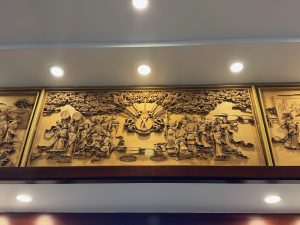
On our way up, via the lift, we saw numerous carvings on each level. We were able to take a closer look at them while walking down the pagoda. Each level depicts carvings of different scenes. The most memorable ones are those on the 5th floor and the 1st floor, depicting the birth and enlightenment of the Buddha, and scenes from “Legend of the White Snake”, respectively. These carvings, other than being a work of art, tell a story on their respective levels. The carvings are intricate, and one can spend hours looking at them. I thought the RMB 40 for the Leifeng Pagoda was worth it, as we got a better view of West Lake compared to the hills of Baochu Pagoda.
Engraving on Level 5 of the pagoda
The engravings on level 5 depicts the life of Buddha
Buddha spreading scriptures to his followers
There are engravings on the scenes of West Lake on Level 4
Level 1 depicts engravings from scenes of "Legend of the White Snake"
Scenes from the lore "Legend of the White Snake"
This engraving on level 1 depict the white snake spirit being imprisoned under Leifeng Pagoda
QingHefang (清河坊)- The Historic Commercial Centre of Hangzhou
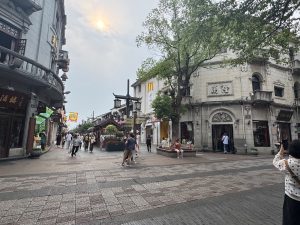
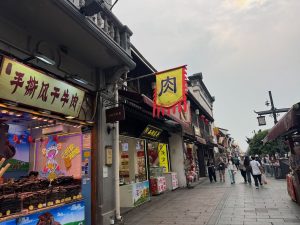
It was already 3 pm by the time we were done with Leifeng Pagoda. We spent the remaining 4 hours in Hangzhou shopping on the iconic Hefang Pedestrian Street (河坊街). As we were feeling a little peckish, we hailed our ride using the Didi app in Alipay, which took us to Hefang Street in 20 minutes, instead of taking the bus (which would have taken us 1 hour). Hefang Street, one of the ancient streets in the Qinghefang commercial centre, is an ancient street where the business and political centre was located. Qinghefang comprises three streets: Hefang Street (河坊街), Wushan Square (吴山广场) and Southern Song Imperial Street (南宋御街). Today, these streets still preserve ancient buildings that have been repurposed as shops selling souvenirs to visitors. Walking along Hefang Street is like stepping right into the pages of history. Despite the numerous shops around, we thought the shops sold mostly the same things; it felt like these shops were copied and pasted, with the same order of shops selling the same things repeated over and over as we walked through the street.
The stores in this part of Hefang Street sell handicraft souvenirs
Hefang Street in Hangzhou
Walking along Hefang Street
Wefie on Hefang Street
Hefang Street is colour and bustling with life
View of Hefang Street from the second level of one of the shops
Hefang Street preserved the ancient China architecture style
Hefang Street is filled with shops selling souvenirs
We tried to cover every street on Hefang Street and found ourselves in front of an ancient gate building with the Chinese words “Drum Tower” (鼓楼) inscribed on it. This tower was used to mark time and announce important events in the past. Today, visitors can only walk under the Drum Tower to a street filled with restaurants and eateries. We traced our footsteps back to Hefang Street and came to the Southern Song Imperial Street. Compared to Hefang Street, the Southern Song Imperial Street sees less foot traffic and feels more peaceful. This street is shorter than Hefang Street, with mainly art galleries.
Walking towards the Drum Tower
Wefie with the Drum Tower in Qinghefang
The Drum Tower in Qinghefang
Map of Qinghefang
This plaque marks the start of the food street
The food street is dotted with numerous restuarants
Even the restaurants on the food street are housed in ancient Chinese architecture
We had 1 hour left before our train back to Shanghai departed. Instead of the HangzhouDong Station, we managed to find a train that departs from Hangzhou Station, about a 25-minute walk from Hefang Street. As we still had some time, we chose to walk to the train station. Along the way, we encountered the peaceful and tranquil side of Hefang Street. We arrived at Hangzhou Station in time for our train, which took us back to Shanghai in one hour. We shopped for food below our hotel before returning to our room to rest for the night.
Last look in Hefang Street before we leave for Shanghai
Walking along the river from Hefang Street towards Hangzhou Train Station
Hangzhou Train Station is about 25 mins walk from Hefang Street
Checking into the departure hall waiting room in Hangzhou Station
Our train back to Shanghai departs from Hangzhou Station
Wefie with the train that took us back to Shanghai
This is a continuation of our cruise from Shanghai to Fukuoka. We were primarily in Shanghai for the cruise and decided to spend a few more days exploring the city after our cruise trip ended. The last time I was in Shanghai was almost three decades ago, and I thought it was a good time for me to return to the city. Our cruise ship was already docked when we woke up this morning. After having breakfast at one of the restaurants onboard, our Royal Genie (butler) met us at 8.30 am to escort us off the ship, ensuring that our disembarkation was smooth. After meeting the driver that we arranged with our hotel for land transfers within Shanghai, we made our way to the hotel for check-in. The plan today was to take it easy and visit the sites near our hotel.
We cleared the port customs relatively quickly and were at the arrival gate
Wefie at the Shanghai Cruise Terminal while waiting for our driver
The Bund
Our hotel is situated on the bank of the Huangpu River on the Bund. The Bund is an iconic stretch of Shanghai, where the old financial centre and activities for the rich and famous are located. Our driver pulled up at the iconic Peace Hotel, where we would call home for the next four nights. At the hotel, we met our butler, Gordon, who gave us a brief orientation of the hotel. Before heading to our room for in-room check-in, Gordon gave us a tour of several suites, including the River View Suite and the Japanese Suite, one of the seven national suites. The highlight of the brief tour was a visit to the Sassoon Suite, the hotel’s Presidential Suite. Perched on the 10th floor, the Sassoon Suite was originally the apartment of Victor Sassoon, the hotel’s original owner. This suite has a vantage point of the Huangpu River and directly faces the Pudong district across the river. Entering this suite, we felt immediately transported back in time to 1920s Shanghai. The suite is very well restored to its original setting. Gordon told us most of the decor we saw in this suite was restored based on the old photos of the suite. We were also told that this suite is the only one with a terrace and that President Obama was a guest in the Sassoon Suite during his visit to Shanghai. After the tour, we were escorted to our room for check-in, where our luggages were already being delivered to the suite.
The Sassoon Suite used to have a working fireplace in the living room
The living room of the Sassoon Suite in Peace Hotel
There is a full dining room in the suite
The pantry in the suite where food is being delivered and prepared
The bedroom of the Sassoon Suite where President Obama stayed when he visited Shanghai
Our Private Tour of the Iconic Peace Hotel
Fairmont Peace Hotel itself is an attraction on the Bund. Its green roof has been an icon on the Bund since the 1920s. Naturally, many significant events took place at the hotel. With such a rich history, the hotel offers complimentary scheduled historic tours of the hotel and its museum, conducted in both English and Chinese. Gordon organised a private historic tour of the hotel for us. We met up with our guide, Richard – the hotel’s historian, at the reception. Our tour began at the hotel’s museum, one floor above the reception. Richard took us through the exhibits in the small museum, from the famous persons who had stayed in the hotel and the suites they had occupied, to the silverware and menus crafted for specific events, to the important events and meetings hosted at Peace Hotel. Richard then brought our attention to a bill that was dated in the 1930s. Although the amount stated in the bill seems small compared to today’s standards, considering inflation and the cost of living at the time, Richard mentioned that the bill was easily equivalent to a year’s salary for a typical Shanghainese in the 1930s. Of the exhibits, the one that intrigued me the most was a small metallic disc. Richard pointed out this was a metallic vinyl record, which stored music played in the Jazz bar back in the days, and a memento for guests. I jokingly remarked that this was the predecessor of CDs.
Wefie in front of the iconic Peace Hotel before our tour
The two buildings of Peace Hotel
View of the Pudong Area from our hotel
The Peace Hotel Museum houses artefacts that the hotel collected over the years
Peace Hotel Museum is open to public, but the guided tour requires prior booking
The silverware was custom-made for Russian Sailors when they stayed in the Peace Hotel
After the tour of the museum, we were brought to the octagon hall, where Richard directed our attention to the large dove sitting in the centre of the hall. This dove is made of 1,500 liuli (琉璃) crystal and weighs more than 1,000 kg to symbolise peace. We were drawn to the metallic murals hanging on the walls of the octagon hall, where Richard pointed out that they depicted the old times in Shanghai. Our tour continues through a hallway where a collection of movies and TV shows that were shot in the Peace Hotel. Our tour concludes at the small hall at the end of the corridor. Richard explained that this was the original main entrance of the hotel, but it had been closed permanently due to feng shui reasons. The significant structure in this original entrance was the split stairs, which are one of the original features since the hotel was built. We were shown a picture of Charlie Chaplin on the stairs.
The octagon lobby of the Peace Hotel
One of the artworks in the lobby depicting the Bund
Another artwork in the lobby depicting old Shanghai
Picture of the iconic Peace Dove in the octagon lobby of the hotel
The Jazz band in Peace Hotel was conferred the world's oldest Jazz band by Guinness World Records
The Old Jazz Band club
The Peace Dove was made up of 1,500 pieces of liuli crystal
The Jazz club
The official main entrance to Peace Hotel was closed permanently due to feng shui
The staircase in the former main entrance where Charlie Chaplin took a picture at
East Nanjing Road – The Ever-Busy Street
After our tour of the hotel, we returned to our room to rest a little. Soon, hunger pangs hit us, and we headed out to the restaurant that Gordon recommended near the hotel for lunch. After lunch, we wanted to purchase a stored-value metro ticket for Shanghai, which would provide convenience when taking the metro around the city. However, the nearest subway station to our hotel does not sell them, and we had to go one station further to People’s Square Station to get them, which is further down East Nanjing Road. Since we had the intention to stroll along East Nanjing Road, we took this opportunity to walk along the street towards People’s Square Station. East Nanjing Road is always crowded with people, regardless of the day of the week. East Nanjing Road is dotted with buildings that were left behind from the World War era, when the city was divided and ruled by different nations. As a result, we see some buildings with a distinctly European architectural style and others with a distinctly Chinese style. Walking along the street feels like walking in history. There are many smaller shops along East Nanjing Road, mainly selling famous Shanghai snacks and souvenirs, as well as eateries and cafes. We also spotted several larger department stores, where most of the luxury brand goods are housed, and fashion boutiques along the road. After getting our transport cards from People’s Square Station, we had the option of taking the metro one stop back to East Nanjing Road Station or walking back. As we were a bit tired after walking, we hopped onto one of the tourist tram rides (RMB 10 each) and saw East Nanjing Road from a different perspective.
East Nanjing Road has a mix of buildings from yesteryears and modern tall buildings
The modern shopping malls on East Nanjing Road
East Nanjing Road is a good representation of how a city merges the old and the new
Shoppings along East Nanjing Road
The older buildings on East Nanjing Road
Shopping and eateries on East Nanjing Road
East Nanjing shopping street
Buildings on East Nanjing Road
Entrance to People's Square, opposite East Nanjing Road
One of the shopping malls on East Nanjing Road
Weifie with the East Nanjing Walking Street signage
We took a tourist tram back to the Bund
The tourist tram that plys along East Nanjing Road
Pudong (浦东) District
We wanted to catch the sunset on the Shanghai Tower, so we headed to the Pudong Area, Shanghai’s financial centre. There are two main ways to access the sights in Lujiazui (陆家嘴): by metro or ferry.
Crossing Huangpu River
Instead of going underground, where we would miss the iconic sight of having both the Bund and Pudong area in one frame, we opted for the Shanghai Ferry ride across the Huangpu River to Lujiazui. Jingling East Road Ferry Terminal is the nearest ferry pier to East Nanjing Road. To get to the ferry terminal, we headed for the Bund and walked along the promenade. The ferry terminal is a stone’s throw from a lighthouse-looking tower along the promenade. Crossing the Huangpu River via the ferry costs RMB 2, payable with a Shanghai metro card or Alipay. Shanghai Ferry has been transporting Shanghainese since 1911, over 100 years ago. The ferry was the only means for Shanghainese to reach the Pudong area before the tunnels and bridges were built. Today, the Shanghai Ferry primarily serves sightseeing purposes, and the last ferry service across the river concludes at 6:30 pm. The best view of the Huangpu River from the ferry was from the back of the boat on the upper deck. We saw a beeline of people rushing for the upper deck and did likewise. Fortunately, we were able to secure a great spot at the back of the boat to enjoy the view of Shanghai’s iconic landmarks. As the ferry slowly pulled away from the pier, we were treated to a view of the buildings on the Bund. The view was the best in the middle of the river, where we were able to capture landmarks on the Bund and Pudong in one frame.
Pudong Area seen from the entrance of our hotel on the Bund
Some of the buildings on the Bund
The iconic Pudong skyline seen from the Bund promenade
Wefie with the Pudong skyline from the Bund promenade
We boarding the ferry from Jingling Road East Pier
The ferry that would take us across the Huangpu River
Pudong skyline seen from the ferry
Wefie with the Pudong skyline on the ferry
Wefie on the ferry as we were pulling off from the pier from the Bund
Evening view of the Bund form the ferry
Pudong skyline from the ferry as we were crossing Huangpu River
Wefie with the Bund on the ferry
View of the Bund from Pudong Pier
The piers the Shanghai ferry serves on Huangpu River
The ferry that took us across the Huangpu River
Our ferry pulls into Dong Chang Road Pier in Pudong
Shanghai Three Towers (上海三件套)
The ferry docked at Dongchang Road Ferry Terminal, and we are officially in the Pudong district. The Pudong area used to be farmland, where no one wanted to stay. Fast forward decades later, the Pudong area is one of the highly sought-after areas with skyrocketing property prices. Pudong had been transformed from farmlands to the city’s financial centre. In the centre of the financial centre lies the Shanghai Three Towers (上海三件套). Our original plan was to catch the sunset from the top of the Shanghai Tower and then return to take night shots of the three towers. Since we were walking past, we took the opportunity to take pictures of the iconic three towers. There is a specific spot where locals gather to take pictures of the three towers is the small open area adjacent to Jin Mao Tower. It is even charted on the Chinese equivalent of Google Maps, as Wang Hong da ka jing dian (网红打卡景点), which translates to a social media influencer’s picture-taking spot. One will not miss the spot, as we saw locals placing their phones on the ground, taking pictures of themselves with the three towers. This is the spot where we can capture the tops of all three buildings – Jin Mao Tower, Shanghai Tower, and Shanghai World Financial Centre, all pointing towards each other in one frame. We tried to follow the locals’ lead and took some pictures before dark. After taking our fair share of pictures, we headed to the Shanghai Tower to view the city from high up.
The three towers of Shanghai
We got the shot of the three towers in a small park in front of Jin Mao Centre
The iconic three tower shot
Shanghai Tower – Night View of the Icons at the Top of Shanghai
Several towers in the Pudong area offer a view of the Huangpu River and the Bund. On the one hand, I wanted to visit the Oriental Pearl Tower, as I had seen it for the first time 30 years ago. However, this shorter tower may not provide the best view of the Bund. The other tower is the taller Shanghai Tower, which features the highest observation deck in the country. The Shanghai Tower is approximately 632m tall, making it the third-tallest building in the world. Although it is not the tallest building in the world, the Shanghai Tower’s observation deck, at 546m, is higher than that of the Burj Khalifa in Dubai, at 452m. There are two prices for the entrance to the Shanghai Tower. RMB 180 only got us to the observation deck on level 118, while the more expensive RMB 268 ticket includes entrance to the light show on level 126. We bought the more expensive RMB 268 ticket, thinking we would be able to look out into the city at the tower’s highest vantage point. Our first stop was the observation deck at level 118, where a lift sped us up over 500m in under 3 minutes. The view from the observation deck on level 118 was stunning! The limits of Shanghai city seem to stretch beyond the horizon. From here, we were able to see the bend of the Huangpu River and the entire stretch of the Bund, as well as the Oriental Pearl Tower situated next to the river. The view of the city at night was especially beautiful. As we were walking around, we were telling ourselves, “This is just the beginning, the view on level 126 would be better”.
The ticket office for Shanghai Tower is located outdoors
My ticket to Shanghai Tower
There is an exhibition of the tallest buildings in the world after the entrance to Shanghai Tower
Fancy signage before the lift to the top of the tower
The lift in Shanghai Tower is one of the fastest in the world
View of Pudong and The Bund from Shanghai Tower
Wefie at the observation deck of Shanghai Tower
Wefie with view of the Bund from Shanghai Tower
We were able to catch view of the entire Bund from Shanghai Tower
We took another lift up to level 126. Entrance to that level is scheduled at a specific time, probably for crowd control purposes. Our excitement for level 126 turned to disappointment upon arrival at level 126. Instead of the floor-to-ceiling windows we saw on level 118, there were walls enclosing this level. In the centre of the level was a large structure, dubbed the Intelligent Eye of Shanghai. This is the damper of the tower, installed to counter the lateral movement of the tower due to wind or earthquake. Unlike the damper in most buildings, which is typically spherical, the damper on the Shanghai Tower resembles the eye of a dragon. We were urged to spread out for a light show. This is when we realised the timed entrance to this floor is actually for the light show. As beautiful as it might be, we felt a little bored since we weren’t exactly into light shows. The light show lasted about 10 minutes. We felt paying the extra for access to level 126 without the view of the city was not worth the money. Unless one is into light shows, I’d rather spend the additional money on food.
Level 126 is only occupied by the damper of the building
Wefie with the damper on level 126 of Shanghai Tower
The light show on level 126
The damper is shaped like the eye of a dragon
Laser and light show on level 126 of Shanghai Tower
Parts of the light show is pretty impressive
The damper is cast in mulitple coloured lights
The laser effect as part of the light show
The light show on level 126
We descended the tower for dinner after the light show. We only managed to find a restaurant at the tower that was still open. After dinner, we returned to the photo spot to take night shots of the Shanghai Three Towers before returning to our hotel via the metro to rest early. We had an early start tomorrow, catching the high-speed train to Hangzhou.
View of the three towers at night seen from the base of Shanghai Tower
Wefie with the Shanghai Three Towers at night
Shanghai Three Towers at night
There are still alot of people at the spot for to take the three towers
We returned to our hotel in subway, which is very efficient and comes very frequently
We had a port day in Fukuoka. As our cruise ship was departing the port at 6:30 pm, we only had about 12 hours to explore Fukuoka. Fukuoka Cruise port is not far from the city, and is very well connected by local buses and taxis. Local buses 11, 19, and the BRT connect the port to the city at 15-minute intervals. The bus stop is not located at the cruise terminal, but in front of the Hakata Port International Terminal building, next to the cruise terminal. The bus ride to the city centre took about 19 minutes, and costs ¥260 per trip. As we are limited to Fukuoka city due to our tight schedule, we can only visit the sights within the city itself.
We spotted a number of tour guides waiting for the passengers on the cruise for their shore excursion tours
We were amongst the first few to clear the port custom in Fukuoka Cruise Centre
Our ship was docked at Fukuoka Cruise Centre
The bus stop is in front of Hakata Port International Terminal located next to the Fukuoka Cruise Centre
Map showing the stop the bus will call by along the way to Hakata station
This is the bus stop where we took the bus to Fukuoka city
The Temples and Shrines of Fukuoka
Temples and shrines are the only sights in Fukuoka city, other than an old shopping street. We visited these places of worship in the morning and did some shopping after lunch.
Shofukuji Temple: Japan’s First Zen Temple
Our first stop on the temple hop is the Shofukuji Temple. Gofuku-Machi bus stop, four bus stops before Hakata Station, is the nearest to the temple. Shofukuji Temple dates back to the 12th century and is the first Zen temple in Japan. The temple grounds are huge, and without a map to guide us, we decided to walk in as far as we could and work our way out. Walking past the main gates to the temple, we can almost immediately feel a sense of zen. One would automatically soften one’s volume when walking within the temple grounds. The gardens of the temple are populated with rows of tall trees, and with the little footfall, walking in the temple grounds felt very peaceful. A wall surrounded the buildings at the back of the temple grounds. We walked along the wall in search of an entrance to these buildings. Little did we know that this part of the temple was off-limits to the public. We assumed these were the living quarters of the temple priests and did not bother looking for an alternate entrance. We spotted a large wooden structure sitting in front of the cordoned-off area and decided to investigate it.
Our first wefie on the streets of Fukuoka
The main entrance to Shofukuji Temple
The temple grounds near the entrance
A Buddha statue near the entrance of Shofukuji Temple
We walked past the bell tower as we were walking to the back of the temple grounds
The part of the temple that is out of bounds to visitors is planted with bansai trees to add to its Zen vibe
Wefie in the grounds of Shofukuji Temple
This large wooden building turns out to be the main temple in Shofukuji Temple. The main temple is also off-limits to visitors. There is a window through which we were able to see inside the temple. Three large golden statues of Buddha occupy the space inside the building. The interior of the building looked old but was very well-preserved. We spotted a string being tied to the hands of each of these Buddhas and did not think too much of it. Since there was nothing much we could do here, we left after paying our respects to the Buddha statues. As we turned around, we spotted a tall wooden pillar in front of the temple building, about 5m away. This is when my friend pointed out a string that runs from this pillar into the temple, which might mean this is how devotees connect to the Buddha statues inside. We headed back to the temple and noticed the string is indeed connected to the Buddhas inside. We headed out and prayed to the pillar, transmitting our wishes through the string to the Buddhas.
The main prayer hall in Shofukuji Temple
There is a pillar with a string that ran from inside the prayer hall
Wefie with the prayer pillar that connects us to the Buddhas inside the main prayer hall
The main prayer hall houses three golden Buddha
As we were walking out of Shofukuji Temple, we returned to the ancient wooden bell tower we saw earlier. However, we did not spot any entrance that we could enter to scale the tower. Seeing there was really nothing much we could do here, we headed back to the entrance of the temple, passing a small stone bridge over a koi pond and made our way to the next attraction. I thought visiting the temple via the koi pond, heading to the large temple with the Buddhas, and returning for a view of the bell tower as one is exiting the temple grounds was the most efficient way to visit the temple. Since most of the temple is closed to the public, it shouldn’t take more than 15 mins to visit the temple.
Walking back to the bell tower
There is another building in front of the main prayer hall that is cordoned off to the public
Wefie at the koi pond near the entrance of Shofukuji Temple
Map of Shofukuji Temple
Tochoji Temple: The Oldest Shingon Temple on Kyushu
We can see our next stop right across the road from Shofukuji Temple. From the entrance of Shofukuji Temple, we can also see the five-storey pagoda. To enter the temple, we had to walk around the corner to the main road, where the temple’s entrance is located. Founded in 806 AD, Tochoji Temple is the oldest Shingon temple in Kyushu. The temple looked very well maintained, and its wooden main entrance is perhaps the oldest-looking structure here. The courtyard of the temple is a vast open space where we can see a pagoda, a large main prayer hall, and an octagonal pavilion. We were drawn to the bright red five-storey pagoda on the side. Topped with a golden spire, this pagoda is what one would typically associate with a Japanese pagoda. Like all pagodas in Japan, this pagoda is also closed to the public. Next to the pagado is a modest wooden building with its doors closed.
Some random temple we walked past on our way to Tochoji Temple
The main entrance to Tochoji Temple still retains the ancient vibe
The pagoda in Tochoji Temple
Wefie with the red pagoda in Tochoji Temple
This prayer hall beside the red pagoda is closed to public
The pagoda in Tochoji Temple
Tracing our footsteps back to the temple courtyard, we walked past the main prayer hall and arrived at an annexe building. This is what people come to Tochoji Temple for: to view a giant statue of the Buddha. The giant Buddha is carved out of wood and sits solemnly on the second floor of the annexe building. Visiting the giant Buddha attracts an entrance fee of ¥50, and photography is prohibited in this part of the temple. The giant Buddha was meticulously carved, with a lifelike, solemn expression on its face. A sign stated that there are thousands of small Buddha statues carved into the wooden wall behind the giant Buddha. One of the more interesting things to see here, besides the giant Buddha, is the Tunnel of Hell, underneath the Buddha. Through this tunnel, we were shown how the Japanese believe one would go through after death. We saw plastered statues of the levels of hell and the punishment that one would go through for the misdeeds committed in life. Nearing the end of the tunnel is a pitch black section, where we can’t even see our hands. Holding on to the walls, feeling our way through, we arrived at a light. This section of the tunnel seemingly symbolises the attainment of nirvana, with the dead meeting Buddha in a hall filled with bright lights.
The bell tower on the upper level of Tochoji Temple
The bell tower is also out of bounds to visitors
After visiting the giant Buddha, we returned to the main prayer hall to offer our prayers. We did not see any statues of Buddha inside this prayer hall; instead, we saw some tablets. Since there is nothing else we can do here, we exited the temple and headed to our next sight.
The main prayer hall in Tochoji Temple
Peeking into the main prayer hall of Tochoji Temple
There is a hexagonal pavilion in Tochoji Temple grounds
Kushida Shrine: The Spirit Centre of Fukuoka
Our next stop, the Kushida Shrine, is about 7 minutes on foot from Tochoji Temple across the road. Compared to the previous two temples, this shrine is very crowded, mainly with passengers from our cruise ship. We entered the shrine through its side gate. Kushida Shrine is the spiritual centre of the residents of Fukuoka, and the locals believe the deities here protect and bless them. The main shrine features typical, elegant woodwork adorned with gold accents on the roof. In front of the roof was an ornament of hay, symbolising prosperity. Despite the crowd, everyone remained orderly as they offered their prayers to the deity installed in the main shrine.
We walked past this random tori gate on the streets of Fukuoka
The side entrance of Kushida Shrine is full of lanterns
There is always a red lantern at the entrance of each Japanese Shrine
Map of Kushida Shrine
There is another entrance inside Kushida Shrine that leads to the the main shrine
It is customary for visitors to cleanse their hands in one of these wells before entering a Japanese Shrine
The main shrine in Kushida Shrine
This Chinese zodiac compass is found under the main entrance of Kushida Shrine, it is believed that the direction the compass is pointing is the lucky direction
Kushida Shrine main shrine seen from the outside
Other than the main shrine, several other smaller shrines are at the back of the main prayer hall. As we were walking to these smaller shrines, we spotted a tall structure sheltering a float. This float, adorned with figurines and animals, is used in July to parade through the streets and offer protection against the plague to the locals. We also found several Torii gates in the shrine grounds, mainly at the back of the main shrine. We spent the next 20 minutes walking around the shrine, paying our respects to the deities in the smaller shrines behind the main shrine.
The side of the float that faces the main gate of Kushida Shrine
The back of the float that local men would parade in the city for blessings and good luck to the community
This is the stone version of the many tori gates within the grounds of Kushida Shrine
One of the more traditional red tori gates in Kushida Shrine
Torii gates are donated by locals to bless their family or business, and this set of torii gates reminded me of the ones in Fushimi Inari Shrine
One of the many side shrines behine the main shrine in the grounds of Kushida Shrine
We spotted a traditional Japanese building, and this is the Memorial building of Emperor Taishou
Shopping In Fukuoka
Kawabata Shopping Arcade
We planned to shop in one of the shopping streets in the Hakata area before heading to the Tenjin area to do more shopping. The Kawabata Shopping Arcade, one of the city’s most famous and oldest shopping arcades, is situated just behind the Kushida Shrine. Kawabata Shopping Arcade is the first merchant area to flourish in the Hakata district, comprising two arcades: Kawabata Shopping Arcade and Kami-Kawabata Shopping Arcade. The sheltered shopping arcade is home to a diverse range of shops, including Japanese-made clothing stores, numerous drugstores, souvenir shops, and bakeries. One can easily spend hours shopping in Kawabata Shopping Arcade. At the end of the shopping street sits the Takashimaya Department Store.
The back of Kushida Shrine is linked to one of the shopping areas in Fukuoka
Kawabata Shopping Arcade entrance
There are lots of shops in Kawabata Shopping Arcade
Inside Kawabata Shopping Arcade
Despite some shops were not opened, we still found lots of things to see in Kawabata Shopping Arcade
The Takashimaya department store at the end of Kawabata Shopping Arcade
Kawabata Shopping Arcade is situated next to a river in Fukuoka
More shopping in Hakata area
Fukuoka is the birthplace of the famous Ichiran Ramen. It would be a pity not to try the ramen in its first store since we are already in Fukuoka. The icing on the cake is that the original store is just a 5-minute walk from Kawabata Shopping Arcade. There was a queue for the ramen store, where a restaurant staff deployed to manage the queue informed us that the wait time is around 90 minutes. I was pleasantly surprised that it took us about 40 minutes to get a seat inside the restaurant. To order ramen, we were given a form by the staff outside to fill out our preferences. Once inside the store, we paid for our ramen using one of the vending machines. Instead of the traditional dining tables and chairs, Ichiran Ramen restaurant had individual booths for customers. We were led to our respective booths, which came fitted with a small wooden window. We would then pass the receipt and the form to the kitchen staff behind the window to customise our ramen. It did not take long for our delicious ramen to be served.
We had lunch at the original store of Ichiran Ramen
The facade of the restaurant still retains the old school Japanese architecture
Peeking into the restaurant
Wefie inside the restuarant while waiting for our ramen
The Ichiran Ramen we ordered
Tenjin Area
After lunch, we headed to Tenjin for more shopping, one subway stop from Hakata. From my research before this trip, I read that Tenjin is a better shopping spot. I would expect a longer shopping arcade, similar to the ones we saw in Kawabata Shopping Arcade. However, to my disappointment, the only shopping arcade in Tenjin, Shintencho, is confined to a small area next to the shopping mall that houses the subway station. There are fewer shops in this shopping arcade, mostly selling clothing and shoes. The Tenjin area is also home to many cafes and shopping malls. However, if one is looking for big brands or luxury goods, the Parco shopping mall, situated above the Tenjin subway station, is a good option. We left Tenjin after spending about 2 hours walking around, as the shops here weren’t exactly the places we wanted to shop. After getting the last bits of stuff, we hopped onto an Uber and headed back to the ship. I thought Fukuoka was a rather boring city; there are not many local attractions, and the shopping was rather disappointing. Luckily, we only had 12 hours here.
Wefie at Shintencho
Tenjin area is filled with small boutiques and some big shopping malls
Shintencho is a small shopping arcade with not much to offer
On the streets of Tenjin area in Fukuoka
The streets of Tenjin area is filled with small boutique shops and restaurants
This is my second sailing on the Spectrum of the Seas. I first sailed on this ship in 2023, when she was based in Singapore as her home port. This review focuses on the room I stayed in for this sailing and the perks that came with the Suite.
Spectrum of the Seas seen from the port
The front part of the Spectrum of the Seas seen from the North Star
The aft part of Spectrum of the Seas seen from the North Star at sea
Check-in at Wusongkou International Cruise Port
Our check-in experience, as a Star Class passenger, was nothing short of amazing. Star and Sky Class have a dedicated check-in area in Wusongkou International Cruise Port. Star Class passengers would check in at the T1 VIP Lounge, located at the far end of the terminal, where everyone alights and completes their check-in in front of the terminal building. There is a manned counter in front of the T1 VIP Lounge entrance, with a blue carpet and huge banners with ‘Sky’ and ‘Star Class’ on each side. Upon confirming our reservation details, the friendly staff quickly took over our luggage and attached the “Star Class” tag to it. We will not see our luggage until we are in our suite. We were then invited into the terminal building, where another staff member offered us a seat and refreshments while she efficiently completed our check-in. Two other staff members, one processing each of our documents, and before we could finish our doughnuts, our check-in was completed. The staff then escorted us to an escalator leading to the security and immigration. After immigration, we met our Royal Genie, who took our passports and escorted us past the other passengers trying to board the ship, into an empty line where we were expedited to board.
The dedicated check-in area for Star Class passengers ar Wusongkou International Cruise Terminal
We were invited to proceed into the VIP lounge at Wusongkou International Cruise Teminal after the staff tagged and took care of our luggage
Light refreshment in the VIP Lounge
We had a sit-down check-in experience where the port staff took care of everything for us while we munched on the snacks provided at the lounge
This is the only part we jioned the rest of the passengers to clear immigration
The Ship
Spectrum of the Seas is one of the larger cruise ship owned by Royal Caribbean. This ship was specifically built for the Chinese market, which explains the Panda statues outside Seaplex on Deck 15, as well as Chinese restaurants such as Hotpot and Sichuan Red. With a total of 16 decks of activities and accommodations, Spectrum of the Seas has a total of 2,137 cabins, spread across decks 3 to 16. Apart from the 2-storey-high Main Dining Room and a myriad of speciality dining options, the former Silver and Gold dining has been renamed Star|Sky|Sea Dining, catering to suite guests. Spectrum of the Seas is equipped with a FlowRider surf simulator, a rock-climbing wall, an iFly skydiving simulator, swimming pools, a Spa and Fitness Centre, a theatre, a casino and an iconic Northstar observation capsule.
Spectrum of the Seas ship map
The Ultimate Family Suite
The one-of-a-kind Ultimate Family Suite is the largest and the highest category suite onboard the Specture of the Seas, which comes with Star Class perks. The Ultimate Family Suite has an expansive floor area of 257㎡ interior living spaces across two decks and almost 20㎡ balcony spaces. The suite comprises a living room, an entertainment room, 3½ bedrooms, and 3½ bathrooms.
We stayed in the only Ultimate Family Suite, the largest suite onboard Spectrum of the Seas
Layout of lower level of the Ultimate Family Suite (not drawn to scale)
Layout of upper level of the Ultimate Family Suite (not drawn to scale)
Lower Deck
Besides the living room, the Lower Floor in the Ultimate Family Suite houses two bedrooms, an entertainment room, a powder room, and a dining area. The balcony is also accessible via the rooms on the lower deck.
Partial View of the lower deck of the Ultimate Family Suite
Entryway
We got a sense of cheerfulness and a Chinese vibe from the entryway, which is evident in the bright red colour used here. Red represents auspiciousness and cheerfulness in the Chinese culture, which is incorporated into parts of the suite. The entryway’s walls are painted a bright red, complemented by a red carpet and red dripping lighting. From the entryway, we got a glimpse of the living room and the piano staircase that leads to the upper deck of the suite.
The entryway of the Ultimate Family Suite is decked in auspicious red
The entryway is a small area that welcomed us to the suite
Dining Area
The first area after the entryway is the main dining area in the Ultimate Family Suite. Continuing with the auspicious theme, the red seen in the entryway extends to the furniture in the dining area. The dining area is furnished with a large glass-top round dining table topped with a bright red centre and velvet dining chairs. The auspicious theme is further enhanced by the artwork that resembles gold coins dangling from the lighting in the dining area. Despite the suite being able to accommodate up to 10 passengers, the dining table is only furnished with six dining chairs.
The dining are in the Ultimate Family Suite is fitted with a dining table for 6
The lighting in the dining area looks like coins dingling from the ceiling
Close up shot of the dining area in our suite
Living Room
While the entryway and the dining area are decorated with the auspicious theme, the decor in the living room takes a departure from the red theme. Instead, this area exudes a sense of fun, with its bright colour theme and numerous entertainment options for the young and the young at heart. The right side of the living room, adjacent to the staircase wall, features a LEGO wall for the young ones to explore their imagination while building their LEGO creations on the wall. We also found an air hockey table next to the LEGO wall. One cannot miss the bright orange slide located next to the floor-to-ceiling window, from which occupants of the suite can slide down to the lower deck.
The space under the staircase is designed as a fun space for kids and young at heart
We found LEGO and mahjong in the cabinet at the slide area
We have an air hockey table in the living room
The slide in our Ultimate Family Suite
Mini golf and giant battleship games in the living room of our suite
There is even a small hide out space under the slide for little ones to relax in
The slide area in our Ultimate Family Suite seen from the upper deck
Occupying the left side of the living room is the lounging area, furnished with a grey fabric three-seater sofa that can be converted into a queen bed, two bright yellow beanbag-like armchairs, and a small round coffee table. This is where suite occupants enjoy movies and shows from the flatscreen TV mounted on the wall. As a Star Class passenger, all paid movies are made complimentary to the suite guests. I like the design of the feature wall on which the TV is mounted. Instead of the usual plan wall, the suite designers incorporated a wavy pattern on the feature wall, reinforcing the fun theme on what would otherwise be a monotonous wall. In addition to the channels, Royal Caribbean equips the TV area of the Ultimate Family Suite with three gaming consoles: a PlayStation, an Xbox, and a Nintendo Switch.
The living room in our Ultimate Family Suite
The quirky but fun looking armchairs in the living room of the suite
The living room is fitted with a large 72" flatscreen TV
The living room is also furnished with a comfortable three-seater sofa and a large coffee table on top of the armchairs
Spectrum of the Seas equipped the living room with a PS4, Xbox, and Nintendo Switch consoles
The "fire" place in the living room makes this space feels cosy, espceially at night
Powder Room
Housed in the curved wall next to the dining area is the powder room. The amount of space allocated to the powder room is rather huge, and fitting only a toilet and a sink makes the powder room look empty. Having said that, considering the Ultimate Family Suite is designed for 10 passengers, having a powder room here provides its occupants with an additional bathroom.
The powder room entrance is wedged between the dining area and the entertainment room in the lower deck
Despite being the smallest room in our Ultimate Family Suite, the powder room is consider rather sizeable
Entertainment Room
Moving further into the Ultimate Family Suite, the entertainment room is designed next to the powder room. Decked in bright red and white colours, the entertainment room functions as a movie theatre with its curtains closed, with seats arranged in a cinema-like setting in rows of two. To enhance the movie-going experience, Royal Caribbean installed a popcorn machine and stocked the small fridge located in the cabinet at the back of the entertainment room with sodas. The entertainment room also has karaoke functions (this is why I termed this room the entertainment room), a favourite pastime of Asian cruisers.
The entertainment room that functions as a movie theatre and a karaoke room in our suite
The entertainment room seats up to eight and can be cordoned off with the blackout curtain
The entertainment room in our Ultimate Family Suite
The entertainment room is fitted with a large flatscreen TV and a karaoke console
The soda fridge in the entertainment room
There is a popcorn machine (that we did not use) and a small soda fridge in the entertainment room
Bedroom 1
The first bedroom we encounter in the Ultimate Family Suite is situated directly across from the entertainment room. This bedroom has a square layout and is the smaller of the two bedrooms in the lower deck of the suite. There is ample storage space and even a small living area in Bedroom 1. This bedroom is fitted with two double-panelled wardrobes at the entrance to the room, opposite the bathroom that provides generous clothing storage space for passengers. Further into the room, and mounted onto the wall next to the wardrobe, is the TV. Rather than holding the TV, the TV console serves more as a storage space. A small desk sits in the corner next to the TV console. I thought calling this a vanity table was a bit of a stretch, as only one small mirror fitted on this table.
Bedroom 1 seen from its entrance
The wardrobe in Bedroom 1 is large enough for its occupants to put away their clothes even for a longer sailing
The TV a mounted on the wall of the bedroom and the TV console beneath provides additional storage for dwellers of this bedroom
The wardrobe in Bedroom 1 that is fitted with two three-tier drawers and an in-room safe
Power outlets in the vanity table
The TV console and the vanity table extends from the wardorbe to the window in the bedroom
The vanity table, which can double up as a work desk in Bedroom 1
The vanity table in Bedroom 1 sits by the window that looks out into the balcony of the suite
A large king bed is positioned against the wall, facing the TV, in the bedroom. The blue velvet headboard constantly reminded us that we are onboard a cruise ship and not a hotel on land. I briefly tested the mattress on this bed and found it to be firm. I can imagine that sleeping on this bed would make one feel refreshed. Two small single-drawer bedside tables were furnished on both sides of the bed, and power points were fitted on the wall to allow passengers in this bedroom to charge their mobile devices overnight. A small chest of drawers occupies the space between the king bed and the exit to the balcony. This chest of drawers, with its five-drawer storage space and cabinet, allows passengers sleeping in Bedroom 1 to store their small items neatly. Sharing the space with the chest of drawers are two lime-green-coloured armchairs, with a small coffee table in between. Placed in front of the exit to the balcony, these chairs not only provide passengers with a place to sit, but also allow them to enjoy the outdoors without being outdoors.
The sleeping area in Bedroom 1
The king bed in Bedroom 1
The bedside tables in Bedroom 1 provides its occupants with tons of space to put away their stuff
The chest of drawers between the king bed and the loungers in Bedroom 1 provides its dweller with more space to stow their stuff
Royal Caribbean fitted a mini fridge in the chest of drawers
The power outlets at the chest of drawers in Bedroom 1
Bedroom 1 with the loungers by the balcony door
I like how the loungers are furnished next to the balcony door for occupants of Bedroom 1 to relax with a view of the sea
Occupants have a great view of the sea from the king bed in Bedroom 1
Bathroom 1
The bathroom in Bedroom 1 sits next to the room’s entrance and is the smallest of the three bathrooms in the suite. We could see the entire bathroom from its entrance. The sink located next to the entrance provides sufficient space for guests to store their toiletries. Like the other cruises we have been on, Royal Caribbean does not provide dental kits or shavers for its passengers. The only bathroom amenity we found at the sink was cotton pads and body lotion. The toilet is between the sink and the walk-in shower. The walk-in shower is only fitted with a regular shower head, where we found the upgraded (MALIN+GOETZ) shower amenities.
Bathroom 1 from its entrance
Sink in Bathroom 1 is fixed next to the entrance
The walk-in shower in bathroom 1 is fitted with only a regular shower head
The toilet is fitted betwen the walk-in shower and the sink in the bathroom
Royal Caribbean provides very minimal bathroom amenities in the Ultimate Family Suite
Royal Caribbean provides the upgraded (MALIN+GOETZ) shower amenities in Bathroom 1
Bathroom 1 is the smallest among the three bathrooms in the Ultimate Family Suite
Master Bedroom
The entrance to the master bedroom is located next to the TV in the entertainment room and is the larger of the two bedrooms on the lower deck, as well as the largest bedroom in the Ultimate Family Suite. The Master Bedroom has a longer but slightly narrower layout. Right by the entrance of the Master Bedroom is a chest of drawers, identical to that in Bedroom 1 next door, which gave passengers staying in this bedroom a place to stow their belongings out of sight. However, instead of ornaments, Royal Caribbean equips this cabinet with a Lavazza coffee machine and some mugs. Further into the Master Bedroom, we found the same TV console we saw in Bedroom 1 here. Like Bedroom 1, the TV is mounted on the wall facing the king bed, allowing passengers to enjoy shows while lying in comfort. Like Bedroom 1, a small vanity table sits at the corner of the room, next to the window.
Master Bedroom in the Ultimate Family Suite is located on the lower deck
The chest of drawers in the Master Bedroom is furnished with the only Lavazza coffee machine in the entire suite, and electric kettle for tea
The only Lavazza coffee machine is found in the Master Bedroom on top of the chest of drawers
The TV and TV console in the Master Bedroom is furnished opposite the king bed
Similar to Bedroom 1, we found another mini fridge in the cabinet of the chest of drawers
The vanity cum work desk in the Master Bedroom is tucked in one corner
The vanity cum work table in the Master Bedroom is identical to that in Bedroom 1
Exit to the balcony from the Master Bedroom looks out into the jacuzzi area
The bed in the Master Bedroom is identical to that in Bedroom 1. The only difference is that the king bed here is positioned next to the exit to the balcony, allowing passengers to catch a glimpse of the sea while lying in bed. The two bedside tables here are identical to those in Bedroom 1, with power outlets fitted onto the wall for passengers to charge their mobile devices. Unlike Bedroom 1, armchairs in the Master Bedroom are furnished in the middle of the room. These blue velvet armchairs provided passengers with a space to sit and sip coffee from the coffee machine located on the chest of drawers opposite them. The wardrobe in the Master Bedroom is fitted on the left of the entrance to the bedroom, opposite the bathroom. There is ample storage space in these two double-panel wardrobes. We also found another in-room safe on top of the drawers in one of the wardrobes. I like how Royal Caribbean has provided ample hangers in each of these wardrobes, enabling passengers to hang all their clothing.
The Master bedroom in the Ultimate Family Suite
The king bed in the Master Bedroom sits next to the exit to the balcony, offering its occupants a view of the outdoors from the bed
Royal Caribbean provides a small pillow menu to its guests in the Ultimate Family Suite
The sitting area in the Master Bedroom is found between the king bed and the bathroom
The sitting area is furnished with two comfortable velvet chairs and a matching coffee table
Ornaments on the shelf behind the sitting area in the Master Bedroom
The wardrobe in the Master Bedroom
One of these wardrobes has plentiful space for passengers to hang up all their clothing
The other wardorbe has two three-tier drawers designed into it, and this is also where the in-room safe is stowed
The Master Bedroom seen from the wardrobe area
Master Bathroom
The bathroom in the Master Bedroom occupies the space to the left of the room’s entrance, opposite the wardrobe. Similar to the bathroom in Bedroom 1, this elongated bathroom houses the toilet, sink and walk-in shower. The sink features a generous countertop space for guests to place their toiletries and other personal items. Like in Bedroom 1, we did not find any bathroom amenities other than cotton pads and body lotion. The walk-in shower, fitted with only a regular shower head, sits beside the sink. Despite the bathroom’s narrower layout, I found the space in the walk-in shower to be rather generous. The walk-in shower here also has the upgraded (MALIN+GOETZ) shower amenities. The toilet sits on the other end of the bathroom, on the left side of the sink.
The Master Bathroom in the Ultimate Family Suite
The walk-in shower is larger than the bathroom in Bedroom 1
The sink in the Master Bathroom
Royal Carribean provided the upgraded (MALIN+GOETZ) shower amenities in the Master Bathroom as well
The toilet is fitted in a corner in the Master Bathroom
The Master Bathroom in the Ultimate Family Suite
Balcony
The balcony in the Ultimate Family Loft Suite is the largest onboard the Spectrum of the Seas and runs across the entire length of the suite. This balcony space is not just a place for passengers to get some fresh air; it is also a space for suite passengers to hang out and enjoy the outdoors. The balcony is furnished with a small dining table for four, allowing passengers to enjoy meals with a stunning view of the sea. The other corner of the balcony, under the shelter, is where passengers can relax and enjoy the sea breeze on the outdoor sofa or the armchairs. There is even a hanging chair at the corner of the balcony for passengers to sway with the gentle waves. In addition to the outdoor furniture, the Ultimate Family Suite features a large jacuzzi tub on its balcony, allowing families to soak in the sea breeze.
We have an expansive balcony in our Ultimate Family Suite on Spectrum of the Seas
We enjoyed breakfast on the outdoor dining table in our balcony
Chairs that we sat to get a relaxing view of the sea from our balcony
The outdoor sofa on our balcony
View of our balcony from the sheltered part
The sheltered part of the balcony
I like to sit on this hanging chair on our balcony
View of the balcony from the sheltered part of the balcony
Upper Deck
Compared to the lower deck, the upper deck of the Ultimate Family Suite primarily serves as a sleeping area. It comprises only a bedroom, an antechamber, and a massive master bathroom. The main feature of the Ultimate Family Suite is the slide within the suite. The first thing we spot on the upper deck is the hole that enabled us to slide down to the lower level.
The upper deck of the Ultimate Family Suite
Antechamber
An antechamber sits beside the staircase, a small area just before the bedroom on the upper deck of the suite. At the time of our sailing, the antechamber was configured into a bedroom with a bunk bed set-up (hence the ½ bedroom in the Ultimate Family Suite). Blackout curtains are installed here to block out the light for better night sleep. We also found a single and a double panel wardrobe at the back of the bunk beds for occupants of this half-bedroom to store their clothing. Though not as large as the wardrobes we saw in the two bedrooms in the lower deck, I reckon there is sufficient storage space in these wardrobes. A drop-down TV is installed in the antechamber, providing the same entertainment as any of the bedrooms in the suite.
The musical staircase in our Ultimate Family Suite for access to the upper deck
The entrance to the slide is situated at the top of the staircase
The antechamber at the top of the stairs can be converted into a bedroom
The antechamber had its bunk beds set up at the time of our arrival
The blackout curtains converts this space into a conducive bedroom
There is a drop down TV fitted in the antechamber
The bunk beds in the antechamber
The Ultimate Family Suite is also fitted with a baby cot
The single-panel wardrobe in the antechamber provided space for its occupants to hang out their clothes
The wardrobe area in the antechamber
The other wardrobe in the antechamber provides its occupants with more space to put away their clothes
Bedroom 3
Bedroom 3 is the main bedroom on the upper deck, decked in bright and cheerful colours that lift one’s spirit the moment one enters the room. This bedroom has a lot of natural lighting as one side of the wall is fitted with glass panels. The presence of this glass wall treats the occupants of this room to an expansive view of the sea. However, as the king bed faces the TV mounted on the wall, only one passenger sleeping in this room can get a sea view from the bed. Blackout curtains are installed at the glass panel wall for better sleep at night. There are two entrances to Bedroom 3, one via the wooden door from the antechamber and another via the glass door from the upper deck walkway. In the centre of Bedroom 3 sits a light grey fabric-framed king bed, which is extremely comfortable to sleep on, enhanced with the foam pillows that our Royal Genie had organised for us prior to our boarding. In addition to providing us with ample space to charge our mobile devices overnight, the two bedside tables also offered space to store smaller items in the two drawers fitted here.
Bedroom 3 on the upper deck has one side enclosed with floor-to-ceiling glass, which gave us an expansive view out into the sea. The vanity cum work table is tucked in one corner of the room
The comfortable king bed in Bedroom 3
The bedside table has tons of storage for us to put our stuff away neatly
The king bed in Bedroom 3 on the upper deck
The blackout curtains effectively blocks out any lighting from outside
In terms of wardrobe space, Bedroom 3 is furnished with two wardrobes, one by the wooden door and the other next to the bedside table. Like those on the lower deck, these wardrobes provided us with ample space to unpack our luggage fully. The three-tiered drawers inside the wardrobe further enhance storage. Opposite the king bed sits a grey cushioned TV console that increases the storage capacity in Bedroom 3. Like the other bedrooms, the TV is mounted on the feature wall in the bedroom, providing entertainment while lying in bed. A small vanity desk is tucked into a corner of the bedroom beside the glass wall.
The entrance to Bedroom 3 from the antechamber
One of the two wardrobes in Bedroom 3
The wardrobe next to the king bed has an in-room safe installed
The two wardrobes in Bedroom 3
The TV in Bedroom 3 has the same entertainment options as the ones in the living room, and the TV console fitted beneath the TV gave us a lot more staorage space
Upper Deck Bathroom
Unlike the bedrooms on the lower deck, where the bathroom is inside the bedroom, the bathroom on the upper deck is outside Bedroom 3. This is the biggest bathroom in the suite and, in fact, the biggest on the entire ship. The bathroom on the upper deck looks bright and airy thanks to the white tiles, the white lighting, and the floor-to-ceiling windows. The dual sinks, fitted by the wall, stretch from the entrance to the toilet cubicle. There is plenty of storage space on the sink countertop due to the relatively small dual sinks on top of the countertop. There is more storage space in the cabinets at the marble sink countertop, where towels are mainly placed. Like the other two bathrooms we saw on the lower deck, the only bathroom amenities we found here were cotton pads and body lotion. Royal Caribbean does not provide the standard bathroom amenities, such as toothbrushes and razors. The toilet is housed in a small cubicle at the end of the sink countertop.
The bathroom on the upperdeck is the largest not only in the suite, but the entire ship
The way to the bathroom on the upper deck
The sink countertop in the upper deck bathroom provides us with a lot of space to place our toiletries, not just on the sink countertop, but also in the drawers below
I find the sinks in the bathroom too shallow to even wash my hands
The toilet is housed in a cubicle at the end of the sink countertop
There is a TV fitted into the mirror, but I find it difficult to watch due to the reflection
The highlight of this bathroom, other than the incredible amount of space, is the bathtub. Granted, this bathtub does not have a jacuzzi function, but the placement in front of the window allows one to relax in the tub with a sea view. It is thoughtful that Royal Caribbean installed a frosted window feature, which can be activated with the flick of a switch to enhance privacy for occupants of this bathroom. Another highlight in this bathroom is the spacious walk-in shower. On top of a regular shower head, the walk-in shower is fitted with a rain shower and five octopus tentacle-like body jets. The only flaw in this walk-in shower is the lack of a ledge for us to place our toiletries. However, this can be easily resolved by unfolding the chair in the walk-in shower. Like the bathroom on the lower decks, Royal Caribbean also provides the upgraded (MALIN+GOETZ) shower amenities in this walk-in shower.
The bathroom on the upper deck
The bathtub is placed in front of the floor-to-ceiling window giving us a view of the sea while soaking in the tub
Royal Caribbean also supplies (MALIN+GOETZ) bath amenities in the walk-in shower
The walk-in shower in the bathroom on the upper deck
Other than the rain and regular shower heads, the walk-in shower here is also fitted with body jets
View of the bathroom from the upper deck
I like the towel rack in the walk-in shower, but not too sure what the small room here is for
The Perks
Royal Caribbean offers three class tiers for guests booked into suites onboard: Sea Class, Sky Class, and Star Class. These suite classes offer passengers additional perks compared to Balcony, Ocean View, and Interior cabins. Our Ultimate Family Suite, being the largest suite onboard Spectrum of the Seas, naturally comes with the highest Royal Suite Class—Star Class, which is packed with numerous perks.
The greatest perk of the Star Class is access to the Royal Genie, a personal butler who takes care of everything we want onboard, from making reservations for dining, shows, and activities to attending to our requests regarding the configuration and beverages we want to stock in our suite. Prior to our sailing, we received email communication from two groups of Royal Genie. About one month before sailing, we received an email from the corporate royal genie, who sent us a survey regarding our preferences for drinks and activities. About four days before sailing, we received an email from James, our Royal Genie onboard, who helped us plan activities and provided very detailed instructions for boarding, as well as recommendations on how to spend our time onboard. During boarding day, James received us at the port after immigration control. With James around, boarding the ship was a breeze; we were being led to bypass the long lines and head directly onto the ship without having to stand in line. It took us only 15 minutes from meeting James at the pier to sitting in the Star & Sky dining room enjoying our lunch, including attending the muster drill. After lunch, James escorted us to our Ultimate Family Suite and had a lot of snacks and finger food set up to welcome us. He even took the liberty of arranging for a birthday cake for me. James took the liberty of planning our daily activities, made the necessary bookings at restaurants and activities, and was present at every venue onboard to ensure we were well cared for by his colleagues.
The welcome platter that our Royal Genie prepared in the suite during our boarding
The programme that our Royal Genie prepared for us prior to sailing
Weife with James, our Royal Genie
We felt protected by James, having him around, who always took us to our venues using the shortest route. James was around when we went on the iFly, helping us take pictures and videos for memory. When it comes to seat reservations at the Royal Theatre or 270 for shows, James always snags the best seats in the house for us to enjoy the performances. He even went above and beyond to get us drinks and snacks for the shows. James would always communicate our dietary restrictions to his speciality restaurant colleagues before we could utter a word. During our sea port day, James got us off the ship before everyone else so we could enjoy more time in Fukuoka. Having a Royal Genie like James around certainly makes the cruise experience more enjoyable.
Our Royal Genie worked hard to secure excellent seat in 270 theatre for us to enjoy the show
We were seated on the third row in the Royal theatre for the show
The seat our Royal Genie snagged for us allowed us to enjoy the show in the Royal Theatre
We had great seats at 270 where we were able to enjoy the performance
Star & Sky Dining
One of the perks of the Star Class tier is access to the Star & Sky Dining reserved for passengers sailing in Star and Sky class cabins. The Star & Sky dining is located on Deck 16 forward, just behind the Balcony. We were ushered to the Star & Sky Dining on embarkation day by our Royal Genie to grab a bite. This is the time we appreciated the tranquillity the restaurant offers, where only ⅓ of the restaurant was occupied. The food was of high quality and came in large portions; we were already full by the time we reached dessert. Our server encouraged us to return to Star & Sky Dining for dinner, where the menu is exclusively prepared for the restaurant. Unfortunately, our schedule for the rest of the cruise was filled with lunch and dinner reservations in speciality restaurants that we did not have spare stomach space to return to Star & Sky Dining for dinner. Having said that, we had our breakfast mostly delivered from Star & Sky Dining to our suite. Except for disembarkation day, when we returned to Star & Sky Dining for breakfast and to bid our server farewell.
Star & Sky Dining decor looks posh
The pork belly appetisier we ordered for lunch durng boarding day
There is a lounging section in Star & Sky Dining
We also ordered the Grill Octopus during boarding day
View from our dining table at Star & Star Dining
The mocktail I ordered during boarding day
I got the Branzino, which was delicious
The Star & Sky Dining signature
Breakfast menu
I had French Toast for breakfast
The Eggs Benedict I had for breakfast
The Balcony
On the other Quantum Class ships, the Suite Sun Deck is an exclusive space reserved for passengers in the Sky and Star Classes and Pinnacle members. But onboard Spectrum of the Seas, there is The Balcony, an outdoor space reserved for these passengers. Located on the forward part of the ship on Deck 16, just above the bridge, The Balcony allows eligible members to chill out in this outdoor space. Unlike the Suite Sun Deck, which is designed for passengers to sunbathe, The Balcony is configured for chilling out with the outdoor sofas furnished in this area. We were able to capture an expansive view of the sea from above the bridge at The Balcony. Unfortunately, we only came here once during embarkation to take a look.
The Balcony is only accessible via Star & Sky Dining
The Balcony is only accessible to Star and Sky Class Suite passengers
The Balcony sits in front of the ship, above the bridge
The Balcony is mainly furnished with loungers, a great place to watch sunset
Speciality Dining
Eat and drink till you drop is what we experienced as a Star Class passenger onboard Spectrum of the Seas. One of the perks of being a Star Class passenger is almost complimentary in the paid speciality restaurants. We tried most of these paid restaurants during this sailing. Although most restaurants are covered under our Star Class perk, there are a couple of speciality dining options, such as the Chef’s Table and Teppanyaki, which attract an additional fee of USD 50 per person for the Chef’s Table and USD 15 per person for Teppanyaki. Throughout our time onboard, we tried Jamie’s Italian, Sichuan Red, Chops Grille, Izumi, Wonderland and Teppanyaki. I had high expectations of Wonderland, but the experience fell short. The food was great and the service was excellent, but the dining experience wasn’t as mind-blowing as what I had seen on YouTube. Of these speciality restaurants, we thought Chops Grille and Sichuan Red were worth paying the extra to dine in. We found the food in these restaurants to be tastier and enjoyed the dining experience more than in other restaurants. Not that the others are bad, we just felt the food in these two restaurants won us over.
Entrance to Chops Grille
The Tenderlion steak I had was tender and juicy
Crab cake for starters at Chops Grille
Izumi entrance
One of the sushi we had in Izumi
We mainly had the sushi rolls in Izumi
Wonderland speciality restaurant
The devil eggs served in Wonderland has a smoky flavour to it
My friend had the seafood in paper which has a lobster tail in it amongst other seafood
Sichuan Red Restaurant
We had the pork belly as one of the appetisers
We also ordered the lobster tofu as one of the mains and this is a must eat onboard
We ordered the lobster pasta in Jamie's
Jamie's Italian is one of the speciality restaurants we tried on Spectrum of the Seas
We also ordered carbonara
Teppanyaki entrance
Our teppanyaki chef preparing our lobster
Complimentary Minibar and Deluxe Beverage Package
We arrived in our suite to find a fully stocked minibar, complete with sodas and beers of our preference, which is one of the perks of staying in a Star Class suite. We even spotted a bottle of Moët & Chandon champagne waiting for us in the living room, along with the soda. All the fridges in the suite, including the one in the entertainment room, were stocked with a variety of drinks, ranging from sodas to still and sparkling water. Royal Caribbean stocked our suite with Evian still water and Pellegrino sparkling water, in addition to the more generic local branded still water. There is so much to drink outside the suite that we did not even finish the drinks our Royal Genie had prepared. One thing to note is that only the still and sparkling water were replenished daily, not the sodas. However, that did not bother us, as one of the perks of being a Star Class passenger is the complimentary deluxe beverage package, which allows us to grab any drinks (alcoholic and non-alcoholic) that would normally be chargeable from the many bars dotted around the ship. We could even grab Starbucks coffee, Häagen-Dazs ice cream and even bubble tea from the many cafes onboard. To further take advantage of the beverage package, we visited the Bionic Bar daily for at least three drinks.
The drinks that our Royal Genie prepared in the suite for us to enjoy
The included drink package that comes with our Star Class perks also includes Starbucks coffee onboard
We were also able to get Häagen-Dazs ice cream from the cafe as part of the Star Class perk
Our drinks package allowed us to pop by any bar onboard and order any drinks
Having a drink in the North Star bar
My drink from the Pool bar
One of our favourite spots onboard - Bionic Bar
I like the Watermelon Fizz from the Bionic Bar
Drinks from the Bionic Bar are also included as part of the Star Class perks
One of the drinks I ordered from the Bionic Bar
The robot bartender at Bionic Bar
Onboard Activities
Laser tag, iFly, and NorthStar are the paid activities (costing between USD 30 and USD 50 per session) made available to us at no charge as a Star Class perk. Our Royal Genie has arranged these activities for us, and all we need to do is show up at the specified time to enjoy them. NorthStar is a capsule fixed to a crane that launches us about 90m from the ship. From the highest point, we could get a great view of the sea and the ship below us. This is a great experience, especially for those who have never tried it. The iFly is a skydiver simulator, essentially a wind tunnel that simulates skydiving, allowing us to float weightlessly in the air. Our Royal Genie even arranged two iFly sessions on different sea days for us to enjoy the ride. Unfortunately, our laser tag session had to be cancelled due to a lack of sign-ups.
Our Royal Genie arranged iFLY sessions for us onboard
Wefie with our first iFLY instructor
Wefie with our second iFLY instructor
Wefie with the iFLY facilty on Spectrum of the Seas
My frist iFLY session
We were also treated to a ride on the North Star
Wefie in the North Star capsule
Laser tag was also included as part of the Star Class perks, but the session was cancelled due to no sign ups
The rare bridge tour which is included as part of the Star Class perks
Priority Queues
As a Star Class passenger, we have reserved queues for some of the activities onboard. We were only interested in playing on the bumper cars and only used the priority queue for the ride. For bumper cars, there is a small section cordoned off with seats for Star Class passengers to rest while waiting for our turn at the bumper cars. We usually didn’t have to wait for too long and were given priority to enter the rink. Due to this priority queue, we were able to ride the bumper car several times in a single session, which we thoroughly enjoyed.
We had a priority zone for bumper car
Riding the bumper cars on the sea
Laundry and Pressing Services
Being a Star Class passenger, we also got complimentary same-day laundry and pressing services. We just had to leave our clothing in one of the laundry bags found in the wardrobe in our suite by 11 am, and our cabin attendants would pass them to the laundry department. Our clothes were already delivered clean and pressed by 6 pm on the same evening.
VOOM Internet Services
Being able to stay connected out at sea is important in this day and age. Royal Caribbean offers Starlink internet to all guests onboard at a fee. Depending on the length of the sailing and whether a discounted rate is available (which can occur from time to time on Royal Caribbean’s website), internet charges can add up. Royal Caribbean offers complimentary internet for one device per passenger booked into Sky and Star Class suites. The internet speed onboard is quite fast and reliable, and we rarely encounter any internet blind spots in our suite or throughout the ship.
Expedited Boarding and Departure
Passengers sailing with Royal Caribbean are required to select a boarding time slot when checking in online, which I thought was great as it disperses the crowd. The cruise company will only allow passengers to board at their selected time slot. As part of the Star Class privilege, we were not confined to a particular boarding time slot. Since we had a separate check-in area, we could simply show up at any time and check in. Similarly, we were also accorded priority departure during disembarkation day, which meant that we did not have to queue up the night before for a disembarkation time slot. We also did not have to stand in line with other passengers at a time slot to disembark the ship. Our Royal Genie escorted us off the ship, skipping all the queues during disembarkation day.
Service On Board
The service we got from the other crews on Spectrum of the Seas were also amazing. It is a stark difference from our first experience on the ship, when she home-ported in Singapore. Most of the crew were welcoming and had the biggest smiles on their face, ready to render any assistance to us (we are not sure if it is the Star Class band we had on our wrist). The servers in the speciality restaurants were very welcoming and took the time to go through the menu with us, recommending their personal favourites. They were always very cheerful and certainly brought joy to our dining experience. Our cabin stewards, Denoi and Herry, were amazing. They were warm, friendly and sincere and would always strike up a conversation whenever we bumped into them along the corridor. They would always keep our cabin clean daily, and we would always return to the suite in the same condition we found it in when we first boarded. During a conversation, we mentioned how we liked the Indonesian instant noodles. Denoi and Herry left us some of theirs, which they had brought from home, as a very nice gesture. Denoi and Herry always greet us with the warmest smile whenever we bump into them along the corridor.
Our cabin stewards thoughtfully left a package with Indomi the next day after learning that we like Indomi
The towel art that our creative cabin stewards made
Walking into the Star & Sky Dining is like returning home, where the staff at the door greeted us with the biggest smiles and remembered our preferences, despite having met us only once. They would strike up a conversation, asking where we were from and our food preferences. Nothing seemed too small for them to fulfil, and they always did their job with the utmost professionalism. On both occasions we visited the Star & Sky Dining, we were served by Mark, a great conversationalist who provided us with a very good introduction to the menu. We enjoyed both visits to the Star & Sky Dining. We were fortunate to have met iFLY instructors Jessica and Chen Li. They were very encouraging and made us feel safe during the flying session. They even gave everyone a pat on the back for doing iFLY.
Overall
We had a wonderful time onboard the Spectrum of the Seas. We enjoyed the ample space in the Ultimate Family Suite and the numerous facilities it offered. The sleep quality on the bed in the suite was excellent, leaving us feeling refreshed every morning. We enjoyed the many perks that come with the Star Class. We felt very well taken care of by our Royal Genie, James, who took the time to plan our activities onboard and made all the reservations in the speciality restaurants. The other ship crew we met onboard were welcoming and friendly, and also contributed to our enjoyment of the cruise.