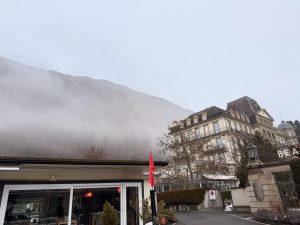
We woke up to a hazy Interlaken today. Initially, I planned to visit Jungfraujoch, followed by Lauterbrunnen today. Since we visited Lauterbrunnen yesterday and had only one sight on the list, we can afford to wake up a little later. As we will be taking an evening train to Zermatt, we checked out of our hotel early in the morning and left our luggage with the hotel, where we will return in the evening to collect it for our onward journey.

Getting to Jungfraujoch
Jungfraujoch, with its nickname “Top of Europe”, is very misleading. Initially, I would have thought this meant the mountain would be the highest peak we would visit during this Switzerland trip. At 3,400m, Jungfraujoch certainly sounded like the highest peak. We would subsequently find out that the Matterhorn Paradise (that we will be visiting tomorrow) towers over Jungfraujoch by almost 500m, and that would be the highest peak we visited on this trip. Jungfraujoch was called the Top of Europe due to its housing the highest railway station in Europe. There are two ways to get up to Jungfraujoch from Interlaken: the all train option via Lauterbrunnen, or one leg with cable car via Grindelwald Terminal. For the first option, one would need to change trains three times, in Lauterbrunnen, Kleine Scheidegg, and Eigergletscher. The cable car option requires us to take a train to Grindelwald Terminal, and change to a cable car to Eigergletscher to catch another train to the Top of Europe. The cable car route is 30 mins faster compared to the all train route. As we wanted to try both routes, we took the cable car route during our ascent and the train option when descending. One point to note for those who got the Bernese Oberland Pass and Half Fare Card: the Bernese Oberland Pass also covers a partial train ride to Grindelwald Terminal and Lauterbrunnen. By booking our ticket from Grindelwald instead of Interlaken Ost Station (where we were staying), we saved CHF6 per person per way. We also found that booking tickets with the Half Fare Card gave us a larger discount than the Bernese Oberland Pass.


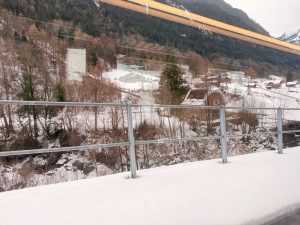
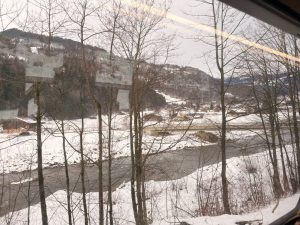

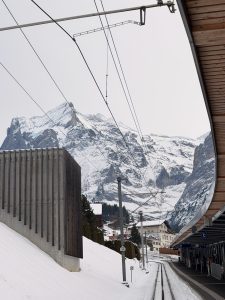
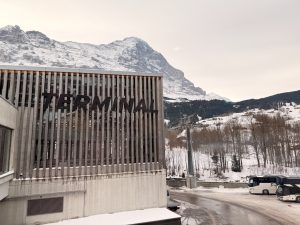
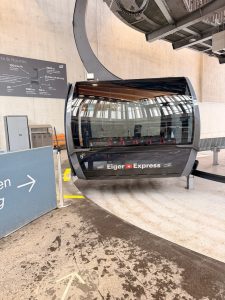
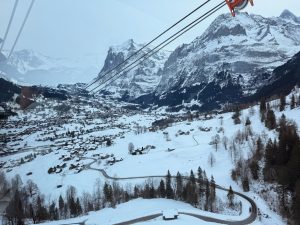
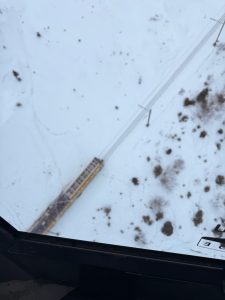
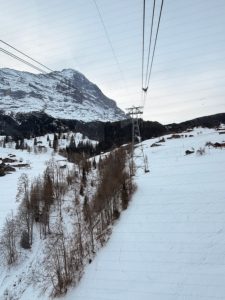
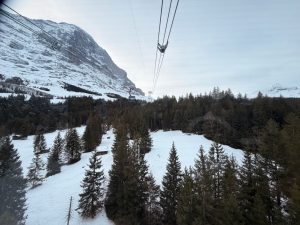
The train ride from Interlaken Ost to Grindelwald Terminal was uneventful, where we saw more winter scenery of the Jungfrau region. The beauty of this route lies in the cable car ride from Grindelwald Terminal to Eigergletscher. As the cable car pulled out of the station, we were mesmerised by the scenery of the land covered in white snow with huts concentrated at parts of the land, resting on the foot of the mighty mountain ranges in the region as though humans were seeking protection from these mountains. Occasionally, we would fly over skiers challenging themselves on the many ski slopes, having fun skiing down the mountain. At one point, we flew over forests of pine trees showing us their resilience, flourishing in the bitter winter cold. These trees looked as if they were competing with each other to reach for the sky. We even saw a train making its way up the mountain on the grounds below us. We could see the entire winter snowscape flashing past our eyes in the 15 mins Eiger Express ride.
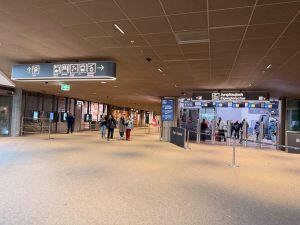
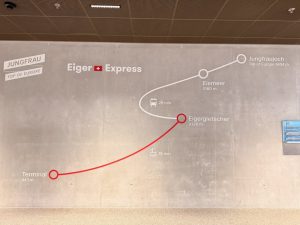




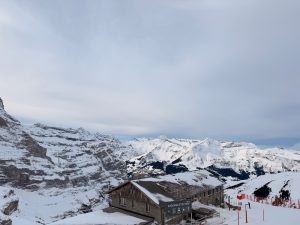
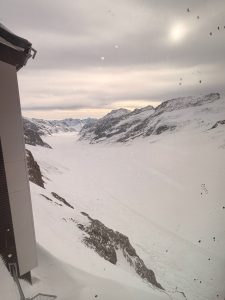
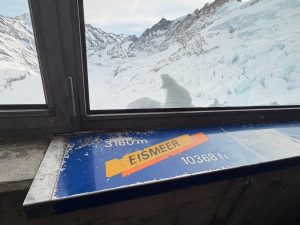
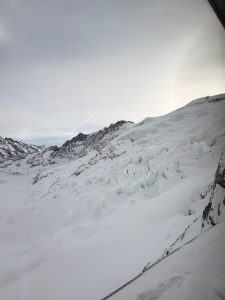
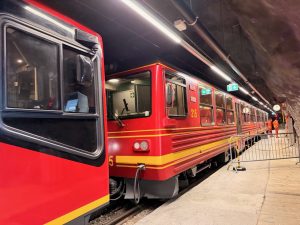
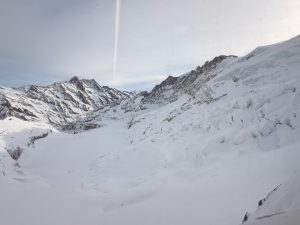
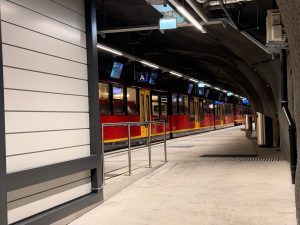
The next leg of the journey involves a train ride through a tunnel. As the train runs on a schedule, having arrived at Eigergletscher via cable car gave us some time to explore the outdoor area of the train station. From here, we could see the glaciers sitting on the side of the mountain top. Soon it was time for us to board the train. It doesn’t matter which side of the train we were sitting on, as the train would travel inside a tunnel that brought us up to the peak station, and there was nothing much to see. There was a brief stop at Eismeer viewpoint, 3,160m up the mountain, where we were given time to look out into the glacier. This part of the mountain was a relatively flat piece of land covered in snow that seemed to form a bridge between two mountain ranges. I would advise people to sit closer to the door of the train as everyone rushes out at Eismeer to get a good spot at the viewpoint. The rest of the journey from Eismeer to Jungfraujoch was pretty much uneventful.
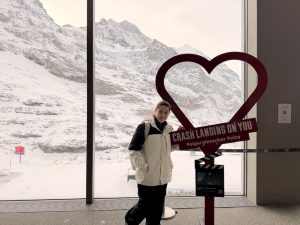


Attractions in Junfraujoch
360° Cinema
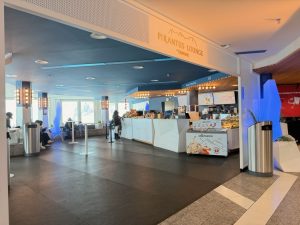
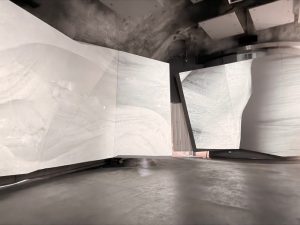
Once at the top of the mountain, we were greeted by a large cafe and a souvenir shop outside the exit to the train station. Here is where we saw people sitting around enjoying the views of the mountain. I found the view up here to be similar to that in Eismeer, with the exception that we were on a higher elevation. There is a fixed route for visitors to experience the six attractions at Jungfraujoch, which would end up returning us to the cafe and the souvenir shop. Following the signage, we arrived at the 360° Cinema. This cinema projects footage of climbers coming up to the summit of Jungfraujoch onto the wall. We did not find it particularly interesting as the film does not explain much about the formation of glaciers. We only stayed here momentarily and headed to the next attraction on the circular route.

Sphinx Terrace & Aletschgletscher
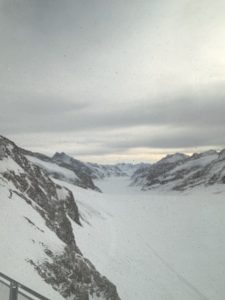
We skipped past the next two attractions along the route due to their closure. Technically, the next stop was supposed to be Sphinx terrace, an observation terrace outside the astronomical observatory on Jungfaujoch. When opened, the terrace would have treated us to the majestic views of the mountain ranges and a good view of the glacier below. The other attraction that was closed during our visit was the Aletschgletscher. This is the part where we would get to walk on the actual glaciers. I had initially planned to include a 1-hour walk on the Aletschgletscher to Mönchsjochhütte, a restaurant housed in a wooden hut. However, the path to the hut is only open from March to October, which means we were confined to the observation building. We were also disappointed to find that the snow fun park on Aletschgletscher was closed as well due to the closure of access to the glacier in the winter months.
Alpine Sensation
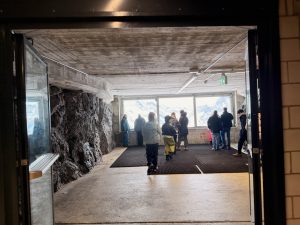
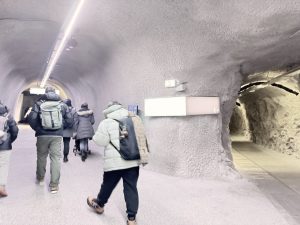
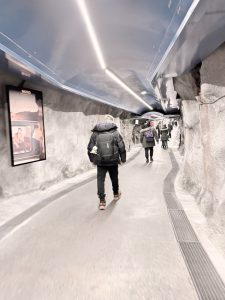
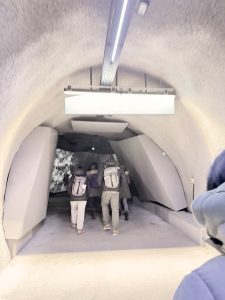
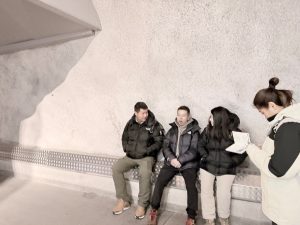
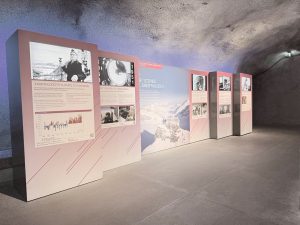
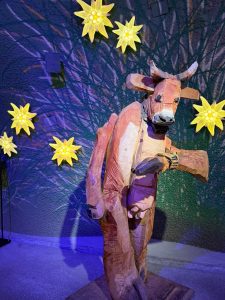
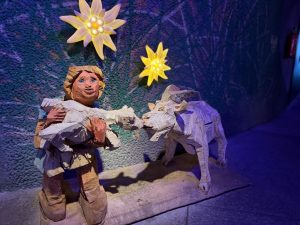
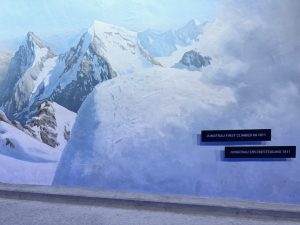
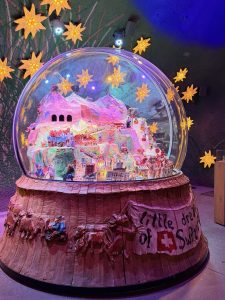
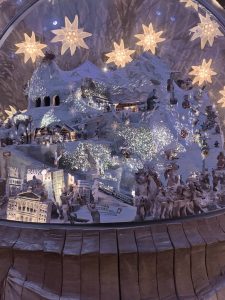
The next attraction on the route was the Alpine Sensation, a 250m corridor between the Sphinx Hall and the Ice Palace showcasing the development of Jungfraujoch. Entering the Alpine Sensation is like walking into a magical tunnel with the ceiling decorated with flowers; in winter, these look like snowflakes to me. I did not see much development of the area being displayed here, except for a couple of signboards talking about climate change and its effects on Jungfraujoch and another telling when the mountain was first climbed. I find the displays of wood sculptures of humans and benches dotted in this part of Jungfraujoch interesting. The large snow globe display gotta be the highlight in the Alpine Sensation and is what attracted me most here. With so many details, mainly carved out of wood, I spent at least 3 mins looking at the condensed version of Jungfraujoch, spotting things that are familiar to me, like the Eiger Express cable car that we rode on, and the train that we saw in the cable car. There was a natural stone tunnel after the giant snow globe with some vintage pictures of people climbing up Jungfrau from yesteryears, before the train was constructed. The tunnel led us to the next attraction, the Ice Palace.



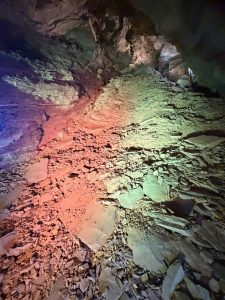

Ice Palace
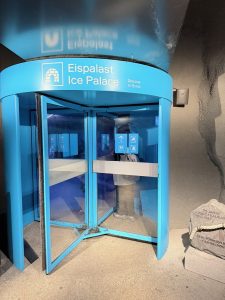
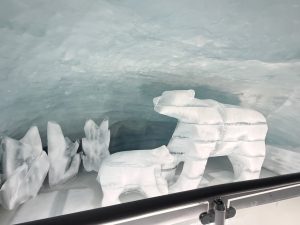
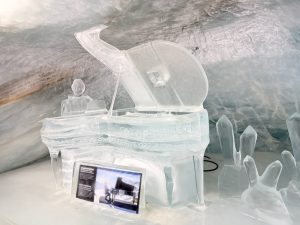
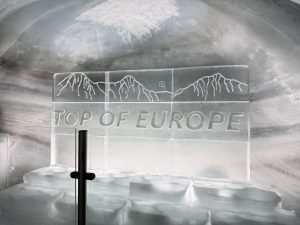
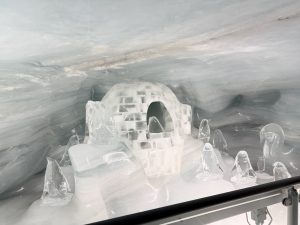
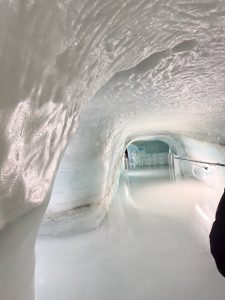
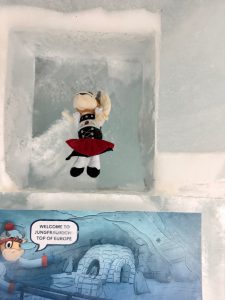
The Ice Palace in Jungfraujoch is essentially an ice tunnel carved out under the glacier in 1938. Entering the Ice Palace is like entering another world. The entire place is covered in ice, even the floor. Despite being made out of ice, the floor does not feel slippery. The highlights of the Ice Palace were the ice sculptures, where we saw a handful of sculptures like polar bears, penguins, eagles and a dragon. There is even a sculpture of a man playing piano and an ice bar. The ice palace wasn’t that big and took us only 7 mins to complete the tour.



Glacier Plateau
The highlight of our visit to Jungfraujoch would be a visit to the outdoor Glacier Plateau. This is where we found the famous twin Swiss flags with the peak of Jungfraujoch in the background, which everyone comes here to take. There was a short queue at the flag when we arrived. Everyone seems to have one objective here: take the mandatory “I was here” picture with the flag. We also joined the queue to take our pictures with the twin flags. As we spend more time here, we see more people coming to join the queue. If one wanted to take a picture with a Swiss flag, but did not want to join the queue, we saw another flag just further up the plateau. There was no queue for a picture with this flag, and yet it also offered the peak of Jungfraujoch.

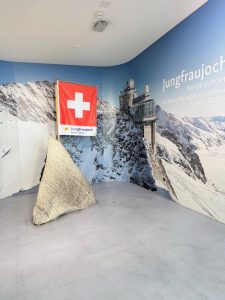

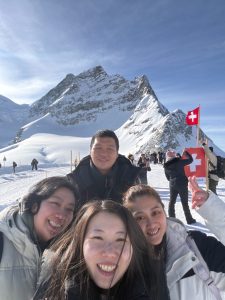

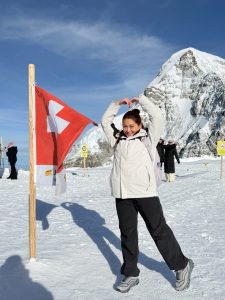
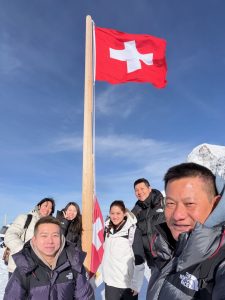


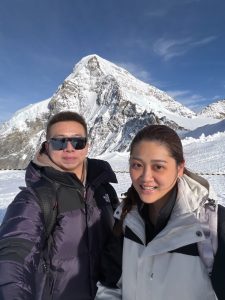
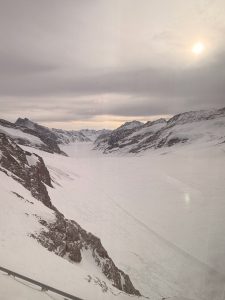
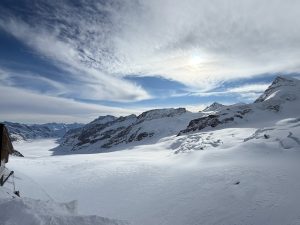
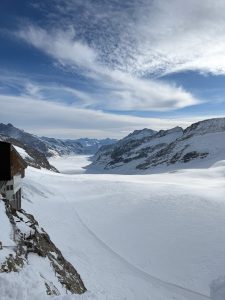
Most of the visitors to the Glacier Plateau are here just for the iconic picture; only a handful bothered to walk around the plateau to look out into the Swiss Alps. There are two sides that offer different views up here. There is the side where we walked up from the building that offered an outdoor viewpoint of the Aletschgletscher, the largest glacier in the Swiss Alps. Like the views we saw previously, inside the building, the Aletschgletscher looked like a large flat piece of snowscape that seemed to bridge between two mountain ranges, making these mountains look shorter than they actually are. Nonetheless, looking out into the snowy desert of Aletschgletscher felt liberating. The other side of the plateau offered views into the nearby mountain ranges rising above the land. Unlike the mountain ranges we saw on Mt. Titlis or Schilthorn, not all of the mountain ranges we saw here were fully covered with snow. Let’s say there are more rocks than snow on these mountains. As there is only one spot for us to look out into the glacier and the mountain ranges, we did not spend too much time here.
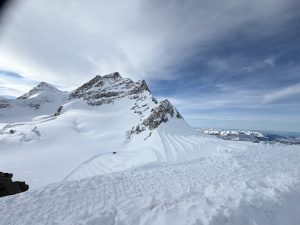
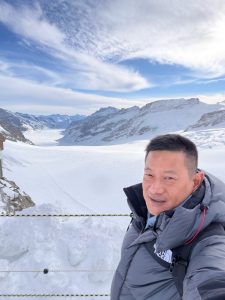
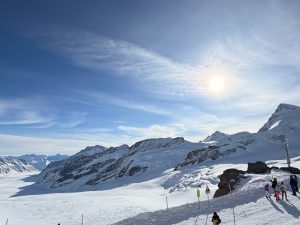

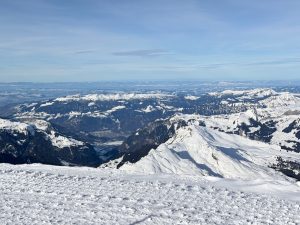
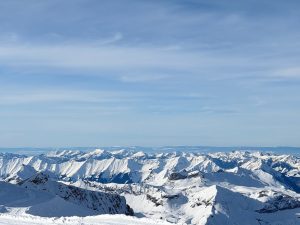
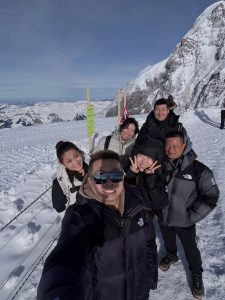

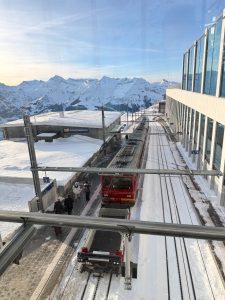
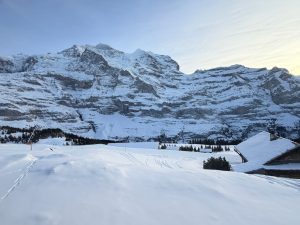
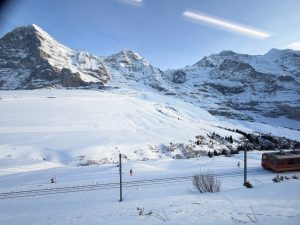
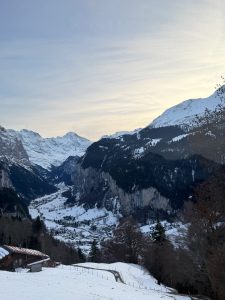
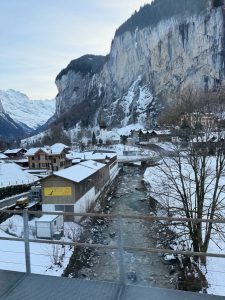
After visiting the attractions on Jungfraujoch, there is really nothing much we can do up here (since the Glacier walk and the snow fun park are closed during the winter months). We waited for the next train to take us back to Interlaken. For our descent, we opted for the all train route. Unlike the upwards trip, the train does not stop at Eismeer from Jungfraujoch to Eigergletscher. The train departing from Eigergletscher requires us to change to another train in Kleine Scheidegg. For the descent route, we found the views on the left side of the carriage more scenic as we were able to see the mountain ranges and the ski tracks. We were also able to see the village of Wengen on the left side of the train, one stop before Lauterbrunnen. I thought the Glacier Plateau existed only for tourists to take their Instagram photos or TikTok videos of them holding up the Swiss flags. There are better views of the Swiss Alps for places that cost a fraction of the price; the “Top of Europe” marketed was not exactly at the highest point in Europe, but only refers to the highest train station in Europe. People are attracted here only for their “I was here” photo. Perhaps my perspective might change if we had the Sphinx terrace and the Aletschgletscher open.





Next Stop – Zermatt
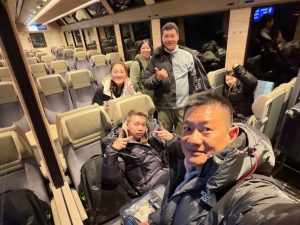
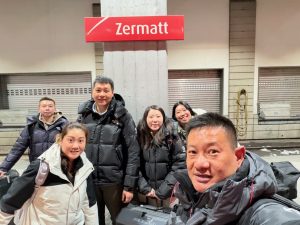
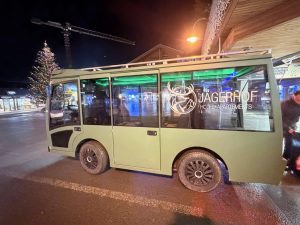
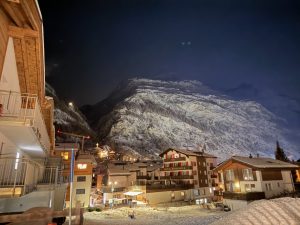
Our train to our next town, Zermatt, departs at 6.07 pm. We made it back to Interlaken in time to pick up our luggage from the hotel concierge and headed to the train station. Fortunately, our hotel offered to send us to the train station. Getting to Zermatt from Interlaken Ost is rather inconvenient as it involves two train transfers in Spiez and Visp. However, the transfer was rather seamless. The train ride was rather uneventful, and due to the darkness outside the train window, we were unable to see any views. We reached Zermatt at 8.17 pm and hopped on the transfer to our apartment provided by the hotel and rested for the night.