This blog post will be long; we did so many things in the span of one morning. We had a heavy day in the morning, visiting the tombs of kings and queens of ancient Egypt on the West Bank of the Nile. To the ancient Egyptians, the east represented life and would have living activities on the East Bank of the Nile, while the west was allocated funerary activities to the West Bank of the Nile. We ended the day with a cruise up the Nile towards Aswan, passing through the Esna Lock.
Sunrise Hot Air Balloon Ride – Marvelling the West Bank Sights from the Sky
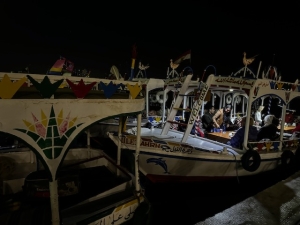
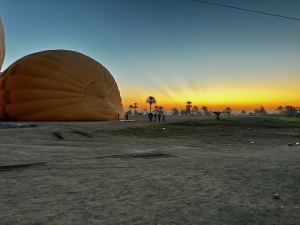
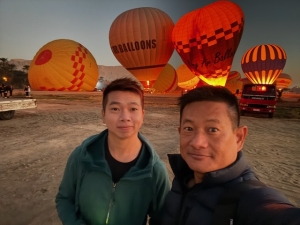
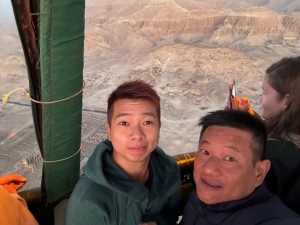
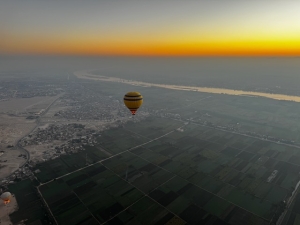
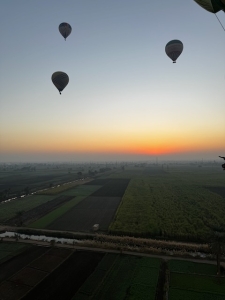
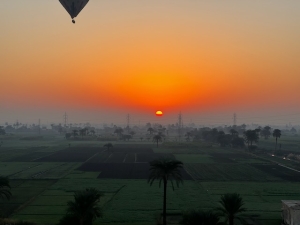
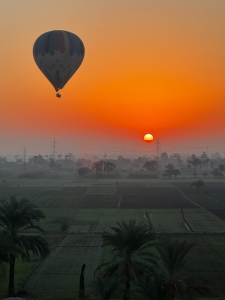
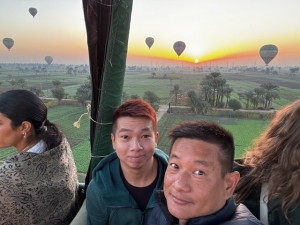
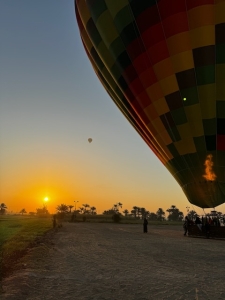
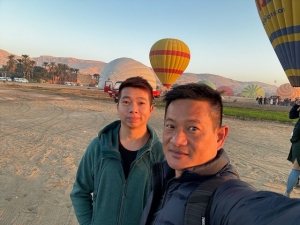
We had an early start today for the optional hot air balloon ride on the West Bank of the Nile (costing USD 140). We were driven to a nearby dock, took a small motor boat across the Nile and drove further into the desert. We could see some hot air balloons floating off the sky while ours were just being set up. It did not take the crew too long to set up the balloon. We could see the sun’s rays peeking over the horizon over the east and at the mountains to the west; the moon seemed to be signing off to rest for the day.

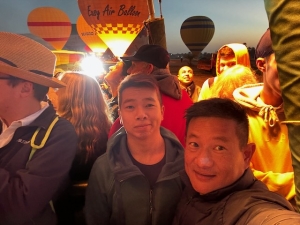
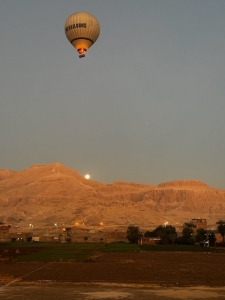

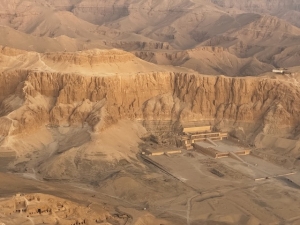
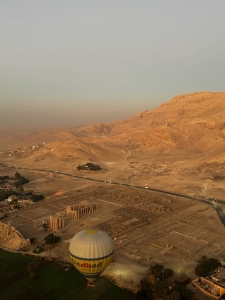
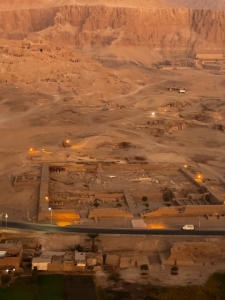
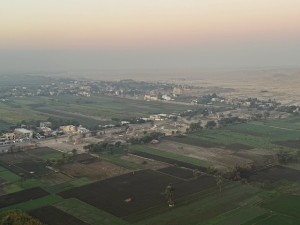
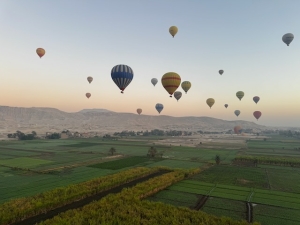
As our balloon slowly made its way up into the sky, we could see the entire farmland next to our hot air balloon take-off spot. It did not take too long for us to be at the same height as the mountain ranges behind. Our pilot guided our attention to the Valley of the Queens, wedged between the mighty pyramid-shaped mountain ranges and the road. But from where I was, it looked like some small holes in a pile of rock. The only landmark I could recognise (from the books and YouTube videos) was Queen Hatshepsut’s Temple, tucked far into the base of the mountain ranges. Nearer to us was a large complex in ruins. Over the highest mountain, I could see the moon shining its light at its brightest, as though the Egyptian moon god, Khonsu, was welcoming us, illuminating the otherwise dark sky. The spotlights at the monuments looked more and more like stars in the sky, dotting all over the brown desert ground below us as we got higher. Very soon, I could see the top of the highest peak of the mountain ranges that stood guard as though protecting the final resting place of the ancient Egyptian royals. The view was magical and worth every penny we paid for this ride. We floated towards what looked like an ancient Egyptian city. In the centre, a group of tall pillars seemingly made up of the hypostyle hall of a temple. Viewing an entire ancient Egyptian town from high above was truly spectacular.
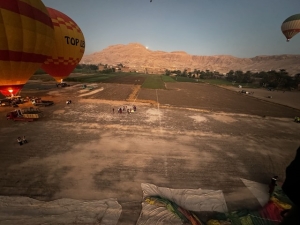



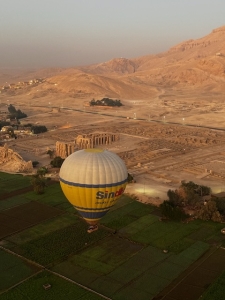

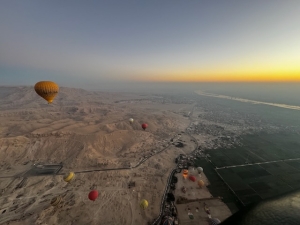
As the pilot turned the balloon around, the brown desert landscape gave way to green fields of farming crops, and the Nile slowly came into our vision as though she was saying hello to us. The green landscape continues to stretch endlessly beyond the Nile. We were floating above some farmlands as the landscape below us turned from brown deserts to green fields. It was time to descend for landing, and we could see the sun slowly emerging from the earth below, as though the Egyptian Sun God, Ra, was greeting us with his warm smile. We floated over some farmlands and a gentle touchdown. We were back to earth. The entire ride took only 45 mins, but it gave us a different perspective of the sight we will see later in the morning.

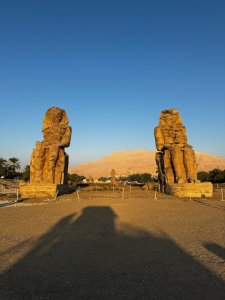
Colossi of Memnon: Twin Statues of Amenhotep III, Entrance to a Temple
After landing, we were driven to a cafe to meet with the rest of our tour group. Our Tour Director, Ahmed, urged us to pop by the two large statues by the roadside. They are the Colossi of Memnon – the statues of Amenhotep III. The statue on the right was in very bad shape as if someone had knocked it over and attempted to piece everything back. Ahmed told us that this was the work of the Romans, though haphazardly, at least they tried their best. Other than the statues, we also saw a few rocks and a few other statues dotted around the area. While writing this blog post, I did a little research on the Colossi of Memnon. These statues of Amenhotep III that we saw sat at the entrance of a funerary temple Amenhotep III built and dedicated to Amon-Ra. However, we did not see any structure near the statues, as they are still being excavated.


Valley of the Kings – The Resting Place of the King of Egypt
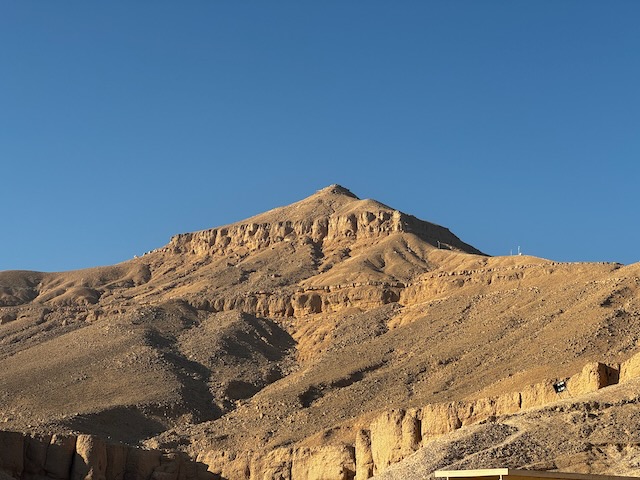
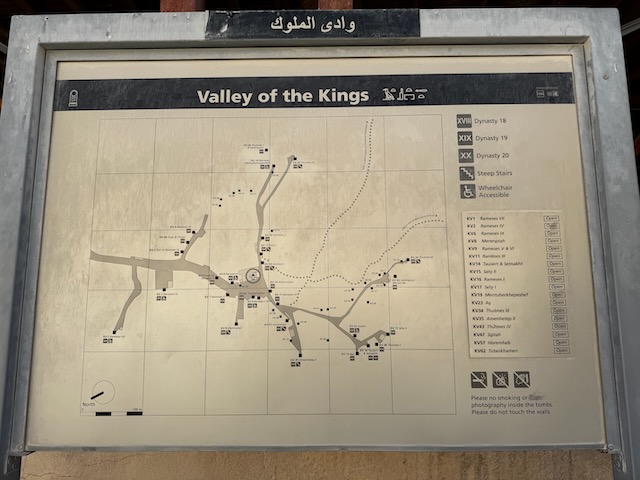
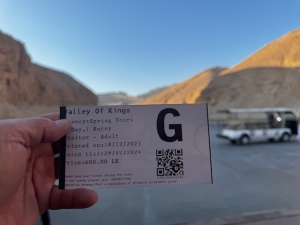
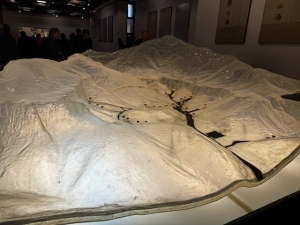
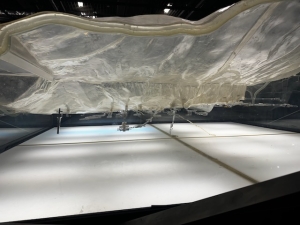
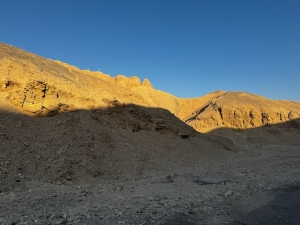
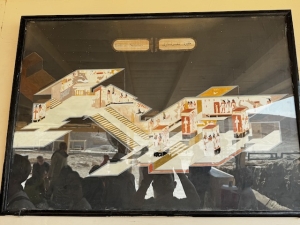
We headed to the Valley of the Kings, a barren mountainous area with no signs of life, where the Egyptian Kings of the New Kingdom were laid to rest for eternity. Some of these tombs were 3,500 years old. Ahmed told us that the tombs in the Valley of the Kings are opened on a rotation basis. He called in to check which group of tombs were opened today and chose what he deemed to be the more impressive tombs to show us. The ticket (cost LE600) only allowed entry to three tombs amongst those that were opened. Before leading us into the Valley of the Kings, Ahmed showed us a model of the valley in the visitor’s centre, which depicted the tombs in the entire valley and the underground locations of each of the 63 tombs in the valley.

KV1: Tomb of Rameses VII
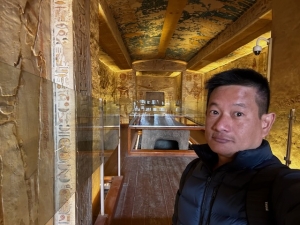
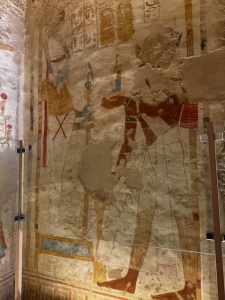
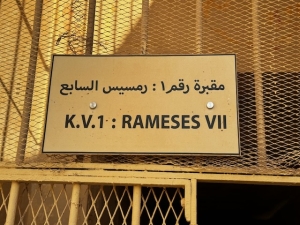
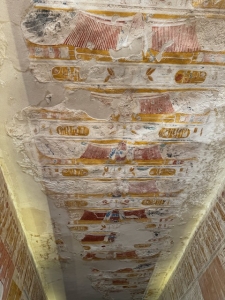
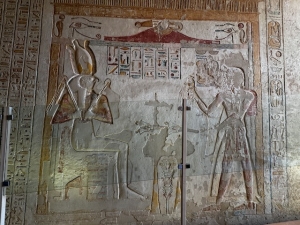
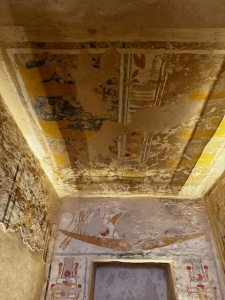
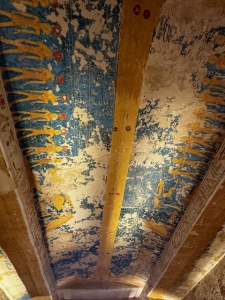
The first tomb we visited was the Tomb of Rameses VII, the nearest tomb to the visitors’ centre in Valley of the Kings. The tomb is relatively small, with one downward-sloping corridor leading to the burial chamber. This corridor looked vibrantly decorated with bright yellow and ceilings with red falcons. The corridor walls were restored to a good scale, and we can see some hieroglyphs and scenes of presumed priests in the funeral possession of the dead king. The walk to the burial chamber was short (under 1 min), where we saw a large sarcophagus encased in a glass casing in the centre. Staff at the tomb enthusiastically pointed it out and told us this was the sarcophagus where Rameses VII’s coffin was placed. He encouraged us to look inside where the sarcophagus used to lay, where we only saw some stones today. The walls in the burial chamber were more vivid in colour, showing scenes of Egyptians praying to what seemed like earth. I particularly like the vibrant blue painting of the Sky Goddess Nut over a group of Egyptian Gods, painted on the entire ceiling above the coffin in the burial chamber. At the chamber’s far end was a depression carved out of the walls with a painting of a boat on top. The tomb of Rameses VII felt celebratory.




KV2: Tomb of Rameses IV
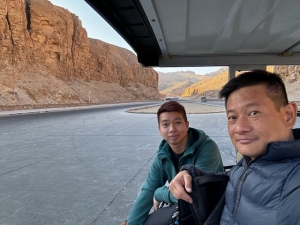
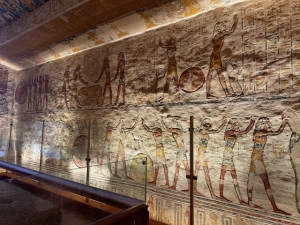
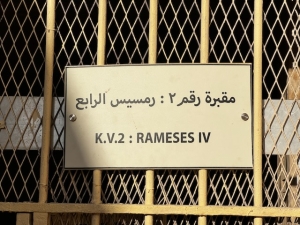
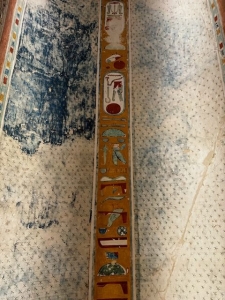
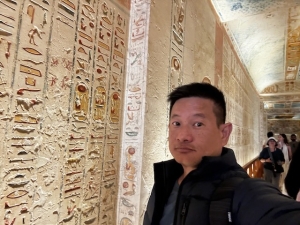
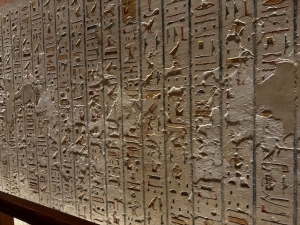
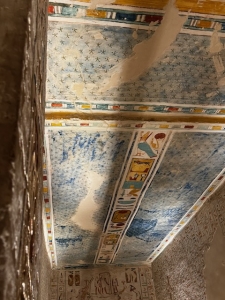
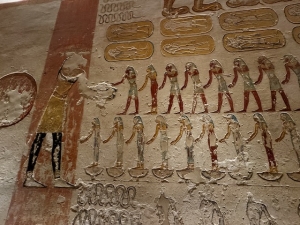
The next tomb we visited was about 3 minutes on foot from the tomb of Rameses VII. This tomb is longer than the previous one, with two sloping corridors. The corridor near the entrance is adorned with rows and rows of hieroglyphs. The tomb walls became gradually more colourful as we walked further into the tomb. There was a scene on the wall depicting priests paying respect to the God Khnum, protector of the Nile. More depictions are associated with the God Khnum along the corridor further into the tomb. The ceiling of this corridor was painted blue and filled with stars. The burial chamber sits at the end of the corridor, where the king’s sarcophagus was placed, and it has carvings of hieroglyphs on the upper part and scenes of what seems like the pharaoh making an offering to a god. The ceiling of the burial chamber was very detailed in its depiction. We saw a different scene of the Sky Goddess Nut eating the sun, supported by the God of Air, Shu. Unlike Rameses VII’s tomb, there is an annexe with three smaller rooms behind the burial chamber. Even this area is brightly painted with detailed hieroglyphs and reliefs. As this area was cordoned off, we cannot distinguish what scenes were depicted in the chambers in the annexe. Like the tomb of Rameses VII, this tomb is equally colourful and feels more like an art gallery.


KV 8: Tomb of Merenptah
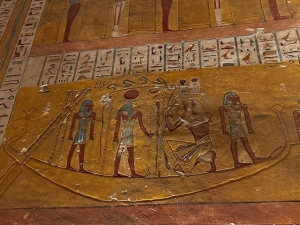
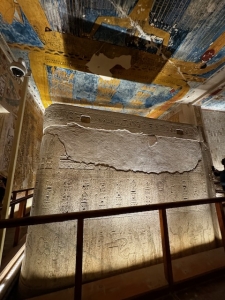
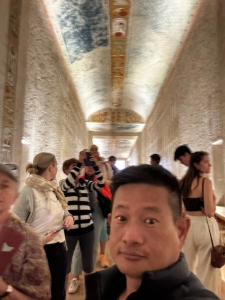
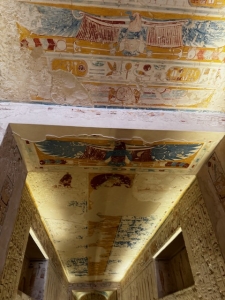
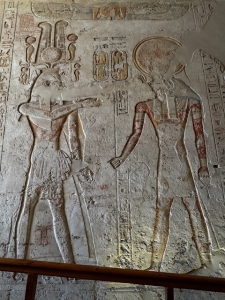
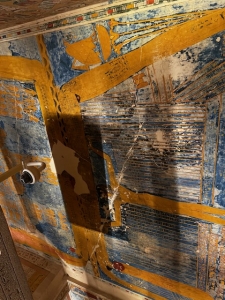
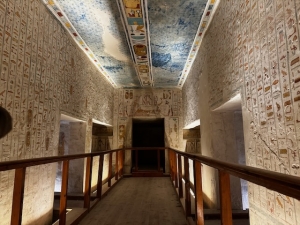
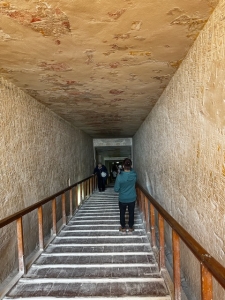
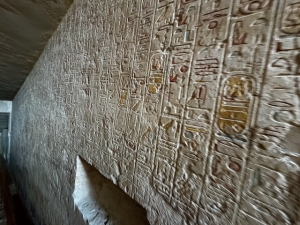
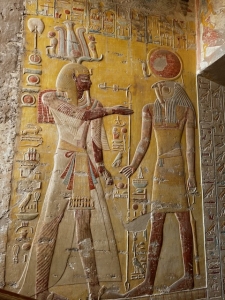
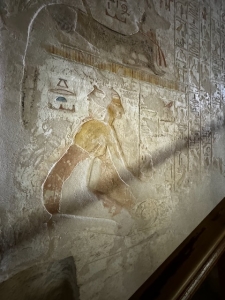
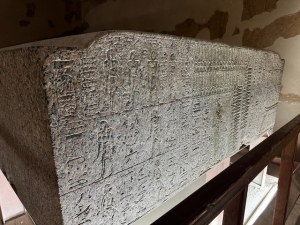
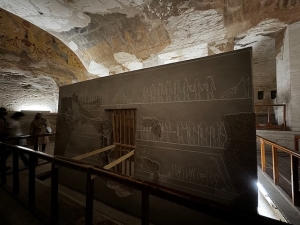
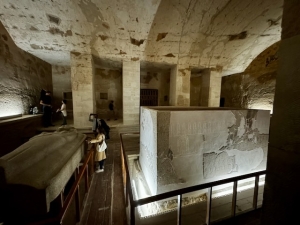
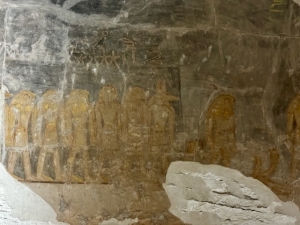
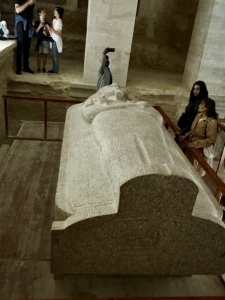
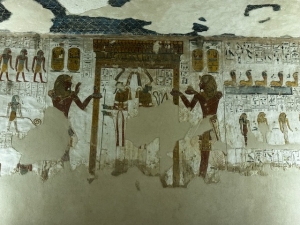
As our ticket only entitled us entry to three tombs, Ahmed gave us a choice of visiting a deep tomb or a colourful tomb. My friend and I chose the deep tomb, the Tomb of Merenptah, with three downward-sloping corridors. Unlike the previous two tombs, the Tomb of Merenptah appears dull, partly due to the long and deep design of the tomb and partly due to the state of the tomb. At the door of King Merenptah’s tomb, a beautiful relief of Osiris and Horus greeted visitors and decked in colours. The first of the three sloping corridors was in its original sand colour, filled with countless faded coloured hieroglyphs. The combination of faded colouring on the walls, long dark corridors, and sparsely restored ceilings gave this tomb a dull look. The hieroglyphs occupied most of the space on the walls of the second corridor. Occasionally, relief of Isis kneeling with Anubis in his animal form on top or painting some Egyptian gods on a boat being pulled by priests would appear in the sea of hieroglyphs. There is a relief of Anubis and Thoth carved into the space between the second and third corridors. However, these paintings and the colours on the walls were faded. The third corridor nearest the burial chamber was very plain and simple. There were no reliefs nor hieroglyphs engraved into this part of the tomb. Just before we reached the main burial chamber, there was a small landing where a smaller sarcophagus with elaborate engravings on the lid was found. This was installed by the ancient Egyptians to confuse tomb raiders, making them think this was the tomb of King Merenptah. Passing this landing, a short corridor led us to the main burial chamber. The burial chamber was huge, housing two sarcophagi, a mummy styled off to the side, and a huge rectangular sarcophagus in the centre. Around these two sarcophagi were some empty rooms. The sarcophagus in the centre, where King Merenptah laid for his eternal rest, had some modern-day carvings and very little of its original facade left. Some paintings were high up on the burial chamber walls and little paintings on the ceiling left. I can only see a small panel of Egyptian Gods like Anubis, Amon, and Horus paying respect to some other God, with a faint light blue sky in the background. Due to flood damage, very little reliefs of King Merenptah’s tomb were left.



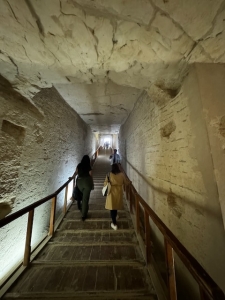
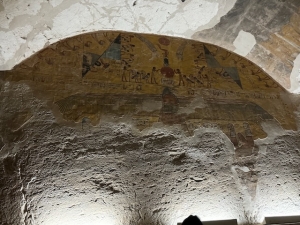
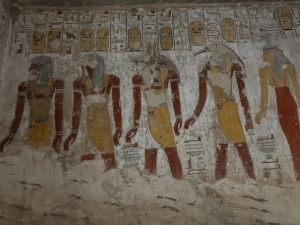
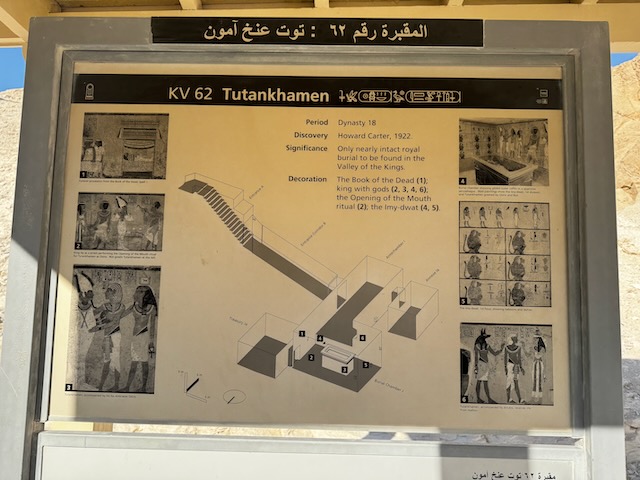
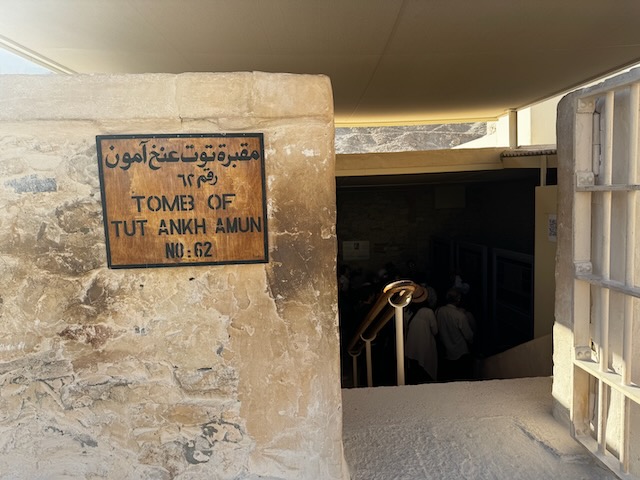
We met up with the rest of the group, and Ahmed pointed to King Tutankhamun’s tomb and told us to take pictures if we wanted. We did not go in as it was crowded and required us to pay an additional fee to visit this tomb.
Queen Hatshepsut’s Temple – An Impressive Building at the Foot of the Mountains
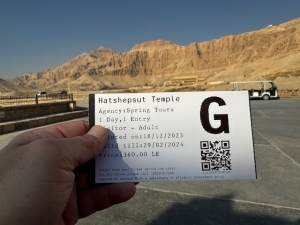
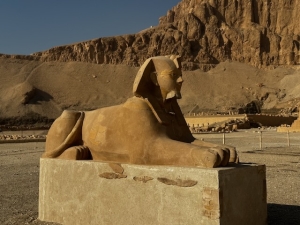
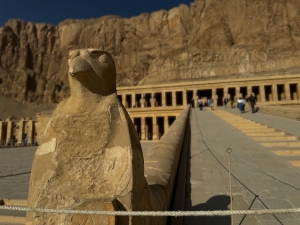
Our next stop was Queen Hatshepsut’s Temple, a short drive from the Valley of the Kings. Queen Hatshepsut’s Temple was an icon of the West Bank of the Nile in Luxor. Almost all the books or pictures would use her temple as a landmark picture to represent this part of Egypt. The three-storey temple, dedicated to the God Amun, was intended to be used as the mortuary temple for Queen Hatshepsut. Queen Hatshepsut’s body was buried in the Valley of the Kings as the first female pharaoh of Egypt. The temple was tucked into the mountain’s base, where the Valley of the Kings was on the other side. The first relic we saw at the temple was the remaining Sphinx on the ground floor with the face of Queen Hatshepsut, which she used to exert her legitimate rule of the country. The temple’s ground floor was occupied by a row of pillars that seemed to support the upper floors of the temple. We skipped this part of the temple and went to the second level. The architectural style on the second floor of Queen Hatshepsut’s Temple adopted the same features as the first floor. There doesn’t seem to be too much going on at this level, which seems to be mainly rows of pillars supporting the third floor. The ramp that extends out on the second floor was adorned with a falcon figurine with a snake body.
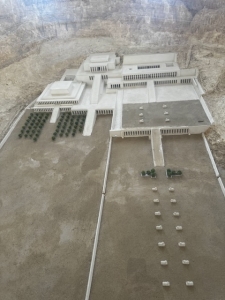

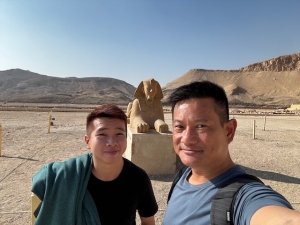
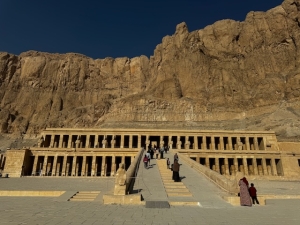

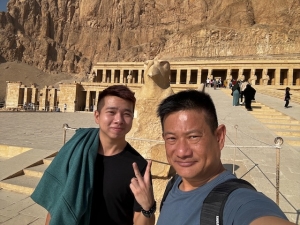
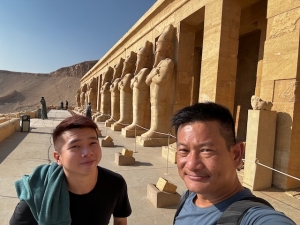
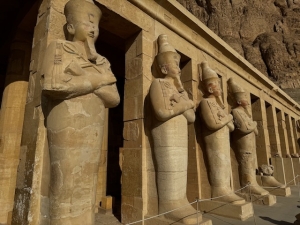
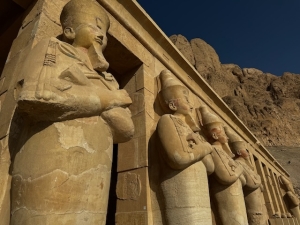
The main highlight of the temple is on the top floor. As soon as we emerged from the ramp, we were greeted by a row of statues of Osiris. Passing the statues of Osiris, we arrived at a small courtyard, where the entrance to the sanctuary was adorned with reliefs depicting Queen Hatshepsut wearing the crown of Lower and Upper Egypt. The sanctuary was a small space. Despite the reliefs here being heavily defaced, we were still impressed by the number of reliefs and the vibrant colours that once glorified this chamber. We could still make out that most of these reliefs depicted Queen Hatshepsut as a man paying respect to Amun. As with the tombs in the Valley of the Kings, the ceiling in this chamber was decked out with stars. A small annexe at the back of the chamber is sealed off to visitors, with statues of Amun on the sides of its entrance. A staff member told us this was where Queen Hatshepsut was mummified.
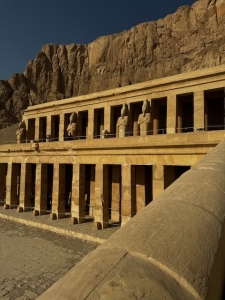


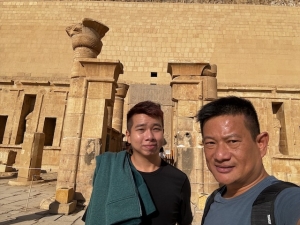
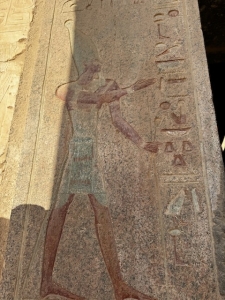
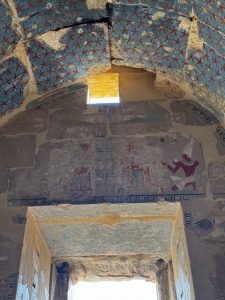
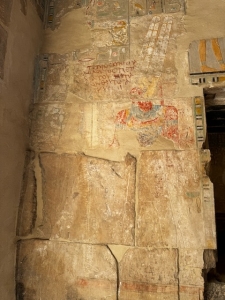
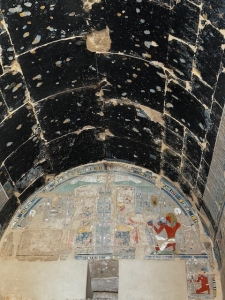
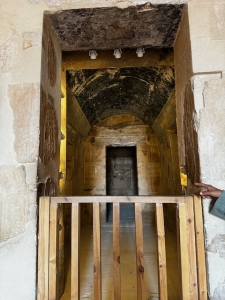
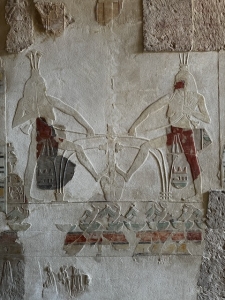
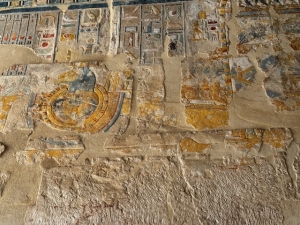
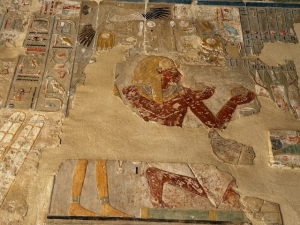


We returned to the courtyard and saw another entrance leading to a separate part of the open courtyard. There does not seem to be too much going on here, except for a large altar (we later found out a Ra idol was installed here). But what was interesting was the relief on the doorway, which depicted Queen Hatshepsut as a man (the false beard was very visible) receiving blessings from Amun and Ra. We went around the temple’s top floor to take more pictures and met with the rest of the group for our next destination.
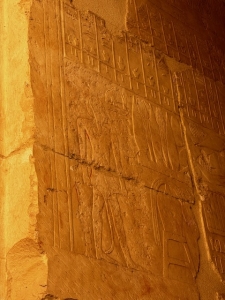
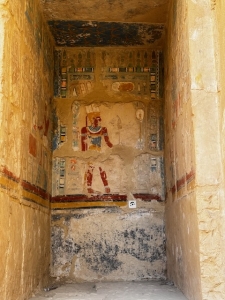


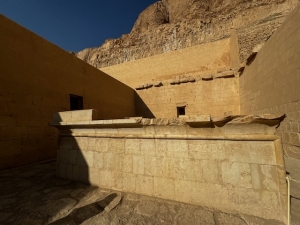
Valley of the Queens – The Beautiful Tomb of Nefertari
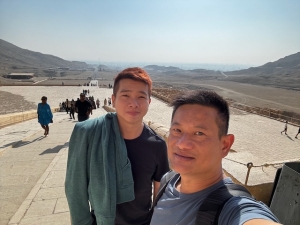
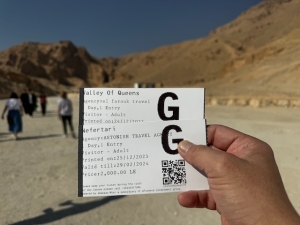
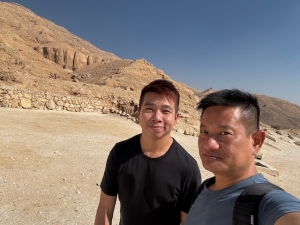
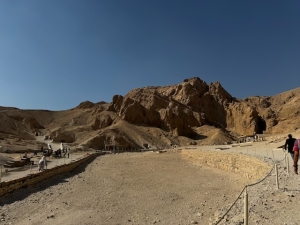
The Valley of the Queens was a short drive from Hatshepsut’s Temple and is where the ancient Egyptians buried their Queens, princes, princesses and nobles. The only tomb we visited at the Valley of the Queens was the 3,500-year-old Tomb of Nefertari, the beloved queen of Rameses II. To gain access to the tomb, the tour company had to buy two tickets, one for the entrance to the valley and another to access the tomb. The Tomb of Nefertari was the most expensive of the sites we visited on this trip, costing LE2,000. Outside the tomb, there was some form of an unstructured queuing system. We were told to wait at the pavilion for our turn, as visitors were only allowed to view the tomb in small groups (of around 15 to 20). A sign in the waiting area stated the visitation of the tomb was limited to 10 minutes per group. The queuing system at the tomb was whoever tour guide made the most noise got to enter the tomb first, while those independent travellers had to wait at the back of the line, praying that they would be called. We saw a group who came after us being given priority to enter. I approached the staff managing the queue at the entrance and informed him that we had been waiting for our turn. After he let the previous group in, he turned to us and invited us to join the queue to be the next group to enter.
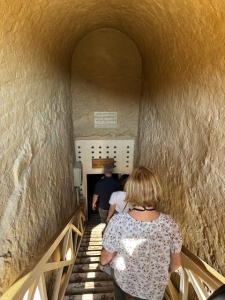
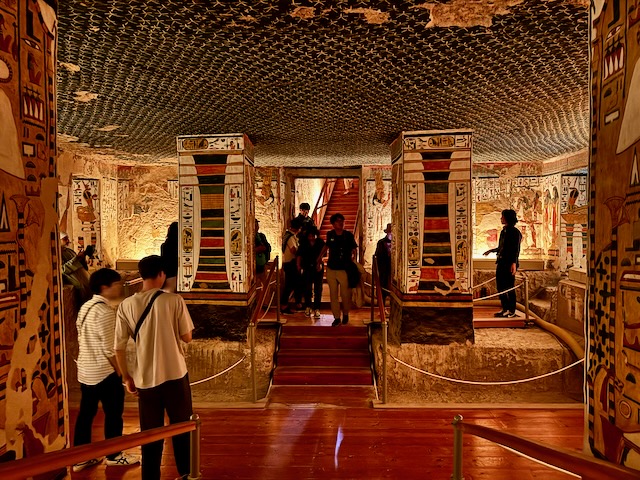
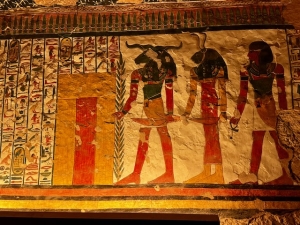
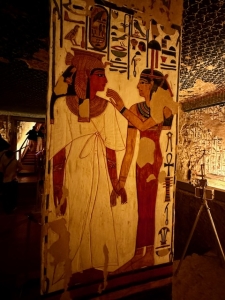
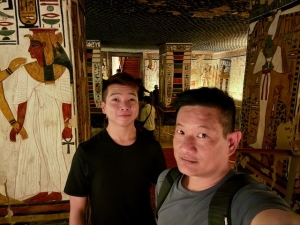
Walking into the Tomb of Nefertari was like walking into an art gallery. The entire tomb was colourful and intricately adorned with reliefs of the late queen. This has got to be the most beautiful tomb we saw today. The entrance staircase led us into a small chamber where we saw vibrantly coloured reliefs engraved onto the wall depicting some of the Egyptian gods. In one particular relief, these gods, in their animal form, came before the body of Queen Nefertari to mourn her death. We saw a path that branched off to another chamber, which was closed to visitors, where I saw some personnel working and perhaps restoring the chamber. There is another staircase that leads us to the main burial chamber. At this staircase, we got our first look at Queen Nefertari. Queen Nefertari looked beautiful, pure and approachable from the engraving on the wall.
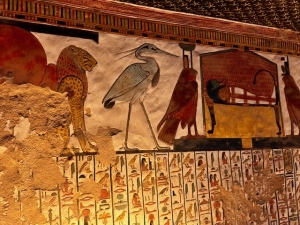
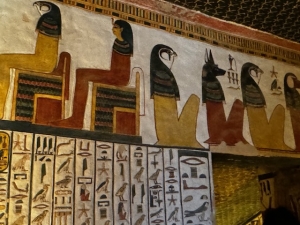
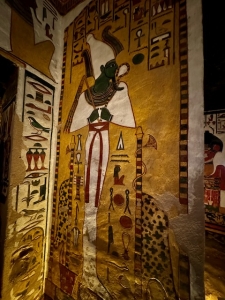
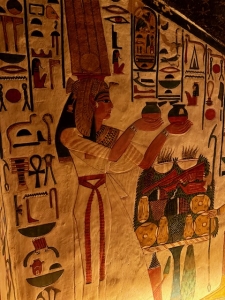
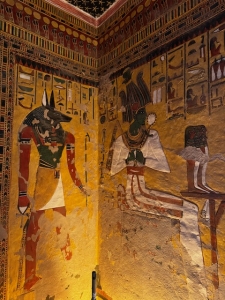
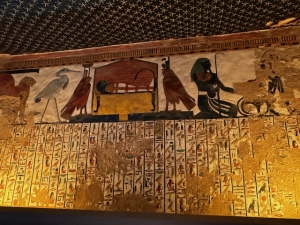
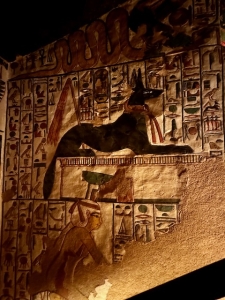
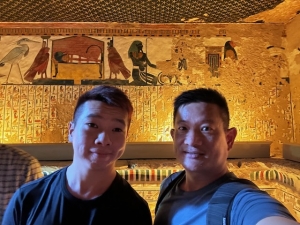
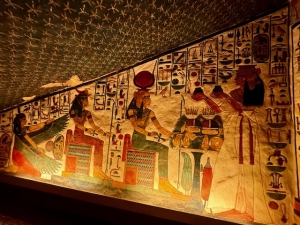
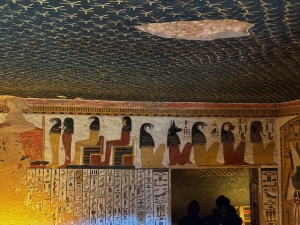
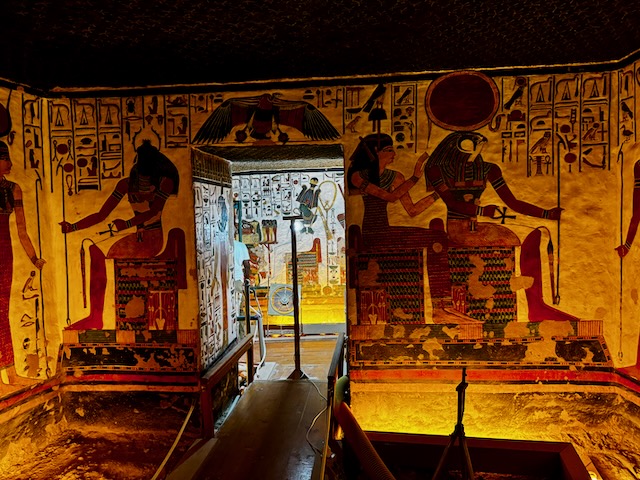
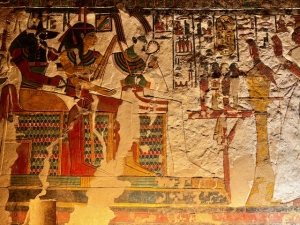
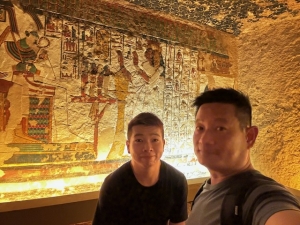
The burial chamber is rather sizeable, with more colourful reliefs of the Egyptian gods, but we did not see the sarcophagus of the late queen. A colourful relief of Queen Nefertari paying respects to Osiris, Hathor and Anubis was engraved onto the innermost wall of the chamber, and another depicting genies guarding the gate to the afterlife was engraved on each side of the wall. In the centre of the burial chamber stood four pillars, each painted with Osiris. The inner two pillars were engraved with Queen Nefertari receiving blessings from Anubis, Isis, Nephthys and Hathor. There are three smaller chambers here in the main burial chambers, and according to the staff working in the tomb, the remains of mummified Queen Nefertari were found abandoned inside the innermost (centre ) chamber. We walked around, trying to take as many pictures as our 10 minutes allowed us. Another staff at the entrance came to the main burial chamber and told everyone our 10 minutes were up. Reluctantly, we exited the tomb.


Sailing up the Nile to Aswan
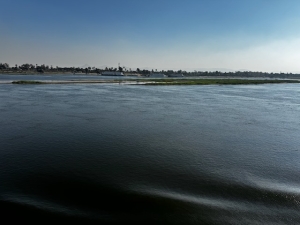
We ended our day of sight visits after the Tomb of Nefertari and returned to the riverboat for lunch. Wow, we did quite a lot in the space of the morning. The plan for the rest of the day was to relax while the boat sailed up the Nile towards our next port of Aswan. The boat slipped off at 1 pm, after all guests were embarked. We lazed around the sundeck (our favourite hang-out spot), taking in the scenery and witnessing how the locals used the River Nile daily.
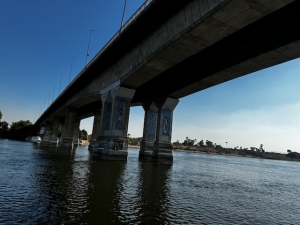
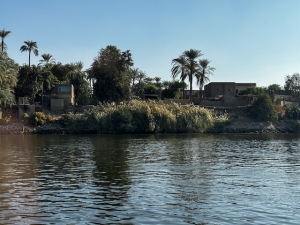

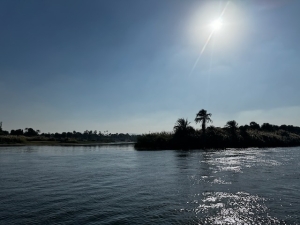
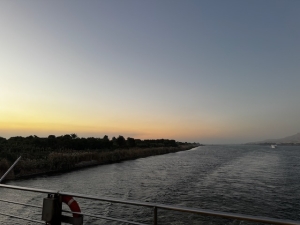
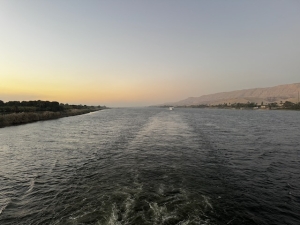
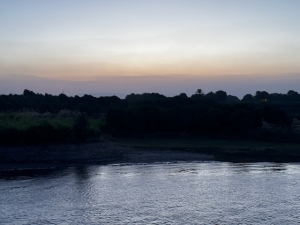
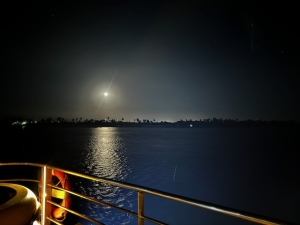
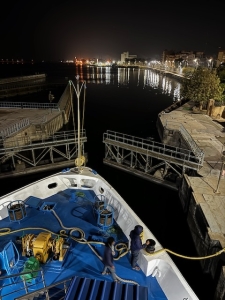
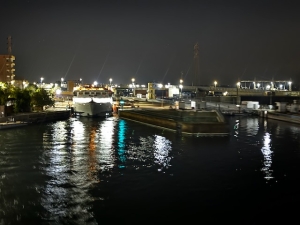
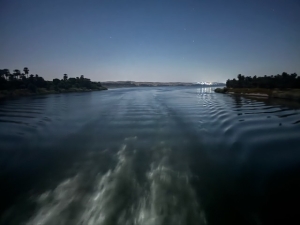
We took a few hours of afternoon nap to recharge. The boat crossed the Esna Lock at night, where we could see the difference in water level at the lock. We were the very few people up here watching the boat entering a pan, which was slowly flooded to match the water level after the lock. The event was quite smooth and relatively fast. After passing Esna Lock, the boat went through another lock. We understood from the ship crew that the second lock was an older lock built by the British but is currently out of order. The boat spent the rest of the night sailing. The River Nile at night was even more peaceful. We reached our next stop, Kom Ombo, at around 5 am, where we would visit the Temple of Kom Ombo later in the morning.





Ballooning is certainly a great idea, I’m impressed by the number of balloons flying today!