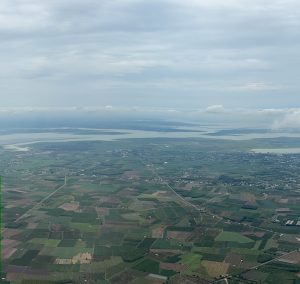
Our flight from Singapore landed in Ho Chi Minh City around noon, which gave us time to visit the sites in the city in the afternoon. As some of the more significant sights in District 1 were very close to each other, they make for a great group to visit. The airport around noon was busy. As we neared the immigration, we were taken aback by the number of tourists in line clearing customs. True to what we saw on social media prior to our trip, the immigration was packed like sardines. We estimated it would take around 2 hours to clear immigration. We were unsure what had caused the long wait time, as we saw quite a number of counters were opened (unlike our trip to Tokyo a few years ago, where only two counters were opened to clear immigration), and immigration clearance was as fast as it gets. The only logical explanation was the number of passengers coming into the city. Fortunately, we had purchased Fast Track Service that allowed us to join the queue for expats, which saw significantly shorter lines. We cleared immigration in 20 minutes. As we were being driven to our hotel, it suddenly rained cats and dogs. At this point, we were discussing our options for the afternoon and changes to the plans. There was no way we would want to walk around the city in the heavy downpours. The month of May is the transition month between the dry and wet seasons in Ho Chi Minh City, with frequent sudden heavy downpours and blazing hot weather. We were very lucky during this trip, as it was either overcast most of the time, making the weather pleasant, or somehow we avoided the rain when shopping indoors.
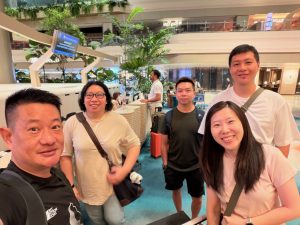
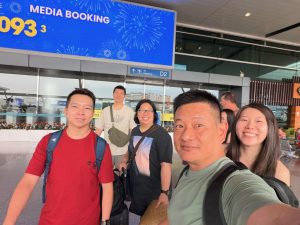
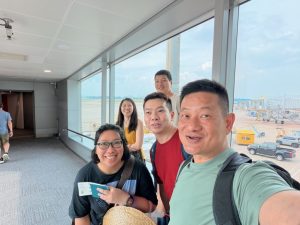
We are checked in and ready for our Ho Chi Minh City trip
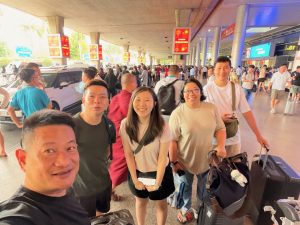
We arrived in Ho Chi Minh City after a 2-hour flight
The Historic District 1 Circuit
Fortunately, the rain had stopped after we got to our rooms and settled in. Our historic circuit in District 1 started with Independence Palace, then to Notre-Dame of Saigon, Saigon Central Post Office, Book Street and ended with Cafe Apartment.
Independence Palace – Where the Unification Happened
Our first stop of the day is the Independence Palace. This historical landmark witnessed and is the centre of action, playing a significant role in the unification history of Vietnam. Up until 1975, Vietnam was split into two: South Vietnam, with the support of the USA, operated under a republic model; and North Vietnam, with the support of Russia, adopted a communist regime. Thus, the birth of the Vietnam War. The Independence Palace was the centre of action and where important decisions were made during the Vietnam War. The war ended when the North Vietnamese army tank crushed through the front gate of the palace, marking the fall of the South Vietnamese government, unifying the country into one communist regime to this day. The entry fee to the Palace varies, depending on how much one wants to see. The base price for only the Independence Palace costs VND 40,000; Palace and Exhibition (curating the history of Independence Palace) costs VND 80,000; and the all-inclusive price of VND 100,000 includes both entry fee to the Independence Palace and Exhibition as well as an Electric Car ride around the Palace grounds. Initially, we thought the electric car service was a ferrying service around the palace grounds. We were guided to hop onto one car, which brought us around the palace grounds, giving us narrations of the significance of the facilities in the palace grounds. The electric car tour took about 10 minutes, and we were dropped off at the entrance of the palace. I would not recommend this service for those who are short on time or just want to visit the palace.
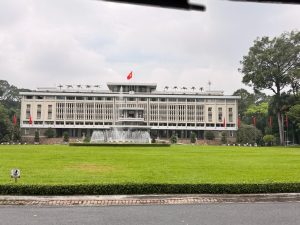
Our first look at the Independence Palace
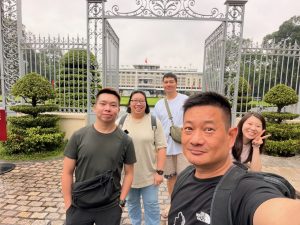
Wefie with Independence Palace at its entrance

We are getting ready for our Electric car tour of the palace grounds
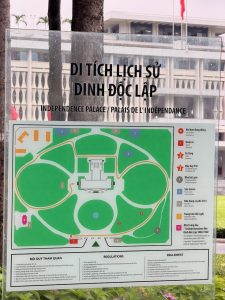
Layout of Independence Palace
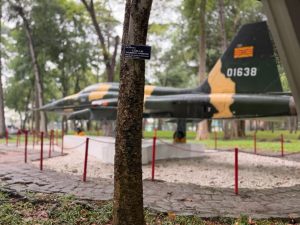
One of the original aircraft used during the Vietnam War on display in the Independence Palace grounds
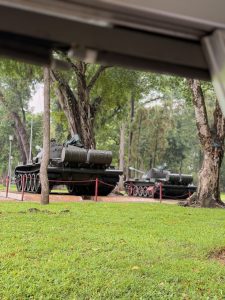
We spotted tanks used during the Vietnam War on the grounds of the Independence Palace
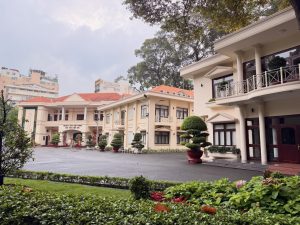
Guest House at the back of the Independence Palace
After the electric car tour around the Independence Palace grounds, we headed to the main building. The Independence Palace was the office of the President of South Vietnam and showcased room after room when the palace functioned as the Presidential Office. We started our visit with the rooms on the first floor. On this floor, the first rooms we saw were the State Banquet Hall and the Conference Hall, situated next to the entrance. Both rooms were filled with furniture from the 70s, but in a more elaborate setting. Imagine large rooms with long tables and chairs laid next to each other with chandeliers hanging on top. These rooms look like a page from yesteryears. Despite its age, I thought this furniture was very well preserved. The highlight on the first floor is the Conference Hall in the centre, occupying part of the palace at the back. The Conference Hall is decked in maroon red from carpet to the backdrop on the stage and decorated with multiple chandeliers hanging from the ceiling. This is where the president declared his resignation after the Americans withdrew their support during the Vietnam War. A painting of the Hung Kings, regarded as the first rulers of Vietnam, hung on the wall of the Conference Hall to link the modern Vietnamese State to its ancient origins.
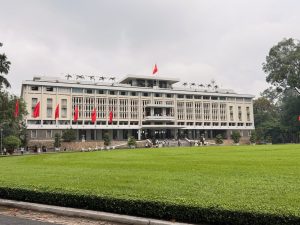
Independence Palace records the significant moments of the unification of Vietnam

The main foyer of the ground floor of Independence Palace

The State Banquet Hall used to host foreign dignitaries

A painting of Hung Kings, believed to be the first kings of Vietnam, hung in the Conference Hall
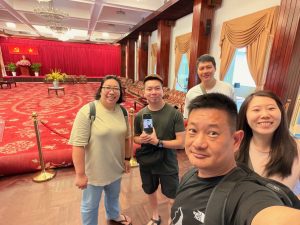
Wefie in the Conference Hall of the Independence Palace
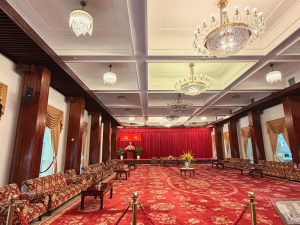
The Conference Hall on the ground floor was and is still used for receptions
There was nothing much else we could see on the first floor, so we headed to the top floors before making our way down in the building to visit the other rooms. As we were walking towards the 4th floor (the lift only stops on the 3rd floor), we walked past the Cabinet room and the First Lady’s Reception Room. Other than looking at the furniture from the 70s, there seemed to be nothing too interesting on this floor. As we were walking towards the stairs that led to the top floor of the Independence Palace, we saw a small room in a cinema layout. There wasn’t much explanation here, and we can only assume this was used to play movies or propaganda films. The top floor of the palace consists of an air-conditioned room and the rooftop area. Here we saw a helicopter and two red ring markings, which marked the area when bombs were dropped by the North Vietnamese Air Force during the Vietnam War, leading to the subsequent surrender of the South and unification of the country. It is a pity that this significant historic event was not recorded anywhere on this floor. Today, the pavilion on this floor has turned into a place to sell souvenirs and hang out for local visitors to rest and enjoy the air conditioning.
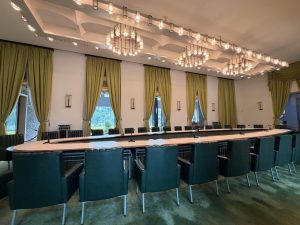
The Cabinet Room, where the President held meetings with his ministers

The First Lady’s Reception Room used to host the wives of vsiting heads of state

View of the Independence Palace grounds and the streets from the top of the palace

There is small cinema on the third floor of the palace
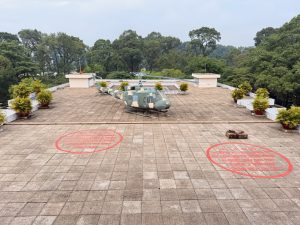
The President’s helicopter, seen on the rooftop of the palace, is always ready for the President’s use
We continued our visit to the Independence Palace on the second floor, where we saw the president’s office, national security council chambers, the vice president’s reception room and some private apartments. At this point, we felt the rooms looked similar and just filled with furniture from yesteryears, so we brushed through the rest of the rooms in the palace. After seeing the rooms on the second floor, we subsequently followed the sign to the bunker in Basement 1. This was the heart of operations during the Vietnam War. There is a president’s office, a bedroom, and rooms and rooms of communications equipment, and also a war room. I reckon visiting the palace is best done with an audio guide, which can be rented at the ticketing counter. The explanations on the walls only mentioned what the rooms are used for, but did not detail the significance of these rooms. Without such a context, we cannot feel the significance of the palace and just see it as another tourist attraction. Our ticket also included entrance to the Exhibition that recorded the transformation of the palace from the Nodorom Palace to the Independent Palace. As we were getting a little “bored” with this place, we skipped the Exhibition and headed to our next stop.
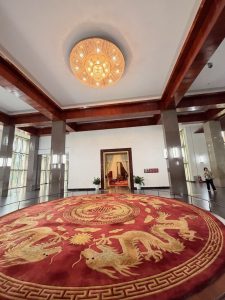
The foyer of the second floor is decorated with a grand carpet with a Vietnamese dragon motif and an elegant chandelier
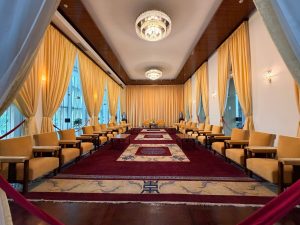
One of the two President’s reception rooms decked in the royal yellow and an elegant maroon carpet

The other President’s reception room with posh funishings

One of the many reception rooms in the Independence Palace

The command centre next to the President’s office
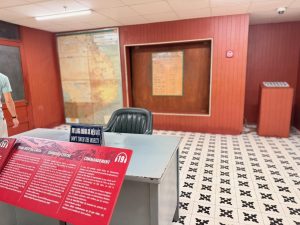
The command centre in the basement, where the Vietnamese war was fought

Communications centre in the basement of the Independence Palace

The President’s bedroom in the basement during Vietnam War

Last wefie with the Independence Palace before we head out
Notre-Dame Cathedral of Saigon – A Little Bit of French Outside France
Leaving the Independence Palace, we headed to our next destination in District 1, Notre Dame of Saigon. The cathedral was not far from the palace and took us only 7 minutes from its main entrance. As we were walking along the side of the cathedral, we saw some scaffolding, mainly in the front facade of the cathedral. I read online that the cathedral has been under renovation since 2017 and will not be completed until 2027. However, the cathedral was still open to the public during this 10-year renovation period. To our dismay, the cathedral was closed during our visit. Other than taking the “we were here” pictures, there was nothing much we could do here.
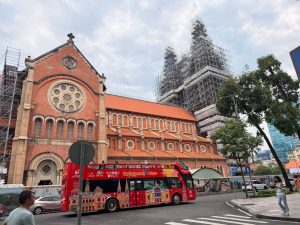
Side view of the Notre-Dame
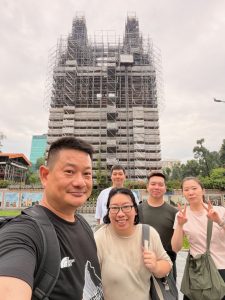
The only thing we can do here is to take a wefie with the Notre-Dame

The facade of Notre-Dame is covered with scaffolding due to ongoing preservation works
Saigon Central Post Office – Oldest Working Post Office
Our next stop is just across from Notre Dame of Saigon, the Saigon Central Post Office. The post office is one of the oldest post offices in Southeast Asia, and it is still functioning today. The facade of the post office looked like some train station in Europe, with European-style casting occupying most of its facade. The beige colour used in the facade made the building look clean and fresh. The interior of the post office looked clean and bright, thanks to the beige colour used and the natural light that would shine through the glass in the central atrium. The interior that is open to the public is relatively small, given how large the post office is. The counters that still serve the locals in their mailing and tax payment needs took up the perimeter of the rectangular concourse. A large portrait of Ho Chi Minh hangs in the centre of the post office, constantly reminding us that this city is named after this legendary leader of Vietnam. Despite the overcast weather, the humid climate motivated us to head into one of the two shops at the wings of the post office in search of air conditioning to cool us off. These shops mainly sell souvenirs representing Vietnam and Ho Chi Minh City. After cooling ourselves down, we headed back out to the main concourse. This is when we saw a booth selling customised stamps. We were able to make stamps with our pictures, either using the instant camera booth or uploading through a link given by the staff. A check with the staff (and subsequently the post office staff) that these stamps can be used as postage. We thought this was a very good souvenir.
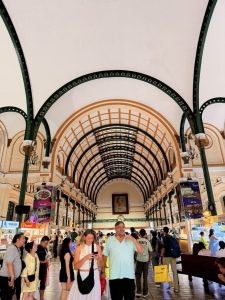
The interior of the Saigon Central Post Office
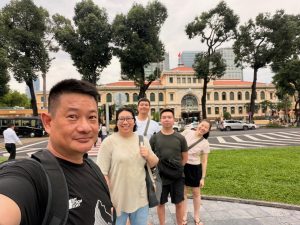
Wefie with the Saigon Central Post Office
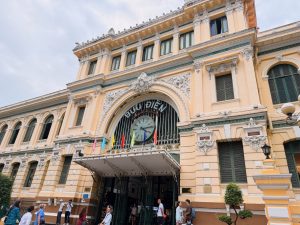
The Saigon Central Post Office has a European-influenced facade
Book Street – An Overhyped Street
We did not stay in the Central Post Office for too long, as there was nothing much we could do here, other than posting letters and postcards. We headed out to our next destination, the Book Street. Book Street is just next to the Saigon Central Post Office, and as its name suggests, it is a short street selling books. Visitors, foreign and locals alike, come here for the Instagram photo. We did not see anyone buying or even browsing the books on sale here. The trees overshading the two rows of bookshops on the side of the road, coupled with the numerous Vietnamese flags hanging overhead across the road, indeed made this place very Instagrammable. As this is a very short street, it only took us 2 minutes to walk through it (we did not bother taking Instagram pictures here).
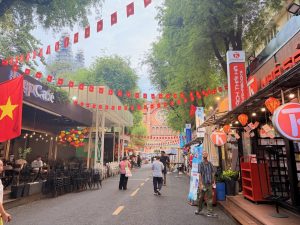
Book Street in District 1 is a very short street with shops selling books and souvenirs

These days these shops on Book Street also sells souvenirs
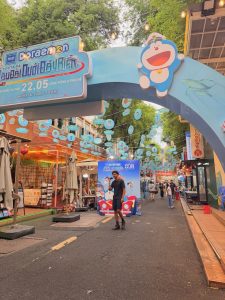
Book Street in Ho Chi Minh City
Nguyen Hue Walking Street & Cafe Apartment – Coffee in the Centre of District 1
Our next stop, the Cafe Apartment, is a 10 min walk from Book Street. As we were making our way, we unknowingly walked past the Saigon Opera House, sitting quietly in the corner of the road, seemingly waiting for people to discover it. The Opera House is where the famous AO show is performed. We would love to watch this performance that combines acrobatic and dance moves, contrasting the lives of the locals between the country and the city. It is a pity that the show is not on during the period that we were in Ho Chi Minh City. Nguyen Hue Walking Street is the main boulevard in Vietnam, which is an open space with shops and restaurants on both sides of the road. The Cafe Apartment, a nine-storey building filled with cafes, soon came into our sight. It is not hard to spot the apartment building with most of the cafes facing Nguyen Hue Walking Street. From the street, it appears that not all the premises are being occupied. There are several empty properties that face Nguyen Hue Walking Street. The cafe that we wanted to visit sits on the 5th floor of the apartment building. We were initially excited to find a lift that we could use to access the 5th floor. However, using the lift requires a payment of VND5,000. I find it weird that a public facility that we took for granted is chargeable. Since the cafe sits on the 5th floor, we decided to walk up the narrow staircase. We took a rest at the cafe, having some Vietnamese coffee (I had the egg coffee) and some snacks while enjoying the air conditioning in the cafe. There is also an outdoor balcony seating option that overlooks Nguyen Hue Walking Street at the cafe.

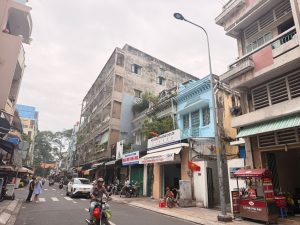
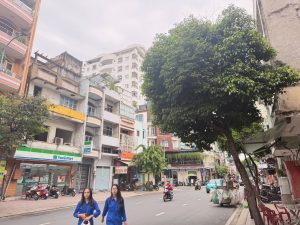
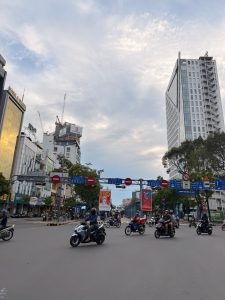
Walking on the Bustling streets of Ho Chi Minh City District 1

We spotted the Opera House sitting quietly on the street
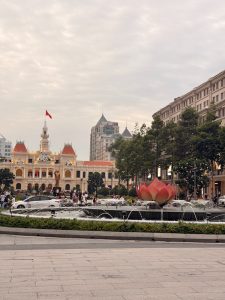
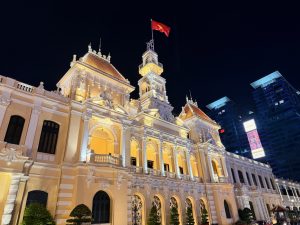
Statue of Ho Chi Minh and the City Hall behind
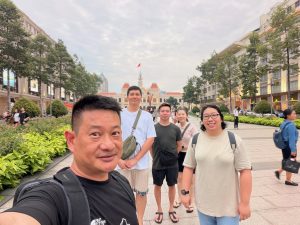
Wefie on Nguyen Hue Walking Street with the Statue of Ho Chi Minh
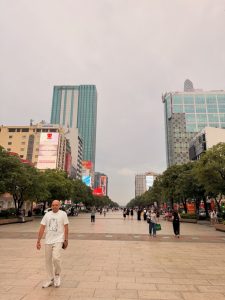
Nguyen Hue Walking Street is a pedestrian walkway in the middle of the road

Walking on Nguyen Hue Walking Street

Wefie with the Cafe Apartment
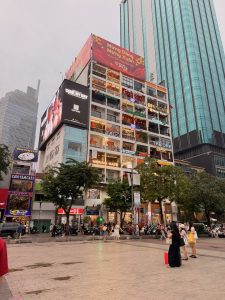
The Cafe Apartment in District 1
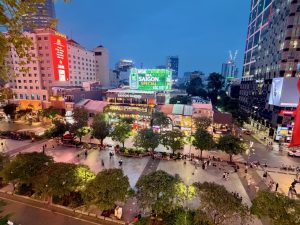
View of Nguyen Hue Walking Street from the Cafe Apartment

Wefie in one of the cafes in the Cafe Apartment
Dinner at Secret Garden
After our fair share of coffee break, it is time for our dinner. I had made a booking on day 3 at this off-the-beaten-path restaurant, Secret Garden. However, a couple of our friends will be on a vegetarian diet on day 3. Seeing that we were near the Secret Garden, we made our way to the restaurant for our first dinner in Ho Chi Minh City. The Secret Garden is only a 7-minute walk from Cafe Apartment. The rooftop restaurant serves authentic Vietnamese cuisine that is also reasonably priced. Weirdly, the restaurant sits atop the residential building, hiding in one corner of District 1, where we would have missed it if not for Google Maps. The restaurant is mainly patronised by locals with a handful of foreigners. The staff were friendly, and the food was delicious. After dinner, we headed back to our hotel to rest for the night.
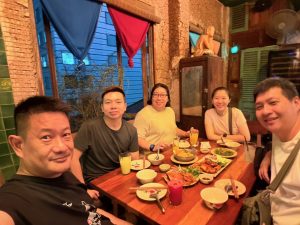
Wefie before we dig into our dinner

The rooftop restaurant where we had our dinner
Bui Vien Walking Street – A Sensory Overload Street
We wanted to pop into one of the few convenience stores near our hotel to get some breakfast, as we will be having an early start tomorrow for our day trip to Cu Chi Tunnel. Using Google Maps, we spotted a shop on the side street opposite our hotel. Unknowingly, we wandered into the famed Bui Vien Walking Street, one of the two main walking streets in Ho Chi Minh City. Unlike Nguyen Hue Walking Street, Bui Vien Walking Street is louder and flashier. The end of the street where we entered from was quieter with cafes, convenience stores and restaurants. But as we walked further into the street, the seemingly peaceful street seemed to be overtaken by pubs and clubs with loud music and girls dancing on the tables outside the pubs under neon lights that constantly shine into our eyes every now and then. Walking on Bui Vien Walking Street, especially at the pub stretch, was a challenge. We were constantly approached by pub staff trying to pull us into their pub for a drink. We did not like this part of the street as it was very noisy with constant irritation from the neon lights. We headed back to our hotel to rest for the night, as we would have an early start and a long day tomorrow.

Bui Vien Walking Street is famous for its nightlife and pubs
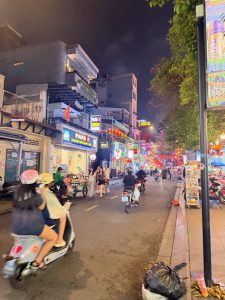
Bui Vien Walking Street has a number of restaurants and convienence stores

Bui Vien Walking Street is very lifely at night