Kansai (Kyoto/Osaka) Day 6 (23 May 18) – The Temples of Kyoto: Wandering Through the Torii Gates of Fushimi Inari-Taishi, to the Zen Gardens of Ginkakuji, to the Majestic Water Temple of Kiyomizu-Dera

DSC09279

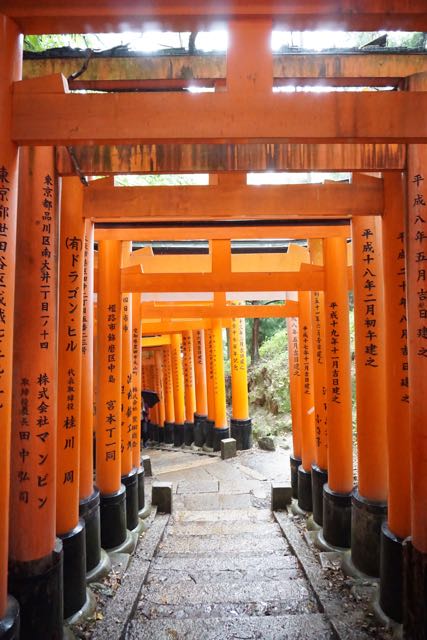
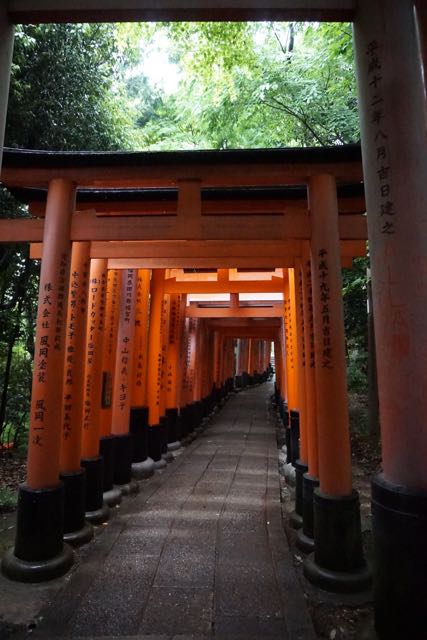
Torii gates of Fushimi Inari-Taishi

Fumishi Inari-Taishi (伏見稲荷大社)

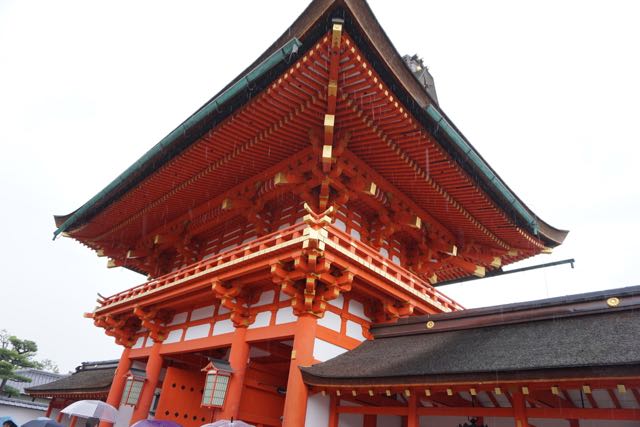
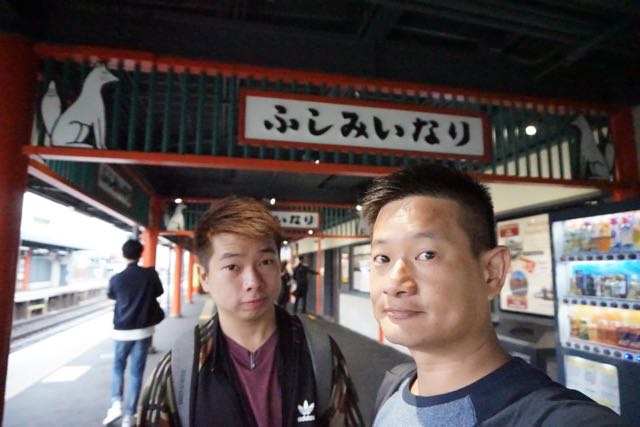
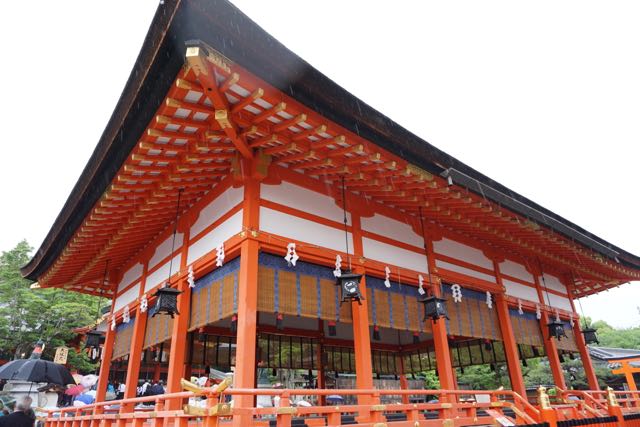
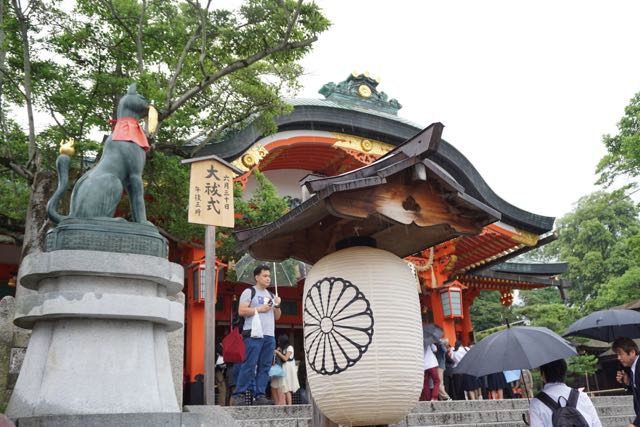
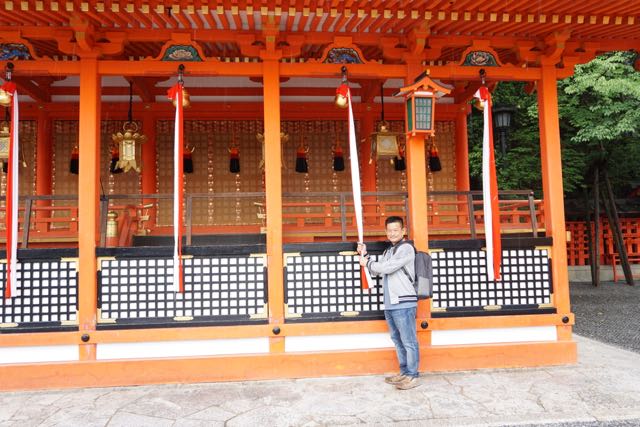
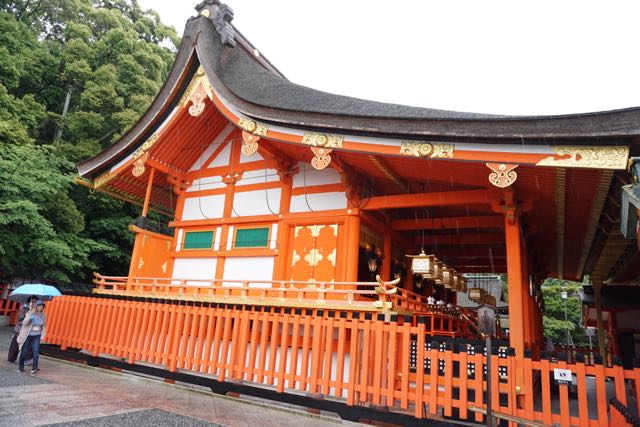
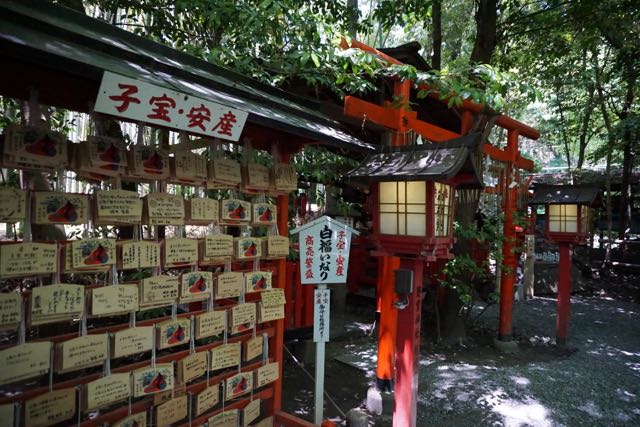
Visitors to Kyoto will bound to make a visit to Fushimi Inari-Taishi, a shrine that is dedicated to The God of Rice, Inari. The shrine was built in 711, just celebrated its 1300th anniversary recently. Our journey to Kansai today brought us to Eastern Kyoto, our first stop is The Temple of Thousand Torii Gates – Fumishi Inari-Taishi. We were hoping to get to the shrine early to avoid bumping into huge crowds, after all, Fushimi Inari-Taishi is one of the visited and photographed spots in Kyoto. I figured it would be boring (not mentioning mainstream) if we just visited the main shrine and walking through the very busy Senbon Torii, other than these sites, we planned to hike up to the top shrine in Mt Inari, hoping to get a good view of the surroundings from the top. The 4km hike up Mt Inari would take about 2 hours. Despite the drizzle, Fushimi Inari-Taishi is still packed with crowds. At Romon (樓門), the main gate of Fushimi Inari-Taishi, we spotted a single storey structure that is decked in bright red pillars and beams with white coloured walls, as the centre part built slightly higher than the side structures.  A little further from Romon sits Honden (本殿), the main shrine of Fushimi Inari-Taishi. Visitors are only allowed to pay their respects to the 5 deities enshrined here at the entrance of the shrine, where 5 bells are installed for prayers to ring prior to their prayers.

DSC09121

We were greeted with hordes of visitors at Romon, the main entrance to Fushimi Inari-Taishi

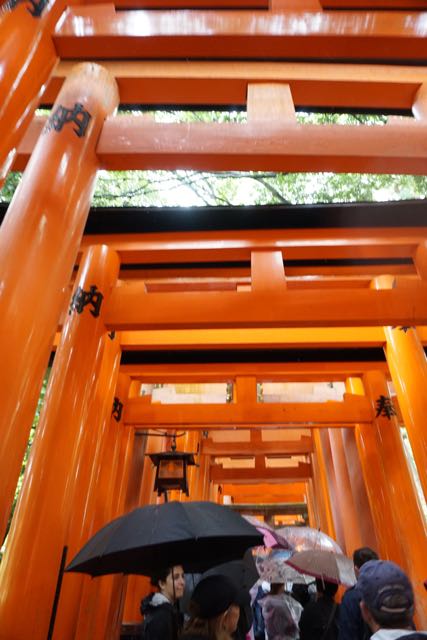
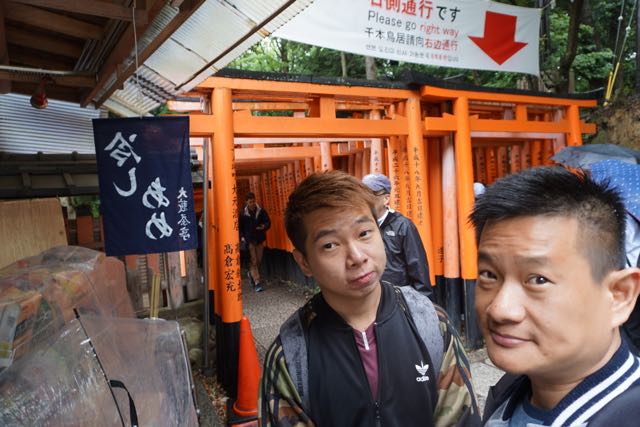
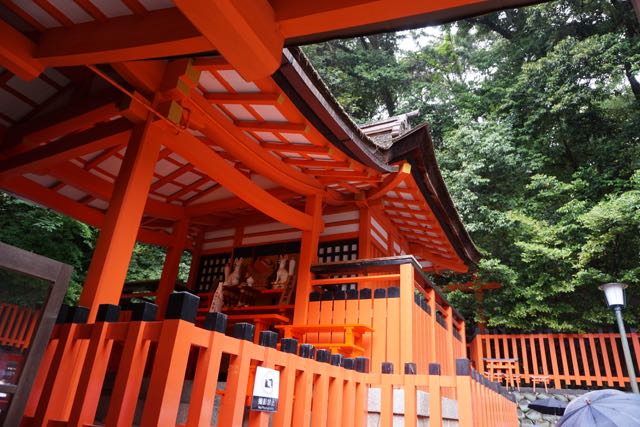
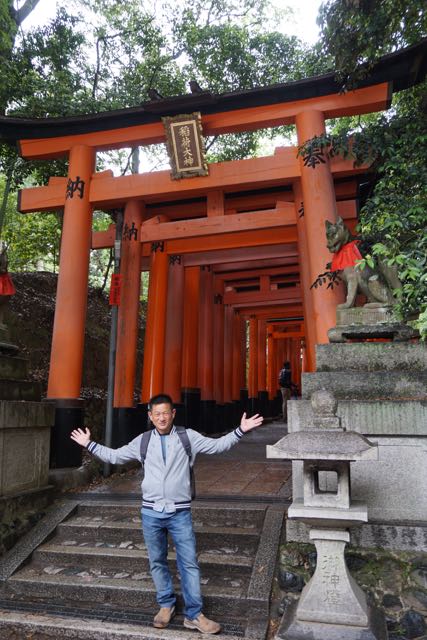
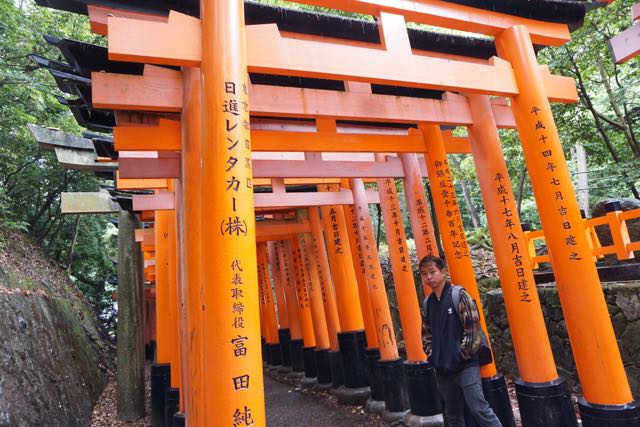
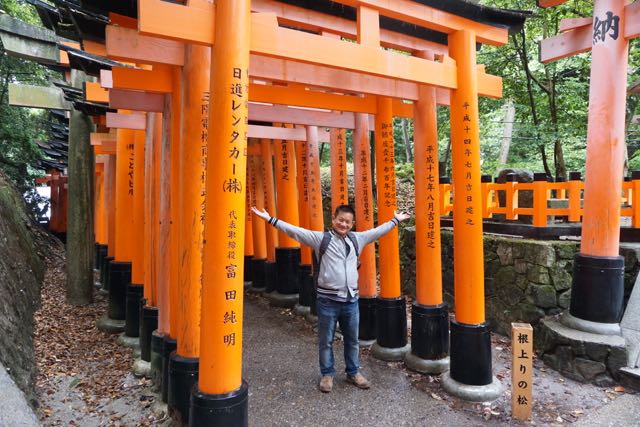
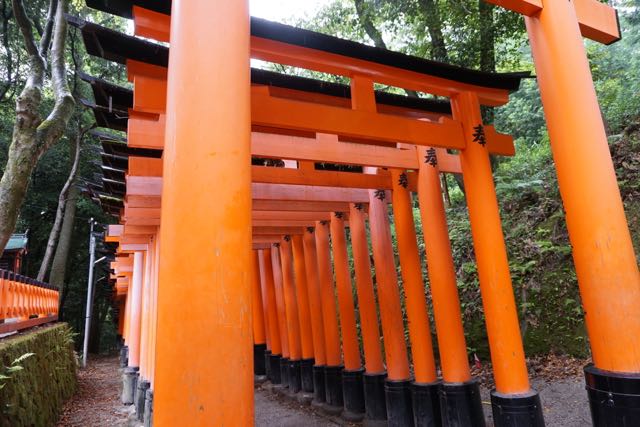
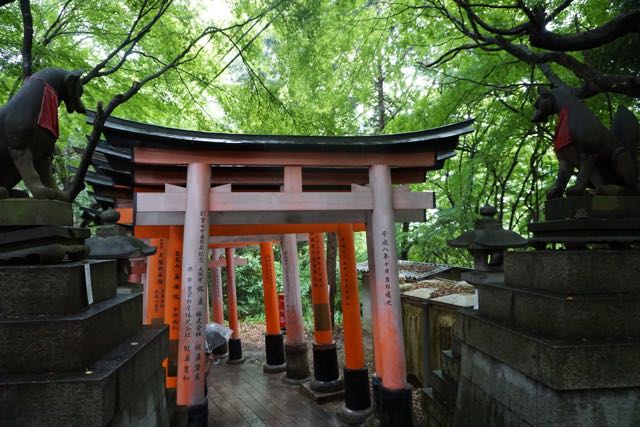
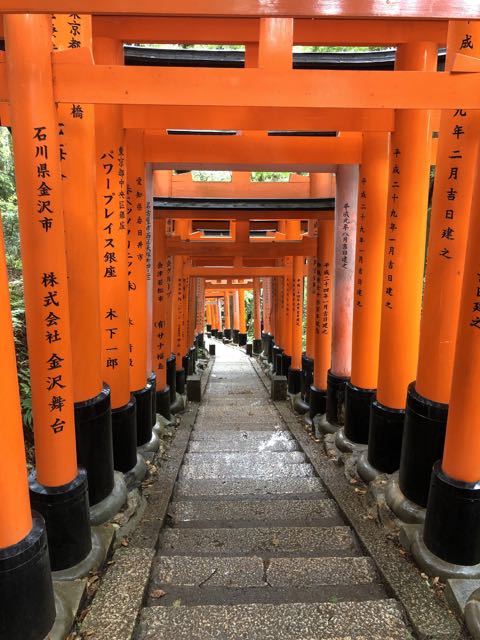
After paying our respects at Honden, we started our hike up Mt Inari through the first stretch Torii Gates, know as Senbon Torii (千本鳥居). Senbon Torii has the highest concentration of torii gates, estimated to be thousands. The torii gates are lined up almost back to back with very little gaps. Walking through these bright red torii gates gives me an almost magical feeling. I have been seeing pictures of Senbon Torii, and now that I am here, it just feels so surreal. Owing to its fame, the number of visitors here is also the highest. It is very difficult to take pictures of the torii gates at Senbon Torii without capturing someone in the shot. My friend and I ended up walking through the torii gates, taking very few pictures. At one point under these torii gates, we came to a split path. The right side leads upwards towards the inner shrine, whereas the left path is for visitors to descend from the inner shrine. Moments later we arrived at the inner shrine of Okusha (奥社奉拝所). There are 3 buildings at Okusha, 2 for temple administrations and 1 is where the deity is enshrined. We also spotted a queue where people seem to be touching some stone. As the queue was rather long, plus we have to cater time to hike up Mt Inari, we did not join the queue.

DSC09164

The torii gates at Senbon Torii Gates

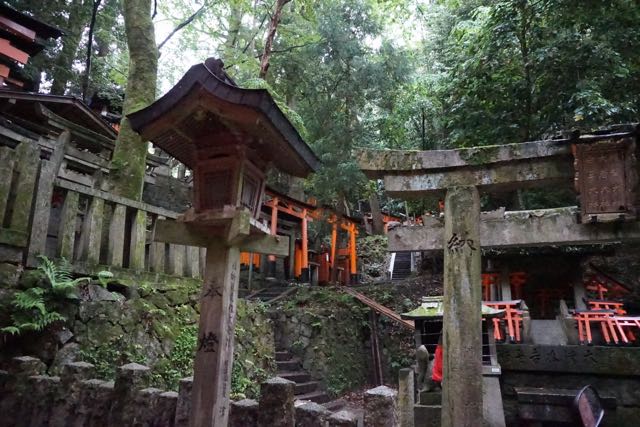
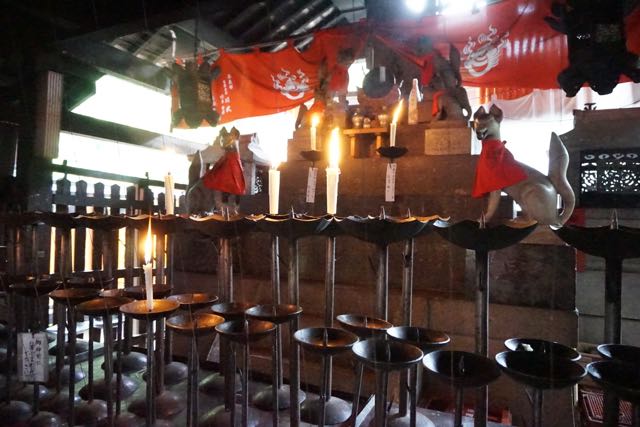
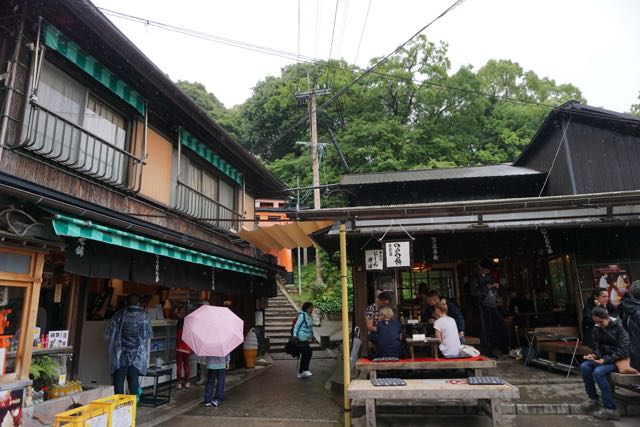
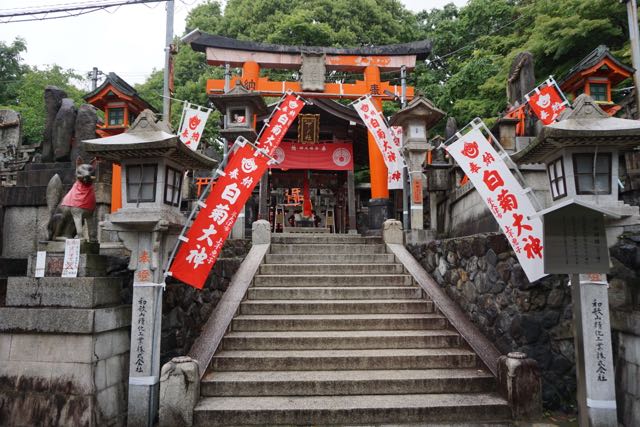
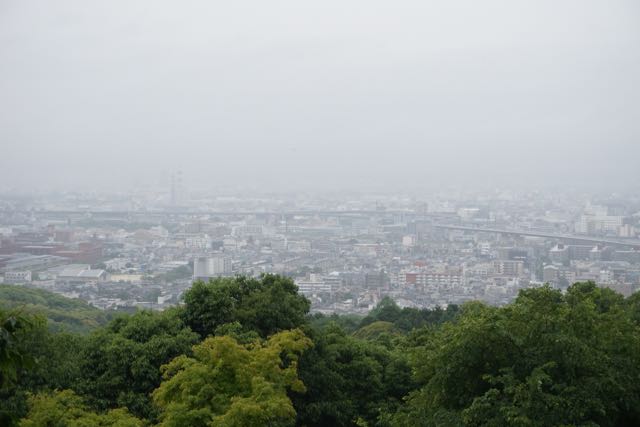
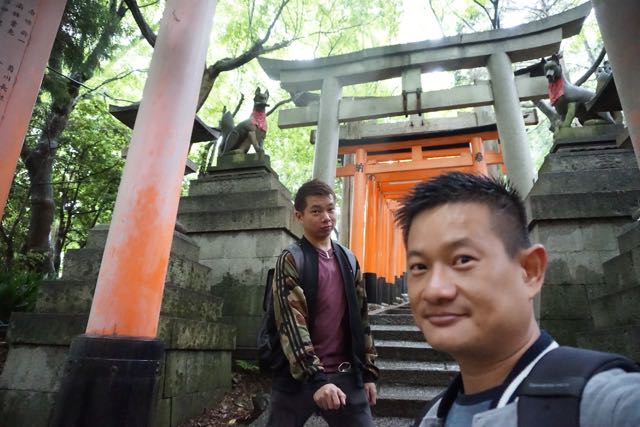
Fushimi Inari-Taishi consists of many smaller shrines spreading on Mt Inari, which we spotted on the hike up to Mt Inari. The torii gates pass Okusha are much larger than those we have seen so far. This part of Fushimi Inari-Taishi is where the crowd started to thin out. From here onwards, we were able to take more pictures with no people in it. Along the way, we saw Kumatakasha (熊鷹社) shrine with a large lake behind it. Along the way, we also came to a rest area. There is a small tea house looking shop that sells food and drinks. I highly recommend people making a trip to Fushimi Inari-Taishi to make a hike up here. It is here we saw Kyoto city from a higher ground. We continued our way up the peak, along the way seeing more smaller shrines. Some shrines are bigger while others seem to be a cluster of smaller shrines. At some points of the path, it felt that the shrines have merged with nature. The forest air is crisp and fresh, possibly due to the rain. We finally reached the top of Mt Inari where the shrine Inchinomine (一ノ峰) is located. We were a tad disappointed that there are no viewpoints at the peak of Mt Inari. From Inchinomine, the path turns downhill. The shrines here are more spread out. We also spotted some torii gates that seem to be newly installed. We see more nature on our way down. Once at the base of Mt Inari, we headed to Kyoto JR Station for our next destination.

DSC09250

View of Southeastern Kyoto from Mt Inari
DSC09265

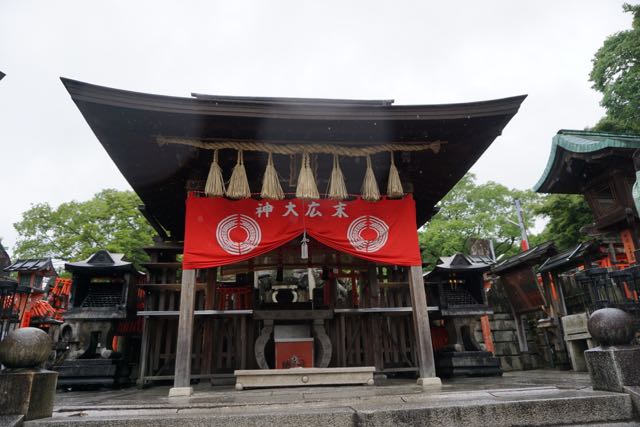
The Shrine on the top of Mt Inari

Ginkakuji (銀閣寺)

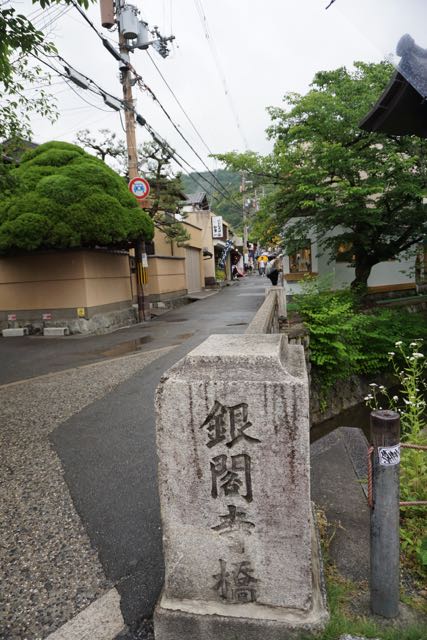
We originally planned to visit the Kyoto Imperial Palace after we are done with Fushimi Inari-Taishi. However, due to the downpour, we spent additional time at Fushimi Inari Taishi, which caused us to miss the English guided tour timing. We decided to change our destination and wanted to visit Kiyomizu-Dera. While queuing for the bus, we realised bus number 100 goes to both Kiyomizu-Dera and Ginkakuji. We decided to make a trip to Ginkakuji. Ginkakuji is a short walk from the bus stop we alighted. Along the way, we walked past the famed Philosopher’s walk. I told my friend we would take a look at Philosopher’s walk if we have the time after visiting Ginkakuji.

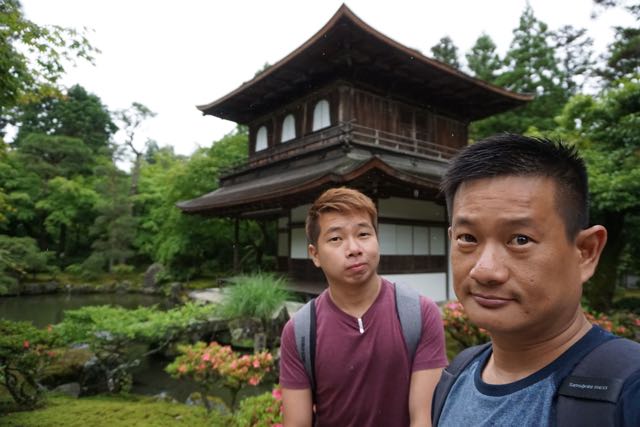
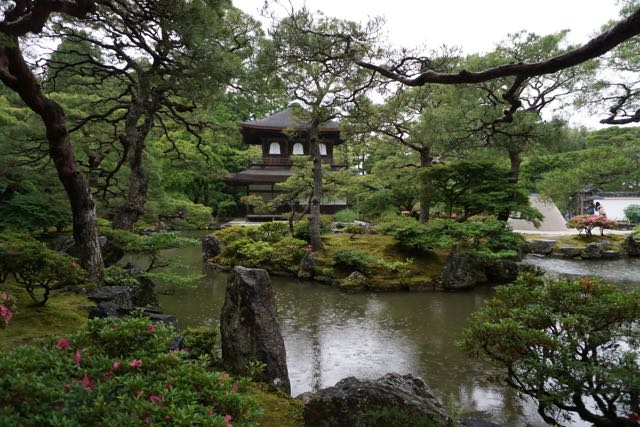
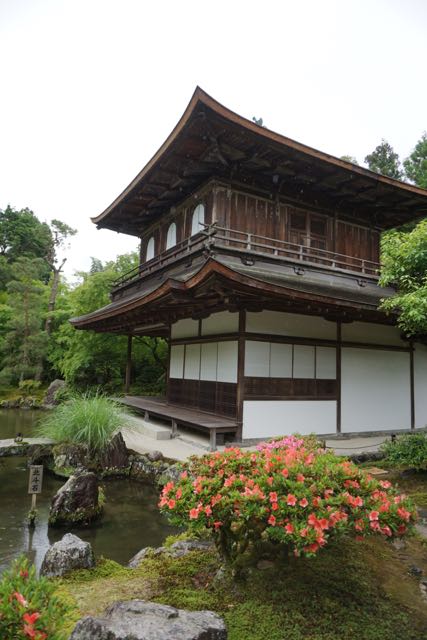
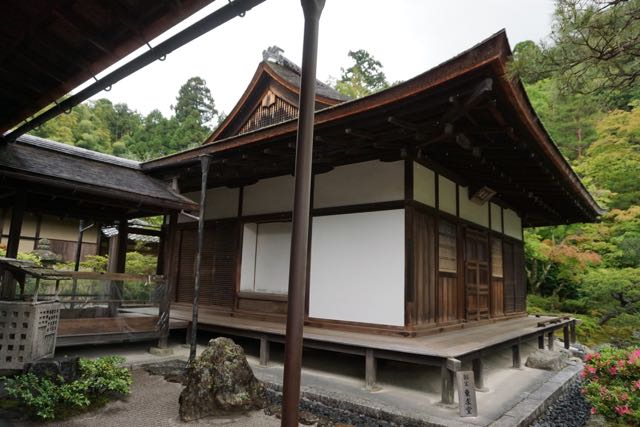
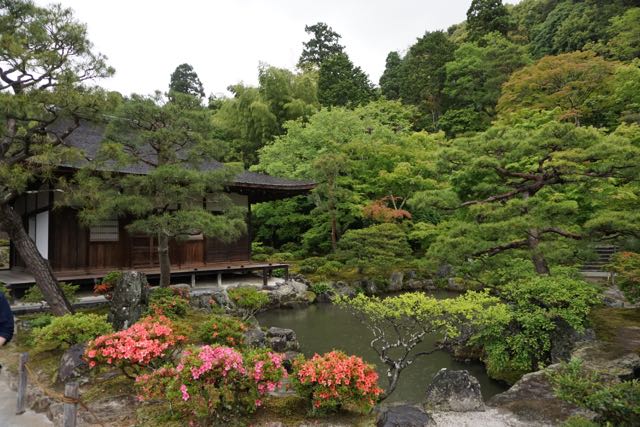
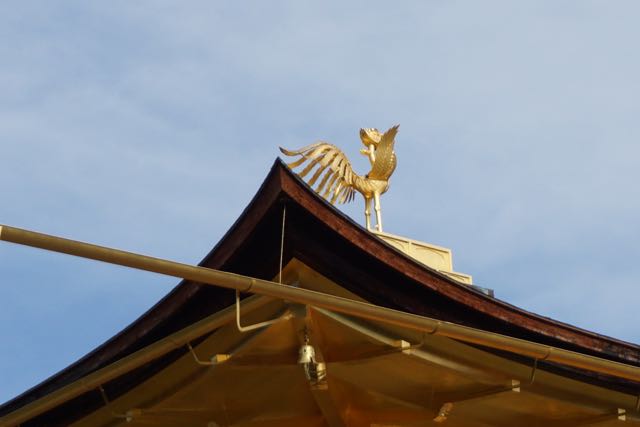
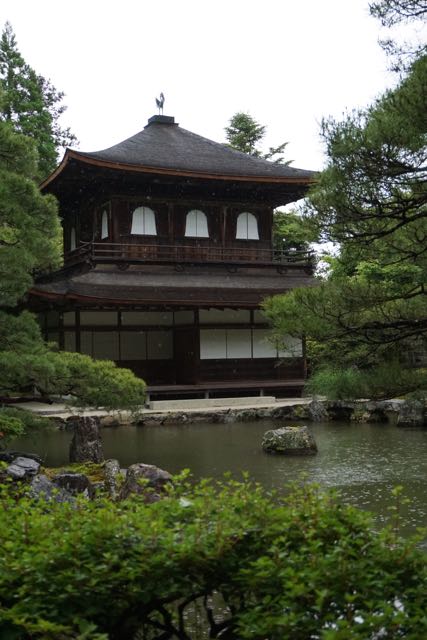
Ginkakuji is built in 1482 and served as the retirement villa for the owner, mirroring the Kinkakuji which was built by the owner’s grandfather. Ginkakuji was converted to a temple after the owner’s death in 1490. The named Ginkaku was given when the owner wanted to cover the pavilion with silver foil, however, this did not materialise till the day the owner passed on. Entering Ginkakuji, there is a short walk from the main gate before we reach the inner gate. Passing the inner gate, the highlight of Ginkakuji, Kannon-den (観音殿)or Ginkaku (銀閣) was on the right of the entrance. Ginkaku is a 2 storey wooden structure sitting by a small pond. The silver pavilion is much simpler and smaller than Kinkakuji, perhaps due to the owner does not want to dwarf the works of his grandfather. Ginkaku still retains its original look (and colour) the day it was built. Similar to Kinkakuji, a silver phoenix taking flight stands on the roof of Ginkaku. Having visited Kinkakuji the day before, looking at Ginkakuji feels like a knockoff from its golden version. Afterall it is modelled after its famous golden version.
DSC09338

Ginkaku, the Silver Pavilion

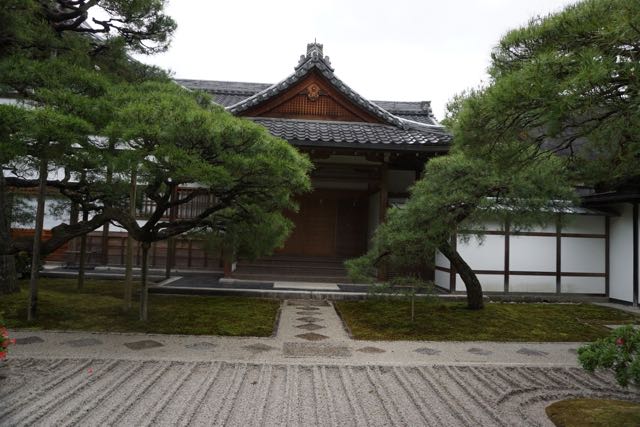
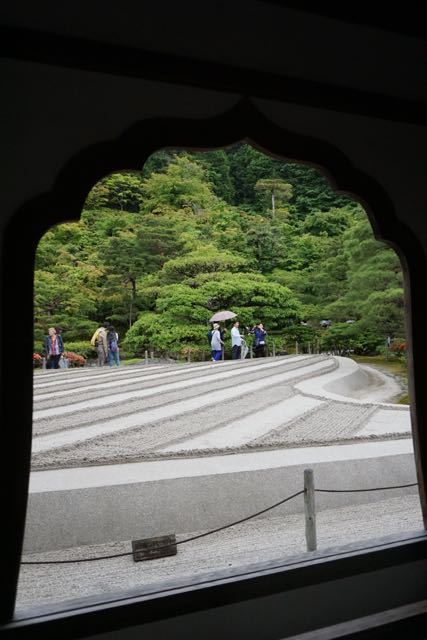
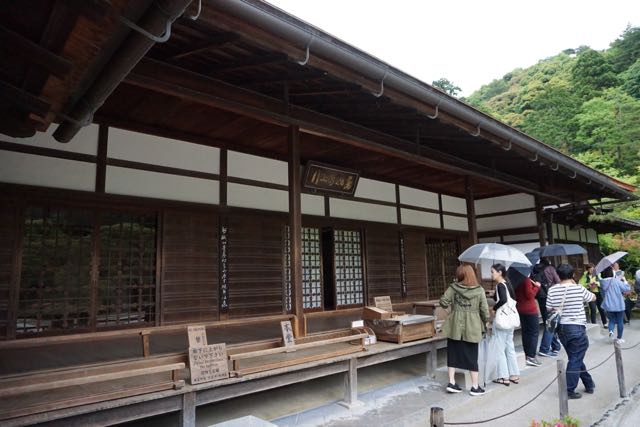
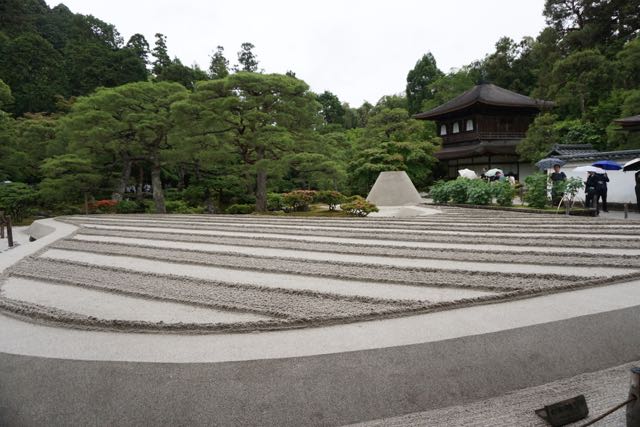
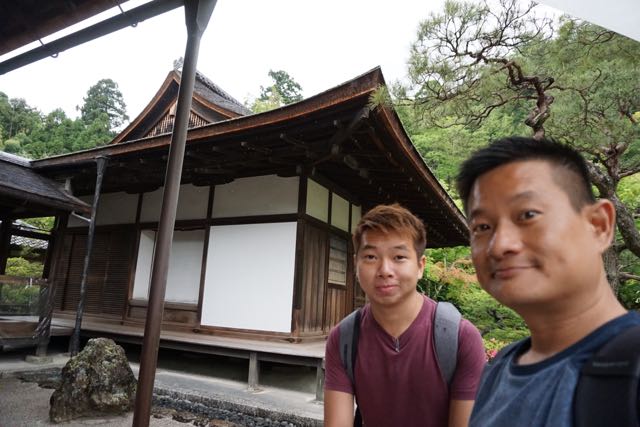
Next to Ginkakuji is where Kogetsudai (向月台) is located. The Kogetsudai is a large open space with a volcano structure made of white sand, which represents waves and Mt Fuji. Next to Kogetsudai sits the Hondo (本堂) and Togudo(東求堂) side by side. Built of wood, the Hondo is out of bounds and is one of the largest buildings in Ginkakuji. Similarly, the Togudo is also made of wood, this is the oldest Shoin style building that has survived earthquakes and fires throughout the centuries.

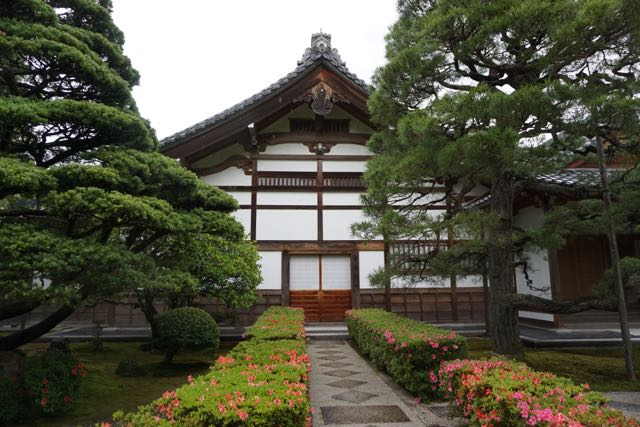
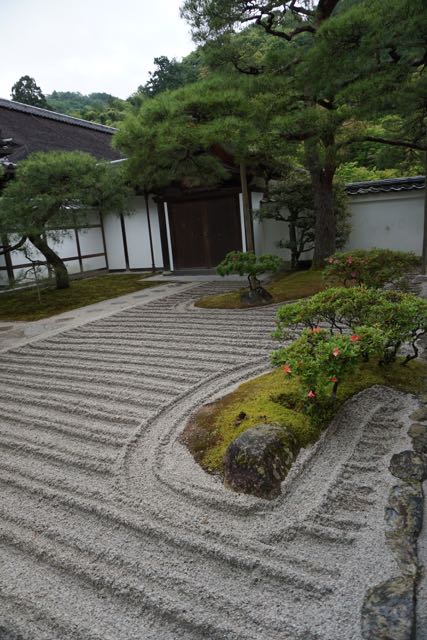
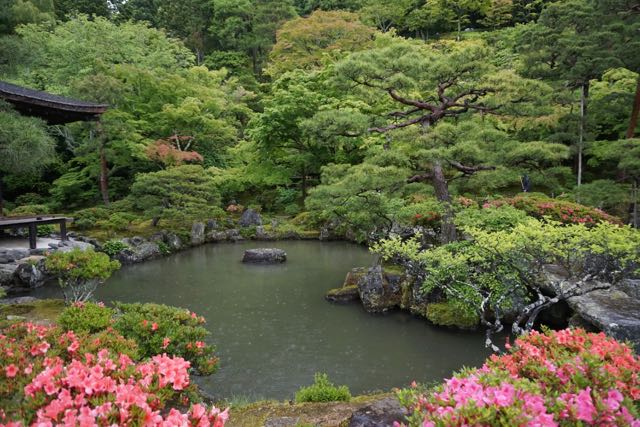
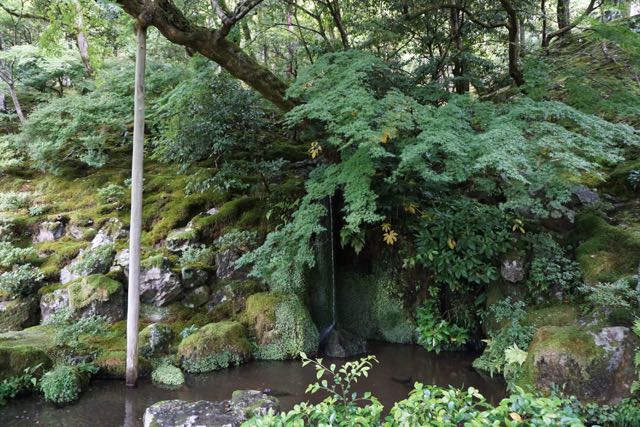
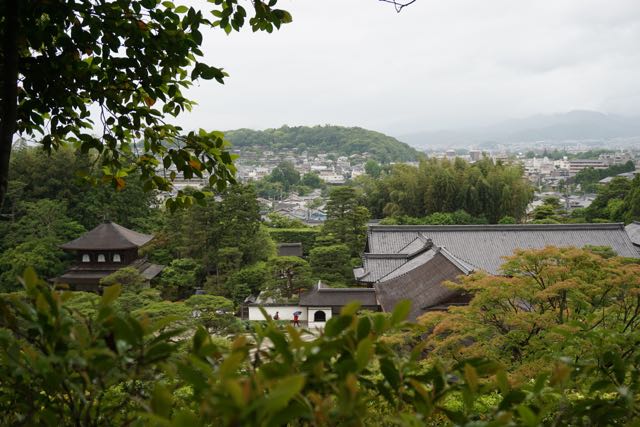
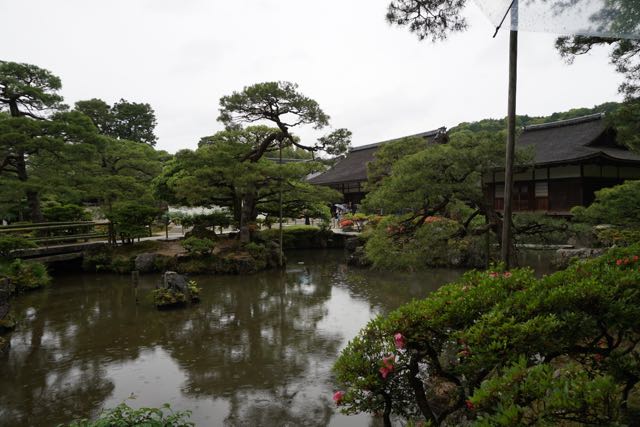
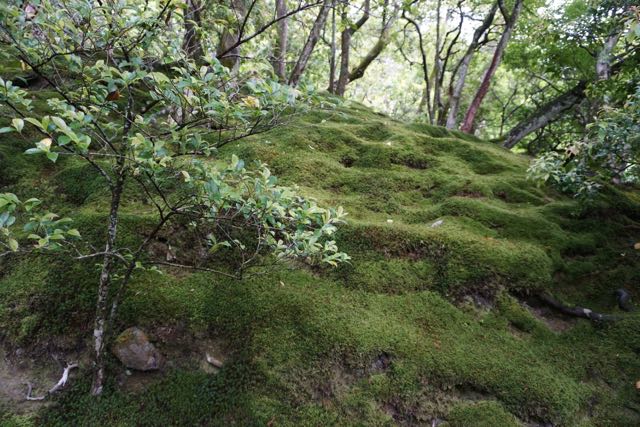
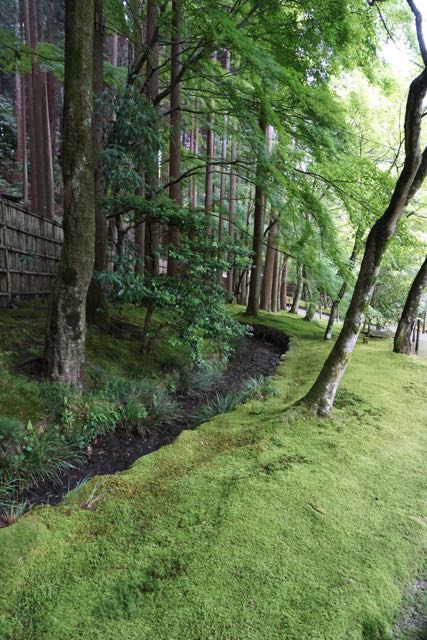
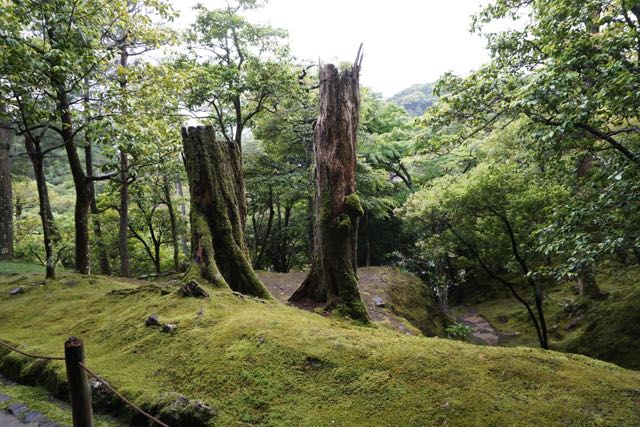
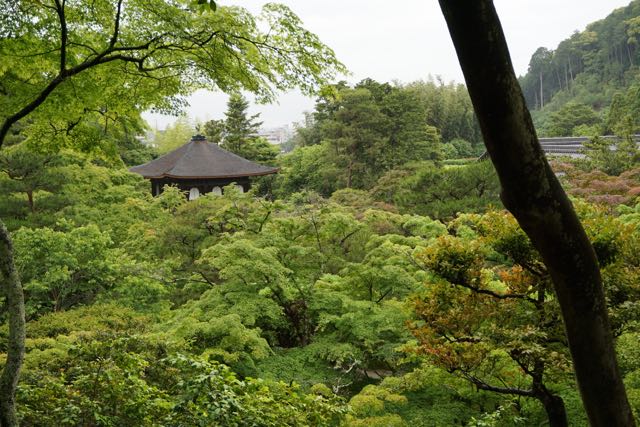
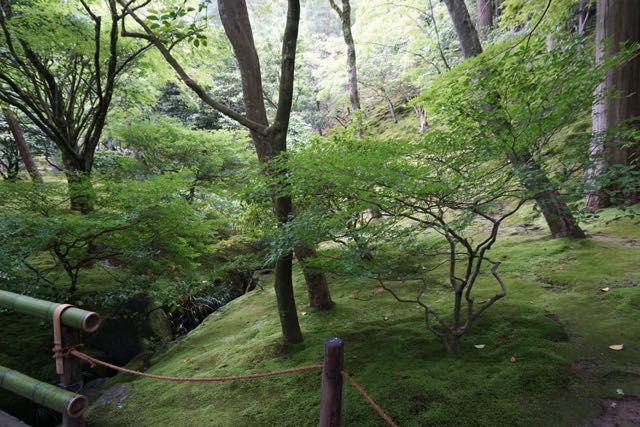
Perhaps the most iconic feature of Ginkakuji is its zen gardens. Almost half the area is dedicated to the zen gardens. There are 4 ponds in Ginkakuji in total, of which 3 are visible to visitors. Passing the Toguko, a path that leads to the moss gardens in Ginkakuji, which leads to a viewpoint up a small hill. Walking around the gardens feels therapeutic and peaceful. From the viewpoint up in the hills, we can see the whole of Ginkakuji and the town in Northeastern Kyoto. Ginkakuji is rather small, it took us 30 mins to finish walking around the grounds of Ginkakuji. Unless one is interested in zen gardens or happens to have spare time (like us), Ginkakuji is hardly worth the time to travel to this part of Kyoto. We originally wanted to take a walk down Philosopher’s Path, however, after walking past, it felt like walking behind someone’s backyard. We gave up the idea of walking down Philosopher’s Path and headed for our next destination in Kyoto.

DSC09347

View of Ginkakuji and northeastern Kyoto from the hill in Ginkakuji

Kiyomizu-Dera (清水寺)

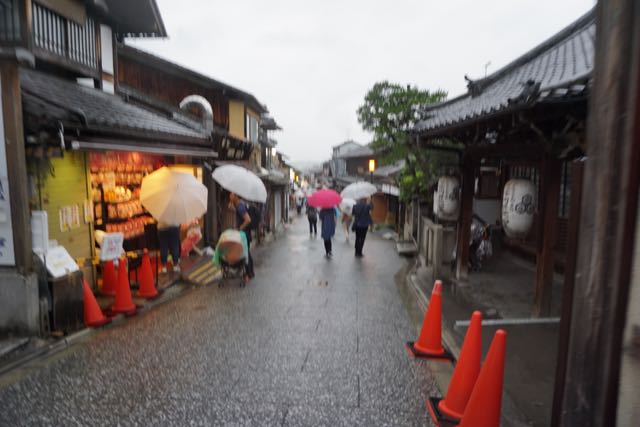
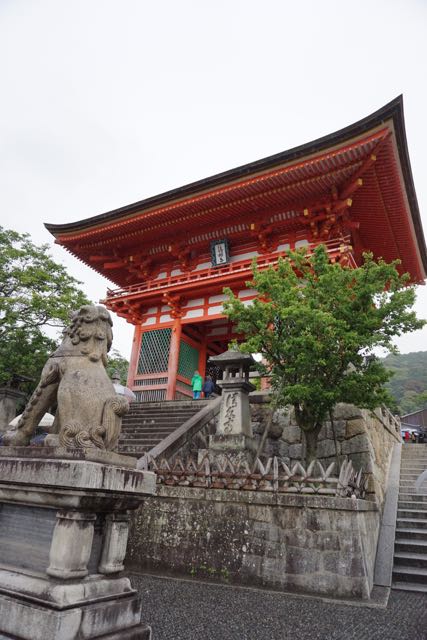
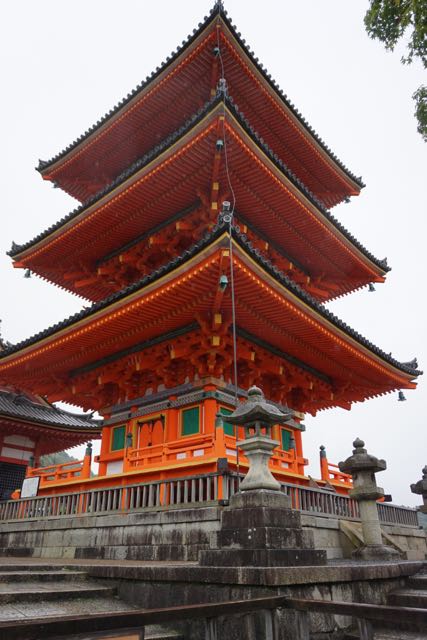
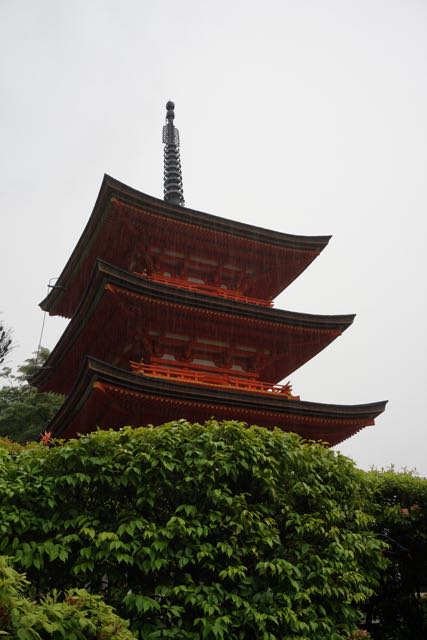
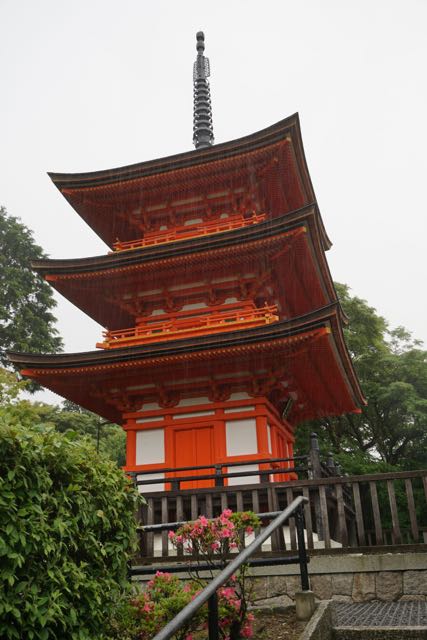
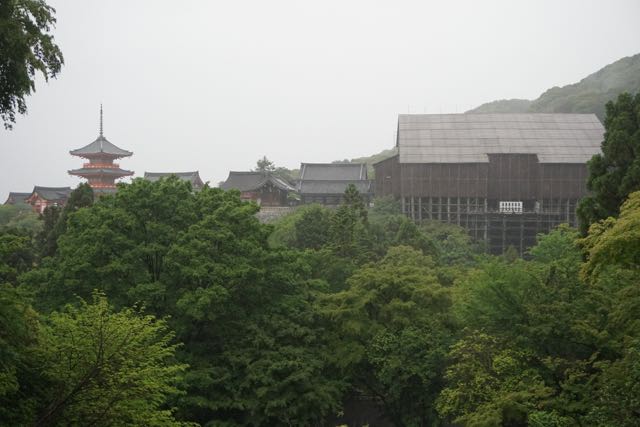
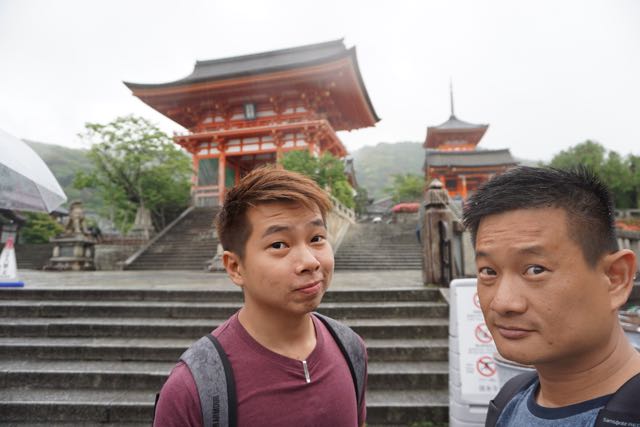
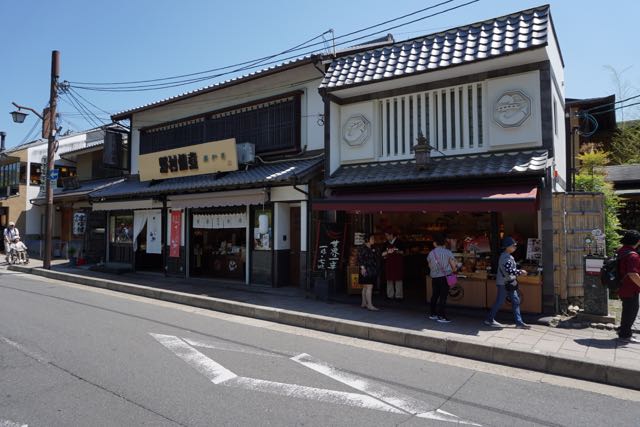
We took the same bus that brought us to Ginkakuji to Kiyomizu-Dera, which is one of the more iconic temples in Kyoto. It took us 7 mins to walk from the bus stop to Kiyomizu-Dera, passing by some wooden buildings along the way. Walking on this street feels as if we are being taken back in time. The street is now filled with shops selling souvenirs. Kiyomizu-Dera is at the end of this street, the first indication of arriving at the temple is the bright red 2 stories main gate. The 14m tall Nio-mon (仁王門) is the main gate that welcomes visitors daily. Sitting on top of a flight of stairs, Nio-mon looks commanding. Walking past Nio-mon, just right behind it, is where the Sai-mon (西門) is located. We were not particularly impressed with the Sai-mon, but are more captivated by the 3 stories red pagoda behind it. From Sai-mon, we spotted another pagoda across on the other side of Kiyomizu-Dera.

DSC09358

Nio-mon, the main gate to  Kiyomizu-Dera

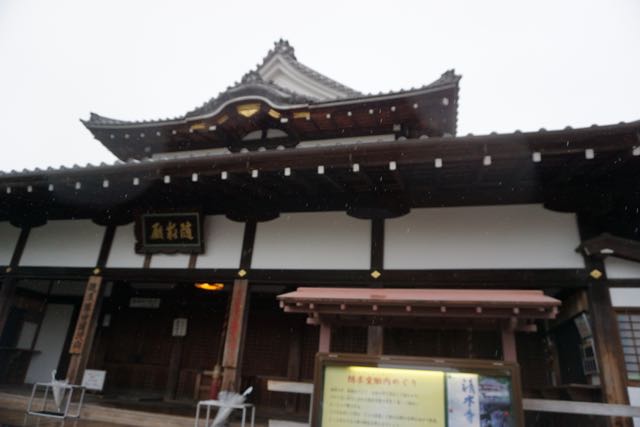
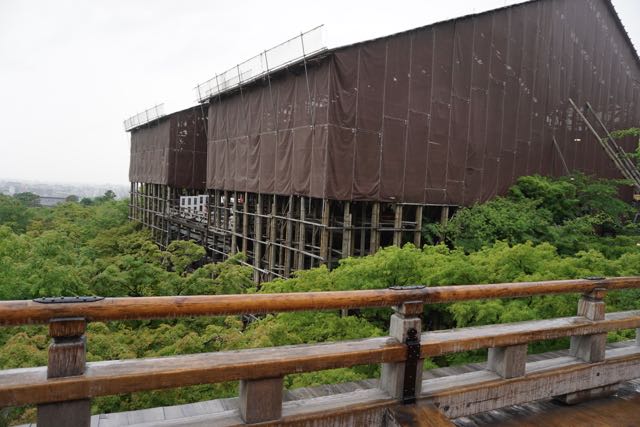
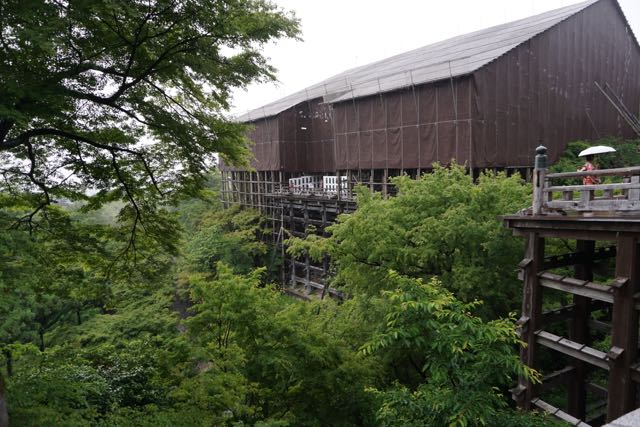
As it was approaching closing time (we only had 45 mins at the time we arrived at Kiyomizu-Dera). My friend and I wasted no time and headed into the main hall – Hondo (本堂). The Stage in Hondo is the most iconic feature in Kiyomizu-Dera, thanks to the location it is built on. The Stage is essentially a veranda, protruding out of the Hondo, built on the steep cliff, supported by 18 pillars that measure 13m tall. However we were a tad disappointed to learn that Kiyomizu-Dera is undergoing preservations works, most the iconic Kiyomizu Stage is covered in canvas and scaffolds, except for a small section that allowed us to take a peek down from the veranda. After offering our respects to the god in Hondo, my friend and I proceeded to the other parts of Kiyomizu-Dera.

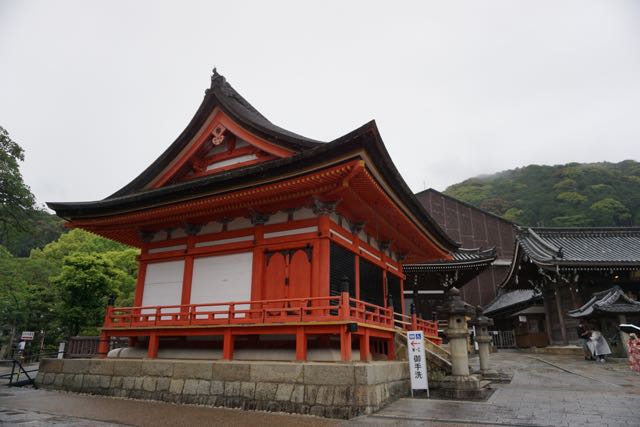
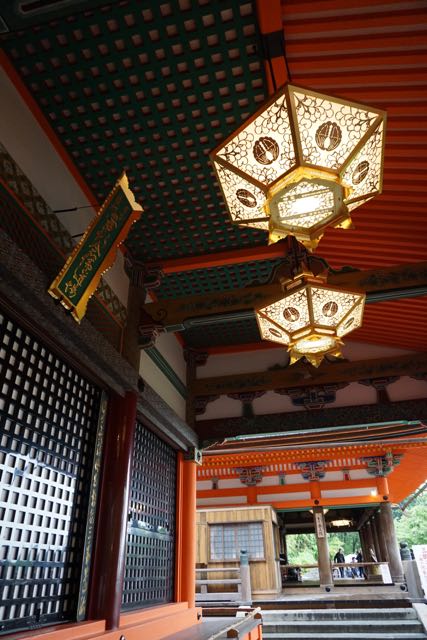
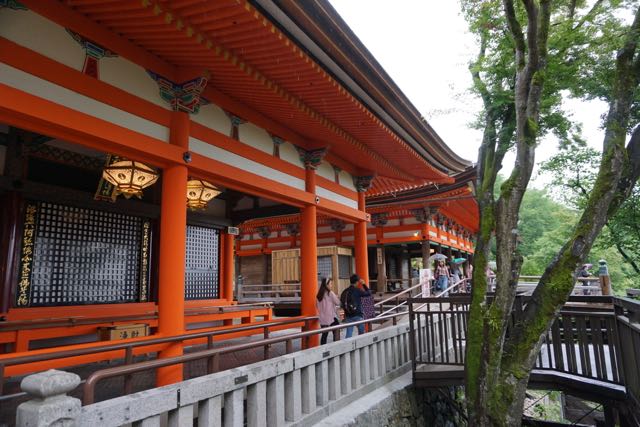
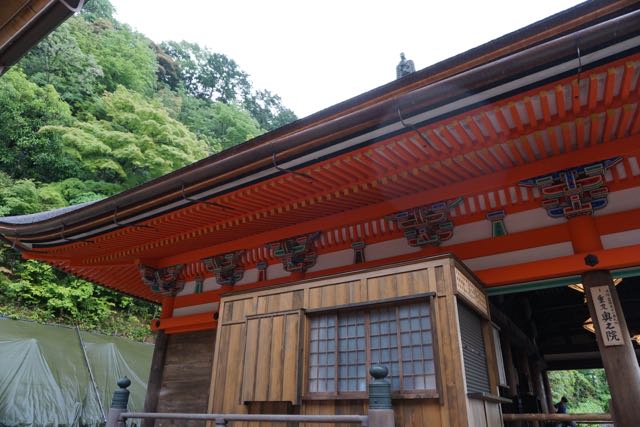
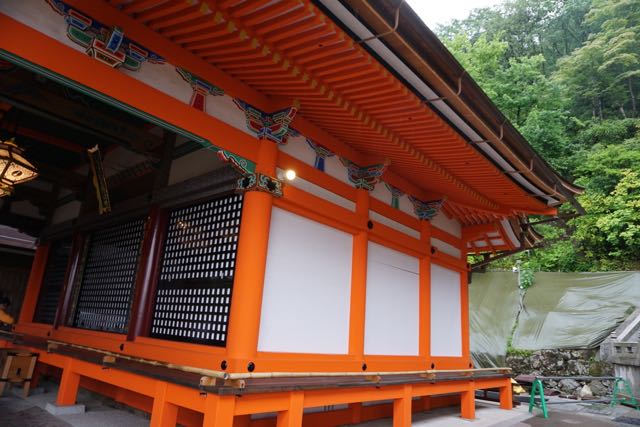
From Hondo, there is a path that splits into lower and upper path in Kiyomizu-Dera. We took the upper path as this is where we can get a good view of Hondo. There are a couple of buildings on this side of Kiyomizu-Dera, the Okuno-in Hall (奧の院) resembles Hondo, but at a smaller scale. Similar to Hondo, there is a veranda at Okuno-in Hall where we got great shots of Hondo (if not for the hideous canvas). We continued on the path leading to the pagoda located opposite Hondo. From Hondo, this pagoda seems far, but the distance between the 2 structures is not as far as it seems. Arriving at this pagoda, it looks the same as the first pagoda next to Nio-mon. As Kiyomizu-Dera is closing soon (announcements were being made on its closing time), we headed for the waterfalls in the temple grounds.

DSC09394

The veranda at Okuno-in Hall is a great picture spot of Hondo

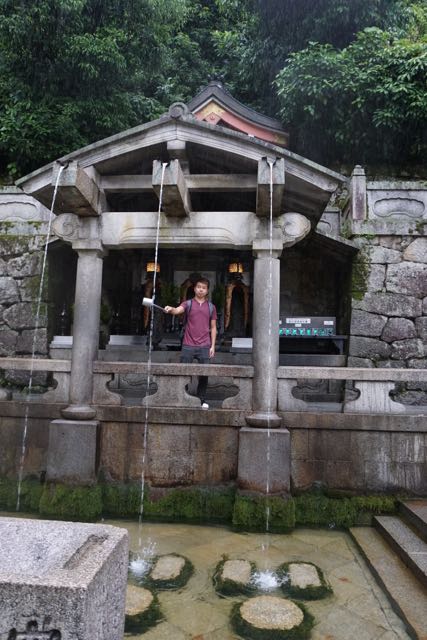
Coming from the pagoda, we took the lower path that leads to the waterfall. Otowa no taki (音羽の瀧) is one the iconic features in Kiyomizu-Dera. It is the pure waters from the mountains here that gives the temple its name. Otowa no taki is a pavilion that has 3 streams of water flowing down from the mountains. It is believed that each of these streams grants different wishes, but drinking from all 3 streams will bring bad luck. I tried drinking from one of the streams, the water tasted like tap water and is very refreshing. One of the good thing about coming to Kiyomizu-Dera when it is about to close is the absence of large crowds, my friend and I did not have to queue for the spring water nor are there crowds that obscure us from taking pictures. If one were to come here when it is about to close (the temple closes at 6pm), do come at least 1½ hours before it closes.

DSC09426

Taking the last wefie before we leave Kiyomizu-Dera

We hurried out Kiyomizu-Dera as it was about to close.  As it was dinner time, my friend and I had dinner in one of the small bento eateries (they were delicious and not pricey at all). We spent the rest of the night shopping in Kyoto before heading back to Osaka.


DSC09430

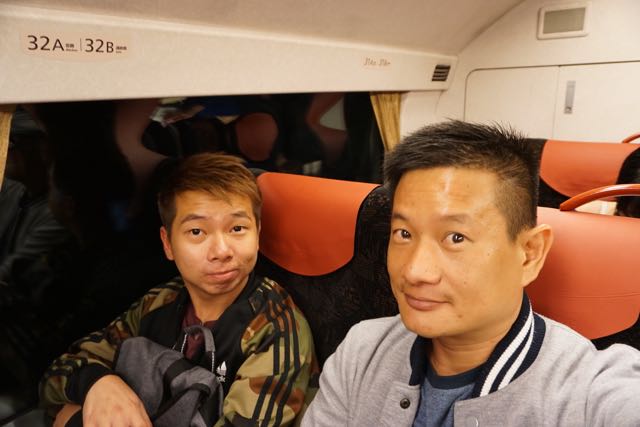
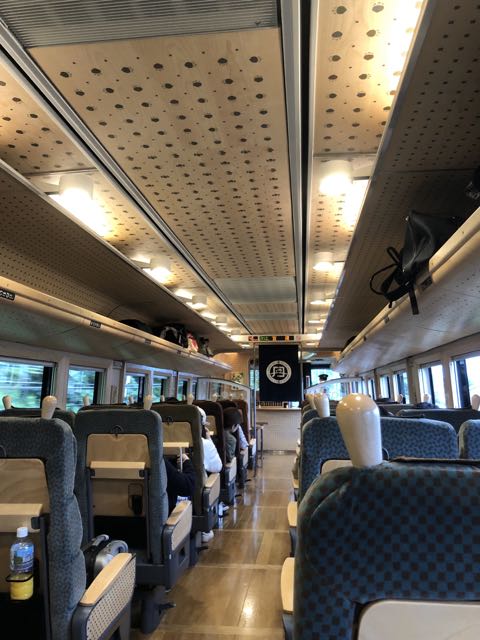
On a double-decker train heading back to Osaka
 

Kansai (Kyoto/Osaka) Day 5 (22 May 18) – The Nature and the Ancients of Kyoto: From Arashiyama to Kinkakuji

DSC09029

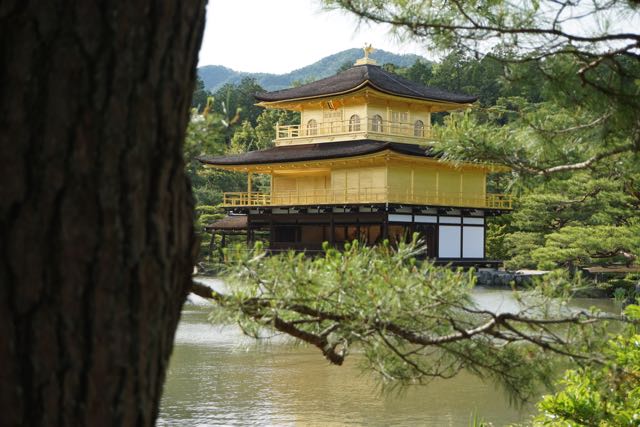
Kinkakuji in Kyoto

For the next 2 days, our travels in Kansai region will be spent visiting the sites in Kyoto. There are a lot of historic places to visit in Kyoto and it would not possible to see everything given the time we will be spending in Kyoto. Numerous guides online provide guides for visitors to Kyoto. I was initially planned on following one of these guides. After some planning, I was telling myself why settle for some guides with places that I am not interested in? A few iterations later, I finally settled on the places I wanted to visit in Kyoto, the beauty of a free and easy trip. We spent our 1st day visiting the sights northwest Kyoto and 2nd day in the southeast Kyoto.

Arashiyama (嵐山)

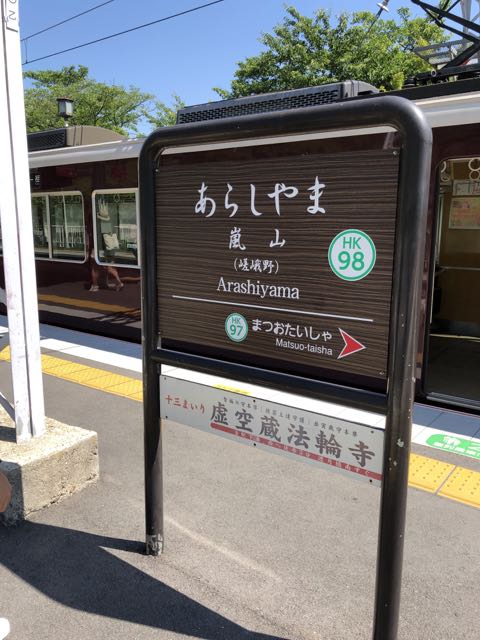
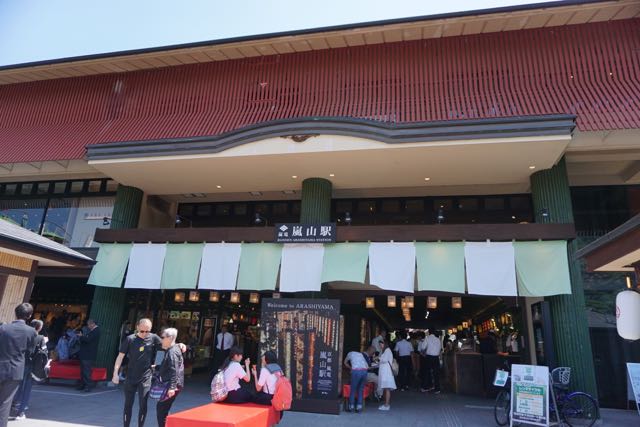
We started our Kyoto travels with Arashiyama, which is famed for its scenic views of the river and the Bamboo Grove. There are 3 train stations that serve Arashiyama area namely Hankyu-Arashiyama Station (阪急嵐山駅), Randen-Arashiyama Station (嵐電嵐山駅), and JR Saga-Arashiyama (嵯峨嵐山駅) located at the south, central and north of Arashiyama, respective. We opted to take the train to the southeast of Arashiyama so that our journey will start from the south and end up in the north of Arashiyama where we will catch the Sangano Scenic Railway.

Togetsukyo Bridge (渡月橋)

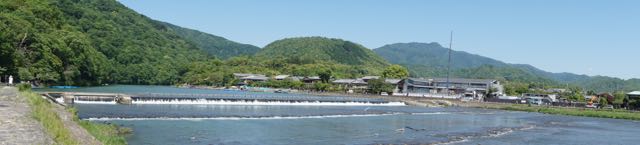
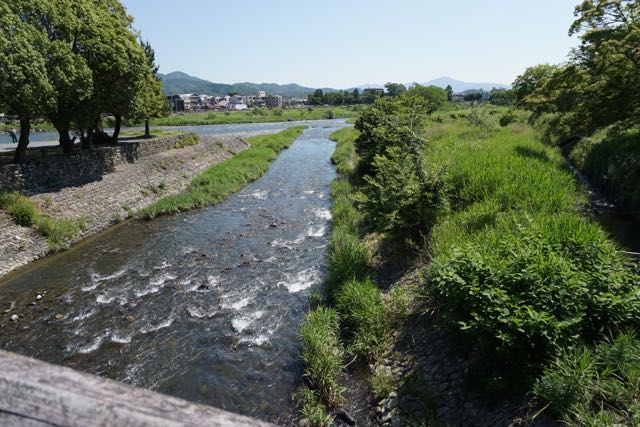
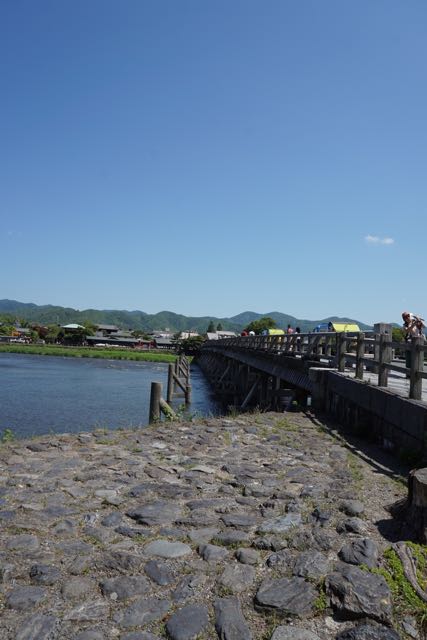
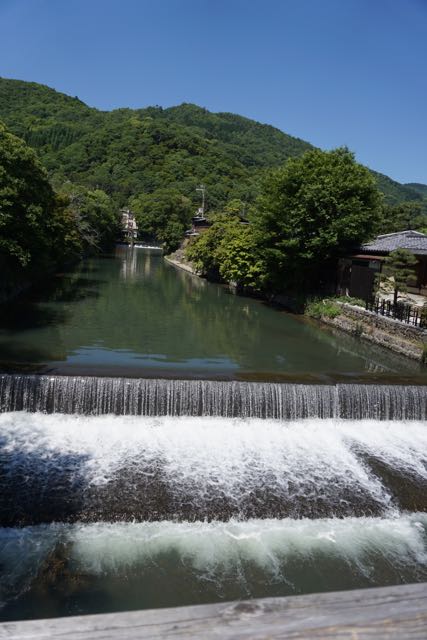
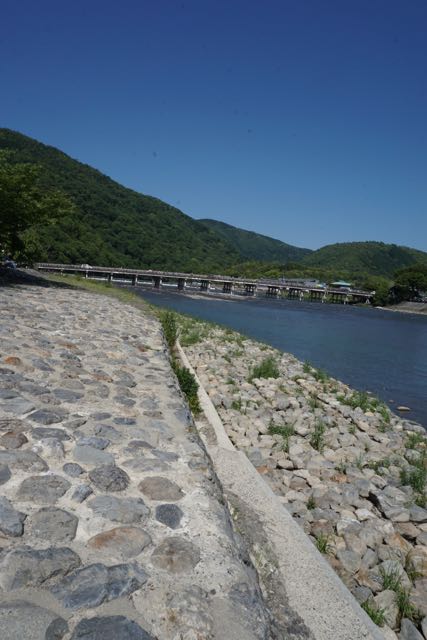
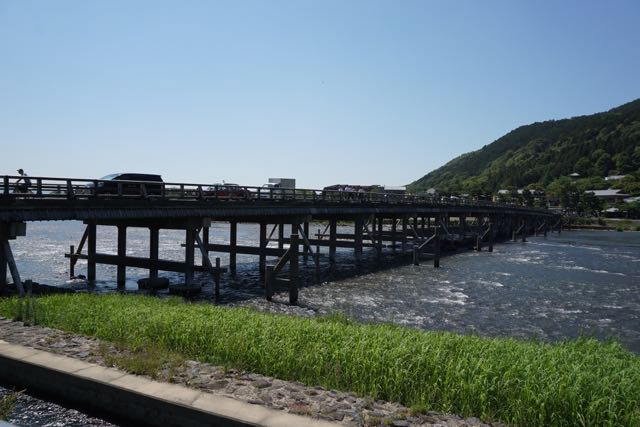
Leaving Hankyu-Arashiyama Station, we headed towards the Katsura River (桂川), where the famed Togetsukyo Bridge is located. We reached Katsura River within minutes and there lies the 155m Togetsukyo Bridge in a distance. The view from the riverside was beautiful. With Togetsukyo Bridge in the foreground and the spring green trees on the hills behind the bridge, no wonder visitors flog here for a picture on the bridge. We walked towards the bridge and was treated to more scenic views of a small raised dam, which looked like a waterfall on the river bed. There are sightseeing boats that dock in the nearby pier. Crossing Togetsukyo Bridge, we came to the built-up area of Arashiyama. The view of the bridge from this side of the river presents a different view, however, I prefer the view from the side near the Hankyu-Arashiyama Station, mainly due to a lesser crowd there.

DSC08818

Panoramic Shot of Katsura River from Togetsu Bridge

Arashiyama Rickshaw Ride (京都人力車)

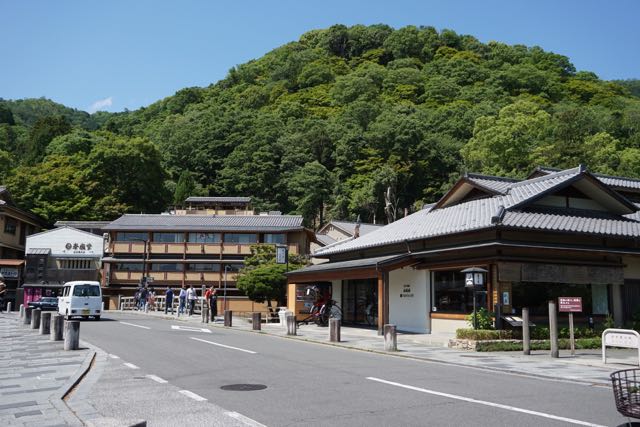
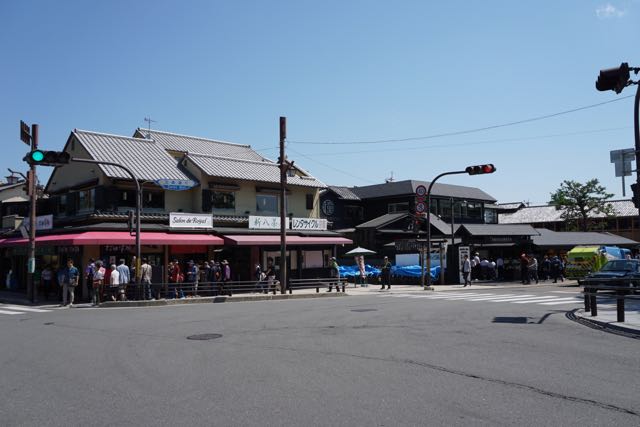
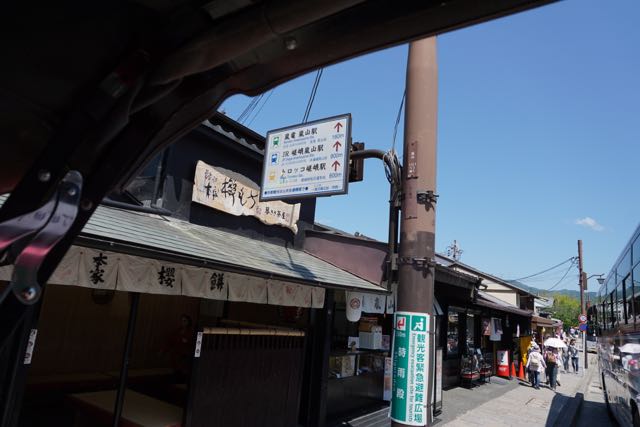
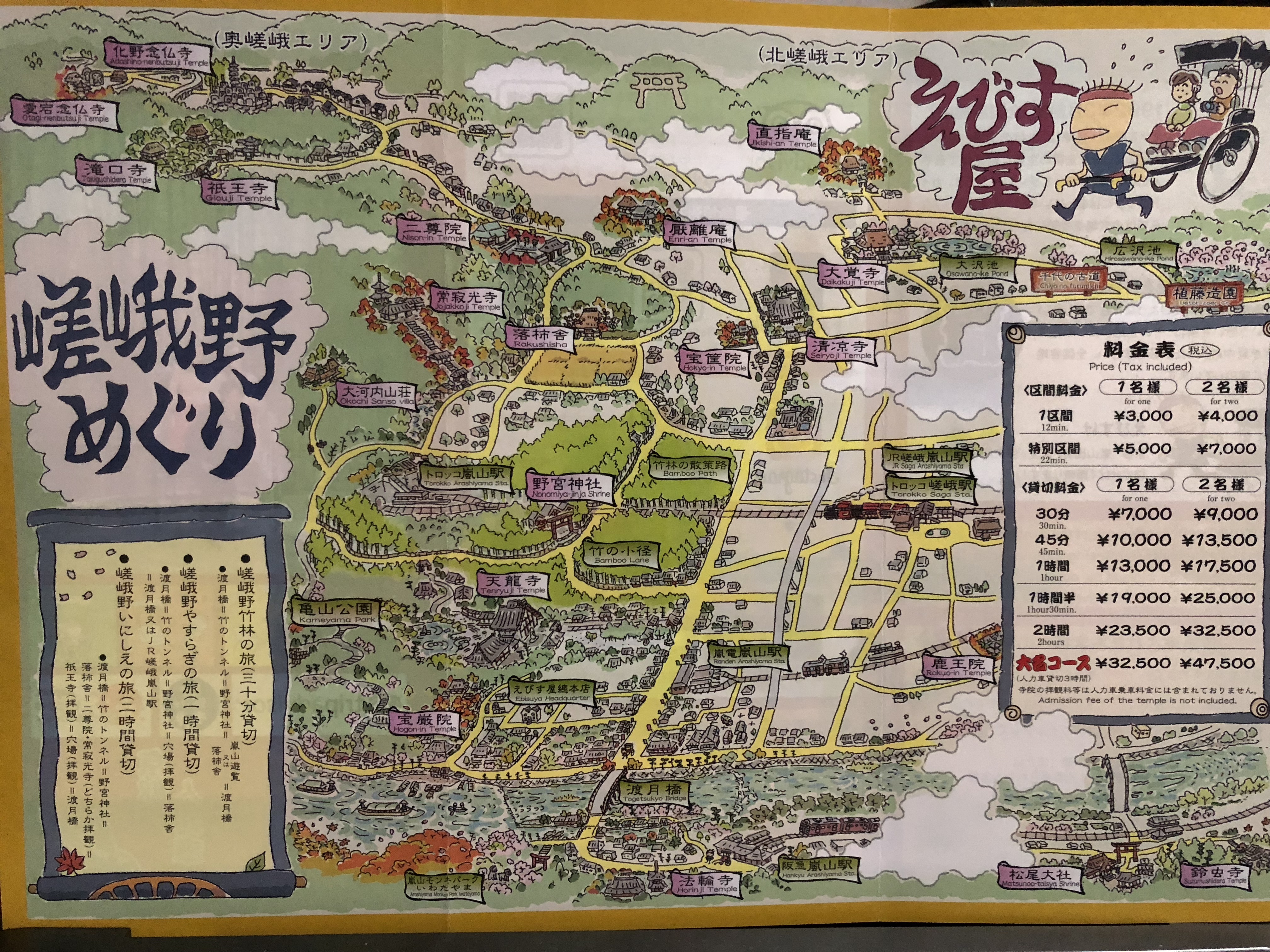
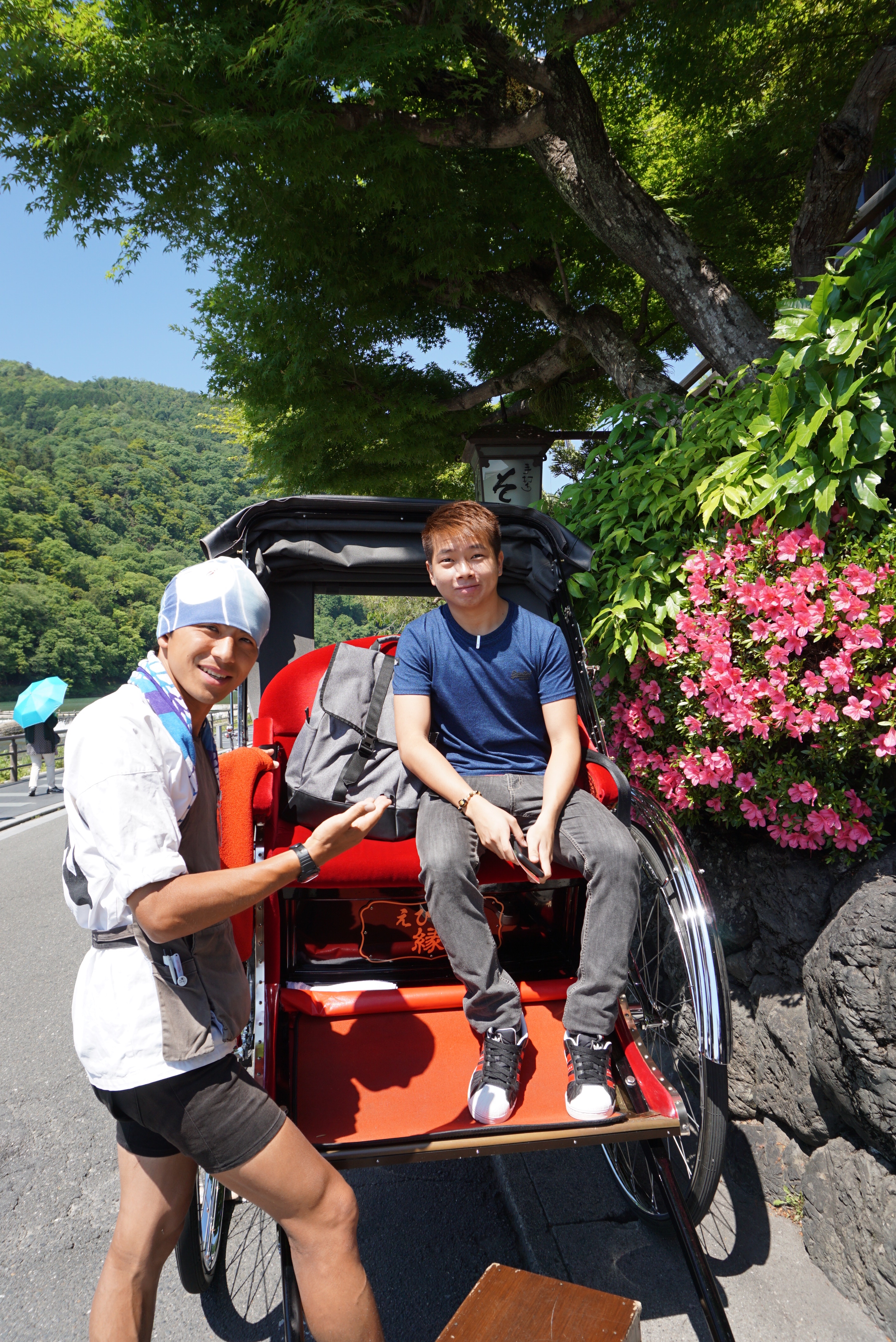
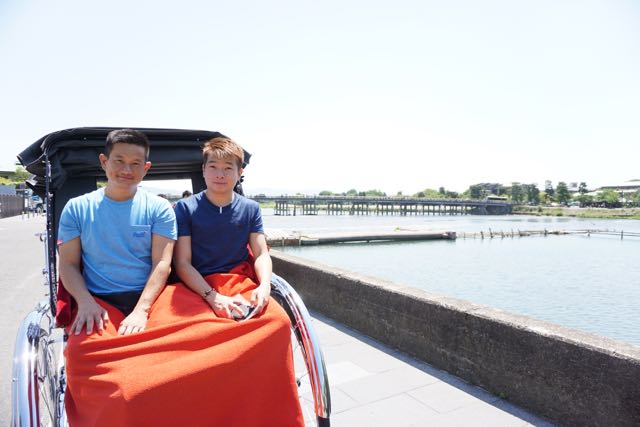
The buildings in this part of Kyoto looks rustic and as though they are from a page out of a history book. As we were waiting to cross the road, we saw rickshaws with visitors on them. Though not in part of our plan, nonetheless we tried a 30mins ride on the rickshaw. Despite being touristy, riding the rickshaw through Arashiyama is a good way of orienting ourselves around Arashiyama. It is also a good way of seeing the sights around this town for those who have little time in this area. Our rickshaw driver introduced us to the various sights along the way. Everywhere in Arashiyama town is crowded with visitors, our rickshaw driver is very skilful in manoeuvring the rickshaw through the hordes of visitors, especially when he was turning into the Bamboo Grove. The main highlight of the ride is the Arashiyama Bamboo Grove. As the rickshaw driver pulled us through the Bamboo Grove, he suddenly turned into a small road that is free from visitors. The rickshaw driver explained this is a road that is reserved for rickshaws. On this road, we can feel the peacefulness in the Bamboo Grove. The Bamboo Grove is split into 2 parts, the area before the train track is crowded with visitors. as compared to the area after the train track. There is a small Shinto shrine near the train track. Somehow this is where all the visitors turned back and headed back to the town. We made mental notes of where to go to after we are done with the rickshaw ride. The driver pulled us pass the train tracks to the part where there are lesser people. It is here that the rickshaw driver made a brief stop and took pictures of us on the rickshaw. We made a u-turn and head back to Katsura River where we boarded the rickshaw. As we thought that our ride will be ending soon, the rickshaw driver made a turn into a side road. On this road, we felt the peacefulness of Arashiyama once again. There are some rustic buildings on this road. Soon we were on the side of the road that we boarded the rickshaw. This marks the end of our rickshaw ride. After a few pictures with the driver, we headed back to Arashiyama Bamboo Grove.

IMG_6743

Map and rate of the Rickshaw that we rode in Arashiyama

DSC08831

My friend with the rickshaw driver

Tenryuji (天龍寺)

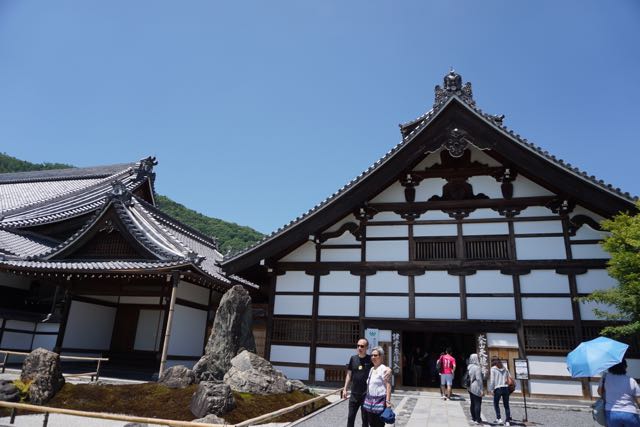
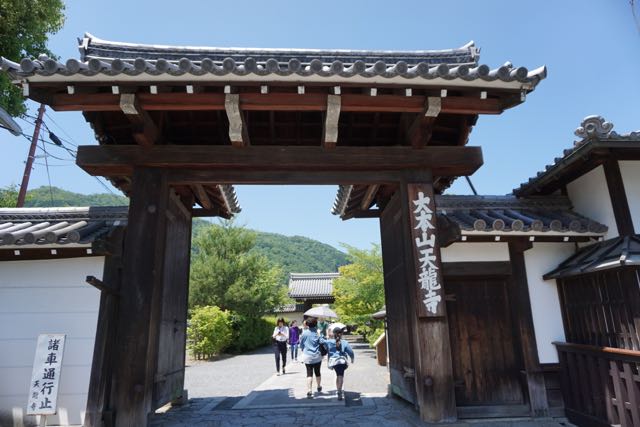
As we were walking towards the Bamboo Grove, we came to Tenryuji, one of the temples on the main road in Arashiyama that we have passed by on the rickshaw just now. My friend and I headed into the compound of this temple. There are quite a number of visitors to Tenryuji. The attraction of this temple is its zen gardens. After walking for another 5 mins, we came to the Kuri (庫裏).  Entering the compounds of the temple is free, however, there are different charges on the admission to various buildings and gardens. Kuri is a relatively small white building triangular roof and is built in 1899. The Kuri is considered one of the 7 major buildings according to the principles of Zen. We felt this place is a little touristy and did not enter Kuri. As we were rushing for time, we exited Tenryuji and headed for the Bamboo Grove.

Arashiyama Bamboo Grove (竹林の小径)

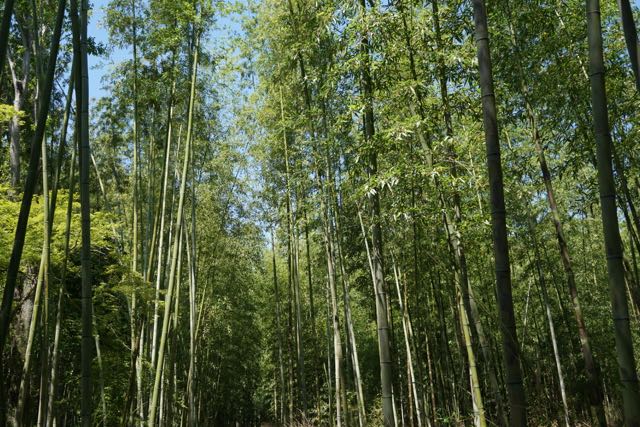
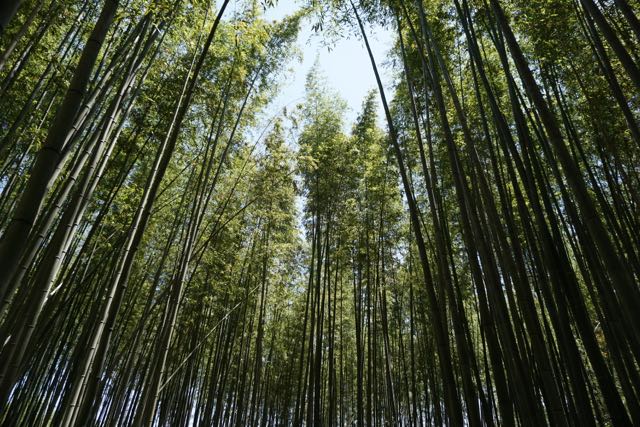
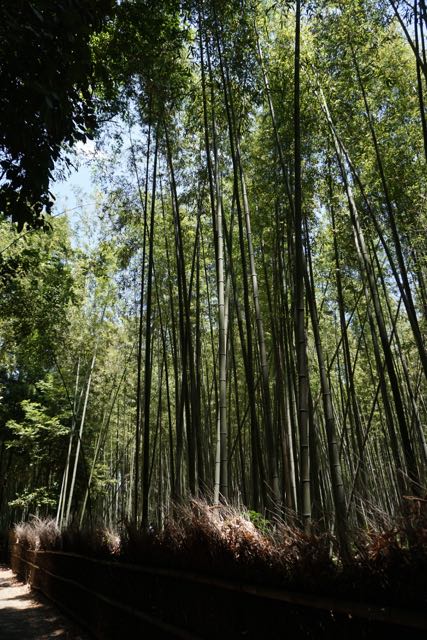
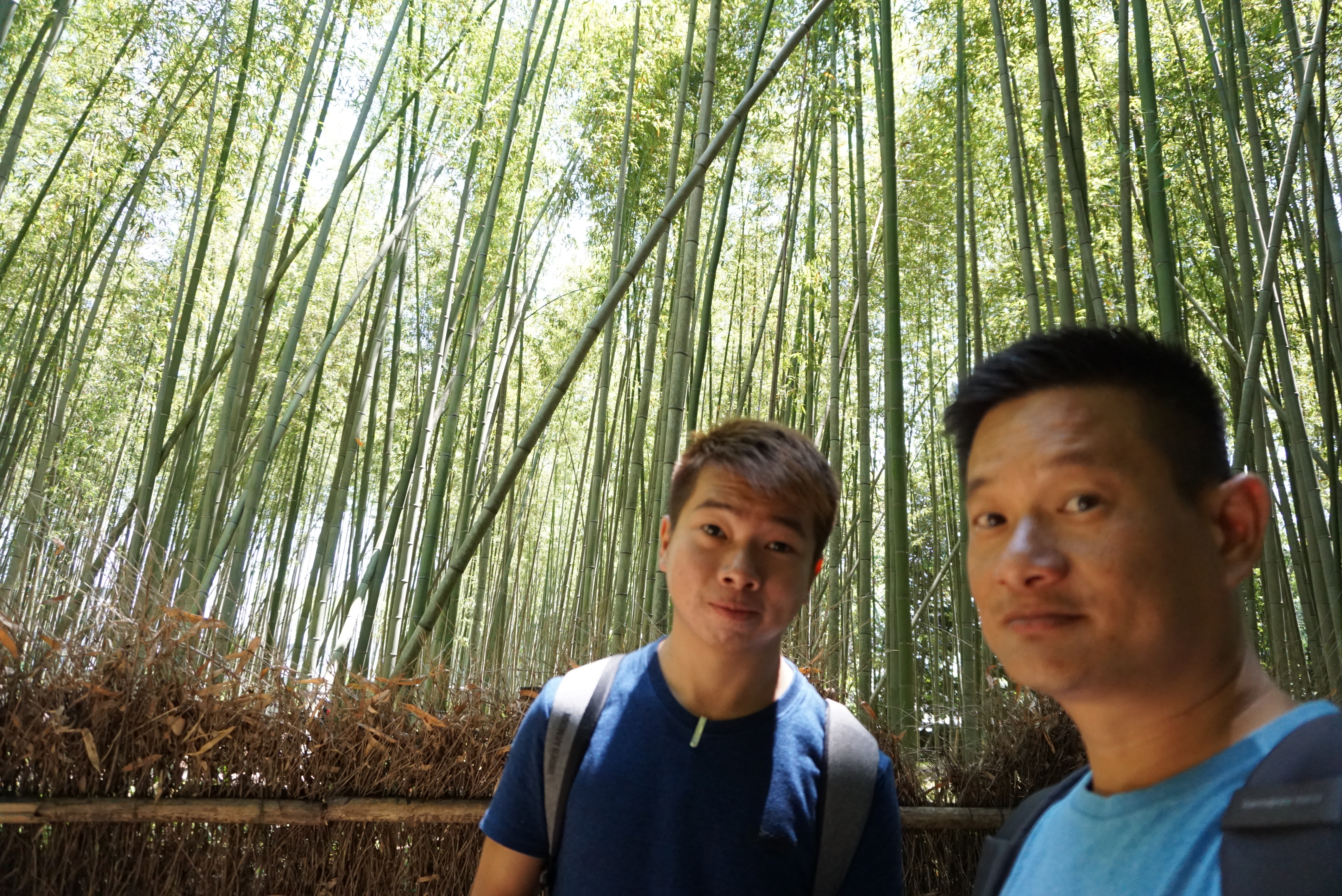
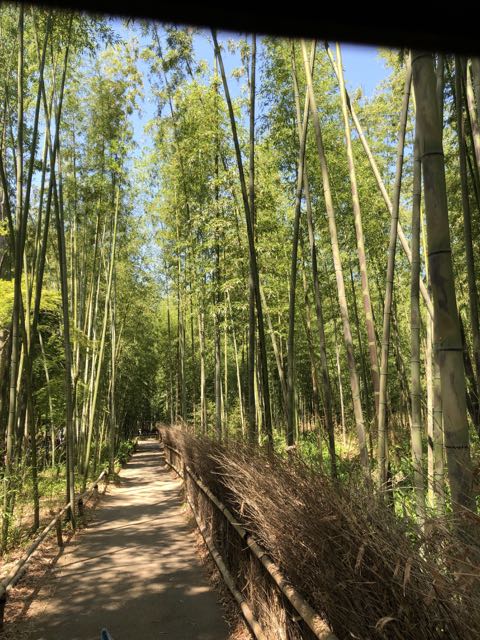
Minutes later, we arrived at the entrance to the famed Arashiyama Bamboo Grove. Having been here moments earlier, we know exactly which spot to go to where there are lesser people. In the area before the train tracks, we couldn’t really appreciate the bamboo grove. Most of the time we were squeezing with other visitors and this area is very bad for photos. As we were making our way past the train tracks, we made a brief stop at the Shinto Shrine in the midst of the Bamboo Grove. Nonomiya Shrine (野宮神社) is a small shrine that the locals come to pray for marriage. There are several small structures in Nonomiya Shrine, consisting of the main prayer shelter and several boards for visitors to hang this wishes. As the shrine is rather small, we exited the shrine after taking some pictures.

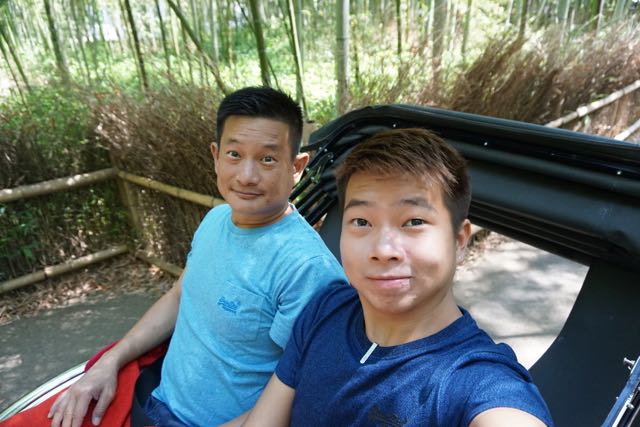
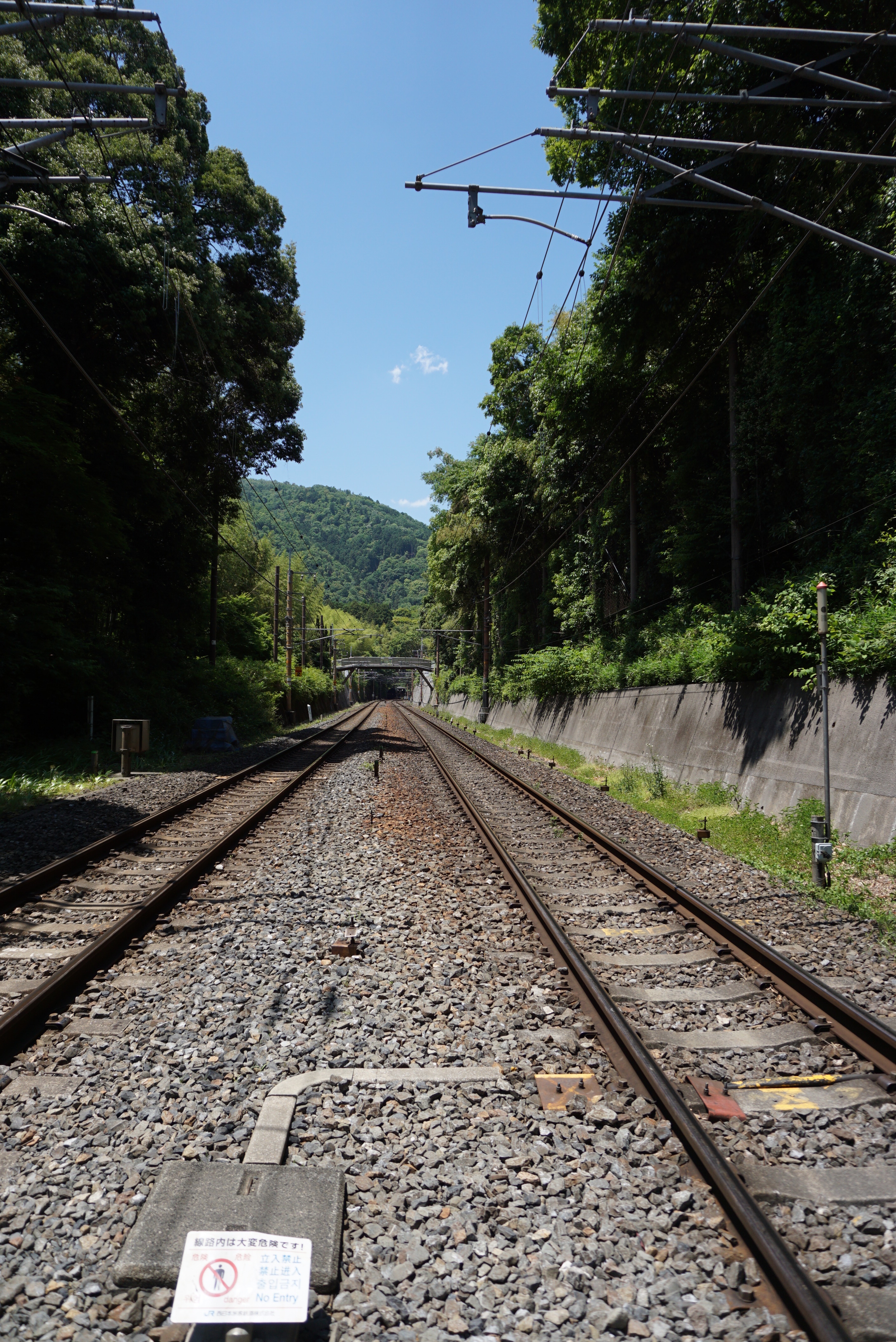
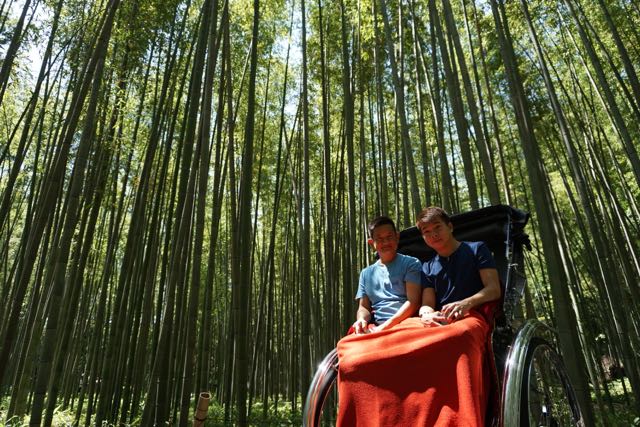
The train tracks that cut the Arashiyama Bamboo Grove into 2 parts is right next to Nonomiya Shrine. We continued our walk in the Bamboo Grove past the train tracks. This is where we felt peace in the Bamboo Grove. There are significantly lesser visitors to this part of the grove, making strolling in this part of the grove a relaxing one. It is here we can hear the rustling of the bamboo leaves as they dance to the rhythm of the wind. My friend and I turned into a small area where we stopped by on the rickshaw earlier to have our photo taken on the rickshaw. This is a perfect spot for pictures with the Bamboos and lesser people. It is recommended for those visiting Arashiyama Bamboo Grove to walk past the train tracks and come here to get away from the crowds.

DSC08870

On the rickshaw in Arashiyama Bamboo Grove

Sagano Scenic Railway (嵯峨野トロッコ列車)

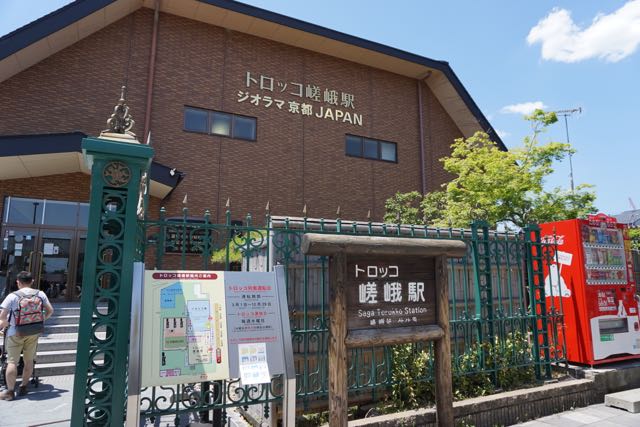
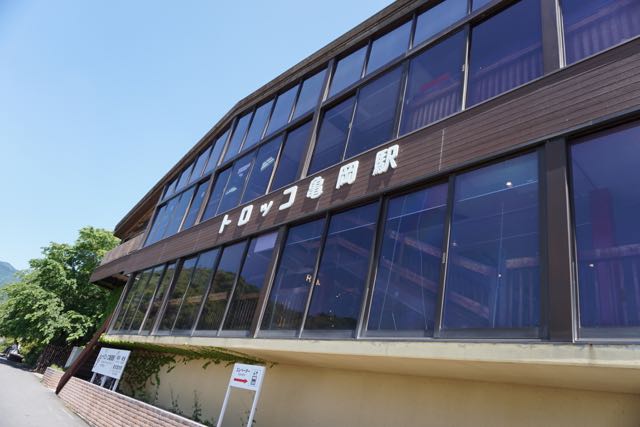
Leaving Arashiyama Bamboo Grove, our next stop is the Saga Torkko Station where we planned to board the Sagano Scenic Railway towards Kameoka. The station about 7 mins walk from the rear exit of the Bamboo Grove. The 25 mins Sagano Scenic Railway runs along Hozugawa River between Arashiyama and Kameoka, after which it will turn around and return to Arashiyama. There are 5 carriages on the Sagano Scenic Railway, 1 of which is open air. We originally wanted to take the open air carriage but was told all seats in this carriage are taken. Our plan of taking the train up to Kameoka was also changed on the spot as the next train available is some 2 hours later. We did not want to wait and opted for the return train ride from Kameoka instead. As our JR pass is still valid, we took the JR towards Umahori Station and waited for our train to come by. Arriving at Umahori Station, we took a 5 mins walk from the JR station to the Scenic Railway station. Along the way, we saw some farmlands in rural Kyoto.

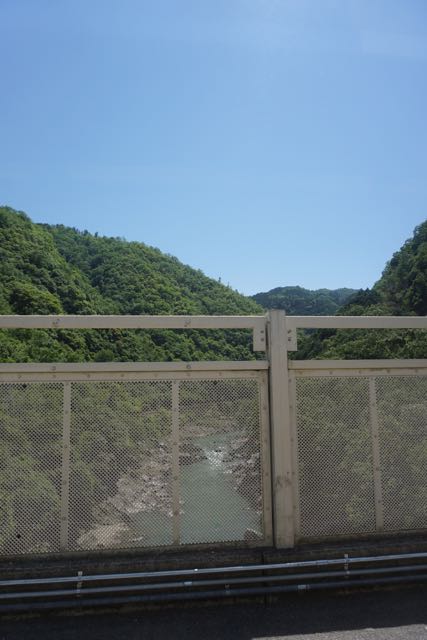
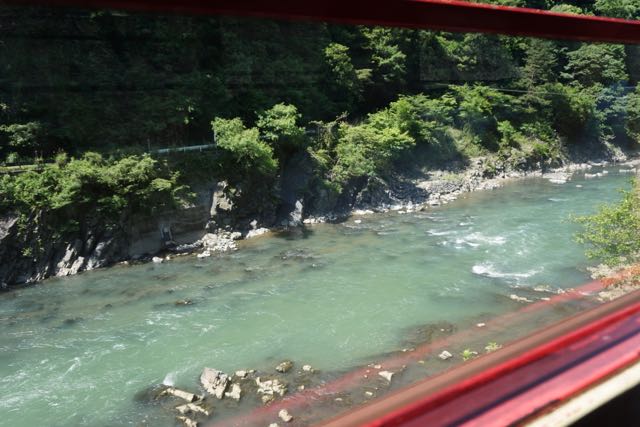
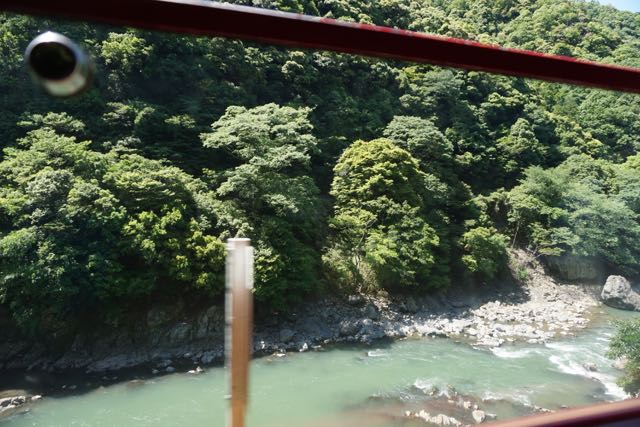
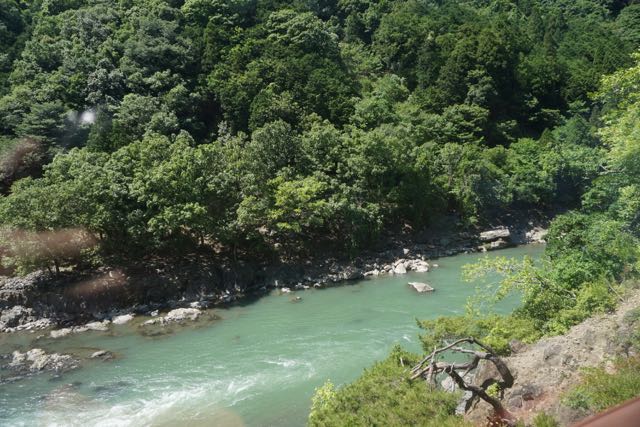
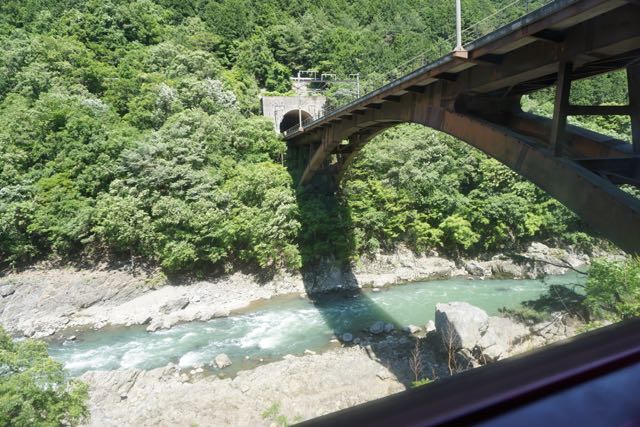
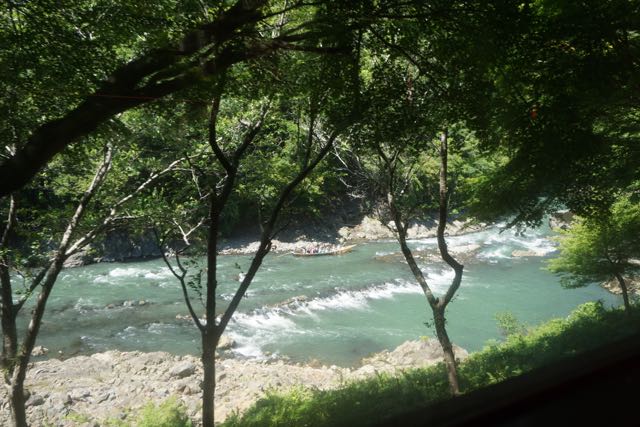
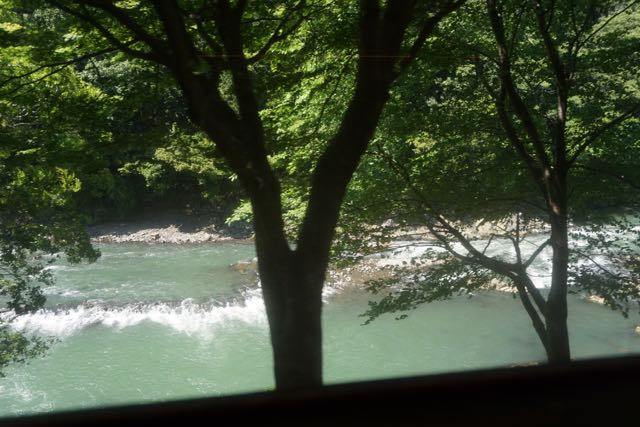
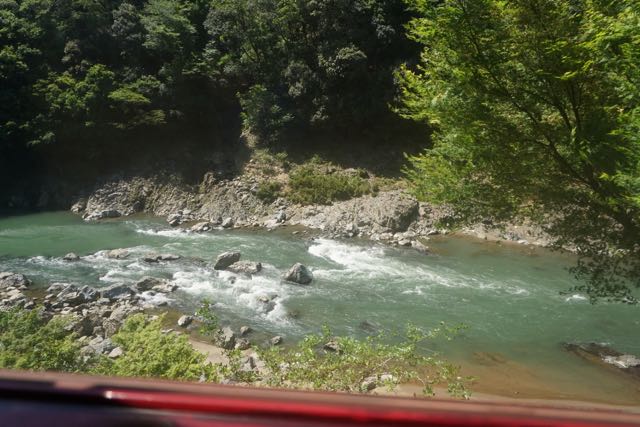
Our train ride arrived on time and we boarded the train as soon as passengers alighted. The cabin of the train is made of wood, giving the train a rustic feel to it. As the train left the station and started on its 25 mins journey towards Arashiyama, we were treated to views of the wilderness in Kyoto. The dramatic scenery saw Hozugawa River turns from being peaceful to angry with rapids in certain areas. The river also widens and narrows as the train runs alongside the river. We saw the hills on the opposite side of the river donning on their spring green coats and at some point of the journey, the hills gave way to the river as Hozugawa River snakes through the mountain ranges. We even saw boats at some point of the river, where visitors chose to brave through the rapids of Hozugawa River as their return option towards Arashiyama. Initially, we were worried that the seats we were assigned will not give us much of the river view as one side of the train tracks will be facing the mountains. We were lucky to have assigned seats on the left side of the train as we realised on the return trip the left side has more time with the sceneries of the wilderness of Arashiyama.

DSC08965

Bridge over Hozugawa River

Nijo Castle(二条城)

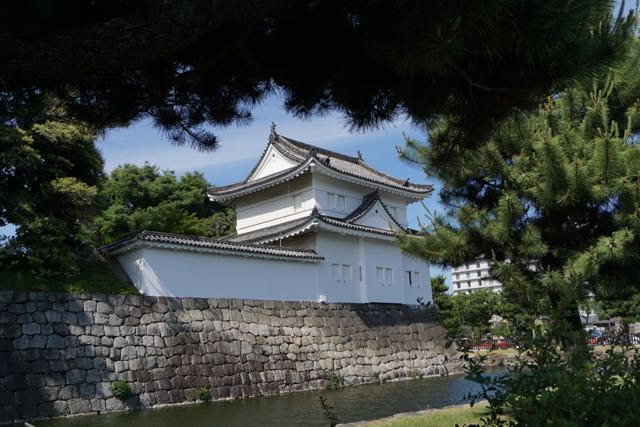
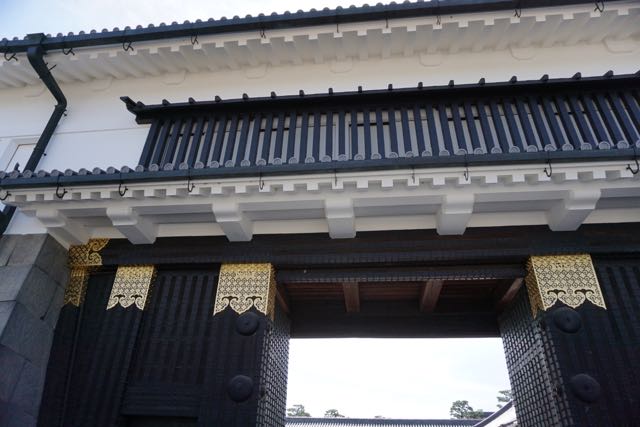
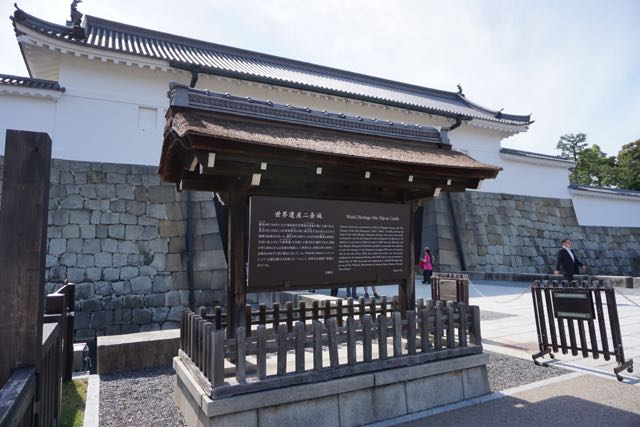
We headed back to Kyoto after alighting from Sagano Scenic Railway. As we were riding on the JR towards Kyoto, I realised there is a JR station near Nijo Castle, which is our next stop in Kyoto. We alighted at the station and headed towards Nijo Castle. The walk from Nijo Station to the castle takes around 15 mins. Soon we found ourselves at the entrance of Nijo Castle. Nijo Castle is built in 1626 as a residence for the Shogun who was tasked to protect the Kyoto Imperial Palace. Unlike Himeji Castle, Nijo Castle is rather flat. We passed through the main gate – Higashiote-mon (東大手門). Higashiote-mon has a rather simple design, the bottom half of the gate and this walls surrounding Nijo Castle are built with stones and the top part is painted in white. The main gate looks rather modest in size with traces of gold plating and looks very well preserved.

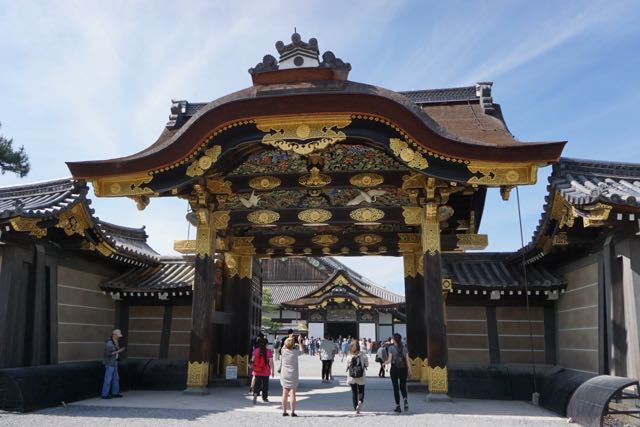
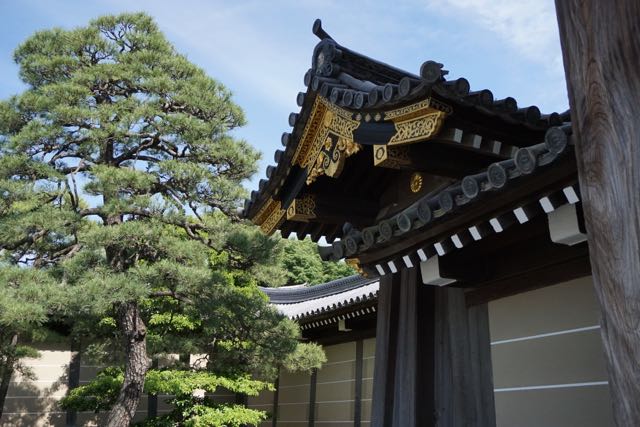
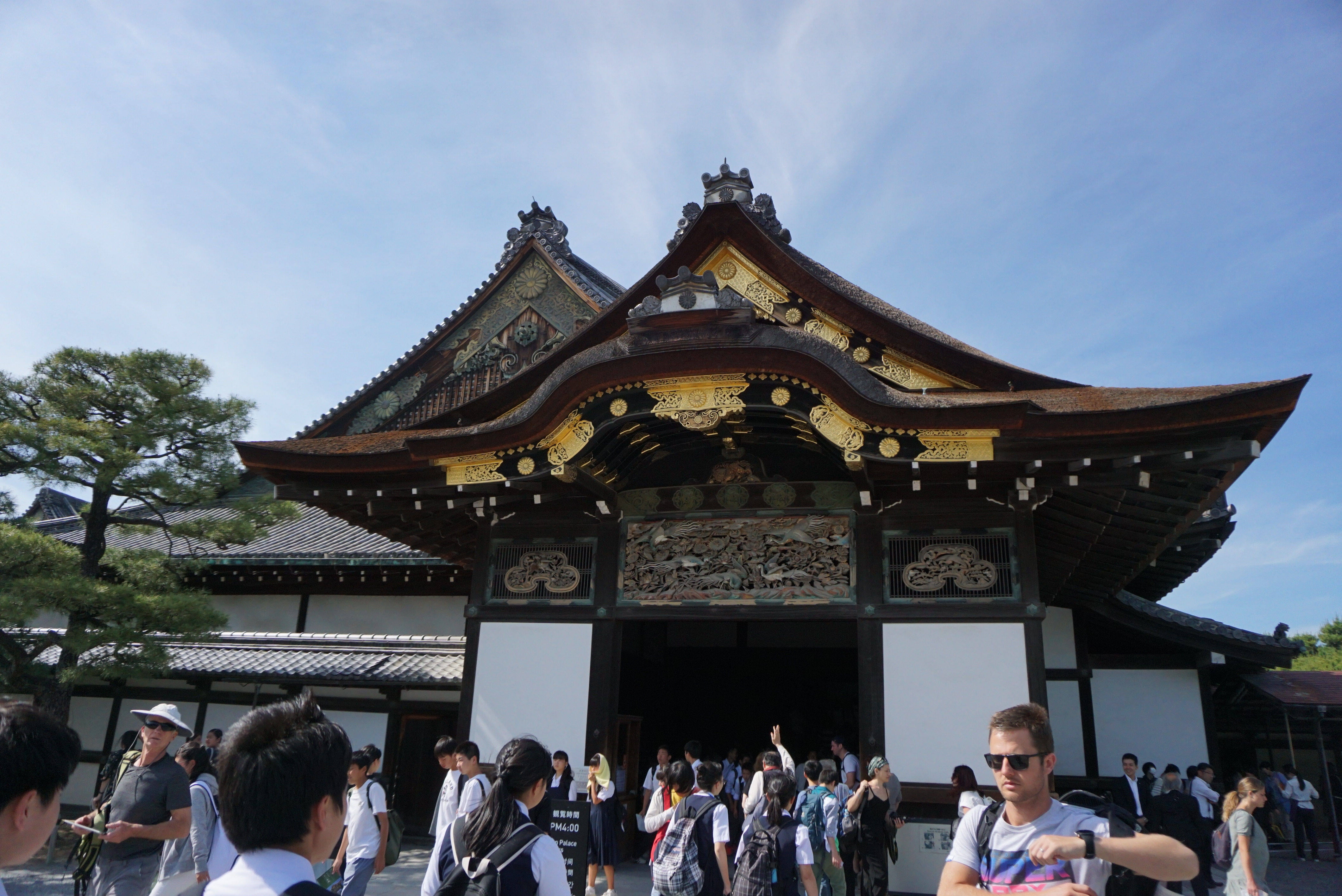
Passing Higashiote-mon, we came to another gate. The Kara-mon (唐門) is more elaborate in its designs. Though not as tall and big as the Higashiote-mon, Kara-mon is work of art. There are more traces of gold plating on this gate, making it look more royalty. The beams are engraved with vibrantly coloured flowers, with a couple of Japanese Cranes in flight from the front of the gate. The second beam has carvings of dragon and tiger.

DSC08994

Kara-mon in Nijo Castle

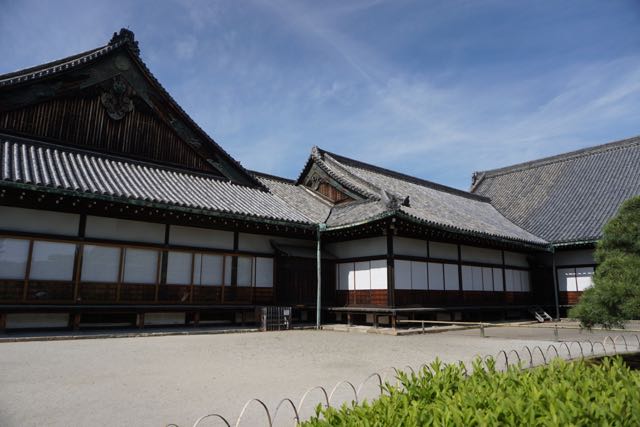
Passing Kara-mon, the first building that we saw is the Ninomaru Palace (二の丸御殿).  Ninomaru Palace consists of 6 connecting buildings, which we were made to walk in a pre-determined fashion through these 6 buildings. Photography is strictly not allowed in the palace and there are staffs stationed around in the palace to enforce this rule. Walking through the buildings, we saw lots of empty rooms, most of which with elaborate paintings on the walls. Some of these rooms are larger than others. These larger rooms tend to be near the entrance to Ninomaru Palace, which served as audience rooms. There are some statues placed in the audience room give visitors a glimpse of what it looked like when Nijo Castle was functional. The rest of the rooms are empty with paintings on it. We walked around the 6 rooms in Ninomaru Palace like zombies as everyone visiting the palace felt like going through the motion of passing through these rooms, and the no photography rule baffles me. Finally, we exited Ninomaru Palace and headed to other parts of Nijo Castle. We followed the pre-determined path round Ninomaru Palace to the gardens behind the palace. As I am not a garden person, I find this a tad boring.

DSC09004

Ninomaru Palace in Nijo Castle

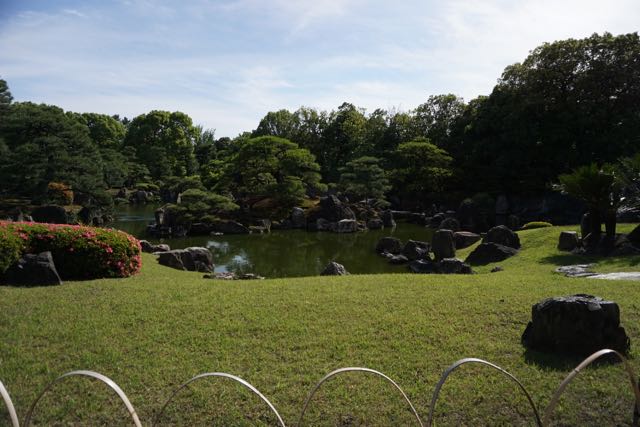
The path leads us to a small bridge crossing a moat inside Nijo Castle. Crossing the bridge, we came to Honmaru Yaguramon (本丸櫓門), which functions as a defensive gate for the main keep inside. The path took us to another garden inside the moat. Little that we realised we can only see the main keep from outside, there are no indications or openings that allow visitors to enter into the main keep. The flat structure of the main keep (本丸御殿), make this main keep feels more like some old Japanese houses rather than a palace. We wandered through this garden in the pre-determined path and headed out Nijo Castle. Personally, I find Nijo Castle not worth visiting with most parts of the palace being out of bounds and the restrictive photography rule inside the only building that is open to visitors. Unless one is an avid garden lover, visiting Nijo Castle is a waste of time.

Kinkaku Rokuonji (金閣鹿苑寺)

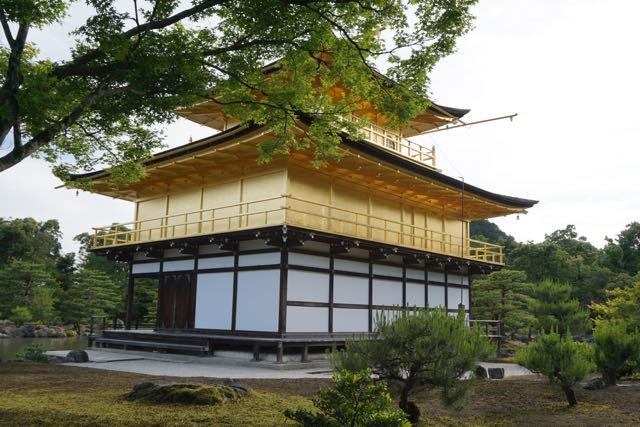
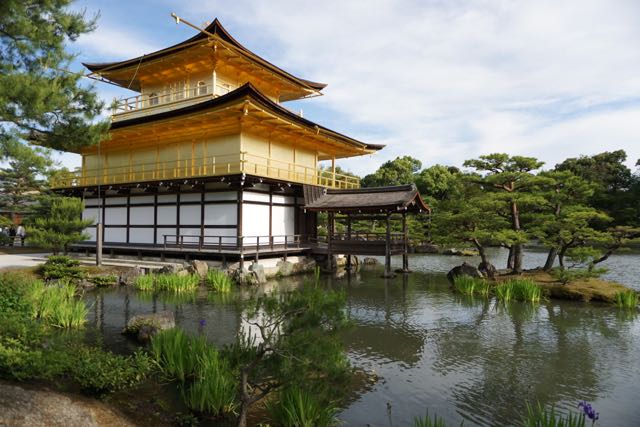
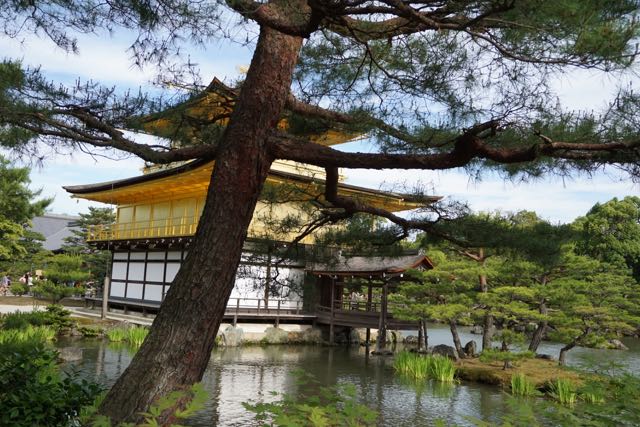
Leaving Nijo Castle, we headed to Kinkaku Rokuonji. The temple is famous for its Kinkaku (Golden Pavilion) hence people usually refer to this temple as Kinkakuji (Golden Pavilion Temple). When planning for this trip, I read that Kinkakuji is very crowded most of the time. The best time for visiting this temple would be either early morning when it first open or 1 hour before it closes, where the crowd would usually thin out. We chose to visit Kinkakuji 1 hour before it closes hoping to see the golden pavilion at the time when crowds are lesser. After paying for our tickets, we entered the grounds of Kinkakuji, the golden pavilion sitting on the side of a lake is immediately in our sight. Kinkakuji is a 3 storey building, with the ground floor of Kinkakuji being semi-open. From the front of Kinkakuji, we can see into the rather empty ground floor with its walls painted with some flower mural. The entire 2nd and 3rd floor are enclosed. It is these levels where the walls are covered in gold foil, giving Kinkakuji its name. A phoenix statue stands right at top of the Kinkakuji with its wings spread out, as though it is ready to take flight. It is said that a Buddha relic is stored on the top floor of Kinkakuji. Kinkakuji looks especially charming with the rays of the setting sun shining onto it, making the top 2 floors of Kinkakuji glow like a gem. Indeed there are lesser people at the time we entered Kinkakuji. We can easily take pictures of Kinkakuji with no people in the background.

DSC09040

Kinkaku up close

My friend and I followed the designated footpath making our way out of the temple grounds. Along the way, we came across Fudo-do (不動堂), a small shrine dedicated to the Buddist deity Fudo-myo-o (不動明王). We paid our respects to the deity enshrined here before making our way out of Kinkakuji.

Strolling in Downtown Kyoto

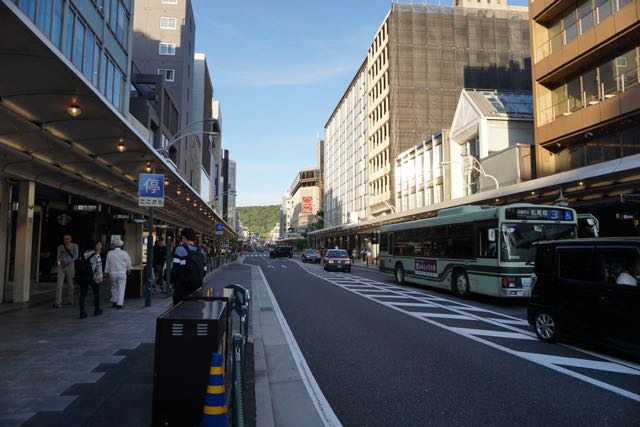
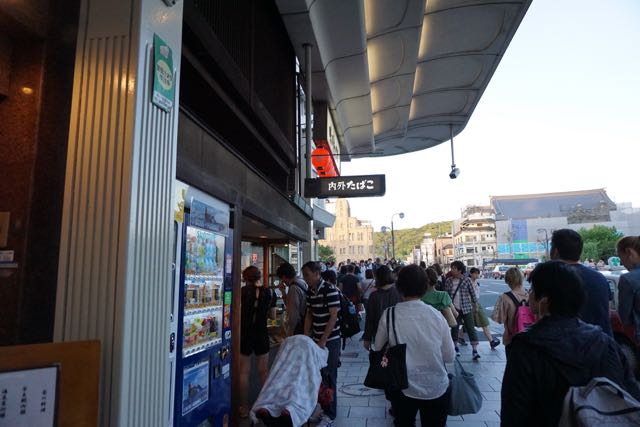
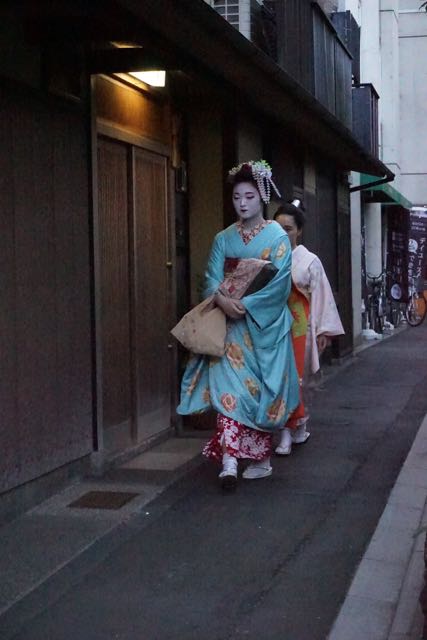
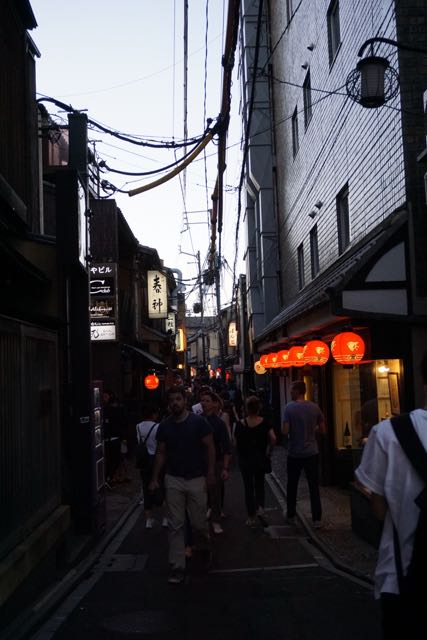
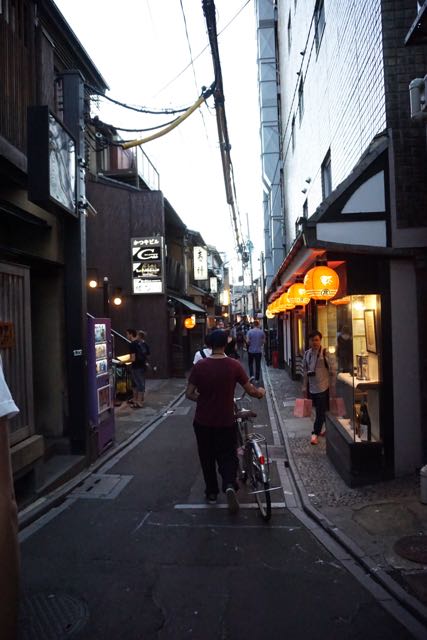
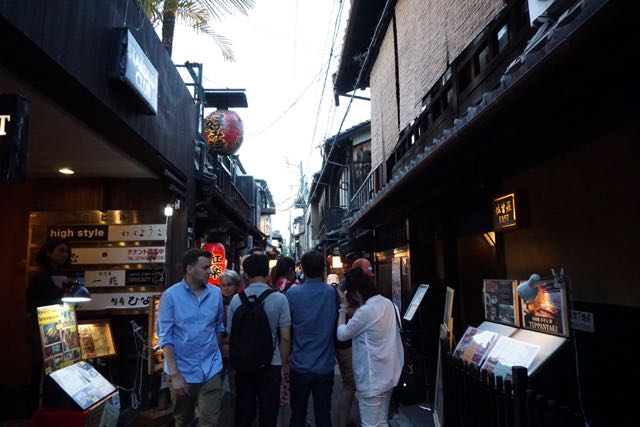
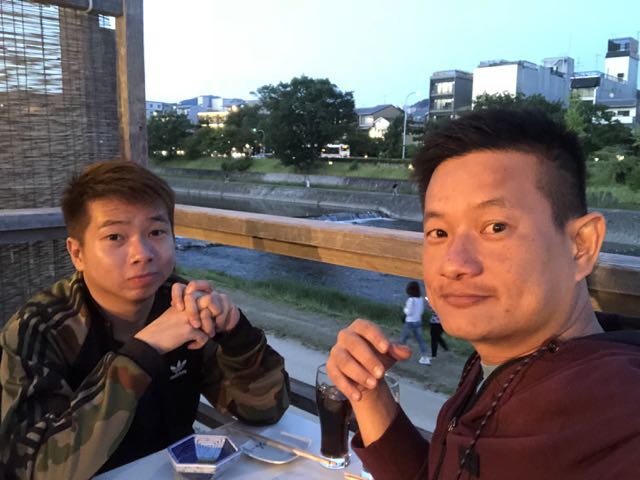
We left Kinkakuji on a local bus bound for Kyoto JR Station. As we were near our destination, we realised there is a shopping strip where the bus was plying through. We hit the buzzer and alighted on the next stop the bus calls on. There are numerous shops and departmental stores along this main road. As we were walking, we saw this small alley that seems to be crowded and turned in to check it out. Little that we realised that we are in the Kamo River (鴨川) dining district. One of the things to do in Kyoto is to dine at one of the restaurants that have an outdoor terrace that faces the Kamo River. This dining experience is only available from May to September each year and has existed for over 400 years in Kyoto. People would flock here to enjoy the cool river breeze while dining during the hotter months of the year. I have wanted to experience this before I came to Kyoto and by chance, we stumbled into this area. We walked along the alley from restaurant to restaurant searching for the food that we like. Dining here is a tad pricey. As we were walking along the alley, I spotted a Geisha walking discreetly to her next place of work. I read that Geishas are a rare sight in Kyoto these days, I must be lucky to have spotted one on my very first time (and first day) in Kyoto. We settled in a restaurant for dinner, dining here is indeed a unique experience.

DSC09100

Geisha spotted rushing to her workplace

IMG_8925

Dining in one of the open terraces along Kamo River

Gion District (祇園)

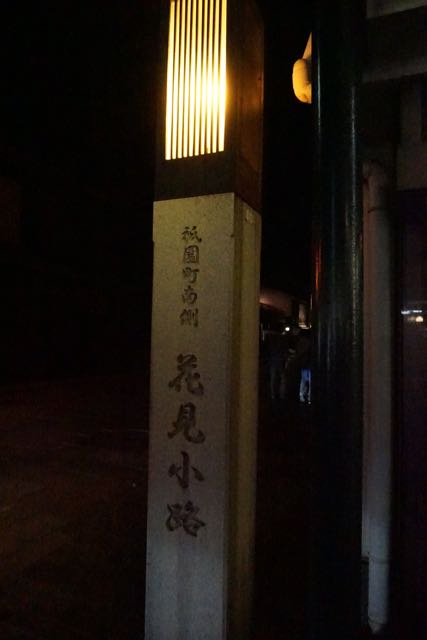
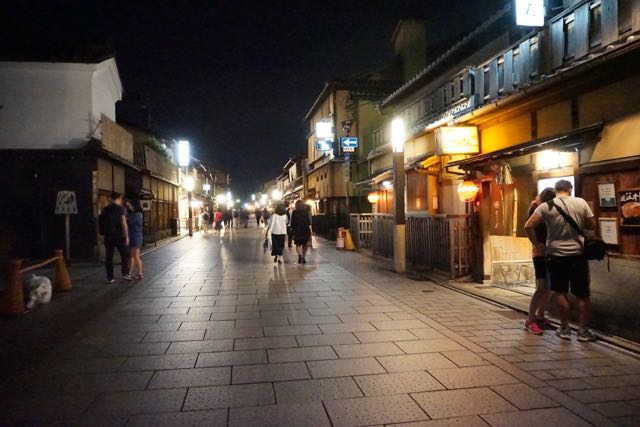
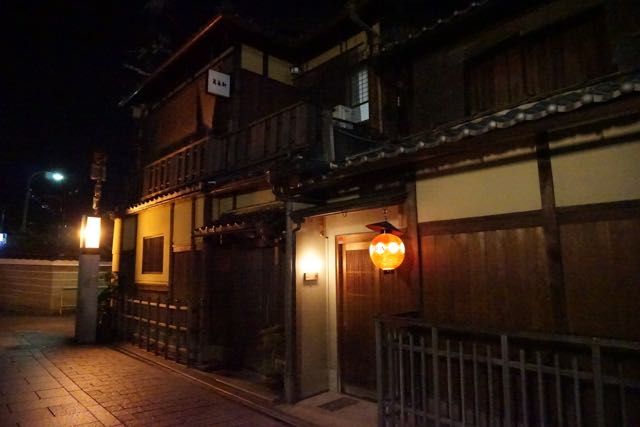
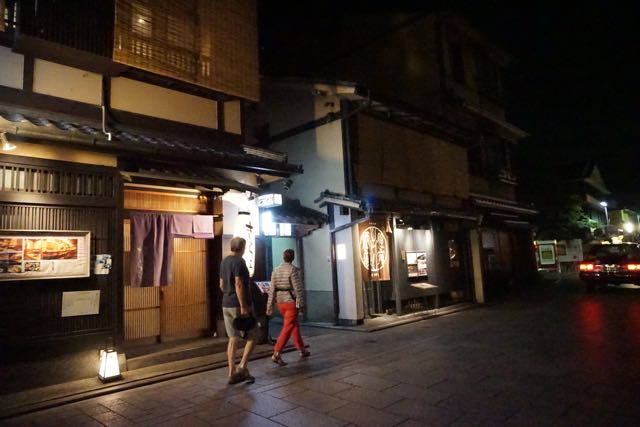
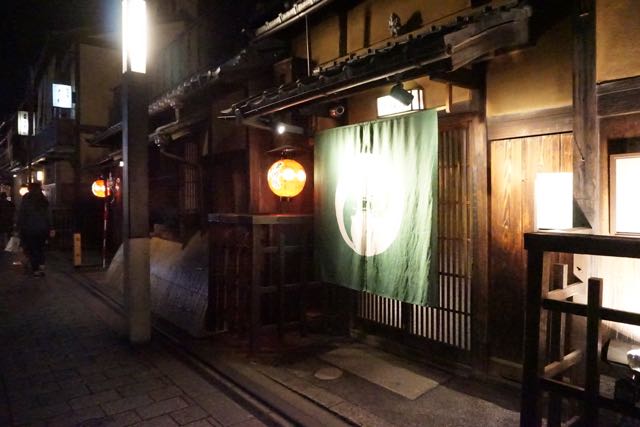
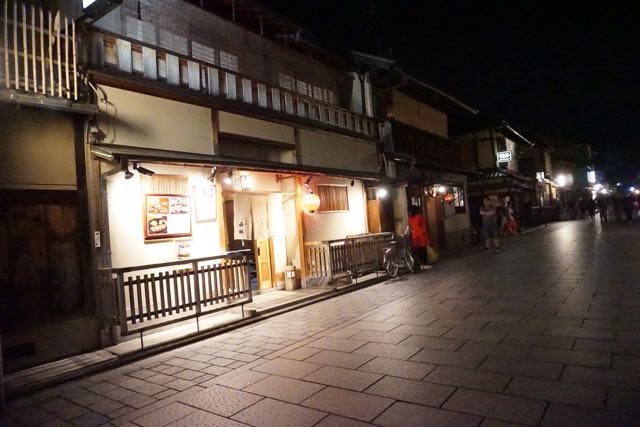
After dinner, we headed across the Kamo River to check out if there are any other shops there. We stumbled in a quiet Gion District, where most of the old wooden buildings are located. Tourists flog here partly for the feel of olden days in Kyoto, partly hoping to catch a glimpse of Geishas as they usually ply through here for work in some of the restaurants here in Gion District. Walking in the streets of Gion District is as though we have been transported back in time. Most of the buildings here are restaurants and have ceased operations at the time we were there. Nonetheless, we enjoyed the peacefulness of the street, which makes strolling in Gion District pleasant. We headed back to Osaka to rest of the night after we believe that we have covered most of Gion District.
Kansai (Kyoto/Osaka) Day 4 (21 May 18) – Oh Deer Oh Deer: Feeding the Deers in Nara Park and the Majestic Todaiji Temple

DSC08692

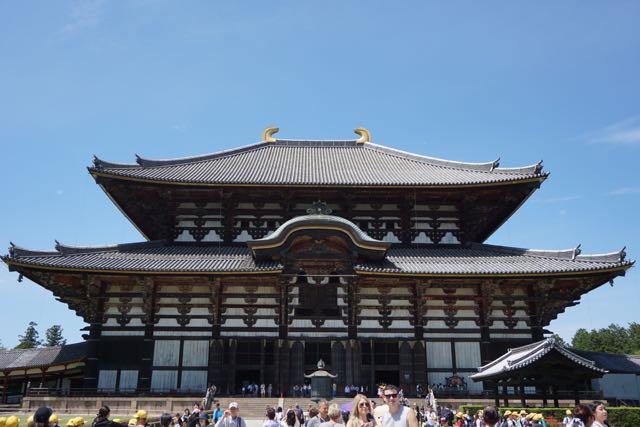
The majestic Todaiji

Nara (奈良) was established as the first permanent capital of Japan from 710 to 794 (also known as the Nara period) before Kyoto was. Nara was chosen as the capital of Japan owing to its location being right in the centre of Japan. Today the only remanent of the imperial palace used during the Nara Period is an open space where the former Palace sat, located north-west of Nara JR station. Nara remains an important historical centre for Buddhism in Japan and is home to the largest wooden structure in the world. Our trip today mainly focuses on the temples East of Nara JR station. Visitors can either take the JR or the Kintetsu line to Nara. As my friend and I wanted to maximise the use of our Kansai-Wide JR Pass, we opted to take the JR to Nara. The way to visit the major sights in Nara is not difficult to locate, I was telling my friend “just follow the crowd, they will bring us to the places we wanted to visit”. The Kintetsu railway is much closer to the major sights and Nara Park.

Main Street in Nara

Coming from the JR Station, we walked along the main shopping street in Nara. As it was still rather early, most of the shops have yet to open. Along this street, I can spot shops selling souvenirs as well as a handful of restaurants. The streets of Nara is very clean, however along the street since leaving the JR station, we couldn’t find any rubbish bin. This means visitors would have to carry their trash with them till Todaiji Temple where we found some trash bins, which is a 15 to 20 mins walk.

Kofukuji (興福寺)

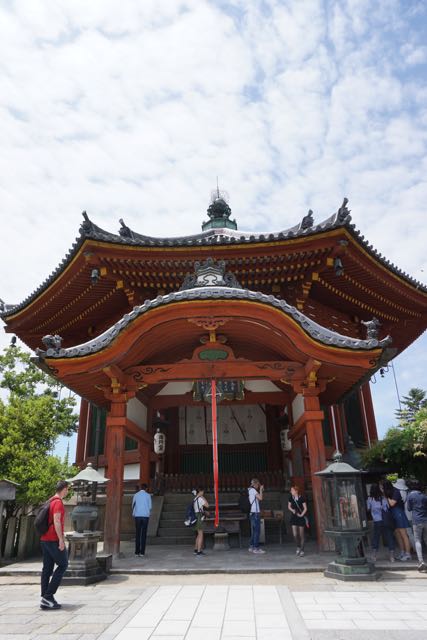
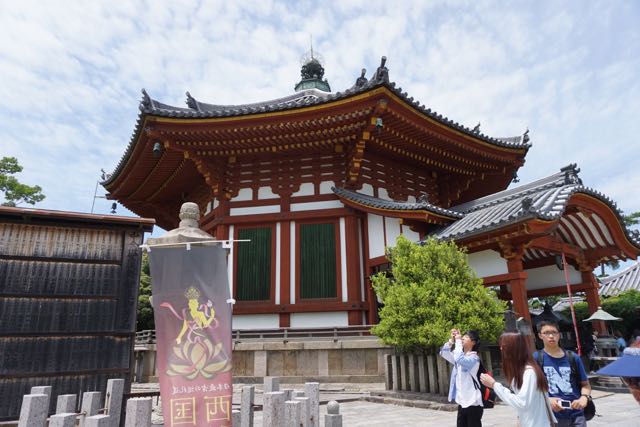
Kofukuji is our first stop in Nara. The temple was transferred to its current location from Kyoto in 710. Coming up from the stairs, the first structure we spot is an octagonal building. This Southern Round Hall (南円堂) is an important cultural property in Japan and houses some of the valuable Buddha statues. With pillars and beams painted in bright red, the Southern Round Hall was first built in 819 and was destroyed by fire 3 times. The current building is constructed in 1789.

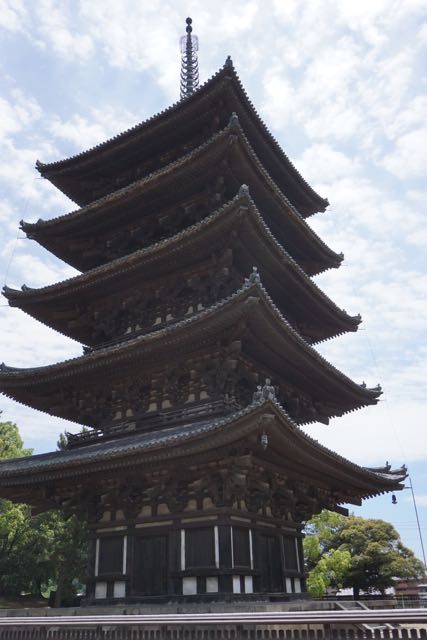
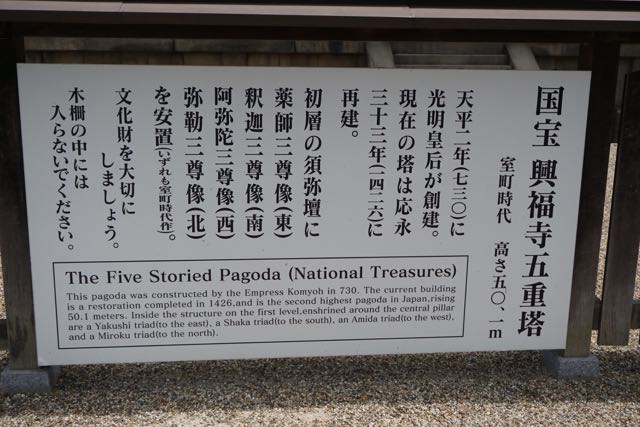
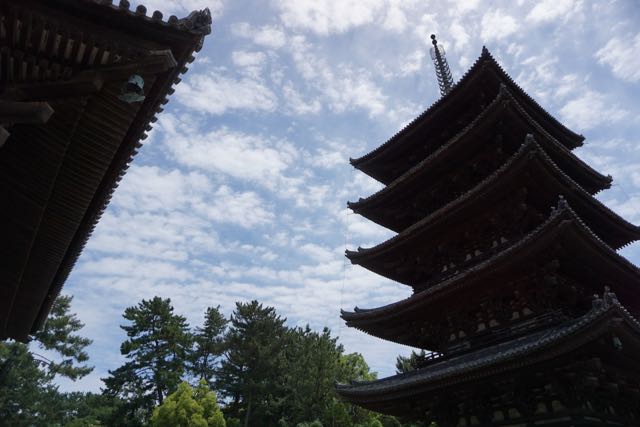
Leaving the Southern Round Hall, we headed along a stretch of gravel road towards the main prayer hall. On the way we spotted a building that is covered with canvas, seems like this building is undergoing preservation. At the end of the road, we came to a 5-storey pagoda and the large prayer hall. The wooden 5-Storey Pagoda (五重塔) is originally constructed in 730, however, it was destroyed by fire a few times and the current version of the pagoda is built in 1426. The grand 5-Storey pagoda is the 2nd tallest wooden building in Japan and is a magnificent sight to look at. Like the temples we saw in Mt Shosha, the 5-Storey Pagoda seem to be constructed without using any nails.

DSC08619
The 5-Story Pagoda (五重塔)

Next to the 5-Storey Pagoda lies the Eastern Golden Hall (東金堂), one of the 3 Golden Halls in Kofukuji. The original Eastern Golden Hall was built in 726, like the other buildings in Kofukuji, it was destroyed by fire several times. The current Eastern Golden Hall was built in 1415. Unlike its name suggests, the Eastern Golden Hall is a single storey wooden building clad with white walls. As we are eager to feed the deer in the park, we did not enter the Eastern Golden Hall.

DSC08633

Eastern Golden Hall (東金堂) next to the 5-Storey Pagoda

Nara Park (奈良公園)

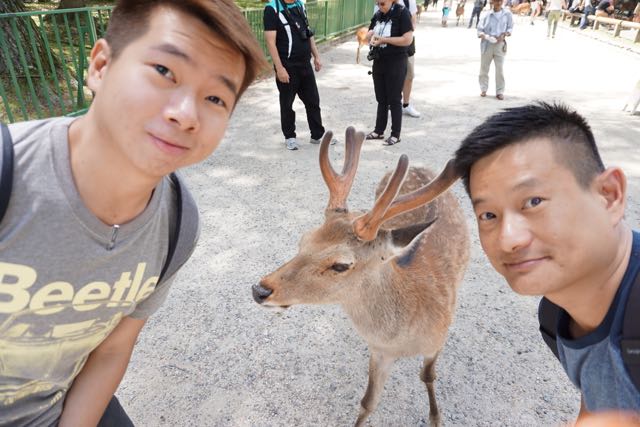
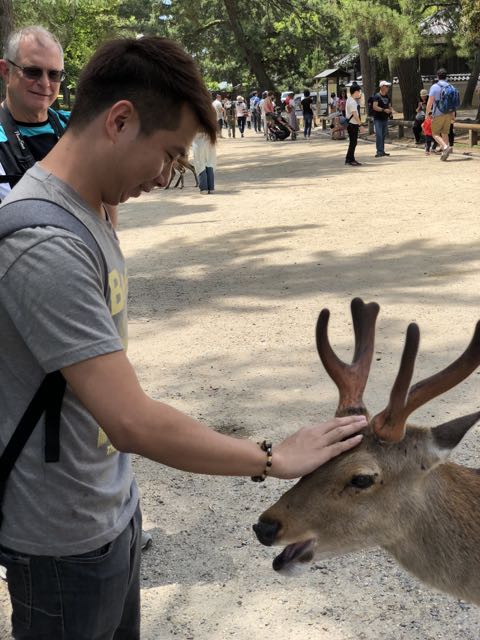
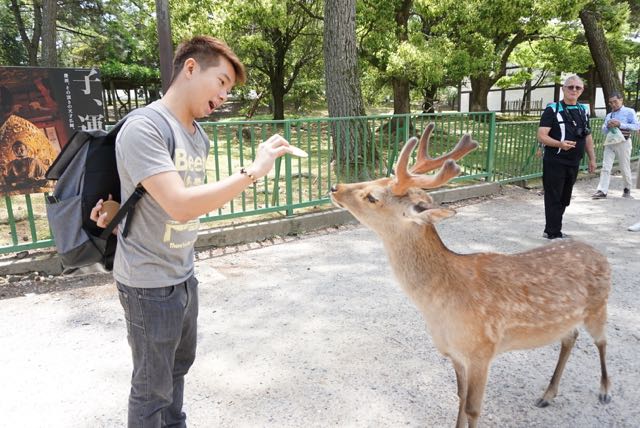
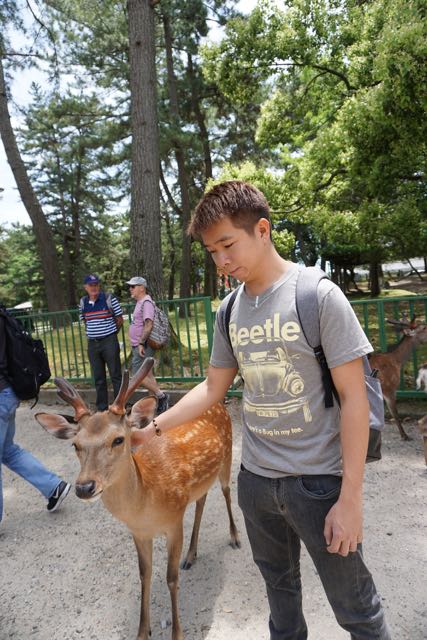
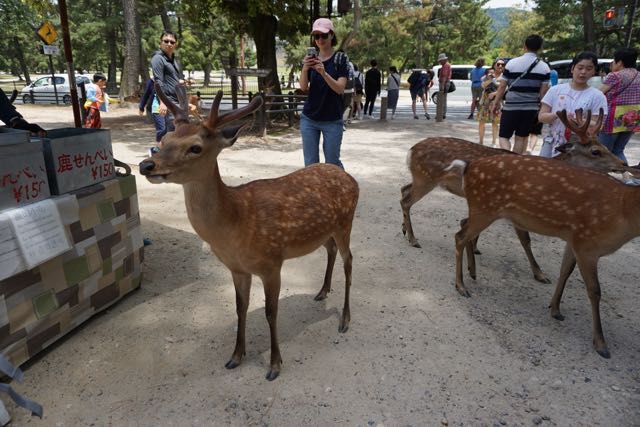
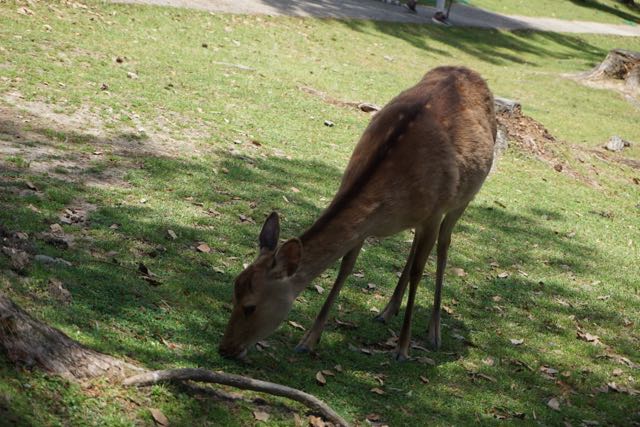
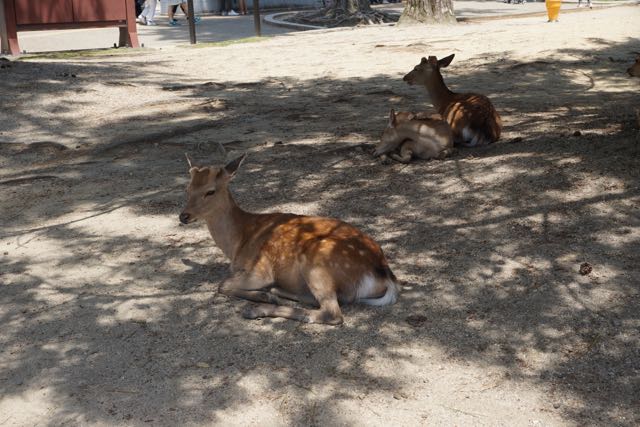
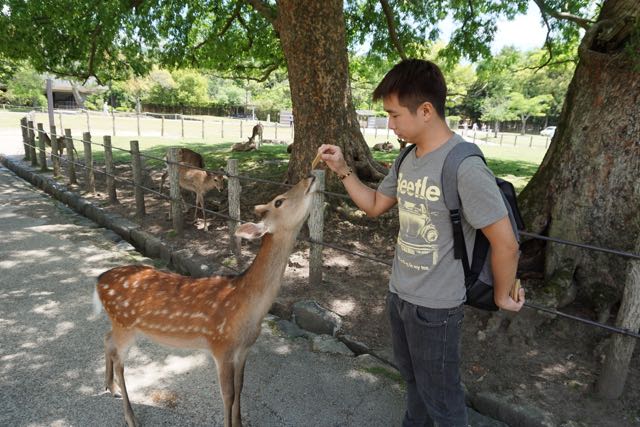
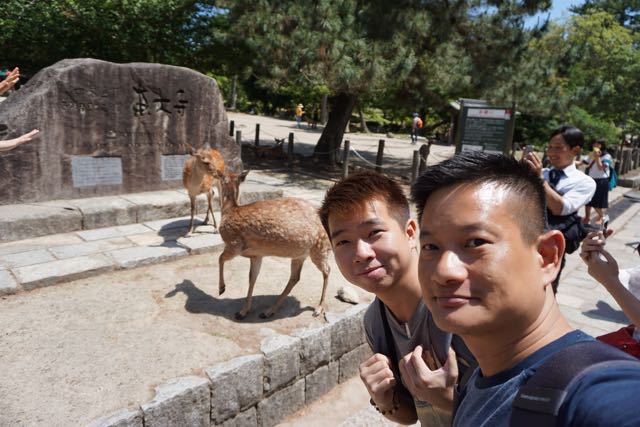
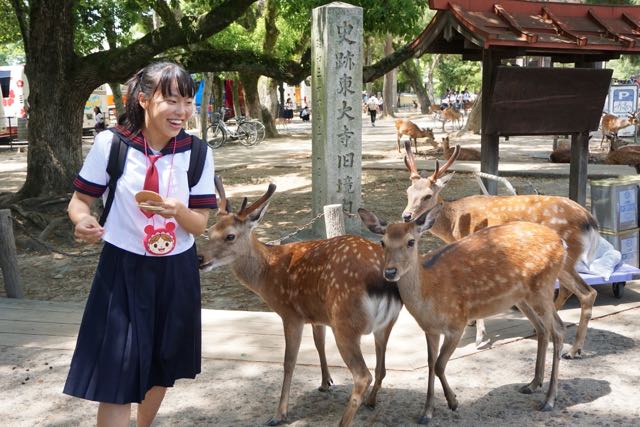
A small road between the 5-Storey Pagoda and the Eastern Golden Hall leads to Nara Park. Nara Park is a large park that we have to pass through to get to Todaiji. As soon as we hit the park, we saw numerous deer roaming around the park waiting for visitors to feed them. Deers are regarded as messengers of the gods in the Shinto religion, hence the locals have been keeping the 1,200 deer in Nara Park. These deer have become the mascot of Nara City and even been designated as a natural treasure. As we were approaching the park, we were approached by some deer, thinking we have food to feed them. My friend bought some deer crackers from a nearby vendor and started to feed them. Some of these deer would bow to my friend, a gesture that they have learnt when asking for food. As my friend was feeding 2 of the deer, a few more deer approached him wanting food from him. As he was feeding 1 of the deer, I saw a deer shoving another deer away. Yet a 3rd deer sneaked up to my friend, passing the other 2 deer and pulling my friend’s shirt in an attempt to get attention from my friend to feed it. My friend bought another set of crackers to feed the deer. After much feeding, we crossed the road to the other side of the park to find more deer. The deer seem to understand the human language when one of them approached me, I told it I have no crackers. The deer left us alone then. Nara Park is a huge area, with deer roaming around the park, either looking for visitors for food or resting below trees.

DSC08642

Taking a wefie with a deer in Nara Park

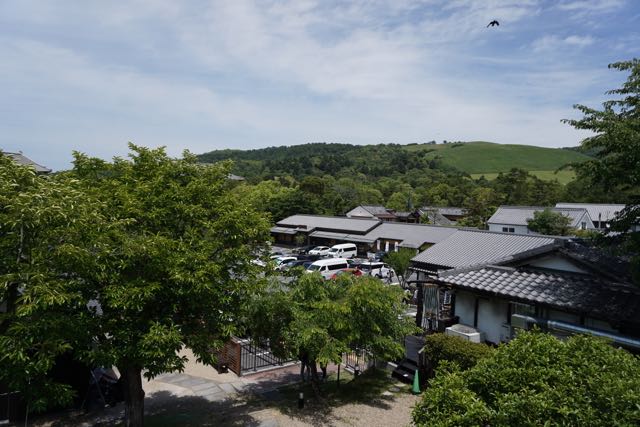
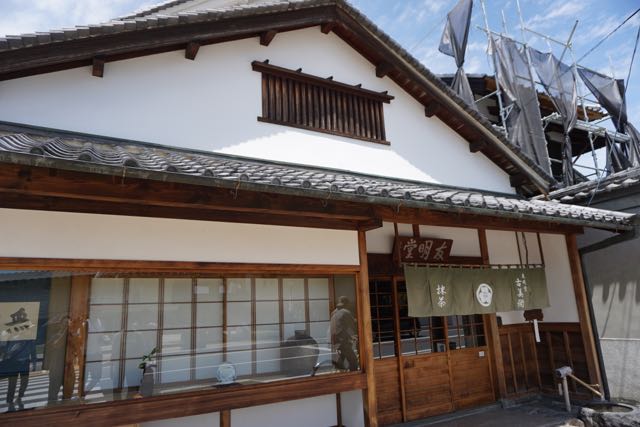
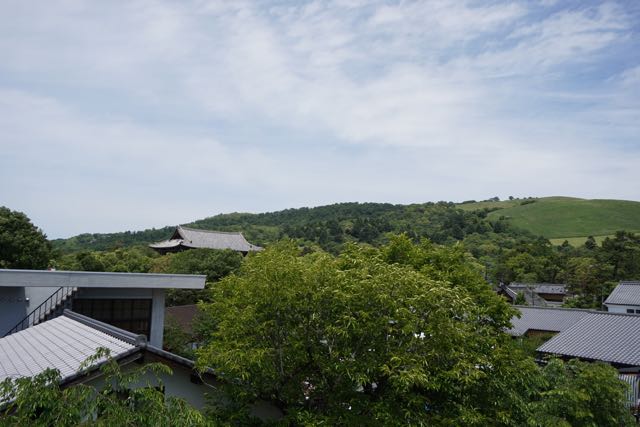
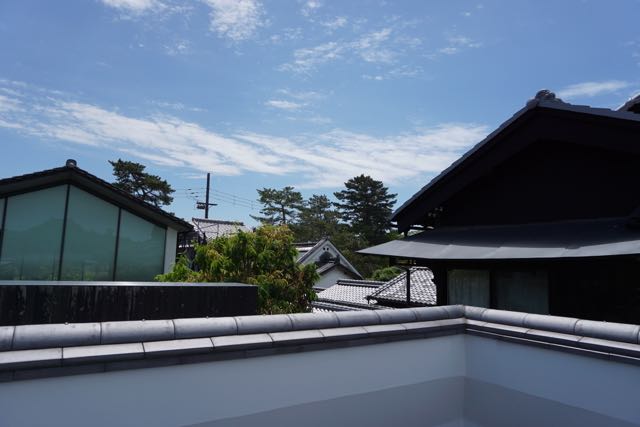
As we were walking out of Nara Park heading towards Todaiji, we spotted a building that welcomes visitors to rest, use their toilet and top up their water bottles. This building exhibits technology that earthquake-proof buildings. As we were walking in, one of the staff welcomed us and suggested that we visit the rooftop of this building, where we can see Todaiji from. We heeded her recommendation and went to the rooftop. Indeed we were able to see Todaiji as well as the hill behind it. Weary visitors can come in here for a rest, which the staffs welcomed us to do so.

Todaiji (東大寺)

My friend and I soon find ourselves at the gate leading to Todaiji. There are a lot of visitors coming to Todaji despite being a Monday. We saw crowds of Japanese students on a field trip here. As with Nara Park, there are pockets of deer roaming around near the entrance of Todaiji.

Nandaimon (南大門)

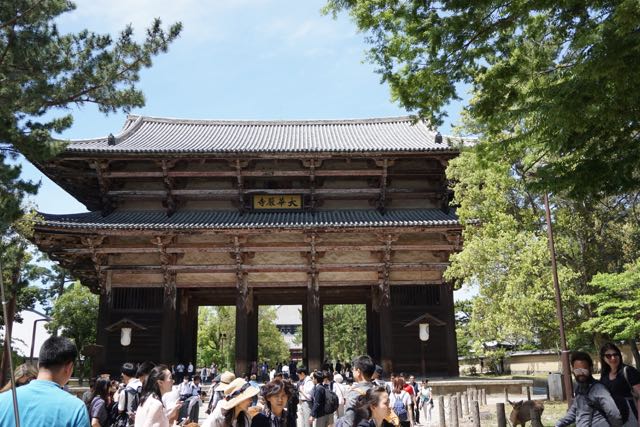
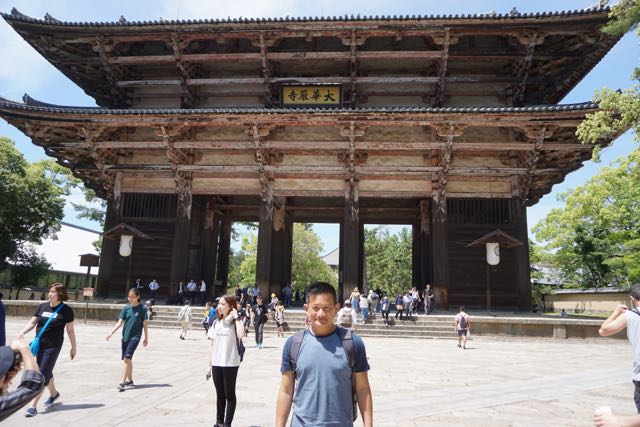
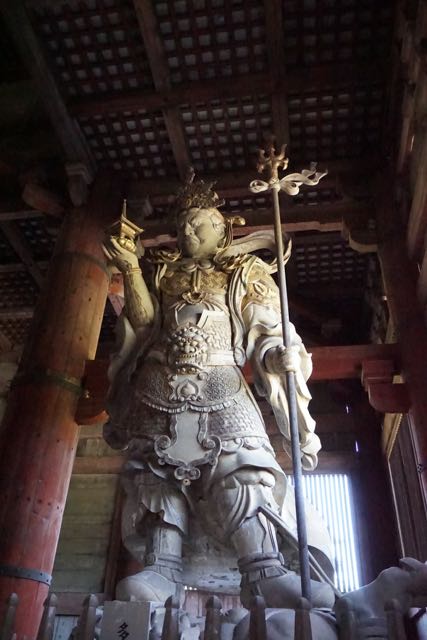
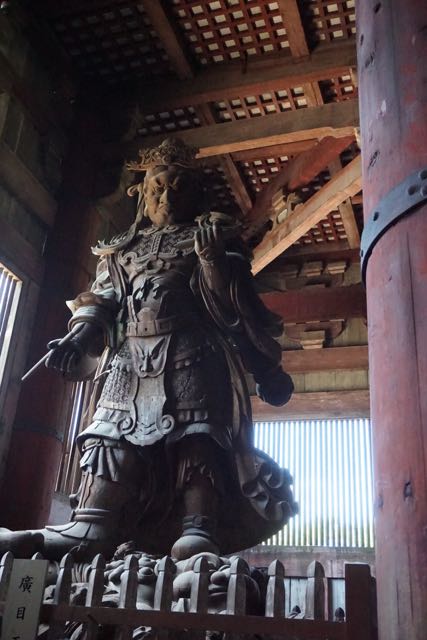
As we were walking towards the temple gate Nandaimon, I am awed by the sheer size of the gate. This is the biggest wooden temple gate that we have come across so far in our travels in Kansai. Indeed Nandaimon is the largest temple gate in entire Japan and was originally built in 1203. I am amazed by how the architects came out with this unique way of constructing the gate, it is visible that the individual woods are pieced together like Lego bricks, using ingenious ways of fitting each block to another. Upon closer inspection of the gate, it seems that Nandaimon was originally painted in red, as traces of peeled red paints can be spotted on the beams of Nandaimon. Walking through Nandaimon makes me feels like an ant on by the side of a giant. 2 gigantic statues of Heavenly Kings (or Ni-o) are installed inside both sides of Nandaimon. A little further from Nandaimon I saw a pond with a small piece of land in the middle. A red torii gate and a small building, which I think is a shrine hide beyond trees planted on this small island.

DSC08671

The impressive Nandaimon

DSC08684

A small shrine hiding behind the trees

Daibutsuden (大仏殿)

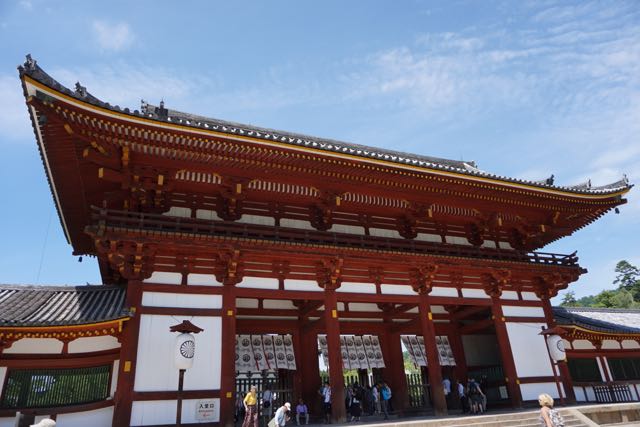
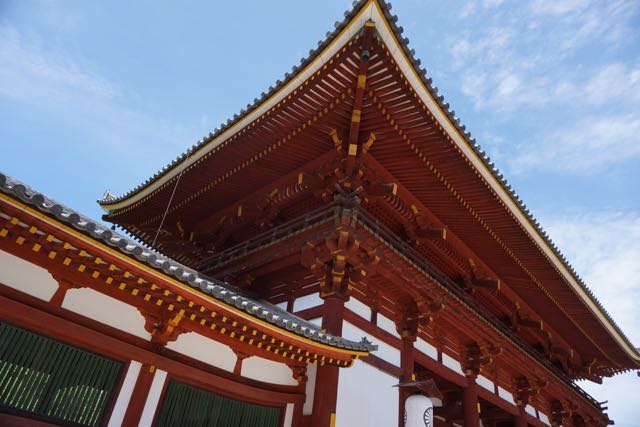
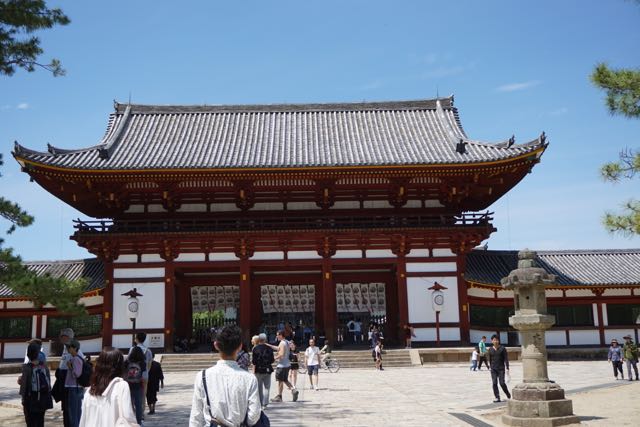
A stone’s throw from the pond, we came to the inner gate (中門) to Daibutsuden. Unlike Nandaimon, the inner gate dons on bright red on its pillars and beams with white walls. The path towards Daibutsuden from the inner gate is blocked off, there are signs that points to a side entrance to Daibutsuden. This is where we got our tickets and secured our entrance to the biggest wooden structure in the world.

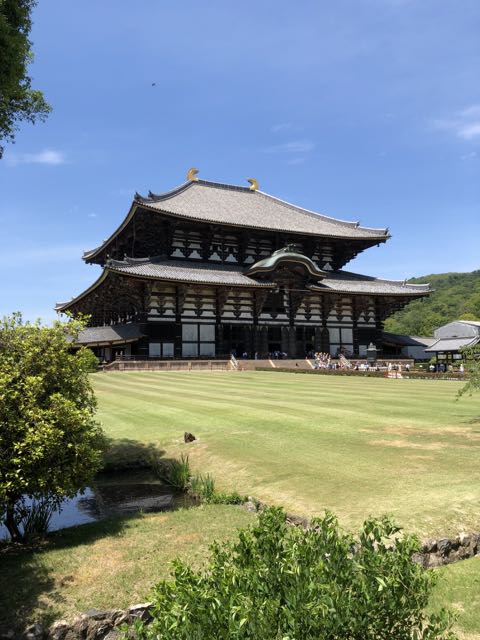
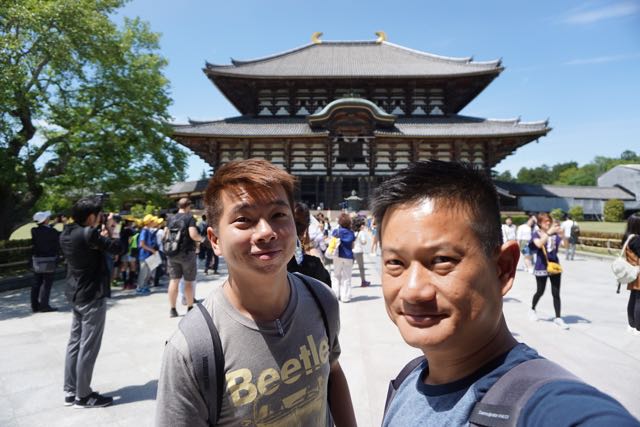
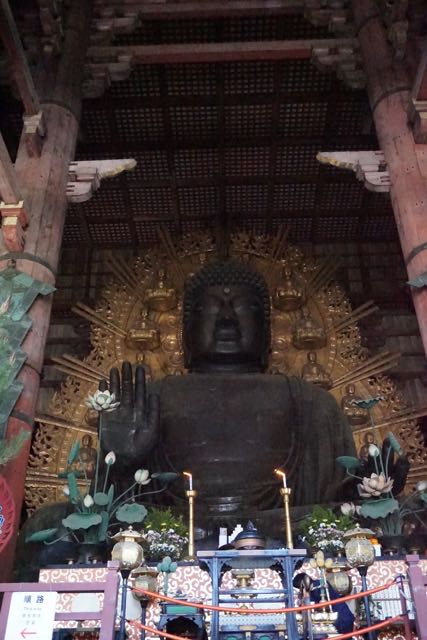
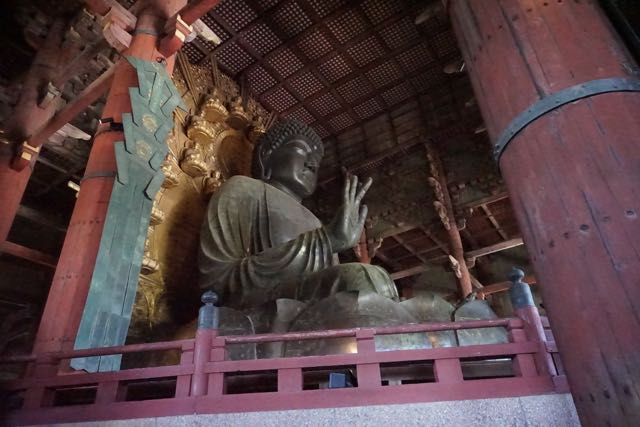
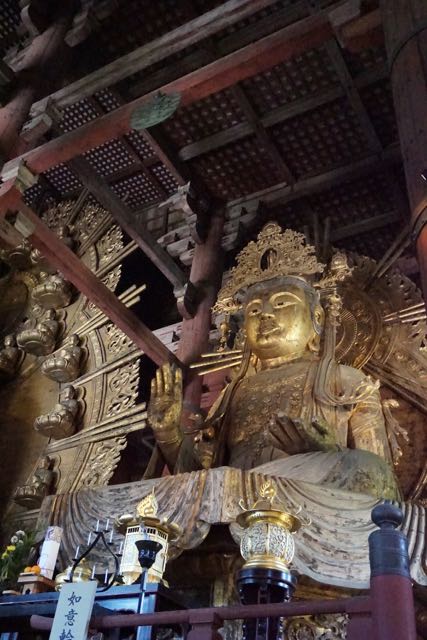
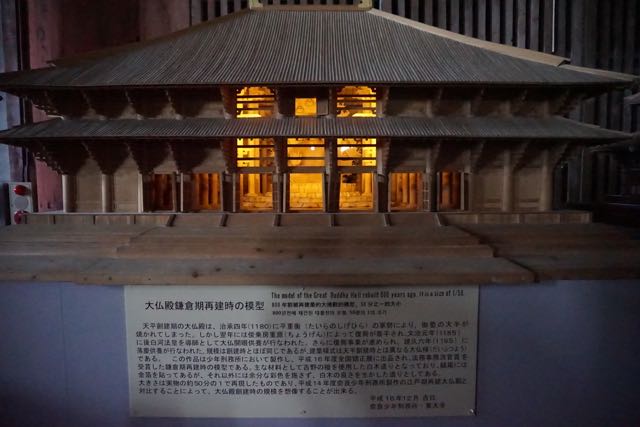
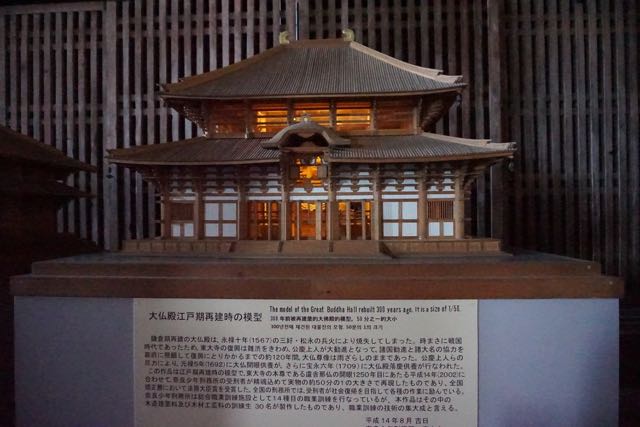
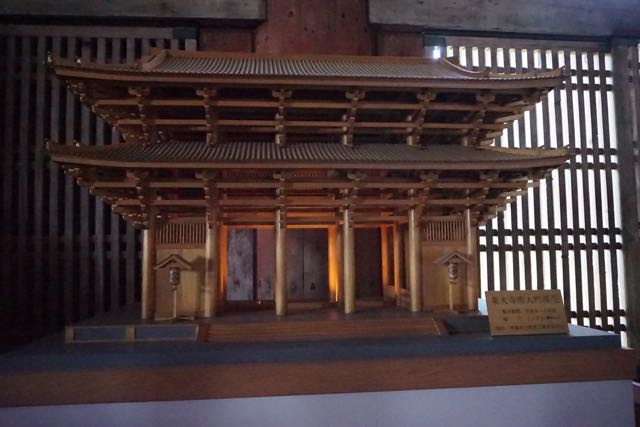
As soon as we passed the ticketing side gates, the majestic Daibutsuden sitting in the centre of a large courtyard come into our view, looking like a gentle giant resting in its den welcoming visitors. Daibutsuden was built in 798. As we were walking to Daibutsuden, its grandeur started to reveal itself. Daibutsuden does not require any fanciful or bright colour to make itself stand out, its sheer size is sufficient to awe visitors. Clad in simple white colour and using its natural colour of the wood it was built with, the only bright colour on Daibutsuden is the pair of golden shachis (decorative ornaments mounted on the top of the roof). From outside, Daibutsuden appears to be a 2-storey building with its 2-tiered roof design. Walking into the building, Daibutsuden is a single storey building with very high roofs. In the centre of Daibutsuden is a large statue of Buddha (Daibutsu). The nearby 15m tall Daibutsu was cast in bronze over in 8 castings over a period of 3 years. The Daibutsu was covered in gold leaf when it was first made, these days the bronze castings gave the big Buddha statue a character if its own. My friend and I walked around the Buddha to explore Daibutsuden. There are 4 other statues on either side of the bid Buddha. Behind the Buddha statue, tucked by the back wall of the hall are 3 models of Daibutsuden. It appears the hall was rebuilt 3 times and the original hall was much bigger than it is today. After walking 1 round in Daibutsuden, we headed out of the hall.

IMG_8839

The first look of Daibutsuden after we passed through the ticketing area

DSC08695

Daibutsuden – The largest wooden structure in the world

DSC08700

The nearly 15m tall Big Buddha in Daibtsuden

DSC08710

Model of the original and bigger Daibutsuden

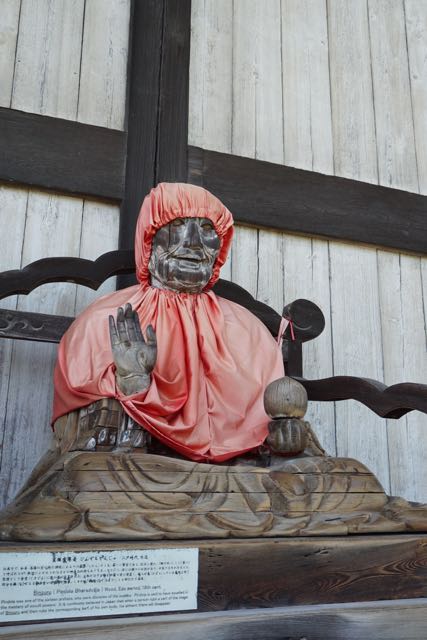
We noticed a wooden and somewhat creepy statue on the right of the entrance of Daibutsuden. Several visitors are looking at this statue. Upon closer inspection, a sign by this statute states that the locals believed by touching the statue and rubbing against the parts where one would feel pain, the pain will go away.

DSC08719

It is believed that touching this statue will help to relieve pains

Nigatsudo (二月堂)

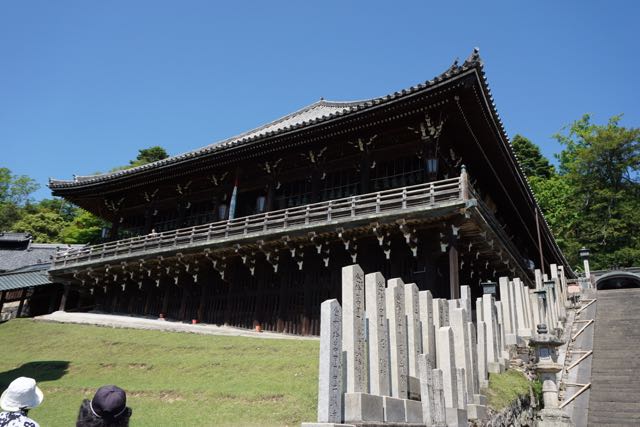
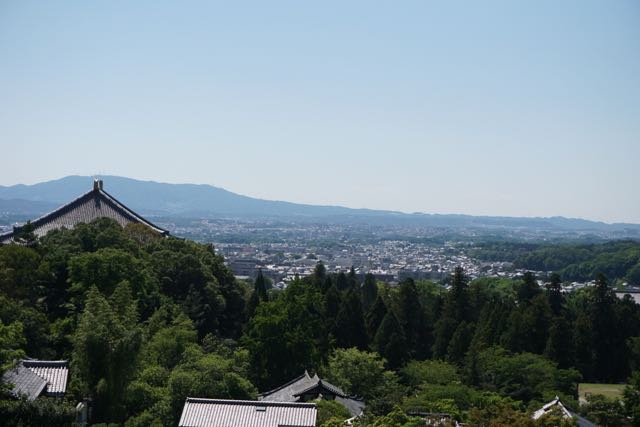
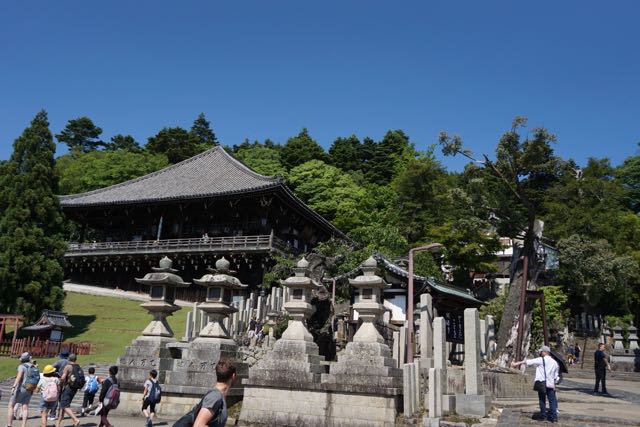
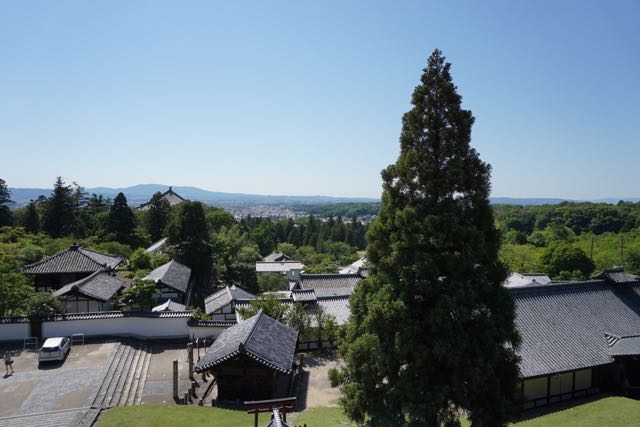
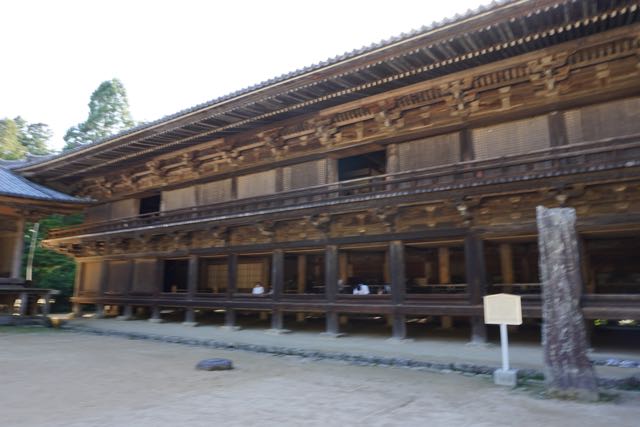
After visiting Daibutsuden, my friend and I followed a pathway outside the parameters of  Daibutsuden. There is hardly anyone going this way. Our plan is to visit some of the side temple buildings in Todaiji. Most visitors would head out of Todaiji after visiting Daibutsuden, however, there are more interesting buildings around. One of these is the Nigatsudo. Nigatsudo (translates to “The Hall of the Second Month”) is one of the important structures in Todaiji, ceremonies are held here in the 2nd month of the lunar calendar. Nigatsudo is first built between 756 to 772 but was destroyed by a fire in 1667. The current building is built in 1669. Nigatsudo was built on the foot of Mt Wakakusa. The 2-storey wooden building is one of the biggest buildings in Todaiji (after Daibutsuden). To get the temple halls, we had to climb a flight of stairs as the temple halls are perched on the side of a hill. Nigatsudo is a great place to get away from the crowds of visitors to Daibutsuden. It is peaceful and quiet here as there are just a handful of visitors (mostly Japanese) here. The biggest draw of us coming to Nigatsudo is the view from the veranda. Other than shielding is from the heat of late spring Kansai (it was getting hot), the view from the veranda allows us to see the whole of Nara City with Daibutsuden in the foreground. It is peaceful and scenic here, coupled with the late spring breeze, the benches on the veranda in Nigatsudo is a great place to relax. It is a shame that most visitors to Todaiji make a u-turn for the exit after visiting Daibutsuden.

DSC08744

Nigatsudo is built into the slopes at the foot of Mt Wakakusa

DSC08759

View of Nara City from Nigatsudo, highly recommend not to miss this spot when one comes to Todaiji

Sangatsudo (三月堂)

Coming down the stairs from Nigatsudo, we spotted a small building on stilts. Sangatsudo is the oldest temple building in Todaiji, dating back to the year 740. The rather simple building holds some valuable statues. Sangatsudo look closed at the time of our visit, my friend and I took some pictures of it and left for Nara City where we grabbed our late lunch.

DSC08762

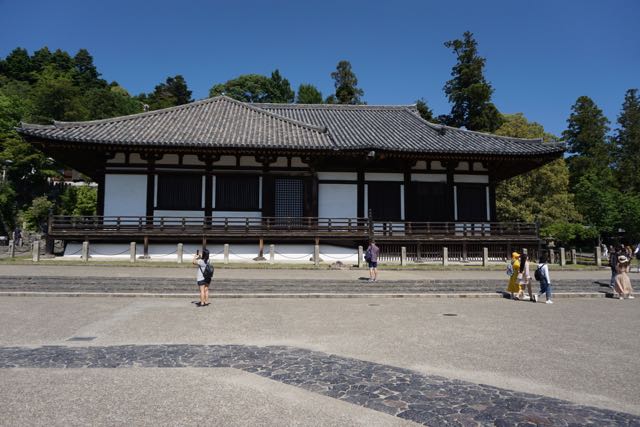
Sangatsudo is the oldest building in Todaiji

DSC08763

Sangatsudo up close

Back To Himeji

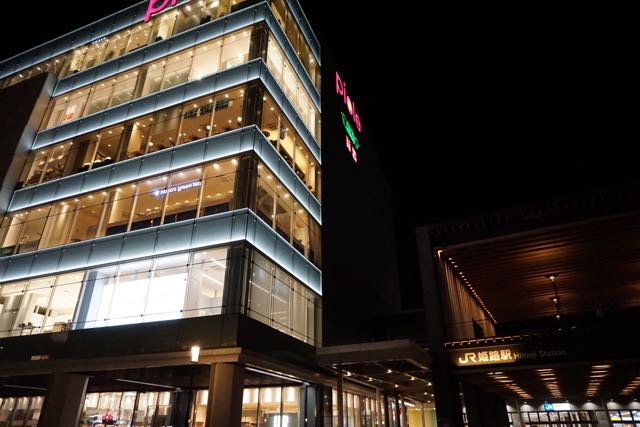
It is still early by the time we are done with visiting the temples in Nara. My Friend and I headed back to Himeji to shop around its shopping Malls at Himeji JR station. Using the Shinkansen ( another way for us to maximise the use of our JR pass) we got to Himeji in less than 1 hour from Nara. After some shopping, we headed back to our accommodation in Osaka to rest for the night, getting ready to visit the sights in Kyoto the next day.

Kansai (Kyoto/Osaka) Day 3 (20 May 18) – Quaint Seaside Town of Amanohashidate

DSC08480

Amanohashidate Bridge to Heaven, one of top 3 views in Japan

Kuromon Ichiba Market (黑門市場)

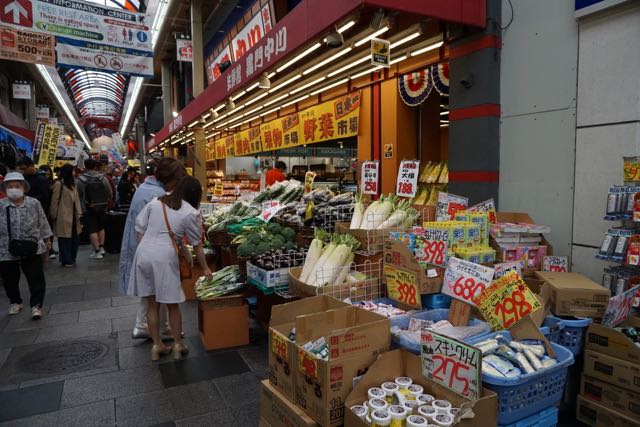
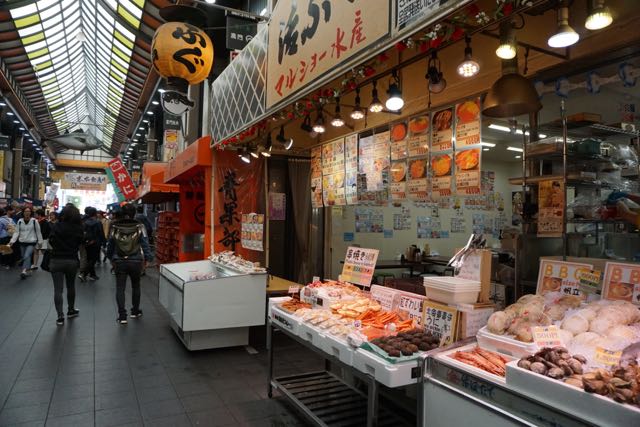
We are visiting Amanohashidate today. When I was planning this Kansai trip, I came across a video that introduces Amanohashidate. Other than the title of 1 of Japan’s top 3 scenic spots, what draws me to make a trip to Amanohashidate is the fact that there are very few foreign visitors coming to this place. As we were on our way to the train station where we begin our 3-hour journey to Amanohashidate, we walked through Kuromon Ichiba Market. Commonly known as the Black Market, Kuromon Ichiba Market sells mainly local produces sourced from all over Japan. Since we are passing through it, my friend and I decided to check what’s on offer, after all, I have heard so much as I was planning our trip to Kansai. The stalls in Kuromon Ichiba Market sells mainly fresh produce such as vegetables, fruits and seafood. The price is a lot cheaper than what we have seen so far in Kansai. Some of the stalls selling seafood even have a dining area, where one can savour the fresh seafood from as far north as Hokkaido, prepared ala-minute and served to patrons. We window-shopped a little, before heading to the train station to catch our train to Amanohashidate.

Kyoto By the Sea – Amanohashidate (天橋立)

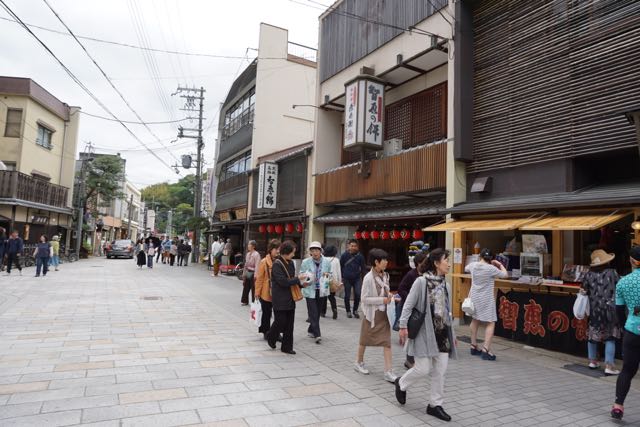
Amanohashidate is some 3-hour train ride from Osaka and is located in northern part of Kyoto Prefecture. After changing 3 trains, we finally arrived at Amanohashidate. There are some shops selling souvenirs opposite Amanohashidate JR station. We briefly went inside some of these shops and decided to come back later if time permits. There are 2 viewpoints in Amanohashidate that will allow us to view the famed sandbar that propelled this quaint little town into top 3 scenic views in Japan. One of these viewpoints is located about 7 mins walk from Amanohashidate JR station. In Amanohashidate Viewland (天橋立ビューランド) lies a small theme park. However, we did not go to this viewpoint as I wanted to visit the original viewpoint at Kasamatsu Park (傘松公園) instead.

IMG_8741

Amanohashidate JR Station

Chionji Temple (智恩寺)

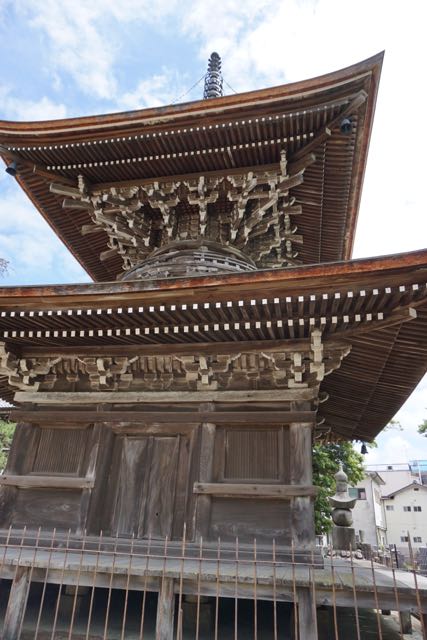
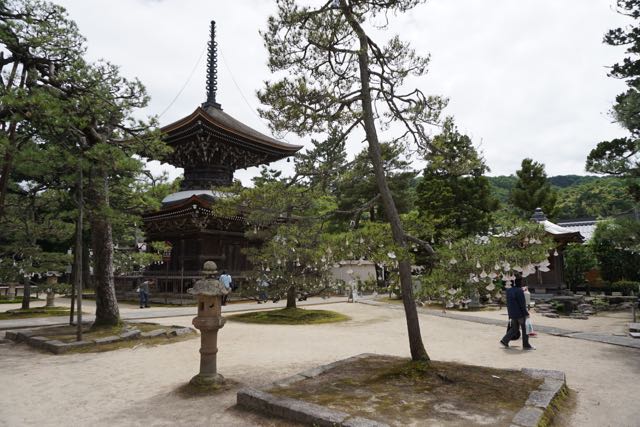
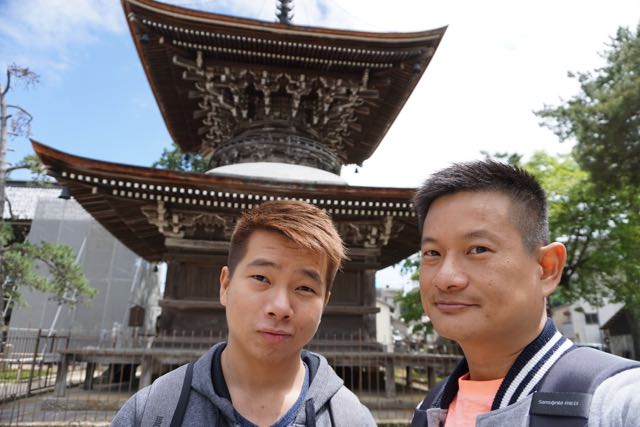
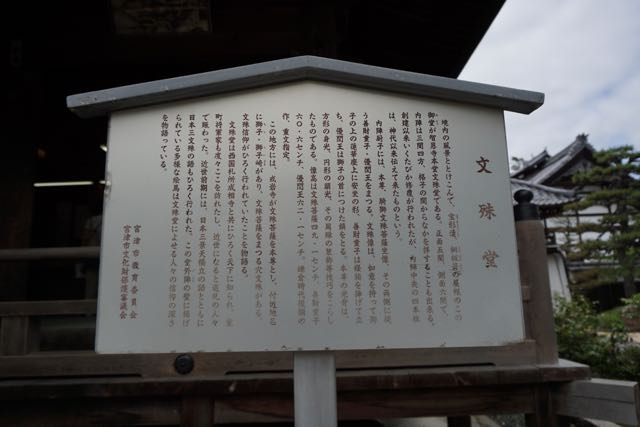
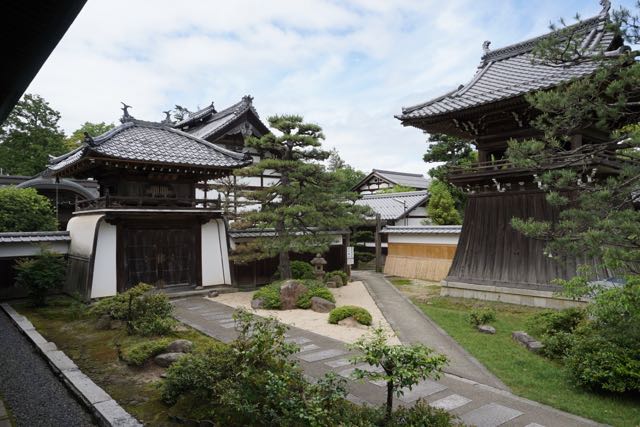
Chionji Temple is our first stop in Amanohashidate, located some 3 mins walk from the JR Station. Chionji is one of the 3 temples in the whole of Japan that is dedicated to Bodhisattva Monju, who grants wisdom to those to come and pay respects at this temple. As we did not enter the temple grounds via the main gate, the first thing that caught my eyes is the 2-storey wooden Tahoto Pagoda (多宝塔). The pagoda is built in the 1500s and is the oldest structure in the temple grounds. Despite not painted in bright colours, rather the pagoda is still clad in its original wooden colour, I like this pagoda for its rustic look. This pagoda, like those temples we seen in Mt Shosha yesterday, looks like they have been assembled block by block with no nails used.

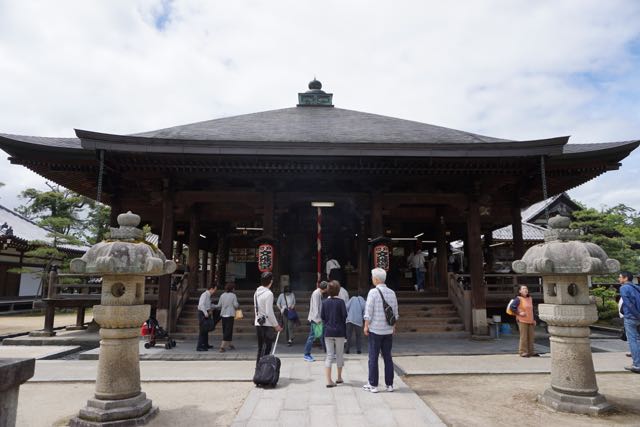
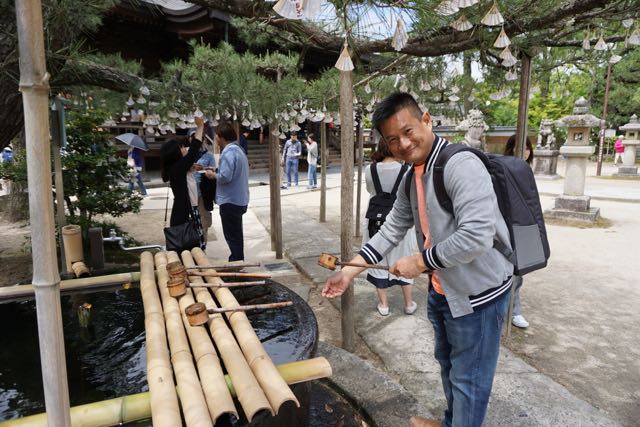
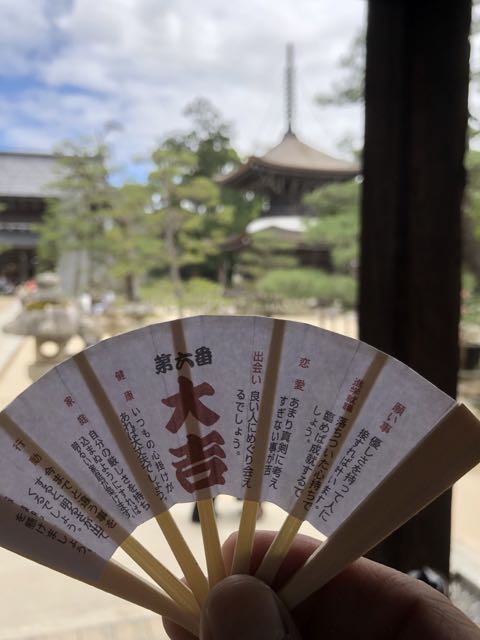
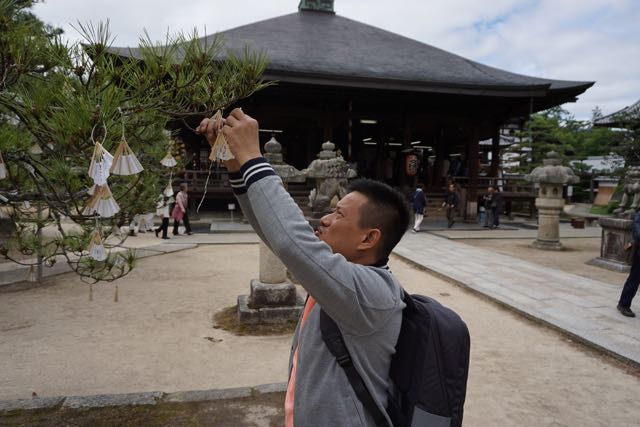
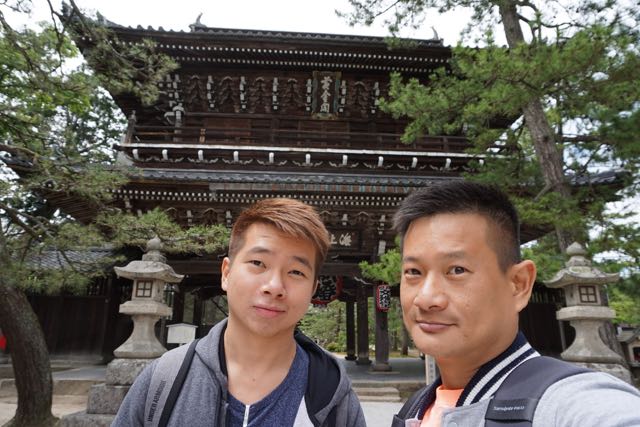
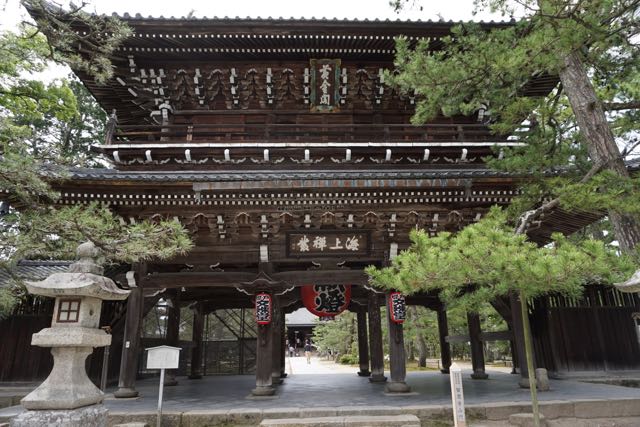
After going through the ritual of cleansing our hands, a ritual when visiting temples in Japan, we headed for the main prayer hall of Chionji. This prayer hall was also made entirely out of wood, took 2 years in its construction and was completed in 1657. The main prayer hall looked more like a big pavilion, with a large fan-shaped roof. It is a ritual here to ring the bell hanging at the entrance of the prayer hall. My friend and I each got a fortune that is shaped like a folding fan. We left our fortunes hanging one of the pine trees in the temple grounds, which is what the locals did. The surrounding of the Chionji Temple exudes a sense of zen, though the other parts of the temple are out of bounds. We left Chionji via the temple gate, known as Ogonkaku (山門). The 2 level gate was built in 7 years by 8,780 carpenters, completing construction in the year 1767.

The Best Way to Visit Amanohashidate – Cycling Through Sandbar

In front of Chionji is a shopping street that sells mainly souvenirs and a handful of restaurants. After settling our lunch, we proceeded to one of the shops to rent a bike. There are several shops on this street that one can rent the bicycle for. We asked around and found a shop that rents a bicycle for the whole day for ¥400 (the other shops’ rate is ¥400 for 2 hours).

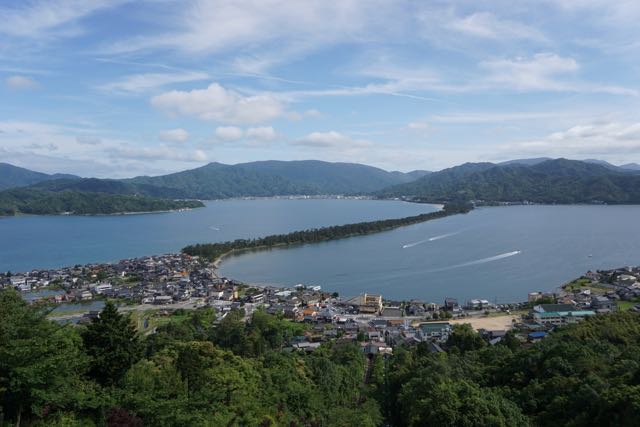
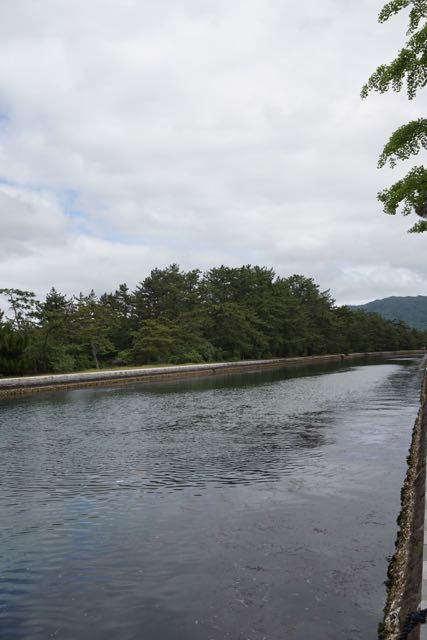
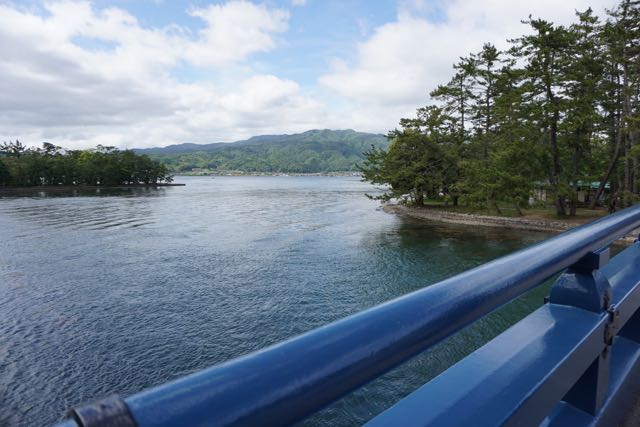
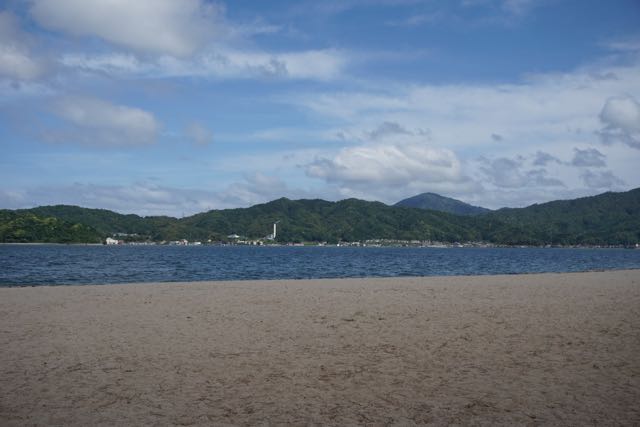
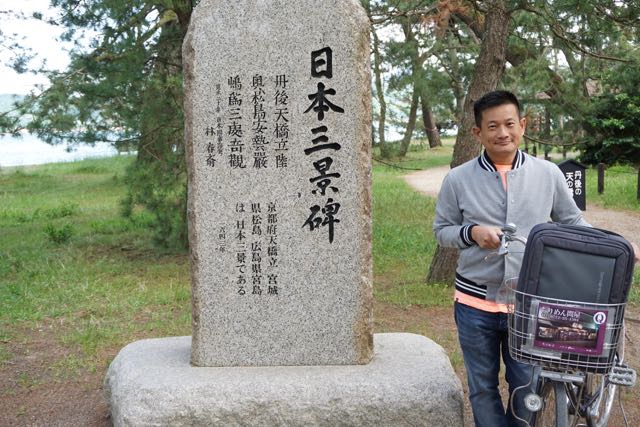
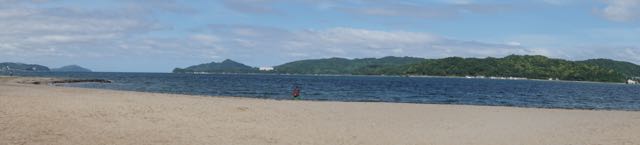
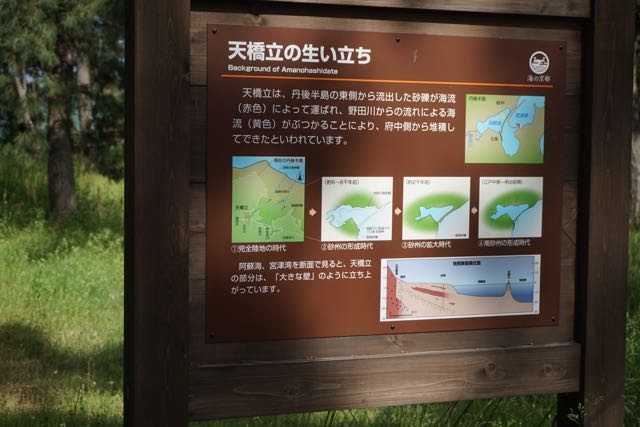
The 3.6 km sandbar in Amanohashidate has Miyazu Bay on one side and Ine Bay. The entire sandbar, at its narrowest point, is a mere 20m wide and 170m wide at its widest point, is home to some 8,000 Japanese pine tree. The sandbar has been moulded to its current shape through thousands of years of earth movement. To get to the other side of Miyazu Bay, one can either walk or cycle or take a ferry across the bay. I think of the best way of visiting Amanohashidate is to cycle through the sandbar, which cuts the travelling time (compared to walking) from 50 mins to 20 mins. Cycling through the sandbar, I was able to see these pine trees up close, as well as the white sandy beach on Ine Bay side of the sandbar. There are a number of locals playing by the beach near to the South side of the sandbar (near to the JR Station). There is only one shop at this side of the sandbar that is operating. Throughout the sandbar, I spotted some buildings that have seen better days, these days these buildings appear to be abandoned. There are also numerous pavilions along the sandbar, ideal for visitors to picnic or simply lunch with a bento set that is bought from one of the nearby shops. There are also several points along the sandbar where vending machines can be found. We reached the northern side of the sandbar in 20 minutes cycling through it.

DSC08427

Panoramic view of the beach facing Ine Bay

Motoise Kono Shrine(龍神社)

Crossing a road, we found a spot to park our bicycles and proceeded to the ropeway station for Kasamatsu Park. The base ropeway station to Kasamatsu Park is rather hidden. To get to the base station, we passed through Motoise Kono Shrine. Motoise Kono Shrine is a Shinto Shrine, where the Goddess of Agriculture is enshrined. The shrine grounds are especially peaceful as soon as I entered it, partly due not many people visiting the shrine at the time I was there. Within the shrine grounds, I can hear a harp-like sound produced as water drips into an underground cave from the Japanese garden ornament. The shrine grounds are not very big and that photography is not allowed in the shrine grounds, we can only take pictures from outside the shrine.

DSC08454

Motoise Kono Shrine

Kasamatsu Park(傘松公園)

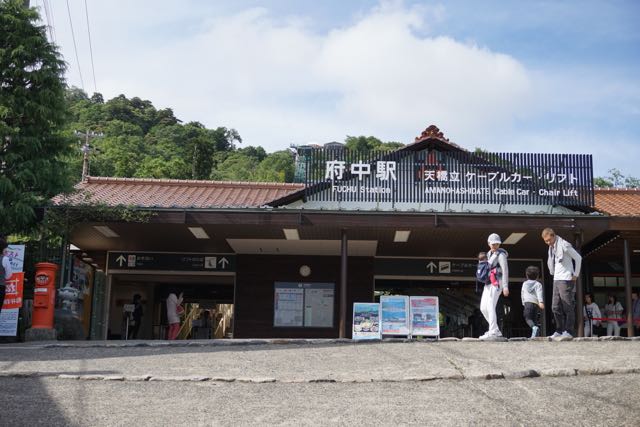
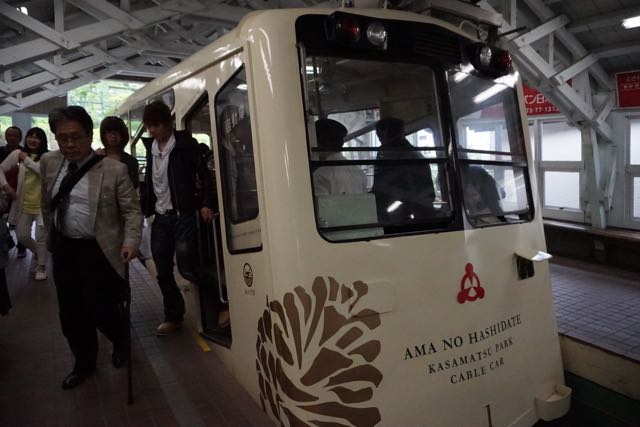
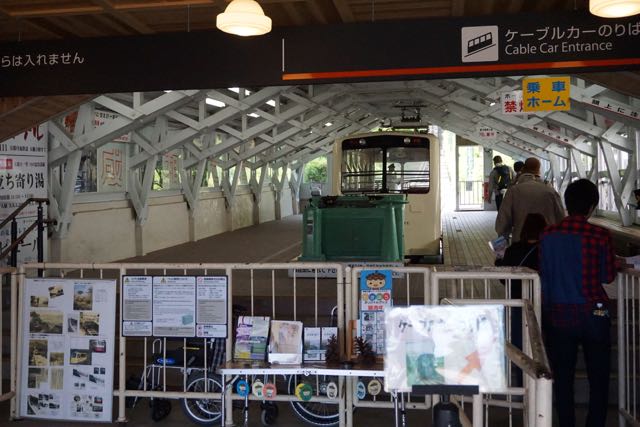
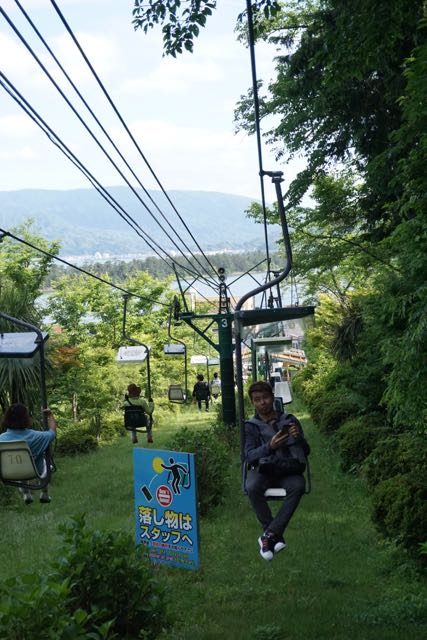
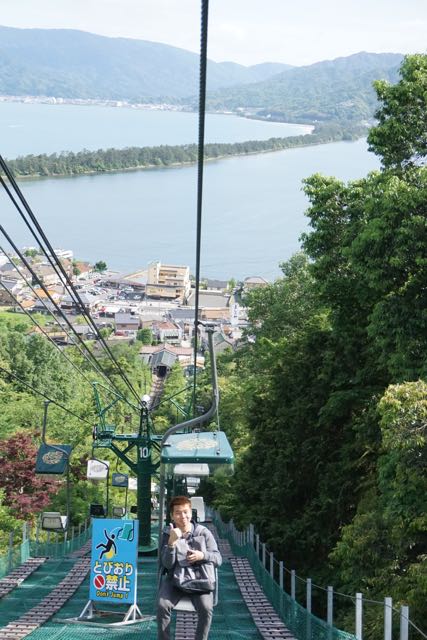
The station where the cable car/ chairlift to Kasamatsu Park is a mere 2 mins walk from Motoise Kono Shrine. We were given the option to take the chairlift or cable car up to Kasamatsu Park. We opted for the chairlift as it looked more exciting. One should take the chairlift when coming down from Kasamatsu Park as one will be treated to the magnificent view of Amanohashidate, as the chairlift faces the sandbar when descending from the hill. When going up the hill, the chairlift is facing the hill. The chairlift rides take about 5 mins, every now and then I turned around in hope to capture some pictures of the view that made it to the top 3 scenic views in Japan.

DSC08457

Amanohashidate Cable car/chairlift station

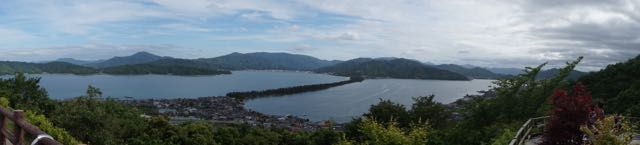
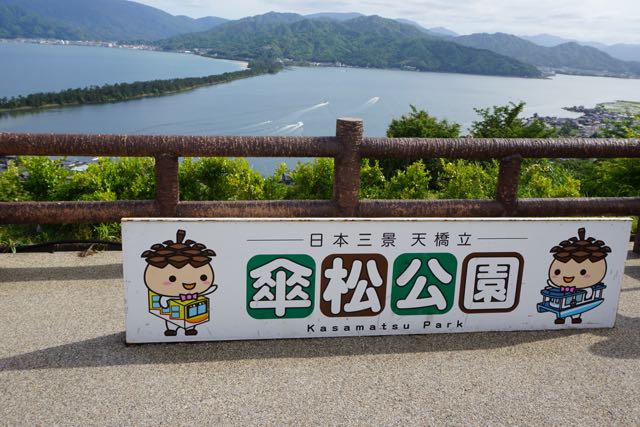
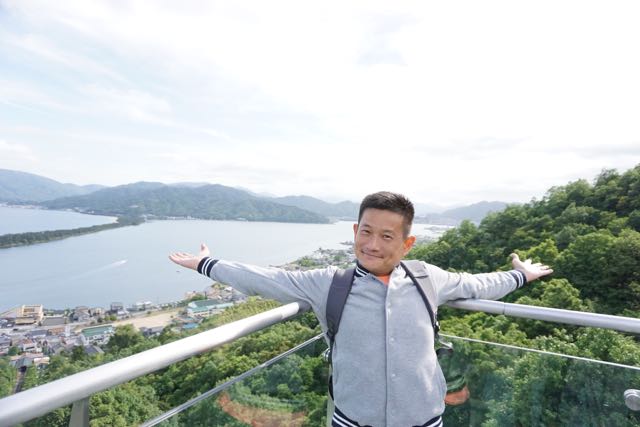
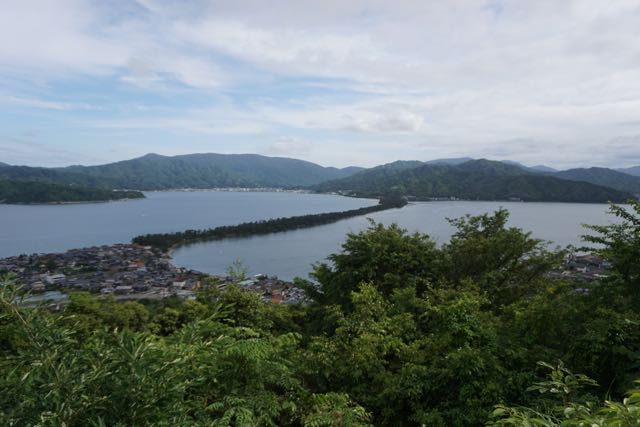
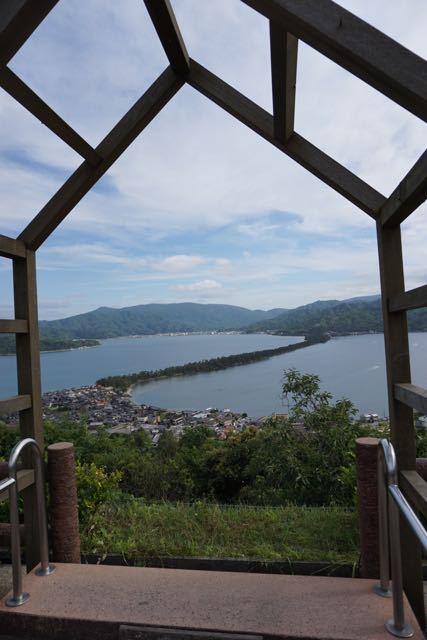
We soon reached the top of the hill. As soon as we turned around, we know that spending the 3 hours on the JR to Amanohashidate is well worth it. The view here is nothing short of spectacular. From the viewpoint here, the sandbar resembles the word “One” in Kanji and Chinese. There are several points where we can see the scenic view of the bay. My friend and I headed to this wooden platform that protrudes into the air where we caught our first glimpse of the Bridge to Heaven. It is simply amazing and to a certain extent, therapeutic. Kasamatsu Park indeed provided the best view of the sandbar. Up here, we can see the sandbar trying to link both sides of the land while separating the lake from the sea. On the left of the sandbar is Ine Bay and the right is Miyazu Bay. With the mountain ranges forming the backdrop, we felt we can stay here forever. There is a small platform by the side of the wooden platform, where a piece of thick glass is used as a panel. From this glass panel, we realised how high we are in the air. There is building in front of the wooden platform. My friend and I checked out the second level, to see if we can grab a better view of the sandbar. On the second level, a big heart-shape with a bell attached serving as a backdrop to 2 chairs was found. This is a great place for lovers to take pictures from, though I do find the pink heart structure a tad too cheesy and spoilt the view of the sandbar.

DSC08542

Panoramic view of Amanohashidate Sandbar

DSC08570

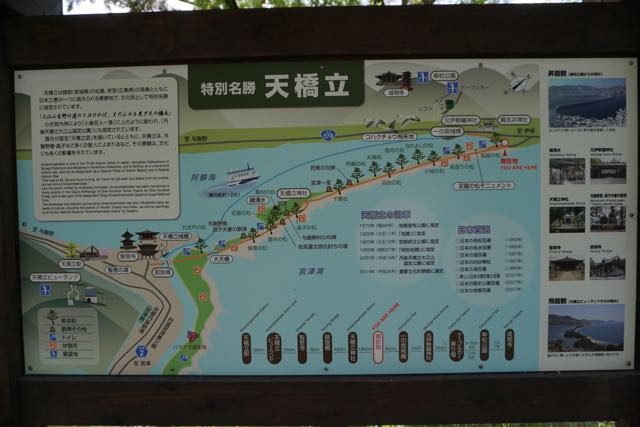
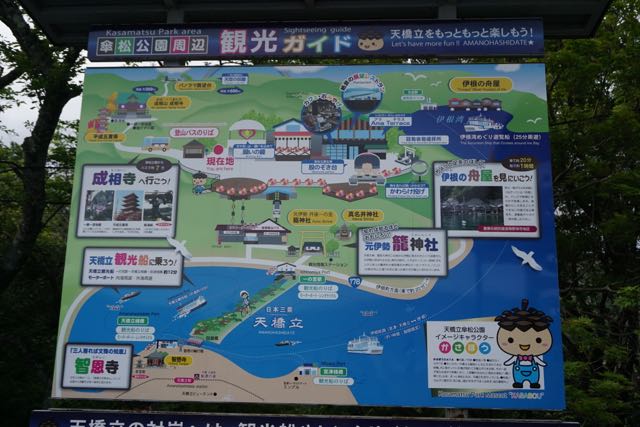
Map of Kasamatsu Park

DSC08497

A perfect spot for lovers to take pictures of Amanohashidate

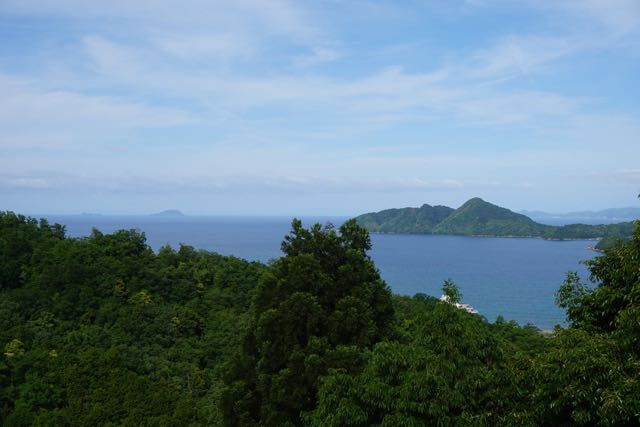
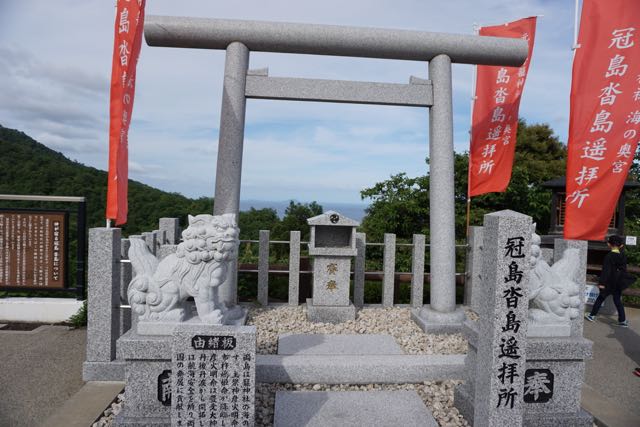
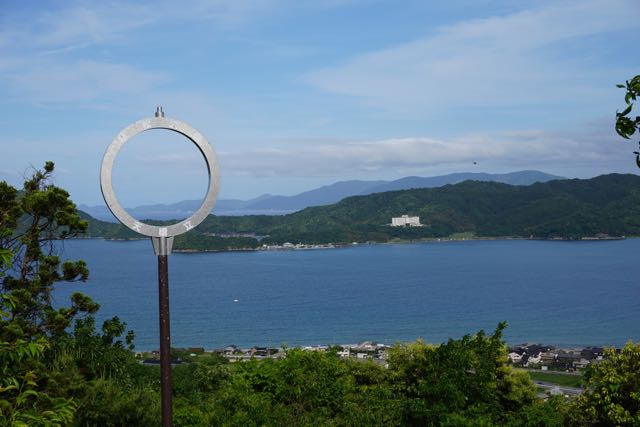
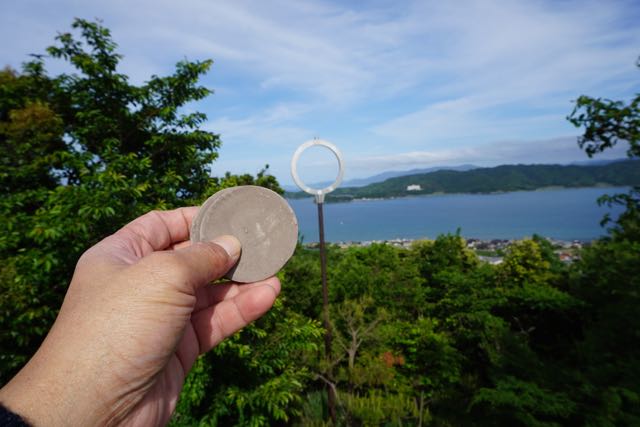
We then headed to the side furthest away from the station. From here we can see out into Ine Bay and some of the islands popping out from the sea as though some playful child is peeping out of the sea. A shrine is installed at this side of Kasamatsu Park. Beside the small shrine, one can try one’s luck by tossing a ceramic tile (3 tiles for ¥300, just take 3 tiles and drop the coins into the coin box) into a ring that is installed in the halls. It is believed that one will get one’s wishes come true if one managed to toss the ceramic tile through the ring. After seeing so many people trying their luck, my friend and I also participated in the fun. I got my first ceramic tile through the ring and was immediately applauded by the Japanese around me. At the time we visited, other than my friend and I, the only other foreigners are this couple (seems from Taiwan). The rest of the visitors are Japanese.

DSC08501

Ine Bay from Kasamatsu Park

DSC08519

A shrine at Kasamatsu Park in front of Ine Bay view

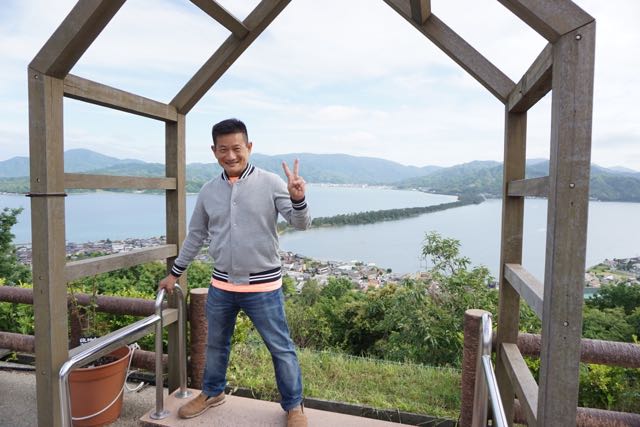
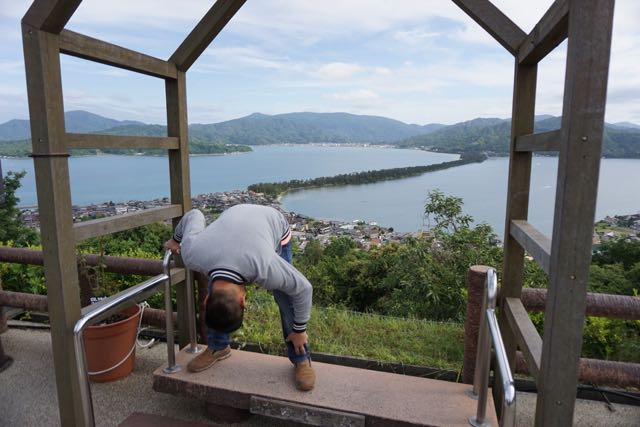
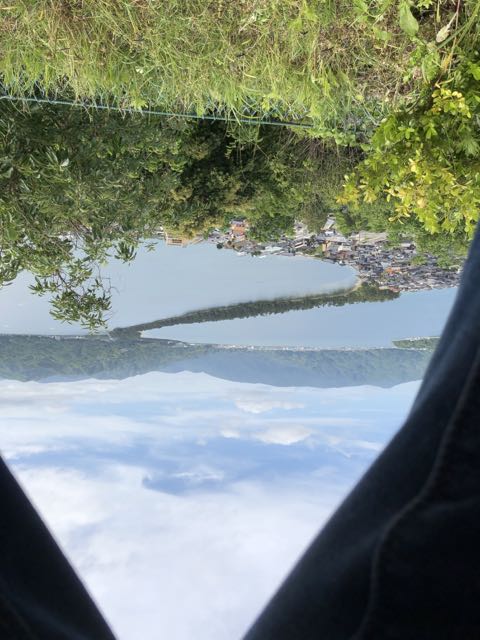
There are some platforms that look like benches near the ring tossing area. This is where an ancient old practice of Matanozuki (股のぞき) of viewing the sandbar has existed for millennia. To do Matanozuki, one would have to stand on one of these platforms with one’s back facing the sandbar and bend down to look at the sandbar (upside down) between one’s legs. My friend and I did the Matanozuki. By viewing the sandbar this way, we understood why the sandbar is also called “Bridge to Heaven” (天の浮橋) by the locals. Viewing the sandbar upside down, the sandbar seems to connect the earth to the sky. It is a must try activity when one comes to view the “Bridge to Heaven” at Matanozuki Park. We were mesmerised by the view here in Kasamatsu Park and did not realise we had spent quite a bit of time here.

IMG_8763

By doing the Matanozuki, the sandbar resembles a bridge to heaven, hence the name Amanohashidate

As it was approaching 5pm (the time we need to return our bikes), my friend and I headed to the station. Our plan was to take the chairlift down so we can enjoy the view of the “Bridge to Heaven” as we were leaving the park. However the chairlift ceased operations at 4pm, our only option is to ride in the cable car down the hill. Once at the base cable car station, we raced across the sandbar and made it in time to return the bike before the shop closes. After returning our bikes, we headed back to Dotonbori in Osaka for our dinner before heading back to our accommodation to rest for the night.

DSC08573

My friend with a friendly shopkeeper selling fishcake

Kansai (Kyoto/Osaka) Day 2 (19 May 18) – The Majestic White Heron Castle: Himeji Castle and The Ancient Temples Of Mt Shosha: Engyoji Temple

DSC08012.JPG

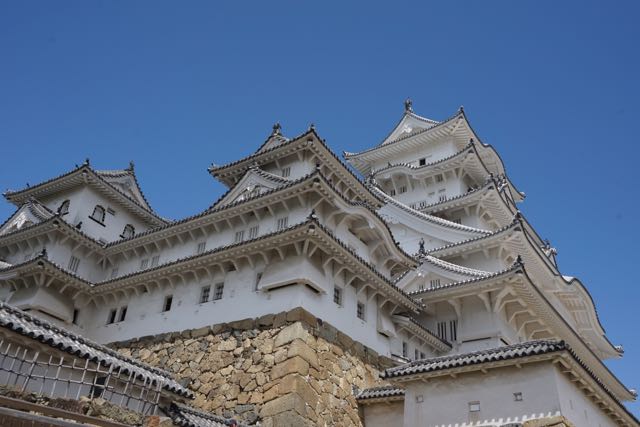
The Majestic Himeji Castle

Onwards to Himeji

Our journey in Kansai region takes us to the city of Himeji today, home of the first UNESCO world heritage site in Japan, Himeji Castle. To get to Himeji, we can either take a local bus to Sannomiya Bus Station and transfer to JR twice to reach Himeji or we could alight at Shin-Kobe from the same bus and catch a Shinkansen from Shin-Kobe station to Himeji. We caught the bus at the bus stop just a stone’s throw distance from the hotel and soon we were on our way to Himeji. Riding the Shinkansen for the first time was an interesting experience, watching this part of Kansai zooming pass our eyes, we were in Himeji station in 30 mins from Shin-Kobe station.

The White Heron Castle – Himeji Castle(姬路城)

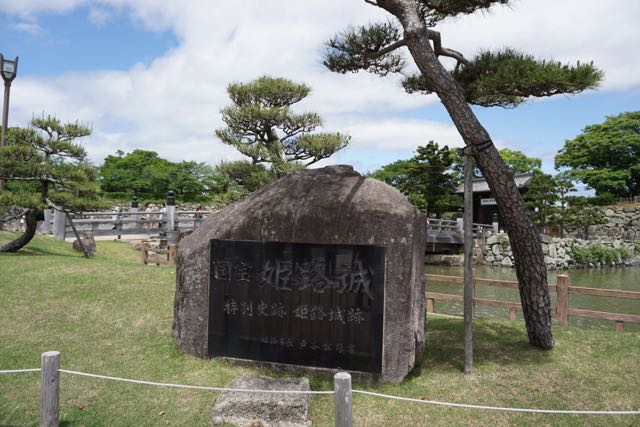
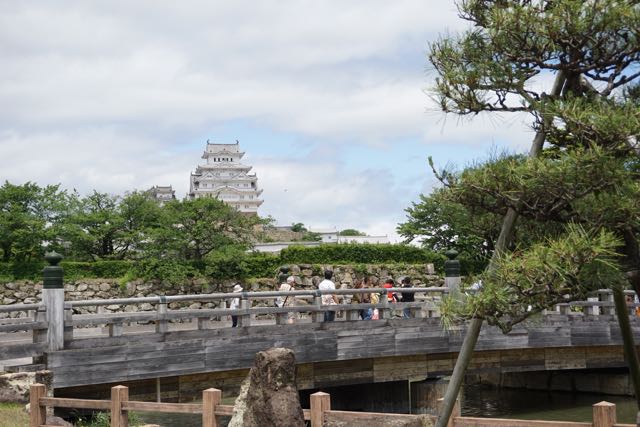
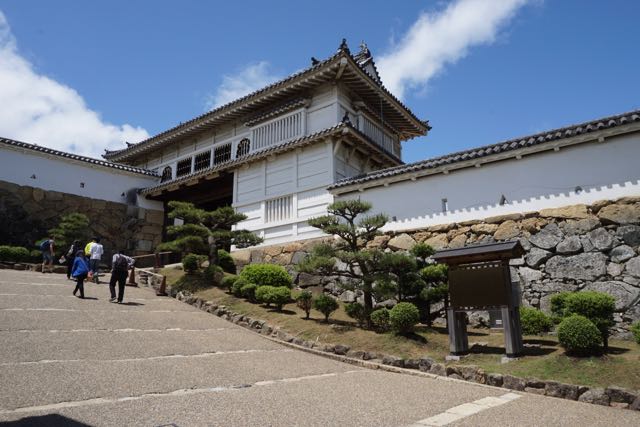
As soon as we arrived at Himeji JR Station, my friend and I left our luggage in the locked found in the JR station. One cannot miss Himeji Castle as one stands at the entrance of the JR Station. The white castle is standing at the end of the road and is visible from the station. It took us 20 mins to get to Himeji Castle by foot. Like most castles around the world, Himeji Castle is surrounded by a moat which functioned as the first layer of defence for the castle in the olden days. A large stone signage placed before the wooden bridge to the grounds of Himeji Castle proudly announces to visitors that Himeji Castle is Japan’s number 1 national treasure.

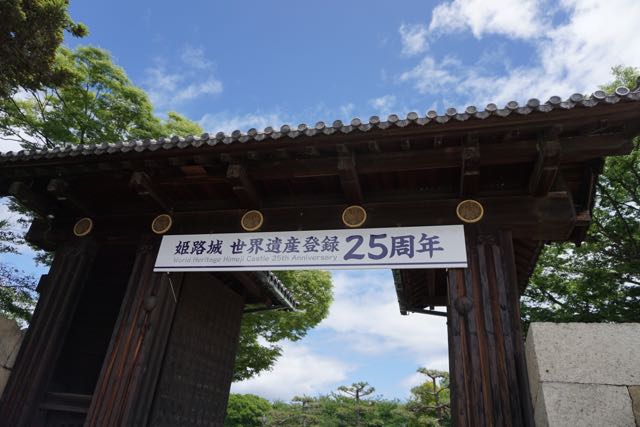
The old wooden bridge that seems to exist together with the castle over its 600 years of existence. Crossing the bridge, pass a wooden archway that welcomes visitors into the grounds of Himeji Castle, I was able to adorn the glory of Himeji Castle perching on top of a hill. There is a large open space in front of the castle, which makes a great photo spot for visitors with the castle. Himeji Castle also affectionately known as the White Heron Castle by the locals, as it resembles a white eagle perching on top of the hill, protecting the citizens of Himeji from harm.

Main Keep of Himeji Castle (天守閣)

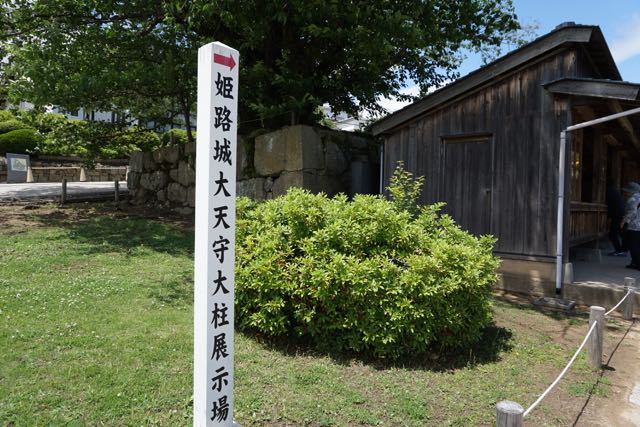
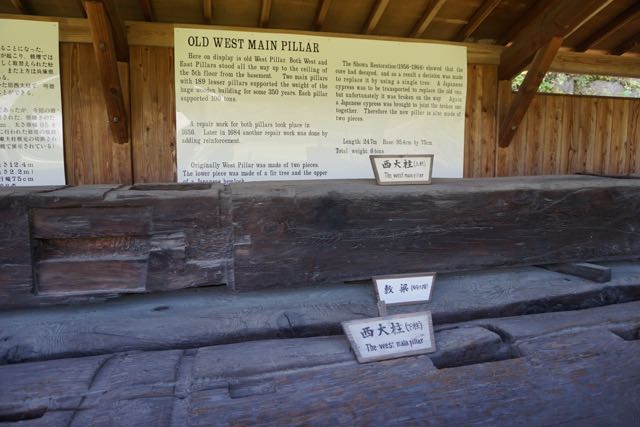
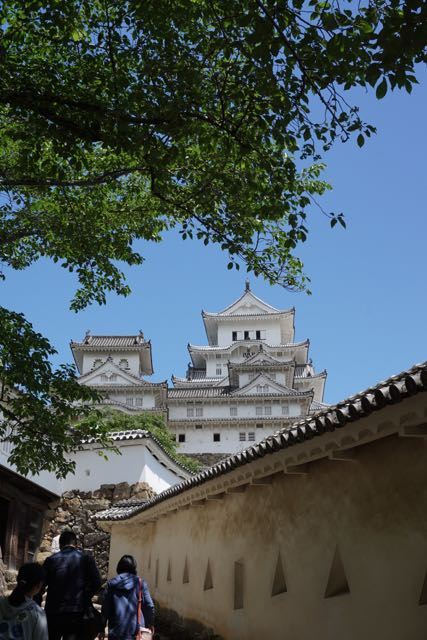
The distinctive feature of Himeji Castle is its white walls and roofs, which gives the castle a very pure look. The main keep of Himeji Castle has 7-storeys, comprising 6 floors above ground and 1 basement floor. From the outside, the main keep of Himeji it appears as if the castle has only 5 storeys. Before we enter the main keep, there is a small building (which can be easily missed despite the signs around pointing to it) at the base of the castle displaying the original West Pillar which was replaced, due to the decaying core, after supporting Himeji Castle for 350 years.

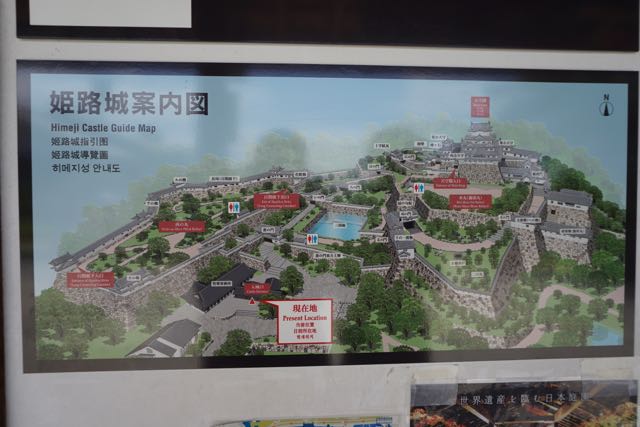
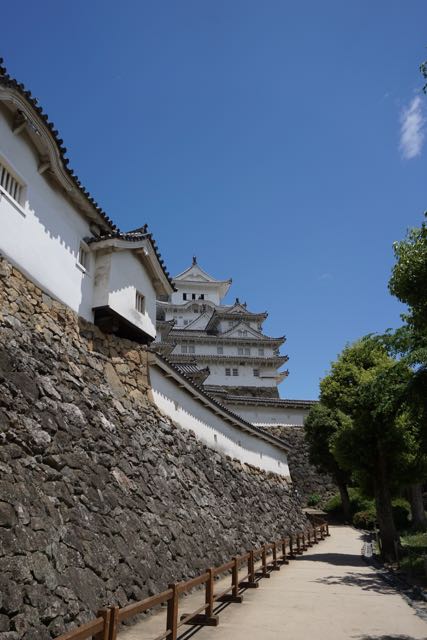
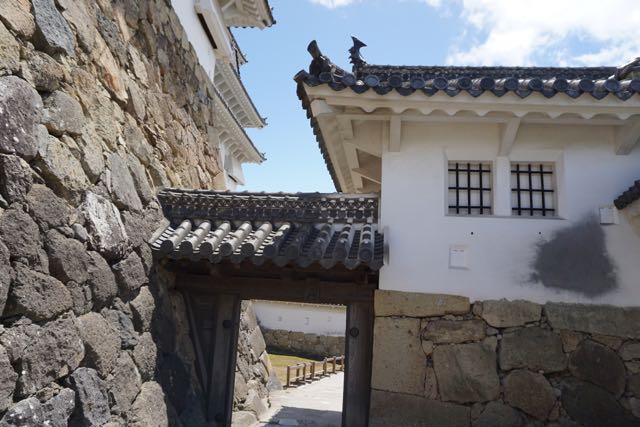
A little further up the hill from the building that displayed the West Main Pillar is the ticketing and entrance to Himeji Castle. Passing the ticketing entrance, we walked pass road that resembles a maze passing through another 7 doors before reaching the main keep. The pathway towards the main keep of Himeji Castle is a pleasant walk. The buildings here are all clad in white, forming a harmonious scheme with the main keep, yet not stealing the limelight from the main keep. I was able to spot the main keep sitting majestically at every twist and turns on the way to the main keep. The pathway to the main keep is designed to slow down intruders with tons of holes where defenders of Himeji Castle can shoot intruders from.

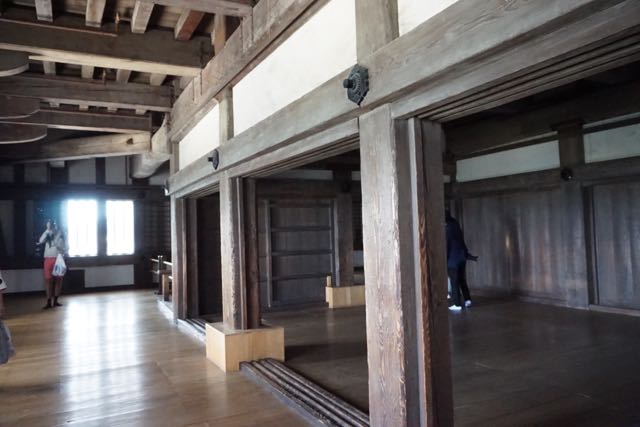
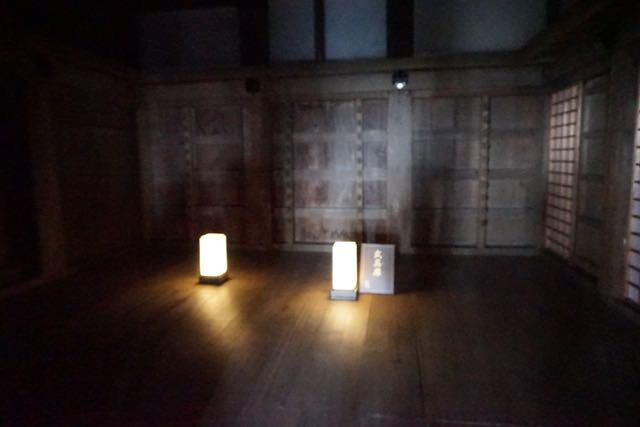
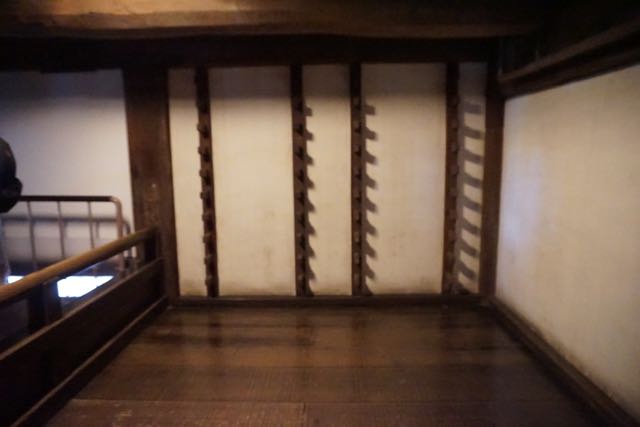
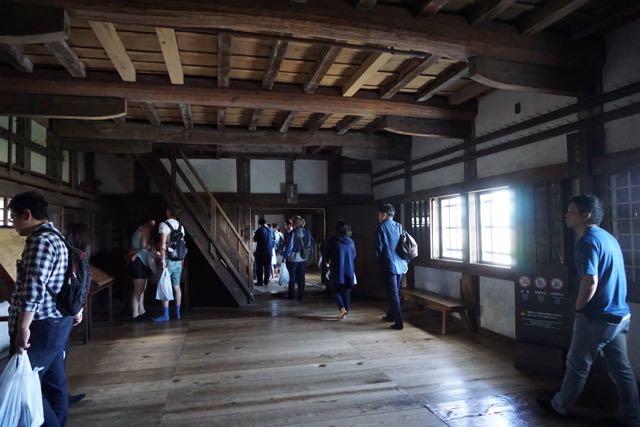
Soon we found ourselves at the entrance to the main keep. All visitors are required to remove their shoes before entering the main keep. I guess this is done for preservation purposes. There are designated pathways that visitors should follow while inside the main keep. Inside the main keep, I can see the entire Himeji Castle is made of wood. We passed by numerous empty rooms, which must have served as barracks or places where the soldiers of Himeji Castle stationed in even of attacks to the castle. Occasionally we spotted signs that attempt to explain what these rooms are used for. On the 2nd floor of the castle, I spotted some racks on some of the walls by the windows inside Himeji Castle, which served as storage for weapons for the faster reaction to attackers.

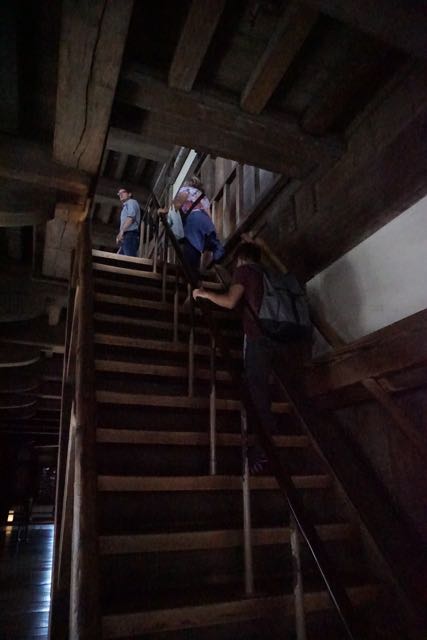
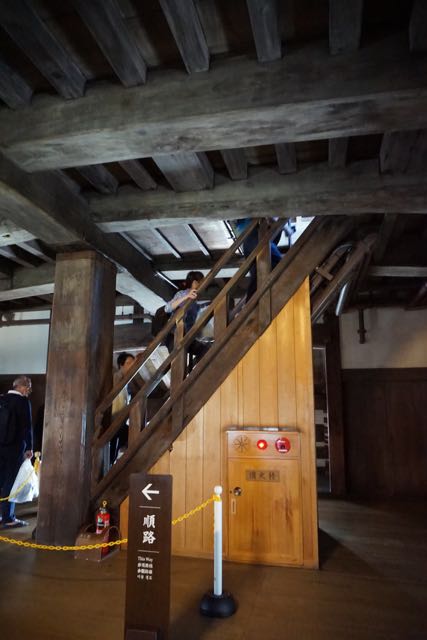
On the 3rd floor, I saw some trap doors spotted in corners of the main keep. These trap doors served as an ambush point to surprise invaders to the castle should they have made it this far into the castle. There are separate stairways that lead up to the top of Himeji Castle. These stairways get steeper and the headroom gets shorter as I climbed up the floors in Himeji Castle. The floor size of each floor seems to get smaller the higher I go up the castle.

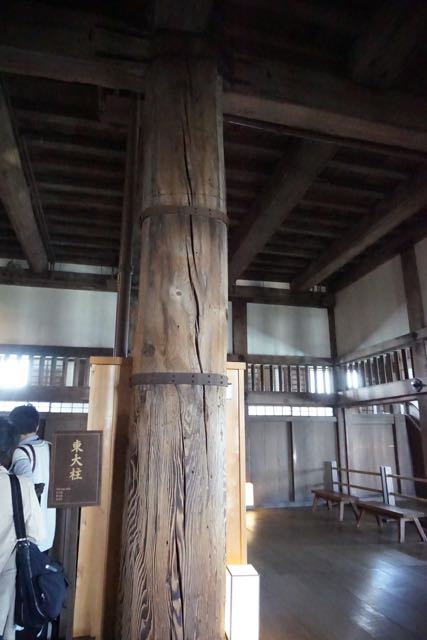
The East and West Pillars can be spotted on the 5th floor of Himeji Castle. These pillars are the backbone of Himeji Castle and supported the main keep from its basement some 6 floors down.

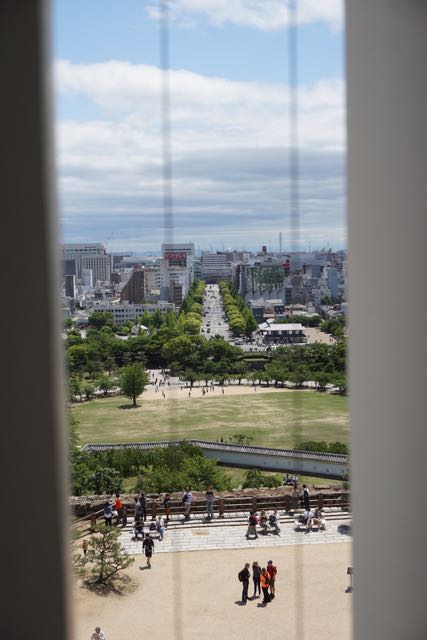
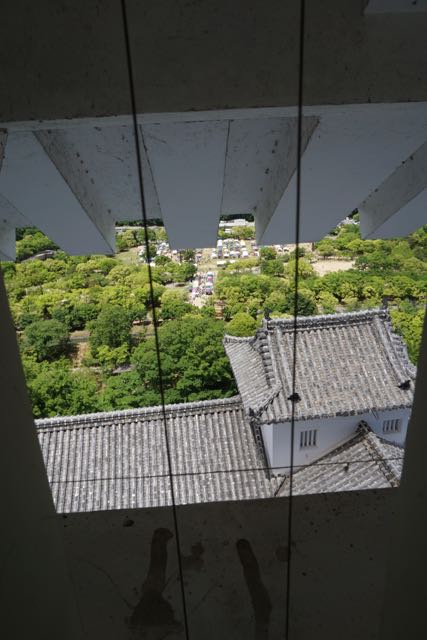
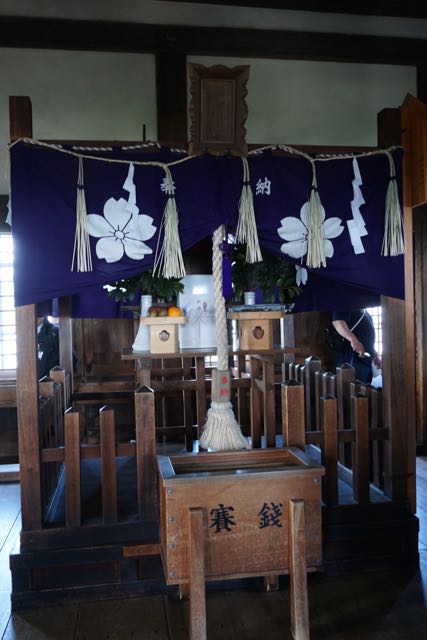
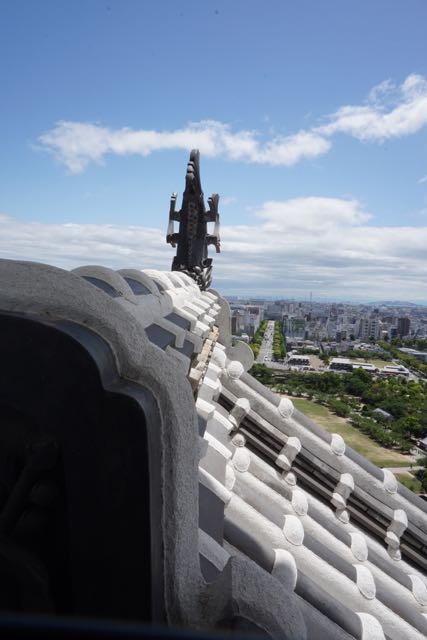
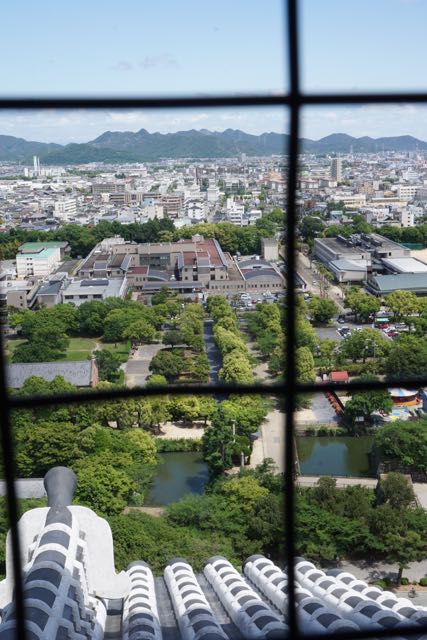
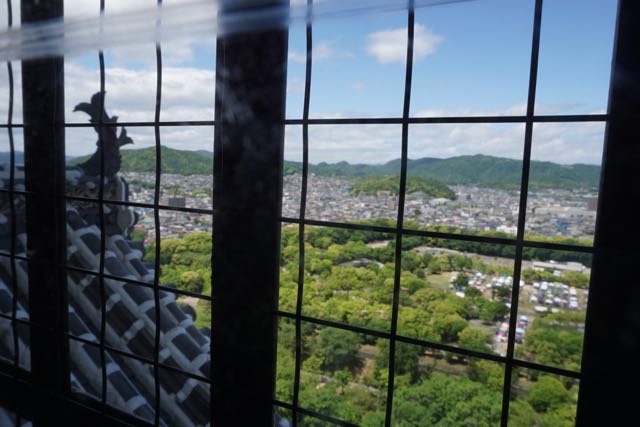
I climbed a small flight of staircase to the 6th floor of the main keep. There is a staff member stationed at the staircase welcoming visitors to the top floor of Himeji Castle. The 6th floor has a rather small floor space. There is a shrine located in the centre of the top floor in Himeji Castle. The Osakabe-jinja shrine seems to serve to protect visitors these days. The view from the top floor is stunning. I can see the entire Himeji City from the top floor of Himeji Castle Main Keep. Visitors stayed on the top floor the longest to take in the views of the city and to rest before walking down the steep staircase to exit the castle. My friend and I enjoyed the breeze and the scenery from the top floor of Himeji Castle.

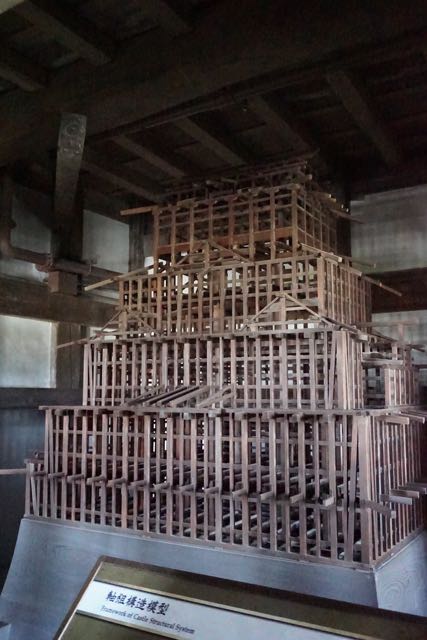
My friend and I climbed down 6 floors and exited the main keep. There are some exhibits in the rooms before the exit to Himeji Castle’s main keep, these exhibits explain the roofing and titles that were used in the construction of Himeji Castle. There is also a display on the structural framework of Himeji Castle.

The West Bailey (西の丸)

We found spots in front of the main keep that allows us to admire the grandeur of Himeji Castle. This is also a great spot to take pictures of the castle up close. As we were walking towards the exit of Himeji Castle, we spotted a sign that points to West Bailey. Since we are already here, we decided to follow the sign and check what is in this West Bailey.

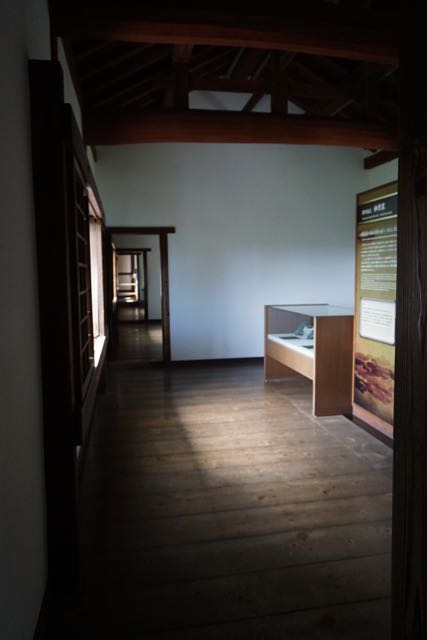
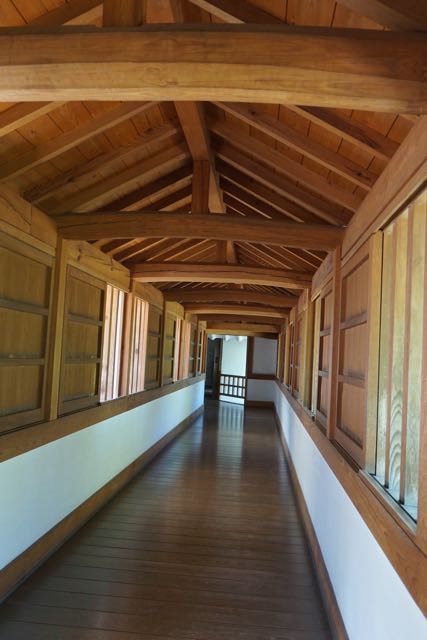
The West Bailey is a 2-storey building that seems to snake around the parameters of Himeji Castle. There are few visitors to the West Bailey, which makes it a great place to wind down from the hordes of visitors coming to see the castle. There are displays on the lords of Himeji Castle. The West Bailey is essentially a long corridor that served as sleeping quarters of the occupants of Himeji Castle. Some of these rooms are bigger than the others, we can only assume that the occupants of these bigger rooms must have been someone important. At the end of the corridor on the 2nd floor of the West Bailey, we spotted a large room with a female figurine in it. This is the figurine of Princess Sen. After walking through the corridors of West Bailey, my friend and I exited Himeji Castle grounds and headed to our next destination in Himeji.

The Backyard of Himeji – Mt Shosha (書寫山)

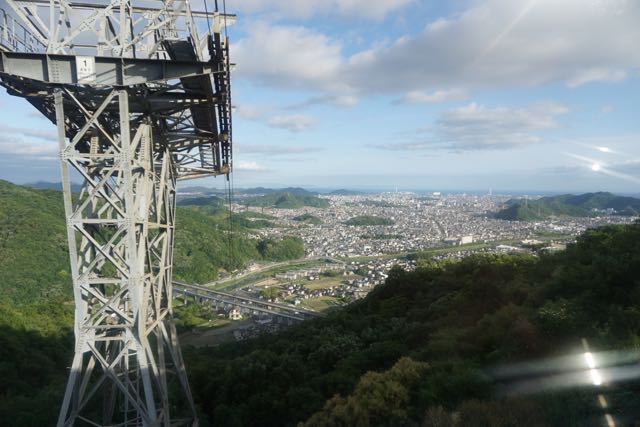
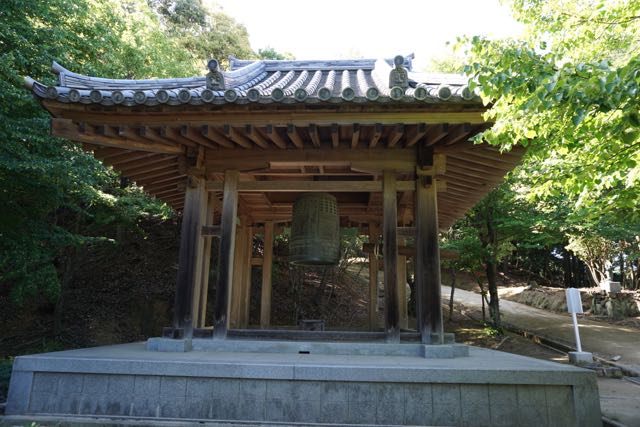
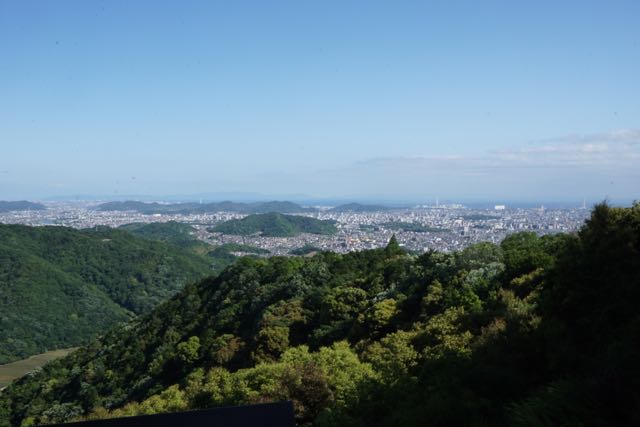
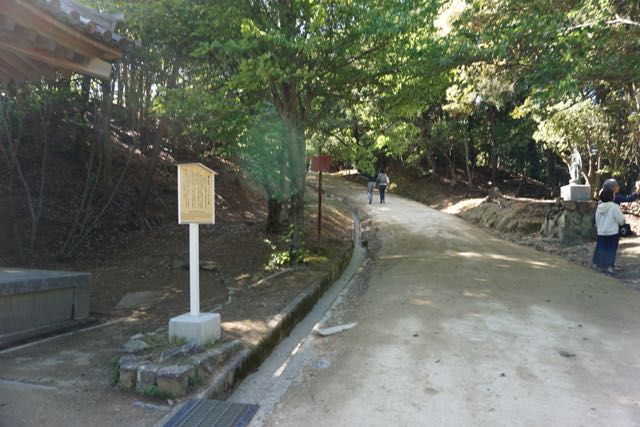
Mt Shosha is home to the ancient Engyoji Temple and is a mere 30 mins bus ride from Himeji Castle. To get to Mt Shosha, we took a bus from the bus stop in front of Himeji Castle to the end of the line. The Mt Shosha ropeway station is just behind the bus stop. We made it in time for the next gondola going up to Mt Shosha. The gondola up to the 371m Mt Shosha takes around 5 mins. As the gondola ascends the mountain, the view of Himeji city becomes apparent. At the top of Mt Shosha, we were greeted with crisp fresh mountain air. There are not many people at the time we visited Mt Shosha (let alone foreigners).  There is only one gravelled pathway that leads to the 1,000-year old temple. Statues of various Buddhas are placed along the sloppy (upwards) path towards Engyoji Temple. A short distance from the ropeway station, we came across a bell pavilion. As we were walking along the path,  we arrived at an open area where we are able to catch the sight of Himeji City below, thank goodness it was a clear day which allowed us to catch a glimpse of the city.

DSC08164

View of Himeji City from Mt Shosha

The Ancient Engyoji Temple (圓教寺)

Engyoji Temple was founded about 1,000 years ago in A.D.966 by a holy priest. The locals believed that one will get purified both in body and spirit when one climbed Mt Shosha. Engyoji Temple served as an important training centre for priests in the Himeji region. Engyoji Temple is made up of several buildings, some of which are constructed since the temple was around. Most of the buildings we see today are reconstructed.

Niomon (仁王門)

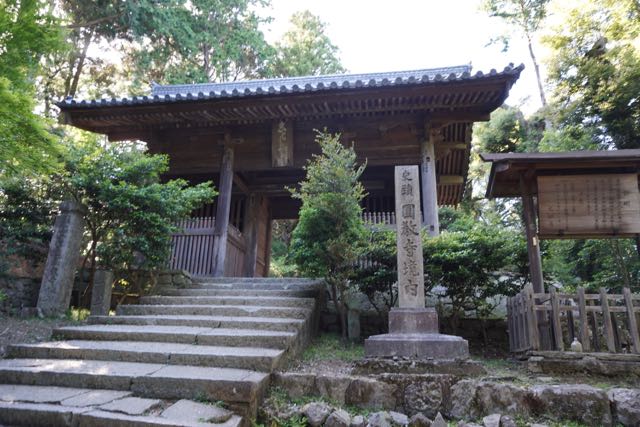
After walking for around 7 mins upslope, we arrived at Niomon. This wooden gate serves as the main entrance to Engyoji Temple. The gate, though simple, looks as if it has been survived through the years. This version of Niomon has been reconstructed and stood to serve as the entrance to the Engyoji Temple since 1665. The area after Niomon is considered sacred. There are a few buildings that seem to serve as living quarters in Engyoji Temple as we were walking towards the first ancient temple building. The peace and tranquillity, as well as the absence of hordes of tourists, made walking on Mt Shosha very pleasant.

Maniden (摩尼殿)

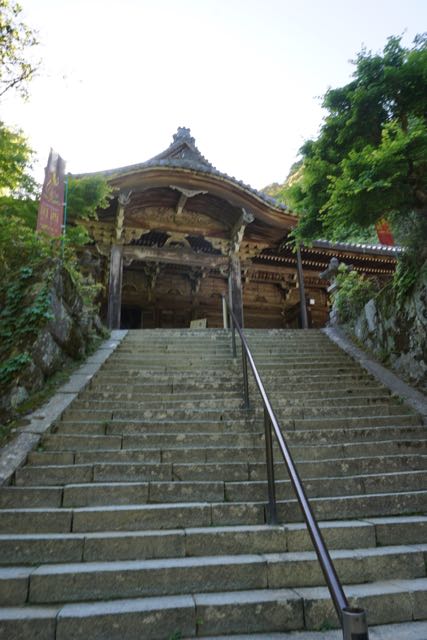
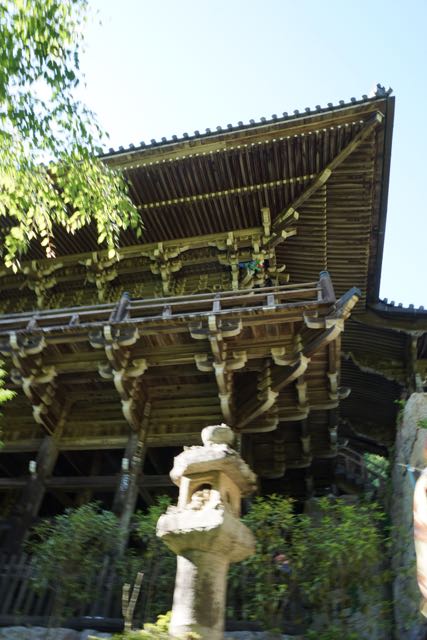
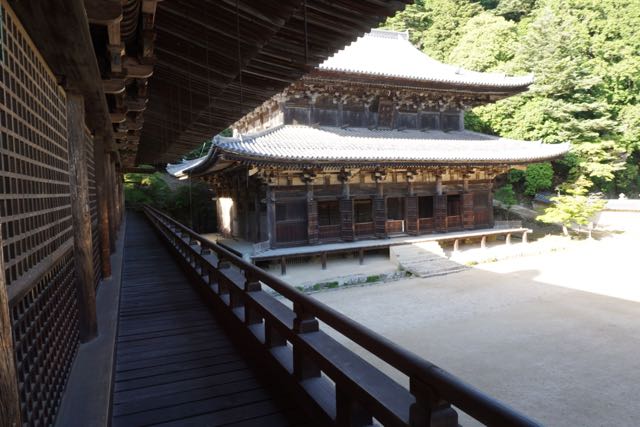
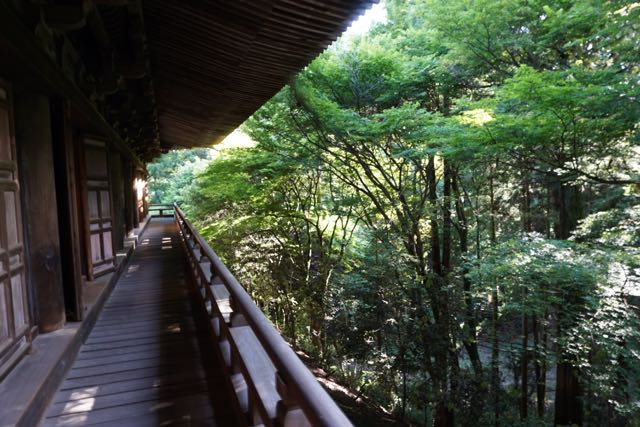
Another 5 mins walk later we arrived at one of the ancient Temples in Engyoji. The Maniden was first built in A.D970, dedicated to the Goddess of Mercy. However, Maniden was burnt down in 1921, the present building was completed in 1932 and stood strong since then. The entire building is made of wood, on top of a hilly part of Mt Shosha. A staircase leads to the entrance of Maniden. From the bottom of the staircase, I can see part of Maniden is being built into the soil of the hill, and part of the temple protrudes out into the air, supported by numerous thick pillars which looks as though it has been there for ages. Once at the top of the staircase, Maniden comes into full view. The entire Maniden is made of wood that seems to stand the test of time. I did not see any nails or any metallic pieces that were used in the construction of this magnificent temple building. Despite not clad in bright colours and still reminding in its wooden finish colour, Maniden still looks magnificent owing to the intricate carvings on the front of the temple. Maniden has a balcony-like structure outside the prayer halls, handing over the cliff side of the hill it is built on. After my friend and I paid respects to the Goddess of Mercy installed in Maniden, we wandered around the parameters of Maniden on the balcony. Perhaps due to the low in human traffic, looking out into the greenery spring forest of Mt Shosha gives me a sense of tranquillity.  As Maniden was not too big, we continued the pathway and headed towards the next group of 3 temple buildings.

Mitsunodo Hall(三つの堂)

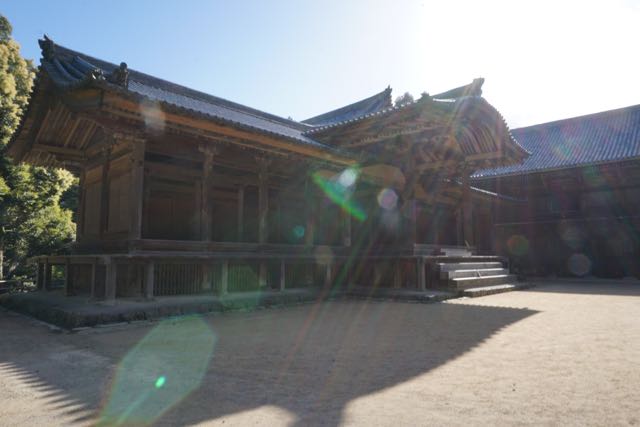
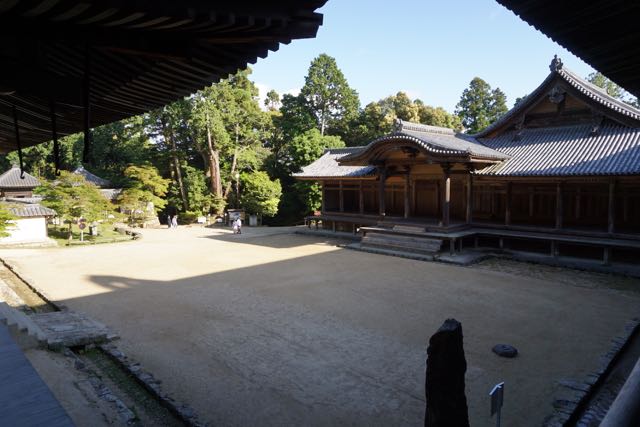
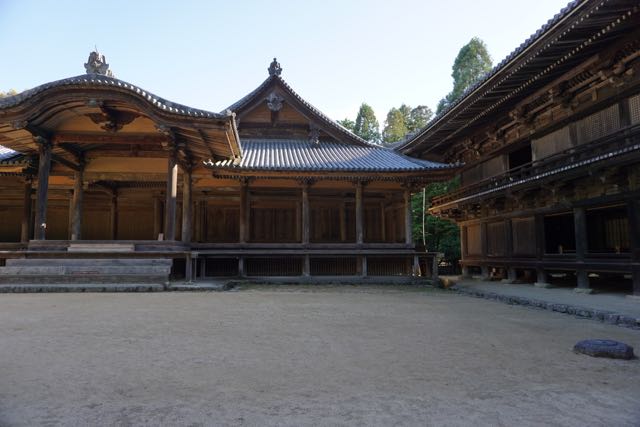
About another 5 mins walk from Maniden, we arrived at Mitsunodo Hall. Mitsunodo Hall is made up of 3 building complexes, namely the Main Hall (Daikodo (大講堂)), Dining Hall (Jikido(食堂)), and Training Hall (Jogyodo(常行堂)). From the entrance to Mistunodo Hall, a large square surrounded by the 3 temple buildings. This is also the filming grounds for Hollywood movie, The Last Samurai. The nearest to the entrance is Jogyodo, an elevated single storey elongated wooden building that has a section protruding out in the middle of the building. As with Maniden, Jogyodo is made entirely out of wood with no traces of nails used in its construction. Jogyodo served the function as a training that also doubles as a ceremonial hall. The exact date of the original Jogyodo was unknown, however, this hall was reconstructed in 1965. The simple Jogyodo has its doors closed at the time of our visit.

DSC08232

The Square at Mitsunodo Hall

Opposite Jogyodo is the Daikodo, which functions as a Main Hall. The original Daikodo was built in A.D986 and was reconstructed in 1956. Compared to Jogyodo, the architectural design of Daikodo is a tad more elaborate. The single storey, double roofed Daikodo also appears to be constructed entirely out of wood with no traces of nails being used. Peeking inside the Daikodo, I can see statues of Golden Buddhas being placed inside, however, we can only offer our prayers outside the Daikodo as the interior of the building was sealed up.

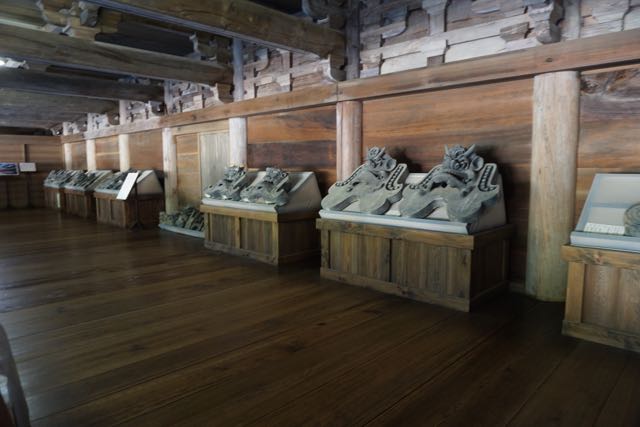
Connecting Daikodo and Jogyodo is the Dining Hall, known as Jikido. The 2 storey building has an open concept. This is the only building here that is opened to visitors. The original Jikido was built in 1174 and was dismantled and rebuilt in 1963. On the first floor of Jikido, a large section has some tables placed on it. This is a place where visitors can practise the art of zen through Japanese calligraphy. Behind the tables, a small section displays the roofing titles of the temples in Engyoji. The second storey of Jikido displays the artefacts of this temple, amongst it are some millennium old Buddha statues that were made out of wood. I like the balconies of Jikido on the 2nd level. The balconies stretch the entire length of the building. On one side, the square that the 3 temple buildings can be seen from a height, while on the other side, one can see the forest. I prefer the view of the forest as it brings peace.

As it was getting near the time when the Mt Shosha ropeway ceases operations, my friend and I did not explore the rest of Engyoji. We made our way back to the ropeway station and subsequently back to Himeji JR Station. We headed for Osaka to check into our accommodation for the rest of our stay in Kansai.

The Kitchen of Japan – Dotonbori (道頓堀) At Night

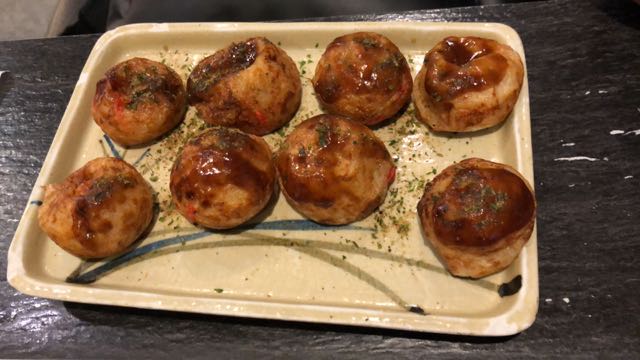
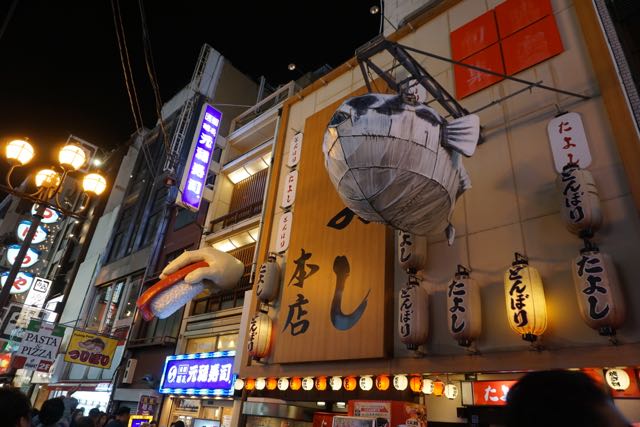
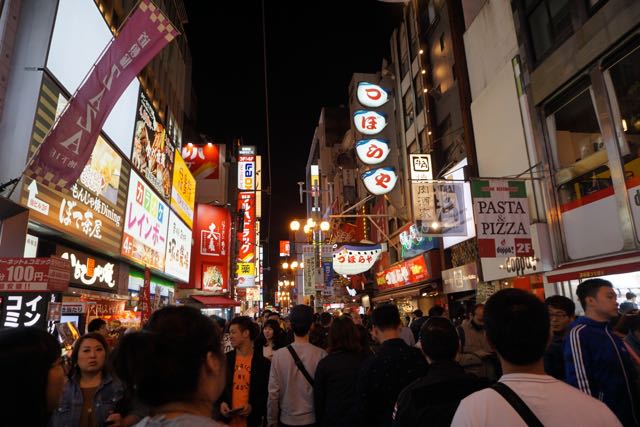
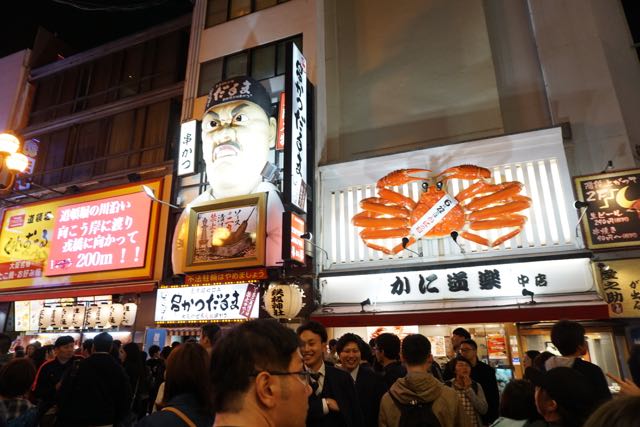
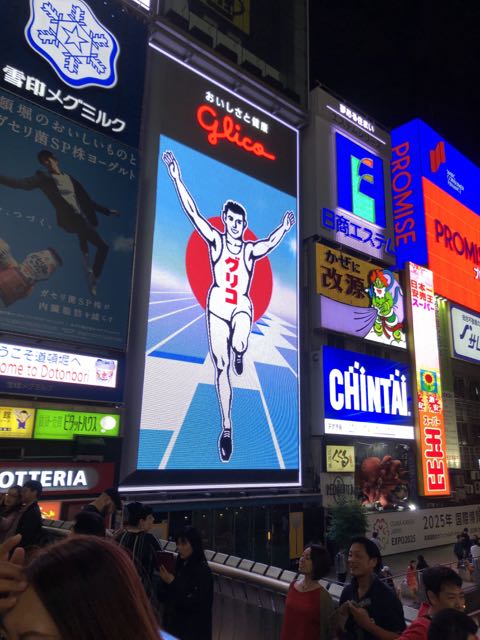
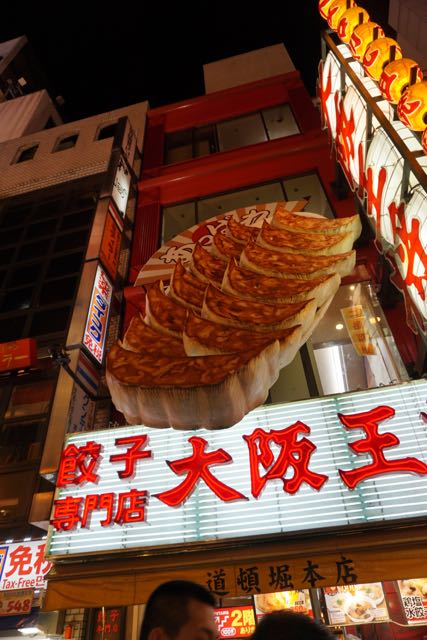
After settling into our accommodation, my friend and I headed to Dotonbori, the famous food street in Osaka. Dotonbori at night is a display of neon lightings and gigantic 3D signs that tell visitors what the shop sells. Dotonbori is very crowded despite late into the night. We strolled along the street and bought whatever street food we see. One of the must-try is the takoyaki balls, which is invented in Osaka. There are some medicine shops that still open late at night in Dotonbori. At one part of Dotonbori, a bridge that is always crowded with visitors especially at night. Visitors come to this bridge to take pictures with the icon of Osaka, the neon light display of the Glico running man. After some street food, my friend and I headed back to our accommodation to rest for the night as we have a 3-hour train ride the next day to our next destination – Amanohashidate.

IMG_8718

The Iconic Glico Man neon display in Dotonbori

Kansai (Kyoto/Osaka) Day 1 (18 May 18) – The Ancient Onsen Waters of Arima-onsen

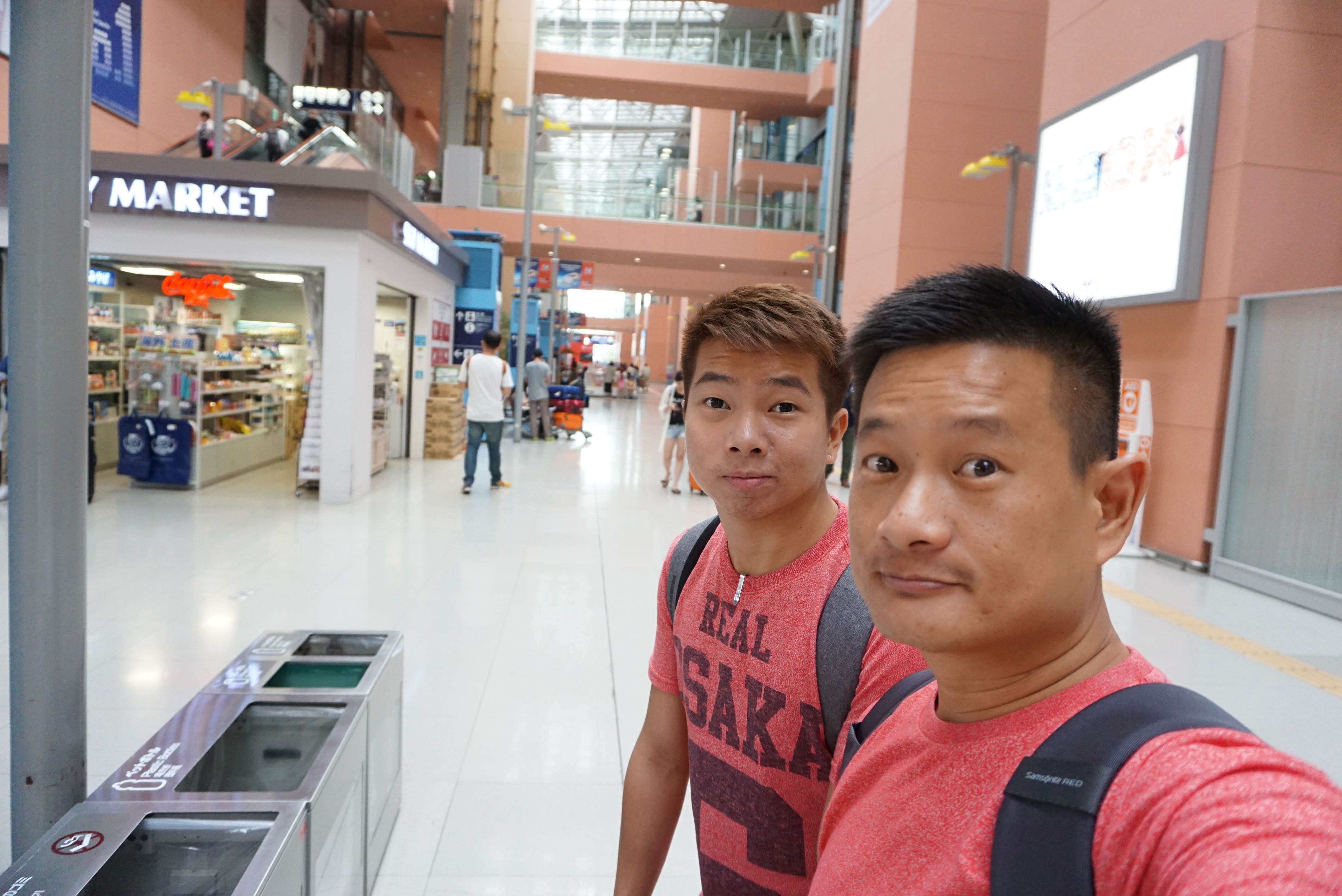
Arrival at Kansai International Airport

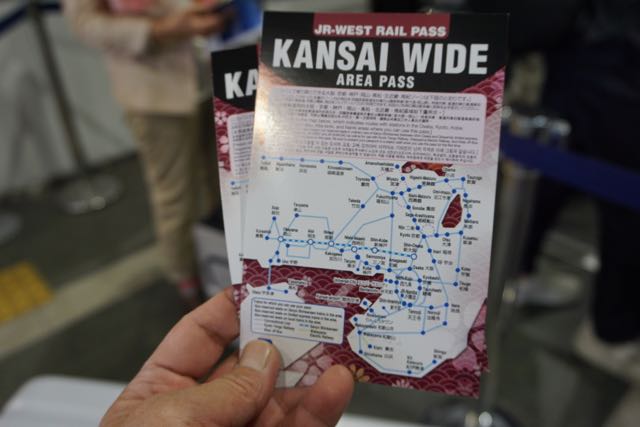
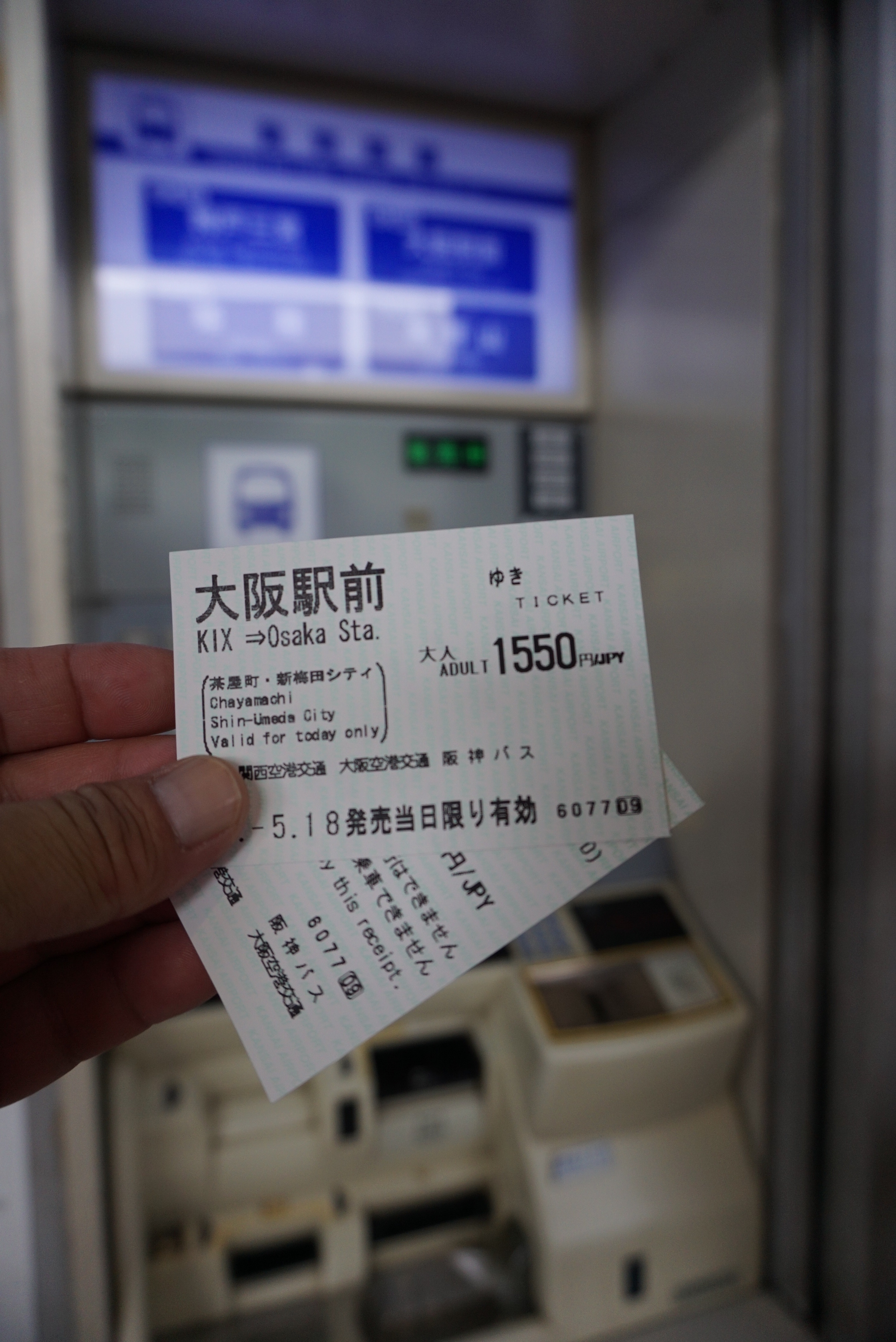
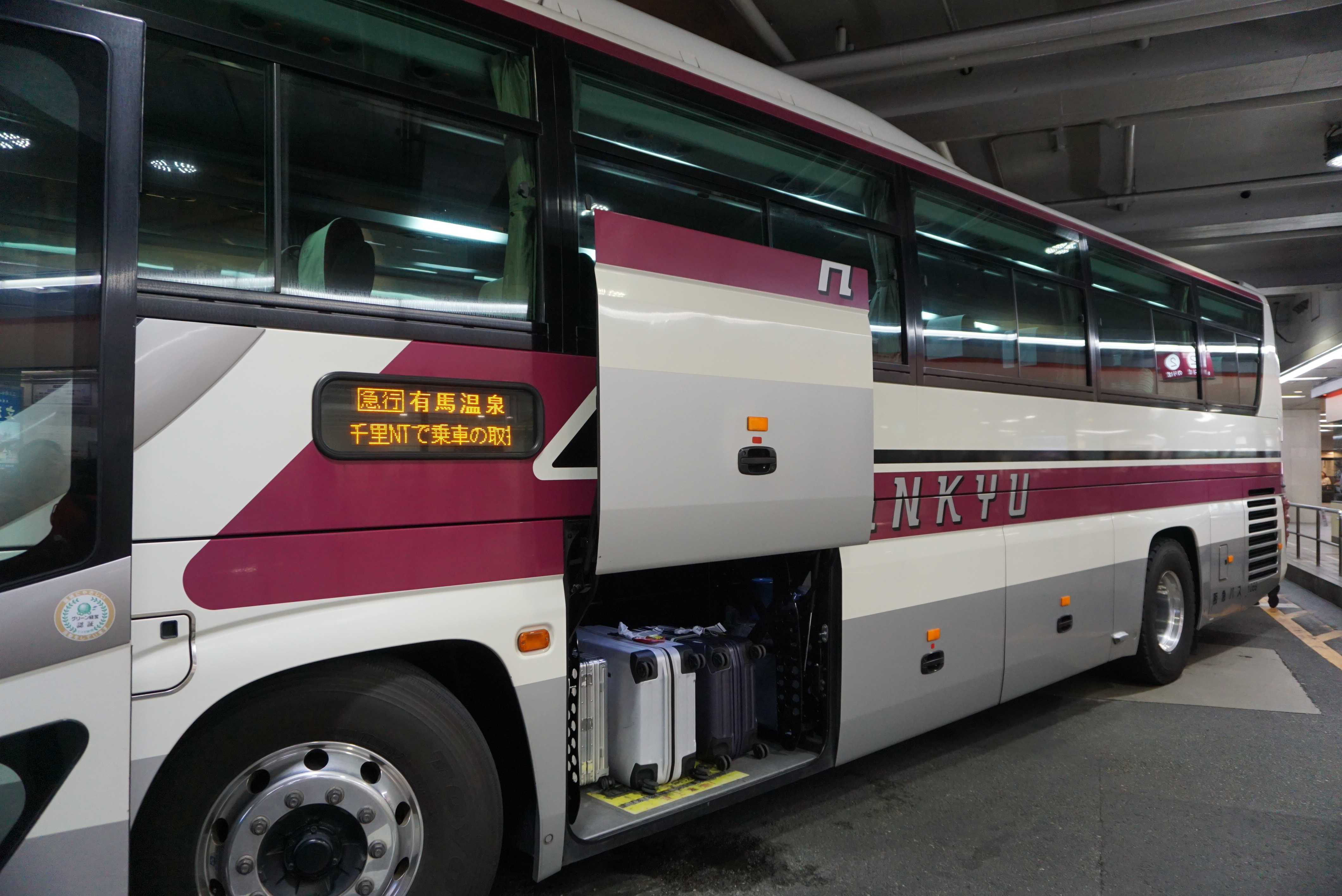
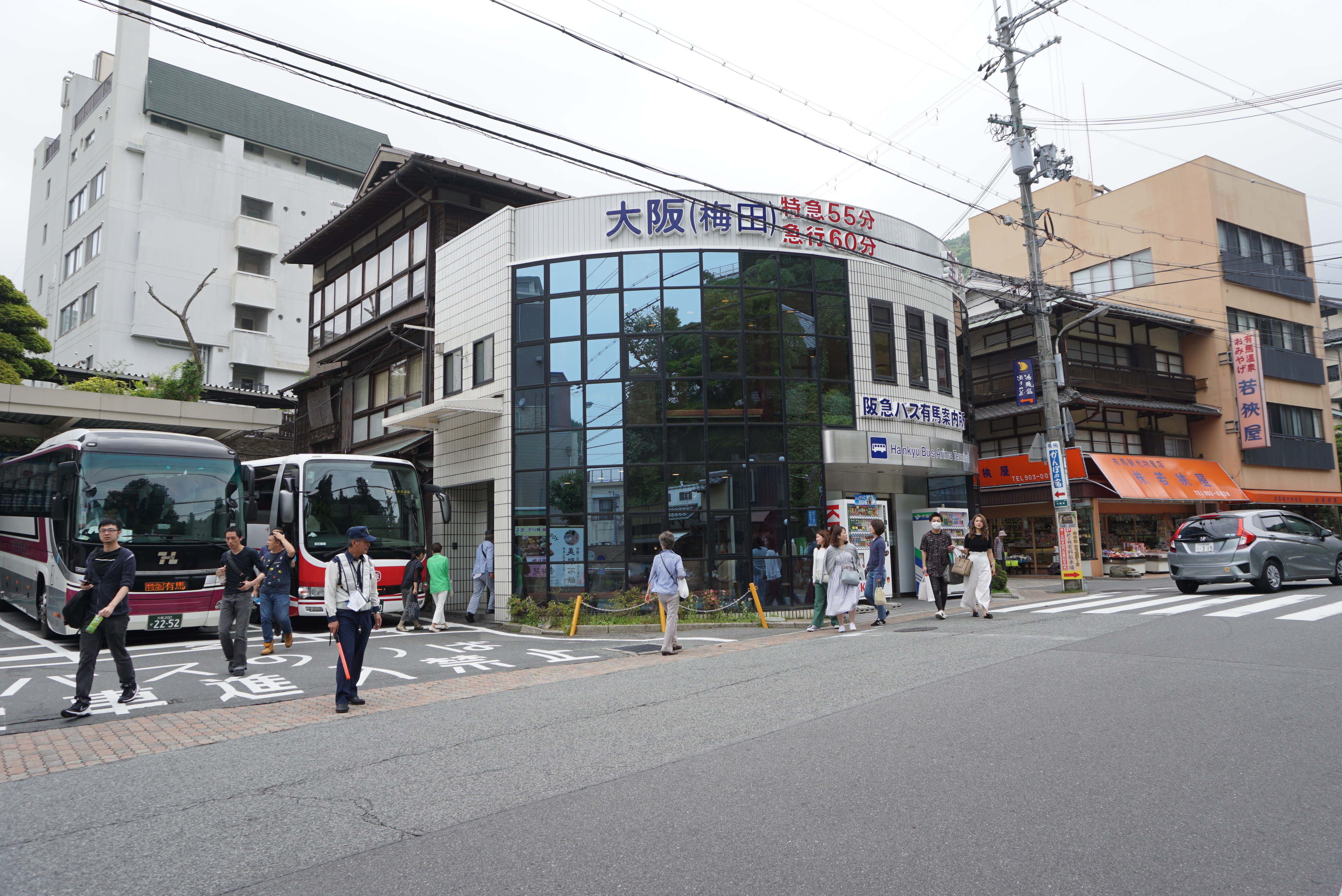
I have always wanted to visit Osaka and Kyoto in Japan due to the rich in historic buildings. After a few years later, I finally made a trip to Osaka and Kyoto located in Kansai of Japan. As I was planning this trip, I found there are more places to visit in Kansai other than the traditional Osaka and Kyoto. During this trip, my friend and I visited some places that are visited by a few foreign visitors. After our red-eye flight connected via Bangkok, my friend and I finally landed at Kansai International Airport. We had previously pre-booked our JR Kansai Wide Pass, 2-day Kansai Thru pass and 2-day Osaka Amazing pass, which provides excellent value for money on the transportation for the next 8 days around Kansai. We waited for the counter to open and collected our passes before heading outside the airport terminal to get our bus tickets to our first stop of the trip – Arima-onsen. There are several ways to get to Arima-onsen from Kansai Airport. We could take a train and transfer at Osaka, then 2 more times in Kobe; or take a bus and transfer either in Kobe or Osaka. The time taken for all 3 options is about the same. We opted to transfer at Osaka as this would minimise the number of transfers required as well as maximise our rest time onboard. It took us around 2 hours to get from Kansai Airport to Arima-onsen.
Screen Shot 2018-05-30 at 1.05.15 AM.png

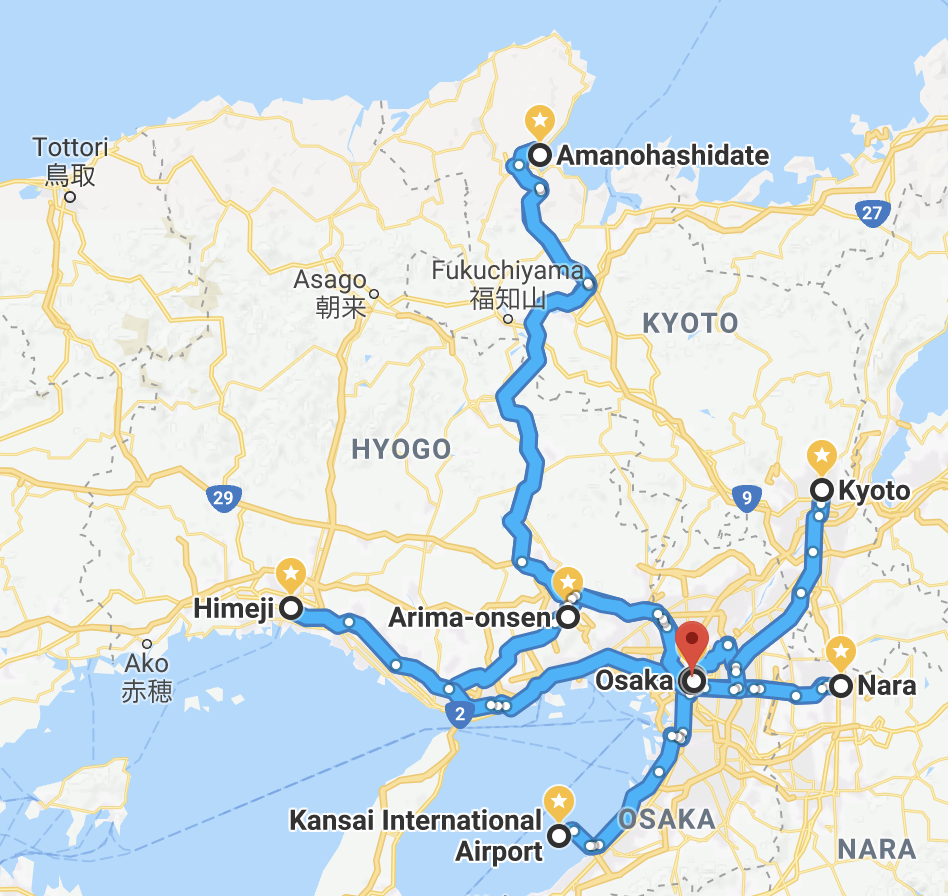
Using Osaka as a base, we explored parts of Kansai during this trip
Arima-Onsen (有馬溫泉)

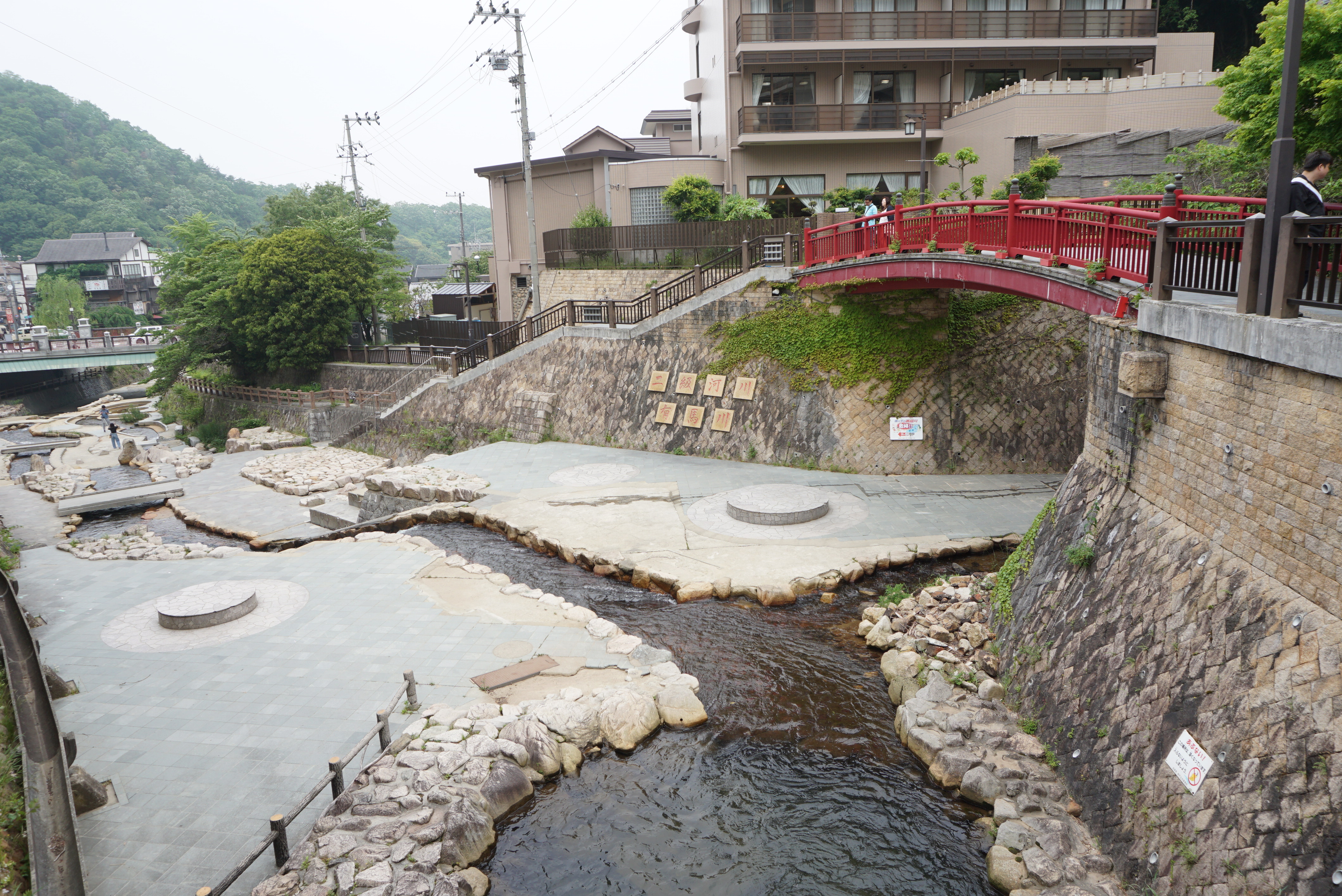
When I was planning this Kansai trip, I wanted to incorporate a stay in an onsen hotel. Trips to Japan is incomplete without a trip to their onsens. As I was looking around in the Kansai region, several options came up. I opted for Arima-onsen as it was one of the oldest onsen towns in Japan, as well as it was visited mainly by locals. Arima-onsen is nested in the hills near the city of Kobe, with the earliest recorded of onsen experience dated back to 8th Century A.D. Unlike most onsens in Japan which are heated by volcanoes, the onsen waters in Arima-onsen is heated by the unique geology in the area and the source of the onsen water is from an ancient sea that made its way from 60km below the ground. Arima-onsen is famed for its Kinsen (Gold Spring) and Ginsen (Silver Spring). The Kinsen has a reddish-brown colour due to the iron and salt concentration. The Kinsen is said to stimulate the skin and temporarily treat symptoms of common skin and joint diseases. The Ginsen is clear onsen waters which contain traces of radium that is said to promote cell activation, relieve muscle fatigue and boost the immune system. We arrived at Arima-onsen slightly afternoon and were too early to check-in. We left our luggage in the onsen hotel and headed out to explore the town of Arima-onsen. The Arima-gawa river runs right in front of the hotel that we will be staying and is connected to by the signature red Nene bridge. Visitors can cross the Nene bridge to get down to the Arima River Shinsui Park, which essentially allows visitors to get up close to this river that runs through the time. In the interest of time, we decided to snap some pictures from the roadside instead.
DSC07738

Arrival at Arima-onsen

DSC07737

Arima-gawa River and Nene Bridge

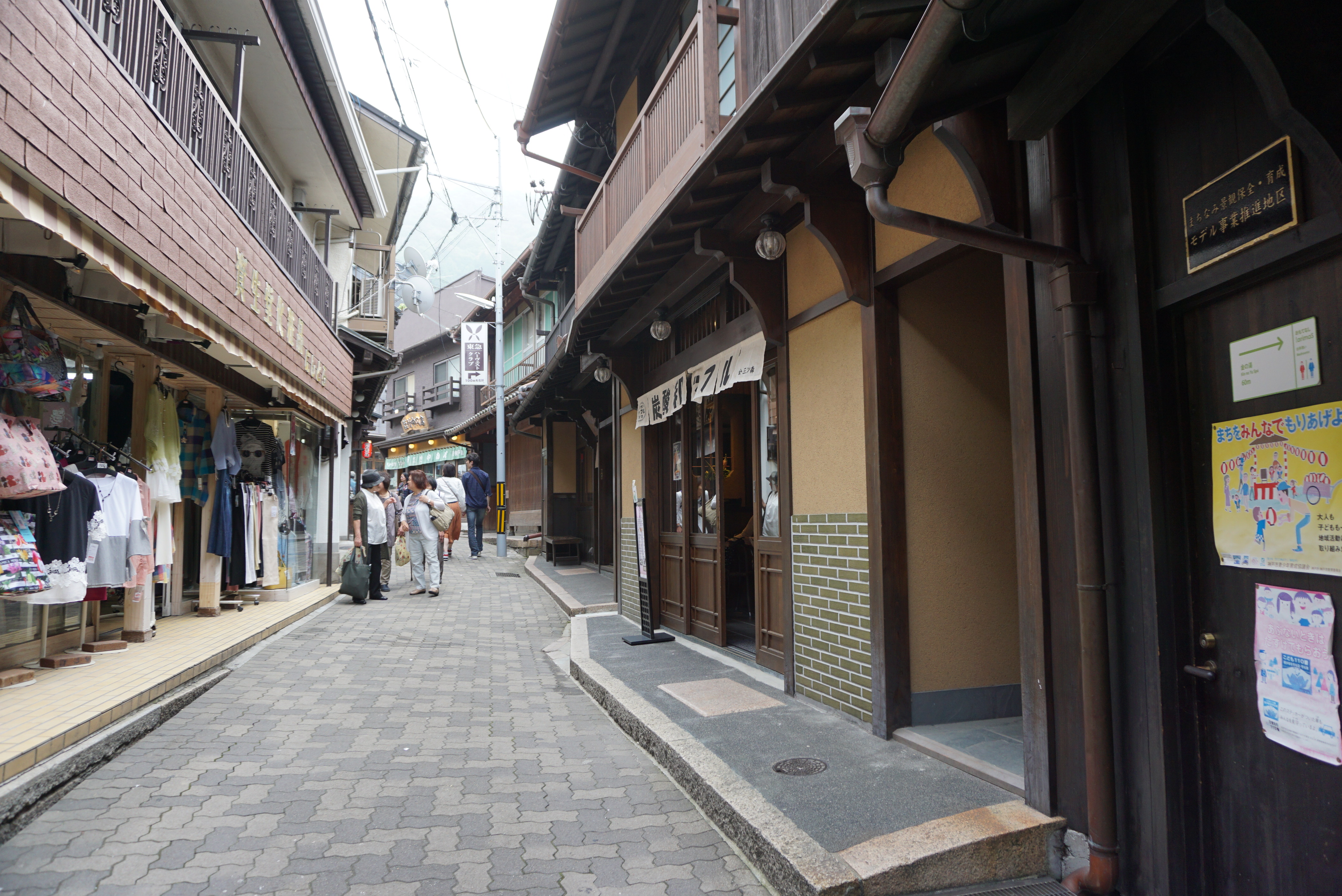
Strolling on the Streets of Arima-Onsen

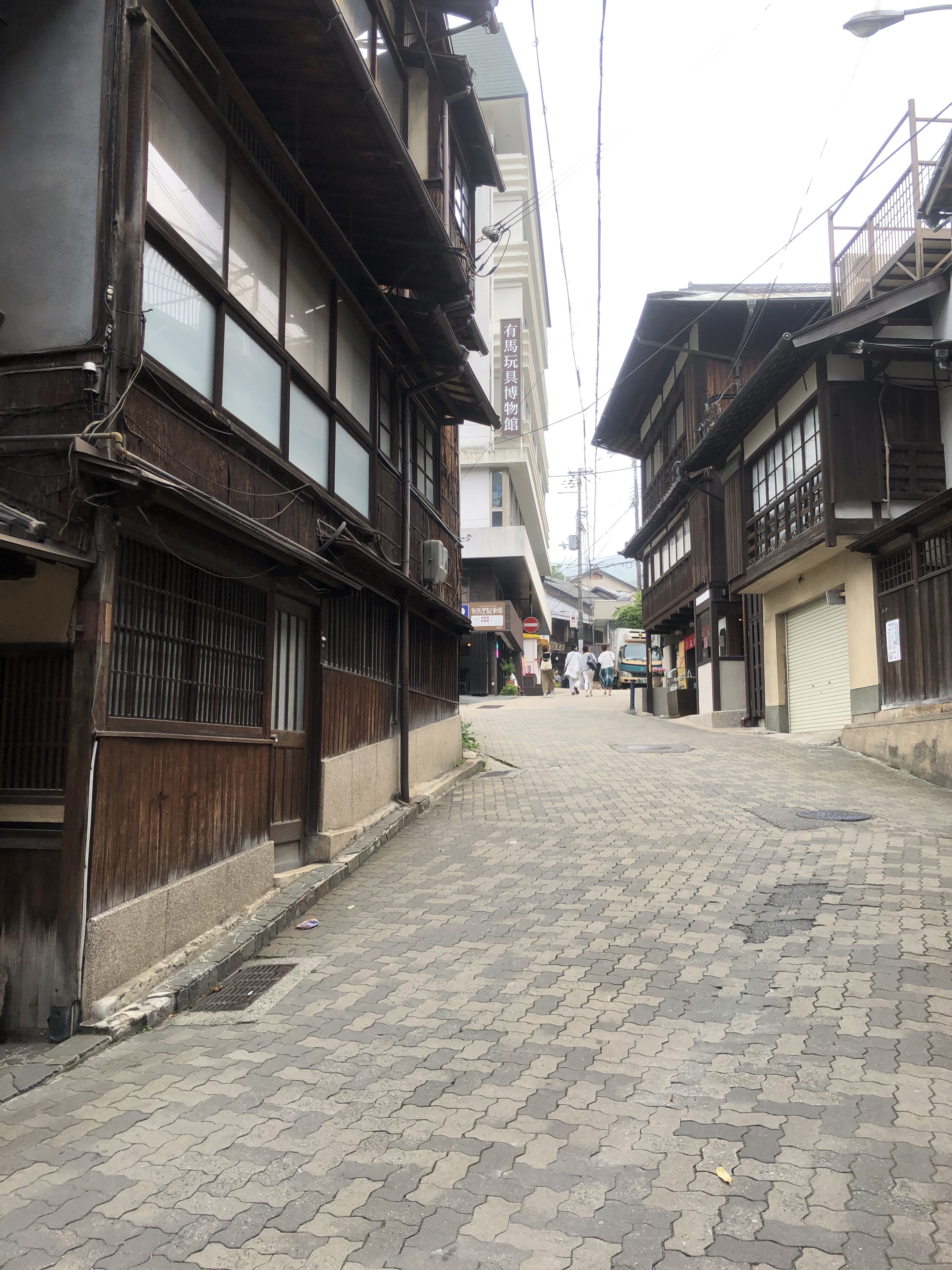
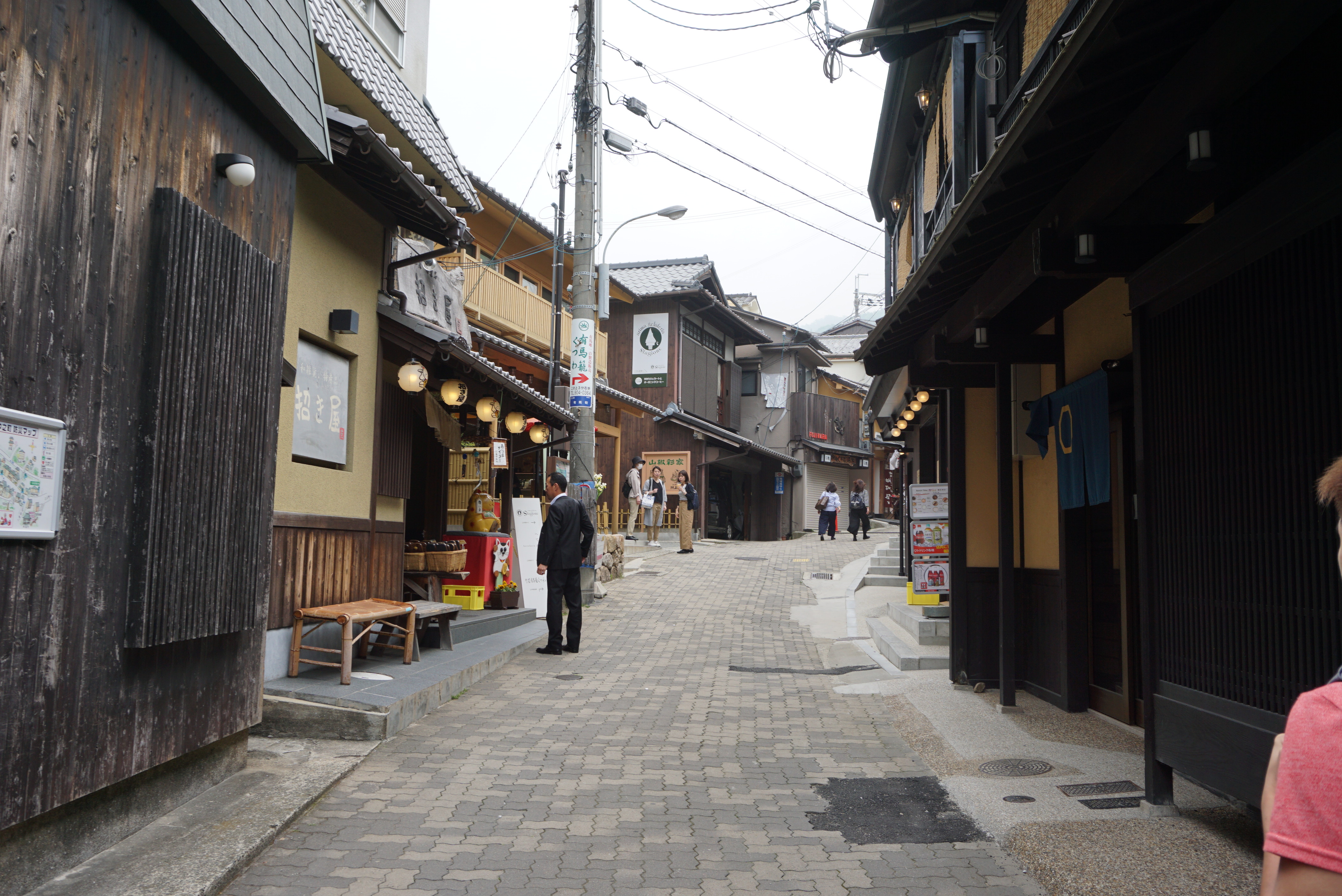
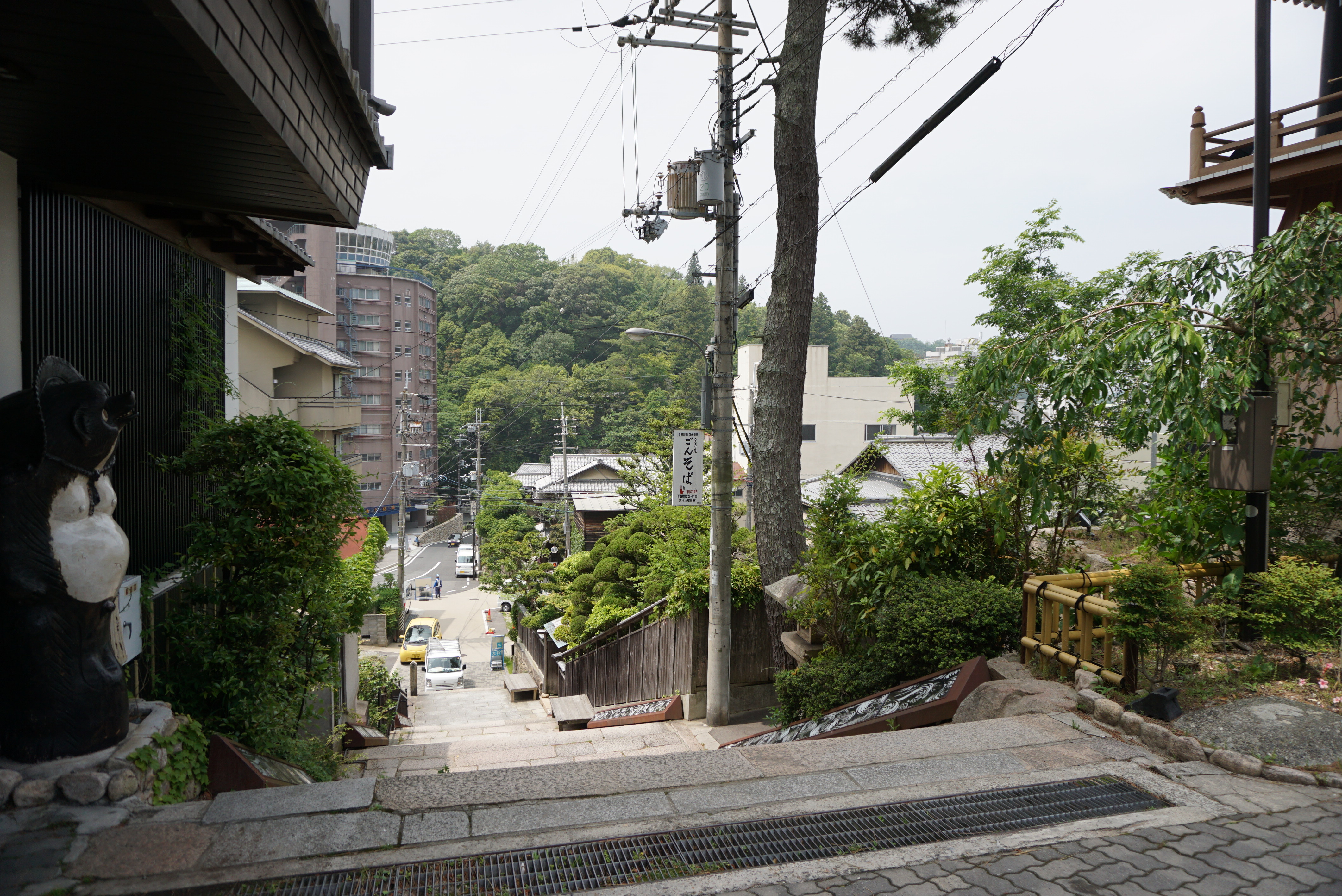
The entire Arima-onsen town is dotted with wooden low rise buildings that are not more than 2 storeys tall, eluding a sense of rustic charm.  This is our first experience with ancient Japanese structure. Walking through these rustic wooden building feels like we are walking into a part of Japanese history. Every building in every corner seems to be preserved since the day the town was built over 1,300 years ago. The town is relatively small, it took us around 30 mins to explore every corner of the town on foot. Most of the buildings in Arima-onsen town sells souvenirs and local street food, the most famous of the street food is the rice crackers which are available in most of the shops in Arima-onsen. Yet a handful of the shops around the town are restaurants. Right smack centre of Arima-onsen, we came across the Gin-no Yu spa, where day-trippers can come and enjoy Kinsen. There is a small stream of Ginsen beside the Gin-no Yu where visitors can soak their tired feet into the footbath. The moment we saw this Ginsen foot bath, my friend and I told ourselves that we will come back at night when it is not crowded.

The Source of Carbonated Water – Tansan Sengen Koen (碳酸泉源)

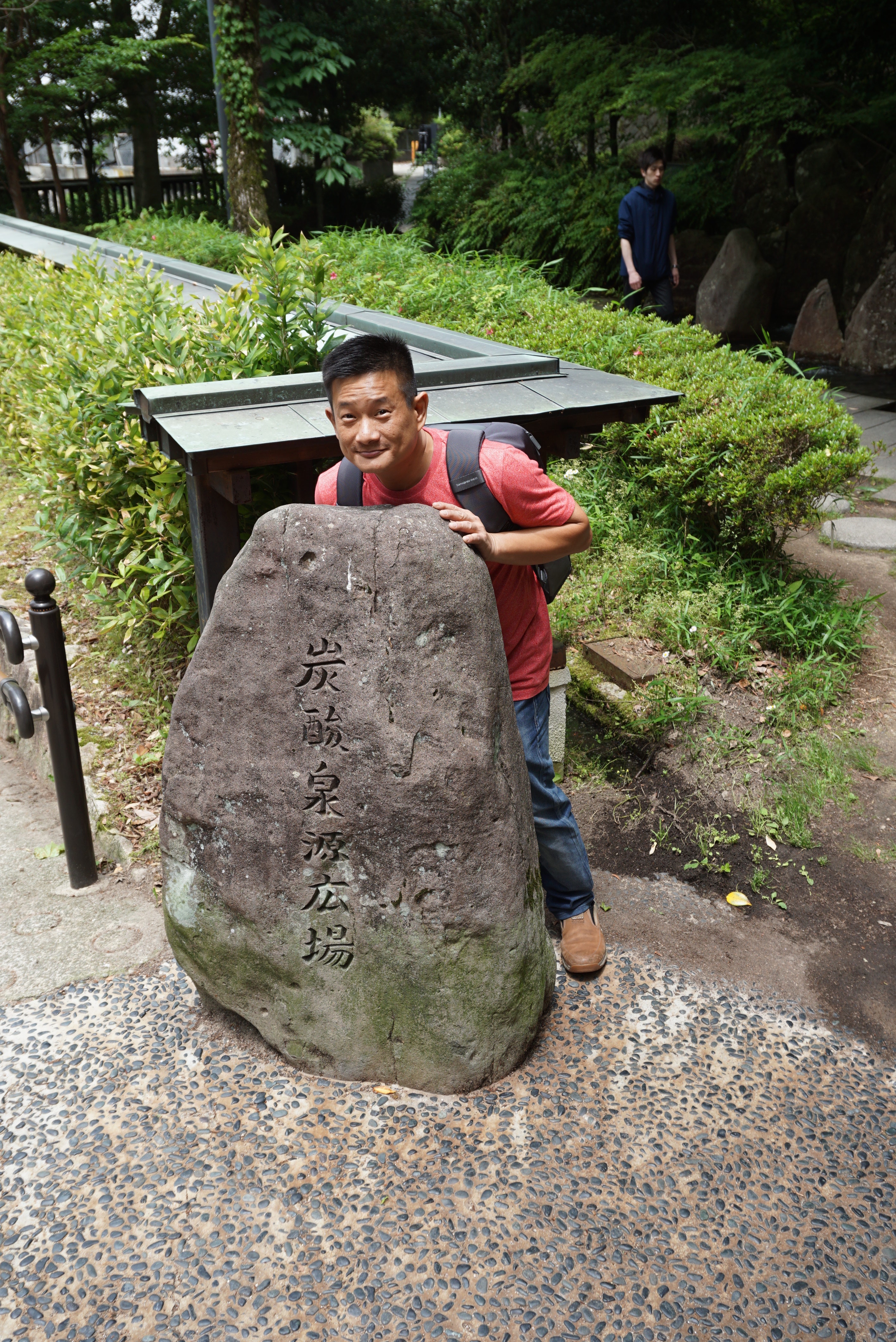
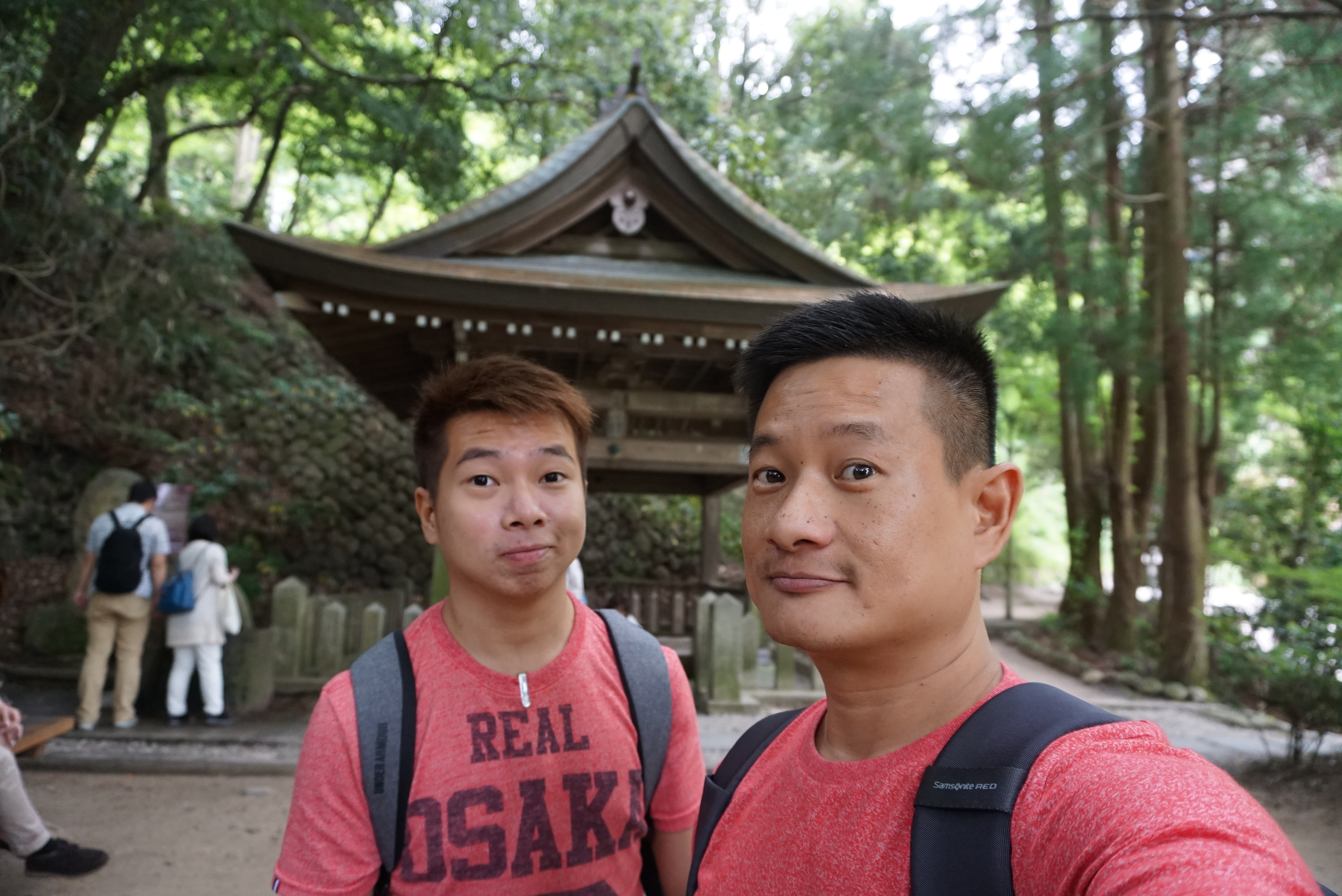
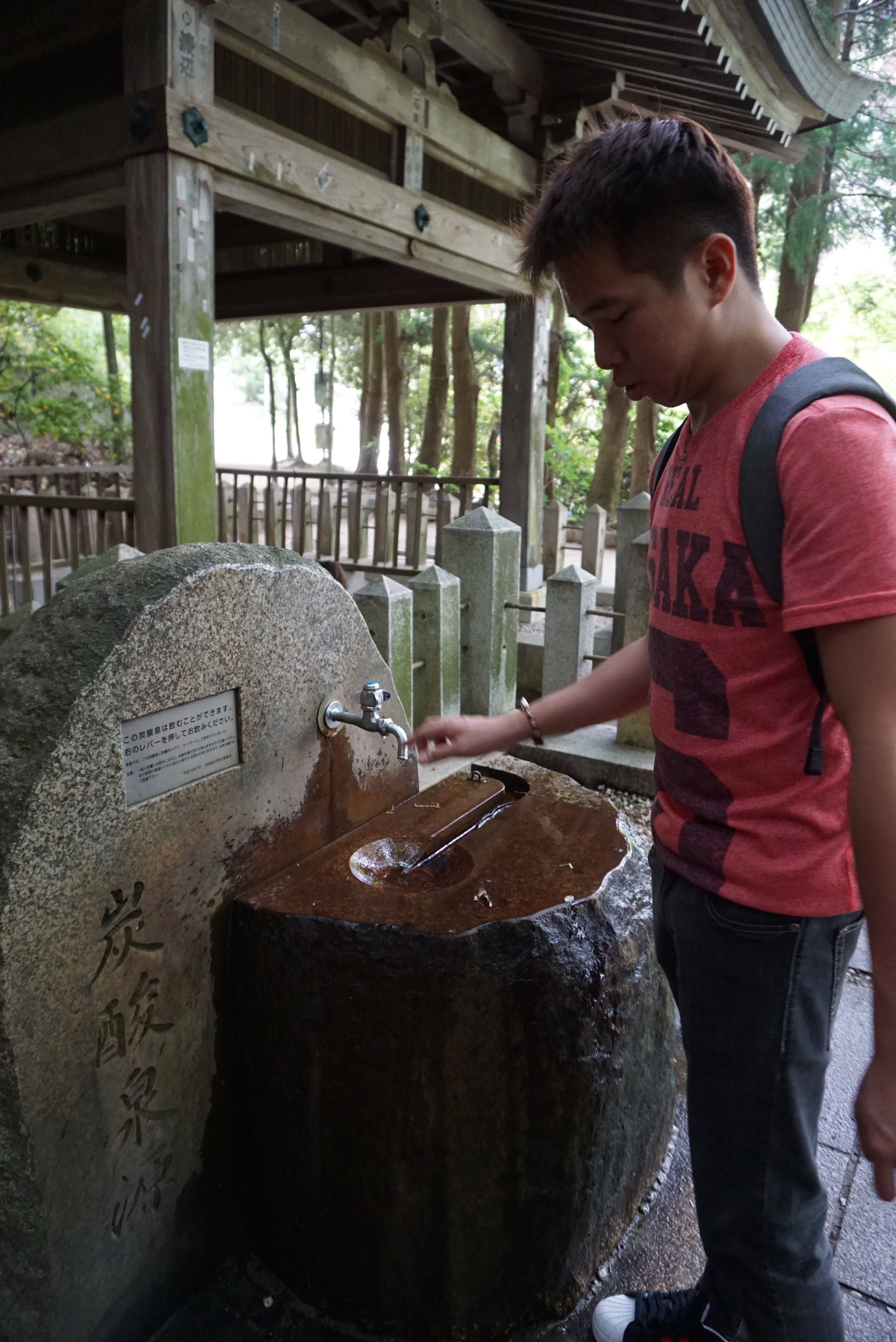
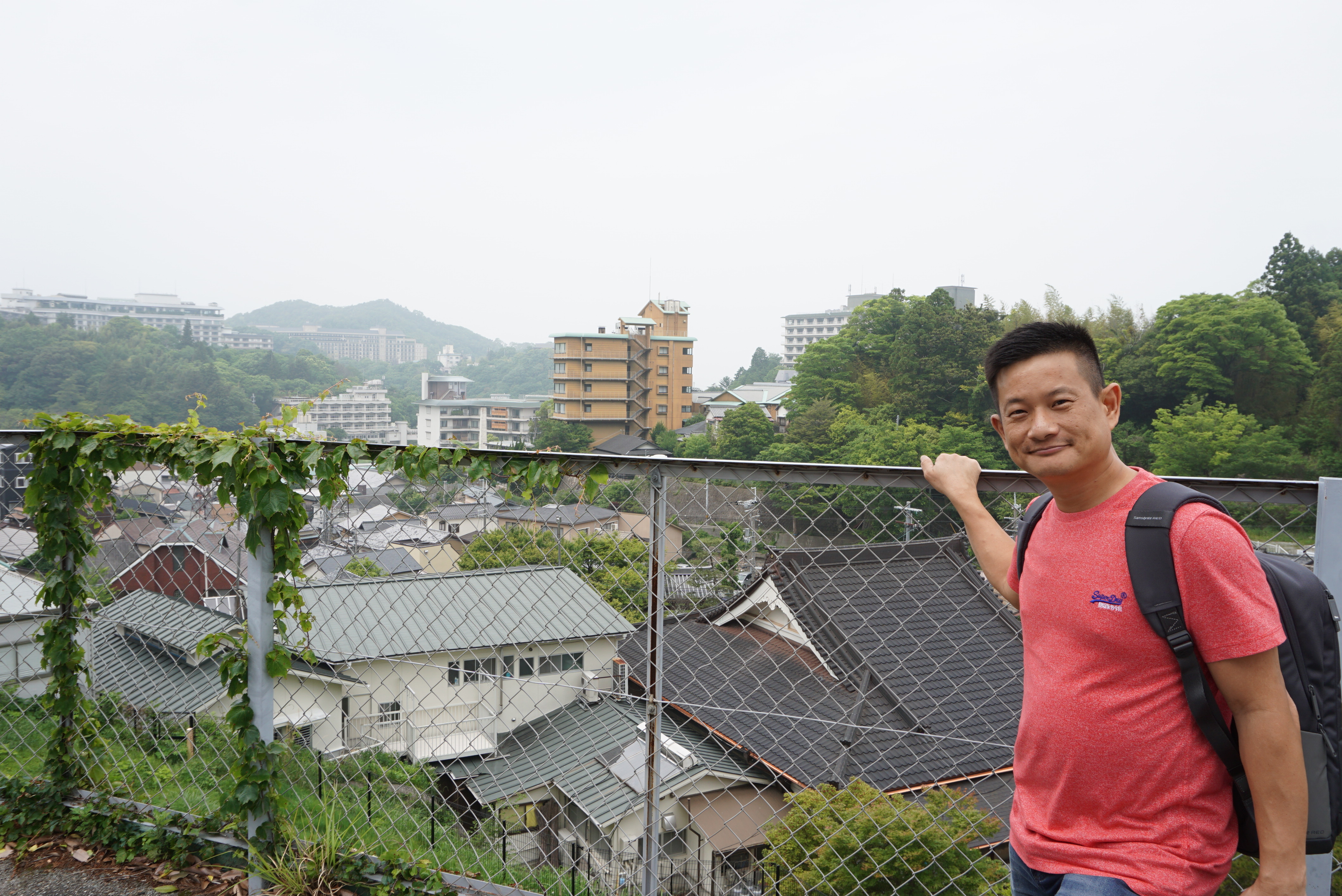
As we were walking through the Arima-onsen, little did we realised that we were walking up a small hill. This hill is Tansan Hill. At the mid-point of the slope, we came upon an ancient-looking wooden pavilion. Upon closer examination, we realised we are at Tansan Sengen Koen. The park is relatively small, with the wooden pavilion as the centre of this attraction. The Tansan Sengen Koen is the source of carbonated water. In the centre of the pavilion is a well, which looked like it was filled with dirty stagnant water. At the side of the Tansan Sengen pavilion is a tap where one can drink the naturally carbonated water from. Not far from Tansan Sengen Koen Park, we discovered a viewpoint (which essentially is a car park) where we can see the whole of Arima-onsen town.

DSC07774

Me with the view of Arima-onsen

The Temple of Onsens – Onsenji Temple (溫泉寺)

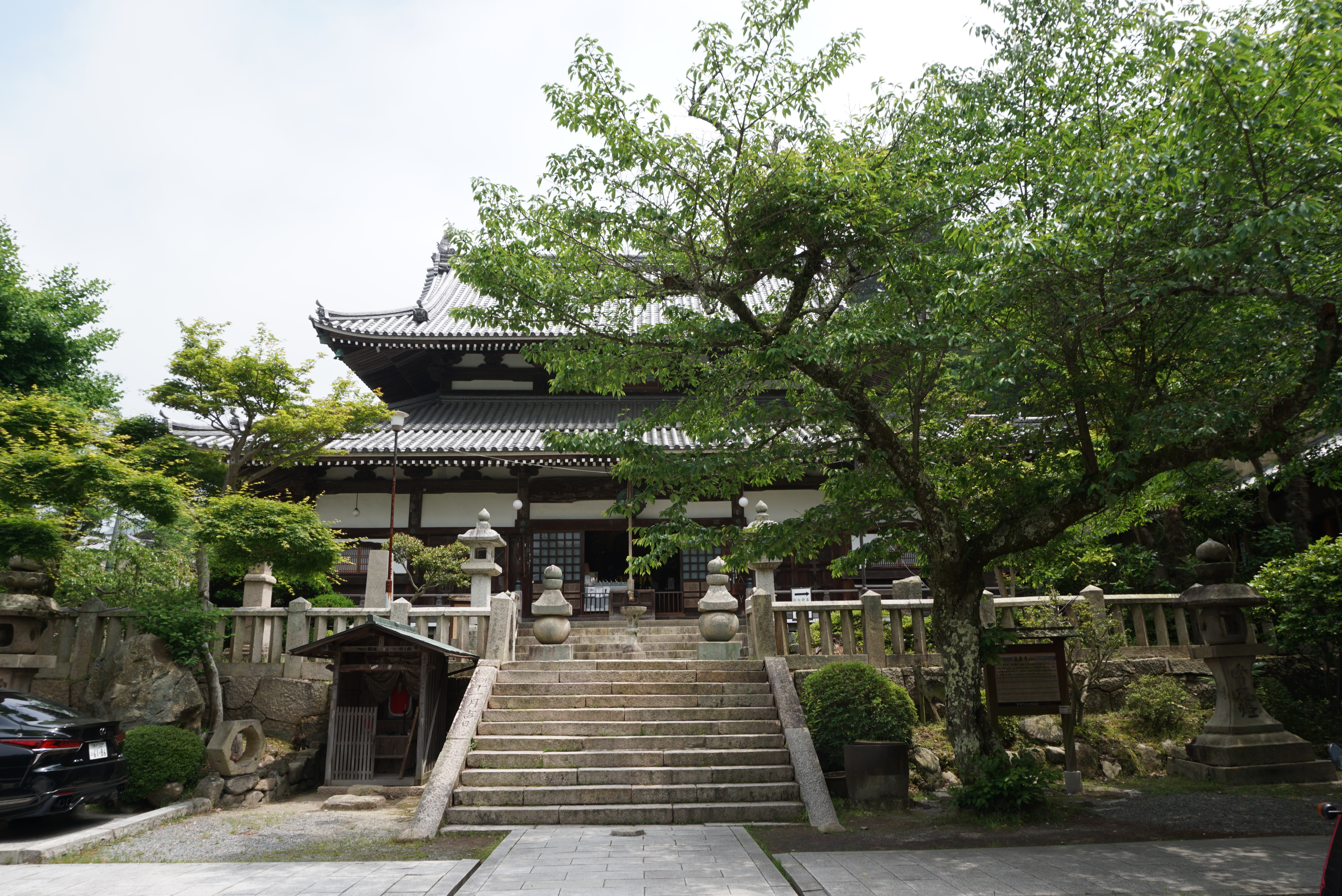
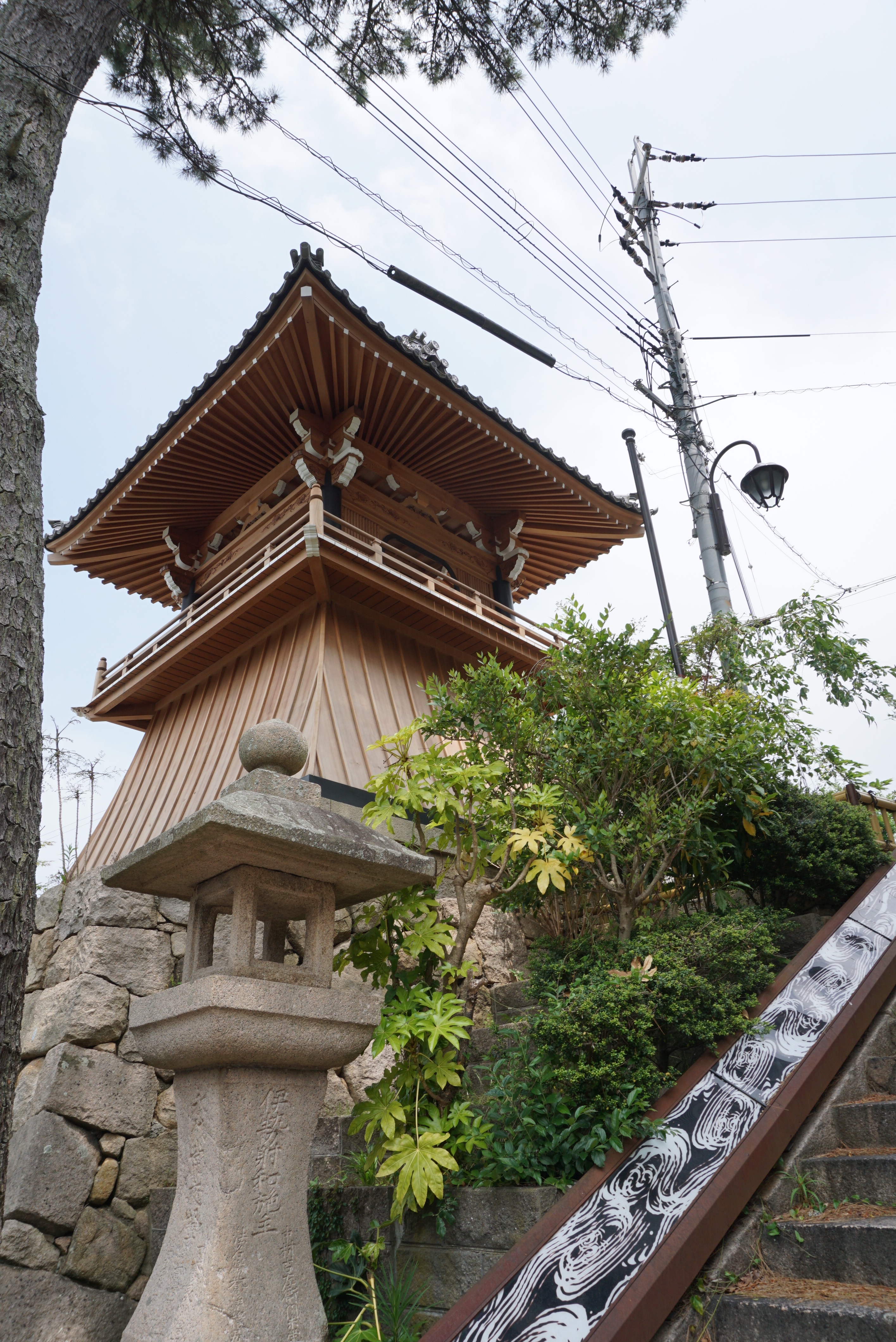
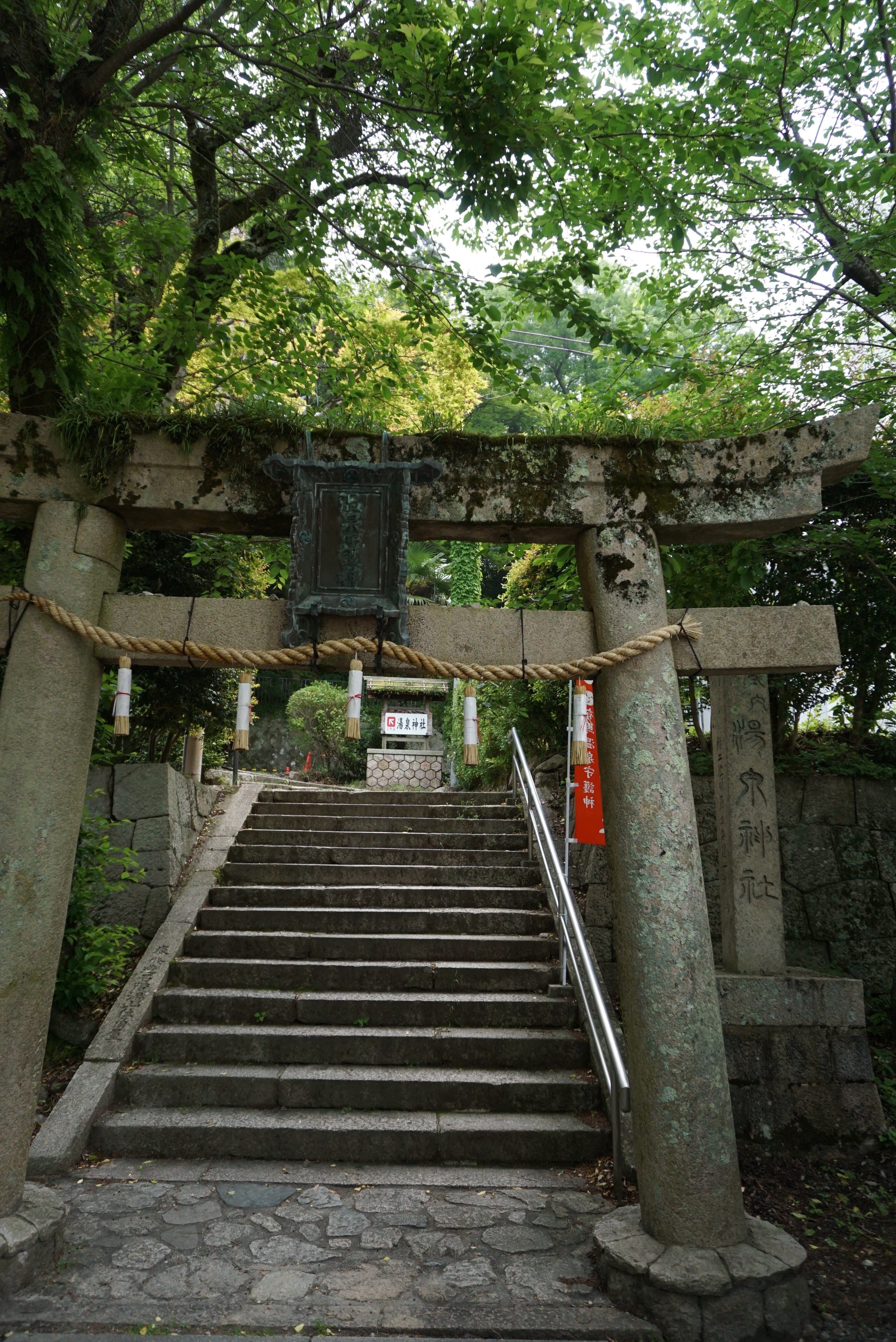
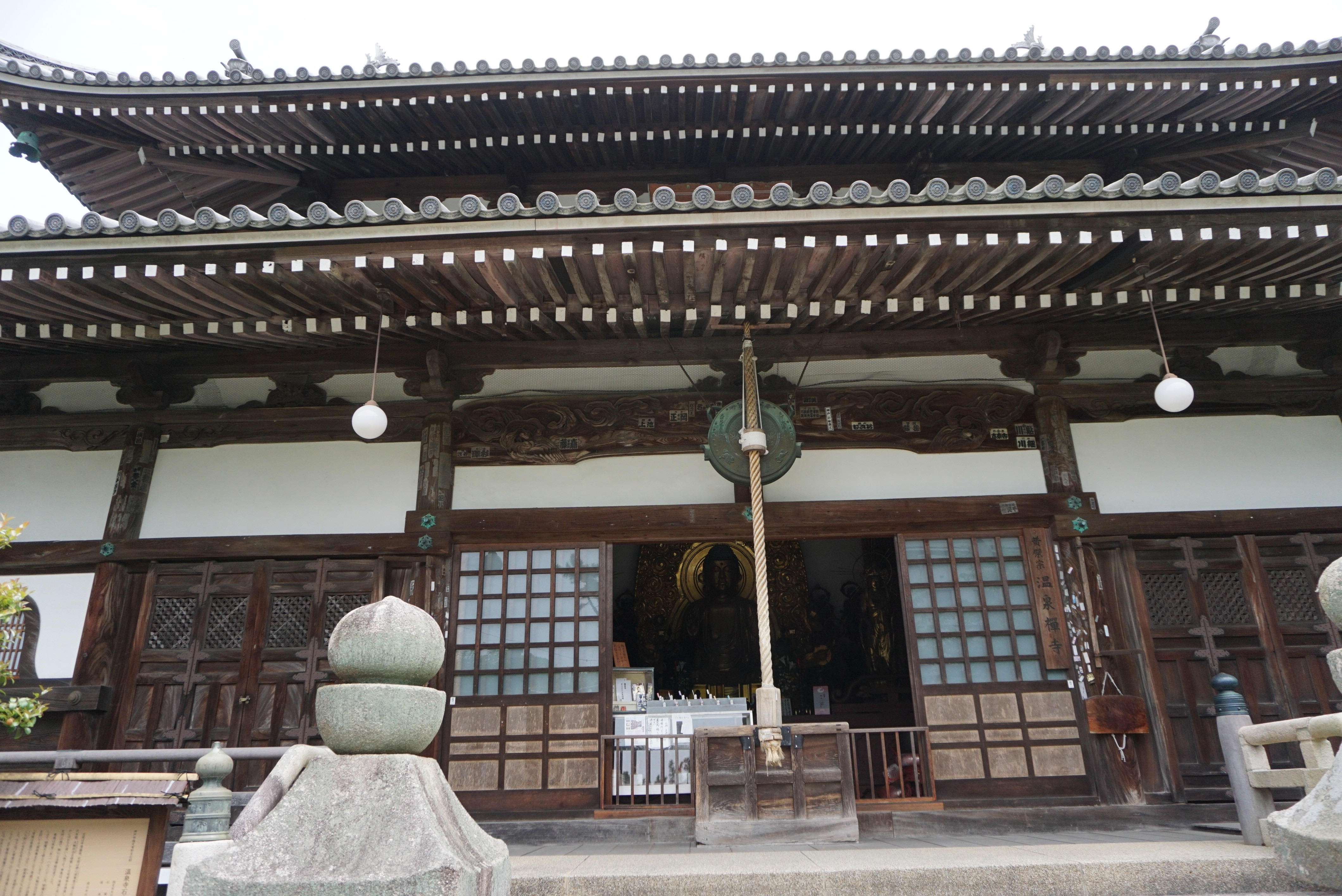
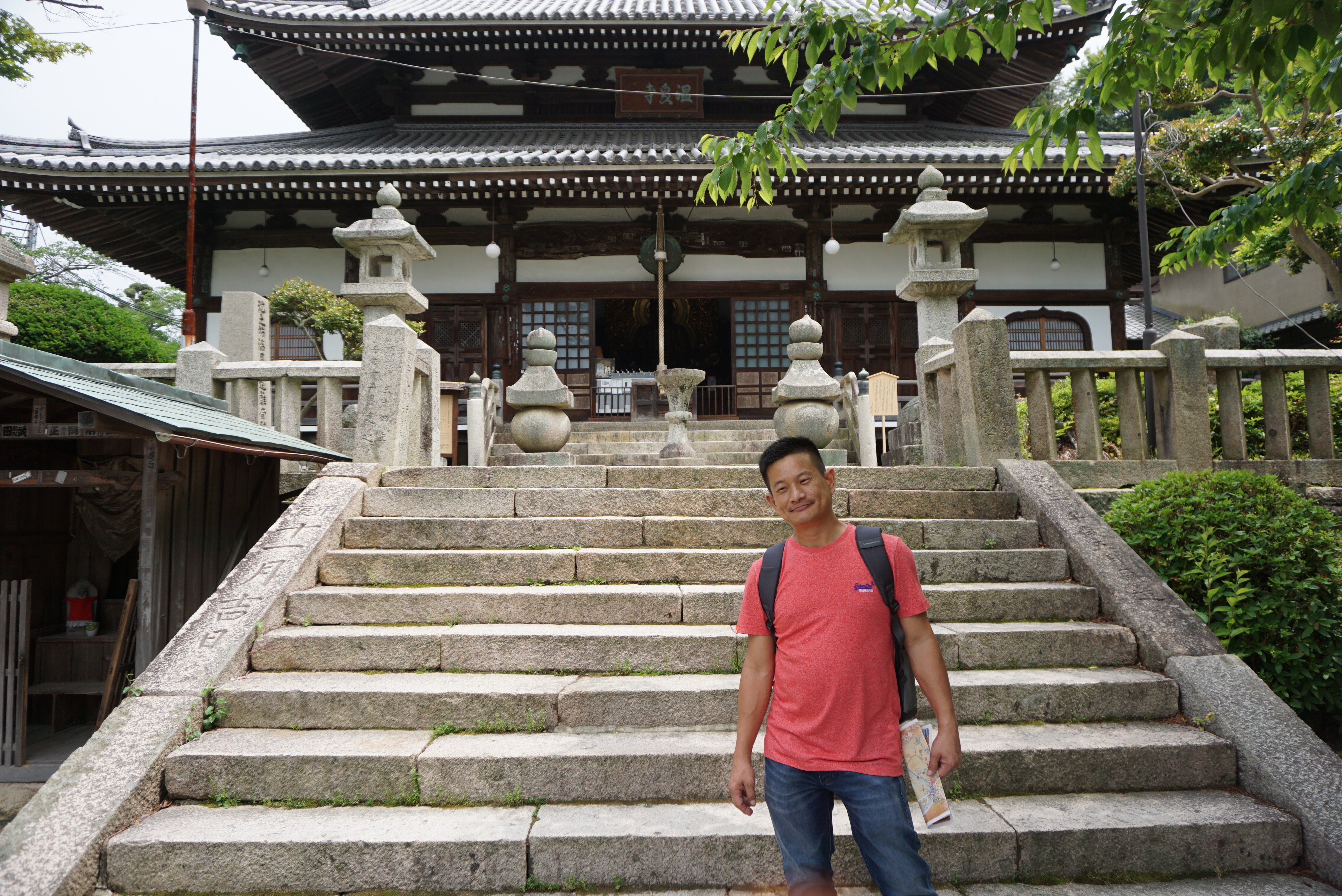
Our destination before heading back to the hotel today is to take the Arima-onsen ropeway up to Mt Rokko, a 931m mountain that separates Arima-onsen from Kobe. As my friend and I continued our journey towards the ropeway station, we spotted a temple up yet another slope. This is the Onsenji Temple in Arima-onsen, literally translates to Temple of Onsen waters. Since we were literally at the doorstep of Onsenji Temple, we decided to take a short hike up the slope to visit the temple. As we were walking up the slope, the first building that we saw is a 2-storey wooden tower, which resembles a bell tower. There was no way for us to verify the purpose of this wooden tower as it was closed at the time of our visit. We proceeded to the single-storey wooden Onsenji Temple prayer hall, a simple structure with a 2-tiered roof and walls clad in white. Inside the temple sits the statue of Buddha of Medicine. Onsenji Temple was set up by Monk Gyoki who recognised the medicinal waters in Arima-onsen. The locals would usually come to Onsenji Temple to pay respects to the Buddha here before taking a dip in the onsens in Arima-onsen. There is a Torii gate made of stone beside the temple that seems to lead further up into the hill. As we were rather tired from the overnight flight, we decided to give it a miss and head to our next destination in Arima-onsen.

DSC07780

Onsenji Temple. It is believed that one should pay respect to the Buddha of Medicine here before soaking in the Ginsen and Kinsen in Arima-onsen

The Mountain between Arima-onsen and Kobe – Mt Rokko (六甲山)

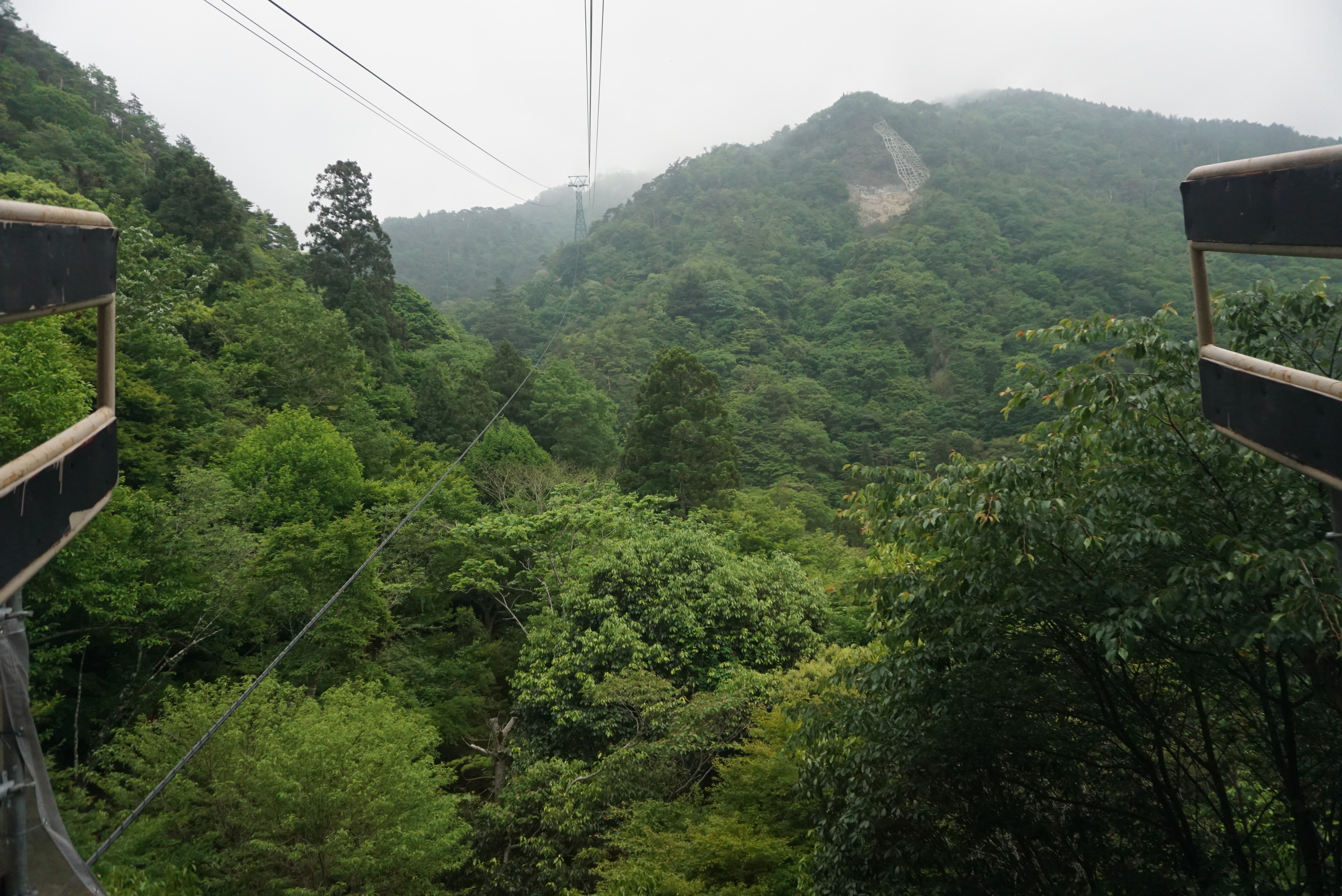
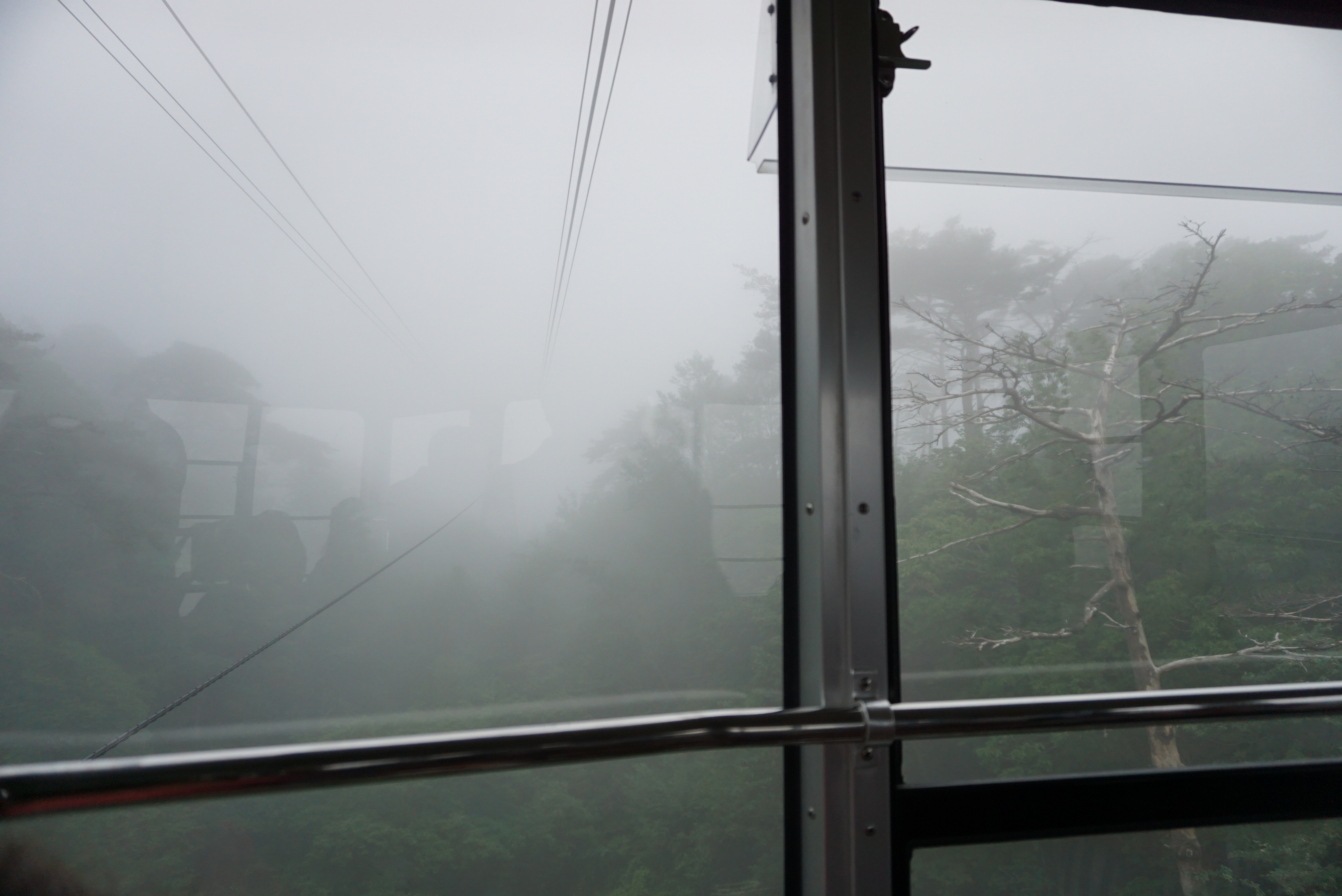
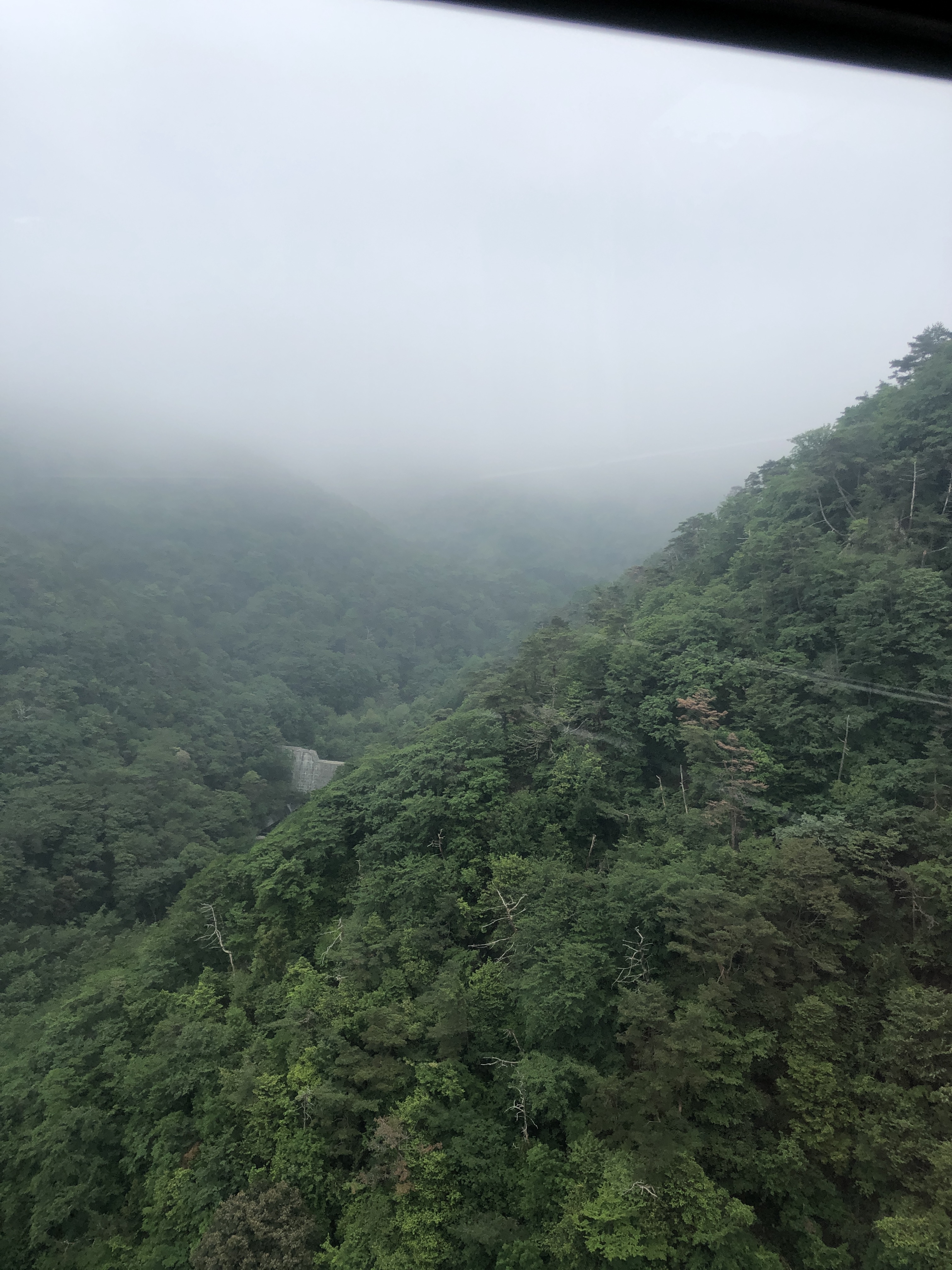
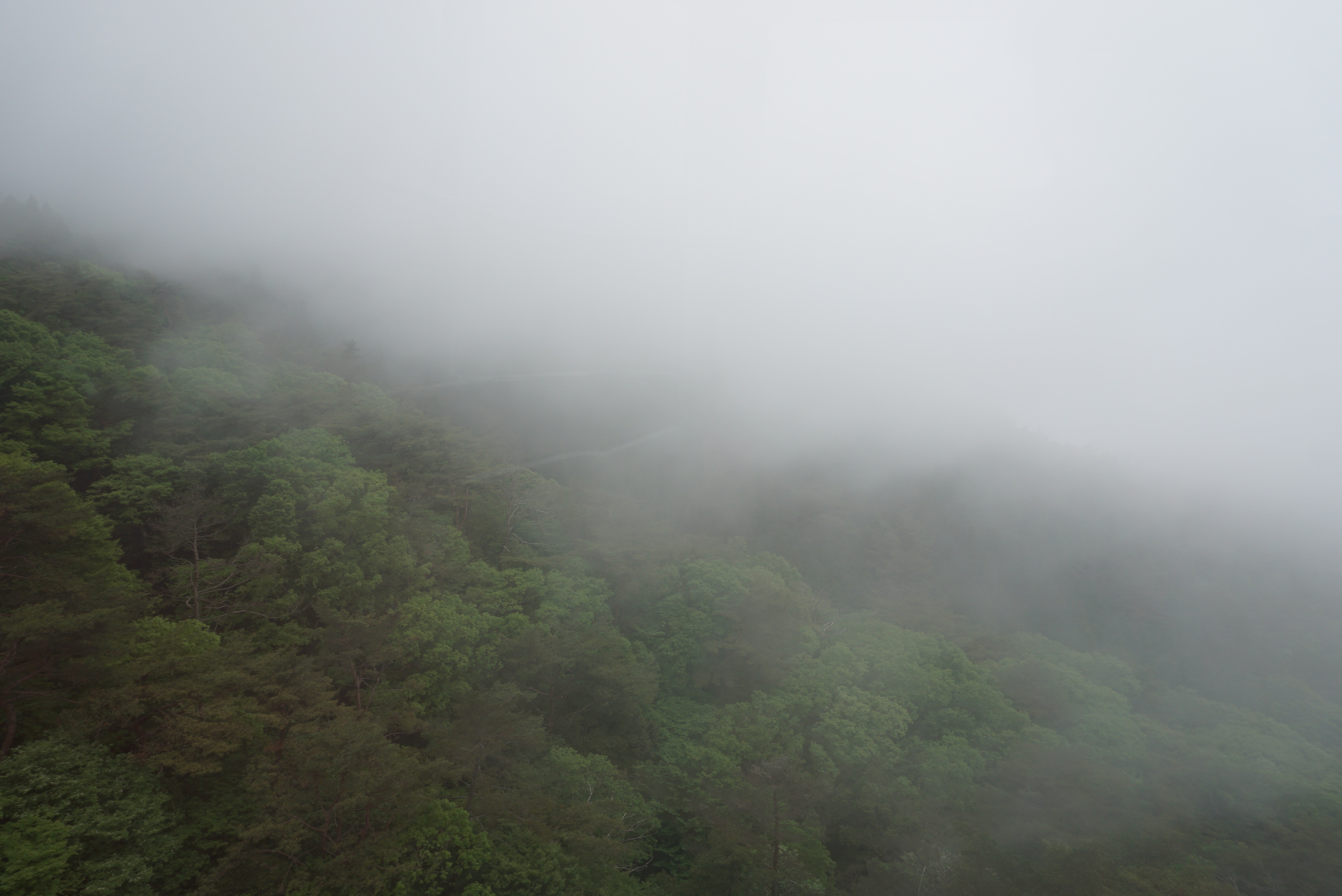
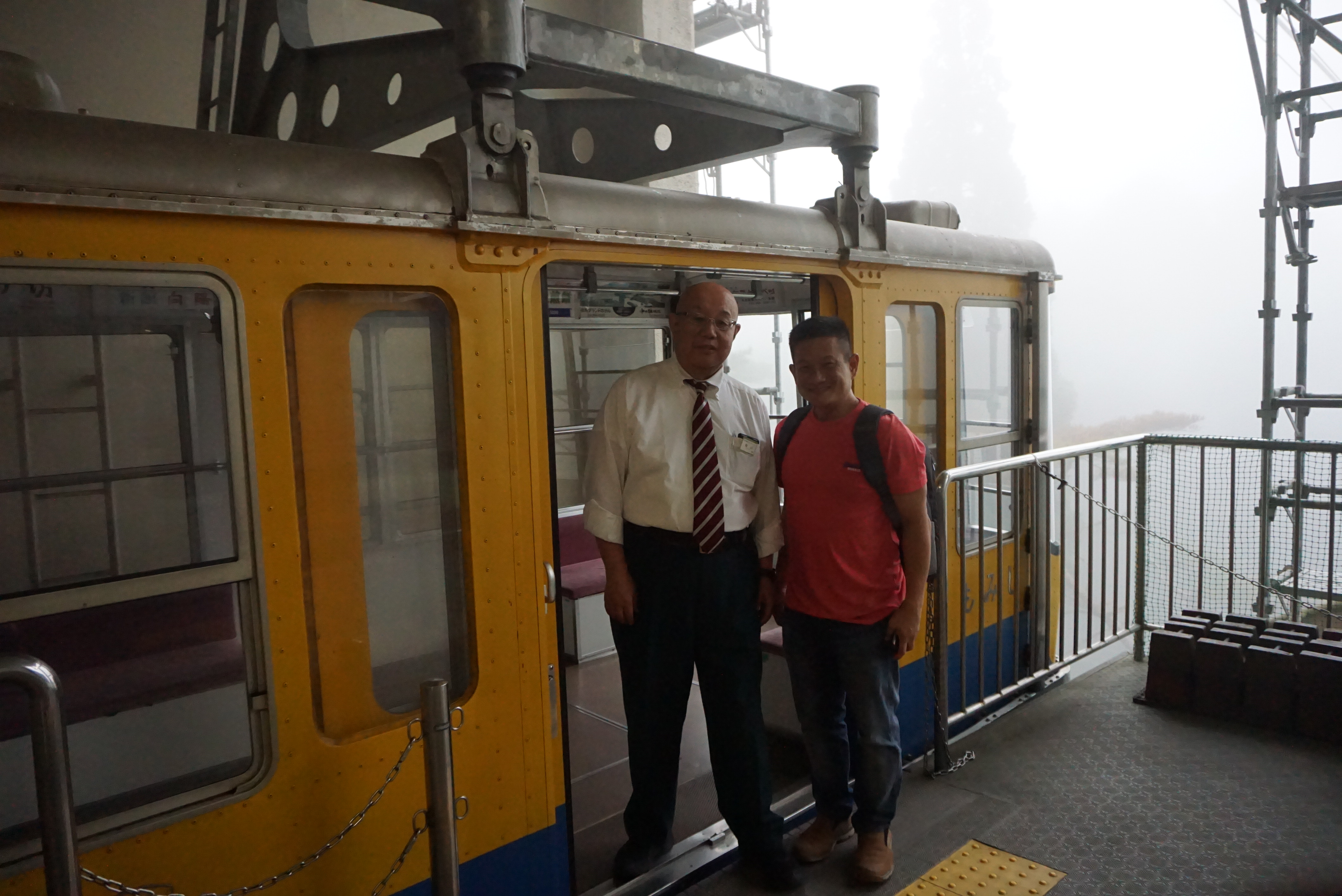
Our next destination is about 20 mins by foot from Onsenji Temple. We were walking what seems to be the outskirts of Arima-onsen, being surrounded by mountains coupled with the crisp fresh mountain air, the walk is rather enjoyable. My friend and I arrived at the Arima-onsen ropeway station where we took a 10 mins ropeway ride to the top of Mt Rokko. The ropeway slowly ascends up the 931m mountain, bringing us over the forested parts of Arima-onsen. The scenic ride allowed us to see the mountain range that forms a barrier between Arima-onsen and the city of Kobe. As we were riding upwards to the Rokko Sancho Station, the gondola passed through some low clouds. The clouds are so thick that we can barely see 50m ahead of us. All that was visible was the cable that the gondola was travelling on. At times the strong wind swayed the gondola that can be felt inside it.

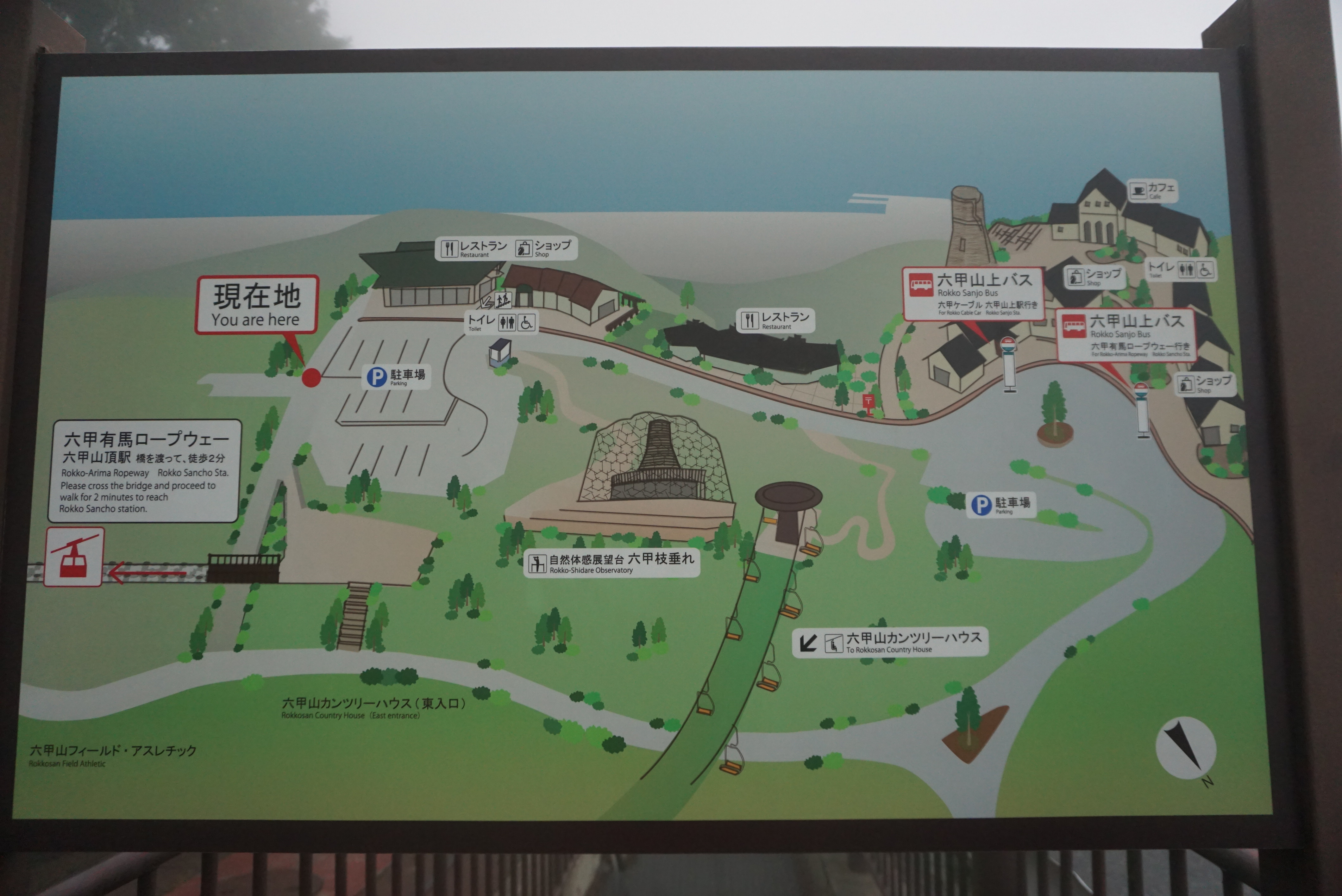
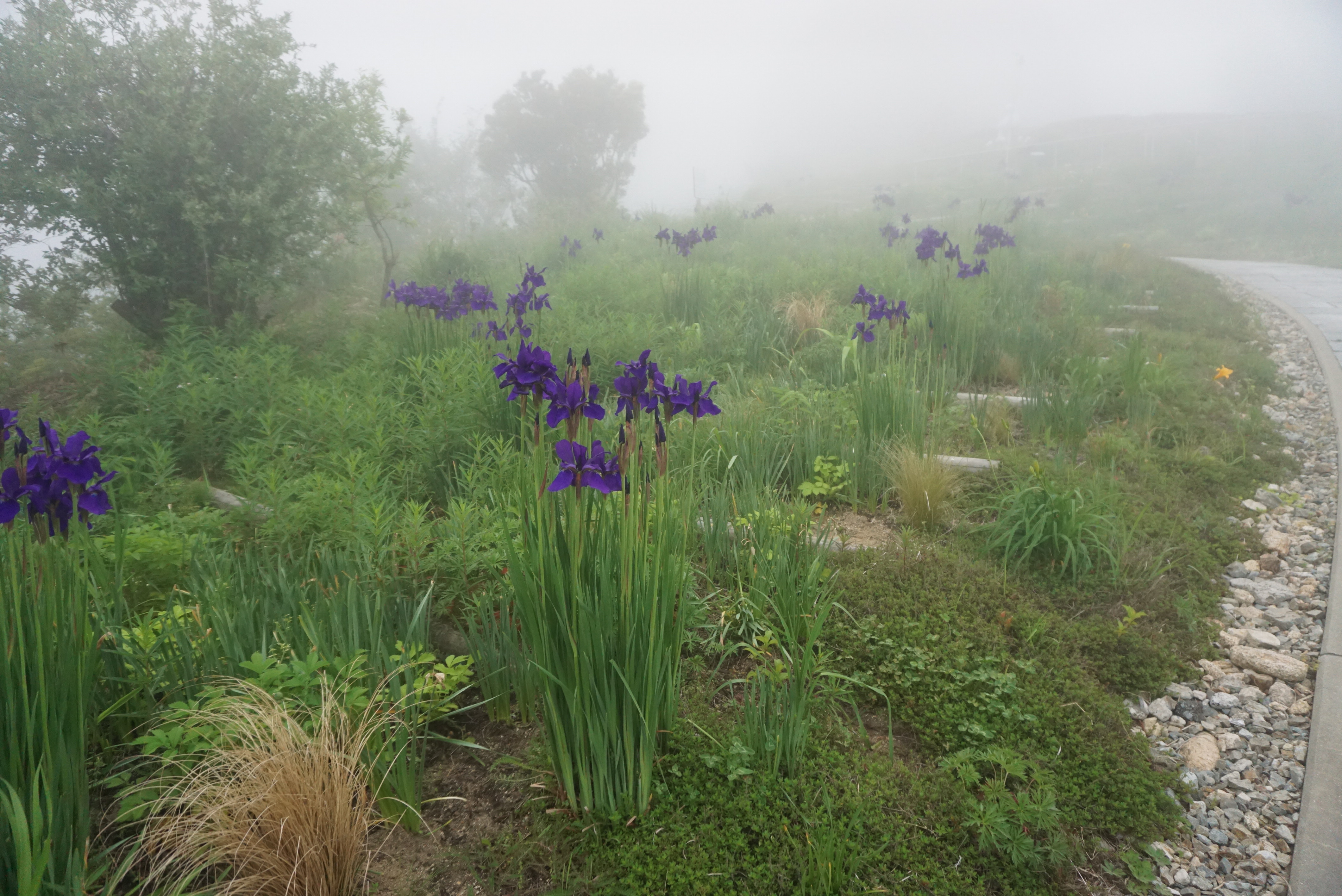
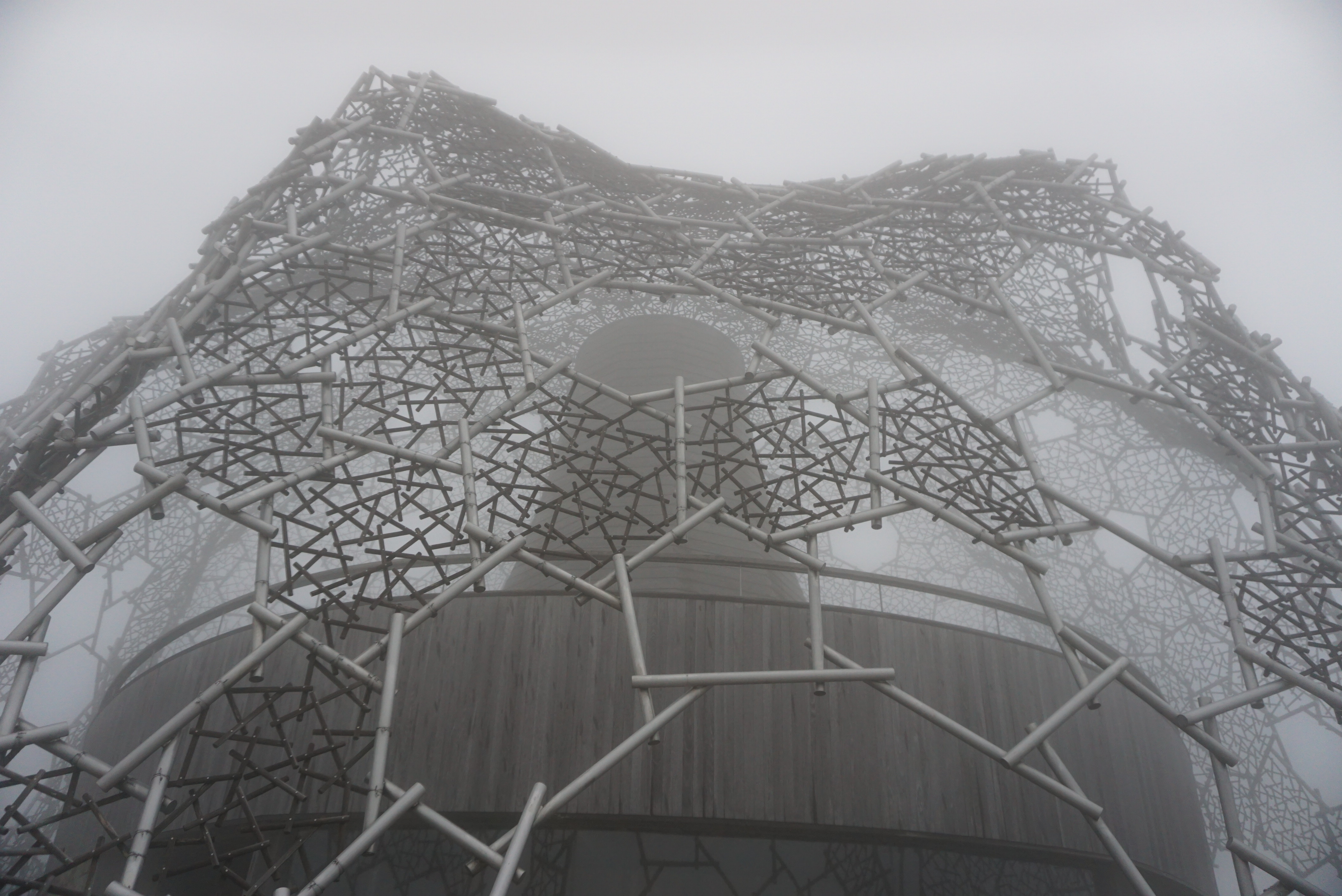
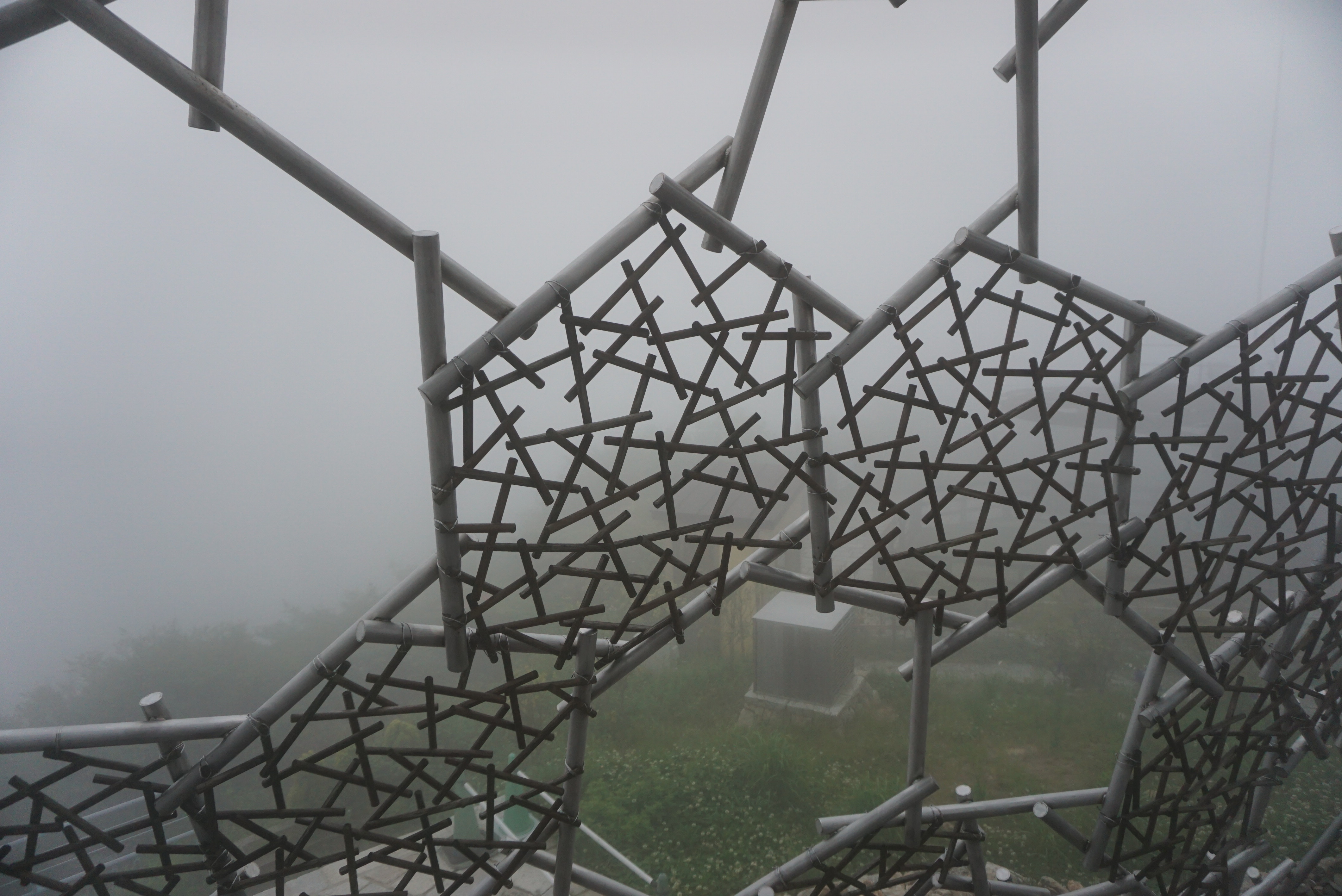
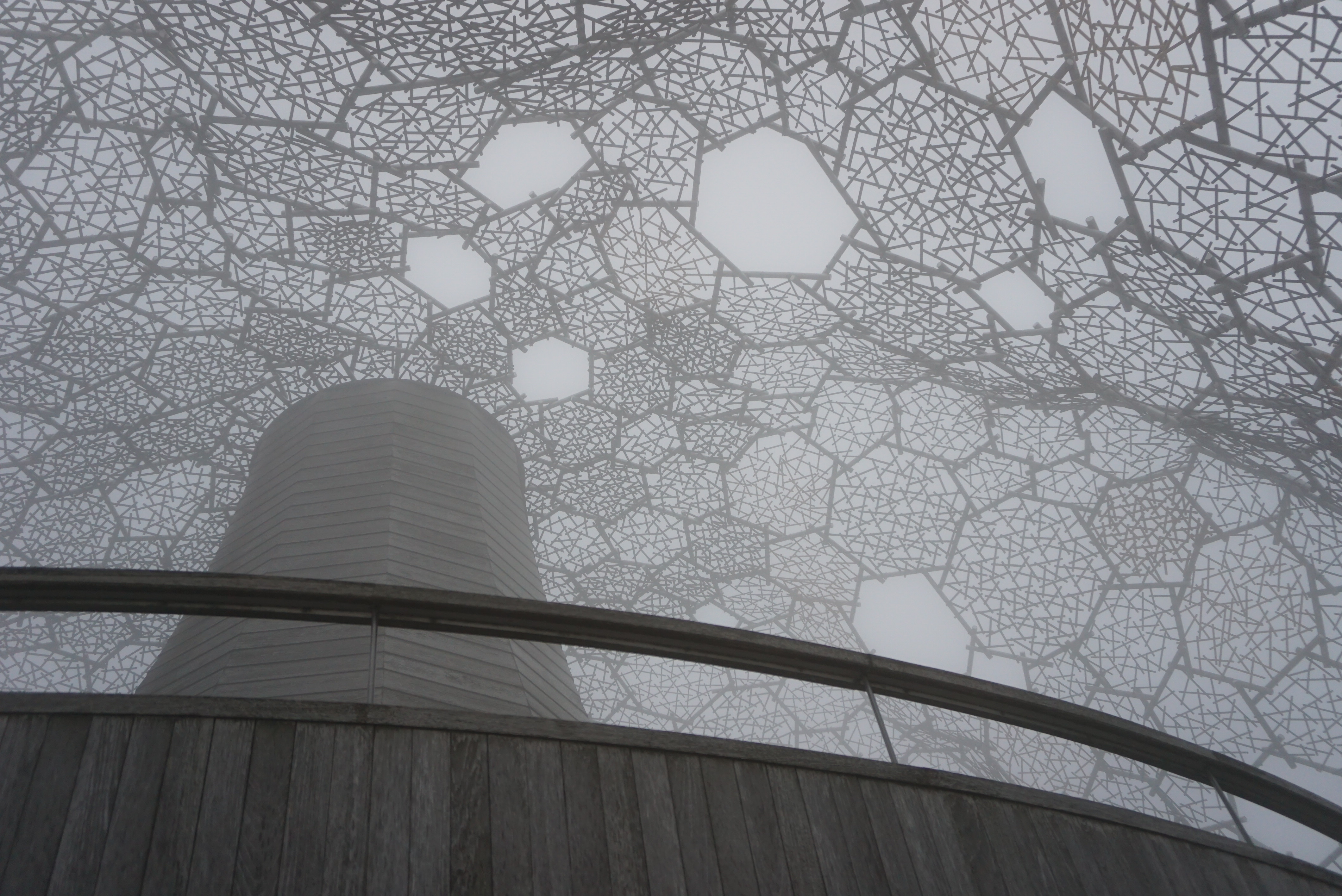
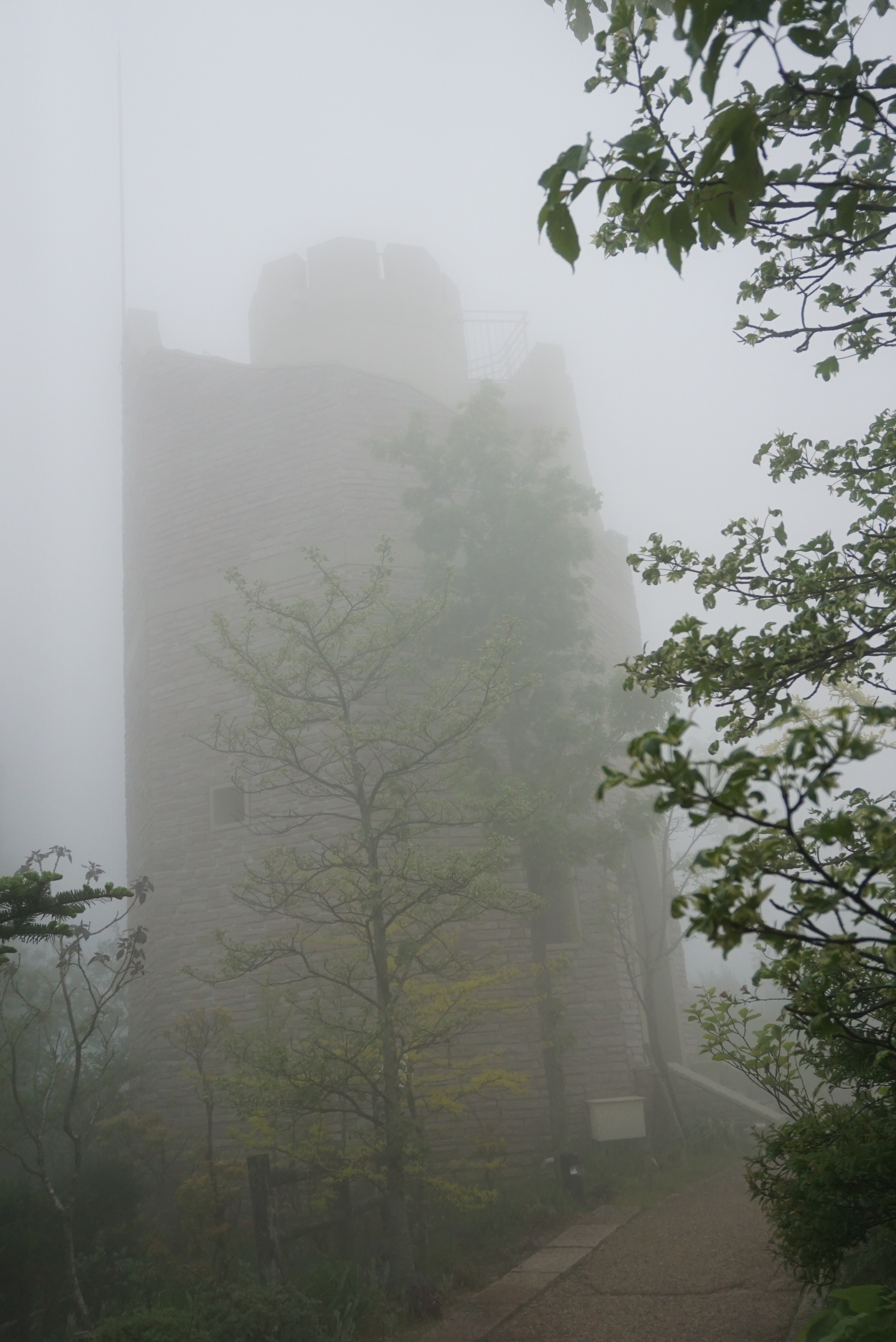
We soon arrived at the peak station of Rokko Sancho Station. Due to the low clouds, everywhere appears foggy. This added some mysticism to the surroundings, but the bad news is we might not be able to see the view of Kobe city that we came for. It kind of reminded me of Showa-Shinzan in Lake Toya, Hokkaido that we visited last year. We did not let this spoilt our mood as we enjoyed the cooling weather. Since we were not able to view the city of Kobe, we made use of our time to visit some of the attractions up here in Mt Rokko. Opposite the cafe where we had our lunch is where the Rokko-Shidare Observatory is located. The wooden tower which seems to be enclosed in a hive-like metal structure is an art piece. According to the poster, the lighting here at night changes according to the season. The low clouds and foggy weather gave the Rokko-Shidare Observatory a sense of mystery.

DSC07838

In a clear day, we would be able to see Kobe from this viewpoint, however, the low clouds mean we were not able to see anything

DSC07866

Rokko-Shidare Observatory on Mt Rokko

My friend and I left the observatory and ventured further away from the ropeway station to see what else is there up here in Mt Rokko. We chanced upon an English village, which is essentially European cottages made of stone. Nearby the cottage is a tower. The low clouds made us feel as though we were in Europe more than we were in Japan. We scaled up the tower, but couldn’t see anything other than the cottages below. Seeing there is nothing much we can do here, my friend and I entered one of the cottages, which turns out to be another shop selling souvenirs. We left shortly after entering the building. As we were a little tired plus there is really nothing much we can do up here with no views to see, we decided to head back to the hotel.

DSC07883

The sky cleared up as we approached the base station of the ropeway

DSC07882

View of Arima-onsen from the ropeway

A Quiet Little Waterfall – Tsuzumigataki Koen(鼓ケ滝公園)

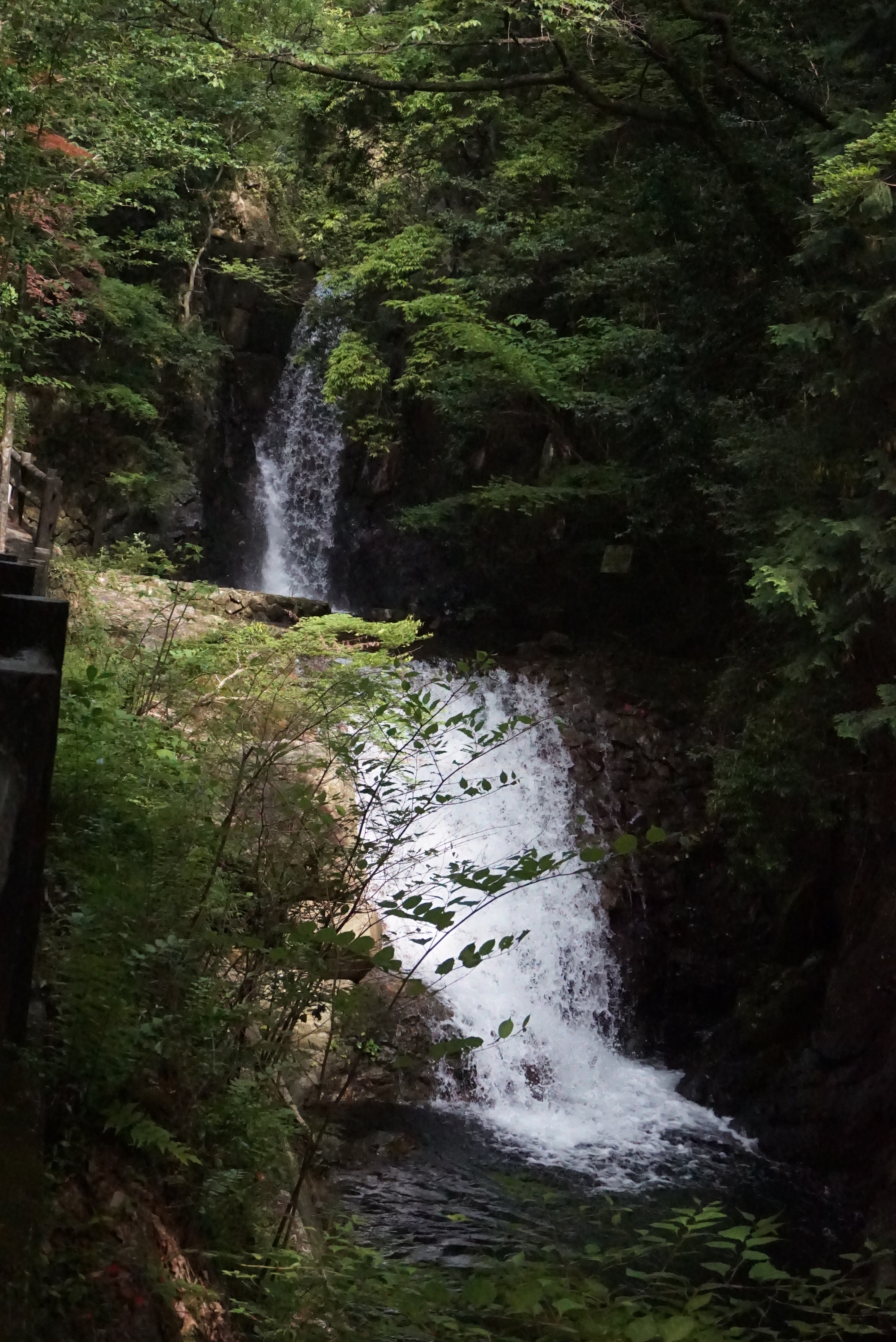
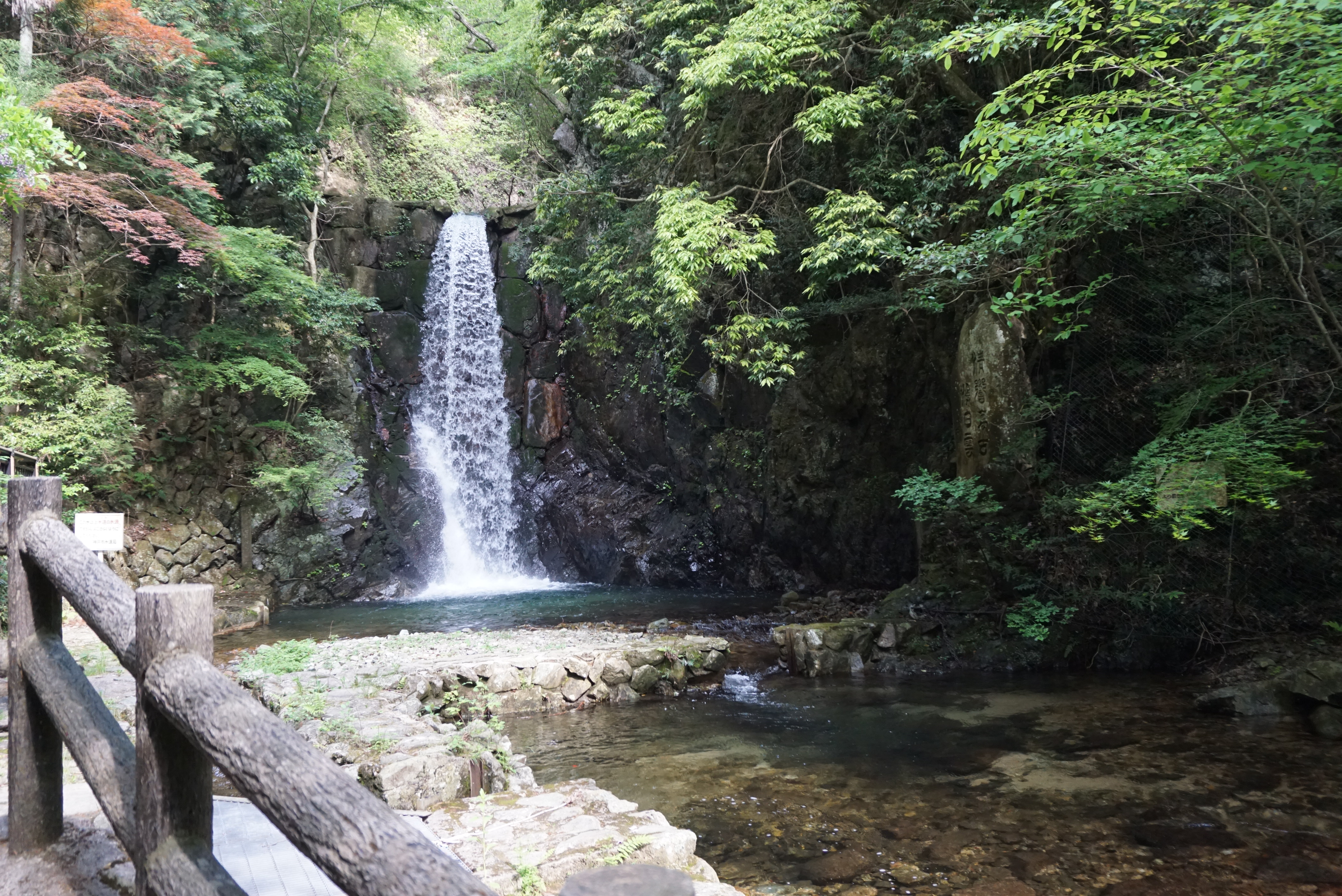
We soon reached the base station of the ropeway in Arima-onsen. My friend and I spotted a sign that points to a waterfall in Tsuzumigataki Koen, which is not far from the ropeway station and headed towards it to check it out. The waterfall is around 3 mins walk from the ropeway station. Tsuzumigataki Koen got its name from the sound of the waterfall when it echoes around the rocks resembling the sound of tsuzumi hand drum. The waterfall is rather small and has 2 tiers to it. There is a small tea house in front of the waterfall. We left for the hotel after snapping some pictures at the waterfall.

Enjoying the Footbath in Arima-onsen

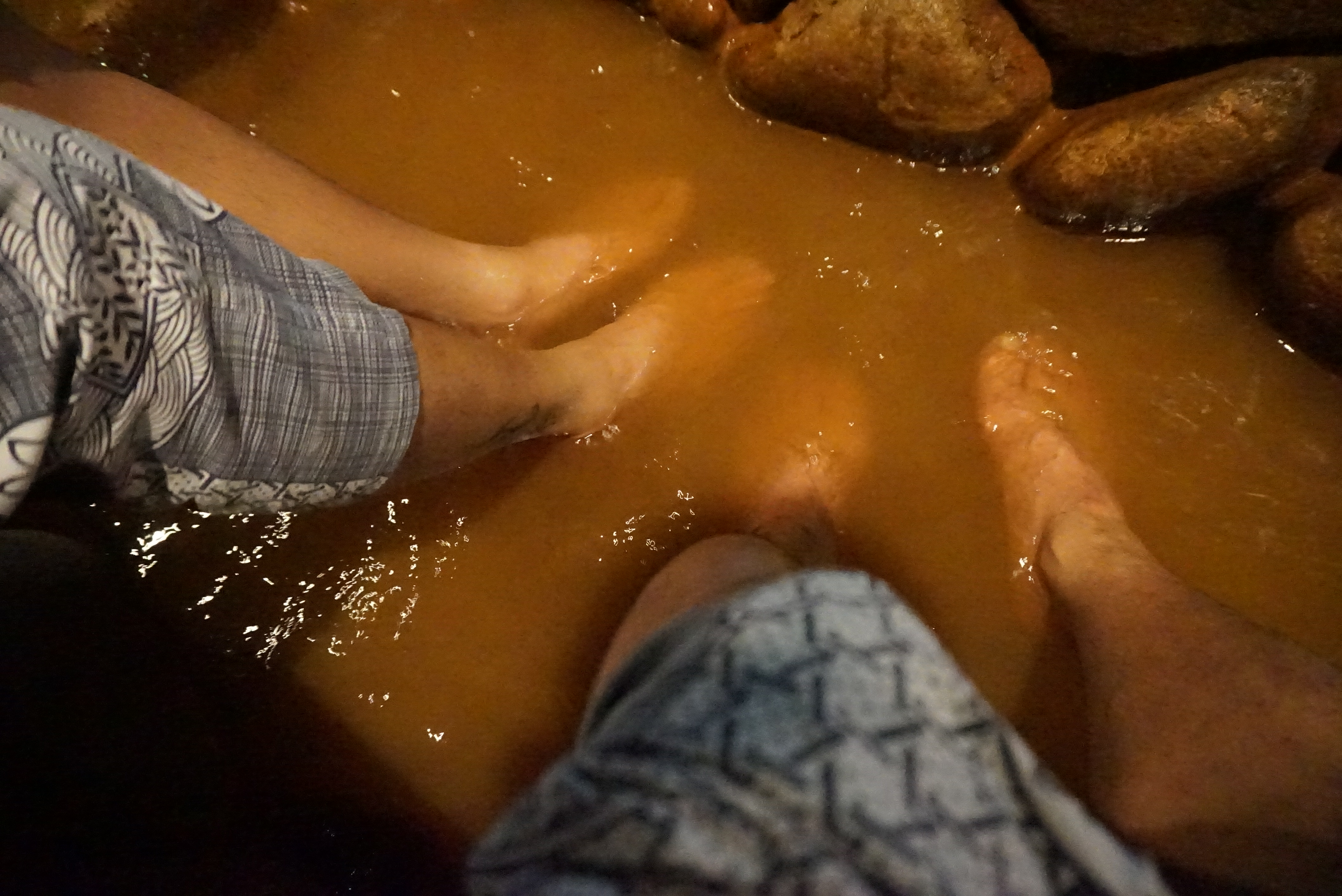
After checking in, my friend and I headed for the onsen to enjoy the Kinsen and Ginsen before heading back to our room for the dinner to be served in-room. We returned back to town for the Ginsen footbath after dinner in our Yukatas. As it was late, there is no one at the Ginsen footbath. We went for another onsen bath after returning to the hotel before we rested for the night.

DSC07924

View of Arima-onsen from our hotel room

IMG_8661

Kinsen and Ginsen in the hotel

Hokkaido Day 14 (Sapporo) (27 Feb 17) – Goodbye Hokkaido, Till We Meet Again

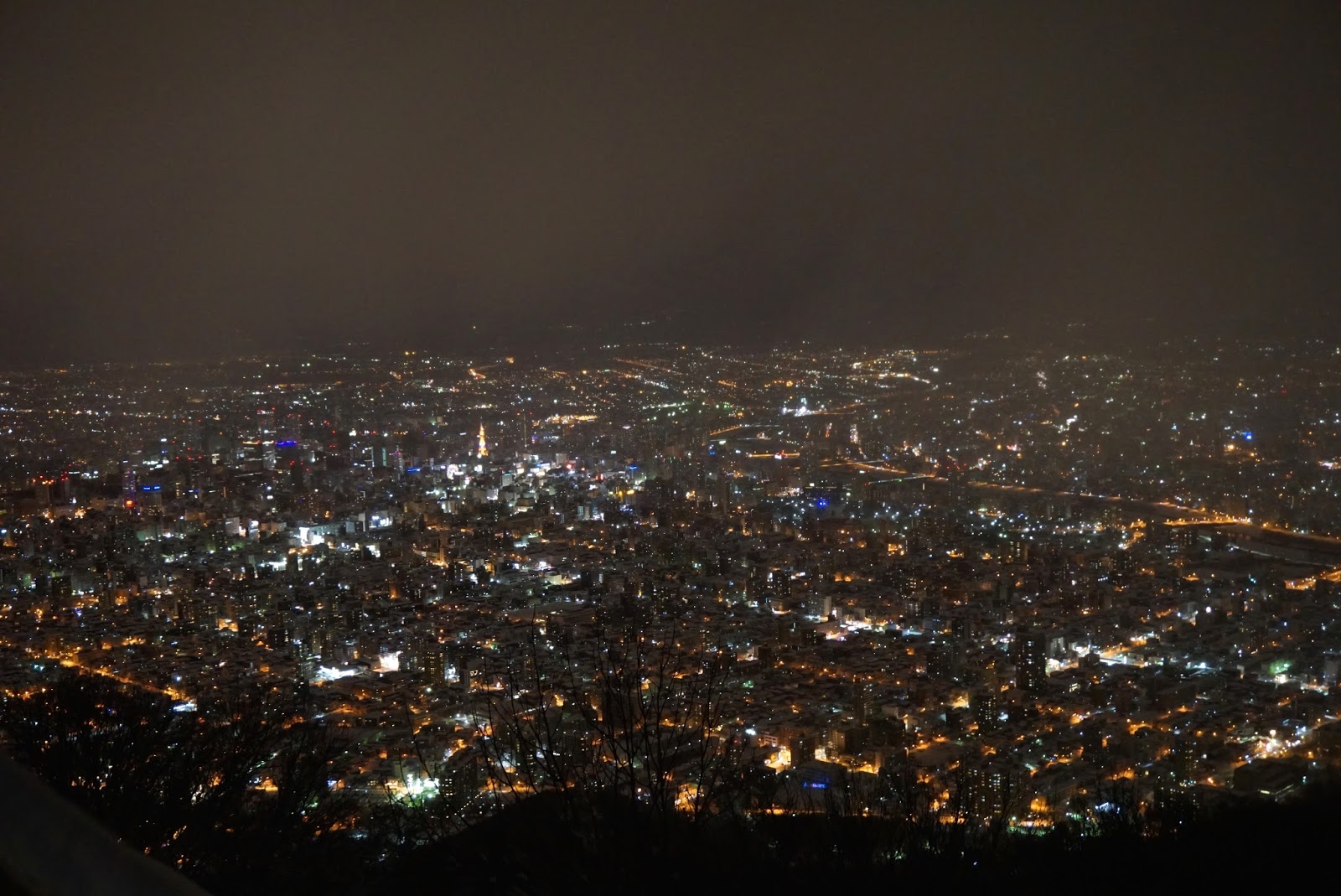
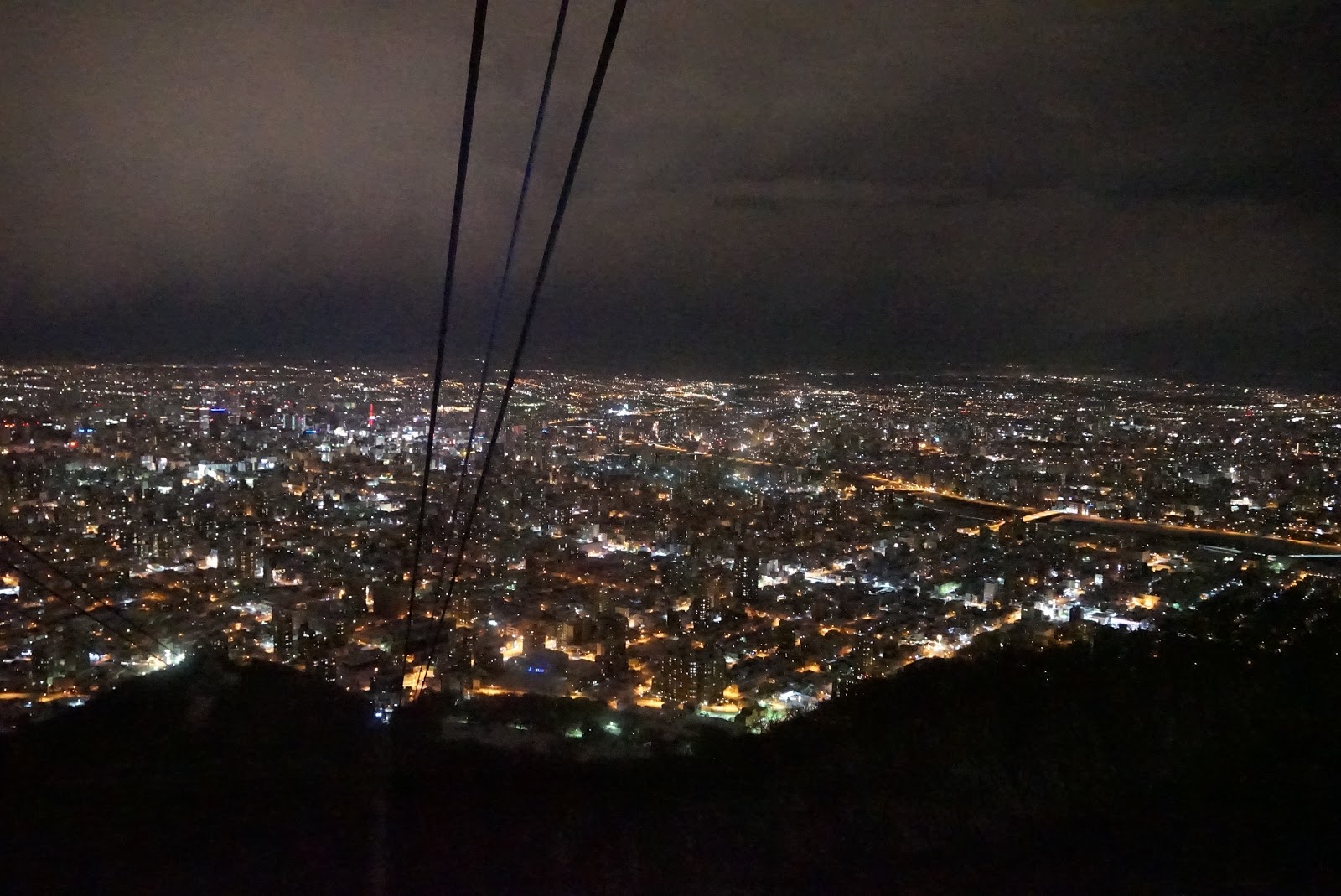
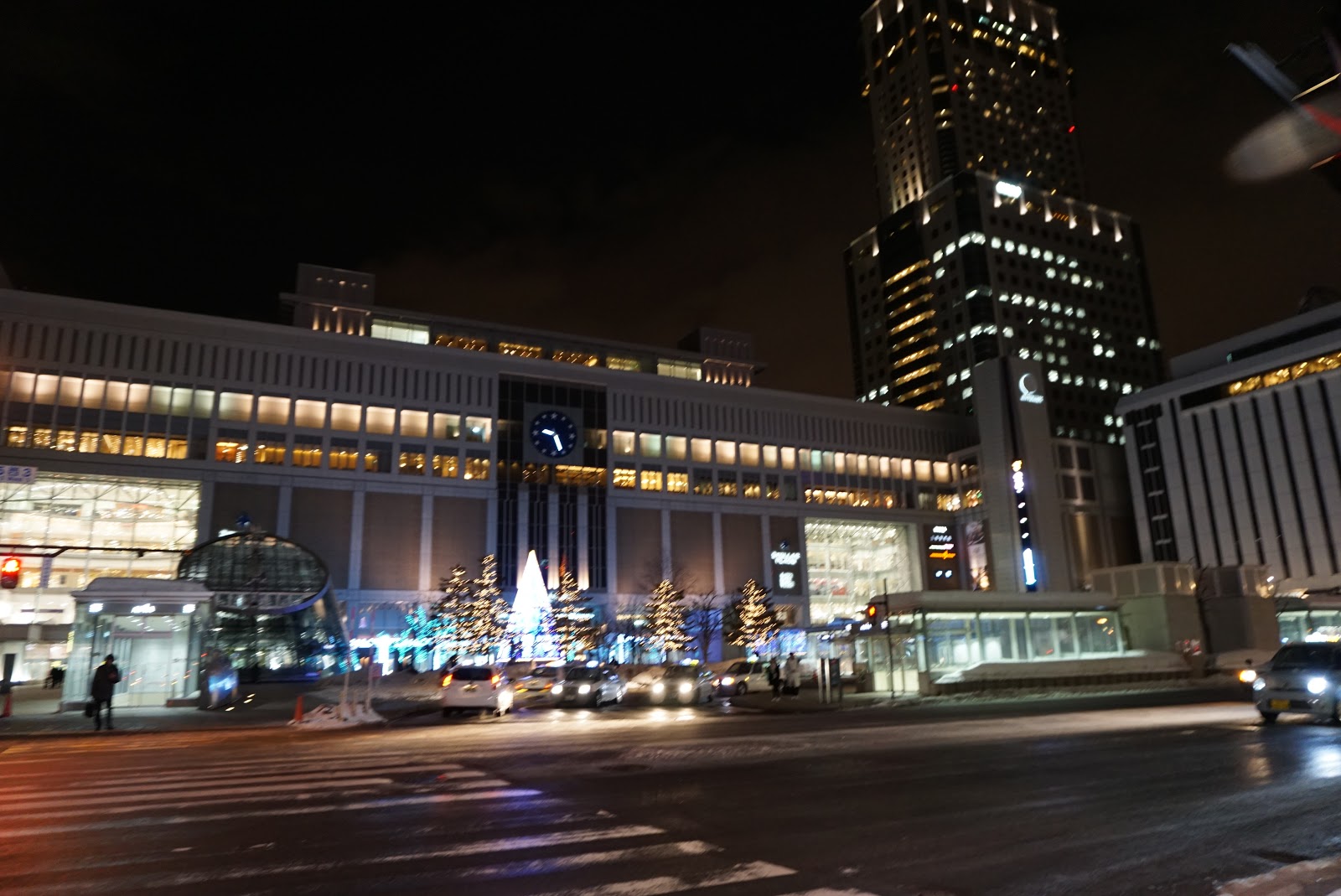
Night view of Sapporo

Farewell Hokkaido, Farewell Japan

Today we fly to Bangkok from Hokkaido, where we will be staying for 2 nights before heading home to Singapore. We headed for Sapporo JR Station at 6.30am to catch or 7.05am train to New Chitose Airport. We wanted to cater sufficient time as we will be lugging our luggage and walking in the snow one last time before we head back. At the train station, we had to carry our luggage up 2 flights of stairs to reach the platform where we boarded the train to New Chitose Airport. I usually have the habit of reaching the airport 3 hours before flight in case there is a long queue at the customs. As expected, there is a long queue at the security prior to the immigration. However, after clearing security, clearing customs is quite fast. There aren’t many shops at the airside in New Chitose Airport, we spent our time in the airline lounge before heading to board the aircraft.As we were sitting on our seats in the aircraft, looking out at the snow-covered tarmac of New Chitose Airport, I felt a sense of unwilling to leave Hokkaido. Afterall we had alot of fun and did a number of firsts in Hokkaido. We did skiing for the first time, we built our first snowman, we experienced snow for the first time, we walked on the frozen lake for the first time, we sailed through the ice for the first time, we soaked in the onsen for the first time and soaked in an onsen in the snow for the first time. So many first times we have done in Hokkaido.
Traveling on JR from Sapporo to New Chitose Airport
Arrived at New Chitose Airport, ready to check in
Walking towards the International Terminal
The queue to clear the security is very long. Do arrive at the airport early
There are not many shopping options or things to do at the airside of New Chitose Airport. There are more things to do in the public area of the airport though
Relaxing in the lounge and grabbed some breakfast before we board the flight back

Afterthought

I quite like the pace of our Hokkaido trip, which we had time to leisurely visit the sights. Each day was planned with at most 3 places to visit. We had the chance to slow down our pace and look around us at the peaceful snowscape in Hokkaido. What kept us from feeling bored is the snow. We spent our time playing with the snow, walking in the snow and admiring the snow scenery. I thought travelling should be relaxed and not rushed (that is one of the reasons why I detest package tours). Travelling in Hokkaido requires a certain amount of planning, especially in winter where public transports are less frequent. Planning for this trip, however, is not difficult. There are websites that helped in the planning of our Hokkaido trip from the Hokkaido JR website to the hotel websites to the websites of the places we have been to. I find travelling in Hokkaido to be very pleasant, everyone is so courteous and made us felt so welcomed and Hokkaido doesn’t feel crowded. We will be back to Japan again, perhaps visit another city the next time we come back.
Aircraft taxiing to the runway


Take off from New Chitose Airport


We are going to miss the snow and the fun we had in Hokkaido


Farewell Hokkaido, Farewell Japan. We will definitely return to Japan

Hokkaido Day 13 (Otaru) (26 Feb 17) – Day Trip to Otaru and Viewing Sapporo from Mt Moiwa

The beautiful and peaceful iconic Otaru Canal

Day Trip to Otaru

The original plan was to visit Mt Moiwa in the morning and by noon arrive at Otaru. However, Mt Moiwa Ropeway opens at 11am, which would mean the half-day will be wasted. We made the decision on the spot at Sapporo JR Station to visit Otaru and return by evening and head over to Mt Moiwa. JR from Sapporo to Otaru took about 1 hour. We bought our train tickets from the vending machines which also allows us to get reserved seat tickets. We also bought our train tickets to New Chitose Airport for tomorrow since we are already at it. Once arrived at Otaru we headed for the Otaru Canal, which is about 10 mins walk away from the train station. To get to Otaru Canal, we walked straight along the street with Otaru JR station behind us. As we were walking towards Otaru Canal, we were surrounded by thick snow and couldn’t resist playing with the snow. As we were playing with the snow, my friend and I started building a snowman by the side of the walkway. We were hoping that our snowman will still be around by the time we return.
Taking JR from Sapporo to Otaru 
We reached Otaru Station in about 1 hour’s time
In Otaru Station
View of Otaru JR Station
Walking towards Otaru Canal
On the streets of Otaru (near Otaru JR Station)
My friend building a snowman on the streets of Otaru
The snowman we built
Buildings in Otaru is influenced by western architecture

The Charming Otaru Canal

We were greeted by a canal across a road, we knew we have arrived at Otaru Canal. Rows of brick-walled warehouses lined up across the canal, standing tall and unwavering by the cold winter of Hokkaido (was -4℃ at the time we were there). Covered with snow and icicles forming on its roof, these buildings eluding a sense of majestic to these buildings which once served as storage space in the first half of 20th century. These days these timeless warehouses transformed into shops and restaurant continue to stay relevant to their changing roles. As we strolled along Otaru Canal on the snow-covered pathway the stroll was comfortable and peaceful as we gaze at the canal and the warehouses, despite having quite a number of visitors strolling along the same path. A bridge nearby, Asakusa Bridge, where a lot more visitors gathered. The view from Asakusa Bridge is even more charming. This is where one can take iconic pictures of Otaru Canal running in the middle with warehouses on the right side and the modern buildings peeking through the snow on the left side. Diagonally opposite Asakusa Bridge is Denuki-Koji Street, which comprises of a cluster of restaurants that are built on whatever land they can find here. On the outside of Denuki-Koji Street are some small stalls that sell some street food. My friend and I headed into one of the cafes to have a small portion of melon soft serve. It was snowing when we exited the shop and seem heavier by the minute. We headed over to the sushi restaurant opposite Denuki-Koji Street.

There it is, Otaru Canal
Taking wefie at Otaru Canal
The warehouses standing unwavering to the cold winter weather
Me at Otaru Canal
The snow and icicles on the warehouses give it a different personality
Denuki-Koji Street Opposite Asakusa Bridge over Otaru Canal
Me on Asakusa Bridge over Otaru Canal
My friend with Denuki-Koji Street
Shops selling street food in Denuki-Koji Street
We went for the melon soft serve in Denuki-Koji Street. It is a pity the melon is not from Hokkaido as we were told Feb is not the season for Hokkaido melons
Denuki-Koji Street
My friend in Denuki-Koji Street
It started to snow as we were getting some street food in Denuki-Koji Street
Going for sushi in a restaurant opposite Denuki-Koji Street 
Maki with tuna
The sushi here is very fresh and tasty

Strolling in Otaru

After lunch, we walked along Rinkosen Street, the street opposite Otaru Canal, towards the Otaru Music Box Museum. There are a number of restaurants and souvenir shops on this side of the side. We went into one of the restaurants to have some ramen and grilled scallops. As we were walking along Rinkosen Street, we came across a shop selling 7-tier soft serve with 7 different flavours. Feeling full from the 2 lunches we had earlier, we opted for the 3-tier soft serve with lavender, vanilla and melon flavours. The soft serve tasted rich and not too sweet, perfect to be eaten in the snowing winter of Otaru. We went into LeTao cafe and got ourselves both flavours of their famed cheesecake. Their cheesecake did not taste too cheesy, coupled with the rich Hokkaido milk it is made from, the cheesecake is simply heavenly. Even my friend who is not a fan of cheesecake got bought over by LeTao cheesecake.

After lunch, we headed back to Otaru Canal and explore the street behind the warehouses. The snowing weather makes Otaru Canal more charming
There are some restaurants souvenir shops in this warehouse
The street behind Otaru Canal
Most of the warehouses are restaurants
My friend in the street behind the warehouse
Some of the warehouses on Otaru Canal
Lunch no.2. We had grill scallops and crab
And Miso Ramen
The grill scallops. There are uni also
The restaurant we had our second lunch in
We saw this shop selling 7-tiered soft serve. We only got stomach space to fit 3 and got the vanilla, lavender and melon flavour soft serve
We passed by one of the restaurants displaying live seafood outside the restaurant
LeTao Cheesecakes is a must-try when coming to Otaru
We ordered both flavours. The delicious cheesecake is rich and does not have a cheesy taste

Otaru Music Box Museum 

Feeling satisfied after our cheesecake, we headed to red-bricked western-styled Otaru Music Box Museum. Outside the Otaru Music Box Museum stands the Otaru Steam Clock which chimes every 15 mins. The interior of the Otaru Music Box Museum is mainly made of wood, from the flooring to the wooden stairways that lead to the 2nd and 3rd floor of the museum. My first impression of Otaru Music Box Museum, apart from it being crowded with tourists, is that it is a big shop selling all sorts of intriguing designed music box made of glass and some in wood. I was very careful when navigating in the museum amongst the hordes of tourists. The real gem is the room on the 2nd floor, near to the entrance of Otaru Music Box Museum. This is where the more expensive and unique and some antique music boxes are being displayed. We were quite turned off by the massive crowd flocking into Otaru Music Box Museum and left the museum.

Walking towards Otaru Music Box Museum along Rinkosen Street  
An oil lamp opposite Otaru Music Box Museum
The steam clock outside Otaru Music Box Museum which chimes every 15 mins
Taking a picture with the steam clock
There are a lot of music boxes for sale in Otaru Music Box Museum
The Otaru Music Box Museum feels more like a huge shop selling music boxes than a museum
Customers can choose what music for their music box here
More music boxes on sale
View of the music box museum from the second floor
Sleeping with a lucky cat
This is part of the display on the second level
One of the more expensive music boxes

Otaru Canal in the Evening

It is getting dark and still snowing, my friend and I made our way back to Otaru Canal Sakaimachidori Shopping Street to take pictures of the night view of the canal. Sakaimachidori Shopping Street has a mixture of western-style and ancient Japanese styled buildings. Personally I find the old Japanese styled buildings to be more charming. The street has shops selling all sorts of souvenirs, mainly souvenirs made of glass. Otaru is famous for its glassware from decorative glass ornaments to practical glass kitchen wares, one is sure to find some glassware that suits one’s needs here. I learnt from my research for the my Hokkaido trip that a cafe in Otaru sells cream puffs that are bigger than one’s face. As we are strolling along Sakaimachidori Shopping Street, we found Kitaichi Glass 3gokan Cafe Bar which sells the signature gigantic cream puff. My first impression of the rustic cafe is it is rather dark, as they used kerosene lamp to light up the cafe. However as we were settling in, I like the cosy ambience in this cafe. As we tucked into the gigantic cream puff, we found the cream inside the puff is generous and not too sweet and has a rich texture to it.

Sakaimachidori Shopping Street viewed from Otaru Music Box Museum
My friend in front of  Otaru Music Box Museum facing Sakaimachidori Shopping Street
This cream puff is gigantic! Still the cream tasted fresh and yummy
We had the giant cream puff at Kitaichi Glass 3gokan Cafe Bar. The rustic restaurant has a distinct kerosene smell as they use kerosene lamp as lighting.
Showing how big the cream puff is in Kitaichi Glass 3gokan Cafe Bar. The cafe is located inside one of the glassware shops.
We found a snowman in front of one of the glassware shops along Sakaimachidori Shopping Street
Taking wefie on Sakaimachidori Shopping Street
Taking pictures with random buildings in Sakaimachidori Shopping Street
There are some Japanese styled buildings alongside Western-styled buildings on Sakaimachidori Shopping Street
One of the shops in Japanese styled building on Sakaimachidori Shopping Street
We walked along this canal to get back to Otaru Canal. The buildings here are simply charming with the snow all around it
Me in front of the canal that links to Otaru Canal
My throwing a snowball into the canal
Walking along this small street is very peaceful. The snow-covered buildings are a beautiful sight to looking at.
Taking pictures of the canal. There are some shops selling glasswares along the canal

The night view of the Otaru Canal is peaceful and beautiful and has a very different flare from the day time. The Victorian-styled lamp lining along the pathway beside the canal gives a very romantic feel to the canal. Taking picture on Asakusa Bridge is a ritual that many tourists come here for, but taking pictures on the pathway is equally beautiful. After taking picture of Otaru Canal, my friend and I headed back to Otaru JR Station to catch the next train back to Sapporo. Along the way, we saw the snowman we built earlier in the day is still there. It survived the snowstorm and mankind’s destruction! We headed to Otaru JR Station and took a train back to Sapporo.

In Otaru Canal in the evening
Taking wefie on Asakusaga Bridge. This spot has the best photo spot of Otaru Canal, especially in the evening
My friend on Asakugawa Bridge overlooking Otaru Canal.


The pathway beside Otaru Canal also offers great photo spot
Taking a picture with Otaru Canal in the evening

Our Final Destination – Viewing Sapporo from Mt Moiwa at Night

Reaching Sapporo, we headed to our last destination of the trip – Mt Moiwa. To get to Mt Moiwa Ropeway station, my friend and I took the subway from Sapporo JR Station to Susukino Station and changed to the Streetcar (Shiden). The Shiden is a tram system that runs from Central Sapporo to Western areas in Sapporo and is the only way (other than catching a cab) to Mt Moiwa Ropeway Station. We alighted at Ropeway Iriguchi Stop and walked about 3 mins to the bus stop where a complimentary shuttle bus picked us up and brought us to the base station (Sanroku Station).
The Streetcar or Shiden is the only way to get to Mt Moiwa Ropeway
Inside the crowded Shiden
The shuttle bus that took us from Shiden stop to Mt Moiwa Ropeway Sanroku Station
The bus ride to Mt Moiwa Sanroku Station takes only 3 mins
Map in Sanroku Station explaining the stations of the Ropeway System on Mt Moiwa
My friend with the Mascot of Mt Moiwa
This is the Ropeway that will take us to Chufuku Station where we changed to the mini cable car to the summit Sancho Station

Mt Moiwa is a 531m mountain located in Southwest of Sapporo, a romantic place for locals to date. The jewel of the crown on Mt Moiwa is its unobstructed view of the entire Sapporo and beyond. On a good day, one can see as far as the Japan Sea. To get to the summit, we took the Mt Moiwa Ropeway to the mid-station (Chufuku Station) and another mini cable car to the summit station (Sancho Station). As the ropeway pulls us up to the Chufuku Station, the City of Sapporo shine like stars in the sky beneath us. It felt as if the ropeway is hanging through a cleared path in the forest of Mt Moiwa. The ropeway reached Chufuku Station in 5 mins. There is a big souvenir shop at Chufuku Station, as we were trying to catch the mini cable cars to Sancho Station, we thought we could come back later to get some souvenirs.

Inside the mini cable car towards Chufuku Station
We are already mesmerised by the view of Sapporo city as we ascend in the Ropeway, to the mid-Chufuku Station
Night view of Sapporo from the Ropeway

We changed to a mini cable car in Chukufu Station which brought us to Sancho Station in around 2 mins. The mini cable cars are essentially 2 small trains like cable cars running on rail tracks. Once at Sancho Station, my friend and I went directly up to the observation deck on the rooftop. As we were exiting the lift, we were greeted by a huge diamond-shaped tripod with a bell in the middle sitting in the centre of the observation deck. It is believed that couples who rang the bell together will find happiness. The Bell of Happiness is surrounded by some railings for couples to put a padlock with their names on it, which is believed that couples who do that will forever be in love with each other. Pass the Bell of Happiness we saw what we came here to see, the view of Sapporo. The night view here is touted to be the new 3 most beautiful nightscapes of Japan. The cold winter wind (it was around -8℃ at the time of our visit) did not stop us from admiring the beautiful night view of Sapporo. Sapporo shone like stars in the sky, brightly lighting the darkness around us. As it was dark, I find it a little tough to make out where is what, on top of that we couldn’t see the Sea of Japan due to the darkness. What a better way than looking at Sapporo from Mt Moiwa at night as a way to draw the curtain to our 14 day trip across Hokkaido. My friend and I looked back at our maiden trip to Japan and recollect how much we had enjoyed ourselves while travelling in Hokkaido, looking at Sapporo from Mt Moiwa. Soon it is time for us to take our leave travelling back to Sanroku Station and head back to our apartment. After all, we have to pack our luggage for our early flight out of Hokkaido tomorrow.

My friend at Mt Moiwa Rooftop Observation Deck
Me ringing the Bell of Happiness. As we were the first ones to take a picture with the bell, I broke the tranquillity (and in the midst startling some people) when I strike the bell
Night view of Sapporo from Mt Moiwa.
Panoramic shot of night view of Sapporo City from Mt Moiwa
Another panoramic shot of Sapporo City from Mt Moiwa. It was freezing up here but the view was well worth it
Me with the night view of Sapporo City
The lights make Sapporo City look like stars in a galaxy system
Night view of Sapporo City is both stunning and peaceful
Night view of Sapporo City
My friend raining the Bell of Happiness
Taking a wefie at the Observation Deck of Mt Moiwa with the beautiful  night view of Sapporo City behind us
Enjoying the view of Sapporo City from Mt Moiwa
One last shot of Sapporo City before we head back to our apartment
Taking the Ropeway back to the base station of Sanroku Station
Night view of Sapporo City from the Ropeway as we descend. If you look closely you can see Sapporo TV Tower (it is lighted up in Red)
Night view of Sapporo City seen from Mt Moiwa Ropeway


Hokkaido Day 12 (Sapporo) (25 Feb 17) – Change in Plan: Shopping in Sapporo and In Search of Ramen Alley

Snowing Susukino district where we had a hard time looking for the famous Ramen Alley

A Sudden Change in Plan

The plan today was for us to visit Otaru and leave shopping in Sapporo on our last day. As we were walking towards the ticketing machines in Sapporo JR Station, we saw Daimaru (a large departmental store in Sapporo JR Station building). Since a friend of ours had asked us to buy some stuff for her, I suggested to my friend that we check out the departmental store and find where this store is so that we do not have to waste time tomorrow locating the store. As we were searching for that store, we realise we spent a considerable amount of time as Daimaru Departmental Store is very big (with 7 floors of shopping). By the time we found what we were looking for, we realised that half the day is gone. We decided to change in plan and visit Otaru tomorrow instead. We would see if we have time to visit Hokkaido Shrine and Mt Moiwa later in the evening.

A shopping mall in Sapporo

Walking Through the Malls

Since we were at Daimaru, we started from the top of the departmental store from 7th floor and shopped our way down to level 1. We spent a considerable amount of time shopping for Black and Blue Label, formerly a series from Burberry which is only found in Japan. After getting our stuff, we found it rather bulky and headed back to our apartment to leave our shopping before heading out to shop again (since our apartment is 4 mins walk from Sapporo JR Station). My friend and I went to a few of the nearby shopping malls to shop. As the sky was getting darker,  suggested to my friend to head to the famed Ramen Alley in Susukino area.

Taking a wefie in the streets of Sapporo
We found a snowman in Odori Park


Taking a picture with the snowman
It is already dark by the time we are done shopping near Sapporo TV Tower 

In Search of Ramen Alley

We took the subway from Odori Station to Susukino Station. It started to snow heavily as we exited Susukino Subway Station. As we did not bring our map out with us (trusting Google Map), we spent some time looking for the Ramen Alley. Google Map led us to a building which it stated as Ramen Alley. However, it looks different from the Ramen Alley I saw when I was researching for our Hokkaido trip. Feeling fed up, we decided to forget about Google Map and go around searching. We turned left after exiting the building, hidden between 2 buildings is the Ramen Alley that we were looking for. True to its name, all the shops here sell only Ramen. The ramen shops here are very small with limited seating. We walked along the Ramen Alley, we chose the shop that has empty seats, trusting that all the shops here serve delicious ramen. The ramen broth in the restaurant is delicious and the ramen is very delicious. The serving is very generous and we had a hearty ramen dinner. After dinner, as we exited Ramen Alley to head to Tanuki Koji for more shopping, we realised that Ramen Alley is actually a small alley behind Holiday Inn ANA Sapporo Susukino. We shopped in Tanuki Koji which is nearby Ramen Alley for souvenirs to bring home, as we might not have time to shop tomorrow. As it was getting late, we did not have time for Hokkaido Shrine and Mt Moiwa. We decided to visit Mt Moiwa tomorrow before we head to Otaru.

It was snowing heavily when we arrived at Susukino


Taking a wefie in the snowing Susukino district
Snowing in Susukino
This is the famous restaurant with a giant crab… we did not eat here but just took a picture here
My friend in the snowing Susukino
Susukino district at night
Susukino district
Me covered with snow while looking for Ramen Alley
We finally found Ramen Alley
Ramen Alley is a small alley between 2 buildings
In one of the Ramen restaurant in Ramen Alley. There is a sign that says no photographing, we can only secretly take pictures
I had the spicy miso ramen
My friend had the miso ramen
We also got Gyoza as a side dish
Me in a random street in Susukino with the snow-covered tree and traffic light
Snow-covered tree in the snowing weather
Snowing in Susukino district
Night scene in Susukino
My friend in the snowing Susukino district
Fresh snow near our apartment


Hokkaido Day 11 (Sapporo) (24 Feb 17) – Our Last Stop in Hokkaido: Sapporo

Night Shot of Sapporo TV Station

Goodbye Toyako Onsen, Hello Sapporo

Today we headed out to the final stop of our Hokkaido trip – Sapporo. To get to Sapporo, we too the complimentary bus shuttle provided by the hotel, which took us 4 hours to travel to Sapporo. This option saved us ¥6,250 per pax compared to taking the JR (¥330 for a local bus to Toya JR Station and ¥5,920 for JR tickets to Sapporo). Always check out if the hotel does provide transfers to your next destination, chances are they do provide at a much cheaper rate. We checked out of our hotel in time for the complimentary bus ride from Toyako Onsen to Sapporo JR Station. It was snowing rather heavily as the bus was making its way towards Sapporo. We stopped halfway for a toilet break and the snow seem heavier. The 3-hour bus ride zipped us through the highways and passing some towns along the way. As we got nearer to Sapporo, the snow seems to subside a little. We arrived at Sapporo JR Station a little afternoon. As we were too early to meet our host for our Airbnb accommodation, my friend and I left our luggage in the lockers found in the JR Station and made our way to our first destination in Sapporo – Sapporo TV Tower and Odori Park.
Making our way from Toyako Onsen to Sapporo
I love the snow scene along the way to Sapporo
Making our way from Toyako Onsen to Sapporo
The snow makes even the most ordinary looks beautiful
The snow got heavier as we were heading towards Sapporo
Making our way from Toyako Onsen to Sapporo


We arrived in Sapporo JR Station some 3 hours later
Outside Sapporo JR Station
Taking a wefie in Sapporo JR Station

Viewing Sapporo from the Sapporo TV Tower 

We walked a few blocks from Sapporo JR Station towards Odori Park. Walking along the streets of Sapporo, I noticed there aren’t many people around, unlike my impression of Japan over the television. It is not too difficult to realise we have reached Odori Park. Odori Park is a stretch of park that cuts through a few blocks in the centre of Sapporo. In winter, Odori Park is a vacant space amid tall buildings that are covered with snow. Odori Park looked bare at the time of our visit, due to the demolition of the ice sculptures and snowmen when the Sapporo Winter Festive ended a few weeks ago, the entire park looks like a place where the locals dump their snow. Standing at its eastern end is Sapporo TV Tower.

Stepping out of Sapporo JS Station, we started to explore the city
Outside Sapporo JR Station
My friend on the streets of Sapporo
Sapporo TV Tower is sitting on the eastern end of Odori Park
My friend standing in the middle of Odori Park with Sapporo TV Tower behind
Taking a wefie with Sapporo TV Tower

One cannot miss Sapporo TV Tower when in Odori Park. The red lattice nearly 150m tall tower that resembles Eiffel Tower in Paris, is standing at the end of Odori Park. At the base of the tower, there is an information counter. To visit the tower, we took a lift to the Sky lounge on the 3rd floor. Exiting the lift, we saw a shop selling souvenirs. Round the corner is the ticketing counter where we got our tickets to go up to the observation deck. Riding the glass lift to the observation is not for those who have height phobia. As the lift rises up 90m above the ground, the lift attendant seems to be introducing the TV Tower in Japanese. Since my friend and I do not understand Japanese, we looked out the lift and enjoy the view.

Sapporo TV Tower up close
Souvenir shop on 2nd level of Sapporo TV Tower
View from 2nd level of Sapporo TV Tower
As soon as the lift door opened at the observation deck level, panels and panels of large windows allowed us to see Sapporo City. The city seems to stretch into the horizon with numerous buildings, tall and short lining up in an orderly manner. As we moved around the observation deck, Odori Park, which looked like a place for dumped snow, became obverse. This is a stretch of white snowy unspoiled land that stretches as far as the eye can see. Along the sides of the park are some sparsely planted trees. We can see as far as Mt Hyakumatsuzawa over the horizon. Some pictures points out where is what along with the windows. Viewing Sapporo from the TV Tower, watching life in the city going about doing their business is rather relaxing. There is some shrine in the observation deck for visitors to make wishes. We left the observation deck after walking around a few times.
Taking a lift to the observation deck in Sapporo TV Tower
View of Sapporo from the observation deck of Sapporo TV Tower
Me on the observation deck of Sapporo TV Tower
From the observation deck, we got a great view of Sapporo
View of Sapporo City from the observation deck of Sapporo TV Tower
The strip of white is where Odori Park is. It started snowing when we were in Sapporo TV Tower
View of Odori Park from Sapporo TV Tower
There are such maps around the observation deck telling visitors what is where when seen from the observation deck
A small shrine in the observation deck of Sapporo TV Tower

Glancing the Sapporo Clock Tower

I saw on the map that the Sapporo Clock Tower is nearby Sapporo TV Tower, and it is on the way back to Sapporo JR Station. My friend and I headed for the century-old clock tower. Sapporo Clock Tower is a 2-storey wooden building sitting in one corner of Sapporo. Despite being dwarfed by the buildings around it, Sapporo Clock Tower still commands the area with its unique structure, which seems at odds with the rest of the concrete buildings surrounding it. The clock tower was built in 1878 and the clock still functions after more than 100 years of service. The clock tower is currently a museum with displays about the building’s history. We did not enter the clock tower but took pictures of it. The best photo spot of Sapporo Clock Tower is the corner of the street opposite facing the clock tower. After some shots, we headed back to Sapporo JR Station to meet up with our host for Airbnb accommodation and settled into our apartment.
The iconic Sapporo Clock Tower is a 2-storey wooden building
Entrance to Sapporo Clock Tower. The clock is still functioning after working for more than 100 years
Taking a wefie in front of Sapporo Clock Tower
Sapporo Clock Tower was taken from opposite the road
Lunchtime
I had the fried pork cutlet with special sauce
My friend had the curry pork cutlet

Making Our Own Cookies in Shiroi Kobito Park

Visiting the Shiroi Kobito Park was originally not in our list when in Sapporo, as I thought it is just another big complex selling the famed Shiroi Kobito (白い恋人) cookie with white chocolate fillings, which is available practically everywhere in Hokkaido. In a spur of the moment after we have settled into our apartment, my friend suggested visiting the Shiroi Kobito Park. Well since we are already in Sapporo, I thought why not. To get to Shiroi Kobito Park, we took the subway from Sapporo JR Station and changed to the Tozai line and alighted at the terminal station Miyanosawa. There are signs all over the station that guided us to Shiroi Kobito Park. The buildings in Shiroi Kobito Park have a European flair to it. The moment we reached Shiroi Kobito Park, the courtyard immediately attracted our attention. Covered with snow and decorated with small huts, snowmen, pine trees the courtyard, which has tons of photo spots, there is Christmas in the air.
We got a store value Sapporo Subway ticket from one of these machines
Waiting for the subway in Sapporo Station
Map of Sapporo Subway System
The subway is clean and efficient
Signs pointing how to get to Shiroi Kibito Park are all over the place from the Subway Station
Shiroi Kibito Park external facade
Entrance to Shiroi Kibito Park
Me in the front courtyard of Shiroi Kibito Park
One of the statues in the main courtyard of Shiroi Kibito Park
View of the main courtyard in Shiroi Kibito Park
Taking a wefie in the main courtyard of Shiroi Kibito Park
Me in one of the small houses in the main courtyard of Shiroi Kibito Park
The displays and the snow gave Shiroi Kibito Park a Christmas mood
Shiroi Kibito building has a European architecture
My friend in the main courtyard of Shiroi Kibito Park
Riding on a sledge in Shiroi Kibito Park
There are plenty of photo spots in the main courtyard of Shiroi Kibito Park
Main courtyard in Shiroi Kibito Park

We headed inside the factory for the Shiroi Kobit Production line that can be observed through glass windows. The factory has a few floors, which is well marked out on the route to be taken. Following the route, the first thing we saw is the Aurora Fountain. A European style fountain, produced in 1870, the fountain looked colourful and lively, thanks to the colourful tiles and lightings in the fountain. European styled tins, cups and teapots are exhibited throughout the building. We were not particularly interested in these displays and followed the signs straight to the factory floor viewing gallery. 2 large window panels are overlooking 2 factory floor operations. From here we can see how freshly baked cookies are made from the baking to the packing. Meticulous the staffs sieving out imperfections ensuring customers receive quality Shiroi Kobito cookie. From here we can also see how each cookie is individually packed. Exiting the factory floor observation area, we entered a cafe looking place. There are a counter and a large floor to the ceiling window panel. This is where my friend and I experienced decorating our own extra-large Shiroi Kobito Cookie in a kitchen. We were both given a small tube of white chocolate to draw whatever we want on the big heart shaped cookie. After we were done, the staff took our cookie and chilled it for another 10 mins before we were given back our cookies and seal them off. It is a fun experience doing our one-in-the-world Shiroi Kobito cookie. As Shiroi Kobito Park was closing, we left the place after getting some products that are only sold here.

The first display we saw inside the Shiroi Kibito factory
Posing with a gigantic Shiroi Kibito biscuit
This fountain was made in 1870 and is still functioning
View of Shiroi Kibito from inside the factory
Exhibits in the Shiroi Kibito factory
The European decor inside the Shiroi Kibito factory exhibition area
Exhibit inside Shiroi Kibito factory
Factory operations in Shiroi Kibito factory viewing gallery
Waiting for our turn to decorate our Shiroi Kibito cookie
Each of us is provided with a big piece of heart-shaped Shiroi Kibito cookie
My friend decorating his Shiroi Kibito cookie
Me thinking what to write on my Shiroi Kibito cookie
My (ugly) looking Shiroi Kibito cookie
My friend’s Shiroi Kibito cookie
Taking a picture with our masterpieces of Shiroi Kibito cookie
Souvenir shop in Shiroi Kibito factory, visitors can still visit here without going into the factory
Shiroi Kibito cookies on sale in the souvenir shop
Night view of the main courtyard of Shiroi Kibito Park

Shopping in Tanuki Koji

As the night was relatively young, we headed over to the Tanuki Koji Shopping Arcade. The 900m covered shopping arcade has over 200 shops, mostly selling souvenirs and pharmacies. There are some restaurants and pubs nearer to the end of the street. We took the subway to Odori Station and walked about 5 mins to reach Tanuki Koji. There are more tourists buying souvenirs here than locals shopping for their daily needs. I read that there is a shrine in Tanuki Koji. We walked along the shopping arcade and found the shrine in Tanuki Koji Chrome 5. The small shrine worships a racoon, which once was popular in this area. Praying to the racoon with a sack of money bag is believed to bring good luck.
On our way to Tanuki Koji Shopping Arcade from Odori JR Station
Street in Sapporo near Tanuki Koji Shopping Arcade
Tanuki Koji Shopping Arcade
My friend in Tanuki Koji Shopping Arcade
Tanuki Koji Shopping Arcade has 7 sections to it
A shrine found in Tanuki Koji Chrome 5
Tanuki Koji Shopping Arcade
We passed by Sapporo TV Tower on our way back to our apartment. The TV Tower looks as charming at night as it is in the day
Random shots in the streets of Sapporo
Sapporo JR Station night view
Night view of Sapporo JR Station and Sapporo JR Tower